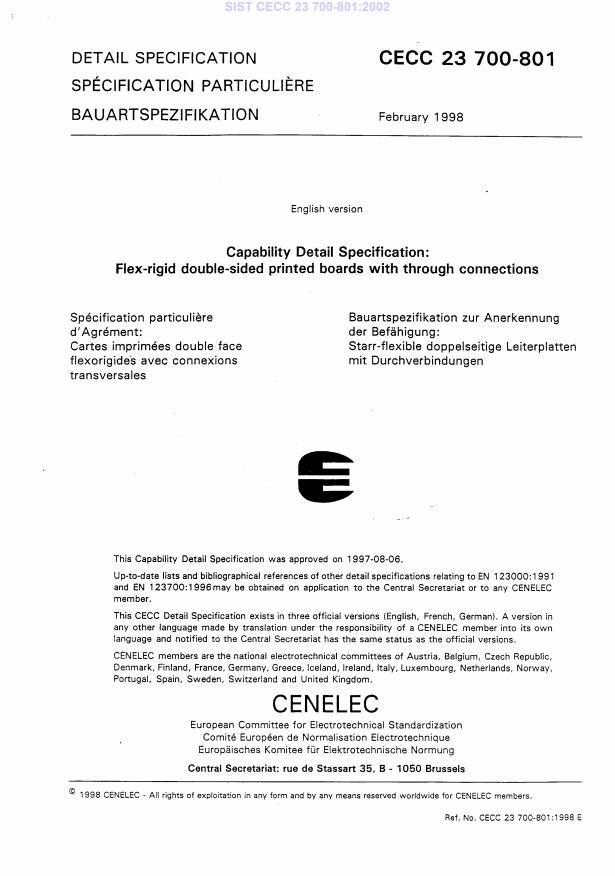
CECC 23 700-801:1998
(Main)Capability Detail Specification: Flex-rigid double-sided printed boards with through connections
Capability Detail Specification: Flex-rigid double-sided printed boards with through connections
Flex-rigid double-sided printed boards with through connections made with materials and surface finishes
Bauartspezifikation zur Anerkennung der Befähigung: Starr-flexible doppelseitige Leiterplatten mit Durchverbindungen
Spécification particulière d'agrément: Cartes imprimées double face flexorigides avec connexions transversales
Capability Detail Specification: Flex-rigid double-sided printed boards with through connections
General Information
Standards Content (Sample)
2003-01.Slovenski inštitut za standardizacijo. Razmnoževanje celote ali delov tega standarda ni dovoljeno.Capability Detail Specification: Flex-rigid double-sided printed boards with through connectionsBauartspezifikation zur Anerkennung der Befähigung: Starr-flexible doppelseitige Leiterplatten mit DurchverbindungenSpécification particulière d'agrément: Cartes imprimées double face flexorigides avec connexions transversalesCapability Detail Specification: Flex-rigid double-sided printed boards with through connections31.180SORãþHPrinted circuits and boardsICS:Ta slovenski standard je istoveten z:CECC 23 700-801:1998SIS
...
This May Also Interest You
IEC 63296-3:2025 specifies the method for measuring the battery duration at a defined sound pressure level for continuous music playback of battery-operated wearable powered loudspeaker equipment. A primary battery or secondary battery can be used as a power source for such a shoulder-carried or body-worn loudspeaker and its composite device. In addition, only equipment that can be placed on or hung from a head and torso simulator (HATS) is covered. Bone conduction speakers are excluded. Portable loudspeaker equipment also supporting video playback as the main function is not covered by this document.
- Draft14 pagesEnglish languagesale 10% offe-Library read for×1 day
- 18-Dec-2025
- 27.015
- 33.160.60
- CLC/TC 100X
IEC 60153-2:2025 specifies straight hollow metallic tubing of ordinary rectangular cross-section for use as waveguides in radio frequency electrical applications. The term "ordinary rectangular waveguide" in the title of this document refers to rectangular waveguides with a b-to-a ratio of 0,5 (or slightly less). The objective of this document is to specify for hollow metallic waveguides: a) the details necessary to ensure compatibility and, as far as is essential, interchangeability; b) test methods; c) uniform requirements for the electrical and mechanical properties. This document does not contain any binding specifications for the materials to be used, but merely examples. The exact selection of materials is subject to agreement between the customer and the supplier. This fourth edition cancels and replaces the third edition published in 2016. This edition constitutes a technical revision. This edition includes the following significant technical changes with respect to the previous edition: a) addition of a cross-sectional view of the waveguide; b) addition of informative content on the theoretical background of the standard; c) use of a lower case "k" in the waveguide designation, where appropriate; d) revision of main specification table (now Table 1): 1) two waveguides moved to the end of the table (R 35, R 41); 2) correction of one waveguide designation (now R 26k); 3) correction of one waveguide outside width (R 18); 4) relaxation of tolerances of waveguide outside dimensions (R 14 to R 70); 5) removed attenuation values of waveguides made of gold, aluminium, and stainless steel; 6) implementation of attenuation values for an idealised copper waveguide; e) relaxation of tolerances of waveguide outside dimensions for R 14 to R 70 in the table now referred to as Table 4; f) clarification of the electrical tests: 1) use of standard annealed copper as the reference material for waveguide tubes; 2) correction of the formula for calculating the theoretical attenuation of an idealised copper waveguide; 3) addition of a formula for calculating the theoretical attenuation of waveguides made of any material; 4) addition of an informative table with typical waveguide materials (Table 5); g) addition of an informative cross-reference for waveguide type designations (Annex A).
- Draft16 pagesEnglish languagesale 10% offe-Library read for×1 day
- 18-Dec-2025
- 33.120.10
- CLC/SR 46F
IEC 61000-4-30:2025 defines the methods for measurement and interpretation of results for power quality parameters in AC power supply systems with a declared fundamental frequency of 50 Hz or 60 Hz. Measurement methods are described for each relevant parameter in terms that give reliable and repeatable results, regardless of the method’s implementation. This document addresses measurement methods for in-situ measurements. This document covers two classes of measurement methods (Class A and Class S). The classes of measurement are specified in Clause 4. NOTE 1 In this document, “A” stands for “advanced” and “S” stands for “surveys”. Measurement of parameters covered by this document is limited to conducted phenomena in power systems. The power quality parameters considered in this document are power frequency, magnitude of the supply voltage, flicker, supply voltage dips and swells, voltage interruptions, transient voltages, supply voltage unbalance, voltage harmonics and interharmonics, rapid voltage changes, mains communicating system (MCS) voltages, magnitude of current, harmonic currents, interharmonic currents and current unbalance. Emissions in the 2 kHz to 150 kHz range are considered in Annex C and Annex D. Depending on the purpose of the measurement, all or a subset of the phenomena on this list can be measured. NOTE 2 Test methods for verifying compliance with this document can be found in IEC 62586-2. NOTE 3 The effects of transducers inserted between the power system and the instrument are acknowledged but not addressed in detail in this document. Guidance about effects of transducers can be found IEC TR 61869-103. This fourth edition cancels and replaces the third edition published in 2015. This edition constitutes a technical revision.This edition includes the following significant technical changes with respect to the previous edition: a) IEC 61000-4-30:2015/AMD1:2021 and IEC 61000-4-30:2015/COR1:2016 were included. b) The measurement method for rapid voltage changes (RVC) has been corrected and extended. c) The measurement method for voltage events has been updated and extended. d) Annex C was divided into 2 parts: 1) Annex C: The measurement method from IEC 61000-4-7:2002 and IEC 61000‑4‑7:2002/AMD1:2008, Annex B for conducted emissions in the 2 kHz to 9 kHz range has been separate 2) Annex D: A new measurement method for conducted emissions in the 9 kHz to 150 kHz range has been added. e) Annex D (underdeviation and overdeviation parameters) was removed. f) Annex E (Class B) was removed.
- Draft83 pagesEnglish languagesale 10% offe-Library read for×1 day
- 18-Dec-2025
- 33.100.99
- 2014/30/EU
- CLC/TC 210
IEC 60794-1-207:2025 describes test procedures to be used in establishing uniform requirements for optical fibre cables for the environmental property: performance degradation when exposed to nuclear radiation. This document applies to optical fibre cables for use with telecommunication equipment and devices employing similar techniques, and to cables having a combination of both optical fibres and electrical conductors. Method F7A evaluates performance degradation of optical fibre cable in environmental background radiation; Method F7B evaluates performance degradation of optical fibre cable in adverse nuclear environments. NOTE Throughout the document, the wording "optical cable" can also include optical fibre units, microduct fibre units, etc. This first edition cancels and replaces the method F7 of the second edition of IEC 60794-1-22 published in 2017. This edition constitutes a technical revision. This edition includes the following significant technical changes with respect to the previous edition: a) detailed content of sample, apparatus, procedure, requirements and details of the method to be specified and reported are added.
- Draft9 pagesEnglish languagesale 10% offe-Library read for×1 day
- 18-Dec-2025
- 33.180.10
- CLC/TC 86A
European common modification to EN 61936-1
- Draft16 pagesEnglish languagesale 10% offe-Library read for×1 day
- 18-Dec-2025
- 29.020
- 29.080.01
- CLC/TC 99X
IEC 60966-2-8:2025 is available as IEC 60966-2-8:2025 RLV which contains the International Standard and its Redline version, showing all changes of the technical content compared to the previous edition.IEC 60966-2-8:2025 is a detail specification that applies to cable assemblies with F-Quick connectors (see IEC 61169-47) and requires quad-shield screening class A++ (see IEC 61196-6-5). This document applies to the cable assemblies for radio and TV receivers. This second edition cancels and replaces the first edition published in 2022. This edition constitutes a technical revision. This edition includes the following significant technical changes with respect to the previous edition: a) in item [5], drawing expanded by right angled connectors; b) in item [12], female F-connectors cancelled (not standardized by IEC 61169-47); c) in item [14] Reflection properties (return loss): different values for straight and right-angled connectors; d) in item [14] Insertion loss: different factors for insertion loss calculation for straight and right-angled connectors; e) in item [14] Loop resistance: loop resistance was set to 1 Ω max. value for the complete length.
- Draft11 pagesEnglish languagesale 10% offe-Library read for×1 day
- 18-Dec-2025
- 33.120.01
- CLC/TC 46X
This document specifies the functional requirements for output and accuracy of measurements of the dynamic interaction between pantograph and overhead contact line.
- Draft24 pagesEnglish languagesale 10% offe-Library read for×1 day
- Draft8 pagesEnglish languagesale 10% offe-Library read for×1 day
This European Standard is applicable to new low voltage devices for measurement, control and protection which are: — for indoor or outdoor fixed installations in traction systems, and — operated in conjunction with high voltage equipment with an a.c. line voltage and frequency as specified in EN 50163. This European Standard also applies to measurement, control and protective devices other than low voltage devices and not covered by a specific railway product standard as far as reasonably possible. Requirements of this document prevail. Scope of amendment Implementation of 2 technical changes: — Modification of subclause 5.4, second item in list of protection functions. — Aligning the value for short-circuit current of 50 Hz traction systems given in Annex A subclause A.2.1 ‘Line testing – General’ with EN 50388-1:2022 Table 7
- Draft4 pagesEnglish languagesale 10% offe-Library read for×1 day
IEC 60794-1-129:2025 applies to optical fibre cables for use with telecommunication equipment and devices employing similar techniques, and to cables having a combination of both optical fibres and electrical conductors. The document defines test procedures used in establishing uniform requirements for mechanical performance-straight midspan access to optical elements. Throughout this document, the wording "optical cable" also includes optical fibre units, microduct fibre units, etc. NOTE See IEC 60794‑1‑2 for a reference guide to test methods of all types and for general requirements and definitions. This edition includes the following significant technical changes with respect to IEC 60794‑1‑21:2015 and IEC 60794-1-21:2015/AMD 1:2020: a) this document cancels and replaces method E29 of IEC 60794-1-21:2015 and IEC 60794‑1‑21:2015/AMD 1:2020; b) addition of the description for applicable cable types; c) update of Figure 2a), Figure 2b) and Figure 3; d) addition of the displacement measure description; e) addition of the details to be reported.
- Draft10 pagesEnglish languagesale 10% offe-Library read for×1 day
- 18-Dec-2025
- 33.180.10
- CLC/TC 86A


Questions, Comments and Discussion
Ask us and Technical Secretary will try to provide an answer. You can facilitate discussion about the standard in here.
Loading comments...