

prEN 50769:2026
(Main)Product Specific Rules for rotating electrical machines and approach for environmental product and material efficiency assessments
- Abstract
This EN defines product specific rules (PSR) for Rotating Electrical Machines. It specifies the process and requirements on how to conduct life cycle assessment (LCA) in the context of environmental product assessments for rotating electrical machines operating direct-on-line or intended for frequency converter (variable speed drive) operation.
- Status
- Not Published
- Publication Date
- 09-Aug-2027
- Technical Committee
- CLC/TC 2 - Rotating machinery
- Drafting Committee
- CLC/TC 2 - Rotating machinery

prEN 50769:2026 is a draft European Standard from CLC for rotating electrical machines. It sets product specific rules (PSR) for life cycle assessment (LCA), environmental product declarations (EPD) and carbon footprint of a product (CFP) for machines operating direct-on-line or intended for frequency converter operation. It also gives material efficiency assessment methods so manufacturers and assessors can prepare comparable environmental information for motors, generators and related systems.
What does prEN 50769:2026 specify?
prEN 50769:2026 specifies the process and requirements for environmental product and material efficiency assessments of rotating electrical machines. It gives a common framework for LCA-based declarations and for material-efficiency related claims, with product-specific detail moved into annexes.
The document is organized into:
- Clause 1 Scope
- Clause 2 Normative references
- Clause 3 Terms and definitions
- Clause 4 Ecodesign and material efficiency aspects
- Clause 5 Product Life Cycle Assessment - Product Specific Rules
- Clause 6 Material Efficiency Assessment
- Clause 7 Environmental Product Declaration
- Annexes A to D and a bibliography
| Annex | What it covers |
|---|---|
| Annex A | Application of the standard |
| Annex B | Approach for integrated products |
| Annex C | Product specific rules for low and high voltage induction motors |
| Annex D | Product specific rules for generators |
The scope covers industrial products such as three phase and single-phase low voltage AC motors, low voltage motors for potentially explosive atmospheres, low voltage synchronous reluctance motors, low voltage permanent magnet motors, low voltage AC servomotors, and high voltage AC motors for direct-on-line operation. It can also be applied to low voltage integrated VSD motors, gear motors, high voltage AC motors operating with variable speed drives, generators, synchronous compensators and other listed cases.
What are the key requirements of prEN 50769:2026?
LCA and product declarations
prEN 50769:2026 requires LCA work to follow EN ISO 14040 and EN ISO 14044, and CFP work to follow EN ISO 14067 as well. In practice, this means environmental results are not free-form statements - they have to be built from recognized LCA methods and reported in a way that can be checked.
The standard requires the functional unit or, where needed, the declared unit to be defined clearly. The declared unit has to identify the representative product, its mass, the linked functional unit and the mathematical relation to the reference service life. For a buyer or auditor, this is the point that makes results comparable across product families.
It also sets rules for:
- system boundaries and life cycle inventory treatment
- exclusion from the system boundary
- cut-off criteria
- allocation rules
- default scenarios for manufacturing, transport, installation, use and end-of-life
These defaults matter because they keep different studies aligned on the same assumptions instead of each organization choosing its own.
Clause 5 also requires rules for extrapolating and scaling LCIA results and for aggregating environmental impacts at system level. That is important when a manufacturer wants to extend results from one machine to a homogeneous product family or to a system rather than a single unit.
The LCA report has to accompany the assessment and document the inputs, outputs, inventory data and assumptions used. This is the record that supports verification and later review.
Material efficiency assessment
Clause 6 sets the material efficiency assessment framework. It covers reliability and durability, ability to remanufacture, ability to repair, reuse and upgrade, recyclability and recoverability, and the proportion of recycled material content.
The document links several of these assessments to the EN 4555x series. In practice, this means the standard does not reinvent those methods - it adapts them for rotating electrical machines and then adds product-specific rules where needed.
For repairability and related assessments, the standard uses priority parts lists and product-specific guidance. That helps manufacturers and service teams decide which components must be considered when documenting repair, reuse, upgrade or end-of-life handling.
A note in the scope is important for safety-critical products: material-efficiency indicators and related circular-economy requirements are interpreted against mandatory safety requirements. For such equipment, safety remains the first constraint.
EPD and CFP reporting
Clause 7 links the assessment results to Environmental Product Declarations and Carbon Footprint of Product statements. It requires the declaration content, producer information, product information, LCIA results, additional environmental information and references to be handled through the programme process.
The standard also sets a maximum validity period of 5 years for EPDs and CFPs issued in conformance with the document, after which the issuer reviews them. That matters in practice because environmental declarations need periodic refresh rather than open-ended reuse.
What terms does prEN 50769:2026 define?
- Product specific rules (PSR) - The product-specific set of rules and requirements used to adapt general declaration rules and LCA practice to rotating electrical machines.
- Life cycle assessment (LCA) - The compilation and evaluation of inputs, outputs and potential environmental impacts across the product life cycle.
- Functional unit - The quantified main function of the product system used as the reference basis for LCA results.
- Declared unit - The reference quantity used for an environmental declaration when a functional unit cannot be used directly.
- Environmental product declaration (EPD) - An environmental statement that reports product environmental data using predetermined indicators derived from LCA.
- Environmentally conscious design (ECD) - A systematic design approach that considers environmental aspects to reduce adverse impacts.
- Homogeneous product family (HPF) - A subgroup of similar products for which environmental aspects can reasonably be expected to be similar and scalable.
Who uses prEN 50769:2026?
prEN 50769:2026 is used by manufacturers of rotating electrical machines, generators and related systems who need LCA-based environmental declarations or material-efficiency information. It is also used by LCA practitioners, ecodesign engineers, sustainability teams, verification bodies, and quality or compliance managers preparing EPDs, CFPs or environmental claims.
It is particularly relevant to industrial motor and generator sectors, including products used with variable speed drives, direct-on-line operation, and machines intended for potentially explosive atmospheres. Buyers and system integrators can use it to compare environmental information on a common basis.
Which standards are used with prEN 50769:2026?
- EN 45552 - General method for assessing durability.
- EN 45554 - General methods for assessing repair, reuse and upgrade.
- EN 45557 - General method for assessing recycled material content.
- EN ISO 14020:2023 - Principles and general requirements for environmental statements and programmes.
- EN ISO 14021 - Rules for self-declared environmental claims.
- EN ISO 14025 - General requirements for EPDs.
- EN ISO 14040 and EN ISO 14044 - LCA principles, framework, requirements and guidelines.
- EN ISO 14067 - Requirements and guidelines for CFP quantification.
- EN IEC 62430 - Principles, requirements and guidance for environmentally conscious design.
- EN IEC 63366:2025 - Product category rules for life cycle assessment of electrical and electronic products and systems.
The foreword also states that the document is read in conjunction with EN IEC 63366, which replaces EN 50693.
What does the prEN 50769:2026 document contain?
The document contains a general framework plus product-specific annexes. Clause 5 sets the LCA rules, default scenarios and reporting approach, while Clause 6 sets the material-efficiency assessment methods and links them to the EN 4555x family. Clause 7 sets the structure for EPD and CFP content and verification.
Annex C is where the detailed motor-specific material appears, including load profiles, energy consumption calculations, a reparability example and product-specific guidance for low and high voltage induction motors. Annex D provides the generator-specific functional unit, declared unit, use scenario guidance and repairability priority parts.
Across the document, the content is aimed at assessment and reporting rather than design prescription. It gives methods, scenarios, formulas, tables and worked examples that support design reviews, testing, environmental declarations, verification and claim substantiation for rotating electrical machines.
Get Certified
Connect with accredited certification bodies for this standard

BSI Group
BSI (British Standards Institution) is the business standards company that helps organizations make excellence a habit.

Bureau Veritas
Bureau Veritas is a world leader in laboratory testing, inspection and certification services.

DNV
DNV is an independent assurance and risk management provider.
Sponsored listings
Frequently Asked Questions
prEN 50769:2026 is a draft published by CLC. Its full title is "Product Specific Rules for rotating electrical machines and approach for environmental product and material efficiency assessments". This standard covers: This EN defines product specific rules (PSR) for Rotating Electrical Machines. It specifies the process and requirements on how to conduct life cycle assessment (LCA) in the context of environmental product assessments for rotating electrical machines operating direct-on-line or intended for frequency converter (variable speed drive) operation.
This EN defines product specific rules (PSR) for Rotating Electrical Machines. It specifies the process and requirements on how to conduct life cycle assessment (LCA) in the context of environmental product assessments for rotating electrical machines operating direct-on-line or intended for frequency converter (variable speed drive) operation.
prEN 50769:2026 is classified under the following ICS (International Classification for Standards) categories: 13.020.60 - Product life-cycles; 29.160.01 - Rotating machinery in general. The ICS classification helps identify the subject area and facilitates finding related standards.
prEN 50769:2026 is available in PDF format for immediate download after purchase. The document can be added to your cart and obtained through the secure checkout process. Digital delivery ensures instant access to the complete standard document.
Standards Content (Sample)
SLOVENSKI STANDARD
01-november-2026
Posebna pravila za rotacijske električne stroje in pristop k ocenjevanju okoljske
učinkovitosti izdelkov in materialov
Product Specific Rules for rotating electrical machines and approach for environmental
product and material efficiency assessments
Ta slovenski standard je istoveten z: prEN 50769:2026
ICS:
13.020.60 Življenjski ciklusi izdelkov Product life-cycles
29.160.01 Rotacijski stroji na splošno Rotating machinery in
general
2003-01.Slovenski inštitut za standardizacijo. Razmnoževanje celote ali delov tega standarda ni dovoljeno.
EUROPEAN STANDARD DRAFT
prEN 50769
NORME EUROPÉENNE
EUROPÄISCHE NORM
November 2026
ICS 29.160.01; 13.020.60 -
English Version
Product Specific Rules for rotating electrical machines and
approach for environmental product and material efficiency
assessments
To be completed To be completed
This draft European Standard is submitted to CENELEC members for enquiry.
Deadline for CENELEC: 2027-01-29.
It has been drawn up by CLC/TC 2.
If this draft becomes a European Standard, CENELEC members are bound to comply with the CEN/CENELEC Internal Regulations which
stipulate the conditions for giving this European Standard the status of a national standard without any alteration.
This draft European Standard was established by CENELEC in three official versions (English, French, German).
A version in any other language made by translation under the responsibility of a CENELEC member into its own language and notified to
the CEN-CENELEC Management Centre has the same status as the official versions.
CENELEC members are the national electrotechnical committees of Austria, Belgium, Bulgaria, Croatia, Cyprus, the Czech Republic,
Denmark, Estonia, Finland, France, Germany, Greece, Hungary, Iceland, Ireland, Italy, Latvia, Lithuania, Luxembourg, Malta, the
Netherlands, Norway, Poland, Portugal, Republic of North Macedonia, Romania, Serbia, Slovakia, Slovenia, Spain, Sweden, Switzerland,
Türkiye and the United Kingdom.
Recipients of this draft are invited to submit, with their comments, notification of any relevant patent rights of which they are aware and to
provide supporting documentation.
Warning : This document is not a European Standard. It is distributed for review and comments. It is subject to change without notice and
shall not be referred to as a European Standard.
European Committee for Electrotechnical Standardization
Comité Européen de Normalisation Electrotechnique
Europäisches Komitee für Elektrotechnische Normung
CEN-CENELEC Management Centre: Rue de la Science 23, B-1040 Brussels
© 2026 CENELEC All rights of exploitation in any form and by any means reserved worldwide for CENELEC Members.
Project: 81588 Ref. No. prEN 50769:2026 E
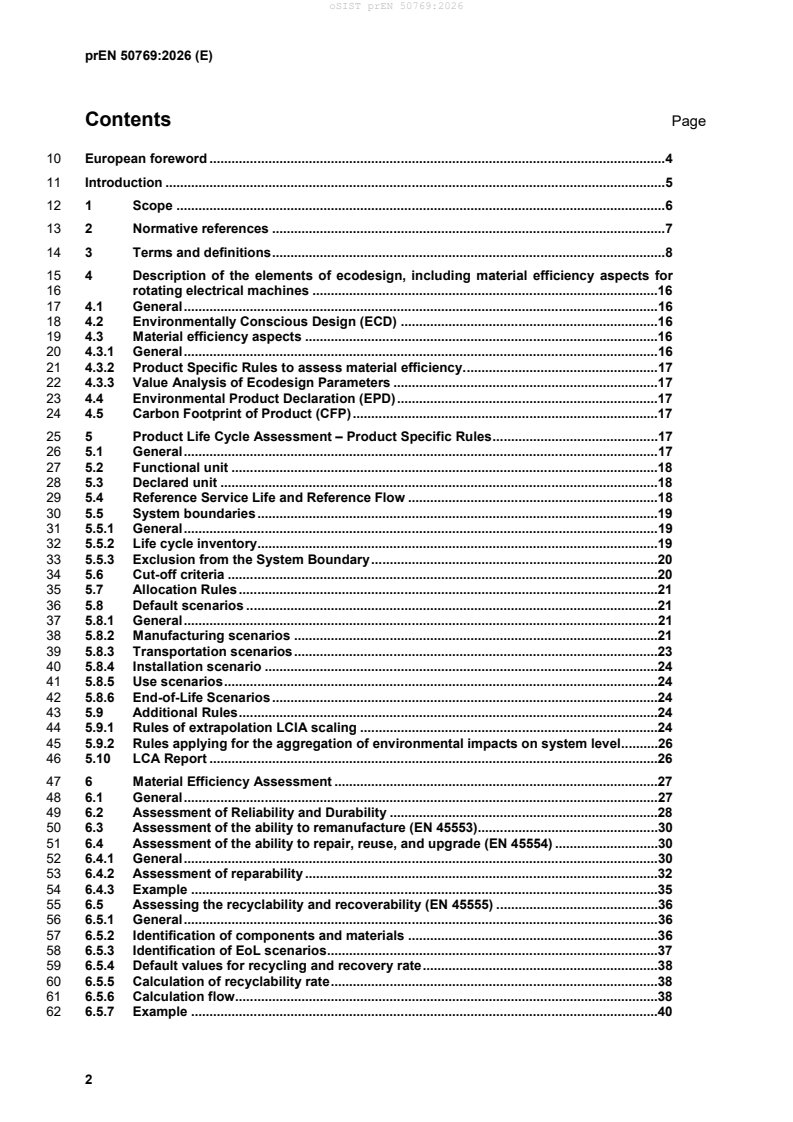
Contents Page
10 European foreword . 4
11 Introduction . 5
12 1 Scope . 6
13 2 Normative references . 7
14 3 Terms and definitions . 8
15 4 Description of the elements of ecodesign, including material efficiency aspects for
16 rotating electrical machines .16
17 4.1 General .16
18 4.2 Environmentally Conscious Design (ECD) .16
19 4.3 Material efficiency aspects .16
20 4.3.1 General .16
21 4.3.2 Product Specific Rules to assess material efficiency. .17
22 4.3.3 Value Analysis of Ecodesign Parameters .17
23 4.4 Environmental Product Declaration (EPD) .17
24 4.5 Carbon Footprint of Product (CFP) .17
25 5 Product Life Cycle Assessment – Product Specific Rules .17
26 5.1 General .17
27 5.2 Functional unit .18
28 5.3 Declared unit .18
29 5.4 Reference Service Life and Reference Flow .18
30 5.5 System boundaries .19
31 5.5.1 General .19
32 5.5.2 Life cycle inventory.19
33 5.5.3 Exclusion from the System Boundary .20
34 5.6 Cut-off criteria .20
35 5.7 Allocation Rules .21
36 5.8 Default scenarios .21
37 5.8.1 General .21
38 5.8.2 Manufacturing scenarios .21
39 5.8.3 Transportation scenarios .23
40 5.8.4 Installation scenario .24
41 5.8.5 Use scenarios .24
42 5.8.6 End-of-Life Scenarios .24
43 5.9 Additional Rules .24
44 5.9.1 Rules of extrapolation LCIA scaling .24
45 5.9.2 Rules applying for the aggregation of environmental impacts on system level .26
46 5.10 LCA Report .26
47 6 Material Efficiency Assessment .27
48 6.1 General .27
49 6.2 Assessment of Reliability and Durability .28
50 6.3 Assessment of the ability to remanufacture (EN 45553).30
51 6.4 Assessment of the ability to repair, reuse, and upgrade (EN 45554) .30
52 6.4.1 General .30
53 6.4.2 Assessment of reparability .32
54 6.4.3 Example .35
55 6.5 Assessing the recyclability and recoverability (EN 45555) .36
56 6.5.1 General .36
57 6.5.2 Identification of components and materials .36
58 6.5.3 Identification of EoL scenarios .37
59 6.5.4 Default values for recycling and recovery rate .38
60 6.5.5 Calculation of recyclability rate .38
61 6.5.6 Calculation flow .38
62 6.5.7 Example .40
63 6.6 Proportion of recycled material content (EN 45557) . 40
64 7 Environmental Product Declaration . 41
65 7.1 General . 41
66 7.2 General Programme Instruction . 42
67 7.2.1 Objective of the programme . 42
68 7.2.2 Procedures for definition of product categories and the development of product
69 specific rules (PSR) . 42
70 7.2.3 Life cycle impact assessment methodology . 43
71 7.2.4 EPD / CFP development and verification process . 43
72 7.3 Environmental Declaration / Carbon footprint Content . 43
73 7.3.1 General . 43
74 7.3.2 Information about the producer . 44
75 7.3.3 Information about the product . 44
76 7.3.4 Life Cycle Impact Assessment (LCIA) results . 44
77 7.3.5 Additional environmental information . 44
78 7.3.6 References within the environmental declaration. 44
79 7.4 Verification of the environmental declaration process . 45
80 Annex A (informative) Application of the standard . 46
81 Annex B (informative) Approach for integrated products . 47
82 Annex C (informative) Product specific rules for low and high voltage induction motors . 49
83 C.1 General . 49
84 C.2 Product Life Cycle Assessment . 49
85 C.3 Material Efficiency assessment. 59
86 Annex D (normative) Product specific rules for generators . 61
87 D.1 General . 61
88 D.2 Product Life Cycle Assessment . 61
89 D.3 Material Efficiency . 61
90 Bibliography . 63
91 European foreword
92 This document (prEN 50769:2026) has been prepared by CLC/TC2 “Rotating machines”.
93 This document is currently submitted to the Enquiry.
94 The following dates are proposed:
• latest date by which the existence of this (doa) dav + 6 months
document has to be announced at national
level
• latest date by which this document shall be (dop) dav + 12 months
implemented at national level by publication of
an identical national standard or by
endorsement
• latest date by which the national standards (dow) dav + 36 months
conflicting with this document have to be (to be confirmed or
withdrawn modified when voting)
95 This document is read in conjunction with EN IEC 63366 (which replaces EN 50693).
96 Introduction
97 This document provides a relevant, consistent, and harmonized approach for specifying substantiation and
98 respective scores on the material efficiency aspects of rotating electrical machines for supporting life cycle
99 assessment (LCA), using Product Specific Rules (PSR). It will also facilitate and harmonize the way to
100 prepare the Environmental Product Declarations (EPD) and/or Carbon Footrpint of Products (CFP), and
101 claims and to provide information on Eco-design Criteria to different stakeholders including via the Digital
102 Product Passport (DPP).
103 This project has no objective for specifying the Environmentally Conscious Design (ECD) of rotating
104 electrical machines but should focus on assessment and measurement as well as relevant information to
105 be provided on material efficiency aspects. It is a standardization work for preparing the adaptability and
106 applicability of existing generic approaches for such a rotating electrical machines product-oriented
107 standard. This standard will support the necessary circularity requested by the different life cycle analysis
108 (LCA) scenarios, aiming for substantiating the quantitative green claims provided by the European
109 regulations, already published or still to come. For that purpose, in addition to deriving and adapting the
110 EN 4555x series for rotating electrical machines, this standard considers EN 50693 for the benefit of the
111 Manufacturers dealing with their product LCA. This standard should support the EU (EU) 2024/1781
112 Ecodesign for Sustainable Product Regulation (ESPR) and related Delegated Acts to be prepared for all
113 categories of products and systems defined in its scope.
114 This document will suggest common PSR for rotating electrical machines that are in the scope of the
115 CLC/TC 2 as much as possible. When particular PSR or other specific requirements can only be related to
116 a dedicated product or system (e.g. for low voltage induction motors only, or generators within the scope
117 of CLC/TC 2) PSR or other specific requirements for such products or systems will be embedded in a
118 dedicated normative Annex of this standard.
119 1 Scope
120 This document defines product specific rules (PSR) rotating electrical machines. It specifies the process
121 and requirements for conducting life cycle assessments (LCA) in the context of Environmental Product
122 Declaration (EPD) and Carbon Foor Print of a Product (CFP) for rotating electrical machines operating
123 direct-online or intended for frequency converter (variable speed drive) operation. The aim is to ensure
124 transparency of the applied methodology and to provide verifiable and comparable results.
125 This document applies for products used in industrial applications:
126 — three phase and single-phase low voltage AC motors;
127 o for direct-online operation;
128 o operating with variable speed drives;
129 — low voltage motors intended for potentially explosive atmospheres;
130 — low voltage synchronous reluctance motors;
131 — low voltage permanent magnet motors;
132 — low voltage AC servomotors;
133 — high voltage AC motors for direct-online operation.
134 This document can be applicable to:
135 — low voltage integrated VSD motors;
136 — gear motors;
137 — high voltage AC motors operating with variable speed drives;
138 — high voltage motors intended for potentially explosive atmospheres;
139 — low and high voltage generators;
140 — low and high voltage synchronous compensator.
141 This document is not applicable for:
142 — motors used in consumer applications;
143 — traction motors;
144 — electric vehicles;
145 — high voltage AC motors operating in variable speed drives;
146 — low voltage DC motors.
147 NOTE 1 For rotating electrical machines with safety-critical design constraints (for example equipment for explosive
148 atmospheres), material-efficiency indicators, ECD measures, and other circular economy related requirements are
149 interpreted with respect to mandatory safety requirements.
150 This document defines functional units and default scenarios in the product-specific context and common
151 rules and guidelines for:
152 a) the Life Cycle Assessment (LCA), including the requirements for default scenarios;
153 b) the Material Efficiency Assessment, including the requirements for default scenarios;
154 c) the LCA report and Environmental Product Declaration (EPD) or claim.
155 The LCA principles and framework are based on ISO 14040 and ISO 14044 and therefore out of scope of
156 this standard.
157 In addition, this document defines specific ecodesign assessment methods and specifications for the
158 material efficiency aspects of rotating electrical machines and equipment that are derived from published
159 horizontal and generic standards for energy-related Products (EN 45550 to EN 45559 standard series).
160 The document specifies these generic standards in the context of rotating electrical machines further
161 through assessment requirements and default scenarios to support ecodesign and related customer
162 information.
163 Further, this document includes definitions and specifications to enable material efficiency assessments at
164 system level of rotating electrical machines.
165 It also provides consistent and common criteria for considering material efficiency-related data to be
166 operated by stakeholders along the lifecycle, supporting the building of digital product passport (DPP), data
167 migration and interoperability of products and systems, including digital twins.
168 2 Normative references
169 The following documents are referred to in the text in such a way that some or all of their content constitutes
170 requirements of this document. For dated references, only the edition cited applies. For undated
171 references, the latest edition of the referenced document (including any amendments) applies.
172 EN 45552, General method for the assessment of the durability of energy-related products
173 EN 45554, General methods for the assessment of the ability to repair, reuse and upgrade energy-related
174 products
175 EN 45557, General method for assessing the proportion of recycled material content in energy-related
176 products
177 EN ISO 14020:2023, Environmental statements and programmes for products - Principles and general
178 requirements (ISO 14020:2022)
179 EN ISO 14021, Environmental statements and programmes for products - Self-declared environmental
180 claims (ISO 14021)
181 EN ISO 14025, Environmental statements and programmes for products - Environmental product
182 declarations (EPDs) (ISO 14025)
183 EN ISO 14040, Environmental management - Life cycle assessment - Principles and framework (ISO
184 14040)
185 EN ISO 14044, Environmental management - Life cycle assessment - Requirements and guidelines (ISO
186 14044)
187 EN ISO 14067, Greenhouse gases - Carbon footprint of products - Requirements and guidelines for
188 quantification (ISO 14067)
189 EN IEC 62430, Environmentally conscious design (ECD) — Principles, requirements and guidance (IEC
190 62430)
191 EN IEC 63366:2025, Product category rules for life cycle assessment of electrical and electronic products
192 and systems (IEC 63366:2025)
193 3 Terms and definitions
194 For the purposes of this document, the following terms and definitions apply.
195 ISO and IEC maintain terminology databases for use in standardization at the following addresses:
196 — ISO Online browsing platform: available at https://www.iso.org/obp/
197 — IEC Electropedia: available at https://www.electropedia.org/
198 3.1
199 accelerated life test
200 ALT
201 test in which the applied stress level is chosen to exceed that stated in the reference conditions to shorten
202 the test duration required to observe the life of the device without altering the basic fault modes and failure
203 mechanisms
204 [SOURCE: IEV ref 845-27-103]
205 3.2
206 conformity assessment
207 demonstration that specified requirements relating to a product, process, system, person or body are
208 fulfilled
209 Note 1 to entry: The subject field of conformity assessment includes activities defined elsewhere in
210 EN ISO/IEC 17000, such as testing, inspection and certification, as well as the accreditation of conformity assessment
211 bodies.
212 [SOURCE: IEV ref. 902-01-01]
213 3.3
214 declared unit
215 quantity of the product used as a reference unit for an environmental declaration when a functional unit
216 cannot be directly used
217 Note 1 to entry: The declared unit might differ from the functional unit in terms of the declaration.
218 [SOURCE: EN 50693:2019, 3.4]
219 3.4
220 end of life
221 EOL
222 life cycle stage of a product starting when it is removed from its intended use phase
223 [SOURCE: IEC/TR 62635]
224 3.5
225 end of life treatment
226 operation after a waste has been handed over to a facility for product and product part reuse, material
227 recycling, energy recovery and residue disposal
228 Note 1 to entry: This includes dismantling, material separation and disposal.
229 [SOURCE: IEC/TR 62635]
230 3.6
231 environmental aspect
232 element of an organization's activities or products that interacts or can interact with the environment
233 Note 1 to entry: Typically, environmental aspects can include emissions to air, discharges to water and waste arisings,
234 which in turn can generate environmental and health impacts such as global warming, smog, water pollution or
235 contaminated land.
236 [SOURCE: EN ISO 14050:2020, 3.2.20]
237 3.7
238 environmental claim
239 statement, symbol or graphic that indicates an environmental aspect of a product, a component or
240 packaging; also known as type II environmental labelling or self-declared claims
241 Note 1 to entry: An environmental claim may be made on product or packaging labels, through product literature,
242 technical bulletins, advertising, publicity, telemarketing, as well as through digital or electronic media such as the
243 Internet.
244 [SOURCE: EN ISO 14021:2026, 3.1.4]
245 3.8
246 environmentally conscious design
247 ECD
248 systematic approach which considers environmental aspects in the design and development process with
249 the aim to reduce adverse environmental impacts
250 [SOURCE: EN IEC 62430:2019]
251 3.9
252 environmental impact
253 change to the environment whether adverse or beneficial, including possible consequences, wholly or
254 partially resulting from an organization’s environmental aspects
255 [SOURCE: EN ISO 14020:2023]
256 3.10
257 environmental label
258 claim which indicates the environmental aspects of a product or service, for example a type I, a type II or
259 a type III environmental declaration or a product environmental footprint
260 Note 1 to entry: An environmental label or declaration may take the form of a statement, symbol or graphic on a product
261 or package label, in product literature, in technical bulletins, in advertising or in publicity, amongst other things.
262 Note 2 to entry: The additional environmental information may be quantitative or qualitative.
263 [SOURCE: EN ISO 14020:2023, modified]
264 3.11
265 environmental parameter
266 quantifiable attribute of an environmental aspect
267 Note 1 to entry: Environmental parameters include the type and quantity of materials used (weight, volume), power
268 consumption, emissions, rate of recyclability, etc.
269 3.12
270 environmental product declaration
271 EPD
272 environmental statement providing environmental data of a product using predetermined impact indicators
273 and predetermined inventory indicators resulting from an LCA and, where relevant and available, additional
274 environmental information; also known as Type III environmental declaration according to EN ISO 14025
275 Note 1 to entry: The predetermined indicators address relevant environmental impacts and aspects, the results of those
276 predetermined indicators are derived from an LCA using PCR
277 Note 2 to entry: Requirements for an LCA are given in EN ISO 14040 and EN ISO 14044.
278 Note 3 to entry: EPDs can include quantitative and qualitative data.
279 Note 4 to entry: EPDs can include, where relevant and available, data related to additional sustainability-related
280 information.
281 Note 5 to entry: general requirements for PCRs are given in CEN ISO/TS 14027; requirements for PCRs for electrical
282 and electronic products and systems (EEPS) are given in EN IEC 63366.
283 [SOURCE: EN ISO 14020:2023, modified]
284 3.13
285 environmental statement
286 information on one or more environmental aspect(s) or environmental impact(s) of a product which intends
287 to inform an intended audience and intends to influence the market of this product
288 Note 1 to entry: An environmental claim may be made on product or packaging labels, through product literature,
289 technical bulletins, advertising, publicity, telemarketing, as well as through digital or electronic media such as the
290 Internet.
291 Note 1 to entry: The environmental statement can represent a point in time or can cover a period of time.
292 Note 2 to entry: Types of environmental statement include, but are not limited to:
293 a) self-declared environmental claims;
294 b) ecolabels;
295 c) environmental product declarations;
296 d) footprint communications.
297 Note 3 to entry: An environmental statement can appear on a product or packaging as a label, a symbol, a logo, an
298 electronic product label or a machine-readable code. It can also be communicated in other ways, e.g. in web-based
299 product data or in an advertisement.
300 Note 4 to entry: In some countries, the term “environmental claim” is used to indicate all types of product environmental
301 statements. However, for the sake of clarity, within this document the word “claim” is only used in relation to a self-
302 declared environmental claim.
303 [SOURCE: EN ISO 14020:2023, modified]
304 3.14
305 environmental statement programme
306 rules and procedures for providing an environmental statement
307 Note 1 to entry: Environmental statement programmes can be carried out at international, regional, national or sub-
308 national levels.
309 Note 2 to entry: An environmental statement programme can include requirements for conformity assessment.
310 Note 3 to entry: In the case of self-declared environmental claims, made in accordance with this document the
311 environmental statement programme is typically established by the responsible party. For other types of environmental
312 statement, the environmental statement programme is typically established by a party that is external to the responsible
313 party.
314 Note 4 to entry: In the case of self-declared environmental claims, the environmental statement programme consists
315 of the information and records used to support the claim, in accordance with this document.
316 [SOURCE: EN ISO 14020:2023, modified]
317 3.15
318 footprint
319 metric(s) used to report life cycle assessment results addressing an area of concern
320 EXAMPLE Carbon footprint of a product (CFP) within the area of concern of climate change.
321 Note 1 to entry: Requirements for footprint communication are given in ISO 14026.
322 [SOURCE: EN ISO 14020:2023]
323 3.16
324 functional unit
325 quantified performance of a product system for use as a reference unit
326 Note 1 to entry: For example, one product providing a certain function like power in kW.
327 [SOURCE: EN ISO 14040:2006]
328 3.17
329 General Programme Instructions
330 GPI
331 overarching guidelines and rules that govern the operation and management of the International EPD
332 System
333 Note 1 to entry: They define how EPDs are created, verified, and published to ensure transparency, comparability, and
334 credibility of environmental product declarations. The GPI ensure that all EPDs comply with the requirements of
335 ISO 14025 and align with the respective PCRs, such as EN IEC 63366 for electrical and electronic products
336 Note 2 to entry: The GPIs are centrally managed and regularly updated by the International EPD System to reflect the
337 latest standards and requirements.
338 3.18
339 hazardous substances and preparations
340 substance or preparation that can adversely impact the environment with immediate or retarded effect
341 [SOURCE: IEC Guide 109:2003, modified]
342 3.19
343 homogenous product family
344 HPF
345 subgroup of a product family based on the underlying technology or build where the environmental aspects
346 can reasonably be expected to be similar and therefore scalable over the group through a function of certain
347 parameter, e.g., power or weight
348 [SOURCE: EN IEC 63366:2025, 3.1.15]
349 3.20
350 LCA report
351 accompanying document to the life cycle assessment as a basis to the environmental declaration giving
352 further detailed information about the inputs, outputs, used LCI-data and the made assumptions in regard
353 to this document
354 3.21
355 life cycle
356 consecutive and interlinked stages of a product system, from raw material acquisition or generation from
357 natural resources to the final disposal
358 [SOURCE: EN ISO 14040:2006]
359 3.22
360 life cycle assessment
361 LCA
362 compilation and evaluation of the inputs, outputs, and the potential environmental impacts of a product
363 system throughout its life cycle
364 [SOURCE: EN ISO 14040:2006]
365 3.23
366 life cycle inventory
367 LCI
368 inventory of flows from and to nature for a product system. Inventory flows include inputs of water, energy,
369 and raw materials, and releases to air, land, and water
370 3.24
371 life cycle inventory analysis
372 LCIA
373 life cycle inventory analysis LCI phase of life cycle assessment involving the compilation and quantification
374 of inputs and outputs for a product throughout its life cycle
375 [SOURCE: EN ISO 14040:2006, 3.3]
376 3.25
377 life cycle stage
378 element of a life cycle
379 Note 1 to entry: The phrase ’life cycle phase’ is sometimes used interchangeably with ‘life cycle stage’.
380 Note 2 to entry: Examples of life cycle stages are: raw material acquisition and production; manufacturing; packaging
381 and distribution; installation and use, maintenance and upgrading and end of life.
382 3.26
383 life cycle thinking
384 LCT
385 consideration of all relevant environmental aspects during the entire life cycle of products
386 [SOURCE: IEC Guide 109:2003, modified]
387 3.27
388 maintenance
389 combination of all technical and management actions intended to retain an item in, or restore it to, a state
390 in which it can perform as required
391 Note 1 to entry: Management is assumed to include supervision activities.
392 [SOURCE: IEV ref 192-06-01]
393 3.28
394 manufacturer-authorised professional repairer
395 professional repairer authorised by the manufacturer, importer or authorized representative to repair safety
396 critical products they place on the market
397 [SOURCE: EU 2024/1834]
398 3.29
399 material
400 substance or mixture within a product or product part
401 [SOURCE: IEC 62674]
402 3.30
403 ongoing reliability testing
404 ORT
405 testing performed to ensure that no changes have occurred in components or production processes that
406 will have a systematic impact on reliability
407 Note 1 to entry: Sample units are randomly selected from actual production, depending on the risk level that has been
408 set. If a failure occurs during testing, a thorough root cause analysis is carried out to check whether the failure was a
409 random event or due to a change in the product or one of the components.
410 3.31
411 organization
412 group of people and facilities with an arrangement of responsibilities, authorities and relationships
413 [SOURCE: EN ISO 9000:2005, 3.3.1, modified]
414 3.32
415 packaging
416 material that is used to protect or contain a product during transportation, storage, marketing or use
417 Note 1 to entry: For the purposes of this International Standard, the term “packaging” also includes any item that is
418 physically attached to, or included with, a product or its container for the purpose of marketing the product or
419 communicating information about the product.
420 [SOURCE: EN ISO 14021]
421 3.33
422 process
423 set of interrelated or interacting activities which transform inputs into outputs
424 Note 1 to entry: Inputs to a process are generally outputs of other processes.
425 Note 2 to entry: Processes in an organization are generally planned and carried out under controlled conditions to add
426 value.
427 [SOURCE: EN ISO 9000:2005, 3.4.1, modified]
428 3.34
429 product
430 any goods or service
431 [SOURCE: EN ISO 14024:2023]
432 3.35
433 product category
434 group of products that can fulfil equivalent functions
435 [SOURCE: EN ISO 14025:2026]
436 3.36
437 product category rules
438 PCR
439 set of specific rules, requirements, and guidelines for developing environmental product declarations for
440 one or more product categories
441 [SOURCE: EN IEC 63366:2025]
442 3.37
443 product family
444 subgroup of a product category – technologically or functionally similar products
445 3.38
446 professional repairer
447 ‘operator or undertaking which provides services of repair and professional maintenance
448 [SOURCE: EU 2024/1834]
449 3.39
450 product specific rules
451 PSR
452 product specific set of rules and requirements, based upon basic product category rules for environmental
453 declarations or statements and underlying life cycle assessment
454 3.40
455 programme operator
456 person or organization responsible for developing and maintaining an environmental statement programme
457 Note 1 to entry: In the case of self-declared environmental claims, the programme operator is typically the responsible
458 party. For other types of environmental statement, the programme operator is typically a party that is external to the
459 responsible party.
460 [SOURCE: EN ISO 14020:2023]
461 3.41
462 raw material
463 primary or secondary material that is used to manufacture a product
464 Note 1 to entry: Secondary material includes recycled material.
465 [SOURCE: EN ISO 14040:2006]
466 3.42
467 recovering
468 operation of any kind which results in waste serving a useful purpose, e.g. in terms of material recovery
469 with material serving as fuels or other means to create energy or in terms of energy recovery with the
470 production of useful energy
471 [SOURCE: EN 45555:2019; modified]
472 3.43
473 recycling
474 processing of waste materials for the original purpose or for other purposes, excluding energy recovery
475 [SOURCE: EN ISO 15270:2008 modified]
476 3.44
477 refurbishing
478 functional or aesthetic maintenance or repair of an item to restore to original, upgraded, or other
479 predetermined form and functionality
480 [SOURCE: IEV 904-04-09]
481 3.45
482 remanufacturing
483 industrial process which produces a product from used products or used parts where at least one change
484 is made which influences the safety, original performance, purpose or type of the product
485 Note 1 to entry: The product created by the remanufacturing process may be considered a new product when placing
486 on the market. Refer to the EU Blue Guide for additional information.
487 Note 2 to entry: Refurbishing is a similar concept to remanufacturing except that it does not involve changes influencing
488 safety, original performance, purpose or type of the product. It is not covered by this standard.
489 [SOURCE: EN 45553:2020]
490 3.46
491 repair
492 direct action taken to effect restoration
493 Note 1 to entry: repair includes fault localization, fault diagnosis; fault correction and function checkout.
494 Note 2 to entry: repair means the product can fulfill its intended use, compliant with the product relevant standards,
495 see also EN 45554:2020
496 [SOURCE: IEV 193-06-008]
497 3.47
498 reuse
499 process by which a product or its parts, having reached the end of their first use, are used for the same
500 purpose for which they were conceived
501 Note 1 to entry: Reuse after second or subsequent usage is also considered as reuse, but normal, regular or sporadic
502 use is not considered as reuse.
503 [SOURCE: EN 45554:2020]
504 3.48
505 safety critical
506 product that has been designed, verified, certified and manufactured under the scope of either Directive
507 2014/34/EU or Directive 2006/42/EC or Regulation 2023/1230/EU
508 3.49
509 stakeholder
510 individual, group or organization that has an interest in an organization or activity
511 Note 1 to entry: Usually a stakeholder can affect or is affected by the organization or the activity.
512 [SOURCE: EN ISO 14050:2020, 3.5, modified]
513 3.50
514 substance
515 chemical element and its compounds in the natural state or obtained by any manufacturing process,
516 including any additive necessary to preserve its stability and any impurity deriving from the process used,
517 but excluding any solvent which may be separated without affecting the stability of the substance or
518 changing its composition
519 [SOURCE: United Nations’ Globally harmonized System of Classification and Labelling (GHS)]
520 3.51
521 upgrade
522 process of enhancing the functionality, performance, capacity or aesthetics of a product
523 Note 1 to entry: Upgrade may involve changes to the software, firmware and/or hardware
524 [SOURCE: ISO 14009:2020, 3.2.27]
525 3.52
526 use stage
527 life cycle stage of a product starting when it has been put into service and finishing at end of use
528 3.53
529 waste
530 substance or object which the holder discards or intends or is required to discard
531 [SOURCE: Directive 2008/98/EC of the European Parliament and of the Council of 19 November 2008 on
532 waste and repealing certain Directives.]
533 4 Description of the elements of ecodesign, including material efficiency
534 aspects for rotating electrical machines
535 4.1 General
536 The process of declaring potential environmental impacts and material efficiency aspects and/or making
537 environmental claims for rotating electrical machines and systems in an environmental declaration or
538 footprint is the outcome of an environmentally conscious design (ECD) process.
539 In this context it shall be mentioned that the basic principles of this standard shall be applied to all products
540 in scope and are further detailed in the product specific Annexes (specifications).
541 4.2 Environmentally Conscious Design (ECD)
542 ECD requires the identification and consideration of potential environmental impacts in the light of the
543 design of a product and/or system. EN IEC 62430 describes the basic principles of ECD with the goal of
544 reducing the potential adverse environmental impacts of products and shall be applied. Additionally, a life
545 cycle assessment [LCA] provides the possibility to quantify the ECD approach. Chapter 6 defines the basic
546 requirements for LCA. When the output is intended for an EPD, in addition the product specific Annexes
547 shall be considered.
548 4.3 Material efficiency aspects
549 4.3.1 General
550 The concept of material efficiency is closely linked to the circular economy, which is an economic model
551 that calls for a radical shift in production and consumption. Material efficiency is about getting the most
552 value out of the materials that we use and reducing waste to achieve a more sustainable future.
553 Material efficiency is a key component of the circular economy because it enables us to get more value out
554 of the limited resources we have. It is a systemic approach that aims to keep resources in use for as long
555 as possible, extracting the maximum value from them before they finally reach their end-of-life.
556 By designing products that use less material or can be easily repaired or reused, we can extend the life
557 cycle of the product. This not only reduces the environmental impact of the product but can also lead to
558 cost savings for businesses.
559 4.3.2 Product Specific Rules to assess material efficiency.
560 For the relevant product ecodesign aspects, the EN 4555x series of horizontal standards are utilized to
561 define the material efficiency assessment for rotating electrical machines in Clause 6, which shall be taken
562 into consideration with the product specific rules set out in the
...