

EN IEC 62471-7:2023
(Main)Photobiological safety of lamps and lamp systems - Part 7: Light sources and luminaires primarily emitting visible radiation
General Information
- Abstract
IEC 62471-7:2023 specifies an assessment of the photobiological safety of electrical light sources and luminaires in normal use as well as some basic product requirements. It applies to electrical light sources and luminaires that emit radiation predominantly in the visible spectral range (380 nm to 780 nm) and are used to illuminate spaces or objects or used for signalling.
- Status
- Published
- Publication Date
- 23-Mar-2023
- Technical Committee
- CLC/TC 34 - 'Lamps and related equipment
- Drafting Committee
- IEC/TC 34 - IEC_TC_34
- Current Stage
- 6060 - Document made available - Publishing
- Start Date
- 24-Mar-2023
- Due Date
- 30-Jun-2023
- Completion Date
- 24-Mar-2023



Overview
EN IEC 62471-7:2023 (IEC 62471-7:2023) is a CLC-adopted European/International standard that specifies the photobiological safety assessment and basic product requirements for electrical light sources and luminaires that primarily emit visible radiation (380 nm–780 nm). It applies to devices used to illuminate spaces or objects, or used for signalling, and reflects updated practice for modern light sources such as LEDs. The standard is part of the IEC 62471 series on photobiological safety and was approved by CENELEC in March 2023.
Key Topics
- Scope and definitions for electrical light sources and luminaires (replaces older "lamp/lamp system" terminology).
- Hazard categories and assessment methods:
- Actinic UV hazards (200–400 nm)
- UV‑A hazards for the eye lens (315–400 nm)
- Retinal blue‑light hazard (300–700 nm)
- Retinal thermal hazard (380–1 400 nm)
- Infrared eye hazard (780–3 000 nm)
- Thermal skin hazard (380–3 000 nm)
- Assessment approaches for both light sources and luminaires, including small‑source cases, application‑specific conditions and assessment distances.
- Application-related emission limits and testing guidance (see provided tables and informative annexes).
- Informative annexes with explanatory material and an example complete luminaire assessment (e.g., LED office luminaire).
Applications
EN IEC 62471-7:2023 is practical for:
- Lighting manufacturers and designers - to evaluate product safety during development and select safe optical and spectral characteristics for LEDs and luminaires.
- Test laboratories and certification bodies - for standardized photobiological testing and reporting for CE and market access.
- Compliance and safety engineers - for risk assessments, labeling and meeting regulatory requirements related to photobiological hazards.
- Lighting specifiers, architects and facility managers - when selecting luminaires for workplaces, public spaces, display lighting or signalling where blue‑light, UV or IR exposure needs control.
- Regulators and product assessors - to harmonize national implementation and withdrawal of conflicting standards (implementation deadline noted in the normative text).
Related Standards
- IEC 62471 (general photobiological safety series)
- IEC 62471-5 (image projectors)
- IEC 60598-1 (luminaires - general requirements)
- Other referenced IEC/EN documents cited in the annexes for testing and conformity
EN IEC 62471-7:2023 is essential for anyone involved in designing, testing or approving visible‑spectrum lighting products who must manage photobiological risk (blue‑light, UV, IR and thermal hazards) and demonstrate compliance with current international practice.
Relations
- Effective Date
- 09-Feb-2026
- Effective Date
- 03-Feb-2026
- Effective Date
- 03-Feb-2026
- Effective Date
- 03-Feb-2026
- Referred By
EN IEC 63545:2026 - Horticultural lighting - Luminaires for horticultural lighting - Safety - Effective Date
- 24-Mar-2026
- Effective Date
- 03-Feb-2026
- Effective Date
- 24-Sep-2024
- Effective Date
- 20-Jun-2023
Get Certified
Connect with accredited certification bodies for this standard

IMQ S.p.A. (Certification)
Italian electrical product certification.

SLG Prüf- und Zertifizierungs GmbH
German testing and certification body.

UL Solutions
Global safety science company with testing, inspection and certification.
Sponsored listings
Frequently Asked Questions
EN IEC 62471-7:2023 is a standard published by CLC. Its full title is "Photobiological safety of lamps and lamp systems - Part 7: Light sources and luminaires primarily emitting visible radiation". This standard covers: IEC 62471-7:2023 specifies an assessment of the photobiological safety of electrical light sources and luminaires in normal use as well as some basic product requirements. It applies to electrical light sources and luminaires that emit radiation predominantly in the visible spectral range (380 nm to 780 nm) and are used to illuminate spaces or objects or used for signalling.
IEC 62471-7:2023 specifies an assessment of the photobiological safety of electrical light sources and luminaires in normal use as well as some basic product requirements. It applies to electrical light sources and luminaires that emit radiation predominantly in the visible spectral range (380 nm to 780 nm) and are used to illuminate spaces or objects or used for signalling.
EN IEC 62471-7:2023 is classified under the following ICS (International Classification for Standards) categories: 29.140.01 - Lamps in general; 31.260 - Optoelectronics. Laser equipment. The ICS classification helps identify the subject area and facilitates finding related standards.
EN IEC 62471-7:2023 has the following relationships with other standards: It is inter standard links to EN ISO 10692-1:2001, EN IEC 60598-1:2021, EN 62471:2008, EN 62471-5:2015, EN IEC 63545:2026, EN IEC 60598-1:2024, EN IEC 62471-7:2023/AC:2024-11, EN IEC 62471-7:2023/AC:2023-07. Understanding these relationships helps ensure you are using the most current and applicable version of the standard.
EN IEC 62471-7:2023 is available in PDF format for immediate download after purchase. The document can be added to your cart and obtained through the secure checkout process. Digital delivery ensures instant access to the complete standard document.
Standards Content (Sample)
SLOVENSKI STANDARD
01-maj-2023
Fotobiološka varnost sijalčnih sistemov - 7. del: Svetlobni viri in svetilke, ki
oddajajo predvsem vidno sevanje (IEC 62471-7:2023)
Photobiological safety of lamps and lamp systems - Part 7: Light sources and luminaires
primarily emitting visible radiation (IEC 62471-7:2023)
Photobiologische Sicherheit von Lampen und Lampensystemen - Teil 7: Lichtquellen
und Leuchten, die hauptsächlich sichtbare Strahlung aussenden (IEC 62471-7:2023)
Sécurité photobiologique des lampes et des appareils utilisant des lampes - Partie 7:
Sources de lumière et luminaires qui émettent principalement un rayonnement visible
(IEC 62471-7:2023)
Ta slovenski standard je istoveten z: EN IEC 62471-7:2023
ICS:
29.140.01 Žarnice na splošno Lamps in general
2003-01.Slovenski inštitut za standardizacijo. Razmnoževanje celote ali delov tega standarda ni dovoljeno.
EUROPEAN STANDARD EN IEC 62471-7
NORME EUROPÉENNE
EUROPÄISCHE NORM March 2023
ICS 29.140.01; 31.260
English Version
Photobiological safety of lamps and lamp systems - Part 7: Light
sources and luminaires primarily emitting visible radiation
(IEC 62471-7:2023)
Sécurité photobiologique des lampes et des appareils Photobiologische Sicherheit von Lampen und
utilisant des lampes - Partie 7: Sources de lumière et Lampensystemen - Teil 7: Lichtquellen und Leuchten, die
luminaires qui émettent principalement un rayonnement hauptsächlich sichtbare Strahlung aussenden
visible (IEC 62471-7:2023)
(IEC 62471-7:2023)
This European Standard was approved by CENELEC on 2023-03-23. CENELEC members are bound to comply with the CEN/CENELEC
Internal Regulations which stipulate the conditions for giving this European Standard the status of a national standard without any alteration.
Up-to-date lists and bibliographical references concerning such national standards may be obtained on application to the CEN-CENELEC
Management Centre or to any CENELEC member.
This European Standard exists in three official versions (English, French, German). A version in any other language made by translation
under the responsibility of a CENELEC member into its own language and notified to the CEN-CENELEC Management Centre has the
same status as the official versions.
CENELEC members are the national electrotechnical committees of Austria, Belgium, Bulgaria, Croatia, Cyprus, the Czech Republic,
Denmark, Estonia, Finland, France, Germany, Greece, Hungary, Iceland, Ireland, Italy, Latvia, Lithuania, Luxembourg, Malta, the
Netherlands, Norway, Poland, Portugal, Republic of North Macedonia, Romania, Serbia, Slovakia, Slovenia, Spain, Sweden, Switzerland,
Türkiye and the United Kingdom.
European Committee for Electrotechnical Standardization
Comité Européen de Normalisation Electrotechnique
Europäisches Komitee für Elektrotechnische Normung
CEN-CENELEC Management Centre: Rue de la Science 23, B-1040 Brussels
© 2023 CENELEC All rights of exploitation in any form and by any means reserved worldwide for CENELEC Members.
Ref. No. EN IEC 62471-7:2023 E
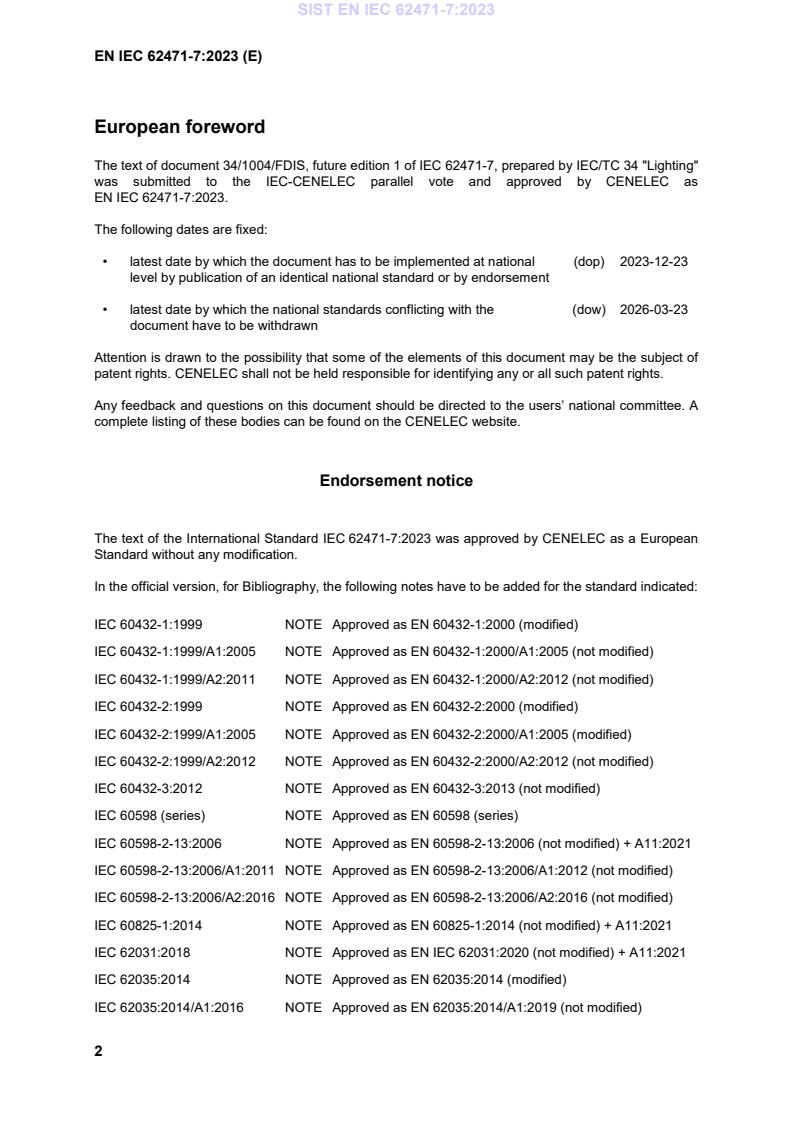
European foreword
The text of document 34/1004/FDIS, future edition 1 of IEC 62471-7, prepared by IEC/TC 34 "Lighting"
was submitted to the IEC-CENELEC parallel vote and approved by CENELEC as
The following dates are fixed:
• latest date by which the document has to be implemented at national (dop) 2023-12-23
level by publication of an identical national standard or by endorsement
• latest date by which the national standards conflicting with the (dow) 2026-03-23
document have to be withdrawn
Attention is drawn to the possibility that some of the elements of this document may be the subject of
patent rights. CENELEC shall not be held responsible for identifying any or all such patent rights.
Any feedback and questions on this document should be directed to the users’ national committee. A
complete listing of these bodies can be found on the CENELEC website.
Endorsement notice
The text of the International Standard IEC 62471-7:2023 was approved by CENELEC as a European
Standard without any modification.
In the official version, for Bibliography, the following notes have to be added for the standard indicated:
IEC 60432-1:1999 NOTE Approved as EN 60432-1:2000 (modified)
IEC 60432-1:1999/A1:2005 NOTE Approved as EN 60432-1:2000/A1:2005 (not modified)
IEC 60432-1:1999/A2:2011 NOTE Approved as EN 60432-1:2000/A2:2012 (not modified)
IEC 60432-2:1999 NOTE Approved as EN 60432-2:2000 (modified)
IEC 60432-2:1999/A1:2005 NOTE Approved as EN 60432-2:2000/A1:2005 (modified)
IEC 60432-2:1999/A2:2012 NOTE Approved as EN 60432-2:2000/A2:2012 (not modified)
IEC 60432-3:2012 NOTE Approved as EN 60432-3:2013 (not modified)
IEC 60598 (series) NOTE Approved as EN 60598 (series)
IEC 60598-2-13:2006 NOTE Approved as EN 60598-2-13:2006 (not modified) + A11:2021
IEC 60598-2-13:2006/A1:2011 NOTE Approved as EN 60598-2-13:2006/A1:2012 (not modified)
IEC 60598-2-13:2006/A2:2016 NOTE Approved as EN 60598-2-13:2006/A2:2016 (not modified)
IEC 60825-1:2014 NOTE Approved as EN 60825-1:2014 (not modified) + A11:2021
IEC 62031:2018 NOTE Approved as EN IEC 62031:2020 (not modified) + A11:2021
IEC 62035:2014 NOTE Approved as EN 62035:2014 (modified)
IEC 62035:2014/A1:2016 NOTE Approved as EN 62035:2014/A1:2019 (not modified)
Annex ZA
(normative)
Normative references to international publications
with their corresponding European publications
The following documents are referred to in the text in such a way that some or all of their content
constitutes requirements of this document. For dated references, only the edition cited applies. For
undated references, the latest edition of the referenced document (including any amendments)
applies.
NOTE 1 Where an International Publication has been modified by common modifications, indicated by (mod),
the relevant EN/HD applies.
NOTE 2 Up-to-date information on the latest versions of the European Standards listed in this annex is available
here: www.cencenelec.eu.
Publication Year Title EN/HD Year
IEC 60050-845 - International Electrotechnical Vocabulary. - -
Lighting
IEC 60598-1 2020 Luminaires - Part 1: General requirements EN IEC 60598-1 2021
and tests
IEC 62471 (mod) 2006 Photobiological safety of lamps and lamp EN 62471 2008
systems
IEC 62471-5 2015 Photobiological safety of lamps and lamp EN 62471-5 2015
systems - Part 5: Image projectors
IEC 62471-7 ®
Edition 1.0 2023-02
INTERNATIONAL
STANDARD
NORME
INTERNATIONALE
colour
inside
Photobiological safety of lamps and lamp systems –
Part 7: Light sources and luminaires primarily emitting visible radiation
Sécurité photobiologique des lampes et des appareils utilisant des lampes –
Partie 7: Sources de lumière et luminaires qui émettent principalement
un rayonnement visible
INTERNATIONAL
ELECTROTECHNICAL
COMMISSION
COMMISSION
ELECTROTECHNIQUE
INTERNATIONALE
ICS 29.140.01; 31.260 ISBN 978-2-8322-6523-9
– 2 – IEC 62471-7:2023 © IEC 2023
CONTENTS
FOREWORD . 4
INTRODUCTION . 6
1 Scope . 7
2 Normative references . 7
3 Terms and definitions . 8
4 Optical radiation hazards of light sources and luminaires . 15
5 Actinic UV hazards exposure for skin and eye (200 nm to 400 nm) . 16
5.1 General . 16
5.2 Actinic UV assessment for light sources . 16
5.3 Actinic UV assessment for luminaires . 16
6 UV-A hazard assessment for the eye lens (315 nm to 400 nm) . 17
6.1 General . 17
6.2 UV-A light source and luminaire assessment . 17
7 Retinal blue light hazard assessment (300 nm to 700 nm) . 18
7.1 General . 18
7.2 Blue light hazard assessment for light sources . 18
7.3 Blue light hazard assessment for luminaires . 18
7.4 Retinal blue light hazard assessment – Small source (300 nm to 700 nm) . 21
8 Retinal thermal hazard assessment (380 nm to 1 400 nm) . 21
8.1 General . 21
8.2 Retinal thermal hazard for light source assessment . 21
8.3 Retinal thermal hazard assessment for luminaire . 22
8.4 Retinal thermal hazard assessment – Weak visual stimulus (780 nm to
1 400 nm) . 22
9 Infrared hazard assessment for the eye (780 nm to 3 000 nm) . 22
9.1 General . 22
9.2 Light source and luminaire assessment . 23
10 Thermal hazard assessment for the skin (380 nm to 3 000 nm) . 23
10.1 General . 23
10.2 Light source and luminaire assessment . 23
Annex A (informative) Information on emission limits for light sources and luminaires . 24
Annex B (informative) Information on UV hazards exposure (200 nm to 400 nm) . 26
Annex C (informative) Information on retinal hazards (300 nm to 1 400 nm) . 27
Annex D (informative) Information on IR-hazard (380 nm to 3 000 nm) . 29
Annex E (informative) Example of a complete luminaire assessment of a LED office
luminaire . 30
E.1 UV assessment . 30
E.1.1 Actinic UV (Clause 5) . 30
E.1.2 UV-A (Clause 6) . 30
E.2 Retinal hazard assessment . 30
E.2.1 Blue light hazard (Clause 7). 30
E.2.2 Thermal retinal hazard (Clause 8) . 30
E.3 Infrared radiation hazard assessment for the eye (780 nm to 3 000 nm)
(Clause 9) . 30
E.4 Thermal hazard assessment for the skin (380 nm to 3 000 nm) (Clause 10) . 30
Bibliography . 31
IEC 62471-7:2023 © IEC 2023 – 3 –
Figure C.1 – Flowchart to define worst-case (minimum) time to dose for the
assessment of the blue light hazard L as a function of application-specific conditions
B
of luminaires . 28
Table 1 – Optical radiation hazards covered in this document . 15
Table 2 – Application-related blue light radiance emission limits at assessment
distances for luminaires . 20
– 4 – IEC 62471-7:2023 © IEC 2023
INTERNATIONAL ELECTROTECHNICAL COMMISSION
____________
PHOTOBIOLOGICAL SAFETY OF LAMPS AND LAMP SYSTEMS –
Part 7: Light sources and luminaires primarily emitting visible radiation
FOREWORD
1) The International Electrotechnical Commission (IEC) is a worldwide organization for standardization comprising
all national electrotechnical committees (IEC National Committees). The object of IEC is to promote international
co-operation on all questions concerning standardization in the electrical and electronic fields. To this end and
in addition to other activities, IEC publishes International Standards, Technical Specifications, Technical Reports,
Publicly Available Specifications (PAS) and Guides (hereafter referred to as "IEC Publication(s)"). Their
preparation is entrusted to technical committees; any IEC National Committee interested in the subject dealt with
may participate in this preparatory work. International, governmental and non-governmental organizations liaising
with the IEC also participate in this preparation. IEC collaborates closely with the International Organization for
Standardization (ISO) in accordance with conditions determined by agreement between the two organizations.
2) The formal decisions or agreements of IEC on technical matters express, as nearly as possible, an international
consensus of opinion on the relevant subjects since each technical committee has representation from all
interested IEC National Committees.
3) IEC Publications have the form of recommendations for international use and are accepted by IEC National
Committees in that sense. While all reasonable efforts are made to ensure that the technical content of IEC
Publications is accurate, IEC cannot be held responsible for the way in which they are used or for any
misinterpretation by any end user.
4) In order to promote international uniformity, IEC National Committees undertake to apply IEC Publications
transparently to the maximum extent possible in their national and regional publications. Any divergence between
any IEC Publication and the corresponding national or regional publication shall be clearly indicated in the latter.
5) IEC itself does not provide any attestation of conformity. Independent certification bodies provide conformity
assessment services and, in some areas, access to IEC marks of conformity. IEC is not responsible for any
services carried out by independent certification bodies.
6) All users should ensure that they have the latest edition of this publication.
7) No liability shall attach to IEC or its directors, employees, servants or agents including individual experts and
members of its technical committees and IEC National Committees for any personal injury, property damage or
other damage of any nature whatsoever, whether direct or indirect, or for costs (including legal fees) and
expenses arising out of the publication, use of, or reliance upon, this IEC Publication or any other IEC
Publications.
8) Attention is drawn to the Normative references cited in this publication. Use of the referenced publications is
indispensable for the correct application of this publication.
9) Attention is drawn to the possibility that some of the elements of this IEC Publication may be the subject of patent
rights. IEC shall not be held responsible for identifying any or all such patent rights.
IEC 62471-7 has been prepared by IEC technical committee 34: Lighting. It is an International
Standard.
The text of this International Standard is based on the following documents:
Draft Report on voting
34/1004/FDIS 34/1011/RVD
Full information on the voting for its approval can be found in the report on voting indicated in
the above table.
The language used for the development of this International Standard is English.
This document was drafted in accordance with ISO/IEC Directives, Part 2, and developed in
accordance with ISO/IEC Directives, Part 1 and ISO/IEC Directives, IEC Supplement, available
at www.iec.ch/members_experts/refdocs. The main document types developed by IEC are
described in greater detail at www.iec.ch/publications.
IEC 62471-7:2023 © IEC 2023 – 5 –
A list of all parts in the IEC 62471 series, published under the general title Photobiological
safety of lamps and lamp systems, can be found on the IEC website.
The committee has decided that the contents of this document will remain unchanged until the
stability date indicated on the IEC website under webstore.iec.ch in the data related to the
specific document. At this date, the document will be
• reconfirmed,
• withdrawn,
• replaced by a revised edition, or
• amended.
IMPORTANT – The "colour inside" logo on the cover page of this document indicates that it
contains colours which are considered to be useful for the correct understanding of its
contents. Users should therefore print this document using a colour printer.
– 6 – IEC 62471-7:2023 © IEC 2023
INTRODUCTION
The wording "lamps and lamp systems" is used in the title of the IEC 62471 series. However,
in the title of this Part 7, the wording "light sources and luminaires" is used. The reason for this
is that due to the introduction of new LED technologies the characteristics of the light-generating
components have changed. Therefore, the terms "electrical light source" and "luminaire" are
nowadays used in TC 34 instead of "lamp" and "lamp system".
"Electric light source" is the generic term for products which produce light; the term "lamp" (light
source with a lamp cap-holder system) is thereby included.
"Luminaire" is the basic term (see IEC 60050-845:2020, 845-30-001) for a product that includes
all necessary accessories and describes a device that distributes, filters, or transforms the light
produced from at least one source of optical radiation and which includes, except the sources
themselves, all the parts necessary for fixing and protecting the sources and, where necessary,
circuit auxiliaries together with the means for connecting them to the power supply.
When luminaires are designed and constructed in accordance with the requirements of this
document, they are presumed to function safely under normal use and present a photobiological
hazard. Conformity of luminaires can be verified by application of the assessment procedures
described in this document.
The light sources can be interchangeable or an integral part of the luminaire. If the light source
is an integral part of the luminaire, the luminaire can also be considered a light source system
(corresponding to a lamp system).
Most electrical light sources and luminaires within the scope of this document will not present
a photobiological hazard due to their spectra, their light distribution, the light levels, and the
natural aversion responses – people do not usually stare into bright sources, for example. There
remain, however, some light sources and luminaires, which have the potential to pose adverse
health effects from the emitted optical radiation. Exposure limits for a range of photobiological
hazards associated with broad-band optical radiation sources have been developed and
published by the International Commission on Non-Ionizing Radiation Protection (ICNIRP).
This document introduces a new assessment procedure to address the various lighting
applications in which the intended purpose is the illumination of objects and scenes and in
signalling applications. This new approach uses revised time bases (and emission limits) related
to the intentional or unintentional direct viewing of the luminaire and assessment distances
depending on application. These emission limits are based on the exposure limits of the
ICNIRP.
In this document, a complete procedure is used to cover all photobiological hazards in the range
of 200 nm to 3 000 nm as implemented in IEC 62471.
This procedure, based on a product- and application-related assessment, leads to a pass/fail
result for a specific product in that given application.
IEC 62471-7:2023 © IEC 2023 – 7 –
PHOTOBIOLOGICAL SAFETY OF LAMPS AND LAMP SYSTEMS –
Part 7: Light sources and luminaires primarily emitting visible radiation
1 Scope
This part of IEC 62471 specifies an assessment of the photobiological safety of electrical light
sources and luminaires in normal use as well as some basic product requirements. It applies to
electrical light sources and luminaires that emit radiation predominantly in the visible spectral
range (380 nm to 780 nm) and are used to illuminate spaces or objects or used for signalling.
Electrical light sources and luminaires designed for emitting radiation in the visible range can
also emit radiation in the ultraviolet (UV) and infrared (IR) regions depending on the technology
applied. This document, therefore, includes the blue light, thermal, UV, UV-A, IR and skin
thermal hazards for the optical radiation over the wavelength range 200 nm to 3 000 nm.
Electrical light sources and luminaires that are designed to predominantly emit radiation outside
the visible spectral range (380 nm to 780 nm) (e.g. UV sterilizers or industrial heaters) are not
within the scope of this document.
Electrical light sources for illumination are considered to emit continuous light for
photobiological safety assessment. This includes light sources with pulse width modulation
(PWM).
This document can also be applied to the illumination function of multi-function luminaires which
can simultaneously perform functions other than illumination. Other standards can be applied
to the non-illumination function(s).
This document can also be applied to electric light sources and luminaires which emit visible
light, when there is no limitation on the presence of people (e.g. horticulture).
This document can also be applied to laser products used for illumination and signalling when
the conditions of IEC 60825-1:2014, 4.4 are met.
NOTE See IEC 60825-1:2014 for other requirements of laser products.
This document is intended to be referenced by product standards for the assessment of
applicable photobiological safety aspects. Additional details for the photobiological safety
assessment and data presentation are specified in the product standards.
2 Normative references
The following documents are referred to in the text in such a way that some or all of their content
constitutes requirements of this document. For dated references, only the edition cited applies.
For undated references, the latest edition of the referenced document (including any
amendments) applies.
IEC 60050-845, International Electrotechnical Vocabulary (IEV) – Part 845: Lighting, available
at http://www.electropedia.org
IEC 60598-1:2020, Luminaires – Part 1: General requirements and tests
IEC 62471:2006, Photobiological safety of lamps and lamp systems
– 8 – IEC 62471-7:2023 © IEC 2023
IEC 62471-5:2015, Photobiological safety of lamps and lamp systems – Part 5: Image projectors
3 Terms and definitions
For the purposes of this document, the terms and definitions given in IEC 62471,
IEC 60050-845 and the following apply.
ISO and IEC maintain terminology databases for use in standardization at the following
addresses:
• IEC Electropedia: available at https://www.electropedia.org/
• ISO Online browsing platform: available at https://www.iso.org/obp
3.1
blue light hazard
BLH
potential for a photochemically induced retinal injury (photic maculopathy) resulting from optical
radiation exposure at wavelengths primarily between 400 nm and 500 nm
Note 1 to entry: This damage mechanism dominates over the thermal damage mechanism for exposure durations
exceeding 10 s.
Note 2 to entry: The weighting function extends into the UV-A for persons without a normal UV-A absorbing lens.
[SOURCE: IEC 60050-845:2020, 845-26-055, modified – In Note 2 to entry "action spectrum"
has been replaced with "weighting function".]
3.2
exposure limit
maximum level of exposure of a surface, usually the eye or skin, that is not expected to result
in adverse biological effects
Note 1 to entry: Exposure limits for human safety of optical radiation, H , are normally recommended by the
L
International Commission on Non-Ionizing Radiation Protection (ICNIRP).
Note 2 to entry: Exposure limits are often based on irradiance (e.g. for the skin), but where relevant, can also be
based on radiance (e.g. the blue light hazard of extended sources).
[SOURCE: IEC 60050-845:2020, 845-26-072]
3.3
emission limit
specified maximum emission level of a source of optical radiation that is not expected to result
in adverse biological effect for a specific application
Note 1 to entry: Evaluation of sources to the emission limits can be based upon reasonably foreseeable conditions
of time-weighted exposure. It incorporates both the concept of exposure duration and exposure distance and is
derived from exposure limits.
[SOURCE: IEC 60050-161:1990, 161-03-12, modified – The domain has been deleted, the
definition has been adapted in relation to optical radiation and the Note to entry has been
added.]
IEC 62471-7:2023 © IEC 2023 – 9 –
3.4
field of view
FOV
solid angle as "seen" by the detector (acceptance angle), e.g. of a radiometer or
spectroradiometer, out of which the detector receives radiation
Note 1 to entry: The field of view should not be confused with the angular subtense of the apparent source, α.
Note 2 to entry: A plane angle is sometimes used to describe a circular symmetric solid angle field of view.
Note 3 to entry: The field of view is expressed in steradian (sr).
[SOURCE: IEC 60050-845:2020, 845-25-077]
3.5
illuminance
E
v
density of incident luminous flux with respect to area at a point on a real or imaginary surface
dΦ
v
E =
v
dA
where Φ is luminous flux and A is the area on which the luminous flux is incident
v
Note 1 to entry: Illuminance can be derived from the spectral irradiance distribution by
∞
E = KE (λ·) V(λ·) d(λ)
v me,λ
∫
where K is maximum luminous efficacy, E (λ) is the spectral irradiance at wavelength λ and V(λ) is spectral
m e,λ
luminous efficiency.
Note 2 to entry: The corresponding radiometric quantity is "irradiance". The corresponding quantity for photons is
"photon irradiance".
−2
Note 3 to entry: The illuminance is expressed in lux (lx = lm · m ).
[SOURCE: IEC 60050-845:2020, 845-21-060]
3.6
infrared radiation
IRR
optical radiation for which the wavelengths are longer than those for visible radiation
Note 1 to entry: For infrared radiation, the range between 780 nm and 1 mm is commonly subdivided into:
IR-A: 780 nm to 1 400 nm, or 0,78 μm to 1,4 μm;
IR-B: 1,4 μm to 3,0 μm;
IR-C: 3 μm to 1 mm.
Note 2 to entry: A precise border between "visible radiation" and "infrared radiation" cannot be defined because
visual sensation at wavelengths greater than 780 nm can be experienced.
Note 3 to entry: In some applications the infrared spectrum has also been divided into "near", "middle", and "far"
infrared; however, the borders necessarily vary with the application.
[SOURCE: IEC 60050-845:2020, 845-21-004]
– 10 – IEC 62471-7:2023 © IEC 2023
3.7
irradiance
density of incident radiant flux with respect to area at a point on a real or imaginary surface
dΦ
e
E =
e
dA
where Φ is radiant flux and A is the area on which the radiant flux is incident
e
Note 1 to entry: The corresponding photometric quantity is "illuminance". The corresponding quantity for photons
is "photon irradiance".
−2
Note 2 to entry: The irradiance is expressed in watt per square metre (W · m ).
[SOURCE: IEC 60050-845:2020, 845-21-053]
3.8
electric light source
primary light source with the means for connecting to the power supply and usually designed to
be incorporated into a luminaire
Note 1 to entry: In IEC standards, "light source” and "lamp" are commonly used with the same meaning.
Note 2 to entry: An electric light source can be an electric lamp, or LED module designed to be connected by
terminals, connectors, or similar devices.
Note 3 to entry: For products that have the same physical characteristics as electric light sources for general lighting
but that are built to emit optical radiation (IEV 845-21-002) mainly in the IR or UV spectrum, the term "IR lamp" or
"UV lamp" is often used.
[SOURCE: IEC 60050-845:2020, 845-27-004, modified – In Note 1 to entry, "and "lamp" are"
has been added and Note 3 to entry has been added.]
3.9
luminaire
apparatus which distributes, filters or transforms the light transmitted from at least one source
of optical radiation and which includes, except the sources themselves, all the parts necessary
for fixing and protecting the sources and, where necessary, circuit auxiliaries together with the
means for connecting them to the power supply
[SOURCE: IEC 60050-845:2020, 845-30-001]
3.10
optical radiation
electromagnetic radiation at wavelengths between the region of transition to X-rays (λ ≈ 1 nm)
and the region of transition to radio waves (λ ≈ 1 mm)
[SOURCE: IEC 60050-845:2020, 845-21-002]
IEC 62471-7:2023 © IEC 2023 – 11 –
3.11
radiance
L
e
L
density of radiant intensity with respect to projected area in a specified direction at a specified
point on a real or imaginary surface, expressed by
dI 1
e
L· =
e
dA cosα
where I is radiant intensity, A is area, and α is the angle between the normal to the surface at
e
the specified point and the specified direction
Note 1 to entry: In a practical sense, the definition of radiance can be thought of as dividing a real or imaginary
surface into an infinite number of infinitesimally small surfaces which can be considered as point sources, each of
which has a specific radiant intensity, I , in the specified direction. The radiance of the surface is then the integral
e
of these radiance elements over the whole surface.
The equation in the definition can mathematically be interpreted as a derivative (i.e. a rate of change of radiant
intensity with projected area) and could alternatively be rewritten in terms of the average radiant intensity I as:
e
I 1
e
L = lim··
e
A→0 A cosα
Hence, radiance is often considered as a quotient of averaged quantities; the area, A, should be small enough that
uncertainties due to variations in radiant intensity within that area are negligible, otherwise, the quotient
I 1
e
L = · gives the average radiance and the specific measurement conditions have to be reported with the
e
A cosα
result.
Note 2 to entry: For a surface being irradiated, an equivalent formula in terms of irradiance, E , and solid angle, Ω,
e
is
dE 1
e
L = · , where θ is the angle between the normal to the surface being irradiated and the direction of
e
dΩθcos
irradiation. This form is useful when the source has no surface (e.g. the sky, the plasma of a discharge).
dΦ
e
Note 3 to entry: An equivalent formula is L = , where Φ is radiant flux and G is geometric extent.
e e
dG
Note 4 to entry: Radiant flux can be obtained by integrating radiance over projected area, A ⋅ cos α, and solid angle,
Ω:
Φ = ∬L · cosα·A d ·Ω d
e e
Note 5 to entry: Since the optical extent, expressed by G · n , where G is geometric extent and n is refractive index,
−2
is invariant, the quantity expressed by L · n is also invariant along the path of the beam if the losses by absorption,
e
reflection and diffusion are taken as 0. That quantity is called "basic radiance".
Note 6 to entry: The equation in the definition can also be described as a function of radiant flux, Φ . In this case,
e
it is mathematically interpreted as a second partial derivative of the radiant flux at a specified point (x, y) in space in
a specified direction (ϑ, ϕ) with respect to projected area, A ⋅ cos α, and solid angle, Ω,
∂Φ x, y,ϑ,φ
( )
e
L x, y,ϑ,φ =
( )
e
∂∂A x,y · cosα· Ωϑ,φ
( ) ( )
where α is the angle between the normal to that area at the specified point and the specified direction.
– 12 – IEC 62471-7:2023 © IEC 2023
Note 7 to entry: The corresponding photometric quantity is "luminance". The corresponding quantity for photons is
"photon radiance".
−2 −1
Note 8 to entry: The radiance is expressed in watts per square metre per steradian (W · m · sr ).
[SOURCE: IEC 60050-845:2020, 845-21-049]
3.12
retina
membrane situated inside the back of the eye that is sensitive to light stimuli
Note 1 to entry: The retina contains photoreceptors and nerve cells that interconnect and transmit to the optic nerve
the signals resulting from stimulation of the photoreceptors. The photoreceptors in the human retina are of three
types: rods and cones, which are responsible for vision, and intrinsically photosensitive retinal ganglion cells
(ipRGCs), which play a role in controlling circadian and neuro-endocrine systems.
[SOURCE: IEC 60050-845:2020, 845-22-001]
3.13
spectral irradiance
E
e,λ
E
λ
density of irradiance with respect to wavelength
Note 1 to entry: The spectral irradiance is expressed by
dE λ
( )
e
E =
e,λ
dλ
where E (λ) is irradiance in terms of wavelength λ.
e
−2 −1
Note 2 to entry: The spectral irradiance is expressed in watt per square metre per nanometre (W · m · nm ).
[SOURCE: IEC 60050-845:2020, 845-21-056, modified – Part of the definition has been
included in Note 1 to entry.]
3.14
spectral radiance
L
λ
density of radiance with respect to wavelength
Note 1 to entry: The spectral radiance is expressed by
dL λ
( )
e
L =
e,λ
dλ
where L (λ) is radiance in terms of wavelength λ.
e
Note 2 to entry: The spectral radiance is expressed in watt per square metre per nanometre per steradian
−2 −1 −1
(W · m · nm · sr ).
[SOURCE: IEC 60050-845:2020, 845-21-052, modified – Part of the definition has been
included in Note 1 to entry.]
IEC 62471-7:2023 © IEC 2023 – 13 –
3.15
ultraviolet radiation
UV radiation
UVR
optical radiation for which the wavelengths are shorter than those for visible radiation
Note 1 to entry: The range between 100 nm and 400 nm is commonly subdivided into:
UV-A: 315 nm to 400 nm;
UV-B: 280 nm to 315 nm;
UV-C: 100 nm to 280 nm.
Note 2 to entry: A precise border between "ultraviolet radiation" and "visible radiation" cannot be defined, because
visual sensation at wavelengths shorter than 400 nm is noted for very bright sources.
Note 3 to entry: In some applications the ultraviolet spectrum has also been divided into "far," "vacuum," and "near"
ultraviolet; however, the borders necessarily vary with the application (e.g. in meteorology, optical design,
photochemistry, and thermal physics).
[SOURCE: IEC 60050-845:2020, 845-21-008]
3.16
visible radiation
optical radiation capable of causing a visual sensation directly
Note 1 to entry: There are no precise limits for the spectral range of visible radiation since they depend upon the
amount of radiant flux reaching the retina and the responsivity of the observer. The lower limit is generally taken
between 360 nm and 400 nm and the upper limit between 760 nm and 830 nm.
[SOURCE: IEC 60050-845:2020, 845-21-003]
3.17
ultraviolet hazard efficacy of luminous radiation
K
S,v
quotient of an ultraviolet hazard quantity to the corresponding photometric quantity
E
s
K =
Sv,
E
v
where
−2
E is the effective actinic irradiance in W · m and
S
−2
E is the illuminance in lx = lm · m
v
−3 −2 −6 −1 −1
EXAMPLE With E = 10 W · m and E = 500 lx follows K = 2 · 10 W · lm = 2 mW · klm .
S v S,v
-1
Note 1 to entry: Ultraviolet hazard efficacy of luminous radiation is expressed in watt per lumen (W · lm ), possibly
−1
with a metric prefix (here mW · klm ).
Note 2 to entry: The ultraviolet hazard efficacy of luminous radiation is obtained by weighting the spectral power
distribution of the lamp or LED module with the UV hazard function S (λ). Information about the relevant UV hazard
UV
function is given in IEC 62471:2006. It only relates to possible hazards regarding UV exposure of human beings. It
does not deal with the possible influence of optical radiation on materials such as mechanical damage or
discoloration.
[SOURCE: IEC 62031:2018, 3.1, modified – The equation with the corresponding explanations
has been added.]
– 14 – IEC 62471-7:2023 © IEC 2023
3.18
UV-A hazard efficacy of luminous radiation
K
UV-A,v
quotient of a UV-A hazard quantity to the corresponding photometric quantity
E
UV−A
K =
UV−A,v
E
v
where
−2
E is the effective UV-A irradiance in W · m and
UV-A
−2
E is the illuminance in lx = lm · m
v
−2 −3 −1 −1
EXAMPLE With E = 10 W · m and E = 500 lx follows K = 20 · 10 W · lm = 20 W · klm .
UV-A v UV-A,v
−1
),
Note 1 to entry: Ultraviolet hazard UV-A efficacy of luminous radiation is expressed in watt per lumen (W · lm
−1
possibly with a metric prefix (here mW · klm ).
3.19
infrared eye hazard efficacy of luminous radiation
K
IR,v
quotient of an E infrared eye hazard quantity to the corresponding photometric quantity
IR
E
IR
K =
IR,v
E
v
where
−2
E is the effective E irradiance in W · m and
IR IR
−2
E is the illuminance in lx = lm · m
v
−2 −3 −1 −1
EXAMPLE With E = 100 W · m and E = 500 lx follows K = 200 · 10 W · lm = 200 W · klm .
IR v IR,v
−1
Note 1 to entry: Infrared eye hazard efficacy of luminous radiation is expressed in watt per lumen (W · lm ),
−1
possibly with a metric prefix (here mW · klm ).
3.20
emission level
amount of optical radiation emitted from a product measured under specific operation conditions
at a certain distance
3.21
white light source
electrically operated product intended to emit, or, in the case of a non-incandescent light
source, intended to be possibly tuned to emit, light, or both, with the following optical
characteristics:
Chromaticity coordinates x and y in the range 0,270 < x < 0,530 and
2 2
2,3172 x + 2,3653 x − 0,2199 < y < − 2,3172 x + 2,3653 x − 0,1595
[SOURCE: Commission Regulation (EU) 2019/2020, Article 2, definition (1), modified – "light
source" has been replaced with "white light source" and bullet points (b), (c), (d) and the text
after bullet point (d) have been deleted.]
IEC 62471-7:2023 © IEC 2023 – 15 –
4 Optical radiation hazards of light sources and luminaires
Optical radiation in the wavelength range from 200 nm to 3 000 nm has the potential to affect
and damage human tissue, depending on the emission wavelength, emission level and
exposure duration. The International Commission on Non-Ionizing Radiation Protection
(ICNIRP) has issued a comprehensive set of exposure limits in different wavelength(s) ranges.
As a result of the strong absorption of optical radiation by tissue, the assessment of optical
radiation hazards should consider exposure of the skin, the anterior elements of the eye
(cornea, conjunctiva, and lens), and the retina. The emission limits for the skin and the anterior
parts of the eye are given in irradiance. The emission limits for the retina are given in radiance.
Whilst the scope of this document includes optical radiation over the wavelength range 200 nm
to 3 000 nm, exposure of the retina shall only be considered over the wavelength range 300 nm
to 1 400 nm, due to the transmission characteristics of the eye.
The hazards considered in this document are summarized in Table 1 and described in detail in
the remainder of this document. Further background information is provided in Annex A.
For an example of a complete luminaire assessment of an LED office luminaire see Annex E.
Table 1 – Optical radiation hazards covered in this document
Optical Symbol for
Weighting Wavelength Assessed
radiation Target tissue emission Unit
a
range quantity
function
hazard level
nm
Skin and
−2
S (λ) E
anterior tissues
Actinic UV 200 to 400 Irradiance W · m
UV s
of the eye
−2
E
UV-A Lens N/A 315 to 400 Irradiance W · m
UV-A
−2 −1
L
Blue light Retina B(λ) 300 to 700 Radiance
W · m · sr
B
Blue light,
−2
E
Retina B(λ) 300 to 700 Irradiance W · m
B
small source
−2 −1
L
Retinal thermal Retina R(λ) 380 to 1 400 Radiance
W · m · sr
R
Retinal
−2 −1
L
thermal, weak Retina R(λ) 780 to 1 400 Radiance
W · m · sr
IR
visual stimulus
Anterior tissues
−2
E
Infrared N/A 780 to 3 000 Irradiance
W · m
IR
of the eye
Visible and
−2
E
Skin N/A 380 to 3 000 Irradiance W · m
H
infrared
a
The weighting functions for S (λ) and B(λ) are defined in IEC 62471:2006 and the weighting function for R(λ) in
UV
IEC 62471-5:2015.
If measurements are necessary, they shall be carried out in accordance with IEC 62471:2006
unless otherwise specified in this document.
For light sources with pulse width modulation (PWM), emission levels of continuous light
(continuous wave (CW)) are applied.
For luminaires with adjustable beam angle the most severe condition shall be selected for each
assessment.
– 16 – IEC 62471-7:2023 © IEC 2023
In this document, the evaluation of a luminaire is understood to mean the evaluation of a
luminaire with the intended normal use of the specified light sources or with the light sources
installed. For the selection of light sources IEC 60598-1:2020, Annex B shall be used.
5 Actinic UV hazards exposure for skin and eye (200 nm to 400 nm)
5.1 General
−2
The ultraviolet hazard irradiance E of light sources and luminaires is expressed in W · m and
S
defined as:
400 nm
E = E·S λ· Δλ
( )
S λ UV
∑
200 nm
where
−2 −1
E is the spectral irradiance in W · m · nm ;
λ
S (λ) is the ultraviolet weighting function;
UV
Δλ is the wavelength increment in nm.
Additional information is given in Annex B.
...