

IEC 61784-2:2014
(Main)Industrial communication networks - Profiles - Part 2: Additional fieldbus profiles for real-time networks based on ISO/IEC 8802-3
General Information
- Abstract
IEC 61784-2:2014 specifies the performance indicators supporting classification schemes for Real-Time Ethernet (RTE) requirements; the profiles and related network components based on ISO/IEC 8802-3 or IEEE 802.3, IEC 61158 series, and IEC 61784-1 and the RTE solutions that are able to run in parallel with ISO/IEC 8802-3 or IEEE 802.3 based applications. These communication profiles are called Real-Time Ethernet communication profiles. This third edition cancels and replaces the second edition published in 2010 and constitutes a technical revision. The main changes are:
- update of selection tables for CPF 3;
- update of selection tables for CPF 11 and CPF 14;
- addition of a new profile CP 11/3 in 12.4;
- addition of a new profile CP 14/4 in 15.6;
- addition of a new Communication Profile Family - CPF 8 in Clause 20.
- Status
- Published
- Publication Date
- 16-Jul-2014
- Technical Committee
- SC 65C - Industrial networks
- Drafting Committee
- WG 9 - TC 65/SC 65C/WG 9
- Current Stage
- DELPUB - Deleted Publication
- Start Date
- 10-Apr-2019
- Completion Date
- 28-Aug-2026

Overview
IEC 61784-2:2014 is an international standard published by the International Electrotechnical Commission (IEC) that focuses on industrial communication networks. Specifically, it addresses additional fieldbus profiles for real-time networks that are based on ISO/IEC 8802-3 or IEEE 802.3 standards. This third edition of IEC 61784-2 represents a technical revision that updates and expands the classification schemes and performance indicators supporting Real-Time Ethernet (RTE) requirements. RTE communication profiles defined in this document ensure that industrial networks can handle real-time communications alongside standard Ethernet applications seamlessly.
Key Topics
Real-Time Ethernet Communication Profiles
IEC 61784-2:2014 defines several RTE communication profiles. These profiles pertain to network components and specifications that enable deterministic and timely data exchange, crucial for industrial automation processes.
Performance Indicators and Classification Scheme
The standard outlines key performance indicators such as:
- Delivery time
- Number of RTE end-stations
- Network topology and number of switches involved
- Throughput specific to RTE versus non-RTE bandwidth
- Accuracy of time synchronization
- Redundancy recovery time
These parameters help classify and benchmark various real-time Ethernet solutions to ensure they meet industrial application needs.
Communication Profile Families (CPF)
The document expands and updates numerous Profile Families (CPF), such as:
- CPF 3 (PROFIBUS & PROFINET) with updated selection tables
- CPF 11 and CPF 14 enhancements
- Introduction of new profiles in CPF 11 and CPF 14
- Addition of a new Communication Profile Family - CPF 8
Each CPF covers a set of technical specifications for physical, data-link, and application layers tailored to different industrial environments.
Conformance and Testing Methodology
IEC 61784-2 defines a robust methodology for conformance testing to ensure that products meet the specified profile requirements. This includes test conditions, procedures, performance measurements, and reporting formats to guarantee interoperability and reliable performance.
Applications
IEC 61784-2:2014 is widely used across various industrial sectors that require reliable, real-time communication over Ethernet networks, including:
- Manufacturing Automation: Ensuring deterministic control communication within factory automation systems like assembly lines, robotics, and process control.
- Process Industry: Supporting critical monitoring and control systems in industries such as chemicals, oil & gas, and pharmaceuticals where precise timing and synchronization are vital.
- Energy and Utilities: Managing substation automation and smart grid applications where real-time data exchange ensures system stability and security.
- Transportation and Infrastructure: Facilitating control systems in railways, automotive production, and airport logistics which rely on synchronized and fault-tolerant communication.
The standard promotes interoperability among network devices and supports parallel operation with existing ISO/IEC 8802-3 Ethernet applications, aiding gradual migration towards real-time industrial Ethernet solutions.
Related Standards
For comprehensive industrial network implementation, IEC 61784-2:2014 is often used in conjunction with:
- ISO/IEC 8802-3 / IEEE 802.3: Base standards for Ethernet physical and data-link layers, forming the foundation for RTE profiles.
- IEC 61158 series: Defines fieldbus communication protocols that complement real-time Ethernet networking and integration.
- IEC 61784-1: Outlines general communication profile specifications forming the baseline framework for industrial network design.
- IEC 61850: Used in power utility automation, supports real-time Ethernet communication in electrical substation environments.
Together, these standards ensure industrial communication networks are robust, interoperable, and meet demanding real-time performance requirements.
Keywords: IEC 61784-2, Real-Time Ethernet, Industrial communication networks, fieldbus profiles, ISO/IEC 8802-3, IEEE 802.3, PROFIBUS, PROFINET, real-time networks, industrial automation, deterministic Ethernet, conformance testing, communication profile families
Relations
- Effective Date
- 05-Sep-2023
- Effective Date
- 05-Sep-2023
Get Certified
Connect with accredited certification bodies for this standard

BSI Group
BSI (British Standards Institution) is the business standards company that helps organizations make excellence a habit.

NYCE
Mexican standards and certification body.
Sponsored listings
Frequently Asked Questions
IEC 61784-2:2014 is a standard published by the International Electrotechnical Commission (IEC). Its full title is "Industrial communication networks - Profiles - Part 2: Additional fieldbus profiles for real-time networks based on ISO/IEC 8802-3". This standard covers: IEC 61784-2:2014 specifies the performance indicators supporting classification schemes for Real-Time Ethernet (RTE) requirements; the profiles and related network components based on ISO/IEC 8802-3 or IEEE 802.3, IEC 61158 series, and IEC 61784-1 and the RTE solutions that are able to run in parallel with ISO/IEC 8802-3 or IEEE 802.3 based applications. These communication profiles are called Real-Time Ethernet communication profiles. This third edition cancels and replaces the second edition published in 2010 and constitutes a technical revision. The main changes are: - update of selection tables for CPF 3; - update of selection tables for CPF 11 and CPF 14; - addition of a new profile CP 11/3 in 12.4; - addition of a new profile CP 14/4 in 15.6; - addition of a new Communication Profile Family - CPF 8 in Clause 20.
IEC 61784-2:2014 specifies the performance indicators supporting classification schemes for Real-Time Ethernet (RTE) requirements; the profiles and related network components based on ISO/IEC 8802-3 or IEEE 802.3, IEC 61158 series, and IEC 61784-1 and the RTE solutions that are able to run in parallel with ISO/IEC 8802-3 or IEEE 802.3 based applications. These communication profiles are called Real-Time Ethernet communication profiles. This third edition cancels and replaces the second edition published in 2010 and constitutes a technical revision. The main changes are: - update of selection tables for CPF 3; - update of selection tables for CPF 11 and CPF 14; - addition of a new profile CP 11/3 in 12.4; - addition of a new profile CP 14/4 in 15.6; - addition of a new Communication Profile Family - CPF 8 in Clause 20.
IEC 61784-2:2014 is classified under the following ICS (International Classification for Standards) categories: 31.220.10 - Plug-and-socket devices. Connectors; 35.100.20 - Data link layer; 35.240.50 - IT applications in industry. The ICS classification helps identify the subject area and facilitates finding related standards.
IEC 61784-2:2014 has the following relationships with other standards: It is inter standard links to IEC 61784-2:2019, IEC 61784-2:2010. Understanding these relationships helps ensure you are using the most current and applicable version of the standard.
IEC 61784-2:2014 is available in PDF format for immediate download after purchase. The document can be added to your cart and obtained through the secure checkout process. Digital delivery ensures instant access to the complete standard document.
Standards Content (Sample)
IEC 61784-2 ®
Edition 3.0 2014-07
INTERNATIONAL
STANDARD
NORME
INTERNATIONALE
colour
inside
Industrial communication networks – Profiles –
Part 2: Additional fieldbus profiles for real-time networks based on
ISO/IEC 8802-3
Réseaux de communication industriels – Profils –
Partie 2: Profils de bus de terrain supplémentaires pour les réseaux en temps
réel basés sur l’ISO/CEI 8802-3
All rights reserved. Unless otherwise specified, no part of this publication may be reproduced or utilized in any form
or by any means, electronic or mechanical, including photocopying and microfilm, without permission in writing from
either IEC or IEC's member National Committee in the country of the requester. If you have any questions about IEC
copyright or have an enquiry about obtaining additional rights to this publication, please contact the address below or
your local IEC member National Committee for further information.
Droits de reproduction réservés. Sauf indication contraire, aucune partie de cette publication ne peut être reproduite
ni utilisée sous quelque forme que ce soit et par aucun procédé, électronique ou mécanique, y compris la photocopie
et les microfilms, sans l'accord écrit de l'IEC ou du Comité national de l'IEC du pays du demandeur. Si vous avez des
questions sur le copyright de l'IEC ou si vous désirez obtenir des droits supplémentaires sur cette publication, utilisez
les coordonnées ci-après ou contactez le Comité national de l'IEC de votre pays de résidence.
IEC Central Office Tel.: +41 22 919 02 11
3, rue de Varembé Fax: +41 22 919 03 00
CH-1211 Geneva 20 info@iec.ch
Switzerland www.iec.ch
About the IEC
The International Electrotechnical Commission (IEC) is the leading global organization that prepares and publishes
International Standards for all electrical, electronic and related technologies.
About IEC publications
The technical content of IEC publications is kept under constant review by the IEC. Please make sure that you have the
latest edition, a corrigenda or an amendment might have been published.
IEC Catalogue - webstore.iec.ch/catalogue Electropedia - www.electropedia.org
The stand-alone application for consulting the entire The world's leading online dictionary of electronic and
bibliographical information on IEC International Standards, electrical terms containing more than 30 000 terms and
Technical Specifications, Technical Reports and other definitions in English and French, with equivalent terms in 14
documents. Available for PC, Mac OS, Android Tablets and additional languages. Also known as the International
iPad. Electrotechnical Vocabulary (IEV) online.
IEC publications search - www.iec.ch/searchpub IEC Glossary - std.iec.ch/glossary
The advanced search enables to find IEC publications by a More than 55 000 electrotechnical terminology entries in
variety of criteria (reference number, text, technical English and French extracted from the Terms and Definitions
committee,…). It also gives information on projects, replaced clause of IEC publications issued since 2002. Some entries
and withdrawn publications. have been collected from earlier publications of IEC TC 37,
77, 86 and CISPR.
IEC Just Published - webstore.iec.ch/justpublished
Stay up to date on all new IEC publications. Just Published IEC Customer Service Centre - webstore.iec.ch/csc
details all new publications released. Available online and If you wish to give us your feedback on this publication or
also once a month by email. need further assistance, please contact the Customer Service
Centre: csc@iec.ch.
A propos de l'IEC
La Commission Electrotechnique Internationale (IEC) est la première organisation mondiale qui élabore et publie des
Normes internationales pour tout ce qui a trait à l'électricité, à l'électronique et aux technologies apparentées.
A propos des publications IEC
Le contenu technique des publications IEC est constamment revu. Veuillez vous assurer que vous possédez l’édition la
plus récente, un corrigendum ou amendement peut avoir été publié.
Catalogue IEC - webstore.iec.ch/catalogue Electropedia - www.electropedia.org
Application autonome pour consulter tous les renseignements
Le premier dictionnaire en ligne de termes électroniques et
bibliographiques sur les Normes internationales,
électriques. Il contient plus de 30 000 termes et définitions en
Spécifications techniques, Rapports techniques et autres
anglais et en français, ainsi que les termes équivalents dans
documents de l'IEC. Disponible pour PC, Mac OS, tablettes
14 langues additionnelles. Egalement appelé Vocabulaire
Android et iPad.
Electrotechnique International (IEV) en ligne.
Recherche de publications IEC - www.iec.ch/searchpub
Glossaire IEC - std.iec.ch/glossary
Plus de 55 000 entrées terminologiques électrotechniques, en
La recherche avancée permet de trouver des publications IEC
en utilisant différents critères (numéro de référence, texte, anglais et en français, extraites des articles Termes et
comité d’études,…). Elle donne aussi des informations sur les Définitions des publications IEC parues depuis 2002. Plus
projets et les publications remplacées ou retirées. certaines entrées antérieures extraites des publications des
CE 37, 77, 86 et CISPR de l'IEC.
IEC Just Published - webstore.iec.ch/justpublished
Service Clients - webstore.iec.ch/csc
Restez informé sur les nouvelles publications IEC. Just
Published détaille les nouvelles publications parues. Si vous désirez nous donner des commentaires sur cette
Disponible en ligne et aussi une fois par mois par email. publication ou si vous avez des questions contactez-nous:
csc@iec.ch.
IEC 61784-2 ®
Edition 3.0 2014-07
INTERNATIONAL
STANDARD
NORME
INTERNATIONALE
colour
inside
Industrial communication networks – Profiles –
Part 2: Additional fieldbus profiles for real-time networks based on
ISO/IEC 8802-3
Réseaux de communication industriels – Profils –
Partie 2: Profils de bus de terrain supplémentaires pour les réseaux en temps
réel basés sur l’ISO/CEI 8802-3
INTERNATIONAL
ELECTROTECHNICAL
COMMISSION
COMMISSION
ELECTROTECHNIQUE
PRICE CODE
INTERNATIONALE
CODE PRIX XH
ICS 35.100.20; 35.240.50 ISBN 978-2-8322-1707-8
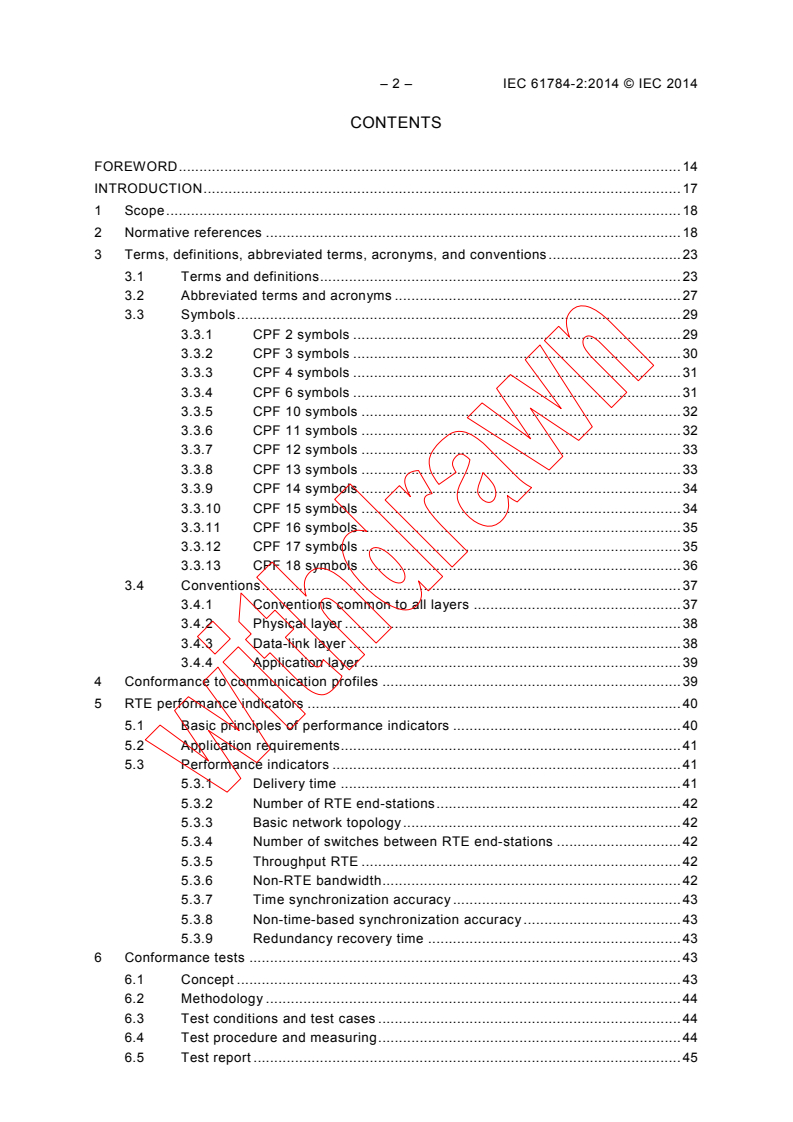
– 2 – IEC 61784-2:2014 © IEC 2014
CONTENTS
FOREWORD . 14
INTRODUCTION . 17
1 Scope . 18
2 Normative references . 18
3 Terms, definitions, abbreviated terms, acronyms, and conventions . 23
3.1 Terms and definitions . 23
3.2 Abbreviated terms and acronyms . 27
3.3 Symbols . 29
3.3.1 CPF 2 symbols . 29
3.3.2 CPF 3 symbols . 30
3.3.3 CPF 4 symbols . 31
3.3.4 CPF 6 symbols . 31
3.3.5 CPF 10 symbols . 32
3.3.6 CPF 11 symbols . 32
3.3.7 CPF 12 symbols . 33
3.3.8 CPF 13 symbols . 33
3.3.9 CPF 14 symbols . 34
3.3.10 CPF 15 symbols . 34
3.3.11 CPF 16 symbols . 35
3.3.12 CPF 17 symbols . 35
3.3.13 CPF 18 symbols . 36
3.4 Conventions . 37
3.4.1 Conventions common to all layers . 37
3.4.2 Physical layer . 38
3.4.3 Data-link layer . 38
3.4.4 Application layer . 39
4 Conformance to communication profiles . 39
5 RTE performance indicators . 40
5.1 Basic principles of performance indicators . 40
5.2 Application requirements . 41
5.3 Performance indicators . 41
5.3.1 Delivery time . 41
5.3.2 Number of RTE end-stations . 42
5.3.3 Basic network topology . 42
5.3.4 Number of switches between RTE end-stations . 42
5.3.5 Throughput RTE . 42
5.3.6 Non-RTE bandwidth . 42
5.3.7 Time synchronization accuracy . 43
5.3.8 Non-time-based synchronization accuracy . 43
5.3.9 Redundancy recovery time . 43
6 Conformance tests . 43
6.1 Concept . 43
6.2 Methodology . 44
6.3 Test conditions and test cases . 44
6.4 Test procedure and measuring . 44
6.5 Test report . 45
7 Communication Profile Family 2 (CIP™) – RTE communication profiles . 45
7.1 General overview . 45
7.2 Profile 2/2 . 46
7.2.1 Physical layer . 46
7.2.2 Data-link layer . 46
7.2.3 Application layer . 46
7.2.4 Performance indicator selection . 46
7.3 Profile 2/2.1 . 50
7.3.1 Physical layer . 50
7.3.2 Data-link layer . 50
7.3.3 Application layer . 52
7.3.4 Performance indicator selection . 54
8 Communication Profile Family 3 (PROFIBUS & PROFINET) – RTE communication
profiles . 55
8.1 General overview . 55
8.1.1 CPF 3 overview . 55
8.1.2 Administrative numbers . 55
8.1.3 Node Classes . 56
8.1.4 Timing parameters . 57
8.1.5 Communication classes . 60
8.1.6 Media redundancy classes . 63
8.1.7 Media classes . 63
8.1.8 Application classes . 64
8.1.9 Records . 67
8.1.10 Communication feature list . 73
8.1.11 Conformance class behaviors . 74
8.2 Profile 3/4 . 78
8.2.1 Physical layer . 78
8.2.2 Data link layer . 78
8.2.3 Application layer . 79
8.2.4 Performance indicator selection . 86
8.3 Profile 3/5 . 93
8.3.1 Physical layer . 93
8.3.2 Data link layer . 93
8.3.3 Application layer . 93
8.3.4 Performance indicator selection . 100
8.4 Profile 3/6 . 102
8.4.1 Physical layer . 102
8.4.2 Data link layer . 102
8.4.3 Application layer . 102
8.4.4 Performance indicator selection . 109
9 Communication Profile Family 4 (P-NET) – RTE communication profiles . 114
9.1 General overview . 114
9.2 Profile 4/3, P-NET on IP . 115
9.2.1 Physical layer . 115
9.2.2 Data-link layer . 115
9.2.3 Application layer . 116
9.2.4 Performance indicator selection . 117
10 Communication Profile Family 6 (INTERBUS®) – RTE communication profiles . 120
– 4 – IEC 61784-2:2014 © IEC 2014
10.1 General overview . 120
10.2 Profile 6/4 . 122
10.2.1 Mapping . 122
10.2.2 Type 10 service and protocol selection . 123
10.2.3 Type 8 service and protocol selection . 123
10.2.4 Performance indicator selection . 124
10.3 Profile 6/5 . 125
10.3.1 Mapping . 125
10.3.2 Type 10 service and protocol selection . 125
10.3.3 Type 8 service and protocol selection . 125
10.3.4 Performance indicator selection . 125
10.4 Profile 6/6 . 126
10.4.1 Mapping . 126
10.4.2 Type 10 service and protocol selection . 126
10.4.3 Type 8 service and protocol selection . 126
10.4.4 Performance indicator selection . 126
11 Communication Profile Family 10 (Vnet/IP) – RTE communication profiles . 127
11.1 General overview . 127
11.2 Profile 10/1 . 128
11.2.1 Physical layer . 128
11.2.2 Data link layer . 128
11.2.3 Application layer . 130
11.2.4 Performance indicator selection . 131
12 Communication Profile Family 11 (TCnet) – RTE communication profiles . 136
12.1 General overview . 136
12.2 Profile 11/1 . 137
12.2.1 Physical layer . 137
12.2.2 Data-link layer . 137
12.2.3 Application layer . 141
12.2.4 Performance indicator selection . 141
12.3 Profile 11/2 . 147
12.3.1 Physical layer . 147
12.3.2 Data-link layer . 147
12.3.3 Application layer . 151
12.3.4 Performance indicator selection . 151
12.4 Profile 11/3 . 156
12.4.1 Physical layer . 156
12.4.2 Data-link layer . 156
12.4.3 Application layer . 159
12.4.4 Performance indicator selection . 160 ®
13 Communication Profile Family 12 (EtherCAT ) – RTE communication profiles . 166
13.1 General overview . 166
13.2 Profile CP 12/1 . 166
13.2.1 Physical layer . 166
13.2.2 Data-link layer . 167
13.2.3 Application layer . 171
13.2.4 Performance indicator selection . 173
13.3 Profile CP 12/2 . 176
13.3.1 Physical layer . 176
13.3.2 Data-link layer . 176
13.3.3 Application layer . 179
13.3.4 Performance indicator selection . 181
14 Communication Profile Family 13 (Ethernet POWERLINK) – RTE communication
profiles . 183
14.1 General overview . 183
14.2 Profile 13/1 . 183
14.2.1 Physical layer . 183
14.2.2 Data-link layer . 184
14.2.3 Application layer . 184
14.2.4 Performance indicator selection . 184
15 Communication Profile Family 14 (EPA)- RTE communication profiles . 189
15.1 General overview . 189
15.2 CPF 14 (EPA) communication concept . 190
15.2.1 General . 190
15.2.2 Network Topology . 190
15.2.3 EPA devices . 191
15.3 Profile 14/1 . 192
15.3.1 Physical layer . 192
15.3.2 Data-link layer . 192
15.3.3 Network Layer . 192
15.3.4 Transport Layer . 192
15.3.5 Application layer . 192
15.3.6 Performance indicator selection . 193
15.4 Profile 14/2 . 196
15.4.1 Physical layer . 196
15.4.2 Data-link layer . 196
15.4.3 Network Layer . 197
15.4.4 Transport Layer . 197
15.4.5 Application layer . 197
15.4.6 Performance indicator selection . 198
15.5 Profile 14/3 . 201
15.5.1 Physical layer . 201
15.5.2 Data-link layer . 201
15.5.3 Network Layer . 202
15.5.4 Transport Layer . 202
15.5.5 Application layer . 202
15.5.6 Performance indicator selection . 203
15.6 Profile 14/4 . 206
15.6.1 Physical layer . 206
15.6.2 Data-link layer . 206
15.6.3 Network layer . 207
15.6.4 Transport layer . 208
15.6.5 Application layer . 208
15.6.6 Performance indicatior selection . 209
16 Communication Profile Family 15 (MODBUS-RTPS) – RTE communication profiles . 211
16.1 General overview . 211
16.2 Profile 15/1 . 212
16.2.1 Physical layer . 212
– 6 – IEC 61784-2:2014 © IEC 2014
16.2.2 Data-link layer . 212
16.2.3 Application layer . 212
16.2.4 Performance indicator selection . 212
16.3 Profile 15/2 . 217
16.3.1 Physical layer . 217
16.3.2 Data-link layer . 217
16.3.3 Application layer . 217
16.3.4 Performance indicator selection . 218
17 Communication Profile Family 16 (SERCOS)- RTE communication profiles . 222
17.1 General overview . 222
17.2 Profile 16/3 (SERCOS III) . 222
17.2.1 Physical layer . 222
17.2.2 Data-link layer . 223
17.2.3 Application layer . 223
17.2.4 Performance indicator selection . 224
18 Communication Profile Family 17(RAPIEnet) – RTE communication profiles . 230
18.1 General overview . 230
18.2 Profile 17/1 . 230
18.2.1 Physical layer . 230
18.2.2 Datalink layer . 230
18.2.3 Application layer . 231
18.2.4 Performance indicator selection . 232
19 Communication Profile Family 18 (SafetyNET p) – RTE communication profiles . 236
19.1 General overview . 236
19.2 Profile 18/1 . 236
19.2.1 Physical layer . 236
19.2.2 Data link layer . 236
19.2.3 Application layer . 239
19.2.4 Performance indicator selection . 240
19.3 Profile 18/2 . 243
19.3.1 Physical layer . 243
19.3.2 Data link layer . 243
19.3.3 Application layer . 245
19.3.4 Performance indicator selection . 247
20 Communication Profile Family 8 (CC-Link) – RTE communication profiles . 249
20.1 General overview . 249
20.2 Profile 8/4 . 249
20.2.1 Physical layer . 249
20.2.2 Data link layer . 249
20.2.3 Application layer . 250
20.2.4 Performance indicator selection . 251
20.3 Profile 8/5 . 256
20.3.1 Physical layer . 256
20.3.2 Data link layer . 256
20.3.3 Application layer . 256
20.3.4 Performance indicator selection . 257
Annex A (informative) Performance Indicator calculation . 263
Bibliography . 283
Figure 1 – Example of graphical representation of consistent indicators. 41
Figure 2 – Conformance test overview . 43
Figure 3 – Example of network topology using CP 3/4, CP 3/5, and CP 3/6 components . 78
Figure 4 – Example of network topology with wireless segment . 81
Figure 5 – Calculation basis for delivery time and throughput RTE . 89
Figure 6 – Linking-device communication profiles RTE-network context . 121
Figure 7 – Linking-device mapping principle . 122
Figure 8 – Data Mapping . 122
Figure 9 – CP 11/1: Throughput RTE and non-RTE bandwidth . 144
Figure 10 – CP 11/2: Throughput RTE and non-RTE bandwidth . 154
Figure 11 – CP 11/3: Throughput RTE and non-RTE bandwidth . 163
Figure 12 – EPA system network topology example . 191
Figure A.1 – CP 3/4: Example of line structure . 265
Figure A.2 – CP 3/4: Example of ring structure . 266
Figure A.3 – CP 3/4: Example of a wireless segment . 266
Figure A.4 – CP 3/4: Example of an integrated wireless client . 267
Figure A.5 – CP 3/5: Example of line structure . 267
Figure A.6 – CP 3/5: Example of ring structure . 268
Figure A.7 – CP 3/6: Example of line structure . 269
Figure A.8 – CP 3/6: Example of line structure . 270
Figure A.9 – CP 3/6: Example of ring structure . 271
Figure A.10 – CP 3/6: Example of tree structure . 272
Figure A.11 – CP 3/6: Example of comb structure . 273
Figure A.12 – CP 3/6: Example of comb structure (optional) . 274
Figure A.13 – Definition of bridge delay . 275
Figure A.14 – Example of a switch structure . 276
Figure A.15 – Application configuration . 277
Figure A.16 – Non-RTE throughput calculation . 279
Figure A.17 – Non time-base synchronization accuracy . 279
Table 1 – Layout of profile (sub)clause selection tables . 37
Table 2 – Contents of (sub)clause selection tables . 37
Table 3 – Layout of service selection tables . 37
Table 4 – Contents of service selection tables . 38
Table 5 – Layout of parameter selection tables . 38
Table 6 – Contents of parameter selection tables . 38
Table 7 – Layout of class attribute selection tables . 39
Table 8 – Contents of class attribute selection tables . 39
Table 9 – Basic network topology types . 42
Table 10 – CP 2/2: PI overview . 46
Table 11 – CP 2/2: PI dependency matrix . 47
Table 12 – CP 2/2: Consistent set of PIs for factory automation . 50
– 8 – IEC 61784-2:2014 © IEC 2014
Table 13 – CP 2/2.1: DLL protocol selection . 51
Table 14 – CP 2/2.1: DLL protocol selection of management objects . 51
Table 15 – CP 2/2.1: AL service selection . 52
Table 16 – CP 2/2.1: AL protocol selection . 53
Table 17 – CP 2/2.1: PI overview . 54
Table 18 – CP 2/2.1: PI dependency matrix . 54
Table 19 – CP 2/2.1: Consistent set of PIs for motion control . 55
Table 20 – Administrative numbers assignment . 56
Table 21 – IP layer parameters for IO controller . 57
Table 22 – IP layer parameters for IO device . 57
Table 23 – Timeout values for name resolution . 58
Table 24 – Reaction time for an IO device . 58
Table 25 – Maximum time values for MRP . 59
Table 26 – Maximum time values for PTCP . 59
Table 27 – Maximum time values for LLDP . 60
Table 28 – Communication classes applicable in conformance classes . 60
Table 29 – Communication performance parameters . 61
Table 30 – Parameters for RT_CLASS_3 bridges. 61
Table 31 – FrameSendOffset deviation . 61
Table 32 – FrameSendOffset deviation for RT_CLASS_1 / RT_CLASS_UDP . 62
Table 33 – Minimum FrameSendOffset . 62
Table 34 – PTCP control loop . 62
Table 35 – Maximum frame size . 63
Table 36 – Media redundancy class applicable in conformance classes . 63
Table 37 – Application classes applicable in conformance classes for IO device and
IO controller . 64
Table 38 – Application classes applicable in conformance classes for network
components . 64
Table 39 – Application class “isochronous application” AL service selection . 65
Table 40 – Application class “isochronous application” AL protocol selection
component . 65
Table 41 – Application class “process automation” AL service selection. 65
Table 42 – Application class “process automation” AL protocol selection component . 65
Table 43 – Application class “High performance” features supported . 66
Table 44 – Application class “High performance” parameter values. 66
Table 45 – Application class “Controller to controller” features supported . 66
Table 46 – Index (user specific) . 67
Table 47 – Index (subslot specific) . 67
Table 48 – Index (slot specific) . 69
Table 49 – Index (AR specific) . 69
Table 50 – Index (API specific) . 71
Table 51 – Index (device specific) . 72
Table 52 – PDPortDataAdjust (sub blocks) . 73
Table 53 – PDPortDataCheck (sub blocks) . 73
Table 54 – Communication feature list . 74
Table 55 – Conformance class behaviors . 74
Table 56 – MIB-II objects . 76
Table 57 – Conformance class behaviors for network components . 77
Table 58 – CP 3/4: AL service selection for an IO device . 79
Table 59 – CP 3/4: AL protocol selection for an IO device and Network component . 82
Table 60 – CP 3/4: AL protocol selection for an IO controller . 84
Table 61 – CP 3/4, CP 3/5 and CP 3/6: Performance indicator overview . 87
Table 62 – CP 3/4, CP 3/5 and CP 3/6: PI dependency matrix .
...