


IEC TS 61827:2004
(Main)Electrical installations for lighting and beaconing of aerodromes - Characteristics of inset and elevated luminaires used on aerodromes and heliports
Electrical installations for lighting and beaconing of aerodromes - Characteristics of inset and elevated luminaires used on aerodromes and heliports
This Technical specification defines the requirements and testing procedures for inset and elevated luminaires with lamps used in aeronautical ground lighting systems and excluding luminaires for general lighting.
General Information
- Status
- Published
- Publication Date
- 13-May-2004
- Technical Committee
- TC 97 - Electrical installations for lighting and beaconing of aerodromes
- Current Stage
- PPUB - Publication issued
- Start Date
- 14-May-2004
- Completion Date
- 15-Jun-2004
Overview
IEC TS 61827:2004 - "Electrical installations for lighting and beaconing of aerodromes - Characteristics of inset and elevated luminaires used on aerodromes and heliports" is an IEC Technical Specification that defines requirements and testing procedures for inset and elevated luminaires used in aeronautical ground lighting (AGL). It covers luminaires with lamps used for runway, taxiway, approach and heliport lighting (excluding general lighting, PAPI/visual approach slope indicators and signs). Prepared by IEC TC 97, this document complements ICAO Annex 14 and is intended for manufacturers, aerodrome operators and certifying authorities.
Key topics and technical requirements
The specification focuses on component-level requirements and associated tests for AGL luminaires. Major technical topics include:
- Scope and classification of inset and elevated luminaires for aerodromes and heliports
- Dimensional and interface requirements to ensure compatibility with airfield installations
- Environmental requirements and tests (solar radiation, salt mist, cyclic conditions) to verify durability in airport environments
- Structural requirements and mechanical tests for in-service robustness
- Electrical requirements, including EMC considerations and interface to constant-current series circuits
- Photometric and optical requirements to ensure correct light distribution, color and intensity for approach, runway and taxiway applications
- Drainage, maintenance, lamp life and accelerated life testing to demonstrate long-term reliability and maintainability
- Functional, endurance and other test procedures for type approval and quality control
The document contains normative references to related IEC standards (for example, IEC 60598-1, IEC 60068 series, IEC 61000 series) and to ICAO guidance (Annex 14, Aerodrome Design Manual).
Applications
IEC TS 61827 is used to:
- Guide design and manufacture of inset and elevated aerodrome luminaires
- Define type tests and acceptance testing for product certification and procurement
- Inform installation interface and compatibility checks with AGL power systems (constant-current regulators and series transformers)
- Support maintenance planning and lifecycle assessments for airport lighting assets
- Provide a compliance reference for regulators and notified bodies assessing aerodrome lighting equipment
Who uses this standard
- Aerodrome and heliport lighting designers and engineers
- Luminaires manufacturers and test laboratories
- Airport maintenance teams and asset managers
- Certification bodies, safety regulators and procurement specialists
Related standards
Important related documents referenced in TS 61827:
- ICAO Annex 14 (Aerodromes) and ICAO Doc 9157 (Aerodrome Design Manual)
- IEC 60598-1 (Luminaires - general requirements)
- IEC 60068 series (Environmental testing)
- IEC 61000 series (EMC)
- IEC 61821 / 61822 / 61823 (AGL maintenance, regulators, series transformers)
Keywords: IEC TS 61827, aerodrome lighting, inset luminaires, elevated luminaires, aeronautical ground lighting, AGL, runway lights, taxiway lights, heliport luminaires, AGL testing procedures.
Frequently Asked Questions
IEC TS 61827:2004 is a technical specification published by the International Electrotechnical Commission (IEC). Its full title is "Electrical installations for lighting and beaconing of aerodromes - Characteristics of inset and elevated luminaires used on aerodromes and heliports". This standard covers: This Technical specification defines the requirements and testing procedures for inset and elevated luminaires with lamps used in aeronautical ground lighting systems and excluding luminaires for general lighting.
This Technical specification defines the requirements and testing procedures for inset and elevated luminaires with lamps used in aeronautical ground lighting systems and excluding luminaires for general lighting.
IEC TS 61827:2004 is classified under the following ICS (International Classification for Standards) categories: 01 - GENERALITIES. TERMINOLOGY. STANDARDIZATION. DOCUMENTATION; 29.140.50 - Lighting installation systems; 93.120 - Construction of airports. The ICS classification helps identify the subject area and facilitates finding related standards.
You can purchase IEC TS 61827:2004 directly from iTeh Standards. The document is available in PDF format and is delivered instantly after payment. Add the standard to your cart and complete the secure checkout process. iTeh Standards is an authorized distributor of IEC standards.
Standards Content (Sample)
TECHNICAL IEC
SPECIFICATION TS 61827
First edition
Pre-Standard
2004-05
Electrical installations for lighting
and beaconing of aerodromes –
Characteristics of inset and elevated luminaires
used on aerodromes and heliports
Reference number
IEC/TS 61827:2004(E)
Publication numbering
As from 1 January 1997 all IEC publications are issued with a designation in the
60000 series. For example, IEC 34-1 is now referred to as IEC 60034-1.
Consolidated editions
The IEC is now publishing consolidated versions of its publications. For example,
edition numbers 1.0, 1.1 and 1.2 refer, respectively, to the base publication, the
base publication incorporating amendment 1 and the base publication incorporating
amendments 1 and 2.
Further information on IEC publications
The technical content of IEC publications is kept under constant review by the IEC,
thus ensuring that the content reflects current technology. Information relating to
this publication, including its validity, is available in the IEC Catalogue of
publications (see below) in addition to new editions, amendments and corrigenda.
Information on the subjects under consideration and work in progress undertaken
by the technical committee which has prepared this publication, as well as the list
of publications issued, is also available from the following:
• IEC Web Site (www.iec.ch)
• Catalogue of IEC publications
The on-line catalogue on the IEC web site (http://www.iec.ch/searchpub/cur_fut.htm)
enables you to search by a variety of criteria including text searches, technical
committees and date of publication. On-line information is also available on
recently issued publications, withdrawn and replaced publications, as well as
corrigenda.
• IEC Just Published
This summary of recently issued publications (http://www.iec.ch/online_news/
justpub/jp_entry.htm) is also available by email. Please contact the Customer
Service Centre (see below) for further information.
• Customer Service Centre
If you have any questions regarding this publication or need further assistance,
please contact the Customer Service Centre:
Email: custserv@iec.ch
Tel: +41 22 919 02 11
Fax: +41 22 919 03 00
TECHNICAL IEC
SPECIFICATION TS 61827
First edition
Pre-Standard
2004-05
Electrical installations for lighting
and beaconing of aerodromes –
Characteristics of inset and elevated luminaires
used on aerodromes and heliports
IEC 2004 Copyright - all rights reserved
No part of this publication may be reproduced or utilized in any form or by any means, electronic or
mechanical, including photocopying and microfilm, without permission in writing from the publisher.
International Electrotechnical Commission, 3, rue de Varembé, PO Box 131, CH-1211 Geneva 20, Switzerland
Telephone: +41 22 919 02 11 Telefax: +41 22 919 03 00 E-mail: inmail@iec.ch Web: www.iec.ch
PRICE CODE
Commission Electrotechnique Internationale T
International Electrotechnical Commission
МеждународнаяЭлектротехническаяКомиссия
For price, see current catalogue
– 2 – TS 61827 IEC:2004(E)
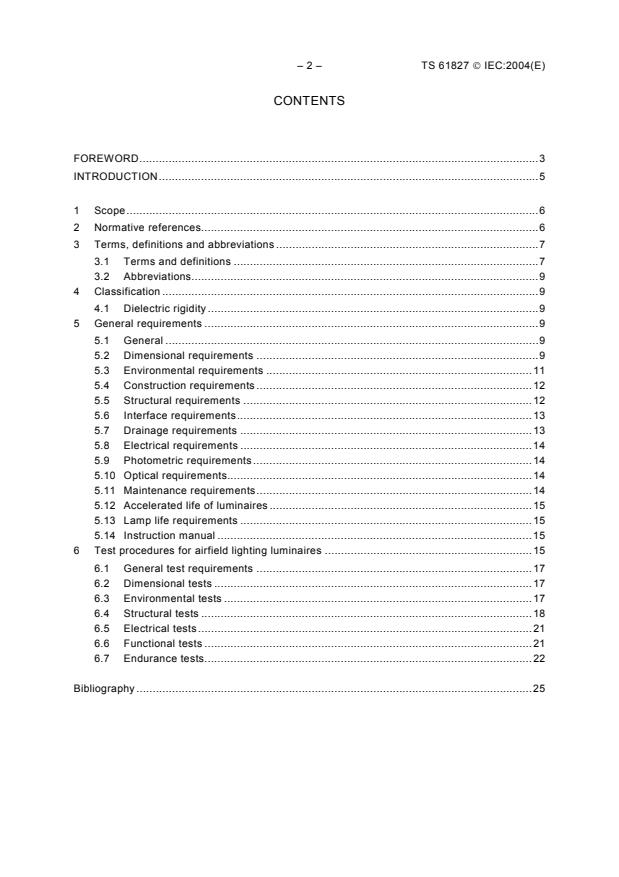
CONTENTS
FOREWORD.3
INTRODUCTION.5
1 Scope.6
2 Normative references.6
3 Terms, definitions and abbreviations .7
3.1 Terms and definitions .7
3.2 Abbreviations.9
4 Classification.9
4.1 Dielectric rigidity.9
5 General requirements.9
5.1 General.9
5.2 Dimensional requirements.9
5.3 Environmental requirements.11
5.4 Construction requirements.12
5.5 Structural requirements.12
5.6 Interface requirements.13
5.7 Drainage requirements.13
5.8 Electrical requirements.14
5.9 Photometric requirements.14
5.10 Optical requirements.14
5.11 Maintenance requirements.14
5.12 Accelerated life of luminaires .15
5.13 Lamp life requirements .15
5.14 Instruction manual.15
6 Test procedures for airfield lighting luminaires .15
6.1 General test requirements .17
6.2 Dimensional tests.17
6.3 Environmental tests.17
6.4 Structural tests.18
6.5 Electrical tests.21
6.6 Functional tests.21
6.7 Endurance tests.22
Bibliography .25
TS 61827 IEC:2004(E) – 3 –
INTERNATIONAL ELECTROTECHNICAL COMMISSION
___________
ELECTRICAL INSTALLATIONS FOR LIGHTING
AND BEACONING OF AERODROMES –
CHARACTERISTICS OF INSET AND ELEVATED LUMINAIRES
USED ON AERODROMES AND HELIPORTS
FOREWORD
1) The International Electrotechnical Commission (IEC) is a worldwide organization for standardization comprising
all national electrotechnical committees (IEC National Committees). The object of IEC is to promote
international co-operation on all questions concerning standardization in the electrical and electronic fields. To
this end and in addition to other activities, IEC publishes International Standards, Technical Specifications,
Technical Reports, Publicly Available Specifications (PAS) and Guides (hereafter referred to as “IEC
Publication(s)”). Their preparation is entrusted to technical committees; any IEC National Committee interested
in the subject dealt with may participate in this preparatory work. International, governmental and non-
governmental organizations liaising with the IEC also participate in this preparation. IEC collaborates closely
with the International Organization for Standardization (ISO) in accordance with conditions determined by
agreement between the two organizations.
2) The formal decisions or agreements of IEC on technical matters express, as nearly as possible, an international
consensus of opinion on the relevant subjects since each technical committee has representation from all
interested IEC National Committees.
3) IEC Publications have the form of recommendations for international use and are accepted by IEC National
Committees in that sense. While all reasonable efforts are made to ensure that the technical content of IEC
Publications is accurate, IEC cannot be held responsible for the way in which they are used or for any
misinterpretation by any end user.
4) In order to promote international uniformity, IEC National Committees undertake to apply IEC Publications
transparently to the maximum extent possible in their national and regional publications. Any divergence
between any IEC Publication and the corresponding national or regional publication shall be clearly indicated in
the latter.
5) IEC provides no marking procedure to indicate its approval and cannot be rendered responsible for any
equipment declared to be in conformity with an IEC Publication.
6) All users should ensure that they have the latest edition of this publication.
7) No liability shall attach to IEC or its directors, employees, servants or agents including individual experts and
members of its technical committees and IEC National Committees for any personal injury, property damage or
other damage of any nature whatsoever, whether direct or indirect, or for costs (including legal fees) and
expenses arising out of the publication, use of, or reliance upon, this IEC Publication or any other IEC
Publications.
8) Attention is drawn to the Normative references cited in this publication. Use of the referenced publications is
indispensable for the correct application of this publication.
9) Attention is drawn to the possibility that some of the elements of this IEC Publication may be the subject of
patent rights. IEC shall not be held responsible for identifying any or all such patent rights.
The main task of IEC technical committees is to prepare International Standards. In
exceptional circumstances, a technical committee may propose the publication of a Technical
Specification when
• the required support cannot be obtained for the publication of an International Standard,
despite repeated efforts, or
• the subject is still under technical development or where, for any other reason, there is the
future but no immediate possibility of an agreement on an International Standard.
Technical Specifications are subject to review within three years of publication to decide
whether they can be transformed into International Standards.
IEC 61827, which is a Technical Specification, has been prepared by IEC technical
committee 97: Electrical installations for lighting and beaconing of aerodromes.
– 4 – TS 61827 IEC:2004(E)
The text of this Technical Specification is based on the following documents:
Enquiry draft Report on voting
97/98A/DTS 97/99/RVC
Full information on the voting for the approval of this Technical Specification can be found in
the report on voting indicated in the above table.
This publication has been drafted in accordance with the ISO/IEC Directives, Part 2.
The committee has decided that the contents of this publication will remain unchanged until
2007. At this date, the publication will be
• reconfirmed;
• withdrawn;
• replaced by a revised edition, or
• amended.
A bilingual version of this Technical Specification may be issued at a later date.
TS 61827 IEC:2004(E) – 5 –
INTRODUCTION
Aeronautical ground lighting (AGL) at an aerodrome or heliport provides the pilot of an aircraft
with location, orientation and alignment information in adverse visibility conditions and at night.
This includes those aircraft in flight, i.e. on approach to or take off from the aerodrome, and
those aircraft and other vehicles moving on the aerodrome surface. The type of lighting is
dependent upon the aerodrome operations, type and density of traffic, aerodrome layout and
other environmental considerations and may be realised in many different forms. For the
purpose of this Technical Specification, the various types of lighting, referred to as AGL
services, are considered as components of the overall AGL system.
This Technical Specification describes the system component requirements and it deals with
the inset and elevated luminaires used in AGL.
This Technical Specification should be considered with the AGL requirements produced by the
International Civil Aviation Organisation (ICAO). ICAO requirements are published in the form
of annexes to the Chicago Convention on International Civil Aviation (1944) to which signatory
nations apply to the air traffic and navigation services within their control regions. The annexes
contain Standards and Recommended Practices (SARPs), describing performance
requirements, based on operational requirements, for the safety, regularity or efficiency of
international air navigation. Other ICAO publications contain additional procedures,
performance specifications and guidance material for the interpretation and implementation of
the SARPs.
Annex 14, Aerodromes (Volumes I and II), to the Convention contains the requirements for
aerodrome and heliport operations and includes those aspects relating to AGL. The Aerodrome
Design Manual Doc. 9157 Part 4 (Visual Aids) contains guidance material on the interpretation
of the AGL requirements in Annex 14, Aerodromes. Part 5 of the Aerodrome Design Manual
Doc. 9157 (Electrical Systems) contains technical information on the electrical supply and
installation of AGL Systems. Recommended maintenance policies and practices for AGL
Systems are contained in Part 9 of the Airport Services Manual Doc. 9137 (Airport Maintenance
Practices).
The safety and technical specifications, requirements and working practices within this
International Technical Specification are intended to be compatible with the Standards and
Recommended Practices contained in Annex 14, Aerodromes and to complement the
information contained in the Aerodrome Design Manual Doc. 9157 and the Aerodrome Services
Manual Part 9 (Aerodrome Maintenance Practices).
The AGL system will evolve with the introduction of new technology and the implementation of
new operational requirements. The general requirements for the AGL system in this Technical
Specification are therefore to be considered generic.
To conform to this Technical Specification, it should be demonstrated to the relevant bodies
that the requirements have been satisfied and therefore that the clause objective(s) has been
met.
NOTE 1 Examples of relevant bodies would include the following:
• aerodrome management;
• certification and licensing authorities;
• safety regulators;
• notified bodies for international or European directives;
• national standards bodies.
– 6 – TS 61827 IEC:2004(E)
ELECTRICAL INSTALLATIONS FOR LIGHTING
AND BEACONING OF AERODROMES –
CHARACTERISTICS OF INSET AND ELEVATED LUMINAIRES
USED ON AERODROMES AND HELIPORTS
1 Scope
This Technical Specification defines the requirements and testing procedures for inset and
elevated luminaires with lamps used in aeronautical ground lighting systems and excluding
luminaires for general lighting.
This Technical Specification is applicable to inset or elevated luminaires used for:
– approach lights: centreline, crossbars, supplementary approach;
– runway lights: runway guard, threshold, threshold wingbar, centreline, edge, touch down
zone, runway end, stopway lights;
– taxiway lights : centreline, edge, stopbar, intermediate holding position lights;
– heliports: aiming point, perimeter, fato luminaires.
The purpose of this Technical Specification is to provide a set of requirements and tests, which
are applicable to the luminaires and their control equipment. In general, this Technical
Specification includes safety requirements for the luminaires.
This Technical Specification is not applicable to visual approach slope indicator systems (PAPI
(precision approach path indicators) etc.) and signs. Any other equipment not described in this
Technical Specification is excluded from its scope.
2 Normative references
The following referenced documents are indispensable for the application of this document. For
dated references, only the edition cited applies. For undated references, the latest edition of
the referenced document (including any amendments) applies.
IEC 60068-2-5, Environmental testing – Part 2: Tests. Test Sa: Simulated solar radiation at
ground level
IEC 60068-2-9, Environmental testing – Part 2: Tests. Guidance for solar radiation testing
IEC 60068-2-11, Environmental testing – Part 2: Tests. Test Ka: Salt mist
IEC 60068-2-52, Environmental testing – Part 2: Tests – Test Kb: Salt mist, cyclic (sodium
chloride solution)
IEC 60417-DB:2002 , Graphical symbols for use on equipment
IEC 60598-1: 2003, Luminaires – Part 1: General requirements and tests
IEC 61000-6-2, Electromagnetic compatibility (EMC) – Part 6-2: Generic standards – Immunity
for industrial environments
___________
"DB" refers to the IEC on-line database.
TS 61827 IEC:2004(E) – 7 –
IEC 61000-6-4, Electromagnetic compatibility (EMC) – Part 6: Generic standards – Section 4:
Emission standard for industrial environments
IEC 61821, Electrical installations for lighting and beaconing of aerodromes – Maintenance of
aeronautical ground lighting constant current series circuits
IEC 61822, Electrical installations for lighting and beaconing of aerodromes – Constant current
regulators
IEC 61823, Electrical installations for lighting and beaconing of aerodromes – AGL series
transformers
ISO 2859 (all parts), Sampling procedures for inspection by attributes
ICAO Annex 14: Aerodromes – Volume I: Aerodrome Design and Operations [Annex 14 to the
Convention on International Civil Aviation, International Standards and Recommended
Practices]
ICAO Annex 14: Aerodromes – Volume II: Heliports [Annex 14 to the Convention on
International Civil Aviation, International Standards and Recommended Practices]
ICAO 9137, Airport Services Manual (Doc 9137) Part 9 — Airport Maintenance Practices
ICAO 9157, Aerodrome Design Manual (Doc 9157) Part 4 — Visual Aids
ICAO 9157, Aerodrome Design Manual (Doc 9157) Part 5 — Electrical Systems
.
3 Terms, definitions and abbreviations
3.1 Terms and definitions
For the purposes of this document, the following terms and definitions apply:
3.1.1
(aerodrome and heliport) luminaire
apparatus which distributes, filters or transforms the light transmitted from one or more lamps
and which includes all the parts necessary for supporting, aiming, fixing and protecting the
lamps, but not the lamps themselves and, where necessary, circuit auxiliaries together with the
means for connecting them to supply
NOTE Aerodrome luminaires will be identified as luminaires in this Technical Specification.
3.1.2
elevated luminaire
luminaire above ground in values more than 40 mm and designed to break, distort or yield on
impact so as to present the minimum hazard to aircraft
3.1.3
inset luminaire
luminaire installed inside the pavement of the movement area of an aerodrome and heliport,
protruding 40 mm or less above grade and capable of withstanding the load of a standing or
moving aircraft
– 8 – TS 61827 IEC:2004(E)
3.1.4
omni-directional luminaires
luminaire with a fixed light output that shows light about a vertical angle for the specified
application at all angles in the azimuth
3.1.5
lamp
source made in order to produce an optical radiation, usually visible
(IEV 845-07-03)
3.1.6
incandescent (electric) lamp
lamp in which light is produced by means of an element heated to incandescence by the
passage of an electric current
(IEV 845-07-04)
3.1.7
base
installation accessory made to be fastened into a pavement possessing structural strength
equal to the surrounding pavement and properties allowing to transfer the heating from the
luminaire and the load imposed by standing or moving aircraft
3.1.8
interface
standard flange connection between the base and the luminaire or other accessory intended to
remain firmly fastened when exposed to forces acting on them
3.1.9
type test
test to ascertain that one or more luminaires, made to a certain design, meet(s) applicable
specifications
3.1.10
acceptance test
agreed procedure between any manufacturer and his customer, which allows the customer to
check if the supplied equipment meets the technical specifications of the product
3.1.11
type test sample
sample consisting of one or more similar units submitted by the manufacturer for the purpose
of a type test
3.1.12
lamp life
life of a batch of lamps with the lamps operated at rated current and/or voltage
3.1.13
useful lamp life
time during which the lamp, installed in the luminaire and operated at rated current and/or
voltage, will produce 50 % of the required luminous intensity as specified in ICAO Annex 14
3.1.14
standard useful lamp life
under given conditions, the operating time of a lamp, installed in the luminaire and powered at
rated current and/or voltage, beginning at a given instant of time and ending when the
photometric intensity becomes unacceptable
TS 61827 IEC:2004(E) – 9 –
3.2 Abbreviations
Abbreviations used in this Technical Specification include:
O DIA Outer diameter of a luminaire
BC DIA Bolt circle diameter of a luminaire
IC DIA Inner clearance diameter of a luminaire
The explanation of each term is shown in Figure 1.
4 Classification
Classification for inset luminaires used in this Technical Specification includes:
Table 1 – Inset luminaires classification
Classification Maximum height above ground
mm
Style 1 40
Style 2 25
Style 3 13
Style 4 6
4.1 Dielectric rigidity
The luminaires shall be classified according to Section 10 of IEC 60598-1.
5 General requirements
5.1 General
This Technical Specification covers the requirements for inset and elevated luminaires used on
aerodrome and heliport runways and taxiways.
5.1.1 Marking
A nameplate shall be securely attached to the luminaire and contain at least the following
information:
– manufacturer’s name and luminaire identification;
– lamp type number and wattage;
– serial number.
5.2 Dimensional requirements
5.2.1 Inset luminaires
The slope α of the top surface of the luminaire, which protrudes above finish grade, shall not
exceed 20° as shown in Figure 1. All recesses shall be provided with «running-on surfaces» on
all sides. The construction of the recesses shall have no influence on the slope of the run-on
surface.
– 10 – TS 61827 IEC:2004(E)
The flange thickness of the band of the inset luminaire as specified in Figure 1 shall be 19 mm
for sizes 1, 2 and 3 and 32 mm for size 4. The inset luminaire maximum height above ground
shall be one of the values shown in Table 1.
The definition of slope does not
include inner shape of the light
channel
Outer diameter (O DIA)
Bolt circle diameter (BC DIA)
Inner clearence diameter (IC DIA)
IEC 509/04
Figure 1 – Dimensions of inset luminaires
The diameters of the luminaires as shown in Figure 1 shall be of one of the four sizes specified
in Table 2.
Table 2 – Specifications of dimensions of inset luminaires
References of diameters Size 1 Size 2 Size 3 Size 4
mm mm mm mm
O DIA ± 0,5 mm 203 254 304 438
BC DIA ± 0,2 mm 184 235 286 362
165 201 252,2 312
IC DIA ± 0,2 mm
The diameter of the luminaire hole shall accommodate a M10 bolt or stud. Location of fixation
holes on the bolt circle is shown in Figure 2.
TS 61827 IEC:2004(E) – 11 –
Sizes 2, 3 and 4
IEC 510/04
NOTE For size 1, both methods of fixation, using respectively 2 or 4 bolts or screws, are accepted. In case of
using 2 bolts or screws, the holes on the top left and bottom right will be used.
Figure 2 – Location of fixation holes on the bolt circle
5.2.2 Elevated luminaires
The overall height of an elevated luminaire intended to be used within the runway or taxiway
safety area shall not exceed 350 mm above pavement except for heliports where the height
limit shall be 250 mm. In case of elevated runway guard lights, the height shall not exceed
650 mm.
These heights could be increased with the approval of the competent aerodrome authority.
5.3 Environmental requirements
The luminaires shall achieve specified performance under the following environmental
conditions.
5.3.1 Temperature
The luminaires shall withstand the exposure to any temperature from −55 °C to + 55 °C.
5.3.2 Thermal shock
The luminaires shall withstand the exposure of the hot luminaire to cold water spray.
5.3.3 Corrosion
The luminaires shall withstand the exposure to a corrosive salt atmosphere in accordance with
IEC 60068-2-11 and IEC 60068-2-52.
NOTE Various de-icing or chemical agents may be utilised at aerodromes; therefore, corrosion is the minimum
performance requirement.
5.3.4 Moisture
The elevated luminaires shall withstand the exposure to moisture, snow, ice and standing water
in accordance with Section 9 of IEC 60598-1. The degree of protection provided by the
enclosure shall be at least IP24.
– 12 – TS 61827 IEC:2004(E)
5.3.5 Solar radiation
The elevated luminaires shall withstand the exposure to solar radiation in accordance with
IEC 60068-2-5 and IEC 60068-2-9.
5.3.6 EMC
The luminaires shall comply with the EMC requirements specified in IEC 61000-6-2 for
immunity and IEC 61000-6-4 for emission.
5.4 Construction requirements
5.4.1 Design and construction requirements
The luminaires described in this Technical Specification should be installed directly in the
ground or pavement or on a mounting interface. All the metal parts as well as their contact
surfaces with other metals shall resist a corrosive environment. All surfaces of the finished top
assembly shall be smooth, without burrs or sharp edges.
For inset luminaires, all edges above the pavement shall be rounded to not less than 1,5 mm
radius, and the surface on the luminaire that mates with the base flange shall provide good
load transfer and shall have a smooth mating surface.
5.4.2 Terminations
The luminaire powered by a series circuit shall be provided with a connection device to connect
to the secondary lead of the AGL series transformer specified in IEC 61823. Earthing
terminal(s), if required, shall be provided and shall be clearly indicated by the appropriate
symbol shown in IEC 60417.
5.5 Structural requirements
5.5.1 Inset luminaires
5.5.1.1 Static load
When installed according to the manufacturer’s recommendations, the luminaire assembly
shall withstand a total static load in kilograms of 32 times the top area of the luminaire in cm ,
distributed uniformly over the top surface.
5.5.1.2 Shear load
The luminaire assembly shall withstand a shear load of 13 600 N applied to the top of the
luminaire in any direction parallel to the mounting surface.
5.5.1.3 Mechanical impact
The luminaire assembly, except omni-directional luminaires, shall withstand the repeated
impact of a steel ball dropped with energy of 40 J.
5.5.1.4 Hydraulic impact
The top of the luminaire assembly, except omni-directional luminaires, shall withstand a
momentary hydraulic pressure of 1 380 kPa (all surfaces exposed when installed according to
manufacturer recommendations).
TS 61827 IEC:2004(E) – 13 –
5.5.1.5 Vibration
Inset luminaire assemblies with lamp(s), installed and shunted, shall withstand vibration along
any axis without damage. They shall withstand an acceleration of 15 G when vibrated at
frequencies between 20 Hz and 2 000 Hz and operating at rated current.
If a lamp fails, a new lamp installed in the luminaire but not shunted shall withstand an
acceleration of 3 G when vibrated between 20 Hz and 2 000 Hz and operating at rated current.
5.5.1.6 Watertightness
The subassembly
...
Questions, Comments and Discussion
Ask us and Technical Secretary will try to provide an answer. You can facilitate discussion about the standard in here.
Loading comments...