


IEC 61770:1998
(Main)Electric appliances connected to the water mains - Avoidance of backsiphonage and failure of hose-sets
Electric appliances connected to the water mains - Avoidance of backsiphonage and failure of hose-sets
Specifies requirements for the connection of appliances to the water mains to prevent backsiphonage of non-potable water into the water mains and flooding due to failure of hose-sets. Appliances include washing machines, dishwashers and other appliances. This includes domestic appliances and those in shops and communal flats. The water pressure is not to exceed 1 MPa. Connection may be temporary or permanent.
General Information
- Status
- Published
- Publication Date
- 15-Oct-1998
- Technical Committee
- TC 61 - Safety of household and similar electrical appliances
- Current Stage
- DELPUB - Deleted Publication
- Start Date
- 23-Jul-2008
- Completion Date
- 13-Feb-2026
Relations
- Effective Date
- 05-Sep-2023
- Effective Date
- 05-Sep-2023
- Effective Date
- 05-Sep-2023
Overview
IEC 61770:1998 - "Electric appliances connected to the water mains – Avoidance of backsiphonage and failure of hose-sets" specifies safety requirements for connecting household and similar electric appliances (for example washing machines, dishwashers and condensation-type tumble dryers) to potable water mains. The standard’s objective is to prevent backsiphonage of non‑potable water into the water mains and to minimize flooding caused by hose‑set failure. It applies to domestic appliances and to appliances in shops and communal flats, for water pressures up to 1 MPa (static pressure limit).
Key topics and requirements
- Scope and definitions: Clarifies potable vs non‑potable water, backflow prevention devices (airgaps, pipe interrupters, dynamic backflow preventers), maximum and critical water levels, hose‑sets and detachable parts.
- Placement of backflow prevention: A backflow prevention device must be located downstream of each water inlet. For appliances with a water softener upstream of an airgap/pipe interrupter, a dynamic backflow preventer is required upstream of the softener.
- Device integrity: Backflow devices must be built so their function cannot be altered, removable only with a tool, and omission renders the appliance inoperable or manifestly incomplete.
- Airgap rules: Airgaps must allow free airflow and drainage; the airgap length must be at least twice the smallest internal pipe diameter, with a minimum of 20 mm, and a clear downward space of 20 mm from the feed pipe outlet.
- Pipe interrupters: Air‑inlet openings must remain permanently open, have total cross‑sectional area at least equal to the water‑inlet, and each opening must have a minimum dimension of 3 mm.
- Hose‑sets: Designed to minimize flooding risk and tested (kinking, pulse resistance, ozone, flexing, bending, impact etc.) - tests are specified and typically applied to multiple samples (three samples, with retest rules if one fails).
- Materials: Metallic parts that affect compliance must resist erosion, dezincification and corrosion.
- Test conditions: Normal and fault test conditions are defined (e.g., appliance orientation, blocked overflows or dispensers, water pressure requirements). Annex A contains a backsiphonage test.
Applications and users
IEC 61770 is primarily used by:
- Appliance manufacturers (design and production of washing machines, dishwashers, tumble dryers)
- Product safety engineers and compliance/test laboratories
- Certification bodies and regulators concerned with potable water protection
- Installers and building managers specifying compliant connections to water mains
Implementing IEC 61770 helps prevent potable water contamination and reduces flood risk from hose or connector failure.
Related standards
- Normative reference: IEC 60730-2-8 (automatic electrical controls - requirements for electrically operated water valves).
- Consult local plumbing and potable water regulations for national requirements on backflow protection and materials.
IEC 61770:1998 - Electric appliances connected to the water mains - Avoidance of backsiphonage and failure of hose-sets Released:10/16/1998 Isbn:2831845270
IEC 61770:1998 - Electric appliances connected to the water mains - Avoidance of backsiphonage and failure of hose-sets Released:10/16/1998 Isbn:2831848156
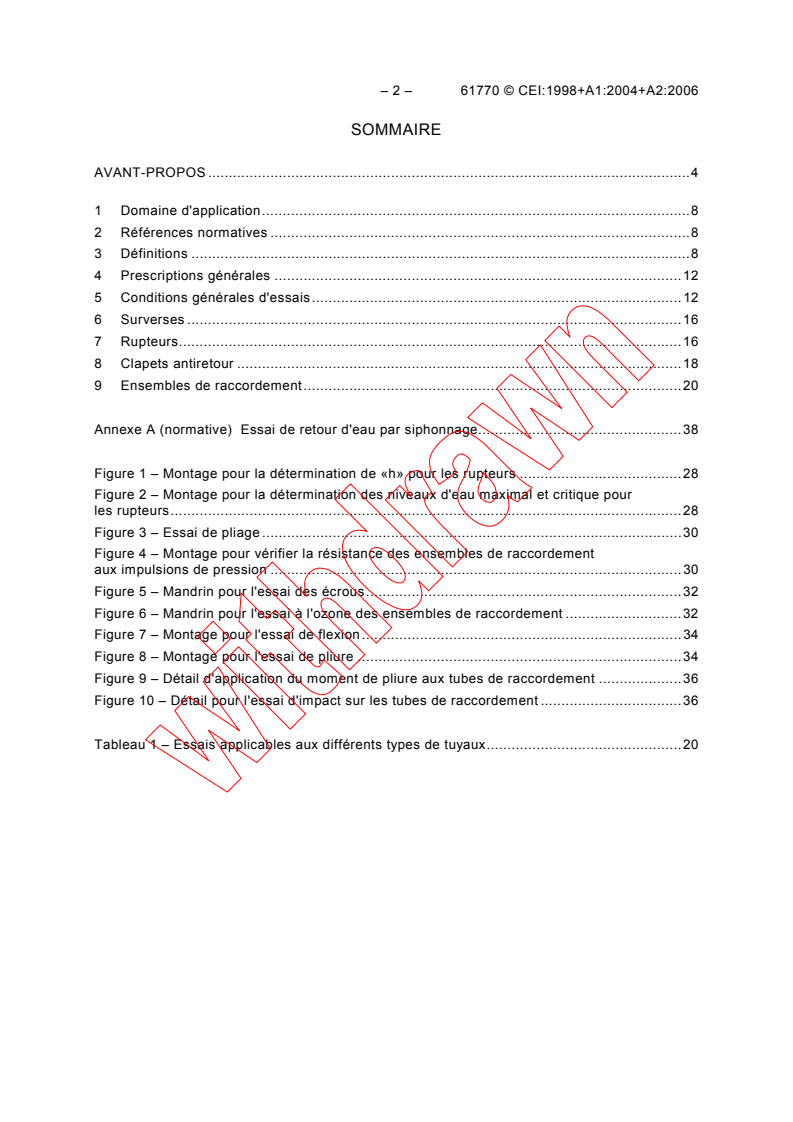
IEC 61770:1998+AMD1:2004+AMD2:2006 CSV - Electric appliances connected to the water mains - Avoidance of backsiphonage and failure of hose-sets Released:5/29/2006 Isbn:2831886198
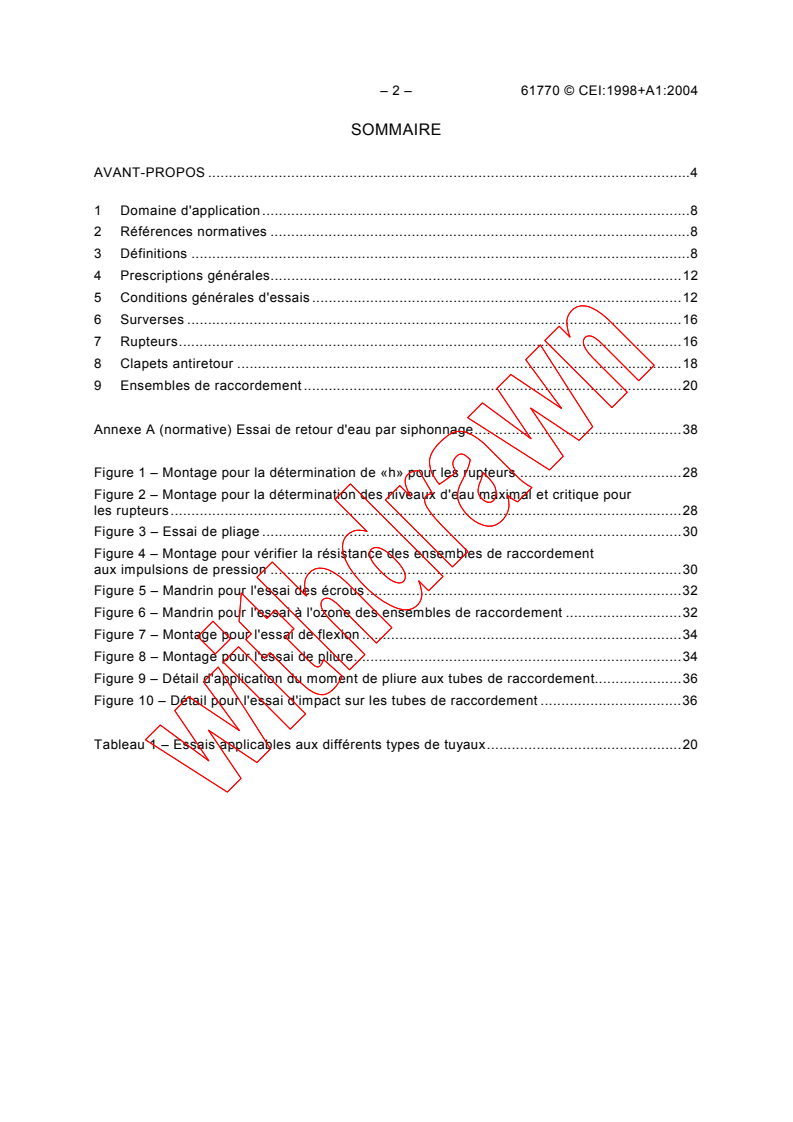
IEC 61770:1998+AMD1:2004 CSV - Electric appliances connected to the water mains - Avoidance of backsiphonage and failure of hose-sets Released:3/17/2004 Isbn:2831874033
Get Certified
Connect with accredited certification bodies for this standard

ICC Evaluation Service
Building products evaluation and certification.

QAI Laboratories
Building and construction product testing and certification.

Aboma Certification B.V.
Specialized in construction, metal, and transport sectors.
Sponsored listings
Frequently Asked Questions
IEC 61770:1998 is a standard published by the International Electrotechnical Commission (IEC). Its full title is "Electric appliances connected to the water mains - Avoidance of backsiphonage and failure of hose-sets". This standard covers: Specifies requirements for the connection of appliances to the water mains to prevent backsiphonage of non-potable water into the water mains and flooding due to failure of hose-sets. Appliances include washing machines, dishwashers and other appliances. This includes domestic appliances and those in shops and communal flats. The water pressure is not to exceed 1 MPa. Connection may be temporary or permanent.
Specifies requirements for the connection of appliances to the water mains to prevent backsiphonage of non-potable water into the water mains and flooding due to failure of hose-sets. Appliances include washing machines, dishwashers and other appliances. This includes domestic appliances and those in shops and communal flats. The water pressure is not to exceed 1 MPa. Connection may be temporary or permanent.
IEC 61770:1998 is classified under the following ICS (International Classification for Standards) categories: 91.140.60 - Water supply systems; 97.030 - Domestic electrical appliances in general. The ICS classification helps identify the subject area and facilitates finding related standards.
IEC 61770:1998 has the following relationships with other standards: It is inter standard links to IEC 61770:1998/AMD1:2004, IEC 61770:1998/AMD2:2006, IEC 61770:2008. Understanding these relationships helps ensure you are using the most current and applicable version of the standard.
IEC 61770:1998 is available in PDF format for immediate download after purchase. The document can be added to your cart and obtained through the secure checkout process. Digital delivery ensures instant access to the complete standard document.
Standards Content (Sample)
INTERNATIONAL
IEC
STANDARD
First edition
1998-10
Electric appliances connected to the water mains –
Avoidance of backsiphonage
and failure of hose-sets
Reference number
Numbering
As from 1 January 1997 all IEC publications are issued with a designation in the
60000 series.
Consolidated publications
Consolidated versions of some IEC publications including amendments are
available. For example, edition numbers 1.0, 1.1 and 1.2 refer, respectively, to the
base publication, the base publication incorporating amendment 1 and the base
publication incorporating amendments 1 and 2.
Validity of this publication
The technical content of IEC publications is kept under constant review by the IEC,
thus ensuring that the content reflects current technology.
Information relating to the date of the reconfirmation of the publication is available
in the IEC catalogue.
Information on the subjects under consideration and work in progress undertaken by
the technical committee which has prepared this publication, as well as the list of
publications issued, is to be found at the following IEC sources:
• IEC web site*
• Catalogue of IEC publications
Published yearly with regular updates
(On-line catalogue)*
• IEC Bulletin
Available both at the IEC web site* and as a printed periodical
Terminology, graphical and letter symbols
For general terminology, readers are referred to IEC 60050: International
Electrotechnical Vocabulary (IEV).
For graphical symbols, and letter symbols and signs approved by the IEC for
general use, readers are referred to publications IEC 60027: Letter symbols to be
used in electrical technology, IEC 60417: Graphical symbols for use on equipment.
Index, survey and compilation of the single sheets and IEC 60617: Graphical symbols
for diagrams.
* See web site address on title page.
INTERNATIONAL
IEC
STANDARD
First edition
1998-10
Electric appliances connected to the water mains –
Avoidance of backsiphonage
and failure of hose-sets
IEC 1998 Copyright - all rights reserved
No part of this publication may be reproduced or utilized in any form or by any means, electronic or
mechanical, including photocopying and microfilm, without permission in writing from the publisher.
International Electrotechnical Commission 3, rue de Varembé Geneva, Switzerland
Telefax: +41 22 919 0300 e-mail: inmail@iec.ch IEC web site http: //www.iec.ch
Commission Electrotechnique Internationale
PRICE CODE
R
International Electrotechnical Commission
For price, see current catalogue
– 2 – 61770 © IEC:1998(E)
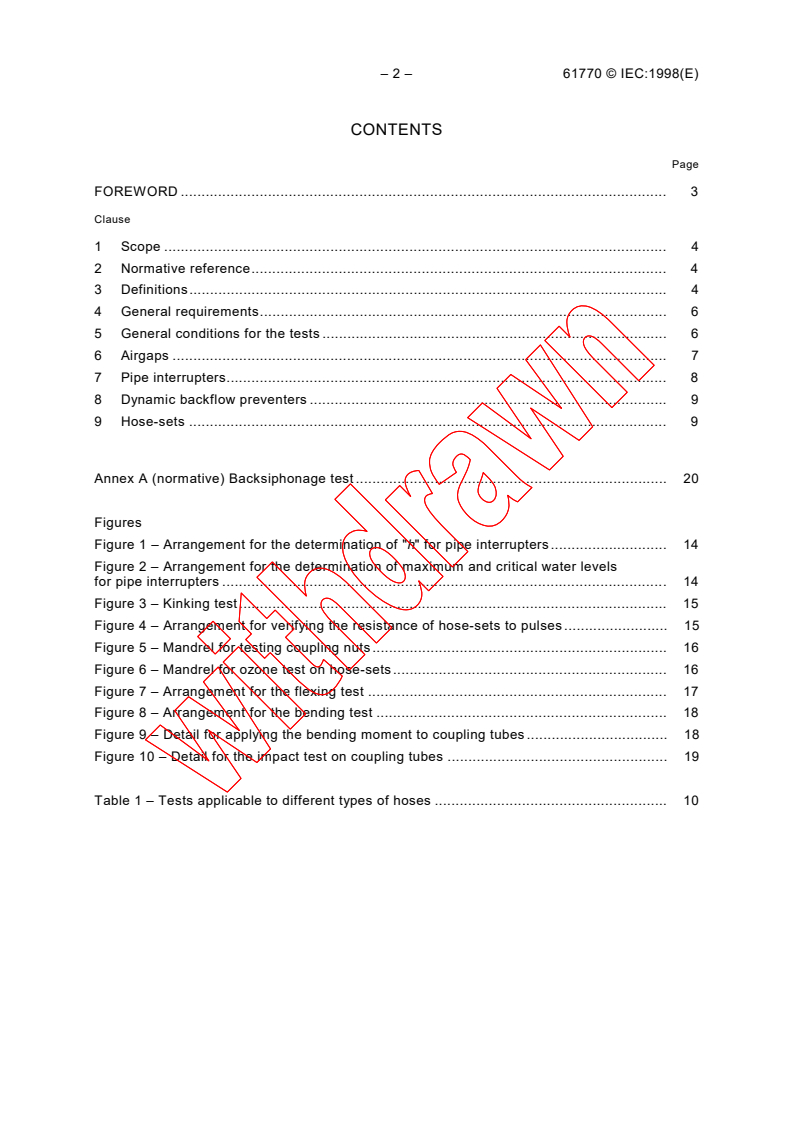
CONTENTS
Page
FOREWORD . 3
Clause
1 Scope . 4
2 Normative reference. 4
3 Definitions. 4
4 General requirements. 6
5 General conditions for the tests . 6
6 Airgaps . 7
7 Pipe interrupters. 8
8 Dynamic backflow preventers . 9
9 Hose-sets . 9
Annex A (normative) Backsiphonage test . 20
Figures
Figure 1 – Arrangement for the determination of "h" for pipe interrupters. 14
Figure 2 – Arrangement for the determination of maximum and critical water levels
for pipe interrupters .14
Figure 3 – Kinking test. 15
Figure 4 – Arrangement for verifying the resistance of hose-sets to pulses . 15
Figure 5 – Mandrel for testing coupling nuts. 16
Figure 6 – Mandrel for ozone test on hose-sets. 16
Figure 7 – Arrangement for the flexing test . 17
Figure 8 – Arrangement for the bending test . 18
Figure 9 – Detail for applying the bending moment to coupling tubes . 18
Figure 10 – Detail for the impact test on coupling tubes . 19
Table 1 – Tests applicable to different types of hoses . 10
61770 © IEC:1998(E) – 3 –
INTERNATIONAL ELECTROTECHNICAL COMMISSION
––––––––––––
ELECTRIC APPLIANCES CONNECTED TO THE WATER MAINS –
AVOIDANCE OF BACKSIPHONAGE AND FAILURE OF HOSE-SETS
FOREWORD
1) The IEC (International Electrotechnical Commission) is a worldwide organization for standardization comprising
all national electrotechnical committees (IEC National Committees). The object of the IEC is to promote
international co-operation on all questions concerning standardization in the electrical and electronic fields. To
this end and in addition to other activities, the IEC publishes International Standards. Their preparation is
entrusted to technical committees; any IEC National Committee interested in the subject dealt with may
participate in this preparatory work. International, governmental and non-governmental organizations liaising
with the IEC also participate in this preparation. The IEC collaborates closely with the International Organization
for Standardization (ISO) in accordance with conditions determined by agreement between the two
organizations.
2) The formal decisions or agreements of the IEC on technical matters express, as nearly as possible, an
international consensus of opinion on the relevant subjects since each technical committee has representation
from all interested National Committees.
3) The documents produced have the form of recommendations for international use and are published in the form
of standards, technical reports or guides and they are accepted by the National Committees in that sense.
4) In order to promote international unification, IEC National Committees undertake to apply IEC International
Standards transparently to the maximum extent possible in their national and regional standards. Any
divergence between the IEC Standard and the corresponding national or regional standard shall be clearly
indicated in the latter.
5) The IEC provides no marking procedure to indicate its approval and cannot be rendered responsible for any
equipment declared to be in conformity with one of its standards.
6) Attention is drawn to the possibility that some of the elements of this International Standard may be the subject
of patent rights. The IEC shall not be held responsible for identifying any or all such patent rights.
International Standard IEC 61770 has been prepared by IEC technical committee 61: Safety of
household and similar electrical appliances.
The text of this standard is based on the following documents:
FDIS Report on voting
61/1480/FDIS 61/1519/RVD
Full information on the voting for the approval of this standard can be found in the report on
voting indicated in the above table.
NOTE – The following print types are used:
– requirements: in roman type;
– test specifications: in italic type;
– notes: in small roman type.
Words in bold in the text are defined in clause 3.
– 4 – 61770 © IEC:1998(E)
ELECTRIC APPLIANCES CONNECTED TO THE WATER MAINS –
AVOIDANCE OF BACKSIPHONAGE AND FAILURE OF HOSE-SETS
1 Scope
This standard specifies requirements for the connection of washing machines, dishwashers
and condensation-type tumble dryers to the water mains having a water pressure not
exceeding 1 MPa for prevention of backsiphonage of non-potable water into the water mains
and flooding due to failure of hose-sets.
This standard may also be applied to the connection of other appliances as long as the
relevant safety standard refers to it but modifications may be necessary.
NOTE 1 – This standard covers the connection of appliances in shops and communal flats, for the use by staff or
residents.
NOTE 2 – This standard does not apply to appliances:
– used for dry cleaning;
– for medical purposes;
– intended for industrial purposes.
NOTE 3 – The connection of the appliance to the water mains may be temporary or permanent.
NOTE 4 – When reference is made to the water mains, water supplied from a cistern or similar system is also
included.
NOTE 5 – Many countries have requirements concerning the prevention of contamination of potable water as a
result of contact with unsuitable materials upstream of a safety device.
2 Normative reference
The following normative document contains provisions which, through reference in this text,
constitutes provisions of this International Standard. At the time of publication, the edition
indicated was valid. All normative documents are subject to revision, and parties to agreements
based on this International Standard are encouraged to investigate the possibility of applying
the most recent editionsof the normative document indicated below. Members of IEC and ISO
maintain registers of currently valid International Standards.
IEC 60730-2-8:1992, Automatic electrical controls for household and similar use – Part 2:
Particular requirements for electrically operated water valves, including mechanical
requirements
3 Definitions
For the purpose of this standard, the following definitions apply.
3.1
potable water
water which is obtained directly from the potable water mains and remains in a closed system
up to the backflow prevention device
61770 © IEC:1998(E) – 5 –
3.2
non-potable water
water which leaves the closed system after having passed the backflow prevention device
3.3
backflow prevention device
means to prevent contamination of potable water by backflow of non-potable water
NOTE – Examples are airgaps and pipe interrupters.
3.4
airgap
unobstructed free distance between the water inlet or the end of the feed pipe and the critical
water level
NOTE – A distance is considered to be unobstructed if the airflow into the feed pipe under vacuum conditions is not
restricted by the construction of the appliance.
3.5
pipe interrupter
device without movable or elastomeric parts, into which air can enter while water is passing
through it
3.6
dynamic backflow preventer
backflow prevention device which prevents backsiphonage by the use of moving parts
3.7
overflow
means for discharging excess water from the appliance when the normal outlet is obstructed
3.8
maximum water level
highest level of the non-potable water in any part of the appliance when it operates
continuously under fault conditions
3.9
critical water level
level to which the non-potable water is reduced from the maximum water level 2 s after
water inlets have been closed
3.10
hose-set
assembly consisting of a flexible hose and couplings
NOTE 1 – The hose-set is for connecting the appliance upstream of the backflow prevention device to the water
mains.
NOTE 2 – Couplings may be removable with or without the aid of a tool.
3.11
detachable part
part which can be removed without the aid of a tool
– 6 – 61770 © IEC:1998(E)
4 General requirements
4.1 Appliances shall have a backflow prevention device located downstream of each water
inlet valve.
For appliances incorporating a water softener located upstream of an airgap or pipe interrupter,
a dynamic backflow preventer shall be incorporated upstream of the water softener.
Dispensers for adding cleaning, rinsing, softening or similar agents to the water, shall not be
located upstream of the backflow prevention device.
Pipework containing potable water located upstream of a backflow prevention device shall
not pass through non-potable water in the appliance.
Compliance is checked by inspection.
NOTE – For a given point in a hydraulic system, "upstream" indicates the side from which the water flows and
"downstream" indicates the side to which the water flows.
4.2 Backflow prevention devices shall be incorporated in the appliance and constructed so
that
– their functional characteristics cannot be changed, even intentionally,
– they can only be removed with the aid of a tool,
– if omitted, the appliance is rendered inoperable or manifestly incomplete.
Compliance is checked by inspection and by manual tests.
4.3 Hose-sets for the connection of appliances to the water mains shall be constructed so
that the risk of flooding is obviated as far as possible.
Compliance is checked by the tests of clause 9.
Metallic parts of the water connection system of the appliance, the deterioration of which
4.4
may cause the appliance to fail to comply with the requirements of this standard, shall be
resistant to erosion, dezincification, oxidation or corrosion.
Compliance is checked by inspection.
1)
NOTE – Resistance to dezincification of brass can be checked in accordance with ISO 6509 .
5 General conditions for the tests
5.1 When reference is made to normal conditions, the following applies:
– the appliance is placed on a horizontal support;
– the appliance is connected to a water supply in accordance with the instructions for
installation;
– the water supply has a static pressure not exceeding 1 MPa and a dynamic pressure not
less than 0,6 MPa;
– the appliance is supplied at rated voltage;
––––––––––
1)
ISO 6509: Corrosion of metals and alloys – Determination of dezincification resistance of brass
61770 © IEC:1998(E) – 7 –
– the appliance is tested without textiles or dishes and without cleaning, rinsing or similar
agents, doors and lids being closed.
NOTE – When water pressures are stated, they are pressure differences from atmospheric pressure.
5.2 When reference is made to fault conditions, the appliance is inclined at an angle of 2° to
the horizontal in the most unfavourable position. In addition to the normal conditions, the
following fault conditions are applied one at a time, as far as is reasonable:
– the connection between any dispenser intended for adding cleaning, rinsing, softening or
similar agents to the water and other parts of the appliance is blocked, unless the cross-
sectional area of the connection exceeds 10 cm throughout its length with no dimension
less than 10 mm;
NOTE 1 – Dispenser connections are not blocked if they have cross-sections which are varied by user action each
time the appliance is used, such as opening a detergent dispenser.
– overflows are blocked if they have
• a circular cross-section not exceeding 5 cm ,
• a non-circular cross-section with one dimension less than 3 mm and an area not
exceeding 5 cm ,
– all magnetic valves upstream of an airgap or pipe interrupter which can be open
simultaneously during the normal programme of the appliance are held open;
– all motors are disconnected from the supply mains and the normal drain outlet is blocked.
NOTE 2 – The fault conditions are applied together with any consequential fault condition.
5.3 Unless otherwise specified, the tests are made in the order indicated and
– for appliances, pipe interrupters and dynamic backflow preventers, on a single sample
as supplied, which shall withstand all the relevant tests,
–for hose-sets, on three samples. If one sample fails, the tests are repeated on a further set
of three samples, all of which shall withstand the repeated tests.
Each of the tests of 9.1.9 to 9.1.11 is carried out on three new samples.
5.4 Tests on airgaps, pipe interrupters and dynamic backflow preventers are made inside
the appliance, unless this is impracticable.
5.5 When determining the critical water level of appliances having more than one water inlet,
and a programme permitting simultaneous filling, each water inlet is closed in turn, other water
inlets being open.
5.6 Unless otherwise specified, the tests are carried out at an ambient temperature of 20 °C ± 5 °C.
6 Airgaps
6.1 Airgaps shall be constructed so that the water can flow freely through the air section and
that water downstream of the airgap cannot be drawn into the feed pipe.
Compliance is checked by inspection and by the tests of 6.2 and 6.3. The test of annex A may
be carried out instead of the test of 6.3.
6.2 The appliance is operated under fault conditions until the maximum water level is
reached.
The water outlet of the feed pipe shall not come into contact with non-potable water.
– 8 – 61770 © IEC:1998(E)
6.3 The appliance is operated under fault conditions until the critical water level is reached.
The length of the airgap shall be at least twice the smallest diameter of the water
supply system within the appliance, with a minimum of 20 mm. There shall also be a clear
space of 20 mm between the outlet of the feed pipe and other parts in any downward direction.
NOTE – The thickness of any water film and the dimensions of waterdrops are to be taken into account.
7 Pipe interrupters
7.1 Pipe interrupters shall be constructed so that the air-inlet openings remain permanently
free and open to the atmosphere. Water which may leak in normal use from an air-inlet
opening shall flow into the container of the appliance but shall not reach a sufficient level for
the vertical dimensions to be reduced below those specified in 7.3 and 7.4.
Pipe interrupters shall be protected against deliberate obstruction or manipulation which could
affect the results of the tests.
The total cross-sectional area of the air-inlet openings shall not be less than the cross-
sectional area of the water-inlet opening. The smallest dimension of each air-inlet opening shall
be at least 3 mm. The dimensions are measured at right angles to the direction of the airflow.
Compliance is checked by inspection, by measurement and by the tests of 7.2 to 7.4. However
if the tests of 7.3 and 7.4 cannot be carried out due to the construction of the appliance,
compliance is checked by the test of annex A instead.
7.2 For separate pipe interrupters, a vertical tube of glass or other transparent material
having approximately the same internal diameter and a length of at least 500 mm, is connected
to the outlet of the pipe interrupter. The free end of
...
NORME CEI
INTERNATIONALE IEC
INTERNATIONAL
Première édition
STANDARD
First edition
1998-10
Appareils électriques raccordés au réseau
d'alimentation en eau –
Prescriptions pour éviter le retour d'eau
par siphonnage et la défaillance des ensembles
de raccordement
Electric appliances connected to
the water mains –
Avoidance of backsiphonage and failure
of hose-sets
Numéro de référence
Reference number
CEI/IEC 61770:1998
Numéros des publications Numbering
Depuis le 1er janvier 1997, les publications de la CEI As from 1 January 1997 all IEC publications are
sont numérotées à partir de 60000. issued with a designation in the 60000 series.
Publications consolidées Consolidated publications
Les versions consolidées de certaines publications de Consolidated versions of some IEC publications
la CEI incorporant les amendements sont disponibles. including amendments are available. For example,
Par exemple, les numéros d’édition 1.0, 1.1 et 1.2 edition numbers 1.0, 1.1 and 1.2 refer, respectively, to
indiquent respectivement la publication de base, la the base publication, the base publication incor-
publication de base incorporant l’amendement 1, et la porating amendment 1 and the base publication
publication de base incorporant les amendements 1 incorporating amendments 1 and 2.
et 2.
Validité de la présente publication Validity of this publication
Le contenu technique des publications de la CEI est The technical content of IEC publications is kept
constamment revu par la CEI afin qu'il reflète l'état under constant review by the IEC, thus ensuring that
actuel de la technique. the content reflects current technology.
Des renseignements relatifs à la date de reconfir- Information relating to the date of the reconfirmation
mation de la publication sont disponibles dans le of the publication is available in the IEC catalogue.
Catalogue de la CEI.
Les renseignements relatifs à des questions à l’étude et Information on the subjects under consideration and
des travaux en cours entrepris par le comité technique work in progress undertaken by the technical
qui a établi cette publication, ainsi que la liste des committee which has prepared this publication, as well
publications établies, se trouvent dans les documents ci- as the list of publications issued, is to be found at the
dessous: following IEC sources:
• «Site web» de la CEI* • IEC web site*
• Catalogue des publications de la CEI • Catalogue of IEC publications
Publié annuellement et mis à jour Published yearly with regular updates
régulièrement (On-line catalogue)*
(Catalogue en ligne)*
• IEC Bulletin
• Bulletin de la CEI Available both at the IEC web site* and
Disponible à la fois au «site web» de la CEI* as a printed periodical
et comme périodique imprimé
Terminology, graphical and letter
Terminologie, symboles graphiques
symbols
et littéraux
For general terminology, readers are referred to
En ce qui concerne la terminologie générale, le lecteur IEC 60050: International Electrotechnical Vocabulary
se reportera à la CEI 60050: Vocabulaire Electro- (IEV).
technique International (VEI).
For graphical symbols, and letter symbols and signs
Pour les symboles graphiques, les symboles littéraux approved by the IEC for general use, readers are
et les signes d'usage général approuvés par la CEI, le referred to publications IEC 60027: Letter symbols to
lecteur consultera la CEI 60027: Symboles littéraux à be used in electrical technology, IEC 60417: Graphical
utiliser en électrotechnique, la CEI 60417: Symboles symbols for use on equipment. Index, survey and
graphiques utilisables sur le matériel. Index, relevé et compilation of the single sheets and IEC 60617:
compilation des feuilles individuelles, et la CEI 60617: Graphical symbols for diagrams.
Symboles graphiques pour schémas.
* See web site address on title page.
* Voir adresse «site web» sur la page de titre.
NORME CEI
INTERNATIONALE IEC
INTERNATIONAL
Première édition
STANDARD
First edition
1998-10
Appareils électriques raccordés au réseau
d'alimentation en eau –
Prescriptions pour éviter le retour d'eau
par siphonnage et la défaillance des ensembles
de raccordement
Electric appliances connected to
the water mains –
Avoidance of backsiphonage and failure
of hose-sets
IEC 1998 Droits de reproduction réservés Copyright - all rights reserved
Aucune partie de cette publication ne peut être reproduite ni No part of this publication may be reproduced or utilized in
utilisée sous quelque forme que ce soit et par aucun procédé, any form or by any means, electronic or mechanical,
électronique ou mécanique, y compris la photo-copie et les including photocopying and microfilm, without permission in
microfilms, sans l'accord écrit de l'éditeur. writing from the publisher.
International Electrotechnical Commission 3, rue de Varembé Geneva, Switzerland
Telefax: +41 22 919 0300 e-mail: inmail@iec.ch IEC web site http://www.iec.ch
CODE PRIX
Commission Electrotechnique Internationale
R
PRICE CODE
International Electrotechnical Commission
Pour prix, voir catalogue en vigueur
For price, see current catalogue
– 2 – 61770 © CEI:1999
SOMMAIRE
Pages
AVANT-PROPOS . 4
Articles
1 Domaine d'application . 6
2 Références normatives. 6
3 Définitions. 6
4 Prescriptions générales . 10
5 Conditions générales d'essais . 10
6 Surverses .14
7 Rupteurs . 14
8 Clapets antiretour. 16
9 Ensembles de raccordement . 18
Annexe A (normative) Essai de retour d'eau par siphonnage . 36
Figures
Figure 1 – Montage pour la détermination de «h» pour les rupteurs. 26
Figure 2 – Montage pour la détermination des niveaux d'eau maximal et critique pour
les rupteurs . 26
Figure 3 – Essai de pliage . 28
Figure 4 – Montage pour vérifier la résistance des ensembles de raccordement
aux impulsions de pression. 28
Figure 5 – Mandrin pour l'essai des écrous . 30
Figure 6 – Mandrin pour l'essai à l'ozone des ensembles de raccordement. 30
Figure 7 – Montage pour l'essai de flexion . 32
Figure 8 – Montage pour l'essai de pliure. 32
Figure 9 – Détail d'application du moment de pliure aux tubes de raccordement. 34
Figure 10 – Détail pour l'essai d'impact sur les tubes de raccordement . 34
Tableau 1 – Essais applicables aux différents types de tuyaux . 18
61770 © IEC:1999 – 3 –
CONTENTS
Page
FOREWORD . 5
Clause
1 Scope . 7
2 Normative reference. 7
3 Definitions. 7
4 General requirements. 11
5 General conditions for the tests . 11
6 Airgaps . 15
7 Pipe interrupters. 15
8 Dynamic backflow preventers . 17
9 Hose-sets .19
Annex A (normative) Backsiphonage test . 37
Figures
Figure 1 – Arrangement for the determination of "h" for pipe interrupters. 27
Figure 2 – Arrangement for the determination of maximum and critical water levels
for pipe interrupters . 27
Figure 3 – Kinking test. 29
Figure 4 – Arrangement for verifying the resistance of hose-sets to pulses . 29
Figure 5 – Mandrel for testing coupling nuts. 31
Figure 6 – Mandrel for ozone test on hose-sets. 31
Figure 7 – Arrangement for the flexing test . 33
Figure 8 – Arrangement for the bending test . 33
Figure 9 – Detail for applying the bending moment to coupling tubes . 35
Figure 10 – Detail for the impact test on coupling tubes . 35
Table 1 – Tests applicable to different types of hoses . 19
– 4 – 61770 © CEI:1999
COMMISSION ÉLECTROTECHNIQUE INTERNATIONALE
––––––––––––
APPAREILS ÉLECTRIQUES RACCORDÉS AU RÉSEAU D'ALIMENTATION
EN EAU – PRESCRIPTIONS POUR ÉVITER LE RETOUR D'EAU
PAR SIPHONNAGE ET LA DÉFAILLANCE DES ENSEMBLES DE
RACCORDEMENT
AVANT-PROPOS
1) La CEI (Commission Électrotechnique Internationale) est une organisation mondiale de normalisation composée
de l'ensemble des comités électrotechniques nationaux (Comités nationaux de la CEI). La CEI a pour objet de
favoriser la coopération internationale pour toutes les questions de normalisation dans les domaines de
l'électricité et de l'électronique. A cet effet, la CEI, entre autres activités, publie des Normes internationales.
Leur élaboration est confiée à des comités d'études, aux travaux desquels tout Comité national intéressé par le
sujet traité peut participer. Les organisations internationales, gouvernementales et non gouvernementales, en
liaison avec la CEI, participent également aux travaux. La CEI collabore étroitement avec l'Organisation
Internationale de Normalisation (ISO), selon des conditions fixées par accord entre les deux organisations.
2) Les décisions ou accords officiels de la CEI concernant les questions techniques représentent, dans la mesure
du possible, un accord international sur les sujets étudiés, étant donné que les Comités nationaux intéressés
sont représentés dans chaque comité d’études.
3) Les documents produits se présentent sous la forme de recommandations internationales. Ils sont publiés
comme normes, spécifications techniques, rapports techniques ou guides et agréés comme tels par les Comités
nationaux.
4) Dans le but d'encourager l'unification internationale, les Comités nationaux de la CEI s'engagent à appliquer de
façon transparente, dans toute la mesure possible, les Normes internationales de la CEI dans leurs normes
nationales et régionales. Toute divergence entre la norme de la CEI et la norme nationale ou régionale
correspondante doit être indiquée en termes clairs dans cette dernière.
5) La CEI n’a fixé aucune procédure concernant le marquage comme indication d’approbation et sa responsabilité
n’est pas engagée quand un matériel est déclaré conforme à l’une de ses normes.
6) L’attention est attirée sur le fait que certains des éléments de la présente Norme internationale peuvent faire
l’objet de droits de propriété intellectuelle ou de droits analogues. La CEI ne saurait être tenue pour
responsable de ne pas avoir identifié de tels droits de propriété et de ne pas avoir signalé leur existence.
La Norme internationale CEI 61770 a été établie par le comité d’études 61 de la CEI: Sécurité
des appareils électrodomestiques et analogues.
Cette version bilingue (1999-06) remplace la version monolingue anglaise.
Le texte anglais de cette norme est basé sur les documents 61/1480/FDIS et 61/1519/RVD. Le
rapport de vote 61/1519/RVD donne toute information sur le vote ayant abouti à l’approbation
de cette norme.
La version française de cette norme n’a pas été soumise au vote.
L’annexe A fait partie intégrante de cette norme.
NOTE – Les caractères d'imprimerie suivants sont employés:
– prescriptions: caractères romains;
– modalités d’essai: caractères italiques;
– notes: petits caractères romains.
Les termes figurant en caractères gras dans le texte sont définis à l'article 3.
61770 © IEC:1999 – 5 –
INTERNATIONAL ELECTROTECHNICAL COMMISSION
––––––––––––
ELECTRIC APPLIANCES CONNECTED TO THE WATER MAINS –
AVOIDANCE OF BACKSIPHONAGE AND FAILURE OF HOSE-SETS
FOREWORD
1) The IEC (International Electrotechnical Commission) is a worldwide organization for standardization comprising
all national electrotechnical committees (IEC National Committees). The object of the IEC is to promote
international co-operation on all questions concerning standardization in the electrical and electronic fields. To
this end and in addition to other activities, the IEC publishes International Standards. Their preparation is
entrusted to technical committees; any IEC National Committee interested in the subject dealt with may
participate in this preparatory work. International, governmental and non-governmental organizations liaising
with the IEC also participate in this preparation. The IEC collaborates closely with the International Organization
for Standardization (ISO) in accordance with conditions determined by agreement between the two
organizations.
2) The formal decisions or agreements of the IEC on technical matters express, as nearly as possible, an
international consensus of opinion on the relevant subjects since each technical committee has representation
from all interested National Committees.
3) The documents produced have the form of recommendations for international use and are published in the form
of standards, technical reports or guides and they are accepted by the National Committees in that sense.
4) In order to promote international unification, IEC National Committees undertake to apply IEC International
Standards transparently to the maximum extent possible in their national and regional standards. Any
divergence between the IEC Standard and the corresponding national or regional standard shall be clearly
indicated in the latter.
5) The IEC provides no marking procedure to indicate its approval and cannot be rendered responsible for any
equipment declared to be in conformity with one of its standards.
6) Attention is drawn to the possibility that some of the elements of this International Standard may be the subject
of patent rights. The IEC shall not be held responsible for identifying any or all such patent rights.
International Standard IEC 61770 has been prepared by IEC technical committee 61: Safety of
household and similar electrical appliances.
This bilingual version (1999-06) replaces the English version.
The text of this standard is based on the following documents:
FDIS Report on voting
61/1480/FDIS 61/1519/RVD
Full information on the voting for the approval of this standard can be found in the report on
voting indicated in the above table.
Annex A forms an integral part of this standard.
NOTE – The following print types are used:
– requirements: in roman type;
– test specifications: in italic type;
– notes: in small roman type.
Words in bold in the text are defined in clause 3.
– 6 – 61770 © CEI:1999
APPAREILS ÉLECTRIQUES RACCORDÉS AU RÉSEAU D'ALIMENTATION
EN EAU – PRESCRIPTIONS POUR ÉVITER LE RETOUR D'EAU
PAR SIPHONNAGE ET LA DÉFAILLANCE DES ENSEMBLES DE
RACCORDEMENT
1 Domaine d'application
La présente norme spécifie les prescriptions concernant le raccordement des machines à laver
le linge, des lave-vaisselle et des sèche-linge de type à condensation au réseau d'alimentation
en eau dont la pression d'eau ne dépasse pas 1 MPa pour éviter un retour d'eau par
siphonnage de l'eau non potable dans le réseau d'alimentation en eau et un débordement dû
à une défaillance d'un ensemble de raccordement.
Cette norme peut également être appliquée pour le raccordement d'autres appareils pour
autant que la norme de sécurité correspondante s'y réfère mais des modifications peuvent être
nécessaires.
NOTE 1 – La présente norme s'applique au raccordement des appareils installés dans des boutiques et des
logements pour collectivités, à l'usage du personnel ou des résidents.
NOTE 2 – La présente norme ne s'applique pas aux appareils:
– utilisés pour le nettoyage à sec;
– pour usages médicaux;
– prévus pour des usages industriels.
NOTE 3 – Le raccordement de l'appareil au réseau d'alimentation en eau peut être temporaire ou permanent.
NOTE 4 – Lorsqu'il est fait référence au réseau d'alimentation en eau, la fourniture de l'eau à partir d'une citerne ou
d'un système similaire est également concernée.
NOTE 5 – De nombreux pays ont des prescriptions en matière de prévention de la contamination de l'eau potable
par contact avec des matériaux inappropriés en amont du dispositif de sécurité.
2 Références normatives
Les documents normatifs suivants contiennent des dispositions qui, par suite de la référence
qui y est faite, constituent des dispositions valables pour la présente Norme internationale. Au
moment de la publication, les éditions indiquées étaient en vigueur. Tout document normatif
est sujet à révision et les parties prenantes aux accords fondés sur la présente Norme
internationale sont invitées à rechercher la possibilité d'appliquer les éditions les plus récentes
des documents normatifs indiqués ci-après. Les membres de la CEI et de l'ISO possèdent le
registre des Normes internationales en vigueur.
CEI 60730-2-8:1992, Dispositifs de commande électrique automatiques à usage domestique et
analogue – Partie 2: Règles particulières pour les électrovannes hydrauliques y compris les
prescriptions mécaniques
3 Définitions
Pour les besoins de la présente norme, les définitions suivantes s'appliquent.
3.1
eau potable
eau obtenue directement à partir du réseau d'alimentation en eau potable et qui demeure dans
un système fermé jusqu'au dispositif antiretour
61770 © IEC:1999 – 7 –
ELECTRIC APPLIANCES CONNECTED TO THE WATER MAINS –
AVOIDANCE OF BACKSIPHONAGE AND FAILURE OF HOSE-SETS
1 Scope
This standard specifies requirements for the connection of washing machines, dishwashers
and condensation-type tumble dryers to the water mains having a water pressure not
exceeding 1 MPa for prevention of backsiphonage of non-potable water into the water mains
and flooding due to failure of hose-sets.
This standard may also be applied to the connection of other appliances as long as the
relevant safety standard refers to it but modifications may be necessary.
NOTE 1 – This standard covers the connection of appliances in shops and communal flats, for the use by staff or
residents.
NOTE 2 – This standard does not apply to appliances:
– used for dry cleaning;
– for medical purposes;
– intended for industrial purposes.
NOTE 3 – The connection of the appliance to the water mains may be temporary or permanent.
NOTE 4 – When reference is made to the water mains, water supplied from a cistern or similar system is also
included.
NOTE 5 – Many countries have requirements concerning the prevention of contamination of potable water as a
result of contact with unsuitable materials upstream of a safety device.
2 Normative reference
The following normative document contains provisions which, through reference in this text,
constitutes provisions of this International Standard. At the time of publication, the edition
indicated was valid. All normative documents are subject to revision, and parties to agreements
based on this International Standard are encouraged to investigate the possibility of applying
the most recent editions of the normative document indicated below. Members of IEC and ISO
maintain registers of currently valid International Standards.
IEC 60730-2-8:1992, Automatic electrical controls for household and similar use – Part 2:
Particular requirements for electrically operated water valves, including mechanical requirements
3 Definitions
For the purpose of this standard, the following definitions apply.
3.1
potable water
water which is obtained directly from the potable water mains and remains in a closed system
up to the backflow prevention device
– 8 – 61770 © CEI:1999
3.2
eau non potable
eau qui quitte le système fermé après avoir franchi le dispositif antiretour
3.3
dispositif antiretour
dispositif destiné à empêcher la contamination de l'eau potable par un retour d'eau non
potable
NOTE – Comme exemples de , on peut citer les et les .
dispositifs antiretour surverses rupteurs
3.4
surverse
distance libre non obstruée entre l'entrée d'eau ou l'extrémité du tuyau d'alimentation et le
niveau d'eau critique
NOTE – Une distance est considérée comme non obstruée si le flux d'air dans le tuyau d'alimentation sous des
conditions de vide n'est pas réduit par des dispositions constructives de l'appareil.
3.5
rupteur
dispositif ne comportant pas de parties mobiles ou en élastomère, dans lequel l'air peut entrer
alors que de l'eau le traverse
3.6
clapet antiretour
dispositif antiretour comportant des parties mobiles évitant le retour d'eau par siphonnage
3.7
trop-plein
dispositif pour évacuer l'excès d'eau de l'appareil lorsque la sortie d'eau normale est obstruée
3.8
niveau d'eau maximal
niveau le plus haut d'eau non potable atteint dans une partie quelconque de l'appareil lorsque
celui-ci fonctionne de façon continue dans des conditions de défaut
3.9
niveau d'eau critique
niveau auquel l'eau non potable est ramenée, à partir du niveau d'eau maximal, 2 s après
que les arrivées d'eau ont été fermées
3.10
ensemble de raccordement
ensemble comprenant un tuyau flexible et des raccords
NOTE 1 – L'ensemble de raccordement est utilisé pour raccorder l'appareil au réseau d'alimentation en eau, en
amont du dispositif antiretour.
NOTE 2 – Les raccords peuvent être amovibles avec ou sans l'aide d'un outil.
3.11
partie amovible
partie qui peut être enlevée sans l'aide d'un outil
61770 © IEC:1999 – 9 –
3.2
non-potable water
water which leaves the closed system after having passed the backflow prevention device
3.3
backflow prevention device
means to prevent contamination of potable water by backflow of non-potable water
NOTE – Examples are airgaps and pipe interrupters.
3.4
airgap
unobstructed free distance between the water inlet or the end of the feed pipe and the critical
water level
NOTE – A distance is considered to be unobstructed if the airflow into the feed pipe under vacuum conditions is not
restricted by the construction of the appliance.
3.5
pipe interrupter
device without movable or elastomeric parts, into which air can enter while water is passing
through it
3.6
dynamic backflow preventer
backflow prevention device which prevents backsiphonage by the use of moving parts
3.7
overflow
means for discharging excess water from the appliance when the normal outlet is obstructed
3.8
maximum water level
highest level of the non-potable water in any part of the appliance when it operates
continuously under fault conditions
3.9
critical water level
level to which the non-potable water is reduced from the maximum water level 2 s after
water inlets have been closed
3.10
hose-set
assembly consisting of a flexible hose and couplings
NOTE 1 – The hose-set is for connecting the appliance upstream of the backflow prevention device to the water
mains.
NOTE 2 – Couplings may be removable with or without the aid of a tool.
3.11
detachable part
part which can be removed without the aid of a tool
– 10 – 61770 © CEI:1999
4 Prescriptions générales
4.1 Les appareils doivent comporter un dispositif antiretour situé en aval de chacune des
vannes d'entrée d'eau.
Pour les appareils comportant un adoucisseur d'eau situé en amont d'une surverse ou d'un
rupteur, un clapet antiretour doit être raccordé en amont de l'adoucisseur d'eau.
Les distributeurs pour l'adjonction à l'eau des agents de nettoyage, de rinçage, des
adoucisseurs ou d'agents analogues, ne doivent pas être raccordés en amont du dispositif
antiretour.
Un système de tuyauterie contenant de l'eau potable en amont du dispositif antiretour ne
doit pas traverser l'eau non potable contenue dans l'appareil.
La vérification est effectuée par examen.
NOTE – Par rapport à un point donné d'un système hydraulique, «en amont» indique le côté d'où vient le courant
d'eau et «en aval» indique le côté où va le courant d'eau.
4.2 Les dispositifs antiretour doivent être incorporés dans l'appareil et être construits de
façon telle que:
– leurs caractéristiques fonctionnelles ne puissent être modifiées même intentionnellement;
– ils ne puissent être enlevés qu'à l'aide d'un outil;
– s’ils sont oubliés, l'appareil ne puisse fonctionner ou soit manifestement incomplet.
La vérification est effectuée par examen et par des essais à la main.
4.3 Les ensembles de raccordement utilisés pour le raccordement des appareils au réseau
d'alimentation en eau doivent être construits de façon telle que le risque de débordement soit
évité autant que possible.
La vérification est effectuée par les essais de l'article 9.
4.4 Les parties métalliques du système de raccordement hydraulique de l'appareil, dont la
détérioration conduirait à ce que l'appareil ne satisfasse plus aux prescriptions de la présente
norme, doivent être résistantes à l'érosion, au dézingage, à l'oxydation ou à la corrosion.
La vérification est effectuée par examen.
1)
NOTE – La résistance au dézingage du cuivre peut être vérifiée conformément à ISO 6509 .
5 Conditions générales d'essais
5.1 Lorsqu'il est fait référence aux conditions normales, ce qui suit s'applique:
– l'appareil est placé sur un support horizontal;
– l'appareil est raccordé à une alimentation en eau conformément aux instructions
d'installation;
– l'alimentation en eau a une pression statique ne dépassant pas 1 MPa et une pression
dynamique non inférieure à 0,6 MPa;
–––––––––
1)
ISO 6509: Corrosion des métaux et des alliages – Détermination de la résistance au dézingage du cuivre
61770 © IEC:1999 – 11 –
4 General requirements
4.1 Appliances shall have a backflow prevention device located downstream of each water
inlet valve.
For appliances incorporating a water softener located upstream of an airgap or pipe interrupter,
a dynamic backflow preventer shall be incorporated upstream of the water softener.
Dispensers for adding cleaning, rinsing, softening or similar agents to the water, shall not be
located upstream of the backflow prevention device.
Pipework containing potable water located upstream of a backflow prevention device shall
not pass through non-potable water in the appliance.
Compliance is checked by inspection.
NOTE – For a given point in a hydraulic system, "upstream" indicates the side from which the water flows and
"downstream" indicates the side to which the water flows.
4.2 Backflow prevention devices shall be incorporated in the appliance and constructed so
that
– their functional characteristics cannot be changed, even intentionally,
– they can only be removed with the aid of a tool,
– if omitted, the appliance is rendered inoperable or manifestly incomplete.
Compliance is checked by inspection and by manual tests.
4.3 Hose-sets for the connection of appliances to the water mains shall be constructed so
that the risk of flooding is obviated as far as possible.
Compliance is checked by the tests of clause 9.
Metallic parts of the water connection system of the appliance, the deterioration of which
4.4
may cause the appliance to fail to comply with the requirements of this standard, shall be
resistant to erosion, dezincification, oxidation or corrosion.
Compliance is checked by inspection.
1)
NOTE – Resistance to dezincification of brass can be checked in accordance with ISO 6509 .
5 General conditions for the tests
5.1 When reference is made to normal conditions, the following applies:
– the appliance is placed on a horizontal support;
– the appliance is connected to a water supply in accordance with the instructions for
installation;
– the water supply has a static pressure not exceeding 1 MPa and a dynamic pressure not
less than 0,6 MPa;
––––––––––
1)
ISO 6509: Corrosion of metals and alloys – Determination of dezincification resistance of brass
– 12 – 61770 © CEI:1999
– l'appareil est alimenté sous la tension assignée;
– l'appareil est essayé sans charge de linge ou de vaisselle et sans agent de nettoyage, de
rinçage ni agents analogues, les portes et les couvercles étant fermés.
NOTE – Lorsque des pressions d'eau sont indiquées, il s'agit de différences de pression par rapport à la pression
atmosphérique.
5.2 Lorsqu'il est fait référence aux conditions de défaut, l'appareil est incliné d'un angle de 2°
par rapport à l'horizontale dans la position la plus défavorable. Outre les conditions normales,
les conditions de défaut suivantes sont appliquées tour à tour, pour autant qu'il soit
raisonnable:
– le raccordement entre tout distributeur pour l'adjonction à l'eau d'agents de nettoyage, de
rinçage, d'adoucissants ou d'agents analogues, et d'autres parties de l'appareil, est obturé,
à moins que la section du raccordement soit supérieure à 10 cm sur toute sa longueur
avec aucune dimension inférieure à 10 mm;
NOTE 1 – Les raccordements des distributeurs ne sont pas obturés s'ils ont des sections qui sont modifiées par
une action de l'utilisateur à chaque fois que l'appareil est utilisé comme l'ouverture d'un distributeur de détergent.
–les trop-pleins sont obturés s'ils ont
• une section circulaire non supérieure à 5 cm ;
• une section non circulaire dont l'une des dimensions est inférieure à 3 mm et dont la
surface n'est pas supérieure à 5 cm ;
– toutes les électrovannes situées en amont d'une surverse ou d'un rupteur qui peuvent être
ouvertes simultanément pendant le programme normal de l'appareil sont maintenues
ouvertes;
– tous les moteurs sont déconnectés de la source d'alimentation électrique et la sortie du
dispositif d'évacuation normal est obturée.
NOTE 2 – Les conditions de défaut sont appliquées en combinaison avec toute autre condition de défaut qui en est
la conséquence.
5.3 Sauf spécification contraire, les essais sont effectués dans l'ordre indiqué et
– pour les appareils, les rupteurs et les dispositifs antiretour dynamiques, sur un seul
échantillon en l'état de livraison, qui doit satisfaire à tous les essais correspondants;
– pour les ensembles de raccordement, sur trois échantillons. Si l'un des échantillons ne
satisfait pas à un essai, les essais sont recommencés sur un nouveau lot de trois
échantillons, qui doivent tous satisfaire aux essais recommencés.
Chacun des essais de 9.1.9 à 9.1.11 est effectué sur trois échantillons neufs.
5.4 Les essais sur les surverses, les rupteurs et les clapets antiretour sont effectués à
l'intérieur de l'appareil, à moins que cela ne soit pas réalisable.
5.5 Lors de la détermination du niveau d'eau critique d'appareils comportant plusieurs
alimentations en eau et un programme permettant un remplissage simultané, chaque
alimentation est fermée tour à tour, les autres alimentations en eau étant maintenues ouvertes.
5.6 Sauf spécification contraire, les essais sont effectués à une température ambiante de
20 °C ± 5 °C.
61770 © IEC:1999 – 13 –
– the appliance is supplied at rated voltage;
– the appliance is tested without textiles or dishes and without cleaning, rinsing or similar
agents, doors and lids being closed.
NOTE – When water pressures are stated, they are pressure differences from atmospheric pressure.
5.2 When reference is made to fault conditions, the appliance is inclined at an angle of 2° to
the horizontal in the most unfavourable position. In addition to the normal conditions, the
following fault conditions are applied one at a time, as far as is reasonable:
– the connection between any dispenser intended for adding cleaning, rinsing, softening or
similar agents to the water and other parts of the appliance is blocked, unless the cross-
sectional area of the connection exceeds 10 cm throughout its length with no dimension
less than 10 mm;
NOTE 1 – Dispenser connections are not blocked if they have cross-sections which are varied by user action each
time the appliance is used, such as opening a detergent dispenser.
– overflows are blocked if they have
• a circular cross-section not exceeding 5 cm ,
• a non-circular cross-section with one dimension less than 3 mm and an area not
exceeding 5 cm ,
– all magnetic valves upstream of an airgap or pipe interrupter which can be open
simultaneously during the normal programme of the appliance are held open;
– all motors are disconnected from the supply mains and the normal drain outlet is blocked.
NOTE 2 – The fault conditions are applied together with any consequential fault condition.
5.3 Unless otherwise specified, the tests are made in the order indicated and
– for appliances, pipe interrupters and dynamic backflow preventers, on a single sample
as supplied, which shall withstand all the relevant tests,
–for hose-sets, on three samples. If one sample fails, the tests are repeated on a further set
of three samples, all of which shall withstand the repeated tests.
Each of the tests of 9.1.9 to 9.1.11 is carried out on three new samples.
5.4 Tests on airgaps, pipe interrupters and dynamic backflow preventers are made inside
the appliance, unless this is impracticable.
5.5 When determining the critical water level of appliances having more than one water inlet,
and a programme permitting simultaneous filling, each water inlet is closed in turn, other water
inlets being open.
5.6 Unless otherwise specified, the tests are carried out at an ambient temperature of 20 °C ± 5 °C.
– 14 – 61770 © CEI:1999
6 Surverses
6.1 Les surverses doivent être réalisées de façon que l'eau puisse s'écouler librement dans
l'air et que l'eau en aval de la surverse ne puisse pas être envoyée dans le tuyau
d'alimentation.
La vérification est effectuée par examen et par les essais de 6.2 et 6.3. L'essai de l'annexe A
peut être effectué à la place de l'essai de 6.3.
6.2 L'appareil est mis en fonctionnement dans les conditions de défaut jusqu'à ce que le
niveau d'eau maximal soit atteint.
La sortie d'eau du tuyau d'alimentation ne doit pas venir en contact avec de l'eau non potable.
6.3 L'appareil est mis en fonctionnement dans les conditions de défaut jusqu'à ce que le
niveau d'eau critique soit atteint.
La longueur de la surverse doit être au moins égale à deux fois le diamètre le plus petit du
système d'alimentation en eau situé à l'intérieur de l'appareil, avec un minimum de 20 mm. Il
doit également exister un espace libre de 20 mm entre l'orifice de sortie du tuyau
d'alimentation et les autres parties, mesurés dans n'importe quelle direction vers le bas.
NOTE – Il faut que l'épaisseur de tout film d'eau et les dimensions des gouttes d'eau soient prises en
considération.
7 Rupteurs
7.1 Les rupteurs doivent être construits de façon que les ouvertures d'entrée d'air restent en
permanence libres et ouvertes à l'atmosphère. L'eau qui en usage normal peut fuir d'une
ouverture d'entrée d'air doit s'écouler vers la cuve de l'appareil et l'accumulation d'eau ne doit
pas être telle que les distances verticales soient réduites à des valeurs inférieures à celles
spécifiées en 7.3 et 7.4.
Les rupteurs doivent être protégés contre les obstructions délibérées ou les manipulations qui
pourraient influencer les résultats des essais.
La section totale des ouvertures d'entrée d'air ne doit pas être inférieure à la section de
l'ouverture d'entrée d'eau. La plus petite dimension de chaque ouverture d'entrée d'air doit être
au moins égale à 3 mm. Les dimensions sont mesurées perpendiculairement à la direction du
flux d'air.
La vérification est effectuée par examen, par des mesures et par les essais de 7.2 à 7.4.
Toutefois, si les essais de 7.3 et 7.4 ne peuvent pas être effectués du fait de la construction de
l'appareil; la vérification est effectuée par l'essai de l'annexe A.
7.2 Pour les rupteurs séparés, un tube vertical en verre ou en une autre matière
transparente, ayant approximativement le même diamètre interne et une longueur d'au moins
500 mm, est raccordé à la sortie du rupteur. L'extrémité libre du tube est immergée dans de
l'eau, à une profondeur d'au moins 25 mm, comme représenté à la figure 1.
Une pompe à vide est raccordée directement à l'entrée du rupteur et une dépression de
65 kPa ± 15 kPa est maintenue pendant au moins 5 s. La distance h entre le niveau d'eau dans
le tube et le niveau d'eau dans le récipient est mesurée.
61770 © IEC:1999 – 15 –
6 Airgaps
6.1 Airgaps shall be constructed so that the water can flow freely through the air section and
that water downstream of the airgap cannot be drawn into the feed pipe.
Compliance is checked by inspection and by the tests of 6.2 and 6.3. The test of annex A may
be carried out instead of the test of 6.3.
6.2 The appliance is operated under fault conditions until the maximum water level is
reached.
The water outlet of the feed pipe shall not come into contact with non-potable water.
6.3 The appliance is operated under fault conditions until the critical water level is reached.
The length of the airgap shall be at least twice the smallest diameter of the water
supply system within the appliance, with a minimum of 20 mm. There shall also be a clear
space of 20 mm between the outlet of the feed pipe and other parts in any downward direction.
NOTE – The thickness of any water film and the dimensions of waterdrops are to be taken into account.
7 Pipe interrupters
7.1 Pipe interrupters shall be constructed so that the air-inlet openings remain permanently
free and open to the atmosphere. Water which may leak in normal use from an air-inlet
opening shall flow into the container of the appliance but shall not reach a sufficient level for
the vertical dimensions to be reduced below those specified in 7.3 and 7.4.
Pipe interrupters shall be protected against deliberate obstruction or manipulation which could
affect the results of the tests.
The total cross-sectional area of the air-inlet openings shall not be less than the cross-
sectional area of the water-inlet opening. The smallest dimension of each air-inlet opening shall
be at least 3 mm. The dimensions are measured at right angles to the direction of the airflow.
Compliance is checked by inspection, by measurement and by the tests of 7.2 to 7.4. However
if the tests of 7.3 and 7.4 cannot be carried out due to the construction of the appliance,
compliance is checked by the test of annex A instead.
7.2 For separate pipe interrupters, a vertical tube of glass or other transparent material
having approximately the same internal diameter and a length of at least 500 mm, is connected
to the outlet of the pipe interrupter. The free end of the tube is immersed in water to a depth
of at least 25 mm, as shown in figure 1.
A vacuum pump is connected directly to the inlet of the pipe interrupter and a negative
pressure of 65 kPa ± 15 kPa is applied for at least 5 s. The distance h between the water level
in the tube and the water level in the container is measured.
– 16 – 61770 © CEI:1999
Pour les rupteurs qui sont incorporés dans l'appareil en aval d'une électrovanne, l'essai est
effectué dans l'appareil. La pompe à vide est raccordée directement à l'entrée d'eau de
l'appareil au moyen de la longueur de tuyau la plus courte possible.
NOTE 1 – Si le tuyau d'alimentation ne peut être enlevé, même avec l'aide d'un outil, la pompe à vide est raccordée
à l'entrée du tuyau.
NOTE 2 – La section de la connexion de la pompe à vide doit être suffisante pour que le flux d'air ne soit pas
réduit.
7.3 L'appareil est mis en fonctionnement dans les conditions de défaut, jusqu'à ce que le
niveau d'eau maximal soit atteint.
La distance verticale entre le niveau d'eau maximal et le point le plus bas de l'ouverture
d'entrée d'air du rupteur est mesurée. Elle doit être au moins égale à la dimension h
représentée à la figure 2.
7.4 Immédiatement après l'essai de 7.3, l'entrée d'eau est fermée. La distance verticale entre
le niveau d'eau critique et le point le plus bas de l'ouverture d'entrée d'air du rupteur est
mesurée. Elle doit être au moins égale à h + 20 mm.
Le niveau d'eau critique dans les tuyaux raccordant le rupteur à un adoucisseur d'eau situé
en aval d'un clapet antiretour est également vérifié.
NOTE – Si le niveau d'eau critique ne peut être repéré du fait que tout ou partie d'un tuyau est opaque, cette
partie ou ce tuyau est remplacé par une partie transparente ou un tuyau transparent ayant la même forme et les
mêmes dimensions.
8 Clapets antiretour
8.1 Les clapets antiretour doivent être construits de façon telle que ni l'usure, ni une
dégradation des parties mobiles, de leurs supports ou de leurs guides, ni l'enlèvement des
parties amovibles, ne permettent un retour d'eau par siphonnage. Les parties mobiles doivent
fonctionner chaque fois que l'eau passe au travers du dispositif dans les conditions normales
d'emploi et la défaillance de l'une d'entre elles doit rendre l'appareil inutilisable ou doit être
évidente à l'usager.
La vérification est effectuée par examen et par la mise en fonction des clapets antiretour
comme cela est décrit en 8.2, suivi de l'essai de l'annexe A. L'essai de l'annexe A est
également effectué dans les conditions suivantes qui sont appliquées tour à tour:
– les parties mobiles étant dans la position la plus défavorable;
–les parties amovibles étant enlevées;
– après avoir simulé la détérioration de chacune des parties mo
...
NORME CEI
INTERNATIONALE
IEC
INTERNATIONAL
Edition 1.2
STANDARD
2006-05
Edition 1:1998 consolidée par les amendements 1:2004 et 2:2006
Edition 1:1998 consolidated with amendments 1:2004 and 2:2006
Appareils électriques raccordés au réseau
d'alimentation en eau –
Prescriptions pour éviter le retour d'eau
par siphonnage et la défaillance des ensembles
de raccordement
Electric appliances connected to
the water mains –
Avoidance of backsiphonage
and failure of hose-sets
Numéro de référence
Reference number
CEI/IEC 61770:1998+A1:2004+A2:2006
Numérotation des publications Publication numbering
Depuis le 1er janvier 1997 , les publications de la CEI As from 1 January 1997 all IEC publications are
sont numérotées à partir de 60000. Ainsi, la CEI 34-1 issued with a designation in the 60000 series. For
devient la CEI 60034-1. example, IEC 34-1 is now referred to as IEC 60034-1.
Editions consolidées Consolidated editions
Les versions consolidées de certaines publications de la The IEC is now publishing consolidated versions of its
CEI incorporant les amendements sont disponibles. Par publications. For example, edition numbers 1.0, 1.1
exemple, les numéros d’édition 1.0, 1.1 et 1.2 indiquent and 1.2 re fer, respectively, to the ba se publication,
respectivement la publication de base, la publication de the base publication incorporating amendment 1 and
base incorporant l’amendement 1, et la publication de the base pu blication incorporating amendments 1
base incorporant les amendements 1 et 2. and 2.
Informations supplémentaires Further information on IEC publications
sur les publications de la CEI
Le contenu technique des publications de la CEI est The technical content of IEC publications is kept
constamment revu par la CEI afin qu'il reflète l'état under constant review by the IEC, thus ensuring that
actuel de la technique. Des renseignements relatifs à the content reflects current technology. Information
cette publication, y compris sa validité, sont dispo- relating to this publication, including its validity, is
nibles dans le Catalogue des publications de la CEI available in the IEC C atalogue of pu blications
(voir ci-dessous) en plus des nouvelles éditions, (see below) in addition to new editions, amendments
amendements et corrigenda. Des informations sur les and corrigenda. Information on the subjects under
sujets à l’étude et l’avancement des travaux entrepris consideration and work in progress undertaken by the
par le comité d’études qui a élaboré cette publication, technical committee which has prepared this
ainsi que la liste des publications parues, sont publication, as well as the list of publications issued,
également disponibles par l’intermédiaire de: is also available from the following:
• Site web de la CEI (www.iec.ch) • IEC Web Site (www.iec.ch)
• Catalogue des publications de la CEI • Catalogue of IEC publications
Le catalogue en ligne sur le site web de la CEI The on-line catalogue on the IEC w eb site
(www.iec.ch/searchpub) vous permet de faire des (www.iec.ch/searchpub) enables you to search by a
recherches en utilisant de nombreux critères, variety of cr iteria including text searches,
comprenant des re cherches textuelles, par comité technical committees and date of publication. On-
d’études ou date de publication. Des informations en line information is a lso available on re cently
ligne sont également disponibles sur les nouvelles issued publications, withdrawn and repla ced
publications, les publications remplacées ou retirées, publications, as well as corrigenda.
ainsi que sur les corrigenda.
• IEC Just Published • IEC Just Published
Ce résumé des dernières publications parues This summary of re cently issued pu blications
(www.iec.ch/online_news/justpub) est aussi dispo- (www.iec.ch/online_news/justpub) is also available
nible par courrier électronique. Veuillez prendre by email. Plea se contact the Customer Se rvice
contact avec le Service client (voir ci-dessous) Centre (see below) for further information.
pour plus d’informations.
• Service clients • Customer Service Centre
Si vous avez des qu estions au sujet de cette If you have any questions regarding this
publication ou avez be soin de rense ignements publication or need furth er assistance, please
supplémentaires, prenez contact avec le Service contact the Customer Service Centre:
clients:
Email: custserv@iec.ch Email: custserv@iec.ch
Tél: +41 22 919 02 11 Tel: +41 22 919 02 11
Fax: +41 22 919 03 00 Fax: +41 22 919 03 00
.
NORME CEI
INTERNATIONALE
IEC
INTERNATIONAL
Edition 1.2
STANDARD
2006-05
Edition 1:1998 consolidée par les amendements 1:2004 et 2:2006
Edition 1:1998 consolidated with amendments 1:2004 and 2:2006
Appareils électriques raccordés au réseau
d'alimentation en eau –
Prescriptions pour éviter le retour d'eau
par siphonnage et la défaillance des ensembles
de raccordement
Electric appliances connected to
the water mains –
Avoidance of backsiphonage
and failure of hose-sets
IEC 2006 Droits de reproduction réservés Copyright - all rights reserved
Aucune partie de cette publication ne peut être reproduite ni No part of this publication may be reproduced or utilized in any
utilisée sous quelque forme que ce soit et par aucun procédé, form or by any means, electronic or mechanical, including
électronique ou mécanique, y compris la photocopie et les photocopying and microfilm, without permission in writing from
microfilms, sans l'accord écrit de l'éditeur. the publisher.
International Electrotechnical Commission, 3, rue de Varembé, PO Box 131, CH-1211 Geneva 20, Switzerland
Telephone: +41 22 919 02 11 Telefax: +41 22 919 03 00 E-mail: inmail@iec.ch Web: www.iec.ch
CODE PRIX
CH
Commission Electrotechnique Internationale
PRICE CODE
International Electrotechnical Commission
МеждународнаяЭлектротехническаяКомиссия
Pour prix, voir catalogue en vigueur
For price, see current catalogue
– 2 – 61770 © CEI:1998+A1:2004+A2:2006
SOMMAIRE
AVANT-PROPOS .4
1 Domaine d'application.8
2 Références normatives .8
3 Définitions.8
4 Prescriptions générales .12
5 Conditions générales d'essais.12
6 Surverses.16
7 Rupteurs.16
8 Clapets antiretour .18
9 Ensembles de raccordement.20
Annexe A (normative) Essai de retour d'eau par siphonnage.38
Figure 1 – Montage pour la détermination de «h» pour les rupteurs .28
Figure 2 – Montage pour la détermination des niveaux d'eau maximal et critique pour
les rupteurs.28
Figure 3 – Essai de pliage .30
Figure 4 – Montage pour vérifier la résistance des ensembles de raccordement
aux impulsions de pression .30
Figure 5 – Mandrin pour l'essai des écrous.32
Figure 6 – Mandrin pour l'essai à l'ozone des ensembles de raccordement .32
Figure 7 – Montage pour l'essai de flexion.34
Figure 8 – Montage pour l'essai de pliure .34
Figure 9 – Détail d'application du moment de pliure aux tubes de raccordement .36
Figure 10 – Détail pour l'essai d'impact sur les tubes de raccordement .36
Tableau 1 – Essais applicables aux différents types de tuyaux.20
61770 © IEC:1998+A1:2004+A2:2006 – 3 –
CONTENTS
FOREWORD.5
1 Scope.9
2 Normative reference .9
3 Definitions.9
4 General requirements .13
5 General conditions for the tests.13
6 Airgaps.17
7 Pipe interrupters .17
8 Dynamic backflow preventers.19
9 Hose-sets.21
Annex A (normative) Backsiphonage test.39
Figure 1 – Arrangement for the determination of "h" for pipe interrupters .29
Figure 2 – Arrangement for the determination of maximum and critical water levels
for pipe interrupters.29
Figure 3 – Kinking test .31
Figure 4 – Arrangement for verifying the resistance of hose-sets to pulses .31
Figure 5 – Mandrel for testing coupling nuts .33
Figure 6 – Mandrel for ozone test on hose-sets .33
Figure 7 – Arrangement for the flexing test .35
Figure 8 – Arrangement for the bending test.35
Figure 9 – Detail for applying the bending moment to coupling tubes .37
Figure 10 – Detail for the impact test on coupling tubes .37
Table 1 – Tests applicable to different types of hoses.21
– 4 – 61770 © CEI:1998+A1:2004+A2:2006
COMMISSION ÉLECTROTECHNIQUE INTERNATIONALE
____________
APPAREILS ÉLECTRIQUES RACCORDÉS
AU RÉSEAU D'ALIMENTATION EN EAU –
PRESCRIPTIONS POUR ÉVITER LE RETOUR D'EAU PAR SIPHONNAGE
ET LA DÉFAILLANCE DES ENSEMBLES DE RACCORDEMENT
AVANT-PROPOS
1) La Commission Electrotechnique Internationale (CEI) est une organisation mondiale de normalisation composée
de l'ensemble des comités électrotechniques nationaux (Comités nationaux de la CEI). La CEI a pour objet de
favoriser la coopération internationale pour toutes les questions de normalisation dans les domaines de
l'électricité et de l'électronique. A cet effet, la CEI – entre autres activités – publie des Normes internationales,
des Spécifications techniques, des Rapports techniques, des Spécifications accessibles au public (PAS) et des
Guides (ci-après dénommés "Publication(s) de la CEI"). Leur élaboration est confiée à des comités d'études,
aux travaux desquels tout Comité national intéressé par le sujet traité peut participer. Les organisations
internationales, gouvernementales et non gouvernementales, en liaison avec la CEI, participent également aux
travaux. La CEI collabore étroitement avec l'Organisation Internationale de Normalisation (ISO), selon des
conditions fixées par accord entre les deux organisations.
2) Les décisions ou accords officiels de la CEI concernant les questions techniques représentent, dans la mesure
du possible, un accord international sur les sujets étudiés, étant donné que les Comités nationaux de la CEI
intéressés sont représentés dans chaque comité d’études.
3) Les Publications de la CEI se présentent sous la forme de recommandations internationales et sont agréées
comme telles par les Comités nationaux de la CEI. Tous les efforts raisonnables sont entrepris afin que la CEI
s'assure de l'exactitude du contenu technique de ses publications; la CEI ne peut pas être tenue responsable
de l'éventuelle mauvaise utilisation ou interprétation qui en est faite par un quelconque utilisateur final.
4) Dans le but d'encourager l'uniformité internationale, les Comités nationaux de la CEI s'engagent, dans toute la
mesure possible, à appliquer de façon transparente les Publications de la CEI dans leurs publications
nationales et régionales. Toutes divergences entre toutes Publications de la CEI et toutes publications
nationales ou régionales correspondantes doivent être indiquées en termes clairs dans ces dernières.
5) La CEI n’a prévu aucune procédure de marquage valant indication d’approbation et n'engage pas sa
responsabilité pour les équipements déclarés conformes à une de ses Publications.
6) Tous les utilisateurs doivent s'assurer qu'ils sont en possession de la dernière édition de cette publication.
7) Aucune responsabilité ne doit être imputée à la CEI, à ses administrateurs, employés, auxiliaires ou
mandataires, y compris ses experts particuliers et les membres de ses comités d'études et des Comités
nationaux de la CEI, pour tout préjudice causé en cas de dommages corporels et matériels, ou de tout autre
dommage de quelque nature que ce soit, directe ou indirecte, ou pour supporter les coûts (y compris les frais
de justice) et les dépenses découlant de la publication ou de l'utilisation de cette Publication de la CEI ou de
toute autre Publication de la CEI, ou au crédit qui lui est accordé.
8) L'attention est attirée sur les références normatives citées dans cette publication. L'utilisation de publications
référencées est obligatoire pour une application correcte de la présente publication.
9) L’attention est attirée sur le fait que certains des éléments de la présente Publication de la CEI peuvent faire
l’objet de droits de propriété intellectuelle ou de droits analogues. La CEI ne saurait être tenue pour
responsable de ne pas avoir identifié de tels droits de propriété et de ne pas avoir signalé leur existence.
La Norme internationale CEI 61770 a été établie par le comité d’études 61 de la CEI: Sécurité
des appareils électrodomestiques et analogues.
La présente version consolidée de la CEI 61770 comprend la première édition (1998)
[documents 61/1480/FDIS et 61/1519/RVD], son amendement 1 (2004) [documents
61/2490/FDIS et 61/2570/RVD] et son amendement 2 (2006) [documents 61/2983/FDIS et
61/2999/RVD].
Le contenu technique de cette version consolidée est donc identique à celui de l'édition de
base et à ses amendements; cette version a été préparée par commodité pour l'utilisateur.
Elle porte le numéro d'édition 1.2.
Une ligne verticale dans la marge indique où la publication de base a été modifiée par les
amendements 1 et 2.
L’annexe A fait partie intégrante de cette norme.
61770 © IEC:1998+A1:2004+A2:2006 – 5 –
INTERNATIONAL ELECTROTECHNICAL COMMISSION
____________
ELECTRIC APPLIANCES CONNECTED TO THE WATER MAINS –
AVOIDANCE OF BACKSIPHONAGE AND FAILURE OF HOSE-SETS
FOREWORD
1) The International Electrotechnical Commission (IEC) is a worldwide organization for standardization comprising
all national electrotechnical committees (IEC National Committees). The object of IEC is to promote
international co-operation on all questions concerning standardization in the electrical and electronic fields. To
this end and in addition to other activities, IEC publishes International Standards, Technical Specifications,
Technical Reports, Publicly Available Specifications (PAS) and Guides (hereafter referred to as “IEC
Publication(s)”). Their preparation is entrusted to technical committees; any IEC National Committee interested
in the subject dealt with may participate in this preparatory work. International, governmental and non-
governmental organizations liaising with the IEC also participate in this preparation. IEC collaborates closely
with the International Organization for Standardization (ISO) in accordance with conditions determined by
agreement between the two organizations.
2) The formal decisions or agreements of IEC on technical matters express, as nearly as possible, an international
consensus of opinion on the relevant subjects since each technical committee has representation from all
interested IEC National Committees.
3) IEC Publications have the form of recommendations for international use and are accepted by IEC National
Committees in that sense. While all reasonable efforts are made to ensure that the technical content of IEC
Publications is accurate, IEC cannot be held responsible for the way in which they are used or for any
misinterpretation by any end user.
4) In order to promote international uniformity, IEC National Committees undertake to apply IEC Publications
transparently to the maximum extent possible in their national and regional publications. Any divergence
between any IEC Publication and the corresponding national or regional publication shall be clearly indicated in
the latter.
5) IEC provides no marking procedure to indicate its approval and cannot be rendered responsible for any
equipment declared to be in conformity with an IEC Publication.
6) All users should ensure that they have the latest edition of this publication.
7) No liability shall attach to IEC or its directors, employees, servants or agents including individual experts and
members of its technical committees and IEC National Committees for any personal injury, property damage or
other damage of any nature whatsoever, whether direct or indirect, or for costs (including legal fees) and
expenses arising out of the publication, use of, or reliance upon, this IEC Publication or any other IEC
Publications.
8) Attention is drawn to the Normative references cited in this publication. Use of the referenced publications is
indispensable for the correct application of this publication.
9) Attention is drawn to the possibility that some of the elements of this IEC Publication may be the subject of
patent rights. IEC shall not be held responsible for identifying any or all such patent rights.
International Standard IEC 61770 has been prepared by IEC technical committee 61: Safety of
household and similar electrical appliances.
This consolidated version of IEC 61770 consists of the first edition (1998) [documents
61/1480/FDIS and 61/1519/RVD], its amendment 1 (2004) [documents 61/2490/FDIS and
61/2570/RVD] and its amendment 2 (2006) [documents 61/2983/FDIS and 61/2999/RVD].
The technical content is therefore identical to the base edition and its amendments and has
been prepared for user convenience.
It bears the edition number 1.2.
A vertical line in the margin shows where the base publication has been modified by
amendments 1 and 2.
Annex A forms an integral part of this standard.
– 6 – 61770 © CEI:1998+A1:2004+A2:2006
NOTE Les caractères d'imprimerie suivants sont employés:
– prescriptions: caractères romains;
– modalités d’essai: caractères italiques;
– notes: petits caractères romains.
Les termes figurant en caractères gras dans le texte sont définis à l'article 3.
Le comité a décidé que le contenu de la publication de base et de ses amendements ne sera
pas modifié avant la date de maintenance indiquée sur le site web de la CEI sous
"http://webstore.iec.ch" dans les données relatives à la publication recherchée. A cette date, la
publication sera
• reconduite,
• supprimée,
• remplacée par une édition révisée, ou
• amendée.
61770 © IEC:1998+A1:2004+A2:2006 – 7 –
NOTE The following print types are used:
– requirements: in roman type;
– test specifications: in italic type;
– notes: in small roman type.
Words in bold in the text are defined in clause 3.
The committee has decided that the contents of the base publication and its amendments will
remain unchanged until the maintenance result date indicated on the IEC web site under
"http://webstore.iec.ch" in the data related to the specific publication. At this date, the
publication will be
• reconfirmed,
• withdrawn,
• replaced by a revised edition, or
• amended.
– 8 – 61770 © CEI:1998+A1:2004+A2:2006
APPAREILS ÉLECTRIQUES RACCORDÉS
AU RÉSEAU D'ALIMENTATION EN EAU –
PRESCRIPTIONS POUR ÉVITER LE RETOUR D'EAU PAR SIPHONNAGE
ET LA DÉFAILLANCE DES ENSEMBLES DE RACCORDEMENT
1 Domaine d'application
La présente Norme internationale spécifie les prescriptions pour les appareils à usages
domestiques et analogues pour éviter un retour d'eau non potable par siphonnage dans le
réseau d'alimentation en eau. Elle spécifie également les prescriptions pour ensembles de
raccordement utilisés pour raccorder de tels appareils aux réseaux d'alimentation dont la
pression ne dépasse pas 1 MPa.
NOTE 1 Comme exemple d'utilisation analogue, on peut citer l'installation d'appareils dans les cantines, les
restaurants, les laveries automatiques et les parties communes des appartements.
NOTE 2 La présente norme ne s’applique pas
– aux appareils utilisés pour le nettoyage à sec;
– aux appareils destinés à des usages médicaux;
– aux appareils destinés à des usages industriels;
– aux chauffe-eau qui font partie intégrante du système d’alimentation en eau;
– aux refroidisseurs d’eau qui font partie intégrante du système d’alimentation en eau.
NOTE 3 Le raccordement de l'appareil au réseau d'alimentation en eau peut être temporaire ou permanent.
NOTE 4 Lorsqu'il est fait référence au réseau d'alimentation en eau, la fourniture de l'eau à partir d'une citerne ou
d'un système similaire est également concernée.
NOTE 5 De nombreux pays ont des prescriptions en matière de prévention de la contamination de l'eau potable
par contact avec des matériaux inappropriés en amont du dispositif de sécurité.
2 Références normatives
Les documents de référence suivants sont indispensables pour l'application du présent
document. Pour les références datées, seule l'édition citée s'applique. Pour les références non
datées, la dernière édition du document de référence s'applique (y compris les éventuels
amendements).
CEI 60730-2-8:1992, Dispositifs de commande électrique automatiques à usage domestique et
analogue – Partie 2: Règles particulières pour les électrovannes hydrauliques y compris les
prescriptions mécaniques
3 Définitions
Pour les besoins de la présente norme, les définitions suivantes s'appliquent.
3.1
eau potable
eau obtenue directement à partir du réseau d'alimentation en eau potable et qui demeure dans
un système fermé jusqu'au dispositif antiretour
3.2
eau non potable
eau qui quitte le système fermé après avoir franchi le dispositif antiretour
61770 © IEC:1998+A1:2004+A2:2006 – 9 –
ELECTRIC APPLIANCES CONNECTED TO THE WATER MAINS –
AVOIDANCE OF BACKSIPHONAGE AND FAILURE OF HOSE-SETS
1 Scope
This International Standard specifies requirements for appliances for household and similar
purposes to prevent the backsiphonage of non-potable water into the water mains. It also
specifies requirements for hose-sets used for connecting such appliances to the water mains
that supply water at a pressure not exceeding 1 MPa.
NOTE 1 Examples of similar purposes are the installation of appliances in canteens, restaurants, launderettes and
communal flats.
NOTE 2 This standard does not apply to
– appliances used for dry cleaning;
– appliances for medical purposes;
– appliances intended for industrial purposes;
– water heaters that are an integral part of the water supply system;
– water coolers that are an integral part of the water supply system.
NOTE 3 The connection of the appliance to the water mains may be temporary or permanent.
NOTE 4 When reference is made to the water mains, water supplied from a cistern or similar system is also
included.
NOTE 5 Many countries have requirements concerning the prevention of contamination of potable water as a
result of contact with unsuitable materials upstream of a safety device.
2 Normative reference
The following referenced documents are indispensable for the application of this document. For
dated references, only the edition cited applies. For undated references, the latest edition of
the referenced document (including any amendments) applies.
IEC 60730-2-8:1992, Automatic electrical controls for household and similar use – Part 2:
Particular requirements for electrically operated water valves, including mechanical requirements
3 Definitions
For the purpose of this standard, the following definitions apply.
3.1
potable water
water which is obtained directly from the potable water mains and remains in a closed system
up to the backflow prevention device
3.2
non-potable water
water which leaves the closed system after having passed the backflow prevention device
– 10 – 61770 © CEI:1998+A1:2004+A2:2006
3.3
dispositif antiretour
dispositif destiné à empêcher la contamination de l'eau potable par un retour d'eau non
potable
NOTE Comme exemples de dispositifs antiretour, on peut citer les surverses et les rupteurs.
3.4
surverse
distance libre non obstruée entre l'entrée d'eau ou l'extrémité du tuyau d'alimentation et le
niveau d'eau critique
NOTE Une distance est considérée comme non obstruée si le flux d'air dans le tuyau d'alimentation sous des
conditions de vide n'est pas réduit par des dispositions constructives de l'appareil.
3.5
rupteur
dispositif ne comportant pas de parties mobiles ou en élastomère, dans lequel l'air peut entrer
alors que de l'eau le traverse
3.6
clapet antiretour
dispositif antiretour comportant des parties mobiles évitant le retour d'eau par siphonnage
3.7
trop-plein
dispositif pour évacuer l'excès d'eau de l'appareil lorsque la sortie d'eau normale est obstruée
3.8
niveau d'eau maximal
niveau le plus haut d'eau non potable atteint dans une partie quelconque de l'appareil lorsque
celui-ci fonctionne de façon continue dans des conditions de défaut
3.9
niveau d'eau critique
niveau auquel l'eau non potable est ramenée, à partir du niveau d'eau maximal, 2 s après
que les arrivées d'eau ont été fermées
3.10
ensemble de raccordement
ensemble comprenant un tuyau flexible et des raccords
NOTE 1 L'ensemble de raccordement est utilisé pour raccorder l'appareil au réseau d'alimentation en eau, en
amont du dispositif antiretour.
NOTE 2 Les raccords peuvent être amovibles avec ou sans l'aide d'un outil.
3.11
partie amovible
partie qui peut être enlevée sans l'aide d'un outil
61770 © IEC:1998+A1:2004+A2:2006 – 11 –
3.3
backflow prevention device
means to prevent contamination of potable water by backflow of non-potable water
NOTE Examples are airgaps and pipe interrupters.
3.4
airgap
unobstructed free distance between the water inlet or the end of the feed pipe and the critical
water level
NOTE A distance is considered to be unobstructed if the airflow into the feed pipe under vacuum conditions is not
restricted by the construction of the appliance.
3.5
pipe interrupter
device without movable or elastomeric parts, into which air can enter while water is passing
through it
3.6
dynamic backflow preventer
backflow prevention device which prevents backsiphonage by the use of moving parts
3.7
overflow
means for discharging excess water from the appliance when the normal outlet is obstructed
3.8
maximum water level
highest level of the non-potable water in any part of the appliance when it operates
continuously under fault conditions
3.9
critical water level
level to which the non-potable water is reduced from the maximum water level 2 s after
water inlets have been closed
3.10
hose-set
assembly consisting of a flexible hose and couplings
NOTE 1 The hose-set is for connecting the appliance upstream of the backflow prevention device to the water
mains.
NOTE 2 Couplings may be removable with or without the aid of a tool.
3.11
detachable part
part which can be removed without the aid of a tool
– 12 – 61770 © CEI:1998+A1:2004+A2:2006
4 Prescriptions générales
4.1 Les appareils doivent comporter un dispositif antiretour situé en aval de chacune des
vannes d'entrée d'eau.
Pour les appareils comportant un adoucisseur d'eau situé en amont d'une surverse ou d'un
rupteur, un clapet antiretour doit être raccordé en amont de l'adoucisseur d'eau.
Les distributeurs pour l'adjonction à l'eau des agents de nettoyage, de rinçage, des
adoucisseurs ou d'agents analogues, ne doivent pas être raccordés en amont du dispositif
antiretour.
Un système de tuyauterie contenant de l'eau potable en amont du dispositif antiretour ne
doit pas traverser l'eau non potable contenue dans l'appareil.
La vérification est effectuée par examen.
NOTE Par rapport à un point donné d'un système hydraulique, «en amont» indique le côté d'où vient le courant
d'eau et «en aval» indique le côté où va le courant d'eau.
4.2 Les dispositifs antiretour doivent être incorporés dans l'appareil ou fixés à celui-ci et
être construits de telle façon que:
– leurs caractéristiques fonctionnelles ne puissent être modifiées même intentionnellement;
– ils ne puissent être enlevés qu'à l'aide d'un outil;
– s’ils sont oubliés, l'appareil ne puisse fonctionner ou soit manifestement incomplet.
La vérification est effectuée par examen et par des essais à la main.
4.3 Les ensembles de raccordement utilisés pour le raccordement des appareils au réseau
d'alimentation en eau doivent être construits de façon telle que le risque de débordement soit
évité autant que possible.
La vérification est effectuée par les essais de l'article 9.
4.4 Les parties métalliques du système de raccordement hydraulique de l'appareil, dont la
détérioration conduirait à ce que l'appareil ne satisfasse plus aux prescriptions de la présente
norme, doivent être résistantes à l'érosion, au dézingage, à l'oxydation ou à la corrosion.
La vérification est effectuée par examen.
1)
NOTE La résistance au dézingage du cuivre peut être vérifiée conformément à ISO 6509 .
5 Conditions générales d'essais
5.1 Lorsqu'il est fait référence aux conditions normales, ce qui suit s'applique:
– l'appareil est placé sur un support horizontal;
– l'appareil est raccordé à une alimentation en eau conformément aux instructions
d'installation;
– l'alimentation en eau a une pression statique ne dépassant pas 1 MPa et une pression
dynamique non inférieure à 0,6 MPa;
–––––––––
1)
ISO 6509: Corrosion des métaux et des alliages – Détermination de la résistance au dézingage du cuivre
61770 © IEC:1998+A1:2004+A2:2006 – 13 –
4 General requirements
4.1 Appliances shall have a backflow prevention device located downstream of each water
inlet valve.
For appliances incorporating a water softener located upstream of an airgap or pipe interrupter,
a dynamic backflow preventer shall be incorporated upstream of the water softener.
Dispensers for adding cleaning, rinsing, softening or similar agents to the water, shall not be
located upstream of the backflow prevention device.
Pipework containing potable water located upstream of a backflow prevention device shall
not pass through non-potable water in the appliance.
Compliance is checked by inspection.
NOTE For a given point in a hydraulic system, "upstream" indicates the side from which the water flows and
"downstream" indicates the side to which the water flows.
4.2 Backflow prevention devices shall be incorporated in, or fixed to, the appliance and
constructed so that
– their functional characteristics cannot be changed, even intentionally,
– they can only be removed with the aid of a tool,
– if omitted, the appliance is rendered inoperable or manifestly incomplete.
Compliance is checked by inspection and by manual tests.
4.3 Hose-sets for the connection of appliances to the water mains shall be constructed so
that the risk of flooding is obviated as far as possible.
Compliance is checked by the tests of clause 9.
4.4 Metallic parts of the water connection system of the appliance, the deterioration of which
may cause the appliance to fail to comply with the requirements of this standard, shall be
resistant to erosion, dezincification, oxidation or corrosion.
Compliance is checked by inspection.
1)
NOTE Resistance to dezincification of brass can be checked in accordance with ISO 6509 .
5 General conditions for the tests
5.1 When reference is made to normal conditions, the following applies:
– the appliance is placed on a horizontal support;
– the appliance is connected to a water supply in accordance with the instructions for
installation;
– the water supply has a static pressure not exceeding 1 MPa and a dynamic pressure not
less than 0,6 MPa;
––––––––––
1)
ISO 6509: Corrosion of metals and alloys – Determination of dezincification resistance of brass
– 14 – 61770 © CEI:1998+A1:2004+A2:2006
– l'appareil est alimenté sous la tension assignée;
– l'appareil est essayé sans charge et sans agent de nettoyage, de rinçage ni agents
similaires, les portes et les couvercles étant fermés.
NOTE Lorsque des pressions d'eau sont indiquées, il s'agit de différences de pression par rapport à la pression
atmosphérique.
5.2 Lorsqu'il est fait référence aux conditions de défaut, l'appareil est incliné d'un angle de 2°
par rapport à l'horizontale dans la position la plus défavorable. Outre les conditions normales,
les conditions de défaut suivantes sont appliquées tour à tour, pour autant qu'il soit
raisonnable:
– le raccordement entre tout distributeur pour l'adjonction à l'eau d'agents de nettoyage, de
rinçage, d'adoucissants ou d'agents analogues, et d'autres parties de l'appareil, est obturé,
à moins que la section du raccordement soit supérieure à 10 cm sur toute sa longueur
avec aucune dimension inférieure à 10 mm;
NOTE 1 Les raccordements des distributeurs ne sont pas obturés s'ils ont des sections qui sont modifiées par une
action de l'utilisateur à chaque fois que l'appareil est utilisé comme l'ouverture d'un distributeur de détergent.
– les trop-pleins sont obturés s'ils ont
• une section circulaire non supérieure à 5 cm ;
• une section non circulaire dont l'une des dimensions est inférieure à 3 mm et dont la
surface n'est pas supérieure à 5 cm ;
– toutes les électrovannes situées en amont d'un dispositif antiretour d'eau qui peuvent
être ouvertes simultanément pendant le programme normal de l'appareil sont maintenues
ouvertes;
– tous les moteurs sont déconnectés de la source d'alimentation électrique et la sortie du
dispositif d'évacuation normal est obturée.
NOTE 2 Les conditions de défaut sont appliquées en combinaison avec toute autre condition de défaut qui en est
la conséquence.
5.3 Sauf spécification contraire, les essais sont effectués dans l'ordre indiqué et
– pour les appareils, les rupteurs et les dispositifs antiretour dynamiques, sur un seul
échantillon en l'état de livraison, qui doit satisfaire à tous les essais correspondants;
– pour les ensembles de raccordement, sur trois échantillons. Si l'un des échantillons ne
satisfait pas à un essai, les essais sont recommencés sur un nouveau lot de trois
échantillons, qui doivent tous satisfaire aux essais recommencés.
Chacun des essais de 9.1.9 à 9.1.11 est effectué sur trois échantillons neufs.
5.4 Les essais sur les surverses, les rupteurs et les clapets antiretour sont effectués sur
l'appareil, à moins que cela ne soit pas réalisable.
5.5 Lors de la détermination du niveau d'eau critique d'appareils comportant plusieurs
alimentations en eau et un programme permettant un remplissage simultané, chaque
alimentation est fermée tour à tour, les autres alimentations en eau étant maintenues ouvertes.
5.6 Sauf spécification contraire, les essais sont effectués à une température ambiante de
20 °C ± 5 °C.
61770 © IEC:1998+A1:2004+A2:2006 – 15 –
– the appliance is supplied at rated voltage;
– the appliance is tested without being loaded and without cleaning, rinsing or similar agents,
doors and lids being closed.
NOTE When water pressures are stated, they are pressure differences from atmospheric pressure.
5.2 When reference is made to fault conditions, the appliance is inclined at an angle of 2° to
the horizontal in the most unfavourable position. In addition to the normal conditions, the
following fault conditions are applied one at a time, as far as is reasonable:
– the connection between any dispenser intended for adding cleaning, rinsing, softening or
similar agents to the water and other parts of the appliance is blocked, unless the cross-
sectional area of the connection exceeds 10 cm throughout its length with no dimension
less than 10 mm;
NOTE 1 Dispenser connections are not blocked if they have cross-sections which are varied by user action each
time the appliance is used, such as opening a detergent dispenser.
– overflows are blocked if they have
• a circular cross-section not exceeding 5 cm ,
• a non-circular cross-section with one dimension less than 3 mm and an area not
exceeding 5 cm ,
– all magnetic valves upstream of a backflow prevention device which can be open
simultaneously during the normal programme of the appliance are held open;
– all motors are disconnected from the supply mains and the normal drain outlet is blocked.
NOTE 2 The fault conditions are applied together with any consequential fault condition.
5.3 Unless otherwise specified, the tests are made in the order indicated and
– for appliances, pipe interrupters and dynamic backflow preventers, on a single sample
as supplied, which shall withstand all the relevant tests,
– for hose-sets, on three samples. If one sample fails, the tests are repeated on a further set
of three samples, all of which shall withstand the repeated tests.
Each of the tests of 9.1.9 to 9.1.11 is carried out on three new samples.
5.4 Tests on airgaps, pipe interrupters and dynamic backflow preventers are made on the
appliance, unless this is impracticable.
5.5 When determining the critical water level of appliances having more than one water inlet,
and a programme permitting simultaneous filling, each water inlet is closed in turn, other water
inlets being open.
5.6 Unless otherwise specified, the tests are carried out at an ambient temperature of 20 °C ± 5 °C.
– 16 – 61770 © CEI:1998+A1:2004+A2:2006
6 Surverses
6.1 Les surverses doivent être réalisées de façon que l'eau puisse s'écouler librement dans
l'air et que l'eau en aval de la surverse ne puisse pas être envoyée dans le tuyau
d'alimentation.
La vérification est effectuée par examen et par les essais de 6.2 et 6.3. L'essai de l'annexe A
peut être effectué à la place de l'essai de 6.3.
6.2 L'appareil est mis en fonctionnement dans les conditions de défaut jusqu'à ce que le
niveau d'eau maximal soit atteint.
La sortie d'eau du tuyau d'alimentation ne doit pas venir en contact avec de l'eau non potable.
6.3 L'appareil est mis en fonctionnement dans les conditions de défaut jusqu'à ce que le
niveau d'eau critique soit atteint.
La longueur de la surverse doit être au moins égale à deux fois le diamètre le plus petit du
système d'alimentation en eau situé à l'intérieur de l'appareil, avec un minimum de 20 mm. Il
doit également exister un espace libre de 20 mm entre l'orifice de sortie du tuyau
d'alimentation et les autres parties, mesurés dans n'importe quelle direction vers le bas.
NOTE Il faut que l'épaisseur de tout film d'eau et les dimensions des gouttes d'eau soient prises en considération.
7 Rupteurs
7.1 Les rupteurs doivent être construits de façon que les ouvertures d'entrée d'air restent en
permanence libres et ouvertes à l'atmosphère. L'eau qui en usage normal peut fuir d'une
ouverture d'entrée d'air doit s'écouler vers la cuve de l'appareil et l'accumulation d'eau ne doit
pas être telle que les distances verticales soient réduites à des valeurs inférieures à celles
spécifiées en 7.3 et 7.4.
Les rupteurs doivent être protégés contre les obstructions délibérées ou les manipulations qui
pourraient influencer les résultats des essais.
La section totale des ouvertures d'entrée d'air ne doit pas être inférieure à la section de
l'ouverture d'entrée d'eau. La plus petite dimension de chaque ouverture d'entrée d'air doit être
au moins égale à 3 mm. Les dimensions sont mesurées perpendiculairement à la direction du
flux d'air.
La vérification est effectuée par examen, par des mesures et par les essais et les mesures de
7.2 à 7.4. Toutefois, si les mesures de 7.3 et 7.4 ne peuvent pas être effectuées du fait de la
construction de l'appareil, la vérification est effectuée par l'essai de l'Annexe A.
7.2 Pour les rupteurs séparés, un tube vertical en verre ou en une autre matière
transparente, ayant approximativement le même diamètre interne et une longueur d'au moins
500 mm, est raccordé à la sortie du rupteur. L'extrémité libre du tube est immergée dans de
l'eau, à une profondeur d'au moins 25 mm, comme représenté à la figure 1.
Une pompe à vide est raccordée directement à l'entrée du rupteur et une dépression de
65 kPa ± 15 kPa est maintenue pendant au moins 5 s. La distance h entre le niveau d'eau dans
le tube et le niveau d'eau dans le récipient est mesurée.
61770 © IEC:1998+A1:2004+A2:2006 – 17 –
6 Airgaps
6.1 Airgaps shall be constructed so that the water can flow freely through the air section and
that water downstream of the airgap cannot be drawn into the feed pipe.
Compliance is checked by inspection and by the tests of 6.2 and 6.3. The test of annex A may
be carried out instead of the test of 6.3.
6.2 The appliance is operated under fault conditi
...
NORME CEI
INTERNATIONALE
IEC
INTERNATIONAL
Edition 1.1
STANDARD
2004-03
Edition 1:1998 consolidée par l'amendement 1:2004
Edition 1:1998 consolidated with amendment 1:2004
Appareils électriques raccordés au réseau
d'alimentation en eau –
Prescriptions pour éviter le retour d'eau
par siphonnage et la défaillance des ensembles
de raccordement
Electric appliances connected to
the water mains –
Avoidance of backsiphonage
and failure of hose-sets
Numéro de référence
Reference number
CEI/IEC 61770:1998+A1:2004
Numérotation des publications Publication numbering
Depuis le 1er janvier 1997, les publications de la CEI As from 1 January 1997 all IEC publications are
sont numérotées à partir de 60000. Ainsi, la CEI 34-1 issued with a designation in the 60000 series. For
devient la CEI 60034-1. example, IEC 34-1 is now referred to as IEC 60034-1.
Editions consolidées Consolidated editions
Les versions consolidées de certaines publications de la The IEC is now publishing consolidated versions of its
CEI incorporant les amendements sont disponibles. Par publications. For example, edition numbers 1.0, 1.1
exemple, les numéros d’édition 1.0, 1.1 et 1.2 indiquent and 1.2 refer, respectively, to the base publication,
respectivement la publication de base, la publication de the base publication incorporating amendment 1 and
base incorporant l’amendement 1, et la publication de the base publication incorporating amendments 1
base incorporant les amendements 1 et 2. and 2.
Informations supplémentaires Further information on IEC publications
sur les publications de la CEI
Le contenu technique des publications de la CEI est The technical content of IEC publications is kept
constamment revu par la CEI afin qu'il reflète l'état under constant review by the IEC, thus ensuring that
actuel de la technique. Des renseignements relatifs à the content reflects current technology. Information
cette publication, y compris sa validité, sont dispo- relating to this publication, including its validity, is
nibles dans le Catalogue des publications de la CEI available in the IEC Catalogue of publications
(voir ci-dessous) en plus des nouvelles éditions, (see below) in addition to new editions, amendments
amendements et corrigenda. Des informations sur les and corrigenda. Information on the subjects under
sujets à l’étude et l’avancement des travaux entrepris consideration and work in progress undertaken by the
par le comité d’études qui a élaboré cette publication, technical committee which has prepared this
ainsi que la liste des publications parues, sont publication, as well as the list of publications issued,
également disponibles par l’intermédiaire de: is also available from the following:
• Site web de la CEI (www.iec.ch) • IEC Web Site (www.iec.ch)
• Catalogue des publications de la CEI • Catalogue of IEC publications
Le catalogue en ligne sur le site web de la CEI The on-line catalogue on the IEC web site
(www.iec.ch/searchpub) vous permet de faire des (www.iec.ch/searchpub) enables you to search by a
recherches en utilisant de nombreux critères, variety of criteria including text searches,
comprenant des recherches textuelles, par comité technical committees and date of publication. On-
d’études ou date de publication. Des informations en line information is also available on recently
ligne sont également disponibles sur les nouvelles issued publications, withdrawn and replaced
publications, les publications remplacées ou retirées, publications, as well as corrigenda.
ainsi que sur les corrigenda.
• IEC Just Published • IEC Just Published
Ce résumé des dernières publications parues This summary of recently issued publications
(www.iec.ch/online_news/justpub) est aussi dispo- (www.iec.ch/online_news/justpub) is also available
nible par courrier électronique. Veuillez prendre by email. Please contact the Customer Service
contact avec le Service client (voir ci-dessous) Centre (see below) for further information.
pour plus d’informations.
• Service clients • Customer Service Centre
Si vous avez des questions au sujet de cette If you have any questions regarding this
publication ou avez besoin de renseignements publication or need further assistance, please
supplémentaires, prenez contact avec le Service contact the Customer Service Centre:
clients:
Email: custserv@iec.ch Email: custserv@iec.ch
Tél: +41 22 919 02 11 Tel: +41 22 919 02 11
Fax: +41 22 919 03 00 Fax: +41 22 919 03 00
.
NORME CEI
INTERNATIONALE
IEC
INTERNATIONAL
Edition 1.1
STANDARD
2004-03
Edition 1:1998 consolidée par l'amendement 1:2004
Edition 1:1998 consolidated with amendment 1:2004
Appareils électriques raccordés au réseau
d'alimentation en eau –
Prescriptions pour éviter le retour d'eau
par siphonnage et la défaillance des ensembles
de raccordement
Electric appliances connected to
the water mains –
Avoidance of backsiphonage
and failure of hose-sets
IEC 2004 Droits de reproduction réservés Copyright - all rights reserved
Aucune partie de cette publication ne peut être reproduite ni No part of this publication may be reproduced or utilized in any
utilisée sous quelque forme que ce soit et par aucun procédé, form or by any means, electronic or mechanical, including
électronique ou mécanique, y compris la photocopie et les photocopying and microfilm, without permission in writing from
microfilms, sans l'accord écrit de l'éditeur. the publisher.
International Electrotechnical Commission, 3, rue de Varembé, PO Box 131, CH-1211 Geneva 20, Switzerland
Telephone: +41 22 919 02 11 Telefax: +41 22 919 03 00 E-mail: inmail@iec.ch Web: www.iec.ch
CODE PRIX
R
Commission Electrotechnique Internationale
PRICE CODE
International Electrotechnical Commission
МеждународнаяЭлектротехническаяКомиссия
Pour prix, voir catalogue en vigueur
For price, see current catalogue
– 2 – 61770 © CEI:1998+A1:2004
SOMMAIRE
AVANT-PROPOS .4
1 Domaine d'application.8
2 Références normatives.8
3 Définitions.8
4 Prescriptions générales.12
5 Conditions générales d'essais .12
6 Surverses.16
7 Rupteurs.16
8 Clapets antiretour.18
9 Ensembles de raccordement.20
Annexe A (normative) Essai de retour d'eau par siphonnage.38
Figure 1 – Montage pour la détermination de «h» pour les rupteurs .28
Figure 2 – Montage pour la détermination des niveaux d'eau maximal et critique pour
les rupteurs.28
Figure 3 – Essai de pliage .30
Figure 4 – Montage pour vérifier la résistance des ensembles de raccordement
aux impulsions de pression .30
Figure 5 – Mandrin pour l'essai des écrous.32
Figure 6 – Mandrin pour l'essai à l'ozone des ensembles de raccordement .32
Figure 7 – Montage pour l'essai de flexion .34
Figure 8 – Montage pour l'essai de pliure.34
Figure 9 – Détail d'application du moment de pliure aux tubes de raccordement.36
Figure 10 – Détail pour l'essai d'impact sur les tubes de raccordement .36
Tableau 1 – Essais applicables aux différents types de tuyaux.20
61770 © IEC:1998+A1:2004 – 3 –
CONTENTS
FOREWORD.5
1 Scope.9
2 Normative reference.9
3 Definitions.9
4 General requirements.13
5 General conditions for the tests.13
6 Airgaps.17
7 Pipe interrupters.17
8 Dynamic backflow preventers.19
9 Hose-sets.21
Annex A (normative) Backsiphonage test.39
Figure 1 – Arrangement for the determination of "h" for pipe interrupters.29
Figure 2 – Arrangement for the determination of maximum and critical water levels
for pipe interrupters.29
Figure 3 – Kinking test.31
Figure 4 – Arrangement for verifying the resistance of hose-sets to pulses.31
Figure 5 – Mandrel for testing coupling nuts.33
Figure 6 – Mandrel for ozone test on hose-sets .33
Figure 7 – Arrangement for the flexing test .35
Figure 8 – Arrangement for the bending test .35
Figure 9 – Detail for applying the bending moment to coupling tubes.37
Figure 10 – Detail for the impact test on coupling tubes .37
Table 1 – Tests applicable to different types of hoses .21
– 4 – 61770 © CEI:1998+A1:2004
COMMISSION ÉLECTROTECHNIQUE INTERNATIONALE
____________
APPAREILS ÉLECTRIQUES RACCORDÉS
AU RÉSEAU D'ALIMENTATION EN EAU –
PRESCRIPTIONS POUR ÉVITER LE RETOUR D'EAU PAR SIPHONNAGE
ET LA DÉFAILLANCE DES ENSEMBLES DE RACCORDEMENT
AVANT-PROPOS
1) La Commission Electrotechnique Internationale (CEI) est une organisation mondiale de normalisation composée
de l'ensemble des comités électrotechniques nationaux (Comités nationaux de la CEI). La CEI a pour objet de
favoriser la coopération internationale pour toutes les questions de normalisation dans les domaines de
l'électricité et de l'électronique. A cet effet, la CEI – entre autres activités – publie des Normes internationales,
des Spécifications techniques, des Rapports techniques, des Spécifications accessibles au public (PAS) et des
Guides (ci-après dénommés "Publication(s) de la CEI"). Leur élaboration est confiée à des comités d'études,
aux travaux desquels tout Comité national intéressé par le sujet traité peut participer. Les organisations
internationales, gouvernementales et non gouvernementales, en liaison avec la CEI, participent également aux
travaux. La CEI collabore étroitement avec l'Organisation Internationale de Normalisation (ISO), selon des
conditions fixées par accord entre les deux organisations.
2) Les décisions ou accords officiels de la CEI concernant les questions techniques représentent, dans la mesure
du possible, un accord international sur les sujets étudiés, étant donné que les Comités nationaux de la CEI
intéressés sont représentés dans chaque comité d’études.
3) Les Publications de la CEI se présentent sous la forme de recommandations internationales et sont agréées
comme telles par les Comités nationaux de la CEI. Tous les efforts raisonnables sont entrepris afin que la CEI
s'assure de l'exactitude du contenu technique de ses publications; la CEI ne peut pas être tenue responsable de
l'éventuelle mauvaise utilisation ou interprétation qui en est faite par un quelconque utilisateur final.
4) Dans le but d'encourager l'uniformité internationale, les Comités nationaux de la CEI s'engagent, dans toute la
mesure possible, à appliquer de façon transparente les Publications de la CEI dans leurs publications
nationales et régionales. Toutes divergences entre toutes Publications de la CEI et toutes publications
nationales ou régionales correspondantes doivent être indiquées en termes clairs dans ces dernières.
5) La CEI n’a prévu aucune procédure de marquage valant indication d’approbation et n'engage pas sa
responsabilité pour les équipements déclarés conformes à une de ses Publications.
6) Tous les utilisateurs doivent s'assurer qu'ils sont en possession de la dernière édition de cette publication.
7) Aucune responsabilité ne doit être imputée à la CEI, à ses administrateurs, employés, auxiliaires ou
mandataires, y compris ses experts particuliers et les membres de ses comités d'études et des Comités
nationaux de la CEI, pour tout préjudice causé en cas de dommages corporels et matériels, ou de tout autre
dommage de quelque nature que ce soit, directe ou indirecte, ou pour supporter les coûts (y compris les frais de
justice) et les dépenses découlant de la publication ou de l'utilisation de cette Publication de la CEI ou de toute
autre Publication de la CEI, ou au crédit qui lui est accordé.
8) L'attention est attirée sur les références normatives citées dans cette publication. L'utilisation de publications
référencées est obligatoire pour une application correcte de la présente publication.
9) L’attention est attirée sur le fait que certains des éléments de la présente Publication de la CEI peuvent faire
l’objet de droits de propriété intellectuelle ou de droits analogues. La CEI ne saurait être tenue pour
responsable de ne pas avoir identifié de tels droits de propriété et de ne pas avoir signalé leur existence.
La Norme internationale CEI 61770 a été établie par le comité d’études 61 de la CEI: Sécurité
des appareils électrodomestiques et analogues.
La présente version consolidée de la CEI 61770 est issue de la première édition (1998)
[documents 61/1480/FDIS et 61/1519/RVD] et de son amendement 1 (2004) [documents
61/2490/FDIS et 61/2570/RVD].
Elle porte le numéro d'édition 1.1
Une ligne verticale dans la marge indique où la publication de base a été modifiée par
l'amendement 1.
61770 © IEC:1998+A1:2004 – 5 –
INTERNATIONAL ELECTROTECHNICAL COMMISSION
____________
ELECTRIC APPLIANCES CONNECTED TO THE WATER MAINS –
AVOIDANCE OF BACKSIPHONAGE AND FAILURE OF HOSE-SETS
FOREWORD
1) The International Electrotechnical Commission (IEC) is a worldwide organization for standardization comprising
all national electrotechnical committees (IEC National Committees). The object of IEC is to promote
international co-operation on all questions concerning standardization in the electrical and electronic fields. To
this end and in addition to other activities, IEC publishes International Standards, Technical Specifications,
Technical Reports, Publicly Available Specifications (PAS) and Guides (hereafter referred to as “IEC
Publication(s)”). Their preparation is entrusted to technical committees; any IEC National Committee interested
in the subject dealt with may participate in this preparatory work. International, governmental and non-
governmental organizations liaising with the IEC also participate in this preparation. IEC collaborates closely
with the International Organization for Standardization (ISO) in accordance with conditions determined by
agreement between the two organizations.
2) The formal decisions or agreements of IEC on technical matters express, as nearly as possible, an international
consensus of opinion on the relevant subjects since each technical committee has representation from all
interested IEC National Committees.
3) IEC Publications have the form of recommendations for international use and are accepted by IEC National
Committees in that sense. While all reasonable efforts are made to ensure that the technical content of IEC
Publications is accurate, IEC cannot be held responsible for the way in which they are used or for any
misinterpretation by any end user.
4) In order to promote international uniformity, IEC National Committees undertake to apply IEC Publications
transparently to the maximum extent possible in their national and regional publications. Any divergence
between any IEC Publication and the corresponding national or regional publication shall be clearly indicated in
the latter.
5) IEC provides no marking procedure to indicate its approval and cannot be rendered responsible for any
equipment declared to be in conformity with an IEC Publication.
6) All users should ensure that they have the latest edition of this publication.
7) No liability shall attach to IEC or its directors, employees, servants or agents including individual experts and
members of its technical committees and IEC National Committees for any personal injury, property damage or
other damage of any nature whatsoever, whether direct or indirect, or for costs (including legal fees) and
expenses arising out of the publication, use of, or reliance upon, this IEC Publication or any other IEC
Publications.
8) Attention is drawn to the Normative references cited in this publication. Use of the referenced publications is
indispensable for the correct application of this publication.
9) Attention is drawn to the possibility that some of the elements of this IEC Publication may be the subject of
patent rights. IEC shall not be held responsible for identifying any or all such patent rights.
International Standard IEC 61770 has been prepared by IEC technical committee 61: Safety of
household and similar electrical appliances.
This consolidated version of IEC 61770 is based on the first edition (1998) [documents
61/1480/FDIS and 61/1519/RVD] and its amendment 1 (2004) [documents 61/2490/FDIS and
61/2570/RVD].
It bears the edition number 1.1.
A vertical line in the margin shows where the base publication has been modified by
amendment 1.
– 6 – 61770 © CEI:1998+A1:2004
L’annexe A fait partie intégrante de cette norme.
NOTE Les caractères d'imprimerie suivants sont employés:
– prescriptions: caractères romains;
– modalités d’essai: caractères italiques;
– notes: petits caractères romains.
Les termes figurant en caractères gras dans le texte sont définis à l'article 3.
The committee has decided that the contents of the base publication and its amendment 1 will
remain unchanged until 2005. At this date, the publication will be
• reconfirmed;
• withdrawn;
• replaced by a revised edition, or
• amended.
61770 © IEC:1998+A1:2004 – 7 –
Annex A forms an integral part of this standard.
NOTE The following print types are used:
– requirements: in roman type;
– test specifications: in italic type;
– notes: in small roman type.
Words in bold in the text are defined in clause 3.
The committee has decided that the contents of the base publication and it amendment 1 will
remain unchanged until 2005. At this date, the publication will be
• reconfirmed;
• withdrawn;
• replaced by a revised edition, or
• amended.
– 8 – 61770 © CEI:1998+A1:2004
APPAREILS ÉLECTRIQUES RACCORDÉS
AU RÉSEAU D'ALIMENTATION EN EAU –
PRESCRIPTIONS POUR ÉVITER LE RETOUR D'EAU PAR SIPHONNAGE
ET LA DÉFAILLANCE DES ENSEMBLES DE RACCORDEMENT
1 Domaine d'application
La présente Norme internationale spécifie les prescriptions pour les appareils à usages
domestiques et analogues pour éviter un retour d'eau non potable par siphonnage dans le
réseau d'alimentation en eau. Elle spécifie également les prescriptions pour ensembles de
raccordement utilisés pour raccorder de tels appareils aux réseaux d'alimentation dont la
pression ne dépasse pas 1 MPa.
NOTE 1 Comme exemple d'utilisation analogue, on peut citer l'installation d'appareils dans les cantines, les
restaurants, les laveries automatiques et les parties communes des appartements.
NOTE 2 La présente norme ne s’applique pas aux appareils
– utilisés pour le nettoyage à sec;
– destinés à des usages médicaux;
– destinés à des usages industriels.
NOTE 3 Le raccordement de l'appareil au réseau d'alimentation en eau peut être temporaire ou permanent.
NOTE 4 Lorsqu'il est fait référence au réseau d'alimentation en eau, la fourniture de l'eau à partir d'une citerne ou
d'un système similaire est également concernée.
NOTE 5 De nombreux pays ont des prescriptions en matière de prévention de la contamination de l'eau potable
par contact avec des matériaux inappropriés en amont du dispositif de sécurité.
2 Références normatives
Les documents de référence suivants sont indispensables pour l'application du présent
document. Pour les références datées, seule l'édition citée s'applique. Pour les références non
datées, la dernière édition du document de référence s'applique (y compris les éventuels
amendements).
CEI 60730-2-8:1992, Dispositifs de commande électrique automatiques à usage domestique et
analogue – Partie 2: Règles particulières pour les électrovannes hydrauliques y compris les
prescriptions mécaniques
3 Définitions
Pour les besoins de la présente norme, les définitions suivantes s'appliquent.
3.1
eau potable
eau obtenue directement à partir du réseau d'alimentation en eau potable et qui demeure dans
un système fermé jusqu'au dispositif antiretour
3.2
eau non potable
eau qui quitte le système fermé après avoir franchi le dispositif antiretour
61770 © IEC:1998+A1:2004 – 9 –
ELECTRIC APPLIANCES CONNECTED TO THE WATER MAINS –
AVOIDANCE OF BACKSIPHONAGE AND FAILURE OF HOSE-SETS
1 Scope
This International Standard specifies requirements for appliances for household and similar
purposes to prevent the backsiphonage of non-potable water into the water mains. It also
specifies requirements for hose-sets used for connecting such appliances to the water mains
that supply water at a pressure not exceeding 1 MPa.
NOTE 1 Examples of similar purposes are the installation of appliances in canteens, restaurants, launderettes and
communal flats.
NOTE 2 This standard does not apply to appliances
– used for dry cleaning;
– for medical purposes;
– intended for industrial purposes.
NOTE 3 The connection of the appliance to the water mains may be temporary or permanent.
NOTE 4 When reference is made to the water mains, water supplied from a cistern or similar system is also
included.
NOTE 5 Many countries have requirements concerning the prevention of contamination of potable water as a
result of contact with unsuitable materials upstream of a safety device.
2 Normative reference
The following referenced documents are indispensable for the application of this document. For
dated references, only the edition cited applies. For undated references, the latest edition of
the referenced document (including any amendments) applies.
IEC 60730-2-8:1992, Automatic electrical controls for household and similar use – Part 2:
Particular requirements for electrically operated water valves, including mechanical requirements
3 Definitions
For the purpose of this standard, the following definitions apply.
3.1
potable water
water which is obtained directly from the potable water mains and remains in a closed system
up to the backflow prevention device
3.2
non-potable water
water which leaves the closed system after having passed the backflow prevention device
– 10 – 61770 © CEI:1998+A1:2004
3.3
dispositif antiretour
dispositif destiné à empêcher la contamination de l'eau potable par un retour d'eau non
potable
NOTE Comme exemples de dispositifs antiretour, on peut citer les surverses et les rupteurs.
3.4
surverse
distance libre non obstruée entre l'entrée d'eau ou l'extrémité du tuyau d'alimentation et le
niveau d'eau critique
NOTE Une distance est considérée comme non obstruée si le flux d'air dans le tuyau d'alimentation sous des
conditions de vide n'est pas réduit par des dispositions constructives de l'appareil.
3.5
rupteur
dispositif ne comportant pas de parties mobiles ou en élastomère, dans lequel l'air peut entrer
alors que de l'eau le traverse
3.6
clapet antiretour
dispositif antiretour comportant des parties mobiles évitant le retour d'eau par siphonnage
3.7
trop-plein
dispositif pour évacuer l'excès d'eau de l'appareil lorsque la sortie d'eau normale est obstruée
3.8
niveau d'eau maximal
niveau le plus haut d'eau non potable atteint dans une partie quelconque de l'appareil lorsque
celui-ci fonctionne de façon continue dans des conditions de défaut
3.9
niveau d'eau critique
niveau auquel l'eau non potable est ramenée, à partir du niveau d'eau maximal, 2 s après
que les arrivées d'eau ont été fermées
3.10
ensemble de raccordement
ensemble comprenant un tuyau flexible et des raccords
NOTE 1 L'ensemble de raccordement est utilisé pour raccorder l'appareil au réseau d'alimentation en eau, en
amont du dispositif antiretour.
NOTE 2 Les raccords peuvent être amovibles avec ou sans l'aide d'un outil.
3.11
partie amovible
partie qui peut être enlevée sans l'aide d'un outil
61770 © IEC:1998+A1:2004 – 11 –
3.3
backflow prevention device
means to prevent contamination of potable water by backflow of non-potable water
NOTE Examples are airgaps and pipe interrupters.
3.4
airgap
unobstructed free distance between the water inlet or the end of the feed pipe and the critical
water level
NOTE A distance is considered to be unobstructed if the airflow into the feed pipe under vacuum conditions is not
restricted by the construction of the appliance.
3.5
pipe interrupter
device without movable or elastomeric parts, into which air can enter while water is passing
through it
3.6
dynamic backflow preventer
backflow prevention device which prevents backsiphonage by the use of moving parts
3.7
overflow
means for discharging excess water from the appliance when the normal outlet is obstructed
3.8
maximum water level
highest level of the non-potable water in any part of the appliance when it operates
continuously under fault conditions
3.9
critical water level
level to which the non-potable water is reduced from the maximum water level 2 s after
water inlets have been closed
3.10
hose-set
assembly consisting of a flexible hose and couplings
NOTE 1 The hose-set is for connecting the appliance upstream of the backflow prevention device to the water
mains.
NOTE 2 Couplings may be removable with or without the aid of a tool.
3.11
detachable part
part which can be removed without the aid of a tool
– 12 – 61770 © CEI:1998+A1:2004
4 Prescriptions générales
4.1 Les appareils doivent comporter un dispositif antiretour situé en aval de chacune des
vannes d'entrée d'eau.
Pour les appareils comportant un adoucisseur d'eau situé en amont d'une surverse ou d'un
rupteur, un clapet antiretour doit être raccordé en amont de l'adoucisseur d'eau.
Les distributeurs pour l'adjonction à l'eau des agents de nettoyage, de rinçage, des
adoucisseurs ou d'agents analogues, ne doivent pas être raccordés en amont du dispositif
antiretour.
Un système de tuyauterie contenant de l'eau potable en amont du dispositif antiretour ne
doit pas traverser l'eau non potable contenue dans l'appareil.
La vérification est effectuée par examen.
NOTE Par rapport à un point donné d'un système hydraulique, «en amont» indique le côté d'où vient le courant
d'eau et «en aval» indique le côté où va le courant d'eau.
4.2 Les dispositifs antiretour doivent être incorporés dans l'appareil ou fixés à celui-ci et
être construits de telle façon que:
– leurs caractéristiques fonctionnelles ne puissent être modifiées même intentionnellement;
– ils ne puissent être enlevés qu'à l'aide d'un outil;
– s’ils sont oubliés, l'appareil ne puisse fonctionner ou soit manifestement incomplet.
La vérification est effectuée par examen et par des essais à la main.
4.3 Les ensembles de raccordement utilisés pour le raccordement des appareils au réseau
d'alimentation en eau doivent être construits de façon telle que le risque de débordement soit
évité autant que possible.
La vérification est effectuée par les essais de l'article 9.
4.4 Les parties métalliques du système de raccordement hydraulique de l'appareil, dont la
détérioration conduirait à ce que l'appareil ne satisfasse plus aux prescriptions de la présente
norme, doivent être résistantes à l'érosion, au dézingage, à l'oxydation ou à la corrosion.
La vérification est effectuée par examen.
1)
NOTE La résistance au dézingage du cuivre peut être vérifiée conformément à ISO 6509 .
5 Conditions générales d'essais
5.1 Lorsqu'il est fait référence aux conditions normales, ce qui suit s'applique:
– l'appareil est placé sur un support horizontal;
– l'appareil est raccordé à une alimentation en eau conformément aux instructions
d'installation;
– l'alimentation en eau a une pression statique ne dépassant pas 1 MPa et une pression
dynamique non inférieure à 0,6 MPa;
–––––––––
1)
ISO 6509: Corrosion des métaux et des alliages – Détermination de la résistance au dézingage du cuivre
61770 © IEC:1998+A1:2004 – 13 –
4 General requirements
4.1 Appliances shall have a backflow prevention device located downstream of each water
inlet valve.
For appliances incorporating a water softener located upstream of an airgap or pipe interrupter,
a dynamic backflow preventer shall be incorporated upstream of the water softener.
Dispensers for adding cleaning, rinsing, softening or similar agents to the water, shall not be
located upstream of the backflow prevention device.
Pipework containing potable water located upstream of a backflow prevention device shall
not pass through non-potable water in the appliance.
Compliance is checked by inspection.
NOTE For a given point in a hydraulic system, "upstream" indicates the side from which the water flows and
"downstream" indicates the side to which the water flows.
4.2 Backflow prevention devices shall be incorporated in, or fixed to, the appliance and
constructed so that
– their functional characteristics cannot be changed, even intentionally,
– they can only be removed with the aid of a tool,
– if omitted, the appliance is rendered inoperable or manifestly incomplete.
Compliance is checked by inspection and by manual tests.
4.3 Hose-sets for the connection of appliances to the water mains shall be constructed so
that the risk of flooding is obviated as far as possible.
Compliance is checked by the tests of clause 9.
4.4 Metallic parts of the water connection system of the appliance, the deterioration of which
may cause the appliance to fail to comply with the requirements of this standard, shall be
resistant to erosion, dezincification, oxidation or corrosion.
Compliance is checked by inspection.
1)
NOTE Resistance to dezincification of brass can be checked in accordance with ISO 6509 .
5 General conditions for the tests
5.1 When reference is made to normal conditions, the following applies:
– the appliance is placed on a horizontal support;
– the appliance is connected to a water supply in accordance with the instructions for
installation;
– the water supply has a static pressure not exceeding 1 MPa and a dynamic pressure not
less than 0,6 MPa;
––––––––––
1)
ISO 6509: Corrosion of metals and alloys – Determination of dezincification resistance of brass
– 14 – 61770 © CEI:1998+A1:2004
– l'appareil est alimenté sous la tension assignée;
– l'appareil est essayé sans charge et sans agent de nettoyage, de rinçage ni agents
similaires, les portes et les couvercles étant fermés.
NOTE Lorsque des pressions d'eau sont indiquées, il s'agit de différences de pression par rapport à la pression
atmosphérique.
5.2 Lorsqu'il est fait référence aux conditions de défaut, l'appareil est incliné d'un angle de 2°
par rapport à l'horizontale dans la position la plus défavorable. Outre les conditions normales,
les conditions de défaut suivantes sont appliquées tour à tour, pour autant qu'il soit
raisonnable:
– le raccordement entre tout distributeur pour l'adjonction à l'eau d'agents de nettoyage, de
rinçage, d'adoucissants ou d'agents analogues, et d'autres parties de l'appareil, est obturé,
à moins que la section du raccordement soit supérieure à 10 cm sur toute sa longueur
avec aucune dimension inférieure à 10 mm;
NOTE 1 Les raccordements des distributeurs ne sont pas obturés s'ils ont des sections qui sont modifiées par une
action de l'utilisateur à chaque fois que l'appareil est utilisé comme l'ouverture d'un distributeur de détergent.
– les trop-pleins sont obturés s'ils ont
• une section circulaire non supérieure à 5 cm ;
• une section non circulaire dont l'une des dimensions est inférieure à 3 mm et dont la
surface n'est pas supérieure à 5 cm ;
– toutes les électrovannes situées en amont d'un dispositif antiretour d'eau qui peuvent
être ouvertes simultanément pendant le programme normal de l'appareil sont maintenues
ouvertes;
– tous les moteurs sont déconnectés de la source d'alimentation électrique et la sortie du
dispositif d'évacuation normal est obturée.
NOTE 2 Les conditions de défaut sont appliquées en combinaison avec toute autre condition de défaut qui en est
la conséquence.
5.3 Sauf spécification contraire, les essais sont effectués dans l'ordre indiqué et
– pour les appareils, les rupteurs et les dispositifs antiretour dynamiques, sur un seul
échantillon en l'état de livraison, qui doit satisfaire à tous les essais correspondants;
– pour les ensembles de raccordement, sur trois échantillons. Si l'un des échantillons ne
satisfait pas à un essai, les essais sont recommencés sur un nouveau lot de trois
échantillons, qui doivent tous satisfaire aux essais recommencés.
Chacun des essais de 9.1.9 à 9.1.11 est effectué sur trois échantillons neufs.
5.4 Les essais sur les surverses, les rupteurs et les clapets antiretour sont effectués sur
l'appareil, à moins que cela ne soit pas réalisable.
5.5 Lors de la détermination du niveau d'eau critique d'appareils comportant plusieurs
alimentations en eau et un programme permettant un remplissage simultané, chaque
alimentation est fermée tour à tour, les autres alimentations en eau étant maintenues ouvertes.
5.6 Sauf spécification contraire, les essais sont effectués à une température ambiante de
20 °C ± 5 °C.
61770 © IEC:1998+A1:2004 – 15 –
– the appliance is supplied at rated voltage;
– the appliance is tested without being loaded and without cleaning, rinsing or similar agents,
doors and lids being closed.
NOTE When water pressures are stated, they are pressure differences from atmospheric pressure.
5.2 When reference is made to fault conditions, the appliance is inclined at an angle of 2° to
the horizontal in the most unfavourable position. In addition to the normal conditions, the
following fault conditions are applied one at a time, as far as is reasonable:
– the connection between any dispenser intended for adding cleaning, rinsing, softening or
similar agents to the water and other parts of the appliance is blocked, unless the cross-
sectional area of the connection exceeds 10 cm throughout its length with no dimension
less than 10 mm;
NOTE 1 Dispenser connections are not blocked if they have cross-sections which are varied by user action each
time the appliance is used, such as opening a detergent dispenser.
– overflows are blocked if they have
• a circular cross-section not exceeding 5 cm ,
• a non-circular cross-section with one dimension less than 3 mm and an area not
exceeding 5 cm ,
– all magnetic valves upstream of a backflow prevention device which can be open
simultaneously during the normal programme of the appliance are held open;
– all motors are disconnected from the supply mains and the normal drain outlet is blocked.
NOTE 2 The fault conditions are applied together with any consequential fault condition.
5.3 Unless otherwise specified, the tests are made in the order indicated and
– for appliances, pipe interrupters and dynamic backflow preventers, on a single sample
as supplied, which shall withstand all the relevant tests,
– for hose-sets, on three samples. If one sample fails, the tests are repeated on a further set
of three samples, all of which shall withstand the repeated tests.
Each of the tests of 9.1.9 to 9.1.11 is carried out on three new samples.
5.4 Tests on airgaps, pipe interrupters and dynamic backflow preventers are made on the
appliance, unless this is impracticable.
5.5 When determining the critical water level of appliances having more than one water inlet,
and a programme permitting simultaneous filling, each water inlet is closed in turn, other water
inlets being open.
5.6 Unless otherwise specified, the tests are carried out at an ambient temperature of 20 °C ± 5 °C.
– 16 – 61770 © CEI:1998+A1:2004
6 Surverses
6.1 Les surverses doivent être réalisées de façon que l'eau puisse s'écouler librement dans
l'air et que l'eau en aval de la surverse ne puisse pas être envoyée dans le tuyau
d'alimentation.
La vérification est effectuée par examen et par les essais de 6.2 et 6.3. L'essai de l'annexe A
peut être effectué à la place de l'essai de 6.3.
6.2 L'appareil est mis en fonctionnement dans les conditions de défaut jusqu'à ce que le
niveau d'eau maximal soit atteint.
La sortie d'eau du tuyau d'alimentation ne doit pas venir en contact avec de l'eau non potable.
6.3 L'appareil est mis en fonctionnement dans les conditions de défaut jusqu'à ce que le
niveau d'eau critique soit atteint.
La longueur de la surverse doit être au moins égale à deux fois le diamètre le plus petit du
système d'alimentation en eau situé à l'intérieur de l'appareil, avec un minimum de 20 mm. Il
doit également exister un espace libre de 20 mm entre l'orifice de sortie du tuyau d'alimentation
et les autres parties, mesurés dans n'importe quelle direction vers le bas.
NOTE Il faut que l'épaisseur de tout film d'eau et les dimensions des gouttes d'eau soient prises en considération.
7 Rupteurs
7.1 Les rupteurs doivent être construits de façon que les ouvertures d'entrée d'air restent en
permanence libres et ouvertes à l'atmosphère. L'eau qui en usage normal peut fuir d'une
ouverture d'entrée d'air doit s'écouler vers la cuve de l'appareil et l'accumulation d'eau ne doit
pas être telle que les distances verticales soient réduites à des valeurs inférieures à celles
spécifiées en 7.3 et 7.4.
Les rupteurs doivent être protégés contre les obstructions délibérées ou les manipulations qui
pourraient influencer les résultats des essais.
La section totale des ouvertures d'entrée d'air ne doit pas être inférieure à la section de
l'ouverture d'entrée d'eau. La plus petite dimension de chaque ouverture d'entrée d'air doit être
au moins égale à 3 mm. Les dimensions sont mesurées perpendiculairement à la direction du
flux d'air.
La vérification est effectuée par examen, par des mesures et par les essais de 7.2 à 7.4.
Toutefois, si les essais de 7.3 et 7.4 ne peuvent pas être effectués du fait de la construction de
l'appareil; la vérification est effectuée par l'essai de l'annexe A.
7.2 Pour les rupteurs séparés, un tube vertical en verre ou en une autre matière
transparente, ayant approximativement le même diamètre interne et une longueur d'au moins
500 mm, est raccordé à la sortie du rupteur. L'extrémité libre du tube est immergée dans de
l'eau, à une profondeur d'au moins 25 mm, comme représenté à la figure 1.
Une pompe à vide est raccordée directement à l'entrée du rupteur et une dépression de
65 kPa ± 15 kPa est maintenue pendant au moins 5 s. La distance h entre le niveau d'eau dans
le tube et le niveau d'eau dans le récipient est mesurée.
61770 © IEC:1998+A1:2004 – 17 –
6 Airgaps
6.1 Airgaps shall be constructed so that the water can flow freely through the air section and
that water downstream of the airgap cannot be drawn into the feed pipe.
Compliance is checked by inspection and by the tests of 6.2 and 6.3. The test of annex A may
be carried out instead of the test of 6.3.
6.2 The appliance is operated under fault conditions until the maximum water level is
reached.
The water outlet of the feed pipe shall not come into contact with non-potable water.
6.3 The appliance is operated under fault conditions until the critical water level is reached.
The length of the airgap shall be at least twice the smallest diameter of the water
supply system within the appliance, with a minimum of 20 mm. There shall also be a clear
space of 20 mm between the outlet of the feed pipe and other parts in any downward direction.
NOTE The thickness of any water film and the dimensions of waterdrops are to be taken into account.
7 Pipe interrupters
7.1 Pipe interrupters shall be constructed so that the air-inlet openings remain permanently
free and open to the atmosphere. Water which may leak in normal use from an air-inlet opening
shall flow into the container of the appliance but shall not reach a sufficient level for the vertical
dimensions to be reduced below those specified in 7.3 and 7.4.
Pipe interrupters shall be protected against deliberate obs
...
Questions, Comments and Discussion
Ask us and Technical Secretary will try to provide an answer. You can facilitate discussion about the standard in here.
Loading comments...