


IEC 61770:2008
(Main)Electric appliances connected to the water mains - Avoidance of backsiphonage and failure of hose-sets
Electric appliances connected to the water mains - Avoidance of backsiphonage and failure of hose-sets
IEC 61770:2008 provides requirements for appliances for household and similar purposes to prevent the backsiphonage of non-potable water into the water mains. It also specifies requirements for hose-sets used for connecting such appliances to the water mains that supply water at a pressure not exceeding 1 MPa. The major changes in this edition as compared with the first edition are as follows: normative references are updated; some notes have been converted to normative text (3.10, 5.2, 6.3, 7.2 and Annex A); the type of petroleum spirit has been specified (9.3).
Appareils électriques raccordés au réseau d'alimentation en eau - Exigences pour éviter le retour d'eau par siphonnage et la défaillance des ensembles de raccordement
La CEI 61770:2008 spécifie les exigences pour les appareils à usages domestiques et analogues pour éviter un retour d'eau non potable par siphonnage dans le réseau d'alimentation en eau. Elle spécifie également les exigences pour les ensembles de raccordement utilisés pour raccorder de tels appareils aux réseaux d'alimentation dont la pression ne dépasse pas 1 MPa. Cette édition inclut les modifications techniques majeures suivantes par rapport à l édition précédente: mise à jour des références normatives; transformation de certaines notes en exigences (3.10, 5.2, 6.3, 7.2 et Annexe A); le type d essence a été spécifié (9.3).
General Information
- Status
- Published
- Publication Date
- 22-Jul-2008
- Technical Committee
- TC 61 - Safety of household and similar electrical appliances
- Drafting Committee
- MT 37 - TC 61/MT 37
- Current Stage
- PPUB - Publication issued
- Start Date
- 23-Jul-2008
- Completion Date
- 15-Aug-2008
Relations
- Effective Date
- 05-Sep-2023
- Effective Date
- 05-Sep-2023
- Effective Date
- 05-Sep-2023
- Effective Date
- 05-Sep-2023
Overview
IEC 61770:2008, titled "Electric appliances connected to the water mains – Avoidance of backsiphonage and failure of hose-sets," is an international standard published by the International Electrotechnical Commission (IEC). It provides essential safety requirements to prevent contamination of potable water through backsiphonage-the undesirable reverse flow of non-potable water into water mains. The standard also specifies performance and safety criteria for hose-sets used to connect household and similar electric appliances to water mains with pressure up to 1 MPa.
This standard is critical for ensuring the safety of water supply installations involving electric appliances such as washing machines and dishwashers, especially in residential, communal, commercial, and similar environments. The document outlines requirements aimed at minimizing the risk of backflow contamination and ensuring the durability and integrity of hose-sets.
Key Topics
Backsiphonage Prevention: IEC 61770 defines the necessary backflow prevention devices such as airgaps, pipe interrupters, and dynamic backflow preventers to ensure potable water remains uncontaminated by non-potable water reversing into the supply line.
Hose-Set Specifications: Detailed requirements cover the design, material quality, and testing of hose-sets used for connecting appliances to water mains, focusing on avoiding failures due to pressure pulses, kinking, ozone exposure, flexing, and bending.
Pressure Limits: The standard applies to water mains with maximum pressures not exceeding 1 MPa, addressing typical household and similar applications.
Testing Protocols: Robust test arrangements are provided, including backsiphonage tests, pulse resistance, coupling nut integrity, flexing, bending moments, and impact resistance to validate the performance of hose-sets and backflow prevention devices.
Normative Updates: The 2008 edition with an amendment in 2015 includes updates to normative references and conversion of some explanatory notes into normative requirements, ensuring clarity and compliance.
Applications
IEC 61770:2008 is designed primarily for:
Household Appliances: Ensures washing machines, dishwashers, and similar electric appliances are safely connected without risk of contaminating potable water sources.
Commercial and Communal Facilities: Applicable to canteens, restaurants, launderettes, and communal residential flats or similar establishments.
Water Supply Safety: Helps manufacturers and installers maintain compliance with sanitation regulations and safety standards, minimizing health risks from cross-contamination.
Water Mains Connection Components: Guides producers of hose-sets and backflow prevention devices to meet international safety and durability standards.
This standard does not apply to dry cleaning machines, industrial appliances, or water heaters and coolers integral to water supply systems.
Related Standards
IEC 60730-2-8: Automatic electrical controls for household and similar uses, detailing requirements for electrically operated water valves relevant to controlling water flow in appliances.
National Standards on Backflow Prevention: Many countries reference or harmonize their local water safety legislation with IEC 61770 to mitigate potable water contamination.
ISO/IEC Directives, Part 2: Governs the drafting and structure of IEC standards to ensure consistency and clear implementation worldwide.
By adhering to IEC 61770:2008, manufacturers, installers, and safety inspectors can significantly reduce risks associated with backflow contamination and hose-set failures in water-supplied electric appliances. This enhances public health protection, ensures equipment reliability, and supports compliance with international safety requirements.
IEC 61770:2008 - Electric appliances connected to the water mains - Avoidance of backsiphonage and failure of hose-sets

IEC 61770:2008+AMD1:2015 CSV - Electric appliances connected to the water mains - Avoidance ofbacksiphonage and failure of hose-sets Released:10/13/2015 Isbn:9782832229675
Get Certified
Connect with accredited certification bodies for this standard

ICC Evaluation Service
Building products evaluation and certification.

QAI Laboratories
Building and construction product testing and certification.

Aboma Certification B.V.
Specialized in construction, metal, and transport sectors.
Sponsored listings
Frequently Asked Questions
IEC 61770:2008 is a standard published by the International Electrotechnical Commission (IEC). Its full title is "Electric appliances connected to the water mains - Avoidance of backsiphonage and failure of hose-sets". This standard covers: IEC 61770:2008 provides requirements for appliances for household and similar purposes to prevent the backsiphonage of non-potable water into the water mains. It also specifies requirements for hose-sets used for connecting such appliances to the water mains that supply water at a pressure not exceeding 1 MPa. The major changes in this edition as compared with the first edition are as follows: normative references are updated; some notes have been converted to normative text (3.10, 5.2, 6.3, 7.2 and Annex A); the type of petroleum spirit has been specified (9.3).
IEC 61770:2008 provides requirements for appliances for household and similar purposes to prevent the backsiphonage of non-potable water into the water mains. It also specifies requirements for hose-sets used for connecting such appliances to the water mains that supply water at a pressure not exceeding 1 MPa. The major changes in this edition as compared with the first edition are as follows: normative references are updated; some notes have been converted to normative text (3.10, 5.2, 6.3, 7.2 and Annex A); the type of petroleum spirit has been specified (9.3).
IEC 61770:2008 is classified under the following ICS (International Classification for Standards) categories: 01 - GENERALITIES. TERMINOLOGY. STANDARDIZATION. DOCUMENTATION; 91.140.60 - Water supply systems; 97.030 - Domestic electrical appliances in general. The ICS classification helps identify the subject area and facilitates finding related standards.
IEC 61770:2008 has the following relationships with other standards: It is inter standard links to IEC 61770:2008/AMD1:2015, IEC 61770:1998/AMD1:2004, IEC 61770:1998/AMD2:2006, IEC 61770:1998. Understanding these relationships helps ensure you are using the most current and applicable version of the standard.
IEC 61770:2008 is available in PDF format for immediate download after purchase. The document can be added to your cart and obtained through the secure checkout process. Digital delivery ensures instant access to the complete standard document.
Standards Content (Sample)
IEC 61770
Edition 2.0 2008-07
INTERNATIONAL
STANDARD
NORME
INTERNATIONALE
Electric appliances connected to the water mains – Avoidance of backsiphonage
and failure of hose-sets
Appareils électriques raccordés au réseau d'alimentation en eau – Exigences
pour éviter le retour d'eau par siphonnage et la défaillance des ensembles de
raccordement
All rights reserved. Unless otherwise specified, no part of this publication may be reproduced or utilized in any form or by
any means, electronic or mechanical, including photocopying and microfilm, without permission in writing from either IEC or
IEC's member National Committee in the country of the requester.
If you have any questions about IEC copyright or have an enquiry about obtaining additional rights to this publication,
please contact the address below or your local IEC member National Committee for further information.
Droits de reproduction réservés. Sauf indication contraire, aucune partie de cette publication ne peut être reproduite
ni utilisée sous quelque forme que ce soit et par aucun procédé, électronique ou mécanique, y compris la photocopie
et les microfilms, sans l'accord écrit de la CEI ou du Comité national de la CEI du pays du demandeur.
Si vous avez des questions sur le copyright de la CEI ou si vous désirez obtenir des droits supplémentaires sur cette
publication, utilisez les coordonnées ci-après ou contactez le Comité national de la CEI de votre pays de résidence.
IEC Central Office
3, rue de Varembé
CH-1211 Geneva 20
Switzerland
Email: inmail@iec.ch
Web: www.iec.ch
About the IEC
The International Electrotechnical Commission (IEC) is the leading global organization that prepares and publishes
International Standards for all electrical, electronic and related technologies.
About IEC publications
The technical content of IEC publications is kept under constant review by the IEC. Please make sure that you have the
latest edition, a corrigenda or an amendment might have been published.
ƒ Catalogue of IEC publications: www.iec.ch/searchpub
The IEC on-line Catalogue enables you to search by a variety of criteria (reference number, text, technical committee,…).
It also gives information on projects, withdrawn and replaced publications.
ƒ IEC Just Published: www.iec.ch/online_news/justpub
Stay up to date on all new IEC publications. Just Published details twice a month all new publications released. Available
on-line and also by email.
ƒ Electropedia: www.electropedia.org
The world's leading online dictionary of electronic and electrical terms containing more than 20 000 terms and definitions
in English and French, with equivalent terms in additional languages. Also known as the International Electrotechnical
Vocabulary online.
ƒ Customer Service Centre: www.iec.ch/webstore/custserv
If you wish to give us your feedback on this publication or need further assistance, please visit the Customer Service
Centre FAQ or contact us:
Email: csc@iec.ch
Tel.: +41 22 919 02 11
Fax: +41 22 919 03 00
A propos de la CEI
La Commission Electrotechnique Internationale (CEI) est la première organisation mondiale qui élabore et publie des
normes internationales pour tout ce qui a trait à l'électricité, à l'électronique et aux technologies apparentées.
A propos des publications CEI
Le contenu technique des publications de la CEI est constamment revu. Veuillez vous assurer que vous possédez
l’édition la plus récente, un corrigendum ou amendement peut avoir été publié.
ƒ Catalogue des publications de la CEI: www.iec.ch/searchpub/cur_fut-f.htm
Le Catalogue en-ligne de la CEI vous permet d’effectuer des recherches en utilisant différents critères (numéro de référence,
texte, comité d’études,…). Il donne aussi des informations sur les projets et les publications retirées ou remplacées.
ƒ Just Published CEI: www.iec.ch/online_news/justpub
Restez informé sur les nouvelles publications de la CEI. Just Published détaille deux fois par mois les nouvelles
publications parues. Disponible en-ligne et aussi par email.
ƒ Electropedia: www.electropedia.org
Le premier dictionnaire en ligne au monde de termes électroniques et électriques. Il contient plus de 20 000 termes et
définitions en anglais et en français, ainsi que les termes équivalents dans les langues additionnelles. Egalement appelé
Vocabulaire Electrotechnique International en ligne.
ƒ Service Clients: www.iec.ch/webstore/custserv/custserv_entry-f.htm
Si vous désirez nous donner des commentaires sur cette publication ou si vous avez des questions, visitez le FAQ du
Service clients ou contactez-nous:
Email: csc@iec.ch
Tél.: +41 22 919 02 11
Fax: +41 22 919 03 00
IEC 61770
Edition 2.0 2008-07
INTERNATIONAL
STANDARD
NORME
INTERNATIONALE
Electric appliances connected to the water mains – Avoidance of
backsiphonage and failure of hose-sets
Appareils électriques raccordés au réseau d'alimentation en eau – Exigences
pour éviter le retour d'eau par siphonnage et la défaillance des ensembles de
raccordement
INTERNATIONAL
ELECTROTECHNICAL
COMMISSION
COMMISSION
ELECTROTECHNIQUE
PRICE CODE
INTERNATIONALE
S
CODE PRIX
ICS 91.140.60; 97.030 ISBN 2-8318-9918-4
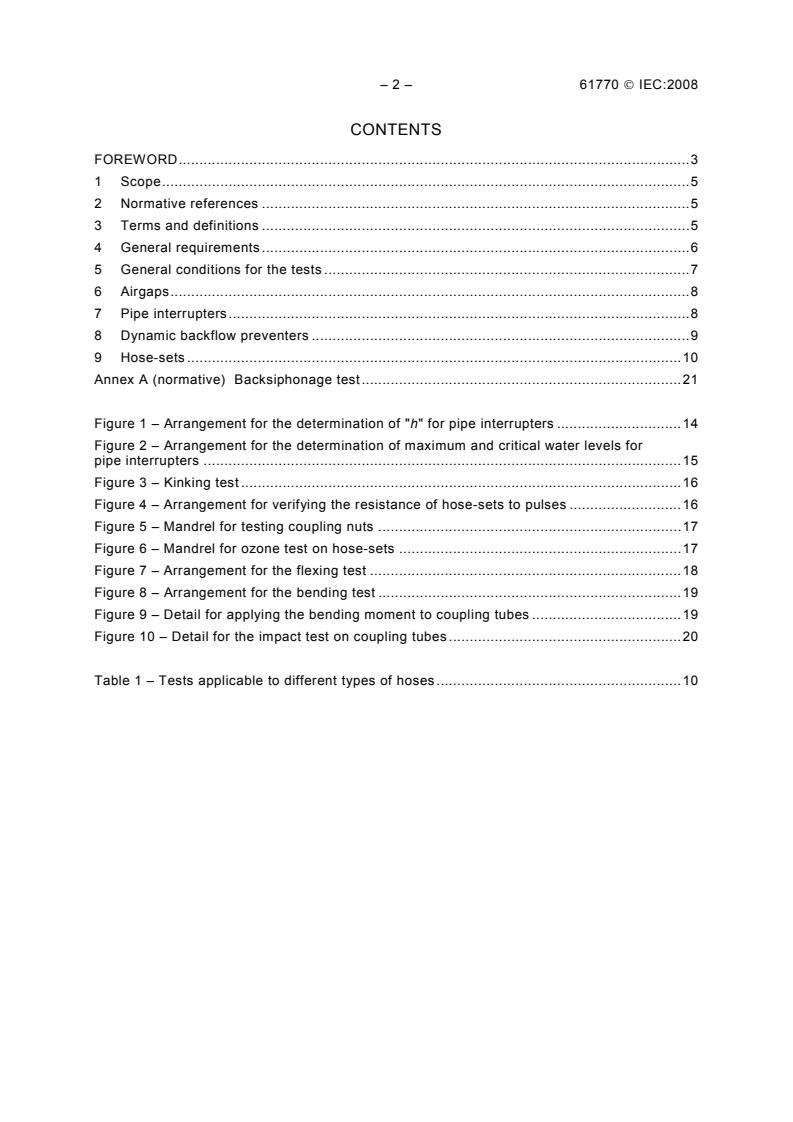
– 2 – 61770 © IEC:2008
CONTENTS
FOREWORD.3
1 Scope.5
2 Normative references .5
3 Terms and definitions .5
4 General requirements .6
5 General conditions for the tests .7
6 Airgaps.8
7 Pipe interrupters.8
8 Dynamic backflow preventers .9
9 Hose-sets .10
Annex A (normative) Backsiphonage test.21
Figure 1 – Arrangement for the determination of "h" for pipe interrupters .
Figure 2 – Arrangement for the determination of maximum and critical water levels for
pipe interrupters .15
Figure 3 – Kinking test .16
Figure 4 – Arrangement for verifying the resistance of hose-sets to pulses .16
Figure 5 – Mandrel for testing coupling nuts .17
Figure 6 – Mandrel for ozone test on hose-sets .17
Figure 7 – Arrangement for the flexing test .18
Figure 8 – Arrangement for the bending test .19
Figure 9 – Detail for applying the bending moment to coupling tubes .19
Figure 10 – Detail for the impact test on coupling tubes .20
Table 1 – Tests applicable to different types of hoses.10
61770 © IEC:2008 – 3 –
INTERNATIONAL ELECTROTECHNICAL COMMISSION
____________
ELECTRIC APPLIANCES CONNECTED TO THE WATER MAINS –
AVOIDANCE OF BACKSIPHONAGE AND FAILURE OF HOSE-SETS
FOREWORD
1) The International Electrotechnical Commission (IEC) is a worldwide organization for standardization comprising
all national electrotechnical committees (IEC National Committees). The object of IEC is to promote
international co-operation on all questions concerning standardization in the electrical and electronic fields. To
this end and in addition to other activities, IEC publishes International Standards, Technical Specifications,
Technical Reports, Publicly Available Specifications (PAS) and Guides (hereafter referred to as “IEC
Publication(s)”). Their preparation is entrusted to technical committees; any IEC National Committee interested
in the subject dealt with may participate in this preparatory work. International, governmental and non-
governmental organizations liaising with the IEC also participate in this preparation. IEC collaborates closely
with the International Organization for Standardization (ISO) in accordance with conditions determined by
agreement between the two organizations.
2) The formal decisions or agreements of IEC on technical matters express, as nearly as possible, an international
consensus of opinion on the relevant subjects since each technical committee has representation from all
interested IEC National Committees.
3) IEC Publications have the form of recommendations for international use and are accepted by IEC National
Committees in that sense. While all reasonable efforts are made to ensure that the technical content of IEC
Publications is accurate, IEC cannot be held responsible for the way in which they are used or for any
misinterpretation by any end user.
4) In order to promote international uniformity, IEC National Committees undertake to apply IEC Publications
transparently to the maximum extent possible in their national and regional publications. Any divergence
between any IEC Publication and the corresponding national or regional publication shall be clearly indicated in
the latter.
5) IEC provides no marking procedure to indicate its approval and cannot be rendered responsible for any
equipment declared to be in conformity with an IEC Publication.
6) All users should ensure that they have the latest edition of this publication.
7) No liability shall attach to IEC or its directors, employees, servants or agents including individual experts and
members of its technical committees and IEC National Committees for any personal injury, property damage or
other damage of any nature whatsoever, whether direct or indirect, or for costs (including legal fees) and
expenses arising out of the publication, use of, or reliance upon, this IEC Publication or any other IEC
Publications.
8) Attention is drawn to the Normative references cited in this publication. Use of the referenced publications is
indispensable for the correct application of this publication.
9) Attention is drawn to the possibility that some of the elements of this IEC Publication may be the subject of
patent rights. IEC shall not be held responsible for identifying any or all such patent rights.
International Standard IEC 61770 has been prepared by IEC technical committee 61: Safety
of household and similar electrical appliances.
This second edition cancels and replaces the first edition published in 1998 including its
Amendment 1 (2004) and Amendment 2 (2006). It constitutes a technical revision.
The principal changes in this edition as compared with the first edition are as follows (minor
changes are not listed):
– normative references are updated;
– some notes have been converted to normative text (3.10, 5.2, 6.3, 7.2 and Annex A);
– the type of petroleum spirit has been specified (9.3).
– 4 – 61770 © IEC:2008
The text of this standard is based on the following documents:
FDIS Report on voting
61/3647/FDIS 61/3687/RVD
Full information on the voting for the approval of this standard can be found in the report on
voting indicated in the above table.
This publication has been drafted in accordance with the ISO/IEC Directives, Part 2.
NOTE 1 The following print types are used:
– requirements: in roman type;
– test specifications: in italic type;
– notes: in small roman type.
Words in bold in the text are defined in Clause 3. When a definition concerns an adjective, the adjective and the
associated noun are also in bold.
The committee has decided that the contents of the base publication and its amendments will
remain unchanged until the maintenance result date indicated on the IEC web site under
"http://webstore.iec.ch" in the data related to the specific publication. At this date, the
publication will be
• reconfirmed,
• withdrawn,
• replaced by a revised edition, or
• amended.
NOTE 2 The attention of National Committees is drawn to the fact that equipment manufacturers and testing
organizations may need a transitional period following publication of a new, amended or revised IEC publication in
which to make products in accordance with the new requirements and to equip themselves for conducting new or
revised tests.
It is the recommendation of the committee that the content of this standard be adopted for implementation
nationally not earlier than 12 months nor later than 36 months from the date of its publication.
61770 © IEC:2008 – 5 –
ELECTRIC APPLIANCES CONNECTED TO THE WATER MAINS –
AVOIDANCE OF BACKSIPHONAGE AND FAILURE OF HOSE-SETS
1 Scope
This International Standard specifies requirements for appliances for household and similar
purposes to prevent the backsiphonage of non-potable water into the water mains. It also
specifies requirements for hose-sets used for connecting such appliances to the water mains
that supply water at a pressure not exceeding 1 MPa.
NOTE 1 Examples of similar purposes are the installation of appliances in canteens, restaurants, launderettes
and communal flats.
NOTE 2 This standard does not apply to
– appliances used for dry cleaning;
– appliances for medical purposes;
– appliances intended for industrial purposes;
– water heaters that are an integral part of the water supply system;
– water coolers that are an integral part of the water supply system.
NOTE 3 The connection of the appliance to the water mains may be temporary or permanent.
NOTE 4 When reference is made to the water mains, water supplied from a cistern or similar system is also
included.
NOTE 5 Many countries have requirements concerning the prevention of contamination of potable water as a
result of contact with unsuitable materials upstream of a backflow prevention device.
2 Normative references
The following referenced documents are indispensable for the application of this document.
For dated references, only the edition cited applies. For undated references, the latest edition
of the referenced document (including any amendments) applies.
IEC 60730-2-8, Automatic electrical controls for household and similar use – Part 2: Particular
requirements for electrically operated water valves, including mechanical requirements
3 Terms and definitions
For the purposes of this document, the following terms and definitions apply.
3.1
potable water
water which is obtained directly from the potable water mains and remains in a closed system
up to the backflow prevention device
3.2
non-potable water
water which leaves the closed system after having passed the backflow prevention device
3.3
backflow prevention device
means to prevent contamination of potable water by backflow of non-potable water
NOTE Examples are airgaps, dynamic backflow preventers and pipe interrupters.
– 6 – 61770 © IEC:2008
3.4
airgap
unobstructed free distance between the water inlet or the end of the feed pipe and the critical
water level
NOTE A distance is considered to be unobstructed if the airflow into the feed pipe under vacuum conditions is not
restricted by the construction of the appliance.
3.5
pipe interrupter
device without movable or elastomeric parts, into which air can enter while water is passing
through it
3.6
dynamic backflow preventer
backflow prevention device which prevents backsiphonage by the use of moving parts
3.7
overflow
means for discharging excess water from the appliance when the normal outlet is obstructed
3.8
maximum water level
highest level of the non-potable water in any part of the appliance when it operates
continuously under fault conditions
3.9
critical water level
level to which the non-potable water is reduced from the maximum water level 2 s after
water inlets have been closed
3.10
hose-set
assembly consisting of a flexible hose and couplings and used for connecting the appliance to
the water mains
NOTE Couplings may be removable with or without the aid of a tool.
3.11
detachable part
part which can be removed without the aid of a tool
4 General requirements
4.1 Appliances shall be provided with a backflow prevention device.
For appliances incorporating a water softener located upstream of an airgap or pipe interrupter,
a dynamic backflow preventer shall be incorporated upstream of the water softener.
Other components presenting a potable water hazard, such as dispensers for adding
cleaning, rinsing, softening or similar agents to the water, shall not be located upstream of the
backflow prevention device.
Pipework containing potable water located upstream of a backflow prevention device shall
not pass through non-potable water in the appliance.
Compliance is checked by inspection.
61770 © IEC:2008 – 7 –
NOTE For a given point in a hydraulic system, "upstream" indicates the side from which the water flows and
"downstream" indicates the side to which the water flows.
4.2 Backflow prevention devices shall be incorporated in, or fixed to, the appliance or they
shall be incorporated in the inlet side of a hose set.
NOTE They may also be incorporated in the water inlet valves.
They shall be constructed so that
– their functional characteristics cannot be changed, even intentionally,
– they can only be removed with the aid of a tool,
– if omitted, the appliance is rendered inoperable or manifestly incomplete.
Compliance is checked by inspection and by manual tests.
4.3 Hose-sets for the connection of appliances to the water mains shall be constructed so
that the risk of flooding is obviated as far as possible.
Compliance is checked by the tests of Clause 9.
4.4 Metallic parts of the water connection system of the appliance, the deterioration of which
may cause the appliance to fail to comply with the requirements of this standard, shall be
resistant to erosion, dezincification, oxidation or corrosion.
Compliance is checked by inspection.
1)
NOTE Resistance to dezincification of brass can be checked in accordance with ISO 6509 .
5 General conditions for the tests
5.1 When reference is made to normal conditions, the following applies:
– the appliance is placed on a horizontal support;
– the appliance is connected to a water supply in accordance with the instructions for
installation;
– the water supply has a static pressure not exceeding 1 MPa and a dynamic pressure not
less than 0,6 MPa;
– the appliance is supplied at rated voltage;
– the appliance is tested without being loaded and without cleaning, rinsing or similar
agents, doors and lids being closed.
NOTE When water pressures are stated, they are pressure differences from atmospheric pressure.
5.2 When reference is made to fault conditions, the appliance is inclined at an angle of 2° to
the horizontal in the most unfavourable position. In addition to the normal conditions, the
following fault conditions are applied one at a time, as far as is reasonable, consequential
faults being taken into consideration:
– the connection between any dispenser intended for adding cleaning, rinsing, softening or
similar agents to the water and other parts of the appliance is blocked, unless the cross-
sectional area of the connection exceeds 10 cm throughout its length with no dimension
less than 10 mm;
—————————
1)
ISO 6509, Corrosion of metals and alloys – Determination of dezincification resistance of brass
– 8 – 61770 © IEC:2008
NOTE Dispenser connections are not blocked if they have cross-sections which are varied by user action each
time the appliance is used, such as opening a detergent dispenser.
– overflows are blocked if they have
• a circular cross-section not exceeding 5 cm ,
• a non-circular cross-section with one dimension less than 3 mm and an area not
exceeding 5 cm ,
– all magnetic valves upstream of a backflow prevention device which can be open
simultaneously during the normal programme of the appliance are held open;
– all motors are disconnected from the supply mains and the normal drain outlet is blocked.
5.3 Unless otherwise specified, the tests are made in the order indicated and
– for appliances, pipe interrupters and dynamic backflow preventers, on a single sample
as supplied, which shall withstand all the relevant tests;
– for hose-sets, on three samples. If one sample fails, the tests are repeated on a further
set of three samples, all of which shall withstand the repeated tests.
Each of the tests of 9.1.9 to 9.1.11 is carried out on three new samples.
5.4 Tests on airgaps, pipe interrupters and dynamic backflow preventers are made on
or is otherwise specified.
the appliance, unless this is impracticable
5.5 When determining the critical water level of appliances having more than one water
inlet, and a programme permitting simultaneous filling, each water inlet is closed in turn, other
water inlets being open.
5.6 Unless otherwise specified, the tests are carried out at an ambient temperature of 20 °C ±
5 °C.
6 Airgaps
6.1 Airgaps shall be constructed so that the water can flow freely through the air section
and that water downstream of the airgap cannot be drawn into the feed pipe.
Compliance is checked by inspection and by the tests of 6.2 and 6.3. The test of Annex A may
be carried out instead of the test of 6.3.
6.2 The appliance is operated under fault conditions until the maximum water level is
reached.
The water outlet of the feed pipe shall not come into contact with non-potable water.
6.3 The appliance is operated under fault conditions until the critical water level is reached.
The length of the airgap shall be at least twice the smallest diameter of the water supply
system within the appliance, with a minimum of 20 mm. There shall also be a clear space of
20 mm between the outlet of the feed pipe and other parts in any downward direction. The
thickness of any water film and the dimensions of waterdrops shall be taken into account.
7 Pipe interrupters
7.1 Pipe interrupters shall be constructed so that the air-inlet openings remain permanently
free and open to the atmosphere. Water which may leak in normal use from an air-inlet
opening shall flow into the container of the appliance but shall not reach a sufficient level for
the vertical dimensions to be reduced below those specified in 7.3 and 7.4.
61770 © IEC:2008 – 9 –
Pipe interrupters shall be protected against deliberate obstruction or manipulation which
could affect the results of the tests.
The total cross-sectional area of the air-inlet openings shall not be less than the cross-
sectional area of the water-inlet opening. The smallest dimension of each air-inlet opening
shall be at least 3 mm. The dimensions are measured at right angles to the direction of the
airflow.
Compliance is checked by inspection, measurement and by the tests and measurements of
7.2 to 7.4. However, if the measurements of 7.3 and 7.4 cannot be made due to the
construction of the appliance, compliance is checked by the test of Annex A.
7.2 For separate pipe interrupters, a vertical tube of glass or other transparent material
having approximately the same internal diameter and a length of at least 500 mm, is
connected to the outlet of the pipe interrupter. The free end of the tube is immersed in water
to a depth of at least 25 mm, as shown in Figure 1.
A vacuum pump is connected directly to the inlet of the pipe interrupter and a negative
± 15 kPa is applied for at least 5 s. The distance h between the water
pressure of 65 kPa
level in the tube and the water level in the container is measured.
For pipe interrupters which are incorporated in the appliance downstream of a magnetic
valve, the test is carried out in the appliance. The vacuum pump is connected directly to the
water inlet of the appliance by means of the shortest possible length of tube.
The cross-sectional area of the connection of the vacuum pump shall be sufficient so that the
airflow is not restricted.
NOTE If the inlet hose cannot be removed even with the aid of a tool, the vacuum pump is connected to the inlet
of the hose.
7.3 The appliance is operated under fault conditions, until the maximum water level is
reached.
The vertical distance between the maximum water level and the lowest rim of the air-inlet
opening of the pipe interrupter is measured. It shall be at least equal to dimension h, shown
in Figure 2.
7.4 Immediately after the test of 7.3, the water inlet is closed. The vertical distance between
the critical water level and the lowest rim of the air inlet opening is measured. It shall be at
least equal to h + 20 mm.
The critical water level in the hoses connecting the pipe interrupter to a water softener
downstream of a dynamic backflow preventer is also checked.
NOTE If the critical water level cannot be observed due to an opaque part or hose, this part or hose is replaced
by a transparent part or transparent hose having the same shape and dimensions.
8 Dynamic backflow preventers
8.1 Dynamic backflow preventers shall be constructed so that wear or damage of movable
parts, their supports or guides, or the removal of detachable parts does not allow
backsiphonage. The movable parts shall operate each time the water passes through the
device under conditions of normal use and failure of any of them shall render the appliance
inoperable or shall be evident to the user.
Compliance is checked by inspection and by operating the dynamic backflow preventer as
described in 8.2, followed by the test of Annex A.
– 10 – 61770 © IEC:2008
The test of Annex A is carried out under the following conditions:
– with movable parts placed in the most unfavourable position, one at a time;
– after detachable parts have been removed;
– after simulating damage to movable parts, including their supports or guides, one at a
time.
Only one of these three conditions is applied at any one time.
8.2 The device is operated for 5 000 cycles. Each cycle comprises a period of 3 s during
which water flows through the device and a period of 3 s without water flow. The water is at a
pressure of 0,2 MPa and has a temperature of
– 15 °C ± 5 °C, for dynamic backflow preventers in the cold water supply;
– 65 °C ± 5 °C, for dynamic backflow preventers in the hot water supply;
– 65 °C ± 5 °C, for dynamic backflow preventers if the inlet is unmarked.
The test is carried out 10 times with a 48 h rest period. Before each test, the dynamic
backflow preventer is checked to ensure that movable parts operate when water flows
through it.
9 Hose-sets
9.1 Hose-sets shall withstand the stresses to which they may be subjected in normal use.
Compliance is checked by the relevant tests specified in 9.1.1 to 9.1.9 as shown in Table 1 for
different types of hoses and by the tests of 9.1.10 and 9.1.11 for couplings.
During the tests of 9.1.1 to 9.1.8, the hose shall not leak, burst or slip from its couplings.
NOTE 1 Deformation which does not impair the function of the hose-set is ignored.
NOTE 2 Flexible metal hose-sets having a length less than 1 m are not subjected to the tests of 9.1.2 and 9.1.3.
NOTE 3 For hose-sets which incorporate devices for protection against flooding and the hose of which is
contained in a flexible tube, only the hose is subjected to the tests of 9.1.6 to 9.1.8.
NOTE 4 Hoses downstream of a magnetic valve are not subjected to the tests of 9.1.6 to 9.1.8 as long as they
cannot come under pressure due to the operation of another magnetic valve.
Table 1 – Tests applicable to different types of hoses
Type of hose
Thermoplastic
Test
Non- Non-thermoplastic
Thermoplastic with metal Flexible metal
thermoplastic with metal braiding
braiding
Kinking 9.1.1 – 9.1.1 – –
Flexing – – – – 9.1.2
Bending – – – – 9.1.3
Crushing – 9.1.4 – 9.1.4 –
Low temperature – – 9.1.5 9.1.5 –
Ageing 9.1.6 9.1.6 9.1.6 9.1.6 –
Pulsing 9.1.7 9.1.7 9.1.7 9.1.7 9.1.7
Pressure 9.1.8 9.1.8 9.1.8 9.1.8 9.1.8
Ozone 9.1.9 9.1.9 – – –
61770 © IEC:2008 – 11 –
9.1.1 The kinking test is carried out as follows.
The hose is folded through an angle of 180° at its mid-point between parallel plates so that
the distance between the plates is equal to twice the outer diameter of the hose, as shown in
Figure 3. After 5 s, the plates are removed.
The test is carried out 10 times with a rest period of 1 min during which the hose is
unstressed. The hose is folded in the same direction each time.
9.1.2 The flexing test is carried out as follows.
One of the couplings of the hose-set is fixed to an oscillating arm as shown in Figure 7. A
mass of 2 kg is attached to the other coupling, the hose being freely suspended. The
oscillating arm is moved through an angle of 180° at a rate of (10 ± 2) flexings per minute for
500 flexings.
NOTE A flexing is one movement of 180°.
9.1.3 The bending test is carried out as follows.
The hose is folded through an angle of 180° at its mid-point between parallel plates as shown
in Figure 8. A force of 30 N is applied to the upper plate.
The distance between the plates shall not exceed 200 mm plus twice the outer diameter of the
hose.
9.1.4 The crushing test is carried out as follows.
The hose is folded through an angle of 180° at its mid-point between parallel plates. A force
of 100 N is applied to the plates and maintained for 5 s.
The test is carried out 10 times with a rest period of 1 min during which the hose is
straightened out. The hose is folded in the same direction each time.
NOTE The arrangement for the test is similar to that shown in Figure 3.
9.1.5 The low temperature test is carried out as follows.
The hose is wound into coils having a diameter of 300 mm ± 10 mm and placed in a cabinet
having a temperature of –15 °C ± 2 °C. After 16 h, the hose is uncoiled and within 6 s a full
turn is wound around a cylinder which is at the same temperature. The diameter of the
cylinder is three times the outer diameter of the hose. The hose is then straightened out.
9.1.6 The ageing test is carried out as follows.
The hose is wound into coils having a diameter of 300 mm ± 10 mm. It is filled with water
which is maintained at a pressure of 1,2 MPa. The temperature of the water is
– 50 °C ± 5 °C, for hose-sets marked 25 °C max.;
– 70 °C ± 5 °C, for hose-sets marked 70 °C max.;
+5
– 90 °C, for hose-sets marked 90 °C max.
The hose-set is placed in a cabinet having the same temperature as specified for the water,
for 168 h. The hose-set is then removed from the cabinet and allowed to cool to
approximately room temperature.
– 12 – 61770 © IEC:2008
9.1.7 The pulsing test is carried out as follows.
The hose-set is connected to a system in which water is circulated and subjected to pressure
pulses, as shown in Figure 4. The temperature of the water is
– 20 °C ± 5 °C, for hose-sets marked 25 °C max.;
– 70 °C ± 5 °C, for hose-sets marked 70 °C max.;
+5
– 90 °C, for hose-sets marked 90 °C max.
The pressure is 1,5 MPa and varies sinusoidally with an amplitude of 0,5 MPa, the frequency
being 30 pulses per minute. The number of pulses applied is 25 000.
9.1.8 The pressure test is carried out as follows.
The hose-set is filled with water having a temperature of
– 20 °C ± 5 °C, for hose-sets marked 25 °C max.;
– 70 °C ± 5 °C, for hose-sets marked 70 °C max.;
+5
– 90 °C, for hose-sets marked 90 °C max.
The hose-set is connected to a pressurized water system. The hydrostatic pressure is
increased at a uniform rate of approximately 100 kPa/s until 3,15 MPa is attained. This
pressure is maintained for 1 min.
9.1.9 The ozone test is carried out as follows.
The samples of hose, each approximately 10 cm long and provided with a coupling, are
placed in a cabinet at a temperature of 30 °C ± 5 °C for 96 h. The ozone concentration in the
–6
cabinet is 0,5 × 10 . The ratio between the total exposed surface area of the three samples
in square centimetres and the volume of the cabinet in cubic centimetres is not to exceed 0,1.
After the test, the samples shall show no cracks visible when using a glass with 6 times
magnification.
NOTE If bulging of the hose caused by the coupling is not visible, for example when it is hidden by a cover, the
coupling is replaced by a mandrel as shown in Figure 6 pressed into the hose.
9.1.10 The strength of coupling nuts is checked by the following test.
Before starting the test, coupling nuts of thermoplastic material are conditioned for 72 h at a
temperature of 23 °C ± 2 °C and a relative humidity between 45 % and 55 %.
The coupling nut with its sealing washer is screwed onto the mandrel shown in Figure 5 with a
maximum of four full threads of engagement and tightened with a torque of 15 Nm.
NOTE Washers may be used to limit the engagement.
+5
The assembly is placed in a cabinet at a temperature of 90 °C for 96 h. It is then allowed to
cool to approximately room temperature.
The torque required to loosen the nut shall not be less than 4 Nm.
The test is carried out twice on the same assembly.
61770 © IEC:2008 – 13 –
The nut shall not break. After removal from the mandrel, the nut shall show no cracks visible
to the naked eye and shall be fit for further use.
9.1.11 The strength of coupling tubes is checked by the tests of 9.1.11.1 and 9.1.11.2.
Before starting the test, coupling tubes of thermoplastic material are conditioned for 72 h at a
± 2 °C and a relative humidity between 45 % and 55 %.
temperature of 23 °C
After the tests, the coupling tubes shall not be broken, shall show no cracks visible to the
naked eye and shall be fit for further use.
9.1.11.1 The coupling tube is firmly attached by its coupling nut, without any sealing washer,
to a fixed mandrel as shown in Figure 9.
A steel tube, having a wall thickness of at least 2 mm and an inner diameter 0,2 mm larger
than the outer diameter of the coupling tube, is slipped over the coupling tube as shown in the
figure.
A force is applied to the steel tube so that the coupling tube is subjected to a bending moment
of 10 Nm which is attained in 2 s. The force is maintained for 30 s.
For angled coupling tubes, two tests are carried out on separate samples. In one test, the
moment is applied in the direction of the angle and in the other test it is applied in the
opposite direction.
9.1.11.2 The coupling tube is firmly attached by its coupling nut, without a sealing washer, to
a fixed mandrel as shown in Figure 10.
An impact having an energy of 1,6 J is applied to the end of the coupling tube as shown in the
figure.
9.2 If hose-sets incorporate water valves for protection against flooding, these valves shall
comply with IEC 60730-2-8.
Compliance is checked by inspection.
9.3 Hose-sets shall be durably marked with
– name, trade mark or identification mark of the manufacturer or responsible vendor,
– model or type reference,
– production date code, identifiable by the manufacturer,
– rated pressure,
– 25 °C max. and a blue coloured identification such as a rim or strip, for hose-sets
intended for cold water supply only,
– 70 °C max. or 90 °C max and a red coloured identification such as a rim or strip, for hose-
sets intended for hot water supply.
Compliance is checked by inspection and by rubbing the marking by hand for 15 s with a
piece of cloth soaked with water and again for 15 s with a piece of cloth soaked with
petroleum spirit.
The petroleum spirit to be used for the test is aliphatic solvent hexane.
After the test, the marking shall be clearly legible. It shall not be easily possible to remove
marking plates and they shall show no curling.
– 14 – 61770 © IEC:2008
A
B
≥ 500 mm
h
C
≥ 25 mm
IEC 1224/08
Key
A pipe interrupter
B tube of glass or other transparent material
C water level in the container
Figure 1 – Arrangement for the determination of "h" for pipe interrupters
61770 © IEC:2008 – 15 –
A
≥ h
≥ h + 20 mm
C
B
IEC 1225/08
Key
A lowest rim of the air-inlet opening
B critical water level
C maximum water level
Figure 2 – Arrangement for the determination of maximum
and critical water levels for pipe interrupters
– 16 – 61770 © IEC:2008
A
D
P
2D
P
IEC 1226/08
Key
A direction of folding
Figure 3 – Kinking test
B
C
F
E
D
A
IEC 1227/08
Key
A thermostatically controlled heater
B pressure tank
C pulse generator
D coupling
E hose with loop
F pump
Figure 4 – Arrangement for verifying the resistance of hose-sets to pulses
61770 © IEC:2008 – 17 –
R 3/4
A
IEC 1228/08
Key
A at least 4 turns of thread
Figure 5 – Mandrel for testing coupling nuts
R = 25
z
15°
R
IEC 1229/08
Dimensions in millimetres
Diameter d d
1 2
10 12,5 ± 0,1 10
12,5 13
15,5 ± 0,1
Figure 6 – Mandrel for ozone test on hose-sets
d
d
– 18 – 61770 © IEC:2008
180°
B
A
C
2 kg
IEC 1230/08
Key
A fixing of coupling
B oscillating arm
C support
Figure 7 – Arrangement for the flexing test
61770 © IEC:2008 – 19 –
A
B
IEC 1231/08
Key
A force
B diameter of the hose
Figure 8 – Arrangement for the bending test
A
B
C
D
IEC 1232/08
Key
A fixed mandrel
B coupling nut
C coupling tube
D steel tube
Figure 9 – Detail for applying the bending moment to coupling tubes
– 20 – 61770 © IEC:2008
A
B
C
D
IEC 1233/08
Key
A fixed mandrel
B coupling nut
C coupling tube
D impact tube
Figure 10 – Detail for the impact test on coupling tubes
61770 © IEC:2008 – 21 –
Annex A
(normative)
Backsiphonage test
The inside of pipes and hoses between the inlet valve and the backflow prevention device
is dried. A transparent hose, having an internal diameter not less than that of the inlet hose, is
connected to the appliance in place of the hose-set. The other end of the transparent hose
is connected, by means of the shortest possible length of tube, to a vacuum pump.
The appliance is filled to the critical water level by a separate water supply, this level being
maintained throughout the test.
A negative pressure of 65 kPa ± 15 kPa is applied for at least 5 s, this pressure being
measured as near as possible to the appliance. The magnetic valve is maintained in the open
position by a separate electrical supply.
For appliances with more than one hose-set, the inlets are tested in turn.
Water shall not have entered into the transparent hose.
The cross-sectional area of the connection of the vacuum pump shall be sufficient so that the
airflow is not restricted.
___________
– 22 – 61770 © CEI:2008
SOMMAIRE
AVANT-PROPOS .23
1 Domaine d'application.25
2 Références normatives .25
3 Termes et définitions .25
4 Exigences générales.27
5 Conditions générales d'essais.27
6 Surverses .28
7 Rupteurs.29
8 Clapets antiretour .30
9 Ensembles de raccordement.31
Annexe A (normative) Essai de retour d'eau par siphonnage.42
Figure 1 – Montage pour la détermination de «h» pour les rupteurs .35
Figure 2 – Montage pour la détermination des niveaux d'eau maximal et critique pour
les rupteurs.36
Figure 3 – Essai de pliage .37
Figure 4 – Montage pour vérifier la résistance des ensembles de raccordement aux
impulsions de pression.37
Figure 5 – Mandrin pour l'essai des écrous.38
Figure 6 – Mandrin pour l'essai à l'ozone des ensembles de raccordement .38
Figure 7 – Montage pour l'essai de flexion.39
Figure 8 – Montage pour l'essai de pliure .40
Figure 9 – Détail d'application du moment de pliure aux tubes de raccordement .40
Figure 10 – Détail pour l'essai d'impact sur les tubes de raccordement .41
Tableau 1 – Essais applicables aux différents types de tuyaux.31
61770 © CEI:2008 – 23 –
COMMISSION ÉLECTROTECHNIQUE INTERNATIONALE
____________
APPAREILS ÉLECTRIQUES
RACCORDÉS AU RÉSEAU D'ALIMENTATION EN EAU –
EXIGENCES POUR ÉVITER LE RETOUR D'EAU PAR SIPHONNAGE
ET LA DÉFAILLANCE DES ENSEMBLES DE RACCORDEMENT
AVANT-PROPOS
1) La Commission Electrotechnique Internationale (CEI) est une organisation mondiale de normalisation composée
de l'ensemble des comités électrotechniques nationaux (Comités nationaux de la CEI). La CEI a pour objet de
favoriser la coopération internationale pour toutes les questions de normalisation dans les domaines de
l'électricité et de l'électronique. A cet effet, la CEI – entre autres activités – publie des Normes internationales,
des Spécifications techniques, des Rapports techniques, des Spécifications a
...
IEC 61770 ®
Edition 2.1 2015-10
CONSOLIDATED VERSION
INTERNATIONAL
STANDARD
NORME
INTERNATIONALE
colour
inside
Electric appliances connected to the water mains – Avoidance of backsiphonage
and failure of hose-sets
Appareils électriques raccordés au réseau d'alimentation en eau – Exigences
pour éviter le retour d'eau par siphonnage et la défaillance des ensembles de
raccordement
All rights reserved. Unless otherwise specified, no part of this publication may be reproduced or utilized in any form
or by any means, electronic or mechanical, including photocopying and microfilm, without permission in writing from
either IEC or IEC's member National Committee in the country of the requester. If you have any questions about IEC
copyright or have an enquiry about obtaining additional rights to this publication, please contact the address below or
your local IEC member National Committee for further information.
Droits de reproduction réservés. Sauf indication contraire, aucune partie de cette publication ne peut être reproduite
ni utilisée sous quelque forme que ce soit et par aucun procédé, électronique ou mécanique, y compris la photocopie
et les microfilms, sans l'accord écrit de l'IEC ou du Comité national de l'IEC du pays du demandeur. Si vous avez des
questions sur le copyright de l'IEC ou si vous désirez obtenir des droits supplémentaires sur cette publication, utilisez
les coordonnées ci-après ou contactez le Comité national de l'IEC de votre pays de résidence.
IEC Central Office Tel.: +41 22 919 02 11
3, rue de Varembé Fax: +41 22 919 03 00
CH-1211 Geneva 20 info@iec.ch
Switzerland www.iec.ch
About the IEC
The International Electrotechnical Commission (IEC) is the leading global organization that prepares and publishes
International Standards for all electrical, electronic and related technologies.
About IEC publications
The technical content of IEC publications is kept under constant review by the IEC. Please make sure that you have the
latest edition, a corrigenda or an amendment might have been published.
IEC Catalogue - webstore.iec.ch/catalogue Electropedia - www.electropedia.org
The stand-alone application for consulting the entire The world's leading online dictionary of electronic and
bibliographical information on IEC International Standards, electrical terms containing more than 30 000 terms and
Technical Specifications, Technical Reports and other definitions in English and French, with equivalent terms in 15
documents. Available for PC, Mac OS, Android Tablets and additional languages. Also known as the International
iPad. Electrotechnical Vocabulary (IEV) online.
IEC publications search - www.iec.ch/searchpub IEC Glossary - std.iec.ch/glossary
The advanced search enables to find IEC publications by a More than 60 000 electrotechnical terminology entries in
variety of criteria (reference number, text, technical English and French extracted from the Terms and Definitions
committee,…). It also gives information on projects, replaced clause of IEC publications issued since 2002. Some entries
and withdrawn publications. have been collected from earlier publications of IEC TC 37,
77, 86 and CISPR.
IEC Just Published - webstore.iec.ch/justpublished
Stay up to date on all new IEC publications. Just Published IEC Customer Service Centre - webstore.iec.ch/csc
details all new publications released. Available online and If you wish to give us your feedback on this publication or
also once a month by email. need further assistance, please contact the Customer Service
Centre: csc@iec.ch.
A propos de l'IEC
La Commission Electrotechnique Internationale (IEC) est la première organisation mondiale qui élabore et publie des
Normes internationales pour tout ce qui a trait à l'électricité, à l'électronique et aux technologies apparentées.
A propos des publications IEC
Le contenu technique des publications IEC est constamment revu. Veuillez vous assurer que vous possédez l’édition la
plus récente, un corrigendum ou amendement peut avoir été publié.
Catalogue IEC - webstore.iec.ch/catalogue Electropedia - www.electropedia.org
Application autonome pour consulter tous les renseignements
Le premier dictionnaire en ligne de termes électroniques et
bibliographiques sur les Normes internationales,
électriques. Il contient plus de 30 000 termes et définitions en
Spécifications techniques, Rapports techniques et autres
anglais et en français, ainsi que les termes équivalents dans
documents de l'IEC. Disponible pour PC, Mac OS, tablettes
15 langues additionnelles. Egalement appelé Vocabulaire
Android et iPad.
Electrotechnique International (IEV) en ligne.
Recherche de publications IEC - www.iec.ch/searchpub
Glossaire IEC - std.iec.ch/glossary
La recherche avancée permet de trouver des publications IEC Plus de 60 000 entrées terminologiques électrotechniques, en
en utilisant différents critères (numéro de référence, texte, anglais et en français, extraites des articles Termes et
comité d’études,…). Elle donne aussi des informations sur les Définitions des publications IEC parues depuis 2002. Plus
projets et les publications remplacées ou retirées. certaines entrées antérieures extraites des publications des
CE 37, 77, 86 et CISPR de l'IEC.
IEC Just Published - webstore.iec.ch/justpublished
Service Clients - webstore.iec.ch/csc
Restez informé sur les nouvelles publications IEC. Just
Published détaille les nouvelles publications parues. Si vous désirez nous donner des commentaires sur cette
Disponible en ligne et aussi une fois par mois par email. publication ou si vous avez des questions contactez-nous:
csc@iec.ch.
IEC 61770 ®
Edition 2.1 2015-10
CONSOLIDATED VERSION
INTERNATIONAL
STANDARD
NORME
INTERNATIONALE
colour
inside
Electric appliances connected to the water mains – Avoidance of
backsiphonage
and failure of hose-sets
Appareils électriques raccordés au réseau d'alimentation en eau – Exigences
pour éviter le retour d'eau par siphonnage et la défaillance des ensembles de
raccordement
INTERNATIONAL
ELECTROTECHNICAL
COMMISSION
COMMISSION
ELECTROTECHNIQUE
INTERNATIONALE
ICS 91.140.60, 97.030 ISBN 978-2-8322-2967-5
IEC 61770 ®
Edition 2.1 2015-10
CONSOLIDATED VERSION
REDLINE VERSION
VERSION REDLINE
colour
inside
Electric appliances connected to the water mains – Avoidance of backsiphonage
and failure of hose-sets
Appareils électriques raccordés au réseau d'alimentation en eau – Exigences
pour éviter le retour d'eau par siphonnage et la défaillance des ensembles de
raccordement
– 2 – IEC 61770:2008+AMD1:2015 CSV
IEC 2015
CONTENTS
FOREWORD . 3
1 Scope . 5
2 Normative references . 5
3 Terms and definitions . 5
4 General requirements . 6
5 General conditions for the tests . 7
6 Airgaps . 8
7 Pipe interrupters . 8
8 Dynamic backflow preventers . 9
9 Hose-sets . 10
Annex A (normative) Backsiphonage test . 21
Figure 1 – Arrangement for the determination of "h" for pipe interrupters . 14
Figure 2 – Arrangement for the determination of maximum and critical water levels for
pipe interrupters . 15
Figure 3 – Kinking test . 16
Figure 4 – Arrangement for verifying the resistance of hose-sets to pulses . 16
Figure 5 – Mandrel for testing coupling nuts . 17
Figure 6 – Mandrel for ozone test on hose-sets . 17
Figure 7 – Arrangement for the flexing test . 18
Figure 8 – Arrangement for the bending test . 19
Figure 9 – Detail for applying the bending moment to coupling tubes . 19
Figure 10 – Detail for the impact test on coupling tubes . 20
Table 1 – Tests applicable to different types of hoses . 10
IEC 2015
INTERNATIONAL ELECTROTECHNICAL COMMISSION
____________
ELECTRIC APPLIANCES CONNECTED TO THE WATER MAINS –
AVOIDANCE OF BACKSIPHONAGE AND FAILURE OF HOSE-SETS
FOREWORD
1) The International Electrotechnical Commission (IEC) is a worldwide organization for standardization comprising
all national electrotechnical committees (IEC National Committees). The object of IEC is to promote
international co-operation on all questions concerning standardization in the electrical and electronic fields. To
this end and in addition to other activities, IEC publishes International Standards, Technical Specifications,
Technical Reports, Publicly Available Specifications (PAS) and Guides (hereafter referred to as “IEC
Publication(s)”). Their preparation is entrusted to technical committees; any IEC National Committee interested
in the subject dealt with may participate in this preparatory work. International, governmental and non-
governmental organizations liaising with the IEC also participate in this preparation. IEC collaborates closely
with the International Organization for Standardization (ISO) in accordance with conditions determined by
agreement between the two organizations.
2) The formal decisions or agreements of IEC on technical matters express, as nearly as possible, an international
consensus of opinion on the relevant subjects since each technical committee has representation from all
interested IEC National Committees.
3) IEC Publications have the form of recommendations for international use and are accepted by IEC National
Committees in that sense. While all reasonable efforts are made to ensure that the technical content of IEC
Publications is accurate, IEC cannot be held responsible for the way in which they are used or for any
misinterpretation by any end user.
4) In order to promote international uniformity, IEC National Committees undertake to apply IEC Publications
transparently to the maximum extent possible in their national and regional publications. Any divergence
between any IEC Publication and the corresponding national or regional publication shall be clearly indicated in
the latter.
5) IEC itself does not provide any attestation of conformity. Independent certification bodies provide conformity
assessment services and, in some areas, access to IEC marks of conformity. IEC is not responsible for any
services carried out by independent certification bodies.
6) All users should ensure that they have the latest edition of this publication.
7) No liability shall attach to IEC or its directors, employees, servants or agents including individual experts and
members of its technical committees and IEC National Committees for any personal injury, property damage or
other damage of any nature whatsoever, whether direct or indirect, or for costs (including legal fees) and
expenses arising out of the publication, use of, or reliance upon, this IEC Publication or any other IEC
Publications.
8) Attention is drawn to the Normative references cited in this publication. Use of the referenced publications is
indispensable for the correct application of this publication.
9) Attention is drawn to the possibility that some of the elements of this IEC Publication may be the subject of
patent rights. IEC shall not be held responsible for identifying any or all such patent rights.
This consolidated version of the official IEC Standard and its amendment has been prepared
for user convenience.
IEC 61770 edition 2.1 contains the second edition (2008-07) [documents 61/3647/FDIS and
61/3687/RVD] and its amendment 1 (2015-10) [documents 61/4952/FDIS and 61/5004/RVD].
In this Redline version, a vertical line in the margin shows where the technical content is
modified by amendment 1. Additions are in green text, deletions are in strikethrough red text. A
separate Final version with all changes accepted is available in this publication.
– 4 – IEC 61770:2008+AMD1:2015 CSV
IEC 2015
International Standard IEC 61770 has been prepared by IEC technical committee 61: Safety
of household and similar electrical appliances.
The principal changes in this edition as compared with the first edition are as follows (minor
changes are not listed):
– normative references are updated;
– some notes have been converted to normative text (3.10, 5.2, 6.3, 7.2 and Annex A);
– the type of petroleum spirit has been specified (9.3).
This publication has been drafted in accordance with the ISO/IEC Directives, Part 2.
NOTE 1 The following print types are used:
– requirements: in roman type;
– test specifications: in italic type;
– notes: in small roman type.
Words in bold in the text are defined in Clause 3. When a definition concerns an adjective, the adjective and the
associated noun are also in bold.
The committee has decided that the contents of the base publication and its amendment will
remain unchanged until the stability date indicated on the IEC web site under
"http://webstore.iec.ch" in the data related to the specific publication. At this date, the
publication will be
• reconfirmed,
• withdrawn,
• replaced by a revised edition, or
• amended.
NOTE 2 The attention of National Committees is drawn to the fact that equipment manufacturers and testing
organizations may need a transitional period following publication of a new, amended or revised IEC publication in
which to make products in accordance with the new requirements and to equip themselves for conducting new or
revised tests.
It is the recommendation of the committee that the content of this standard be adopted for implementation
nationally not earlier than 12 months nor later than 36 months from the date of its publication.
IMPORTANT – The 'colour inside' logo on the cover page of this publication indicates
that it contains colours which are considered to be useful for the correct
understanding of its contents. Users should therefore print this document using a
colour printer.
IEC 2015
ELECTRIC APPLIANCES CONNECTED TO THE WATER MAINS –
AVOIDANCE OF BACKSIPHONAGE AND FAILURE OF HOSE-SETS
1 Scope
This International Standard specifies requirements for appliances for household and similar
purposes to prevent the backsiphonage of non-potable water into the water mains. It also
specifies requirements for hose-sets used for connecting such appliances to the water mains
that supply water at a pressure not exceeding 1 MPa.
NOTE 1 Examples of similar purposes are the installation of appliances in canteens, restaurants, launderettes
and communal flats.
NOTE 2 This standard does not apply to
– appliances used for dry cleaning;
– appliances for medical purposes;
– appliances intended for industrial purposes;
– water heaters that are an integral part of the water supply system;
– water coolers that are an integral part of the water supply system.
NOTE 3 The connection of the appliance to the water mains may be temporary or permanent.
NOTE 4 When reference is made to the water mains, water supplied from a cistern or similar system is also
included.
NOTE 5 Many countries have requirements concerning the prevention of contamination of potable water as a
result of contact with unsuitable materials upstream of a backflow prevention device.
2 Normative references
The following referenced documents are indispensable for the application of this document.
For dated references, only the edition cited applies. For undated references, the latest edition
of the referenced document (including any amendments) applies.
IEC 60730-2-8, Automatic electrical controls for household and similar use – Part 2: Particular
requirements for electrically operated water valves, including mechanical requirements
3 Terms and definitions
For the purposes of this document, the following terms and definitions apply.
3.1
potable water
water which is obtained directly from the potable water mains and remains in a closed system
up to the backflow prevention device
3.2
non-potable water
water which leaves the closed system after having passed the backflow prevention device
3.3
backflow prevention device
means to prevent contamination of potable water by backflow of non-potable water
NOTE Examples are airgaps, dynamic backflow preventers and pipe interrupters.
– 6 – IEC 61770:2008+AMD1:2015 CSV
IEC 2015
3.4
airgap
unobstructed free distance between the water inlet or the end of the feed pipe and the critical
water level
NOTE A distance is considered to be unobstructed if the airflow into the feed pipe under vacuum conditions is not
restricted by the construction of the appliance.
3.5
pipe interrupter
device without movable or elastomeric parts, into which air can enter while water is passing
through it
3.6
dynamic backflow preventer
backflow prevention device which prevents backsiphonage by the use of moving parts
3.7
overflow
means for discharging excess water from the appliance when the normal outlet is obstructed
3.8
maximum water level
highest level of the non-potable water in any part of the appliance when it operates
continuously under fault conditions
3.9
critical water level
level to which the non-potable water is reduced from the maximum water level 2 s after
water inlets have been closed
3.10
hose-set
assembly consisting of a flexible hose and couplings and used for connecting the appliance to
the water mains
Note 1 to entry: Hose-sets need not be pre-assembled. Couplings may be removable with or without the aid of a
tool.
3.11
detachable part
part which can be removed without the aid of a tool
4 General requirements
4.1 Appliances shall be provided with a backflow prevention device.
For appliances incorporating a water softener located upstream of an airgap or pipe interrupter,
a dynamic backflow preventer shall be incorporated upstream of the water softener.
Other components presenting a potable water hazard, such as dispensers for adding
cleaning, rinsing, softening or similar agents to the water, shall not be located upstream of the
backflow prevention device.
Pipework containing potable water located upstream of a backflow prevention device shall
not pass through non-potable water in the appliance.
Compliance is checked by inspection.
IEC 2015
NOTE For a given point in a hydraulic system, "upstream" indicates the side from which the water flows and
"downstream" indicates the side to which the water flows.
4.2 Backflow prevention devices shall be incorporated in, or fixed to, the appliance or they
shall be incorporated in the inlet side of a hose set.
NOTE They may also be incorporated in the water inlet valves.
They shall be constructed so that
– their functional characteristics cannot be changed, even intentionally,
– they can only be removed with the aid of a tool,
– if omitted, the appliance is rendered inoperable or manifestly incomplete.
Compliance is checked by inspection and by manual tests.
4.3 Hose-sets for the connection of appliances to the water mains shall be constructed so
that the risk of flooding is obviated as far as possible.
Compliance is checked by the tests of Clause 9.
4.4 Metallic parts of the water connection system of the appliance, the deterioration of which
may cause the appliance to fail to comply with the requirements of this standard, shall be
resistant to erosion, dezincification, oxidation or corrosion.
Compliance is checked by inspection.
1)
NOTE Resistance to dezincification of brass can be checked in accordance with ISO 6509 .
5 General conditions for the tests
5.1 When reference is made to normal conditions, the following applies:
– the appliance is placed on a horizontal support;
– the appliance is connected to a water supply in accordance with the instructions for
installation;
– the water supply has a static pressure not exceeding 1 MPa and a dynamic pressure not
less than 0,6 MPa;
– the appliance is supplied at rated voltage;
– the appliance is tested without being loaded and without cleaning, rinsing or similar
agents, doors and lids being closed.
NOTE When water pressures are stated, they are pressure differences from atmospheric pressure.
5.2 When reference is made to fault conditions, the appliance is inclined at an angle of 2° to
the horizontal in the most unfavourable position. In addition to the normal conditions, the
following fault conditions are applied one at a time, as far as is reasonable, consequential
faults being taken into consideration:
– the connection between any dispenser intended for adding cleaning, rinsing, softening or
similar agents to the water and other parts of the appliance is blocked, unless the cross-
sectional area of the connection exceeds 10 cm throughout its length with no dimension
less than 10 mm;
—————————
1)
ISO 6509, Corrosion of metals and alloys – Determination of dezincification resistance of brass
– 8 – IEC 61770:2008+AMD1:2015 CSV
IEC 2015
NOTE Dispenser connections are not blocked if they have cross-sections which are varied by user action each
time the appliance is used, such as opening a detergent dispenser.
– overflows are blocked if they have
• a circular cross-section not exceeding 5 cm ,
• a non-circular cross-section with one dimension less than 3 mm and an area not
exceeding 5 cm ,
– all magnetic valves upstream of a backflow prevention device which can be open
simultaneously during the normal programme of the appliance are held open;
– all motors are disconnected from the supply mains and the normal drain outlet is blocked.
5.3 Unless otherwise specified, the tests are made in the order indicated and
– for appliances, pipe interrupters and dynamic backflow preventers, on a single sample
as supplied, which shall withstand all the relevant tests;
– for hose-sets, on three samples. If one sample fails, the tests are repeated on a further
set of three samples, all of which shall withstand the repeated tests.
Each of the tests of 9.1.9 to 9.1.11 is carried out on three new samples.
5.4 Tests on airgaps, pipe interrupters and dynamic backflow preventers are made on
the appliance, unless this is impracticable or is otherwise specified.
5.5 When determining the critical water level of appliances having more than one water
inlet, and a programme permitting simultaneous filling, each water inlet is closed in turn, other
water inlets being open.
5.6 Unless otherwise specified, the tests are carried out at an ambient temperature of 20 °C ±
5 °C.
6 Airgaps
6.1 Airgaps shall be constructed so that the water can flow freely through the air section
and that water downstream of the airgap cannot be drawn into the feed pipe.
Compliance is checked by inspection and by the tests of 6.2 and 6.3. The test of Annex A may
be carried out instead of the test of 6.3.
6.2 The appliance is operated under fault conditions until the maximum water level is
reached.
The water outlet of the feed pipe shall not come into contact with non-potable water.
6.3 The appliance is operated under fault conditions until the critical water level is reached.
The length of the airgap shall be at least twice the smallest diameter of the water supply
system within the appliance, with a minimum of 20 mm. There shall also be a clear space of
20 mm between the outlet of the feed pipe and other parts in any downward direction. The
thickness of any water film and the dimensions of waterdrops shall be taken into account.
7 Pipe interrupters
7.1 Pipe interrupters shall be constructed so that the air-inlet openings remain permanently
free and open to the atmosphere. Water which may leak in normal use from an air-inlet
opening shall flow into the container of the appliance but shall not reach a sufficient level for
the vertical dimensions to be reduced below those specified in 7.3 and 7.4.
IEC 2015
Pipe interrupters shall be protected against deliberate obstruction or manipulation which
could affect the results of the tests.
The total cross-sectional area of the air-inlet openings shall not be less than the cross-
sectional area of the water-inlet opening. The smallest dimension of each air-inlet opening
shall be at least 3 mm. The dimensions are measured at right angles to the direction of the
airflow.
Compliance is checked by inspection, measurement and by the tests and measurements of
7.2 to 7.4. However, if the measurements of 7.3 and 7.4 cannot be made due to the
construction of the appliance, compliance is checked by the test of Annex A.
7.2 For separate pipe interrupters, a vertical tube of glass or other transparent material
having approximately the same internal diameter and a length of at least 500 mm, is
connected to the outlet of the pipe interrupter. The free end of the tube is immersed in water
to a depth of at least 25 mm, as shown in Figure 1.
A vacuum pump is connected directly to the inlet of the pipe interrupter and a negative
pressure of 65 kPa ± 15 kPa is applied for at least 5 s. The distance h between the water
level in the tube and the water level in the container is measured.
For pipe interrupters which are incorporated in the appliance downstream of a magnetic
valve, the test is carried out in the appliance. The vacuum pump is connected directly to the
water inlet of the appliance by means of the shortest possible length of tube.
The cross-sectional area of the connection of the vacuum pump shall be sufficient so that the
airflow is not restricted.
NOTE If the inlet hose cannot be removed even with the aid of a tool, the vacuum pump is connected to the inlet
of the hose.
7.3 The appliance is operated under fault conditions, until the maximum water level is
reached.
The vertical distance between the maximum water level and the lowest rim of the air-inlet
opening of the pipe interrupter is measured. It shall be at least equal to dimension h, shown
in Figure 2.
7.4 Immediately after the test of 7.3, the water inlet is closed. The vertical distance between
the critical water level and the lowest rim of the air inlet opening is measured. It shall be at
least equal to h + 20 mm.
The critical water level in the hoses connecting the pipe interrupter to a water softener
downstream of a dynamic backflow preventer is also checked.
NOTE If the critical water level cannot be observed due to an opaque part or hose, this part or hose is replaced
by a transparent part or transparent hose having the same shape and dimensions.
8 Dynamic backflow preventers
8.1 Dynamic backflow preventers shall be constructed so that wear or damage of movable
parts, their supports or guides, or the removal of detachable parts does not allow
backsiphonage. The movable parts shall operate each time the water passes through the
device under conditions of normal use and failure of any of them shall render the appliance
inoperable or shall be evident to the user.
Compliance is checked by inspection and by operating the dynamic backflow preventer as
described in 8.2, followed by the test of Annex A.
– 10 – IEC 61770:2008+AMD1:2015 CSV
IEC 2015
The test of Annex A is carried out under the following conditions:
– with movable parts placed in the most unfavourable position, one at a time;
– after detachable parts have been removed;
– after simulating damage to movable parts, including their supports or guides, one at a
time.
Only one of these three conditions is applied at any one time.
8.2 The device is operated for 5 000 cycles. Each cycle comprises a period of 3 s during
which water flows through the device and a period of 3 s without water flow. The water is at a
pressure of 0,2 MPa and has a temperature of
– 15 °C ± 5 °C, for dynamic backflow preventers in the cold water supply;
– 65 °C ± 5 °C, for dynamic backflow preventers in the hot water supply;
– 65 °C ± 5 °C, for dynamic backflow preventers if the inlet is unmarked.
The test is carried out 10 times with a 48 h rest period. Before each test, the dynamic
backflow preventer is checked to ensure that movable parts operate when water flows
through it.
9 Hose-sets
9.1 Hose-sets shall withstand the stresses to which they may be subjected in normal use.
Compliance is checked by the relevant tests specified in 9.1.1 to 9.1.9 as shown in Table 1 for
different types of hoses and by the tests of 9.1.10 and 9.1.11 for couplings.
During the tests of 9.1.1 to 9.1.8, the hose shall not leak, burst or slip from its couplings.
NOTE 1 Deformation which does not impair the function of the hose-set is ignored.
NOTE 2 Flexible metal hose-sets having a length less than 1 m are not subjected to the tests of 9.1.2 and 9.1.3.
NOTE 3 For hose-sets which incorporate devices for protection against flooding and the hose of which is
contained in a flexible tube, only the hose is subjected to the tests of 9.1.6 to 9.1.8.
NOTE 4 Hoses downstream of a magnetic valve are not subjected to the tests of 9.1.6 to 9.1.8 as long as they
cannot come under pressure due to the operation of another magnetic valve.
Table 1 – Tests applicable to different types of hoses
Type of hose
Thermoplastic
Test
Non- Non-thermoplastic
Thermoplastic with metal Flexible metal
thermoplastic with metal braiding
braiding
Kinking 9.1.1 – 9.1.1 – –
Flexing – – – – 9.1.2
Bending – – – – 9.1.3
Crushing – 9.1.4 – 9.1.4 –
Low temperature – – 9.1.5 9.1.5 –
Ageing 9.1.6 9.1.6 9.1.6 9.1.6 –
Pulsing 9.1.7 9.1.7 9.1.7 9.1.7 9.1.7
Pressure 9.1.8 9.1.8 9.1.8 9.1.8 9.1.8
Ozone 9.1.9 9.1.9 – – –
IEC 2015
9.1.1 The kinking test is carried out as follows.
The hose is folded through an angle of 180° at its mid-point between parallel plates so that
the distance between the plates is equal to twice the outer diameter of the hose, as shown in
Figure 3. After 5 s, the plates are removed.
The test is carried out 10 times with a rest period of 1 min during which the hose is
unstressed. The hose is folded in the same direction each time.
9.1.2 The flexing test is carried out as follows.
One of the couplings of the hose-set is fixed to an oscillating arm as shown in Figure 7. A
mass of 2 kg is attached to the other coupling, the hose being freely suspended. The
oscillating arm is moved through an angle of 180° at a rate of (10 ± 2) flexings per minute for
500 flexings.
NOTE A flexing is one movement of 180°.
9.1.3 The bending test is carried out as follows.
The hose is folded through an angle of 180° at its mid-point between parallel plates as shown
in Figure 8. A force of 30 N is applied to the upper plate.
The distance between the plates shall not exceed 200 mm plus twice the outer diameter of the
hose.
9.1.4 The crushing test is carried out as follows.
The hose is folded through an angle of 180° at its mid-point between parallel plates. A force
of 100 N is applied to the plates and maintained for 5 s.
The test is carried out 10 times with a rest period of 1 min during which the hose is
straightened out. The hose is folded in the same direction each time.
NOTE The arrangement for the test is similar to that shown in Figure 3.
9.1.5 The low temperature test is carried out as follows.
The hose is wound into coils having a diameter of 300 mm ± 10 mm and placed in a cabinet
having a temperature of –15 °C ± 2 °C. After 16 h, the hose is uncoiled and within 6 s a full
turn is wound around a cylinder which is at the same temperature. The diameter of the
cylinder is three times the outer diameter of the hose. The hose is then straightened out.
9.1.6 The ageing test is carried out as follows.
The hose is wound into coils having a diameter of 300 mm ± 10 mm. It is filled with water
which is maintained at a pressure of 1,2 MPa. The temperature of the water is
– 50 °C ± 5 °C, for hose-sets marked 25 °C max.;
– 70 °C ± 5 °C, for hose-sets marked 70 °C max.;
+5
– 90 °C, for hose-sets marked 90 °C max.
The hose-set is placed in a cabinet having the same temperature as specified for the water,
for 168 h. The hose-set is then removed from the cabinet and allowed to cool to
approximately room temperature.
– 12 – IEC 61770:2008+AMD1:2015 CSV
IEC 2015
9.1.7 The pulsing test is carried out as follows.
The hose-set is connected to a system in which water is circulated and subjected to pressure
pulses, as shown in Figure 4. The temperature of the water is
– 20 °C ± 5 °C, for hose-sets marked 25 °C max.;
– 70 °C ± 5 °C, for hose-sets marked 70 °C max.;
+5
– 90 °C, for hose-sets marked 90 °C max.
The pressure is 1,5 MPa and varies sinusoidally with an amplitude of 0,5 MPa, the frequency
being 30 pulses per minute. The number of pulses applied is 25 000.
9.1.8 The pressure test is carried out as follows.
The hose-set is filled with water having a temperature of
– 20 °C ± 5 °C, for hose-sets marked 25 °C max.;
– 70 °C ± 5 °C, for hose-sets marked 70 °C max.;
+5
– 90 °C, for hose-sets marked 90 °C max.
The hose-set is connected to a pressurized water system. The hydrostatic pressure is
increased at a uniform rate of approximately 100 kPa/s until 3,15 MPa is attained. This
pressure is maintained for 1 min.
9.1.9 The ozone test is carried out as follows.
The samples of hose, each approximately 10 cm long and provided with a coupling, are
placed in a cabinet at a temperature of 30 °C ± 5 °C for 96 h. The ozone concentration in the
–6
cabinet is 0,5 × 10 . The ratio between the total exposed surface area of the three samples
in square centimetres and the volume of the cabinet in cubic centimetres is not to exceed 0,1.
After the test, the samples shall show no cracks visible when using a glass with 6 times
magnification.
NOTE If bulging of the hose caused by the coupling is not visible, for example when it is hidden by a cover, the
coupling is replaced by a mandrel as shown in Figure 6 pressed into the hose.
9.1.10 The strength of coupling nuts is checked by the following test.
Before starting the test, coupling nuts of thermoplastic material are conditioned for 72 h at a
temperature of 23 °C ± 2 °C and a relative humidity between 45 % and 55 %.
The coupling nut with its sealing washer is screwed onto the mandrel shown in Figure 5 with a
maximum of four full threads of engagement and tightened with a torque of 15 Nm.
NOTE Washers may be used to limit the engagement.
+5
The assembly is placed in a cabinet at a temperature of 90 °C for 96 h. It is then allowed to
cool to approximately room temperature.
The torque required to loosen the nut shall not be less than 4 Nm.
The test is carried out twice on the same assembly.
IEC 2015
The nut shall not break. After removal from the mandrel, the nut shall show no cracks visible
to the naked eye and shall be fit for further use.
9.1.11 The strength of coupling tubes is checked by the tests of 9.1.11.1 and 9.1.11.2.
Before starting the test, coupling tubes of thermoplastic material are conditioned for 72 h at a
temperature of 23 °C ± 2 °C and a relative humidity between 45 % and 55 %.
After the tests, the coupling tubes shall not be broken, shall show no cracks visible to the
naked eye and shall be fit for further use.
9.1.11.1 The coupling tube is firmly attached by its coupling nut, without any sealing washer,
to a fixed mandrel as shown in Figure 9.
A steel tube, having a wall thickness of at least 2 mm and an inner diameter 0,2 mm larger
than the outer diameter of the coupling tube, is slipped over the coupling tube as shown in the
figure.
A force is applied to the steel tube so that the coupling tube is subjected to a bending moment
of 10 Nm which is attained in 2 s. The force is maintained for 30 s.
For angled coupling tubes, two tests are carried out on separate samples. In one test, the
moment is applied in the direction of the angle and in the other test it is applied in the
opposite direction.
9.1.11.2 The coupling tube is firmly attached by its coupling nut, without a sealing washer, to
a fixed mandrel as shown in Figure 10.
An impact having an energy of 1,6 J is applied to the end of the coupling tube as shown in the
figure.
9.2 If hose-sets incorporate water valves for protection against flooding, these valves shall
comply with IEC 60730-2-8.
Compliance is checked by inspection.
9.3 Hose-sets shall be durably marked with
– name, trade mark or identification mark of the manufacturer or responsible vendor,
– model or type reference,
– production date code, identifiable by the manufacturer,
– rated pressure,
– 25 °C max. and a blue coloured identification such as a rim or strip, for hose-sets
intended for cold water supply only,
– 70 °C max. or 90 °C max and a red coloured identification such as a rim or strip, for hose-
sets intended for hot water supply.
For an appliance that is intended for connection to the cold water supply only, a hose-set
supplied with an appliance does not need to be marked.
Compliance is checked by inspection and by rubbing the marking by hand for 15 s with a
piece of cloth soaked with water and again for 15 s with a piece of cloth soaked with
petroleum spirit.
The petroleum spirit to be used for the test is aliphatic solvent hexane.
– 14 – IEC 61770:2008+AMD1:2015 CSV
IEC 2015
After the test, the marking shall be clearly legible. It shall not be easily possible to remove
marking plates and they shall show no curling.
A
B
≥ 500 mm
h
C
≥ 25 mm
IEC 1224/08
Key
A pipe interrupter
B tube of glass or other transparent material
C water level in the container
Figure 1 – Arrangement for the determination of "h" for pipe interrupters
IEC 2015
A
≥ h
≥ h + 20 mm
C
B
IEC 1225/08
Key
A lowest rim of the air-inlet opening
B critical water level
C maximum water level
Figure 2 – Arrangement for the determination of maximum
and critical water levels for pipe interrupters
– 16 – IEC 61770:2008+AMD1:2015 CSV
IEC 2015
A
D
P
2D
P
IEC 1226/08
Key
A direction of folding
Figure 3 – Kinking test
B
C
F
E
D
A
IEC 1227/08
Key
A thermostatically controlled heater
B pressure tank
C pulse generator
D coupling
E hose with loop
F pump
Figure 4 – Arrangement for verifying the resistance of hose-sets to pulses
IEC 2015
R 3/4
A
IEC 1228/08
Key
A at least 4 turns of thread
Figure 5 – Mandrel for testing coupling nuts
R = 25
z
15°
R
IEC 1229/08
Dimensions in millimetres
Diameter d d
1 2
10 10
12,5 ± 0,1
12,5 13
15,5 ± 0,1
Figure 6 – Mandrel for ozone test on hose-sets
d
d
– 18 – IEC 61770:2008+AMD1:2015 CSV
IEC 2015
180°
B
A
C
2 kg
IEC 1230/08
Key
A fixing of coupling
B oscillating arm
C support
Figure 7 – Arrangement for the flexing test
IEC 2015
A
B
IEC 1231/08
Key
A force
B diameter of the hose
Figure 8 – Arrangement for the bending test
A
B
C
D
IEC 1232/08
Key
A fixed mandrel
B coupling nut
C coupling tube
D steel tube
Figure 9 – Detail for applying the bending moment to coupling tubes
– 20 – IEC 61770:2008+AMD1:2015 CSV
IEC 2015
A
B
C
D
IEC 1233/08
Key
A fixed mandrel
B coupling nut
C coupling tube
D impact tube
Figure 10 – Detail for the impact test on coupling tubes
IEC 2015
Annex A
(normative)
Backsiphonage test
The inside of pipes and hoses between the inlet valve and the backflow prevention device
is dried. A transparent hose, having an internal diameter not less than that of the inlet hose, is
connected to the appliance in place of the hose-set. The other end of the transparent hose
is connected, by means of the shortest possible length of tube, to a vacuum pump.
The appliance is filled to the critical water level by a separate water supply, this level being
maintained throughout the test.
± 15 kPa is applied for at least 5 s, this pressure being
A negative pressure of 65 kPa
measured as near as possible to the appliance. The magnetic valve is maintained in the open
position by a separate electrical supply.
For appliances with more than one hose-set, the inlets are tested in turn.
Water shall not have entered into the transparent hose.
The cross-sectional area of the connection of the vacuum pump shall be sufficient so that the
airflow is not restricted.
___________
– 22 – IEC 61770:2008+AMD1:2015 CSV
IEC 2015
SOMMAIRE
AVANT-PROPOS . 23
1 Domaine d'application . 25
2 Références normatives . 25
3 Termes et définitions . 25
4 Exigences générales . 27
...
Questions, Comments and Discussion
Ask us and Technical Secretary will try to provide an answer. You can facilitate discussion about the standard in here.
Loading comments...