

IEC 62802:2017
(Main)Measurement method of a half-wavelength voltage and a chirp parameter for Mach-Zehnder optical modulator in high-frequency radio on fibre (RoF) systems
General Information
- Abstract
IEC 62802:2017 specifies measurement methods of a half-wavelength voltage and a chirp parameter applicable to MZMs in microwave and millimeter-wave RoF systems. In addition, these methods are also effective for the estimation of the intermodulation distortions and transmission performances. The methods apply for the following:
- frequency range: 5 GHz to 110 GHz;
- wavelength band: 0,8 µm to 2,0 µm;
- electro-optic material based MZMs and their modules.
- Status
- Published
- Publication Date
- 26-Jul-2017
- Technical Committee
- TC 103 - Transmitting and receiving equipment for radiocommunication
- Drafting Committee
- WG 6 - TC 103/WG 6
- Current Stage
- PPUB - Publication issued
- Start Date
- 27-Jul-2017
- Completion Date
- 17-Aug-2017
Buy Documents
IEC 62802:2017 - Measurement method of a half-wavelength voltage and a chirp parameter for Mach-Zehnder optical modulator in high-frequency radio on fibre (RoF) systems Released:7/27/2017
IEC 62802:2017 - Measurement method of a half-wavelength voltage and a chirp parameter for Mach-Zehnder optical modulator in high-frequency radio on fibre (RoF) systems Released:11/13/2019
Overview
IEC 62802:2017 defines standardized measurement methods for two critical parameters of Mach‑Zehnder optical modulators (MZMs) used in high‑frequency Radio on Fibre (RoF) systems: the half‑wavelength voltage (Vπ/2) and the chirp parameter. The standard targets electro‑optic material‑based MZMs and their modules, covering the 5 GHz to 110 GHz frequency range and optical wavelengths from 0.8 µm to 2.0 µm. These measurement procedures support consistent characterization of modulators for microwave and millimeter‑wave photonic links.
Key Topics and Requirements
- Parameters measured
- Half‑wavelength voltage (Vπ/2) - drive voltage required to produce a π phase shift in the MZM transfer function.
- Chirp parameter - quantifies frequency chirp induced by modulation, affecting RF-to-optical and optical-to-RF conversion.
- Measurement scope
- Applicable for microwave and millimeter‑wave RoF applications (5–110 GHz).
- Optical wavelength band 0.8–2.0 µm.
- Measurement methods
- Method A: fixed DC‑bias condition (simultaneous Vπ/2 and chirp extraction).
- Method B: DC‑bias sweep to derive parameters across operating points.
- Method C: measurements using minimum‑transmission and maximum‑transmission bias points.
- Test arrangement and conditions
- Standard circuit diagrams and transfer‑curve analysis are provided.
- Specifies environmental and temperature conditions and warming‑up requirements for measurement equipment.
- Guidance on sampling for quality control and appropriate sampling frequency.
- Additional considerations
- Methods also support estimation of intermodulation distortion and transmission performance of MZMs.
- Annex A (informative) covers parallel integrated MZM configurations (quad/dual parallel structures).
Applications and Who Should Use It
- Device manufacturers - to characterize and specify MZM drive voltages, chirp, and linearity for product datasheets.
- Test and calibration laboratories - for repeatable, standardized Vπ/2 and chirp measurements at microwave/millimeter frequencies.
- System integrators and network designers - to assess modulator suitability for high‑frequency RoF links, RF photonics front‑ends, and point‑to‑multipoint wireless distribution.
- R&D teams - for material and device comparison when developing electro‑optic modulators for 5G/6G and beyond.
Related Standards
- IEC 62007 series (optical fiber communications measurement guidance)
- IEC PAS 62593:2008 (includes intermodulation distortion/NOMI calculations referenced in IEC 62802)
- Prepared by IEC TC 103 (Transmitting equipment for radiocommunication)
Keywords: IEC 62802:2017, Mach‑Zehnder optical modulator, half‑wavelength voltage, chirp parameter, Radio on Fibre, RoF, microwave, millimeter‑wave, measurement methods, electro‑optic material.
Buy Documents
IEC 62802:2017 - Measurement method of a half-wavelength voltage and a chirp parameter for Mach-Zehnder optical modulator in high-frequency radio on fibre (RoF) systems Released:7/27/2017
IEC 62802:2017 - Measurement method of a half-wavelength voltage and a chirp parameter for Mach-Zehnder optical modulator in high-frequency radio on fibre (RoF) systems Released:11/13/2019
Get Certified
Connect with accredited certification bodies for this standard

IMQ S.p.A. (Certification)
Italian electrical product certification.

SLG Prüf- und Zertifizierungs GmbH
German testing and certification body.

UL Solutions
Global safety science company with testing, inspection and certification.
Sponsored listings
Frequently Asked Questions
IEC 62802:2017 is a standard published by the International Electrotechnical Commission (IEC). Its full title is "Measurement method of a half-wavelength voltage and a chirp parameter for Mach-Zehnder optical modulator in high-frequency radio on fibre (RoF) systems". This standard covers: IEC 62802:2017 specifies measurement methods of a half-wavelength voltage and a chirp parameter applicable to MZMs in microwave and millimeter-wave RoF systems. In addition, these methods are also effective for the estimation of the intermodulation distortions and transmission performances. The methods apply for the following: - frequency range: 5 GHz to 110 GHz; - wavelength band: 0,8 µm to 2,0 µm; - electro-optic material based MZMs and their modules.
IEC 62802:2017 specifies measurement methods of a half-wavelength voltage and a chirp parameter applicable to MZMs in microwave and millimeter-wave RoF systems. In addition, these methods are also effective for the estimation of the intermodulation distortions and transmission performances. The methods apply for the following: - frequency range: 5 GHz to 110 GHz; - wavelength band: 0,8 µm to 2,0 µm; - electro-optic material based MZMs and their modules.
IEC 62802:2017 is classified under the following ICS (International Classification for Standards) categories: 29.260.20 - Electrical apparatus for explosive atmospheres; 33.060.20 - Receiving and transmitting equipment; 33.180.99 - Other fibre optic equipment. The ICS classification helps identify the subject area and facilitates finding related standards.
IEC 62802:2017 is available in PDF format for immediate download after purchase. The document can be added to your cart and obtained through the secure checkout process. Digital delivery ensures instant access to the complete standard document.
Standards Content (Sample)
IEC 62802 ®
Edition 1.0 2017-07
INTERNATIONAL
STANDARD
colour
inside
Measurement methods of a half-wavelength voltage and a chirp parameter for
Mach-Zehnder optical modulators in high-frequency radio on fibre (RoF)
systems
All rights reserved. Unless otherwise specified, no part of this publication may be reproduced or utilized in any form
or by any means, electronic or mechanical, including photocopying and microfilm, without permission in writing from
either IEC or IEC's member National Committee in the country of the requester. If you have any questions about IEC
copyright or have an enquiry about obtaining additional rights to this publication, please contact the address below or
your local IEC member National Committee for further information.
IEC Central Office Tel.: +41 22 919 02 11
3, rue de Varembé Fax: +41 22 919 03 00
CH-1211 Geneva 20 info@iec.ch
Switzerland www.iec.ch
About the IEC
The International Electrotechnical Commission (IEC) is the leading global organization that prepares and publishes
International Standards for all electrical, electronic and related technologies.
About IEC publications
The technical content of IEC publications is kept under constant review by the IEC. Please make sure that you have the
latest edition, a corrigenda or an amendment might have been published.
IEC Catalogue - webstore.iec.ch/catalogue Electropedia - www.electropedia.org
The stand-alone application for consulting the entire The world's leading online dictionary of electronic and
bibliographical information on IEC International Standards, electrical terms containing 20 000 terms and definitions in
Technical Specifications, Technical Reports and other English and French, with equivalent terms in 16 additional
documents. Available for PC, Mac OS, Android Tablets and languages. Also known as the International Electrotechnical
iPad. Vocabulary (IEV) online.
IEC publications search - www.iec.ch/searchpub IEC Glossary - std.iec.ch/glossary
The advanced search enables to find IEC publications by a 65 000 electrotechnical terminology entries in English and
variety of criteria (reference number, text, technical French extracted from the Terms and Definitions clause of
committee,…). It also gives information on projects, replaced IEC publications issued since 2002. Some entries have been
and withdrawn publications. collected from earlier publications of IEC TC 37, 77, 86 and
CISPR.
IEC Just Published - webstore.iec.ch/justpublished
Stay up to date on all new IEC publications. Just Published IEC Customer Service Centre - webstore.iec.ch/csc
details all new publications released. Available online and If you wish to give us your feedback on this publication or
also once a month by email. need further assistance, please contact the Customer Service
Centre: csc@iec.ch.
IEC 62802 ®
Edition 1.0 2017-07
INTERNATIONAL
STANDARD
colour
inside
Measurement methods of a half-wavelength voltage and a chirp parameter for
Mach-Zehnder optical modulators in high-frequency radio on fibre (RoF)
systems
INTERNATIONAL
ELECTROTECHNICAL
COMMISSION
ICS 33.060.20; 33.180.99 ISBN 978-2-8322-4609-2
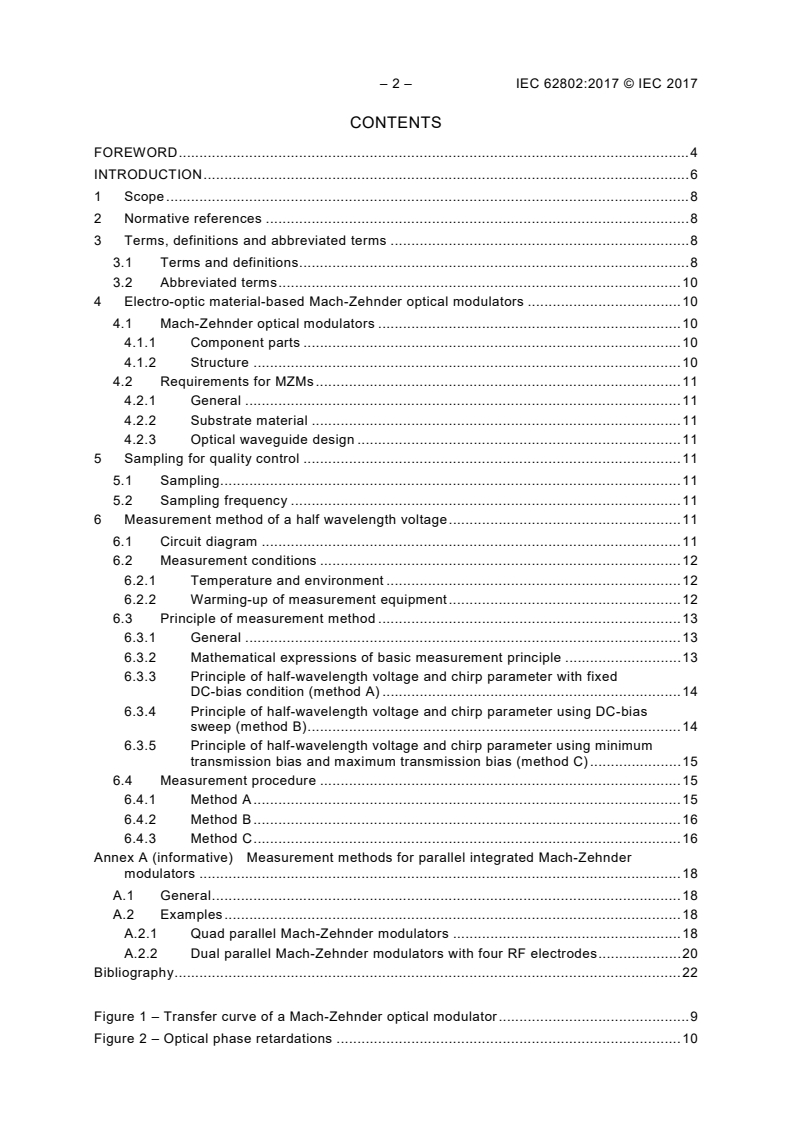
– 2 – IEC 62802:2017 © IEC 2017
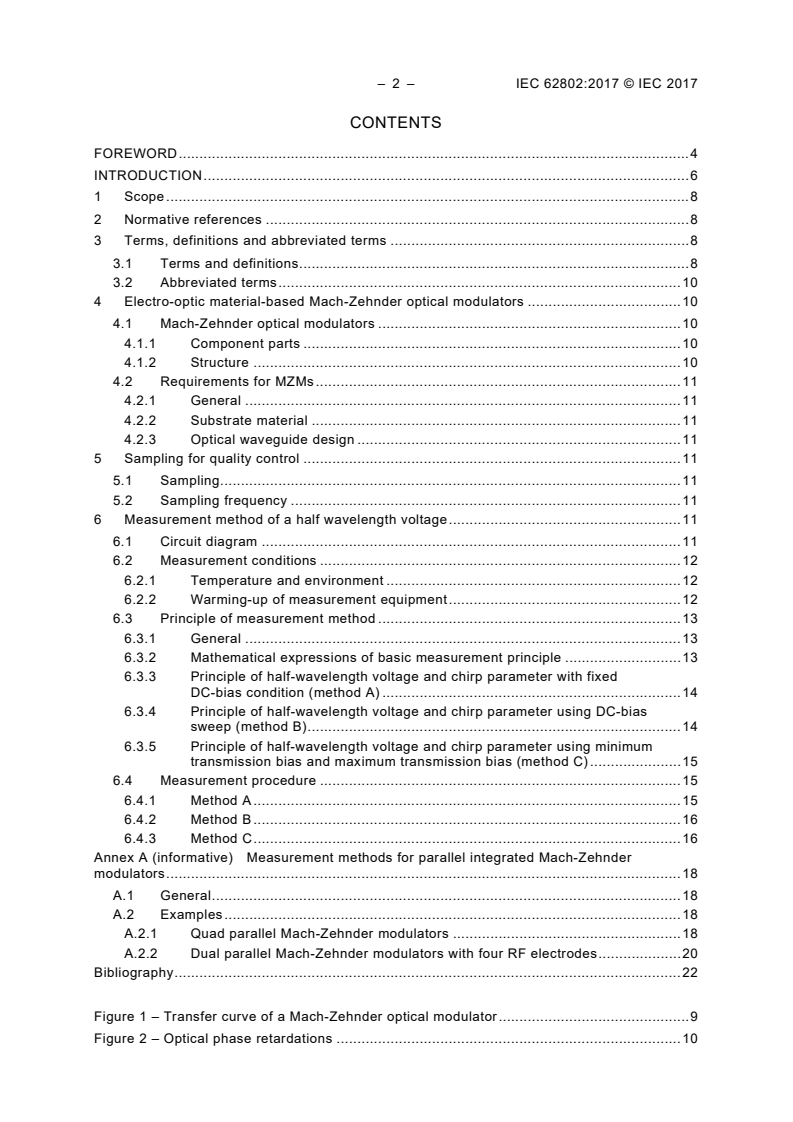
CONTENTS
FOREWORD . 4
INTRODUCTION . 6
1 Scope . 8
2 Normative references . 8
3 Terms, definitions and abbreviated terms . 8
3.1 Terms and definitions . 8
3.2 Abbreviated terms . 10
4 Electro-optic material-based Mach-Zehnder optical modulators . 10
4.1 Mach-Zehnder optical modulators . 10
4.1.1 Component parts . 10
4.1.2 Structure . 10
4.2 Requirements for MZMs . 11
4.2.1 General . 11
4.2.2 Substrate material . 11
4.2.3 Optical waveguide design . 11
5 Sampling for quality control . 11
5.1 Sampling. 11
5.2 Sampling frequency . 11
6 Measurement method of a half wavelength voltage . 11
6.1 Circuit diagram . 11
6.2 Measurement conditions . 12
6.2.1 Temperature and environment . 12
6.2.2 Warming-up of measurement equipment . 12
6.3 Principle of measurement method . 13
6.3.1 General . 13
6.3.2 Mathematical expressions of basic measurement principle . 13
6.3.3 Principle of half-wavelength voltage and chirp parameter with fixed
DC-bias condition (method A) . 14
6.3.4 Principle of half-wavelength voltage and chirp parameter using DC-bias
sweep (method B) . 14
6.3.5 Principle of half-wavelength voltage and chirp parameter using minimum
transmission bias and maximum transmission bias (method C) . 15
6.4 Measurement procedure . 15
6.4.1 Method A . 15
6.4.2 Method B . 16
6.4.3 Method C . 16
Annex A (informative) Measurement methods for parallel integrated Mach-Zehnder
modulators . 18
A.1 General . 18
A.2 Examples . 18
A.2.1 Quad parallel Mach-Zehnder modulators . 18
A.2.2 Dual parallel Mach-Zehnder modulators with four RF electrodes . 20
Bibliography . 22
Figure 1 – Transfer curve of a Mach-Zehnder optical modulator . 9
Figure 2 – Optical phase retardations . 10
Figure 3 – Circuit diagram . 12
Figure A.1 – Optical sideband generation from a sub-MZM element in a parallel MZM . 19
Figure A.2 – Halfwave voltages of sub-MZMs of a quad parallel MZM . 19
Figure A.3 – Chirp parameters of sub-MZMs of a quad parallel MZM . 20
Figure A.4 – Structure of dual parallel Mach-Zehnder modulators with four RF electrodes . 20
– 4 – IEC 62802:2017 © IEC 2017
INTERNATIONAL ELECTROTECHNICAL COMMISSION
____________
MEASUREMENT METHODS OF A HALF-WAVELENGTH VOLTAGE
AND A CHIRP PARAMETER FOR MACH-ZEHNDER OPTICAL MODULATORS
IN HIGH-FREQUENCY RADIO ON FIBRE (ROF) SYSTEMS
FOREWORD
1) The International Electrotechnical Commission (IEC) is a worldwide organization for standardization comprising
all national electrotechnical committees (IEC National Committees). The object of IEC is to promote international
co-operation on all questions concerning standardization in the electrical and electronic fields. To this end and in
addition to other activities, IEC publishes International Standards, Technical Specifications, Technical Reports,
Publicly Available Specifications (PAS) and Guides (hereafter referred to as “IEC Publication(s)”). Their
preparation is entrusted to technical committees; any IEC National Committee interested in the subject dealt with
may participate in this preparatory work. International, governmental and non-governmental organizations liaising
with the IEC also participate in this preparation. IEC collaborates closely with the International Organization for
Standardization (ISO) in accordance with conditions determined by agreement between the two organizations.
2) The formal decisions or agreements of IEC on technical matters express, as nearly as possible, an international
consensus of opinion on the relevant subjects since each technical committee has representation from all
interested IEC National Committees.
3) IEC Publications have the form of recommendations for international use and are accepted by IEC National
Committees in that sense. While all reasonable efforts are made to ensure that the technical content of IEC
Publications is accurate, IEC cannot be held responsible for the way in which they are used or for any
misinterpretation by any end user.
4) In order to promote international uniformity, IEC National Committees undertake to apply IEC Publications
transparently to the maximum extent possible in their national and regional publications. Any divergence between
any IEC Publication and the corresponding national or regional publication shall be clearly indicated in the latter.
5) IEC itself does not provide any attestation of conformity. Independent certification bodies provide conformity
assessment services and, in some areas, access to IEC marks of conformity. IEC is not responsible for any
services carried out by independent certification bodies.
6) All users should ensure that they have the latest edition of this publication.
7) No liability shall attach to IEC or its directors, employees, servants or agents including individual experts and
members of its technical committees and IEC National Committees for any personal injury, property damage or
other damage of any nature whatsoever, whether direct or indirect, or for costs (including legal fees) and expenses
arising out of the publication, use of, or reliance upon, this IEC Publication or any other IEC Publications.
8) Attention is drawn to the Normative references cited in this publication. Use of the referenced publications is
indispensable for the correct application of this publication.
9) Attention is drawn to the possibility that some of the elements of this IEC Publication may be the subject of patent
rights. IEC shall not be held responsible for identifying any or all such patent rights.
International Standard IEC 62802 has been prepared by IEC technical committee 103:
Transmitting equipment for radiocommunication.
The text of this International Standard is based on the following documents:
CDV Report on voting
103/131/CDV 103/161/RVC
Full information on the voting for the approval of this International Standard can be found in the
report on voting indicated in the above table.
This document has been drafted in accordance with the ISO/IEC Directives, Part 2.
The committee has decided that the contents of this document will remain unchanged until the
stability date indicated on the IEC website under "http://webstore.iec.ch" in the data related to
the specific document. At this date, the document will be
• reconfirmed,
• withdrawn,
• replaced by a revised edition, or
• amended.
A bilingual version of this publication may be issued at a later date.
IMPORTANT – The 'colour inside' logo on the cover page of this publication indicates
that it contains colours which are considered to be useful for the correct
understanding of its contents. Users should therefore print this document using a
colour printer.
– 6 – IEC 62802:2017 © IEC 2017
INTRODUCTION
A variety of microwave/millimeter-wave-photonic devices are useful for wireless communication
and broadcasting systems. An optical modulator is an interface which converts an electronic
signal to an optical signal. In the field of optical fibre communication systems, the IEC 62007
series was published in 1999.
Microwave/millimeter-wave RoF systems are comprised mainly of two parts: one is RF to
photonic converter (E/O), and the other is photonic to RF converter (O/E). Radio waves are
converted into an optical signal at E/O. This signal is transferred through the optical fibre and
then the radio waves are regenerated at O/E.
A variety of photonic devices that carry microwave and millimeter-wave signals as subcarrier
frequencies are used for high-frequency RoF systems. In particular, the Mach-Zehnder optical
modulator (MZM) plays an important role to convert electronic (high-frequency above
millimeter-wave) signal to optical signal. In high-frequency RoF systems, specifications of drive
voltages, chirp characteristics, inter-modulation distortion of the modulators have been the
important technical parameters. This document is prepared to provide the measurement method
of MZMs to the industry for evaluating electro-optic material of the modulators to be used in
high-frequency RoF systems. This document defines the measurement methods of a
half-wavelength voltage and a chirp parameter, which have a significant impact on the
performance of RoF systems. Additionally, these methods are also used for the estimation of the
intermodulation distortions and transmission performances.
The half-wavelength voltage and the chirp parameter can be measured at the same time using
the methods defined in this document. The nonlinear distortion characteristics are also
important for the performance of the systems. The intermodulation distortion of the MZM is
calculated from the driving voltage and the half-wavelength voltage. The detailed explanations
and calculation method of intermodulation distortions from the normalized optical modulation
index (NOMI) are described in IEC PAS 62593:2008[1] , Annex B.
The International Electrotechnical Commission (IEC) draws attention to the fact that it is claimed
that compliance with this document may involve the use of patents concerning:
a) a method for characterization of optical modulator, and method for controlling high frequency
oscillator using the same (JP 3538619B),
b) a method and apparatus for measurement of characteristic of optical modulator
(JP 3866082B),
c) a method for evaluating characteristic of optical modulator having Mach-Zehnder
interferometer (WO 2011-027409),
d) a method of measuring half-wave voltage of optical modulator (JP 2009-229926A).
Details pertaining to the patent holders and the locations where the patents are referred to in the
document are given in Table 1.
___________
1 Numbers in square brackets refer to the Bibliography.
Table 1 – Patents present in this document
Related clause Patent holder Patent number
Clause 6 National Institute of Information and Communications JP 3538619
Technology
Annex A (informative)
6.4.3 National Institute of Information and Communications JP 3866082
Technology
Sumitomo Osaka Cement Co., Ltd.
A.2.1 National Institute of Information and Communications (WO 2011-027409)
Technology
EP 2477021A
Sumitomo Osaka Cement Co., Ltd.
US 8867042
CN 102575971
JP 5622154
A.2.2 Sumitomo Osaka Cement Co., Ltd. (JP2009-229926A)
JP 4991610
IEC takes no position concerning the evidence, validity and scope of these patent rights.
The holders of these patent rights have assured the IEC that he/she is willing to negotiate
licences under reasonable and non-discriminatory terms and conditions with applicants
throughout the world. In this respect, the statement of the holders of these patent rights are
registered with IEC. Information may be obtained from:
National Institute of Information and Communications Technology
4-2-1 Nukui-Kitamachi, Koganei, Tokyo 184-8795, Japan
Sumitomo Osaka Cement Co., Ltd.
6-28 Rokubancho, Chiyoda-Ku, Tokyo 102-8465, Japan.
Attention is drawn to the possibility that some of the elements of this document may be the
subject of patent rights other than those identified above. IEC shall not be held responsible for
identifying any or all such patent rights.
ISO (www.iso.org/patents) and IEC (http://patents.iec.ch) maintain on-line data bases of patents
relevant to their standards. Users are encouraged to consult the databases for the most
up-to-date information concerning patents.
– 8 – IEC 62802:2017 © IEC 2017
MEASUREMENT METHODS OF A HALF-WAVELENGTH VOLTAGE
AND A CHIRP PARAMETER FOR MACH-ZEHNDER OPTICAL MODULATORS
IN HIGH-FREQUENCY RADIO ON FIBRE (ROF) SYSTEMS
1 Scope
This document specifies measurement methods of a half-wavelength voltage and a chirp
parameter applicable to MZMs in microwave and millimeter-wave RoF systems. In addition,
these methods are also effective for the estimation of the intermodulation distortions and
transmission performances. The methods apply for the following:
– frequency range: 5 GHz to 110 GHz;
– wavelength band: 0,8 µm to 2,0 µm;
– electro-optic material based MZMs and their modules.
2 Normative references
The following documents are referred to in the text in such a way that some or all of their content
constitutes requirements of this document. For dated references, only the edition cited applies.
For undated references, the latest edition of the referenced document (including any
amendments) applies.
IEC 62007-1, Semiconductor optoelectronic devices for fibre optic system applications – Part 1:
Specification template for essential ratings and characteristics
IEC 62007-2, Semiconductor optoelectronic devices for fibre optic system applications – Part 2:
Measurement methods
3 Terms, definitions and abbreviated terms
3.1 Terms and definitions
For the purposes of this document, the terms and definitions given in IEC 62007-1:2015 and
IEC 62007-2:2009 and the following apply.
ISO and IEC maintain terminological databases for use in standardization at the following
addresses:
• IEC Electropedia: available at http://www.electropedia.org/
• ISO Online browsing platform: available at http://www.iso.org/obp
3.1.1
half-wavelength voltage
V
π
voltage required for a Pockels effect material based Mach-Zehnder optical modulator to induce
a phase shift of half a wavelength between the lightwaves of two arms of the Mach-Zehnder
interferometer
SEE: Figure 1.
Note 1 to entry: It corresponds to an ON/OFF voltage of the Mach-Zehnder optical modulator.
Note 2 to entry: IEC PAS 62593 defines a measurement method for a half-wavelength voltage suitable for lower
frequency applications, especially less than 5 GHz.
V
TT
Quad.
Input voltage
IEC
Figure 1 – Transfer curve of a Mach-Zehnder optical modulator
3.1.2
NOMI
normalized optical modulation index
for the Mach-Zehnder optical modulator, ratio of driving voltage and half-wavelength voltage of
the modulator, defined as:
NOMI = (V / V ) × 100 [%] (1)
pp π
where
V is the driving voltage (peak to peak voltage);
pp
V is the half-wavelength voltage.
π
Note 1 to entry For the Mach-Zehnder optical modulator, the intermodulation distortion is dependent on NOMI. The
detailed explanations of OMI including measurement method are described in IEC PAS 62593:2008, Annex A. The
calculation method of intermodulation distortions from the measured NOMI is described in IEC PAS 62593:2008,
Annex B.
3.1.3
extinction ratio
R
ext
ratio of two optical power levels of the optical signal generated by the optical modulator, defined
as:
R = 10log(P /P ) (2)
ext 1 2
where
P is the optical power level generated when the output power is "on";
P is the power level generated when the output power is "off."
Note 1 to entry: The extinction ratio is sometimes expressed as a fraction not in dB.
3.1.4
chirp parameter
undesired optical phase change with amplitude or intensity modulation, which is defined as the
ratio of amplitude modulation and the phase modulation:
dφ
dt
α =
(3)
1 dE
E dt
Output optimal power
– 10 – IEC 62802:2017 © IEC 2017
where
E is the optical amplitude at the modulator output,
φ is the optical phase at the modulator output.
Note 1 to entry: In IEC 61280-2-9 [2], chirp measurement methods for laser transmitters were overviewed, and
time-resolved chirp and alpha-parameter measurement methods for of laser transmitters for digital systems is are
given in IEC 61280-2-10 [3]. The chirp parameter alpha of an MZM is explained in detail in [4].
Note 2 to entry: The alpha parameter of an MZM can also be measured together with a half-wave voltage V by the
π
sideband monitoring methods described in [5] and [6] using an optical spectrum analyzer.
3.2 Abbreviated terms
DC direct current
DUT device under test
MZM Mach-Zehnder modulator
NOMI normalized OMI
OMI optical modulation index
OSA optical spectrum analyzer
RF radio frequency
4 Electro-optic material-based Mach-Zehnder optical modulators
4.1 Mach-Zehnder optical modulators
4.1.1 Component parts
The optical modulators and their modules consist of the basic parts as follows:
– Mach-Zehnder interferometer type optical modulator;
– input and output fibre pigtails (where appropriate);
– bia
...
IEC 62802 ®
Edition 1.0 2017-07
INTERNATIONAL
STANDARD
NORME
INTERNATIONALE
colour
inside
Measurement methods of a half-wavelength voltage and a chirp parameter for
Mach-Zehnder optical modulators in high-frequency radio on fibre (RoF)
systems
Méthodes de mesure d'une tension à demi-longueur d'onde et d'un paramètre de
fluctuation de la longueur d'onde pour modulateurs optiques de Mach-Zehnder
dans les systèmes de radio par fibre (RoF) à haute fréquence
All rights reserved. Unless otherwise specified, no part of this publication may be reproduced or utilized in any form
or by any means, electronic or mechanical, including photocopying and microfilm, without permission in writing from
either IEC or IEC's member National Committee in the country of the requester. If you have any questions about IEC
copyright or have an enquiry about obtaining additional rights to this publication, please contact the address below or
your local IEC member National Committee for further information.
Droits de reproduction réservés. Sauf indication contraire, aucune partie de cette publication ne peut être reproduite
ni utilisée sous quelque forme que ce soit et par aucun procédé, électronique ou mécanique, y compris la photocopie
et les microfilms, sans l'accord écrit de l'IEC ou du Comité national de l'IEC du pays du demandeur. Si vous avez des
questions sur le copyright de l'IEC ou si vous désirez obtenir des droits supplémentaires sur cette publication, utilisez
les coordonnées ci-après ou contactez le Comité national de l'IEC de votre pays de résidence.
IEC Central Office Tel.: +41 22 919 02 11
3, rue de Varembé info@iec.ch
CH-1211 Geneva 20 www.iec.ch
Switzerland
About the IEC
The International Electrotechnical Commission (IEC) is the leading global organization that prepares and publishes
International Standards for all electrical, electronic and related technologies.
About IEC publications
The technical content of IEC publications is kept under constant review by the IEC. Please make sure that you have the
latest edition, a corrigendum or an amendment might have been published.
IEC publications search - webstore.iec.ch/advsearchform Electropedia - www.electropedia.org
The advanced search enables to find IEC publications by a The world's leading online dictionary on electrotechnology,
variety of criteria (reference number, text, technical containing more than 22 000 terminological entries in English
committee,…). It also gives information on projects, replaced and French, with equivalent terms in 16 additional languages.
and withdrawn publications. Also known as the International Electrotechnical Vocabulary
(IEV) online.
IEC Just Published - webstore.iec.ch/justpublished
Stay up to date on all new IEC publications. Just Published IEC Glossary - std.iec.ch/glossary
details all new publications released. Available online and 67 000 electrotechnical terminology entries in English and
once a month by email. French extracted from the Terms and Definitions clause of
IEC publications issued since 2002. Some entries have been
IEC Customer Service Centre - webstore.iec.ch/csc collected from earlier publications of IEC TC 37, 77, 86 and
If you wish to give us your feedback on this publication or CISPR.
need further assistance, please contact the Customer Service
Centre: sales@iec.ch.
A propos de l'IEC
La Commission Electrotechnique Internationale (IEC) est la première organisation mondiale qui élabore et publie des
Normes internationales pour tout ce qui a trait à l'électricité, à l'électronique et aux technologies apparentées.
A propos des publications IEC
Le contenu technique des publications IEC est constamment revu. Veuillez vous assurer que vous possédez l’édition la
plus récente, un corrigendum ou amendement peut avoir été publié.
Recherche de publications IEC - Electropedia - www.electropedia.org
webstore.iec.ch/advsearchform Le premier dictionnaire d'électrotechnologie en ligne au
La recherche avancée permet de trouver des publications IEC monde, avec plus de 22 000 articles terminologiques en
en utilisant différents critères (numéro de référence, texte, anglais et en français, ainsi que les termes équivalents dans
comité d’études,…). Elle donne aussi des informations sur les 16 langues additionnelles. Egalement appelé Vocabulaire
projets et les publications remplacées ou retirées. Electrotechnique International (IEV) en ligne.
IEC Just Published - webstore.iec.ch/justpublished Glossaire IEC - std.iec.ch/glossary
Restez informé sur les nouvelles publications IEC. Just 67 000 entrées terminologiques électrotechniques, en anglais
Published détaille les nouvelles publications parues. et en français, extraites des articles Termes et Définitions des
Disponible en ligne et une fois par mois par email. publications IEC parues depuis 2002. Plus certaines entrées
antérieures extraites des publications des CE 37, 77, 86 et
Service Clients - webstore.iec.ch/csc CISPR de l'IEC.
Si vous désirez nous donner des commentaires sur cette
publication ou si vous avez des questions contactez-nous:
sales@iec.ch.
IEC 62802 ®
Edition 1.0 2017-07
INTERNATIONAL
STANDARD
NORME
INTERNATIONALE
colour
inside
Measurement methods of a half-wavelength voltage and a chirp parameter for
Mach-Zehnder optical modulators in high-frequency radio on fibre (RoF)
systems
Méthodes de mesure d'une tension à demi-longueur d'onde et d'un paramètre
de fluctuation de la longueur d'onde pour modulateurs optiques de Mach-
Zehnder dans les systèmes de radio par fibre (RoF) à haute fréquence
INTERNATIONAL
ELECTROTECHNICAL
COMMISSION
COMMISSION
ELECTROTECHNIQUE
INTERNATIONALE
ICS 33.060.20; 33.180.99 ISBN 978-2-8322-7554-2
– 2 – IEC 62802:2017 © IEC 2017
CONTENTS
FOREWORD . 4
INTRODUCTION . 6
1 Scope . 8
2 Normative references . 8
3 Terms, definitions and abbreviated terms . 8
3.1 Terms and definitions . 8
3.2 Abbreviated terms . 10
4 Electro-optic material-based Mach-Zehnder optical modulators . 10
4.1 Mach-Zehnder optical modulators . 10
4.1.1 Component parts . 10
4.1.2 Structure . 10
4.2 Requirements for MZMs . 11
4.2.1 General . 11
4.2.2 Substrate material . 11
4.2.3 Optical waveguide design . 11
5 Sampling for quality control . 11
5.1 Sampling. 11
5.2 Sampling frequency . 11
6 Measurement method of a half wavelength voltage . 11
6.1 Circuit diagram . 11
6.2 Measurement conditions . 12
6.2.1 Temperature and environment . 12
6.2.2 Warming-up of measurement equipment . 12
6.3 Principle of measurement method . 13
6.3.1 General . 13
6.3.2 Mathematical expressions of basic measurement principle . 13
6.3.3 Principle of half-wavelength voltage and chirp parameter with fixed
DC-bias condition (method A) . 14
6.3.4 Principle of half-wavelength voltage and chirp parameter using DC-bias
sweep (method B) . 14
6.3.5 Principle of half-wavelength voltage and chirp parameter using minimum
transmission bias and maximum transmission bias (method C) . 15
6.4 Measurement procedure . 15
6.4.1 Method A . 15
6.4.2 Method B . 16
6.4.3 Method C . 16
Annex A (informative) Measurement methods for parallel integrated Mach-Zehnder
modulators . 18
A.1 General . 18
A.2 Examples . 18
A.2.1 Quad parallel Mach-Zehnder modulators . 18
A.2.2 Dual parallel Mach-Zehnder modulators with four RF electrodes . 20
Bibliography . 22
Figure 1 – Transfer curve of a Mach-Zehnder optical modulator . 9
Figure 2 – Optical phase retardations . 10
Figure 3 – Circuit diagram . 12
Figure A.1 – Optical sideband generation from a sub-MZM element in a parallel MZM . 19
Figure A.2 – Halfwave voltages of sub-MZMs of a quad parallel MZM . 19
Figure A.3 – Chirp parameters of sub-MZMs of a quad parallel MZM . 20
Figure A.4 – Structure of dual parallel Mach-Zehnder modulators with four RF electrodes . 20
– 4 – IEC 62802:2017 © IEC 2017
INTERNATIONAL ELECTROTECHNICAL COMMISSION
____________
MEASUREMENT METHODS OF A HALF-WAVELENGTH VOLTAGE
AND A CHIRP PARAMETER FOR MACH-ZEHNDER OPTICAL MODULATORS
IN HIGH-FREQUENCY RADIO ON FIBRE (ROF) SYSTEMS
FOREWORD
1) The International Electrotechnical Commission (IEC) is a worldwide organization for standardization comprising
all national electrotechnical committees (IEC National Committees). The object of IEC is to promote international
co-operation on all questions concerning standardization in the electrical and electronic fields. To this end and in
addition to other activities, IEC publishes International Standards, Technical Specifications, Technical Reports,
Publicly Available Specifications (PAS) and Guides (hereafter referred to as “IEC Publication(s)”). Their
preparation is entrusted to technical committees; any IEC National Committee interested in the subject dealt with
may participate in this preparatory work. International, governmental and non-governmental organizations liaising
with the IEC also participate in this preparation. IEC collaborates closely with the International Organization for
Standardization (ISO) in accordance with conditions determined by agreement between the two organizations.
2) The formal decisions or agreements of IEC on technical matters express, as nearly as possible, an international
consensus of opinion on the relevant subjects since each technical committee has representation from all
interested IEC National Committees.
3) IEC Publications have the form of recommendations for international use and are accepted by IEC National
Committees in that sense. While all reasonable efforts are made to ensure that the technical content of IEC
Publications is accurate, IEC cannot be held responsible for the way in which they are used or for any
misinterpretation by any end user.
4) In order to promote international uniformity, IEC National Committees undertake to apply IEC Publications
transparently to the maximum extent possible in their national and regional publications. Any divergence between
any IEC Publication and the corresponding national or regional publication shall be clearly indicated in the latter.
5) IEC itself does not provide any attestation of conformity. Independent certification bodies provide conformity
assessment services and, in some areas, access to IEC marks of conformity. IEC is not responsible for any
services carried out by independent certification bodies.
6) All users should ensure that they have the latest edition of this publication.
7) No liability shall attach to IEC or its directors, employees, servants or agents including individual experts and
members of its technical committees and IEC National Committees for any personal injury, property damage or
other damage of any nature whatsoever, whether direct or indirect, or for costs (including legal fees) and expenses
arising out of the publication, use of, or reliance upon, this IEC Publication or any other IEC Publications.
8) Attention is drawn to the Normative references cited in this publication. Use of the referenced publications is
indispensable for the correct application of this publication.
9) Attention is drawn to the possibility that some of the elements of this IEC Publication may be the subject of patent
rights. IEC shall not be held responsible for identifying any or all such patent rights.
International Standard IEC 62802 has been prepared by IEC technical committee 103:
Transmitting equipment for radiocommunication.
This bilingual version (2019-11) corresponds to the monolingual English version, published in
2017-07.
The text of this International Standard is based on the following documents:
CDV Report on voting
103/131/CDV 103/161/RVC
Full information on the voting for the approval of this International Standard can be found in the
report on voting indicated in the above table.
The French version of this standard has not been voted upon.
This document has been drafted in accordance with the ISO/IEC Directives, Part 2.
The committee has decided that the contents of this document will remain unchanged until the
stability date indicated on the IEC website under "http://webstore.iec.ch" in the data related to
the specific document. At this date, the document will be
• reconfirmed,
• withdrawn,
• replaced by a revised edition, or
• amended.
IMPORTANT – The 'colour inside' logo on the cover page of this publication indicates
that it contains colours which are considered to be useful for the correct
understanding of its contents. Users should therefore print this document using a
colour printer.
– 6 – IEC 62802:2017 © IEC 2017
INTRODUCTION
A variety of microwave/millimeter-wave-photonic devices are useful for wireless communication
and broadcasting systems. An optical modulator is an interface which converts an electronic
signal to an optical signal. In the field of optical fibre communication systems, the IEC 62007
series was published in 1999.
Microwave/millimeter-wave RoF systems are comprised mainly of two parts: one is RF to
photonic converter (E/O), and the other is photonic to RF converter (O/E). Radio waves are
converted into an optical signal at E/O. This signal is transferred through the optical fibre and
then the radio waves are regenerated at O/E.
A variety of photonic devices that carry microwave and millimeter-wave signals as subcarrier
frequencies are used for high-frequency RoF systems. In particular, the Mach-Zehnder optical
modulator (MZM) plays an important role to convert electronic (high-frequency above
millimeter-wave) signal to optical signal. In high-frequency RoF systems, specifications of drive
voltages, chirp characteristics, inter-modulation distortion of the modulators have been the
important technical parameters. This document is prepared to provide the measurement method
of MZMs to the industry for evaluating electro-optic material of the modulators to be used in
high-frequency RoF systems. This document defines the measurement methods of a
half-wavelength voltage and a chirp parameter, which have a significant impact on the
performance of RoF systems. Additionally, these methods are also used for the estimation of the
intermodulation distortions and transmission performances.
The half-wavelength voltage and the chirp parameter can be measured at the same time using
the methods defined in this document. The nonlinear distortion characteristics are also
important for the performance of the systems. The intermodulation distortion of the MZM is
calculated from the driving voltage and the half-wavelength voltage. The detailed explanations
and calculation method of intermodulation distortions from the normalized optical modulation
index (NOMI) are described in IEC PAS 62593:2008[1] , Annex B.
The International Electrotechnical Commission (IEC) draws attention to the fact that it is claimed
that compliance with this document may involve the use of patents concerning:
a) a method for characterization of optical modulator, and method for controlling high frequency
oscillator using the same (JP 3538619B),
b) a method and apparatus for measurement of characteristic of optical modulator
(JP 3866082B),
c) a method for evaluating characteristic of optical modulator having Mach-Zehnder
interferometer (WO 2011-027409),
d) a method of measuring half-wave voltage of optical modulator (JP 2009-229926A).
Details pertaining to the patent holders and the locations where the patents are referred to in the
document are given in Table 1.
___________
1 Numbers in square brackets refer to the Bibliography.
Table 1 – Patents present in this document
Related clause Patent holder Patent number
Clause 6 National Institute of Information and Communications JP 3538619
Technology
Annex A (informative)
6.4.3 National Institute of Information and Communications JP 3866082
Technology
Sumitomo Osaka Cement Co., Ltd.
A.2.1 National Institute of Information and Communications (WO 2011-027409)
Technology
EP 2477021A
Sumitomo Osaka Cement Co., Ltd.
US 8867042
CN 102575971
JP 5622154
A.2.2 Sumitomo Osaka Cement Co., Ltd. (JP2009-229926A)
JP 4991610
IEC takes no position concerning the evidence, validity and scope of these patent rights.
The holders of these patent rights have assured the IEC that he/she is willing to negotiate
licences under reasonable and non-discriminatory terms and conditions with applicants
throughout the world. In this respect, the statement of the holders of these patent rights are
registered with IEC. Information may be obtained from:
National Institute of Information and Communications Technology
4-2-1 Nukui-Kitamachi, Koganei, Tokyo 184-8795, Japan
Sumitomo Osaka Cement Co., Ltd.
6-28 Rokubancho, Chiyoda-Ku, Tokyo 102-8465, Japan.
Attention is drawn to the possibility that some of the elements of this document may be the
subject of patent rights other than those identified above. IEC shall not be held responsible for
identifying any or all such patent rights.
ISO (www.iso.org/patents) and IEC (http://patents.iec.ch) maintain on-line data bases of patents
relevant to their standards. Users are encouraged to consult the databases for the most
up-to-date information concerning patents.
– 8 – IEC 62802:2017 © IEC 2017
MEASUREMENT METHODS OF A HALF-WAVELENGTH VOLTAGE
AND A CHIRP PARAMETER FOR MACH-ZEHNDER OPTICAL MODULATORS
IN HIGH-FREQUENCY RADIO ON FIBRE (ROF) SYSTEMS
1 Scope
This document specifies measurement methods of a half-wavelength voltage and a chirp
parameter applicable to MZMs in microwave and millimeter-wave RoF systems. In addition,
these methods are also effective for the estimation of the intermodulation distortions and
transmission performances. The methods apply for the following:
– frequency range: 5 GHz to 110 GHz;
– wavelength band: 0,8 µm to 2,0 µm;
– electro-optic material based MZMs and their modules.
2 Normative references
The following documents are referred to in the text in such a way that some or all of their content
constitutes requirements of this document. For dated references, only the edition cited applies.
For undated references, the latest edition of the referenced document (including any
amendments) applies.
IEC 62007-1, Semiconductor optoelectronic devices for fibre optic system applications – Part 1:
Specification template for essential ratings and characteristics
IEC 62007-2, Semiconductor optoelectronic devices for fibre optic system applications – Part 2:
Measurement methods
3 Terms, definitions and abbreviated terms
3.1 Terms and definitions
For the purposes of this document, the terms and definitions given in IEC 62007-1:2015 and
IEC 62007-2:2009 and the following apply.
ISO and IEC maintain terminological databases for use in standardization at the following
addresses:
• IEC Electropedia: available at http://www.electropedia.org/
• ISO Online browsing platform: available at http://www.iso.org/obp
3.1.1
half-wavelength voltage
V
π
voltage required for a Pockels effect material based Mach-Zehnder optical modulator to induce
a phase shift of half a wavelength between the lightwaves of two arms of the Mach-Zehnder
interferometer
SEE: Figure 1.
Note 1 to entry: It corresponds to an ON/OFF voltage of the Mach-Zehnder optical modulator.
Note 2 to entry: IEC PAS 62593 defines a measurement method for a half-wavelength voltage suitable for lower
frequency applications, especially less than 5 GHz.
V
TT
Quad.
Input voltage
IEC
Figure 1 – Transfer curve of a Mach-Zehnder optical modulator
3.1.2
NOMI
normalized optical modulation index
for the Mach-Zehnder optical modulator, ratio of driving voltage and half-wavelength voltage of
the modulator, defined as:
NOMI = (V / V ) × 100 [%] (1)
pp π
where
V is the driving voltage (peak to peak voltage);
pp
V is the half-wavelength voltage.
π
Note 1 to entry For the Mach-Zehnder optical modulator, the intermodulation distortion is dependent on NOMI. The
detailed explanations of OMI including measurement method are described in IEC PAS 62593:2008, Annex A. The
calculation method of intermodulation distortions from the measured NOMI is described in IEC PAS 62593:2008,
Annex B.
3.1.3
extinction ratio
R
ext
ratio of two optical power levels of the optical signal generated by the optical modulator, defined
as:
R = 10log(P /P ) (2)
ext 1 2
where
P is the optical power level generated when the output power is "on";
P is the power level generated when the output power is "off."
Note 1 to entry: The extinction ratio is sometimes expressed as a fraction not in dB.
3.1.4
chirp parameter
undesired optical phase change with amplitude or intensity modulation, which is defined as the
ratio of amplitude modulation and the phase modulation:
dφ
dt
α =
(3)
1 dE
E dt
Output optimal power
– 10 – IEC 62802:2017 © IEC 2017
where
is the optical amplitude at the modulator output,
E
φ is the optical phase at the modulator output.
Note 1 to entry: In IEC 61280-2-9 [2], chirp measurement methods for laser transmitters were overviewed, and
time-resolved chirp and alpha-parameter measurement methods for of laser transmitters for digital systems is are
given in IEC 61280-2-10 [3]. The chirp parameter alpha of an MZM is explained in detail in [4].
Note 2 to entry: The alpha parameter of an MZM can also be measured together with a half-wave voltage V by the
π
sideband monitoring methods described in [5] and [6] using an optical spectrum analyzer.
3.2 Abbreviated terms
DC direct current
DUT device under test
MZM Mach-Zehnder modulator
NOMI normalized OMI
OMI optical modulation index
OSA optical spectrum analyzer
RF radio frequency
4 Electro-optic material-based Mach-Zehnder optical modulators
4.1 Mach-Zehnder optical modulators
4.1.1 Component parts
The optical modulators and their modules consist of the basic parts as follows:
– Mach-Zehnder interferometer type optical modulator;
– input and output fibre pigtails (where appropriate);
– bias control port (where appropriate);
– photodiode for bias monitoring (where appropriate);
– laser diode for light source (where appropriate);
– thermal sensor (where appropriate);
– Peltier element (where appropriate).
4.1.2 Structure
The structure is as follows:
– electrode: lumped type, traveling-wave type, etc.
– options: optical isolator, photodiode, half-mirror, laser-diode, etc.
V
E (t)
E (t)
out
in
V
IEC
Figure 2 – Optical phase retardations
Due to the Pockels effect, optical phase retardation at each arm in the Mach-Zehnder
interferometer can be controlled by the voltage applied on the electrode. The optical phase
retardations at the upper arm and the lower arm are proportional to the voltages V and V
1 2
(see Figure 2).
4.2 Requirements for MZMs
4.2.1 General
This method is based on the theoretical transfer curve of electro-optic material based
Mach-Zehnder interferometer, where the phase shift of traveling light on each arm of the
interferometer should be proportional to applied voltage, and the power of traveling lightwaves
in each arm are almost the same. Requirements for the modulator of this measurement method
are as follows.
4.2.2 Substrate material
The main substrate materials of the modulator should be materials such as LiNbO , LiTaO ,
3 3
KH PO , PZT, PLZT, InP, GaAs, InGaAs, InAlAs, InGaAsP, nonlinear optical chromophore
2 4
containing polymer, FTC type chromophore containing polymer, etc., which realise the
electro-optic effect (Pockels effect). If strictly considered, semiconductor materials do not
possess a pure electro optic effect, however, the semiconductor Mach-Zehnder modulators can
be adjudged as electro-optic material-based Mach-Zehnder modulators.
4.2.3 Optical waveguide design
The optical waveguide should be designed as a single Mach-Zehnder interferometer type
comprised of two Y-junctions or symmetric directional couplers and parallel waveguides.
Reflection-type Mach-Zehnder optical modulators are modified designs of the modulators.
5 Sampling for quality control
5.1 Sampling
A statistically significant sampling plan shall be agreed upon by user and supplier. Sampled
devices shall be randomly selected and representatives of production population, and shall
satisfy the quality assurance criteria using the proposed test methods.
5.2 Sampling frequency
Appropriate statistical methods shall be applied to determine adequate sample size and
acceptance criteria for the considered lot size. In the absence of more detailed statistical
analysis, the following sampling plan can be employed:
Half-wavelength voltage: two units at least per manufacturing lot.
6 Measurement method of a half wavelength voltage
6.1 Circuit diagram
See Figure 3.
– 12 – IEC 62802:2017 © IEC 2017
3 5
1 2 4
7 6
IEC
Key
The circuit description and requirements are as follows:
1 laser diode
2 polarization controller
3 device under test (DUT)
4 optical spectrum analyzer (OSA)
5 personal computer
6 DC voltage source or monitor signal source (SG2)
7 bias tee
8 (step) attenuator (electrical)
9 microwave amplifier
10 microwave signal source (SG1)
11 power meter or spectrum analyzer (electrical)
Figure 3 – Circuit diagram
6.2 Measurement conditions
6.2.1 Temperature and environment
The measurement should be carried out in a room with a temperature ranging from 5 °C to 35 °C.
If the operation temperature ranges of the measurement apparatuses are narrower than this
range, the specifications of the measurement apparatuses should be followed. It is desirable to
control the measurement temperature within ±5 °C in order to suppress the influence of the
temperature drift of measurement apparatuses to a minimum. The temperature of the DUT can
be changed using a temperature controller to verify the temperature dependence of the
measured parameters as necessary.
6.2.2 Warming-up of measurement equipment
The warming-up time shall be kept typically to 60 min, or the time written in the specifications of
the measurement equipments or systems. Moreover, the warming-up time should be taken to be
the longest among all of the measurement equipment.
6.3 Principle of measurement method
6.3.1 General
The method for measuring the half-wavelength voltage (RF half-wavelength voltage) of a
In this method, the half-wavelength
Mach-Zehnder type optical modulator is described in 6.3.
voltages of Mach-Zehnder type optical modulators can be measured accurately by using an
optical spectrum analyzer (OSA). When a single-tone RF signal is applied to the modulator, the
optical output would have sideband components whose frequency separation is equal to the
frequency of the single-tone RF signal. The induced optical phases in a MZ modulator can be
calculated from the intensities of the optical sideband components measured by the OSA.
When the input RF power or voltage is also measured at this condition, the half-wavelength
voltage, V can be determined. This measurement can be achieved through a wide frequency
π
range from a few GHz to 110 GHz, which depends on the frequency range of the RF signal
generator and power meter.
6.3.2 Mathematical expressions of basic measurement principle
The optical output of an MZM is given by:
jω t
E e
i
E = {exp j[A sinω t + φ ]+ exp j[A sinω t + φ ]}
1 m B1 2 m B2
jω t ∞ ∞
0
E e
jnω t jnω t
i jφ jφ
m m
B1 B2
= e J (A )e +e J (A )e (4)
∑ n 1 ∑ n 2
n=−∞ n=−∞
jφ
jω t − jφ ∞ jφ ∞
0 B B B
E e e
jnω t jnω t
i
2 m 2 m
= e J (A )e +e J (A )e
∑ n 1 ∑ n 2
n=−∞ n=−∞
φ + φ
B1 B2
φ = (5)
B
φ = −φ + φ (6)
B B1 B2
where
φ and φ are the optical phase delays at two arms in the Mach-Zehnder interferometer in
B1 B2
the modulator;
the phase difference φ can be controlled by DC-bias voltage applied on the electrode of the
B
modulator;
jω t
is the electric field of the input lightwave, where ω is the angular frequency of the
Ee
i 0
input lightwave and ω is that of the RF signal;
m
A and A are the optical phase retardation due to the RF signal fed to the electrode in the
1 2
modulator.
J is the first kind Bessel’s function. Intensities of sideband components, which correspond to
n
the n-th order terms in Equation (4), can be measured by using an OSA. Nonlinear
simultaneous equations for A and A can therefore be obtained.
1 2
The half-wavelength voltage V was derived from A and A using:
π 1 2
πV
pp
(7)
V =
π
2(A − A )
1 2
– 14 – IEC 62802:2017 © IEC 2017
If the case of a small amplitude modulation where A and A < 1 is considered, the chirp
1 2
parameter, the ratio of the amplitude modulation and the phase modulation can be described by:
A + A
1 2
α = , (8)
A − A
1 2
where the DC-bias is , which corresponds to an optimal condition for small amplitude
φ =π 2
B
modulation [6]. A and A have opposite polarity in properly designed MZMs using push-pull
1 2
configuration which provides effective intensity modulation. If the modulator has a symmetric
structure with respect to the optical waveguide, A equals −A , so that α equals 0, which
1 2 0
corresponds to a zero-chirp modulator. Assuming that nonlinear optical effects, except the
Pockels effect, are negligible, the ratio between A and A does not depend on the intensity of
1 2
the electric signal. Thus, α is also an intrinsic parameter of the modulator. There are various
options in the selection of the simultaneous equations.
6.3.3 Principle of half-wavelength voltage and chirp parameter with fixed DC-bias
condition (method A)
The ratio between the n-th and (n+1)-th order sideband intensities in the optical spectrum is
expressed by:
jφ
B
J (A ) + J (A )e
n 1 n 2
R =
n
jφ
B
J (A ) + J (A )e
n+1 1 n+1 2 (9)
2 2
{J (A )} + {J (A )} + 2J (A )J (A )cosφ
n 1 n 2 n 1 n 2 B
=
2 2
{J (A )} + {J (A )} + 2J (A )J (A )cosφ
n+1 1 n+1 2 n+1 1 n+1 2 B
If the electrode is not DC-coupled, the phase difference can not be controlled by the bias
φ
B
voltage. Simultaneous equations for , A and A therefore need to be solved. For example, by
φ
B 1 2
using three equations, R , R , and R , , A and A can be obtained. When can be
φ φ
0 1 2 B 1 2 B
precisely controlled, A and A can be determined from two R ’s. The number of equations is
1 2 n
equal to that of unknown variables, but these equations are transcendental. Thus, several
solutions may be derived, and some of them may be unphysical. Actual solutions can be
obtained by using more equations than the number of unknown variables.
6.3.4 Principle of half-wavelength voltage and chirp parameter using DC-bias sweep
(method B)
in Equation (9) shows the connection between the optical spectrum and the
Factor cosφ
B
DC-bias voltage. depends on the environmental conditions, which is known as DC-drift.
φ
B
Because the half-wavelength voltage V does not change much, the effect of DC-drift can be
π
eliminated by sweeping the DC-bias voltage across two times V for DC, which corresponds to
π
a period of cosφ . The ratio of the optical sideband intensities is expressed by:
B
2 2
{J (A )} + {J (A )}
n 1 n 2
R = (10)
n
2 2
{J (A )} + {J (A )}
n+1 1 n+1 2
and does not depend on the DC-bias voltage, so A and A can be precisely determined.
1 2
6.3.5 Principle of half-wavelength voltage and chirp parameter using minimum
transmission bias and maximum transmission bias (method C)
If φ can be precisely controlled, A and A can be obtained from the zeroth and first order
B
1 2
sideband components, where two types of DC-bias conditions are used. The intensity of the n-th
order sideband can be expressed by:
jφ
B
J (A ) + J (A )e
n 1 n 2
P = E
n i
(11)
2 2
{J (A )} + {J (A )} + 2J (A )J (A )cosφ
n 1 n 2 n 1 n 2 B
= E
i
When no RF signal is applied to the modulator, A and A are equal to zero. The optical power is
1 2
given by:
1+ cosφ
B
P '= E (12)
0 i
P ' depends on the DC-bias and E shows the peak power of the optical output without RF
0 i
signal input. Two DC-bias points are used: the maximum transmission bias φ =0 ( P ' = E ), and
B 0 i
the minimum transmission bias φ = π ( P '= 0). At the maximum transmission bias, P has
B 0 0
the maximum ( P ), while P has the minimum. At the minimum transmission bias, P has the
oa 1 1
maximum ( P ), while P has the minimum. P can therefore be accurately measured at the
1b 0 0
maximum transmission bias, and P at the minimum transmission bias, because the other
spectral components are much smaller than the desired component. P and P are
oa 1b
normalized by E , and expressed by:
i
2 2
{J (A )} + {J (A )} + 2J (A )J (A )cosφ
P
0 1 0 2 0 1 0 2 B
0a
= (13)
E 4
i
2 2
{J (A )} + {J (A )} − 2J (A )J (A )cosφ
P
1 1 1 2 1 1 1 2 B
1b
= (14)
E 4
i
P and P are normalized by E and can be measured by an OSA or an optical power meter.
oa 1b i
A and A are determined from Equations (13) and (14).
1 2
6.4 Measurement procedure
6.4.1 Method A
The measurement procedure for Method A is as follows:
1) The measurement setup is prepared as shown in Figure 3.
2) The output signal of SG1 is set as follows:
Frequency: measurement frequency of driving voltage (10 GHz, 26 GHz, etc.)
Output power: >0 dBm at the RF input port of the modulator.
3) Intensities of optical sideband components (0th, 1st, 2nd, 3rd and 4th) are measured by
using an OSA.
– 16 – IEC 62802:2017 © IEC 2017
4) φ , A and A are numerically calculated from three simultaneous equations from R , R , R
B 1 2 0 1 2
and R (see Equation (9)). To confirm the validity of the solution, φ , A and A are put to the
3 B 1 2
Equation (9) which is not used to calculate them.
5) The half-wavelength voltage V and the chirp parameter α are obtained from A and A by
π 1 2
πV
A + A
pp
1 2
using Vπ = and α = .
2(A − A ) A − A
1 2 1 2
6.4.2 Method B
The measurement procedure for Method B is as follows:
1) The measurement setup is prepared as shown in Figure 3.
2) The output signal of SG1 is set as follows:
Frequency: measurement frequency of driving voltage (10 GHz, 26 GHz, etc.)
Output power: >0 dBm at the RF input port of the modulator.
3) V at d.c. is measured.
π
4) The output signal of SG2 is set as follows:
Frequency: low frequency (1 kHz, 100 kHz, etc.)
Output amplitude: 2 V at d.c.
π
5) Intensities of optical sideband components (0th, 1st, 2nd and 3rd) are measured by using an
OSA.
and A are numerically calculated from two simultaneous equations from R , R , and R
6) A
1 2 0 1 2
(see Equation (10)). To confirm the validity of the solution, A and A are put into
1 2
Equation (10), which is not used to calculate them.
7) The half-wavelength voltage V and the chirp parameter α are obtained from A and A by
π 1 2
πV
A + A
pp
1 2
using Vπ = and α = .
2(A − A ) A − A
1 2 1 2
6.4.3 Method C
The measurement procedure for Method C is as follows:
1) The measurement setup is prepared as shown in Figure 3.
2) The bias voltage is set as follows:
The intensity of optical output power becomes the maximum value.
3) The optical output power without RF input signal (P ) is measured.
4) The output signal of SG1 is set as follows:
Frequency: measurement frequency of driving voltage (10 GHz, 26 GHz, etc.)
5) The bias voltage is readjusted as follows:
The intensity of the optical carrier (optical side band 0th) becomes the maximum value.
6) The intensity of the optical carrier P is measured by using an OSA.
0a
7) The bias voltage is set as follows:
The intensity of the optical carrier (optical side band 0th) becomes minimum.
8) The intensity of the 1st optical sideband P is measured by using an OSA.
1b
9) P and P are normalized by E (= P ). A and A are numerically calculated from the
oa 1b i
0 1 2
two simultaneous equations, Equations (10) and (11).
10) The half-wavelength voltage V and the chirp parameter α are obtained from A and A
π 0 1 2
πV
A + A
pp
1 2
using Vπ = and α = .
2(A − A ) A − A
1 2 1 2
– 18 – IEC 62802:2017 © IEC 2017
Annex A
(informative)
Measurement methods for parallel integrated Mach-Zehnder modulators
A.1 General
The methods described in this document are applicable to integrated MZMs. By using a parallel
integrated MZM consisting of plural sub-MZMs, vector modulation and multilevel modulation can
be generated and, therefore, the quadrature phase-shift-keying (QPSK) using a dual parallel
modulator is prevailing technology. More integrated MZMs, such as quad-parallel MZMs,
octet-parallel MZMs, which can synthesize optical multi-level signals from binary data stream
generated by electronics designed for binary modulation formats, have been developed.
Measurement of modulator characteristics are very important in order to achieve precise and
high-speed optical modulation. However, the parallel MZMs have many electrodes to control, so
that precise characterization of MZMs is not easy.
Annex A gives examples of measurement for parallel integrated MZMs. Precise measurement of
half-wave voltage, extinction ratio and chirp parameter of each MZM element can be achieved
using an optical spectrum analysis [1,3]. Method A is particularly suitable for the measurement
of integrated modulators.
A.2 Examples
A.2.1 Quad parallel Mach-Zehnder modulators
In a quad parallel MZM (QP-MZM) consisting of quad sub MZM elements, seven-dimensional
bias control is needed for the operation. However, characteristics of one of the MZM elements
can be measured without turning off the other elements, using Method A or Method B, in which
driving voltage and chirp parameter can be obtained without measurements of intensities of
optical carrier component [1,3].
An electric sinusoidal signal is fed to one of the MZM elements, as shown in Figure A.1. When
the electric isolation between the electrodes is high enough, the first and higher order sideband
components are generated only at the sub-MZM element to which the electric signal is applied,
while the zeroth-order (carrier) component is composed of lightwaves from all MZM components.
The characterization of a particular sub-MZM element can be achieved by using the first and
higher order sideband components using method A.
On the other hand, as bias control is needed, method C is used to achieve precise
characterization of sub-MZMs. For the measurement of the first MZM element of a QP-MZM,
optical phase differences in the second, third and fourth elements should be π to turn off other
elements other than the first, where sideband components including the zeroth-order would be
used to obtain a half-wave voltage and a chirp parameter.
Examples of measured results are as follows:
Half-wave voltages and intrinsic chirp parameters of four MZM elements in a QP-MZM
monolithically integrated on a lithium niobate substrate were measured. The 3-dB bandwidth of
the E/O response measured by a lightwave component analyzer (Agilent, 86030A) with a
1 548 nm wavelength light source was 16 GHz. A 10-GHz sinusoidal signal was applied on one
of the MZM elements. Intensities of the first, second and third optical sidebands were measured
by an optical spectrum analyzer. The ratio between the first, second, third and fourth order
sideband intensities in the optical spectrum of e
...