

IEC 62676-4:2014
(Main)Video surveillance systems for use in security applications - Part 4: Application guidelines
General Information
- Abstract
IEC 62676-4:2014 gives recommendations and requirements for the selection, planning, installation, commissioning, maintaining and testing video surveillance systems (VSS) comprising of image capture device(s), interconnection(s) and image handling device(s), for use in security applications. The objectives of this part of IEC 62676 are to:
- provide a framework to assist customers, installers and users in establishing their requirements;
- assist specifiers and users in determining the appropriate equipment required for a given application;
- provide means of evaluating objectively the performance of the VSS.
- Status
- Published
- Publication Date
- 28-Apr-2014
- Technical Committee
- TC 79 - Alarm and electronic security systems
- Drafting Committee
- WG 12 - TC 79/WG 12


Overview
IEC 62676-4:2014, titled Video surveillance systems for use in security applications – Part 4: Application guidelines, is an international standard developed by the International Electrotechnical Commission (IEC). This standard provides a comprehensive framework and set of recommendations for the entire lifecycle of video surveillance systems (VSS) used in security applications. It covers critical aspects such as system selection, planning, installation, commissioning, maintenance, and testing, aiming to optimize system performance and ensure compliance with security objectives.
The guideline targets customers, installers, specifiers, and users, helping them to define operational requirements, select appropriate equipment, and evaluate video surveillance performance objectively. The standard applies to image capture devices, interconnections, and image handling devices within a VSS.
Key Topics
The IEC 62676-4:2014 standard addresses essential topics to ensure effective deployment and operation of video surveillance systems, including:
System Planning and Risk Assessment
Before installation, the standard emphasizes conducting a thorough risk assessment and site survey to identify security needs and limitations. Selection of security grades and operational requirements development are cornerstone activities.Equipment Selection and Performance Criteria
Guidance on camera types, lens selection, site coverage, illumination considerations, and tamper protection ensures that users select equipment suited for specific security environments. It also covers IP-based video equipment performance and system integration.System Design and Installation
Recommendations include designing the system layout, field of view considerations, camera numbers, and positions to maximize surveillance efficiency. Installation and commissioning guidelines ensure verification of system integrity and functionality before handover.Image Handling and Storage
Defines specifications for image compression formats, frame rate, resolution, encryption, metadata inclusion, and archival storage. These aspects are critical for maintaining video quality, data security, and regulatory compliance.Control Room Configuration
Details optimal control room setups, operator workload considerations, video display types and sizes, workstation arrangement, environmental conditions, and backup power to support continuous monitoring.Testing and Maintenance
Establishes requirements for test plan preparation, user and technical acceptance testing, image quality evaluation, and periodic maintenance to sustain system performance.Documentation and Conformance
Highlights the importance of maintaining comprehensive documentation spanning risk assessments, operational requirements, design specifications, test plans, and installation records to demonstrate standards conformance.
Applications
IEC 62676-4:2014 serves as a vital resource in a variety of security-related applications, such as:
Public Safety and Urban Surveillance
Ensuring effective monitoring of public spaces to prevent crime and support law enforcement operations.Critical Infrastructure Protection
Securing utilities, transportation hubs, and energy facilities against unauthorized access and sabotage.Commercial and Industrial Security
Protecting assets, employees, and sensitive information in offices, factories, warehouses, and retail environments.Transportation Security
Surveillance of airports, seaports, railways, and transit systems to detect threats and manage incidents.
By following the guidelines outlined in this standard, organizations can design and operate video surveillance systems that meet security objectives while ensuring reliability, compliance, and cost-effectiveness.
Related Standards
Organizations implementing IEC 62676-4:2014 often consider complementary standards within the IEC 62676 series and other relevant international standards to ensure comprehensive video surveillance system deployment:
- IEC 62676-1 – System requirements for video surveillance systems.
- IEC 62676-2 – Video system requirements related to cameras, transmission, and recording.
- IEC 62676-3 – Video system requirements for networked VSS.
- ISO/IEC 27001 – Information security management, applicable for protecting stored and transmitted video data.
- EN 50131 – Intrusion alarm systems, often integrated with VSS for holistic security solutions.
Adhering to IEC 62676-4 alongside these standards enables robust and interoperable security installations that address both technical performance and operational effectiveness in video surveillance.
Keywords: IEC 62676-4, video surveillance systems, security applications, video system planning, camera selection, system installation, operational requirements, video performance, IP video transmission, image storage, control room configuration, surveillance system standards, risk assessment, video surveillance guidelines.
Relations
- Effective Date
- 05-Sep-2023
Get Certified
Connect with accredited certification bodies for this standard

ANCE
Mexican certification and testing association.

CIS Institut d.o.o.
Personal Protective Equipment (PPE) certification body. Notified Body NB-2890 for EU Regulation 2016/425 PPE.

Intertek Slovenia
Intertek testing, inspection, and certification services in Slovenia.
Sponsored listings
Frequently Asked Questions
IEC 62676-4:2014 is a standard published by the International Electrotechnical Commission (IEC). Its full title is "Video surveillance systems for use in security applications - Part 4: Application guidelines". This standard covers: IEC 62676-4:2014 gives recommendations and requirements for the selection, planning, installation, commissioning, maintaining and testing video surveillance systems (VSS) comprising of image capture device(s), interconnection(s) and image handling device(s), for use in security applications. The objectives of this part of IEC 62676 are to: - provide a framework to assist customers, installers and users in establishing their requirements; - assist specifiers and users in determining the appropriate equipment required for a given application; - provide means of evaluating objectively the performance of the VSS.
IEC 62676-4:2014 gives recommendations and requirements for the selection, planning, installation, commissioning, maintaining and testing video surveillance systems (VSS) comprising of image capture device(s), interconnection(s) and image handling device(s), for use in security applications. The objectives of this part of IEC 62676 are to: - provide a framework to assist customers, installers and users in establishing their requirements; - assist specifiers and users in determining the appropriate equipment required for a given application; - provide means of evaluating objectively the performance of the VSS.
IEC 62676-4:2014 is classified under the following ICS (International Classification for Standards) categories: 13.320 - Alarm and warning systems; 33.120.40 - Aerials. The ICS classification helps identify the subject area and facilitates finding related standards.
IEC 62676-4:2014 has the following relationships with other standards: It is inter standard links to IEC 62676-4:2025. Understanding these relationships helps ensure you are using the most current and applicable version of the standard.
IEC 62676-4:2014 is available in PDF format for immediate download after purchase. The document can be added to your cart and obtained through the secure checkout process. Digital delivery ensures instant access to the complete standard document.
Standards Content (Sample)
IEC 62676-4 ®
Edition 1.0 2014-04
INTERNATIONAL
STANDARD
NORME
INTERNATIONALE
colour
inside
Video surveillance systems for use in security applications –
Part 4: Application guidelines
Systèmes de vidéosurveillance destinés à être utilisés dans les applications de
sécurité –
Partie 4: Directives d’application
All rights reserved. Unless otherwise specified, no part of this publication may be reproduced or utilized in any form
or by any means, electronic or mechanical, including photocopying and microfilm, without permission in writing from
either IEC or IEC's member National Committee in the country of the requester. If you have any questions about IEC
copyright or have an enquiry about obtaining additional rights to this publication, please contact the address below or
your local IEC member National Committee for further information.
Droits de reproduction réservés. Sauf indication contraire, aucune partie de cette publication ne peut être reproduite
ni utilisée sous quelque forme que ce soit et par aucun procédé, électronique ou mécanique, y compris la photocopie
et les microfilms, sans l'accord écrit de l'IEC ou du Comité national de l'IEC du pays du demandeur. Si vous avez des
questions sur le copyright de l'IEC ou si vous désirez obtenir des droits supplémentaires sur cette publication, utilisez
les coordonnées ci-après ou contactez le Comité national de l'IEC de votre pays de résidence.
IEC Central Office Tel.: +41 22 919 02 11
3, rue de Varembé Fax: +41 22 919 03 00
CH-1211 Geneva 20 info@iec.ch
Switzerland www.iec.ch
About the IEC
The International Electrotechnical Commission (IEC) is the leading global organization that prepares and publishes
International Standards for all electrical, electronic and related technologies.
About IEC publications
The technical content of IEC publications is kept under constant review by the IEC. Please make sure that you have the
latest edition, a corrigenda or an amendment might have been published.
IEC Catalogue - webstore.iec.ch/catalogue Electropedia - www.electropedia.org
The stand-alone application for consulting the entire The world's leading online dictionary of electronic and
bibliographical information on IEC International Standards, electrical terms containing more than 30 000 terms and
Technical Specifications, Technical Reports and other definitions in English and French, with equivalent terms in 14
documents. Available for PC, Mac OS, Android Tablets and additional languages. Also known as the International
iPad. Electrotechnical Vocabulary (IEV) online.
IEC publications search - www.iec.ch/searchpub IEC Glossary - std.iec.ch/glossary
The advanced search enables to find IEC publications by a More than 55 000 electrotechnical terminology entries in
variety of criteria (reference number, text, technical English and French extracted from the Terms and Definitions
committee,…). It also gives information on projects, replaced clause of IEC publications issued since 2002. Some entries
and withdrawn publications. have been collected from earlier publications of IEC TC 37,
77, 86 and CISPR.
IEC Just Published - webstore.iec.ch/justpublished
Stay up to date on all new IEC publications. Just Published IEC Customer Service Centre - webstore.iec.ch/csc
details all new publications released. Available online and If you wish to give us your feedback on this publication or
also once a month by email. need further assistance, please contact the Customer Service
Centre: csc@iec.ch.
A propos de l'IEC
La Commission Electrotechnique Internationale (IEC) est la première organisation mondiale qui élabore et publie des
Normes internationales pour tout ce qui a trait à l'électricité, à l'électronique et aux technologies apparentées.
A propos des publications IEC
Le contenu technique des publications IEC est constamment revu. Veuillez vous assurer que vous possédez l’édition la
plus récente, un corrigendum ou amendement peut avoir été publié.
Catalogue IEC - webstore.iec.ch/catalogue Electropedia - www.electropedia.org
Application autonome pour consulter tous les renseignements
Le premier dictionnaire en ligne de termes électroniques et
bibliographiques sur les Normes internationales,
électriques. Il contient plus de 30 000 termes et définitions en
Spécifications techniques, Rapports techniques et autres
anglais et en français, ainsi que les termes équivalents dans
documents de l'IEC. Disponible pour PC, Mac OS, tablettes
14 langues additionnelles. Egalement appelé Vocabulaire
Android et iPad.
Electrotechnique International (IEV) en ligne.
Recherche de publications IEC - www.iec.ch/searchpub
Glossaire IEC - std.iec.ch/glossary
Plus de 55 000 entrées terminologiques électrotechniques, en
La recherche avancée permet de trouver des publications IEC
en utilisant différents critères (numéro de référence, texte, anglais et en français, extraites des articles Termes et
comité d’études,…). Elle donne aussi des informations sur les Définitions des publications IEC parues depuis 2002. Plus
projets et les publications remplacées ou retirées. certaines entrées antérieures extraites des publications des
CE 37, 77, 86 et CISPR de l'IEC.
IEC Just Published - webstore.iec.ch/justpublished
Service Clients - webstore.iec.ch/csc
Restez informé sur les nouvelles publications IEC. Just
Published détaille les nouvelles publications parues. Si vous désirez nous donner des commentaires sur cette
Disponible en ligne et aussi une fois par mois par email. publication ou si vous avez des questions contactez-nous:
csc@iec.ch.
IEC 62676-4 ®
Edition 1.0 2014-04
INTERNATIONAL
STANDARD
NORME
INTERNATIONALE
colour
inside
Video surveillance systems for use in security applications –
Part 4: Application guidelines
Systèmes de vidéosurveillance destinés à être utilisés dans les applications de
sécurité –
Partie 4: Directives d’application
INTERNATIONAL
ELECTROTECHNICAL
COMMISSION
COMMISSION
ELECTROTECHNIQUE
PRICE CODE
INTERNATIONALE
CODE PRIX XB
ICS 13.320 ISBN 978-2-8322-1504-3
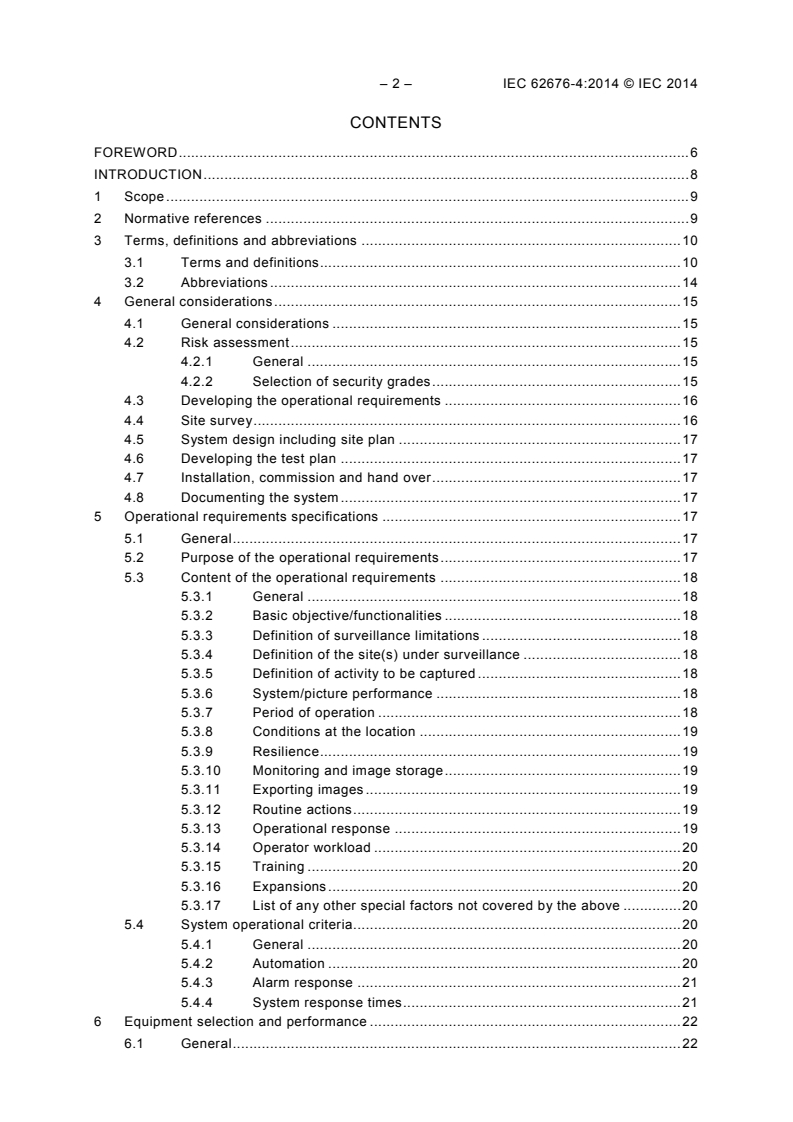
– 2 – IEC 62676-4:2014 © IEC 2014
CONTENTS
FOREWORD . 6
INTRODUCTION . 8
1 Scope . 9
2 Normative references . 9
3 Terms, definitions and abbreviations . 10
3.1 Terms and definitions . 10
3.2 Abbreviations . 14
4 General considerations . 15
4.1 General considerations . 15
4.2 Risk assessment . 15
4.2.1 General . 15
4.2.2 Selection of security grades . 15
4.3 Developing the operational requirements . 16
4.4 Site survey . 16
4.5 System design including site plan . 17
4.6 Developing the test plan . 17
4.7 Installation, commission and hand over . 17
4.8 Documenting the system . 17
5 Operational requirements specifications . 17
5.1 General . 17
5.2 Purpose of the operational requirements . 17
5.3 Content of the operational requirements . 18
5.3.1 General . 18
5.3.2 Basic objective/functionalities . 18
5.3.3 Definition of surveillance limitations . 18
5.3.4 Definition of the site(s) under surveillance . 18
5.3.5 Definition of activity to be captured . 18
5.3.6 System/picture performance . 18
5.3.7 Period of operation . 18
5.3.8 Conditions at the location . 19
5.3.9 Resilience . 19
5.3.10 Monitoring and image storage . 19
5.3.11 Exporting images . 19
5.3.12 Routine actions . 19
5.3.13 Operational response . 19
5.3.14 Operator workload . 20
5.3.15 Training . 20
5.3.16 Expansions . 20
5.3.17 List of any other special factors not covered by the above . 20
5.4 System operational criteria. 20
5.4.1 General . 20
5.4.2 Automation . 20
5.4.3 Alarm response . 21
5.4.4 System response times . 21
6 Equipment selection and performance . 22
6.1 General . 22
6.2 Camera equipment . 22
6.3 Camera and lens selection criteria . 22
6.4 Camera selection . 22
6.4.1 General . 22
6.4.2 PTZ . 23
6.5 Lens and housing selection . 23
6.6 Site coverage/numbers of cameras . 24
6.7 Field of view – object size . 24
6.8 Field of view – Other considerations . 26
6.9 Illumination . 26
6.10 IP Video equipment . 27
6.11 Tamper protection/detection . 28
6.11.1 Camera tamper protection/detection . 28
6.11.2 System tamper protection/detection . 28
6.12 System integration . 28
7 Image presentation . 29
7.1 Display types . 29
7.2 Resolution. 30
8 Transmission . 30
8.1 Principles . 30
8.1.1 General . 30
8.1.2 Selection of IP video performance classes . 31
8.1.3 Interoperability . 31
8.2 Wired transmission links . 32
8.3 Wireless transmission links . 32
8.4 Key considerations for IP based transmission systems. 33
9 Video performance characteristics . 34
9.1 Image compression . 34
9.2 Frame rate . 34
9.3 Resolution. 35
10 Storage characteristics . 35
11 Image storage and export . 37
11.1 Format of the compressed video data . 37
11.2 Encryption. 37
11.3 Basic metadata (time, date, camera identifier) . 37
11.4 Multiplexing format . 38
11.5 Image enhancements . 38
11.6 Image export . 38
11.7 Replay of exported images . 39
12 VSS control room configuration . 39
12.1 Control rooms . 39
12.2 Number, size and positioning of VSS video displays . 40
12.3 Displays and screens mounted on or off the workstation . 40
12.4 Recommended display sizes . 40
12.5 Number of camera images per operator . 40
12.6 Number of work stations . 41
12.7 Equipment siting . 41
12.8 Backup power supply provision . 41
– 4 – IEC 62676-4:2014 © IEC 2014
12.9 Operating temperature . 42
12.10 Lightning and surge protection . 42
13 Defining the test plan . 42
13.1 Purpose of the test plan . 42
13.2 User acceptance testing/inspection . 42
13.3 Technical acceptance testing . 42
13.3.1 Imaging chain consistency . 42
13.3.2 Image quality . 42
14 Summary of the documentation – Pre-installation . 44
14.1 General . 44
14.2 Risk assessment . 45
14.3 Operational requirements . 45
14.4 Design specification . 45
14.5 Site plan . 45
14.6 Test plan . 45
15 System installation and commissioning . 45
15.1 Factory acceptance testing . 45
15.2 Installation process . 46
15.3 User acceptance testing, commissioning and handover . 46
15.4 Declaration of conformance to standards . 46
16 Final documentation . 47
16.1 General . 47
16.2 Complete system drawings . 47
16.3 System commission (with camera specific audits) . 47
16.4 Interface descriptions . 47
16.5 Compliance with legislation (informative) . 47
17 Maintenance . 48
17.1 Maintenance service agreements . 48
17.2 Staff . 48
17.3 Corrective maintenance . 48
17.4 Preventive maintenance . 49
Annex A (informative) Current video standard formats . 51
Annex B (normative) Test protocol for VSS target . 52
B.1 Scope of the test . 52
B.2 Test prerequisites . 52
B.3 Preconditions . 52
B.4 Face selection . 52
B.5 Live view methodology (faces) . 53
B.6 Live view methodology (VRN) . 53
B.7 Recorded view methodology (faces) . 53
B.8 Recorded view methodology (VRN) . 54
B.9 Motion . 54
B.10 Faces: scoring criteria . 54
B.11 VRN: scoring criteria . 54
B.12 Heads control sheet (for example only) . 57
B.13 VRN control sheet (for example only) . 58
Annex C (normative) Test method of image quality – Guidance for the use of the
video test target . 59
Annex D (informative) Guide to specifying VSS parameters . 63
Annex E (normative) Detection response testing and acceptability criteria . 65
E.1 General . 65
E.2 False and nuisance alarms . 65
E.3 Setting the response time . 65
E.4 PTZ response time test procedure . 66
E.5 Observer cueing and prompting . 66
E.6 Detection test locations . 66
E.7 Target camouflage . 67
E.8 Tests with moving targets . 67
E.9 Test conditions . 67
E.10 Testing a "live" system . 67
E.11 Detection test results tables . 68
Bibliography . 69
Figure 1 – Recommended minimum sizes for PAL (576i) resolution . 25
Figure B.1 – Heads control sheet . 57
Figure B.2 – VRN control sheet example . 58
Figure C.1 – A3 test target . 59
Figure C.2 – Avoiding optical distortion . 62
Table 1 – Example System feedback – PTZ Control Responding time, performance
and operator . 22
Table 2 – Commonly encountered resolutions (in pixels) . 25
Table 3 – Person screen height equivalent for different digital resolutions (in percent) . 26
Table 4 – Examples of display technologies . 29
Table 5 – Example resolutions . 30
Table 6 – Wireless transmission options . 33
Table 7 – Factors affecting the storage capacity required for a video recorder . 35
Table B.1 – Example auditor log sheet . 55
Table B.2 – Example control room observer log sheet . 55
Table B.3 – Example camera audit sheet . 55
Table B.4 – Blank auditor log sheet . 56
Table B.5 – Blank control room observer log sheet . 56
Table B.6 – Blank camera audit sheet . 56
Table D.1 – Suggested VSS building blocks . 63
Table E.1 – Detection test results . 68
– 6 – IEC 62676-4:2014 © IEC 2014
INTERNATIONAL ELECTROTECHNICAL COMMISSION
____________
VIDEO SURVEILLANCE SYSTEMS FOR
USE IN SECURITY APPLICATIONS –
Part 4: Application guidelines
FOREWORD
1) The International Electrotechnical Commission (IEC) is a worldwide organization for standardization comprising
all national electrotechnical committees (IEC National Committees). The object of IEC is to promote
international co-operation on all questions concerning standardization in the electrical and electronic fields. To
this end and in addition to other activities, IEC publishes International Standards, Technical Specifications,
Technical Reports, Publicly Available Specifications (PAS) and Guides (hereafter referred to as “IEC
Publication(s)”). Their preparation is entrusted to technical committees; any IEC National Committee interested
in the subject dealt with may participate in this preparatory work. International, governmental and non-
governmental organizations liaising with the IEC also participate in this preparation. IEC collaborates closely
with the International Organization for Standardization (ISO) in accordance with conditions determined by
agreement between the two organizations.
2) The formal decisions or agreements of IEC on technical matters express, as nearly as possible, an international
consensus of opinion on the relevant subjects since each technical committee has representation from all
interested IEC National Committees.
3) IEC Publications have the form of recommendations for international use and are accepted by IEC National
Committees in that sense. While all reasonable efforts are made to ensure that the technical content of IEC
Publications is accurate, IEC cannot be held responsible for the way in which they are used or for any
misinterpretation by any end user.
4) In order to promote international uniformity, IEC National Committees undertake to apply IEC Publications
transparently to the maximum extent possible in their national and regional publications. Any divergence
between any IEC Publication and the corresponding national or regional publication shall be clearly indicated in
the latter.
5) IEC itself does not provide any attestation of conformity. Independent certification bodies provide conformity
assessment services and, in some areas, access to IEC marks of conformity. IEC is not responsible for any
services carried out by independent certification bodies.
6) All users should ensure that they have the latest edition of this publication.
7) No liability shall attach to IEC or its directors, employees, servants or agents including individual experts and
members of its technical committees and IEC National Committees for any personal injury, property damage or
other damage of any nature whatsoever, whether direct or indirect, or for costs (including legal fees) and
expenses arising out of the publication, use of, or reliance upon, this IEC Publication or any other IEC
Publications.
8) Attention is drawn to the Normative references cited in this publication. Use of the referenced publications is
indispensable for the correct application of this publication.
9) Attention is drawn to the possibility that some of the elements of this IEC Publication may be the subject of
patent rights. IEC shall not be held responsible for identifying any or all such patent rights.
International Standard IEC 62676-4 has been prepared by IEC technical committee 79: Alarm
and electronic security systems.
This standard is based on EN 50132-7 (2012).
The text of this standard is based on the following documents:
FDIS Report on voting
79/455/FDIS 79/466/RVD
Full information on the voting for the approval of this standard can be found in the report on
voting indicated in the above table.
This publication has been drafted in accordance with the ISO/IEC Directives, Part 2.
A list of all the parts in the IEC 62676 series, under the general title Video surveillance
systems for use in security applications, can be found on the IEC website.
The committee has decided that the contents of this publication will remain unchanged until
the stability date indicated on the IEC web site under "http://webstore.iec.ch" in the data
related to the specific publication. At this date, the publication will be
• reconfirmed,
• withdrawn,
• replaced by a revised edition, or
• amended.
IMPORTANT – The 'colour inside' logo on the cover page of this publication indicates
that it contains colours which are considered to be useful for the correct
understanding of its contents. Users should therefore print this document using a
colour printer.
– 8 – IEC 62676-4:2014 © IEC 2014
INTRODUCTION
The IEC Technical Committee 79 in charge of alarm and electronic security systems together
with many governmental organisations, test houses and equipment manufacturers has defined
a common framework for video surveillance transmission in order to achieve interoperability
between products.
The IEC 62676 series of standards on video surveillance system is divided into 4 independent
parts:
Part 1: System requirements
Part 2: Video transmission protocols
Part 3: Analog and digital video interfaces
Part 4: Application guidelines
Each part offers its own clauses for the scope, normative references, definitions and
requirements.
The purpose of this part of IEC 62676 is to provide guidance on how to ensure that video
surveillance systems (VSS), thus far referred to as closed circuit television (CCTV), meet their
functional and performance requirements.
This part of IEC 62676 will prove useful to those responsible for establishing operational
requirements, writing specifications, selecting, installing, commissioning, using and
maintaining a VSS.
VSS, in its simplest form, is a means of providing images from security cameras and
recorders for viewing on a display via a transmission system. There is no theoretical limit to
the number of cameras and displays which may be used in a VSS installation but in practice
will be limited by the efficient combination of control and display equipment and the operator's
ability to manage the system.
The successful operation of a VSS requires the active co-operation of the user in carrying out
the recommended procedures.
Due to the wide range of VSS applications, for example security, safety, public safety,
transportation, etc. only the minimum requirements are covered in this part of IEC 62676.
VIDEO SURVEILLANCE SYSTEMS FOR
USE IN SECURITY APPLICATIONS –
Part 4: Application guidelines
1 Scope
This part of IEC 62676 gives recommendations and requirements for the selection, planning,
installation, commissioning, maintaining and testing video surveillance systems (VSS)
comprising of image capture device(s), interconnection(s) and image handling device(s), for
use in security applications.
The objectives of this part of IEC 62676 are to:
a) provide a framework to assist customers, installers and users in establishing their
requirements,
b) assist specifiers and users in determining the appropriate equipment required for a given
application,
c) provide means of evaluating objectively the performance of the VSS.
2 Normative references
The following documents, in whole or in part, are normatively referenced in this document and
are indispensable for its application. For dated references, only the edition cited applies. For
undated references, the latest edition of the referenced document (including any
amendments) applies.
IEC 62676-1-1, Video surveillance systems for use in security applications – Part 1-1: System
requirements – General
IEC 62676-1-2, Video surveillance systems for use in security applications – Part 1-2: System
requirements – Peformance requirements for video transmission
IEC 62676-2-1, Video surveillance systems for use in security applications – Part 2-1: Video
transmission protocols – General requirements
IEC 62676-2-2, Video surveillance systems for use in security applications – Part 2-2: Video
transmission protocols – IP interoperability implementation based on HTTP and REST
services
IEC 62676-2-3, Video surveillance systems for use in security applications – Part 2-3: Video
transmission protocols – IP interoperability implementation based on Web services
IEC 62676-3, Video surveillance systems for use in security applications – Part 3: Analog and
digital video interfaces
– 10 – IEC 62676-4:2014 © IEC 2014
3 Terms, definitions and abbreviations
3.1 Terms and definitions
For the purposes of this document, the following terms and definitions apply.
3.1.1
camera housing
enclosure to provide physical and/or environmental protection of the camera, lens and
ancillary equipment
3.1.2
camera sensitivity
image capturing device capability to produce an image in certain light conditions
3.1.3
VSS surveillance installation
installation consisting of the hardware and software components of a VSS, fully installed and
operational for monitoring a defined security zone
3.1.4
VSS camera
unit containing an imaging device producing a video signal from an optical image
3.1.5
VSS camera equipment
unit containing a VSS camera plus appropriate lens and necessary ancillary equipment
3.1.6
VSS control unit
equipment for controlling and monitoring the required operational functions of the VSS
3.1.7
VSS technician
qualified person who is trained and competent in the installation, maintenance, servicing and
fault-finding of VSSs
3.1.8
VSS
system consisting of camera equipment, monitoring and associated equipment for
transmission and controlling purposes, which may be necessary for the surveillance of a
protected area
3.1.9
corrective maintenance
emergency servicing of a system, or part thereof, carried out in response to the development
of a fault
3.1.10
corrective maintenance report
document that details the requirement for normal or emergency corrective maintenance and
indicates the corrective action taken, as required by IEC 62676-4 or other applicable technical
standards
Note 1 to entry: The report may be an electronic document.
3.1.11
company
organization providing design, installation or maintenance of the VSS system
3.1.12
detect
defined functional purpose of a camera to enable the operator to reliably and easily determine
whether or not any target, such as a person, is present.
3.1.13
electronic iris
automatic electronic shutter which changes the camera sensitivity in relation to the varying
light conditions in order to maintain the video output signal within defined limits
3.1.14
electronic shutter
arrangement in the camera changing its sensitivity by electronically controlling its exposure
time
3.1.15
event recording
event controlled recording or storing of image signals for a pre-determined time
Note 1 to entry: refers to video recording not to system log of events.
3.1.16
external synchronisation
method of feeding reference timing signals to all connected devices to ensure that their video
output signals are synchronous
3.1.17
focal length
f
measurement of the converging power of a lens, normally expressed in mm, which can be
used to determine the angle of view for a given sensor size
3.1.18
geo data
digital information assigning a certain spatial location to the earth's surface
3.1.19
identify
defined functional purpose of a camera to enable identifyfication of an individual beyond
reasonable doubt
3.1.20
inspect
defined functional purpose of a camera to enable the operator to obtain information from
objects
Note 1 to entry: An example object may include text or a logo on clothing.
3.1.21
imaging device
device that converts an optical image into an electrical signal
3.1.22
imaging device illumination
level of illumination (luminance) at the photosensitive surface of the imaging device
– 12 – IEC 62676-4:2014 © IEC 2014
3.1.23
iris
variable aperture mechanism which regulates the amount of light passing through the lens
onto the imaging device of the VSS camera
3.1.24
Kell factor
subjective number of lines of resolution that can be visually perceived in a video display
system, expressed as a percentage of the total number of lines of resolution
3.1.25
lens
optical device for projecting an image of a desired scene onto the photo sensitive surface of
the imaging device
3.1.26
monitor
defined functional purpose of a camera to enable viewing of the number, direction and speed
of movement of people across a wide area, providing their presence is known to the operator
3.1.27
NTSC
NTSC resolution
standard-definition video mode referring in digital applications to 486 lines or 720 × 486 pixels
3.1.28
image presentation device
device for converting video signals into pictures on a display screen
3.1.29
observe
defined functional purpose of a camera enabling characteristic details of an individual, such
as distinctive clothing to be seen, whilst allowing a view of activity surrounding an incident
3.1.30
pan and tilt unit
motorised unit permitting the horizontal and vertical positioning of the camera equipment
3.1.31
PAL
PAL resolution
standard-definition video mode referring in digital applications to 576 lines or 720 × 576 pixels
3.1.32
pan, tilt, zoom
PTZ
function of a camera permitting the horizontal, vertical positioning of the camera together with
the angle of view
3.1.33
picture storage
storing of fixed or video images
3.1.34
preventive maintenance
routine servicing of a system, carried out on a scheduled basis
3.1.35
preventative maintenance report
document which records the preventive maintenance carried out in accordance with
IEC 62676-4 or other applicable technical standard
Note 1 to entry: The report may be an electronic document.
3.1.36
recognise
defined functional purpose of a camera to enable the operator to obtain recognition of an
individual
3.1.37
risk assessment
systematic process to determine the impact of the consequences of hazards and threats
relative to their probability
Note 1 to entry: The result of the analysis provides the basis for risk evaluation within a risk management
process.
3.1.38
risk management
culture, processes and structures that are directed towards the effective management of
potential opportunities and adverse effects
3.1.39
risk management process
systematic application of management policies, procedures and practices to the tasks of
establishing the context, identifying, analysing, evaluating, treating, monitoring and
communicating risk
3.1.40
scene illumination
level of illumination (luminance) on the area to be kept under surveillance
3.1.41
site plan
pictorial representation of the protected area showing the location and intended views of the
VSS cameras
3.1.42
system design proposal
specification of the system design including location factors, site plan, field of view, detector
range and coverage and control room design
3.1.43
time lapse recording
periodic recording of video images at pre-defined intervals
3.1.44
video signal
video channel being transmitted, streaming or not streaming, analog or digital
3.1.45
video signal amplitude
magnitude of the video signal
– 14 – IEC 62676-4:2014 © IEC 2014
3.1.46
zoom lens
lens with adjustable focal length and therefore an adjustable angle of view
3.2 Abbreviations
For the purposes of this document, the following abbreviations apply.
ASB anti-social behaviour
BNC Bayonet Neill-Concelman (connector)
CCIR Consultative Committee on International Radio
CCTV closed circuit television
DVR digital video recorder
EMC electro-magnetic compatibility
CRT cathode ray tube
FAT factory acceptance testing
FPS frames per second
Gbps gigabits per second
HD high definition
NVR network video recorder
LCD liquid crystal display
IP internet protocol
IPD image presentation device
Mbps megabit per second
MPEG motion picture experts group
OR operational requirement
PTZ pan tilt zoom
REST REpresentational State Transfer (webservice)
RTSP real time stream control protocol
SXGA Super eXtended Graphics Adapter
TCP/IP transmission control protocol/internet protocol
VRN vehicle registration number
UAT user acceptance testing
UDP user datagram protocol
UPS uninterruptible power supply
UTC universal time coordinated
UV ultra violet
VCA video content analysis
VMS video management system
VMD video motion detection
WORM write once read many
VSS video surveillance system
...