

IEC TS 60871-3:2015
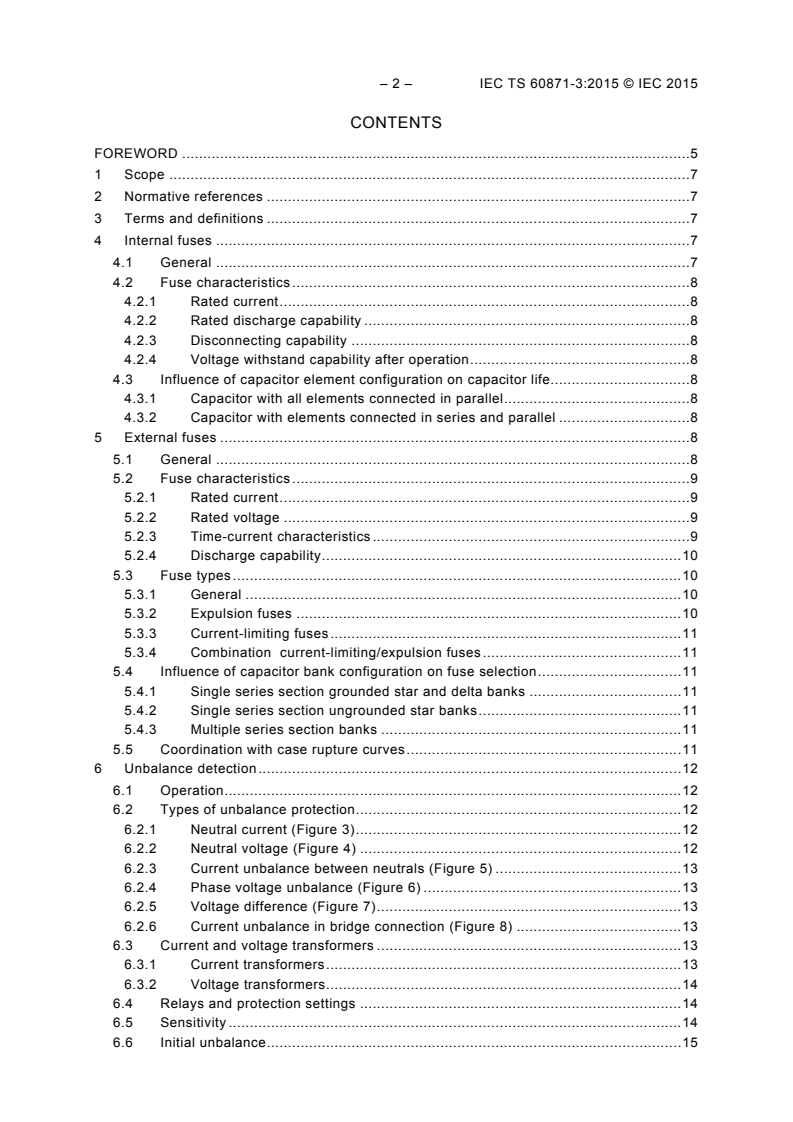
(Main)Shunt capacitors for a.c. power systems having a rated voltage above 1000 V - Part 3: Protection of shunt capacitors and shunt capacitor banks
General Information
- Abstract
IEC/TS 60871-3:2015(E) which is a technical specification, gives guidance on the protection of shunt capacitors and shunt capacitor banks. it applies to capacitors according to IEC 60871-1. This second edition cancels and replaces the first edition published in 2005. This edition constitutes a technical revision. This edition includes the following significant technical changes with respect to the previous edition:
- Clearer writing of formulas on energy limitation for expulsion fuses;
- Updated normative references and bibliography;
- A new clause for synchronized switching has been added. Keywords: shunt capacitors, shunt capacitor banks
- Status
- Published
- Publication Date
- 21-Aug-2023
- Technical Committee
- TC 33 - Power capacitors and their applications
- Drafting Committee
- MT 19 - TC 33/MT 19
- Current Stage
- PPUB - Publication issued
- Start Date
- 25-Jun-2015
- Completion Date
- 15-Oct-2015
Buy Documents
IEC TS 60871-3:2015 - Shunt capacitors for a.c. power systems having a rated voltage above 1000 V - Part 3: Protection of shunt capacitors and shunt capacitor banks Released:6/25/2015

IEC TS 60871-3:2015+AMD1:2023 CSV - Shunt capacitors for AC power systems having a rated voltage above 1 000 V - Part 3: Protection of shunt capacitors and shunt capacitor banks Released:8/22/2023
Overview
IEC TS 60871-3:2015 is a Technical Specification that gives guidance on the protection of shunt capacitors and shunt capacitor banks for AC power systems with a rated voltage above 1 000 V. It applies to capacitors manufactured in accordance with IEC 60871-1 and provides practical protection guidance for installation, operation and safety. This second edition (2015) cancels and replaces the previous edition and includes updated references, clearer energy-limitation formulas for expulsion fuses and a new clause on synchronized switching.
Key topics and technical requirements
The specification addresses protection principles and component requirements, including:
Fuse protection
- Internal and external fuse selection and characteristics (rated current, discharge capability, disconnecting capability, voltage withstand after operation).
- Fuse types covered: expulsion, current-limiting, and combination fuses.
- Guidance on energy limitation for expulsion fuses and coordination with capacitor case rupture curves.
Unbalance detection and protection
- Methods and relay settings for detecting phase or neutral unbalance (neutral current, neutral voltage, phase voltage unbalance, differential measurements).
- Use of current and voltage transformers and sensitivity considerations.
Overload and voltage protection
- Protection against overload currents, overvoltage and undervoltage conditions; reclosing behaviour.
Transient and switching issues
- Use of surge arresters, damping devices and measures for limiting lightning and switching transients.
- New guidance on synchronized switching to reduce switching transients and inrush effects.
Safety and auxiliary protection
- Requirements for discharging devices (internal resistors, external discharge devices), discharge after disconnection, and protection of dead metallic parts.
Applications
IEC TS 60871-3 is intended for practical use where reliable operation of reactive power equipment is critical:
- Design and protection of shunt capacitor banks in substations and industrial plants
- Selection and coordination of fuses and protective relays for high-voltage capacitor installations
- Mitigating switching and lightning transients affecting capacitor life
- Safety procedure development for maintenance (discharge and earthing)
Who should use this standard
- Power utilities and substation protection engineers
- Capacitor and capacitor-bank manufacturers
- Protection relay and fuse designers
- Network planners, consultants and testing laboratories
Related standards
- IEC 60871-1 (capacitor general requirements) - primary normative reference
- Other IEC publications on surge protection, switchgear and protection relays for system coordination
This Technical Specification provides focused, practical guidance to improve reliability, safety and coordination of shunt capacitors and shunt capacitor banks in high-voltage AC systems. For implementation, obtain the full document and applicable normative references from the IEC webstore.
Relations
- Effective Date
- 05-Sep-2023
Buy Documents
IEC TS 60871-3:2015 - Shunt capacitors for a.c. power systems having a rated voltage above 1000 V - Part 3: Protection of shunt capacitors and shunt capacitor banks Released:6/25/2015
IEC TS 60871-3:2015+AMD1:2023 CSV - Shunt capacitors for AC power systems having a rated voltage above 1 000 V - Part 3: Protection of shunt capacitors and shunt capacitor banks Released:8/22/2023
Get Certified
Connect with accredited certification bodies for this standard

IMQ S.p.A. (Certification)
Italian electrical product certification.

SLG Prüf- und Zertifizierungs GmbH
German testing and certification body.

UL Solutions
Global safety science company with testing, inspection and certification.
Sponsored listings
Frequently Asked Questions
IEC TS 60871-3:2015 is a technical specification published by the International Electrotechnical Commission (IEC). Its full title is "Shunt capacitors for a.c. power systems having a rated voltage above 1000 V - Part 3: Protection of shunt capacitors and shunt capacitor banks". This standard covers: IEC/TS 60871-3:2015(E) which is a technical specification, gives guidance on the protection of shunt capacitors and shunt capacitor banks. it applies to capacitors according to IEC 60871-1. This second edition cancels and replaces the first edition published in 2005. This edition constitutes a technical revision. This edition includes the following significant technical changes with respect to the previous edition: - Clearer writing of formulas on energy limitation for expulsion fuses; - Updated normative references and bibliography; - A new clause for synchronized switching has been added. Keywords: shunt capacitors, shunt capacitor banks
IEC/TS 60871-3:2015(E) which is a technical specification, gives guidance on the protection of shunt capacitors and shunt capacitor banks. it applies to capacitors according to IEC 60871-1. This second edition cancels and replaces the first edition published in 2005. This edition constitutes a technical revision. This edition includes the following significant technical changes with respect to the previous edition: - Clearer writing of formulas on energy limitation for expulsion fuses; - Updated normative references and bibliography; - A new clause for synchronized switching has been added. Keywords: shunt capacitors, shunt capacitor banks
IEC TS 60871-3:2015 is classified under the following ICS (International Classification for Standards) categories: 01 - GENERALITIES. TERMINOLOGY. STANDARDIZATION. DOCUMENTATION; 29.240.99 - Other equipment related to power transmission and distribution networks; 31.060.70 - Power capacitors. The ICS classification helps identify the subject area and facilitates finding related standards.
IEC TS 60871-3:2015 has the following relationships with other standards: It is inter standard links to IEC TS 60871-3:2015/AMD1:2023. Understanding these relationships helps ensure you are using the most current and applicable version of the standard.
IEC TS 60871-3:2015 is available in PDF format for immediate download after purchase. The document can be added to your cart and obtained through the secure checkout process. Digital delivery ensures instant access to the complete standard document.
Standards Content (Sample)
IEC TS 60871-3 ®
Edition 2.0 2015-06
TECHNICAL
SPECIFICATION
Shunt capacitors for AC power systems having a rated voltage above 1 000 V –
Part 3: Protection of shunt capacitors and shunt capacitor banks
All rights reserved. Unless otherwise specified, no part of this publication may be reproduced or utilized in any form
or by any means, electronic or mechanical, including photocopying and microfilm, without permission in writing from
either IEC or IEC's member National Committee in the country of the requester. If you have any questions about IEC
copyright or have an enquiry about obtaining additional rights to this publication, please contact the address below or
your local IEC member National Committee for further information.
IEC Central Office Tel.: +41 22 919 02 11
3, rue de Varembé Fax: +41 22 919 03 00
CH-1211 Geneva 20 info@iec.ch
Switzerland www.iec.ch
About the IEC
The International Electrotechnical Commission (IEC) is the leading global organization that prepares and publishes
International Standards for all electrical, electronic and related technologies.
About IEC publications
The technical content of IEC publications is kept under constant review by the IEC. Please make sure that you have the
latest edition, a corrigenda or an amendment might have been published.
IEC Catalogue - webstore.iec.ch/catalogue Electropedia - www.electropedia.org
The stand-alone application for consulting the entire The world's leading online dictionary of electronic and
bibliographical information on IEC International Standards, electrical terms containing more than 30 000 terms and
Technical Specifications, Technical Reports and other definitions in English and French, with equivalent terms in 15
documents. Available for PC, Mac OS, Android Tablets and additional languages. Also known as the International
iPad. Electrotechnical Vocabulary (IEV) online.
IEC publications search - www.iec.ch/searchpub IEC Glossary - std.iec.ch/glossary
The advanced search enables to find IEC publications by a More than 60 000 electrotechnical terminology entries in
variety of criteria (reference number, text, technical English and French extracted from the Terms and Definitions
committee,…). It also gives information on projects, replaced clause of IEC publications issued since 2002. Some entries
and withdrawn publications. have been collected from earlier publications of IEC TC 37,
77, 86 and CISPR.
IEC Just Published - webstore.iec.ch/justpublished
Stay up to date on all new IEC publications. Just Published IEC Customer Service Centre - webstore.iec.ch/csc
details all new publications released. Available online and If you wish to give us your feedback on this publication or
also once a month by email. need further assistance, please contact the Customer Service
Centre: csc@iec.ch.
IEC TS 60871-3 ®
Edition 2.0 2015-06
TECHNICAL
SPECIFICATION
Shunt capacitors for AC power systems having a rated voltage above 1 000 V –
Part 3: Protection of shunt capacitors and shunt capacitor banks
INTERNATIONAL
ELECTROTECHNICAL
COMMISSION
ICS 29.240.99; 31.060.70 ISBN 978-2-8322-2755-8
– 2 – IEC TS 60871-3:2015 © IEC 2015
CONTENTS
FOREWORD .5
1 Scope .7
2 Normative references .7
3 Terms and definitions .7
4 Internal fuses .7
4.1 General .7
4.2 Fuse characteristics .8
4.2.1 Rated current .8
4.2.2 Rated discharge capability .8
4.2.3 Disconnecting capability .8
4.2.4 Voltage withstand capability after operation .8
4.3 Influence of capacitor element configuration on capacitor life.8
4.3.1 Capacitor with all elements connected in parallel .8
4.3.2 Capacitor with elements connected in series and parallel .8
5 External fuses .8
5.1 General .8
5.2 Fuse characteristics .9
5.2.1 Rated current .9
5.2.2 Rated voltage .9
5.2.3 Time-current characteristics .9
5.2.4 Discharge capability . 10
5.3 Fuse types . 10
5.3.1 General . 10
5.3.2 Expulsion fuses . 10
5.3.3 Current-limiting fuses . 11
5.3.4 Combination current-limiting/expulsion fuses . 11
5.4 Influence of capacitor bank configuration on fuse selection . 11
5.4.1 Single series section grounded star and delta banks . 11
5.4.2 Single series section ungrounded star banks . 11
5.4.3 Multiple series section banks . 11
5.5 Coordination with case rupture curves . 11
6 Unbalance detection . 12
6.1 Operation . 12
6.2 Types of unbalance protection . 12
6.2.1 Neutral current (Figure 3) . 12
6.2.2 Neutral voltage (Figure 4) . 12
6.2.3 Current unbalance between neutrals (Figure 5) . 13
6.2.4 Phase voltage unbalance (Figure 6) . 13
6.2.5 Voltage difference (Figure 7) . 13
6.2.6 Current unbalance in bridge connection (Figure 8) . 13
6.3 Current and voltage transformers . 13
6.3.1 Current transformers . 13
6.3.2 Voltage transformers . 14
6.4 Relays and protection settings . 14
6.5 Sensitivity . 14
6.6 Initial unbalance . 15
7 Overload current . 15
7.1 Operation . 15
7.2 Protective arrangement . 15
7.3 Current transformers . 15
7.4 Relays . 15
7.5 Protective settings . 16
8 Over and undervoltage . 16
8.1 Operation . 16
8.2 Overvoltage protection . 16
8.3 Undervoltage protection . 16
8.4 Reclosing . 16
9 Other protection . 17
9.1 Surge arresters . 17
9.1.1 General . 17
9.1.2 Operation . 17
9.1.3 Lightning transients. 17
9.1.4 Switching transients . 17
9.1.5 Temporary overvoltages . 17
9.1.6 Rated voltage . 17
9.1.7 Energy absorption . 18
9.2 Damping devices . 18
9.2.1 Capacitor switching . 18
9.2.2 Inrush currents . 18
9.2.3 Voltage transients . 19
9.2.4 Ratings . 19
9.3 Synchronized switching . 19
9.3.1 Operation . 19
9.3.2 Breaker contacts delay. 19
10 Safety . 19
10.1 Discharging devices . 19
10.1.1 General . 19
10.1.2 Internal resistors . 20
10.1.3 External discharge devices . 20
10.1.4 Discharging after disconnection . 20
10.2 Dead metallic parts . 20
Bibliography . 25
Figure 1 – Fuse types . 10
Figure 2 – Typical case rupture curves for approximately 30 000 cm³ case volume . 21
Figure 3 – Star connection with the neutral grounded through a current transformer . 21
Figure 4 – Star connection with voltage transformer between neutral and ground . 21
Figure 5 – Star connection with ungrounded neutral and voltage transformers
connected in an open delta . 22
Figure 6 – Double-star connection with ungrounded neutral . 22
Figure 7 – Star connection with grounded neutral and voltage transformers connected
in differential measurement . 22
Figure 8 – Bridge connection . 22
– 4 – IEC TS 60871-3:2015 © IEC 2015
Figure 9 – Line overcurrent relays for capacitor bank, grounded . 22
Figure 10 – Line overcurrent relays for capacitor bank, ungrounded . 23
Table 1 – Melting currents for type-K (fast) fuse links, in amperes . 23
Table 2 – Melting currents for type-T (slow) fuse links, in amperes . 24
INTERNATIONAL ELECTROTECHNICAL COMMISSION
____________
SHUNT CAPACITORS FOR AC POWER SYSTEMS HAVING
A RATED VOLTAGE ABOVE 1 000 V –
Part 3: Protection of shunt capacitors and
shunt capacitor banks
FOREWORD
1) The International Electrotechnical Commission (IEC) is a worldwide organization for standardization comprising
all national electrotechnical committees (IEC National Committees). The object of IEC is to promote
international co-operation on all questions concerning standardization in the electrical and electronic fields. To
this end and in addition to other activities, IEC publishes International Standards, Technical Specifications,
Technical Reports, Publicly Available Specifications (PAS) and Guides (hereafter referred to as “IEC
Publication(s)”). Their preparation is entrusted to technical committees; any IEC National Committee interested
in the subject dealt with may participate in this preparatory work. International, governmental and non-
governmental organizations liaising with the IEC also participate in this preparation. IEC collaborates closely
with the International Organization for Standardization (ISO) in accordance with conditions determined by
agreement between the two organizations.
2) The formal decisions or agreements of IEC on technical matters express, as nearly as possible, an
international consensus of opinion on the relevant subjects since each technical committee has representation
from all interested IEC National Committees.
3) IEC Publications have the form of recommendations for international use and are accepted by IEC National
Committees in that sense. While all reasonable efforts are made to ensure that the technical content of IEC
Publications is accurate, IEC cannot be held responsible for the way in which they are used or for any
misinterpretation by any end user.
4) In order to promote international uniformity, IEC National Committees undertake to apply IEC Publications
transparently to the maximum extent possible in their national and regional publications. Any divergence
between any IEC Publication and the corresponding national or regional publication shall be clearly indicated in
the latter.
5) IEC itself does not provide any attestation of conformity. Independent certification bodies provide conformity
assessment services and, in some areas, access to IEC marks of conformity. IEC is not responsible for any
services carried out by independent certification bodies.
6) All users should ensure that they have the latest edition of this publication.
7) No liability shall attach to IEC or its directors, employees, servants or agents including individual experts and
members of its technical committees and IEC National Committees for any personal injury, property damage or
other damage of any nature whatsoever, whether direct or indirect, or for costs (including legal fees) and
expenses arising out of the publication, use of, or reliance upon, this IEC Publication or any other IEC
Publications.
8) Attention is drawn to the Normative references cited in this publication. Use of the referenced publications is
indispensable for the correct application of this publication.
9) Attention is drawn to the possibility that some of the elements of this IEC Publication may be the subject of
patent rights. IEC shall not be held responsible for identifying any or all such patent rights.
The main task of IEC technical committees is to prepare International Standards. In
exceptional circumstances, a technical committee may propose the publication of a technical
specification when
• the required support cannot be obtained for the publication of an International Standard,
despite repeated efforts, or
• the subject is still under technical development or where, for any other reason, there is
the future but no immediate possibility of an agreement on an International Standard.
International Standard IEC 60871-3, which is a technical specification, has been prepared by
IEC technical committee 33: Power capacitors and their applications.
This second edition cancels and replaces the first edition published in 1996. This edition
constitutes a technical revision.
– 6 – IEC TS 60871-3:2015 © IEC 2015
This edition includes the following significant technical changes with respect to the previous
edition:
a) Clearer writing of formulas on energy limitation for expulsion fuses;
b) Updated normative references and bibliography;
c) A new clause for synchronized switching has been added.
The text of this technical specification is based on the following documents:
Enquiry draft Report on voting
33/545/DTS 33/563/RVC
Full information on the voting for the approval of this technical specification can be found in
the report on voting indicated in the above table.
This publication has been drafted in accordance with the ISO/IEC Directives, Part 2.
A list of all parts in the IEC 60871, published under the general title Shunt capacitors for a.c.
power systems having a rated voltage above 1 000 V, can be found on the IEC website.
The committee has decided that the contents of this publication will remain unchanged until
the stability date indicated on the IEC website under "http://webstore.iec.ch" in the data
related to the specific publication. At this date, the publication will be
• transformed into an International standard,
• reconfirmed,
• withdrawn,
• replaced by a revised edition, or
• amended.
A bilingual version of this publication may be issued at a later date.
SHUNT CAPACITORS FOR AC POWER SYSTEMS HAVING
A RATED VOLTAGE ABOVE 1 000 V –
Part 3: Protection of shunt capacitors and
shunt capacitor banks
1 Scope
This part of IEC 60871, which is a technical specification, gives guidance on the protection of
shunt capacitors and shunt capacitor banks. it applies to capacitors according to IEC 60871-
1.
2 Normative references
The following documents, in whole or in part, are normatively referenced in this document
and are indispensable for its application. For dated references, only the edition cited applies.
For undated references, the latest edition of the referenced document (including any
amendments) applies.
IEC 60549, High-voltage fuses for the external protection of shunt capacitors
IEC 60871-1, Shunt capacitors for a.c. power systems having a rated voltage above 1 000 V
–Part 1: General
IEC 60871-4, Shunt capacitors for AC power systems having a rated voltage above 1 000 V –
Part 4: Internal fuses
3 Terms and definitions
For the purposes of this document, the terms and definitions given in IEC 60549, IEC 60871-
1 and IEC 60871-4 apply.
4 Internal fuses
4.1 General
Internal fuses for shunt capacitors are selective current-limiting fuses arranged inside a
capacitor. As defined in IEC 60871-4, they are designed to isolate faulted capacitor elements
or capacitor unit, to allow operation of the remaining parts of that capacitor unit and the bank
in which the capacitor unit is connected.
The operation of an internal fuse is initiated by the breakdown of a capacitor element. The
affected element is instantaneously disconnected by the operation of the element fuse
without interruption in the operation of the capacitor.
The number of externally parallel connected capacitors and the available short-circuit current
of the supply system should not affect the current-limiting of internal fuses.
It should be noted that internal fuses do not provide protection against a short circuit between
internal connections or a short circuit between active parts and casing, both of which may
lead to case rupture.
– 8 – IEC TS 60871-3:2015 © IEC 2015
4.2 Fuse characteristics
4.2.1 Rated current
There is no definition or test method existing for element fuses.
Element fuses are, in general, designed for much higher currents than the maximum
permissible element current. They are meant to disconnect only faulty elements. The faulty
elements and their fuses are not intended to be replaced.
4.2.2 Rated discharge capability
IEC 60871-4 and IEC 60871-1 specify that the capacitor be subject to five undamped
. For special applications, where inrush currents
discharges from a d.c. charge level of 2,5 U
N
and/or peak voltages are limited, lower discharge requirements are applicable.
4.2.3 Disconnecting capability
Requirements and test procedures are given in IEC 60871-4. These tests verify that the fuse
has a current-limiting action.
4.2.4 Voltage withstand capability after operation
Requirements and test procedures are given in IEC 60871-4.
4.3 Influence of capacitor element configuration on capacitor life
4.3.1 Capacitor with all elements connected in parallel
After the breakdown of an element, the respective fuse will melt in less than a millisecond
owing to the discharge current from the parallel connected elements and capacitors and the
power frequency current from the supply. The capacitor may, however, continue operating
with a correspondingly reduced output.
If the capacitor is operated at a fixed bus voltage, no variation in operating voltage on the
remaining healthy elements will occur.
4.3.2 Capacitor with elements connected in series and parallel
After the breakdown of an element, all parallel connected elements discharge their stored
energy or part of it into the faulty element. The power frequency current is limited by the
remaining healthy elements connected in series.
After the disconnection of the faulty element, the capacitor continues operating with a
correspondingly reduced output. The remaining healthy elements of the group are then
stressed with a voltage approximately m × n /[m (n – 1) + 1] times the initial voltage, where n
is the number of parallel connected elements per group and m the number of series-
connected sections per unit. In certain cases the voltage may be higher, for example due to
neutral shift with an ungrounded star configuration.
5 External fuses
5.1 General
External fuses for shunt capacitors are defined in IEC 60549 as intended to clear faults inside
a capacitor unit and to permit continued operation of the remaining parts of the bank in which
the unit is connected. They will also clear an external capacitor bushing flashover.
The operation of an external fuse is generally determined by the power frequency fault
current and by the discharge energy from capacitors connected in parallel with the faulty
capacitor.
The initial breakdown is usually of an individual element within a capacitor. This invariably
becomes a short circuit which removes all elements in parallel with it and eliminates one
series section from the capacitor. Should the cause of the initial failure continue, failure of
successive series sections (which see an increasing voltage with each series section
removed) will occur. This causes an increase in the current through the capacitor to the point
where the fuse operates removing the failed capacitor from the circuit.
It should be noted, particularly in the case of paper or paper/film dielectric capacitors, that
the capacitor case may occasionally rupture in the event of failure. This occurs when the
initial element failure has high resistance between the shorted electrodes due to the
presence of paper and sustained arcing generates gas which swells the case to the point
where it may rupture before the protecting fuse can disconnect the capacitor.
Capacitors with all-film dielectric have a lower incidence of case rupture because the film
melts and generally allows a low resistance short between the electrodes. However, case
rupture may still occur due to arcing when there is a broken internal connection and when
there is excessive stored energy available in parallel capacitors and/or high power frequency
fault current.
5.2 Fuse characteristics
5.2.1 Rated current
The rated current of the selected fuse should be consistent with the criteria used for the
selection of a switch or circuit-breaker for the same bank. From the various national
standards the minimum accepted rating is 1,35 times the rated capacitor current.
In a steady-state basis, there is no need for the fuse capability to exceed that for the switch
or circuit-breaker. However, transient conditions such as currents associated with system or
bank switching should be considered. It is common to use a fuse with a current rating of 1,65
times the rated capacitor current.
IEC 60549 specifies that the fuse rated current be at least 1,43 times the capacitor rating.
This falls between the two values mentioned above of 1,35 and 1,65. For some banks, the
fuse rating may be higher than 1,65 times the capacitor rated current to avoid spurious fuse
operation due to switching transients and for mechanical reasons.
NOTE The continuous rating of the fuse is not necessarily its nameplate rating. For example, an expulsion fuse
link with a rating much smaller than the rating of the fuse holder can carry 150 % of its nameplate rating on a
continuous basis. It is extremely important that the actual current rating of the fuse link be known. Typically, fuse
holders are available in two current ratings, one for up to 50 A and the other for up to 100 A, whereas fuse links
used in these holders are rated from 5 A to 100 A. These holders also vary in voltage rating, e.g. up to 9 kV, 9 kV
to 16 kV and 16 kV to 25 kV.
5.2.2 Rated voltage
The rated voltage of the fuse should be not less than 1,1 times the rated voltage of the
capacitor with which it is associated in order to meet the requirements of IEC 60549.
5.2.3 Time-current characteristics
Time-current characteristics are available from most fuse manufacturers to assist in
coordination.
This information is sometimes available in table form.
– 10 – IEC TS 60871-3:2015 © IEC 2015
5.2.4 Discharge capability
The external fuse should be capable of withstanding inrush transients and currents due to
external short circuits. IEC 60549 specifies tests to verify the I t to which the fuse may be
subjected for 5 and 100 discharges.
5.3 Fuse types
5.3.1 General
The different types of fuse are indicated in Figure 1.
External fuses
Expulsion Current-limiting
Combination
(current-limiting/expulsion)
Indoor/Outdoor Outdoor
Outdoor
IEC
Figure 1 – Fuse types
5.3.2 Expulsion fuses
The following information on expulsion fuses should be noted:
a) Expulsion fuses are normally used in outdoor applications due to noise and gases
released during fuse operation.
b) Expulsion fuses have limited power frequency fault current capability. Therefore consult
with the fuse manufacturer when fault current at the fuse exceeds 1 800 A, or use
current-limiting fuses.
Floating star-connected banks and those with multiple series sections minimize the
importance of the power frequency interrupting capability of the fuse.
c) Expulsion fuses have limited ability to clear against the discharge energy of capacitors
connected in parallel with a shorted capacitor. Standard fuses are generally rated at
15 kJ or less; consult the fuse manufacturer.
Both fuse tubes and capacitor cases may rupture due to energy available in the event of a
capacitor failure. The probability of case rupture in the event of capacitor failure is
generally considered acceptable with all-film capacitors when the parallel energy has
generally been limited to 15 kJ. This limit is calculated on the basis that the capacitor
voltage is at 1,1 times the peak value of rated voltage (when higher power frequency
overvoltages are anticipated, the parallel energy should be reduced accordingly). At rated
voltage, this limit is equivalent to 4 650 kvar of parallel connected capacitors at 60 Hz and
3 900 kvar at 50 Hz. For all-paper and film/paper capacitors, the energy is typically limited
to 10 kJ.
From energy in W.s. (J): Energy = C × (U )
rms
kvar ×1 000
Substituting capacitance: C (µF) =
2π ×f ×U
N N
It follows then that: energy = 159 × kvar/frequency
d) Expulsion fuse links are available in ANSI Type T and Type K (see bibliography).
The difference in performance is in the time for melting of the link, as shown in Tables
1 and 2.
5.3.3 Current-limiting fuses
The following information on current-limiting fuses should be noted:
a) Current-limiting fuses may be used for indoor and outdoor applications.
b) Current-limiting fuses will limit the power frequency short-circuit current to less than the
prospective value and will reduce the current to zero before the normal working frequency
current zero.
c) Generally, current-limiting fuses impose no upper limit on the parallel stored energy
available to a shorted capacitor. However, some current-limiting fuses have a maximum
limit for parallel energy. The fuse manufacturer should be consulted regarding the
discharge energy interrupting rating.
d) It should be noted that some fuses will not clear on power frequency current. The fuse
manufacturer should be consulted regarding the interrupting rating for power frequency
current.
5.3.4 Combination current-limiting/expulsion fuses
As the name implies, these fuses combine a totally enclosed current-limiting fuse with an
expulsion fuse.
a) As with expulsion fuses, combination fuses are normally used in outdoor applications due
to noise and gases released during fuse operation.
b) As with current-limiting fuses, combination fuses will limit the power frequency short-
circuit current to less than the prospective value and will reduce the current to zero
before the normal working frequency current zero.
c) As with current-limiting fuses, combination fuses generally have no upper limit on the
parallel stored energy available to a shorted capacitor. However, some combination fuses
have a maximum limit for parallel energy. The fuse manufacturer should be consulted
regarding the discharge energy interrupting rating.
d) It should be noted that some fuses will not clear on power frequency current. The fuse
manufacturer should be consulted regarding the interrupting rating for power frequency
current.
5.4 Influence of capacitor bank configuration on fuse selection
5.4.1 Single series section grounded star and delta banks
Current-limiting or combination fuses are normally required because a shorted capacitor is
subjected to high fault currents that may cause the fuse holder or capacitor case to rupture.
5.4.2 Single series section ungrounded star banks
The available energy from parallel connected capacitors will probably be the determining
factor in selecting either expulsion or one of the current-limiting options.
5.4.3 Multiple series section banks
Available short-circuit current is not a factor in these banks since the multiple series sections
will limit the fault current through a shorted capacitor. In large banks having many capacitors
in parallel per series section, expulsion type fuses may often be used if the bank
configuration is changed, e.g. to double star, to limit the parallel energy.
5.5 Coordination with case rupture curves
In addition to the considerations in fuse selection already dealt with, the fuse should
coordinate with the rupture curves for the bank capacitor units.
– 12 – IEC TS 60871-3:2015 © IEC 2015
These curves are available in some national standards and from manufacturers of capacitors.
Figure 2 illustrates examples of these curves.
To minimize risk of case rupture, selected fuses should provide coordination in the "low
probability" region. Refer to 5.3.2, 5.3.3 and 5.3.4 for comments on energy from capacitors
connected in parallel.
6 Unbalance detection
6.1 Operation
Each time an internal capacitor element fails, a slight change of voltage distribution and
current flow within the capacitor bank is encountered. The magnitude of these changes
depends upon the number of failed elements and their location within the bank. If an
externally fused capacitor is disconnected by its fuse, a larger voltage and current change is
obtained than if single elements are disconnected by internal fuses.
By the use of various bank connections and relaying schemes, the voltage or current
unbalance may be measured and utilized for protection. The main purpose of the unbalance
protection is to give an alarm or to disconnect the entire capacitor bank when overvoltages
across healthy capacitors, adjacent to a failed capacitor, are excessive. Normally not more
than 10 % overvoltage should be allowed (overvoltage limit according to IEC 60871-1).
Another function of the unbalance protection is to remove the bank from service for a fault not
isolated by a fuse or to protect banks that are not internally or externally fused. Unbalance
protection is not a replacement for short-circuit protection.
6.2 Types of unbalance protection
6.2.1 Neutral current (Figure 3)
The capacitors are star-connected (grounded) with a current transformer between neutral and
ground. An unbalance in the bank will cause current to flow from neutral to ground.
This protection scheme is sensitive to phase unbalances in the network and depends upon
the system being effectively grounded. The settings should allow for normal variations and
the sensitivity of the protection may therefore be impaired. Harmonic currents (3rd harmonic
in particular) will pass through the current transformer; a filter may sometimes be necessary
to avoid disturbances.
6.2.2 Neutral voltage (Figure 4)
The capacitors are star-connected (ungrounded) with a voltage transformer between neutral
and ground. A voltage difference between neutral and ground will be measured at unbalance.
The sensitivity is relatively poor due to influence by phase unbalances and the scheme
depends upon the system being effectively grounded. The settings should allow for normal
variations and the sensitivity of the protection may therefore be impaired. The method is most
suitable in combination with external fuses.
Voltage transformers used in this application should be rated for full system voltage. The
neutral voltage will rise significantly during switching and the transformer may be saturated if
not correctly rated. Resistive dividers and static relays may be used instead of voltage
transformers to overcome the problems with saturation, transient overvoltages on switching
and the high cost of a voltage transformer rated for full system voltage.
6.2.3 Current unbalance between neutrals (Figure 5)
The capacitors are arranged in two parallel stars (ungrounded) with a current transformer
between the neutrals. The stars do not have to be equal in size. An unbalance in the bank
will cause current to flow in the neutral.
This protection is not affected by unbalance in the network and it is not particularly sensitive
to harmonics. The scheme may be used for both internal and external fuses. As the
sensitivity performance is good the method is especially useful for internal fuses. The current
transformer should be rated for full system voltage.
6.2.4 Phase voltage unbalance (Figure 6)
The capacitors are star-connected (ungrounded) and three line-to-neutral voltage
transformers are used with their secondaries connected in open delta. An unbalance in the
bank will cause a neutral shift voltage and thus an output signal from the open delta. These
voltage transformers should have insulation rated for primary to ground and primary to
secondary voltages.
Due to three-phase summation the output magnitude is higher than would be the case with
the neutral to ground measurement (Figure 4). The sensitivity performance is therefore
improved. The influence by phase unbalances is still a concern.
6.2.5 Voltage difference (Figure 7)
The capacitors are connected ungrounded or grounded star. The voltage shift of each phase
midpoint (or close to midpoint) is measured relative to its line-to-neutral voltage by means of
voltage transformers. Signals will be obtained separately from each phase where capacitor
failures occur.
This method is suitable for large capacitor banks since the total bank will be divided into
three separate protection zones. This may be of importance for overall sensitivity. The
method is not influenced by phase voltage unbalance.
For very large capacitor banks a double star-connection may be used where comparisons are
made between the midpoints of the two branches of each phase.
6.2.6 Current unbalance in bridge connection (Figure 8)
The capacitors in each phase are arranged in two branches with a current transformer
connected between midpoints or close to midpoints of the two branches. Failures anywhere
in the branches will cause an unbalance current to flow through the current transformer.
This method is suitable for large capacitor banks since the total bank will be divided into
three separate protection zones. The method is not influenced by phase voltage unbalances.
It may be used in delta- or star-connected banks with the neutral grounded or ungrounded.
6.3 Current and voltage transformers
6.3.1 Current transformers
Rated current is based on the calculated unbalance at different failure modes. Harmonic
current should be considered in determining the rating. For internally fused capacitors the
current may be very low and current transformers should be chosen accordingly.
For ungrounded banks the rated voltage should correspond to the system voltage. Lower
ratings may be used if the banks are grounded.
– 14 – IEC TS 60871-3:2015 © IEC 2015
The current transformer should be capable of withstanding currents during abnormal
conditions such as short circuits. Such failures may lead to a high peak transient and high
power frequency currents during the delay of the overcurrent protection. Switching current
transient should also be taken into account. The current transformer may be protected at its
primary by means of spark gaps or surge arresters.
The accuracy requirement is generally quite low. Class 10 P would normally be sufficient
providing the measuring error of the current transformer at the protection setting current is
less than 5 % (see IEC 60044-1). Should the maximum unbalance be much lower than the
rated current of the current transformer, a better accuracy class is required.
6.3.2 Voltage transformers
The rated primary voltage of the voltage transformer should correspond to the calculated
maximum unbalance.
For ungrounded banks the insulation class also applies to the voltage transformer. For
grounded banks, voltage transformers with reduced insulation may be used.
When the primary winding forms a discharge path for the capacitor, the capability to
withstand the discharge energy and peak current at disconnection from the line has to be
considered.
Standard voltage transformers of accuracy class 0,5 are normally used (see IEC 60044-2).
For connection schemes according to Figures 6 and 7, special attention should be paid to
matching the voltage transformers in different phases.
6.4 Relays and protection settings
To avoid false operations due to switching or other transients, the unbalance relay should
have a certain time delay. Typical delay-settings are about 0,1 s to 1 s; for external fuses, the
coordination with fuses is of special importance. The relaying should also incorporate
features for blocking of automatic reclosure if such a system is used.
Relays used for unbalance protection should normally have reduced sensitivity for
frequencies other than the fundamental to prevent undesired operation and to simplify
calculation of the relay setting.
When defining settings for the unbalance relay, one has to consider the overvoltage limit
(10 %) for adjacent capacitors, i.e. alarm for overvoltages less than 10 %, trip when in excess
of 10 %. For internally fused capacitors there may be different restrictions on voltage rise
across parallel non-failed internal elements.
Depending on bank size, one or more fuses may be allowed to operate before an alarm is
initiated. The protective relaying should trip the bank once the overvoltage limit is exceeded.
6.5 Sensitivity
The sensitivity of the protection depends upon the size of the capacitor bank or that part of
the bank which is incorporated in one particular protection zone. For large banks a method
that allows one separate relay (in rare cases even more) per phase is necessary.
When defining the number of relays based on sensitivity requirements, the influence of
factors such as temperature differences within the bank should be considered.
Sensitivity analysis, i.e. the relation between number of failed elements, fuses and current or
voltage outputs, is usually made by the capacitor manufacturer. Higher sensitivity is generally
needed with internally fused than with externally
...
IEC TS 60871-3 ®
Edition 2.1 2023-08
CONSOLIDATED VERSION
TECHNICAL
SPECIFICATION
colour
inside
Shunt capacitors for AC power systems having a rated voltage above 1 000 V –
Part 3: Protection of shunt capacitors and shunt capacitor banks
All rights reserved. Unless otherwise specified, no part of this publication may be reproduced or utilized in any form
or by any means, electronic or mechanical, including photocopying and microfilm, without permission in writing from
either IEC or IEC's member National Committee in the country of the requester. If you have any questions about IEC
copyright or have an enquiry about obtaining additional rights to this publication, please contact the address below or
your local IEC member National Committee for further information.
IEC Secretariat Tel.: +41 22 919 02 11
3, rue de Varembé info@iec.ch
CH-1211 Geneva 20 www.iec.ch
Switzerland
About the IEC
The International Electrotechnical Commission (IEC) is the leading global organization that prepares and publishes
International Standards for all electrical, electronic and related technologies.
About IEC publications
The technical content of IEC publications is kept under constant review by the IEC. Please make sure that you have the
latest edition, a corrigendum or an amendment might have been published.
IEC publications search - webstore.iec.ch/advsearchform IEC Products & Services Portal - products.iec.ch
The advanced search enables to find IEC publications by a Discover our powerful search engine and read freely all the
variety of criteria (reference number, text, technical publications previews. With a subscription you will always have
committee, …). It also gives information on projects, replaced access to up to date content tailored to your needs.
and withdrawn publications.
Electropedia - www.electropedia.org
IEC Just Published - webstore.iec.ch/justpublished
The world's leading online dictionary on electrotechnology,
Stay up to date on all new IEC publications. Just Published
containing more than 22 300 terminological entries in English
details all new publications released. Available online and once
and French, with equivalent terms in 19 additional languages.
a month by email.
Also known as the International Electrotechnical Vocabulary
(IEV) online.
IEC Customer Service Centre - webstore.iec.ch/csc
If you wish to give us your feedback on this publication or need
further assistance, please contact the Customer Service
Centre: sales@iec.ch.
IEC TS 60871-3 ®
Edition 2.1 2023-08
CONSOLIDATED VERSION
TECHNICAL
SPECIFICATION
colour
inside
Shunt capacitors for AC power systems having a rated voltage above 1 000 V –
Part 3: Protection of shunt capacitors and shunt capacitor banks
INTERNATIONAL
ELECTROTECHNICAL
COMMISSION
ICS 29.240.99; 31.060.70 ISBN 978-2-8322-7449-1
IEC TS 60871-3 ®
Edition 2.1 2023-08
CONSOLIDATED VERSION
REDLINE VERSION
colour
inside
Shunt capacitors for AC power systems having a rated voltage above 1 000 V –
Part 3: Protection of shunt capacitors and shunt capacitor banks
– 2 – IEC TS 60871-3:2015+AMD1:2023 CSV
© IEC 2023
CONTENTS
FOREWORD . 5
1 Scope . 7
2 Normative references . 7
3 Terms and definitions . 7
4 Internal fuses. 7
4.1 General . 7
4.2 Fuse characteristics . 8
4.2.1 Rated current . 8
4.2.2 Rated discharge capability . 8
4.2.3 Disconnecting capability . 8
4.2.4 Voltage withstand capability after operation . 8
4.3 Influence of capacitor element configuration on capacitor life . 8
4.3.1 Capacitor with all elements connected in parallel . 8
4.3.2 Capacitor with elements connected in series and parallel . 8
5 External fuses . 8
5.1 General . 8
5.2 Fuse characteristics . 9
5.2.1 Rated current . 9
5.2.2 Rated voltage . 9
5.2.3 Time-current characteristics . 9
5.2.4 Discharge capability . 10
5.3 Fuse types . 10
5.3.1 General . 10
5.3.2 Expulsion fuses . 10
5.3.3 Current-limiting fuses. 11
5.3.4 Combination current-limiting/expulsion fuses . 11
5.4 Influence of capacitor bank configuration on fuse selection . 11
5.4.1 Single series section grounded star and delta banks. 11
5.4.2 Single series section ungrounded star banks . 11
5.4.3 Multiple series section banks . 11
5.5 Coordination with case rupture curves . 11
6 Unbalance detection . 12
6.1 Operation . 12
6.2 Types of unbalance protection . 12
6.2.1 Neutral current (Figure 3) . 12
6.2.2 Neutral voltage (Figure 4) . 12
6.2.3 Current unbalance between neutrals (Figure 5) . 13
6.2.4 Phase voltage unbalance (Figure 6) . 13
6.2.5 Voltage difference (Figure 7) . 13
6.2.6 Current unbalance in bridge connection (Figure 8) . 13
6.3 Current and voltage transformers . 13
6.3.1 Current transformers. 13
6.3.2 Voltage transformers . 14
6.4 Relays and protection settings . 14
6.5 Sensitivity . 14
6.6 Initial unbalance . 15
© IEC 2023
6.7 Calculation of the unbalance relay’s settings . 15
7 Overload current . 15
7.1 Operation . 15
7.2 Protective arrangement . 15
7.3 Current transformers . 16
7.4 Relays . 16
7.5 Protective settings . 16
8 Over and undervoltage . 16
8.1 Operation . 16
8.2 Overvoltage protection . 17
8.3 Undervoltage protection . 17
8.4 Reclosing . 17
9 Other protection. 17
9.1 Surge arresters . 17
9.1.1 General . 17
9.1.2 Operation . 17
9.1.3 Lightning transients . 17
9.1.4 Switching transients . 18
9.1.5 Temporary overvoltages . 18
9.1.6 Rated voltage . 18
9.1.7 Energy absorption . 18
9.2 Damping devices . 18
9.2.1 Capacitor switching . 18
9.2.2 Inrush currents . 18
9.2.3 Voltage transients . 19
9.2.4 Ratings . 19
9.3 Synchronized switching . 19
9.3.1 Operation . 19
9.3.2 Breaker contacts delay . 20
10 Safety . 20
10.1 Discharging devices . 20
10.1.1 General . 20
10.1.2 Internal resistors . 20
10.1.3 External discharge devices . 20
10.1.4 Discharging after disconnection . 20
10.2 Dead metallic parts . 21
Bibliography . 26
Figure 1 – Fuse types . 10
Figure 2 – Typical case rupture curves for approximately 30 000 cm³ case volume . 22
Figure 3 – Star connection with the neutral grounded through a current transformer . 22
Figure 4 – Star connection with voltage transformer between neutral and ground . 22
Figure 5 – Star connection with ungrounded neutral and voltage transformers
connected in an open delta . 23
Figure 6 – Double-star connection with ungrounded neutral . 23
Figure 7 – Star connection with grounded neutral and voltage transformers connected
in differential measurement . 23
– 4 – IEC TS 60871-3:2015+AMD1:2023 CSV
© IEC 2023
Figure 8 – Bridge connection . 23
Figure 9 – Line overcurrent relays for capacitor bank, grounded . 23
Figure 10 – Line overcurrent relays for capacitor bank, ungrounded . 24
Table 1 – Melting currents for type-K (fast) fuse links, in amperes . 24
Table 2 – Melting currents for type-T (slow) fuse links, in amperes . 25
© IEC 2023
INTERNATIONAL ELECTROTECHNICAL COMMISSION
____________
SHUNT CAPACITORS FOR AC POWER SYSTEMS HAVING
A RATED VOLTAGE ABOVE 1 000 V –
Part 3: Protection of shunt capacitors and
shunt capacitor banks
FOREWORD
1) The International Electrotechnical Commission (IEC) is a worldwide organization for standardization comprising
all national electrotechnical committees (IEC National Committees). The object of IEC is to promote
international co-operation on all questions concerning standardization in the electrical and electronic fields. To
this end and in addition to other activities, IEC publishes International Standards, Technical Specifications,
Technical Reports, Publicly Available Specifications (PAS) and Guides (hereafter referred to as “IEC
Publication(s)”). Their preparation is entrusted to technical committees; any IEC National Committee interested
in the subject dealt with may participate in this preparatory work. International, governmental and non-
governmental organizations liaising with the IEC also participate in this preparation. IEC collaborates closely
with the International Organization for Standardization (ISO) in accordance with conditions determined by
agreement between the two organizations.
2) The formal decisions or agreements of IEC on technical matters express, as nearly as possible, an international
consensus of opinion on the relevant subjects since each technical committee has representation from all
interested IEC National Committees.
3) IEC Publications have the form of recommendations for international use and are accepted by IEC National
Committees in that sense. While all reasonable efforts are made to ensure that the technical content of IEC
Publications is accurate, IEC cannot be held responsible for the way in which they are used or for any
misinterpretation by any end user.
4) In order to promote international uniformity, IEC National Committees undertake to apply IEC Publications
transparently to the maximum extent possible in their national and regional publications. Any divergence
between any IEC Publication and the corresponding national or regional publication shall be clearly indicated in
the latter.
5) IEC itself does not provide any attestation of conformity. Independent certification bodies provide conformity
assessment services and, in some areas, access to IEC marks of conformity. IEC is not responsible for any
services carried out by independent certification bodies.
6) All users should ensure that they have the latest edition of this publication.
7) No liability shall attach to IEC or its directors, employees, servants or agents including individual experts and
members of its technical committees and IEC National Committees for any personal injury, property damage or
other damage of any nature whatsoever, whether direct or indirect, or for costs (including legal fees) and
expenses arising out of the publication, use of, or reliance upon, this IEC Publication or any other IEC
Publications.
8) Attention is drawn to the Normative references cited in this publication. Use of the referenced publications is
indispensable for the correct application of this publication.
9) Attention is drawn to the possibility that some of the elements of this IEC Publication may be the subject of
patent rights. IEC shall not be held responsible for identifying any or all such patent rights.
This consolidated version of the official IEC Standard and its amendment has been
prepared for user convenience.
IEC TS 60871-3 edition 2.1 contains the second edition (2015-06) [documents
33/545/DTS and 33/563/RVC] and its amendment 1 (2023-08) [documents 33/688/DTS and
33/691/RVDTS].
In this Redline version, a vertical line in the margin shows where the technical content
is modified by amendment 1. Additions are in green text, deletions are in strikethrough
red text. A separate Final version with all changes accepted is available in this
publication.
– 6 – IEC TS 60871-3:2015+AMD1:2023 CSV
© IEC 2023
The main task of IEC technical committees is to prepare International Standards. In
exceptional circumstances, a technical committee may propose the publication of a technical
specification when
• the required support cannot be obtained for the publication of an International Standard,
despite repeated efforts, or
• the subject is still under technical development or where, for any other reason, there is the
future but no immediate possibility of an agreement on an International Standard.
International Standard IEC 60871-3, which is a technical specification, has been prepared by
IEC technical committee 33: Power capacitors and their applications.
This second edition constitutes a technical revision.
This edition includes the following significant technical changes with respect to the previous
edition:
a) Clearer writing of formulas on energy limitation for expulsion fuses;
b) Updated normative references and bibliography;
c) A new clause for synchronized switching has been added.
This publication has been drafted in accordance with the ISO/IEC Directives, Part 2.
A list of all parts in the IEC 60871, published under the general title Shunt capacitors for a.c.
power systems having a rated voltage above 1 000 V, can be found on the IEC website.
The committee has decided that the contents of this document and its amendment will remain
unchanged until the stability date indicated on the IEC website under webstore.iec.ch in the
data related to the specific document. At this date, the document will be
• reconfirmed,
• withdrawn,
• replaced by a revised edition, or
• amended.
IMPORTANT – The 'colour inside' logo on the cover page of this publication indicates
that it contains colours which are considered to be useful for the correct
understanding of its contents. Users should therefore print this document using a
colour printer.
© IEC 2023
SHUNT CAPACITORS FOR AC POWER SYSTEMS HAVING
A RATED VOLTAGE ABOVE 1 000 V –
Part 3: Protection of shunt capacitors and
shunt capacitor banks
1 Scope
This part of IEC 60871, which is a technical specification, gives guidance on the protection of
shunt capacitors and shunt capacitor banks. it applies to capacitors according to IEC 60871-1.
2 Normative references
The following documents, in whole or in part, are normatively referenced in this document and
are indispensable for its application. For dated references, only the edition cited applies. For
undated references, the latest edition of the referenced document (including any
amendments) applies.
IEC 60549, High-voltage fuses for the external protection of shunt capacitors
IEC 60871-1, Shunt capacitors for a.c. power systems having a rated voltage above 1 000 V –
Part 1: General
IEC 60871-4, Shunt capacitors for AC power systems having a rated voltage above 1 000 V –
Part 4: Internal fuses
3 Terms and definitions
For the purposes of this document, the terms and definitions given in IEC 60549, IEC 60871-1
and IEC 60871-4 apply.
4 Internal fuses
4.1 General
Internal fuses for shunt capacitors are selective current-limiting fuses arranged inside a
capacitor. As defined in IEC 60871-4, they are designed to isolate faulted capacitor elements
or capacitor unit, to allow operation of the remaining parts of that capacitor unit and the bank
in which the capacitor unit is connected.
The operation of an internal fuse is initiated by the breakdown of a capacitor element. The
affected element is instantaneously disconnected by the operation of the element fuse without
interruption in the operation of the capacitor.
The number of externally parallel connected capacitors and the available short-circuit current
of the supply system should not affect the current-limiting of internal fuses.
It should be noted that internal fuses do not provide protection against a short circuit between
internal connections or a short circuit between active parts and casing, both of which may
lead to case rupture.
– 8 – IEC TS 60871-3:2015+AMD1:2023 CSV
© IEC 2023
4.2 Fuse characteristics
4.2.1 Rated current
There is no definition or test method existing for element fuses.
Element fuses are, in general, designed for much higher currents than the maximum
permissible element current. They are meant to disconnect only faulty elements. The faulty
elements and their fuses are not intended to be replaced.
4.2.2 Rated discharge capability
IEC 60871-4 and IEC 60871-1 specify that the capacitor be subject to five undamped
discharges from a d.c. charge level of 2,5 U . For special applications, where inrush currents
N
and/or peak voltages are limited, lower discharge requirements are applicable.
4.2.3 Disconnecting capability
Requirements and test procedures are given in IEC 60871-4. These tests verify that the fuse
has a current-limiting action.
4.2.4 Voltage withstand capability after operation
Requirements and test procedures are given in IEC 60871-4.
4.3 Influence of capacitor element configuration on capacitor life
4.3.1 Capacitor with all elements connected in parallel
After the breakdown of an element, the respective fuse will melt in less than a millisecond
owing to the discharge current from the parallel connected elements and capacitors and the
power frequency current from the supply. The capacitor may, however, continue operating
with a correspondingly reduced output.
If the capacitor is operated at a fixed bus voltage, no variation in operating voltage on the
remaining healthy elements will occur.
4.3.2 Capacitor with elements connected in series and parallel
After the breakdown of an element, all parallel connected elements discharge their stored
energy or part of it into the faulty element. The power frequency current is limited by the
remaining healthy elements connected in series.
After the disconnection of the faulty element, the capacitor continues operating with a
correspondingly reduced output. The remaining healthy elements of the group are then
stressed with a voltage approximately m × n /[m (n – 1) + 1] times the initial voltage, where n
is the number of parallel connected elements per group and m the number of series-
connected sections per unit. In certain cases the voltage may be higher, for example due to
neutral shift with an ungrounded star configuration.
5 External fuses
5.1 General
External fuses for shunt capacitors are defined in IEC 60549 as intended to clear faults inside
a capacitor unit and to permit continued operation of the remaining parts of the bank in which
the unit is connected. They will also clear an external capacitor bushing flashover.
© IEC 2023
The operation of an external fuse is generally determined by the power frequency fault current
and by the discharge energy from capacitors connected in parallel with the faulty capacitor.
The initial breakdown is usually of an individual element within a capacitor. This invariably
becomes a short circuit which removes all elements in parallel with it and eliminates one
series section from the capacitor. Should the cause of the initial failure continue, failure of
successive series sections (which see an increasing voltage with each series section
removed) will occur. This causes an increase in the current through the capacitor to the point
where the fuse operates removing the failed capacitor from the circuit.
It should be noted, particularly in the case of paper or paper/film dielectric capacitors, that the
capacitor case may occasionally rupture in the event of failure. This occurs when the initial
element failure has high resistance between the shorted electrodes due to the presence of
paper and sustained arcing generates gas which swells the case to the point where it may
rupture before the protecting fuse can disconnect the capacitor.
Capacitors with all-film dielectric have a lower incidence of case rupture because the film
melts and generally allows a low resistance short between the electrodes. However, case
rupture may still occur due to arcing when there is a broken internal connection and when
there is excessive stored energy available in parallel capacitors and/or high power frequency
fault current.
5.2 Fuse characteristics
5.2.1 Rated current
The rated current of the selected fuse should be consistent with the criteria used for the
selection of a switch or circuit-breaker for the same bank. From the various national
standards the minimum accepted rating is 1,35 times the rated capacitor current.
In a steady-state basis, there is no need for the fuse capability to exceed that for the switch or
circuit-breaker. However, transient conditions such as currents associated with system or
bank switching should be considered. It is common to use a fuse with a current rating of 1,65
times the rated capacitor current.
IEC 60549 specifies that the fuse rated current be at least 1,43 times the capacitor rating.
This falls between the two values mentioned above of 1,35 and 1,65. For some banks, the
fuse rating may be higher than 1,65 times the capacitor rated current to avoid spurious fuse
operation due to switching transients and for mechanical reasons.
NOTE The continuous rating of the fuse is not necessarily its nameplate rating. For example, an expulsion fuse
link with a rating much smaller than the rating of the fuse holder can carry 150 % of its nameplate rating on a
continuous basis. It is extremely important that the actual current rating of the fuse link be known. Typically, fuse
holders are available in two current ratings, one for up to 50 A and the other for up to 100 A, whereas fuse links
used in these holders are rated from 5 A to 100 A. These holders also vary in voltage rating, e.g. up to 9 kV, 9 kV
to 16 kV and 16 kV to 25 kV.
5.2.2 Rated voltage
The rated voltage of the fuse should be not less than 1,1 times the rated voltage of the
capacitor with which it is associated in order to meet the requirements of IEC 60549.
5.2.3 Time-current characteristics
Time-current characteristics are available from most fuse manufacturers to assist in
coordination.
This information is sometimes available in table form.
– 10 – IEC TS 60871-3:2015+AMD1:2023 CSV
© IEC 2023
5.2.4 Discharge capability
The external fuse should be capable of withstanding inrush transients and currents due to
external short circuits. IEC 60549 specifies tests to verify the I t to which the fuse may be
subjected for 5 and 100 discharges.
5.3 Fuse types
5.3.1 General
The different types of fuse are indicated in Figure 1.
External fuses
Expulsion Current-limiting
Combination
(current-limiting/expulsion)
Indoor/Outdoor
Outdoor Outdoor
IEC
Figure 1 – Fuse types
5.3.2 Expulsion fuses
The following information on expulsion fuses should be noted:
a) Expulsion fuses are normally used in outdoor applications due to noise and gases
released during fuse operation.
b) Expulsion fuses have limited power frequency fault current capability. Therefore consult
with the fuse manufacturer when fault current at the fuse exceeds 1 800 A, or use
current-limiting fuses.
Floating star-connected banks and those with multiple series sections minimize the
importance of the power frequency interrupting capability of the fuse.
c) Expulsion fuses have limited ability to clear against the discharge energy of capacitors
connected in parallel with a shorted capacitor. Standard fuses are generally rated at 15 kJ
or less; consult the fuse manufacturer.
Both fuse tubes and capacitor cases may rupture due to energy available in the event of a
capacitor failure. The probability of case rupture in the event of capacitor failure is
generally considered acceptable with all-film capacitors when the parallel energy has
generally been limited to 15 kJ. This limit is calculated on the basis that the capacitor
voltage is at 1,1 times the peak value of rated voltage (when higher power frequency
overvoltages are anticipated, the parallel energy should be reduced accordingly). At rated
voltage, this limit is equivalent to 4 650 kvar of parallel connected capacitors at 60 Hz and
3 900 kvar at 50 Hz. For all-paper and film/paper capacitors, the energy is typically limited
to 10 kJ.
From energy in W.s. (J): Energy = C × (U )
rms
kvar ×1 000
Substituting capacitance: C (µF) =
2π ×f ×U
N N
It follows then that: energy = 159 × kvar/frequency
d) Expulsion fuse links are available in ANSI Type T and Type K (see bibliography).
The difference in performance is in the time for melting of the link, as shown in Tables
1 and 2.
© IEC 2023
5.3.3 Current-limiting fuses
The following information on current-limiting fuses should be noted:
a) Current-limiting fuses may be used for indoor and outdoor applications.
b) Current-limiting fuses will limit the power frequency short-circuit current to less than the
prospective value and will reduce the current to zero before the normal working frequency
current zero.
c) Generally, current-limiting fuses impose no upper limit on the parallel stored energy
available to a shorted capacitor. However, some current-limiting fuses have a maximum
limit for parallel energy. The fuse manufacturer should be consulted regarding the
discharge energy interrupting rating.
d) It should be noted that some fuses will not clear on power frequency current. The fuse
manufacturer should be consulted regarding the interrupting rating for power frequency
current.
5.3.4 Combination current-limiting/expulsion fuses
As the name implies, these fuses combine a totally enclosed current-limiting fuse with an
expulsion fuse.
a) As with expulsion fuses, combination fuses are normally used in outdoor applications due
to noise and gases released during fuse operation.
b) As with current-limiting fuses, combination fuses will limit the power frequency short-
circuit current to less than the prospective value and will reduce the current to zero before
the normal working frequency current zero.
c) As with current-limiting fuses, combination fuses generally have no upper limit on the
parallel stored energy available to a shorted capacitor. However, some combination fuses
have a maximum limit for parallel energy. The fuse manufacturer should be consulted
regarding the discharge energy interrupting rating.
d) It should be noted that some fuses will not clear on power frequency current. The fuse
manufacturer should be consulted regarding the interrupting rating for power frequency
current.
5.4 Influence of capacitor bank configuration on fuse selection
5.4.1 Single series section grounded star and delta banks
Current-limiting or combination fuses are normally required because a shorted capacitor is
subjected to high fault currents that may cause the fuse holder or capacitor case to rupture.
5.4.2 Single series section ungrounded star banks
The available energy from parallel connected capacitors will probably be the determining
factor in selecting either expulsion or one of the current-limiting options.
5.4.3 Multiple series section banks
Available short-circuit current is not a factor in these banks since the multiple series sections
will limit the fault current through a shorted capacitor. In large banks having many capacitors
in parallel per series section, expulsion type fuses may often be used if the bank configuration
is changed, e.g. to double star, to limit the parallel energy.
5.5 Coordination with case rupture curves
In addition to the considerations in fuse selection already dealt with, the fuse should
coordinate with the rupture curves for the bank capacitor units.
– 12 – IEC TS 60871-3:2015+AMD1:2023 CSV
© IEC 2023
These curves are available in some national standards and from manufacturers of capacitors.
Figure 2 illustrates examples of these curves.
To minimize risk of case rupture, selected fuses should provide coordination in the "low
probability" region. Refer to 5.3.2, 5.3.3 and 5.3.4 for comments on energy from capacitors
connected in parallel.
6 Unbalance detection
6.1 Operation
Each time an internal capacitor element fails, a slight change of voltage distribution and
current flow within the capacitor bank is encountered. The magnitude of these changes
depends upon the number of failed elements and their location within the bank. If an
externally fused capacitor is disconnected by its fuse, a larger voltage and current change is
obtained than if single elements are disconnected by internal fuses.
By the use of various bank connections and relaying schemes, the voltage or current
unbalance may be measured and utilized for protection. The main purpose of the unbalance
protection is to give an alarm or to disconnect the entire capacitor bank when overvoltages
across healthy capacitors, adjacent to a failed capacitor, are excessive. Normally not more
than 10 % overvoltage should be allowed (overvoltage limit according to IEC 60871-1).
Another function of the unbalance protection is to remove the bank from service for a fault not
isolated by a fuse or to protect banks that are not internally or externally fused. Unbalance
protection is not a replacement for short-circuit protection.
6.2 Types of unbalance protection
6.2.1 Neutral current (Figure 3)
The capacitors are star-connected (grounded) with a current transformer between neutral and
ground. An unbalance in the bank will cause current to flow from neutral to ground.
This protection scheme is sensitive to phase unbalances in the network and depends upon
the system being effectively grounded. The settings should allow for normal variations and the
sensitivity of the protection may therefore be impaired. Harmonic currents (3rd harmonic in
particular) will pass through the current transformer; a filter may sometimes be necessary to
avoid disturbances.
6.2.2 Neutral voltage (Figure 4)
The capacitors are star-connected (ungrounded) with a voltage transformer between neutral
and ground. A voltage difference between neutral and ground will be measured at unbalance.
The sensitivity is relatively poor due to influence by phase unbalances and the scheme
depends upon the system being effectively grounded. The settings should allow for normal
variations and the sensitivity of the protection may therefore be impaired. The method is most
suitable in combination with external fuses.
Voltage transformers used in this application should be rated for full system voltage. The
neutral voltage will rise significantly during switching and the transformer may be saturated if
not correctly rated. Resistive dividers and static relays may be used instead of voltage
transformers to overcome the problems with saturation, transient overvoltages on switching
and the high cost of a voltage transformer rated for full system voltage.
© IEC 2023
6.2.3 Current unbalance between neutrals (Figure 5)
The capacitors are arranged in two parallel stars (ungrounded) with a current transformer
between the neutrals. The stars do not have to be equal in size. An unbalance in the bank will
cause current to flow in the neutral.
This protection is not affected by unbalance in the network and it is not particularly sensitive
to harmonics. The scheme may be used for both internal and external fuses. As the sensitivity
performance is good the method is especially useful for internal fuses. The current
transformer should be rated for full system voltage.
6.2.4 Phase voltage unbalance (Figure 6)
The capacitors are star-connected (ungrounded) and three line-to-neutral voltage
transformers are used with their secondaries connected in open delta. An unbalance in the
bank will cause a neutral shift voltage and thus an output signal from the open delta. These
voltage transformers should have insulation rated for primary to ground and primary to
secondary voltages.
Due to three-phase summation the output magnitude is higher than would be the case with
the neutral to ground measurement (Figure 4). The sensitivity performance is therefore
improved. The influence by phase unbalances is still a concern.
6.2.5 Voltage difference (Figure 7)
The capacitors are connected ungrounded or grounded star. The voltage shift of each phase
midpoint (or close to midpoint) is measured relative to its line-to-neutral voltage by means of
voltage transformers. Signals will be obtained separately from each phase where capacitor
failures occur.
This method is suitable for large capacitor banks since the total bank will be divided into three
separate protection zones. This may be of importance for overall sensitivity. The method is
not influenced by phase voltage unbalance.
For very large capacitor banks a double star-connection may be used where comparisons are
made between the midpoints of the two branches of each phase.
6.2.6 Current unbalance in bridge connection (Figure 8)
The capacitors in each phase are arranged in two branches with a current transformer
connected between midpoints or close to midpoints of the two branches. Failures anywhere in
the branches will cause an unbalance current to flow through the current transformer.
This method is suitable for large capacitor banks since the total bank will be divided into three
separate protection zones. The method is not influenced by phase voltage unbalances. It may
be used in delta- or star-connected banks with the neutral grounded or ungrounded.
6.3 Current and voltage transformers
6.3.1 Current transformers
Rated current is based on the calculated unbalance at different failure modes. Harmonic
current should be considered in determining the rating. For internally fused capacitors the
current may be very low and current transformers should be chosen accordingly.
For ungrounded banks the rated voltage should correspond to the system voltage. Lower
ratings may be used if the banks are grounded.
– 14 – IEC TS 60871-3:2015+AMD1:2023 CSV
© IEC 2023
The current transformer should be capable of withstanding currents during abnormal
conditions such as short circuits. Such failures may lead to a high peak transient and high
power frequency currents during the delay of the overcurrent protection. Switching current
transient should also be taken into account. The current transformer may be protected at its
primary by means of spark gaps or surge arresters.
The accuracy requirement is generally quite low. Class 10 P would normally be sufficient
providing the measuring error of the current transformer at the protection setting current is
less than 5 % (see IEC 60044-1). Should the maximum unbalance be much lower than the
rated current of the current transformer, a better accuracy class is required.
6.3.2 Voltage transformers
The rated primary voltage of the voltage transformer should correspond to the calculated
maximum unbalance.
For ungrounded banks the insulation class also applies to the voltage transformer. For
grounded banks, voltage transformers with reduced insulation may be used.
When the primary winding forms a discharge path for the capacitor, the capability to withstand
the discharge energy and peak current at disconnection from the line has to be considered.
Standard voltage transformers of accuracy class 0,5 are normally used (see IEC 60044-2).
For connection schemes according to Figures 6 and 7, special attention should be paid to
matching the voltage transformers in different phases.
6.4 Relays and protection settings
To avoid false operations due to switching or other transients, the unbalance relay should
have a certain time delay. Typical delay-settings are about 0,1 s to 1 s; for external fuses, the
coordination with fuses is of special importance. The relaying should also incorporate features
for blocking of automatic reclosure if such a system is used.
Relays used for unbalance protection should normally have reduced sensitivity for frequencies
other than the fundamental to prevent undesired operation and to simplify calculation of the
relay setting.
When defining settings for the unbalance relay, one has to consider the overvoltage limit
(10 %) for adjacent capacitors, i.e. alarm for overvoltages less than 10 %, trip when in excess
of 10 %. For internally fused capacitors there may be different restrictions on voltage rise
across parallel non-failed internal elements.
Depending on bank size, one or more fuses may be allowed to operate before an alarm is
initiated. The protective relaying should trip the bank once the overvoltage limit is exceeded.
6.5 Sensitivity
The sensitivit
...