

IEC 60477-2:2022
(Main)Laboratory resistors - Part 2: Laboratory AC resistors
General Information
- Abstract
IEC 60477-2:2022 applies to resistors intended as laboratory AC resistors for use over a range of frequencies from DC up to a stated frequency which is not in excess of 1 MHz. Such resistors are hereinafter referred to as "AC resistors".
In addition to satisfying the requirements of IEC 60477-1, resistors satisfying the requirements of this document are designed to have a small variation of resistance and a small phase displacement over the stated frequency range.
IEC 60477-2:2022 cancels and replaces the first edition published in 1979, and Amendment 1:1997. This edition constitutes a technical revision.
This edition includes the following significant technical changes with respect to the previous edition:
a) extended the AC resistor frequency range to 1 MHz;
b) updated the terms and definitions according to IEC 60050 series;
c) added the definition of AC/DC difference of an AC resistor;
d) added the resistor classification according to the AC resistance or AC/DC difference index;
e) updated the classification according to the AC resistor construction;
f) updated the safety symbols and requirements according to IEC 60477-1;
g) added the three-element equivalent circuits of an AC resistor in Annex C;
h) added the annex on constructions of AC resistors.
- Status
- Published
- Publication Date
- 29-Mar-2022
- Technical Committee
- TC 85 - Measuring equipment for electrical and electromagnetic quantities
- Drafting Committee
- MT 25 - TC 85/MT 25
- Current Stage
- PPUB - Publication issued
- Start Date
- 30-Mar-2022
- Completion Date
- 22-Apr-2022
Overview
IEC 60477-2:2022 is an international standard published by the International Electrotechnical Commission (IEC) that specifies requirements for laboratory AC resistors. These resistors are designed for use across a frequency range from direct current (DC) up to 1 MHz. This standard is part 2 of the IEC 60477 series, which addresses laboratory resistors, complementing the first part that focuses on DC resistors.
This 2022 edition of IEC 60477-2 represents a comprehensive technical revision, replacing the original 1979 edition and its 1997 amendment. The updated standard introduces extended frequency coverage, refined definitions and classifications, enhanced safety requirements, and detailed guidance on resistor constructions and equivalent circuit models.
IEC 60477-2 ensures that AC laboratory resistors exhibit minimal resistance variation and phase displacement across the specified frequency range, critical for precision measurement and calibration applications in electrical and electronic testing environments.
Key Topics
Frequency Range
Laboratory AC resistors covered by IEC 60477-2 operate reliably from DC up to a stated frequency not exceeding 1 MHz, extending from earlier editions to support high-frequency applications.Performance Requirements
Resistors must demonstrate:- Small variation in resistance values over the permitted frequency range
- Minimal phase displacement to maintain accuracy in AC measurements
Classification Systems
The standard introduces classifications based on:- AC resistance index
- AC/DC difference index
- Resistor construction types aligned with performance and safety parameters
Terms and Definitions Update
Terminology is harmonized with the IEC 60050 series, providing standardized descriptions such as “equivalent electric circuit” and “circuit elements.”Equivalent Circuits
Annex C details three-element equivalent circuits modeling AC resistor behavior, aiding in analysis and design considerations.Resistor Construction
Annex D provides comprehensive guidance on various AC resistor constructions including:- Two-terminal and multiple-terminal configurations
- Coaxial and terminal-pair resistor designs
Safety and Markings
Safety symbols and markings are standardized in accordance with IEC 60477-1. Clear labeling conventions facilitate proper identification and usage.
Applications
IEC 60477-2:2022 AC resistors are essential components in:
Calibration Laboratories
Precision AC resistors ensure accurate calibration of instruments that operate with alternating currents within the defined frequency range.Testing and Measurement Equipment
Used in designing and verifying the performance of AC measurement devices such as impedance analyzers and AC bridges.Research and Development
Enable controlled experimentation and validation of electronic circuits involving AC resistances up to 1 MHz.High-Frequency Electronics
Suitable for applications requiring stable resistance characteristics and minimal phase errors at radio frequency and audio frequency ranges.Standards Compliance and Quality Assurance
Aid manufacturers and laboratories in meeting international benchmarks for measurement accuracy and traceability.
Related Standards
IEC 60477-1: Laboratory DC Resistors
Defines requirements for DC laboratory resistors, providing foundational specifications complemented by IEC 60477-2.IEC 60050: International Electrotechnical Vocabulary
Source of standardized terminology for electrical and electronic components including resistors and circuits.IEC 60477 Series
Additional parts and amendments may provide further details on specialized types or applications of laboratory resistors.ISO/IEC Directives
Govern the development and publication processes of IEC standards, ensuring international consensus and quality.
By adhering to IEC 60477-2:2022, engineers, metrologists, and manufacturers can ensure their AC resistors conform to internationally recognized performance and safety criteria. This promotes reliability, precision, and interoperability in laboratory measurement and calibration tasks involving AC resistance components.
Relations
- Revises
IEC 60477-2:1979/AMD1:1997 - Amendment 1 - Laboratory resistors. Part 2: Laboratory a.c. resistors - Effective Date
- 05-Sep-2023
Get Certified
Connect with accredited certification bodies for this standard

BSMI (Bureau of Standards, Metrology and Inspection)
Taiwan's standards and inspection authority.
Sponsored listings
Frequently Asked Questions
IEC 60477-2:2022 is a standard published by the International Electrotechnical Commission (IEC). Its full title is "Laboratory resistors - Part 2: Laboratory AC resistors". This standard covers: IEC 60477-2:2022 applies to resistors intended as laboratory AC resistors for use over a range of frequencies from DC up to a stated frequency which is not in excess of 1 MHz. Such resistors are hereinafter referred to as "AC resistors". In addition to satisfying the requirements of IEC 60477-1, resistors satisfying the requirements of this document are designed to have a small variation of resistance and a small phase displacement over the stated frequency range. IEC 60477-2:2022 cancels and replaces the first edition published in 1979, and Amendment 1:1997. This edition constitutes a technical revision. This edition includes the following significant technical changes with respect to the previous edition: a) extended the AC resistor frequency range to 1 MHz; b) updated the terms and definitions according to IEC 60050 series; c) added the definition of AC/DC difference of an AC resistor; d) added the resistor classification according to the AC resistance or AC/DC difference index; e) updated the classification according to the AC resistor construction; f) updated the safety symbols and requirements according to IEC 60477-1; g) added the three-element equivalent circuits of an AC resistor in Annex C; h) added the annex on constructions of AC resistors.
IEC 60477-2:2022 applies to resistors intended as laboratory AC resistors for use over a range of frequencies from DC up to a stated frequency which is not in excess of 1 MHz. Such resistors are hereinafter referred to as "AC resistors". In addition to satisfying the requirements of IEC 60477-1, resistors satisfying the requirements of this document are designed to have a small variation of resistance and a small phase displacement over the stated frequency range. IEC 60477-2:2022 cancels and replaces the first edition published in 1979, and Amendment 1:1997. This edition constitutes a technical revision. This edition includes the following significant technical changes with respect to the previous edition: a) extended the AC resistor frequency range to 1 MHz; b) updated the terms and definitions according to IEC 60050 series; c) added the definition of AC/DC difference of an AC resistor; d) added the resistor classification according to the AC resistance or AC/DC difference index; e) updated the classification according to the AC resistor construction; f) updated the safety symbols and requirements according to IEC 60477-1; g) added the three-element equivalent circuits of an AC resistor in Annex C; h) added the annex on constructions of AC resistors.
IEC 60477-2:2022 is classified under the following ICS (International Classification for Standards) categories: 17.220.20 - Measurement of electrical and magnetic quantities; 31.040.01 - Resistors in general. The ICS classification helps identify the subject area and facilitates finding related standards.
IEC 60477-2:2022 has the following relationships with other standards: It is inter standard links to IEC 60477-2:1979/AMD1:1997. Understanding these relationships helps ensure you are using the most current and applicable version of the standard.
IEC 60477-2:2022 is available in PDF format for immediate download after purchase. The document can be added to your cart and obtained through the secure checkout process. Digital delivery ensures instant access to the complete standard document.
Standards Content (Sample)
IEC 60477-2 ®
Edition 2.0 2022-03
INTERNATIONAL
STANDARD
NORME
INTERNATIONALE
Laboratory resistors –
Part 2: Laboratory AC resistors
Résistances de laboratoire –
Partie 2: Résistances de laboratoire à courant alternatif
All rights reserved. Unless otherwise specified, no part of this publication may be reproduced or utilized in any form
or by any means, electronic or mechanical, including photocopying and microfilm, without permission in writing from
either IEC or IEC's member National Committee in the country of the requester. If you have any questions about IEC
copyright or have an enquiry about obtaining additional rights to this publication, please contact the address below or
your local IEC member National Committee for further information.
Droits de reproduction réservés. Sauf indication contraire, aucune partie de cette publication ne peut être reproduite
ni utilisée sous quelque forme que ce soit et par aucun procédé, électronique ou mécanique, y compris la photocopie
et les microfilms, sans l'accord écrit de l'IEC ou du Comité national de l'IEC du pays du demandeur. Si vous avez des
questions sur le copyright de l'IEC ou si vous désirez obtenir des droits supplémentaires sur cette publication, utilisez
les coordonnées ci-après ou contactez le Comité national de l'IEC de votre pays de résidence.
IEC Secretariat Tel.: +41 22 919 02 11
3, rue de Varembé info@iec.ch
CH-1211 Geneva 20 www.iec.ch
Switzerland
About the IEC
The International Electrotechnical Commission (IEC) is the leading global organization that prepares and publishes
International Standards for all electrical, electronic and related technologies.
About IEC publications
The technical content of IEC publications is kept under constant review by the IEC. Please make sure that you have the
latest edition, a corrigendum or an amendment might have been published.
IEC publications search - webstore.iec.ch/advsearchform IEC Products & Services Portal - products.iec.ch
The advanced search enables to find IEC publications by a Discover our powerful search engine and read freely all the
variety of criteria (reference number, text, technical publications previews. With a subscription you will always
committee, …). It also gives information on projects, replaced have access to up to date content tailored to your needs.
and withdrawn publications.
Electropedia - www.electropedia.org
IEC Just Published - webstore.iec.ch/justpublished
The world's leading online dictionary on electrotechnology,
Stay up to date on all new IEC publications. Just Published
containing more than 22 300 terminological entries in English
details all new publications released. Available online and
and French, with equivalent terms in 19 additional languages.
once a month by email.
Also known as the International Electrotechnical Vocabulary
(IEV) online.
IEC Customer Service Centre - webstore.iec.ch/csc
If you wish to give us your feedback on this publication or
need further assistance, please contact the Customer Service
Centre: sales@iec.ch.
A propos de l'IEC
La Commission Electrotechnique Internationale (IEC) est la première organisation mondiale qui élabore et publie des
Normes internationales pour tout ce qui a trait à l'électricité, à l'électronique et aux technologies apparentées.
A propos des publications IEC
Le contenu technique des publications IEC est constamment revu. Veuillez vous assurer que vous possédez l’édition la
plus récente, un corrigendum ou amendement peut avoir été publié.
Recherche de publications IEC - IEC Products & Services Portal - products.iec.ch
webstore.iec.ch/advsearchform Découvrez notre puissant moteur de recherche et consultez
La recherche avancée permet de trouver des publications IEC gratuitement tous les aperçus des publications. Avec un
en utilisant différents critères (numéro de référence, texte, abonnement, vous aurez toujours accès à un contenu à jour
comité d’études, …). Elle donne aussi des informations sur adapté à vos besoins.
les projets et les publications remplacées ou retirées.
Electropedia - www.electropedia.org
IEC Just Published - webstore.iec.ch/justpublished
Le premier dictionnaire d'électrotechnologie en ligne au
Restez informé sur les nouvelles publications IEC. Just
monde, avec plus de 22 300 articles terminologiques en
Published détaille les nouvelles publications parues.
anglais et en français, ainsi que les termes équivalents dans
Disponible en ligne et une fois par mois par email.
19 langues additionnelles. Egalement appelé Vocabulaire
Electrotechnique International (IEV) en ligne.
Service Clients - webstore.iec.ch/csc
Si vous désirez nous donner des commentaires sur cette
publication ou si vous avez des questions contactez-nous:
sales@iec.ch.
IEC 60477-2 ®
Edition 2.0 2022-03
INTERNATIONAL
STANDARD
NORME
INTERNATIONALE
Laboratory resistors –
Part 2: Laboratory AC resistors
Résistances de laboratoire –
Partie 2: Résistances de laboratoire à courant alternatif
INTERNATIONAL
ELECTROTECHNICAL
COMMISSION
COMMISSION
ELECTROTECHNIQUE
INTERNATIONALE
ICS 17.220.20; 31.040.01 ISBN 978-2-8322-1092-7
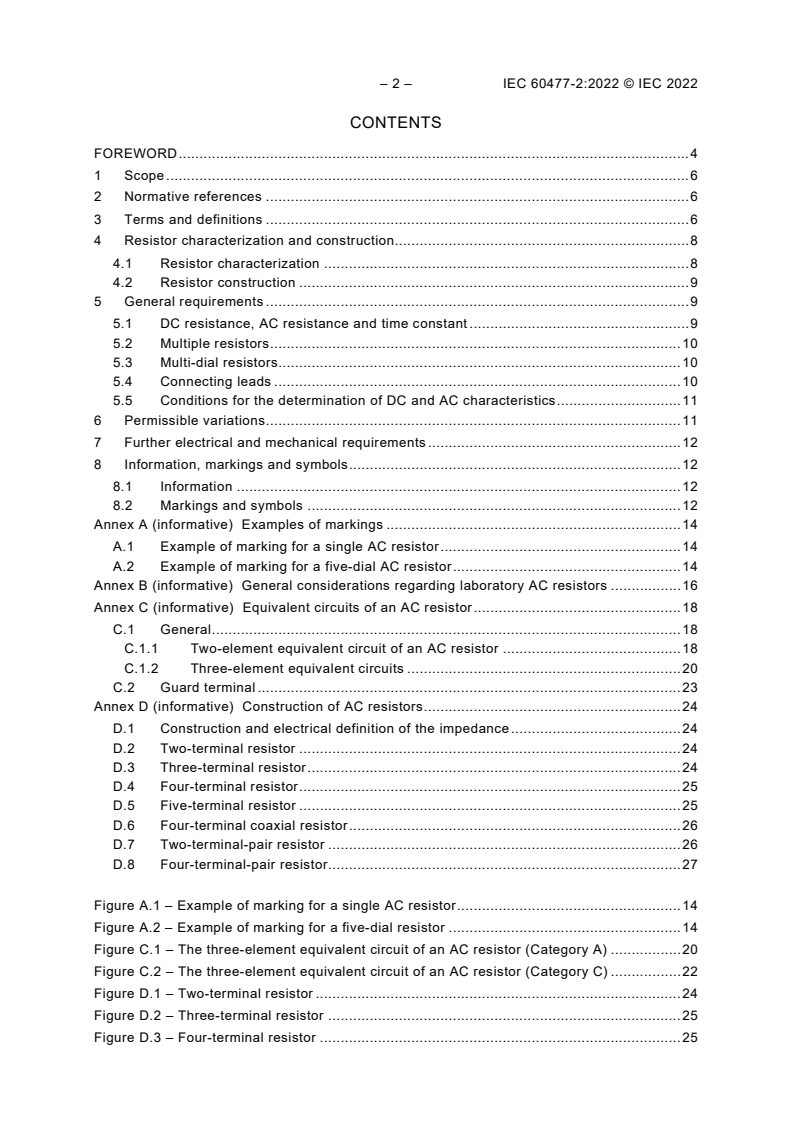
– 2 – IEC 60477-2:2022 © IEC 2022
CONTENTS
FOREWORD . 4
1 Scope . 6
2 Normative references . 6
3 Terms and definitions . 6
4 Resistor characterization and construction. 8
4.1 Resistor characterization . 8
4.2 Resistor construction . 9
5 General requirements . 9
5.1 DC resistance, AC resistance and time constant . 9
5.2 Multiple resistors . 10
5.3 Multi-dial resistors. 10
5.4 Connecting leads . 10
5.5 Conditions for the determination of DC and AC characteristics . 11
6 Permissible variations . 11
7 Further electrical and mechanical requirements . 12
8 Information, markings and symbols . 12
8.1 Information . 12
8.2 Markings and symbols . 12
Annex A (informative) Examples of markings . 14
A.1 Example of marking for a single AC resistor . 14
A.2 Example of marking for a five-dial AC resistor . 14
Annex B (informative) General considerations regarding laboratory AC resistors . 16
Annex C (informative) Equivalent circuits of an AC resistor . 18
C.1 General . 18
C.1.1 Two-element equivalent circuit of an AC resistor . 18
C.1.2 Three-element equivalent circuits . 20
C.2 Guard terminal . 23
Annex D (informative) Construction of AC resistors . 24
D.1 Construction and electrical definition of the impedance . 24
D.2 Two-terminal resistor . 24
D.3 Three-terminal resistor . 24
D.4 Four-terminal resistor . 25
D.5 Five-terminal resistor . 25
D.6 Four-terminal coaxial resistor . 26
D.7 Two-terminal-pair resistor . 26
D.8 Four-terminal-pair resistor . 27
Figure A.1 – Example of marking for a single AC resistor . 14
Figure A.2 – Example of marking for a five-dial resistor . 14
Figure C.1 – The three-element equivalent circuit of an AC resistor (Category A) . 20
Figure C.2 – The three-element equivalent circuit of an AC resistor (Category C) . 22
Figure D.1 – Two-terminal resistor . 24
Figure D.2 – Three-terminal resistor . 25
Figure D.3 – Four-terminal resistor . 25
Figure D.4 – Five-terminal resistor . 26
Figure D.5 – Four-terminal coaxial resistor . 26
Figure D.6 – Two-terminal-pair resistor . 27
Figure D.7 – Four-terminal-pair resistor . 27
Table 1 – Limits of the AC resistance relative uncertainty . 9
Table 2 – Limits of the AC/DC difference . 10
Table 3 – Upper limit of the nominal range of use for frequency . 11
– 4 – IEC 60477-2:2022 © IEC 2022
INTERNATIONAL ELECTROTECHNICAL COMMISSION
____________
LABORATORY RESISTORS –
Part 2: Laboratory AC resistors
FOREWORD
1) The International Electrotechnical Commission (IEC) is a worldwide organization for standardization comprising
all national electrotechnical committees (IEC National Committees). The object of IEC is to promote international
co-operation on all questions concerning standardization in the electrical and electronic fields. To this end and
in addition to other activities, IEC publishes International Standards, Technical Specifications, Technical Reports,
Publicly Available Specifications (PAS) and Guides (hereafter referred to as "IEC Publication(s)"). Their
preparation is entrusted to technical committees; any IEC National Committee interested in the subject dealt with
may participate in this preparatory work. International, governmental and non-governmental organizations liaising
with the IEC also participate in this preparation. IEC collaborates closely with the International Organization for
Standardization (ISO) in accordance with conditions determined by agreement between the two organizations.
2) The formal decisions or agreements of IEC on technical matters express, as nearly as possible, an international
consensus of opinion on the relevant subjects since each technical committee has representation from all
interested IEC National Committees.
3) IEC Publications have the form of recommendations for international use and are accepted by IEC National
Committees in that sense. While all reasonable efforts are made to ensure that the technical content of IEC
Publications is accurate, IEC cannot be held responsible for the way in which they are used or for any
misinterpretation by any end user.
4) In order to promote international uniformity, IEC National Committees undertake to apply IEC Publications
transparently to the maximum extent possible in their national and regional publications. Any divergence between
any IEC Publication and the corresponding national or regional publication shall be clearly indicated in the latter.
5) IEC itself does not provide any attestation of conformity. Independent certification bodies provide conformity
assessment services and, in some areas, access to IEC marks of conformity. IEC is not responsible for any
services carried out by independent certification bodies.
6) All users should ensure that they have the latest edition of this publication.
7) No liability shall attach to IEC or its directors, employees, servants or agents including individual experts and
members of its technical committees and IEC National Committees for any personal injury, property damage or
other damage of any nature whatsoever, whether direct or indirect, or for costs (including legal fees) and
expenses arising out of the publication, use of, or reliance upon, this IEC Publication or any other IEC
Publications.
8) Attention is drawn to the Normative references cited in this publication. Use of the referenced publications is
indispensable for the correct application of this publication.
9) Attention is drawn to the possibility that some of the elements of this IEC Publication may be the subject of patent
rights. IEC shall not be held responsible for identifying any or all such patent rights.
IEC 60477-2 has been prepared by IEC technical committee 85: Measuring equipment for
electrical and electromagnetic quantities. It is an International Standard.
This second edition cancels and replaces the first edition published in 1979, and
Amendment 1:1997. This edition constitutes a technical revision.
This edition includes the following significant technical changes with respect to the previous
edition:
a) extended the AC resistor frequency range to 1 MHz;
b) updated the terms and definitions according to IEC 60050 series;
c) added the definition of AC/DC difference of an AC resistor;
d) added the resistor classification according to the AC resistance or AC/DC difference index;
e) updated the classification according to the AC resistor construction;
f) updated the safety symbols and requirements according to IEC 60477-1;
g) added the three-element equivalent circuits of an AC resistor in Annex C;
h) added the annex on constructions of AC resistors.
The text of this International Standard is based on the following documents:
Draft Report on voting
85/822/FDIS 85/825/RVD
Full information on the voting for its approval can be found in the report on voting indicated in
the above table.
The language used for the development of this International Standard is English.
A list of all parts in the IEC 60477 series, published under the general title Laboratory resistors,
can be found on the IEC website.
This document was drafted in accordance with ISO/IEC Directives, Part 2, and developed in
accordance with ISO/IEC Directives, Part 1 and ISO/IEC Directives, IEC Supplement, available
at www.iec.ch/members_experts/refdocs. The main document types developed by IEC are
described in greater detail at www.iec.ch/standardsdev/publications.
The committee has decided that the contents of this document will remain unchanged until the
stability date indicated on the IEC website under webstore.iec.ch in the data related to the
specific document. At this date, the document will be
• reconfirmed,
• withdrawn,
• replaced by a revised edition, or
• amended.
– 6 – IEC 60477-2:2022 © IEC 2022
LABORATORY RESISTORS –
Part 2: Laboratory AC resistors
1 Scope
This part of IEC 60477 applies to resistors intended as laboratory AC resistors for use over a
range of frequencies from DC up to a stated frequency which is not in excess of 1 MHz. Such
resistors are hereinafter referred to as "AC resistors".
In addition to satisfying the requirements of IEC 60477-1, resistors satisfying the requirements
of this document are designed to have a small variation of resistance and a small phase
displacement over the stated frequency range.
2 Normative references
The following documents are referred to in the text in such a way that some or all of their content
constitutes requirements of this document. For dated references, only the edition cited applies.
For undated references, the latest edition of the referenced document (including any
amendments) applies.
IEC 60477-1, Laboratory resistors – Part 1: Laboratory DC resistors
3 Terms and definitions
For the purposes of this document, the following terms and definitions apply.
ISO and IEC maintain terminological databases for use in standardization at the following
addresses:
• ISO Online browsing platform: available at http://www.iso.org/obp
• IEC Electropedia: available at http://www.electropedia.org/
3.1
equivalent electric circuit
circuit composed of ideal circuit elements which has, at the terminals or ports, a behaviour
equivalent to that of a given electric or magnetic circuit or device
Note 1 to entry: Equivalent electric circuits can also be used to represent other kinds of devices or phenomena.
[SOURCE: IEC 60050-131:2002, 131-15-07]
3.2
circuit element
in electromagnetism, mathematical model of a device characterized by one or more relations
between integral quantities
[SOURCE: IEC 60050-131:2002, 131-11-03]
3.3
equivalent circuit of an AC resistor
equivalent electric circuit of an AC resistor
electric circuit which has the same AC characteristics as a resistor, and which would have an
impedance equal to the resistor under specified operating conditions
Note 1 to entry: Specified operating conditions should include working frequency and voltage.
3.4
two-element equivalent circuit of an AC resistor
equivalent circuit of an AC resistor with two elements under specified operating conditions
Note 1 to entry: A two-element equivalent circuit of an AC resistor is given by either an equivalent AC resistance,
R in series with an equivalent inductance, L or an equivalent AC resistance, R in parallel with an equivalent
s s p
capacitance, C (see Annex C).
p
3.5
three-element equivalent circuit of an AC resistor
equivalent electric circuit of an AC resistor with three elements under specified operating
conditions
3.6
equivalent AC resistance of an AC resistor
AC resistance
or R ) which is the AC resistive component of the resistor
value of resistance (R
s p
Note 1 to entry: The AC resistance is usually taken as the equivalent series resistance R , for resistors of
s
, for resistors of Category C (see Annex B).
Category A, and as the equivalent parallel resistance R
p
3.7
terminal pair
port consisting of two terminals such that the electric current directed from an external circuit
or device to one terminal is identical with the current directed from the other terminal to the
external circuit or device
[SOURCE: IEC 60050-131:2002, 131-12-63]
3.8
time constant
τ
-t/τ
time τ in the expression F(t) = A + Be of a quantity F growing or decaying exponentially
-t/τ
towards a constant value A with increasing time t, or in the expression F(t) = A + f(t)e of an
exponentially damped oscillation, where f is a periodic function of time
Note 1 to entry: The time constant of an exponentially varying quantity is the duration of a time interval at the end
of which the absolute value of the difference between the quantity and the limit has decreased to 1/e of the absolute
value of this difference at the beginning of the time interval, where e is the base of natural logarithms.
Note 2 to entry: For a resistor, at any particular frequency, the time constant is defined as either: L /R , or R C
s s p p
whichever yields a positive value (see Annex C). For determining the time constant, the DC resistance may be used
instead of the equivalent AC resistance.
Note 3 to entry: For a resistor using the three-element equivalent circuit expressed, the time constant is
L L
approximately equal to: − CR , or CR− (see Annex C).
R R
– 8 – IEC 60477-2:2022 © IEC 2022
Note 4 to entry: The phase displacement of the current flowing through the resistor from the voltage appearing
L
across it with a time constant L /R or − CR is such that the current is lagging, and that with a time constant R C
s s p p
R
L
or CR− is leading when L and C , have positive values, L and L being expressed in henrys, R , R and R in ohms
s p s s p
R
and C and C in farads.
p
[SOURCE: IEC 60050-103:2009, 103-05-26, modified – The existing Note 2 has been deleted
and a new Note 2, Note 3 and Note 4 to entry have been added to adapt to usage in AC resistor
technology.]
3.9
time constant index
conventional designation of a time constant by a number or symbol
Note 1 to entry: In this document, the time constant index is expressed in seconds using the appropriate SI prefix.
3.10
AC/DC difference
difference between the equivalent AC resistance at a stated frequency and
the DC resistance, expressed as a percentage (%) of the DC resistance
3.11
AC/DC difference index
number which designates the limit of the AC/DC difference in nominal range of use for
frequency, expressed in %
3.12
frequency index
number which designates the upper limit of the nominal range of use for frequency, expressed
in hertz using the appropriate SI prefix
3.13
skin effect
for an alternating electric current in a conductor, phenomenon in which the current density is
greater near the surface than in the interior of the conductor
Note 1 to entry: The skin effect increases the resistance and decreases the inductance of a conductor with the
frequency of the electric current.
Note 2 to entry: The skin effect occurs also in the more general case of any time-varying current.
[SOURCE: IEC 60050-121:1998, 121-13-18]
3.14
residual inductance
inductance value between the points of connection of a multiple or multi-dial AC resistor having
switching devices with a zero position, when all switching elements are set to the zero position
4 Resistor characterization and construction
4.1 Resistor characterization
AC resistors satisfying the requirements of this document are characterized:
a) by classes related to their DC accuracy as specified in IEC 60477-1,
b) by classes related to their equivalent AC resistance as specified in 5.1 or AC/DC difference
indices as specified in 5.1, and
c) by time constant indices as specified in 5.1, and
d) by frequency indices as specified in Clause 6.
4.2 Resistor construction
Because of the uncertainties in AC properties which can result from stray inductances, stray
capacitances, eddy currents, dielectric absorption effects and skin effects, the AC resistors to
which this document applies are classified according to their construction (see Annex D), as
follows:
a) two-terminal resistor, each terminal being able to be used both for current or potential;
b) three-terminal resistor which has one more shield terminal (can also be called a guard
terminal) connected to the electric screen than the two-terminal resistor to reduce the stray
capacitances effect;
c) four-terminal resistor which has independent current terminals and potential terminals to
reduce the stray inductances and contact resistances;
d) five-terminal resistor which has one more shield terminal than the four-terminal resistor;
e) four-terminal coaxial resistor which has two terminal-pairs with the outer shield conductors
working as the low terminal of current or potential;
f) two-terminal-pair resistor which has two terminal-pairs with the outer shield conductors
working as the return path for the signal current (not grounded);
g) four-terminal-pair resistor which has four terminal-pairs with the outer shield conductors
working as the return path for the signal current (not grounded) to eliminate the effect of
mutual coupling between the current and potential leads.
5 General requirements
5.1 DC resistance, AC resistance and time constant
The DC characteristics of an AC resistor shall be as specified in IEC 60477-1.
The equivalent AC resistance of an AC resistor characterized by class related to the AC
resistance shall comply with the limits of relative uncertainty as specified for their AC resistance
class index in Table 1 at initial calibration.
Table 1 – Limits of the AC resistance relative uncertainty
AC resistance
0,000 01 0,000 02 0,000 05 … 2 5 10
class index
Limits of relative
uncertainty for 0,000 01 % 0,000 02 % 0,000 05 % … 2 % 5 % 10 %
AC resistance
NOTE The value of the AC resistance of a given resistor is somewhat dependent on the frequency at which it is
measured. However, as the purpose here is to classify AC resistors, measurements at 1 kHz (or lower) are
generally adequate.
The AC/DC difference of an AC resistor characterized by AC/DC difference index shall comply
with the limits of AC/DC difference specified for its AC/DC difference index in Table 2 at initial
calibration.
– 10 – IEC 60477-2:2022 © IEC 2022
Table 2 – Limits of the AC/DC difference
AC/DC
0,000 001 0,000 002 0,000 005 … 0,2 0,5 1
difference index
Limits of the
AC/DC ±0,000 001 % ±0,000 002 % ±0,000 005 % … ±0,2 % ±0,5 % ±1 %
difference
NOTE Measurements at 1 kHz (or lower) are here generally adequate.
An AC resistor shall choose either an AC resistance class index or an AC/DC difference index
to show the AC resistance character.
The time constant of an AC resistor shall not exceed the appropriate value of the time constant
index selected from the sequence:
• 1 ns, 2 ns, 5 ns, 10 ns, …100 μs.
NOTE The value of the time constant of a given resistor is also somewhat dependent on the frequency at which it
is measured. Measurements at 1 kHz (or lower) are here generally adequate as with the measurements of AC
resistance.
5.2 Multiple resistors
Multiple resistors, excluding multi-dial resistors, may have a different AC resistance class or
AC/DC difference and time constant index for each selectable value.
For a multiple resistor in which the lowest selectable resistance value is nominally zero, the
manufacturer shall state the value of the residual inductance under this condition.
5.3 Multi-dial resistors
Multi-dial resistors shall have a single AC resistance class index or AC/DC difference index and
a single time constant index for all selectable values on any dial used alone. The several dials
may each have a different AC resistance class index or AC/DC difference index and a different
time constant index.
The AC resistance class index or AC/DC difference index of a given dial shall also apply at any
setting of the dial when that dial is used in conjunction with any setting of any dial(s) inferior to
it in value.
The time constant index of a given dial shall also apply at any setting of the dial when that dial
is used in conjunction with any setting of any dial(s) inferior to it in value.
5.4 Connecting leads
Separate current and potential connections shall be made to a resistor having a pair of terminals
for each port of connection, unless other conditions are stated by the manufacturer. The mutual
inductances between the current and potential leads and between each of these leads and the
resistor shall be minimized.
The leads making connection to a resistor having a single terminal for each port of connection
shall be arranged so as to minimize their inductance.
NOTE 1 This arrangement is particularly important for resistors of values of 10 Ω and lower.
The leads making connection to a resistor shall not alter significantly the equivalent parallel
capacitance, if necessary, by the provision of a screen for each lead and by the use of an
appropriate measuring circuit.
NOTE 2 The magnitude of capacitance that will cause a significant alteration will depend upon the value of the
resistance and the time constant.
5.5 Conditions for the determination of DC and AC characteristics
All tests of DC characteristics shall be carried out as specified in IEC 60477-1.
NOTE At low frequencies, the uncertainty of an AC resistor is essentially the same as its uncertainty at DC.
At higher frequencies, an additional variation as specified in Clause 6 is permitted.
All tests of AC characteristics shall be carried out under the reference conditions specified in
IEC 60477-1.
The AC resistance of an AC resistor shall be measured at a frequency of 1 kHz or at the
frequency corresponding to its frequency index if the latter is lower (see Clause 6).
The time constant of an AC resistor shall be measured at a frequency of 1 kHz or at the
frequency corresponding to its frequency index if the latter is lower (see Clause 6).
The residual inductance of an AC resistor (see 5.2) shall be measured with the resistor
connected as in normal use and at a frequency of 1 kHz or at the frequency corresponding to
its frequency index if the latter is lower (see Clause 6).
A resistor with a shield terminal (see items b) and d) of 4.2 shall be tested with the screen
connected as specified by the manufacturer.
A resistor without a shield terminal (see items a) and c) of 4.2 shall be tested within an earthed
conductive enclosure as specified by the manufacturer. If this enclosure is not specified, the
resistor shall be tested within an earthed conductive enclosure separated from the surface of
the resistor by between 10 mm and 20 mm at all places.
A resistor with terminal pairs (see items e), f) and g) of 4.2 shall be tested with the terminal pair
connected as specified by the manufacturer.
Any other necessary conditions shall be stated by the manufacturer.
When necessary, details of the testing method shall be agreed between the manufacturer and
the user.
6 Permissible variations
Changes in influence quantities over the nominal ranges of use specified in IEC 60477-1 will
cause no significant effect on the AC characteristics of the resistor. Requirements relating to
variations of AC characteristics other than those due to frequency are therefore not included in
this document.
The upper limit of the nominal range of use for frequency shall be designated using the
appropriate frequency index selected from Table 3.
Table 3 – Upper limit of the nominal range of use for frequency
Frequency index 1 M 500 k 200 k … 500 200 100 50
Upper limit of the
nominal range of 1 MHz 500 kHz 200 kHz … 500 Hz 200 Hz 100 Hz 50 Hz
use for frequency
– 12 – IEC 60477-2:2022 © IEC 2022
When the AC resistor is under reference conditions as specified in IEC 60477-1, the AC
resistance relative uncertainty for any frequency within its nominal range of use shall not exceed
the permissible AC resistance relative uncertainty (see 5.1), or the AC/DC difference for any
frequency within its nominal range of use shall not exceed the permissible AC/DC difference
(see 5.1).
Multiple resistors, excluding multi-dial resistors, may have a different frequency index for each
selectable value.
Multi-dial resistors shall have a single frequency index for all selectable values on any dial used
alone. The several dials may each have a different frequency index. The frequency index of a
given dial shall also apply when that dial is used in conjunction with any dial(s) inferior to it in
value.
Conditions for the determination of the variation due to frequency:
• connecting leads shall be arranged as specified in 5.4.
• when necessary, details of the testing method shall be agreed between the manufacturer
and the user.
7 Further electrical and mechanical requirements
AC resistors shall comply with the further electrical and mechanical requirements specified in
IEC 60477-1.
The manufacturer shall specify the method(s) of connection of the screen, if any.
The manufacturer shall state whether the characteristics are given relating to the equivalent
series model or the equivalent parallel model (see 3.4) as relevant (see note to 3.6).
8 Information, markings and symbols
8.1 Information
In addition to the markings required by IEC 60477-1 (except for those mentioned in 8.2 of this
document), AC resistors shall also carry markings to show the AC resistance class index or
AC/DC difference index, time constant index and the frequency index.
The AC resistance class index or AC/DC difference index shall be marked using the appropriate
value selected from the set of values given in Table 1 or Table 2 (see 5.1) and shall follow "AC
resistance" or "AC/DC difference".
The time constant index shall be marked using the appropriate value selected from the set of
values given in 5.1 and followed by "s".
The frequency index shall be marked using the appropriate value selected from Table 3 and
followed by "Hz".
For a multiple resistor in which the lowest selectable resistance value is nominally zero, the
value of residual inductance under this condition (see 5.2) shall be marked.
8.2 Markings and symbols
The markings (see Annex A) of AC resistance class index or AC/DC difference index, time
constant index and frequency index specified in 8.1 shall be given on a nameplate or on the
enclosure and shall follow the marking for DC accuracy class (as specified in IEC 60477-1) on
the same line or on successive lines and in the order stated in 8.1.
The marking of residual inductance specified in 8.1 shall be given on a nameplate or on the
enclosure and shall follow the marking of the value of the residual resistance (as specified in
IEC 60477-1).
Instead of the marking "Laboratory DC resistor" (see 9.2 of IEC 60477-1:2022), AC resistors
shall be marked "Laboratory DC / AC resistor". This term may be marked in any other language.
– 14 – IEC 60477-2:2022 © IEC 2022
Annex A
(informative)
Examples of markings
A.1 Example of marking for a single AC resistor
Figure A.1 is an example marking for a single AC resistor.
Figure A.1 – Example of marking for a single AC resistor
The marking denotes that the time constant index is 100 ns. This indicates that the time
constant measured at 1 kHz does not exceed 100 ns. The value of the time constant will not
change significantly over the nominal range of use for frequency.
Also, the frequency range is DC to 10 kHz. This denotes that the variation of the equivalent AC
resistance at any frequency between DC and 10 kHz will not exceed 0,002 % of the nominal
value.
For other markings, see IEC 60477-1.
A.2 Example of marking for a five-dial AC resistor
Figure A.2 gives an example marking for a five-dial AC resistor.
Figure A.2 – Example of marking for a five-dial resistor
The marking denotes that the residual inductance (with all dials set to zero) is (7 ± 0,5) μH.
The numbers given in the third row of Figure A.2 (following "AC / DC difference") denote that
the AC/DC difference does not exceed ±0,05 % at any frequency up to 100 Hz on the 0,1 Ω dial,
±0,02 % up to 200 Hz on the 1 Ω dial, ±0,01 % up to 5 kHz on the 10 Ω dial, ±0,01 % up to
10 kHz on the 100 Ω dial and ±0,005 % up to 10 kHz on the 1 000 Ω dial.
The numbers given in ns and μs denote that the time constant does not exceed 100 μs at any
frequency up to 100 Hz on the 0,1 Ω dial, 10 μs up to 200 Hz on the 1 Ω dial, 1 μs up to 5 kHz
on the 10 Ω dial and 100 ns up to 10 kHz on the other dials.
However, as the time constant does not change significantly over the nominal range of use for
frequency, it is measured at 1 kHz or at the frequency corresponding to the frequency index
when this is lower (see note to 5.1).
The numbers preceding the symbol "Hz" are the frequency indices. These denote that the
variation of the equivalent AC resistance of each dial at any frequency between DC and the
corresponding upper limit of the nominal range of use for frequency (designated by the
appropriate frequency index) will not exceed the AC/DC difference limits corresponding to the
relevant AC/DC difference index.
The numbers preceding "ns (μs)" and "Hz" for any dial imply that the performance indicated will
be obtained no matter which dials inferior in value are also in use.
For other markings, see IEC 60477-1.
– 16 – IEC 60477-2:2022 © IEC 2022
Annex B
(informative)
General considerations regarding laboratory AC resistors
This document on AC resistors has been prepared as an extension of IEC 60477-1, applying to
resistors intended to be used with alternating as well as with direct current.
AC resistors, in addition to covering a wide range of values, for example from tens of milliohms
to a megohm, are designed for frequencies differing widely in range; some may be used only
at 50 Hz or 60 Hz, while others are capable of use as laboratory resistors at the lower radio
frequencies. For the purpose of this document, an upper limit of 1 MHz has been set. The
requirements for these varied applications have been incorporated in this document.
The AC properties of a resistor are inherently of a subtle and complex nature but in spite of this
the standard is straightforward. The most informative characteristic to use as the criterion for
assessing an AC resistor is the frequency up to which it will operate as a resistor within some
specified limits of uncertainty or variations on resistance and phase-angle. By using frequency
as the basic parameter for classifying AC resistors, it has been possible to prepare a standard
that is wide-ranging and simple.
Although the phase-angle is the quantity that is important in the use of a resistor, it is more
convenient and appropriate to specify the time constant as this is not dependent, or is only
slightly dependent, on frequency.
Resistors for AC applications may be divided into three categories according to their values, as
given in the dashed list below. However, in this document it has not been found necessary to
make these divisions, but merely to specify those features and conditions that are necessary
and sufficient.
– Category A
Low values below, say, about 100 Ω. The effects of inductance and eddy currents
predominate.
– Category B
Intermediate values, between Categories A and C. The effects in both Categories A and C
are likely to be significant.
– Category C
High values above, say, 1 000 Ω. The effects of capacitance usually predominate.
Resistors in Category A may have either two or four terminals, or four terminal pairs. It is
necessary for the resistor to have four terminals or four terminal-pairs if the least uncertainty of
inductance as well as of resistance of connection leads is to be realized. It is necessary for the
resistor to have four terminal-pairs if the least uncertainty of mutual coupling between the
current and voltage leads is to be realized.
Category B resistors can readily be designed so that the uncertainty in inductance arising from
the connection of the leads is negligible. Likewise, the effect of the capacitance uncertainty can
be made negligible.
Resistors in Category C, as well as the high value resistors of Category B, shall be screened
or use the terminal-pair connectors when high accuracy of time constant is required.
Resistors which have an independent electric screen can be used only in circuits which are
compatible with guard terminal devices.
Resistors which are of terminal-pair type construction can be used only in circuits which are
compatible with terminal-pair devices which return the current though the outer shield
conductors of the terminal-pair.
For each resistor satisfying this document, the degree to which the AC parameters are
significant will be related to the resistor's AC resistance class or AC/DC difference index, time
constant index and to its frequency index.
– 18 – IEC 60477-2:2022 © IEC 2022
Annex C
(informative)
Equivalent circuits of an AC resistor
C.1 General
C.1.1 Two-element equivalent circuit of an AC resistor
Although the exact equivalent circuit of an AC resistor may not be useful or even obtainable,
three-element equivalent circuits formed only of lumped resistive, capacitive and inductive
elements can always be used to give an appropriate representation of the resistor as given
by C.1.2. Alternatively, at a specified frequency, a graph of the real and imaginary components
of the resistor as a function of frequency may be used to express the AC characteristics. For
the purpose of this document, a simple characterization of the AC properties with two-elements
as given by C.1.1, is employed to derive AC resistance and time constant as the criterion for
assessing an AC resistor. Meanwhile, three-element equivalent circuits given by C.1.2 are used
to characterize the AC properties of an AC resistor in a frequency range.
At a specified frequency, any resistor can be characterized either as an inductance in series
with a resistance (the series representation), or as a capacitance in parallel with a resistance
(the parallel representation).
These two cases may be expressed by:
U
Rj+ ωL (C.1)
ss
I
or
I 1
(C.2)
+ jωC
p
UR
p
where:
U = voltage appearing across the device when a current, I, flows through it;
R = equivalent series resistance;
s
R = equivalent parallel resistance;
p
L = equivalent series inductance;
s
C = equivalent parallel capacitance.
p
At any particular frequency, either the series or the parallel representation may be used to
describe the properties of the resistor and to simulate the effect of that frequency. For any
particular resistor, the representation which has a positive reactive component will, in nearly all
cases, yield a model which is accurate at the stated frequency and which is a good
approximation over the usable frequency range. Except in rare cases, the ot
...