

IEC 62739-2:2016
(Main)Test method for erosion of wave soldering equipment using molten lead-free solder alloy - Part 2: Erosion test method for metal materials with surface processing
General Information
- Abstract
IEC 62739-2:2016 provides an evaluating test method for the erosion of the metallic materials with surface processing intended to be used for lead-free wave soldering equipment as a solder bath and other components which are in contact with the molten solder. It aims at prevention of an accident or a fire by predicting a setup and life of a suitable maintenance cycle.
- Status
- Published
- Publication Date
- 12-Jul-2016
- Technical Committee
- TC 91 - Electronics assembly technology
- Drafting Committee
- WG 3 - TC 91/WG 3
- Current Stage
- PPUB - Publication issued
- Start Date
- 13-Jul-2016
- Completion Date
- 31-Aug-2016
Buy Documents
IEC 62739-2:2016 - Test method for erosion of wave soldering equipment using molten lead-free solder alloy - Part 2: Erosion test method for metal materials with surface processing Released:7/13/2016
Overview
IEC 62739-2:2016 is an international standard developed by the International Electrotechnical Commission (IEC) that specifies test methods for evaluating erosion in metallic materials with surface processing, which are used in lead-free wave soldering equipment. The main aim of this standard is to provide reliable and repeatable methods to assess how surface-processed metal components-such as solder baths and other parts in direct contact with molten lead-free solder alloys-perform over time. This helps manufacturers predict maintenance intervals and minimize the risks of accidents, equipment failure, or fire due to excessive material erosion.
Key Topics
- Test Methods for Erosion: IEC 62739-2:2016 details two primary methods:
- Method A – Without Bending: Assesses erosion under standard operational conditions.
- Method B – With Bending: An accelerated test to evaluate erosion under more severe conditions.
- Test Equipment Requirements: The standard outlines requirements for pots, rotation devices, and temperature controls, ensuring equipment can replicate the conditions within actual wave soldering systems.
- Specimen Preparation: Guidelines for selecting and preparing test specimens with surface processing that matches the actual application.
- Measurement Procedures: Specifies the use of optical microscopes and digital indicators to measure erosion depths precisely, with necessary accuracy standards.
- Dross Handling and Cleaning: Describes procedures for maintaining the quality of molten solder by regular removal of dross (oxidized waste material).
- Reporting Requirements: Standardizes the required documentation, such as date, materials, conditions, equipment numbers, erosion presence, and measured erosion depth.
Applications
IEC 62739-2:2016 is essential for manufacturers and users of electronic assembly equipment, particularly where molten lead-free solders are used. Key applications include:
- Selection of Erosion-Resistant Materials: Testing and qualifying surface-processed metal materials for use in solder baths and components exposed to molten solder, ensuring extended equipment lifespan and safer operation.
- Predictive Maintenance Scheduling: By understanding how various materials erode under specific processing conditions, manufacturers can plan optimal maintenance cycles, reducing downtime and costs.
- Quality Assurance: Standardized testing procedures improve consistency and reliability of test results, supporting quality assurance processes during product design, development, and ongoing production.
- Risk Mitigation: Reliable erosion data allows for better risk assessment, minimizing the potential for hazardous failures due to weakened solder bath components.
Related Standards
For comprehensive evaluation and adherence to best practices in electronics assembly, reference to the following related standards is beneficial:
- IEC 62739-1:2013: Test method for erosion of wave soldering equipment using molten lead-free solder alloy - Part 1 addresses metal materials without surface processing.
- IEC 61190-1-3: Specifies requirements for electronic grade solder alloys and solid solders used in soldering.
- IEC 60194:2015: Provides essential terminology for printed board design and manufacturing.
- ISO 16143 Series: Details standards for stainless steels for general purposes, including corrosion-resistant products relevant for solder bath construction.
Practical Value
Implementing IEC 62739-2:2016 in your production environment enables:
- Increased Equipment Reliability: By regularly testing and qualifying materials, you extend the service life of soldering equipment and reduce the likelihood of unplanned failures.
- Enhanced Safety: Early detection of erosion helps prevent potential accidents or fire hazards in electronics assembly facilities.
- Optimized Operational Efficiency: Standardized maintenance cycles informed by accurate erosion data lead to less downtime and more predictable operations.
- Regulatory Compliance: Using internationally recognized standards ensures global market access and conformance to industry requirements.
By adhering to IEC 62739-2:2016, organizations can achieve more efficient, safer, and cost-effective manufacturing processes in the electronics assembly industry, particularly those involving lead-free wave soldering operations.
Buy Documents
IEC 62739-2:2016 - Test method for erosion of wave soldering equipment using molten lead-free solder alloy - Part 2: Erosion test method for metal materials with surface processing Released:7/13/2016
Frequently Asked Questions
IEC 62739-2:2016 is a standard published by the International Electrotechnical Commission (IEC). Its full title is "Test method for erosion of wave soldering equipment using molten lead-free solder alloy - Part 2: Erosion test method for metal materials with surface processing". This standard covers: IEC 62739-2:2016 provides an evaluating test method for the erosion of the metallic materials with surface processing intended to be used for lead-free wave soldering equipment as a solder bath and other components which are in contact with the molten solder. It aims at prevention of an accident or a fire by predicting a setup and life of a suitable maintenance cycle.
IEC 62739-2:2016 provides an evaluating test method for the erosion of the metallic materials with surface processing intended to be used for lead-free wave soldering equipment as a solder bath and other components which are in contact with the molten solder. It aims at prevention of an accident or a fire by predicting a setup and life of a suitable maintenance cycle.
IEC 62739-2:2016 is classified under the following ICS (International Classification for Standards) categories: 31.190 - Electronic component assemblies; 31.240 - Mechanical structures for electronic equipment. The ICS classification helps identify the subject area and facilitates finding related standards.
IEC 62739-2:2016 is available in PDF format for immediate download after purchase. The document can be added to your cart and obtained through the secure checkout process. Digital delivery ensures instant access to the complete standard document.
Standards Content (Sample)
IEC 62739-2 ®
Edition 1.0 2016-07
INTERNATIONAL
STANDARD
NORME
INTERNATIONALE
Test method for erosion of wave soldering equipment using molten lead-free
solder alloy –
Part 2: Erosion test method for metal materials with surface processing
Méthode d'essai de l'érosion de l'équipement de brasage à la vague utilisant un
alliage à braser sans plomb fondu –
Partie 2: Méthode d'essai d'érosion de matériaux métalliques avec traitement de
surface
All rights reserved. Unless otherwise specified, no part of this publication may be reproduced or utilized in any form
or by any means, electronic or mechanical, including photocopying and microfilm, without permission in writing from
either IEC or IEC's member National Committee in the country of the requester. If you have any questions about IEC
copyright or have an enquiry about obtaining additional rights to this publication, please contact the address below or
your local IEC member National Committee for further information.
Droits de reproduction réservés. Sauf indication contraire, aucune partie de cette publication ne peut être reproduite
ni utilisée sous quelque forme que ce soit et par aucun procédé, électronique ou mécanique, y compris la photocopie
et les microfilms, sans l'accord écrit de l'IEC ou du Comité national de l'IEC du pays du demandeur. Si vous avez des
questions sur le copyright de l'IEC ou si vous désirez obtenir des droits supplémentaires sur cette publication, utilisez
les coordonnées ci-après ou contactez le Comité national de l'IEC de votre pays de résidence.
IEC Central Office Tel.: +41 22 919 02 11
3, rue de Varembé Fax: +41 22 919 03 00
CH-1211 Geneva 20 info@iec.ch
Switzerland www.iec.ch
About the IEC
The International Electrotechnical Commission (IEC) is the leading global organization that prepares and publishes
International Standards for all electrical, electronic and related technologies.
About IEC publications
The technical content of IEC publications is kept under constant review by the IEC. Please make sure that you have the
latest edition, a corrigenda or an amendment might have been published.
IEC Catalogue - webstore.iec.ch/catalogue Electropedia - www.electropedia.org
The stand-alone application for consulting the entire The world's leading online dictionary of electronic and
bibliographical information on IEC International Standards, electrical terms containing 20 000 terms and definitions in
Technical Specifications, Technical Reports and other English and French, with equivalent terms in 15 additional
documents. Available for PC, Mac OS, Android Tablets and languages. Also known as the International Electrotechnical
iPad. Vocabulary (IEV) online.
IEC publications search - www.iec.ch/searchpub IEC Glossary - std.iec.ch/glossary
The advanced search enables to find IEC publications by a 65 000 electrotechnical terminology entries in English and
variety of criteria (reference number, text, technical French extracted from the Terms and Definitions clause of
committee,…). It also gives information on projects, replaced IEC publications issued since 2002. Some entries have been
and withdrawn publications. collected from earlier publications of IEC TC 37, 77, 86 and
CISPR.
IEC Just Published - webstore.iec.ch/justpublished
Stay up to date on all new IEC publications. Just Published IEC Customer Service Centre - webstore.iec.ch/csc
details all new publications released. Available online and If you wish to give us your feedback on this publication or
also once a month by email. need further assistance, please contact the Customer Service
Centre: csc@iec.ch.
A propos de l'IEC
La Commission Electrotechnique Internationale (IEC) est la première organisation mondiale qui élabore et publie des
Normes internationales pour tout ce qui a trait à l'électricité, à l'électronique et aux technologies apparentées.
A propos des publications IEC
Le contenu technique des publications IEC est constamment revu. Veuillez vous assurer que vous possédez l’édition la
plus récente, un corrigendum ou amendement peut avoir été publié.
Catalogue IEC - webstore.iec.ch/catalogue Electropedia - www.electropedia.org
Application autonome pour consulter tous les renseignements
Le premier dictionnaire en ligne de termes électroniques et
bibliographiques sur les Normes internationales,
électriques. Il contient 20 000 termes et définitions en anglais
Spécifications techniques, Rapports techniques et autres
et en français, ainsi que les termes équivalents dans 15
documents de l'IEC. Disponible pour PC, Mac OS, tablettes
langues additionnelles. Egalement appelé Vocabulaire
Android et iPad.
Electrotechnique International (IEV) en ligne.
Recherche de publications IEC - www.iec.ch/searchpub
Glossaire IEC - std.iec.ch/glossary
La recherche avancée permet de trouver des publications IEC 65 000 entrées terminologiques électrotechniques, en anglais
en utilisant différents critères (numéro de référence, texte, et en français, extraites des articles Termes et Définitions des
comité d’études,…). Elle donne aussi des informations sur les publications IEC parues depuis 2002. Plus certaines entrées
projets et les publications remplacées ou retirées. antérieures extraites des publications des CE 37, 77, 86 et
CISPR de l'IEC.
IEC Just Published - webstore.iec.ch/justpublished
Service Clients - webstore.iec.ch/csc
Restez informé sur les nouvelles publications IEC. Just
Published détaille les nouvelles publications parues. Si vous désirez nous donner des commentaires sur cette
Disponible en ligne et aussi une fois par mois par email. publication ou si vous avez des questions contactez-nous:
csc@iec.ch.
IEC 62739-2 ®
Edition 1.0 2016-07
INTERNATIONAL
STANDARD
NORME
INTERNATIONALE
Test method for erosion of wave soldering equipment using molten lead-free
solder alloy –
Part 2: Erosion test method for metal materials with surface processing
Méthode d'essai de l'érosion de l'équipement de brasage à la vague utilisant un
alliage à braser sans plomb fondu –
Partie 2: Méthode d'essai d'érosion de matériaux métalliques avec traitement de
surface
INTERNATIONAL
ELECTROTECHNICAL
COMMISSION
COMMISSION
ELECTROTECHNIQUE
INTERNATIONALE
ICS 31.190; 31.240 ISBN 978-2-8322-3522-5
– 2 – IEC 62739-2:2016 © IEC 2016
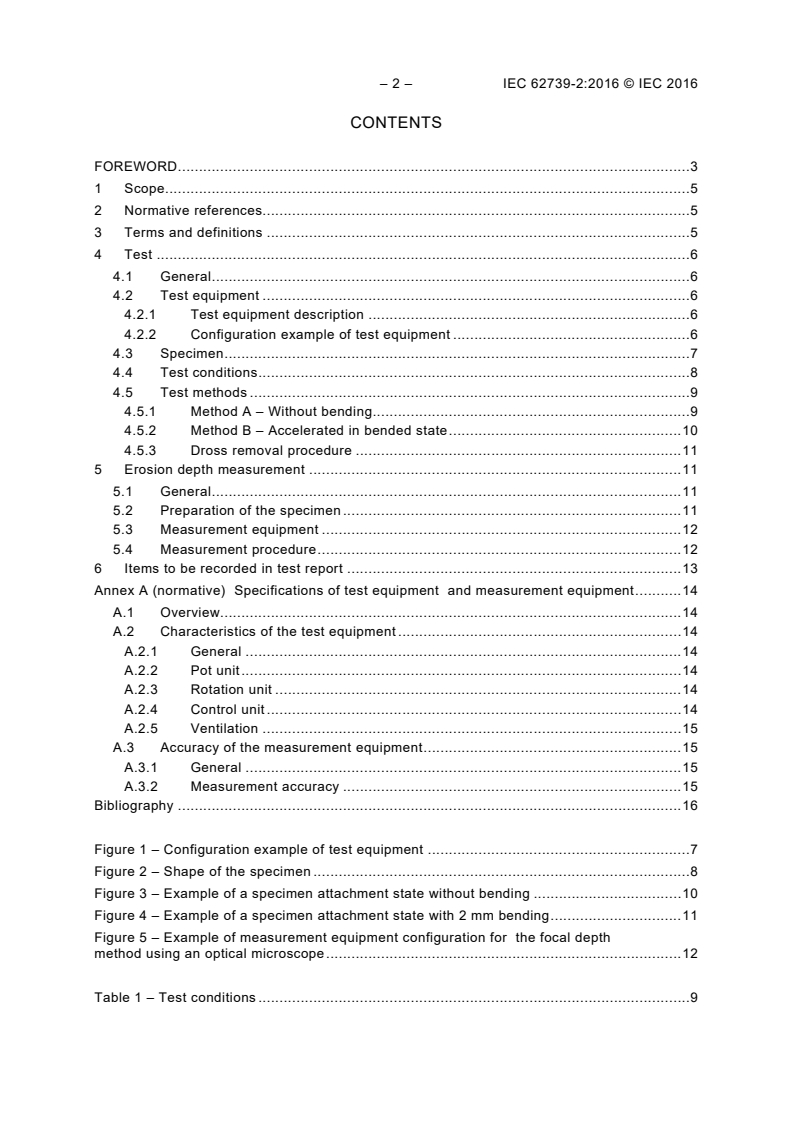
CONTENTS
FOREWORD . 3
1 Scope . 5
2 Normative references. 5
3 Terms and definitions . 5
4 Test . 6
4.1 General . 6
4.2 Test equipment . 6
4.2.1 Test equipment description . 6
4.2.2 Configuration example of test equipment . 6
4.3 Specimen . 7
4.4 Test conditions . 8
4.5 Test methods . 9
4.5.1 Method A – Without bending . 9
4.5.2 Method B – Accelerated in bended state . 10
4.5.3 Dross removal procedure . 11
5 Erosion depth measurement . 11
5.1 General . 11
5.2 Preparation of the specimen . 11
5.3 Measurement equipment . 12
5.4 Measurement procedure . 12
6 Items to be recorded in test report . 13
Annex A (normative) Specifications of test equipment and measurement equipment . 14
A.1 Overview. 14
A.2 Characteristics of the test equipment . 14
A.2.1 General . 14
A.2.2 Pot unit . 14
A.2.3 Rotation unit . 14
A.2.4 Control unit . 14
A.2.5 Ventilation . 15
A.3 Accuracy of the measurement equipment . 15
A.3.1 General . 15
A.3.2 Measurement accuracy . 15
Bibliography . 16
Figure 1 – Configuration example of test equipment . 7
Figure 2 – Shape of the specimen . 8
Figure 3 – Example of a specimen attachment state without bending . 10
Figure 4 – Example of a specimen attachment state with 2 mm bending . 11
Figure 5 – Example of measurement equipment configuration for the focal depth
method using an optical microscope . 12
Table 1 – Test conditions . 9
INTERNATIONAL ELECTROTECHNICAL COMMISSION
____________
TEST METHOD FOR EROSION OF WAVE SOLDERING
EQUIPMENT USING MOLTEN LEAD-FREE SOLDER ALLOY –
Part 2: Erosion test method for metal materials
with surface processing
FOREWORD
1) The International Electrotechnical Commission (IEC) is a worldwide organization for standardization comprising
all national electrotechnical committees (IEC National Committees). The object of IEC is to promote
international co-operation on all questions concerning standardization in the electrical and electronic fields. To
this end and in addition to other activities, IEC publishes International Standards, Technical Specifications,
Technical Reports, Publicly Available Specifications (PAS) and Guides (hereafter referred to as “IEC
Publication(s)”). Their preparation is entrusted to technical committees; any IEC National Committee interested
in the subject dealt with may participate in this preparatory work. International, governmental and non-
governmental organizations liaising with the IEC also participate in this preparation. IEC collaborates closely
with the International Organization for Standardization (ISO) in accordance with conditions determined by
agreement between the two organizations.
2) The formal decisions or agreements of IEC on technical matters express, as nearly as possible, an international
consensus of opinion on the relevant subjects since each technical committee has representation from all
interested IEC National Committees.
3) IEC Publications have the form of recommendations for international use and are accepted by IEC National
Committees in that sense. While all reasonable efforts are made to ensure that the technical content of IEC
Publications is accurate, IEC cannot be held responsible for the way in which they are used or for any
misinterpretation by any end user.
4) In order to promote international uniformity, IEC National Committees undertake to apply IEC Publications
transparently to the maximum extent possible in their national and regional publications. Any divergence
between any IEC Publication and the corresponding national or regional publication shall be clearly indicated in
the latter.
5) IEC itself does not provide any attestation of conformity. Independent certification bodies provide conformity
assessment services and, in some areas, access to IEC marks of conformity. IEC is not responsible for any
services carried out by independent certification bodies.
6) All users should ensure that they have the latest edition of this publication.
7) No liability shall attach to IEC or its directors, employees, servants or agents including individual experts and
members of its technical committees and IEC National Committees for any personal injury, property damage or
other damage of any nature whatsoever, whether direct or indirect, or for costs (including legal fees) and
expenses arising out of the publication, use of, or reliance upon, this IEC Publication or any other IEC
Publications.
8) Attention is drawn to the Normative references cited in this publication. Use of the referenced publications is
indispensable for the correct application of this publication.
9) Attention is drawn to the possibility that some of the elements of this IEC Publication may be the subject of
patent rights. IEC shall not be held responsible for identifying any or all such patent rights.
International Standard IEC 62739-2 has been prepared by IEC technical committee 91:
Electronics assembly technology.
The text of this standard is based on the following documents:
FDIS Report on voting
91/1365/FDIS 91/1379/RVD
Full information on the voting for the approval of this standard can be found in the report on
voting indicated in the above table.
This publication has been drafted in accordance with the ISO/IEC Directives, Part 2.
– 4 – IEC 62739-2:2016 © IEC 2016
A list of all parts in the IEC 62739 series, published under the general title Test method for
erosion of wave soldering equipment using molten lead-free solder alloy, can be found on the
IEC website.
The committee has decided that the contents of this publication will remain unchanged until
the stability date indicated on the IEC website under "http://webstore.iec.ch" in the data
related to the specific publication. At this date, the publication will be
• reconfirmed,
• withdrawn,
• replaced by a revised edition, or
• amended.
TEST METHOD FOR EROSION OF WAVE SOLDERING
EQUIPMENT USING MOLTEN LEAD-FREE SOLDER ALLOY –
Part 2: Erosion test method for metal materials
with surface processing
1 Scope
This part of IEC 62739 provides an evaluating test method for the erosion of the metallic
materials with surface processing intended to be used for lead-free wave soldering equipment
as a solder bath and other components which are in contact with the molten solder. It aims at
prevention of an accident or a fire by predicting a setup and life of a suitable maintenance
cycle.
2 Normative references
The following documents, in whole or in part, are normatively referenced in this document and
are indispensable for its application. For dated references, only the edition cited applies. For
undated references, the latest edition of the referenced document (including any
amendments) applies.
IEC 61190-1-3, Attachment materials for electronic assembly – Part 1-3: Requirements for
electronic grade solder alloys and fluxed and non-fluxed solid solders for electronic soldering
applications
3 Terms and definitions
For the purposes of this document, the following terms and definitions apply.
3.1
erosion
phenomenon where a base material is dissolved and made thinner by coming into contact with
molten solder
[SOURCE: IEC 62739-1:2013, 3.1]
3.2
lead-free solder
alloy that does not contain more than 0,1 % lead (Pb) by weight and used for joining
components to substrates or for coating surfaces
[SOURCE: IEC 60194:2015, 75.1904]
3.3
dross
oxide and other contaminants that form on the surface of molten solder
[SOURCE: IEC 60194:2015, 75.0410]
– 6 – IEC 62739-2:2016 © IEC 2016
4 Test
4.1 General
The specimen is mounted to the rotation block of the test equipment which is driven by the
motor (may include gear unit) then immersed into molten lead-free solder and rotated to
simulate solder flow in the wave soldering equipment. The erosion depth is measured after
the block is rotated for a designated period of time.
4.2 Test equipment
4.2.1 Test equipment description
Test equipment shall include equipment that realises the test conditions specified in 4.4.
Component materials of the test equipment which come in contact with molten solder shall be
erosion resistant or processed to be erosion resistant.
Details of the specifications of the equipment are given in Annex A.
4.2.2 Configuration example of test equipment
An example of the configuration of the test equipment is shown in Figure 1.
The test equipment consists of a pot unit, rotation unit, and control unit:
a) the pot unit consists of a heater to melt the lead-free solder alloy and a pot in which a
specimen can rotate.
b) the rotation unit consists of a motor which rotates the specimen and a rotation block to
which the specimen is attached.
c) the control unit has functions to control the heater, using a temperature sensor, control
mechanism and motor rotation.
Since dross spreads during the test, it is preferable for the test equipment to have a
ventilatory function with an exhaust air duct.
Other test equipment can be used if its configuration and functions meet the above
requirements.
Exhaust air duct
Rotation motor
Rotation unit
Rotation block
Specimen
Heate
Control unit
Solder
Temperature
Pot
sensor
Pot unit
IEC
Figure 1 – Configuration example of test equipment
4.3 Specimen
A specimen of the following material and shape is used.
a) The surface processing of the specimen shall be the same as that of the solder bath and
its components which come into contact with the molten solder.
b) The shape of specimen and the indication of the surface processing designation shall be
as shown in Figure 2. The indication shall be engraved.
c) The surfaces of the specimen to be evaluated shall be the surface with surface processing
indication (face A) and its backside (face B), and from the lower edge to 50 mm above it.
– 8 – IEC 62739-2:2016 © IEC 2016
Dimensions in millimetres
4 2
2 × ø3,3
a
IEC
Key
a
Engraved mark
Figure 2 – Shape of the specimen
4.4 Test conditions
Test materials and test conditions are shown in Table 1.
70 8 6
Table 1 – Test conditions
Composition of test solder alloy Sn96,5Ag3Cu,5 specified in IEC 61190-1-3 shall be used if not otherwise
specified in individual standards.
Solder temperature (at 450 °C ±3 °C (the temperature is measured at a depth of 35 mm to 40 mm
measurement position)
from the solder surface and at a distance of 20 mm to 30 mm from the
specimen).
Rotation speed of specimen 100 r/min ±3 r/min.
Rotation radius of specimen 6 mm to 8 mm (from the centre of the rotation block to the outer edge of
the specimen).
Dipping depth of specimen 65 mm to 70 mm (from molten solder surface to the lower edge of the
specimen).
Test duration Suitable test time needs to be set up in advance.
Frequency of removal of dross A minimum of once every 16 h.
The time until erosion shows varies in accordance with the surface processing of the specimen. The appropriate
test duration that shows the difference of the erosion depth depending on the surface processing, should be
defined before performing the test. Care shall be taken to keep the uneroded area clean since this area is used
as the base of the erosion measurement.
4.5 Test methods
4.5.1 Method A – Without bending
If no further acceleration is demanded, the test without bending is conducted following the
steps outlined below.
a) Clean the surface of the specimen with gauze or a paper towel.
b) The specimen shall be attached to the rotation block with face B touching the block,
without contacting the molten solder.
c) Remove the dross floating on the molten solder in the pot following the dross removal
procedure specified in 4.5.3. Dip the specimen attached to the rotation block into the
molten solder maintained at the specified temperature. The specimen should be dipped in
the molten solder to the depth specified in 4.4 and rotated by the rotation motor at the
rotation speed specified in 4.4. After the rotation is complete, start measuring the elapsed
time of the test. An example of a specimen attachment state without bending is shown in
Figure 3.
d) Remove the specimen from the molten solder within 2 h after the test duration reaches to
a specified value, and wipe off the solder completely from the specimen with a waste cloth.
e) The dross floating on the molten solder in the pot is removed at the frequency specified in
4.4.
f) After the test duration specified in 4.4, measure the depth of the erosion by the method
specified in Clause 5.
g) Do not remove the specimen from the molten solder until the elapsed time of a test has
reached the rated value, which includes the time for removing the dross and the
equipment down time during the night.
– 10 – IEC 62739-2:2016 © IEC 2016
Dimensions in millimetres
Rotation shaft
Molten
solder
ø90
IEC
Figure 3 – Example of a specimen attachment state without bending
4.5.2 Method B – Accelerated in bended state
If further acceleration is demanded, the test with bending is conducted following the steps
outlined below.
a) Clean the surface of the specimen with gauze or a paper towel.
b) The specimen shall be attached to the rotation block with face B touching the block,
without contacting the molten solder.
c) Remove the dross floating on the molten solder in the pot following the dross removal
procedure specified in 4.5.3. Dip the specimen attached to the rotation block into the
molten solder maintained at the specified temperature. The specimen should be dipped in
the molten solder to the depth specified in 4.4 and rotated by the rotation motor at the
rotation speed specified in 4.4. After the rotation is complete, start measuring the elapsed
time of the test. An example of a specimen attachment state with bending is shown in
Figure 4.
d) Remove the specimen from the molten solder within 2 h after the test duration has
reached a specified value, and wipe off the solder completely from the specimen with a
waste cloth.
e) The dross floating on the molten solder in the pot is removed at the frequency specified in
4.4.
f) After the test duration specified in 4.4, measure the depth of the erosion by the method
specified in Clause 5.
g) Do not remove the specimen from the molten solder until the elapsed time of a test has
reached the rated value, which includes the time for removing the dross and the
equipment down time during the night.
Dimensions in millimetres
Rotation shaft
Molten
solder
ø90
IEC
Figure 4 – Example of a specimen attachment state with 2 mm bending
4.5.3 Dross removal procedure
The dross floating on the molten solder in the pot is removed following the steps outlined
below.
a) Stop the rotation motor and use an appropriate jig (like a stainless steel ladle with many
holes) to remove the dross floating on the molten solder in the pot. Put the dross in a
sealed container.
b) Check the volume of the molten solder in the pot (to ensure the dipping depth as specified
in 4.4 is maintained). If the volume does not meet the specified requirements, supply
additional solder accordingly.
c) Dip the specimen into the molten solder, which is now free from dross, to the depth
specified in 4.4. Continue the test specified in 4.5.1 or 4.5.2.
5 Erosion depth measurement
5.1 General
After the test, the erosion depth of the specimen is measured by the focal depth method using
an optical microscope as described below.
5.2 Preparation of the specimen
The specimen is prepared following the steps outlined below.
– 12 – IEC 62739-2:2016 © IEC 2016
a) After the test has been conducted for the test duration specified in 4.4, continue dipping
the specimen in the molten solder until the rotation stops. Remove the specimen from the
solder when the rotation stops.
b) Remove the specimen by picking it up from the molten solder and detaching it from the
rotation block.
c) Dip the specimen again into the molten solder, heat it, and remove it from the solder. Wipe
the surface of the specimen to be evaluated immediately with a cotton cloth to remove the
solder.
If the solder has not been removed completely, repeat step c) until all solder has been
removed.
5.3 Measurement equipment
The measurement equipment shall consist of an optical microscope, digital micrometre, CCD
camera, and TV monitor and be able to measure focal depth. An example of the measurement
equipment is shown in Figure 5.
Pole
Indicator
Indicator fixing knob
Zero adjustment
button
CCD camera
Lens slide knob
TV monitor
Microscope lens
Specimen
Measurement table
IEC
Figure 5 – Example of measurement equipment configuration for
the focal depth method using an optical microscope
5.4 Measurement procedure
The specimen is measured following the steps outlined below.
a) Prepare the measurement equipment specified in 5.3 (if the equipment includes no CCD
camera, specimens shall be observed using normal or corrected vision).
b) Visually observe faces A and B specified in 4.3 to find the seemingly deepest erosion area
in advance (more than 3 areas on each face).
c) Place the specimen on the measurement equipment and find the deepest erosion area by
multiplying the magnification of the microscope to its maximum setting (the magnification
ratio is preferably 200 or higher).
d) After identifying the deepest erosion area, focus the microscope’s lens on an uneroded
area within the view angle by rotating the lens slide knob.
e) Press the zero setting button of the digital indicator to reset the indicated value to zero.
f) Then, rotate the lens slide knob of the microscope to focus on the deepest erosion area.
g) Read and record the value indicated on the digital indicator.
h) It is preferable to take a photograph of the erosion area if possible.
i) The position where the erosion seems to be the deepest is measured at three places or
more on each face, and the maximum value is adopted as erosion depth. To exclude the
influence of the erosion generated by dross, the evaluation area is limited to 50 mm from
the lower edge of the specimen. It is premised that the specified dipping depth is 65 mm to
70 mm. In the case of a test with 2 mm bending, the specimen area touching with bending
pin and holder shall be excepted from the evaluation area.
6 Items to be recorded in test report
In the test report, each of the following items shall be included:
a) date and time of the measurement;
b) test and measuring equipment manufacturer and equipment number;
c) specimen:
1) material, surface processing, and number;
2) thermal refining;
3) processing conducted (e.g. cutting, grinding);
4) surface condition;
d) solder material;
e) test conditions:
1) temperature of molten solder;
2) rotation speed;
f) presence/absence of erosion, depth of erosion;
g) condition of erosion (details of the erosion’s condition; photographs that indicate the
location of the erosion).
– 14 – IEC 62739-2:2016 © IEC 2016
Annex A
(normative)
Specifications of test equipment
and measurement equipment
A.1 Overview
This annex provides specifications of the test equipment mentioned in 4.2 and measurement
equipment mentioned in 5.3.
A.2 Characteristics of the test equipment
A.2.1 General
The test equipment of this standard shall consist of a pot unit, rotation unit, and control unit,
each of which has the following characteristics.
A.2.2 Pot unit
The pot unit shall have the following characteristics.
a) The pot should be large enough to contain more than 5 kg of solder so that the specimen
can rotate inside it and not block the rotation of the specimen specified in 4.4.
b) The pot should be deep enough to dip the specimen to the specified depth.
c) If a steel pot is used, the pot surface should be processed to prevent erosion. No
particular specification is given to the surface processing.
d) The heater should be capable of melting the solder and heating the molten solder up to
500 °C.
e) If the heater needs to be dipped in the molten solder, the heater surface should be
processed to prevent erosion.
A.2.3 Rotation unit
The rotation unit shall have the following characteristics.
a) The rotation unit has a motor that rotates the specimen.
b) The shaft of the rotation motor is provided with a rotation block to hold the specimen.
c) The specimen attached to the rotation block rotates in the solder at the depth specified in
4.4.
A.2.4 Control unit
The control unit shall have the following characteristics.
a) The control unit has a temperature sensor and uses a temperature adjuster to control the
heater. The unit is capable of maintaining the temperature of the molten solder at
450 °C ± 3 °C.
b) If the temperature sensor needs to be dipped in the molten solder to the depth specified in
4.4, it is preferable that the sensor is surface processed.
c) The motor shall be controlled at a rotation speed of 100 r/min ± 3 r/min as specified in 4.4.
d) It is preferable that the elapsed time of the test specified in 4.4 can be automatically
recorded.
e) For safety reasons, it is preferable that the equipment has an interlock or other functions
to prevent overheating of the solder.
...