

IEC 60489-2:1991/AMD1:1999
(Amendment)Amendment 1 - Methods of measurement for radio equipment used in the mobile services - Part 2: Transmitters employing A3E, F3E or G3E emissions
General Information
- Abstract
- Status
- Published
- Publication Date
- 15-Jul-1999
- Technical Committee
- TC 102 - Equipment used in radiocommunications for mobile services and for satellite communication systems
- Drafting Committee
- WG 6 - TC 102/WG 6
- Current Stage
- PPUB - Publication issued
- Start Date
- 16-Jul-1999
- Completion Date
- 30-Jun-1999
Overview
IEC 60489-2:1991/AMD1:1999 is Amendment 1 to the IEC standard describing measurement methods for radio equipment used in the mobile services - Part 2: Transmitters employing A3E, F3E or G3E emissions. This amendment updates clause numbering, adds new measurement items (for example modulation sensitivity and compressor characteristics), revises measurement procedures and test-site guidance, and removes/renames specified appendices.
Key topics and technical requirements
- Added/renumbered clauses: insertion of clause 13 (modulation sensitivity), renaming of total distortion factor clause, insertion of clause 16 (compressor characteristics), and renumbering of subsequent clauses.
- Audio-frequency band limitation: reproducible measurements require restricting the demodulated audio-frequency band using band-limiting filters tailored to the signal type; for residual hum/noise only the low-pass portion need be specified.
- Antenna-terminal measurement practices: updated guidance for using band-rejection filters and when to replace them with a high‑pass filter (approx. 1.5× carrier) for measuring spurious at/above the second harmonic.
- Radiated radio‑frequency power measurements:
- Definitions and methods for average radiated carrier power, maximum effective radiated carrier power (horizontal plane and spherical), RFM (random field measurement), and RFCD (radio‑frequency coupling device) radiated power.
- Measurement site guidance: OATS, LRTS, anechoic chambers (AC), RFM sites, RFCDs and references to annex A of IEC 60489-1 for test-site selection and setup.
- Spurious, noise and adjacent channel power: methods for radiated spurious narrow‑band components, radiated transmitter noise, and radiated adjacent channel power using RFCD or near‑field coupling and ratio measurement relative to radiated carrier power.
- Cabinet radiation: noted as part of radiated spurious components, with measurement cross‑references to IEC 60244‑6 and IEC 60244‑7.
- Inter‑transmitter intermodulation (ITIM) and TIMCL: definitions and antenna‑terminal measurement method using a line stretcher and circulator; precise procedure steps for inducing/measuring third‑order intermodulation products.
Applications and who uses this standard
- RF test engineers and laboratory technicians conducting transmitter conformity and performance tests
- Manufacturers of mobile radio transmitters and integrated antenna equipment performing design verification and production testing
- Certification bodies and regulatory agencies verifying compliance with emission, spurious and intermodulation limits
- EMC and RF compliance consultants establishing test methods on OATS, RFCDs, anechoic chambers and RFM sites
Related standards
- IEC 60489‑1 (test-site/use guidance; annex A referenced)
- IEC 60244‑6 and IEC 60244‑7 (cabinet radiation)
- ITU‑T Recommendation O.41 (psophometer) - referenced for audio/noise measurement context
Keywords: IEC 60489-2:1991/AMD1:1999, mobile services, radio transmitter measurement, A3E F3E G3E, radiated power, spurious emissions, RFCD, RFM, OATS, intermodulation, modulation sensitivity.
Get Certified
Connect with accredited certification bodies for this standard

ANCE
Mexican certification and testing association.

Intertek Slovenia
Intertek testing, inspection, and certification services in Slovenia.

LNE (Laboratoire National de Métrologie et d'Essais)
French national laboratory for metrology and testing.
Sponsored listings
Frequently Asked Questions
IEC 60489-2:1991/AMD1:1999 is a standard published by the International Electrotechnical Commission (IEC). Its full title is "Amendment 1 - Methods of measurement for radio equipment used in the mobile services - Part 2: Transmitters employing A3E, F3E or G3E emissions". This standard covers: Amendment 1 - Methods of measurement for radio equipment used in the mobile services - Part 2: Transmitters employing A3E, F3E or G3E emissions
Amendment 1 - Methods of measurement for radio equipment used in the mobile services - Part 2: Transmitters employing A3E, F3E or G3E emissions
IEC 60489-2:1991/AMD1:1999 is classified under the following ICS (International Classification for Standards) categories: 33.060.20 - Receiving and transmitting equipment; 33.060.30 - Radio relay and fixed satellite communications systems. The ICS classification helps identify the subject area and facilitates finding related standards.
IEC 60489-2:1991/AMD1:1999 is available in PDF format for immediate download after purchase. The document can be added to your cart and obtained through the secure checkout process. Digital delivery ensures instant access to the complete standard document.
Standards Content (Sample)
INTERNATIONAL
IEC
STANDARD
60489-2
AMENDMENT 1
1999-07
Amendment 1
Methods of measurement for radio equipment
used in the mobile services –
Part 2:
Transmitters employing A3E, F3E
or G3E emissions
Amendement 1
Méthodes de mesure applicables au matériel
de radiocommunication utilisé
dans les services mobiles –
Partie 2:
Emetteurs utilisant les émissions
A3E, F3E ou G3E
IEC 1999 Copyright - all rights reserved
International Electrotechnical Commission 3, rue de Varembé Geneva, Switzerland
Telefax: +41 22 919 0300 e-mail: inmail@iec.ch IEC web site http://www.iec.ch
Commission Electrotechnique Internationale
PRICE CODE T
International Electrotechnical Commission
For price, see current catalogue
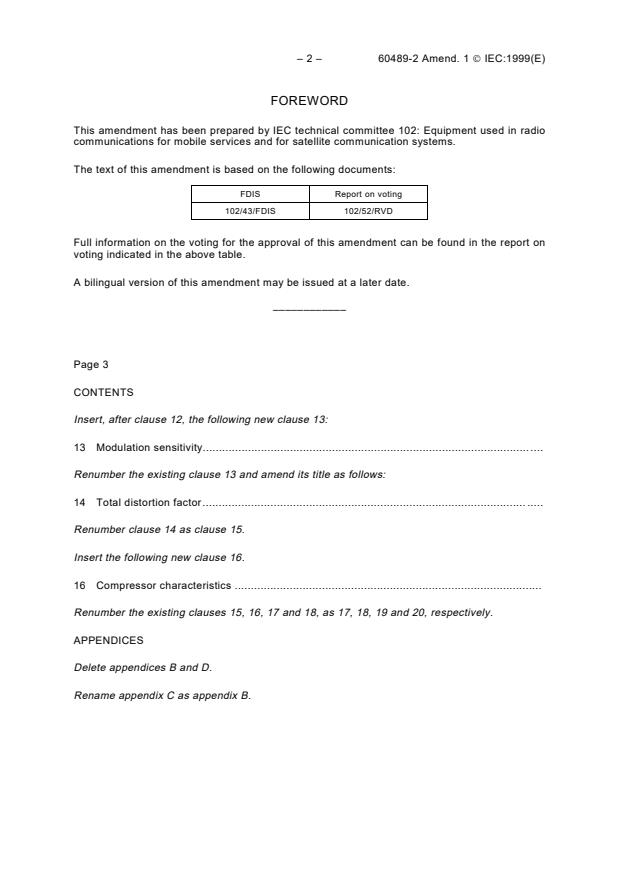
– 2 – 60489-2 Amend. 1 IEC:1999(E)
FOREWORD
This amendment has been prepared by IEC technical committee 102: Equipment used in radio
communications for mobile services and for satellite communication systems.
The text of this amendment is based on the following documents:
FDIS Report on voting
102/43/FDIS 102/52/RVD
Full information on the voting for the approval of this amendment can be found in the report on
voting indicated in the above table.
A bilingual version of this amendment may be issued at a later date.
––––––––––––
Page 3
CONTENTS
Insert, after clause 12, the following new clause 13:
13 Modulation sensitivity. .
Renumber the existing clause 13 and amend its title as follows:
14 Total distortion factor. .
Renumber clause 14 as clause 15.
Insert the following new clause 16.
16 Compressor characteristics .
Renumber the existing clauses 15, 16, 17 and 18, as 17, 18, 19 and 20, respectively.
APPENDICES
Delete appendices B and D.
Rename appendix C as appendix B.
60489-2 Amend. 1 © IEC:1999(E) – 3 –
Page 5
PREFACE
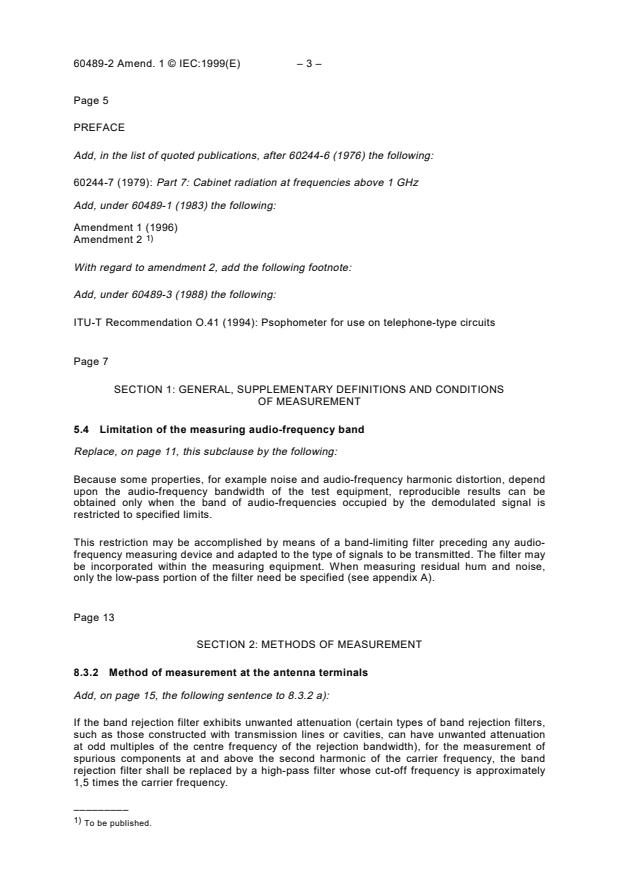
Add, in the list of quoted publications, after 60244-6 (1976) the following:
60244-7 (1979): Part 7: Cabinet radiation at frequencies above 1 GHz
Add, under 60489-1 (1983) the following:
Amendment 1 (1996)
1)
Amendment 2
With regard to amendment 2, add the following footnote:
Add, under 60489-3 (1988) the following:
ITU-T Recommendation O.41 (1994): Psophometer for use on telephone-type circuits
Page 7
SECTION 1: GENERAL, SUPPLEMENTARY DEFINITIONS AND CONDITIONS
OF MEASUREMENT
5.4 Limitation of the measuring audio-frequency band
Replace, on page 11, this subclause by the following:
Because some properties, for example noise and audio-frequency harmonic distortion, depend
upon the audio-frequency bandwidth of the test equipment, reproducible results can be
obtained only when the band of audio-frequencies occupied by the demodulated signal is
restricted to specified limits.
This restriction may be accomplished by means of a band-limiting filter preceding any audio-
frequency measuring device and adapted to the type of signals to be transmitted. The filter may
be incorporated within the measuring equipment. When measuring residual hum and noise,
only the low-pass portion of the filter need be specified (see appendix A).
Page 13
SECTION 2: METHODS OF MEASUREMENT
8.3.2 Method of measurement at the antenna terminals
Add, on page 15, the following sentence to 8.3.2 a):
If the band rejection filter exhibits unwanted attenuation (certain types of band rejection filters,
such as those constructed with transmission lines or cavities, can have unwanted attenuation
at odd multiples of the centre frequency of the rejection bandwidth), for the measurement of
spurious components at and above the second harmonic of the carrier frequency, the band
rejection filter shall be replaced by a high-pass filter whose cut-off frequency is approximately
1,5 times the carrier frequency.
–––––––––
1)
To be published.
– 4 – 60489-2 Amend. 1 IEC:1999(E)
Page 17
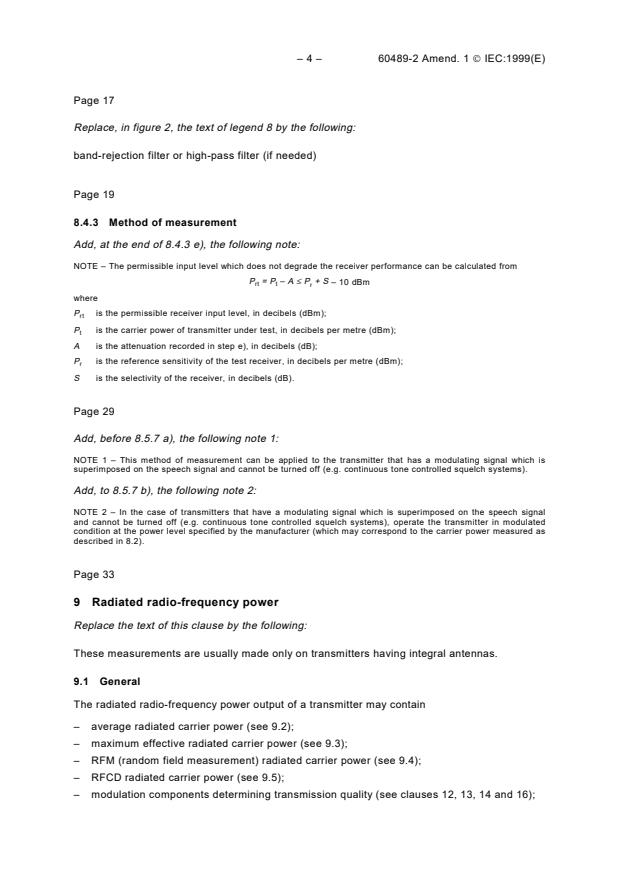
Replace, in figure 2, the text of legend 8 by the following:
band-rejection filter or high-pass filter (if needed)
Page 19
8.4.3 Method of measurement
Add, at the end of 8.4.3 e), the following note:
NOTE – The permissible input level which does not degrade the receiver performance can be calculated from
P = P – A
≤ P + S – 10 dBm
rt t
r
where
P is the permissible receiver input level, in decibels (dBm);
rt
P is the carrier power of transmitter under test, in decibels per metre (dBm);
t
A is the attenuation recorded in step e), in decibels (dB);
P is the reference sensitivity of the test receiver, in decibels per metre (dBm);
r
S is the selectivity of the receiver, in decibels (dB).
Page 29
Add, before 8.5.7 a), the following note 1:
NOTE 1 – This method of measurement can be applied to the transmitter that has a modulating signal which is
superimposed on the speech signal and cannot be turned off (e.g. continuous tone controlled squelch systems).
Add, to 8.5.7 b), the following note 2:
NOTE 2 – In the case of transmitters that have a modulating signal which is superimposed on the speech signal
and cannot be turned off (e.g. continuous tone controlled squelch systems), operate the transmitter in modulated
condition at the power level specified by the manufacturer (which may correspond to the carrier power measured as
described in 8.2).
Page 33
9 Radiated radio-frequency power
Replace the text of this clause by the following:
These measurements are usually made only on transmitters having integral antennas.
9.1 General
The radiated radio-frequency power output of a transmitter may contain
– average radiated carrier power (see 9.2);
– maximum effective radiated carrier power (see 9.3);
– RFM (random field measurement) radiated carrier power (see 9.4);
– RFCD radiated carrier power (see 9.5);
– modulation components determining transmission quality (see clauses 12, 13, 14 and 16);
60489-2 Amend. 1 © IEC:1999(E) – 5 –
– other modulation components (e.g. components contributing to the adjacent channel power)
(see 9.8);
– spurious narrow-bandwidth components (see 9.6);
– noise, both inside the band (see clause 18) and outside the band, where it is called
spurious transmitter noise (see 9.7);
– inter-transmitter intermodulation products (see clause 11), and
– cabinet radiation (see 9.9).
The measured levels may be due to the radiation from the antenna, audio lines, control lines,
power mains or from the cabinet. These measurements generally require the use of a test
site or an RFCD. Guides for the use of such test sites and RFCDs are given in IEC 60489-1,
annex A.
9.2 Average radiated carrier power for transmitters with integral antennas
9.2.1 Definition
Average of the radiated carrier powers in eight directions distributed at 45° angles in the
horizontal plane.
NOTE – The average radiated carrier power can be measured in OATS (open area test sites) or in LRTS (low
reflection test sites) or in AC (anechoic chambers). Measured values in OATS may differ from the values measured
in the other two test sites because of the ground reflected wave effect.
9.2.2 Method of measurement
a) Choose the test site and the measuring distance suitable for the frequency, the environmental
conditions, the required measurement error and transmitter dimensions, from those
described in annex A of IEC 60489-1.
b) Place the equipment under test as illustrated in a subclause for the chosen test site in the
above-mentioned annex.
c) Measure the normal direction radiated power by the basic measuring procedure described
in the subclause.
NOTE – The normal direction of the equipment under test is usually the operation side and is specified by the
manufacturer. The normal direction may be the specific direction used for RFCD calibration measurements.
d) Rotate the equipment under test 45° clockwise and measure this direction radiated power
by the same procedure as in step c).
e) Repeat step d) until values have been obtained for eight azimuth positions.
9.2.3 Presentation of results
Calculate the average of eight values measured in step d). Record measurement conditions of
the test site.
9.3 Maximum effective radiated carrier power
9.3.1 Maximum effective radiated carrier power in the horizontal plane
9.3.1.1 Definition
Maximum effective radiated carrier power in the horizontal plane.
NOTE – The maximum radiated carrier power can be measured in OATS, LRTS or AC. Measured values in OATS
may differ from the values measured in the other two test sites because of the ground reflected wave effect.
– 6 – 60489-2 Amend. 1 IEC:1999(E)
9.3.1.2 Method of measurement for the maximum effective radiated carrier power
in the horizontal plane
a) Choose the test site and the measuring distance suitable for the frequency, the environmental
conditions, the required measurement error and transmitter dimensions, from those
described in annex A of IEC 60489-1.
b) Place the transmitter under test as illustrated in a subclause for the chosen test site in the
above-mentioned annex. Calibrate the test site.
c) Measure the normal direction radiated power by the basic measuring procedure for
radiation measurement described in the above-mentioned subclause.
NOTE – The normal direction of the equipment under test is usually the operation side and is specified by the
manufacturer. The normal direction may be the specific direction used for RFCD calibration measurements.
d) Rotate the transmitter under test in the horizontal plane and find the direction which has the
maximum indication on the power measuring device. Note the maximum indication.
9.3.1.3 Presentation of results
Calculate the maximum effective radiated carrier power in the horizontal plane and record the
direction in step d).
9.3.2 Maximum effective radiated carrier power on a spherical surface
9.3.2.1 Definition
Maximum value of effective radiated carrier power observed on a closed surface surrounding
an antenna.
NOTE – The maximum radiated carrier power can be measured in LRTS or in AC.
9.3.2.2 Method of measurement for the maximum effective radiated carrier power
on a spherical surface
Follow the procedure described in items a) to c) of 9.3.1.2.
d) Rotate the transmitter under test in the horizontal plane and find the direction which has the
maximum indication on the selective measuring device.
e) Rotate the transmitter under test 90° in the vertical plane keeping the direction found in
step d) to the measuring antenna.
f) Orient the measuring antenna so that it is horizontally polarized. Rotate the transmitter
under test in the horizontal plane and note the maximum indication. This will be the
direction which has the maximum radiated carrier power on a spherical surface.
g) If another direction offers more radiated carrier power, confirm it for that direction by
repeating step d) to step f).
9.3.2.3 Presentation of results
Calculate the maximum effective radiated carrier power in step f) and record the direction in
step d) as the horizontal plane direction and the direction in step f) as the vertical plane
direction.
9.4 RFM (random field measurement) radiated carrier power
9.4.1 Definition
Median of radiated carrier power measurements taken along a random path in a random field.
NOTE – The RFM radiated carrier power can be measured in the RFM site.
60489-2 Amend. 1 © IEC:1999(E) – 7 –
9.4.2 Method of measurement
a) Confirm the construction parameter of the RFM site and position the transmitter under test
as illustrated in annex A of IEC 60489-1.
b) Measure the RFM radiated carrier power by the basic measuring procedure described in the
above-mentioned annex.
9.4.3 Presentation of results
Record the RFM radiated carrier power, the path length and the DDD value measured in step b).
NOTE – The DDD value expresses the measuring error or repeatability in the test site evaluation measurement
described in the above-mentioned annex.
9.5 RFCD (radio-frequency coupling device) radiated carrier power
9.5.1 Definition
Signal level at the output of an RFCD, in which the transmitter under test operates, calibrated
by the specific direction radiated carrier power in a test site.
9.5.2 Method of measurement
a) Choose the RFCD for the frequency and size of the transmitter under test from those
described in annex A of IEC 60489-1.
b) Calibrate or confirm the calibration value for the output signal level of the RFCD. The
calibration should be performed with the calibration method for the chosen RFCD described
in the subclause of the above-mentioned annex.
c) Place the transmitter under test in the specified position and in the specified direction and
activate the transmitter.
d) Measure the output level of the RFCD.
9.5.3 Presentation of results
Calculate the RFCD radiated carrier power from the relation of the values in step b) and
step d). Record the position, the direction of the transmitter under test in the RFCD, and the
calibration value.
9.6 Radiated spurious narrow-bandwidth components
The methods of measurement for the radiated spurious narrow-bandwidth components are
principally the same as those of the radiated carrier power described in 9.2 to 9.5. The only
difference for radiated spurious measurement is the presence of a very high-level carrier.
Therefore, the measurement conditions are the same as the combination of the above radiated
carrier power measurement and the measurement of the terminal spurious narrow-bandwidth
radio-frequency components in 8.3.
The different kinds of radiated spurious narrow-bandwidth components are as follows:
– average radiated spurious narrow-bandwidth components;
– maximum radiated spurious narrow-bandwidth components;
– RFM radiated spurious narrow-bandwidth components;
– RFCD radiated spurious narrow-bandwidth components.
9.7 Radiated spurious transmitter noise
9.7.1 Definition
Continuous spectrum of noise components radiated by transmitters with integral antennas.
NOTE – For more general information, see 8.4.1.
– 8 – 60489-2 Amend. 1 IEC:1999(E)
9.7.2 Method of measurement
This method uses the RFCD or near-field coupling of the transmitter and the test antenna in
the Faraday cage (if necessary) and the output of the RFCD, or the test antenna is measured
with the same method as for one of the terminal radio-frequency powers, for example 8.4. The
method uses the ratio measurement, and the coupling of the RFCD or the coupling of the
transmitter and the test antenna is calculated from the radiated carrier power measured as
described in 9.2.
9.8 Radiated adjacent channel power
9.8.1 Definition
That part of the total power, under defined conditions of modulation, which falls within a
specified bandwidth centred on the centre frequency of either of the adjacent channels radiated
from transmitters with integral antennas.
9.8.2 Method of measurement
This method uses the RFCD or near-field coupling of the transmitter and the test antenna in
the Faraday cage (if necessary), and the output of the RFCD or the test antenna is measured
with the same method for one of the terminal radio-frequency powers, for example 8.5. The
method uses the ratio measurement, and the coupling of the RFCD or the coupling of the
transmitter and the test antenna is calculated from the radiated carrier power measured as
described in 9.2 to 9.4.
9.9 Cabinet radiation
9.9.1 Definition
The cabinet radiation of transmitters with integral antennas is contained in the radiated
spurious narrow-bandwidth components measured as described in 9.6.
9.9.2 Method of measurement
Methods of measurement for the cabinet radiation of transmitters equipped with suitable
antenna terminals are given in IEC 60244-6 and IEC 60244-7.
Page 57
11 Inter-transmitter intermodulation
Replace the text of this clause by the following:
11.1 Definition
Process by which intermodulation products are generated in the output circuits of a transmitter
due to the presence of an unwanted signal from another transmitter.
11.1.1 Inter-transmitter intermodulation (ITIM)
For the purpose of this standard, inter-transmitter intermodulation (ITIM) is expressed in terms
of the ratio, in decibels, of the transmitter carrier power to the power of the third-order
intermodulation product caused by the presence of an interfering signal which is 30 dB below
the level of the transmitter output and which is incident upon the output of the disturbed
transmitter.
60489-2 Amend. 1 © IEC:1999(E) – 9 –
11.1.2 Transmitter intermodulation conversion loss (TIMCL)
For the purpose of this standard, transmitter intermodulation conversion loss (TIMCL) is
expressed in terms of the ratio, in decibels, of the power of the interfering signal (which is
30 dB below the transmitter carrier power) which is incident upon the output of the disturbed
transmitter to the power of the third-order intermodulation product.
NOTE – Inter-transmitter intermodulation (ITIM) and transmitter intermodulation conversion loss (TIMCL) are related
arithmetically by the expression
ITIM = TIMCL + 30 dB
11.2 Method of measurement (antenna terminals)
11.2.1 Method of measurement using a line stretcher and a circulator
a) Connect the equipment as shown in figure 8a.
NOTE 1 – The impedance of all components in the measuring arrangement (with the possible exception of the
output impedance of the transmitter under test) should be the same as the characteristic impedance of the
measuring arrangement transmission line. The directional couplers should be used to measure the incident and the
reflected powers, and to make certain that there is not a gross mismatch between the test load and the measuring
arrangement.
b) Operate the transmitter without modulation at rated power output and adjust the selective
voltmeter (3) for maximum indication at the operating frequency of the transmitter. Record
the carrier level with the switch (4) in position A.
c) Adjust the frequency of the radio-frequency test signal source (9) to a frequency 100 kHz
above the operating frequency of the transmitter.
d) Change switch (4) to position B. Adjust the selective voltmeter for maximum reading at the
frequency of the radio-frequency test signal source (9) and adjust the test signal level to
produce a value 30 dB below the level recorded in step b).
e) With switch (4) in position A and the transmitter operating at rated power, adjust the
selective voltmeter for maximum reading at the frequency of the third-order intermodulation
product which is 100 kHz below the transmitter operating frequency.
f) Adjust the line stretcher (5) until the maximum level of the intermodulation product is
obtained.
g) Repeat step d) and record the level of the signal from the radio-frequency test signal
source.
h) Repeat step e) and record the level of the intermodulation product.
i) Change switch (4) to position B and note the reading of the selective voltmeter. A level less
than 10 dB lower than that measured in step h) indicates a source of intermodulation other
than the transmitter under test, for example the radio-frequency test signal source (9) or the
circulator (7). This shall be eliminated and step h) shall then be repeated.
j) The ratio, in decibels, of the level of the transmitter signal measured in step b) to the level
of the intermodulation product measured in step h) is the inter-transmitter intermodulation
(ITIM).
k) The ratio, in decibels, of the level of the unwanted signal level measured in step g) to the
level of the intermodulation product measured in step h) is the transmitter intermodulation
conversion loss (TIMCL).
NOTE 2 – The method of measurement can be used for other frequency spacings and levels of the radio-frequency
test signal source (9).
NOTE 3 – The selective voltmeter (3) should have a selectivity sufficiently high so as not to be influenced by the
carrier level when measuring the intermodulation product.
– 10 – 60489-2 Amend. 1 IEC:1999(E)
11.2.2 Method of measurement using a resistive or a capacitive coupler
a) Connect the equipment as shown in figure 8b.
NOTE 1 – In order to reduce mismatch errors, it is important that the 10 dB power attenuator (2) is coupled to the
transmitter with the shortest possible connection.
b) Operate the transmitter without modulation at rated power output and adjust the spectrum
analyser (8) to give a maximum indication with a frequency span of 500 kHz.
c) Adjust the frequency of the unmodulated radio-frequency test signal source (6) to a
frequency 100 kHz above the operating frequency of the transmitter.
d) Adjust the level of the value monitored on the spectrum analyser to 10 dB below the level of
the transmitter (as displayed on the spectrum analyser).
NOTE 2 – This procedure will ensure that the ratio of the levels at the transmitter terminals is 30 dB.
e) Measure the intermodulation component by direct observation on the spectrum analyser (8)
and record the ratio, in decibels, of the level of the largest intermodulation component to
the level of the interfering signal.
f) Calculate the inter-transmitter intermodulation (ITIM) using the following relationship:
ITIM = X – 2 A dB
where
X is the ratio recorded in step e);
A is the attenuation of the power attenuator (2) (nominally 10 dB).
g) Calculate the transmitter intermodulation conversion loss (TIMCL) using the following
relationship:
TIMCL = X – 2 A – 30 dB
where
X is the ratio recorded in step e);
A is the attenuation of the power attenuator (2) (nominally 10 dB).
NOTE 3 – This method of measurement may be used for other frequency spacings and levels of radio-frequency
test signal source (9).
NOTE 4 – The spectrum analyser should have a selectivity sufficiently high so as not to be influenced by the
transmitter carrier level when measuring the intermodulation product.
11.3 Method of measurement (integral antenna)
11.3.1 Method of measurement using a circulator and a line stretcher
a) Connect the equipment as shown in figure 8c.
NOTE 1 – The impedance of all components in the measuring arrangement (with the possible exception of the
output impedance of the transmitter) should be the same as the characteristic impedance of the measuring
arrangement transmission line. The directional couplers should be used to measure the incident and reflected
powers, and to make certain that there is not a gross mismatch between the test load and the measuring
arrangement. The value of the maximum effective radiated power, P (see 9.3), is required for this measurement
max
method.
b) Operate the transmitter without modulation at rated power output. Connect P1 (of figure 8c)
to Q2 and adjust the attenuator (12) so that the spectrum analyser (3) is operating in its
linear region. Record the value of the attenuation of the attenuator (12) in decibels and the
level measured on the spectrum analyser in decibels per metre.
c) Calculate and record the amount of the coupling loss (A ) of the RFCD using the
c
relationship:
A = P – A – B dB
c max
where
P is the maximum effective radiated power (see 9.3);
max
A is the attenuation of the attenuator (12) recorded in step b);
B is the level measured by the spectrum analyser (3) in step b).
60489-2 Amend. 1 © IEC:1999(E) – 11 –
d) With switch (4) in position A, connect P1 to P2 and Q1 to Q2. Adjust the attenuator (12) so
that the spectrum analyser is operating in its linear range. Record the level measured on
the spectrum analyser (3) in decibels per metre.
e) Adjust the frequency of the radio-frequency test signal source (9) to a frequency 100 kHz
above the operating frequency of the transmitter.
f) Change the switch (4) to position B. Adjust the level of the radio-frequency test signal
source to produce a level displayed on the spectrum analyser (3) which is below the level
recorded in
...