

IEC 62974-1:2017
(Main)Monitoring and measuring systems used for data collection, gathering and analysis - Part 1: Device requirements
General Information
- Abstract
IEC 62974-1:2017 specifies product and performance requirements for devices that fall under the heading of “monitoring and measuring systems used for data collection, gathering and analysis”, for industrial, commercial and similar use rated below or equal to 1 kV AC and 1,5 kV DC.
These devices are fixed and are intended to be used indoors as panel-mounted devices, or as modular devices fixed on a DIN rail, or as housing devices fixed on a DIN rail, or as devices fixed by other means inside a cabinet.
These devices are used to upload or download information (energy measured on loads, power metering and monitoring data, temperature information…), mainly for energy efficiency purposes. These devices are known as energy servers, energy data loggers, data gateways and I/O data concentrators.
- Status
- Published
- Publication Date
- 21-May-2017
- Technical Committee
- TC 85 - Measuring equipment for electrical and electromagnetic quantities
- Drafting Committee
- WG 20 - TC 85/WG 20
- Current Stage
- DELPUB - Deleted Publication
- Start Date
- 09-Aug-2024
- Completion Date
- 04-Dec-2020
Overview
IEC 62974-1:2017 is an international standard developed by the International Electrotechnical Commission (IEC) that specifies product and performance requirements for monitoring and measuring devices. These devices are essential for data collection, gathering, and analysis in industrial, commercial, and similar applications. The standard targets devices rated up to 1 kV AC and 1.5 kV DC, intended for fixed indoor installation, typically panel-mounted or mounted on DIN rails inside cabinets.
The focus of IEC 62974-1:2017 is on devices that support energy efficiency by uploading or downloading key data such as energy consumption on loads, power metering, monitoring, and temperature information. Devices covered include energy servers, energy data loggers, data gateways, and I/O data concentrators.
This standard outlines critical safety, environmental, and performance criteria, ensuring that monitoring systems deliver reliable, accurate, and safe data acquisition for optimizing energy consumption and operational efficiency.
Key Topics
Scope and Application: Defines device ratings (≤1 kV AC/1.5 kV DC), installation environments (fixed, indoor, panel or DIN rail mounting), and application domains (industrial, commercial, energy management).
Device Architecture and Functionality: Covers the general design, product coding, and device configurations including minimum embedded functions such as data processing, communication connectivity, timestamping, data logging, aggregation, analysis, and local human-machine interface (HMI) visualization.
Safety Requirements: Sets standards for clearances and creepage distances, protection of accessible parts, electrical hazards, and compliance with electromagnetic compatibility (EMC) to prevent interference and ensure safe operation.
Environmental and Mechanical Conditions: Establishes durability requirements against climate variations, mechanical impacts, and protection levels defined by IK and IP codes, securing device robustness and reliability under various operational conditions.
Testing Protocols: Specifies mandatory type tests addressing safety, EMC, climatic, mechanical performance, and routine tests for ongoing quality control.
Marking and Documentation: Details marking standards for clear device identification and guidance for installation and operation to facilitate correct usage and maintenance.
Applications
IEC 62974-1:2017 applies to a broad range of industrial and commercial facilities where continuous monitoring of energy usage, power parameters, and environmental data is necessary for energy optimization and management. Typical applications include:
Energy Management Systems: Devices compliant with this standard facilitate real-time data acquisition and historical data analysis, enabling smarter energy consumption strategies.
Industrial Automation: Integration of monitoring devices in control panels ensures data-driven decision-making for operational efficiency and equipment health monitoring.
Building Management Systems: Ensures accurate metering and environmental data gathering to optimize HVAC, lighting, and other energy-intensive systems.
Renewable Energy Monitoring: Supports data collection from distributed energy resources to analyze performance and improve energy yield.
Related Standards
IEC 61000 Series: Electromagnetic compatibility (EMC) standards referenced for interference immunity and emission requirements.
IEC 60068 Series: Environmental testing standards covering climatic and mechanical endurance tests.
IEC 60664: Standards on insulation coordination relevant for ensuring safety clearances in devices rated up to specified voltage limits.
ISO/IEC Directives, Part 2: Guidance on the drafting and presentation of International Standards, ensuring consistency and clarity.
Understanding and applying IEC 62974-1:2017 helps manufacturers and users ensure that monitoring and measuring devices provide dependable, safe, and standardized data collection suited for modern energy management and operational analysis. This contributes significantly to enhancing energy efficiency, reducing operational costs, and supporting environmental sustainability programs.
Relations
- Effective Date
- 05-Sep-2023
Get Certified
Connect with accredited certification bodies for this standard

ANCE
Mexican certification and testing association.

BSMI (Bureau of Standards, Metrology and Inspection)
Taiwan's standards and inspection authority.

Intertek Slovenia
Intertek testing, inspection, and certification services in Slovenia.
Sponsored listings
Frequently Asked Questions
IEC 62974-1:2017 is a standard published by the International Electrotechnical Commission (IEC). Its full title is "Monitoring and measuring systems used for data collection, gathering and analysis - Part 1: Device requirements". This standard covers: IEC 62974-1:2017 specifies product and performance requirements for devices that fall under the heading of “monitoring and measuring systems used for data collection, gathering and analysis”, for industrial, commercial and similar use rated below or equal to 1 kV AC and 1,5 kV DC. These devices are fixed and are intended to be used indoors as panel-mounted devices, or as modular devices fixed on a DIN rail, or as housing devices fixed on a DIN rail, or as devices fixed by other means inside a cabinet. These devices are used to upload or download information (energy measured on loads, power metering and monitoring data, temperature information…), mainly for energy efficiency purposes. These devices are known as energy servers, energy data loggers, data gateways and I/O data concentrators.
IEC 62974-1:2017 specifies product and performance requirements for devices that fall under the heading of “monitoring and measuring systems used for data collection, gathering and analysis”, for industrial, commercial and similar use rated below or equal to 1 kV AC and 1,5 kV DC. These devices are fixed and are intended to be used indoors as panel-mounted devices, or as modular devices fixed on a DIN rail, or as housing devices fixed on a DIN rail, or as devices fixed by other means inside a cabinet. These devices are used to upload or download information (energy measured on loads, power metering and monitoring data, temperature information…), mainly for energy efficiency purposes. These devices are known as energy servers, energy data loggers, data gateways and I/O data concentrators.
IEC 62974-1:2017 is classified under the following ICS (International Classification for Standards) categories: 17.220.20 - Measurement of electrical and magnetic quantities; 33.180.20 - Fibre optic interconnecting devices. The ICS classification helps identify the subject area and facilitates finding related standards.
IEC 62974-1:2017 has the following relationships with other standards: It is inter standard links to IEC 62974-1:2024. Understanding these relationships helps ensure you are using the most current and applicable version of the standard.
IEC 62974-1:2017 is available in PDF format for immediate download after purchase. The document can be added to your cart and obtained through the secure checkout process. Digital delivery ensures instant access to the complete standard document.
Standards Content (Sample)
IEC 62974-1 ®
Edition 1.0 2017-05
INTERNATIONAL
STANDARD
NORME
INTERNATIONALE
colour
inside
Monitoring and measuring systems used for data collection, gathering and
analysis –
Part 1: Device requirements
Systèmes de surveillance et de mesure utilisés pour la collecte et l'analyse de
données –
Partie 1: Exigences relatives aux dispositifs
All rights reserved. Unless otherwise specified, no part of this publication may be reproduced or utilized in any form
or by any means, electronic or mechanical, including photocopying and microfilm, without permission in writing from
either IEC or IEC's member National Committee in the country of the requester. If you have any questions about IEC
copyright or have an enquiry about obtaining additional rights to this publication, please contact the address below or
your local IEC member National Committee for further information.
Droits de reproduction réservés. Sauf indication contraire, aucune partie de cette publication ne peut être reproduite
ni utilisée sous quelque forme que ce soit et par aucun procédé, électronique ou mécanique, y compris la photocopie
et les microfilms, sans l'accord écrit de l'IEC ou du Comité national de l'IEC du pays du demandeur. Si vous avez des
questions sur le copyright de l'IEC ou si vous désirez obtenir des droits supplémentaires sur cette publication, utilisez
les coordonnées ci-après ou contactez le Comité national de l'IEC de votre pays de résidence.
IEC Central Office Tel.: +41 22 919 02 11
3, rue de Varembé Fax: +41 22 919 03 00
CH-1211 Geneva 20 info@iec.ch
Switzerland www.iec.ch
About the IEC
The International Electrotechnical Commission (IEC) is the leading global organization that prepares and publishes
International Standards for all electrical, electronic and related technologies.
About IEC publications
The technical content of IEC publications is kept under constant review by the IEC. Please make sure that you have the
latest edition, a corrigenda or an amendment might have been published.
IEC Catalogue - webstore.iec.ch/catalogue Electropedia - www.electropedia.org
The stand-alone application for consulting the entire The world's leading online dictionary of electronic and
bibliographical information on IEC International Standards, electrical terms containing 20 000 terms and definitions in
Technical Specifications, Technical Reports and other English and French, with equivalent terms in 16 additional
documents. Available for PC, Mac OS, Android Tablets and languages. Also known as the International Electrotechnical
iPad. Vocabulary (IEV) online.
IEC publications search - www.iec.ch/searchpub IEC Glossary - std.iec.ch/glossary
The advanced search enables to find IEC publications by a 65 000 electrotechnical terminology entries in English and
variety of criteria (reference number, text, technical French extracted from the Terms and Definitions clause of
committee,…). It also gives information on projects, replaced IEC publications issued since 2002. Some entries have been
and withdrawn publications. collected from earlier publications of IEC TC 37, 77, 86 and
CISPR.
IEC Just Published - webstore.iec.ch/justpublished
Stay up to date on all new IEC publications. Just Published IEC Customer Service Centre - webstore.iec.ch/csc
details all new publications released. Available online and If you wish to give us your feedback on this publication or
also once a month by email. need further assistance, please contact the Customer Service
Centre: csc@iec.ch.
A propos de l'IEC
La Commission Electrotechnique Internationale (IEC) est la première organisation mondiale qui élabore et publie des
Normes internationales pour tout ce qui a trait à l'électricité, à l'électronique et aux technologies apparentées.
A propos des publications IEC
Le contenu technique des publications IEC est constamment revu. Veuillez vous assurer que vous possédez l’édition la
plus récente, un corrigendum ou amendement peut avoir été publié.
Catalogue IEC - webstore.iec.ch/catalogue Electropedia - www.electropedia.org
Application autonome pour consulter tous les renseignements
Le premier dictionnaire en ligne de termes électroniques et
bibliographiques sur les Normes internationales,
électriques. Il contient 20 000 termes et définitions en anglais
Spécifications techniques, Rapports techniques et autres
et en français, ainsi que les termes équivalents dans 16
documents de l'IEC. Disponible pour PC, Mac OS, tablettes
langues additionnelles. Egalement appelé Vocabulaire
Android et iPad.
Electrotechnique International (IEV) en ligne.
Recherche de publications IEC - www.iec.ch/searchpub
Glossaire IEC - std.iec.ch/glossary
65 000 entrées terminologiques électrotechniques, en anglais
La recherche avancée permet de trouver des publications IEC
en utilisant différents critères (numéro de référence, texte, et en français, extraites des articles Termes et Définitions des
comité d’études,…). Elle donne aussi des informations sur les publications IEC parues depuis 2002. Plus certaines entrées
projets et les publications remplacées ou retirées. antérieures extraites des publications des CE 37, 77, 86 et
CISPR de l'IEC.
IEC Just Published - webstore.iec.ch/justpublished
Service Clients - webstore.iec.ch/csc
Restez informé sur les nouvelles publications IEC. Just
Published détaille les nouvelles publications parues. Si vous désirez nous donner des commentaires sur cette
Disponible en ligne et aussi une fois par mois par email. publication ou si vous avez des questions contactez-nous:
csc@iec.ch.
IEC 62974-1 ®
Edition 1.0 2017-05
INTERNATIONAL
STANDARD
NORME
INTERNATIONALE
colour
inside
Monitoring and measuring systems used for data collection, gathering and
analysis –
Part 1: Device requirements
Systèmes de surveillance et de mesure utilisés pour la collecte et l'analyse de
données –
Partie 1: Exigences relatives aux dispositifs
INTERNATIONAL
ELECTROTECHNICAL
COMMISSION
COMMISSION
ELECTROTECHNIQUE
INTERNATIONALE
ICS 17.220.20 ISBN 978-2-8322-4359-6
– 2 – IEC 62974-1:2017 © IEC 2017
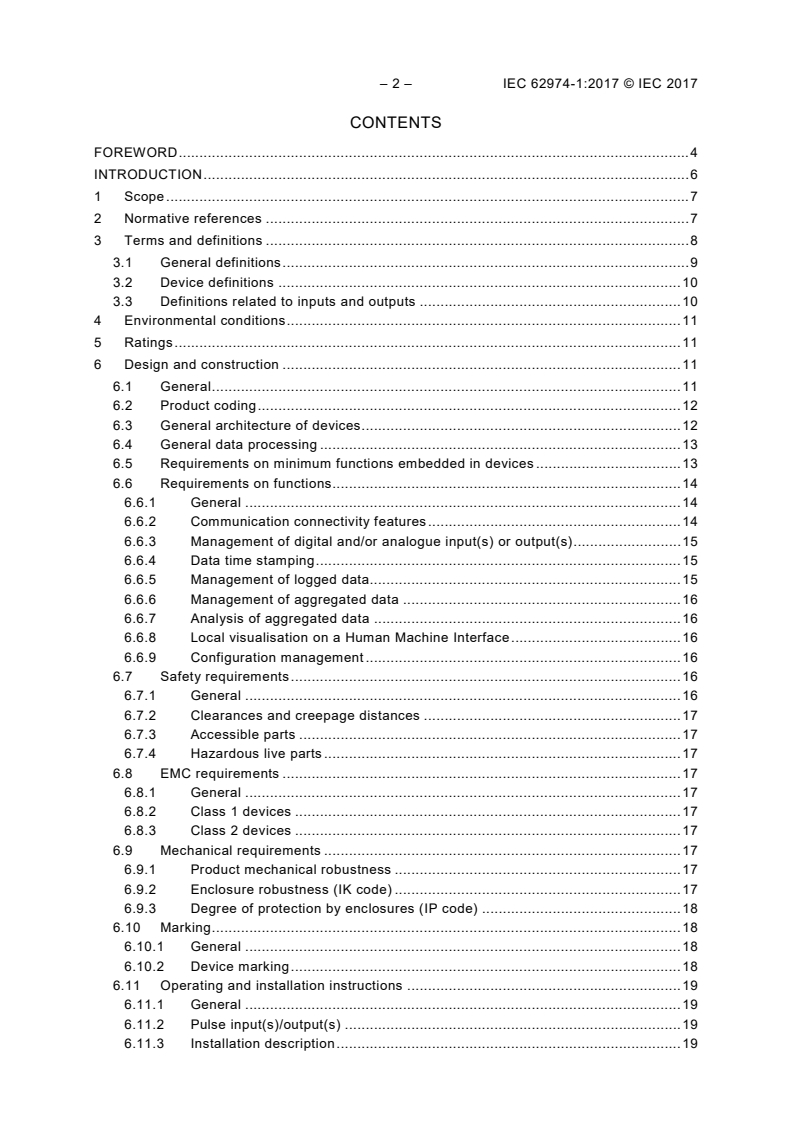
CONTENTS
FOREWORD . 4
INTRODUCTION . 6
1 Scope . 7
2 Normative references . 7
3 Terms and definitions . 8
3.1 General definitions . 9
3.2 Device definitions . 10
3.3 Definitions related to inputs and outputs . 10
4 Environmental conditions . 11
5 Ratings . 11
6 Design and construction . 11
6.1 General . 11
6.2 Product coding . 12
6.3 General architecture of devices . 12
6.4 General data processing . 13
6.5 Requirements on minimum functions embedded in devices . 13
6.6 Requirements on functions . 14
6.6.1 General . 14
6.6.2 Communication connectivity features . 14
6.6.3 Management of digital and/or analogue input(s) or output(s) . 15
6.6.4 Data time stamping . 15
6.6.5 Management of logged data. 15
6.6.6 Management of aggregated data . 16
6.6.7 Analysis of aggregated data . 16
6.6.8 Local visualisation on a Human Machine Interface . 16
6.6.9 Configuration management . 16
6.7 Safety requirements . 16
6.7.1 General . 16
6.7.2 Clearances and creepage distances . 17
6.7.3 Accessible parts . 17
6.7.4 Hazardous live parts . 17
6.8 EMC requirements . 17
6.8.1 General . 17
6.8.2 Class 1 devices . 17
6.8.3 Class 2 devices . 17
6.9 Mechanical requirements . 17
6.9.1 Product mechanical robustness . 17
6.9.2 Enclosure robustness (IK code) . 17
6.9.3 Degree of protection by enclosures (IP code) . 18
6.10 Marking . 18
6.10.1 General . 18
6.10.2 Device marking . 18
6.11 Operating and installation instructions . 19
6.11.1 General . 19
6.11.2 Pulse input(s)/output(s) . 19
6.11.3 Installation description . 19
7 Type tests . 20
7.1 Performance criteria for type tests . 20
7.2 Safety tests . 21
7.3 EMC tests . 21
7.4 Climatic tests . 21
7.5 Mechanical tests . 22
7.5.1 Degree of protection provide by enclosures for electrical equipment
against external mechanical impacts (IK code) . 22
7.5.2 Degree of protection by enclosure (IP code) . 22
8 Routine tests . 22
Annex A (informative) Example of system architectures . 23
Annex B (informative) Example of device processing . 25
Bibliography . 26
Figure 1 – Lifecycle solutions for energy efficiency . 6
Figure 2 – General architecture of devices . 13
Figure A.1 – Basic local monitoring and measuring system architecture . 23
Figure A.2 – Advanced local monitoring and measuring system architecture . 23
Figure A.3 – Remote monitoring and measuring system architecture . 24
Figure B.1 – General data processing of the general device . 25
Table 1 – Environmental conditions . 11
Table 2 – Devices coding table . 12
Table 3 – List of minimum functions of the devices . 14
Table 4 – Enclosure mechanical requirements . 18
Table 5 – Minimum IP requirements . 18
Table 6 – Marking to apply to devices . 19
Table 7 –Specific performance criteria . 20
Table 8 – Additional tests for class 2 devices . 21
Table 9 – Climatic requirements . 22
– 4 – IEC 62974-1:2017 © IEC 2017
INTERNATIONAL ELECTROTECHNICAL COMMISSION
____________
MONITORING AND MEASURING SYSTEMS USED
FOR DATA COLLECTION, GATHERING AND ANALYSIS –
Part 1: Device requirements
FOREWORD
1) The International Electrotechnical Commission (IEC) is a worldwide organization for standardization comprising
all national electrotechnical committees (IEC National Committees). The object of IEC is to promote
international co-operation on all questions concerning standardization in the electrical and electronic fields. To
this end and in addition to other activities, IEC publishes International Standards, Technical Specifications,
Technical Reports, Publicly Available Specifications (PAS) and Guides (hereafter referred to as “IEC
Publication(s)”). Their preparation is entrusted to technical committees; any IEC National Committee interested
in the subject dealt with may participate in this preparatory work. International, governmental and non-
governmental organizations liaising with the IEC also participate in this preparation. IEC collaborates closely
with the International Organization for Standardization (ISO) in accordance with conditions determined by
agreement between the two organizations.
2) The formal decisions or agreements of IEC on technical matters express, as nearly as possible, an international
consensus of opinion on the relevant subjects since each technical committee has representation from all
interested IEC National Committees.
3) IEC Publications have the form of recommendations for international use and are accepted by IEC National
Committees in that sense. While all reasonable efforts are made to ensure that the technical content of IEC
Publications is accurate, IEC cannot be held responsible for the way in which they are used or for any
misinterpretation by any end user.
4) In order to promote international uniformity, IEC National Committees undertake to apply IEC Publications
transparently to the maximum extent possible in their national and regional publications. Any divergence
between any IEC Publication and the corresponding national or regional publication shall be clearly indicated in
the latter.
5) IEC itself does not provide any attestation of conformity. Independent certification bodies provide conformity
assessment services and, in some areas, access to IEC marks of conformity. IEC is not responsible for any
services carried out by independent certification bodies.
6) All users should ensure that they have the latest edition of this publication.
7) No liability shall attach to IEC or its directors, employees, servants or agents including individual experts and
members of its technical committees and IEC National Committees for any personal injury, property damage or
other damage of any nature whatsoever, whether direct or indirect, or for costs (including legal fees) and
expenses arising out of the publication, use of, or reliance upon, this IEC Publication or any other IEC
Publications.
8) Attention is drawn to the Normative references cited in this publication. Use of the referenced publications is
indispensable for the correct application of this publication.
9) Attention is drawn to the possibility that some of the elements of this IEC Publication may be the subject of
patent rights. IEC shall not be held responsible for identifying any or all such patent rights.
International Standard IEC 62974-1 has been prepared by IEC technical committee 85:
Measuring equipment for electrical and electromagnetic quantities.
The text of this standard is based on the following documents:
FDIS Report on voting
85/587/FDIS 85/589/RVD
Full information on the voting for the approval of this International Standard can be found in
the report on voting indicated in the above table.
This document has been drafted in accordance with the ISO/IEC Directives, Part 2.
The committee has decided that the contents of this document will remain unchanged until the
stability date indicated on the IEC website under "http://webstore.iec.ch" in the data related to
the specific document. At this date, the document will be
• reconfirmed,
• withdrawn,
• replaced by a revised edition, or
• amended.
IMPORTANT – The 'colour inside' logo on the cover page of this publication indicates
that it contains colours which are considered to be useful for the correct
understanding of its contents. Users should therefore print this document using a
colour printer.
– 6 – IEC 62974-1:2017 © IEC 2017
INTRODUCTION
The use of electrical energy needs to be optimised worldwide to ensure more efficient use of
available energy sources, for enhanced competitiveness, and for reducing greenhouse gas
emissions and other related environmental impacts.
It implies better energy management leading to a necessary improvement of energy
performance, particularly in terms of efficiency, use and consumption. This can be
summarized by the lifecycle shown in Figure 1:
Lifecycle solutions for Energy Efficiency
Energy audit
and Measure
building, industrial
process
Optimize through
Fix the basics Monitor, maintain,
Control
Automation and
Low consumption improve
improve
regulation
devices, Meters installation
HVAC control,
insulation material, Monitoring services
Energy management system
lightning control,
power factor EE analysis software
(EnMS) according to ISO 50001
variable speed
correction…
with monitoring and measurement
drives…
equipment (PMD) according to
IEC 61557-12
Passive Active
energy efficiency energy efficiency
IEC
Figure 1 – Lifecycle solutions for energy efficiency
Standards such as ISO 50001, ISO 50002, ISO 50006 and IEC 60364-8-1 are providing
information related to this topic.
What is not known cannot be changed, and what is not measured is not known. Consequently,
there is an increasing need to measure energy within the installations in order to:
• monitor performance indicators or to monitor energy baselines, or
• compare energy performance between baseline period and reporting period as described
in ISO 50006.
Measurements can be collected by employees at a defined frequency, provided absences are
accounted for (vacation, off sick, etc.), provided the measurements are relevant (number of
measurement points to collect) and provided measurements can be relatively coherent
(synchronism).
This is why more and more devices are used for collection, gathering and sometimes analysis
of measured data. Some typical architectures are given in Annex A.
MONITORING AND MEASURING SYSTEMS USED
FOR DATA COLLECTION, GATHERING AND ANALYSIS –
Part 1: Device requirements
1 Scope
This part of IEC 62974 specifies product and performance requirements for devices that fall
under the heading of “monitoring and measuring systems used for data collection, gathering
and analysis”, for industrial, commercial and similar use rated below or equal to 1 kV AC and
1,5 kV DC.
These devices are fixed and are intended to be used indoors as panel-mounted devices, or as
modular devices fixed on a DIN rail, or as housing devices fixed on a DIN rail, or as devices
fixed by other means inside a cabinet.
These devices are used to upload or download information (energy measured on loads, power
metering and monitoring data, temperature information…), mainly for energy efficiency
purposes. These devices are known as energy servers, energy data loggers, data gateways
and I/O data concentrators.
NOTE These systems are embedded or can be connected to a software application capable of consolidating data
and delivering automatic analysis. Automatic analysis can include calculation of energy baselines or energy
performance indicators as requested for the energy management system required by ISO 50001, or can be used
during energy audits as defined in ISO 50002, or can be used for monitoring an installation complying with
IEC 60364-8-1. These devices can also be used for certification according to labels such as LEED, BREEAM , HQE,
etc.
This standard does not cover:
• devices used only in the consumer market (living quarters) or household;
• devices used in the smart metering infrastructure (e.g. smart meters);
• devices used in the smart grid infrastructure;
• devices used as IT servers in the information technology business;
• power metering and monitoring devices: PMD with additional functions (e.g. energy data
logger function);
• I/O data concentrators already covered by a specific product standard;
• communication protocols and interoperability;
• power quality instruments (PQI);
• software used for the data collection and analysis of the power quality for the supply side.
2 Normative references
The following documents are referred to in the text in such a way that some or all of their
content constitutes requirements of this document. For dated references, only the edition
cited applies. For undated references, the latest edition of the referenced document (including
any amendments) applies.
IEC 60068-2-1, Environmental testing – Part 2-1: Tests – Test A: Cold
IEC 60068-2-2, Environmental testing – Part 2-2: Tests – Tests B: Dry heat
– 8 – IEC 62974-1:2017 © IEC 2017
IEC 60068-2-14, Environmental testing – Part 2-14 – Tests – Test N: Change of temperature
IEC 60068-2-78, Environmental testing – Part 2-78 – Tests – Test Cab: Damp heat, steady
state
IEC 60529, Degrees of protection provided by enclosures (IP Code)
IEC 60721-3-1, Classification of environmental conditions – Part 3: Classification of groups of
environmental parameters and their severities – Section 1: Storage
IEC 60721-3-2, Classification of environmental conditions – Part 3: Classification of groups of
environmental parameters and their severities – Section 2: Transportation
IEC 60721-3-3, Classification of environmental conditions – Part 3: Classification of groups of
environmental parameters and their severities – Section 3: Stationary use at weatherprotected
locations
IEC 61000-4-5, Electromagnetic compatibility (EMC) – Part 4-5: Testing and measurement
techniques – Surge immunity test
IEC 61000-4-8, Electromagnetic compatibility (EMC) – Part 4-8: Testing and measurement
techniques – Testing and measurement techniques – Power frequency magnetic field
immunity test
IEC 61000-4-11, Electromagnetic compatibility (EMC) – Part 4-11: Testing and measurement
techniques – Voltage dips, short interruptions and voltage variations immunity tests
IEC 61010 (all parts), Safety requirements for electrical equipment for measurement, control,
and laboratory use
IEC 61131-2:2003, Programmable controllers – Part 2: Equipment requirements and tests
IEC 61326-1, Electrical equipment for measurement, control and laboratory use – EMC
requirements – Part 1: General requirements
IEC 62053-31, Electricity metering equipment (a.c.) – Particular requirements – Part 31: Pulse
output devices for electromechanical and electronic meters (two wires only)
IEC 62262, Degrees of protection provided by enclosures for electrical equipment against
external mechanical impacts (IK code)
3 Terms and definitions
For the purposes of this document, the following terms and definitions apply.
ISO and IEC maintain terminological databases for use in standardization at the following
addresses:
• IEC Electropedia: available at http://www.electropedia.org
• ISO online browsing platform: available at http://www.iso.org/obp
3.1 General definitions
3.1.1
energy data
quantities related to the management of energy measured in industrial, commercial and
similar plants, including energy consumption, relevant variables and electrical parameters
Note 1 to entry: Energy consumption refers to the various forms of energy (electricity, fossil fuels, steam, heat,
compressed air, etc.).
Note 2 to entry: Electrical parameters refer to P, U, I, PF, THD, harmonics, etc., which can also be monitored.
3.1.2
relevant variable
quantifiable factor that impacts energy performance and routinely changes
EXAMPLE: Production parameters (production, volume, production rate, etc.); weather conditions (outdoor
temperature, degree days, etc.); operating hours; operating parameters (operational temperature, light level, etc.).
[SOURCE: ISO 50006:2014, 3.14]
3.1.3
energy baseline
EnB
quantified reference(s) providing a basis for comparison of energy performance
Note 1 to entry: An energy baseline can be normalized using variables affecting energy use and/or consumption,
such as production level, the degree days (outdoor temperature), etc.
Note 2 to entry: Energy baseline is also used to calculate energy savings, as a reference with and without
implementation of energy performance improvement actions, or evaluated over a period of time.
[SOURCE: ISO 13273-1:2015, 3.3.8]
3.1.4
energy performance indicator
EnPI
quantitative value or measure of energy performance
Note 1 to entry: The EnPIs used in energy management systems (EnMS) are defined by the organization.
Note 2 to entry: The EnPIs could be expressed as a simple metric, ratio or a more complex model.
Note 3 to entry: The main types of EnPI are:
• measured energy value: consumption of an entire site, or one or more energy uses measured by a meter;
• ratio of measured values: expression of the energy efficiency;
• statistical model: relationship between energy consumption and the relevant factors using linear or non-linear
regressions;
• physical model: relationship between energy consumption and the relevant factors using physical simulations.
[SOURCE: ISO 13273-1:2015, 3.3.6, modified – Addition of Note 3 that refers to the last
paragraph of 4.3.1 of ISO 50006:2014]
3.1.5
monitoring and measuring system
system in charge of metering, measuring, collecting, concentrating and analysing energy data
3.1.6
data retention
capability to store data for a specified time duration within a powered or unpowered device
– 10 – IEC 62974-1:2017 © IEC 2017
3.1.7
data backup
capability to store a copy of data stored in a device for an unlimited time duration
Note 1 to entry: The copied data is supposed to provide data in the case of a device failure leading to data loss
3.2 Device definitions
3.2.1
energy servers
ESE
devices in charge of computation and retention of energy data, relevant variables, and
visualisation through a local display or remote access, in electrical distribution systems of
industrial, commercial and similar plants
3.2.2
energy data logger
EDL
devices in charge of logging and exporting information to networks, in electrical distribution
systems of industrial, commercial and similar plants
3.2.3
data gateway
DGW
devices in charge of transmission of information between networks in electrical distribution
systems of industrial, commercial and similar plants
3.2.4
I/O data concentrator
IODC
devices for collection of digital and/or analogue energy data in electrical distribution systems
of industrial, commercial and similar plants
3.2.5
measuring device
device able to measure energy data
3.3 Definitions related to inputs and outputs
3.3.1
pulse device
functional unit for emitting, transmitting, retransmitting or receiving electric pulses,
representing finite quantities, such as energy normally transmitted from some form of meter
(electricity, gas, water, etc.) to a receiver unit
[SOURCE: IEC 62053-31:1998, 3.2.2, modified – "gas" and "water" added.]
3.3.2
pulse input device
pulse device for receiving pulses related to an energy measurement (electricity, gas, water,
etc.)
[SOURCE: IEC 62053-31:1998, 3.2.3, modified – "related to an energy measurement
(electricity, gas, water, etc.)" added.]
3.3.3
pulse output device
pulse device for emitting pulses related to an energy measurement (electricity, gas, water,
etc.)
[SOURCE: IEC 62053-31:1998, 3.2.4, modified – "related to an energy measurement
(electricity, gas, water, etc.)" added.]
3.3.4
control output
unit able to control the state (on or off) of an external device
EXAMPLE: Control output managing a contactor (digital value) or a temperature regulator (analogue output)
4 Environmental conditions
Typical environmental conditions are described in Table 1.
Table 1 – Environmental conditions
Environmental parameters Storage and transport Indoor operation
Ambient temperature: limit range of For K55 class: For K55 class:
a e
operation
−25 °C to +70 °C −5 °C to +55 °C
For K70 class: For K70 class:
−40 °C to + 70 °C −25 °C to +70 °C
d d
Relative humidity: 24 h average from 5 % to 95 % from 5 % to 95 %
Solar radiations Negligible Negligible
Wind-driven precipitation (rain, Negligible Negligible
snow, hail, etc.)
c c
Air pollution by dust, salt, smoke, No significant air pollution No significant air pollution
corrosive/flammable gas, vapours
Vibration, earth tremors IEC 60721-3-1 / 1M3 IEC 60721-3-3 / 3M3
IEC 60721-3-2 / 2M3
Electromagnetic disturbance --- Industrial electromagnetic
immunity environment as defined in
IEC 61326-1 Table 2
Altitude ---
≤ 2 000 m
Pollution degree --- 2 according to IEC 61010
b
Overvoltage category (relative to the --- IEC 61010 Overvoltage category III
mains supply)
a
See definition. Temperature may be lower on the front face of panel mounted instruments.
b
For guidance on the overvoltage category, see IEC 61010-1.
c
These conditions correspond to maximum values given for classes 3C2 and 3S2 in IEC 60721-3-3.
d
No condensation or ice is taken into consideration.
e
Limit temperatures are extreme temperatures. The device is not supposed to stay at limit T° during 100% of
the time.
5 Ratings
No requirements.
6 Design and construction
6.1 General
Devices shall comply with the requirements specified hereafter.
– 12 – IEC 62974-1:2017 © IEC 2017
6.2 Product coding
Devices shall be classified according to the following criterion.
• Kind of device:
– IODC: I/O data concentrators;
– DGW: data gateways;
– EDL: energy data logger;
– ESE: energy servers.
• Temperature class:
– K55 class;
– K70 class.
• Product performance class:
– class 1: for devices intended to manage (collect, store, transmit) energy data within the
EMC environmental conditions described in Table 1;
– class 2: for devices intended to manage (collect, store, transmit) energy data within the
EMC environmental conditions described in Table 1, and intended to have a better
immunity even in the presence of longer or harsher EMC disturbances, and intended to
be robust against connectivity losses.
Devices shall be named according to the coding of Table 2.
Table 2 – Devices coding table
Kind of device Class For devices intended to For devices intended to
work up to K55 climatic work up to K70 climatic
environment environment
a
Energy I/O concentrators Class 1 EIOC, Class 1, K55 EIOC, Class 1, K70
Data Gateways Class 1 DGW, Class 1, K55 DGW, Class 1, K70
b
Class 2 DGW, Class 2, K55 DGW, Class 2, K70
Energy Data Logger Class 1 EDL, Class 1, K55 EDL, Class 1, K70
Class 2 EDL, Class 2, K55 EDL, Class 2, K70
Energy Servers Class 1 ESE, Class 1, K55 ESE, Class 1, K70
Class 2 ESE, Class 2, K55 ESE, Class 2, K70
a
No need for class 2 on IODC
b
Since data gateways are not managing “logged data” or “aggregated date”, they are not subject to the “data
retention” requirement
6.3 General architecture of devices
Energy servers (ESE), energy data loggers (EDL), data gateways (DGW) and I/O data
concentrators (IODC) shall be composed of one or several functional blocks as defined in
Figure 2.
Device HMI
Analogue and digital
input management
Analogue and digital
Management unit
output management
Downstream Upstream
communication communication
IEC
Figure 2 – General architecture of devices
6.4 General data processing
ESEs, EDLs, DGWs and IODCs are part of a general data processing system.
NOTE See example shown in informative Annex B. Further information is provided in Annex A.
6.5 Requirements on minimum functions embedded in devices
ESEs, EDLs, DGWs and IODCs shall embed the mandatory functions defined in Table 3.
Requirements on functions listed in Table 3 are specified in 6.6.
– 14 – IEC 62974-1:2017 © IEC 2017
Table 3 – List of minimum functions of the devices
Functions (see 6.6) Requirement Requirement Requirement Requirement
for IODC for DGW for EDL for ESE
Management of I/O
Collection of digital or analogue input(s) M O O O
Update of digital or analogue output(s) O O O O
Communication connectivity features
Upstream connectivity M M M M
Downstream connectivity --- M M M
Time stamping
Data time stamping --- O M M
Management of logged data
Data logging --- --- M M
Logged data retention --- --- M M
Publication of logged data --- --- M M
Management of aggregated data
Data aggregation --- --- --- M
Publication of aggregated data --- --- --- O
Aggregated data backup --- --- --- O
Analysis of aggregated data
Simple energy efficiency applications --- --- --- M
Advanced energy efficiency applications --- --- --- O
HMI features
Visualization on a local or remote display --- --- --- M
Key
M: mandatory
O: optional
---: not relevant
6.6 Requirements on functions
6.6.1 General
Table 3 specifies “M” (mandatory) and “O” (optional) functions. In case either mandatory or
optional functions are implemented in the device, then these functions shall comply with the
requirements within the relevant subclauses of 6.6.
6.6.2 Communication connectivity features
6.6.2.1 General
Devices shall comply with the relevant communication standards or specifications.
6.6.2.2 Loss of connectivity
Manufacturers shall document the behaviour of the device in case of loss of downstream or
upstream communications. In particular, the manufacturer shall document how the loss of
communication is reported and/or recorded by the device, and what diagnostic information is
provided.
6.6.3 Management of digital and/or analogue input(s) or output(s)
6.6.3.1 General
Devices embedding this function shall comply with the relevant standards, if any.
6.6.3.2 Analogue input(s)/output(s)
Analogue inputs/outputs shall comply with IEC 61131-2.
NOTE 1 The currents of analogue input/outputs are usually 4 mA to 20 mA, but can also be 0 mA to 20 mA.
NOTE 2 The voltages of analogue inputs/outputs are usually 0 V to 5 V, but can also be 0 V to 10 V.
6.6.3.3 Pulse input(s)/output(s)
Pulse inputs/outputs shall comply with 4.1 of IEC 62053-31:1998 (Functional requirements).
6.6.3.4 Digital input(s)/output(s)
There are no required standards to be met.
6.6.4 Data time stamping
Manufacturers shall document the resolution of data stamping.
NOTE 1 Preferably, data is stamped as close as possible to when it has been measured.
Preferred data time stamps shall be UTC (Greenwich Mean Time); use of another format shall
be described.
NOTE 2 Additional information, such as time zone or DST offset, may accompany the time stamp.
6.6.5 Management of logged data
6.6.5.1 Data logging
Devices shall log raw data and their associated information (zone, energy use, time stamp).
6.6.5.2 Logged data retention capability
Manufacturers shall document the data retention capabilities: number and time interval of
measurements retained during a specified time.
Devices embedding this function shall be able to retain logged data in the absence of mains
power during the specified retention time. Devices embedding this function shall be able to
continue to operate during an upstream communication outage without any loss of logged
data during the specified retention time, and without missing any data coming from
downstream communication.
Devices embedding this function shall be able to continue to operate during an upstream
communication outage without any loss of logged data during the specified retention time, and
without missing any data coming from downstream communication during the specified
retention time.
Class 2 devices shall have a minimum specified retention time of 24 hours.
6.6.5.3 Logged data up-loading
Manufacturers shall define uploading capabilities of logged data.
– 16 – IEC 62974-1:2017 © IEC 2017
In particular, manufacturers shall document if data is kept available in the device after it has
been uploaded, and, in such a case, how long it is kept.
6.6.6 Management of aggregated data
6.6.6.1 Data aggregation
Manufacturers shall document the units and the method used to aggregate data. In particular,
they will define the way to aggregate data:
• by zone;
• by energy use (ventilation, lighting, cooling, transportation, processes, production lines,
etc.).
NOTE 1 The concepts of energy use and zone are defined in ISO 50001 and IEC 60364-8-1.
6.6.6.2 Aggregated data backup
Devices shall be able to manage a device failure: they will save aggregated data by any
means, for example on a removable memory module, on remote memory storage or on a data
server.
6.6.6.3 Aggregated data uploading
Manufacturers shall document uploading capabilities of aggregated data.
In particular, manufacturers shall specify and document how long aggregated data shall be
kept available in the device after it has been uploaded.
6.6.7 Analysis of aggregated data
6.6.7.1 Simple energy efficiency applications
Manufacturers shall document applications implemented in the device.
NOTE Examples of simple energy efficiency applications include: consumption aggregation by use or by zone,
cost allocation.
6.6.7.2 Advanced energy efficiency applications
Manufacturers shall document applications implemented in the device.
NOTE Examples of advanced energy efficiency applications include: bill estimation, calculation of “EnPI” and
“baselines” according to ISO 50001 and ISO 50006.
6.6.8 Local visualisation on a Human Machine Interface
Manufacturers shall document how visualization on a local or remote display function is
ensured.
6.6.9 Configuration management
The device configuration shall be retained without time limit, even in the case of a power
outage.
6.7 Safety requirements
6.7.1 General
Devices shall comply with the requirements of IEC 61010 in addition to the requirements of
6.7.2, 6.7.3 and 6.7.4.
6.7.2 Clearances and creepage distances
Clearances and creepage distances shall be selected at least in accordance with:
• pollution degree 2;
• overvoltage category III for mains circuits.
6.7.3 Accessible parts
Requirements for accessible parts as defined in IEC 61010 apply.
Circuits intended to be connected to an external accessible circuit shall be considered to be
accessible conductive parts, e.g. communication circuits.
A communication port that may be connected to a data system shall also be considered to be
an accessible conductive part.
These accessible conductive parts require protection against single fault condition.
NOTE Basic insulation is not sufficient protection against single fault condition. Examples of relevant insulation
are double insulation or reinforced insulation (see IEC 61010).
6.7.4 Hazardous live parts
In a distribution system, the neutral conductor shall be considered to be a hazardous live part.
6.8 EMC requirements
6.8.1 General
Devices shall comply with Table 2 (Immunity test requirements for equipment intended to be
used in an industrial electromagnetic environment) of IEC 61326-1:2012 for immunity tests.
For emissions, either class A or class B limits as defined in IEC 61326-1:2012 shall apply.
6.8.2 Class 1 devices
No additional requirements.
6.8.3 Class 2 devices
Class 2 devices shall pass the additional tests specified in Table 8.
6.9 Mechanical requirements
6.9.1 Product mechanical robustness
Devices shall withstand vibrations, shocks during operation. Devices shall withstand
vibrations, shocks and free falls during transport.
6.9.2 Enclosure robustness (IK code)
The requirements of Table 4 shall be fulfilled
...