

CISPR TR 30-1:2012
(Main)Test method on electromagnetic emissions - Part 1: Electronic control gear for single- and double-capped fluorescent lamps
General Information
- Abstract
CISPR/TR 30-1:2012(E), which is a technical report, details, with the aid of reference luminaires, an independent method by which the radio disturbance characteristics of electronic control gear for fluorescent lamp luminaires with protection classes I and/or II may be compared against the requirements of CISPR 15. This technical report covers electronic control gear for double-capped fluorescent lamps fitted with G5 or G13 lamp caps and to single-capped fluorescent lamps fitted with lamp caps: 2GX7, 2G8, 2G10, 2G11, 2GX13, G23, GX23, G24q, GX24q, GR8, and GR10q. It is specifically applicable for equipment to be connected to 230 V - 50 Hz mains power networks. For other power systems, modifications may be necessary. This first edition of CISPR/TR 30-1 cancels and replaces the first edition of CISPR/TR 30 published in 2001. It is a technical revision which includes the following significant technical changes with respect to the previous edition:
- minor correction of wiring distances of reference luminaire in Figure A.1;
- addition of reference luminaires for electronic control gear with output terminals on both ends;
- addition of reference luminaires for electronic control gear for circular-shaped fluorescent lamps; and
- introduction of control gear marking indicating suitability for application in protection class I and/or class II luminaires.
- Status
- Published
- Publication Date
- 23-Aug-2012
- Current Stage
- PPUB - Publication issued
- Start Date
- 24-Aug-2012
- Completion Date
- 30-Nov-2012
Buy Documents


CISPR TR 30-1:2012 - Test method on electromagnetic emissions - Part 1: Electronic control gear for single- and double-capped fluorescent lamps
CISPR TR 30-1:2012 - Test method on electromagnetic emissions - Part 1: Electronic control gear for single- and double-capped fluorescent lamps
Overview
CISPR TR 30-1:2012 - Test method on electromagnetic emissions, Part 1 - specifies an independent EMC test method for electronic control gear for single‑ and double‑capped fluorescent lamps. Published by IEC/CISPR, this technical report defines reference luminaires and measurement arrangements that allow the radio‑disturbance characteristics of control gear to be compared against the limits in CISPR 15. It is specifically applicable to equipment intended for connection to 230 V − 50 Hz mains networks.
Key scope items:
- Covers electronic control gear for double‑capped lamps with G5 or G13 caps and single‑capped lamps with caps such as 2GX7, 2G8, 2G10, 2G11, 2GX13, G23, GX23, G24q, GX24q, GR8, GR10q.
- Defines reference luminaire construction, mounting, wiring and grounding for protection class I and II applications.
- Not a replacement for full luminaire testing - the reference luminaire is not a worst‑case luminaire and passing the reference test does not automatically guarantee the finished luminaire meets CISPR 15.
Key topics and technical requirements
- Reference luminaires: metal plate mounted on insulating material with defined dimensions and lamp‑to‑plate clearances. Several reference layouts are provided (single/dual lamps, circular lamps, output terminals on both ends).
- Test method: mount the electronic control gear on the reference luminaire, operate all lamps simultaneously, and perform emissions tests per CISPR 15 (radiated and conducted measurements - clauses 8.1, 9.1, 9.2 or Annex B).
- Presumption of compliance: control gear with a reference luminaire is deemed compliant if it meets CISPR 15 terminal voltage limits (Table 2a), radiated limits (Table 3a/3b or B.1) and control terminal limits (Table 2c) where applicable. No limits apply at load terminals.
- Protection class marking: the 2012 edition introduces marking to indicate suitability for use in Class I and/or Class II luminaires.
- Edition changes: corrected wiring distances, added reference luminaires for outputs at both ends and for circular‑shaped lamps.
Practical applications - who uses this standard
- EMC test laboratories performing emissions verification of lamp control gear.
- Manufacturers of electronic control gear and luminaire designers using reference luminaires to evaluate radio disturbance behavior.
- Compliance engineers and certification bodies assessing conformity to CISPR 15 limits for components intended for luminaires.
- Useful during product development to identify emission issues early and reduce unnecessary full‑luminaire retesting.
Related standards
- CISPR 15 - Limits and methods of measurement of radio disturbance characteristics of electrical lighting and similar equipment (normative reference).
- CISPR TR 30-2 - Reference luminaires and test methods for electronic control gear for other discharge lamps.
Keywords: CISPR TR 30-1:2012, electronic control gear, fluorescent lamps, reference luminaire, CISPR 15, electromagnetic emissions, EMC, protection class I, protection class II, 230 V 50 Hz.
Relations
- Effective Date
- 05-Sep-2023
Buy Documents
CISPR TR 30-1:2012 - Test method on electromagnetic emissions - Part 1: Electronic control gear for single- and double-capped fluorescent lamps
CISPR TR 30-1:2012 - Test method on electromagnetic emissions - Part 1: Electronic control gear for single- and double-capped fluorescent lamps
Get Certified
Connect with accredited certification bodies for this standard

ANCE
Mexican certification and testing association.

Intertek Slovenia
Intertek testing, inspection, and certification services in Slovenia.

LNE (Laboratoire National de Métrologie et d'Essais)
French national laboratory for metrology and testing.
Sponsored listings
Frequently Asked Questions
CISPR TR 30-1:2012 is a technical report published by the International Electrotechnical Commission (IEC). Its full title is "Test method on electromagnetic emissions - Part 1: Electronic control gear for single- and double-capped fluorescent lamps". This standard covers: CISPR/TR 30-1:2012(E), which is a technical report, details, with the aid of reference luminaires, an independent method by which the radio disturbance characteristics of electronic control gear for fluorescent lamp luminaires with protection classes I and/or II may be compared against the requirements of CISPR 15. This technical report covers electronic control gear for double-capped fluorescent lamps fitted with G5 or G13 lamp caps and to single-capped fluorescent lamps fitted with lamp caps: 2GX7, 2G8, 2G10, 2G11, 2GX13, G23, GX23, G24q, GX24q, GR8, and GR10q. It is specifically applicable for equipment to be connected to 230 V - 50 Hz mains power networks. For other power systems, modifications may be necessary. This first edition of CISPR/TR 30-1 cancels and replaces the first edition of CISPR/TR 30 published in 2001. It is a technical revision which includes the following significant technical changes with respect to the previous edition: - minor correction of wiring distances of reference luminaire in Figure A.1; - addition of reference luminaires for electronic control gear with output terminals on both ends; - addition of reference luminaires for electronic control gear for circular-shaped fluorescent lamps; and - introduction of control gear marking indicating suitability for application in protection class I and/or class II luminaires.
CISPR/TR 30-1:2012(E), which is a technical report, details, with the aid of reference luminaires, an independent method by which the radio disturbance characteristics of electronic control gear for fluorescent lamp luminaires with protection classes I and/or II may be compared against the requirements of CISPR 15. This technical report covers electronic control gear for double-capped fluorescent lamps fitted with G5 or G13 lamp caps and to single-capped fluorescent lamps fitted with lamp caps: 2GX7, 2G8, 2G10, 2G11, 2GX13, G23, GX23, G24q, GX24q, GR8, and GR10q. It is specifically applicable for equipment to be connected to 230 V - 50 Hz mains power networks. For other power systems, modifications may be necessary. This first edition of CISPR/TR 30-1 cancels and replaces the first edition of CISPR/TR 30 published in 2001. It is a technical revision which includes the following significant technical changes with respect to the previous edition: - minor correction of wiring distances of reference luminaire in Figure A.1; - addition of reference luminaires for electronic control gear with output terminals on both ends; - addition of reference luminaires for electronic control gear for circular-shaped fluorescent lamps; and - introduction of control gear marking indicating suitability for application in protection class I and/or class II luminaires.
CISPR TR 30-1:2012 is classified under the following ICS (International Classification for Standards) categories: 33.060.30 - Radio relay and fixed satellite communications systems; 33.100.10 - Emission. The ICS classification helps identify the subject area and facilitates finding related standards.
CISPR TR 30-1:2012 has the following relationships with other standards: It is inter standard links to CISPR TR 30:2001. Understanding these relationships helps ensure you are using the most current and applicable version of the standard.
CISPR TR 30-1:2012 is available in PDF format for immediate download after purchase. The document can be added to your cart and obtained through the secure checkout process. Digital delivery ensures instant access to the complete standard document.
Standards Content (Sample)
CISPR TR 30-1 ®
Edition 1.0 2012-08
INTERNATIONAL
STANDARD
INTERNATIONAL SPECIAL COMMITTEE ON RADIO INTERFERENCE
Test method on electromagnetic emissions –
Part 1: Electronic control gear for single- and double-capped fluorescent lamps
All rights reserved. Unless otherwise specified, no part of this publication may be reproduced or utilized in any form
or by any means, electronic or mechanical, including photocopying and microfilm, without permission in writing from
either IEC or IEC's member National Committee in the country of the requester.
If you have any questions about IEC copyright or have an enquiry about obtaining additional rights to this publication,
please contact the address below or your local IEC member National Committee for further information.
IEC Central Office Tel.: +41 22 919 02 11
3, rue de Varembé Fax: +41 22 919 03 00
CH-1211 Geneva 20 info@iec.ch
Switzerland www.iec.ch
About the IEC
The International Electrotechnical Commission (IEC) is the leading global organization that prepares and publishes
International Standards for all electrical, electronic and related technologies.
About IEC publications
The technical content of IEC publications is kept under constant review by the IEC. Please make sure that you have the
latest edition, a corrigenda or an amendment might have been published.
Useful links:
IEC publications search - www.iec.ch/searchpub Electropedia - www.electropedia.org
The advanced search enables you to find IEC publications The world's leading online dictionary of electronic and
by a variety of criteria (reference number, text, technical electrical terms containing more than 30 000 terms and
committee,…). definitions in English and French, with equivalent terms in
It also gives information on projects, replaced and additional languages. Also known as the International
withdrawn publications. Electrotechnical Vocabulary (IEV) on-line.
IEC Just Published - webstore.iec.ch/justpublished Customer Service Centre - webstore.iec.ch/csc
Stay up to date on all new IEC publications. Just Published If you wish to give us your feedback on this publication
details all new publications released. Available on-line and or need further assistance, please contact the
also once a month by email. Customer Service Centre: csc@iec.ch.
CISPR TR 30-1 ®
Edition 1.0 2012-08
INTERNATIONAL
STANDARD
INTERNATIONAL SPECIAL COMMITTEE ON RADIO INTERFERENCE
Test method on electromagnetic emissions –
Part 1: Electronic control gear for single- and double-capped fluorescent lamps
INTERNATIONAL
ELECTROTECHNICAL
COMMISSION
PRICE CODE
R
ICS 33.100.10 ISBN 978-2-83220-312-5
– 2 – TR CISPR 30-1 © IEC:2012(E)
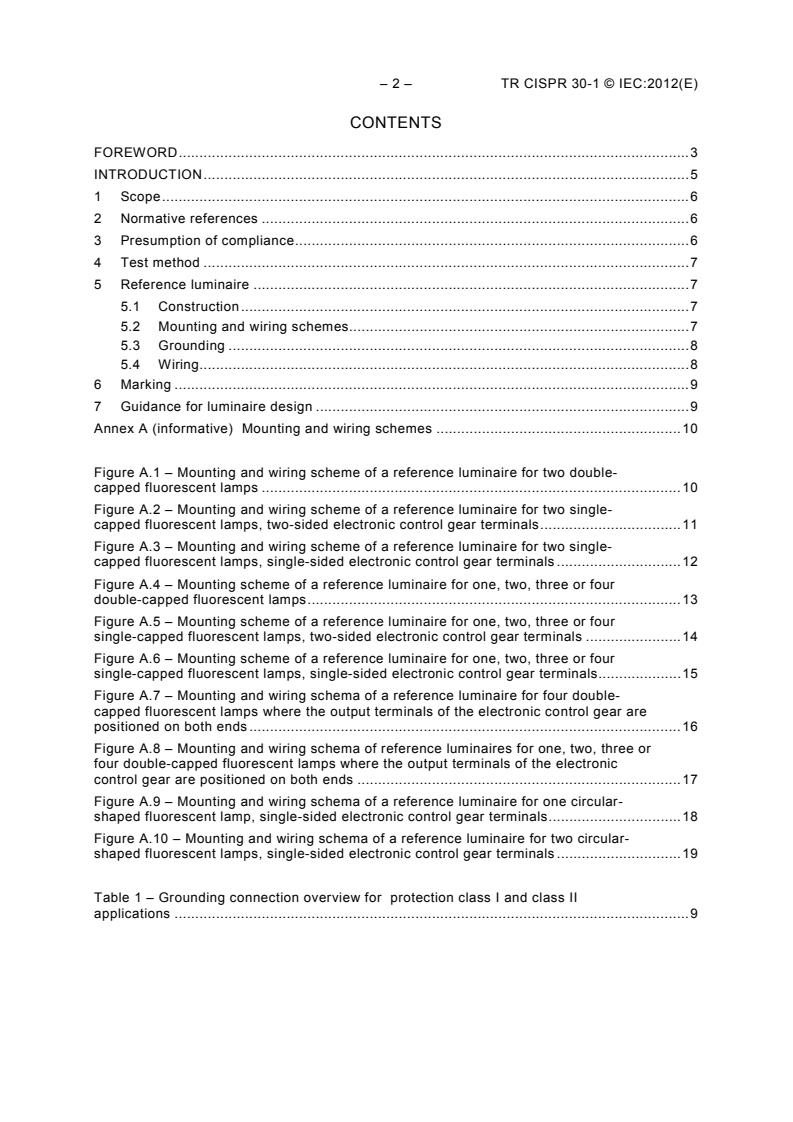
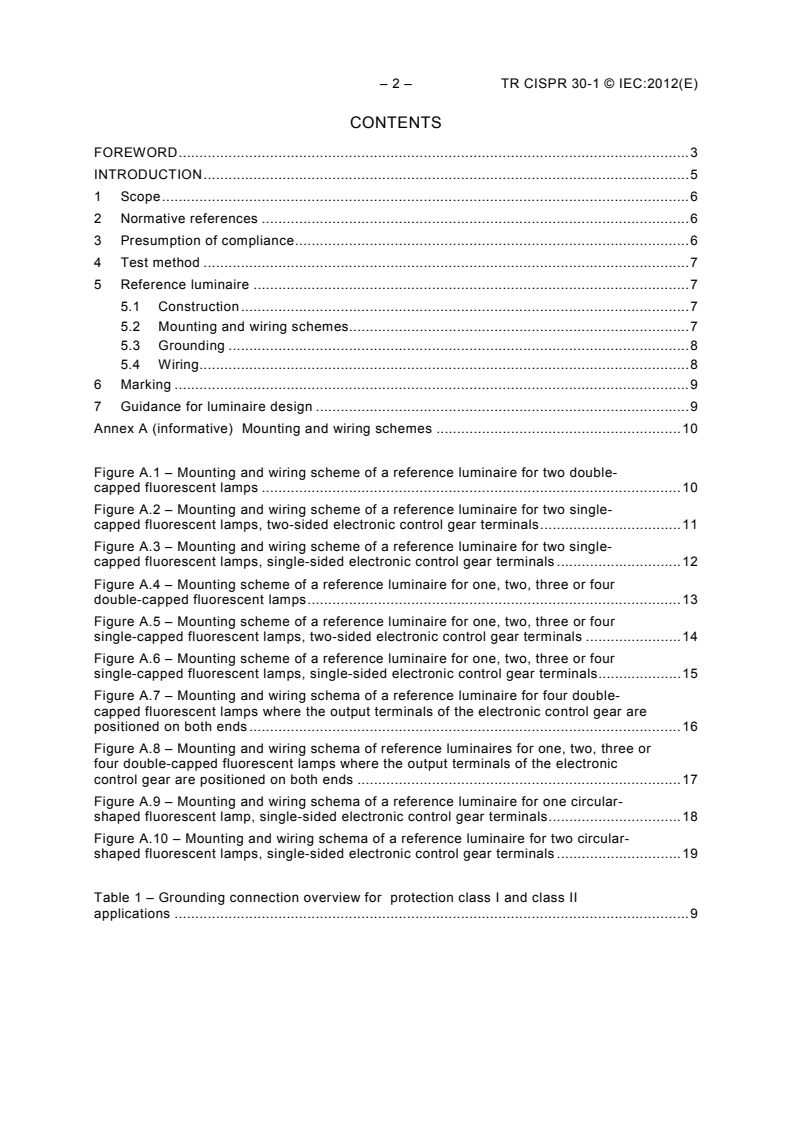
CONTENTS
FOREWORD . 3
INTRODUCTION . 5
1 Scope . 6
2 Normative references . 6
3 Presumption of compliance . 6
4 Test method . 7
5 Reference luminaire . 7
5.1 Construction . 7
5.2 Mounting and wiring schemes. 7
5.3 Grounding . 8
5.4 Wiring. 8
6 Marking . 9
7 Guidance for luminaire design . 9
Annex A (informative) Mounting and wiring schemes . 10
Figure A.1 – Mounting and wiring scheme of a reference luminaire for two double-
capped fluorescent lamps . 10
Figure A.2 – Mounting and wiring scheme of a reference luminaire for two single-
capped fluorescent lamps, two-sided electronic control gear terminals . 11
Figure A.3 – Mounting and wiring scheme of a reference luminaire for two single-
capped fluorescent lamps, single-sided electronic control gear terminals . 12
Figure A.4 – Mounting scheme of a reference luminaire for one, two, three or four
double-capped fluorescent lamps . 13
Figure A.5 – Mounting scheme of a reference luminaire for one, two, three or four
single-capped fluorescent lamps, two-sided electronic control gear terminals . 14
Figure A.6 – Mounting scheme of a reference luminaire for one, two, three or four
single-capped fluorescent lamps, single-sided electronic control gear terminals. 15
Figure A.7 – Mounting and wiring schema of a reference luminaire for four double-
capped fluorescent lamps where the output terminals of the electronic control gear are
positioned on both ends . 16
Figure A.8 – Mounting and wiring schema of reference luminaires for one, two, three or
four double-capped fluorescent lamps where the output terminals of the electronic
control gear are positioned on both ends . 17
Figure A.9 – Mounting and wiring schema of a reference luminaire for one circular-
shaped fluorescent lamp, single-sided electronic control gear terminals . 18
Figure A.10 – Mounting and wiring schema of a reference luminaire for two circular-
shaped fluorescent lamps, single-sided electronic control gear terminals . 19
Table 1 – Grounding connection overview for protection class I and class II
applications . 9
TR CISPR 30-1 © IEC:2012(E) – 3 –
INTERNATIONAL ELECTROTECHNICAL COMMISSION
____________
TEST METHOD ON ELECTROMAGNETIC EMISSIONS –
Part 1: Electronic control gear for single- and
double-capped fluorescent lamps
FOREWORD
1) The International Electrotechnical Commission (IEC) is a worldwide organization for standardization comprising
all national electrotechnical committees (IEC National Committees). The object of IEC is to promote
international co-operation on all questions concerning standardization in the electrical and electronic fields. To
this end and in addition to other activities, IEC publishes International Standards, Technical Specifications,
Technical Reports, Publicly Available Specifications (PAS) and Guides (hereafter referred to as “IEC
Publication(s)”). Their preparation is entrusted to technical committees; any IEC National Committee interested
in the subject dealt with may participate in this preparatory work. International, governmental and non-
governmental organizations liaising with the IEC also participate in this preparation. IEC collaborates closely
with the International Organization for Standardization (ISO) in accordance with conditions determined by
agreement between the two organizations.
2) The formal decisions or agreements of IEC on technical matters express, as nearly as possible, an international
consensus of opinion on the relevant subjects since each technical committee has representation from all
interested IEC National Committees.
3) IEC Publications have the form of recommendations for international use and are accepted by IEC National
Committees in that sense. While all reasonable efforts are made to ensure that the technical content of IEC
Publications is accurate, IEC cannot be held responsible for the way in which they are used or for any
misinterpretation by any end user.
4) In order to promote international uniformity, IEC National Committees undertake to apply IEC Publications
transparently to the maximum extent possible in their national and regional publications. Any divergence
between any IEC Publication and the corresponding national or regional publication shall be clearly indicated in
the latter.
5) IEC itself does not provide any attestation of conformity. Independent certification bodies provide conformity
assessment services and, in some areas, access to IEC marks of conformity. IEC is not responsible for any
services carried out by independent certification bodies.
6) All users should ensure that they have the latest edition of this publication.
7) No liability shall attach to IEC or its directors, employees, servants or agents including individual experts and
members of its technical committees and IEC National Committees for any personal injury, property damage or
other damage of any nature whatsoever, whether direct or indirect, or for costs (including legal fees) and
expenses arising out of the publication, use of, or reliance upon, this IEC Publication or any other IEC
Publications.
8) Attention is drawn to the Normative references cited in this publication. Use of the referenced publications is
indispensable for the correct application of this publication.
9) Attention is drawn to the possibility that some of the elements of this IEC Publication may be the subject of
patent rights. IEC shall not be held responsible for identifying any or all such patent rights.
The main task of IEC technical committees is to prepare International Standards. However, a
technical committee may propose the publication of a technical report when it has collected
data of a different kind from that which is normally published as an International Standard, for
example "state of the art".
CISPR 30-1, which is a technical report, has been prepared by CISPR subcommittee F:
Interference relating to household appliances tools, lighting equipment and similar apparatus.
This first edition of CISPR/TR 30-1 cancels and replaces the first edition of CISPR/TR 30
published in 2001. It is a technical revision.
This edition includes the following significant technical changes with respect to the previous
edition:
– minor correction of wiring distances of reference luminaire in Figure A.1;
– 4 – TR CISPR 30-1 © IEC:2012(E)
– addition of reference luminaires for electronic control gear with output terminals on both
ends;
– addition of reference luminaires for electronic control gear for circular-shaped fluorescent
lamps;
– introduction of control gear marking indicating suitability for application in protection class
I and/or class II luminaires.
The text of this technical report is based on the following documents:
Enquiry draft Report on voting
CISPR/F/538/DTR CISPR/F/577/RVC
Full information on the voting for the approval of this technical report can be found in the
report on voting indicated in the above table.
This publication has been drafted in accordance with the ISO/IEC Directives, Part 2.
A list of all parts of the CISPR 30 series can be found, under the general title Test method on
electromagnetic emissions, on the IEC website.
The committee has decided that the contents of this publication will remain unchanged until
the stability date indicated on the IEC web site under "http://webstore.iec.ch" in the data
related to the specific publication. At this date, the publication will be
• reconfirmed,
• withdrawn,
• replaced by a revised edition, or
• amended.
A bilingual version of this publication may be issued at a later date.
TR CISPR 30-1 © IEC:2012(E) – 5 –
INTRODUCTION
Requirements to limit radio-frequency disturbances from lighting equipment are standardized
in CISPR 15. They are restricted to those kinds of lighting equipment which are considered as
finished products and intended to be placed on the market for the end user, viz. luminaires,
self-ballasted lamps and independent lamp control gear. No emission requirements apply to
components intended to be built into luminaires.
Most electronic control gear for lamps (tubular fluorescent, low voltages halogen incandescent
lamps or HID-lamps) are built into a number of different types of luminaires: not only in
luminaires of different manufacturers but also in different types of luminaires of one
manufacturer.
All those luminaires are tested, although disturbance data of a certain luminaire can be
predicted from other luminaire measurements equipped with the same electronic control gear
and lamps.
This has led to the question whether a worst-case test luminaire could be designed in which
the electronic control gear could be tested. In the event that this test luminaire complies with
the relevant requirements, all luminaires where that particular electronic control gear is built in
comply, and a great deal of superfluous testing can be avoided. This idea looks correct,
simple and interesting, but leads to two comments:
• a worst-case luminaire is too strict. From pre-measurements it appeared that commercial
electronic control gear did not pass some tests in a worst-case dummy luminaire, whereas
they do in real luminaires;
• even if the electronic control gear passes the tests in a worst-case luminaire, the question
remains who is responsible in case the real luminaire, where it is built in, does not comply.
The conclusion is that it is not advisable to change the basic principle of CISPR 15 that no
emission requirements apply to components built into a luminaire.
There is, however, a need for an independent test method to check the behaviour of an
electronic control gear in the radiofrequency spectrum.
This edition of CISPR/TR 30-1, which replaces CISPR/TR 30, is published in conjunction with
CISPR/TR 30-2. Each part of CISPR 30 series is independent and describes the test set-up
for electronic control gear use together with a special lamp family. T
...
CISPR TR 30-1 ®
Edition 1.0 2012-08
INTERNATIONAL
STANDARD
INTERNATIONAL SPECIAL COMMITTEE ON RADIO INTERFERENCE
Test method on electromagnetic emissions –
Part 1: Electronic control gear for single- and double-capped fluorescent lamps
All rights reserved. Unless otherwise specified, no part of this publication may be reproduced or utilized in any form
or by any means, electronic or mechanical, including photocopying and microfilm, without permission in writing from
either IEC or IEC's member National Committee in the country of the requester.
If you have any questions about IEC copyright or have an enquiry about obtaining additional rights to this publication,
please contact the address below or your local IEC member National Committee for further information.
IEC Central Office Tel.: +41 22 919 02 11
3, rue de Varembé Fax: +41 22 919 03 00
CH-1211 Geneva 20 info@iec.ch
Switzerland www.iec.ch
About the IEC
The International Electrotechnical Commission (IEC) is the leading global organization that prepares and publishes
International Standards for all electrical, electronic and related technologies.
About IEC publications
The technical content of IEC publications is kept under constant review by the IEC. Please make sure that you have the
latest edition, a corrigenda or an amendment might have been published.
Useful links:
IEC publications search - www.iec.ch/searchpub Electropedia - www.electropedia.org
The advanced search enables you to find IEC publications The world's leading online dictionary of electronic and
by a variety of criteria (reference number, text, technical electrical terms containing more than 30 000 terms and
committee,…). definitions in English and French, with equivalent terms in
It also gives information on projects, replaced and additional languages. Also known as the International
withdrawn publications. Electrotechnical Vocabulary (IEV) on-line.
IEC Just Published - webstore.iec.ch/justpublished Customer Service Centre - webstore.iec.ch/csc
Stay up to date on all new IEC publications. Just Published If you wish to give us your feedback on this publication
details all new publications released. Available on-line and or need further assistance, please contact the
also once a month by email. Customer Service Centre: csc@iec.ch.
CISPR TR 30-1 ®
Edition 1.0 2012-08
INTERNATIONAL
STANDARD
INTERNATIONAL SPECIAL COMMITTEE ON RADIO INTERFERENCE
Test method on electromagnetic emissions –
Part 1: Electronic control gear for single- and double-capped fluorescent lamps
INTERNATIONAL
ELECTROTECHNICAL
COMMISSION
PRICE CODE
R
ICS 33.100.10 ISBN 978-2-83220-312-5
– 2 – TR CISPR 30-1 © IEC:2012(E)
CONTENTS
FOREWORD . 3
INTRODUCTION . 5
1 Scope . 6
2 Normative references . 6
3 Presumption of compliance . 6
4 Test method . 7
5 Reference luminaire . 7
5.1 Construction . 7
5.2 Mounting and wiring schemes. 7
5.3 Grounding . 8
5.4 Wiring. 8
6 Marking . 9
7 Guidance for luminaire design . 9
Annex A (informative) Mounting and wiring schemes . 10
Figure A.1 – Mounting and wiring scheme of a reference luminaire for two double-
capped fluorescent lamps . 10
Figure A.2 – Mounting and wiring scheme of a reference luminaire for two single-
capped fluorescent lamps, two-sided electronic control gear terminals . 11
Figure A.3 – Mounting and wiring scheme of a reference luminaire for two single-
capped fluorescent lamps, single-sided electronic control gear terminals . 12
Figure A.4 – Mounting scheme of a reference luminaire for one, two, three or four
double-capped fluorescent lamps . 13
Figure A.5 – Mounting scheme of a reference luminaire for one, two, three or four
single-capped fluorescent lamps, two-sided electronic control gear terminals . 14
Figure A.6 – Mounting scheme of a reference luminaire for one, two, three or four
single-capped fluorescent lamps, single-sided electronic control gear terminals. 15
Figure A.7 – Mounting and wiring schema of a reference luminaire for four double-
capped fluorescent lamps where the output terminals of the electronic control gear are
positioned on both ends . 16
Figure A.8 – Mounting and wiring schema of reference luminaires for one, two, three or
four double-capped fluorescent lamps where the output terminals of the electronic
control gear are positioned on both ends . 17
Figure A.9 – Mounting and wiring schema of a reference luminaire for one circular-
shaped fluorescent lamp, single-sided electronic control gear terminals . 18
Figure A.10 – Mounting and wiring schema of a reference luminaire for two circular-
shaped fluorescent lamps, single-sided electronic control gear terminals . 19
Table 1 – Grounding connection overview for protection class I and class II
applications . 9
TR CISPR 30-1 © IEC:2012(E) – 3 –
INTERNATIONAL ELECTROTECHNICAL COMMISSION
____________
TEST METHOD ON ELECTROMAGNETIC EMISSIONS –
Part 1: Electronic control gear for single- and
double-capped fluorescent lamps
FOREWORD
1) The International Electrotechnical Commission (IEC) is a worldwide organization for standardization comprising
all national electrotechnical committees (IEC National Committees). The object of IEC is to promote
international co-operation on all questions concerning standardization in the electrical and electronic fields. To
this end and in addition to other activities, IEC publishes International Standards, Technical Specifications,
Technical Reports, Publicly Available Specifications (PAS) and Guides (hereafter referred to as “IEC
Publication(s)”). Their preparation is entrusted to technical committees; any IEC National Committee interested
in the subject dealt with may participate in this preparatory work. International, governmental and non-
governmental organizations liaising with the IEC also participate in this preparation. IEC collaborates closely
with the International Organization for Standardization (ISO) in accordance with conditions determined by
agreement between the two organizations.
2) The formal decisions or agreements of IEC on technical matters express, as nearly as possible, an international
consensus of opinion on the relevant subjects since each technical committee has representation from all
interested IEC National Committees.
3) IEC Publications have the form of recommendations for international use and are accepted by IEC National
Committees in that sense. While all reasonable efforts are made to ensure that the technical content of IEC
Publications is accurate, IEC cannot be held responsible for the way in which they are used or for any
misinterpretation by any end user.
4) In order to promote international uniformity, IEC National Committees undertake to apply IEC Publications
transparently to the maximum extent possible in their national and regional publications. Any divergence
between any IEC Publication and the corresponding national or regional publication shall be clearly indicated in
the latter.
5) IEC itself does not provide any attestation of conformity. Independent certification bodies provide conformity
assessment services and, in some areas, access to IEC marks of conformity. IEC is not responsible for any
services carried out by independent certification bodies.
6) All users should ensure that they have the latest edition of this publication.
7) No liability shall attach to IEC or its directors, employees, servants or agents including individual experts and
members of its technical committees and IEC National Committees for any personal injury, property damage or
other damage of any nature whatsoever, whether direct or indirect, or for costs (including legal fees) and
expenses arising out of the publication, use of, or reliance upon, this IEC Publication or any other IEC
Publications.
8) Attention is drawn to the Normative references cited in this publication. Use of the referenced publications is
indispensable for the correct application of this publication.
9) Attention is drawn to the possibility that some of the elements of this IEC Publication may be the subject of
patent rights. IEC shall not be held responsible for identifying any or all such patent rights.
The main task of IEC technical committees is to prepare International Standards. However, a
technical committee may propose the publication of a technical report when it has collected
data of a different kind from that which is normally published as an International Standard, for
example "state of the art".
CISPR 30-1, which is a technical report, has been prepared by CISPR subcommittee F:
Interference relating to household appliances tools, lighting equipment and similar apparatus.
This first edition of CISPR/TR 30-1 cancels and replaces the first edition of CISPR/TR 30
published in 2001. It is a technical revision.
This edition includes the following significant technical changes with respect to the previous
edition:
– minor correction of wiring distances of reference luminaire in Figure A.1;
– 4 – TR CISPR 30-1 © IEC:2012(E)
– addition of reference luminaires for electronic control gear with output terminals on both
ends;
– addition of reference luminaires for electronic control gear for circular-shaped fluorescent
lamps;
– introduction of control gear marking indicating suitability for application in protection class
I and/or class II luminaires.
The text of this technical report is based on the following documents:
Enquiry draft Report on voting
CISPR/F/538/DTR CISPR/F/577/RVC
Full information on the voting for the approval of this technical report can be found in the
report on voting indicated in the above table.
This publication has been drafted in accordance with the ISO/IEC Directives, Part 2.
A list of all parts of the CISPR 30 series can be found, under the general title Test method on
electromagnetic emissions, on the IEC website.
The committee has decided that the contents of this publication will remain unchanged until
the stability date indicated on the IEC web site under "http://webstore.iec.ch" in the data
related to the specific publication. At this date, the publication will be
• reconfirmed,
• withdrawn,
• replaced by a revised edition, or
• amended.
A bilingual version of this publication may be issued at a later date.
TR CISPR 30-1 © IEC:2012(E) – 5 –
INTRODUCTION
Requirements to limit radio-frequency disturbances from lighting equipment are standardized
in CISPR 15. They are restricted to those kinds of lighting equipment which are considered as
finished products and intended to be placed on the market for the end user, viz. luminaires,
self-ballasted lamps and independent lamp control gear. No emission requirements apply to
components intended to be built into luminaires.
Most electronic control gear for lamps (tubular fluorescent, low voltages halogen incandescent
lamps or HID-lamps) are built into a number of different types of luminaires: not only in
luminaires of different manufacturers but also in different types of luminaires of one
manufacturer.
All those luminaires are tested, although disturbance data of a certain luminaire can be
predicted from other luminaire measurements equipped with the same electronic control gear
and lamps.
This has led to the question whether a worst-case test luminaire could be designed in which
the electronic control gear could be tested. In the event that this test luminaire complies with
the relevant requirements, all luminaires where that particular electronic control gear is built in
comply, and a great deal of superfluous testing can be avoided. This idea looks correct,
simple and interesting, but leads to two comments:
• a worst-case luminaire is too strict. From pre-measurements it appeared that commercial
electronic control gear did not pass some tests in a worst-case dummy luminaire, whereas
they do in real luminaires;
• even if the electronic control gear passes the tests in a worst-case luminaire, the question
remains who is responsible in case the real luminaire, where it is built in, does not comply.
The conclusion is that it is not advisable to change the basic principle of CISPR 15 that no
emission requirements apply to components built into a luminaire.
There is, however, a need for an independent test method to check the behaviour of an
electronic control gear in the radiofrequency spectrum.
This edition of CISPR/TR 30-1, which replaces CISPR/TR 30, is published in conjunction with
CISPR/TR 30-2. Each part of CISPR 30 series is independent and describes the test set-up
for electronic control gear use together with a special lamp family. T
...