

IEC 62026-7:2010
(Main)Low-voltage switchgear and controlgear - Controller-device interfaces (CDIs) - Part 7: CompoNet
General Information
- Abstract
IEC 62026-7:2010 specifies an interface system providing bit-level and word-level communication between a controller and control circuit devices such as sensors, actuators, and switching elements. The interface system uses cabling with round or flat profiles containing a two conductor signalling pair and optionally a two conductor power supply pair. This part establishes requirements for the interchangeability of components with such interfaces. This standard cancels and replaces IEC/PAS 62026-7 published in 2009. This first edition constitutes a general technical revision with clarifications only and with no significant change in the technology.
- Status
- Published
- Publication Date
- 08-Dec-2010
- Technical Committee
- SC 121A - Low-voltage switchgear and controlgear
- Drafting Committee
- WG 3 - TC 121/SC 121A/WG 3
- Current Stage
- PPUB - Publication issued
- Start Date
- 09-Dec-2010
- Completion Date
- 15-Jan-2011


Overview
IEC 62026-7:2010 is an international standard published by the International Electrotechnical Commission (IEC) that defines the Controller-Device Interfaces (CDIs) for low-voltage switchgear and controlgear systems, specifically focusing on the CompoNet interface. This standard specifies the communication interface enabling bit-level and word-level data exchange between controllers and control circuit devices including sensors, actuators, and switching elements. The standard establishes requirements for the interchangeability and interoperability of components using this interface, promoting consistent and reliable integration in industrial automation networks.
As a key part of the IEC 62026 series, Part 7 supersedes the IEC/PAS 62026-7 published in 2009 with clarifications but maintains technological consistency. It covers physical, electrical, and communication protocols necessary for implementing CompoNet interfaces, ensuring robust and standardized connectivity in low-voltage control systems.
Key Topics
- Controller-Device Interfaces (CDIs): Defines the bidirectional communication between a controller and field devices (sensors, actuators).
- Communication Protocol: Specifies bit-level and word-level messaging including message formats, timing requirements, and explicit/implicit messaging.
- Cabling and Connectors: Details requirements for round and flat cable profiles, connector profiles, and associated termination components to ensure signal integrity and ease of installation.
- Network Architecture: Explains the CompoNet communication model, including components like masters, slaves, and repeaters, as well as network access state machines.
- Physical Layer Specifications: Includes aspects such as signaling methods, power supply pairs, signal isolation, and transmission media.
- Performance and Testing: Establishes constructional and performance requirements for CDIs, along with standardized tests for electrical, mechanical, logical, and electromagnetic compatibility (EMC).
- Interoperability & Interchangeability: Defines standards for component marking, configuration switches, and protection mechanisms like miswiring avoidance to facilitate system integration.
- Timing and Synchronization: Defines communication cycles, time domains, and collision avoidance to ensure deterministic communication suitable for control systems.
Applications
IEC 62026-7:2010 facilitates standardized integration of low-voltage control devices in various industrial and manufacturing environments. Practical benefits include:
- Industrial Automation: Seamless communication between programmable logic controllers (PLCs) and field devices in manufacturing facilities for monitoring and control.
- Building Management Systems: Connecting sensors and actuators for HVAC, lighting, and security control with reliable low-voltage networks.
- Machine Control: Real-time control and status feedback from motors, switches, and other actuators ensuring safe and efficient machine operation.
- Process Control: Enabling robust communication in chemical, pharmaceutical, and food processing plants supporting critical instrumentation.
- Energy Management: Integrating meter reading devices and energy controllers to optimize power usage and fault detection.
- Interoperable Systems: Ensures devices from different manufacturers adhere to a common communication standard simplifying installation, maintenance, and upgrades.
Related Standards
IEC 62026-7 fits within the broader IEC 62026 series, addressing Controller-Device Interfaces. Related international standards that complement or integrate with IEC 62026-7 include:
- IEC 61131 Series: Programmable controllers, providing higher-level programming and operational standards for controllers using CDIs like CompoNet.
- IEC 61158 / IEC 61784: Industrial communication networks – fieldbus specifications, including network profiles that may coexist with or complement CompoNet implementations.
- IEC 61000 Series: Electromagnetic compatibility (EMC) standards ensuring devices meet immunity and emission requirements compliant with IEC 62026-7 testing.
- IEC 60947: Low-voltage switchgear and controlgear standards that define device performance expected in systems utilizing CompoNet interfaces.
- IEC/TR 61691-1: Guidelines related to industrial communication systems, enhancing understanding of interoperability and integration techniques.
By adhering to IEC 62026-7 and related standards, manufacturers and users achieve reliable, secure, and standardized controlgear communication solutions across diverse low-voltage applications.
Keywords: IEC 62026-7, CompoNet, Controller-device interfaces, low-voltage switchgear, controlgear communication, industrial automation, control circuit devices, sensors, actuators, communication protocols, IEC standards, interoperability, electromagnetic compatibility, cabling profiles, connectors, network architecture.
Relations
- Effective Date
- 05-Sep-2023
Get Certified
Connect with accredited certification bodies for this standard

IMQ S.p.A. (Certification)
Italian electrical product certification.

SLG Prüf- und Zertifizierungs GmbH
German testing and certification body.

UL Solutions
Global safety science company with testing, inspection and certification.
Sponsored listings
Frequently Asked Questions
IEC 62026-7:2010 is a standard published by the International Electrotechnical Commission (IEC). Its full title is "Low-voltage switchgear and controlgear - Controller-device interfaces (CDIs) - Part 7: CompoNet". This standard covers: IEC 62026-7:2010 specifies an interface system providing bit-level and word-level communication between a controller and control circuit devices such as sensors, actuators, and switching elements. The interface system uses cabling with round or flat profiles containing a two conductor signalling pair and optionally a two conductor power supply pair. This part establishes requirements for the interchangeability of components with such interfaces. This standard cancels and replaces IEC/PAS 62026-7 published in 2009. This first edition constitutes a general technical revision with clarifications only and with no significant change in the technology.
IEC 62026-7:2010 specifies an interface system providing bit-level and word-level communication between a controller and control circuit devices such as sensors, actuators, and switching elements. The interface system uses cabling with round or flat profiles containing a two conductor signalling pair and optionally a two conductor power supply pair. This part establishes requirements for the interchangeability of components with such interfaces. This standard cancels and replaces IEC/PAS 62026-7 published in 2009. This first edition constitutes a general technical revision with clarifications only and with no significant change in the technology.
IEC 62026-7:2010 is classified under the following ICS (International Classification for Standards) categories: 29.130.20 - Low voltage switchgear and controlgear; 33.200 - Telecontrol. Telemetering. The ICS classification helps identify the subject area and facilitates finding related standards.
IEC 62026-7:2010 has the following relationships with other standards: It is inter standard links to IEC PAS 62026-7:2009. Understanding these relationships helps ensure you are using the most current and applicable version of the standard.
IEC 62026-7:2010 is available in PDF format for immediate download after purchase. The document can be added to your cart and obtained through the secure checkout process. Digital delivery ensures instant access to the complete standard document.
Standards Content (Sample)
IEC 62026-7 ®
Edition 1.0 2010-12
INTERNATIONAL
STANDARD
NORME
INTERNATIONALE
colour
inside
Low-voltage switchgear and controlgear – Controller-device interfaces (CDIs) –
Part 7: CompoNet
Appareillage à basse tension – Interfaces appareil de commande-appareil (CDI) –
Partie 7: CompoNet
All rights reserved. Unless otherwise specified, no part of this publication may be reproduced or utilized in any form or by
any means, electronic or mechanical, including photocopying and microfilm, without permission in writing from either IEC or
IEC's member National Committee in the country of the requester.
If you have any questions about IEC copyright or have an enquiry about obtaining additional rights to this publication,
please contact the address below or your local IEC member National Committee for further information.
Droits de reproduction réservés. Sauf indication contraire, aucune partie de cette publication ne peut être reproduite
ni utilisée sous quelque forme que ce soit et par aucun procédé, électronique ou mécanique, y compris la photocopie
et les microfilms, sans l'accord écrit de la CEI ou du Comité national de la CEI du pays du demandeur.
Si vous avez des questions sur le copyright de la CEI ou si vous désirez obtenir des droits supplémentaires sur cette
publication, utilisez les coordonnées ci-après ou contactez le Comité national de la CEI de votre pays de résidence.
IEC Central Office
3, rue de Varembé
CH-1211 Geneva 20
Switzerland
Email: inmail@iec.ch
Web: www.iec.ch
About the IEC
The International Electrotechnical Commission (IEC) is the leading global organization that prepares and publishes
International Standards for all electrical, electronic and related technologies.
About IEC publications
The technical content of IEC publications is kept under constant review by the IEC. Please make sure that you have the
latest edition, a corrigenda or an amendment might have been published.
ƒ Catalogue of IEC publications: www.iec.ch/searchpub
The IEC on-line Catalogue enables you to search by a variety of criteria (reference number, text, technical committee,…).
It also gives information on projects, withdrawn and replaced publications.
ƒ IEC Just Published: www.iec.ch/online_news/justpub
Stay up to date on all new IEC publications. Just Published details twice a month all new publications released. Available
on-line and also by email.
ƒ Electropedia: www.electropedia.org
The world's leading online dictionary of electronic and electrical terms containing more than 20 000 terms and definitions
in English and French, with equivalent terms in additional languages. Also known as the International Electrotechnical
Vocabulary online.
ƒ Customer Service Centre: www.iec.ch/webstore/custserv
If you wish to give us your feedback on this publication or need further assistance, please visit the Customer Service
Centre FAQ or contact us:
Email: csc@iec.ch
Tel.: +41 22 919 02 11
Fax: +41 22 919 03 00
A propos de la CEI
La Commission Electrotechnique Internationale (CEI) est la première organisation mondiale qui élabore et publie des
normes internationales pour tout ce qui a trait à l'électricité, à l'électronique et aux technologies apparentées.
A propos des publications CEI
Le contenu technique des publications de la CEI est constamment revu. Veuillez vous assurer que vous possédez
l’édition la plus récente, un corrigendum ou amendement peut avoir été publié.
ƒ Catalogue des publications de la CEI: www.iec.ch/searchpub/cur_fut-f.htm
Le Catalogue en-ligne de la CEI vous permet d’effectuer des recherches en utilisant différents critères (numéro de référence,
texte, comité d’études,…). Il donne aussi des informations sur les projets et les publications retirées ou remplacées.
ƒ Just Published CEI: www.iec.ch/online_news/justpub
Restez informé sur les nouvelles publications de la CEI. Just Published détaille deux fois par mois les nouvelles
publications parues. Disponible en-ligne et aussi par email.
ƒ Electropedia: www.electropedia.org
Le premier dictionnaire en ligne au monde de termes électroniques et électriques. Il contient plus de 20 000 termes et
définitions en anglais et en français, ainsi que les termes équivalents dans les langues additionnelles. Egalement appelé
Vocabulaire Electrotechnique International en ligne.
ƒ Service Clients: www.iec.ch/webstore/custserv/custserv_entry-f.htm
Si vous désirez nous donner des commentaires sur cette publication ou si vous avez des questions, visitez le FAQ du
Service clients ou contactez-nous:
Email: csc@iec.ch
Tél.: +41 22 919 02 11
Fax: +41 22 919 03 00
IEC 62026-7 ®
Edition 1.0 2010-12
INTERNATIONAL
STANDARD
NORME
INTERNATIONALE
colour
inside
Low-voltage switchgear and controlgear – Controller-device interfaces (CDIs) –
Part 7: CompoNet
Appareillage à basse tension – Interfaces appareil de commande-appareil (CDI) –
Partie 7: CompoNet
INTERNATIONAL
ELECTROTECHNICAL
COMMISSION
COMMISSION
ELECTROTECHNIQUE
PRICE CODE
INTERNATIONALE
XH
CODE PRIX
ICS 29.130.20; 33.200 ISBN 978-2-88912-284-4
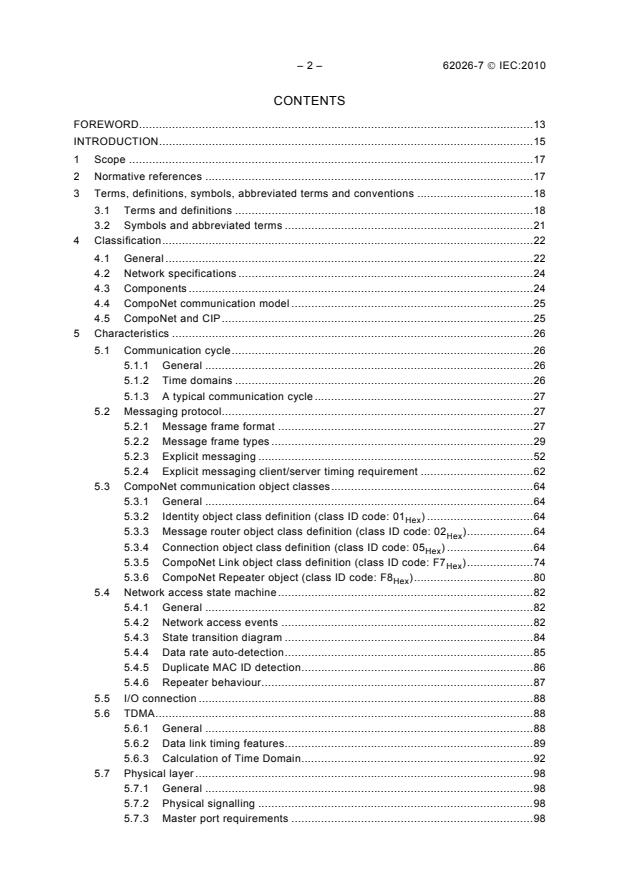
– 2 – 62026-7 © IEC:2010
CONTENTS
FOREWORD.13
INTRODUCTION.15
1 Scope .17
2 Normative references .17
3 Terms, definitions, symbols, abbreviated terms and conventions .18
3.1 Terms and definitions .18
3.2 Symbols and abbreviated terms .21
4 Classification.22
4.1 General .22
4.2 Network specifications .24
4.3 Components .24
4.4 CompoNet communication model .25
4.5 CompoNet and CIP.25
5 Characteristics .26
5.1 Communication cycle.26
5.1.1 General .26
5.1.2 Time domains .26
5.1.3 A typical communication cycle.27
5.2 Messaging protocol.27
5.2.1 Message frame format .27
5.2.2 Message frame types .29
5.2.3 Explicit messaging .52
5.2.4 Explicit messaging client/server timing requirement .62
5.3 CompoNet communication object classes.64
5.3.1 General .64
5.3.2 Identity object class definition (class ID code: 01 ) .64
Hex
5.3.3 Message router object class definition (class ID code: 02 ).64
Hex
5.3.4 Connection object class definition (class ID code: 05 ) .64
Hex
5.3.5 CompoNet Link object class definition (class ID code: F7 ).74
Hex
5.3.6 CompoNet Repeater object (class ID code: F8 ).80
Hex
5.4 Network access state machine .82
5.4.1 General .82
5.4.2 Network access events .82
5.4.3 State transition diagram .84
5.4.4 Data rate auto-detection.85
5.4.5 Duplicate MAC ID detection.86
5.4.6 Repeater behaviour.87
5.5 I/O connection .88
5.6 TDMA.88
5.6.1 General .88
5.6.2 Data link timing features.89
5.6.3 Calculation of Time Domain.92
5.7 Physical layer.98
5.7.1 General .98
5.7.2 Physical signalling .98
5.7.3 Master port requirements .98
62026-7 © IEC:2010 – 3 –
5.7.4 Slave port requirements .101
5.7.5 Receiving signal requirements for master and slave ports .104
5.7.6 Requirements for digital processing.105
5.7.7 Recommended circuits and component parameters .108
5.7.8 Isolation.113
5.7.9 Transmission medium .114
5.7.10 Topology.115
5.7.11 Link power .121
5.7.12 Repeater implementation .124
6 Product information .125
7 Normal service, mounting and transport conditions.125
7.1 Normal service conditions .125
7.1.1 General .125
7.1.2 Ambient air temperature.126
7.1.3 Altitude .126
7.1.4 Climatic conditions.126
7.2 Conditions during transport and storage .126
7.3 Mounting .126
8 Constructional and performance requirements.126
8.1 Indicators and configuration switches.126
8.1.1 Status indicators .126
8.1.2 Switches.128
8.1.3 CompoNet marking .129
8.2 CompoNet cable.130
8.2.1 Overview .130
8.2.2 Cable profile template .131
8.2.3 Round cable I profile .132
8.2.4 Round cable II profile .134
8.2.5 Flat cable I profile .136
8.2.6 Flat cable II profile .139
8.3 Terminator.141
8.3.1 General .141
8.3.2 Terminating resistor .141
8.3.3 Terminating capacitor.141
8.4 Connectors.141
8.4.1 General .141
8.4.2 Template .141
8.4.3 Engaging specification for connector profiles: open, flat I, flat II .143
8.4.4 Specifications of hooks for connector profiles: open, flat I, flat II .145
8.4.5 Open connector profile.146
8.4.6 Profile of flat connector I .150
8.4.7 Profile of flat connector II .155
8.4.8 Profile of sealed M12 connector .158
8.5 Node power supply implementation .159
8.5.1 General .159
8.5.2 Requirement for node power supply connection .159
8.5.3 The requirements for nodes powered by network power supplies: .160
8.6 Miswiring protection.161
8.7 Electromagnetic compatibility (EMC) .161
– 4 – 62026-7 © IEC:2010
8.7.1 General .161
8.7.2 Immunity.161
8.7.3 Emissions .162
9 Tests.162
9.1 General .162
9.2 Electrical testing .163
9.2.1 Slave port operation voltage test .163
9.2.2 Reverse connected power supply line.163
9.2.3 Momentary power interruption .164
9.2.4 Isolation.164
9.2.5 Input impedance .165
9.2.6 Output waveform.166
9.2.7 Minimum input waveform.166
9.2.8 Electromagnetic compatibility testing .167
9.3 Mechanical test .168
9.4 Logical test.168
9.4.1 General .168
9.4.2 Test of slaves and repeaters .168
9.4.3 Test of master.171
Annex A (normative) CompoNet common services.174
Annex B (normative) CompoNet error codes.175
Annex C (normative) Connection path attribute definition.176
Annex D (normative) Data type specification and encoding .177
Annex E (normative) Communication objects library .181
Annex F (normative) Value ranges .182
Annex G (normative) CN default time domain .183
Bibliography .187
Figure 1 – Segment layer.23
Figure 2 – CompoNet components .25
Figure 3 – Time domains.26
Figure 4 – A typical communication cycle .27
Figure 5 – A general frame.27
Figure 6 – Preamble of frames .28
Figure 7 – Transmission direction.28
Figure 8 – Transmission direction.29
Figure 9 – OUT frame format .30
Figure 10 – OUT command code .30
Figure 11 – TRG frame format.32
Figure 12 – TRG command code .32
Figure 13 – CN frame format.32
Figure 14 – CN command code .33
Figure 15 – IN frame format .34
Figure 16 – IN command code.35
Figure 17 – A_EVENT frame format .35
62026-7 © IEC:2010 – 5 –
Figure 18 – A_EVENT command code.36
Figure 19 – B_EVENT frame format .37
Figure 20 – B_EVENT command code meanings .38
Figure 21 – B_EVENT message format .39
Figure 22 – E_CMD block .39
Figure 23 – Group block.40
Figure 24 – Item block .40
Figure 25 – Status Read (STR Response) event data .43
Figure 26 – Configuration event data (STW Request) .45
Figure 27 – Poll data.46
Figure 28 – B_EVENT general decoding phase .47
Figure 29 – Flow chart for processing a matched STW request .49
Figure 30 – BEACON frame format.50
Figure 31 – BEACON command code .50
Figure 32 – Object diagram of A_Event message flow .52
Figure 33 – A_EVENT message format .52
Figure 34 – Compact message type request format (non-fragmented frame/first
fragment frame) .53
Figure 35 – Expanded message type request format (non-fragmented frame/first
fragment frame) .54
Figure 36 – Compact/Expanded message successful response format (unfragmented
frame/first fragment frame).54
Figure 37 – Compact/Expanded message unsuccessful response format
(unfragmented frame/first fragment frame).55
Figure 38 – Compact/Expanded message request format for fragments .55
Figure 39 – Compact/Expanded message response format for fragments.55
Figure 40 – Service data format .56
Figure 41 – Predefined master/slave I/O connection state transition diagram .70
Figure 42 – Predefined master/slave I/O connection state transition diagram .72
Figure 43 – Connection flow.73
Figure 44 – Allocate request service data .78
Figure 45 – Allocate response service data .79
Figure 46 – Release request service data.79
Figure 47 – Reset service parameter.82
Figure 48 – State transition diagram.84
Figure 49 – Sub-state of non-participated state .85
Figure 50 – Sub-state of participated state .85
Figure 51 – Data rate detection diagram.86
Figure 52 – BEACON changed by repeaters .88
Figure 53 – Multicast I/O connections.88
Figure 54 – Master MAC and Phy. circuit diagram .89
Figure 55 – Slave MAC and Phy. circuit diagram .90
Figure 56 – Repeater MAC and Phy. circuit diagram.91
Figure 57 – Transmission process.92
– 6 – 62026-7 © IEC:2010
Figure 58 – Transmission cycle model.93
Figure 59 – CnDefaultTimeDomain cycle model.95
Figure 60 – Master event communication model .96
Figure 61 – Slave event communication model .97
Figure 62 – Manchester encoding (inverted) .98
Figure 63 – Master port transmit mask .100
Figure 64 – Output waveform test circuit for master or slave port .101
Figure 65 – Slave port transmit mask .103
Figure 66 – Receive mask 1.104
Figure 67 – Receive mask 2.105
Figure 68 – Receive mask 3.105
Figure 69 – PHY/MAC interface diagram .106
Figure 70 – Digital receive mask 1 .106
Figure 71 – Digital receive mask 2 .107
Figure 72 – Digital receive mask 3 .107
Figure 73 – Logical transmit mask.108
Figure 74 – Recommended circuit for a master port .109
Figure 75 – Recommended circuit for a slave port .110
Figure 76 – Transformer symbol.110
Figure 77 – Driver voltage measurement circuit .112
Figure 78 – Propagation delay test circuit.112
Figure 79 – An isolation example of a master port .113
Figure 80 – An isolation example of an I/O module with connectivity to other power
sources .114
Figure 81 – An isolation example of a simple slave that requires connection to devices
with ungrounded signal wiring .114
Figure 82 – An isolation example of a non-network powered slave .114
Figure 83 – Media topology.116
Figure 84 – Position of a terminator.117
Figure 85 – Number of devices per segment.117
Figure 86 – Cable length limitation Illustration .118
Figure 87 – Branch restriction .118
Figure 88 – Wiring selection.119
Figure 89 – General wiring method.120
Figure 90 – Flexible wiring method.121
Figure 91 – Power dispatching method.123
Figure 92 – Network segment powered by the master .123
Figure 93 – Connection with power supply.123
Figure 94 – Network segments powered by repeaters .124
Figure 95 – A simplified diagram for a repeater .125
Figure 96 – Outline of round cable II .136
Figure 97 – Outline of flat cable I .138
Figure 98 – Dimension of flat cable I .139
Figure 99 – Outline of flat cable II .140
62026-7 © IEC:2010 – 7 –
Figure 100 – Dimension of flat cable II .141
Figure 101 – Engaging dimensions of plug connector .143
Figure 102 – Contact space for plug connector.144
Figure 103 – Engaging dimensions of jack connector.145
Figure 104 – Connector hook .146
Figure 105 – Open connecter plug (informative) .148
Figure 106 – Open connecter jack (informative).149
Figure 107 – Method to measure contact resistance (open connectors).150
Figure 108 – De-rating current for connectors.150
Figure 109 – Flat connector I plug .153
Figure 110 – Flat connector I jack (informative) .154
Figure 111 – Method to measure contact resistance (flat I, II connectors).155
Figure 112 – Flat connector II plug (informative).157
Figure 113 – Flat connector II jack (informative) .157
Figure 114 – Marking connector for trunk lines .158
Figure 115 – M12 connecter pinout .159
Figure 116 – Link power circuits.160
Figure 117 – Power-drop along a cable .160
Figure 118 – Power design for a node (informative) .161
Figure 119 – Operating voltage test circuit .163
Figure 120 – Reverse connected power supply line .164
Figure 121 – Isolation .165
Figure 122 – Input impedance .165
Figure 123 – Output slave test circuit for slave port .166
Figure 124 – Minimum input waveform test circuit.167
Figure 125 – Minimum input waveform test system .167
Figure 126 – Data link test for slave and repeater DUT.169
Figure 127 – Test configuration for minimum traffic of master DUT .172
Figure 128 – Test configuration for proxy of master DUT .173
Figure D.1 – An example to generate CRC .180
Table 1 – Network specifications .24
Table 2 – OSI reference model and CompoNet .26
Table 3 – Command codes.28
Table 4 – Command restrictions for slave MAC .29
Table 5 – Block name description.30
Table 6 – CN target .30
Table 7 – I/O refresh.31
Table 8 – Block name description.32
Table 9 – Block name description.33
Table 10 – Duplication checking function status.33
Table 11 – A_EVENT sending request.33
Table 12 – Status of CN frames .34
– 8 – 62026-7 © IEC:2010
Table 13 – Warning bit of CN frames.34
Table 14 – Alarm bit of CN frames.34
Table 15 – Block name description.34
Table 16 – Encoded length .35
Table 17 – Block name description.36
Table 18 – Acknowledgement bit of A_EVENT.36
Table 19 – Command type of A_EVENT .36
Table 20 – Block name description.37
Table 21 – Acknowledgement bit of B_EVENT.38
Table 22 – Command type of B_EVENT .38
Table 23 – E_CMD block meanings.39
Table 24 – Group block meanings .40
Table 25 – Item block meanings.40
Table 26 – Processing rules for a STR request.48
Table 27 – Processing rules for an A_EVENT poll request .48
Table 28 – Processing rules for a STW request .48
Table 29 – STW request commands .50
Table 30 – Block name description.50
Table 31 – Control code of BEACON frames .51
Table 32 – Speed Code of BEACON frames .51
Table 33 – Control code format .56
Table 34 – A Data encoding example .58
Table 35 – Fragment type values .59
Table 36 – Fragmented transmission.60
Table 37 – Fragmented reception.61
Table 38 – Explicit message timeout values .63
Table 39 – Maximum value of expected packet rate.65
Table 40 – CompoNet connection object attribute access rules .65
Table 41 – CompoNet Link object specific additional error codes .68
Table 42 – Connection instance ID for predefined master/slave connections .69
Table 43 – Default multicast poll connection object attribute values .69
Table 44 – Predefined master/slave I/O connection state event matrix .70
Table 45 – CompoNet Link class attributes.74
Table 46 – CompoNet Link class services .74
Table 47 – CompoNet Link instance attributes .74
Table 48 – MAC ID range.75
Table 49 – Data rate .76
Table 50 – Allocation choice .76
Table 51 – Data rate switch value .76
Table 52 – Bit definitions for node state octet .77
Table 53 – Bit definitions for node network state.77
Table 54 – CompoNet Link object common services .77
Table 55 – CompoNet Link Object class specific services .78
62026-7 © IEC:2010 – 9 –
Table 56 – Allocation choice octet contents .78
Table 57 – EPR value .79
Table 58 – Explicit message timer.79
Table 59 – Release master/slave connection set request parameters.79
Table 60 – Release choice octet contents .80
Table 61 – Repeater class attribute.80
Table 62 – Repeater class services.80
Table 63 – Instance attributes of repeater class.81
Table 64 – Repeater common service.82
Table 65 – Reset attributes .82
Table 66 – Data rate and network watchdog time periods .83
Table 67 – Description of the state machine .84
Table 68 – Duplicate MAC ID detection mechanism .87
Table 69 – Repeating directions of frames.87
Table 70 – Master timing features .89
Table 71 – Slave timing features .90
Table 72 – Repeater timing features.91
Table 73 – Cable propagation delay .91
Table 74 – Maximum cable length .92
Table 75 – Parameters in TimeDomain calculation.92
Table 76 – Frame marks .93
Table 77 – TimeDomain sett
...