

ISO 9033:2026
(Main)Aluminium ores — Determination of the moisture content of bulk material
- Abstract
This document specifies a method to determine the moisture content of aluminium ores. It applies to the samples taken from bulk aluminium ores, e.g. shipments and stockpiles.
- Status
- Published
- Publication Date
- 05-Nov-2026
- Technical Committee
- ISO/TC 79/SC 12 - Aluminium ores
- Drafting Committee
- ISO/TC 79/SC 12 - Aluminium ores
- Current Stage
- 6060 - International Standard published
- Start Date
- 06-Nov-2026
- Completion Date
- 06-Nov-2026
ISO 9033 is an ISO standard for determining the moisture content of bulk aluminium ores. It specifies how to sample, dry, weigh and calculate the moisture content of consignments such as shipments and stockpiles, and it also gives correction methods when sprayed water or rainfall has affected the ore.
What does ISO 9033 specify?
ISO 9033 specifies a method for measuring the moisture content of samples taken from bulk aluminium ores. The document is written for material handled in bulk, so the result can be used for commercial transactions and cargo handling.
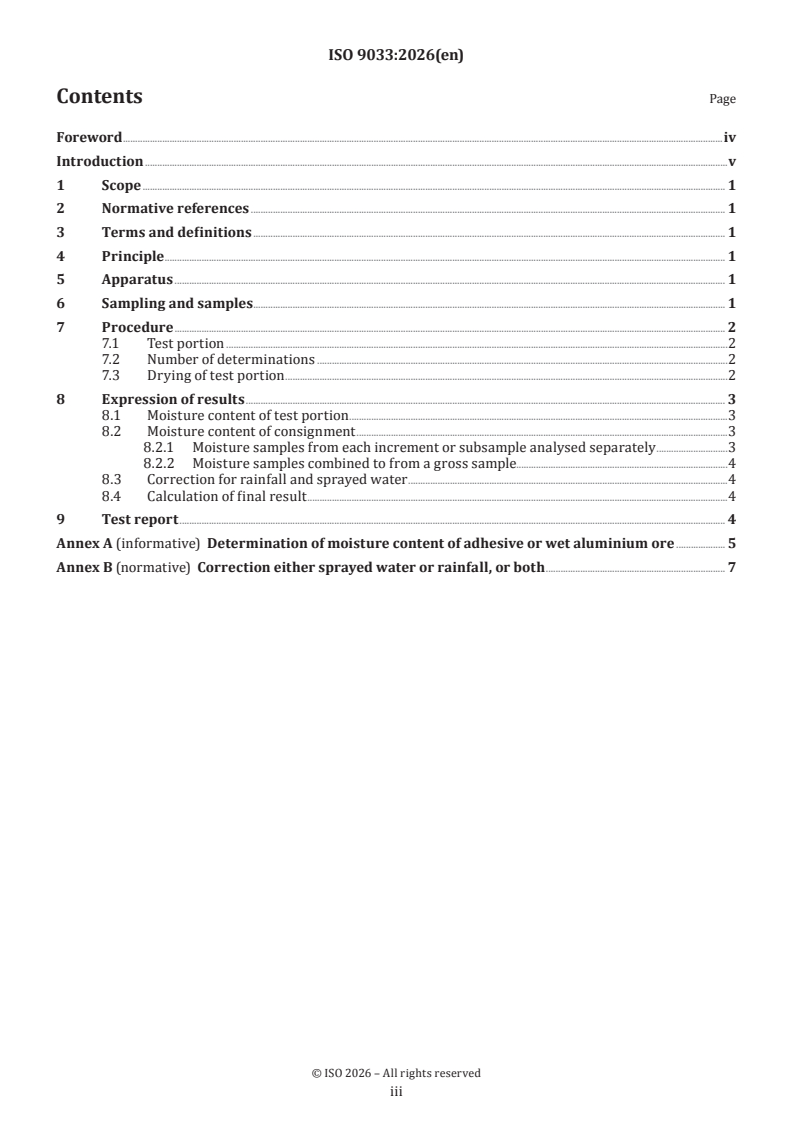
The standard is organized into clauses 1 to 9, covering scope, references, terms, principle, apparatus, sampling and samples, procedure, expression of results, and test report. It also has two annexes that address special cases.
| Annex | What it covers |
|---|---|
| Annex A | Determination of moisture content of adhesive or wet aluminium ore, using a pre-drying route |
| Annex B | Correction for sprayed water, rainfall, or both |
What are the key requirements of ISO 9033?
ISO 9033 requires the moisture test sample to be prepared and handled so that the measured mass loss represents the ore, not handling losses or added water. In practice, that means controlling sampling, container handling, oven drying and any correction for outside water.
Sampling and test portions
Clause 6 requires test samples to be taken and prepared in accordance with ISO 8685 and ISO 6140. ISO 9033 allows two sampling approaches: moisture samples from each increment or subsample can be analysed separately, or moisture samples can be combined into a gross sample.
Clause 7.1 requires test portions prepared under ISO 6140 to be kept in sealed containers and to meet the minimum masses in Table 1. If a portion is too large for the oven, it may be split into the minimum number of parts, but no part may be less than 1 kg. This matters because moisture can change while the sample is open.
Drying and weighing
Clause 4 and 7.3 require the test portion to be dried to constant mass in a ventilated oven with forced circulation at 105 °C ± 5 °C. The sample is weighed before opening, dried, weighed, redried for a further 2 h, and reweighed until successive weighings are within the limits in Table 1.
Clause 5 lists the apparatus needed: a drying pan, the ventilated oven, and a weighing device with very fine reading capability. Table 1 also links top size to layer thickness, minimum mass, weighing accuracy and minimum drying time, so the drying conditions match the ore size.
Number of determinations
Clause 7.2 sets the number of determinations. If increments or subsamples are analysed separately, one determination is made on each subsample, with duplicates when there are fewer than four subsamples. If subsamples are combined into a gross moisture sample, four test portions are prepared, two are tested first, and the other two are held in reserve. This gives a check on repeatability before the consignment result is accepted.
Calculating the result
Clause 8 gives the calculation steps. The moisture content of a test portion is calculated from the mass loss after drying, and the consignment moisture content is then calculated either as a weighted mean of subsamples or from duplicate test portions, depending on the sampling route used.
If duplicate results differ by more than 0.3 % absolute, Clause 8 requires additional checks and, if needed, rejection of the highest and lowest values before averaging the remaining results. Clause 8.4 then rounds the final result to one decimal place. In practice, this controls how the reported percentage is handled for trading or records.
Corrections and reporting
Clause 8.3 sends sprayed-water and rainfall corrections to Annex B. Annex B gives separate corrections for loading and discharge, and for cases where both sprayed water and rainfall have affected the consignment. Clause 9 requires the test report to identify the sample, the edition used, the result with the calculation clause, any deviations, unusual observations and the test date.
Annex A provides an alternative route for adhesive or very wet ore. It allows pre-drying before normal moisture testing, then combines the pre-dried and additional moisture contents to obtain the total as-received moisture content.
What terms does ISO 9033 define?
ISO 9033 uses a small set of operational terms that are central to the method. These terms help readers follow the sampling, drying and correction steps.
- Moisture content - the water content of the test portion or consignment, expressed as a percentage by mass.
- Test portion - the portion of ore that is weighed, dried and reweighed for the moisture determination.
- Consignment - the bulk ore lot whose moisture content is being calculated from one or more subsamples.
- Subsample - an increment-derived part of the consignment used for separate moisture determination or for building a gross sample.
- Sprayed water - water added between moisture determination and tonnage determination, typically for dust control.
- Rainfall - rainfall affecting holds, hoppers or conveyors during handling and sampling.
- Pre-dried moisture content - the moisture removed in the Annex A pre-drying step before the main determination.
Who uses ISO 9033?
ISO 9033 is used by laboratories, sampling teams, port and terminal operators, surveyors, producers and buyers of aluminium ores. They use it to measure moisture for shipment records, stockpile checks, cargo handling, and commercial settlement.
It is especially relevant where moisture affects mass-based trade, where samples are hard to prepare because the ore is wet or sticky, or where water has been added or received during handling.
What changed in ISO 9033 from the previous edition?
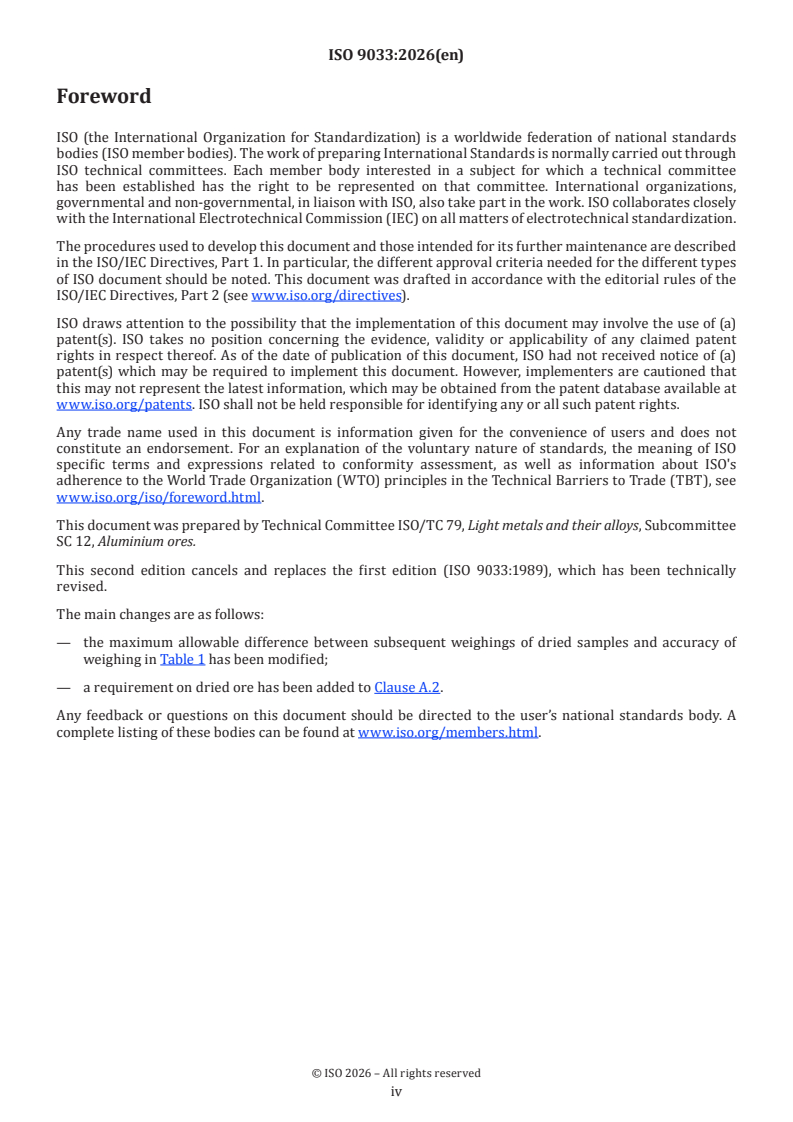
ISO 9033 is the second edition and it cancels and replaces ISO 9033:1989. The foreword states that the standard has been technically revised, including changes to Table 1 on allowable differences between successive weighings and weighing accuracy, and an added requirement in Clause A.2 for dried ore.
Which standards are used with ISO 9033?
ISO 9033 refers to ISO 8685 for sampling procedures and ISO 6140 for sample preparation. These two standards support the moisture test by defining how the bulk ore is sampled and how the test portions are prepared before drying.
What does the ISO 9033 document contain?
ISO 9033 contains a drying-based test method, a sampling route, and calculation steps for individual samples and consignments. It includes Table 1 for mass, layer thickness, weighing accuracy and minimum drying time by ore top size.
The document also includes Formula (1) for test-portion moisture content, Formula (2) for consignment moisture from separate subsamples, and Formula (3) for duplicate determinations from a gross sample. Annex A adds formulas for pre-drying adhesive or wet ore, and Annex B adds correction formulas for sprayed water and rainfall on loading or discharge.
Relations
- Effective Date
- 19-Oct-2024
Get Certified
Connect with accredited certification bodies for this standard

Bureau Veritas Chile
Bureau Veritas certification services in Chile.
Bureau Veritas Peru
Bureau Veritas certification services in Peru.
BVQI Peru
Bureau Veritas certification in Peru.
Sponsored listings
Frequently Asked Questions
ISO 9033:2026 is a standard published by the International Organization for Standardization (ISO). Its full title is "Aluminium ores — Determination of the moisture content of bulk material". This standard covers: This document specifies a method to determine the moisture content of aluminium ores. It applies to the samples taken from bulk aluminium ores, e.g. shipments and stockpiles.
This document specifies a method to determine the moisture content of aluminium ores. It applies to the samples taken from bulk aluminium ores, e.g. shipments and stockpiles.
ISO 9033:2026 is classified under the following ICS (International Classification for Standards) categories: 73.060.40 - Aluminium ores. The ICS classification helps identify the subject area and facilitates finding related standards.
ISO 9033:2026 has the following relationships with other standards: It is inter standard links to ISO 9033:1989. Understanding these relationships helps ensure you are using the most current and applicable version of the standard.
ISO 9033:2026 is available in PDF format for immediate download after purchase. The document can be added to your cart and obtained through the secure checkout process. Digital delivery ensures instant access to the complete standard document.
Standards Content (Sample)
International
Standard
ISO 9033
Second edition
Aluminium ores — Determination
2026-11
of the moisture content of bulk
material
Minerais alumineux — Détermination de l'humidité du matériau
en vrac
Reference number
© ISO 2026
All rights reserved.
This ISO publication is protected by copyright and is owned by ISO and/or its licensors.
The content of this ISO publication is provided under licence, not sold. Use is subject to the applicable licence terms issued by ISO,
an ISO member body, or an authorized third-party distributor.
Except as required for implementation or expressly permitted by a separate licence, no part of this ISO publication may be
reproduced, distributed, modified, used, or made available in any form or by any means – electronic or mechanical, including
photocopying, scanning, recording, or posting on internal or external digital platforms.
Any use beyond the scope of the granted rights is prohibited and may result in legal action.
ISO copyright office
CP 401 • CH-1214 Vernier, Geneva
Phone: +41 22 749 01 11
Email: copyright@iso.org
Website: www.iso.org
Published in Switzerland
ii
Contents Page
Foreword .iv
Introduction .v
1 Scope . 1
2 Normative references . 1
3 Terms and definitions . 1
4 Principle . 1
5 Apparatus . 1
6 Sampling and samples . . 1
7 Procedure . 2
7.1 Test portion .2
7.2 Number of determinations .2
7.3 Drying of test portion .2
8 Expression of results . 3
8.1 Moisture content of test portion .3
8.2 Moisture content of consignment .3
8.2.1 Moisture samples from each increment or subsample analysed separately .3
8.2.2 Moisture samples combined to from a gross sample.4
8.3 Correction for rainfall and sprayed water .4
8.4 Calculation of final result .4
9 Test report . 4
Annex A (informative) Determination of moisture content of adhesive or wet aluminium ore . 5
Annex B (normative) Correction either sprayed water or rainfall, or both . 7
iii
Foreword
ISO (the International Organization for Standardization) is a worldwide federation of national standards
bodies (ISO member bodies). The work of preparing International Standards is normally carried out through
ISO technical committees. Each member body interested in a subject for which a technical committee
has been established has the right to be represented on that committee. International organizations,
governmental and non-governmental, in liaison with ISO, also take part in the work. ISO collaborates closely
with the International Electrotechnical Commission (IEC) on all matters of electrotechnical standardization.
The procedures used to develop this document and those intended for its further maintenance are described
in the ISO/IEC Directives, Part 1. In particular, the different approval criteria needed for the different types
of ISO document should be noted. This document was drafted in accordance with the editorial rules of the
ISO/IEC Directives, Part 2 (see www.iso.org/directives).
ISO draws attention to the possibility that the implementation of this document may involve the use of (a)
patent(s). ISO takes no position concerning the evidence, validity or applicability of any claimed patent
rights in respect thereof. As of the date of publication of this document, ISO had not received notice of (a)
patent(s) which may be required to implement this document. However, implementers are cautioned that
this may not represent the latest information, which may be obtained from the patent database available at
www.iso.org/patents. ISO shall not be held responsible for identifying any or all such patent rights.
Any trade name used in this document is information given for the convenience of users and does not
constitute an endorsement. For an explanation of the voluntary nature of standards, the meaning of ISO
specific terms and expressions related to conformity assessment, as well as information about ISO's
adherence to the World Trade Organization (WTO) principles in the Technical Barriers to Trade (TBT), see
www.iso.org/iso/foreword.html.
This document was prepared by Technical Committee ISO/TC 79, Light metals and their alloys, Subcommittee
SC 12, Aluminium ores.
This second edition cancels and replaces the first edition (ISO 9033:1989), which has been technically
revised.
The main changes are as follows:
— the maximum allowable difference between subsequent weighings of dried samples and accuracy of
weighing in Table 1 has been modified;
— a requirement on dried ore has been added to Clause A.2.
Any feedback or questions on this document should be directed to the user’s national standards body. A
complete listing of these bodies can be found at www.iso.org/members.html.
iv
Introduction
Aluminum ores are an important raw material for alumina production and their annual consumption is very
large. Moisture content is an important parameter in commercial transactions of aluminum ores, so it is
necessary to formulate a method to determine the moisture content of bulk material in aluminum ores in
order to reduce disputes in the trade of aluminum ores.
Annex A specifies a method to be used when it is difficult to carry out sieving, crushing and dividing owing
to the sample being adhesive or excessively wet. In this case, the sample may be pre-dried until preparation
can be conducted without any trouble. The pre-dried moisture content of a consignment can be determined
by the procedure specified in Annex A.
Annex B specifies methods of correction either sprayed water or rainfall or both. In the event of the
consignment being subjected to either sprayed water or rainfall or both to control dust emission, the
moisture content of the consignment can be corrected for this added water in accordance with Annex B.
v
International Standard ISO 9033:2026(en)
Aluminium ores — Determination of the moisture content of
bulk material
1 Scope
This document specifies a method to determine the moisture content of aluminium ores. It applies to the
samples taken from bulk aluminium ores, e.g. shipments and stockpiles.
2 Normative references
The following documents are referred to in the text in such a way that some or all of their content constitutes
requirements of this document. For dated references, only the edition cited applies. For undated references,
the latest edition of the referenced document (including any amendments) applies.
ISO 8685, Aluminium ores — Sampling procedures
ISO 6140, Aluminium ores — Preparation of samples
3 Terms and definitions
No terms and definitions are listed in this document.
ISO and IEC maintain terminology databases for use in standardization at the following addresses:
— ISO Online browsing platform: available at https:// www .iso .org/ obp
— IEC Electropedia: available at https:// www .electropedia .org/
4 Principle
The test portion is dried to a constant mass in a ventilated oven with forced circulation of air regulated at
105 °C ± 5 °C. The loss in mass is then measured.
5 Apparatus
The usual laboratory apparatus and, in particular, the following shall be used.
5.1 Drying pan.
5.2 Ventilated oven, with forced circulation of air regulated at 105 °C ± 5 °C.
5.3 Weighing device, capable of being read to an accuracy of 0,05 % of the mass of the test portion.
6 Sampling and samples
Test samples shall be taken and prepared in accordance with the procedures specified in ISO 8685 and
ISO 6140 respectively. Two possibilities exist for the preparation of the moisture samples. These are:
a) The moisture samples prepared from each increment or subsample are prepared and analysed
individually.
b) The moisture samples from each increment or subsample are combined to form a gross sample.
7 Procedure
7.1 Test portion
The test portions prepared by the procedure specified in ISO 6140 shall be provided in sealed containers
and shall have the minimum masses specified in Table 1.
The moisture content of adhesive or wet aluminium ore can be determined by the procedure specified in
Annex A.
When a test portion is too large for the ventilated oven (5.2) , it may be divided into several parts for drying.
Divide the portion into the minimum number of parts possible, taking care to avoid a change in moisture
content. In no case shall the minimum mass of a part be less than 1 kg.
Alternatively, to avoid dividing large test portions into parts for drying, moisture determinations may be
carried out on individual increments or subsamples as taken, provided the sum of the masses of all the
increments or subsamples exceeds the mass of the test portions given in Table 1.
7.2 Number of determinations
Moisture determination may be carried out in one of the following ways:
a) Where moisture samples from individual increments or subsamples are analysed separately, one
moisture determination shall be carried out on each subsample. If there are fewer than four subsamples
per consignment, duplicate test portions shall be prepared from each subsample and analysed.
b) Where the moisture samples from each subsample are combined to form a gross moisture sample, four
test portions shall be prepared. Moisture determinations shall be carried out on two of the test portions
with the remaining two test portions kept in reserve.
7.3 Drying of test portion
Weigh the container and aluminium ore test portion before opening the container (as received). Weigh the
clean, dry drying pan (5.1). Transfer the aluminium ore to the drying pan and spread the ore evenly to a
depth not exceeding that specified in Table 1.
Place the dry
...