

ISO 4799:1978
(Main)Laboratory glassware — Condensers
General Information
- Abstract
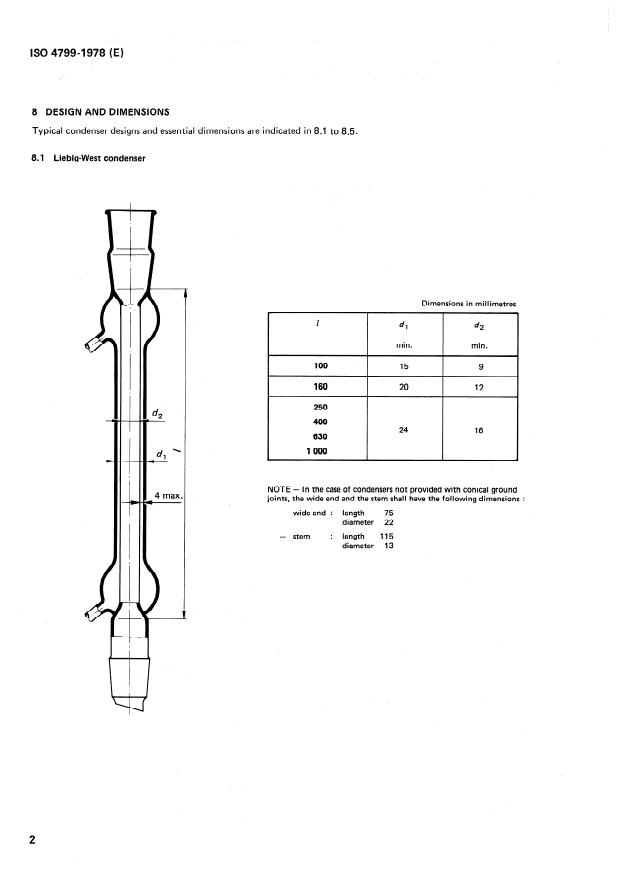
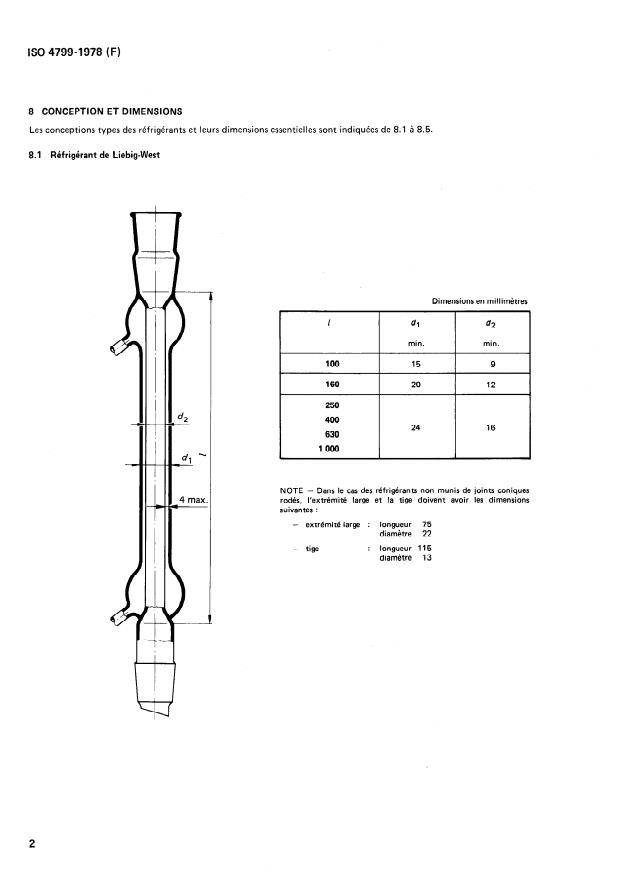
Five types of condensors of three calsses according to design and the relative position of the colling medium with the nominal jacket length are specified: water jacket condenser (Allihn condenser, Liebig-West condenser and coiled destillate candenser), coolant-tube condenser, and double-section condenser. The material and the construction with ground glass joints are described by figures and tables for the dimensions.
- Status
- Published
- Publication Date
- 31-Oct-1978
- Technical Committee
- ISO/TC 48 - Laboratory equipment
- Drafting Committee
- ISO/TC 48 - Laboratory equipment
- Current Stage
- 9020 - International Standard under periodical review
- Start Date
- 15-Jul-2026
- Completion Date
- 15-Jul-2026
Buy Documents

ISO 4799:1978 - Laboratory glassware — Condensers Released:11/1/1978
ISO 4799:1978 - Verrerie de laboratoire — Réfrigérants Released:11/1/1978
ISO 4799:1978 - Verrerie de laboratoire — Réfrigérants Released:11/1/1978
Overview
ISO 4799:1978 - Laboratory Glassware - Condensers is an international standard developed by ISO that specifies requirements and classifications for laboratory glass condensers. It establishes an internationally accepted series of glass condensers suitable for general laboratory use, focusing on types, design, dimensions, material properties, and markings. This standard helps ensure compatibility, safety, and performance in scientific laboratories worldwide that utilize glass condensers for thermal exchange in chemical processes.
Keywords: laboratory glassware, condensers, ISO 4799, glass condensers, laboratory standard, scientific equipment, Allihn condenser, Liebig condenser, coolant-tube condenser.
Key Topics
Types and Classes of Condensers:
The standard defines five types of condensers, grouped into three design classes based on the arrangement of the cooling medium and jacket length:- Water jacket condensers: Includes Allihn, Liebig-West, and coiled distillate condensers.
- Coolant-tube condensers: Such as the Graham condenser.
- Double-section condensers: Includes jacketed coil types.
Material and Construction:
Condensers must be constructed from clear glass with suitable chemical and thermal resistance, minimizing defects and internal stress to reduce the risk of breakage.Glass Joints:
Detailed requirements for interchangeable ground glass joints are included:- Conical joints: Must conform to ISO 383.
- Spherical joints: Must conform to ISO 641.
- Extremities may be plain or fitted with these standard joints.
Dimensions and Marking:
Each condenser type has specified nominal jacket lengths and essential dimensions, detailed in figures and tables. All condensers must be permanently marked with:- Nominal jacket length
- Manufacturer or vendor identification
- Size of any ground joints used
Applications
Chemical Laboratories:
Used extensively in chemical, biological, and physical labs for condensation and heat exchange in distillation, reflux, and separation processes.Quality Assurance:
Ensures interchangeability and compatibility of glassware from different manufacturers.Safety and Reliability:
By adhering to precise material and dimensional specifications, laboratories reduce the risk of equipment failure during experiments involving thermal cycling and chemical exposure.Global Trade and Procurement:
Facilitates international trade in laboratory equipment by providing universally recognized specifications, simplifying procurement and ensuring uniformity in laboratory setups.
Related Standards
ISO 383:
Laboratory glassware - Interchangeable conical ground joints. Specifies dimensions and requirements for standard conical joints.ISO 641:
Laboratory glassware - Interchangeable spherical ground joints. Covers spherical joint compatibility and dimensions.Other Laboratory Glassware Standards:
Standards covering burettes, pipettes, flasks, and additional apparatus ensure the quality and interconnectivity of laboratory equipment beyond condensers.
Summary
ISO 4799:1978 provides clear, harmonized guidelines for the manufacture and application of laboratory glass condensers, helping laboratories achieve greater reliability, safety, and operational efficiency. By following these recommendations, laboratories ensure consistent performance and global compatibility of their scientific glassware, supporting standardized laboratory practices worldwide.
Relations
- Effective Date
- 25-Aug-2026
- Effective Date
- 25-Aug-2026
- Effective Date
- 25-Aug-2026
- Effective Date
- 25-Aug-2026
- Effective Date
- 25-Aug-2026
Buy Documents
ISO 4799:1978 - Laboratory glassware — Condensers Released:11/1/1978
ISO 4799:1978 - Verrerie de laboratoire — Réfrigérants Released:11/1/1978
ISO 4799:1978 - Verrerie de laboratoire — Réfrigérants Released:11/1/1978
Get Certified
Connect with accredited certification bodies for this standard

ECOCERT
Organic and sustainability certification.

Eurofins Food Testing Global
Global leader in food, environment, and pharmaceutical product testing.

Intertek Bangladesh
Intertek certification and testing services in Bangladesh.
Sponsored listings
Frequently Asked Questions
ISO 4799:1978 is a standard published by the International Organization for Standardization (ISO). Its full title is "Laboratory glassware — Condensers". This standard covers: Five types of condensors of three calsses according to design and the relative position of the colling medium with the nominal jacket length are specified: water jacket condenser (Allihn condenser, Liebig-West condenser and coiled destillate candenser), coolant-tube condenser, and double-section condenser. The material and the construction with ground glass joints are described by figures and tables for the dimensions.
Five types of condensors of three calsses according to design and the relative position of the colling medium with the nominal jacket length are specified: water jacket condenser (Allihn condenser, Liebig-West condenser and coiled destillate candenser), coolant-tube condenser, and double-section condenser. The material and the construction with ground glass joints are described by figures and tables for the dimensions.
ISO 4799:1978 is classified under the following ICS (International Classification for Standards) categories: 71.040.20 - Laboratory ware and related apparatus. The ICS classification helps identify the subject area and facilitates finding related standards.
ISO 4799:1978 has the following relationships with other standards: It is inter standard links to EN ISO 28706-2:2017, EN ISO 28706-3:2018, EN ISO 28706-2:2011, EN ISO 15009:2016, EN ISO 8985:2022. Understanding these relationships helps ensure you are using the most current and applicable version of the standard.
ISO 4799:1978 is available in PDF format for immediate download after purchase. The document can be added to your cart and obtained through the secure checkout process. Digital delivery ensures instant access to the complete standard document.
Standards Content (Sample)
SLOVENSKI STANDARD
01-avgust-1995
Laboratorijska steklovina - Hladilniki
Laboratory glassware -- Condensers
Verrerie de laboratoire -- Réfrigérants
Ta slovenski standard je istoveten z: ISO 4799:1978
ICS:
71.040.20 Laboratorijska posoda in Laboratory ware and related
aparati apparatus
2003-01.Slovenski inštitut za standardizacijo. Razmnoževanje celote ali delov tega standarda ni dovoljeno.
------
...
INTERNATIONAL STANDARD
INTERNATIONAL ORGANIZATION FOR STANDARDlZATION@MEWYHAPOIIHAR OPrAHM3ALWlR fl0 CTAHJIJAPTM3ALWl.ORGANISATION INTERNATIONALE DE NORMALISATION
Laboratory glassware - Condensers
Verrerie de labora toire - Refrigkan ts
First edition - 1978-11-15
Ref. No. ISO 4799-1978 (E)
UDC 542.231
: laboratory equipment, Iaboratory glassware, coolers, condensers (liquefiers), specifications, dimensions, marking.
Descriptors
Price based on 6 pages
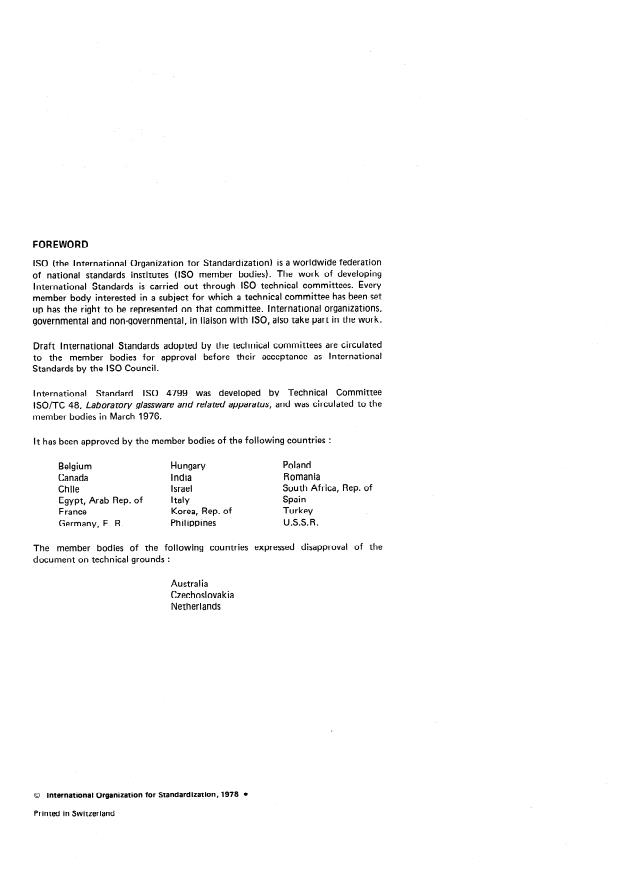
FOREWORD
ISO (the International Organization for Standardization) is a worldwide federation
of national Standards institutes (ISO member bodies). The work of developing
International Standards is carried out through ISO technical committees. Every
member body interested in a subject for which a technical committee has been set
up has the right to be represented on that committee. International organizations,
governmental and non-governmental, in liaison with ISO, also take part in the work.
Draft International Standards adopted by the technical committees are circulated
to the member bodies for approval before their acceptance as International
Standards by the ISO Council.
International Standard ISO 4799 was developed by Technical Committee
ISO/TC 48, Laboratory glassware and related apparatus, and was circulated to the
member bodies in March 1976.
lt has been approved by the member bodies of the following countries :
Belgium Hungary Poland
Romania
Canada India
South Africa, Rep. of
Chile Israel
Egypt, Arab Rep. of I taly Spain
Turkey
France Korea, Rep. of
U.S.S.R.
Germany, F. R. Philippines
countries expressed disapproval of the
The member bodies of the following
document on technical grounds :
Australia
Czechoslovakia
Netherlands
GI International Organkation for Standardkation, 1978 @
Printed in Switzerland
ISO 47994978 (E)
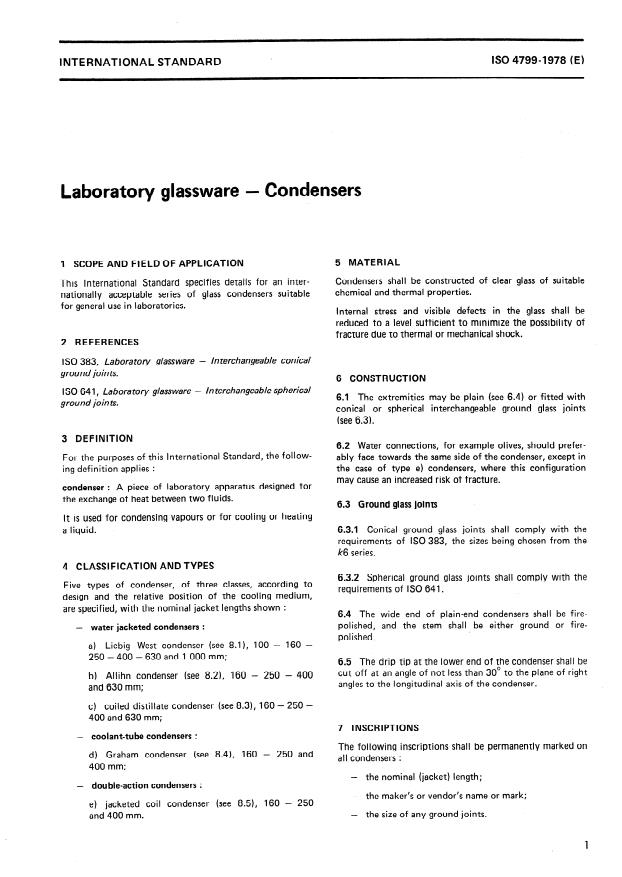
INTERNATIONAL STANDARD
Laborstory glassware - Condensers
5 MATERIAL
1 SCOPE AND FIELD OF APPLICATION
Condensers shall be constructed of clear glass of suitable
This International Standard specifies details for an inter-
Chemical and thermal properties.
nationally acceptable series of glass condensers suitable
for general use in laboratories.
lnternal stress and visible defects in the glass shall be
reduced to a level sufficient to minimize the possibility of
fracture due to thermal or mechanical shock.
2 REFERENCES
ISO 383, Laboratoty glassware - lnterchangeable conical
ground jein ts.
6 CONSTRUCTION
I SO 64 1, Labora tory glassware - In terchangeable spherical
6.1 The extremities may be plain (see 6.4) or fitted with
ground join ts.
conical or spherical interchangeable ground glass joints
(see 6.3).
3 DEFINITION
6.2 Water connections, for example olives, should prefer-
For the p
...
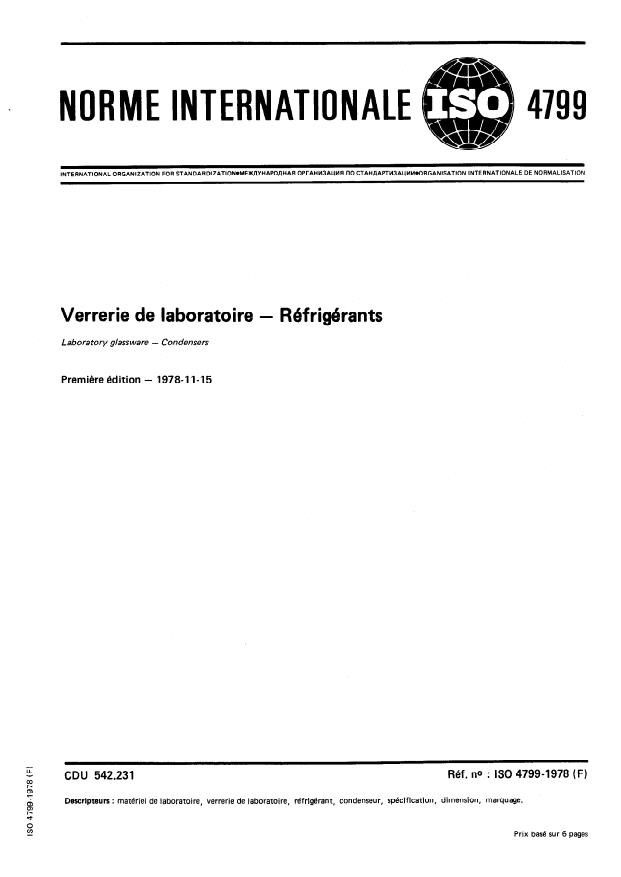
NORME INTERNATIONALE
INTERNATIONAL ORGANIZATION FOR STANDARDIZATION.ME~YHAPO~HAR OPrAHl43AlU’lR fl0 CTAH~APTH3AL&lM.ORGANISATION INTERNATIONALE DE NORMALISATION
Verrerie de laboratoire - Réfrigérants
Laboratory glassware - Condensers
Première édition - 1978-l 1-15
Réf. no : ISO 4799-1978 (F)
CDU 542.231
Descripteurs : matériel de laboratoire, verrerie de laboratoire, réfrigérant, condenseur, spécification, dimension, marquage.
Prix basé sur 6 pages
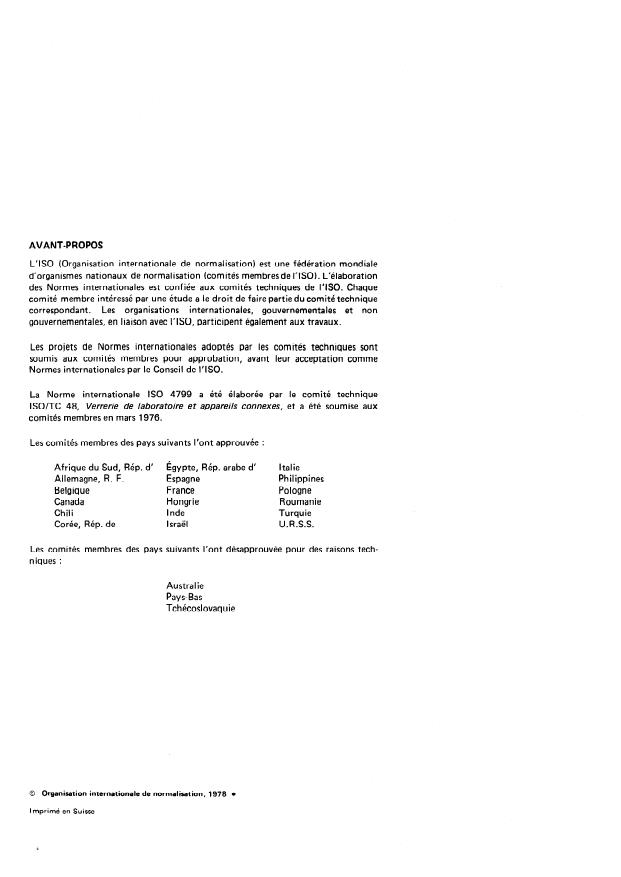
AVANT-PROPOS
L’ISO (Organisation internationale de normalisation) est une fédération mondiale
d’organismes nationaux de normalisation (comités membres de I’ISO). L’élaboration
des Normes internationales est confiée aux comités techniques de I’ISO. Chaque
comité membre intéressé par une étude a le droit de faire partie du comité technique
correspondant. Les organisations internationales, gouvernementales et non
gouvernementales, en liaison avec I’ISO, participent également aux travaux.
Les projets de Normes internationales adoptés par les comités techniques sont
soumis aux comités membres pour approbation, avant leur acceptation comme
Normes internationales par le Conseil de I’ISO.
La Norme internationale ISO 4799 a été élaborée par le comité technique
lSO/TC 48, Verrerie de laboratoire et appareils connexes, et a été soumise aux
comités membres en mars 1976.
Les comités membres des pays suivants l’ont approuvée :
Afrique du Sud, Rép. d’ Égypte, Rép. arabe d’ Italie
Allemagne, R. F. Espagne Philippines
Belgique France Pologne
Canada Hongrie Roumanie
Chili Inde Turquie
Corée, Rép. de Israël U.R.S.S.
Les comités membres des pays suivants l’ont désapprouvée pour des raisons tech-
niques :
Australie
Pays-Bas
Tchécoslovaquie
0 Organisation internationale de normalisation, 1978 l
Imprimé en Suisse
ISO 4799-1978 (F)
NORME INTERNATIONALE
Verrerie de laboratoire - Réfrigérants
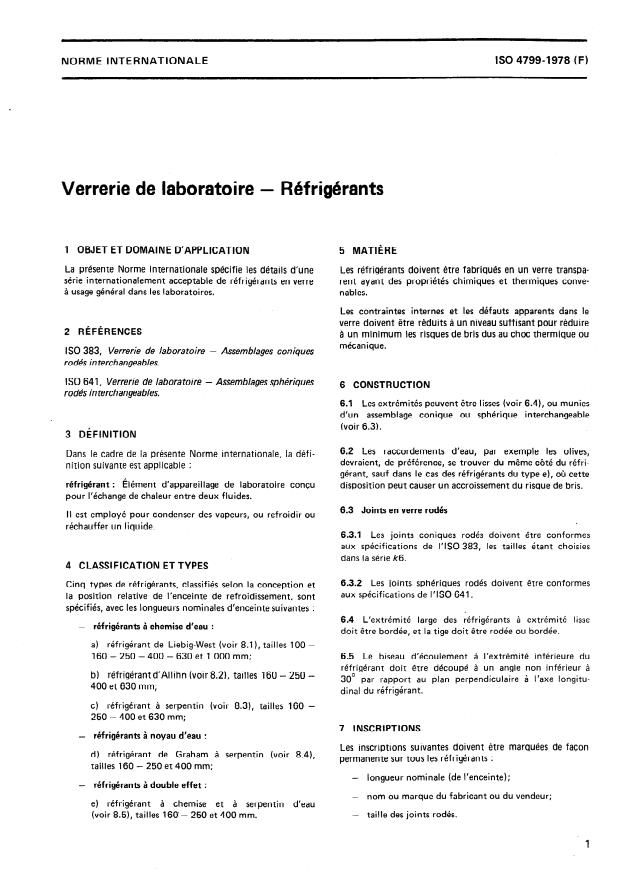
1 OBJET ET DOMAINE D’APPLICATION
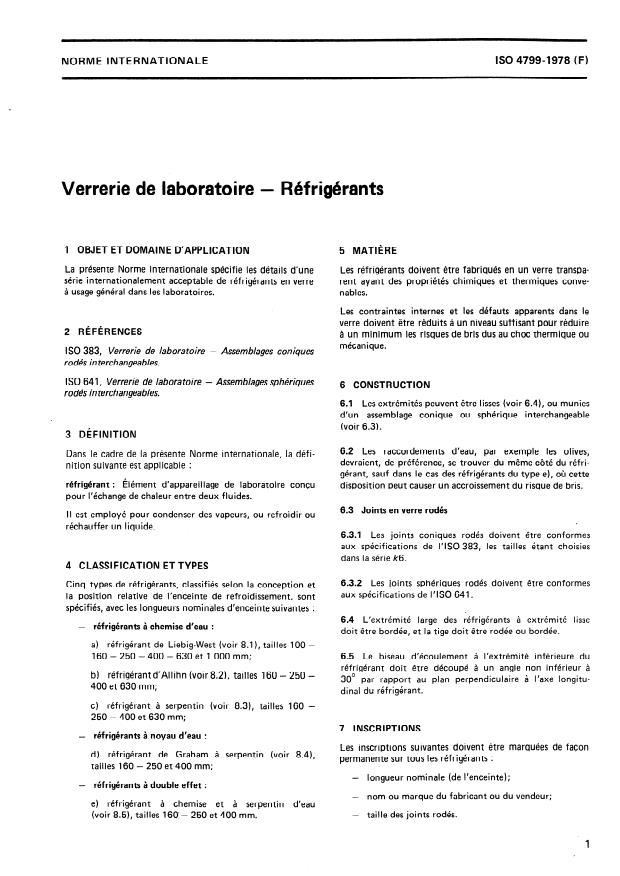
5 MATIÈRE
La présente Norme internationale spécifie les détails d’une
Les réfrigérants doivent être fabriqués en un verre transpa-
série internationalement acceptable de réfrigérants en verre
rent ayant des propriétés chimiques et thermiques conve-
à usage général dans les laboratoires. nables.
Les contraintes internes et les défauts apparents dans le
verre doivent être réduits à un niveau suffisant pour réduire
2 RÉFÉRENCES
à un minimum les risques de bris dus au choc thermique ou
mécanique.
I SO 383, Verrerie de laboratoire - Assemblages coniques
rodés in terchangeables.
I SO 64 1, Verrerie de laboratoire - Assemblages sphériques
6 CONSTRUCTION
rodés in terchangeables.
6.1 Les extrémités peuvent être lisses (voir 6.4), ou munies
d’un assemblage conique ou sphérique interchangeable
(voir 6.3).
3 DÉFINITION
6.2 Les raccordements d’eau, par exemple les olives,
Dans le cadre de la présente Norme internationale, la défi-
devraient, de préférence, se trouver du même côté du réfri-
nition suivante est applicable :
gérant, sauf dans le cas dès réfrigérants du type e), où cette
réfrigérant : Élément d’appareillage de laboratoire conçu
disposition peut causer un accroissement du risque de bris.
pour l’échange de chaleur entre deux fluides.
6.3 Joints en verre rodés
II est employé pour condenser des vapeurs, ou refroidir ou
.
réchauffer un liquide.
6.3.1 Les joints coniques rodés doivent être conformes
aux spécifications de I’ISO 383, les tailles étant choisies
dans la série k6.
4 CLASSIFICA
...
NORME INTERNATIONALE
INTERNATIONAL ORGANIZATION FOR STANDARDIZATION.ME~YHAPO~HAR OPrAHl43AlU’lR fl0 CTAH~APTH3AL&lM.ORGANISATION INTERNATIONALE DE NORMALISATION
Verrerie de laboratoire - Réfrigérants
Laboratory glassware - Condensers
Première édition - 1978-l 1-15
Réf. no : ISO 4799-1978 (F)
CDU 542.231
Descripteurs : matériel de laboratoire, verrerie de laboratoire, réfrigérant, condenseur, spécification, dimension, marquage.
Prix basé sur 6 pages
AVANT-PROPOS
L’ISO (Organisation internationale de normalisation) est une fédération mondiale
d’organismes nationaux de normalisation (comités membres de I’ISO). L’élaboration
des Normes internationales est confiée aux comités techniques de I’ISO. Chaque
comité membre intéressé par une étude a le droit de faire partie du comité technique
correspondant. Les organisations internationales, gouvernementales et non
gouvernementales, en liaison avec I’ISO, participent également aux travaux.
Les projets de Normes internationales adoptés par les comités techniques sont
soumis aux comités membres pour approbation, avant leur acceptation comme
Normes internationales par le Conseil de I’ISO.
La Norme internationale ISO 4799 a été élaborée par le comité technique
lSO/TC 48, Verrerie de laboratoire et appareils connexes, et a été soumise aux
comités membres en mars 1976.
Les comités membres des pays suivants l’ont approuvée :
Afrique du Sud, Rép. d’ Égypte, Rép. arabe d’ Italie
Allemagne, R. F. Espagne Philippines
Belgique France Pologne
Canada Hongrie Roumanie
Chili Inde Turquie
Corée, Rép. de Israël U.R.S.S.
Les comités membres des pays suivants l’ont désapprouvée pour des raisons tech-
niques :
Australie
Pays-Bas
Tchécoslovaquie
0 Organisation internationale de normalisation, 1978 l
Imprimé en Suisse
ISO 4799-1978 (F)
NORME INTERNATIONALE
Verrerie de laboratoire - Réfrigérants
1 OBJET ET DOMAINE D’APPLICATION
5 MATIÈRE
La présente Norme internationale spécifie les détails d’une
Les réfrigérants doivent être fabriqués en un verre transpa-
série internationalement acceptable de réfrigérants en verre
rent ayant des propriétés chimiques et thermiques conve-
à usage général dans les laboratoires. nables.
Les contraintes internes et les défauts apparents dans le
verre doivent être réduits à un niveau suffisant pour réduire
2 RÉFÉRENCES
à un minimum les risques de bris dus au choc thermique ou
mécanique.
I SO 383, Verrerie de laboratoire - Assemblages coniques
rodés in terchangeables.
I SO 64 1, Verrerie de laboratoire - Assemblages sphériques
6 CONSTRUCTION
rodés in terchangeables.
6.1 Les extrémités peuvent être lisses (voir 6.4), ou munies
d’un assemblage conique ou sphérique interchangeable
(voir 6.3).
3 DÉFINITION
6.2 Les raccordements d’eau, par exemple les olives,
Dans le cadre de la présente Norme internationale, la défi-
devraient, de préférence, se trouver du même côté du réfri-
nition suivante est applicable :
gérant, sauf dans le cas dès réfrigérants du type e), où cette
réfrigérant : Élément d’appareillage de laboratoire conçu
disposition peut causer un accroissement du risque de bris.
pour l’échange de chaleur entre deux fluides.
6.3 Joints en verre rodés
II est employé pour condenser des vapeurs, ou refroidir ou
.
réchauffer un liquide.
6.3.1 Les joints coniques rodés doivent être conformes
aux spécifications de I’ISO 383, les tailles étant choisies
dans la série k6.
4 CLASSIFICA
...