

ISO/R 31-3:1960
(Main)Title missing - Legacy paper document
Title missing - Legacy paper document
General Information
Buy Standard
Standards Content (Sample)
1
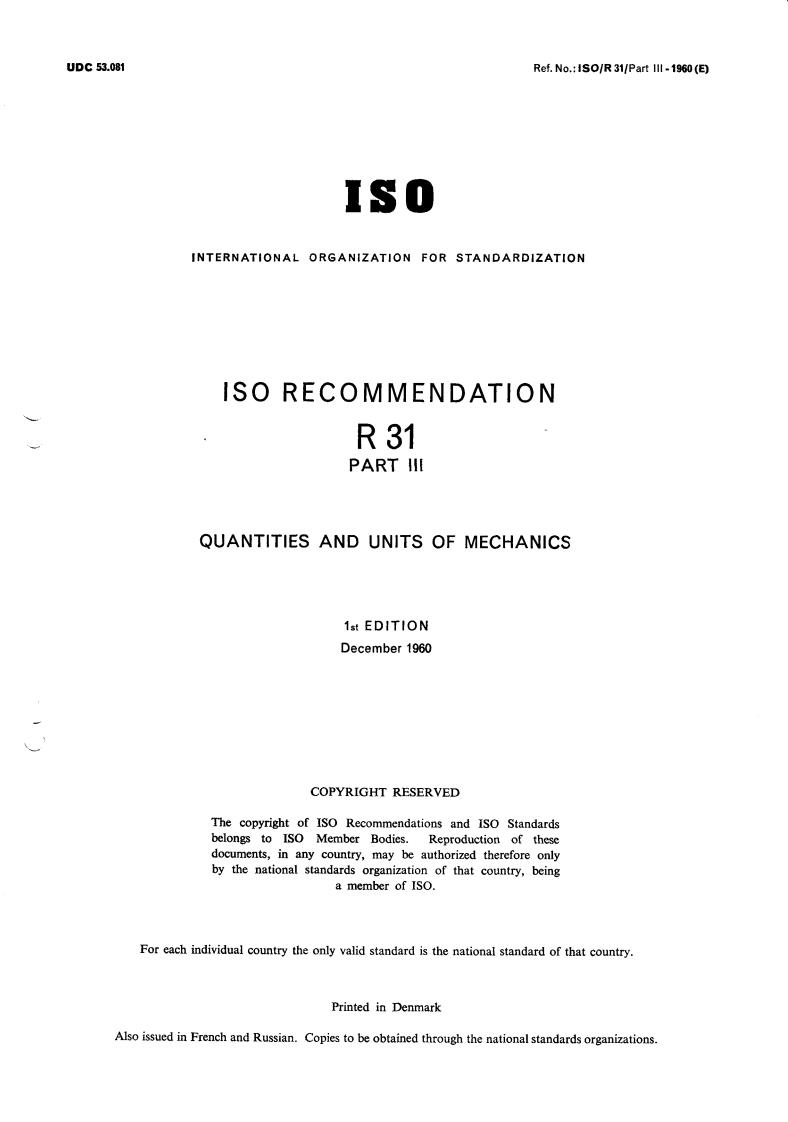
UDC 53.081 Ref. No.:lSO/R3l/Part Ill-l96O(E)
IS0
ORGAN I2 AT I ON FO R STAND AR D IZATl O N
I N TERN AT I O N A L
I SO R EC O M M EN DATI O N
R 31
PART Ill
QUANTITIES AND UNITS OF MECHANICS
1st EDITION
December 1960
COPYRIGHT RESERVED
The copyright of IS0 Recommendations and IS0 Standards
belongs to IS0 Member Bodies. Reproduction of these
documents, in any country, may be authorized therefore only
by the national standards organization of that country, being
a member of ISO.
For each individual country the only valid standard is the national standard of that country.
Printed in Denmark
Also issued in French and Russian. Copies to be obtained through the national standards organizations.
---------------------- Page: 1 ----------------------
BRIEF HISTORY
The IS0 Recommendation K 31, Part III, Quantities and Units of Mechanics, was
drawn up by Technical Committee ISO/TC 12, Quantities, Units, Symbols, Con-
version Factors and Conversion Tables, the Secretariat of which is held by the
Danish Standards Association, Dansk Standardiseringsriid (DS).
The ISO/TC 12 Secretariat drew up two drafts in succession, the second of which
was studied in detail by the Technical Committee during its fourth meeting, held
in Copenhagen in November 1957. The Secretariat then prepared a third draft
proposal, which was approved as a Draft IS0 Recommendation.
It should be noted that the following international organizations have had these
draft proposals sent to them and have taken part in the discussions at the
meetings of Technical Committee ISO/TC 12 :
International Commission on Illumination
International Committee on Weights and Measures
International Electrotechnical Commission
International Union of Pure and Applied Chemistry -
International Union of Pure and Applied Physics
and its Sub-Committee SUN
Organisation Internationale de Métrologie Légale
On 31 March 1959, the Draft IS0 Recommendation (No. 276) was distributed
to all the IS0 Member Bodies and was approved by the following Member Bodies :
Australia Hungary Poland
Austria India Portugal
Belgium Ireland Sweden
Burma Israel Switzerland
Czechoslovakia Japan United Kingdom
Denmark Netherlands U. S. A.
France New Zealand U. S. S. R.
Germany Norway
Greece Pakistan
Two Member Bodies opposed the approval of the Draft:
Italy, Romania
The Draft IS0 Recommendation was submitted by correspondence to the IS0
IS0 RECOM-
Council, which decided, in December 1960, to accept it as an
M END AT I O N.
-2-
---------------------- Page: 2 ----------------------
1
ISOIR31IPart 111 - 1960(E)
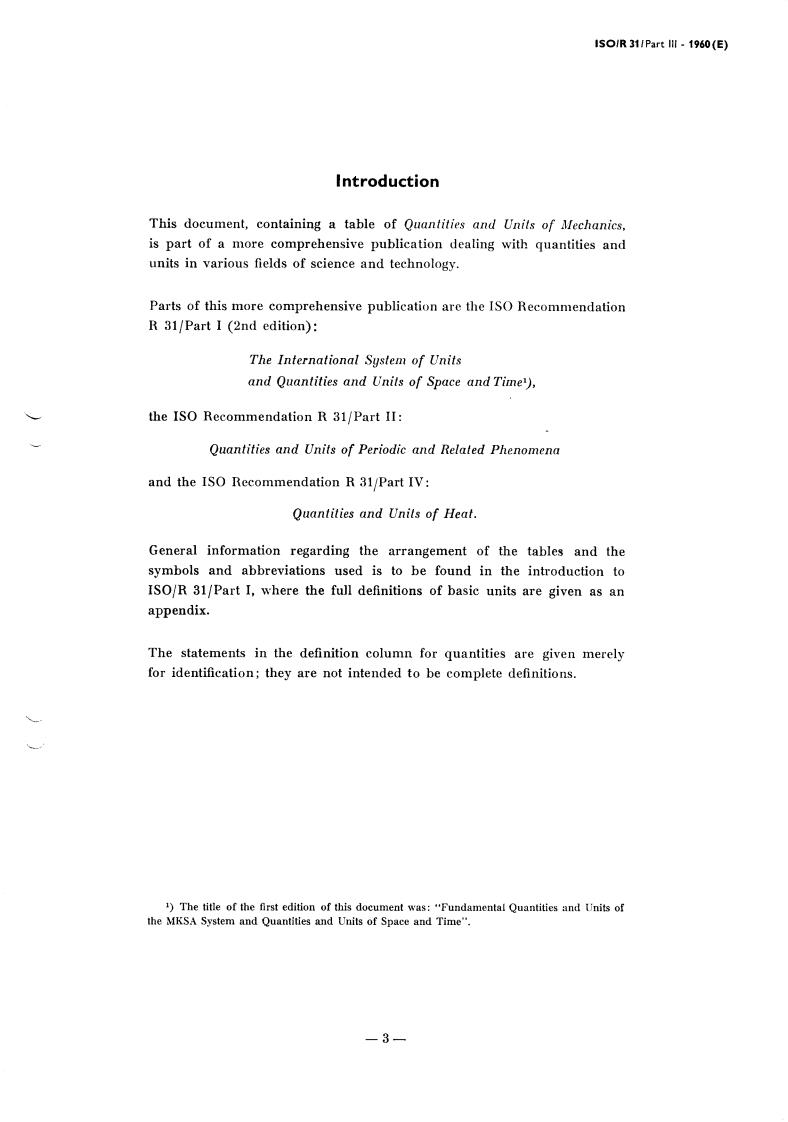
Introduction
This document, containing a table of Quantities and Units of Mechanics,
is part of a more comprehensive publication dealing with quantities and
units in various fields of science and technology.
Parts of this more comprehensive publication arc, the IS0 Recommendation
R 311Part I(2nd edition):
The International System of Units
and Quantities and Units of Space and Time’),
the IS0 Recommendation R 31/Part II:
Quantities und Units of Periodic and Related Phenomena
and the IS0 Recommendation R Sl/Part IV:
Quantities und Units of Heat.
General information regarding the arrangement of the tables and the
symbols and abbreviations used is to be found in the introduction to
ISO/R 31/Part I, where the full definitions of basic units are given as an
appendix.
The statements in the definition column for quantities are given merely
for identification; they are not intended to be complete definitions.
I) The title of the first edition of this document was: “Fundamental Quantities and Units of
the MKSA System and Quantities and Units of Space and Time”.
-3-
---------------------- Page: 3 ----------------------
ISOIR 31IPart 111 - 1960(E)
3. Mechanics
Quantities
3 -1 .I
l
Item 1
Quantity Symbol Definition
Remarks
No. 1
l
I
l I
3-1.1 mass m
I
I I
I
-4-
---------------------- Page: 4 ----------------------
ISOIR31IPart 111 - 196O(E)
3. Mechanics
Units
3-1 .a. .3 -1 .h
Name of unit International
symbolic I
Definition Remarks
, Conversion factors
N~. , cases abbreviation abbreviation
for this name for unit
I
3-1 .a The kilogramme is the unit of For details, see KO/R 31 /Part 1.
kilogramme
massdefined underthat name
by the Conférence Genérale
des Poids et Mesures.
3-1 .b
gramme 1 g = IO-' kg
3-1 .C tonne 1 t = 1000 kg
...................................... * ..............
L1.d metric carat 1 metric carat = 200 mg Adopted by the 4th Conférence
Générale des Poids et Mesures
(1907) for commercial transac-
tions in diamonds, fine pearls and
precious stones.
3-1 .e metric technical I metric technical unit of 1 metrictechnical unit of mass
unit of mass mass is the mass that acquires = 9.80656 kg (exactly)
an acceleration of 1 mjs'
under the influence of a
force equal to 1 kilogramme
-force. (See 3-8d).
I-1.f pound (UR) 1 Ib (UK) is the fundamental 1 Ib (UK) = 0.453 592 338 kg For details, see ISO/R 31/Part I.
(avoirdupois), unit of mass in the British (determined experimentally in See also remark 3-1.h
lb (UK) Imperial System as defined in 1933).
law (Weights and hleasures
Acts).
I-1.g pound (US) The avoirdupois pound (US) 1 Ib avdp (US) = 0.453 592 427 7 kg
The relation given in the definition
(avoirdupois), is derived from the inter- (exactly; was officially adopted on or before
Ib avdp (US) national kilogramme as au- March 21. 1894.
thorised in the hlendenhall
The factor therein is the result of
Order of 5th April, 1893. The an experimental determination in
relation used is 1 avoirdupois
1883 of the mass at that time of
pound-0.453592427 7kg the United Kingdom Standards.
See also remark 3-1.h
3-1.h pound Consideration has been given to
Ib 1 Ib = 0.453 59237 kg
the possibility of redefining the
, (avoirdupois)
U.K. and U.S. pounds (avoirdu-
pois) on a common legal basis by
reference to the kilogramme,
and the following values have
been proposed :
I pound = 0.453 5923 kg
or 0.453 592 37 kg
Both these values are such that
the ratioofthe grain (1/70001b)
to the kilogramme would be
exactly expressible as a termi-
nating decimal. No decision,
however, hasso far been reached
Throughout these tables the
term pound, with its symbolic
abbreviation Ib, not followed by
theaffix(UK)or(US), relatestoa
unit of mass which istreated here
as if it were exactly equivalent to
0.45359237 kg, but the adoption
of this relationship should not
be regarded as giving it any
special status: nor does it pre-
judice the choice of a common
definitive value for the pound in
the future. The same common
relationship applies to multiples
and sub-multiples of the pound
whenever they are not followed
by an affix having some other
significance.
The value of the pound given
under 3-1.h coincides with that
adopted in 1959for precise mea-
surement for science and tech-
6 natio-
nology by the following
nal laboratories: (continued)
-5-
---------------------- Page: 5 ----------------------
ISOIR31IPart 111 - 1960(E)
Mechanics (continued)
3.
Quantities
3-2.1. .3-7.1
Quantity Symbol Definition') ~ Remarks
Mass divided by volume.
1-2.1 density
!'. P
i
(mass density)
- ~~ ~ ~__ ~ ~ - ~~~~ -
Ratio of the density of a substance to the This quantity is dimensionles.
3-3.1 relative density id
densltyofareferencesubstanceundercon- When the reference substance is
ditions that should be specified for both ~ water, the name specific gravity is
1 often used in English.
substances.
~. __
~~ ~
3-4.1 specific volume Volume divided by mass. ~
__
Product of mass and velocity.
3-5.1 momentum
I
The moment of momentum of a particle
3-6.1 moment of momentum,
is equal to the vector pro-
angular momentum about a point
duct of the radius vector from this point
to the particle and the momentum of
the particle.
-
~~
The (dynamic) moment of inertia of a To be distinguished from 3-16.1 and
3-7.1 moment of inertia ~1,J
body about an axis is the sum (integral) of 3-1 6.2
(dynamic moment of inertia)l
the products of its mass-elements and the
squares of their distances from the axis.
-
1) The statements in this column are given merely for identification and they are not intended to be complete definitions.
-6-
---------------------- Page: 6 ----------------------
ISOIR31IPart 111 - 1960(E)
3. Mechanics (continued)
Units
3-1.i . 3-7.a
Name of unit
International
Item
and in certain symbolic
Conversion factors Remarks
Definition
abbreviation
No. cases abbreviation
for unit
~
for this name
Applied Physics Division, Natio-
1
I
nal Research Council, Ottawa,
1 slug=(980.665/30.48)1b(exactly) This unit is the British technical
3-1 .i slug 1 slug is the mass that acqui-
res an acceleration of 1 ft/s2 = 32.1740 Ib unit of mass. See3-8.f
= 14.5939 kg
under the influence of aforce
equal to 1 pound-force.
UR and
3-1.j grain, gr 1 grain = (1/7000) Ih 1 grain = 64.798 91 mg (exactly)
16 dram = Ounce US avoi
16 ounce 1 pound c dupois
1 OZ = 28.3495 g
3-1.k ounce 1 oz = 437.5 grain
units
(avoirdupois), oz
I
1 cwt = 50.8023 kg - i UK unit In the US when the
3-1.1 hundredweight, i 1 1 cwt = 112 Ib
,
word ton is used
c\vt 1
alone the reference is
I
to the short ton of
2000 Ih unless therc
is specific reference
I-1.m ton 1 ton = 22401b 1 ton = 1016.05 kg
= 1.01605 t ~ UK IInit to the long ton or gross
3-1.n short 1 sh cwt = 100 lh avdp (US) 1 sh cwt = 45.3592 kg ’ US unit
hundredweight,
sh cwt
ton” and “long hund-
1 US unir redweight” respccti-
short ton, 1 1 sh tn = 2000 Ib avdp (USj 1 sh tn = 907.185 kg
3-1.0
= 0.907 185 t vely.
sh tn
i
The troy pound is not a legal unil
I-1.p troy ounce, 1 troy ounce = 480 grain 1 troy ounce = 31.1035 g
in the UK, but is legalised in the
oz tr in UK,
as equal
oz t in US US, where it is defined
to 5760 grain.
3 scruple (UK) = 1 drarhm (UK)
I-1.q apothecaries’ 1 I apothecaries’ ounce = 480 1 apothecaries’ounce = 31.1035 g
ounce, 3 scruple (US) = 1 dram ap (US)
I grain
8 drachm (UK) = 1 oz apoth (UK
oz apoth in UK,
8 dram ap (US) = 1 oz ap (US)
oz ap in US
~~ ~ ~ ~~ ______~ ~~
3-2.a
tonne per t/m3 ~ 1 t/m3 = 1000 kg/m5 1 t/m3 = 1 g/cm3
3-2.b
cubic metre
................................................... “I.
.............................. ........................ ................................................. .............................................. , ........
1 g/ml = 999.972 kg/mS
3-2.c gramme per milli- I g/ml
litre
I
’ 1 lb/ft3 = 16.0185 kg/m3
3-2.d
pound per ~ lb/ft3 ~
!
cubic foot
3-4.a cubic metre
per kilogramme
3-5.a kilogramme kg. mls
1
metre per second I
3-6.a kilogramme kg. mals
metre squared
per second
3-7.a kilogramme kg. m2
:
metre squared
I
I
1
i
I _~_
-7-
---------------------- Page: 7 ----------------------
1
ISOlR 31 I Part 111 - 1960(E)
3. Mechanics (continued)
Quantities
3-8.1 . 3-11.3
Definition ‘) Remarks
1-8.1 force
The weight of a body is that force which, The quantity here defined has com-
1-8.2 weight
monly been called the local “gravita-
when applied to the body, would give it
an acceleration equal to the local accelera- tional” force on the body. It is note-
worthy that the “weight” arises not
tion of free fall.
only from the resultant of the gravi-
tational forces existing at the place
where the body is, but also from the
local centrifugal force.
The effect of atmospheric buoyancy is
excluded, and consequently the
weight defined is the weight in vacuo.
(See also Comptes Rendus, 3’ Con-
férence Génerale des Poidset Mesures,
p. 70).
1901,
~ ~~ ~- - ~ ~__ .-
I
Weight divided by volume. 1 Varies with the acceleration offreefall.
3-9.1 specific weight
, (weight density)
M The moment of a force about a point is
3-1 0.1 moment of force
equal to the vector product of the ra-
dius vector, from this point to any point
on the line of action of the force, and
the force.
M
3-1 0.2 bending moment
When the resultant of a system of
3-1 0.3 T
torque, moment of a couple
forces is zero, this system can be re-
1 placed by a couple.
-~ ____ ~___--~-
-~
I
3-1 1 .I pressure
P
U
3-1 I .Z normal stress
t
3-1 1.3 shear stress
’) See footnote on page 6.
-8-
---------------------- Page: 8 ----------------------
I
ISOIR 31IPart 111 - 1960(E)
3. Mechanics (continued)
Units
3-8.a . 3-11.c
Name of unit International
Item
and in certain symbolic
Defi nition Conversion factors Remarks
:ases abbreviation abbreviation
No.
for this name for unit
-
3-8.a newton 1 N is that force which, when
applied to a body having a
mass of 1 kg, gives it an
acceleration of 1 m/s2.
3-8.b dyne 1 dyn is that force which, 1 dyn = N (exactly)
when applied to a body hav-
ing a mass of 1 g, gives it an
acceleration of 1 cm/sz.
1 sn = IOJ N (exactly) 1 sn = 1 kN
3-8s sthhe, sn 1 sn is that forcewhich, when
applied to a body having a
mass of 1 t, gives it an accele-
ration of 1 m/s2.
...................................................
....................................................
This is the force which, when 1 kilogramme-force This is the metric technical unit
3-8.d kilogramme-force,;
applied to a body having a = 9.806 65 N (exactly) of force.
kgf
mass of 1 kg. gives it an The abbreviations kgf (kilo-
gramme-force) and kp (kilo-
acceleration of 9.80665 misz.
pond) are both widely used.
This unit must be distinguished
from the(inconstant)local weight
of a body having a mass of 1 kg.
3-8.e 1 pdl is that force which, 1 pdl = 0.138 255 N
poundal ~ pdl
when applied to a body hav-
ing a mass of 1 Ib, gives it an
acceleration of 1 ft/s2.
f pound-force. Ibf ~ 1 Ibf is that force which, 1 Ibf = 4.448 22 N This is the British technical unit
3-8
of force. This unit must be dist-
when applied to a body hav- = 32.1740 pdl
ing a mass of 1 Ib, gives it an inguished from the (inconstant)
local weight of a body having a
acceleration of 9.80665 m/s2.
mass of 1 Ib. This would be called
“pound-weight”.
... ~ ..
3-9.a newton per N/m3
cubic metre
............................. ................................................ ............................................... ....... , ......................................................
..........
3-9.b kilogramme-force 1 kilogramme-force per cubic See remark 3-8.d
= 9.806 65 N/m3 (exactly)
per cubic metre, metre
kgf/m3
3-9.c pound-force per ~ 1 Ibf/ft3 = 157.087 N/mJ See remark 3-8.f
i
cubic foot, Ibf/ft3
~~ ~-~
~. .-
1
The symbolic abbreviation may
3-10.a newton metre N.m
also be written m.N. but not
mN.
.......... ......................................... ...................................................................................... .....................................................
3-10.b kilogram me-force ! I 1 kilogramme-force metre See remark 3-8.d
!
= 9.806 65 N - m (exactly
metre, kgf. m
i
3-10.c pound-force foot, ! 1 Ibf-ft = 1.35582 N.m See remark 3-8.f
,
Ibf-ft
This unit is also called pascal.
3-l1.a newton per
square metre
3-1l.b pi8re. pz I
...
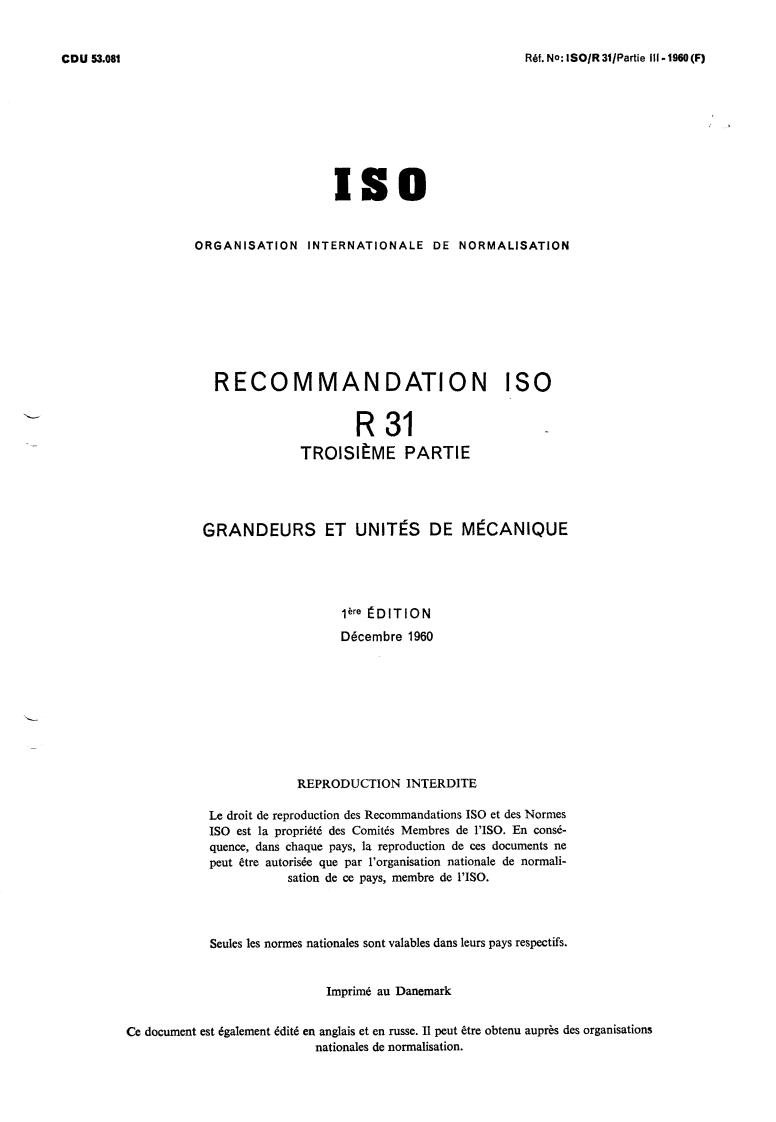
CDU 53.081 RBf. NO: ISO/R 3t/Partie 111 - 1960 (F)
IS0
O RG A N I SAT I ON I N T ER N AT I O N A LE D E N O R M A LI SAT1 O N
R E C O M M A N D AT1 O N I S O
R 31
TROlSIEME PARTIE
GRANDEURS ET UNITÉS DE MÉCANIQUE
ibre EDITION
Décembre 1960
REPRODUCTION INTERDITE
Le droit de reproduction des Recommandations IS0 et des Normes
IS0 est la propriété des Comités Membres de 1’ISO. En consé-
quence, dans chaque pays, la reproduction de ces documents ne
peut étre autorisk que par l’organisation nationale de normali-
sation de ce pays, membre de 1’ISO.
Seules les normes nationales sont valables dans leurs pays respectifs.
Imprimé au Danemark
Ce document est Bgalement édité en anglais et en russe. I1 peut étre obtenu auprès des organisations
nationales de normalisation.
---------------------- Page: 1 ----------------------
HISTORIQUE
La Recommandation ISO/1\ 31, Troisième Partie, Grandeurs et unités de niécani-
que, a été élaborée par le Comité Technique ISO/TC 12, Grandeurs, unités, sym-
boles, facteurs de conversion et tables de conversion, dont le Secrétariat est assuré
par l’Association Danoise de Normalisation, Dansk Standardiseringsr5d (DS).
Le Secrétariat d’lSO/TC 12 a établi successivement deux avant-projets dont le
deuxième fut examiné de manière détaillée par le Comité Technique au cours de
sa quatricine réunion, tenue à Copenhague, en novembre 1957. Le Secrétariat
établit alors un troisième avant-projet qui fut soumis par correspondance aux
membres du Comité Technique et fut approuvé comme Projet de Recommanda-
tion ISO.
I1 est à noter que les organisations internationales suivantes ont reçu communi-
cation de ces avant-projets et ont participé aux débats des réunions du Comité
Technique ISO/TC 12 :
Commission Inlernationale de 1’Eclairage
Comité International des Poids et Mesures
Commision Electrotechnique Internationale
Union Internationale de Chimie Pure et Appliquée
Union Internationale de Physique Pure et Appliquée et son
Sous-Comité SUN
Organisation Internationale de Métrologie Légale
En date du 31 mars 1959, ce Projet de Recommandation (NO 276) fut distribué
à tous les Comités Membres de I’ISO et approuvé par les Comités Membres sui-
vants :
Allemagne Inde Portugal
Australie
Irlande Royaume-Uni
Autriche Israël Suède
Belgique Japon Suisse
Birmanie Norvège Tchécoslovaquie
Danemark
Nouvelle-Zélande U.R.S.S.
France
Pakistan U.S.A.
Grèce Pays Bas
Hongrie Pologne
Deux Comités Membres se déclarèrent opposCs à l’approbation du Projet:
Italie, Roumanie
Le Projet de Recommandation IS0 fut alors soumis par correspondance au Con-
seil de 1’ISO qui décida, en dCcembre 1960, de l’accepter comme RECOMMAN-
DATION ISO.
---------------------- Page: 2 ----------------------
ISO/R 3l/Partie 111 - 1960(F)
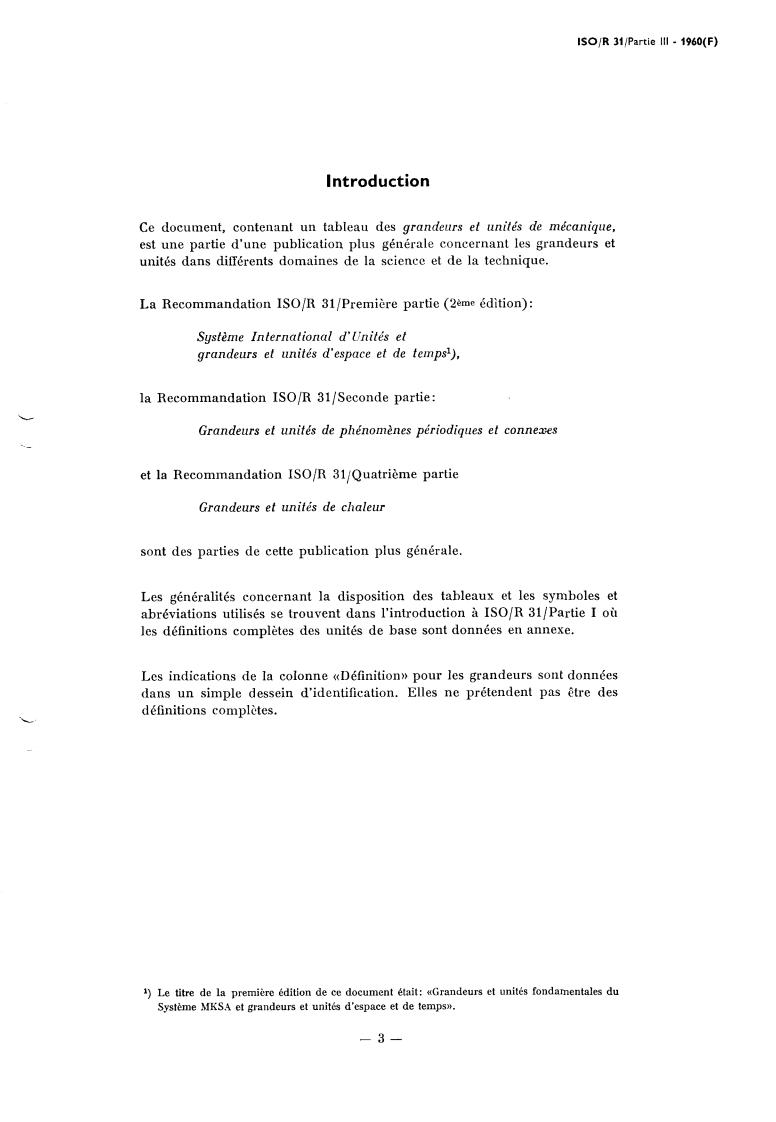
Introduction
Ce document, contenant un tableau des grandeurs et unités de mécanique,
est une partie d’une publication plus générale concernant les grandeurs et
unités dans différents domaines de la science et de la technique.
La Recommandation ISO/R 31 /Premi&re partie (2ème édition)
Système In terna t ional d’ Un it és et
grandeurs et unités d’espace et de temps’),
la Recommandation ISO/R 31/Seconde partie:
Grandeurs et unités de phénomtnes périodiques et connexes
et la Recominandation ISO/R 31/Quatrième partie
Grandeurs et unités de chaleur
sont des parties de cette publication plus générale.
Les généralitCs concernant la disposition des tableaux et les symboles et
abréviations utilisés se trouvent dans l’introduction à ISO/R 31/Partie I oil
les définitions complEtes des unités de base sont données en annexe.
Les indications de la colonne ((Définition)) pour les grandeurs sont données
dans un simple dessein d’identification. Elles ne prétendent pas etre des
définitions compl&tes.
1) Le titre de la premiere édition de ce document Btait: ((Grandeurs et unités fondamentales du
Système MKSA et grandeurs et unités d’espace et de temps)).
---------------------- Page: 3 ----------------------
ISO/R 31/Partie Ill - 1960(F)
3. Mécanique
Grandeurs
3-1 .I
Symbole Definition Remarques
Grandeur
masse
-4-
---------------------- Page: 4 ----------------------
lSO/R 31IPartie 111 - 1960(F)
3. Mécanique
Unités
3-1 .a. .3-1 .h
Nom de l’unité
Symbole
et, dans certains
,nternational Définition ~ Facteurs de conversion Remarques
cas, abréviation
de l’unité
pour ce nom
Le kilogramme est l’unité de Pour les détails,
3-1 .a kilogramme
sous ce nom voir lSO/R 31/Partie I.
masse définie
par la Conférence Genérale
des Poids et Mesures.
1 g = IO-= kg
3-1 .b gramme
3-1.c tonne 1 t = 1000 kg
. . . . . . . . . . . * . . . . . . .
3-1.d carat métrique 1 carat métrique = 200 mg Adoptée par la 4e Conference GB-
nérale des Poids et Mesures
(1907) pour les transactions com-
merciales concernant les dia-
mants, les perles fines et les pierres
précieuses.
1 unité technique métrique 1 unité technique métrique de
3-1 .e uni te technique
métrique de mast de masse est la masse qui masse = 9,80665 kg (exactement)
acquiert une accélération de
1 m/sa lorsqu’on lui applique
A 1 kilo-
une force égale
gramme-force. (Voir 3-8.d)
1 lb (UK) = 0,,453 592 338 kg Pour les détails,
3-1.f pound (UK) 1 lb (UK) est l’unité fonda-
(avoirdupois), mentale de masse du système (déterminé expérimentalement ed voir ISO/R 31/Partie I.
impérial britannique, telle 1933).
lb (UK) i Voir aussi remarque 3-1.h
qu’elle est définie par la loi I
(Weights and Measures Acts).
l
3-1.g pound (US) Le pound avoirdupois (US) 1 lb avdp (US) = 0,453 592 427 7 kgl La relation donnée dans la de-
(avoirdupois), est dérive du kilogramme in- (exactement) 1 finition a eté officiellement adop-
lb avdp (US) ternational comme autorisé tee le 21 mars 1894.
par I’ArrOté Mendenhall du Le facteur qui y figure est le ré-
5 avril 1893. La relation uti- I sultat d’une détermination expéri-
lisée est 1 pound avoirdupois 1 mentale, faite en 1883, de la masse
= 0,453 592 427 7 kg de l’étalon britanniaue existant à
cette époque.
Voir aussi remarque 3-1.h
3-1.h pound Ib 1 Ib = 0,453 592 37 kg On a envisagé la possibilité de
définir à nouveau les pounds
(avoirdupois)
U.K. et U.S. (avoirdupois) sur
une base légale commune par
référence au kilogramme, et les
valeurs suivantes ont été pro-
posées: 1 Dound = 0.453 592 3 krr
ou 01453 592 37 cg
Ces deux valeurs sont telles
que le rapport entre le grain
(1/70001b) et le kilogramme
s’exprime exactement par un
nombre décimal. Cependant,
jusqu’à ce jour, aucune décision
’ n’a été prise.
Dans toutes ces tables, le terme
pound, ainsi que son symbole Ib,
non suivis de (UK) ou (US)
s’appliquent à une unité de
masse qui est considérée ici
comme étant exactement égaleà
0,453 592 37 kg, mais l’adoption
de cette relation ne doit pas être
considérée comme lui conférant
une position particulière: de
même qu’elle ne préjuge en
aucune façon du choix ultérieur
d’une valeur commune définitive
pour le pound. La même relation
commune s’applique aussi aux
multiples et sous-multiples du
pound chaque fois qu’ils ne sont
pas suivis d’une indication ayant
une signification différente.
La valeur du pound donnée au
3-1 .h coïncide avec celle adoptée
en 1959 pour les mesures de pré-
cision pour la science et la tech-
nique par les six laboratoires
nationaux suivants:
-
-5-
---------------------- Page: 5 ----------------------
I
lSO/R 31/Partie 111 - 1960(F)
3. Mécanique (suite)
Grandeurs
3-2.1 . . .3-7.1
I
I
i
Remarques
Definition l)
NO i Grandeur
~~ ~ ~ ~~~~~
- ~~~~
masse volumique
3-2.1
I Quotient de la masse par le volume.
I i
Cette grandeur est sans dimensions.
densité relative d Rapport de la masse volumique d’un corps
3-3.1
homogene à la massevolumiqued’uncorps Quand le corps de référence est l’eau,
~~
volume massique U
3-4.1
~
Produit de la masse par la vitesse.
3-5.1 quantité de mouvement
P
3-6.1 moment cinétique,
moment de quantite de
mouvement
___
A distinguer de 3-16.1 et 3-16.2
Le moment d’inertie (moment d’inertie
3-7.1 moment d’inertie
(moment d’inertie dyna- dynamique) d’un corps par rapport à un
axe est la somme (intégrale) des produits
mique)
de ses masses elementaires par les carres
de leurs distances à l’axe.
1) Les indications de cette colonne sont donndes dans un simple dessein d’identification et elles ne prétendent pas &re des definitions complètes.
-6-
---------------------- Page: 6 ----------------------
ISO/R 3l/Partie 111 - 1960(F)
3. Mécanique (suite)
Unités
3-1 .i . . .3-7.a
Nom de l’unit6
Symbole
et, dans certains
international Définition Facteurs de conversion I Remarques
NO
cas, abréviation
de I,unité
pour ce nom
I ~
-
I Applied Physics Division, Natio-
nal Research Council, Ottawa,
Canada. Dominion Physical La-
boratory, Lower Hutt, New Zea-
1 land. National Bureau of Stan-
I
l
l
1 I
, 1
l
1 slugest lamassequiacquiert
slug
3-1.i
une accélération de 1 ft/s2
lorsqu’on lui applique une
force égale à 1 pound-force.
1 grain = (1/7000) Ib
grain, gr
3-1.j
1 oz = 437,5 grain
3-1.k ounce
(avoirdupois), oz
1 cwt = 112 Ib
hundredweight,
3-1.1
:wt
porte au ((short tonn di
2000 lb, à moins qu’i
I
nc soit fait une référen
ce spéciale au don{
1 ton = 2240 Ib 1 ton = 1016.05 kg Unité du
3-l.n- ton
- 1,016 05 t Royaume- ton)) ou au ((gross ton))
Uni
Le ((ton)) de 2240 Ib e
le cchundredweighb) di
112 lb sont aussi uti
Unité des lisCs dans une certain1
1 sh cwt = 100 Ib avdp (US) 1 sh cwt = 45,3592 kg
3-1.n short
hits-Unis mesure aux Etats-Unis
hundredweight,
Dans ce cas, ils son
sh cwt
I appelés rcspectivemen
1 sh tn - 907.185 kg Unite des dong tonn et doni
short ton, i 1 sh tn = 2000 Ib avdp (US)
3- 1 .O
Etats-Unis I hundredweight)).
= 0,907 185 t
sh In
1 troy ounce = 31,1035 g Le pound troy n’est pas une unité
troy ounce, i 1 troy ounce = 480 grain
3-1.p
au Royaume-Uni, mais es1
légale
oz tr
I
reconnue par la loi aux Etats-
au Royaume-Uni,
Unis, oh il est défini comme
oz t aux Gtats-Unis
étant égal A 5760 grain.
1 1 apothecaries’ ounce - 480 1 apothecaries’ ounce = 31,1035 g 3 scruple (UR) = 1 drachm (UK)
apothecaries’
3 scruple (US) = 1 dram ap (US)
ounce, oz apoth grain
8 drachm (UK) = 1 oz apolh (UK)
au Royaume-Uni,
8 dram ap (US) = 1 oz ap (US)
ozapaux Qtats-Unis
3-2.a 1 kilogramme par
1 kg/m3
1 metre cube I
1 I t/m3 = I g/cm3
~ 1 t/m3 = 1000 kg/m3
................................................. ........ * ..... * ......................................... .................................................... ,
1 g/ml = 999.972 kg/ms
!
i 1 Ib/ft3 = 16,0185 kg/m3
1
____-. .
___~ ~~ .
I
parseconde I
____ __ ~- __
kilogramme 1 kg. m2/s
mètre card
par seconde
I
I
~~ - ~~ ~~ ~ -
3-7.a , kilogramme
l
I
- -
---------------------- Page: 7 ----------------------
I
ISO/R 31/Partie 111 - 1960(F)
3. Mecanique (suite)
Grandeurs
3-8.1 . . .3-11.3
Remarques
No Grandeur j Symbole Definition l)
3-8.1 force
3-8.2 poids Le poids d’un corps est la force qui, ap- La grandeur ici definie a et6 parfois
appelee force <> ou pesan-
pliquee à ce corps, lui communiquerait
à I’accél6ration teur du corps. II importe de remar-
une acdl6ration égale
locale en chute libre. quer que le <> provient non
seulement de la resultante des forces
newtoniennes existant à l’endroit où
se trouve le corps, mais aussi de la
force centrifuge localc.
L’influence de la poussee atmosphe-
rique est exclue et en consequence
le poids ainsi defini est le poids dans
le vide. (Voir aussi Comptes Rendus,
3” Conference GBnLrale des Poids et
Mesures, 1901, p. 70).
Quotient du poids par le volume. Varie avec I’accel6ration en chute
3-9.1 poids volumique
libre.
(ou poids specifique)
~~ ~-
1-10.1 moment d’une force Le moment d’une force par rapport à un
point est Bgal au produit vectoriel du
rayon vecteur, allant de ce point à
tout point de la ligne d’action de laforce,
par la force.
LI 0.2 moment de flexion
3-10.3 moment d’un couple Lorsque la resultante d’un systerne de
forces est nulle, ce systsme peut être
(torque)
remplace par un couple.
______.~~
-~
3-1 1 .I pression
3-1 1.2 contrainte normale,
tension normale
3-1 1.3 contrainte tangentielle,
tension de cisaillement
’> Voir note en page 6.
-8-
---------------------- Page: 8 ----------------------
ISO/R 31/Partie 111 - 1960(F)
3. MeCanique (suite)
Unites
3-8.a. . 3-1 1 .c
- ~
Nom de l’unité
Symbole
et, dans certains
NO nternational Définition Facteurs de conversion Remarques
cas, abréviation
de l’unité
pour ce nom
- ~~
3-8.a newton N 1 Nest laforcequi, appliquée
àun corps ayant une masse de
1 kg, lui communique une ac-
célération de 1 m/s2.
1 dyn est la force qui, appli- 1 dyn = IO” N (exactement)
3-8.b dyne
dyn
qu6e à un corps ayant une
1 g, lui communique
masse de
une accélération de 1 cm/s2.
sthene. sn 1 sn estlaforcequi,appliquée 1 sn = IO’ N (exactement) 1 sn = 1 krJ
3-8.c
à un corps ayant une masse
de 1 t. lui communique une
accélération de 1 m/s2.
.....................................................
.......... .............................. ............................................. _. ....................................................
Cette unitéest l’unité technique
3-8.d kilogramme-force, C’est la force qui, appliquée 1 kilogramme-force = 9,806 65 N
(exactement) métrique de force.
àuncorpsayant unemassede
kgf
1 kg, lui communique une ac- Les abréviations kgf (kilogram-
me-force) et kp (kilopond) sont
célération de 9,806 65 m/s2.
toutes deux largement utilisées.
Cette unité est à distinguer du
poids local (variable) d’un corps
ayant une masse de 1 kg.
1 pdl = 0,138 255 N
3-8.e poundal 1 pdl est la force qui, appli-
quée à un corps ayant une
massedel Ib, luicommunique
une accélération de 1 ft/s2.
3-8.f 1 Ibf est la force qui, appli- 1 Ibf = 4,448 22 N Cette unité est l’unité technique
pound-force, Ibf
britannique deforce. Cette unité
quée à un corps ayant une = 32,1740 pdl
à distinguer du poids local
masse de 1 Ib, lui communi- est
(variable) d’un corps ayant une
que une accélération de
9,806 65 m/s2. masse de 1 Ib. Celle-ci s’appel-
lerait ccpound-weight>>.
3-9.a newton par N/m3
mètre cube
.....................................................
Voir remarque 3-8.d
kilogramme-force 1 kilogramme-force par metre
3-9.b
cube = 9,80665 N/m3
par metre cube,
kgf/m3 (exactement)
Voir remarque 3-8.f
3-9.c pound-force per 1 lbf/ft3 = 157,087 N/m3
cubic foot, Ibf/ft3
~ -~
Le symbole peut aussi être écrit
3-10.a metre-newton N.m
m .N, mais non mN.
......................................................
I-1O.b metre- I metre-kilogramme-force = Voir remarque 3-8.d
9,80665 N. m (exactement)
kilogramme-force.
kgf . m
1-1o.c pound-force foot, j 1 Ibf.ft = 1,35582 Nam Voir remarque 3-8.f
Ibf*ft
1-1 I .a newton par N/m2 Cette unité est aussi appelée
metre carré pascal.
I-1l.b 1 pz = 1 sn/m2 1 pz = IO3 N/m2 (exactement)
pieze, pz
3-1l.c bar 1 1 bar = IO5 N/m2 1 1 bar = IO5 N/m2 (exactement) Le microbar (1 pbar =I dyn/cm2)
bar
I = ln6 rlvnirm2
.- est aussi appelé barye.
-I ”I-“’
(exactement) Le millibar est très employé en
= 1 hpz (exactement) barométrie météorologique, et
alors son nom est souvent abrégé
comme suit: mb.
-9-
---------------------- Page: 9 ----------------------
ISO/R 31/Partie 111 - 1960(F)
3. MeCaniq
...
Questions, Comments and Discussion
Ask us and Technical Secretary will try to provide an answer. You can facilitate discussion about the standard in here.