

ISO/FDIS 22161-3
(Main)Aerospace series — Brazing and high-temperature brazing of metallic components — Part 3: Furnace, torch and induction brazing using silver alloys
General Information
- Abstract
This document specifies the requirements for furnace, torch and induction brazing using silver alloys. This document is applicable to brazing of metallic components, in conjunction with the design/engineering authority’s requirements.
- Status
- Not Published
- Technical Committee
- ISO/TC 44/SC 14 - Welding and brazing in aerospace
- Drafting Committee
- ISO/TC 44/SC 14 - Welding and brazing in aerospace
- Current Stage
- 5020 - FDIS ballot initiated: 2 months. Proof sent to secretariat
- Start Date
- 18-Sep-2026
- Completion Date
- 18-Sep-2026
Buy Documents

ISO/FDIS 22161-3 - Aerospace series — Brazing and high-temperature brazing of metallic components — Part 3: Furnace, torch and induction brazing using silver alloys
REDLINE ISO/FDIS 22161-3 - Aerospace series — Brazing and high-temperature brazing of metallic components — Part 3: Furnace, torch and induction brazing using silver alloys
Overview
ISO/FDIS 22161-3:2026 is an international standard developed by ISO for the aerospace sector, specifically focused on the brazing and high-temperature brazing of metallic components using silver alloys. This standard sets forth clear requirements for three primary brazing methods: furnace brazing, torch brazing, and induction brazing. It is intended for use in conjunction with specific requirements defined by the design or engineering authority, ensuring the structural integrity and airworthiness of aerospace hardware.
The document provides comprehensive guidelines covering conformance, joint classification, brazement design, qualification of procedures, fabrication processes, quality personnel, and inspection methods. Its implementation supports quality assurance in aerospace fabrication and strengthens compliance with global best practices.
Key Topics
- Scope of Application: The standard applies to the brazing of metallic components in aerospace, utilizing silver alloys in various controlled conditions.
- Joint Classification: Defines three classes of joints based on their criticality, with inspection and testing requirements tailored to the risk associated with joint failure.
- Brazing Procedures: Outlines the creation and qualification of Brazing Procedure Specifications (BPS) and corresponding Brazing Procedure Qualification Records (BPQR), ensuring repeatable, qualified production processes.
- Brazement Design: Mandates that design authorities specify unique and mission-critical requirements, providing guidance for joint integrity and functionality.
- Inspection Methods: Details rigorous visual, radiographic, metallographic, and mechanical testing (such as tensile, peel, and bend tests) according to joint class.
- Personnel Qualification: Requires both brazing operators and inspectors in aerospace manufacturing to be qualified according to established standards and procedures.
- Consumables and Equipment Control: Specifies the identification, traceability, storage, and handling of filler materials, fluxes, and brazing equipment to maintain quality assurance.
Applications
ISO/FDIS 22161-3 is essential for organizations involved in aerospace manufacturing and maintenance, particularly in:
- Production of Aerospace Components: Ensuring silver alloy brazing processes meet stringent requirements for quality and safety.
- Component Repair and Overhaul: Standardizing brazing repair procedures across the industry.
- Quality Assurance and Control: Providing a framework for inspection, testing, and qualification of brazed joints in aerospace.
- Supplier and Subcontractor Management: Enforcing consistent standards across different suppliers and subcontractors involved in aerospace projects.
- Regulatory Compliance: Assisting manufacturers in demonstrating conformance to international quality and safety standards required by authorities and customers.
Adhering to ISO/FDIS 22161-3 enhances product reliability and safety, minimizes failure risk, and strengthens global competitiveness by following internationally recognized benchmarks for brazing with silver alloys in aerospace.
Related Standards
Organizations implementing ISO/FDIS 22161-3 often reference the following related standards for additional guidance and compliance:
- ISO 11745: Qualification test for brazers and brazing operators in aerospace.
- ISO 14731: Welding coordination - tasks and responsibilities.
- ISO 17636: Non-destructive testing of welds - radiographic testing.
- ISO 17927-1 & ISO 17927-2: Fusion welding process specification and acceptance criteria for aerospace applications.
- ISO 18496: Brazing fluxes - classification and technical delivery conditions.
- ISO/TR 25901-1: Vocabulary for welding and allied processes.
- EN 4179: Qualification and approval of personnel for non-destructive testing in aerospace.
- SAE AMS 2750: Pyrometry standard for temperature control in thermal processing.
- ASTM E8/E8M & ASTM E21: Test methods for metallic material tension testing, including elevated temperatures.
- ASTM E1742/E1742M: Standard practice for radiographic examination.
By deploying ISO/FDIS 22161-3 in tandem with these standards, aerospace organizations ensure robust process control, technical traceability, and end-product excellence in metallic component brazing using silver alloys.
Buy Documents
ISO/FDIS 22161-3 - Aerospace series — Brazing and high-temperature brazing of metallic components — Part 3: Furnace, torch and induction brazing using silver alloys
REDLINE ISO/FDIS 22161-3 - Aerospace series — Brazing and high-temperature brazing of metallic components — Part 3: Furnace, torch and induction brazing using silver alloys
Get Certified
Connect with accredited certification bodies for this standard

BUREAU VERITAS Certification Germany
Bureau Veritas certification in Germany.

DVS-ZERT GmbH
German welding certification society.

Element Materials Technology
Materials testing and product certification.
Sponsored listings
Frequently Asked Questions
ISO/FDIS 22161-3 is a draft published by the International Organization for Standardization (ISO). Its full title is "Aerospace series — Brazing and high-temperature brazing of metallic components — Part 3: Furnace, torch and induction brazing using silver alloys". This standard covers: This document specifies the requirements for furnace, torch and induction brazing using silver alloys. This document is applicable to brazing of metallic components, in conjunction with the design/engineering authority’s requirements.
This document specifies the requirements for furnace, torch and induction brazing using silver alloys. This document is applicable to brazing of metallic components, in conjunction with the design/engineering authority’s requirements.
ISO/FDIS 22161-3 is classified under the following ICS (International Classification for Standards) categories: 25.160.50 - Brazing and soldering; 49.025.01 - Materials for aerospace construction in general. The ICS classification helps identify the subject area and facilitates finding related standards.
ISO/FDIS 22161-3 is available in PDF format for immediate download after purchase. The document can be added to your cart and obtained through the secure checkout process. Digital delivery ensures instant access to the complete standard document.
Standards Content (Sample)
FINAL DRAFT
International
Standard
ISO/TC 44/SC 14
Aerospace series — Brazing and
Secretariat: DIN
high-temperature brazing of
Voting begins on:
metallic components —
2026-09-18
Part 3:
Voting terminates on:
2026-11-13
Furnace, torch and induction
brazing using silver alloys
RECIPIENTS OF THIS DRAFT ARE INVITED TO SUBMIT,
WITH THEIR COMMENTS, NOTIFICATION OF ANY
RELEVANT PATENT RIGHTS OF WHICH THEY ARE AWARE
AND TO PROVIDE SUPPOR TING DOCUMENTATION.
IN ADDITION TO THEIR EVALUATION AS
BEING ACCEPTABLE FOR INDUSTRIAL, TECHNO-
LOGICAL, COMMERCIAL AND USER PURPOSES, DRAFT
INTERNATIONAL STANDARDS MAY ON OCCASION HAVE
TO BE CONSIDERED IN THE LIGHT OF THEIR POTENTIAL
TO BECOME STAN DARDS TO WHICH REFERENCE MAY BE
MADE IN NATIONAL REGULATIONS.
Reference number
FINAL DRAFT
International
Standard
ISO/TC 44/SC 14
Aerospace series — Brazing and
Secretariat: DIN
high-temperature brazing of
Voting begins on:
metallic components —
Part 3:
Voting terminates on:
Furnace, torch and induction
brazing using silver alloys
RECIPIENTS OF THIS DRAFT ARE INVITED TO SUBMIT,
WITH THEIR COMMENTS, NOTIFICATION OF ANY
RELEVANT PATENT RIGHTS OF WHICH THEY ARE AWARE
AND TO PROVIDE SUPPOR TING DOCUMENTATION.
© ISO 2026
IN ADDITION TO THEIR EVALUATION AS
All rights reserved. Unless otherwise specified, or required in the context of its implementation, no part of this publication may
BEING ACCEPTABLE FOR INDUSTRIAL, TECHNO-
LOGICAL, COMMERCIAL AND USER PURPOSES, DRAFT
be reproduced or utilized otherwise in any form or by any means, electronic or mechanical, including photocopying, or posting on
INTERNATIONAL STANDARDS MAY ON OCCASION HAVE
the internet or an intranet, without prior written permission. Permission can be requested from either ISO at the address below
TO BE CONSIDERED IN THE LIGHT OF THEIR POTENTIAL
or ISO’s member body in the country of the requester.
TO BECOME STAN DARDS TO WHICH REFERENCE MAY BE
MADE IN NATIONAL REGULATIONS.
ISO copyright office
CP 401 • Ch. de Blandonnet 8
CH-1214 Vernier, Geneva
Phone: +41 22 749 01 11
Email: copyright@iso.org
Website: www.iso.org
Published in Switzerland Reference number
ii
Contents Page
Foreword .v
1 Scope . 1
2 Normative references . 1
3 Terms and definitions . 1
4 Conformance . 2
5 Classification and inspection requirements of joints . 2
6 Brazement design . 3
7 Brazing procedure specification (BPS) . 3
7.1 General .3
7.2 Qualification .3
7.3 Test brazements .4
7.3.1 Standard Test Brazements.4
7.3.2 Workmanship test .5
7.4 Base metal grouping .11
7.5 BPS qualification/brazing procedure qualification record (BPQR) .11
8 Fabrication .11
8.1 General .11
8.2 Identification and traceability of brazing consumables .11
8.2.1 Filler material .11
8.2.2 Fluxes . 12
8.3 Storage and use . 12
8.3.1 Filler material . 12
8.3.2 Brazing fluxes . 12
8.3.3 Gases. 12
8.4 Furnace brazing equipment . 12
8.4.1 Brazing furnace temperature control . 12
8.4.2 Vacuum furnaces . 12
8.4.3 Furnace atmosphere control . 13
8.5 Assembly of parts. 13
8.5.1 Cleaning and joint preparation . 13
8.5.2 Joint fit-up . 13
8.5.3 Joint preparation . 13
8.5.4 Filler metal application .14
8.5.5 Flux application .14
8.5.6 Stop-off application .14
8.6 Brazing .14
8.6.1 Torch brazing .14
8.6.2 Furnace brazing .14
8.6.3 Induction brazing.14
8.6.4 Post braze operations . 15
9 Personnel .15
9.1 Brazing coordination personnel . 15
9.2 Qualification of brazers and brazing operators . 15
9.3 Qualification of inspection personnel . 15
10 Inspection methods .15
10.1 Visual inspection . 15
10.2 Radiographic testing (RT) . 15
10.3 Destructive testing .16
10.3.1 General .16
10.3.2 Peel test .16
10.3.3 Tensile testing .16
iii
10.3.4 Tensile test .16
10.3.5 Bend testing .16
10.3.6 Bend test .17
10.3.7 Metallographic examination .17
11 Acceptance criteria .18
11.1 Surface requirements .18
11.2 Macroetch test requirements .18
11.3 Internal requirements .18
11.3.1 Radiographic testing requirement .18
11.3.2 Peel and bend test requirements .18
Annex A (informative) Example forms . 19
Bibliography .22
iv
Foreword
ISO (the International Organization for Standardization) is a worldwide federation of national standards
bodies (ISO member bodies). The work of preparing International Standards is normally carried out through
ISO technical committees. Each member body interested in a subject for which a technical committee
has been established has the right to be represented on that committee. International organizations,
governmental and non-governmental, in liaison with ISO, also take part in the work. ISO collaborates closely
with the International Electrotechnical Commission (IEC) on all matters of electrotechnical standardization.
The procedures used to develop this document and those intended for its further maintenance are described
in the ISO/IEC Directives, Part 1. In particular, the different approval criteria needed for the different types
of ISO document should be noted. This document was drafted in accordance with the editorial rules of the
ISO/IEC Directives, Part 2 (see www.iso.org/directives).
ISO draws attention to the possibility that the implementation of this document may involve the use of (a)
patent(s). ISO takes no position concerning the evidence, validity or applicability of any claimed patent
rights in respect thereof. As of the date of publication of this document, ISO had not received notice of (a)
patent(s) which may be required to implement this document. However, implementers are cautioned that
this may not represent the latest information, which may be obtained from the patent database available at
www.iso.org/patents. ISO shall not be held responsible for identifying any or all such patent rights.
Any trade name used in this document is information given for the convenience of users and does not
constitute an endorsement.
For an explanation of the voluntary nature of standards, the meaning of ISO specific terms and expressions
related to conformity assessment, as well as information about ISO's adherence to the World Trade
Organization (WTO) principles in the Technical Barriers to Trade (TBT), see www.iso.org/iso/foreword.html.
This document was prepared by Technical Committee ISO/TC 44, Welding and allied processes, Subcommittee
SC 14, Welding and brazing in aerospace.
A list of all parts in the ISO 22161 series can be found on the ISO website.
Any feedback or questions on this document should be directed to the user’s
national standards body. A complete listing of these bodies can be found at
www.iso.org/members.html. Official interpretations of ISO/TC 44 documents, where they exist, are
available from this page: https://committee.iso.org/sites/tc44/home/interpretation.html.
v
FINAL DRAFT International Standard ISO/FDIS 22161-3:2026(en)
Aerospace series — Brazing and high-temperature brazing of
metallic components —
Part 3:
Furnace, torch and induction brazing using silver alloys
1 Scope
This document specifies the requirements for furnace, torch and induction brazing using silver alloys. This
document is applicable to brazing of metallic components, in conjunction with the design/engineering
authority’s requirements.
2 Normative references
The following documents are referred to in the text in such a way that some or all of their content constitutes
requirements of this document. For dated references, only the edition cited applies. For undated references,
the latest edition of the referenced document (including any amendments) applies.
ISO 4136, Destructive tests on welds in metallic materials — Transverse tensile test
ISO 5173, Destructive tests on welds in metallic materials — Bend tests
ISO 6892 (all parts), Metallic materials — Tensile testing
ISO 11745, Brazing for aerospace applications — Qualification test for brazers and brazing operators — Brazing
of metallic components
ISO 17636 (all parts), Non-destructive testing of welds — Radiographic testing
ISO 17927-1, Welding for aerospace applications — Fusion welding of metallic components — Part 1: Process
specification
ISO 17927-2, Welding for aerospace applications — Fusion welding of metallic components — Part 2: Acceptance
criteria
ISO 18496, Brazing — Fluxes for brazing — Classification and technical delivery conditions
ISO/TR 25901-1, Welding and allied processes — Vocabulary — Part 1: General terms
EN 4179, Aerospace series — Qualification and approval of personnel for non-destructive testing
ASTM E8/E8M, Test Methods for Tension Testing of Metallic Materials
ASTM E21, Standard Test Methods for Elevated Temperature Tension Tests of Metallic Materials
ASTM E1742/E1742M, Standard Practice for Radiographic Examination
SAE AMS 2750, Pyrometry
3 Terms and definitions
For the purposes of this document, the terms and definitions given in ISO/TR 25901-1 and the following
apply.
ISO and IEC maintain terminology databases for use in standardization at the following addresses:
— ISO Online browsing platform: available at https:// www .iso .org/ obp
— IEC Electropedia: available at https:// www .electropedia .org/
3.1
design/engineering authority
organization having the responsibility for the structural integrity or maintenance of airworthiness of the
hardware and conformance with all relevant documents
[SOURCE: ISO 24394:2018, 3.8]
3.2
preliminary brazing procedure specification
pBPS
document containing the required variables of the brazing procedure which is not yet qualified
[SOURCE: ISO 17779:2021, 3.3]
3.3
brazing procedure specification
BPS
document that has been qualified and provides the required variables of the brazing procedure to ensure
repeatability during production brazing
[SOURCE: ISO 17779:2021, 3.2]
3.4
brazing procedure qualification record
BPQR
record comprising all necessary data from qualification of a preliminary brazing procedure specification (3.2)
[SOURCE: ISO 17779:2021, 3.4]
4 Conformance
When conformance to this document is claimed, all provisions of this document shall be fulfilled, except
those for provisions that the design/engineering authority specifically exempts.
5 Classification and inspection requirements of joints
For the purposes of this document, three classes of brazed joints are defined. This classification shall be
stated in the design documents. If there are no other testing requirements defined by the design/engineering
authority, the minimum amount of testing shall be as follows.
— Class I: A brazed joint whose failure under operating conditions causes the loss of the aircraft/spacecraft
or one of its main components or constitutes a direct hazard to people.
Class I requires visual and dimensional inspection and testing of the sub-surface characteristics: 100 %
of all joints.
— Class II: A brazed joint whose failure causes malfunctions without compromising continued safe flight
until the end of the mission.
Class II requires visual and dimensional inspection, 100 % of all joints.
— Class III: A brazed joint whose failure does not affect the safety and the transport function of the aircraft/
spacecraft.
Class III requires visual and dimensional inspection, 100 % of all joints.
If the design documents do not specify classification and/or inspection requirements, refer to design/
engineering authority.
6 Brazement design
The design/engineering authority is responsible for the design of the brazement and defines the requirements
to ensure conformance with all mission and systems requirements. The engineering documentation shall
clearly define any special requirements, imposed over and above the general requirements.
7 Brazing procedure specification (BPS)
7.1 General
All brazed joints shall be performed in accordance with a brazing procedure specification. A brazing
procedure specification may be used for different production parts. A brazing procedure qualification
record provides test data for assessing the properties of a brazed joint.
The brazing procedure specification (BPS) shall include the information as given in Table 1.
Any format may be used for the BPS, provided all qualification variables and other applicable information
are included. For an example of a BPS, see Figures A.1, A.2 or A.3
7.2 Qualification
a) The actual conditions used in making the test brazement, in accordance with 7.3, and the results of
the required examination and specimen testing shall be recorded on a brazing procedure qualification
record (BPQR). Any format may be used, provided all qualification variables are addressed. For an
example of a BPQR, see Figures A.1, A.2 or A.3.
A BPS may be supported by multiple BPQRs.
b) The qualifying company shall certify that the information on the BPQR is an accurate record of the
tests performed and the test results are in conformance with the qualification variables and testing
requirements of this specification.
c) Test brazements shall not be repaired to meet acceptance requirements.
d) A change of any essential variable beyond that allowed by Table 1 requires requalification of the brazing
procedure specification or an additional brazing procedure qualification covering the changed variables.
Table 1 — Brazing procedure specification (BPS) data
Essential variable Variation requiring requalification
Joint type — A change in joint type. The addition or deletion of a flange is not considered
a change in joint type.
— For lap or socket joints, a decrease from the overlap length used on the
test coupon requires requalification. Overlap may be increased without
requalification. The required overlap shown on the BPS may be expressed
as a minimum dimension or as a ratio of part thickness.
Joint clearance A change of joint clearance outside of the following ranges
— 0,05 mm to 0,13 mm for brazing using flux
— 0,00 mm to 0,05 mm for brazing in a protective atmosphere
Material group(s) designation(s) — A change in material group (see 7.4)
Base metal heat treatment condition —
— may be varied without requalification.
TTabablele 1 1 ((ccoonnttiinnueuedd))
Essential variable Variation requiring requalification
Base metal form (sheet, tube etc.) —
Diameter (tubular only) —
Thickness A change outside the qualification range. The qualification range is 0,5 T to 2 T.
Plating A change from plated to unplated or vice versa or a change in the type of plat-
ing requires requalification.
Filler Metal Alloy A change from one filler metal alloy to a different filler metal alloy.
Filler Metal Form A change from one form of filler metal to another form.
Filler Metal Placement A change from preplaced filler metal to mechanically or manually fed filler
metal, and vice versa.
Flux Use The addition or deletion of brazing flux.
Flux type and trade name — A change in the flux type in accordance with ISO 18496
— A change from a flux not listed in ISO 18496 to another flux requires
requalification.
Furnace Brazing Atmosphere A change in brazing atmosphere requires requalification.
Furnace Brazing Temperature A change in nominal brazing temperature of more than 10 °C requires requali-
fication.
Furnace Brazing Time A change in the brazing time at temperature of more than 10 % requires
requalification.
Type of gas for torch brazing A change in the type of gas for torch brazing.
Nozzle size for torch brazing —
Flame type for torch brazing A change in the flame type (neutral, reducing and oxidizing).
Inductor geometry for induction A change in the geometry.
brazing
Controller settings for induction A change in the controller settings.
brazing
Protective atmosphere for induction A change in the protective atmosphere.
brazing
Brazing Flow Position A change in the braze metal flow direction, except that an angular deviation of
15° is allowed.
Flux removal —
Post Braze Heat Treatment — The addition or deletion of a Post Braze Heat Treatment.
— A change in the postbraze heat treatment temperature more than ±10 °C
from that qualified or a decrease in postbraze heat treatment time of
the greater of 15 minutes or 10 % of the post braze heat treatment time
recorded on the BPQR.
— may be varied without requalification.
7.3 Test brazements
7.3.1 Standard Test Brazements
a) Each brazing procedure shall be qualified by making one or more test brazements, as follows:
1) Standard test pieces per Figure 1 to Figure 13 which show typical joint types for brazing.
i) The value of
...
ISO/TC 44/SC 14
Secretariat: DIN
Date: 2026-06-2509-04
Aerospace series — Brazing and high-temperature brazing of
metallic components —
Part 3:
Furnace, torch and induction brazing using silver alloys
FDIS stage
ISO #####-#:####(X/FDIS 22161-3:2026(en)
All rights reserved. Unless otherwise specified, or required in the context of its implementation, no part of this publication
may be reproduced or utilized otherwise in any form or by any means, electronic or mechanical, including photocopying,
or posting on the internet or an intranet, without prior written permission. Permission can be requested from either ISO
at the address below or ISO’s member body in the country of the requester.
ISO copyright office
CP 401 • Ch. de Blandonnet 8
CH-1214 Vernier, Geneva
Phone: + 41 22 749 01 11
EmailE-mail: copyright@iso.org
Website: www.iso.orgwww.iso.org
Published in Switzerland
ii © ISO #### 2026 – All rights reserved
ii
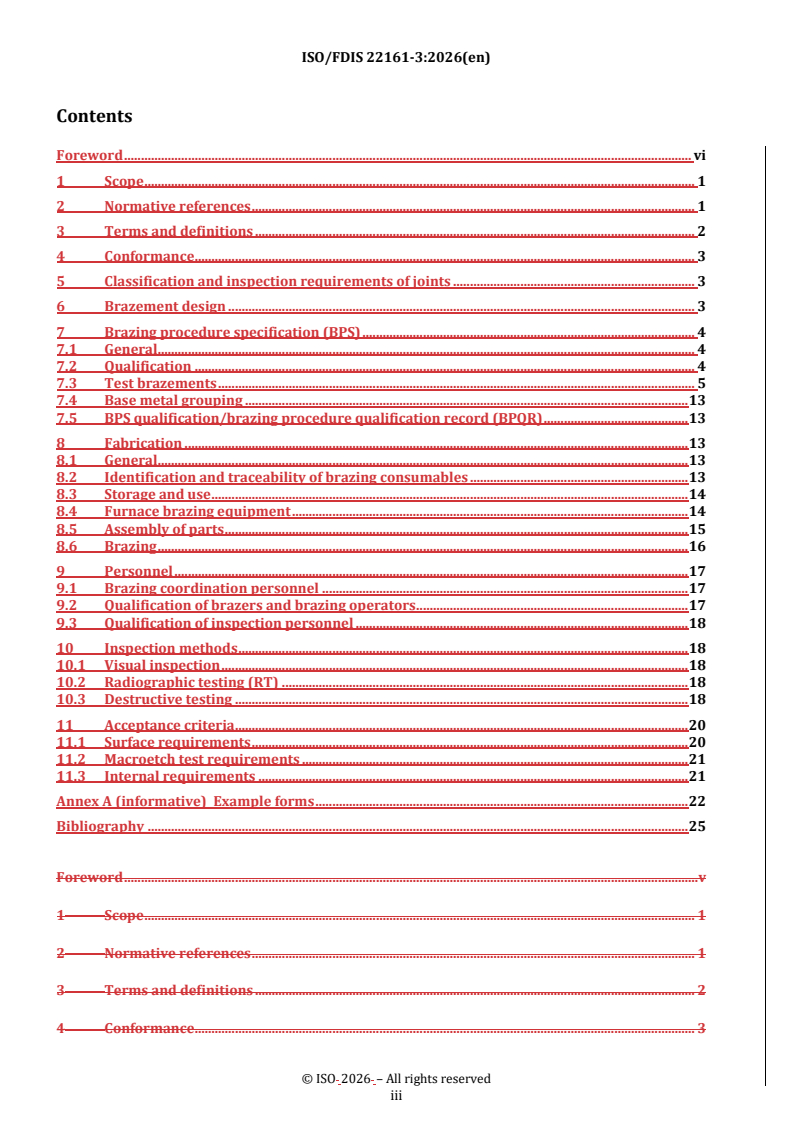
Contents
Foreword . vi
1 Scope . 1
2 Normative references . 1
3 Terms and definitions . 2
4 Conformance . 3
5 Classification and inspection requirements of joints . 3
6 Brazement design . 3
7 Brazing procedure specification (BPS) . 4
7.1 General . 4
7.2 Qualification . 4
7.3 Test brazements . 5
7.4 Base metal grouping . 13
7.5 BPS qualification/brazing procedure qualification record (BPQR) . 13
8 Fabrication . 13
8.1 General . 13
8.2 Identification and traceability of brazing consumables . 13
8.3 Storage and use . 14
8.4 Furnace brazing equipment . 14
8.5 Assembly of parts . 15
8.6 Brazing . 16
9 Personnel . 17
9.1 Brazing coordination personnel . 17
9.2 Qualification of brazers and brazing operators . 17
9.3 Qualification of inspection personnel . 18
10 Inspection methods . 18
10.1 Visual inspection . 18
10.2 Radiographic testing (RT) . 18
10.3 Destructive testing . 18
11 Acceptance criteria . 20
11.1 Surface requirements . 20
11.2 Macroetch test requirements . 21
11.3 Internal requirements . 21
Annex A (informative) Example forms . 22
Bibliography . 25
Foreword . v
1 Scope . 1
2 Normative references . 1
3 Terms and definitions . 2
4 Conformance . 3
© ISO 2026 – All rights reserved
iii
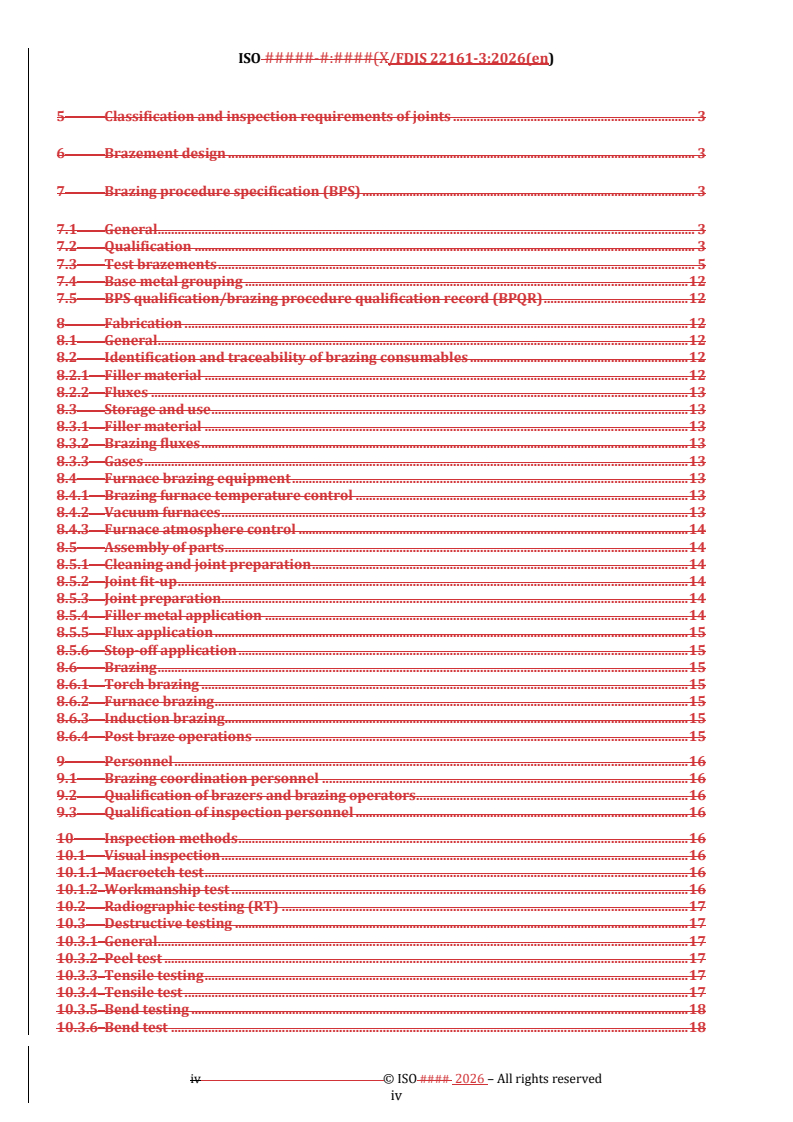
ISO #####-#:####(X/FDIS 22161-3:2026(en)
5 Classification and inspection requirements of joints . 3
6 Brazement design . 3
7 Brazing procedure specification (BPS) . 3
7.1 General . 3
7.2 Qualification . 3
7.3 Test brazements . 5
7.4 Base metal grouping . 12
7.5 BPS qualification/brazing procedure qualification record (BPQR) . 12
8 Fabrication . 12
8.1 General . 12
8.2 Identification and traceability of brazing consumables . 12
8.2.1 Filler material . 12
8.2.2 Fluxes . 13
8.3 Storage and use . 13
8.3.1 Filler material . 13
8.3.2 Brazing fluxes . 13
8.3.3 Gases . 13
8.4 Furnace brazing equipment . 13
8.4.1 Brazing furnace temperature control . 13
8.4.2 Vacuum furnaces . 13
8.4.3 Furnace atmosphere control . 14
8.5 Assembly of parts . 14
8.5.1 Cleaning and joint preparation . 14
8.5.2 Joint fit-up . 14
8.5.3 Joint preparation. 14
8.5.4 Filler metal application . 14
8.5.5 Flux application . 15
8.5.6 Stop-off application . 15
8.6 Brazing . 15
8.6.1 Torch brazing . 15
8.6.2 Furnace brazing . 15
8.6.3 Induction brazing . 15
8.6.4 Post braze operations . 15
9 Personnel . 16
9.1 Brazing coordination personnel . 16
9.2 Qualification of brazers and brazing operators . 16
9.3 Qualification of inspection personnel . 16
10 Inspection methods . 16
10.1 Visual inspection . 16
10.1.1 Macroetch test . 16
10.1.2 Workmanship test . 16
10.2 Radiographic testing (RT) . 17
10.3 Destructive testing . 17
10.3.1 General . 17
10.3.2 Peel test . 17
10.3.3 Tensile testing . 17
10.3.4 Tensile test . 17
10.3.5 Bend testing . 18
10.3.6 Bend test . 18
iv © ISO #### 2026 – All rights reserved
iv
10.3.7 Metallographic examination . 18
11 Acceptance criteria . 19
11.1 Surface requirements . 19
11.2 Macroetch test requirements . 19
11.3 Internal requirements . 19
11.3.1 Radiographic testing requirement . 19
11.3.2 Peel and bend test requirements . 19
Annex A (informative) Example forms . 20
Bibliography . 23
Bibliography . 24
© ISO 2026 – All rights reserved
v
ISO #####-#:####(X/FDIS 22161-3:2026(en)
Foreword
ISO (the International Organization for Standardization) is a worldwide federation of national standards
bodies (ISO member bodies). The work of preparing International Standards is normally carried out through
ISO technical committees. Each member body interested in a subject for which a technical committee has been
established has the right to be represented on that committee. International organizations, governmental and
non-governmental, in liaison with ISO, also take part in the work. ISO collaborates closely with the
International Electrotechnical Commission (IEC) on all matters of electrotechnical standardization.
The procedures used to develop this document and those intended for its further maintenance are described
in the ISO/IEC Directives, Part 1. In particular, the different approval criteria needed for the different types of
ISO document should be noted. This document was drafted in accordance with the editorial rules of the
ISO/IEC Directives, Part 2 (see www.iso.org/directives).
ISO draws attention to the possibility that the implementation of this document may involve the use of (a)
patent(s). ISO takes no position concerning the evidence, validity or applicability of any claimed patent rights
in respect thereof. As of the date of publication of this document, ISO had not received notice of (a) patent(s)
which may be required to implement this document. However, implementers are cautioned that this may not
represent the latest information, which may be obtained from the patent database available at
www.iso.org/patents.www.iso.org/patents. ISO shall not be held responsible for identifying any or all such
patent rights.
Any trade name used in this document is information given for the convenience of users and does not
constitute an endorsement.
For an explanation of the voluntary nature of standards, the meaning of ISO specific terms and expressions
related to conformity assessment, as well as information about ISO's adherence to the World Trade
Organization (WTO) principles in the Technical Barriers to Trade (TBT), see
www.iso.org/iso/foreword.htmlwww.iso.org/iso/foreword.html.
This document was prepared by Technical Committee ISO/TC 44, Welding and allied processes, Subcommittee
SC 14, Welding and brazing in aerospace.
A list of all parts in the ISO 22161 series can be found on the ISO website.
Any feedback or questions on this document should be directed to the user’s national standards body. A
complete listing of these bodies can be found at www.iso.org/members.html.www.iso.org/members.html.
Official interpretations of ISO/TC 44 documents, where they exist, are available from this page:
https://committee.iso.org/sites/ tc44/home/interpretation.html.
vi © ISO #### 2026 – All rights reserved
vi
FINAL DRAFT International Standard ISO/FDIS 22161-3:2026(en)
Aerospace series — Brazing and high-temperature brazing of metallic
components —
Part 3:
Furnace, torch and induction brazing using silver alloys
1 Scope
This document specifies the requirements for furnace, torch and induction brazing using silver alloys. This
document is applicable to brazing of metallic components, in conjunction with the design/engineering
authority’s requirements.
2 Normative references
The following documents are referred to in the text in such a way that some or all of their content constitutes
requirements of this document. For dated references, only the edition cited applies. For undated references,
the latest edition of the referenced document (including any amendments) applies.
ISO 4136, Destructive tests on welds in metallic materials — Transverse tensile test
ISO 5173, Destructive tests on welds in metallic materials — Bend tests
ISO 6892 (all parts), Metallic materials — Tensile testing
ISO 4136, Destructive tests on welds in metallic materials — Transverse tensile test
ISO 5173, Destructive tests on welds in metallic materials — Bend tests
ISO 6892 (all parts), Metallic materials — Tensile testing
ISO 11745, Brazing for aerospace applications — Qualification test for brazers and brazing operators — Brazing
of metallic components
ISO 14731, Welding coordination — Tasks and responsibilities
ISO 17636 (all parts), Non-destructive testing of welds — Radiographic testing
ISO 17927-1, Welding for aerospace applications — Fusion welding of metallic components — Part 1:
Process specification
ISO 17927-2, Welding for aerospace applications — Fusion welding of metallic components — Part 2:
Acceptance criteria
ISO 18496, Brazing — Fluxes for brazing — Classification and technical delivery conditions
ISO 24394, Welding for aerospace applications — Qualification test for welders and welding operators —
Fusion welding of metallic components
ISO/TR 25901-1, Welding and allied processes — Vocabulary — Part 1: General terms
ISO #####-#:####(X/FDIS 22161-3:2026(en)
EN 4179, Aerospace series — Qualification and approval of personnel for non-destructive testing
ASTM E8/E8M, Test Methods for Tension Testing of Metallic Materials
ASTM E21, Standard Test Methods for Elevated Temperature Tension Tests of Metallic Materials
ASTM E1742/E1742M, Standard Practice for Radiographic Examination
SAE AMS 2750, Pyrometry
ISO 17636 (all parts), Non-destructive testing of welds — Radiographic testing
ISO 17927-1, Welding for aerospace applications — Fusion welding of metallic components — Part 1: Process
specification
ISO 17927-2, Welding for aerospace applications — Fusion welding of metallic components — Part 2:
Acceptance criteria
ISO 18496, Brazing — Fluxes for brazing — Classification and technical delivery conditions
ISO/TR 25901-1, Welding and allied processes — Vocabulary — Part 1: General terms
EN 4179, Aerospace series — Qualification and approval of personnel for non-destructive testing
ASTM E8/E8M, Test Methods for Tension Testing of Metallic Materials
ASTM E21, Standard Test Methods for Elevated Temperature Tension Tests of Metallic Materials
ASTM E1742/E1742M, Standard Practice for Radiographic Examination
SAE AMS 2750, Pyrometry
3 Terms and definitions
For the purposes of this document, the terms and definitions given in ISO/TR 25901-1 and the following apply.
ISO and IEC maintain terminology databases for use in standardization at the following addresses:
— — ISO Online browsing platform: available at https://www.iso.org/obphttps://www.iso.org/obp
— — IEC Electropedia: available at https://www.electropedia.org/https://www.electropedia.org/
3.1 3.1
design/engineering authority
organization having the responsibility for the structural integrity or maintenance of airworthiness of the
hardware and conformance with all relevant documents
[SOURCE: ISO 24394:2018, 3.8]
3.2 3.2
preliminary brazing procedure specification
pBPS
document containing the required variables of the brazing procedure which is not yet qualified
[SOURCE: ISO 17779:2021, 3.3]
2 © ISO #### 2026 – All rights reserved
3.3 3.3
brazing procedure specification
BPS
document that has been qualified and provides the required variables of the brazing procedure to ensure
repeatability during production brazing
[SOURCE: ISO 17779:2021, 3.2]
3.4 3.4
brazing procedure qualification record
BPQR
record comprising all necessary data from qualification of a preliminary brazing procedure specification
(3.2)(3.2)
[SOURCE: ISO 17779:2021, 3.4]
4 Conformance
When conformance to this document is claimed, all provisions of this document shall be fulfilled, except those
for provisions that the design/engineering authority specifically exempts.
5 Classification and inspection requirements of joints
For the purposes of this document, three classes of brazed joints are defined. This classification shall be stated
in the design documents. If there are no other testing requirements defined by the design/engineering
authority, the minimum amount of testing shall be as follows.
— — Class I: A brazed joint whose failure under operating conditions causes the loss of the
aircraft/spacecraft or one of its main components or constitutes a direct hazard to people.
Class I requires visual and dimensional inspection and testing of the sub-surface characteristics: 100 % of
all joints.
— — Class II: A brazed joint whose failure causes malfunctions without compromising continued safe flight
until the end of the mission.
Class II requires visual and dimensional inspection, 100 % of all joints.
— — Class III: A brazed joint whose failure does not affect the safety and the transport function of the
aircraft/spacecraft.
Class III requires visual and dimensional inspection, 100 % of all joints.
If the design documents do not specify classification and/or inspection requirements, refer to
design/engineering authority.
6 Brazement design
The design/engineering authority is responsible for the design of the brazement and defines the requirements
to ensure conformance with all mission and systems requirements. The engineering documentation shall
clearly define any special requirements, imposed over and above the general requirements.
© ISO 2026 – All rights reserved
ISO #####-#:####(X/FDIS 22161-3:2026(en)
7 Brazing procedure specification (BPS)
7.1 General
All brazed joints shall be performed in accordance with a brazing procedure specification. A brazing procedure
specification may be used for different production parts. A brazing procedure qualification record provides
test data for assessing the properties of a brazed joint.
The brazing procedure specification (BPS) shall include the information as given in Table 1.Table 1 .
Any format may be used for the BPS, provided all qualification variables and other applicable information are
included. For an example of a BPS, see Figures A.1, A.2 or A.3Figure A.1 , Figure A.2 or Figure A.3
7.2 Qualification
a) a) The actual conditions used in making the test brazement, in accordance with 7.3,7.3, and the
results of the required examination and specimen testing shall be recorded on a brazing procedure
qualification record (BPQR). Any format may be used, provided all qualification variables are addressed.
For an example of a BPQR, see Figures A.1, A.2 or A.3.Figure A.1 , Figure A.2 or Figure A.3 .
A BPS may be supported by multiple BPQRs.
b) b) The qualifying company shall certify that the information on the BPQR is an accurate record of
the tests performed and the test results are in conformance with the qualification variables and testing
requirements of this specification.
c) c) Test brazements shall not be repaired to meet acceptance requirements.
d) d) A change of any essential variable beyond that allowed by Table 1Table 1 requires
requalification of the brazing procedure specification or an additional brazing procedure qualification
covering the changed variables.
Table 1 — Brazing procedure specification (BPS) data
Essential variable Variation requiring requalification
— — A change in joint type. The addition or deletion of a flange is not
Joint type
considered a change in joint type.
— — For lap or socket joints, a decrease from the overlap length used on the
test coupon requires requalification. Overlap may be increased without
requalification. The required overlap shown on the BPS may be expressed
as a minimum dimension or as a ratio of part thickness.
Joint clearance A change of joint clearance outside of the following ranges
— — 0,05 mm to 0,13 mm for brazing using flux
— — 0,00 mm to 0,05 mm for brazing in a protective atmosphere
— — A change in material group (see 7.4)7.4)
Material group(s) designation(s)
Base metal heat treatment
—
condition
Base metal form (sheet, tube etc.) —
Diameter (tubular only) —
4 © ISO #### 2026 – All rights reserved
Essential variable Variation requiring requalification
Thickness A change outside the qualification range. The qualification range is 0,5 T to
2 T.
Plating A change from plated to unplated or vice versa or a change in the type of
plating requires requalification.
Filler Metal Alloy A change from one filler metal alloy to a different filler metal alloy.
Filler Metal Form A change from one form of filler metal to another form.
Filler Metal Placement A change from preplaced filler metal to mechanically or manually fed filler
metal, and vice versa.
Flux Use The addition or deletion of brazing flux.
— — A change in the flux type in accordance with ISO 18496
Flux type and trade name
— — A change from a flux not listed in ISO 18496 to another flux requires
requalification.
Furnace Brazing Atmosphere A change in brazing atmosphere requires requalification.
Furnace Brazing Temperature A change in nominal brazing temperature of more than 10 °C requires
requalification.
Furnace Brazing Time A change in the brazing time at temperature of more than 10 % requires
requalification.
Type of gas for torch brazing A change in the type of gas for torch brazing.
Nozzle size for torch brazing —
Flame type for torch brazing A change in the flame type (neutral, reducing and oxidizing).
Inductor geometry for induction A change in the geometry.
brazing
Controller settings for induction A change in the controller settings.
brazing
Protective atmosphere for A change in the protective atmosphere.
induction brazing
Brazing Flow Position A change in the braze metal flow direction, except that an angular deviation of
15° is allowed.
Flux removal —
— — The addition or deletion of a Post Braze Heat Treatment.
Post Braze Heat Treatment
— — A change in the postbraze heat treatment temperature more than
±10 °C from that qualified or a decrease in postbraze heat treatment time
of the greater of 15 minutes or 10 % of the post braze heat treatment time
recorded on the BPQR.
— may be varied without requalification.
7.3 Test brazements
7.3.1 Standard Test Brazements
a) a) Each brazing procedure shall be qualified by making one or more test brazements, as follows:
© ISO 2026 – All rights reserved
ISO #####-#:####(X/FDIS 22161-3:2026(en)
1) 1) Standard test pieces per Figure 1Figure 1 to Figure 13Figure 13 which show typical joint
types for brazing.
i) i) The value of X shall be 4, or as established by the engineering drawing.
ii) ii) The value of T shall be that of the joint member with the lower product of minimum tensile
strength and cross-sectional area.
iii) iii) The width o
...