

ISO 25243:2026
(Main)Textiles — Smart textiles systems — Test method for repeated underwater pressurization
- Abstract
This document specifies a test method for determining the ability of smart textile systems to withstand high pressure conditions in underwater applications.
- Status
- Published
- Publication Date
- 03-Nov-2026
- Technical Committee
- ISO/TC 38 - Textiles
- Drafting Committee
- ISO/TC 38/WG 32 - Smart textiles
- Current Stage
- 6060 - International Standard published
- Start Date
- 04-Nov-2026
- Completion Date
- 04-Nov-2026
ISO 25243 is an ISO standard from ISO/TC 38 for smart textile systems. It specifies a test method for repeated underwater pressurization so users can check whether a smart textile system can withstand high-pressure underwater use. It is aimed at manufacturers, test laboratories, and quality teams working with e-textiles for demanding environments.
What does ISO 25243 specify?
ISO 25243 specifies an environmental test method for repeated pressurization underwater for smart textile systems. In practice, it tells you how to prepare specimens, what equipment to use, how to run the pressure cycles, and what to record at the end.
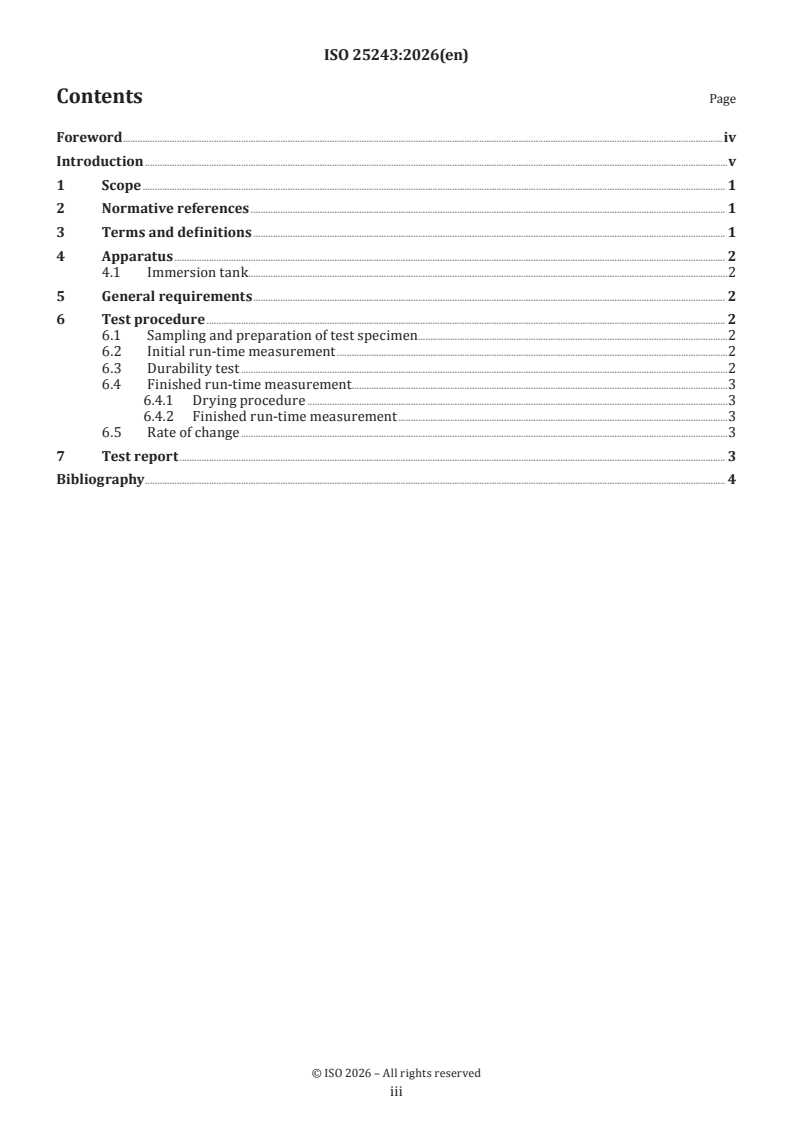
The document is organized into seven main clauses:
- Scope
- Normative references
- Terms and definitions
- Apparatus
- General requirements
- Test procedure
- Test report
That structure matters because the standard moves from identifying the test purpose to the equipment, then to the step-by-step method and the reporting items needed to document the result.
What are the key requirements of ISO 25243?
ISO 25243 focuses on a pressure-durability check for smart textile systems used underwater. The main practical point is to compare the system’s run-time before and after repeated submersion and pressurization.
Specimen preparation and conditioning
Clause 6.1 requires three test specimens per sample. The specimen may be unpacked, switched off, and ready for use, unless the operating conditions specify something else. This matters because the starting state must match how the product is meant to be used.
Clause 6.2 requires the specimens to be conditioned in the ISO 139 standard atmosphere before the initial run-time measurement. The test uses the maximum performance condition, so the result reflects the device at its most demanding operating state.
Pressure exposure
Clause 4.1 and 6.3 define the equipment and the durability test. The apparatus uses an immersion tank in accordance with EN 14225-1, and the tank must deliver at least 6 bar and be large enough for the smart textile system.
Clause 6.3 requires ten continuous cycles in water at 20 C, with each cycle made up of pressurization, holding, and release stages. In practice, this gives a repeatable stress sequence that simulates repeated underwater pressure exposure.
Drying and final measurement
Clause 6.4 requires the specimens to be dried after the pressure test using ISO 6330 flat drip dry, then kept in the ISO 139 standard atmosphere for at least 24 h before the finished run-time measurement. This helps separate temporary wetting effects from lasting performance changes.
Clause 6.4 also requires the finished run-time to be measured on all three specimens and averaged. If one or more specimens do not work normally, the finished run-time is not calculated, which prevents misleading results.
Performance change and reporting
Clause 6.5 requires a rate of change calculation based on initial and finished run-time. This gives a simple indicator of how much performance changed after the underwater pressurization test.
Clause 7 requires the test report to include the document reference, product identification, test conditions, initial run-time, finished run-time, rate of change, appearance changes, deviations, unusual features, and the test date. That record is important for comparison, traceability, and supplier or lab reporting.
What terms does ISO 25243 define?
- Smart textile system - A fabric that shows an intended and usable response to environmental change or an external signal.
- Initial run-time (t_initial) - The time from starting the system with a fully charged auxiliary battery until battery discharge stops operation, before the durability test.
- Finished run-time (t_final) - The same run-time measurement after the durability test has been carried out.
- E-textiles (smart textiles) - The document uses this term in the introduction for textile systems used in demanding applications, including underwater conditions.
- ISO 139 standard atmosphere - The conditioning environment used before and after testing so the run-time measurements are made under controlled conditions.
Who uses ISO 25243?
ISO 25243 is used by manufacturers of smart textile systems, test laboratories, and quality assurance teams that need to verify underwater durability. It is also relevant to buyers and technical evaluators who need a defined way to compare products for underwater or high-pressure use. The standard is especially relevant where the product must keep working after repeated pressure exposure in water.
Which standards are used with ISO 25243?
ISO 25243 refers to three normative or companion documents:
- ISO 139 - provides the standard atmosphere for conditioning and testing.
- ISO 6330 - provides the drying procedure used after the water-pressure test.
- EN 14225-1 - provides the diving-suit-related test equipment and conditions used for the immersion tank and water-pressure setup.
- ISO/TR 23383:2020 - is cited as the source for the definition of smart textile system.
What does the ISO 25243 document contain?
ISO 25243 contains the apparatus requirements, the specimen preparation steps, the initial and finished run-time measurements, the underwater pressure cycling procedure, and the calculation of the rate of change. It also sets out what the test report must include so results can be compared and traced. The document is practical in form: it gives the test setup, the conditioning and drying conditions, the sequence of actions, and the reporting items needed for laboratory use, product verification, or qualification testing.
Get Certified
Connect with accredited certification bodies for this standard

Control Union Certifications
Global certification for agriculture and sustainability.

Hohenstein Institut
Textile testing and certification.

Bureau Veritas Bangladesh
Bureau Veritas certification services in Bangladesh.
Sponsored listings
Frequently Asked Questions
ISO 25243:2026 is a standard published by the International Organization for Standardization (ISO). Its full title is "Textiles — Smart textiles systems — Test method for repeated underwater pressurization". This standard covers: This document specifies a test method for determining the ability of smart textile systems to withstand high pressure conditions in underwater applications.
This document specifies a test method for determining the ability of smart textile systems to withstand high pressure conditions in underwater applications.
ISO 25243:2026 is classified under the following ICS (International Classification for Standards) categories: 59.080.80 - Smart textiles. The ICS classification helps identify the subject area and facilitates finding related standards.
ISO 25243:2026 is available in PDF format for immediate download after purchase. The document can be added to your cart and obtained through the secure checkout process. Digital delivery ensures instant access to the complete standard document.
Standards Content (Sample)
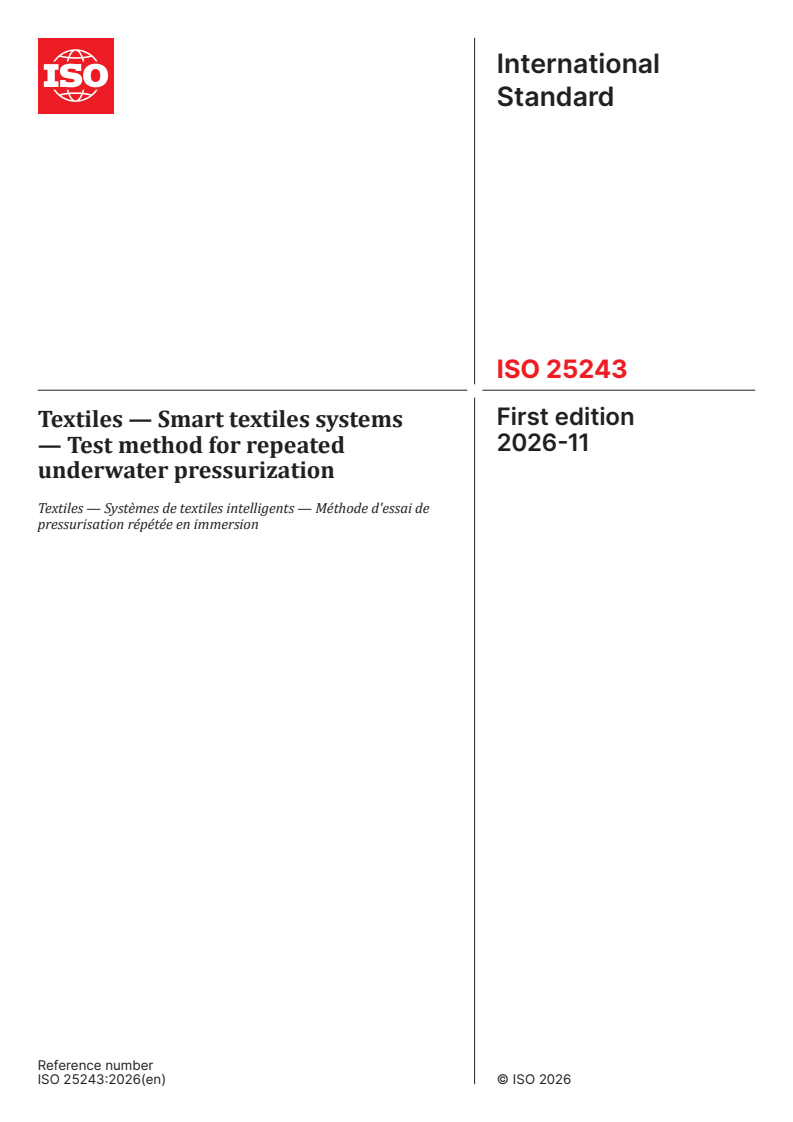
International
Standard
ISO 25243
First edition
Textiles — Smart textiles systems
2026-11
— Test method for repeated
underwater pressurization
Textiles — Systèmes de textiles intelligents — Méthode d'essai de
pressurisation répétée en immersion
Reference number
© ISO 2026
All rights reserved.
This ISO publication is protected by copyright and is owned by ISO and/or its licensors.
The content of this ISO publication is provided under licence, not sold. Use is subject to the applicable licence terms issued by ISO,
an ISO member body, or an authorized third-party distributor.
Except as required for implementation or expressly permitted by a separate licence, no part of this ISO publication may be
reproduced, distributed, modified, used, or made available in any form or by any means – electronic or mechanical, including
photocopying, scanning, recording, or posting on internal or external digital platforms.
Any use beyond the scope of the granted rights is prohibited and may result in legal action.
ISO copyright office
CP 401 • CH-1214 Vernier, Geneva
Phone: +41 22 749 01 11
Email: copyright@iso.org
Website: www.iso.org
Published in Switzerland
ii
Contents Page
Foreword .iv
Introduction .v
1 Scope . 1
2 Normative references . 1
3 Terms and definitions . 1
4 Apparatus . 2
4.1 Immersion tank.2
5 General requirements . 2
6 Test procedure . 2
6.1 Sampling and preparation of test specimen .2
6.2 Initial run-time measurement .2
6.3 Durability test .2
6.4 Finished run-time measurement.3
6.4.1 Drying procedure .3
6.4.2 Finished run-time measurement .3
6.5 Rate of change .3
7 Test report . 3
Bibliography . 4
iii
Foreword
ISO (the International Organization for Standardization) is a worldwide federation of national standards
bodies (ISO member bodies). The work of preparing International Standards is normally carried out through
ISO technical committees. Each member body interested in a subject for which a technical committee
has been established has the right to be represented on that committee. International organizations,
governmental and non-governmental, in liaison with ISO, also take part in the work. ISO collaborates closely
with the International Electrotechnical Commission (IEC) on all matters of electrotechnical standardization.
The procedures used to develop this document and those intended for its further maintenance are described
in the ISO/IEC Directives, Part 1. In particular, the different approval criteria needed for the different types
of ISO documents should be noted. This document was drafted in accordance with the editorial rules of the
ISO/IEC Directives, Part 2 (see www.iso.org/directives).
ISO draws attention to the possibility that the implementation of this document may involve the use of (a)
patent(s). ISO takes no position concerning the evidence, validity or applicability of any claimed patent
rights in respect thereof. As of the date of publication of this document, ISO had not received notice of (a)
patent(s) which may be required to implement this document. However, implementers are cautioned that
this may not represent the latest information, which may be obtained from the patent database available at
www.iso.org/patents. ISO shall not be held responsible for identifying any or all such patent rights.
Any trade name used in this document is information given for the convenience of users and does not
constitute an endorsement.
For
...