

ISO 25242:2026
(Main)Textiles — Smart textiles systems — Test method for cyclic environmental temperature change
- Abstract
This document provides an environment test to determine the ability of smart textiles (e.g. electrically heated garment) to withstand rapid changes of ambient temperature. This document is applicable to jacket, vest, jumper, etc., which includes the electrically operating part.
- Status
- Published
- Publication Date
- 04-Nov-2026
- Technical Committee
- ISO/TC 38 - Textiles
- Drafting Committee
- ISO/TC 38/WG 32 - Smart textiles
- Current Stage
- 6060 - International Standard published - 60 Publication
- Start Date
- 05-Nov-2026
- Due Date
- 05-Nov-2026
- Completion Date
- 05-Nov-2026
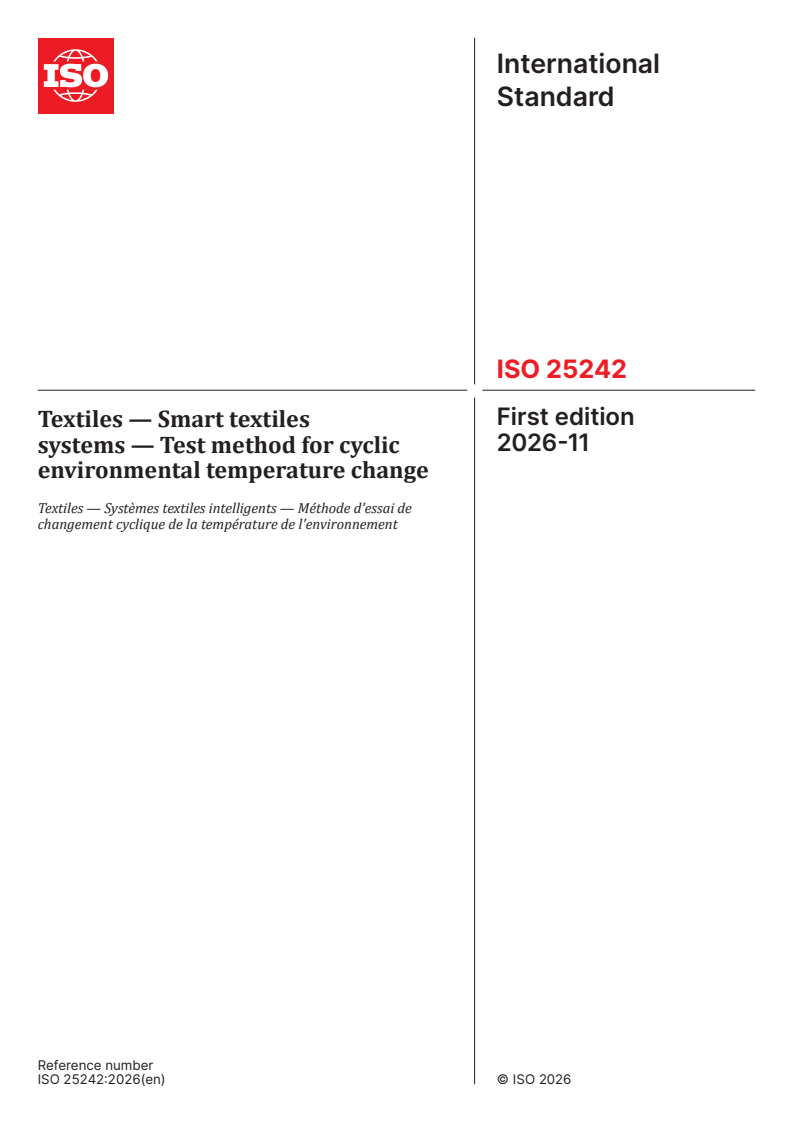
ISO 25242:2026 is an International Standard from ISO for testing smart textiles systems under cyclic environmental temperature change. It specifies a laboratory method for checking how products such as electrically heated garments withstand rapid shifts between high and low ambient temperatures, with the focus on items that include the electrically operating part.
What does ISO 25242:2026 specify?
ISO 25242:2026 specifies an environmental test method for smart textiles systems exposed to rapid temperature changes. It is written for jacket, vest, jumper and similar products that include an electrically operating part.
The document is organized into seven clauses:
- Scope
- Normative references
- Terms and definitions
- Test equipment
- General requirements
- Test procedure, including specimen preparation, conditioning, cycling, recovery and run-time measurements
- Test report
Clause 6 is the core of the document. It sets out how to choose the test arrangement, how many specimens to use, how to condition and cycle them, and how to record run-time before, during and after the test. Clause 7 then states what information has to be reported so results can be compared and reviewed.
What are the key requirements of ISO 25242:2026?
ISO 25242:2026 focuses on a controlled temperature-change exposure and on comparing the system’s run-time before and after the test. In practice, the method is about repeating the same operating conditions, measuring the effect of the temperature cycling, and recording the outcome clearly.
Test equipment and set-up
The test equipment is an environmental chamber in accordance with IEC 60068-2-14 test Na, or Nc. The chamber has to house the specimen, allow measurement during conditioning, and hold the specified temperature within the required tolerances. For the reader, this means the chamber must support both the temperature shifts and the measurement activity without changing the test conditions.
Specimens and pre-test conditions
Clause 6.3 requires three test specimens per sample. The specimen is tested in an unpacked, switched-off, ready-for-use state, unless the operating conditions specify otherwise. Clause 6.6 requires conditioning at laboratory ambient conditions in the standard atmosphere from ISO 139, and the specimen is brought into operating condition when the relevant specification requires it.
Run-time measurements
ISO 25242:2026 requires a visual examination and electrical check before the first run-time measurement, as required by the relevant specification. The initial run-time is measured with the system at maximum performance conditions, and the average of the three specimens is recorded. The same approach is used for the in operation run-time during cycling and for the finished run-time after recovery. This gives a before-during-after comparison of how the system performs through the temperature stress.
Temperature cycling and recovery
Clause 6.8 defines one test cycle as a sequence from laboratory ambient to the first conditioning temperature, then to the second conditioning temperature, and back to laboratory ambient. The document uses the test cycle defined in IEC 60068-2-14 test Na or Nc. After cycling, the specimens are stored for at least 24 h in standard atmosphere conditions, unless the relevant specification sets a different recovery period.
Result calculation and reporting
Clause 6.12 defines a run-time change rate based on the initial and finished run-time. If the finished run-time cannot be obtained, the rate is not calculated. Clause 7 requires the report to identify the standard, the specimen, the test type, conditioning, mounting, temperatures, exposure time, number of cycles, measurements, recovery, deviations, observations and test date.
What terms does ISO 25242:2026 define?
ISO 25242:2026 defines the key terms used to interpret the run-time measurements.
- Smart textile system - a fabric that shows an intended and usable response to changes in its surroundings or to an external signal or input.
- Initial run-time - the elapsed time from system start with a fully charged auxiliary battery until battery discharge causes termination before cycling.
- In operation run-time - the elapsed time from system start with a fully charged auxiliary battery until battery discharge during the test.
- Finished run-time - the elapsed time from system start with a fully charged auxiliary battery until battery discharge after the test has been conducted.
- tinitial - the symbol used for initial run-time.
- tin operation - the symbol used for in operation run-time.
- tfinal - the symbol used for finished run-time.
Who uses ISO 25242:2026?
ISO 25242:2026 is used by laboratories, manufacturers, suppliers and quality teams working with smart textiles systems, especially electrically heated garments and similar wearable products. Test engineers use it to run environmental durability checks, quality managers use it to compare performance before and after temperature cycling, and buyers or customers use the reported results to review product robustness under storage, transport, installation and use conditions.
Which standards are used with ISO 25242:2026?
ISO 25242:2026 relies on two normative references and cites one related ISO document for terminology.
- ISO 139 - provides the standard atmospheres used for conditioning and testing.
- IEC 60068-2-14:2023 - provides the environmental test framework for change of temperature, including test Na and test Nc, and the chamber-related procedure used by this document.
- ISO/TR 23383:2020 - is cited as the source of the definition of smart textile system.
What does the ISO 25242:2026 document contain?
ISO 25242:2026 contains the full laboratory method, from specimen preparation through final reporting. It includes a table that aligns the test parameters for Na and Nc, a figure that illustrates the temperature cycle, and a formula for calculating the run-time change rate.
The document also sets out the practical steps for chamber preparation, specimen mounting or support, conditioning, initial measurement, cycling, in operation measurement, recovery and finished measurement. Clause 7 then lists the reporting items needed for traceable test records, including temperatures, exposure time, number of cycles, any deviation from procedure, and unusual observations.
Get Certified
Connect with accredited certification bodies for this standard

Control Union Certifications
Global certification for agriculture and sustainability.

Hohenstein Institut
Textile testing and certification.

Bureau Veritas Bangladesh
Bureau Veritas certification services in Bangladesh.
Sponsored listings
Frequently Asked Questions
ISO 25242:2026 is a standard published by the International Organization for Standardization (ISO). Its full title is "Textiles — Smart textiles systems — Test method for cyclic environmental temperature change". This standard covers: This document provides an environment test to determine the ability of smart textiles (e.g. electrically heated garment) to withstand rapid changes of ambient temperature. This document is applicable to jacket, vest, jumper, etc., which includes the electrically operating part.
This document provides an environment test to determine the ability of smart textiles (e.g. electrically heated garment) to withstand rapid changes of ambient temperature. This document is applicable to jacket, vest, jumper, etc., which includes the electrically operating part.
ISO 25242:2026 is classified under the following ICS (International Classification for Standards) categories: 59.080.80 - Smart textiles. The ICS classification helps identify the subject area and facilitates finding related standards.
ISO 25242:2026 is available in PDF format for immediate download after purchase. The document can be added to your cart and obtained through the secure checkout process. Digital delivery ensures instant access to the complete standard document.
Standards Content (Sample)
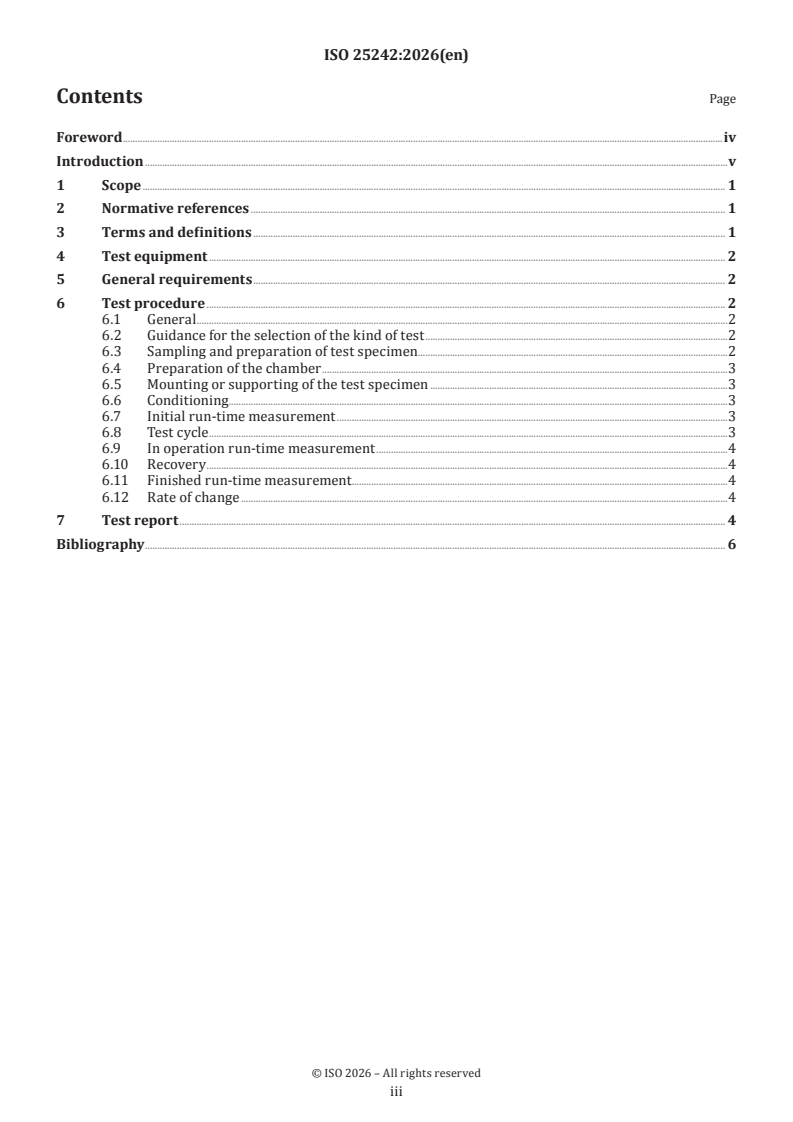
Contents
- Introduction
- 1 Scope
- 2 Normative references
- 3 Terms and definitions
- 3.1 smart textile system
- 3.2 initial run-time
- 3.3 in operation run-time
- 3.4 finished run-time
- 4 Test equipment
- 5 General requirements
- 6 Test procedure
- 6.1 General
- 6.2 Guidance for the selection of the kind of test
- 6.3 Sampling and preparation of test specimen
- 6.4 Preparation of the chamber
- 6.5 Mounting or supporting of the test specimen
- 6.6 Conditioning
- 6.7 Initial run-time measurement
- 6.8 Test cycle
- 6.9 In operation run-time measurement
- 6.10 Recovery
- 6.11 Finished run-time measurement
- 6.12 Rate of change
- 7 Test report
- Bibliography
Introduction
During their use, e-textiles (smart textiles) can experience to extreme cold environments so durability is a critical property.
A change of temperature test is intended to determine the effect on the specimen of a change of temperature or a succession of changes of temperature.
This document specifies the test method and assessment of their performance under conditions of storage, transportation, installation and use.
International Standard ISO 25242:2026(en) Textiles — Smart textiles systems — Test method for cyclic environmental temperature change
1 Scope
This document provides an environment test to determine the ability of smart textiles (e.g. electrically heated garment) to withstand rapid changes of ambient temperature. This document is applicable to jacket, vest, jumper, etc., which includes the electrically operating part.
2 Normative references
The following documents are referred to in the text in such a way that some or all of their content constitutes requirements of this document. For dated references, only the edition cited applies. For undated references, the latest edition of the referenced document (including any amendments) applies. ISO 139, Textiles — Standard atmospheres for conditioning and testing IEC 60068-2-14:2023, Environmental testing — Part 2: Tests — Test N: Change of temperature
3 Terms and definitions
For the purposes of this document, the following terms and definitions apply. ISO and IEC maintain terminology databases for use in standardization at the following addresses:
- ISO Online browsing platform: available at https:// www .iso .org/ obp
- IEC Electropedia: available at https:// www .electropedia .org/
3.1 smart textile system
fabric which exhibits an intended and exploitable response as a reaction either to changes in its surroundings/ environment or to an external signal/input [SOURCE: ISO/TR 23383:2020, 3.8]
3.2 initial run-time
t_ initial span of time actually elapsed from the initiation of system execution using the fully charged auxiliary battery integrated into the textile-based system to the termination caused by battery discharge
3.3 in operation run-time
t_ in operation span of time actually elapsed from the initiation of system execution using the fully charged auxiliary battery integrated into the textile-based system to the termination caused by battery discharge during testing
ISO 25242:2026(en)
3.4 finished run-time
t_ final span of time actually elapsed from the initiation of system execution using the fully charged auxiliary battery integrated into the textile-based system to the termination caused by battery discharge after test has been conducted
...