


ISO/FDIS 6590-1
(Main)Packaging — Vocabulary — Part 1: Paper sacks
Packaging — Vocabulary — Part 1: Paper sacks
This part of ISO 6590 defines terms commonly used in paper sack manufacture. It refers to single- and multi-ply sacks made from paper; it does not refer to bags for the retail trade. It specifies types of sacks, constructional details, materials and describes parts of a sack. It delivers alphabetical indices in three languages.
Titre manque — Partie 1: Titre manque
La présente partie de l'ISO 6590 définit les termes communément utilisés dans l'industrie du sac en papier. Elle est applicable à des sacs en papier à grande contenance, simples ou multicouches, et non à des sacs pour le commerce de détail.
General Information
Relations
Buy Standard
Standards Content (Sample)
FINAL DRAFT
International
Standard
ISO/TC 122/SC 3
Packaging — Vocabulary —
Secretariat: BSI
Part 1:
Voting begins on:
2025-01-27
Paper sacks
Voting terminates on:
2025-03-24
RECIPIENTS OF THIS DRAFT ARE INVITED TO SUBMIT,
WITH THEIR COMMENTS, NOTIFICATION OF ANY
RELEVANT PATENT RIGHTS OF WHICH THEY ARE AWARE
AND TO PROVIDE SUPPOR TING DOCUMENTATION.
IN ADDITION TO THEIR EVALUATION AS
BEING ACCEPTABLE FOR INDUSTRIAL, TECHNO-
ISO/CEN PARALLEL PROCESSING LOGICAL, COMMERCIAL AND USER PURPOSES, DRAFT
INTERNATIONAL STANDARDS MAY ON OCCASION HAVE
TO BE CONSIDERED IN THE LIGHT OF THEIR POTENTIAL
TO BECOME STAN DARDS TO WHICH REFERENCE MAY BE
MADE IN NATIONAL REGULATIONS.
Reference number
FINAL DRAFT
International
Standard
ISO/TC 122/SC 3
Packaging — Vocabulary —
Secretariat: BSI
Part 1:
Voting begins on:
Paper sacks
Voting terminates on:
RECIPIENTS OF THIS DRAFT ARE INVITED TO SUBMIT,
WITH THEIR COMMENTS, NOTIFICATION OF ANY
RELEVANT PATENT RIGHTS OF WHICH THEY ARE AWARE
AND TO PROVIDE SUPPOR TING DOCUMENTATION.
© ISO 2025
IN ADDITION TO THEIR EVALUATION AS
All rights reserved. Unless otherwise specified, or required in the context of its implementation, no part of this publication may
BEING ACCEPTABLE FOR INDUSTRIAL, TECHNO-
ISO/CEN PARALLEL PROCESSING
LOGICAL, COMMERCIAL AND USER PURPOSES, DRAFT
be reproduced or utilized otherwise in any form or by any means, electronic or mechanical, including photocopying, or posting on
INTERNATIONAL STANDARDS MAY ON OCCASION HAVE
the internet or an intranet, without prior written permission. Permission can be requested from either ISO at the address below
TO BE CONSIDERED IN THE LIGHT OF THEIR POTENTIAL
or ISO’s member body in the country of the requester.
TO BECOME STAN DARDS TO WHICH REFERENCE MAY BE
MADE IN NATIONAL REGULATIONS.
ISO copyright office
CP 401 • Ch. de Blandonnet 8
CH-1214 Vernier, Geneva
Phone: +41 22 749 01 11
Email: copyright@iso.org
Website: www.iso.org
Published in Switzerland Reference number
ii
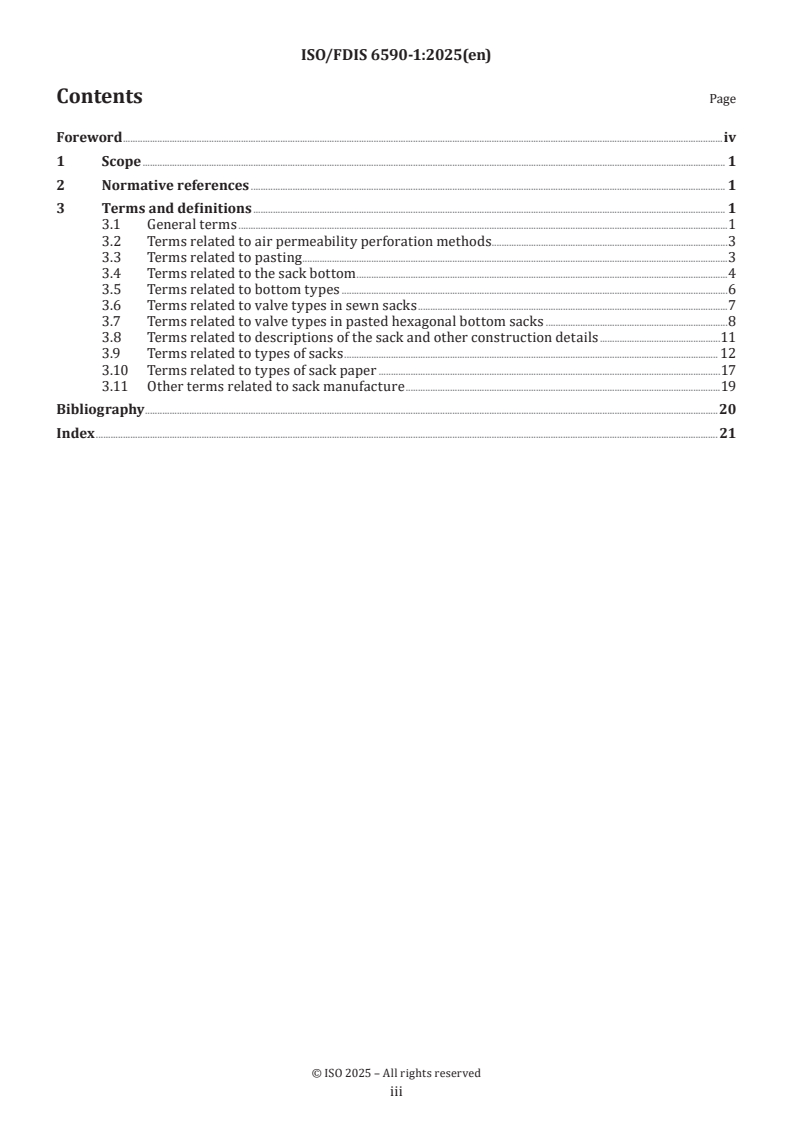
Contents Page
Foreword .iv
1 Scope . 1
2 Normative references . 1
3 Terms and definitions . 1
3.1 General terms .1
3.2 Terms related to air permeability perforation methods .3
3.3 Terms related to pasting .3
3.4 Terms related to the sack bottom .4
3.5 Terms related to bottom types .6
3.6 Terms related to valve types in sewn sacks .7
3.7 Terms related to valve types in pasted hexagonal bottom sacks .8
3.8 Terms related to descriptions of the sack and other construction details .11
3.9 Terms related to types of sacks . 12
3.10 Terms related to types of sack paper .17
3.11 Other terms related to sack manufacture .19
Bibliography .20
Index .21
iii
Foreword
ISO (the International Organization for Standardization) is a worldwide federation of national standards
bodies (ISO member bodies). The work of preparing International Standards is normally carried out through
ISO technical committees. Each member body interested in a subject for which a technical committee
has been established has the right to be represented on that committee. International organizations,
governmental and non-governmental, in liaison with ISO, also take part in the work. ISO collaborates closely
with the International Electrotechnical Commission (IEC) on all matters of electrotechnical standardization.
The procedures used to develop this document and those intended for its further maintenance are described
in the ISO/IEC Directives, Part 1. In particular, the different approval criteria needed for the different types
of ISO document should be noted. This document was drafted in accordance with the editorial rules of the
ISO/IEC Directives, Part 2 (see www.iso.org/directives).
ISO draws attention to the possibility that the implementation of this document may involve the use of (a)
patent(s). ISO takes no position concerning the evidence, validity or applicability of any claimed patent
rights in respect thereof. As of the date of publication of this document, ISO had not received notice of (a)
patent(s) which may be required to implement this document. However, implementers are cautioned that
this may not represent the latest information, which may be obtained from the patent database available at
www.iso.org/patents. ISO shall not be held responsible for identifying any or all such patent rights.
Any trade name used in this document is information given for the convenience of users and does not
constitute an endorsement.
For an explanation of the voluntary nature of standards, the meaning of ISO specific terms and expressions
related to conformity assessment, as well as information about ISO's adherence to the World Trade
Organization (WTO) principles in the Technical Barriers to Trade (TBT), see www.iso.org/iso/foreword.html.
This document was prepared by Technical Committee ISO/TC 122, Packaging, Subcommittee SC 3,
Performance requirements and tests for means of packaging, packages and unit loads (as required by
ISO/TC 122), in collaboration with the European Committee for Standardization (CEN) Technical Committee
CEN/TC 261, Packaging, in accordance with the Agreement on technical cooperation between ISO and CEN
(Vienna Agreement).
This second edition cancels and replaces the first edition (ISO 6590-1:1983), which has been technically
revised.
The main changes are as follows:
— general editorial changes have been made to the document in line with ISO/IEC Directives Part 2;
— updates have been made to the figures accompanying specific terms and definitions;
— considerations have been made to align with existing standards in order to avoid additional interpretations
of identical terms, where necessary, and conversely proposing updates to existing definitions where
considerations should be made in renewing the definitions in other standards;
— new terms have been added to reflect the development within the field;
— old terms for products and services no longer in use have been deleted.
A list of all parts in the ISO 6590 series can be found on the ISO website.
Any feedback or questions on this document should be directed to the user’s national standards body. A
complete listing of these bodies can be found at www.iso.org/members.html.
iv
FINAL DRAFT International Standard ISO/FDIS 6590-1:2025(en)
Packaging — Vocabulary —
Part 1:
Paper sacks
1 Scope
This document defines terms commonly used in paper sacks manufacture. It refers to single- and multi-ply
sacks made of paper or combination of paper and other materials where the paper is the main part.
It does not refer to bags for retail trade.
2 Normative references
There are no normative references in this document.
3 Terms and definitions
ISO and IEC maintain terminology databases for use in standardization at the following addresses:
— ISO Online browsing platform: available at https:// www .iso .org/ obp
— IEC Electropedia: available at https:// www .electropedia .org/
3.1 General terms
3.1.1
paper sack
flexible packaging of single or multiple plies (3.1.2), predominantly made of paper
Note 1 to entry: Suitable for packaging large quantities of powdery or granulate products mainly intended for business-
to-business distribution chains activities.
Note 2 to entry: Hereafter, where the word sack is used in the text of this document, paper sack is to be understood. If
no prefix is applied to a term under definition, paper sack is also to be understood.
3.1.2
ply
sheet of paper or other flexible material, or combination of such materials, forming the walls of a sack
3.1.3
gusset
fold with a prescribed size inserted in the longitudinal edges of a tube (3.1.4)
3.1.4
tube
one or more plies (3.1.2) in the form of a flattened cylinder with a prescribed width cut into a prescribed length
3.1.4.1
flat tube
tube (3.1.4) comprised solely of one or more flattened cylindrical plies (3.1.2)
3.1.4.2
gusseted tube
tube (3.1.4) comprised of one or more plies (3.1.2) with folds inserted in the longitudinal edges
3.1.4.3
flush cut tube
flat tube (3.1.4.1) or a gusseted tube (3.1.4.2) with plies (3.1.2) cut collectively or individually to a
prescribed length
Figure 1 — Example of a flush cut tube
3.1.4.4
stepped end tube
flat tube (3.1.4.1) or a gusseted tube (3.1.4.2) with plies (3.1.2) cut individually and staggered in echelon to a
prescribed length so that the final tube length will result longer than each single ply length
Figure 2 — Example of a stepped end tube
3.1.4.5
notched end tube
flat tube (3.1.4.1) or a gusseted tube (3.1.4.2) with plies (3.1.2) cut individually and staggered in a manner
which provides one or two edge notches on one tube (3.1.4) end
Figure 3 — Example of a notched end tube
3.2 Terms related to air permeability perforation methods
3.2.1
air permeability perforation
holes pierced through the sack walls or the individual plies (3.1.2), made by needles during manufacturing,
in order to facilitate air release during sack filling
3.2.2
micro-perforation
small holes made on individual plies prior to forming the tube (3.1.4)
Note 1 to entry: The distance between the micro-holes can vary (e.g. 25 × 25 mm, 10 × 10 mm, 5 × 5 mm or smaller)
and can be applied in full or in limited areas of each ply and it is typically obtained with conical needles allowing a
variable grade of perforation or with straight needle for a predetermined and more stable degree of perforation.
3.2.3
sack perforation
process of making holes through the entire sack wall, made directly on the formed tube (3.1.4)
Note 1 to entry: Sack perforations are usually made on a specific area of the sack wall, typically under the valve
position.
3.3 Terms related to pasting
3.3.1
pasting
adhesive bonding
joining together the different plies (3.1.2) and the different materials by means of adhesives (3.11.3)
3.3.2
longitudinal overlap
areas of the longitudinal edges of a ply (3.1.2) which are superposed
3.3.3
longitudinal pasting
pasting (3.3.1) by which the longitudinal overlap of a ply (3.1.2) is joined together with an adhesive (3.11.3)
or extrusion
Note 1 to entry: The seam may be continuous or interrupted.
3.3.4
cross pasting
application of an adhesive (3.11.3) between the plies (3.1.2) normally at one or both ends of a tube (3.1.4)
Note 1 to entry: Cross pasting facilitates separation of the front and back side of the tube during manufacture or of the
mouth of the sack during filling. It can increase the strength of certain types of sacks.
3.3.5
heat sealing
welding
method of joining together surfaces under controlled application of heat, pressure and dwell time
[SOURCE: ISO 21067-1:2016, 2.5.14, modified — The secondary term "welding" was added and in the
definition the word "mating" was replaced with “joining together”.
3.3.6
ultrasonic sealing
method of joining together surfaces under controlled application of ultrasounds at a specified frequency
Note 1 to entry: Frequencies are typically 20 000 Hz or 30 000 Hz on paper products.
3.3.7
sewing
stitching
joining together individual plies (3.1.2) by means of sewing thread (3.11.4)
3.3.8
pasted closure
closure of a tube (3.1.4) at one end only with an adhesive (3.11.3)
3.4 Terms related to the sack bottom
3.4.1
bottom
closure, to a prescribed dimension, of one or both tube ends to form the final sack configuration
3.4.2
bottom overlap
areas of the tra
...
ISO/DIS FDIS 6590-1:2025(en)
ISO/TC 122/SC 3/WG 11
Secretariat: BSI
Date: 2024-12-092025-01-13
Packaging — Vocabulary — —
Part 1:
Paper sacks
FDIS stage
ISO/WD FDIS 6590-1:2024 (E2025(en)
All rights reserved. Unless otherwise specified, or required in the context of its implementation, no part of this publication
may be reproduced or utilized otherwise in any form or by any means, electronic or mechanical, including photocopying,
or posting on the internet or an intranet, without prior written permission. Permission can be requested from either ISO
at the address below or ISO’s member body in the country of the requester.
ISO copyright office
CP 401 • Ch. de Blandonnet 8
CH-1214 Vernier, Geneva
Phone: + 41 22 749 01 11
EmailE-mail: copyright@iso.org
Website: www.iso.orgwww.iso.org
Published in Switzerland
ii © ISO 2024 2025 – All rights reserved
ii
ISO/DIS FDIS 6590-1:2025(en)
Contents
Foreword . iv
1 Scope . 1
2 Normative references . 1
3 Terms and definitions . 1
Bibliography . 34
Index 35
Foreword . iv
1 Scope . 1
2 Normative references . 1
3 Terms and definitions . 1
3.1 General terms . 1
3.2 Terms related to air permeability perforation methods . 3
3.3 Terms related to pasting . 3
3.4 Terms related to the sack bottom . 4
3.5 Terms related to bottom types . 6
3.6 Terms related to valve types in sewn sacks . 7
3.8 Terms related to descriptions of the sack and other construction details . 12
3.9 Terms related to types of sacks . 13
3.10 Terms related to types of sack paper . 18
3.11 Other terms related to sack manufacture . 20
Bibliography . 22
© ISO 2025 – All rights reserved
iii
ISO/WD FDIS 6590-1:2024 (E2025(en)
Foreword
ISO (the International Organization for Standardization) is a worldwide federation of national standards
bodies (ISO member bodies). The work of preparing International Standards is normally carried out through
ISO technical committees. Each member body interested in a subject for which a technical committee has been
established has the right to be represented on that committee. International organizations, governmental and
non-governmental, in liaison with ISO, also take part in the work. ISO collaborates closely with the
International Electrotechnical Commission (IEC) on all matters of electrotechnical standardization.
The procedures used to develop this document and those intended for its further maintenance are described
in the ISO/IEC Directives, Part 1. In particular, the different approval criteria needed for the different types of
ISO document should be noted. This document was drafted in accordance with the editorial rules of the
ISO/IEC Directives, Part 2 (see www.iso.org/directives).
ISO draws attention to the possibility that the implementation of this document may involve the use of (a)
patent(s). ISO takes no position concerning the evidence, validity or applicability of any claimed patent rights
in respect thereof. As of the date of publication of this document, ISO had not received notice of (a) patent(s)
which may be required to implement this document. However, implementers are cautioned that this may not
represent the latest information, which may be obtained from the patent database available at
www.iso.org/patents.www.iso.org/patents. ISO shall not be held responsible for identifying any or all such
patent rights.
Any trade name used in this document is information given for the convenience of users and does not
constitute an endorsement.
For an explanation of the voluntary nature of standards, the meaning of ISO specific terms and expressions
related to conformity assessment, as well as information about ISO's adherence to the World Trade
Organization (WTO) principles in the Technical Barriers to Trade (TBT), see
www.iso.org/iso/foreword.html.www.iso.org/iso/foreword.html.
This document was prepared by Technical Committee ISO/TC 122, Packaging, Subcommittee SC 3,
Performance requirements and tests for means of packaging, packages and unit loads (as required by ISO/TC
122), in collaboration with the European Committee for Standardization (CEN) Technical Committee
CEN/TC 261, Packaging, in accordance with the Agreement on technical cooperation between ISO and CEN
(Vienna Agreement).
This second edition cancels and replaces the first edition (ISO 6590-1:1983), which has been technically
revised.
The main changes are as follows:
⎯— general editorial changes have been made to the document in line with ISO/IEC Directives Part 2;
⎯— updates have been made to the figures accompanying specific terms and definitions;
⎯— considerations have been made to align with existing standards in order to avoid additional
interpretations of identical terms, where necessary, and conversely proposing updates to existing
definitions where considerations should be made in renewing the definitions in other standards;
⎯— new terms have been added to reflect the development within the field;
⎯— old terms for products and services no longer in use have been deleted.
A list of all parts in the ISO 6590 series can be found on the ISO website.
iv © ISO 2024 2025 – All rights reserved
iv
ISO/DIS FDIS 6590-1:2025(en)
Any feedback or questions on this document should be directed to the user’s national standards body. A
complete listing of these bodies can be found at www.iso.org/members.html.
© ISO 2025 – All rights reserved
v
DRAFT International Standard ISO/DIS 6590-1:2025(en)
Packaging — Vocabulary — —
Part 1:
Paper sacks
1 Scope
This document defines terms commonly used in paper sacks manufacture. It refers to single- and multi-ply
sacks made of paper or combination of paper and other materials where the paper is the main part.
It does not refer to bags for retail trade.
2 Normative references
There are no normative references in this document.
3 Terms and definitions
For the purposes of this document, the following terms and definitions apply.
ISO and IEC maintain terminology databases for use in standardization at the following addresses:
— — ISO Online browsing platform: available at https://www.iso.org/obphttps://www.iso.org/obp
— — IEC Electropedia: available at https://www.electropedia.org/https://www.electropedia.org/
3.1 General terms
3.1.1 3.1.1
paper sack
flexible packaging of single or multiple plies [3.1.2],(3.1.2), predominantly made of paper
Note 1 to entry: Suitable for packaging large quantities of powdery or granulate products mainly intended for business-
to-business distribution chains activities.
Note 2 to entry: Hereafter, where the word sack is used in the text of this document, paper sack is to be understood. If
no prefix is applied to a term under definition, paper sack is also to be understood.
3.1.2 3.1.2
ply
sheet of paper or other flexible material, or combination of such materials, forming the walls of a sack
3.1.3 3.1.3
gusset
fold with a prescribed size inserted in the longitudinal edges of a tube [3.1.4](3.1.4)
3.1.4 3.1.4
tube
one or more plies [3.1.2](3.1.2) in the form of a flattened cylinder with a prescribed width cut into a prescribed
length
2 © ISO 2024 2025 – All rights reserved
ISO/DIS FDIS 6590-1:2025(en)
3.1.4.1 3.1.4.1
flat tube
tube [3.1.4](3.1.4) comprised solely of one or more flattened cylindrical plies [3.1.2](3.1.2)
3.1.4.2 3.1.4.2
gusseted tube
tube [3.1.4](3.1.4) comprised of one or more plies [3.1.2](3.1.2) with folds inserted in the longitudinal edges
3.1.4.3 3.1.4.3
flush cut tube
flat tube [3.1.4.1](3.1.4.1) or a gusseted tube [3.1.4.2](3.1.4.2) with plies [3.1.2](3.1.2) cut collectively or
individually to a prescribed length
Figure 1 — Example of a flush cut tube
3.1.4.4 3.1.4.4
stepped end tube
flat tube [3.1.4.1](3.1.4.1) or a gusseted tube [3.1.4.2](3.1.4.2) with plies [3.1.2](3.1.2) cut individually and
staggered in echelon to a prescribed length so that the final tube length will result longer than each single ply
length
© ISO 2025 – All rights reserved
Figure 2 — Example of a stepped end tube
4 © ISO 2024 2025 – All rights reserved
ISO/DIS FDIS 6590-1:2025(en)
3.1.4.5 3.1.4.5
notched end tube
flat tube [3.1.4.1](3.1.4.1) or a gusseted tube [3.1.4.2](3.1.4.2) with plies [3.1.2](3.1.2) cut individually and
staggered in a manner which provides one or two edge notches on one tube [3.1.4](3.1.4) end
Figure 3 — Example of a notched end tube
3.2 Terms related to air permeability perforation methods
3.2.1 3.2.1
air permeability perforation
holes pierced through the sack walls or the individual plies [3.1.2],(3.1.2), made by needles during
manufacturing, in order to facilitate air release during sack filling
3.2.2 3.2.2
micro-perforation
small holes made on individual plies prior to forming the tube [3.1.4](3.1.4)
Note 1 to entry: The distance between the micro-holes can vary (e.g. 25 x × 25 mm, 10 x × 10 mm, 5 x × 5 mm or
smaller) and can be applied in full or in limited areas of each ply and it is typically obtained with conical needles allowing
a variable grade of perforation or with straight needle for a predetermined and more stable degree of perforation.
3.2.3 3.2.3
sack perforation
process of making holes through the entire sack wall, made directly on the formed tube [3.1.4](3.1.4)
Note 1 to entry: Sack perforations are usually made on a specific area of the sack wall, typically under the valve position.
© ISO 2025 – All rights reserved
3.3 Terms related to pasting
3.3.1 3.3.1
pasting
adhesive bonding
joining together the different plies [3.1.2](3.1.2) and the different materials by means of adhesives
[3.11.3](3.11.3)
3.3.2 3.3.2
longitudinal overlap
areas of the longitudinal edges of a ply [3.1.2](3.1.2) which are superposed
3.3.3 3.3.3
longitudinal pasting
pasting [3.3.1](3.3.1) by which the longitudinal overlap of a ply [3.1.2](3.1.2) is joined together with an
adhesive [3.11.3](3.11.3) or extrusion
Note 1 to entry: The seam may be continuous or interrupted.
3.3.4 3.3.4
cross pasting
application of an adhesive [3.11.3](3.11.3) between the plies [3.1.2](3.1.2) normally at one or both ends of a
tube [3.1.4](3.1.4)
Note 1 to entry: Cross pasting facilitates separation of the front and back side of the tube during manufacture or of the
mouth of the sack during filling. It can increase the strength of certain types of sacks.
3.3.5 3.3.5
heat sealing
welding
method of joining together surfaces under controlled application of heat, pressure and dwell time
[SOURCE: ISO 21067-1:2016, 2.5.14, modified — The secondary term "welding" was added and in the
definition the word "mating" was replaced with “joining together”.
3.3.6 3.3.6
ultrasonic sealing
method of joining together surfaces under controlled application of ultrasounds at a specified frequency
Note 1 to entry: Frequencies are typically 20 000 Hz or 30 000 Hz on paper products.
3.3.7 3.3.7
sewing
stitching
joining together individual plies [3.1.2](3.1.2) by means of sewing thread [3.11.4](3.11.4)
3.3.8 3.3.8
pasted closure
closure of a tube [3.1.4](3.1.4) at one end only with an adhesive [3.11.3](3.11.3)
3.4 Terms related to the sack bottom
3.4.1 3.4.1
bottom
closure, to a prescribed dimension, of one or both tube ends to form the final sack configuration
6 © ISO 2024 2025 – All rights reserved
ISO/DIS FDIS 6590-1:2025(en)
3.4.2 3.4.2
bottom overlap
areas of the transverse ends of a tube [3.1.4](3.1.4) which are superposed when formed into a bottom
3.4.3 3.4.3
bottom pasting
joining together of the sack walls by means of an adhesive [3.11.3](3.11.3)
Note 1 to entry: Before closure of the tube one or
...
Questions, Comments and Discussion
Ask us and Technical Secretary will try to provide an answer. You can facilitate discussion about the standard in here.