

ISO 13485:2016
(Main)Medical devices — Quality management systems — Requirements for regulatory purposes
General Information
- Abstract
ISO 13485:2016 specifies requirements for a quality management system where an organization needs to demonstrate its ability to provide medical devices and related services that consistently meet customer and applicable regulatory requirements. Such organizations can be involved in one or more stages of the life-cycle, including design and development, production, storage and distribution, installation, or servicing of a medical device and design and development or provision of associated activities (e.g. technical support). ISO 13485:2016 can also be used by suppliers or external parties that provide product, including quality management system-related services to such organizations. Requirements of ISO 13485:2016 are applicable to organizations regardless of their size and regardless of their type except where explicitly stated. Wherever requirements are specified as applying to medical devices, the requirements apply equally to associated services as supplied by the organization. The processes required by ISO 13485:2016 that are applicable to the organization, but are not performed by the organization, are the responsibility of the organization and are accounted for in the organization's quality management system by monitoring, maintaining, and controlling the processes. If applicable regulatory requirements permit exclusions of design and development controls, this can be used as a justification for their exclusion from the quality management system. These regulatory requirements can provide alternative approaches that are to be addressed in the quality management system. It is the responsibility of the organization to ensure that claims of conformity to ISO 13485:2016 reflect any exclusion of design and development controls. If any requirement in Clauses 6, 7 or 8 of ISO 13485:2016 is not applicable due to the activities undertaken by the organization or the nature of the medical device for which the quality management system is applied, the organization does not need to include such a requirement in its quality management system. For any clause that is determined to be not applicable, the organization records the justification as described in 4.2.2.
- Status
- Published
- Publication Date
- 24-Feb-2016
- Technical Committee
- ISO/TC 210 - Quality management and corresponding general aspects for medical devices
- Drafting Committee
- ISO/TC 210/WG 1 - Application of quality systems to medical devices
- Current Stage
- 9093 - International Standard confirmed
- Start Date
- 31-Oct-2025
- Completion Date
- 29-Aug-2026
Buy Documents

ISO 13485:2016 - Medical devices — Quality management systems — Requirements for regulatory purposes Released:2/25/2016
REDLINE ISO 13485:2016 - Medical devices — Quality management systems — Requirements for regulatory purposes Released:2/25/2016

ISO 13485:2016 - Dispositifs médicaux — Systemes de management de la qualité — Exigences a des fins réglementaires Released:2/25/2016
Overview
ISO 13485:2016 - Medical devices - Quality management systems - Requirements for regulatory purposes - specifies requirements for a quality management system (QMS) for organizations that design, produce, install, distribute or service medical devices. The standard focuses on demonstrating consistent ability to meet customer and applicable regulatory requirements across the medical device life‑cycle. ISO 13485:2016 is applicable to organizations of any size or type and can also be adopted by suppliers and external parties providing goods or QMS‑related services to the medical device sector.
Key topics and requirements
ISO 13485:2016 structures its QMS requirements around a process approach and includes (but is not limited to) the following technical topics:
- Quality management system and documentation (general QMS requirements, document and record control)
- Management responsibility (leadership, quality policy, management review, customer focus)
- Resource management (human resources, infrastructure, work environment)
- Product realization (planning, customer‑related processes, design and development, purchasing, production and service provision)
- Monitoring, measurement and improvement (control of monitoring/measurement devices, control of nonconforming product, corrective actions, data analysis)
- Regulatory alignment (identifying and incorporating applicable regulatory requirements; justification and recording of any excluded design and development controls per clause 4.2.2)
- Supplier and outsourced process control (organizations are responsible for processes they do not perform and must monitor, maintain and control those processes)
- Risk‑focused elements (process effectiveness, meeting safety/performance regulatory expectations)
(The content mirrors major clauses 4–8 of the standard and emphasizes regulatory‑driven requirements for medical devices.)
Applications - who uses ISO 13485:2016
- Medical device manufacturers (designers, OEMs)
- Contract manufacturers, sterilization and calibration service providers
- Distributors, importers and authorized representatives
- Suppliers contracted for QMS‑related services
- Regulatory affairs teams and conformity assessment/certification bodies
ISO 13485:2016 is widely used to support regulatory submissions, supplier qualification, product launch controls, and to demonstrate conformity for market access.
Benefits / Practical value
- Harmonizes QMS requirements for regulatory compliance across jurisdictions
- Improves product safety, traceability and consistency of device performance
- Facilitates supplier control and outsourced process accountability
- Supports certification and confidence in regulatory audits and market acceptance
Related standards
- ISO 9001 (format and process approach relationship; differences explained in Annex A)
- ISO 9000:2005 (fundamentals and vocabulary)
- Guidance: ISO/TR 14969 (application guidance for ISO 13485)
Keywords: ISO 13485:2016, medical devices, quality management system, regulatory requirements, design and development, supplier control, certification.
Relations
- Effective Date
- 09-Sep-2026
- Effective Date
- 25-Aug-2026
- Effective Date
- 25-Aug-2026
- Effective Date
- 25-Aug-2026
- Effective Date
- 25-Aug-2026
- Effective Date
- 25-Aug-2026
- Effective Date
- 25-Aug-2026
- Effective Date
- 25-Aug-2026
- Effective Date
- 25-Aug-2026
- Referred By
EN ISO 20789:2019 - Anaesthetic and respiratory equipment - Passive humidifiers (ISO 20789:2018) - Effective Date
- 25-Aug-2026
- Effective Date
- 25-Aug-2026
- Effective Date
- 15-Apr-2026
- Effective Date
- 08-Apr-2026
- Effective Date
- 12-Feb-2026
- Consolidated By
ISO 8331:2016 - Rubber and plastics hoses and hose assemblies — Guidelines for selection, storage, use and maintenance - Effective Date
- 06-Jun-2022
Buy Documents
ISO 13485:2016 - Medical devices — Quality management systems — Requirements for regulatory purposes Released:2/25/2016
REDLINE ISO 13485:2016 - Medical devices — Quality management systems — Requirements for regulatory purposes Released:2/25/2016
ISO 13485:2016 - Dispositifs médicaux — Systemes de management de la qualité — Exigences a des fins réglementaires Released:2/25/2016
Get Certified
Connect with accredited certification bodies for this standard

BSI Group
BSI (British Standards Institution) is the business standards company that helps organizations make excellence a habit.

TÜV SÜD
TÜV SÜD is a trusted partner of choice for safety, security and sustainability solutions.

Bureau Veritas
Bureau Veritas is a world leader in laboratory testing, inspection and certification services.
Sponsored listings
Frequently Asked Questions
ISO 13485:2016 is a standard published by the International Organization for Standardization (ISO). Its full title is "Medical devices — Quality management systems — Requirements for regulatory purposes". This standard covers: ISO 13485:2016 specifies requirements for a quality management system where an organization needs to demonstrate its ability to provide medical devices and related services that consistently meet customer and applicable regulatory requirements. Such organizations can be involved in one or more stages of the life-cycle, including design and development, production, storage and distribution, installation, or servicing of a medical device and design and development or provision of associated activities (e.g. technical support). ISO 13485:2016 can also be used by suppliers or external parties that provide product, including quality management system-related services to such organizations. Requirements of ISO 13485:2016 are applicable to organizations regardless of their size and regardless of their type except where explicitly stated. Wherever requirements are specified as applying to medical devices, the requirements apply equally to associated services as supplied by the organization. The processes required by ISO 13485:2016 that are applicable to the organization, but are not performed by the organization, are the responsibility of the organization and are accounted for in the organization's quality management system by monitoring, maintaining, and controlling the processes. If applicable regulatory requirements permit exclusions of design and development controls, this can be used as a justification for their exclusion from the quality management system. These regulatory requirements can provide alternative approaches that are to be addressed in the quality management system. It is the responsibility of the organization to ensure that claims of conformity to ISO 13485:2016 reflect any exclusion of design and development controls. If any requirement in Clauses 6, 7 or 8 of ISO 13485:2016 is not applicable due to the activities undertaken by the organization or the nature of the medical device for which the quality management system is applied, the organization does not need to include such a requirement in its quality management system. For any clause that is determined to be not applicable, the organization records the justification as described in 4.2.2.
ISO 13485:2016 specifies requirements for a quality management system where an organization needs to demonstrate its ability to provide medical devices and related services that consistently meet customer and applicable regulatory requirements. Such organizations can be involved in one or more stages of the life-cycle, including design and development, production, storage and distribution, installation, or servicing of a medical device and design and development or provision of associated activities (e.g. technical support). ISO 13485:2016 can also be used by suppliers or external parties that provide product, including quality management system-related services to such organizations. Requirements of ISO 13485:2016 are applicable to organizations regardless of their size and regardless of their type except where explicitly stated. Wherever requirements are specified as applying to medical devices, the requirements apply equally to associated services as supplied by the organization. The processes required by ISO 13485:2016 that are applicable to the organization, but are not performed by the organization, are the responsibility of the organization and are accounted for in the organization's quality management system by monitoring, maintaining, and controlling the processes. If applicable regulatory requirements permit exclusions of design and development controls, this can be used as a justification for their exclusion from the quality management system. These regulatory requirements can provide alternative approaches that are to be addressed in the quality management system. It is the responsibility of the organization to ensure that claims of conformity to ISO 13485:2016 reflect any exclusion of design and development controls. If any requirement in Clauses 6, 7 or 8 of ISO 13485:2016 is not applicable due to the activities undertaken by the organization or the nature of the medical device for which the quality management system is applied, the organization does not need to include such a requirement in its quality management system. For any clause that is determined to be not applicable, the organization records the justification as described in 4.2.2.
ISO 13485:2016 is classified under the following ICS (International Classification for Standards) categories: 03.100.70 - Management systems; 03.120.10 - Quality management and quality assurance; 11.040.01 - Medical equipment in general. The ICS classification helps identify the subject area and facilitates finding related standards.
ISO 13485:2016 has the following relationships with other standards: It is inter standard links to EN ISO 18704:2026, EN ISO 5840-1:2021, EN ISO 11737-1:2018, EN ISO 11137-3:2017, EN ISO 25539-2:2020, EN ISO 25539-3:2024, EN ISO/ASTM 52904:2020, EN ISO 18113-1:2024, EN ISO 25539-1:2017, EN ISO 20789:2019, EN ISO 13408-2:2018, EN ISO 20417:2021, EN ISO 10451:2026, EN ISO 13485:2016, ISO 8331:2016. Understanding these relationships helps ensure you are using the most current and applicable version of the standard.
ISO 13485:2016 is available in PDF format for immediate download after purchase. The document can be added to your cart and obtained through the secure checkout process. Digital delivery ensures instant access to the complete standard document.
Standards Content (Sample)
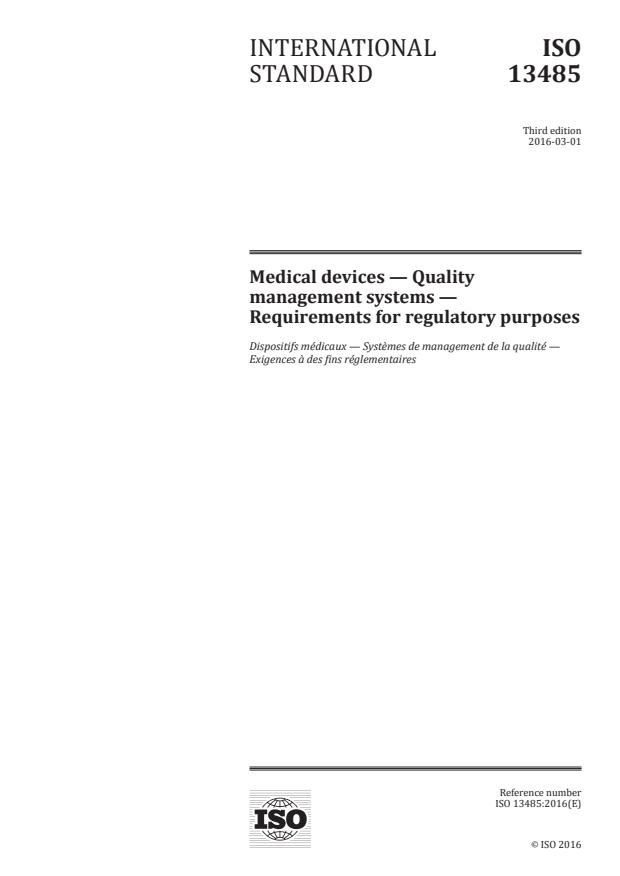
INTERNATIONAL ISO
STANDARD 13485
Third edition
2016-03-01
Medical devices — Quality
management systems —
Requirements for regulatory purposes
Dispositifs médicaux — Systèmes de management de la qualité —
Exigences à des fins réglementaires
Reference number
©
ISO 2016
© ISO 2016, Published in Switzerland
All rights reserved. Unless otherwise specified, no part of this publication may be reproduced or utilized otherwise in any form
or by any means, electronic or mechanical, including photocopying, or posting on the internet or an intranet, without prior
written permission. Permission can be requested from either ISO at the address below or ISO’s member body in the country of
the requester.
ISO copyright office
Ch. de Blandonnet 8 • CP 401
CH-1214 Vernier, Geneva, Switzerland
Tel. +41 22 749 01 11
Fax +41 22 749 09 47
copyright@iso.org
www.iso.org
ii © ISO 2016 – All rights reserved
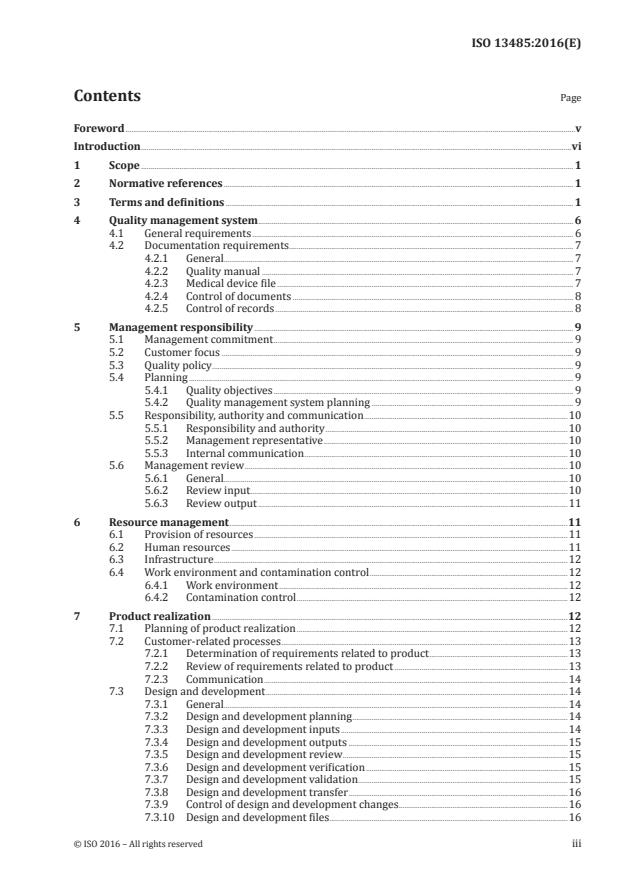
Contents Page
Foreword .v
Introduction .vi
1 Scope . 1
2 Normative references . 1
3 Terms and definitions . 1
4 Quality management system . 6
4.1 General requirements . 6
4.2 Documentation requirements. 7
4.2.1 General. 7
4.2.2 Quality manual . 7
4.2.3 Medical device file . 7
4.2.4 Control of documents . 8
4.2.5 Control of records . 8
5 Management responsibility . 9
5.1 Management commitment . 9
5.2 Customer focus . 9
5.3 Quality policy . 9
5.4 Planning . 9
5.4.1 Quality objectives . 9
5.4.2 Quality management system planning . 9
5.5 Responsibility, authority and communication .10
5.5.1 Responsibility and authority .10
5.5.2 Management representative .10
5.5.3 Internal communication .10
5.6 Management review .10
5.6.1 General.10
5.6.2 Review input .10
5.6.3 Review output .11
6 Resource management .11
6.1 Provision of resources .11
6.2 Human resources .11
6.3 Infrastructure .12
6.4 Work environment and contamination control .12
6.4.1 Work environment .12
6.4.2 Contamination control .12
7 Product realization .12
7.1 Planning of product realization .12
7.2 Customer-related processes .13
7.2.1 Determination of requirements related to product .13
7.2.2 Review of requirements related to product .13
7.2.3 Communication .14
7.3 Design and development .14
7.3.1 General.14
7.3.2 Design and development planning .14
7.3.3 Design and development inputs .14
7.3.4 Design and development outputs .15
7.3.5 Design and development review .15
7.3.6 Design and development verification .15
7.3.7 Design and development validation .15
7.3.8 Design and development transfer .16
7.3.9 Control of design and development changes .16
7.3.10 Design and development files .16
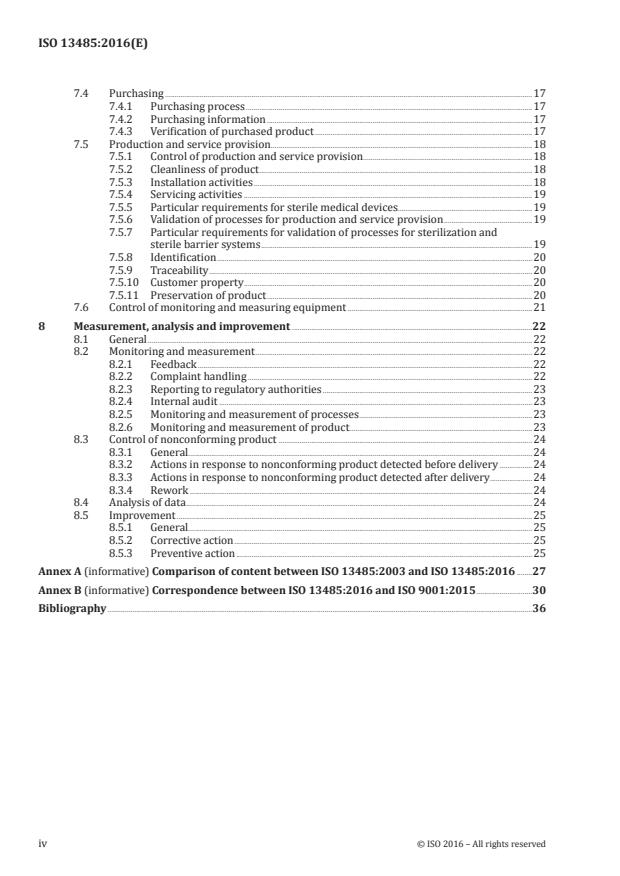
7.4 Purchasing .17
7.4.1 Purchasing process .17
7.4.2 Purchasing information .17
7.4.3 Verification of purchased product .17
7.5 Production and service provision .18
7.5.1 Control of production and service provision .18
7.5.2 Cleanliness of product .18
7.5.3 Installation activities .18
7.5.4 Servicing activities .19
7.5.5 Particular requirements for sterile medical devices.19
7.5.6 Validation of processes for production and service provision .19
7.5.7 Particular requirements for validation of processes for sterilization and
sterile barrier systems .19
7.5.8 Identification .20
7.5.9 Traceability .20
7.5.10 Customer property .20
7.5.11 Preservation of product .20
7.6 Control of monitoring and measuring equipment .21
8 Measurement, analysis and improvement .22
8.1 General .22
8.2 Monitoring and measurement .22
8.2.1 Feedback .22
8.2.2 Complaint handling .22
8.2.3 Reporting to regulatory authorities .23
8.2.4 Internal audit .23
8.2.5 Monitoring and measurement of processes .23
8.2.6 Monitoring and measurement of product .23
8.3 Control of nonconforming product .24
8.3.1 General.24
8.3.2 Actions in response to nonconforming product detected before delivery .24
8.3.3 Actions in response to nonconforming product detected after delivery .24
8.3.4 Rework .24
8.4 Analysis of data .24
8.5 Improvement .25
8.5.1 General.25
8.5.2 Corrective action .25
8.5.3 Preventive action .25
Annex A (informative) Comparison of content between ISO 13485:2003 and ISO 13485:2016 .27
Annex B (informative) Correspondence between ISO 13485:2016 and ISO 9001:2015 .30
Bibliography .36
iv © ISO 2016 – All rights reserved
Foreword
ISO (the International Organization for Standardization) is a worldwide federation of national standards
bodies (ISO member bodies). The work of preparing International Standards is normally carried out
through ISO technical committees. Each member body interested in a subject for which a technical
committee has been established has the right to be represented on that committee. International
organizations, governmental and non-governmental, in liaison with ISO, also take part in the work.
ISO collaborates closely with the International Electrotechnical Commission (IEC) on all matters of
electrotechnical standardization.
The procedures used to develop this document and those intended for its further maintenance are
described in the ISO/IEC Directives, Part 1. In particular the different approval criteria needed for the
different types of ISO documents should be noted. This document was drafted in accordance with the
editorial rules of the ISO/IEC Directives, Part 2 (see www.iso.org/directives).
Attention is drawn to the possibility that some of the elements of this document may be the subject of
patent rights. ISO shall not be held responsible for identifying any or all such patent rights. Details of
any patent rights identified during the development of the document will be in the Introduction and/or
on the ISO list of patent declarations received (see www.iso.org/patents).
Any trade name used in this document is information given for the convenience of users and does not
constitute an endorsement.
For an explanation on the meaning of ISO specific terms and expressions related to conformity assessment,
as well as information about ISO’s adherence to the World Trade Organization (WTO) principles in the
Technical Barriers to Trade (TBT) see the following URL: www.iso.org/iso/foreword.html.
The committee responsible for this document is Technical Committee ISO/TC 210, Quality management
and corresponding general aspects for medical devices.
This third edition of ISO 13485 cancels and replaces the second edition (ISO 13485:2003) and
ISO/TR 14969:2004, which have been technically revised. It also incorporates the Technical
Corrigendum ISO 13485:2003/Cor.1:2009. A summary of the changes incorporated into this edition
compared with the previous edition is given in Annex A.
Introduction
0.1 General
This International Standard specifies requirements for a quality management system that can be used by
an organization involved in one or more stages of the life-cycle of a medical device, including design and
development, production, storage and distribution, installation, servicing and final decommissioning
and disposal of medical devices, and design and development, or provision of associated activities (e.g.
technical support). The requirements in this International Standard can also be used by suppliers or
other external parties providing product (e.g. raw materials, components, subassemblies, medical
devices, sterilization services, calibration services, distribution services, maintenance services) to such
organizations. The supplier or external party can voluntarily choose to conform to the requirements of
this International Standard or can be required by contract to conform.
Several jurisdictions have regulatory requirements for the application of quality management systems
by organizations with a variety of roles in the supply chain for medical devices. Consequently, this
International Standard expects that the organization:
— identifies its role(s) under applicable regulatory requirements;
— identifies the regulatory requirements that apply to its activities under these roles;
— incorporates these applicable regulatory requirements within its quality management system.
The definitions in applicable regulatory requirements differ from nation to nation and region to region.
The organization needs to understand how the definitions in this International Standard will be
interpreted in light of regulatory definitions in the jurisdictions in which the medical devices are made
available.
This International Standard can also be used by internal and external parties, including certification
bodies, to assess the organization’s ability to meet customer and regulatory requirements applicable
to the quality management system and the organization’s own requirements. It is emphasized that the
quality management system requirements specified in this International Standard are complementary
to the technical requirements for product that are necessary to meet customer and applicable
regulatory requirements for safety and performance.
The adoption of a quality management system is a strategic decision of an organization. The design and
implementation of an organization’s quality management system is influenced by the:
a) organizational environment, changes in that environment, and the influence that the organizational
environment has on the conformity of the medical devices;
b) organization’s varying needs;
c) organization’s particular objectives;
d) product the organization provides;
e) processes the organization employs;
f) organization’s size and organizational structure;
g) regulatory requirements applicable to the organization’s activities.
It is not the intent of this International Standard to imply the need for uniformity in the structure of
different quality management systems, uniformity of documentation or alignment of documentation to
the clause structure of this International Standard.
There is a wide variety of medical devices and some of the particular requirements of this International
Standard only apply to named groups of medical devices. These groups are defined in Clause 3.
vi © ISO 2016 – All rights reserved
0.2 Clarification of concepts
In this International Standard, the following terms or phrases are used in the context described below.
— When a requirement is qualified by the phrase “as appropriate”, it is deemed to be appropriate unless
the organization can justify otherwise. A requirement is considered appropriate if it is necessary for:
— product to meet requirements;
— compliance with applicable regulatory requirements;
— the organization to carry out corrective action;
— the organization to manage risks.
— When the term “risk” is used, the application of the term within the scope of this International
Standard pertains to safety or performance requirements of the medical device or meeting
applicable regulatory requirements.
— When a requirement is required to be “documented”, it is also required to be established,
implemented and maintained.
— When the term “product” is used, it can also mean “service”. Product applies to output that is
intended for, or required by, a customer, or any intended output resulting from a product realization
process.
— When the term “regulatory requirements” is used, it encompasses requirements contained in any
law applicable to the user of this International Standard (e.g. statutes, regulations, ordinances or
directives). The application of the term “regulatory requirements” is limited to requirements for the
quality management system and the safety or performance of the medical device.
In this International Standard, the following verbal forms are used:
— “shall” indicates a requirement;
— “should” indicates a recommendation;
— “may” indicates a permission;
— “can” indicates a possibility or a capability.
Information marked as “NOTE” is for guidance in understanding or clarifying the associated
requirement.
0.3 Process approach
This International Standard is based on a process approach to quality management. Any activity that
receives input and converts it to output can be considered as a process. Often the output from one
process directly forms the input to the next process.
For an organization to function effectively, it needs to identify and manage numerous linked processes.
The application of a system of processes within an organization, together with the identification and
interactions of these processes, and their management to produce the desired outcome, can be referred
to as the “process approach.”
When used within a quality management system, such an approach emphasizes the importance of:
a) understanding and meeting requirements;
b) considering processes in terms of added value;
c) obtaining results of process performance and effectiveness;
d) improving processes based on objective measurement.
0.4 Relationship with ISO 9001
While this is a stand-alone standard, it is based on ISO 9001:2008, which has been superseded by
ISO 9001:2015. For the convenience of users, Annex B shows the correspondence between this
International Standard and ISO 9001:2015.
This International Standard is intended to facilitate global alignment of appropriate regulatory
requirements for quality management systems applicable to organizations involved in one or more
stages of the life-cycle of a medical device. This International Standard includes some particular
requirements for organizations involved in the life-cycle of medical devices and excludes some
of the requirements of ISO 9001 that are not appropriate as regulatory requirements. Because of
these exclusions, organizations whose quality management systems conform to this International
Standard cannot claim conformity to ISO 9001 unless their quality management system meets all the
requirements of ISO 9001.
0.5 Compatibility with other management systems
This International Standard does not include requirements specific to other management systems,
such as those particular to environmental management, occupational health and safety management,
or financial management. However, this International Standard enables an organization to align or
integrate its own quality management system with related management system requirements. It is
possible for an organization to adapt its existing management system(s) in order to establish a quality
management system that complies with the requirements of this International Standard.
viii © ISO 2016 – All rights reserved
INTERNATIONAL STANDARD ISO 13485:2016(E)
Medical devices — Quality management systems —
Requirements for regulatory purposes
1 Scope
This International Standard specifies requirements for a quality management system where an
organization needs to demonstrate its ability to provide medical devices and related services that
consistently meet customer and applicable regulatory requirements. Such organizations can be involved
in one or more stages of the life-cycle, including design and development, production, storage and
distribution, installation, or servicing of a medical device and design and development or provision of
associated activities (e.g. technical support). This International Standard can also be used by suppliers
or external parties that provide product, including quality management system-related services to such
organizations.
Requirements of this International Standard are applicable to organizations regardless of their size
and regardless of their type except where explicitly stated. Wherever requirements are specified as
applying to medical devices, the requirements apply equally to associated services as supplied by the
organization.
The processes required by this International Standard that are applicable to the organization, but
are not performed by the organization, are the responsibility of the organization and are accounted
for in the organization’s quality management system by monitoring, maintaining, and controlling the
processes.
If applicable regulatory requirements permit exclusions of design and development controls, this can
be used as a justification for their exclusion from the quality management system. These regulatory
requirements can provide alternative approaches that are to be addressed in the quality management
system. It is the responsibility of the organization to ensure that claims of conformity to this
International Standard reflect any exclusion of design and development controls.
If any requirement in Clauses 6, 7 or 8 of this International Standard is not applicable due to the
activities undertaken by the organization or the nature of the medical device for which the quality
management system is applied, the organization does not need to include such a requirement in its
quality management system. For any clause that is determined to be not applicable, the organization
records the justification as described in 4.2.2.
2 Normative references
The following documents, in whole or in part, are normatively referenced in this document and are
indispensable for its application. For dated references, only the edition cited applies. For undated
references, the latest edition of the referenced document (including any amendments) applies.
1)
ISO 9000:2015 , Quality management systems — Fundamentals and vocabulary
3 Terms and definitions
For the purposes of this document, the terms and definitions given in ISO 9000:2015 and the
following apply.
1) Supersedes ISO 9000:2005.
3.1
advisory notice
notice issued by the organization, subsequent to delivery of the medical device, to provide supplementary
information or to advise on action to be taken in the:
— use of a medical device,
— modification of a medical device,
— return of the medical device to the organization that supplied it, or
— destruction of a medical device
Note 1 to entry: Issuance of an advisory notice can be required to comply with applicable regulatory requirements.
3.2
authorized representative
natural or legal person established within a country or jurisdiction who has received a written mandate
from the manufacturer to act on his behalf for specified tasks with regard to the latter’s obligations
under that country or jurisdiction’s legislation
[SOURCE: GHTF/SG1/N055:2009, 5.2]
3.3
clinical evaluation
assessment and analysis of clinical data pertaining to a medical device to verify the clinical safety and
performance of the device when used as intended by the manufacturer
[SOURCE: GHTF/SG5/N4:2010, Clause 4]
3.4
complaint
written, electronic or oral communication that alleges deficiencies related to the identity, quality,
durability, reliability, usability, safety or performance of a medical device that has been released from
the organization’s control or related to a service that affects the performance of such medical devices
Note 1 to entry: This definition of “complaint” differs from the definition given in ISO 9000:2015.
3.5
distributor
natural or legal person in the supply chain who, on his own behalf, furthers the availability of a medical
device to the end user
Note 1 to entry: More than one distributor may be involved in the supply chain.
Note 2 to entry: Persons in the supply chain involved in activities such as storage and transport on behalf of the
manufacturer, importer or distributor, are not distributors under this definition.
[SOURCE: GHTF/SG1/N055:2009, 5.3]
3.6
implantable medical device
medical device which can only be removed by medical or surgical intervention and which is intended to:
— be totally or partially introduced into the human body or a natural orifice, or
— replace an epithelial surface or the surface of the eye, and
— remain after the procedure for at least 30 days
Note 1 to entry: This definition of implantable medical device includes active implantable medical device
2 © ISO 2016 – All rights reserved
3.7
importer
natural or legal person in the supply chain who is the first in a supply chain to make a medical device,
manufactured in another country or jurisdiction, available in the country or jurisdiction where it is to
be marketed
[SOURCE: GHTF/SG1/N055:2009, 5.4]
3.8
labelling
label, instructions for use, and any other information that is related to identification, technical
description, intended purpose and proper use of the medical device, but excluding shipping documents
[SOURCE: GHTF/SG1/N70:2011, Clause 4]
3.9
life-cycle
all phases in the life of a medical device, from the initial conception to final decommissioning and
disposal
[SOURCE: ISO 14971:2007, 2.7]
3.10
manufacturer
natural or legal person with responsibility for design and/or manufacture of a medical device with the
intention of making the medical device available for use, under his name; whether or not such a medical
device is designed and/or manufactured by that person himself or on his behalf by another person(s)
Note 1 to entry: This “natural or legal person” has ultimate legal responsibility for ensuring compliance with
all applicable regulatory requirements for the medical devices in the countries or jurisdictions where it is
intended to be made available or sold, unless this responsibility is specifically imposed on another person by the
Regulatory Authority (RA) within that jurisdiction.
Note 2 to entry: The manufacturer’s responsibilities are described in other GHTF guidance documents. These
responsibilities include meeting both pre-market requirements and post-market requirements, such as adverse
event reporting and notification of corrective actions.
Note 3 to entry: “Design and/or manufacture”, as referred to in the above definition, may include specification
development, production, fabrication, assembly, processing, packaging, repackaging, labelling, relabelling,
sterilization, installation, or remanufacturing of a medical device; or putting a collection of devices, and possibly
other products, together for a medical purpose.
Note 4 to entry: Any person who assembles or adapts a medical device that has already been supplied by another
person for an individual patient, in accordance with the instructions for use, is not the manufacturer, provided
the assembly or adaptation does not change the intended use of the medical device.
Note 5 to entry: Any person who changes the intended use of, or modifies, a medical device without acting on
behalf of the original manufacturer and who makes it available for use under his own name, should be considered
the manufacturer of the modified medical device.
Note 6 to entry: An authorized representative, distributor or importer who only adds its own address and
contact details to the medical device or the packaging, without covering or changing the existing labelling, is not
considered a manufacturer.
Note 7 to entry: To the extent that an accessory is subject to the regulatory requirements of a medical device, the
person responsible for the design and/or manufacture of that accessory is considered to be a manufacturer.
[SOURCE: GHTF/SG1/N055:2009, 5.1]
3.11
medical device
instrument, apparatus, implement, machine, appliance, implant, reagent for in vitro use, software,
material or other similar or related article, intended by the manufacturer to be used, alone or in
combination, for human beings, for one or more of the specific medical purpose(s) of:
— diagnosis, prevention, monitoring, treatment or alleviation of disease;
— diagnosis, monitoring, treatment, alleviation of or compensation for an injury;
— investigation, replacement, modification, or support of the anatomy or of a physiological process;
— supporting or sustaining life;
— control of conception;
— disinfection of medical devices;
— providing information by means of in vitro examination of specimens derived from the human body;
and does not achieve its primary intended action by pharmacological, immunological or metabolic
means, in or on the human body, but which may be assisted in its intended function by such means
Note 1 to entry: Products which may be considered to be medical devices in some jurisdictions but not in others
include:
— disinfection substances;
— aids for persons with disabilities;
— devices incorporating animal and/or human tissues;
— devices for in vitro fertilization or assisted reproduction technologies.
[SOURCE: GHTF/SG1/N071:2012, 5.1]
3.12
medical device family
group of medical devices manufactured by or for the same organization and having the same basic
design and performance characteristics related to safety, intended use and function
3.13
performance evaluation
assessment and analysis of data to establish or verify the ability of an in vitro diagnostic medical device
to achieve its intended use
3.14
post-market surveillance
systematic process to collect and analyse experience gained from medical devices that have been placed
on the market
3.15
product
result of a process
Note 1 to entry: There are four generic product categories, as follows:
— services (e.g. transport);
— software (e.g. computer program, dictionary);
— hardware (e.g. engine mechanical part);
— processed materials (e.g. lubricant).
4 © ISO 2016 – All rights reserved
Many products comprise elements belonging to different generic product categories. Whether the product is
then called service, software, hardware or processed material depends on the dominant element. For example,
the offered product “automobile” consists of hardware (e.g. tyres), processed materials (e.g. fuel, cooling liquid),
software (e.g. engine control software, driver’s manual), and service (e.g. operating explanations given by the
salesman).
Note 2 to entry: Service is the result of at least one activity necessarily performed at the interface between the
supplier and customer and is generally intangible. Provision of a service can involve, for example, the following:
— an activity performed on a customer-supplied tangible product (e.g. automobile to be repaired);
— an activity performed on a customer-supplied intangible product (e.g. the income statement needed to
prepare a tax return);
— the delivery of an intangible product (e.g. the delivery of information in the context of knowledge
transmission);
— the creation of ambience for the customer (e.g. in hotels and restaurants).
Software consists of information and is generally intangible and can be in the form of approaches, transactions
or procedures.
Hardware is generally tangible and its amount is a countable characteristic. Processed materials are generally
tangible and their amount is a continuous characteristic. Hardware and processed materials often are referred
to as goods.
Note 3 to entry: This definition of “product” differs from the definition given in ISO 9000:2015.
2)
[SOURCE: ISO 9000:2005 , 3.4.2, modified]
3.16
purchased product
product provided by a party outside the organization’s quality management system
Note 1 to entry: The provision of product does not necessarily infer a commercial or financial arrangement.
3.17
risk
combination of the probability of occurrence of harm and the severity of that harm
Note 1 to entry: This definition of “risk” differs from the definition given in ISO 9000:2015.
[SOURCE: ISO 14971:2007, 2.16]
3.18
risk management
systematic application of management policies, procedures and practices to the tasks of analysing,
evaluating, controlling and monitoring risk
[SOURCE: ISO 14971:2007, 2.22]
3.19
sterile barrier system
minimum package that prevents ingress of microorganisms and allows aseptic presentation of the
product at the point of use
[SOURCE: ISO 11607-1:2006, 3.22]
2) Superseded by ISO 9000:2015.
3.20
sterile medical device
medical device intended to meet the requirements for sterility
Note 1 to entry: The requirements for sterility of a medical device can be subject to applicable regulatory
requirements or standards.
4 Quality management system
4.1 General requirements
4.1.1 The organization shall document a quality management system and maintain its effectiveness in
accordance with the requirements of this International Standard and applicable regulatory requirements.
The organization shall establish, implement and maintain any requirement, procedure, activity or
arrangement required to be documented by this International Standard or applicable regulatory
requirements.
The organization shall document the role(s) undertaken by the organization under the applicable
regulatory requirements.
NOTE Roles undertaken by the organization can include manufacturer, authorized representative, importer
or distributor.
4.1.2 The organization shall:
a) determine the processes needed for the quality management system and the application of
these processes throughout the organization taking into account the roles undertaken by the
organization;
b) apply a risk based approach to the control of the appropriate processes needed for the quality
management system;
c) determine the sequence and interaction of these processes.
4.1.3 For each quality management system process, the organization shall:
a) determine criteria and methods needed to ensure that both the operation and control of these
processes are effective;
b) ensure the availability of resources and information necessary to support the operation and
monitoring of these processes;
c) implement actions necessary to achieve planned results and maintain the effectiveness of these
processes;
d) monitor, measure as appropriate, and analyse these processes;
e) establish and maintain records needed to demonstrate conformance to this International Standard
and compliance with applicable regulatory requirements (see 4.2.5).
4.1.4 The organization shall manage these quality management system processes in accordance with
the requirements of this International Standard and applicable regulatory requirements. Changes to be
made to these processes shall be:
a) evaluated for their impact on the quality management system;
b) evaluated for their impact on the medical devices produced under this quality management system;
6 © ISO 2016 – All rights reserved
c) controlled in accordance with the requirements of this International Standard and applicable
regulatory requirements.
4.1.5 When the organization chooses to outsource any process that affects product conformity to
requirements, it shall monitor and ensure control over such processes. The organization shall retain
responsibility of conformity to this International Standard and to customer and applicable regulatory
requirements for outsourced processes. The controls shall be proportionate to the risk involved and the
ability of the external party to meet the requirements in accordance with 7.4. The controls shall include
written quality agreements.
4.1.6 The organization shall document procedures for the validation of the application of computer
software used in the quality management system. Such software applications shall be validated prior to
initial use and,
...
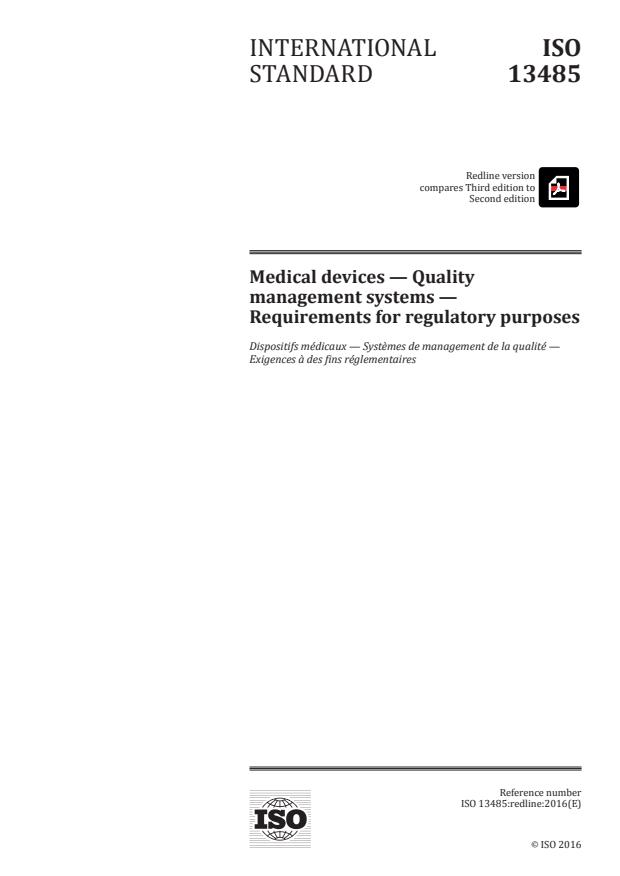
INTERNATIONAL ISO
STANDARD 13485
Redline version
compares Third edition to
Second edition
Medical devices — Quality
management systems —
Requirements for regulatory purposes
Dispositifs médicaux — Systèmes de management de la qualité —
Exigences à des fins réglementaires
Reference number
ISO 13485:redline:2016(E)
©
ISO 2016
ISO 13485:redline:2016(E)
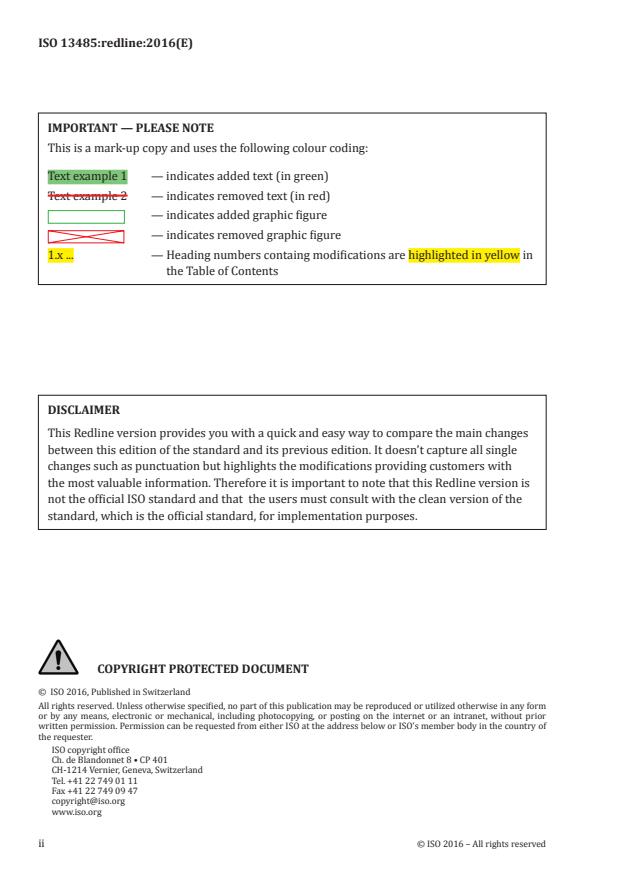
IMPORTANT — PLEASE NOTE
This is a mark-up copy and uses the following colour coding:
Text example 1 — indicates added text (in green)
Text example 2 — indicates removed text (in red)
— indicates added graphic figure
— indicates removed graphic figure
1.x . — Heading numbers containg modifications are highlighted in yellow in
the Table of Contents
DISCLAIMER
This Redline version provides you with a quick and easy way to compare the main changes
between this edition of the standard and its previous edition. It doesn’t capture all single
changes such as punctuation but highlights the modifications providing customers with
the most valuable information. Therefore it is important to note that this Redline version is
not the official ISO standard and that the users must consult with the clean version of the
standard, which is the official standard, for implementation purposes.
© ISO 2016, Published in Switzerland
All rights reserved. Unless otherwise specified, no part of this publication may be reproduced or utilized otherwise in any form
or by any means, electronic or mechanical, including photocopying, or posting on the internet or an intranet, without prior
written permission. Permission can be requested from either ISO at the address below or ISO’s member body in the country of
the requester.
ISO copyright office
Ch. de Blandonnet 8 • CP 401
CH-1214 Vernier, Geneva, Switzerland
Tel. +41 22 749 01 11
Fax +41 22 749 09 47
copyright@iso.org
www.iso.org
ii © ISO 2016 – All rights reserved
ISO 13485:redline:2016(E)
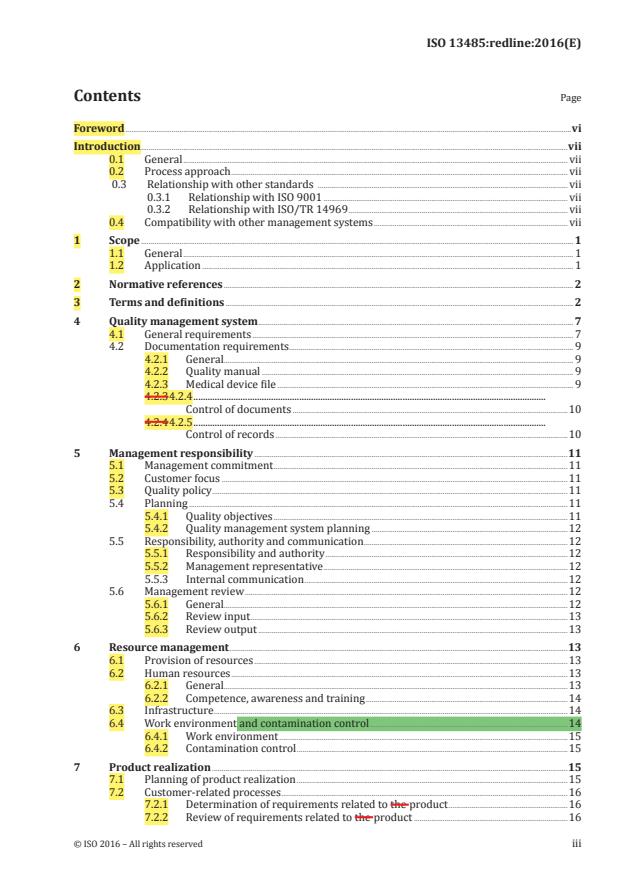
Contents Page
Foreword .vi
Introduction .vii
0.1 General . vii
0.2 Process approach . vii
0.3 Relationship with other standards . vii
0.3.1 Relationship with ISO 9001 . vii
0.3.2 Relationship with ISO/TR 14969 . vii
0.4 Compatibility with other management systems . vii
1 Scope . 1
1.1 General . 1
1.2 Application . 1
2 Normative references . 2
3 Terms and definitions . 2
4 Quality management system . 7
4.1 General requirements . 7
4.2 Documentation requirements. 9
4.2.1 General. 9
4.2.2 Quality manual . 9
4.2.3 Medical device file . 9
4.2.3 4.2.4 .
Control of documents .10
4.2.4 4.2.5 .
Control of records .10
5 Management responsibility .11
5.1 Management commitment .11
5.2 Customer focus .11
5.3 Quality policy .11
5.4 Planning .11
5.4.1 Quality objectives .11
5.4.2 Quality management system planning .12
5.5 Responsibility, authority and communication .12
5.5.1 Responsibility and authority .12
5.5.2 Management representative .12
5.5.3 Internal communication .12
5.6 Management review .12
5.6.1 General.12
5.6.2 Review input .13
5.6.3 Review output .13
6 Resource management .13
6.1 Provision of resources .13
6.2 Human resources .13
6.2.1 General.13
6.2.2 Competence, awareness and training .14
6.3 Infrastructure .14
6.4 Work environment and contamination control .14
6.4.1 Work environment .15
6.4.2 Contamination control .15
7 Product realization .15
7.1 Planning of product realization .15
7.2 Customer-related processes .16
7.2.1 Determination of requirements related to the product .16
7.2.2 Review of requirements related to the product .16
ISO 13485:redline:2016(E)
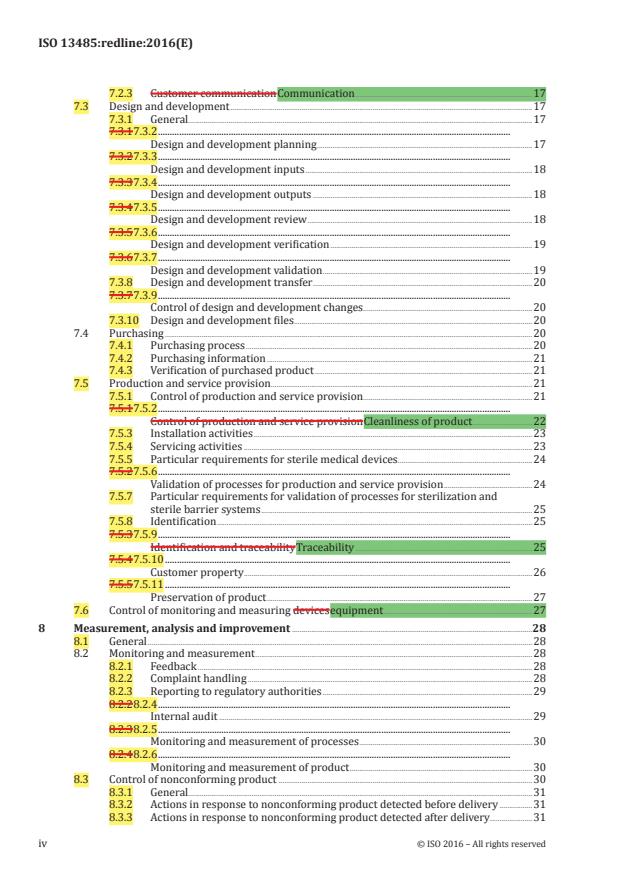
7.2.3 Customer communication Communication .17
7.3 Design and development .17
7.3.1 General.17
7.3.1 7.3.2 .
Design and development planning .17
7.3.2 7.3.3 .
Design and development inputs .18
7.3.3 7.3.4 .
Design and development outputs .18
7.3.4 7.3.5 .
Design and development review .18
7.3.5 7.3.6 .
Design and development verification .19
7.3.6 7.3.7 .
Design and development validation .19
7.3.8 Design and development transfer .20
7.3.7 7.3.9 .
Control of design and development changes .20
7.3.10 Design and development files .20
7.4 Purchasing .20
7.4.1 Purchasing process .20
7.4.2 Purchasing information .21
7.4.3 Verification of purchased product .21
7.5 Production and service provision .21
7.5.1 Control of production and service provision .21
7.5.1 7.5.2 .
Control of production and service provision Cleanliness of product .22
7.5.3 Installation activities .23
7.5.4 Servicing activities .23
7.5.5 Particular requirements for sterile medical devices.24
7.5.2 7.5.6 .
Validation of processes for production and service provision .24
7.5.7 Particular requirements for validation of processes for sterilization and
sterile barrier systems .25
7.5.8 Identification .25
7.5.3 7.5.9 .
Identification and traceability Traceability .25
7.5.4 7.5.10 .
Customer property .26
7.5.5 7.5.11 .
Preservation of product .27
7.6 Control of monitoring and measuring devices equipment .27
8 Measurement, analysis and improvement .28
8.1 General .28
8.2 Monitoring and measurement .28
8.2.1 Feedback .28
8.2.2 Complaint handling .28
8.2.3 Reporting to regulatory authorities .29
8.2.2 8.2.4 .
Internal audit .29
8.2.3 8.2.5 .
Monitoring and measurement of processes .30
8.2.4 8.2.6 .
Monitoring and measurement of product .30
8.3 Control of nonconforming product .30
8.3.1 General.31
8.3.2 Actions in response to nonconforming product detected before delivery .31
8.3.3 Actions in response to nonconforming product detected after delivery .31
iv © ISO 2016 – All rights reserved
ISO 13485:redline:2016(E)
8.3.4 Rework .31
8.4 Analysis of data .32
8.5 Improvement .32
8.5.1 General.32
8.5.2 Corrective action .32
8.5.3 Preventive action .33
Bibliography .34
ISO 13485:redline:2016(E)
Foreword
ISO (the International Organization for Standardization) is a worldwide federation of national standards
bodies (ISO member bodies). The work of preparing International Standards is normally carried out
through ISO technical committees. Each member body interested in a subject for which a technical
committee has been established has the right to be represented on that committee. International
organizations, governmental and non-governmental, in liaison with ISO, also take part in the work.
ISO collaborates closely with the International Electrotechnical Commission (IEC) on all matters of
electrotechnical standardization.
International Standards areThe procedures used to develop this document and those intended for its
further maintenance are described in the ISO/IEC Directives, Part 1. In particular the different approval
criteria needed for the different types of ISO documents should be noted. This document was drafted
in accordance with the rules given ineditorial rules of the ISO/IEC Directives, Part 2 (see www.iso.
org/directives).
The main task of technical committees is to prepare International Standards. Draft International
Standards adopted by the technical committees are circulated to the member bodies for voting.
Publication as an International Standard requires approval by at least 75 % of the member bodies
casting a vote.
Attention is drawn to the possibility that some of the elements of this document may be the subject of
patent rights. ISO shall not be held responsible for identifying any or all such patent rights. Details of
any patent rights identified during the development of the document will be in the Introduction and/or
on the ISO list of patent declarations received (see www.iso.org/patents).
Any trade name used in this document is information given for the convenience of users and does not
constitute an endorsement.
For an explanation on the meaning of ISO specific terms and expressions related to conformity assessment,
as well as information about ISO’s adherence to the World Trade Organization (WTO) principles in the
Technical Barriers to Trade (TBT) see the following URL: www.iso.org/iso/foreword.html.
ISO 13485 was prepared byThe committee responsible for this document is Technical Committee
ISO/TC 210, Quality management and corresponding general aspects for medical devices.
This secondthird edition of ISO 13485 cancels and replaces the firstsecond edition
(ISO 13485:19962003) and ISO/TR 14969:2004, which hashave been technically revised. It also cancels
and replacesincorporates the Technical Corrigendum ISO 13488:199613485:2003/Cor.1:2009. Those
organizations which have used ISO 13488 in the past may use this International Standard by excluding
certain requirements in accordance withA summary of the changes incorporated into this 1.2edition
compared with the previous edition is given in Annex A.
This edition of ISO 13485 has a revised title and addresses quality assurance of product, customer
requirements, and other elements of quality system management.
vi © ISO 2016 – All rights reserved
ISO 13485:redline:2016(E)
Introduction
0.1 General
This International Standard specifies requirements for a quality management system that can be used
by an organization for the design and development, production, installation and servicing of medical
devices, and the design, development, and provision of related services.
It can also be used by internal and external parties, including certification bodies, to assess the
organization’s ability to meet customer and regulatory requirements.
Information marked “NOTE” is for guidance in understanding or clarifying the associated requirement.
It is emphasized that the quality management system requirements specified in this International
Standard are complementary to technical requirements for products.
The adoption of a quality management system should be a strategic decision of an organization. The
design and implementation of an organization’s quality management system is influenced by varying
needs, particular objectives, the products provided, the processes employed and the size and structure
of the organization. It is not the intent of this International Standard to imply uniformity in the structure
of quality management systems or uniformity of documentation.
There is a wide variety of medical devices and some of the particular requirements of this International
Standard only apply to named groups of medical devices. These groups are defined in Clause 3.
0.2 Process approach
This International Standard is based on a process approach to quality management.
Any activity that receives inputs and converts them to outputs can be considered as a process.
For an organization to function effectively, it has to identify and manage numerous linked processes.
Often the output from one process directly forms the input to the next.
The application of a system of processes within an organization, together with the identification and
interactions of these processes, and their management, can be referred to as the “process approach”.
0.3 Relationship with other standards
0.3.1 Relationship with ISO 9001
While this is a stand-alone standard, it is based on ISO 9001.
Those clauses or subclauses that are quoted directly and unchanged from ISO 9001 are in normal font.
The fact that these subclauses are presented unchanged is noted in Annex B.
Where the text of this International Standard is not identical to the text of ISO 9001, the sentence or
indent containing that text as a whole is shown in italics (in blue italics for electronic versions). The
nature and reasons for the text changes are noted in Annex B.
0.3.2 Relationship with ISO/TR 14969
ISO/TR 14969 is a Technical Report intended to provide guidance for the application of ISO 13485.
0.4 Compatibility with other management systems
This International Standard follows the format of ISO 9001 for the convenience of users in the medical
device community.
ISO 13485:redline:2016(E)
This International Standard does not include requirements specific to other management systems,
such as those particular to environmental management, occupational health and safety management,
or financial management.
However, this International Standard enables an organization to align or integrate its own quality
management system with related management system requirements. It is possible for an organization
to adapt its existing management system(s) in order to establish a quality management system that
complies with the requirements of this International Standard.
0.1 General
This International Standard specifies requirements for a quality management system that can be used by
an organization involved in one or more stages of the life-cycle of a medical device, including design and
development, production, storage and distribution, installation, servicing and final decommissioning
and disposal of medical devices, and design and development, or provision of associated activities (e.g.
technical support). The requirements in this International Standard can also be used by suppliers or
other external parties providing product (e.g. raw materials, components, subassemblies, medical
devices, sterilization services, calibration services, distribution services, maintenance services) to such
organizations. The supplier or external party can voluntarily choose to conform to the requirements of
this International Standard or can be required by contract to conform.
Several jurisdictions have regulatory requirements for the application of quality management systems
by organizations with a variety of roles in the supply chain for medical devices. Consequently, this
International Standard expects that the organization:
— identifies its role(s) under applicable regulatory requirements;
— identifies the regulatory requirements that apply to its activities under these roles;
— incorporates these applicable regulatory requirements within its quality management system.
The definitions in applicable regulatory requirements differ from nation to nation and region to region.
The organization needs to understand how the definitions in this International Standard will be
interpreted in light of regulatory definitions in the jurisdictions in which the medical devices are made
available.
This International Standard can also be used by internal and external parties, including certification
bodies, to assess the organization’s ability to meet customer and regulatory requirements applicable
to the quality management system and the organization’s own requirements. It is emphasized that the
quality management system requirements specified in this International Standard are complementary
to the technical requirements for product that are necessary to meet customer and applicable
regulatory requirements for safety and performance.
The adoption of a quality management system is a strategic decision of an organization. The design and
implementation of an organization’s quality management system is influenced by the:
a) organizational environment, changes in that environment, and the influence that the organizational
environment has on the conformity of the medical devices;
b) organization’s varying needs;
c) organization’s particular objectives;
d) product the organization provides;
e) processes the organization employs;
f) organization’s size and organizational structure;
g) regulatory requirements applicable to the organization’s activities.
viii © ISO 2016 – All rights reserved
ISO 13485:redline:2016(E)
It is not the intent of this International Standard to imply the need for uniformity in the structure of
different quality management systems, uniformity of documentation or alignment of documentation to
the clause structure of this International Standard.
There is a wide variety of medical devices and some of the particular requirements of this International
Standard only apply to named groups of medical devices. These groups are defined in Clause 3.
ISO 13485:redline:2016(E)
0.2 Clarification of concepts
In this International Standard, the following terms or phrases are used in the context described below.
— When a requirement is qualified by the phrase “as appropriate”, it is deemed to be appropriate unless
the organization can justify otherwise. A requirement is considered appropriate if it is necessary for:
— product to meet requirements;
— compliance with applicable regulatory requirements;
— the organization to carry out corrective action;
— the organization to manage risks.
— When the term “risk” is used, the application of the term within the scope of this International
Standard pertains to safety or performance requirements of the medical device or meeting
applicable regulatory requirements.
— When a requirement is required to be “documented”, it is also required to be established,
implemented and maintained.
— When the term “product” is used, it can also mean “service”. Product applies to output that is
intended for, or required by, a customer, or any intended output resulting from a product realization
process.
— When the term “regulatory requirements” is used, it encompasses requirements contained in any
law applicable to the user of this International Standard (e.g. statutes, regulations, ordinances or
directives). The application of the term “regulatory requirements” is limited to requirements for the
quality management system and the safety or performance of the medical device.
In this International Standard, the following verbal forms are used:
— “shall” indicates a requirement;
— “should” indicates a recommendation;
— “may” indicates a permission;
— “can” indicates a possibility or a capability.
Information marked as “NOTE” is for guidance in understanding or clarifying the associated
requirement.
0.3 Process approach
This International Standard is based on a process approach to quality management. Any activity that
receives input and converts it to output can be considered as a process. Often the output from one
process directly forms the input to the next process.
For an organization to function effectively, it needs to identify and manage numerous linked processes.
The application of a system of processes within an organization, together with the identification and
interactions of these processes, and their management to produce the desired outcome, can be referred
to as the “process approach.”
When used within a quality management system, such an approach emphasizes the importance of:
a) understanding and meeting requirements;
b) considering processes in terms of added value;
c) obtaining results of process performance and effectiveness;
d) improving processes based on objective measurement.
x © ISO 2016 – All rights reserved
ISO 13485:redline:2016(E)
0.4 Relationship with ISO 9001
While this is a stand-alone standard, it is based on ISO 9001:2008, which has been superseded by
ISO 9001:2015. For the convenience of users, Annex B shows the correspondence between this
International Standard and ISO 9001:2015.
This International Standard is intended to facilitate global alignment of appropriate regulatory
requirements for quality management systems applicable to organizations involved in one or more
stages of the life-cycle of a medical device. This International Standard includes some particular
requirements for organizations involved in the life-cycle of medical devices and excludes some
of the requirements of ISO 9001 that are not appropriate as regulatory requirements. Because of
these exclusions, organizations whose quality management systems conform to this International
Standard cannot claim conformity to ISO 9001 unless their quality management system meets all the
requirements of ISO 9001.
0.5 Compatibility with other management systems
This International Standard does not include requirements specific to other management systems,
such as those particular to environmental management, occupational health and safety management,
or financial management. However, this International Standard enables an organization to align or
integrate its own quality management system with related management system requirements. It is
possible for an organization to adapt its existing management system(s) in order to establish a quality
management system that complies with the requirements of this International Standard.
INTERNATIONAL STANDARD ISO 13485:redline:2016(E)
Medical devices — Quality management systems —
Requirements for regulatory purposes
1 Scope
1.1 General
This International Standard specifies requirements for a quality management system where an
organization needs to demonstrate its ability to provide medical devices and related services that
consistently meet customer requirements and regulatory requirements applicable to medical devices
and related services.
The primary objective of this International Standard is to facilitate harmonized medical device
regulatory requirements for quality management systems. As a result, it includes some particular
requirements for medical devices and excludes some of the requirements of ISO 9001 that are not
appropriate as regulatory requirements. Because of these exclusions, organizations whose quality
management systems conform to this International Standard cannot claim conformity to ISO 9001
unless their quality management systems conform to all the requirements of ISO 9001 (see Annex B).
1.2 Application
All requirements of this International Standard are specific to organizations providing medical devices,
regardless of the type or size of the organization.
If regulatory requirements permit exclusions of design and development controls (see 7.3), this can be
used as a justification for their exclusion from the quality management system. These regulations can
provide alternative arrangements that are to be addressed in the quality management system. It is the
responsibility of the organization to ensure that claims of conformity with this International Standard
reflect exclusion of design and development controls [see 4.2.2 a) and 7.3].
If any requirement(s) in Clause 7 of this International Standard is(are) not applicable due to the nature
of the medical device(s) for which the quality management system is applied, the organization does not
need to include such a requirement(s) in its quality management system [see 4.2.2 a)].
The processes required by this International Standard, which are applicable to the medical device(s),
but which are not performed by the organization, are the responsibility of the organization and are
accounted for in the organization’s quality management system [see 4.1 a)].
In this International Standard the terms “if appropriate” and “where appropriate” are used several
times. When a requirement is qualified by either of these phrases, it is deemed to be “appropriate” unless
the organization can document a justification otherwise. A requirement is considered “appropriate” if it
is necessary in order for
— the product to meet specified requirements, and/or
— the organization to carry out corrective action.
This International Standard specifies requirements for a quality management system where an
organization needs to demonstrate its ability to provide medical devices and related services that
consistently meet customer and applicable regulatory requirements. Such organizations can be involved
in one or more stages of the life-cycle, including design and development, production, storage and
distribution, installation, or servicing of a medical device and design and development or provision of
associated activities (e.g. technical support). This International Standard can also be used by suppliers
or external parties that provide product, including quality management system-related services to such
organizations.
ISO 13485:redline:2016(E)
Requirements of this International Standard are applicable to organizations regardless of their size
and regardless of their type except where explicitly stated. Wherever requirements are specified as
applying to medical devices, the requirements apply equally to associated services as supplied by the
organization.
The processes required by this International Standard that are applicable to the organization, but
are not performed by the organization, are the responsibility of the organization and are accounted
for in the organization’s quality management system by monitoring, maintaining, and controlling the
processes.
If applicable regulatory requirements permit exclusions of design and development controls, this can
be used as a justification for their exclusion from the quality management system. These regulatory
requirements can provide alternative approaches that are to be addressed in the quality management
system. It is the responsibility of the organization to ensure that claims of conformity to this
International Standard reflect any exclusion of design and development controls.
If any requirement in Clauses 6, 7 or 8 of this International Standard is not applicable due to the
activities undertaken by the organization or the nature of the medical device for which the quality
management system is applied, the organization does not need to include such a requirement in its
quality management system. For any clause that is determined to be not applicable, the organization
records the justification as described in 4.2.2.
2 Normative references
The following referenced documentsdocuments, in whole or in part, are normatively referenced in
this document and are indispensable for the application of this documentits application. For dated
references, only the edition cited applies. For undated references, the latest edition of the referenced
document (including any amendments) applies.
1)
ISO 9000:2000 2015 , Quality management systems — Fundamentals and vocabulary
3 Terms and definitions
For the purposes of this document, the terms and definitions given in ISO 9000:2015 apply, together
with the following. and the following apply.
The following terms, used in this edition of ISO 13485 to describe the supply chain, have been changed
to reflect the vocabulary currently used:
supplier -------------> organization ----------> customer
The term “organization” replaces the term “supplier” used in ISO 13485:1996 , and refers to the
unit to which this International Standard applies. Also, the term “supplier” now replaces the term
“subcontractor”.
Throughout the text of this International Standard, wherever the term “product” occurs, it can also
mean “service”.
Wherever requirements are specified as applying to “medical devices”, the requirements apply equally
to related services as supplied by the organization.
The following definitions should be regarded as generic, as definitions provided in national regulations
can differ slightly and take precedence.
1) Supersedes ISO 9000:2005.
2 © ISO 2016 – All rights reserved
ISO 13485:redline:2016(E)
3.1
active implantable medical device
active medical device which is intended to be totally or partially introduced, surgically or medically,
into the human body or by medical intervention into a natural orifice, and which is intended to remain
after the procedure
3.2
active medical device
medical device relying for its functioning on a source of electrical energy or any source of power other
than that directly generated by the human body or gravity
3.3 3.1
advisory notice
notice issued by the organization
...
NORME ISO
INTERNATIONALE 13485
Troisième édition
2016-03-01
Dispositifs médicaux — Systèmes
de management de la qualité —
Exigences à des fins réglementaires
Medical devices — Quality management systems — Requirements for
regulatory purposes
Numéro de référence
©
ISO 2016
DOCUMENT PROTÉGÉ PAR COPYRIGHT
© ISO 2016, Publié en Suisse
Droits de reproduction réservés. Sauf indication contraire, aucune partie de cette publication ne peut être reproduite ni utilisée
sous quelque forme que ce soit et par aucun procédé, électronique ou mécanique, y compris la photocopie, l’affichage sur
l’internet ou sur un Intranet, sans autorisation écrite préalable. Les demandes d’autorisation peuvent être adressées à l’ISO à
l’adresse ci-après ou au comité membre de l’ISO dans le pays du demandeur.
ISO copyright office
Ch. de Blandonnet 8 • CP 401
CH-1214 Vernier, Geneva, Switzerland
Tel. +41 22 749 01 11
Fax +41 22 749 09 47
copyright@iso.org
www.iso.org
ii © ISO 2016 – Tous droits réservés
Sommaire Page
Avant-propos .v
Introduction .vi
1 Domaine d’application . 1
2 Références normatives . 1
3 Termes et définitions . 1
4 Système de management de la qualité . 6
4.1 Exigences générales . 6
4.2 Exigences relatives à la documentation . 7
4.2.1 Généralités . 7
4.2.2 Manuel qualité . 7
4.2.3 Dossier du dispositif médical . 8
4.2.4 Maîtrise des documents . . 8
4.2.5 Maîtrise des enregistrements . 9
5 Responsabilité de la direction . 9
5.1 Engagement de la direction . 9
5.2 Orientation client . 9
5.3 Politique qualité . 9
5.4 Planification .10
5.4.1 Objectifs qualité .10
5.4.2 Planification du système de management de la qualité .10
5.5 Responsabilité, autorité et communication .10
5.5.1 Responsabilité et autorité .10
5.5.2 Représentant de la direction .10
5.5.3 Communication interne .10
5.6 Revue de direction .10
5.6.1 Généralités .10
5.6.2 Éléments d’entrée de la revue .11
5.6.3 Éléments de sortie de la revue .11
6 Management des ressources .11
6.1 Mise à disposition des ressources .11
6.2 Ressources humaines .12
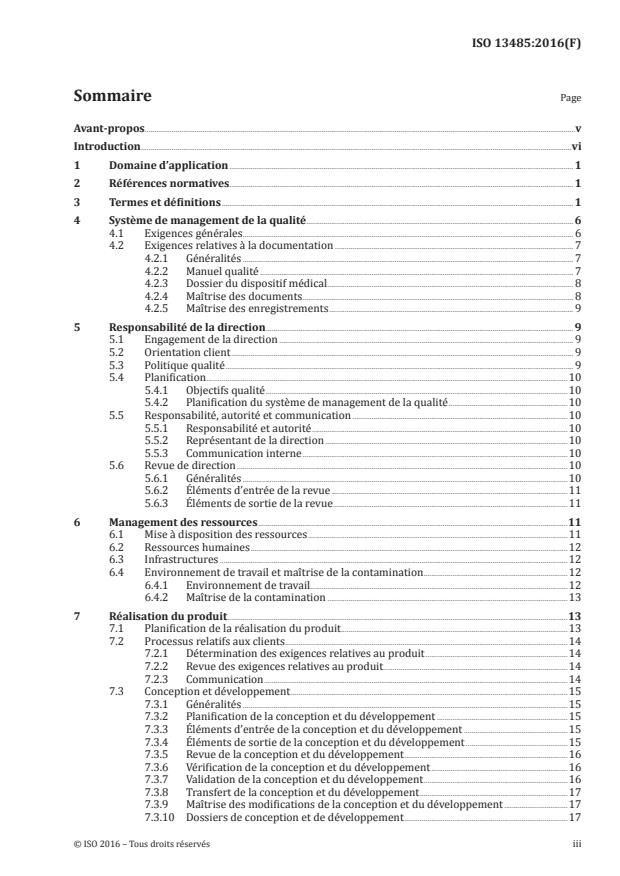
6.3 Infrastructures .12
6.4 Environnement de travail et maîtrise de la contamination .12
6.4.1 Environnement de travail.12
6.4.2 Maîtrise de la contamination .13
7 Réalisation du produit .13
7.1 Planification de la réalisation du produit.13
7.2 Processus relatifs aux clients .14
7.2.1 Détermination des exigences relatives au produit .14
7.2.2 Revue des exigences relatives au produit.14
7.2.3 Communication .14
7.3 Conception et développement .15
7.3.1 Généralités .15
7.3.2 Planification de la conception et du développement .15
7.3.3 Éléments d’entrée de la conception et du développement .15
7.3.4 Éléments de sortie de la conception et du développement .15
7.3.5 Revue de la conception et du développement .16
7.3.6 Vérification de la conception et du développement .16
7.3.7 Validation de la conception et du développement .16
7.3.8 Transfert de la conception et du développement .17
7.3.9 Maîtrise des modifications de la conception et du développement .17
7.3.10 Dossiers de conception et de développement .17
7.4 Achats .18
7.4.1 Processus d’achat .18
7.4.2 Informations relatives aux achats .18
7.4.3 Vérification du produit acheté.18
7.5 Production et prestation de service .19
7.5.1 Maîtrise de la production et de la prestation de service .19
7.5.2 Propreté du produit .19
7.5.3 Activités d’installation.20
7.5.4 Prestations associées .20
7.5.5 Exigences particulières pour les dispositifs médicaux stériles .20
7.5.6 Validation des processus de production et de prestation de service .20
7.5.7 Exigences spécifiques relatives à la validation des procédés de
stérilisation et des systèmes de barrière stérile .21
7.5.8 Identification .21
7.5.9 Traçabilité .21
7.5.10 Propriété du client .22
7.5.11 Préservation du produit .22
7.6 Maîtrise des équipements de surveillance et de mesure .22
8 Mesurage, analyse et amélioration .23
8.1 Généralités .23
8.2 Surveillance et mesurage .23
8.2.1 Retours d’information .23
8.2.2 Traitement des réclamations .23
8.2.3 Signalement aux autorités réglementaires .24
8.2.4 Audit interne .24
8.2.5 Surveillance et mesure des processus .24
8.2.6 Surveillance et mesure du produit .25
8.3 Maîtrise du produit non conforme.25
8.3.1 Généralités .25
8.3.2 Actions en réponse à une non-conformité du produit détectée avant livraison .25
8.3.3 Actions en réponse à une non-conformité du produit détectée après livraison .25
8.3.4 Retouches .26
8.4 Analyse des données .26
8.5 Amélioration .26
8.5.1 Généralités .26
8.5.2 Actions correctives .26
8.5.3 Actions préventives .27
Annexe A (informative) Comparaison entre le contenu de l’ISO 13485:2003 et celui de
l’ISO 13485:2016 .28
Annexe B (informative) Correspondances entre l’ISO 13485:2016 et l’ISO 9001:2015 .32
Bibliographie .37
iv © ISO 2016 – Tous droits réservés
Avant-propos
L’ISO (Organisation internationale de normalisation) est une fédération mondiale d’organismes
nationaux de normalisation (comités membres de l’ISO). L’élaboration des Normes internationales est
en général confiée aux comités techniques de l’ISO. Chaque comité membre intéressé par une étude
a le droit de faire partie du comité technique créé à cet effet. Les organisations internationales,
gouvernementales et non gouvernementales, en liaison avec l’ISO participent également aux travaux.
L’ISO collabore étroitement avec la Commission électrotechnique internationale (IEC) en ce qui
concerne la normalisation électrotechnique.
Les procédures utilisées pour élaborer le présent document et celles destinées à sa mise à jour sont
décrites dans les Directives ISO/IEC, Partie 1. Il convient, en particulier de prendre note des différents
critères d’approbation requis pour les différents types de documents ISO. Le présent document a été
rédigé conformément aux règles de rédaction données dans les Directives ISO/IEC, Partie 2 (voir www.
iso.org/directives).
L’attention est appelée sur le fait que certains des éléments du présent document peuvent faire l’objet de
droits de propriété intellectuelle ou de droits analogues. L’ISO ne saurait être tenue pour responsable
de ne pas avoir identifié de tels droits de propriété et averti de leur existence. Les détails concernant
les références aux droits de propriété intellectuelle ou autres droits analogues identifiés lors de
l’élaboration du document sont indiqués dans l’Introduction et/ou dans la liste des déclarations de
brevets reçues par l’ISO (voir www.iso.org/brevets).
Les appellations commerciales éventuellement mentionnées dans le présent document sont données
pour information, par souci de commodité, à l’intention des utilisateurs et ne sauraient constituer un
engagement.
Pour une explication de la signification des termes et expressions spécifiques de l’ISO liés à
l’évaluation de la conformité, ou pour toute information au sujet de l’adhésion de l’ISO aux principes
de l’OMC concernant les obstacles techniques au commerce (OTC), voir le lien suivant: Avant-propos —
Informations supplémentaires.
Le comité chargé de l’élaboration du présent document est l’ISO/TC 210, Management de la qualité et
aspects généraux correspondants des dispositifs médicaux.
Cette troisième édition de l’ISO 13485 annule et remplace la deuxième édition (ISO 13485:2003)
ainsi que l’ISO/TR 14969:2004, qui ont fait l’objet d’une révision technique. Elle incorpore également
l’ISO 13485:2003/Cor.1:2009. L’Annexe A présente un résumé des modifications apportées à la présente
édition par rapport à l’édition précédente.
Introduction
0.1 Généralités
La présente Norme internationale spécifie les exigences d’un système de management de la qualité
pouvant être utilisé par un organisme impliqué dans une ou plusieurs étapes du cycle de vie d’un
dispositif médical incluant la conception et le développement, la production, le stockage et la
distribution, l’installation, les prestations associées, la mise hors service et l’élimination des dispositifs
médicaux, ainsi que la conception, le développement et la prestation d’activités associées (par exemple
support technique). Les exigences figurant dans la présente Norme internationale peuvent également
être utilisées par les fournisseurs ou d’autres parties externes qui fournissent des produits (par exemple
matières premières, composants, sous-ensembles, dispositifs médicaux, services de stérilisation,
services d’étalonnage, services de distribution, services de maintenance) à de tels organismes. Le
fournisseur ou la partie externe peut volontairement choisir de se conformer aux exigences de la
présente Norme internationale ou peut être contractuellement tenu(e) de le faire.
Plusieurs juridictions comportent des exigences réglementaires pour l’application des systèmes de
management de la qualité par les organismes jouant divers rôles dans la chaîne d’approvisionnement
des dispositifs médicaux. En conséquence, la présente Norme internationale prévoit que l’organisme:
— identifie son (ses) rôle(s) en vertu des exigences réglementaires en vigueur;
— identifie les exigences réglementaires applicables à ses activités dans le cadre de ces rôles;
— intègre ces exigences réglementaires applicables dans son système de management de la qualité.
Les définitions figurant dans les exigences réglementaires en vigueur diffèrent entre les pays et entre les
régions. Il est nécessaire que l’organisme comprenne comment les définitions figurant dans la présente
Norme internationale seront interprétées à la lumière des définitions réglementaires applicables dans
les juridictions dans lesquelles ses dispositifs médicaux sont mis à disposition.
La présente Norme internationale peut également être utilisée aussi bien par l’organisme en interne que
par des parties externes, y compris des organismes de certification, pour évaluer sa capacité à satisfaire
aux exigences des clients et aux exigences réglementaires applicables au système de management de la
qualité, ainsi qu’aux exigences de l’organisme lui-même. Il est souligné que les exigences de système de
management de la qualité énoncées dans la présente Norme internationale sont complémentaires des
exigences techniques relatives au produit nécessaires pour satisfaire aux exigences des clients et aux
exigences réglementaires applicables en matière de sécurité et de performance.
L’adoption d’un système de management de la qualité relève d’une décision stratégique de l’organisme.
La conception et la mise en œuvre d’un système de management de la qualité tiennent compte:
a) de l’environnement de l’organisme, des modifications de cet environnement et de son influence sur
la conformité des dispositifs médicaux;
b) des besoins variables de l’organisme;
c) des objectifs particuliers de l’organisme;
d) du produit fourni par l’organisme;
e) des processus mis en œuvre par l’organisme;
f) de la taille et de la structure de l’organisme;
g) des exigences réglementaires applicables aux activités de l’organisme.
La présente Norme internationale ne vise ni l’uniformité des structures des différents systèmes de
management de la qualité, ni celle de la documentation ou l’harmonisation de la documentation avec la
structure des articles de la présente Norme internationale.
vi © ISO 2016 – Tous droits réservés
Il existe une grande variété de dispositifs médicaux et certaines exigences particulières de la présente
Norme internationale s’appliquent uniquement aux groupes de dispositifs médicaux dénommés. Ces
groupes sont définis dans l’Article 3.
0.2 Clarification des concepts
Dans la présente Norme internationale, les termes ou expressions suivants sont utilisés dans le contexte
décrit ci-après.
— Lorsqu’une exigence s’accompagne de l’expression «lorsque approprié» ou «suivant le cas», elle
est considérée appropriée à moins que l’organisme puisse justifier du contraire. Une exigence est
considérée appropriée lorsqu’elle se révèle nécessaire pour:
— que le produit soit conforme aux exigences;
— garantir la conformité aux exigences réglementaires applicables;
— que l’organisme entreprenne une action corrective;
— que l’organisme gère les risques.
— Lorsqu’il est utilisé, le terme «risque» s’inscrit dans le domaine d’application de la présente Norme
internationale et concerne les exigences de sécurité ou de performance du dispositif médical ou la
mise en conformité aux exigences réglementaires applicables.
— Lorsqu’il est exigé qu’une exigence soit «documentée», il est également exigé qu’elle soit établie,
mise en œuvre et entretenue.
— Lorsque le terme «produit» est utilisé, il peut également signifier «service». Le terme produit
s’applique aux éléments de sortie qui sont destinés à, ou exigés par, un client; ou à tout élément de
sortie planifié et issu d’un processus de réalisation de produits.
— Lorsqu’il est utilisé, le terme «exigences réglementaires» englobe les exigences contenues dans toute
loi applicable à l’utilisateur de la présente Norme internationale (par exemple lois, réglementations,
ordonnances ou directives). L’application de l’expression «exigences réglementaires» est limitée aux
exigences relatives au système de management de la qualité et à la sécurité ou aux performances du
dispositif médical.
Dans la présente Norme internationale, les formes verbales suivantes sont utilisées:
— «doit» indique une exigence;
— «il convient de» indique une recommandation;
— «peut» indique une permission, une possibilité ou une capacité.
Les informations sous forme de «NOTE» sont fournies pour clarifier l’exigence associée ou en faciliter la
compréhension.
0.3 Approche processus
La présente Norme internationale repose sur une approche du management de la qualité fondée sur
les processus. Toute activité qui reçoit un élément d’entrée et le transforme en élément de sortie peut
être considérée comme un processus. L’élément de sortie d’un processus constitue souvent l’élément
d’entrée du processus suivant.
Pour qu’un organisme fonctionne de manière efficace, il doit identifier et gérer de nombreux processus
corrélés. L’«approche processus» désigne l’application d’un système de processus au sein d’un organisme,
ainsi que l’identification, les interactions et le management de ces processus en vue d’obtenir le résultat
souhaité.
Lorsqu’elle est utilisée dans un système de management de la qualité, cette approche souligne
l’importance:
a) de comprendre et de remplir les exigences;
b) de considérer les processus en termes de valeur ajoutée;
c) de mesurer la performance et l’efficacité des processus;
d) d’améliorer les processus sur la base de mesures objectives.
0.4 Relation avec l’ISO 9001
La présente norme, bien qu’indépendante, s’appuie sur l’ISO 9001:2008, qui a été remplacée par
l’ISO 9001:2015. Pour faciliter la lecture des utilisateurs, l’Annexe B présente les correspondances entre
la présente Norme internationale et l’ISO 9001:2015.
La présente Norme internationale est destinée à faciliter l’harmonisation internationale des exigences
réglementaires appropriées pour les systèmes de management de la qualité applicables aux organismes
impliqués dans une ou plusieurs étapes du cycle de vie d’un dispositif médical. La présente Norme
internationale comprend certaines exigences particulières aux organismes impliqués dans le cycle
de vie des dispositifs médicaux, mais certaines exigences de l’ISO 9001, non appropriées en tant
qu’exigences réglementaires, en sont exclues. Du fait de ces exclusions, les organismes dont les systèmes
de management de la qualité sont conformes à la présente Norme internationale ne peuvent revendiquer
la conformité à l’ISO 9001 que si leur système de management de la qualité est conforme à l’ensemble
des exigences de l’ISO 9001.
0.5 Compatibilité avec d’autres systèmes de management
La présente Norme internationale ne comporte pas d’exigences spécifiques à d’autres systèmes
de management, tels que le management environnemental, le management de l’hygiène et de la
sécurité au travail ou la gestion financière. Toutefois, la présente Norme internationale permet à
un organisme d’harmoniser ou d’intégrer son propre système de management de la qualité avec les
exigences de système de management correspondantes. Il est possible pour un organisme d’adapter
son (ses) système(s) de management existant(s) afin d’établir un système de management de la qualité
satisfaisant aux exigences de la présente Norme internationale.
viii © ISO 2016 – Tous droits réservés
NORME INTERNATIONALE ISO 13485:2016(F)
Dispositifs médicaux — Systèmes de management de la
qualité — Exigences à des fins réglementaires
1 Domaine d’application
La présente Norme internationale énonce les exigences relatives au système de management de la
qualité lorsqu’un organisme doit démontrer son aptitude à fournir régulièrement des dispositifs
médicaux et des services associés conformes aux exigences des clients et aux exigences réglementaires
applicables. Ces organismes peuvent être impliqués dans une ou plusieurs étapes du cycle de vie
incluant la conception et le développement, la production, le stockage et la distribution, l’installation
ou les prestations associées d’un dispositif médical, ainsi que la conception, le développement ou la
prestation d’activités associées (par exemple support technique). La présente Norme internationale
peut également être utilisée par les fournisseurs ou les parties externes qui fournissent des produits,
notamment des services associés au système de management de la qualité à de tels organismes.
Les exigences de la présente Norme internationale s’appliquent aux organismes, indépendamment de
leur taille ou de leur nature, à l’exception des cas où cela est clairement indiqué. Lorsque les exigences
s’appliquent effectivement aux dispositifs médicaux, elles s’appliquent également aux services associés
fournis par l’organisme.
Les processus requis par la présente Norme internationale, qui sont applicables à l’organisme, mais
non mis en œuvre par celui-ci, relèvent de la responsabilité de ce dernier qui en tient compte dans son
système de management de la qualité en surveillant, en tenant à jour et en maîtrisant les processus.
Le fait que des exigences réglementaires applicables autorisent l’exclusion des systèmes de contrôle
de conception et de développement peut servir à justifier leur exclusion du système de management
de la qualité. Ces exigences réglementaires peuvent prévoir d’autres approches qu’il faut appliquer
dans le système de management de la qualité. Il incombe à l’organisme de s’assurer que ses demandes
de conformité à la présente Norme internationale correspondent à toute exclusion des systèmes de
contrôle de conception et de développement.
Lorsqu’une exigence définie à l’Article 6, 7 ou 8 de la présente Norme internationale ne peut être
appliquée en raison des activités entreprises par l’organisme ou de la nature du dispositif médical
auquel s’applique le système de management de la qualité, l’organisme n’est pas tenu d’inclure cette
exigence dans son système de management de la qualité. Pour les paragraphes apparaissant comme
non applicables, l’organisme enregistre la justification comme cela est décrit en 4.2.2.
2 Références normatives
Les documents suivants, en totalité ou en partie, sont référencés de manière normative dans le présent
document et sont indispensables pour son application. Pour les références datées, seule l’édition citée
s’applique. Pour les références non datées, la dernière édition du document de référence s’applique (y
compris les éventuels amendements).
1)
ISO 9000:2015 , Systèmes de management de la qualité — Principes essentiels et vocabulaire
3 Termes et définitions
Pour les besoins du présent document, les termes et définitions de l’ISO 9000:2015 ainsi que les suivants
s’appliquent.
1) Remplace l’ISO 9000:2005.
3.1
fiche d’avertissement
notice diffusée par l’organisme, suite à la livraison du dispositif médical, pour fournir des informations
supplémentaires ou donner des recommandations relatives à l’action corrective ou préventive à
prendre lors:
— de l’utilisation d’un dispositif médical,
— de la modification d’un dispositif médical,
— du retour du dispositif médical à l’organisme ayant fourni ce dernier, ou
— de la destruction d’un dispositif médical
Note 1 à l’article: La diffusion d’une fiche d’avertissement peut être requise pour satisfaire aux exigences
réglementaires applicables.
3.2
représentant autorisé
personne physique ou morale, établie dans un pays ou une juridiction, ayant reçu un mandat écrit d’un
fabricant pour agir en son nom dans le cadre de tâches bien spécifiques relatives aux obligations de ce
dernier en vertu des réglementations de ce pays ou de cette juridiction
[SOURCE: GHTF/SG1/N055:2009, 5.2]
3.3
évaluation clinique
évaluation et analyse des données cliniques relatives à un dispositif médical pour vérifier la sécurité
clinique et les performances du dispositif lorsqu’il est utilisé comme prévu par le fabricant
[SOURCE: GHTF/SG5/N4:2010, Article 4]
3.4
réclamation
communication écrite, électronique ou verbale faisant état de déficiences relatives à l’identité, la qualité,
la durabilité, la fiabilité, l’aptitude à l’utilisation, la sécurité ou les performances d’un dispositif médical
qui n’est plus sous le contrôle de l’organisme ou relatives à un service qui affecte les performances d’un
tel dispositif médical
Note 1 à l’article: La définition de «réclamation» diffère de la définition donnée dans l’ISO 9000:2015.
3.5
distributeur
personne physique ou morale dans la chaîne d’approvisionnement qui, en son nom propre, contribue à
la disponibilité d’un dispositif médical pour l’utilisateur final
Note 1 à l’article: Plusieurs distributeurs peuvent être impliqués dans la chaîne d’approvisionnement.
Note 2 à l’article: Les personnes de la chaîne d’approvisionnement impliquées dans les activités telles que le
stockage et le transport au nom du fabricant, de l’importateur ou du distributeur, ne sont pas des distributeurs
au sens de cette définition.
[SOURCE: GHTF/SG1/N055:2009, 5.3]
3.6
dispositif médical implantable
dispositif médical qui ne peut être enlevé que par une intervention médicale ou chirurgicale et qui
est conçu:
— pour être implanté en totalité ou en partie dans le corps humain ou dans un orifice naturel, ou
— pour remplacer une surface épithéliale ou la surface de l’œil, et
2 © ISO 2016 – Tous droits réservés
— pour rester après l’intervention pour une période d’au moins trente jours
Note 1 à l’article: Cette définition d’un dispositif médical implantable inclut les dispositifs médicaux
implantables actifs.
3.7
importateur
personne physique ou morale dans la chaîne d’approvisionnement qui est la première personne, au sein
de la chaîne d’approvisionnement, à rendre disponible un dispositif médical, produit dans un autre pays
ou une autre juridiction, dans le pays ou la juridiction où il est mis à disposition pour utilisation
[SOURCE: GHTF/SG1/N055:2009, 5.4]
3.8
étiquetage
étiquette, instructions d’utilisation, et toute autre information qui est liée à l’identification, la
description technique, la destination et l’utilisation correcte du dispositif médical, mais à l’exclusion
des documents d’expédition
[SOURCE: GHTF/SG1/N70:2011, Article 4]
3.9
cycle de vie
toutes les phases de la vie d’un dispositif médical, depuis sa conception initiale jusqu’à sa mise hors
service et sa mise au rebut finales
[SOURCE: ISO 14971:2007, 2.7]
3.10
fabricant
personne physique ou morale responsable de la conception et/ou de la fabrication d’un dispositif
médical dans le but de le rendre disponible pour utilisation, en son nom, que ce dispositif médical soit
ou non conçu et/ou fabriqué par cette personne ou en son nom par une ou plusieurs autres personnes
Note 1 à l’article: Cette personne physique ou morale a la responsabilité légale finale d’assurer que les dispositifs
médicaux respectent l’ensemble des exigences réglementaires applicables dans les pays ou juridictions où ceux-ci
doivent être rendus disponibles ou vendus, à moins que l’autorité réglementaire (AR) au sein de cette juridiction
impose spécifiquement cette responsabilité à une autre personne.
Note 2 à l’article: Les responsabilités du fabricant sont décrites dans d’autres documents d’orientation GHTF.
Ces responsabilités comprennent la satisfaction des exigences avant et après mise sur le marché, telles que le
signalement de tout événement indésirable et la notification d’actions correctives.
Note 3 à l’article: La conception et/ou la fabrication, comme référencée dans la définition ci-dessus, peut inclure
l’élaboration de spécifications, la production, la fabrication, l’assemblage, le traitement, le conditionnement, le
reconditionnement, l’étiquetage, le réétiquetage, la stérilisation, l’installation ou la remise à neuf d’un dispositif
médical; ou le regroupement d’un ensemble de dispositifs, et éventuellement d’autres produits, à des fins
médicales.
Note 4 à l’article: Toute personne qui assemble ou adapte un dispositif médical ayant déjà été fourni par une autre
personne pour un patient en particulier, et ce, conformément aux instructions d’utilisation, n’est pas le fabricant,
sous réserve que l’assemblage ou l’adaptation ne modifie en rien l’utilisation prévue du dispositif médical.
Note 5 à l’article: Il convient que toute personne qui modifie l’utilisation prévue ou apporte des changements à un
dispositif médical sans avoir été mandaté par le fabricant d’origine et qui le rend disponible pour utilisation en
son nom propre soit considérée comme le fabricant du dispositif médical modifié.
Note 6 à l’article: Un représentant autorisé, un distributeur ou un importateur qui ajoute uniquement sa propre
adresse et ses coordonnées au dispositif médical ou à l’emballage sans recouvrir ou modifier l’étiquetage existant
n’est pas considéré comme un fabricant.
Note 7 à l’article: Dans la mesure où un accessoire est assujetti aux exigences réglementaires d’un dispositif
médical, la personne responsable de sa conception et/ou de sa fabrication est considérée comme un fabricant.
[SOURCE: GHTF/SG1/N055:2009, 5.1]
3.11
dispositif médical
instrument, appareil, équipement, machine, dispositif, implant, réactif destiné à une utilisation in vitro,
logiciel, matériel ou autre article similaire ou associé, dont le fabricant prévoit qu’il soit utilisé seul ou
en association chez l’être humain pour une ou plusieurs fins médicales spécifiques suivantes:
— diagnostic, prévention, contrôle, traitement ou atténuation d’une maladie;
— diagnostic, contrôle, traitement, atténuation ou compensation d’une blessure;
— étude, remplacement, modification ou entretien de l’anatomie ou d’un processus physiologique;
— entretien (artificiel) ou maintien de la vie;
— maîtrise de la conception;
— désinfection des dispositifs médicaux;
— communication d’informations par un examen in vitro de spécimens (prélèvements) provenant du
corps humain;
et dont l’action principale voulue n’est pas obtenue par des moyens pharmacologiques ou
immunologiques ni par métabolisme, dans le corps humain ou à la surface de celui-ci, mais dont la
fonction peut être assistée par de tels moyens
Note 1 à l’article: Les produits susceptibles d’être considérés comme des dispositifs médicaux dans certaines
juridictions mais pas dans d’autres incluent:
— les produits désinfectants;
— les aides pour les personnes handicapées;
— les dispositifs intégrant des tissus animaux ou humains;
— les dispositifs pour les technologies de fécondation in vitro et de reproduction assistée.
[SOURCE: GHTF/SG1/N071:2012, 5.1]
3.12
famille de dispositifs médicaux
groupe de dispositifs médicaux fabriqués par ou pour le même organisme et possédant les mêmes
caractéristiques de conception de base et de performances en termes de sécurité, d’usage prévu ou de
fonction
3.13
évaluation des performances
évaluation et analyse de données afin d’établir ou de vérifier l’aptitude d’un dispositif médical de
diagnostic in vitro à remplir son usage prévu
3.14
surveillance après mise sur le marché
processus systématique de recueil et d’analyse de l’expérience acquise à partir des dispositifs médicaux
qui ont été mis à disposition
3.15
produit
résultat d’un processus
Note 1 à l’article: Il existe quatre catégories génériques de produits:
— les services (par exemple transport);
4 © ISO 2016 – Tous droits réservés
— les «software» (par exemple logiciel, dictionnaire);
— les [produits] matériels (par exemple pièces mécaniques de moteur);
— les produits issus de processus à caractère continu (par exemple lubrifiant).
De nombreux produits sont constitués d’éléments appartenant à différentes catégories génériques de produits.
Le produit est appelé service, logiciel, matériel ou produit issu de processus à caractère continu selon l’élément
dominant. Par exemple, l’offre produit «automobile» se compose de matériel (par exemple les pneus), de produits
issus de processus à caractère continu (par exemple carburant, liquide de refroidissement), de «software» (par
exemple logiciel de commande de moteur, manuel d’utilisation) et de services (par exemple explications du
vendeur concernant le fonctionnement).
Note 2 à l’article: Un service est le résultat d’au moins une activité nécessairement réalisée à l’interface entre le
fournisseur et le client et est généralement immatériel. La prestation d’un service peut impliquer par exemple:
— une activité réalisée sur un produit tangible fourni par le client (par exemple réparation d’une voiture);
— une activité réalisée sur un produit immatériel (par exemple une déclaration de revenus nécessaire pour
déclencher l’impôt);
— la fourniture d’un produit immatériel (par exemple fourniture d’informations dans le contexte de la
transmission de connaissances);
— la création d’une ambiance pour le client (par exemple dans les hôtels et les restaurants).
Un «software» se compose d’informations, est généralement immatériel et peut se présenter sous forme de
démarches, de transactions ou de procédures.
Un produit matériel est généralement tangible et son volume constitue une caractéristique dénombrable.
Les produits issus de processus à caractère continu sont généralement tangibles et leur volume constitue
une caractéristique continue. Les produits matériels et issus de processus à caractère continu sont souvent
appelés biens.
Note 3 à l’article: La définition de «produit» diffère de la définition donnée dans l’ISO 9000:2015.
Note 4 à l’article: En français, il n’existe pas de terme traduisant le concept contenu dans le terme anglais
«software». Le terme «logiciel» traduit le terme anglais «computer software».
2)
[SOURCE: ISO 9000:2005 , 3.4.2, modifiée]
3.16
produit acheté
produit fourni par une partie extérieure au système de management de la qualité de l’organisme
Note 1 à l’article: La fourniture de produits ne suppose pas nécessairement un arrangement commercial ou
financier.
3.17
risque
combinaison de la probabilité d’un dommage et de sa gravité
Note 1 à l’article: La définition de «risque» diffère de la définition donnée dans l’ISO 9000:2015.
[SOURCE: ISO 14971:2007, 2.16]
3.18
gestion des risques
application systématique des politiques de gestion, des procédures et des pratiques à des tâches
d’analyse, d’évaluation, de contrôle et de maîtrise des risques
[SOURCE: ISO 14971:2007, 2.22]
2) Remplace l’ISO 9000:2005.
3.19
système de barrière stérile
emballage minimal qui empêche la pénétration des micro-organismes et permet la présentation
aseptique du produit au point d’utilisation
[SOURCE: ISO 11607-1:2006, 3.22]
3.20
dispositif médical stérile
dispositif médical conçu pour satisfaire aux exigences relatives à l’état stérile
Note 1 à l’article: Les exigences relatives à l’aspect stérile d’un di
...