

ISO 13845:2015
(Main)Plastics piping systems — Elastomeric-sealing-ring-type socket joints for use with thermoplastic pressure pipes — Test method for leaktightness under internal pressure and with angular deflection
General Information
- Abstract
ISO 13845:2015 specifies a method for testing the leak tightness under internal pressure with angular deflection of assembled joints between elastomeric-sealing-ring-type sockets made of plastic or metal and plastic pressure pipes.
- Status
- Published
- Publication Date
- 09-Feb-2015
- Current Stage
- 9060 - Close of review
- Completion Date
- 02-Dec-2030
Buy Documents
ISO 13845:2015 - Plastics piping systems -- Elastomeric-sealing-ring-type socket joints for use with thermoplastic pressure pipes -- Test method for leaktightness under internal pressure and with angular deflection
ISO 13845:2015 - Plastics piping systems — Elastomeric-sealing-ring-type socket joints for use with thermoplastic pressure pipes — Test method for leaktightness under internal pressure and with angular deflection/10/2015
ISO 13845:2015 - Systemes de canalisations en plastiques -- Assemblages par emboîture a bague d'étanchéité en élastomere pour les tubes sous pression plastiques -- Méthode d'essai d'étanchéité sous pression interne et avec déviation angulaire
ISO 13845:2015 - Systèmes de canalisations en plastiques — Assemblages par emboîture à bague d'étanchéité en élastomère pour les tubes sous pression plastiques — Méthode d'essai d'étanchéité sous pression interne et avec déviation angulaire/10/2015
Overview
ISO 13845:2015 is an international standard developed by the International Organization for Standardization (ISO) that defines a test method for leaktightness of elastomeric-sealing-ring-type socket joints used with thermoplastic pressure pipes. This standard specifically addresses the leak tightness under internal pressure combined with angular deflection, ensuring that joint assemblies maintain integrity when subjected to real-world mechanical stresses. It is essential for manufacturers, engineers, and quality control professionals working with plastics piping systems to verify the performance and reliability of socket joints in fluid transport applications.
Key Topics
Scope and Applicability
ISO 13845:2015 applies to joints assembled between elastomeric-sealing-ring-type sockets-made of plastic or metal-and thermoplastic pressure pipes. It covers test conditions for monitoring leakage under internal pressure while the joint is also subjected to angular deflection.Test Principle
The method involves mounting a plastic pipe into a socket joint and applying an internal hydrostatic pressure within a controlled temperature range. Simultaneously, an angular deflection is imposed on the pipe/socket assembly to simulate bending stresses. The joint is then checked for any leakage throughout the specified test duration.Test Parameters
The standard requires compliance with parameters such as:- Test medium (usually water or another fluid)
- Test pressure (up to twice the nominal pipe pressure)
- Test temperature (controlled within ±2 °C)
- Angle of deflection
- Test duration These parameters may be defined by associated standards referring to ISO 13845 or default values in the standard’s Annex A.
Test Apparatus
The described equipment includes a fixed framework capable of applying angular deflection, a pressure control and measuring system to maintain and monitor hydrostatic pressure, and a mechanism that ensures precise positioning and force application without deforming the socket.Specimen Preparation
Test assemblies use pipes and fittings prepared according to manufacturer instructions, ideally tested after 24 hours from production to stabilize material properties. Pipe and socket dimensions should reflect production tolerance extremes to ensure meaningful test results.Procedure
The procedure includes securing the test joint, determining or enforcing the required angle of deflection, filling the assembly with test medium while removing air, conditioning to temperature equilibrium, and maintaining pressure and deflection while continuously checking for leaks.Reporting
Test reports must document detailed information including the reference standards, component specifications, angle of deflection, test conditions (pressure, temperature, duration), observed leakage, and any factors influencing test results. This documentation supports product certification and compliance.
Applications
ISO 13845:2015 is widely used in industries involving thermoplastic piping systems where reliable sealing performance under pressure and mechanical stress is critical. Key application areas include:
- Water supply and distribution networks
- Sewage and drainage systems
- Industrial fluid transport pipelines
- Heating and cooling installations
- Chemical processing plants using plastic piping
By adhering to this standard, manufacturers can confidently validate the durability and leak tightness of socket joints in elastomeric seals, reducing failures and maintenance costs in field installations.
Related Standards
ISO 13845:2015 is part of a broader framework of standards governing plastics piping systems and test methods. Relevant related standards include:
- ISO 13844 – Specifications for testing mechanical properties of plastic pipes and fittings
- ISO 14236 – Resistance to internal pressure testing of thermoplastic pipes
- ISO 16135 – Test methods for joint integrity under mechanical stress
- ISO 4435 – Plastics piping system performance requirements
These standards collectively ensure comprehensive quality assurance for plastic piping components, covering everything from material properties to joint testing under a variety of operational scenarios.
Leveraging ISO 13845:2015 provides a recognized methodology for confirming the performance and safety of elastomeric-sealing-ring-type socket joints with thermoplastic pressure pipes, driving higher standards in piping system reliability worldwide.
Relations
- Effective Date
- 12-Feb-2026
- Effective Date
- 06-Jun-2022
- Effective Date
- 31-Dec-2011
Buy Documents
ISO 13845:2015 - Plastics piping systems -- Elastomeric-sealing-ring-type socket joints for use with thermoplastic pressure pipes -- Test method for leaktightness under internal pressure and with angular deflection
ISO 13845:2015 - Plastics piping systems — Elastomeric-sealing-ring-type socket joints for use with thermoplastic pressure pipes — Test method for leaktightness under internal pressure and with angular deflection/10/2015
ISO 13845:2015 - Systemes de canalisations en plastiques -- Assemblages par emboîture a bague d'étanchéité en élastomere pour les tubes sous pression plastiques -- Méthode d'essai d'étanchéité sous pression interne et avec déviation angulaire
ISO 13845:2015 - Systèmes de canalisations en plastiques — Assemblages par emboîture à bague d'étanchéité en élastomère pour les tubes sous pression plastiques — Méthode d'essai d'étanchéité sous pression interne et avec déviation angulaire/10/2015
Get Certified
Connect with accredited certification bodies for this standard

DIBt (Deutsches Institut für Bautechnik)
German Institute for Building Technology.
DIN CERTCO
DIN Group product certification.

Aboma Certification B.V.
Specialized in construction, metal, and transport sectors.
Sponsored listings
Frequently Asked Questions
ISO 13845:2015 is a standard published by the International Organization for Standardization (ISO). Its full title is "Plastics piping systems — Elastomeric-sealing-ring-type socket joints for use with thermoplastic pressure pipes — Test method for leaktightness under internal pressure and with angular deflection". This standard covers: ISO 13845:2015 specifies a method for testing the leak tightness under internal pressure with angular deflection of assembled joints between elastomeric-sealing-ring-type sockets made of plastic or metal and plastic pressure pipes.
ISO 13845:2015 specifies a method for testing the leak tightness under internal pressure with angular deflection of assembled joints between elastomeric-sealing-ring-type sockets made of plastic or metal and plastic pressure pipes.
ISO 13845:2015 is classified under the following ICS (International Classification for Standards) categories: 23.040.01 - Pipeline components and pipelines in general; 23.040.20 - Plastics pipes; 91.140.60 - Water supply systems. The ICS classification helps identify the subject area and facilitates finding related standards.
ISO 13845:2015 has the following relationships with other standards: It is inter standard links to EN ISO 13845:2015, ISO/IEC 13818-7:2003/Amd 1:2004, ISO 13845:2000. Understanding these relationships helps ensure you are using the most current and applicable version of the standard.
ISO 13845:2015 is available in PDF format for immediate download after purchase. The document can be added to your cart and obtained through the secure checkout process. Digital delivery ensures instant access to the complete standard document.
Standards Content (Sample)
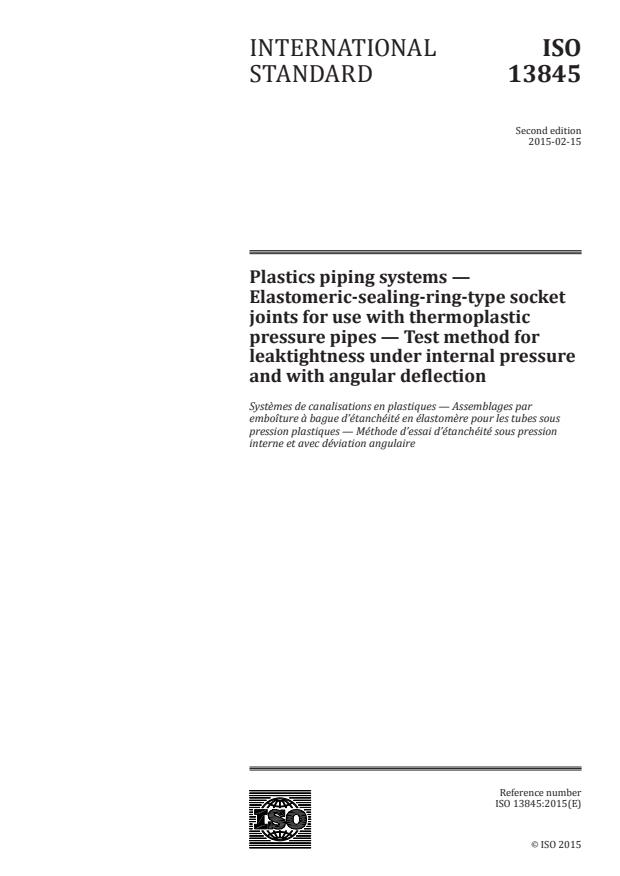
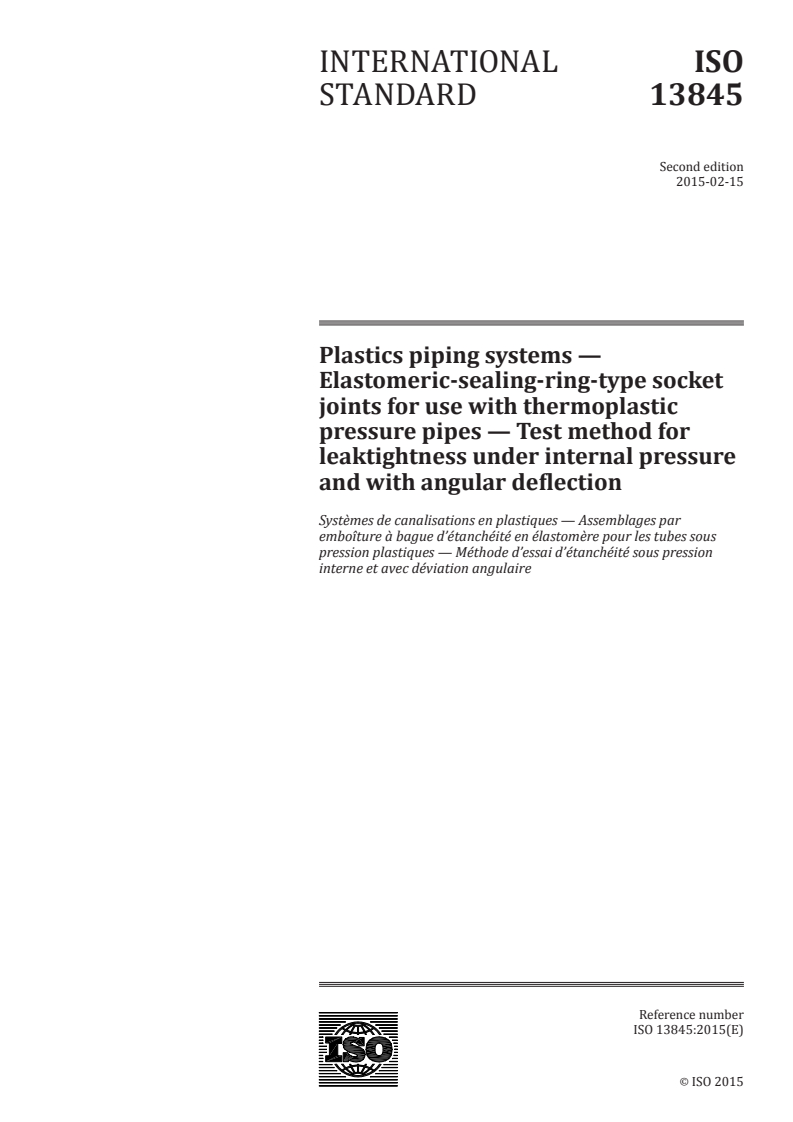
INTERNATIONAL ISO
STANDARD 13845
Second edition
2015-02-15
Plastics piping systems —
Elastomeric-sealing-ring-type socket
joints for use with thermoplastic
pressure pipes — Test method for
leaktightness under internal pressure
and with angular deflection
Systèmes de canalisations en plastiques — Assemblages par
emboîture à bague d’étanchéité en élastomère pour les tubes sous
pression plastiques — Méthode d’essai d’étanchéité sous pression
interne et avec déviation angulaire
Reference number
©
ISO 2015
© ISO 2015
All rights reserved. Unless otherwise specified, no part of this publication may be reproduced or utilized otherwise in any form
or by any means, electronic or mechanical, including photocopying, or posting on the internet or an intranet, without prior
written permission. Permission can be requested from either ISO at the address below or ISO’s member body in the country of
the requester.
ISO copyright office
Case postale 56 • CH-1211 Geneva 20
Tel. + 41 22 749 01 11
Fax + 41 22 749 09 47
E-mail copyright@iso.org
Web www.iso.org
Published in Switzerland
ii © ISO 2015 – All rights reserved
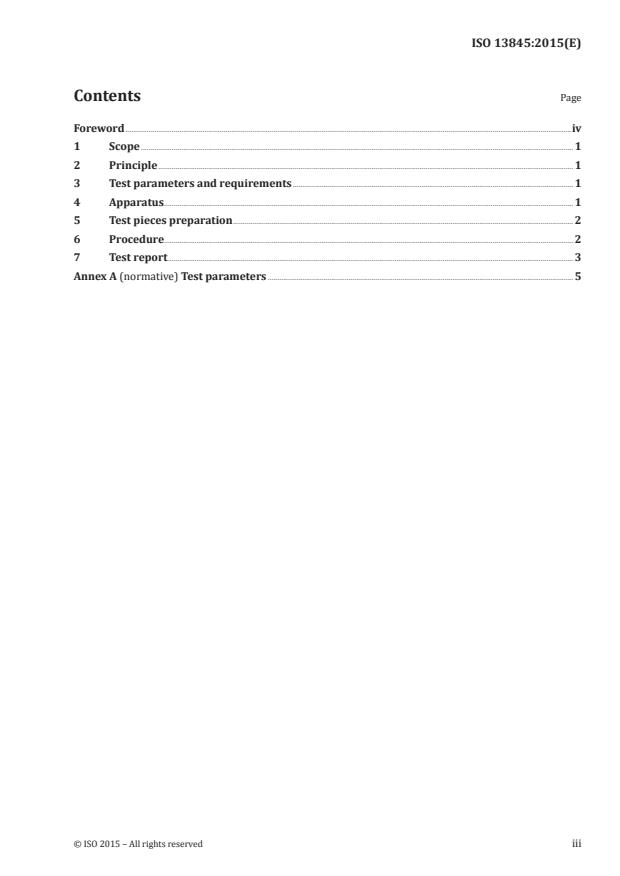
Contents Page
Foreword .iv
1 Scope . 1
2 Principle . 1
3 Test parameters and requirements . 1
4 Apparatus . 1
5 Test pieces preparation . 2
6 Procedure. 2
7 Test report . 3
Annex A (normative) Test parameters . 5
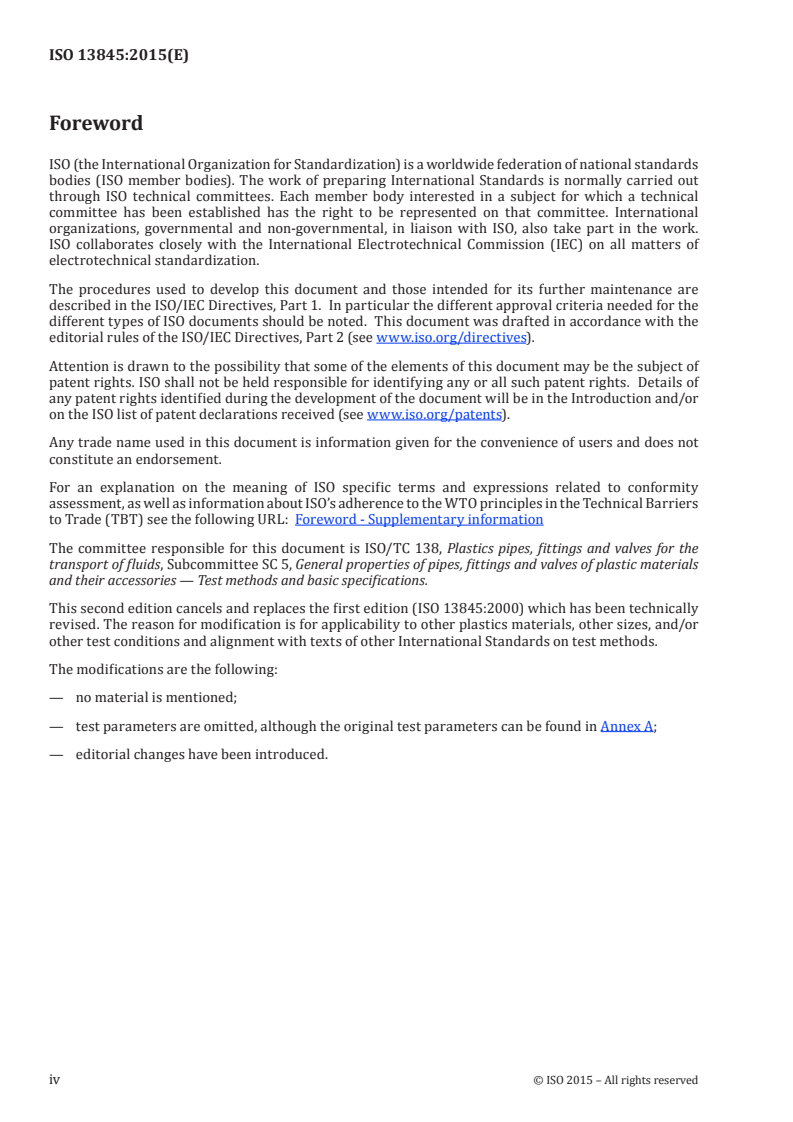
Foreword
ISO (the International Organization for Standardization) is a worldwide federation of national standards
bodies (ISO member bodies). The work of preparing International Standards is normally carried out
through ISO technical committees. Each member body interested in a subject for which a technical
committee has been established has the right to be represented on that committee. International
organizations, governmental and non-governmental, in liaison with ISO, also take part in the work.
ISO collaborates closely with the International Electrotechnical Commission (IEC) on all matters of
electrotechnical standardization.
The procedures used to develop this document and those intended for its further maintenance are
described in the ISO/IEC Directives, Part 1. In particular the different approval criteria needed for the
different types of ISO documents should be noted. This document was drafted in accordance with the
editorial rules of the ISO/IEC Directives, Part 2 (see www.iso.org/directives).
Attention is drawn to the possibility that some of the elements of this document may be the subject of
patent rights. ISO shall not be held responsible for identifying any or all such patent rights. Details of
any patent rights identified during the development of the document will be in the Introduction and/or
on the ISO list of patent declarations received (see www.iso.org/patents).
Any trade name used in this document is information given for the convenience of users and does not
constitute an endorsement.
For an explanation on the meaning of ISO specific terms and expressions related to conformity
assessment, as well as information about ISO’s adherence to the WTO principles in the Technical Barriers
to Trade (TBT) see the following URL: Foreword - Supplementary information
The committee responsible for this document is ISO/TC 138, Plastics pipes, fittings and valves for the
transport of fluids, Subcommittee SC 5, General properties of pipes, fittings and valves of plastic materials
and their accessories — Test methods and basic specifications.
This second edition cancels and replaces the first edition (ISO 13845:2000) which has been technically
revised. The reason for modification is for applicability to other plastics materials, other sizes, and/or
other test conditions and alignment with texts of other International Standards on test methods.
The modifications are the following:
— no material is mentioned;
— test parameters are omitted, although the original test parameters can be found in Annex A;
— editorial changes have been introduced.
iv © ISO 2015 – All rights reserved
INTERNATIONAL STANDARD ISO 13845:2015(E)
Plastics piping systems — Elastomeric-sealing-ring-type
socket joints for use with thermoplastic pressure pipes —
Test method for leaktightness under internal pressure and
with angular deflection
WARNING — Persons using this International Standard should be familiar with normal
laboratory practice, if applicable. The use of this International Standard may involve hazardous
materials, operations, and equipment. This International Standard does not purport to address
all of the safety concerns, if any, associated with its use. It is the responsibility of the user of this
International Standard to establish appropriate safety and health practices and determine the
applicability of regulatory limitations prior to use.
1 Scope
This Internation
...
INTERNATIONAL ISO
STANDARD 13845
Second edition
2015-02-15
Plastics piping systems —
Elastomeric-sealing-ring-type socket
joints for use with thermoplastic
pressure pipes — Test method for
leaktightness under internal pressure
and with angular deflection
Systèmes de canalisations en plastiques — Assemblages par
emboîture à bague d’étanchéité en élastomère pour les tubes sous
pression plastiques — Méthode d’essai d’étanchéité sous pression
interne et avec déviation angulaire
Reference number
©
ISO 2015
© ISO 2015
All rights reserved. Unless otherwise specified, no part of this publication may be reproduced or utilized otherwise in any form
or by any means, electronic or mechanical, including photocopying, or posting on the internet or an intranet, without prior
written permission. Permission can be requested from either ISO at the address below or ISO’s member body in the country of
the requester.
ISO copyright office
Case postale 56 • CH-1211 Geneva 20
Tel. + 41 22 749 01 11
Fax + 41 22 749 09 47
E-mail copyright@iso.org
Web www.iso.org
Published in Switzerland
ii © ISO 2015 – All rights reserved
Contents Page
Foreword .iv
1 Scope . 1
2 Principle . 1
3 Test parameters and requirements . 1
4 Apparatus . 1
5 Test pieces preparation . 2
6 Procedure. 2
7 Test report . 3
Annex A (normative) Test parameters . 5
Foreword
ISO (the International Organization for Standardization) is a worldwide federation of national standards
bodies (ISO member bodies). The work of preparing International Standards is normally carried out
through ISO technical committees. Each member body interested in a subject for which a technical
committee has been established has the right to be represented on that committee. International
organizations, governmental and non-governmental, in liaison with ISO, also take part in the work.
ISO collaborates closely with the International Electrotechnical Commission (IEC) on all matters of
electrotechnical standardization.
The procedures used to develop this document and those intended for its further maintenance are
described in the ISO/IEC Directives, Part 1. In particular the different approval criteria needed for the
different types of ISO documents should be noted. This document was drafted in accordance with the
editorial rules of the ISO/IEC Directives, Part 2 (see www.iso.org/directives).
Attention is drawn to the possibility that some of the elements of this document may be the subject of
patent rights. ISO shall not be held responsible for identifying any or all such patent rights. Details of
any patent rights identified during the development of the document will be in the Introduction and/or
on the ISO list of patent declarations received (see www.iso.org/patents).
Any trade name used in this document is information given for the convenience of users and does not
constitute an endorsement.
For an explanation on the meaning of ISO specific terms and expressions related to conformity
assessment, as well as information about ISO’s adherence to the WTO principles in the Technical Barriers
to Trade (TBT) see the following URL: Foreword - Supplementary information
The committee responsible for this document is ISO/TC 138, Plastics pipes, fittings and valves for the
transport of fluids, Subcommittee SC 5, General properties of pipes, fittings and valves of plastic materials
and their accessories — Test methods and basic specifications.
This second edition cancels and replaces the first edition (ISO 13845:2000) which has been technically
revised. The reason for modification is for applicability to other plastics materials, other sizes, and/or
other test conditions and alignment with texts of other International Standards on test methods.
The modifications are the following:
— no material is mentioned;
— test parameters are omitted, although the original test parameters can be found in Annex A;
— editorial changes have been introduced.
iv © ISO 2015 – All rights reserved
INTERNATIONAL STANDARD ISO 13845:2015(E)
Plastics piping systems — Elastomeric-sealing-ring-type
socket joints for use with thermoplastic pressure pipes —
Test method for leaktightness under internal pressure and
with angular deflection
WARNING — Persons using this International Standard should be familiar with normal
laboratory practice, if applicable. The use of this International Standard may involve hazardous
materials, operations, and equipment. This International Standard does not purport to address
all of the safety concerns, if any, associated with its use. It is the responsibility of the user of this
International Standard to establish appropriate safety and health practices and determine the
applicability of regulatory limitations prior to use.
1 Scope
This Internation
...
NORME ISO
INTERNATIONALE 13845
Deuxième édition
2015-02-15
Systèmes de canalisations en
plastiques — Assemblages par
emboîture à bague d’étanchéité
en élastomère pour les tubes sous
pression plastiques — Méthode
d’essai d’étanchéité sous pression
interne et avec déviation angulaire
Plastics piping systems — Elastomeric-sealing-ring-type socket
joints for use with thermoplastic pressure pipes — Test method for
leaktightness under internal pressure and with angular deflection
Numéro de référence
©
ISO 2015
DOCUMENT PROTÉGÉ PAR COPYRIGHT
© ISO 2015
Droits de reproduction réservés. Sauf indication contraire, aucune partie de cette publication ne peut être reproduite ni utilisée
sous quelque forme que ce soit et par aucun procédé, électronique ou mécanique, y compris la photocopie, l’affichage sur
l’internet ou sur un Intranet, sans autorisation écrite préalable. Les demandes d’autorisation peuvent être adressées à l’ISO à
l’adresse ci-après ou au comité membre de l’ISO dans le pays du demandeur.
ISO copyright office
Case postale 56 • CH-1211 Geneva 20
Tel. + 41 22 749 01 11
Fax + 41 22 749 09 47
E-mail copyright@iso.org
Web www.iso.org
Publié en Suisse
ii © ISO 2015 – Tous droits réservés
Sommaire Page
Avant-propos .iv
1 Domaine d’application . 1
2 Principes . 1
3 Paramètres d’essai et exigences . 1
4 Appareillage . 1
5 Préparation des éprouvettes . 2
6 Mode opératoire. 2
7 Rapport d’essai . 3
Annexe A (normative) Paramètres d’essai . 5
Avant-propos
L’ISO (Organisation internationale de normalisation) est une fédération mondiale d’organismes
nationaux de normalisation (comités membres de l’ISO). L’élaboration des Normes internationales est
en général confiée aux comités techniques de l’ISO. Chaque comité membre intéressé par une étude
a le droit de faire partie du comité technique créé à cet effet. Les organisations internationales,
gouvernementales et non gouvernementales, en liaison avec l’ISO participent également aux travaux.
L’ISO collabore étroitement avec la Commission électrotechnique internationale (IEC) en ce qui concerne
la normalisation électrotechnique.
Les procédures utilisées pour élaborer le présent document et celles destinées à sa mise à jour sont
décrites dans les Directives ISO/IEC, Partie 1. Il convient, en particulier de prendre note des différents
critères d’approbation requis pour les différents types de documents ISO. Le présent document a été
rédigé conformément aux règles de rédaction données dans les Directives ISO/IEC, Partie 2 (voir www.
iso.org/directives).
L’attention est appelée sur le fait que certains des éléments du présent document peuvent faire l’objet de
droits de propriété intellectuelle ou de droits analogues. L’ISO ne saurait être tenue pour responsable
de ne pas avoir identifié de tels droits de propriété et averti de leur existence. Les détails concernant les
références aux droits de propriété intellectuelle ou autres droits analogues identifiés lors de l’élaboration
du document sont indiqués dans l’Introduction et/ou dans la liste des déclarations de brevets reçues par
l’ISO (voir www.iso.org/brevets).
Les appellations commerciales éventuellement mentionnées dans le présent document sont données pour
information, par souci de commodité, à l’intention des utilisateurs et ne sauraient constituer un engagement.
Pour une explication de la signification des termes et expressions spécifiques de l’ISO liés à l’évaluation de
la conformité, ou pour toute information au sujet de l’adhésion de l’ISO aux principes de l’OMC concernant
les obstacles techniques au commerce (OTC), voir le lien suivant: Avant-propos — Informations
supplémentaires.
Le comité chargé de l’élaboration du présent document est l’ISO/TC 138, Tubes, raccords et robinetterie en
matières plastiques pour le transport des fluides, sous comité SC 5, Propriétés générales des tubes, raccords
et robinetteries en matières plastiques et leurs accessoires — Méthodes d’essais et spécifications de base.
Cette deuxième édition annule et remplace la première édition (ISO 13845:2000), qui a fait l’objet
d’une révision technique. La raison de la modification est d’assurer l’applicabilité à d’autres matières
plastiques, d’autres dimensions et/ou d’autres conditions d’essais et d’aligner le texte avec celui d’autres
Normes internationales sur les méthodes d’essai.
Les modifications sont les suivantes:
— aucun matériau n’est mentionné;
— les paramètres d’essai ne sont pas indiqués, cependant, les paramètres d’essais d’origine peuvent
être retrouvés dans l’Annexe A;
— des modifications éditoriales ont été introduites.
iv © ISO 2015 – Tous droits réservés
NORME INTERNATIONALE ISO 13845:2015(F)
Systèmes de canalisations en plastiques — Assemblages par
emboîture à bague d’étanchéité en élastomère pour les tubes
sous pression plastiques — Méthode d’essai d’étanchéité
sous pression interne et avec déviation angulaire
ATTENTION — Les personnes utilisant la présente Norme internationale doivent avoir
connaissance des pratiques normales de laboratoire, le cas échéant. L’utilisation de la présente
Norme internationale peut impliquer des matériaux, des opérations et des équipements
dangereux. La présente Norme internationale n’a pas pour but de traiter tous les problèmes
de sécurité éventuels liés à son utilisation. Il incombe à l’utilisateur de la présente Norme
internationale de mettre en place des pratiques appropriées en matière d’hygiène et de sécurité
et de déterminer l’applicabilité des limites réglementaires avant de l’utiliser.
1 Domaine d’appli
...
NORME ISO
INTERNATIONALE 13845
Deuxième édition
2015-02-15
Systèmes de canalisations en
plastiques — Assemblages par
emboîture à bague d’étanchéité
en élastomère pour les tubes sous
pression plastiques — Méthode
d’essai d’étanchéité sous pression
interne et avec déviation angulaire
Plastics piping systems — Elastomeric-sealing-ring-type socket
joints for use with thermoplastic pressure pipes — Test method for
leaktightness under internal pressure and with angular deflection
Numéro de référence
©
ISO 2015
DOCUMENT PROTÉGÉ PAR COPYRIGHT
© ISO 2015
Droits de reproduction réservés. Sauf indication contraire, aucune partie de cette publication ne peut être reproduite ni utilisée
sous quelque forme que ce soit et par aucun procédé, électronique ou mécanique, y compris la photocopie, l’affichage sur
l’internet ou sur un Intranet, sans autorisation écrite préalable. Les demandes d’autorisation peuvent être adressées à l’ISO à
l’adresse ci-après ou au comité membre de l’ISO dans le pays du demandeur.
ISO copyright office
Case postale 56 • CH-1211 Geneva 20
Tel. + 41 22 749 01 11
Fax + 41 22 749 09 47
E-mail copyright@iso.org
Web www.iso.org
Publié en Suisse
ii © ISO 2015 – Tous droits réservés
Sommaire Page
Avant-propos .iv
1 Domaine d’application . 1
2 Principes . 1
3 Paramètres d’essai et exigences . 1
4 Appareillage . 1
5 Préparation des éprouvettes . 2
6 Mode opératoire. 2
7 Rapport d’essai . 3
Annexe A (normative) Paramètres d’essai . 5
Avant-propos
L’ISO (Organisation internationale de normalisation) est une fédération mondiale d’organismes
nationaux de normalisation (comités membres de l’ISO). L’élaboration des Normes internationales est
en général confiée aux comités techniques de l’ISO. Chaque comité membre intéressé par une étude
a le droit de faire partie du comité technique créé à cet effet. Les organisations internationales,
gouvernementales et non gouvernementales, en liaison avec l’ISO participent également aux travaux.
L’ISO collabore étroitement avec la Commission électrotechnique internationale (IEC) en ce qui concerne
la normalisation électrotechnique.
Les procédures utilisées pour élaborer le présent document et celles destinées à sa mise à jour sont
décrites dans les Directives ISO/IEC, Partie 1. Il convient, en particulier de prendre note des différents
critères d’approbation requis pour les différents types de documents ISO. Le présent document a été
rédigé conformément aux règles de rédaction données dans les Directives ISO/IEC, Partie 2 (voir www.
iso.org/directives).
L’attention est appelée sur le fait que certains des éléments du présent document peuvent faire l’objet de
droits de propriété intellectuelle ou de droits analogues. L’ISO ne saurait être tenue pour responsable
de ne pas avoir identifié de tels droits de propriété et averti de leur existence. Les détails concernant les
références aux droits de propriété intellectuelle ou autres droits analogues identifiés lors de l’élaboration
du document sont indiqués dans l’Introduction et/ou dans la liste des déclarations de brevets reçues par
l’ISO (voir www.iso.org/brevets).
Les appellations commerciales éventuellement mentionnées dans le présent document sont données pour
information, par souci de commodité, à l’intention des utilisateurs et ne sauraient constituer un engagement.
Pour une explication de la signification des termes et expressions spécifiques de l’ISO liés à l’évaluation de
la conformité, ou pour toute information au sujet de l’adhésion de l’ISO aux principes de l’OMC concernant
les obstacles techniques au commerce (OTC), voir le lien suivant: Avant-propos — Informations
supplémentaires.
Le comité chargé de l’élaboration du présent document est l’ISO/TC 138, Tubes, raccords et robinetterie en
matières plastiques pour le transport des fluides, sous comité SC 5, Propriétés générales des tubes, raccords
et robinetteries en matières plastiques et leurs accessoires — Méthodes d’essais et spécifications de base.
Cette deuxième édition annule et remplace la première édition (ISO 13845:2000), qui a fait l’objet
d’une révision technique. La raison de la modification est d’assurer l’applicabilité à d’autres matières
plastiques, d’autres dimensions et/ou d’autres conditions d’essais et d’aligner le texte avec celui d’autres
Normes internationales sur les méthodes d’essai.
Les modifications sont les suivantes:
— aucun matériau n’est mentionné;
— les paramètres d’essai ne sont pas indiqués, cependant, les paramètres d’essais d’origine peuvent
être retrouvés dans l’Annexe A;
— des modifications éditoriales ont été introduites.
iv © ISO 2015 – Tous droits réservés
NORME INTERNATIONALE ISO 13845:2015(F)
Systèmes de canalisations en plastiques — Assemblages par
emboîture à bague d’étanchéité en élastomère pour les tubes
sous pression plastiques — Méthode d’essai d’étanchéité
sous pression interne et avec déviation angulaire
ATTENTION — Les personnes utilisant la présente Norme internationale doivent avoir
connaissance des pratiques normales de laboratoire, le cas échéant. L’utilisation de la présente
Norme internationale peut impliquer des matériaux, des opérations et des équipements
dangereux. La présente Norme internationale n’a pas pour but de traiter tous les problèmes
de sécurité éventuels liés à son utilisation. Il incombe à l’utilisateur de la présente Norme
internationale de mettre en place des pratiques appropriées en matière d’hygiène et de sécurité
et de déterminer l’applicabilité des limites réglementaires avant de l’utiliser.
1 Domaine d’appli
...