

ISO 18646-5:2026
(Main)Robotics — Performance criteria and related test methods for service robots — Part 5: Locomotion for legged robots
General Information
- Abstract
This document describes methods for specifying and evaluating the locomotion performance of legged robots. The tests listed in this document are mainly used to evaluate the complete machine. They can be also used for sample test, qualification test or check-and-accept test. This document is not intended for the verification or validation of safety requirements.
- Status
- Published
- Publication Date
- 23-Jul-2026
- Technical Committee
- ISO/TC 299 - Robotics
- Drafting Committee
- ISO/TC 299 - Robotics
- Current Stage
- 6060 - International Standard published
- Start Date
- 24-Jul-2026
- Due Date
- 04-Sep-2026
- Completion Date
- 24-Jul-2026
Overview
ISO 18646-5:2026 - Robotics: Performance Criteria and Related Test Methods for Service Robots – Part 5: Locomotion for Legged Robots is an international standard developed by ISO to provide comprehensive performance criteria and evaluation methods for legged service robots. This standard is focused on the locomotion abilities of biped, quadruped, and multi-legged robots, aiming to support consistent and transparent testing of their movement capabilities. Notably, these test methods apply to full machines, including use in sample, qualification, or check-and-accept tests but do not address safety verification or validation.
Key Topics
ISO 18646-5:2026 presents standardized ways to assess various locomotion attributes of legged robots under controlled conditions. The key criteria and associated test methods include:
Test Conditions and Environments
- Preparation of robots and calibration
- Environmental conditions such as temperature and humidity
- Travel surface specifications including surface friction
Rated Speed
- Measures the robot’s maximum speed under normal operational settings
Stopping Distance
- Assesses how quickly and reliably a robot can decelerate to a halt
Maximum Climbing Height
- Determines the maximum vertical step the robot can ascend and descend
Capacity to Climb Stairs
- Measures whether the robot can traverse standard stairs in both directions
Maximum Slope Angle
- Evaluates the steepest incline or decline the robot can negotiate
Dragging Force
- Gauges the force required to halt the robot’s forward movement
Crossing Capacity
- Assesses the robot’s ability to cross gaps or negative obstacles
Minimum Pass-Through Height and Travel Width
- Measures the tightest vertical and horizontal spaces the robot can navigate through
Each criterion is associated with a clearly defined test facility, procedure, and success criteria to promote reproducibility and fair comparison.
Applications
Implementation of ISO 18646-5:2026 adds significant value across multiple domains:
Product Development and Optimization
- Offers R&D teams reliable data to optimize design and functionality of legged robots
- Enables designers to target real-world mobility challenges in various terrains
Quality Assurance and Manufacturing
- Supplies manufacturers with standardized metrics for quality control
- Allows for consistent assessment of each robot’s movement capabilities
Procurement and Product Comparison
- Assists purchasers and integration specialists in evaluating and comparing multiple legged robot models based on objective, standardized performance data
Certification and Regulatory Compliance
- Provides third-party testing and certification bodies with clear testing procedures and benchmarks
Academic and Research Use
- Facilitates comparison and benchmarking within robotics research and competitions
By unifying performance evaluation, the standard helps reduce trade barriers, avoid market fragmentation, and drive industry-wide clarity for legged robot technologies.
Related Standards
For a comprehensive approach to robotics performance evaluation, consider the following associated ISO standards:
- ISO 18646-2: Robotics - Performance criteria and related test methods for service robots - Part 2: Navigation
- ISO 8373: Robotics - Vocabulary
- ISO 7176-13: Wheelchairs - Determination of coefficient of friction of test surfaces
These standards contribute additional guidelines on definitions, navigation, and related testing methodologies relevant to legged robot performance.
Keywords: ISO 18646-5, legged robots, performance criteria, locomotion test methods, service robots, robot mobility, standardized robotics tests, robot climbing ability, robot speed assessment, robotics quality assurance, international robot standards
Get Certified
Connect with accredited certification bodies for this standard

DVS-ZERT GmbH
German welding certification society.
CARES (UK Certification Authority for Reinforcing Steels)
UK certification for reinforcing steels and construction.
EWF/IIW (European/International Welding Federation)
International welding personnel certification.
Sponsored listings
Frequently Asked Questions
ISO 18646-5:2026 is a standard published by the International Organization for Standardization (ISO). Its full title is "Robotics — Performance criteria and related test methods for service robots — Part 5: Locomotion for legged robots". This standard covers: This document describes methods for specifying and evaluating the locomotion performance of legged robots. The tests listed in this document are mainly used to evaluate the complete machine. They can be also used for sample test, qualification test or check-and-accept test. This document is not intended for the verification or validation of safety requirements.
This document describes methods for specifying and evaluating the locomotion performance of legged robots. The tests listed in this document are mainly used to evaluate the complete machine. They can be also used for sample test, qualification test or check-and-accept test. This document is not intended for the verification or validation of safety requirements.
ISO 18646-5:2026 is classified under the following ICS (International Classification for Standards) categories: 25.040.30 - Industrial robots. Manipulators. The ICS classification helps identify the subject area and facilitates finding related standards.
ISO 18646-5:2026 is available in PDF format for immediate download after purchase. The document can be added to your cart and obtained through the secure checkout process. Digital delivery ensures instant access to the complete standard document.
Standards Content (Sample)
International
Standard
ISO 18646-5
First edition
Robotics — Performance criteria
2026-07
and related test methods for service
robots —
Part 5:
Locomotion for legged robots
Robotique — Critères de performance et méthodes d'essai
correspondantes pour robots de service —
Partie 5: Locomotion pour robots à pattes
Reference number
© ISO 2026
All rights reserved. Unless otherwise specified, or required in the context of its implementation, no part of this publication may
be reproduced or utilized otherwise in any form or by any means, electronic or mechanical, including photocopying, or posting on
the internet or an intranet, without prior written permission. Permission can be requested from either ISO at the address below
or ISO’s member body in the country of the requester.
ISO copyright office
CP 401 • Ch. de Blandonnet 8
CH-1214 Vernier, Geneva
Phone: +41 22 749 01 11
Email: copyright@iso.org
Website: www.iso.org
Published in Switzerland
ii
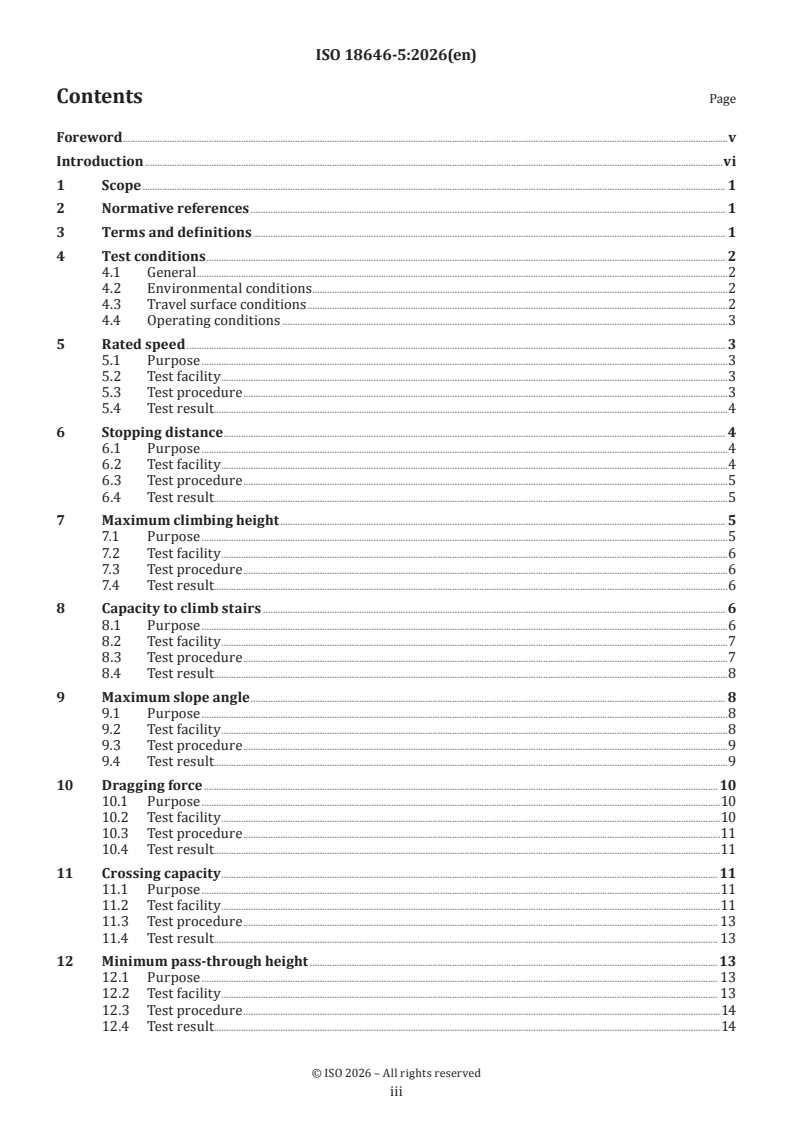
Contents Page
Foreword .v
Introduction .vi
1 Scope . 1
2 Normative references . 1
3 Terms and definitions . 1
4 Test conditions . 2
4.1 General .2
4.2 Environmental conditions . .2
4.3 Travel surface conditions .2
4.4 Operating conditions .3
5 Rated speed . 3
5.1 Purpose .3
5.2 Test facility .3
5.3 Test procedure .3
5.4 Test result.4
6 Stopping distance . 4
6.1 Purpose .4
6.2 Test facility .4
6.3 Test procedure .5
6.4 Test result.5
7 Maximum climbing height . 5
7.1 Purpose .5
7.2 Test facility .6
7.3 Test procedure .6
7.4 Test result.6
8 Capacity to climb stairs . 6
8.1 Purpose .6
8.2 Test facility .7
8.3 Test procedure .7
8.4 Test result.8
9 Maximum slope angle . 8
9.1 Purpose .8
9.2 Test facility .8
9.3 Test procedure .9
9.4 Test result.9
10 Dragging force . 10
10.1 Purpose .10
10.2 Test facility .10
10.3 Test procedure .11
10.4 Test result.11
11 Crossing capacity .11
11.1 Purpose .11
11.2 Test facility .11
11.3 Test procedure . 13
11.4 Test result. 13
12 Minimum pass-through height .13
12.1 Purpose . 13
12.2 Test facility . 13
12.3 Test procedure .14
12.4 Test result.14
iii
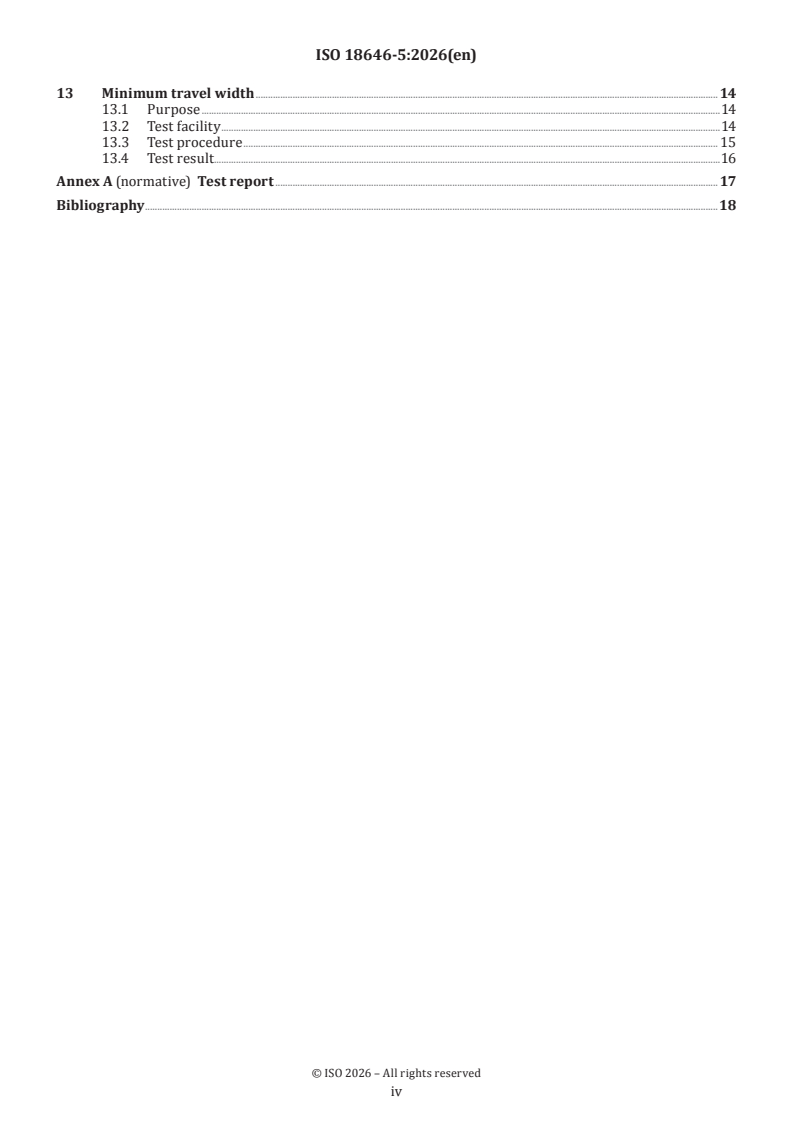
13 Minimum travel width . 14
13.1 Purpose .14
13.2 Test facility .14
13.3 Test procedure . 15
13.4 Test result.16
Annex A (normative) Test report . 17
Bibliography .18
iv
Foreword
ISO (the International Organization for Standardization) is a worldwide federation of national standards
bodies (ISO member bodies). The work of preparing International Standards is normally carried out through
ISO technical committees. Each member body interested in a subject for which a technical committee
has been established has the right to be represented on that committee. International organizations,
governmental and non-governmental, in liaison with ISO, also take part in the work. ISO collaborates closely
with the International Electrotechnical Commission (IEC) on all matters of electrotechnical standardization.
The procedures used to develop this document and those intended for its further maintenance are described
in the ISO/IEC Directives, Part 1. In particular, the different approval criteria needed for the different types
of ISO document should be noted. This document was drafted in accordance with the editorial rules of the
ISO/IEC Directives, Part 2 (see www.iso.org/directives).
ISO draws attention to the possibility that the implementation of this document may involve the use of (a)
patent(s). ISO takes no position concerning the evidence, validity or applicability of any claimed patent
rights in respect thereof. As of the date of publication of this document, ISO had not received notice of (a)
patent(s) which may be required to implement this document. However, implementers are cautioned that
this may not represent the latest information, which may be obtained from the patent database available at
www.iso.org/patents. ISO shall not be held responsible for identifying any or all such patent rights.
Any trade name used in this document is information given for the convenience of users and does not
constitute an endorsement.
For an explanation of the voluntary nature of standards, the meaning of ISO specific terms and expressions
related to conformity assessment, as well as information about ISO's adherence to the World Trade
Organization (WTO) principles in the Technical Barriers to Trade (TBT), see www.iso.org/iso/foreword.html.
This document was prepared by Technical Committee ISO/TC 299, Robotics.
A list of all parts in the ISO 18646 series can be found on the ISO website.
Any feedback or questions on this document should be directed to the user’s national standards body. A
complete listing of these bodies can be found at www.iso.org/members.html.
v
Introduction
With the development of service robot technology, legged robots have an increasing application range in the
fields of service, guide, life companion and family entertainment. This industry has developed a market of
a certain scale and at the same time, it has appreciable development prospects and huge market potential
in the fields of industrial manufacture, facility test and maintenance, special operations and depopulated
zone exploration. Currently, the product parameters of biped, quadruped and multi-legged robots are
claimed inconsistently by different companies, and the test conditions and test methods for the parameters
are inconsistent and unclarified. In this case, designers cannot achieve optimization through effective
tests for product performance; manufacturing staff cannot monitor product quality through consistent
evaluating method; and users can neither select products based on needs nor compare products of the same
type according to performance parameters. Furthermore, there appear to be unnecessary divergence and
conflicts between legged robot products from different countries in international trade because of the lack
of related International Standards, which can lead to an unhealthy development of the legged robot industry.
This document lists a series of specifications on the performance of legged robots, as well as test conditions,
test purpose, test facility, test procedures and the treatment of test results based on legged robot’s unique
characteristics, such as dispersed stepping movement, multiple limbs, multiple degrees-of-freedom, its
application in varied topography and human-machine interaction. The purpose of this document is to
establish a consistent system of performance representation and method of evaluation for legged robots, to
facilitate design optimization, performance claims, quality monitoring and product selection.
This document can provide:
— data foundation of product optimization for research and development staff;
— quality monitoring methods for manufacturing staff;
— accordance for testing and certification authorities;
— guidance of integration for system integration companies.
vi
International Standard ISO 18646-5:2026(en)
Robotics — Performance criteria and related test methods for
service robots —
Part 5:
Locomotion for legged robots
1 Scope
This document describes methods for specifying and evaluating the locomotion performance of legged
robots.
The tests listed in this document are mainly used to evaluate the complete machine. They can be also used
for sample test, qualification test or check-and-accept test.
This document is not intended for the verification or validation of safety requirements.
2 Normative references
The following documents are referred to in the text in such a way that some or all of their content constitutes
requirements of this document. For dated references, only the edition cited applies. For undated references,
the latest edition of the referenced document (including any amendments) applies.
ISO 7176-13, Wheelchairs — Part 13: Determination of coefficient of friction of test surfaces
ISO 8373, Robotics — Vocabulary
ISO 18646-2, Robotics — Performance criteria and related test methods for service robots — Part 2: Navigation
3 Terms and definitions
For the purposes of this document, the terms and definitions given in ISO 8373, ISO 18646-2 and the
following apply.
ISO and IEC maintain terminology databases for use in standardization at the following addresses:
— ISO Online browsing platform: available at https:// www .iso .org/ obp
— IEC Electropedia: available at https:// www .electropedia .org/
3.1
legged robot
mobile robot that travels using one or more legs
[SOURCE: ISO 8373:2021, 4.15.2, modified— Note 1 to entry has been removed.]
3.2
rated speed
maximum speed of the legged robot in normal operating conditions
3.3
topography
shape of the travel surface
3.4
capacity
ability of robot to accomplish a certain type of task
3.5
stride width
minimum width in the direction perpendicular to robot’s traveling direction that can cover the projection of
the robot on horizontal travel surface
3.6
test configuration
particular arrangement of test objects
[SOURCE: ISO 18646-2:2024, 3.19]
3.7
trial
single instance of test procedure performed under identical test configuration (3.6)
Note 1 to entry: A trial can be repeated multiple times.
[SOURCE: ISO 18646-2:2024, 3.20]
4 Test conditions
4.1 General
The legged robot shall be completely assembled, sufficiently charged and operational.
The tests shall be preceded by the preparations for operation as specified by the manufacturer, including
calibration of any relevant sensors that have an effect on the test results.
All conditions specified in Clause 4 shall be satisfied for the tests described in this document, unless it is
stated otherwise in the specific clauses.
Some of the tests described in this document have multiple test configurations which require separate test
procedures. For each test conformation, multiple trials may be conducted, if specified in the test procedure.
Each test shall be independent to locomotion modes (walking, jumping, running) and the applied locomotion
modes shall be noted in the test report. The test shall be reported based on the information in Annex A.
4.2 Environmental conditions
The following environmental conditions should be maintained during all tests:
— ambient temperature: 10 °C to 30 °C;
— relative humidity: 0 % to 80 %.
If the environmental conditions specified by the manufacturer exceed the given ranges, tests may be
conducted outside of the above ranges. These conditions shall be declared in the test results.
4.3 Travel surface conditions
If not specified, a hard and even surface with a coefficient of friction between 0,75 and 1,0 measured in
accordance with ISO 7176-13 shall be used to test the performance. The surface shall be horizontal, if not
specified.
...