


ISO 2080:1981
(Main)Electroplating and related processes — Vocabulary
Electroplating and related processes — Vocabulary
This second edition cancels and replaces the first edition (i. e. ISO 2080:1973). Includes terms widely used in the science and industry of elektrodeposition and metal- finishing. In addition to terms used in the three official ISO languages (English, French and Russian), this International Standard includes the equivalent terms in the German language.Elektrolytisches Herstellen von Metallüberzügen und verwandte Verfahren; Begriffe
Dépôts électrolytiques et opérations s'y rattachant — Vocabulaire
General Information
- Status
- Withdrawn
- Publication Date
- 31-Oct-1981
- Withdrawal Date
- 31-Oct-1981
- Technical Committee
- ISO/TC 107 - Metallic and other inorganic coatings
- Drafting Committee
- ISO/TC 107 - Metallic and other inorganic coatings
- Current Stage
- 9599 - Withdrawal of International Standard
- Start Date
- 07-Jul-2008
- Completion Date
- 12-Feb-2026
Relations
- Effective Date
- 11-Feb-2026
- Effective Date
- 09-Feb-2026
- Effective Date
- 09-Feb-2026
- Effective Date
- 09-Feb-2026
- Effective Date
- 09-Feb-2026
- Effective Date
- 09-Feb-2026
- Effective Date
- 09-Feb-2026
- Effective Date
- 09-Feb-2026
- Effective Date
- 09-Feb-2026
- Effective Date
- 09-Feb-2026
- Effective Date
- 15-Apr-2008

Get Certified
Connect with accredited certification bodies for this standard

National Aerospace and Defense Contractors Accreditation Program (NADCAP)
Global cooperative program for special process quality in aerospace.
CARES (UK Certification Authority for Reinforcing Steels)
UK certification for reinforcing steels and construction.
DVS-ZERT GmbH
German welding certification society.
Sponsored listings
Frequently Asked Questions
ISO 2080:1981 is a standard published by the International Organization for Standardization (ISO). Its full title is "Electroplating and related processes — Vocabulary". This standard covers: This second edition cancels and replaces the first edition (i. e. ISO 2080:1973). Includes terms widely used in the science and industry of elektrodeposition and metal- finishing. In addition to terms used in the three official ISO languages (English, French and Russian), this International Standard includes the equivalent terms in the German language.Elektrolytisches Herstellen von Metallüberzügen und verwandte Verfahren; Begriffe
This second edition cancels and replaces the first edition (i. e. ISO 2080:1973). Includes terms widely used in the science and industry of elektrodeposition and metal- finishing. In addition to terms used in the three official ISO languages (English, French and Russian), this International Standard includes the equivalent terms in the German language.Elektrolytisches Herstellen von Metallüberzügen und verwandte Verfahren; Begriffe
ISO 2080:1981 is classified under the following ICS (International Classification for Standards) categories: 01.040.25 - Manufacturing engineering (Vocabularies); 25.220.40 - Metallic coatings. The ICS classification helps identify the subject area and facilitates finding related standards.
ISO 2080:1981 has the following relationships with other standards: It is inter standard links to EN ISO 12683:2004, EN ISO 12687:1998, EN ISO 10111:2001, EN ISO 15720:2001, EN ISO 15730:2016, EN ISO 2177:2004, EN ISO 10308:2006, EN ISO 4526:2004, EN ISO 15721:2001, EN ISO 14647:2016, ISO 2080:2008. Understanding these relationships helps ensure you are using the most current and applicable version of the standard.
ISO 2080:1981 is available in PDF format for immediate download after purchase. The document can be added to your cart and obtained through the secure checkout process. Digital delivery ensures instant access to the complete standard document.
Standards Content (Sample)
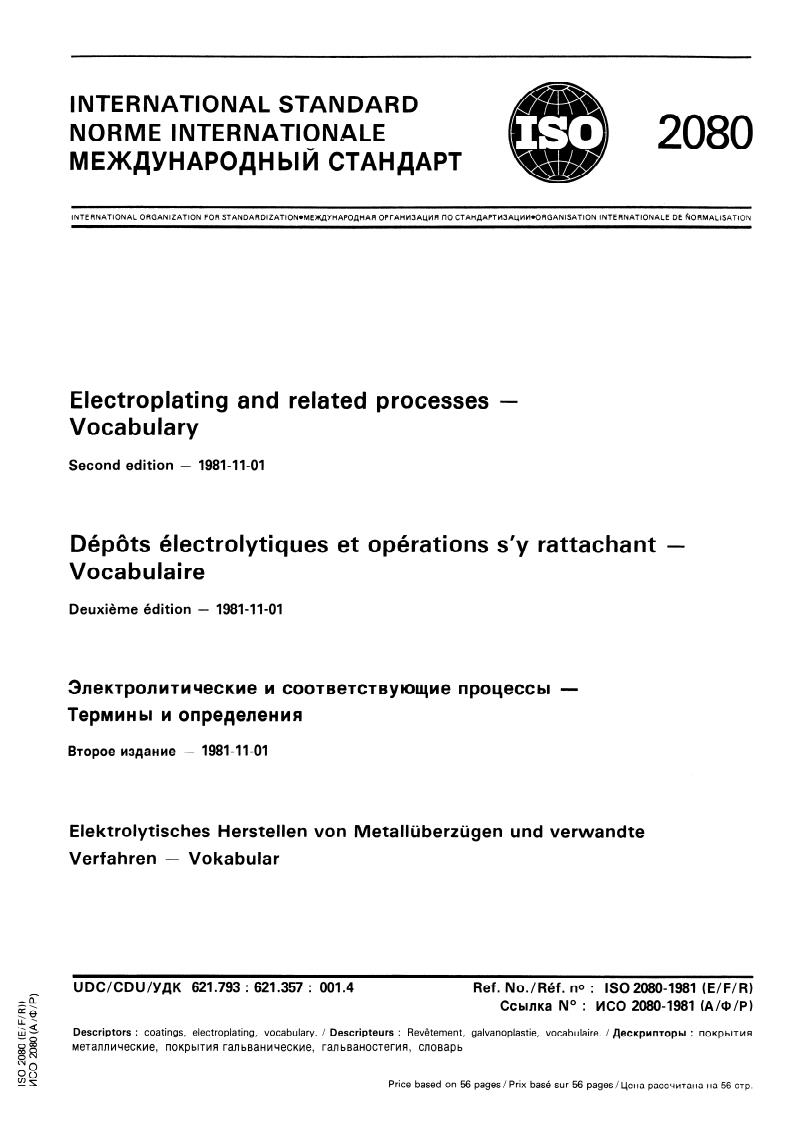
INTERNATIONAL STANDARD
NORME INTERNATIONALE
ME>KAYHAPOAHbll?l CTAHAAPT
INTERNATIONAL ORGANIZATION FOR STANDARDIZATIONWV~E>KL~YHAPO~HAR OPrAHM3A~MR fl0 CTAH~APTt43A~MM~ORGANlSATlON INTERNATIONALE DE &ORMALISATION
Electroplating and related processes -
Vocabulary
Second edition - 1981-11-01
Depots Glectrolytiques et opkations s’y rattachant -
Vocabulaire
Deuxieme Edition - 1981-11-01
~J’leKTpOJlldTb4WXKHe bd COOTBeTCTBylOllJHe ilpO~eCCbl -
TepWItibl H OnpeflWWiIM
BTopoe wAawe - 1981-11-01
Elektrolytisches Herstellen von Metallüberzügen und verwandte
Verfahren - Vokabular
UDWCDWYAK 621.793 : 621.357 : 001.4 Ref. NoJRbf. no : ISO 2080-1981 (E/F/R)
-C
CCblJlKa No :
MC0 20804981 (A/WP)
EG
b-
\a
WV Descriptors : coatings, electroplating, vocabulary. / Descripteurs : Revetement, gdVanOphh?, vocabulaire. / fleCKpHllTOpbl : rlOKpblTMR
MeTannwecKMe, noKpblTm ranbBaHr/tqecKMe, l-an bBaHOCTeWlfI, CflOBapb
ON
:g
Es Price based on 56 pages / Prix bask sur 56 pages / UeHa paccwTaHa Ha 56 CTP.
Foreword
ISO (the International Organization for Standardization) is a worldwide federation of national
Standards institutes (ISO member bedies). The work of developing International Standards is car-
ried out through ISO technical committees. Every member body interested in a subject for which
a technical committee has been set up has the right to be represented on that committee. lnterna-
tional organizations, governmental and non-governmental, in liaison with ISO, also take part in
the work.
Draft Inter national Standards ad opted by the technical committees are circ ulated to the member
bodies for approval before their acceptance as Interna tional Standards by the IS 0 Council.
International Standard ISO 2080 was developed by Techni cal Committee I so /TC 107, Meta/.k
cos tings, and was circulated member bodies in November 1979.
and other non-organic to the
lt has been approved by the member bodies of the following countries :
Australia Italy South Africa, Rep. of
Bulgaria Japan Spain
Czechoslova kia Korea, Rep. of Switzerland
Netherlands
Egypt, Arab Rep. of USA
Germany, F. R. New Zealand USSR
Hungary Poland
India Romania
No member body expressed disapproval of the document.
This second edition cancels and replaces the first edition (i.e. 2080-1973).
Avant-propos
L’ISO (Organisation internationale de normalisation) est une federation mondiale d’organismes
nationaux de normalisation (comites membres de I’ISO). L’elaboration des Normes internationa-
les est confiee aux comites techniques de I’ISO. Chaque comite membre interesse par une etude
a Ie droit de faire Partie du comite technique correspondant. Les organisations internationales,
gouvernementales et non gouvernementales, en liaison avec I’ISO, par-ticipent egalement aux tra-
Les projets de Normes internationales adoptes par les comites techniques sont soumis aux comi-
tes membres pour approbation, avant leur acceptation comme internationales par Ie
Normes
Conseil de I’ISO.
La Norme internationale ISO 2080 a etc elaboree par Ie comite technique ISO/TC 107, Revete-
ments m&a//iques et autres revetements non organiques, et a etc soumise aux comites membres
en novembre 1979.
Les comites membres des pays suivants I’ont approuvee :
Afrique du Sud, Rep. d’ Hongrie Roumanie
Allemag ne, R.F. Inde Suisse
Australie Italie Tchecoslovaquie
Bulgarie Japon URSS
Corde, Rep. de Nouvelle-Zelande USA
Egypte, Rep. arabe d’ Pays- Bas
Espagne
Pologne
Aucun comite membre ne I’a desapprouvee.
Cette deuxieme edition annule et remplace Ia Premiere edition (ISO 2080-1973).
ii
BBeJqeHMe
MC0 (MexAyHapo4Hafi Opraw3aqm no CTatiflapAusaqm) - BCeMldpHaFl @efiepaqm HaqPlo-
HaflbHblX OpraHOB l-l0 CTaH~ap~Vl3a~Wl (KOMMTeTOB-WEHOB MCO). Pa3pa6OTKa Me~/y-iapO#-i blX
CTaHAapTOB llpOBOAqMTCF1 B TeXHMqeCKMX KOMLlTeTaX MCO. KaxRblti KOMMTeT-qneH, 3aMHTepeCO-
BaHHbllil B TeMaTMKe, ,4JlfI pa3pa60TKM KOTOpOti TeXHMqeCKMti KOMMTeT 6bln CO3AaH, LlMeeT IlpaBO
6blTb llpeACTaBJleHHblM B COOTBeTCTB)UOu(eM TeXHM’deCKOM KOMLlTeTe. MemgyHapOp,Hble npa-
BMTeJlbCTBeHHble OpraHM3a~Ml4, CBR3aHHble C 1/1co, TaK%e llpVlHl4MatOT YraCTLle B ee pa6OTe.
flpOeKTbI Me~~yHapO~HblX CTaHflapTOB, OAO6peHHble TeXHMqeCKMMM KOMMTeTaMM, paCCblna-
IOTCR KOMLlTeTaM-qfleHaM ,IJ0 MX YTBep~~eHMfl COBeTOM L/1co B KaLleCTBe Me~yHapOp,tibIX
CTaHQapTOB.
MexJJyHapOAHbIti CTaHAapT L/Ico 2080 pa3pa60TaH TeXHWeCKMM KOMMTeTOM MCO/TK 107.
Memannu~ecwe u dpyrue Heopzawvecwe noKpb/muR, M pa30cnai-i weHarid opraHt43aqm4 B
HOfl6pe 1979 rofla.
AOKYMeHT 6bln 0406peH KOMMTeTaMU-clfleHaMM Cfle~ytO~MX CTpaH :
KopeM, Pecn. @eAepamBtioti Pecny6-
ABCTpanWI
Hkl/qepnaHfloB nMKVI repMaHW4
60nrapkw
HOBOM 3enaHAmM 4exocnoBaKm
BeHrpm
ErmTa, Apa6. Pecn. llon b UJM LLlBetiqapm4
~KHO-A@~MK. Pecn.
VlHJJMM PYMblHMPl
CCCP mlOHMM
Vlcnawi4
MTanm CUIA
HVI OJjVIH KOMMTeT-qneH He OTKnOHMn 4OKyMeHT.
~TO BTopoe mqatiue atiHynMpyeT M 3aMekmeT nepBoe MsAatiMe (MC0 20804973).
@ International Organkation for Standardkation, 1981 0
@ Organisation internationale de normalisation, 1981
0 MexAyHapojqt+an Opratib43aqHR no CTaHAapw3aqw 1981 @
B l.lJeetiqapr/r~
Printed in Switzerland/ Imprime en Suisse/haaHo
Ill
ihis page intentionally left blank
INTERNATIONAL STANDARD
ISO 2080-1981 (E/F/R)
NORME INTERNATIONALE
MCO2080-1981 (A/@/P)
MEX,ljYHAPO~Hblül CTAHAAPT
Electroplating and related processes -
Vocabulary
Depots 6lectrolytiques et operations s’y rattachant -
Vocabulaire
%eKTpOflb4TMWCKW ld COOTBeTCTBytO~He npOl,JeCCbi -
TepMwibl bd onpe~enetim
Elektrolytisches Herstellen von Metallüberzügen und verwandte
Verfahren - Vokabular
ISO 2080-1981 (E/F/R)
MC0 20804981 (A/@/P)
Objet et domaine d’application
Scope and field of application
La presente Norme internationale etablit Ie vocabulaire des
This International Standard establishes the vocabulary for elec-
depots electrolytiques et des operations s’y rattachant. Elle
troplating and related processes. lt includes terms widely used
in the science and industry of electrodeposition and metal- camporte les termes frequemment utilises dans Ia science et
I’industrie de I’electrodeposition et de Ia finition des metaux.
finishing.
lt should be understood that the interpretations given are those II est a noter que I’interpretation donnee correspond a I’usage
dans Ia pratique de ce domaine et n’est pas necessairement
corresponding to the practical usage in these fields and that
identique a celle qui est admise dans d’autres domaines. Dans
they do not necessarily coincide with those used in other fields.
In some extreme cases, attention is drawn to this fact by certains cas extremes, on a attire I’attention en ajoutant les
adding the words “. . . in electroplating”. mots ((. . . dans Ie cas des d6pO ts klectrolytiques)) .
Les termes chimiques, physiques et electriques dont I’usage,
Chemical, physical and electrical terms are not included in this
vocabulary, even though they may be frequently used in elec- dans Ie cas des depots electrolytiques, est identique a celui qui
troplating, if their use in electroplating is identical with that in en est fait dans Ia science originale et dont Ie sens peut etre
the original science and their meaning is believed to be gener- admis comme connu, n’ont pas etc inclus dans ce vocabulaire,
ally known. Definitions of such expressions tan be found in one meme s’ils sont frequemment utilises. Les definitions de tels
termes peuvent etre trouvees dans les dictionnaires courants de
of the weil-known handbooks or dictionaries of chemistry or
physics and in IEC Publication 50 (50), international elec- chimie ou de physique ou encore dans Ia Publication CEI 50
(501, Vocabulaire 6lectrochimique international - &ectrocj7i-
tro technical vocabulary; Elec tro-chemis try and elec trometal-
lurgy, or in the publication of the International Union of mie et k/ectrom&a//urgie, ou dans Ia Publication de I’lnternatio-
Pure and Applied Chemistry (IUPAC), Division of Physical nal Union of Pure and Applied Chemistry (IUPAC), Division of
Manual of Symbols and terminology for physico- Physical Chemistry : Manual of Symbols and terminology for
Chemistry :
Chemical quantities and units, Appendix 3, Electrochemical physico-Chemical quantities and units, Appendix 3, Electroche-
nomenclature. mical nomencla ture.
The terms are arranged in English alphabetical order-. Les termes sont classes dans I’ordre alphabetique anglais. Des
repertoires alphabetiques des termes francais, russes et alle-
Alphabetical indexes of the French, Russian, and German
mands sont donnes en vue de faciliter leur recherche.
terms are given to facilitate reference.
NOTES NOTES
1 In addition to terms used in the three official ISO languages 1 En plus des termes utilises dans les trois langues officielles de I’ISO
(English, French and Russian), this International Standard includes the (anglais, francais et russe), Ia presente Norme internationale donne les
,
equivalent terms in the German language; these have been included, termes correspondants en langue allemande; ceux-ci ont etc inclus,
for information, at the request of Technical Committee ISO/TC 107, pour information, a Ia demande du comite technique ISO/TC 107,
et les comites membres de Ia Republique federale d’Allemagne,
and the member bodies for the Federal Republic of Germany, Austria
and Switzerland have verified their equivalence. However, only the d’Autriche et de Suisse en ont verifie Ia conformite. Toutefois, seuls les
terms and definitions given in the official languages tan be considered termes et definitions donnes dans les langues officielles peuvent etre
as ISO terms and definitions. consideres comme termes et definitions ISO.
2 Some of the terms and definitions used in the watch case and 2 Quelques termes et definitions utilises dans les industries des boites
jewelry industries for gold alloy coatings are different from those given de montres et de Ia bijouterie pour les revetements d’alliages d’or sont
differents de ceux donne dans Ia presente Norme internationale et sont
in this International Standard and in some countries are governed by
law. Definitions of some terms relating to watch cases are defined in fixes par Ia loi dans certains pays. Quelques-uns de ces termes utilises
ISO 3160, Watch cases and their accessories - General requirements pour les boites de montres sont definis dans I’ISO 3160, Boites de
for gold alo y CO verings. montres et leurs accessoires - Caractbristiques g&&ales relatives aux
re v@ temen ts en alliages d’or.
ISO 2080-1981 (E/F/R)
MC0 20804981 (A/WP)
Zweck und Anwendungsbereich
06lbeKT H 06naCrb npblMeHeHblF1
Diese Internationale Norm legt ein Vokabular für elektrolyti-
t-iaCTOFIqWI MW+t~yHapO~Hblti CTaHAapT YCTaHaBflVlBaeT Tep-
sches Herstellen von Metallüberzügen und verwandte Verfah-
MMHbl M OllpefieJleHPlFl flflF4 3J’leKTPOJlMTMWCKMX M COOTBeT-
ren fest. Sie enthält in Wissenschaft, Metallabscheide- und
CTBylO~PlX MM llpOu,eCCOB. OH BKJllOqaeT TePMltlHbl UIMPOKO
flpVlMeHfiE?Mble B HayKe Ll ~pOMbll,lJfleHHOCTlil CBfi3aHHOti C 3JleK- Oberflächenbehandlungsindustrie häufig verwendete Benen-
nungen.
TPOJlMTMWCKMM llOKpblTl4eM M o6pa6oTKoti MeTanflOB.
Es wird darauf hingewiesen, daß die gegebenen Erklärungen
Cfle)JyeT nOHPlMaTb, qT0 flpe~CTaBJleHHble OflpeflUleHklfl COOT-
dem praktischen Gebrauch in diesem Bereich entsprechen und
BeTCTBytOT OnpejJWleHklFIM M TePMMHaM, l-lpklMeHFlE?MblM Ha
flpaKTMKe B 3TPlX 06naCMx M, qT0 OHM He 06R3aTenbHO AOIl- daß sie nicht zwangsläufig mit denjenigen übereinstimmen, die
in anderen Bereichen verwendet werden. In einigen Sonderfäl-
XHbl COOTBeTCTBOBaTb nOA06HblM B APYrMX 06naCTRx. B OT-
JJWlbHblX l4CKJllOilVlTeJlbHbIX CJlyWfiX AOJlNtHO 6blTb 06pall@HO len wird durch Hinzufügen der Worte : )L . . beim elektrolyti-
sehen Herste//en von Meta//tiberzügen« auf diese Tatsache hin-
BHMMaHMe Ha 3TOT C@KT llyTeM JJO6aBfleHMR CJlOBa “. . . B 3!7eK-
gewiesen.
mponumw4ecKcux npo4eccax”.
XimwwecK~e, @43wectwe M 3neKTpwecKMe TepMMHbl He Chemische, physikalische und elektrische Benennungen wur-
den nicht in das Vokabular aufgenommen, selbst wenn diese
BKJllOL(eHbl B AaHHblti h/kmp,ytiapO~tiblti CTaHAEipT, XOTR OHM
MOrnt4 6bl CBO6OflHO MCnOJl b30BaTbCFl B 3neKTPOnMTMWCKMX häufig beim elektrolytischen Herstellen von Metallüberzügen
npoueccax, ecnt4 MX Mcnon b30BaHMe B 3neKTponMTwecKMx verwendet werden, ihre Verwendung beim elektrolytischen
rlpOueCCaX IlAeHTWHO C TaKOBblMM B HayKe l4 MX 3HaqeHMe Herstellen von Metallüberzügen und in der Wissenschaft je-
CclMTaeTCFl 06U(enpM3HaHHblM. OnpeJJeneHklfl TaKMX Bblpaxe-
doch identisch ist und ihre Bedeutung als allgemein bekannt
HMti MOTYT 6blTb HatiAeHbl B XOPOUJO M3BeCTHblX yW6HMKax
vorausgesetzt werden kann. Definitionen solcher Ausdrücke
Mnt4 cnosapfix no XMMMM ww c@43MKe M B ny6nMKaukw M~K 50
können in einem der bekannten Handbücher oder Wörterbü-
(50), MexdyHapodHbrii 3neKmpomexHwecKuü cnoßapb.
cher der Chemie oder Physik und in der IEC Publication 50 (50),
3neKmpoxuMuR u 3neKmpoMemannyptuH, r4nM B ny6nMKaqMM
International electrotechnical vocabulary; Electrochemistry and
Me~~yHapo~Horo co03a TeopeTwecKoM M npwKnaAHoti XM-
electrometaiurgy, oder in der Publikation der International
MMM, oTgen @vwrecKoti XMMMM : CGO~HUK cuMBonoB u
Union of Pure and Applied Chemistry (IUPAC), Division of
mepMuHonotuH dnR @u3u KO-XUMUYeCKUX BenUYUH U edUHUl.J Physical Chemistry :
Manual of symbols and terminology
u3MepeHuFi, TlpMno>rteHMe 3.3neKmpoxuMuH. HoMeHKnamypa. for physico-Chemical quantities and units, Appendix 3, Electro-
Chemical nomenclature, gefunden werden.
-kPMkIHbl paCllOJlO>KeHbl B aHrWllkKOM anC@BPlTHOM nOpfl&
Ke. hC&iBMTHblti llepWeHb C@PaH~Y3CKMX, PYCCKMX M HeMeu- Die Benennungen sind in englischer alphabetischer Reihenfol-
ge angeordnet. Um ihr Auffinden zu erleichtern, ist ein Ver-
KMX TePMMHOB &aeTCfl fiJlF1 06JlWWHklR CCblnOK.
zeichnis der französischen, russischen und deutschen Benen-
nungen beigefügt.
llPMME’4AHVlFI
1 B flOnOnHeHVIe K TepMkIHaM Ha O@M~MaJlbHbIX R3blKaX HC0 (aHrnMM-
ANMERKUNGEN
CKOM, C@paHqy3CKOM M pyCCKOM) HaCTORllJldl MeMflyHapOflHbIti CTaH-
AapT AaeT 3KBMBafleHTHble TepMMHbl Ha HeMeLJKOM R3blKe; 3TM TepMM-
1 Zusätzlich zu den in den drei offiziellen Sprachen der ISO (Englisch,
Hbl BBeAeHbl no flpOCb6e TeXHWIeCKOrO KOMMTeTa MC0 107 M ny6nw
Französisch und Russisch) verwendeten Benennungen enthält die vor-
KylOTCFI nOfl OTBeTCTBeHHOCTb KOMPlTeTOB-%leHOB @eflepaTPlBHOti PeC-
liegende Internationale Norm die entsprechenden Benennungen in
ny6nuKM repMaHW4 (APlH), ABCTPMM (OH) M UlseMuaptiM (CHB). OflHako,
deutscher Sprache; diese wurden zur Information auf Wunsch des
JlL’llUb TepMMHbl M OnpefleIleHklfl Ha OC@l~MaJlbHbIX R3blKaX MOryT paC-
Technischen Komitees ISO/TC 107 aufgenommen. Ihre Übereinstim-
CMaTpMBaTbCfl KaK TepMMHbl M OnpeQeJleHWl L/1co.
mung wurde von den Mitgliedskörperschaften der Bundesrepublik
Deutschland, Österreichs und der Schweiz geprüft. Trotzdem können
2 HeKOTOpble M3 3TMX TepMMHOB kl OnpeAeJleHklti npklMeHfleMblX B qa-
nur die in den offiziellen Sprachen angegebenen Benennungen und
COBOM flene M B loBenPlpHoGl npOMblWleHHOCTM Am noKpblTuM cnnasa-
Definitionen als ISO-Benennungen und ISO-Definitionen angesehen
MM 30JlOTa OTJlM~atOTCfI OT TepMMHOB kl Onpe/jeJleHPlti npMBeAeHHblX B
werden.
HaCTORU(eM Me>KJjyHapOfiHOM CTaHJJapTe, a B HeKOTOpblX CTpaHaX OHM
0npe~enfltoTcR cooTBeTcTBytoqurMM 3aKotiarw. OnpeAeneHm Kacam-
2 Gewisse Benennungen und Definitionen, die in den Uhrenschalen-
qMecR Kopnycos qacoB onpefieneHbl B MC0 3160, i&Vch cases and
und Schmuckwarenindustrien für Goldlegierungsüberzüge gebräuch-
their accessories - General requiremen ts for gold alo y coatings
lich sind, unterscheiden sich von den in dieser Internationalen Norm
(Kopnycbl qaCoB M MX npMHaAnemHoCw - 06upe Tpe6oBaHm Am no-
angeführten und sind in gewissen Ländern gesetzlich festgelegt. Einige
KpblTm cnnaBaMM 30noTa).
dieser Begriffe sind für Uhrenschalen in der ISO 3160, Watch cases
and their accessories - General requiremen ts for gold alle y coverings,
definiert.
ISO 20804981 (E/F/R)
MC0 20804981 (A/@/P)
Termes et dbfinitions
Terms and definitions
100 activation : Elimination d’un etat passif de surface.
100 activation : Elimination of a passive surface condition.
NOTE - Not to be confused with 231, conditioning.
NOTE - A ne pas confondre avec 231, conditionnement.
101 agent d’addition; additif : Produit ajoute, habituelle-
101 addition agent; additive : A material added, usually in
ment en petites quantites, a une Solution pour modifier ses pro-
small quantities, to a Solution to modify its characteristics or
prietes et par Ia celles des depots obtenus dans cette Solution.
the properties of the deposit obtained from the Solution.
103 finition noire; bronzage : Formation d’un depot noir
103 alkaline blackening; black finishing : Production of a
d’oxydes ou de sels (sulfures) sur I’acier ou Ie cuivre et ses allia-
black Oxide or sulphide coating on steel or topper (topper
ges par immersion dans une Solution appropriee (souvent alca-
alloys) by immersion in hot alkaline salt solutions.
line chaude).
105 anion : A negatively charged ion. 105 anion : Ion Charge negativement.
106 anode :
106 anode :
a) En electrolyse, electrode sur laquelle les ions negatifs se
a) In electrolysis, the electrode at which negative ions are
dechargent, les ions positifs se forment ou d’autres reac-
discharged, positive ions are formed or other oxidizing reac-
tions occur. tions d’oxydation se produisent.
b) Objet qui remplit ces fonctions.
b) The Object which performs these functions.
107 dissolution des anodes : Dissolution du metal de
107 anode corrosion : Dissolution of anode metal by the
I’anode par action electrochimique dans Ia cellule d’electrolyse.
electrochemical action in the electrolytic cell. (The dissolution
of the anode by Chemical action of the electrolyte without cur- (La dissolution d’un metal sans passage de courant dans un cir-
cuit exterieur est generalement appelee corrosion. 1
rent is generally not called corrosion, but dissolution.)
NOTE - L’usage en anglais est inverse.
NOTE - The usage in French and German is inverse.
specif ied 108 rendement anodique : Rendement en courant d’un
108 anode efficiency : Current efficiency of a
anodic process. processus anodique determine.
109 film anodique :
109 anode film :
a) Film solide forme sur I’anode Pendant I’electrolyse.
a) Solid film formed on the anode during electrolysis.
b) Voir 267, couche de diffusion, qui est Ie terme prefere.
b) See 267, diffusion layer, which is the preferred term.
110 anode polarization : See 550, pohrization. 110 Polarisation anodique : Voir 556, polarkation.
ISO 2080-1981 (E/F/R)
MCO2080-1981 (A/@/P)
Begriffe und Definitionen
=kpWIHbl H Onpe~eneiim
100 aKTHBaqbl Fi : YcTpaHeHMe COCTOfIHMFl naCCMBHOCTM no- 100 Aktivieren : Eliminieren eines passiven Oberflächenzu-
HOCTM.
sepx stands.
IlPMMECIAHME - He IlyTElTb C Tf?PMMHOM 231, KotduyuoHupoBaHue ANMERKUNG - Nicht zu verwechseln mit 231, Konditionieren.
101 Zusatzstoff; Additiv : Stoff, der in meist geringen Men-
101 npb4caaKa : BeiqeCTBo /JO6aBflFleMOe B He6On bUJl4X KOflkl-
qeCTBaX K paCTBOpy AJlFl M3MeHeHMfl er0 XapaKTepVlCTklK M gen einer Lösung zugesetzt wird, um die Eigenschaften dieser
CBO~TB ocafiKa, ocaqqaehnoro 143 pac-rsopa. Lösung oder des daraus abgeschiedenen Überzugs zu verän-
dern.
102 aAre3bw : npOqHOCTb CL(enneHMfl MexJJy flOKpblTMeM Pl 102 Haftfestigkeit : Festigkeit der Bindung zwischen einem
er0 OCHOBHblM MeTaJlnOM, M3MepeHHafl KaK Cklfla, KOTOpafl He- Überzug und seiner Unterlage, ausgedrückt als die zur Tren-
o6xojqma Aflfl OTpblBa llOKpblTMR OT llOAnOmK1/1, M KOTOpaR nung des Überzugs von seiner Unterlage erforderliche Kraft pro
Flächeneinheit.
~PMXO~MTCFI Ha llOBepXHOCTb e#4HPl~bl nnO~a~Vl.
103 qenowoe qeptiewe : Co3flaHtie Ha cTani4 Mni4 MeqM
TeMHoM OKMCHOW nneHkr4 ny-rehn norpy>i
nOirHblti COneBOti paCTBOp.
ANMERKUNG - Im deutschen Sprachgebrauch besteht kein Unter-
schied zwischen diesem Ausdruck und 145.
Anion : Negativ geladenes Ion.
105 aHHOH : OTpPlqaTenbHO 3apflxeHHblti VlOH. 105
106 aHoJj: 106 Anode :
a) llp~ 3neKTpontise, 3neKTpoA, y KoToporo paspfwat0T- a) in der Elektrolyse die Elektrode, an welcher negative lo-
CFI 0TprqaTen bH ble HOH bi, 06pa3ytOTCfl nonoXl/lTen bH ble nen entladen oder positive Ionen gebildet werden, oder an
MoHbl ww npoi4cxoAfiT fipyri4e peaKqw4 oKMcneHt4fl. welcher sonstige Oxidationsreaktionen stattfinden.
blti
rlpeaMeT, KOTOP npeflHa3HaqeH flnfl BblnonHeHkw b) Gegenstand, der die obengenannten Aufgaben erfüllt.
6)
M.
3TVI
x Ct3YHKW
107 Anodenauflösung : Auflösung des Anodenmetalls
107 aHOAHaA KOPP03Wl : PacTBopeHMe MeTanna aHo4a 6na-
durch elektrochemische Einwirkung in der Elek trolysezelle.
rOfiapfI 3neKTpOXMMM~eCKOMy ~etiCTBtN0 B ran bBaHWleCKOti
BaHHe. (PaCTBOpeHMe aHOfla XMMMqeCKMM 4eldCTBPleM 3neK-
- Im deutschen Sprachgebrauch wird unter Anoden-
TpOnklTa 6e3 TOKa 06blWO He Ha3blBaeTCFI KOppOJVleti, a pa- ANMERKUNG
bzw. Eigenkorrosion eher der Anteil der Metallauflösung an der Anode
CTBOpeHMeM.)
verstanden, die ohne Stromfluß, nur durch Wirkung des Elektrolyten,
eintritt, während man im englischen Sprachgebrauch darunter das Ge-
genteil versteht.
108 aHOC\H bl il KOXfNl~bleHT none3Horo fleiicr BHR : Bblxofi 108 anodische Stromausbeute :
no TO 1Ky B KOHK PeTHOM aHOQH0 M npoqecc e. Stromausbeute eines bestimmten anodischen Prozesses.
109 aHoAHafl IlneHKa : 109 Anodenfilm :
a) Feste Deckschic ht, die während der Elektrolyse auf der
TBep&afI nneHKa, o6pasytotqailcfl Ha aHofle B npoqecce
a)
er0 cnyx6 bi. Anode en tsteht.
b) Siehe 267, Diffusionsschicht (vorzuziehender Aus-
6) CM. TepMMH 267, du@@ywowblCj cnoü.
druck).
110 aHoRtiafi nonRpb43aqb4fl: TaKoe M3MeHeHMe noTeHqMana 110 Anodenpolarisation : Siehe 550, Polarisation.
3neKTpoCja npi4 3neKTpont43e, KoTopoe genaeT noTeHqMan Ka-
TOfla MeHbUle qeM COOTBeTCTBylO~Mti nOTeHuMan B CTaTMqeC-
KOM COCTOflHMM, nOnflpkl3a~VlFl3KBMBafleHTHa pa3HOCTPl IlOTeH-
L(ManOB Me>KF1y CTaTM’deCKMM M #4HaMWeCKMM flOTeHqVla-
naMM. (CM. TaKPKe TepMMH 550, /7OnRpU3ElL&IR.)
ISO 2080-1981 (E/F/R)
MC0 2080-1981 (A/@/P)
111 revetement anodique :
111 anodic coating :
a) anodic Oxide coating : A protective, decorative or a) revetement d’oxyde anodique : Revetement protec-
functional coating formed by conversion of the surface of a teur, decoratif ou fonctionnel, obtenu par transformation de
Ia surface d’un metal par un procede electrolytique
metal in an electrolytic Oxidation process (see 112, anodiz-
hg). This coating is sometimes called anodic film, but (voir 112, anodisation). Ce revetement est parfois appele
should not be confused with 109, anode fi/m. film ou couche anodique, mais ne doit pas etre confondu
avec 109, film anodigue.
b) sacrificial coating : A metallic coating less noble than
b) revetement sacrificiel : Revetement metallique
the basis metal.
moins noble que Ie metal de base.
112 anodisation; Oxydation anodique : Procede electroly-
112 anodizing (USA : anodising); anodic Oxidation : An
c in which the surface layer of a tique d’oxydation dans lequel Ia couche superficielle du metal,
electrolytic Oxidation proces3
metal, such as aluminium, magnesium or zinc, is converted to a tel que I’aluminium, Ie magnesium ou Ie zinc, est transformee
coating, usually an Oxide, having protective, decorative or en une couche, habituellement un Oxyde, ayant des proprietes
functional properties. protectrices, decoratives ou fonctionnelles.
113 anolyte : 113 anolyte :
In a divided cell, th e Portion of el ectrolyte on the anode Dans une cellule a diaphragme, Portion de I’electrolyte
a) a)
side of the diaphragm. situ ee entre Ie diaphragme et I’anod e.
The port ion of el ectrolyte in the vicinity of the anode. b) Portion de I’electrolyte situee au voisinage de I’anode.
b)
common usage ( Usage inhabituel. )
Wn
114 depot autocatalytique : Deposition d’un revetement
114 autocatalytic plating : Deposition of a metallic coating
metallique par une reduction chimique controlee qui est cataly-
by a controlled Chemical reduction that is catalyzed by the
metal or alloy being deposited. sec par Ie metal ou I’alliage depose.
-
NOTE Autocatalytic plating is freq uently referred to as elec troless NOT E - Le depo t autocatalytique est parfois designe comme d6pO t
pla ting (see 293) though this usage is discouraged. sans courant (voir 2931, mais cet usage est deconseille.
115 auxiliary anode : A supplementary anode employed 115 anode auxiliaire : Anode supplementaire utilisee pen-
during electrodeposition to achieve a desired thickness distribu- dant I’electrodeposition pour realiser une distribution determi-
tion of the deposit. nee de I’epaisseur du depot.
116 auxiliary cathode : See 653, thief. 116 cathode auxiliaire : Voir 653, ecran voleur de courant.
130 baking : Heating to low temperatures before or after
130 etuvage; cuisson : Chauffage a temperature moderee,
electroplating or autocatalytic plating process Steps to reduce avant ou apres Ie depot electrolytique ou autocatalytique, afin
residual Stresses or to remove gases causing embrittlement de reduire les contraintes residuelles ou d’eliminer les gaz incor-
effects. pores qui sont Cause de fragilisation.
NOTE stoving (in UK ) are also used NOTE - Les termes etuvage et cuisson sont aussi utilises
The terms bah-g (in USA) and dans
in the pai nt industry, but the purpose of the treatment is different. I’industrie des peintures, mais Ie bu t du traitement est different.
131 barrel electroplating : A barrel process (see 132) by 131 depot electrolytique au tonneau : Procede de traite-
which electrodeposits are applied to articles in bulk; in contrast ment au tonneau (voir 132) dans lequel des depots electrolyti-
to vat plating (USA : stiXJplating), see 702. ques sont appliques sur des pieces en vrac, par Opposition a Ia
technique au montage (voir 702).
ISO2080-1981 (E/F/R)
UICO 20804981 (A/@/P)
111 aHOAHOe nOKpblTHe : 111 anodischer Überzug :
a) aHO~HO-OKblCHOe flOKpblTHe : 3aqVlTHOe, fieKOpaTPlB- a) anodische Oxidschicht : Schicht mit schützenden,
HOe MnM @yHKL(MOHafl bHOe flOKpblTl/le, o6pasytoweecfl6na- dekorativen oder funktionellen Aufgaben, hergestellt durch
rOflapR peaKql&l B3aMMO~et&TBMFl llOBepXHOCTl4 MeTaflfla B
Umwandlung der Oberfläche eines Metalls während eines
llpOueCCe 3fleKTpM’deCKOrO OKMCJleHMR (CM. TepMMH 112,
elektrolytischen Oxidationsverfahrens (siehe 112, anodische
ZIHOdU/IIO~aHUe). 3TO llOKpbiTl4e MHOrC(a Ha3blBatOT aHOA- Oxidation). Nicht zu verwechseln mit 109, AnodenfIrn.
HOM llneHKOti, HO He CneAyeT CMeWVlBaTb C TepMMHOM 109,
aHodHaH nnetitca. b) Opferanode : Metallüberzug, der weniger edel ist als
das Grundmetall.
6) npOTeKTOpHOe llOKpblTHe: MeTannNeCKOe IlOKpbl-
TMe MeHee 6narOpOfitiOe cleM OCHOBHOl;i Mc-rann.
112 aHoAHposatwe; aHoRHoe owcnewe : llpouecc 3neK- 112 anodische Oxidation; Anodisieren : Elektrolytisches
TpOnMTM~eCKOrO OKPlCneHPlfi, npl4 KOTOpOM nOBepXHOCTHblti Oxidationsverfahren, bei dem die Oberflächenschicht eines Me-
cnoti MeTanna, HanpMMep, anroMMHMfr, MarHr4q utiHka, npespa- talls (z.B. Aluminium, Magnesium, Zink) in eine Schicht (mei-
WaeTCfl B nOKpblTVle C 3a~MTHblMM, fleKOpaTMBHblMl4 MnM stens ein Oxid) mit schützenden, dekorativen oder funktionel-
C@yHK~lilOHanbHbIMM CBOtiCTBaMM. len Aufgaben umgewandelt wird.
113 aHOJlHT : 113 Anolyt :
a) B ranbBaHr4cleckoti r3aHtie c AMa@parMoti I-lacTb 3neK- a) In einer getei Iten Zelle der Teil des Elektrolyten an der
TpOflaB aHOfiHOti nOnOBMHeBaH Hbl. Anodenseite des Diaphragmas.
3nekTponviT y aHoAa. b) Teil des Elektrolyten in der Nähe der Anode. (Selten
6)
verwendet. )
114 aBTOKaTaIlHTH’4eCKaR ruieTaßnki3aqi4fl: OcaqeHMe Me- 114 autokatalytisches Metallabscheiden : Abscheiden ei-
TannMqecKoro noKpblTi4fl B npoqecce perynMpyeMor0 XMMM- nes Metallüberzugs durch eine kontrollierte chemische Reduk-
qecKor0 BocTaHoBneHMq KaTanM3yeMoro 0caqaeMblM Me- tion, die durch das abgeschiedene Metall bzw. die abgeschie-
TannoM i4nM cnnaBoM. dene Legierung katalysiert wird.
ANMERKUNG - Das autokatalytische Metailabscheiden wird häufig
als stromloses Meta//abscheiden (siehe 293) bezeichnet, doch wird von
ilPMMEL1AHME - ABTOKaTaflMTWECKaR MeTafllll43a~l4Fl qaCT0 03Ha-
diesem Ausdruck abgeraten.
qaexfi KaK 3neKmponusHaH Memannusayufl (c~. 293), ofltiaK0 3Toro
cne4ye-r M36era-r b.
115 BCnOMOraTeJlbHblii aHOp( : AOnOnHPlTebHblti aHO& MC- 115 Hilfsanode : Eine zusätzliche Anode, die beim elektroly-
flOnb3yeMblti B FlpOqeCCe ranbBaHVlqeCKOr0 nOKpblTMFl AnFl tischen Metallabscheiden verwendet wird, um die gewünschte
TOTO, c(T06bl flOnyqL’lTb HyxHytO TOnll&lHy I-lOKpblTMfI
Schichtdickenverteilung des Überzugs zu erreichen.
116 BCnOMOraTenbHblii KaTOfl: CM. TepMMH 653, BCI)oMo- 116 Hilfskathode : Siehe 653.
2amenbHblü tcamod.
130 ropswafi cywa : ropfwafl 06pa60Tka ~0 M nocne riarie- 130 Temperieren; Ausheizen : Wärmebehandlung bei nie-
ceHi4fl ranbBaHi4qecKoro noKpblTi4fl Mni4 aBToKaTanuTMYec- driger Temperatur vor oder nach dem elektrolytischen oder au-
KOM MeTannMsaqtiH AnH ocna6neHMfl ocTaTo~Hor0 HanpfvKe- tokatalytischen Metallabscheiden, um Restspannungen zu ver-
HMR anfl yjqaneHMf4 x~~~IKoCTM.
mindern oder um Versprödung bewirkende Gase auszutreiben.
131 6apa6aHHafl MeTannb43aqbw : Pa3HOBM#HOCTb 6apa6aH- 131 elektrolytisches Metallabscheiden im Trommelver-
HOW o6pa6oTKH (CM. 132), npM KOTOPOM 3neKTponMTW4ecKMe fahren (z.B. Trommelverkupfern) : Ein Trommelverfahren
noKpblTMfl oca>icCIatoTcR Ha 3arpymeHHyt0 B 6apa6aH nap-rr/tro (siehe 132), wobei in Trommeln oder Glocken elektrolytische
l43fienMti; B npOTl4BOBeC npOueCCy ,,nOKpblTMe B BaHHe,, Überzüge auf Massenteilen erzeugt werden. Gegensatz zu 702,
(c~.702), Korfia M3AenMfl noaBeweHbl B ranbBaHmqecKoM BaHHe
elektrolytisches Me talabscheiden im Bad mit Einzelaufhän-
Ha OTgenbHblX nO#BeCKaX.
ww
ISO 2080-1981 (E/F/R)
MC0 20804981 (A/@/P)
132 barrel processing : Mechanical, Chemical or electrolytic 132 traitement au tonneau : Traitement mecanique, chimi-
treatment of articles in bulk in a rotating Container. Examples que ou electrolytique de pieces en vrac dans un recipient rota-
tif. Exemples types :
are barrel burnishing, barrel polishing, barrel cleaning, barrel brunissage au tonneau; polissage au ton-
neau; degraissage au tonneau; depot electrolytique au ton-
electroplating.
neau.
133 base metal : Opposite of 500, noble metal. 133 metal commun : Contraire de 500, metal noble.
NOTE - Not to be confused with 134, basis metal.
134 materiau de base; metal de base : Materiau (ou metal)
134 basis material; basis metal : Material upon which
sur lequel les revetements sont appliques ou produits. (Voir
coatings are deposited or formed. (See also 630, Substrate.)
aussi 630, Substrat.)
NOTE - Not to be confused with 133, base met&
135 projection de billes : Voir 146/2.
135 bead blasting : See 146/2.
: A conductor immersed in the elec- 136 electrode bipolaire : Conducteur immerge dans I’elec-
136 bipolar electrode
trolyte between the anode and the cathode but not connected trolyte entre I’anode et Ia cathode, mais non relie a Ia Source de
to the power supply. The part of the conductor nearest the courant. La Partie du conducteur qui est plus pres de I’anode
anode acts as a cathode and that nearest the cathode acts as an joue Ie role de cathode et celle qui est plus pres de Ia cathode
anode. joue Ie role d’anode.
145 f inition noire; bro e : Production d’un fini noir, par
145 blackening : black finishing; black Oxide treat-
ment : The production of a black finish, for example see 103, exemp Ie voir 103.
alkaline blackening .
146 blasting : A process in which solid metallic, mineral or 146 projection de particules : Procede dans lequel des par-
ticules solides metalliques, minerales ou vegetales, sont proje-
vegetable particles are projected at high velocity against the
work piece for the purpose of cleaning, abrading or peening its tees a grande vitesse sur une piece pour nettoyer, abrader ou
surface. If the process is principally used for imparting hardness marteler sa surface. Si I’on utilise Ie procede principalement
pour introduire des tensions compressives ou pour augmenter
or compressive Stresses, it is normally termed peening (see 608,
sho t peening) . Ia durete, on Ie nomme normalement martelage (voir 608, mar-
telage 2 Ia grenaille In arg tes arrondies) .
The following methods of blasting are generally distinguished :
On distingue en general les methodes suivantes :
VW1 abrasive blasting : General term for blasting using 14611 Nojection abrasive : Terme general designant Ia pro-
Pr
abrasive particles. jection de particules abrasives.
146/2 projection de billes :
146/2 bead blasting : A process whereby small spherical Procede dans lequel de petites
glass or ceramic beads are propelled against a metallic surface. billes de verre ou de ceramique sont projetees contre une sur-
lt is carried out in either the wet or dry state. face metallique. L’opet-ation peut etre faite a I’etat sec ou
humide.
14613 tut wire blasting : Blasti ng with short tut lengths of 14613 projection de Segments de fi I : Projection de fils (fer-
reux 0 U non ferreux) coupes en Petits fragments.
wire (ferrous and non-ferro IUS).
VW4 grit blasting : Abrasive blasting with small, irregularly VW4 grenaillage (avec grenaille anguleuse) : Projection
d’un abrasif constitue de grains d’acier ou de fonte, Petits et
shaped angular pieces of steel or cast iron. (In UK, this term
tan also apply to the use of non-metallic particles of similar anguleux, sur Ia surface d’une piece.
shape.)
ISO 2080-1981 (E/F/R)
VlCO2080-1981 (A/WP)
132 o6pa6orKa B 6apa6aHax : MexaHr@recKaq XuMMcleckaR 132 Trommelverfahren : Mechanische, chemische oder
MnM 3neKTponMTMCIeckaR 06pa60TKa t43genW BO BparqatoqeM- elektrolytische Behandlung von losen Massenteilen in einem ro-
Cfl KOHTetiHepe. npwMepbl : 6apa6aHHoe nonMposaHHe, Gapa- tierenden Behälter. Beispiele sind neben 131 : Trommelglän-
6aHHafr oqMcTka, 6apa6aHHoe HatiecetiMe ran br3ariMqeckMx zen, Trommelpolieren, Trommelreinigen.
nOKpblTM lil.
133 He6naropoAH bl H Merann 133 unedles Metall : Gegensatz zu 500, Ede/meta//.
: B npOTl4BOBeC TepMPlHy 500,
6nazOpOdHblÜ Memann
IlPIlMEqAHI’lE - He n)‘TaTb C Tf?PMMHOM 134, OCHOBHOÜ Memann.
134 OCHOBHO~~ MaTepHan; OCHOBHO~~ MeTann : MaTepMan, Ha 134 Grundwerkstoff; Grundmetall : Werkstoff, auf dem
KOTOpbllil HaHOCflTCR IlOKpblTMfl MnM, Ha KOTOpOM OHM o6pa- Überzüge abgeschieden oder erzeugt werden. (Siehe auch 630,
3yto~cfl. (CM. TaKme TepMMH 630, cy6cmpam.) Substrat.)
IlPL/1MEq AHME - He IlyTaTb C TePMMHOM 133,
He6J7EftOpOdHblü
Memann.
135 135 Strahlen mit Perlen : Siehe 146/2.
o6pa6cma lllapI4KOM : CM. TepMMH 146/2.
136 ~Byxnon~HblW 3neKrpoR : FI~OBOJJHMK, norpymeHHblM
136 bipolare Elektrode; Zwischenelektrode; Zwischen-
B 3neKTpOnVlT Me)Kfiy aHO&JOM M KaTOflOM, HO He COeJJMHeHHblti leiter : Leiter, der ohne Anschluß an die Energieversorgung
C MCTO~HMKOM TOKa. qaCTb npOBORHl4Ka 6nM3KOro K aHOfiy zwischen Anode und Kathode in den Elektrolyten eintaucht.
AefiCTByeT KaK KaTO& a 6nM3Koro K KaTOAy AetiCTByeT KaK
Die der Anode zugewendete Seite dieses Leiters wirkt als Ka-
aHo& thode, die der Kathode zugewendete Seite als Anode.
145 qepHeHb4e; qenoriHoe rlepHeHb4e: Co3AaHMe Ha cTanM 145 Brünieren : Herstellen einer schwarzen Oxid- oder Sul-
TeMHolii OKMCHOM nneHKi4, HanpMMep, cM. TepMMH 103, 4eno+ fidschicht, siehe z.B. 103.
Hoe vepkiewe nyTeM norpyxeHMR B ropflqi4M u(enoc(HoW cone-
Bblti paCTBOp.
146 CTpyhiaFI 06pa60TKa : npOqeCC 06pa6oTKu M3flenMR no- 146 Strahlen : Verfahren, bei dem metallische, mineralische
TOKOM CIacTMq Tsepaoro BeqecTBa, noAasaeMor0 c Bbicokoti oder pflanzliche Feststoffteilchen mit hoher Geschwindigkeit
CKOpOCTbtO C qenbI0 OWCTKM, yJJaneHI4fI OKanMHbl MnM o6pa- auf das Werkstück aufgeschleudert werden, um dieses zu reini-
6OTKM nOBepXHOCTl4. EcnM npOqeCC npiAMeHReTCfI C qenbt0 gen, zu verfestigen oder um Material von seiner Oberfläche ab-
npPlJJaHVlFI TBepAOCTM MnM CNWlMaIOqerO HanpWKeHMF106blilHO
zutragen. (Im deutschen Sprachgebrauch besteht kein Unter-
er0 Ha3blBatOT HaKnenOM (CM. TepMMH 608, dpo6ecmpytiHaR 06-
schied zwischen den englischen Ausdrücken ))blasting« und
pa6omKa). »peening«; vgl. 608, Kugelstrahlen.)
PasnMqatoT cnedyrorqtie MeTogbl c~pyM~0M 06pa6oTKM : Im allgemeinen wird zwischen den folgenden Strahlverfahren
un terschieden :
146ll a6pa3HBHasl
06pa6oT Ka : 06t414ti TepMMH flnF1 o6pa- VW1 abrasives Strahlen : Allgemeiner Ausdruck für das
6OTKM a6pa3vIBHblMM L(aCTM~aMM. Strahlen unter Verwendung abrasiver Teilchen.
VW2 o6pa6oTKa WapHxoM : npoqecc, npM K0T0p0~ Ma- 146/2 Strahlen mit Perlen : Ein Verfahren, bei dem kleine,
neHbKMe Kpyrnble cTeKnRHHble Mnu KepaMMqecKMe wapMKti kugelförmige Glas-oder Keramikperlen gegen eine metallische
BpauatoTcfi BoKpyr MeTannMqecKoM noBepxHocTw. np0qecc Oberfläche geschleudert werden. Es wird trocken oder naß
npOXOAl4T BO BnamHOM MnM CyXOM COCTOfIHMM. durchgeführt.
14613 o6pa60TKa npoBonoKoii : 06pa6oTKa C nOMOU1,bK) KO- 146/3 Stahlstrahlen; Strahlen mit Drahtkorn : Strahlen
pOTKMX 06pe3KOs (CTanbHOlil Pl HeCTanbHOti). mit kurzen Abschnitten von Stahldraht (gegebenenfalls auch
Nichteisendraht). Siehe auch 146/4.
14614 ~pO6eCTpyiitWI OrlHCTKa : 06JJyeKa a6pa3viBHblMPI
146/4 Sehrotstrahlen (auch Stahlstrahlen) : Abrasives
3epHaMM ManeHbKMMM, HellpaBlNlbHOlil @OpMbl, rnaBHblM 06- Strahlen mit kleinen, unregelmäßig geformten, kantigen Teil-
pa3oM ~3 cTanM MnM qyryHa.
chen von Stahl oder Gußeisen. (Im deutschen Sprachgebrauch
wird häufig keine klare Unterscheidung zwischen 146/3 und
146/4 gemacht.)
ISO 2080-1981 (E/F/R)
MC0 2080-1981 (A/@/P)
146/5 sand blasting : Abrasive blasting with sand or related 14615 sablage : Projection d’un abrasif tel que Ie sable ou
hard material of similar particle size (for example pumice, Silicon tout autre materiau dur comparable (par exemple Ia Pierre
carbide or aluminium Oxide). ponce, Ie carbure de silicium ou I’oxyde d’aluminium).
‘146/6 shot blasting : A process whereby hard, small, VW6 grenaillage (avec grenaille arrondie) : Procede dans
spherical objects (such as metal shot) are propelled against a lequel de Petits objets durs, de forme spherique (billes metalli-
metallic surface. (To be distinguished from 608, shotpeening.) ques) sont projetes contre une surface metallique. (A distinguer
de 608, martelage ti Ia grenailie 2 aretes arrondies. )
VW7 vapour blasting (USA : vapor blasting) : Identical 14617 sablage humide : Voir 146/8.
with 146/8, wet blasting, which is the preferred term.
146/8 wet blasting : Blasting with a liquid medium or slurry VW8 sablage humide : Projection d’un liquide ou d’une
containing abrasive to clean delicate Parts of close dimensional bouillie contenant des grains abrasifs pour nettoyer des pieces
tolerantes and to enhance the fatigue resistance of hardened delicates a faibles tolerantes dimensionnelles et pour augmen-
Parts. ter Ia resistance a Ia fatigue de pieces durcies.
147 blister : A dome shaped defect in an electrodeposited 147 Cloque : Defaut en forme de calotte d’un depot electroly-
coating arising from loss of adhesion between coating and tique du a un manque d’adherence local entre Ie depot et Ie
Substrate. Substrat.
148 blueing : The formation of a very thin blue Oxide film on
148 bleuissage : Formation d’un film bleu tres mince
steel either by heating in air or by immersion in concentrated d’oxyde sur I’acier, soit par chauffage a I’air, soit par immersion
oxidizing solutions.
dans des solutions oxydantes concentrees.
152 bobbing (USA : polishing, see 551 b)) : The preliminary 152 prepolissage; degrossissage : Premieres operations de
diminution de Ia rugosite d’une surface metallique par I’action
stages of smoothing a metal surface by the action of abrasive
de particules abrasives. Ces particules sont normalement liees
par-ticles. These particles are most commonly attached by
par un adhesif a Ia surface de disques ou de bandes sans fin.
adhesive to the surface of wheels or endless belts. (See also
[Voir aussi 353, meulage, et 551 b), poOssage.1
353, grinding . )
- This term is becomi obsolete
NOTE and is being mostly replaced
by 551 polishing.
I
153 bright dipping : Brief immersion in a Solution to produce 153 decapage brillant : Courte immersion dans une Solution
appropriee pour rendre brillante une surface metallique. (A dis-
a bright surface on a metal.
tinguer de 213, polissage chimigue.)
NOTE - Not to be confused with 213, chemicalpolishing.
154 bright finish : A finish with a uniform non-directional 154 finition brillante :
Finition caracterisee par une surface
smooth surface of high reflectivity. uniforme, polie, sans texture orientee, presentant un pouvoir
de reflexion eleve.
155 bright electroplating : A process that produces an elec- 155 depot electrolytique brillant; deposition electroly-
trodeposit having a high degree of specular reflectivity in the
tique brillante : Procede dans lequel Ie depot sort du bain
as-plated condition. d’electrolyse avec un haut pouvoir reflecteur.
ISO 20804981 (E/F/R)
MC0 2080-1981 (A/WP)
146/5 necKocrpyiiHaR o6pa6oTKa : A6pasMBriafl o6pa60TKa VW5 Sandstrahlen : Abrasives Strahlen mit Quarzsand
fleCKOM MnM COOTBeTCTBytOUJ,MM TBepflblM MaTepMaflOM C ‘da- oder anderen harten Materialien vergleichbarer Teilchengröße
cTr4uaMM nO,qO6HOrO pashnepa (HanpMMep, neM3a, CMJWK~H~- (z.B. mit Bimsstein, Siliciumcarbid oder Aluminiumoxid).
Bbll/l Kap6Ma MnM OKMCb aJlK>MMHMR).
146/6 06AyeKa Apo6btO: flpoqecc, npM KOTOPOM Tflxenbte, 146/6 Kugelstrahlen : Ein Verfahren, bei dem kleine, harte
kugelförmige Teilchen (Schrotkugeln) gegen eine metallische
MaJleHbKVle, C@eplNeCKOti @OpMbl flpeAMeTbl (TaKMe KaK Me-
TannMqeCKafl fipo6b) BpaqaIOTCF1 BOKpyr MeTaflnMqeCKOti I-IO- Oberfläche geschleudert werden. (Im deutschen Sprachge-
BepXHOCTVl (CfleJjyeT OTnVlL(aTb OT TepMPlHa 608, dpO6eCl?7pyti- brauch wird im Gegensatz zum englischen und französischen
t+aR o6pa6omKa). Sprachgebrauch kein Unterschied gemacht zwischen diesem
Begriff und dem Begriff 608.)
146/7 Gleichbedeutend mit 146/8.
146/7 IKM~KOCTHOe XOHHHrOBaHHe : MoKpafl neCKOCTpyl+
HaFI o6pa6oTKa MnM 06pa6oTKa B3BeCbt0, Coflepmaiqeti a6pa-
3~4~ AnFi O~~MCTKM aeraneti BbicoKoti TO~HOCTM ~/1 noBblweHw4
yCTOfiWlBOCTM K yCTanOCTl4 TFlxenblX ciaCTeiii.
146/8 Naßstrahlen; Schlammstrahlen : Strahlen mit einer
Flüssigkeit oder einem Abrasivmittel enthaltenden Schlamm,
um empfindliche Teile mit engen Toleranzen zu reinigen und
um die Ermüdungsfestigkeit gehärteter Teile zu erhöhen.
147 Blase : Ein kalottenförmiger Fehler auf einem elektroly-
147 B3C/yTHe : fle@eKT Kynonoo6pa3HoGl @OpMbl Ha 3neK-
TpOnMTM~eCKOM rlOKpblTMl4, o6pa3ytoqnticR OT llOTepPl aJJre- tisch abgeschiedenen Überzug, herrührend von schlechter Haf-
3MM Me)KCIy nOKpblTl4eM M OCHOBHblM MeTannOM. tung des Überzugs auf dem Substrat.
Co3AaHue 0qeHb T0~K0ti rony6orir 0KMcHOM 148 Bläuen : Bildung eines sehr dünnen blauen Oxidfilms auf
148 BOpOHeHble :
nneHkM Ha cTanM nM6o nyrehn HarpesaHMH Ha BosAyxe, nM6o Stahl, entweder durch Erhitzen in Luft oder durch Eintauchen
nOrpymeHl4eM B KOH~eHTpMpOBaHHble OKMCnMTWlbHble pac- in konzentrierte oxidierende Lösungen.
TBOpbl.
ANMERKUNG - Im deutschen Sprachgebrauch bezeichnet man mit
Bläuen auch das Färben von Messing in blauen Farbtönen. (Blaubei-
zen.)
152 flOnblpOBKa [CM. TepMMH 551 6) KOHKpeTHaFI Onepaqblfl 152 Schleifen : Die ersten Stufen des Glättens einer Metall-
(06blYHOe nOHMMaHMe B CUJA)] : flpeflBaptdTenbHble CTaAMM Oberfläche durch Anwendung von Schleifmitteln, die meistens
06pa60TKM nof3epxHocrM MeTanna
...
Questions, Comments and Discussion
Ask us and Technical Secretary will try to provide an answer. You can facilitate discussion about the standard in here.
Loading comments...