

ISO 197-4:1983
(Main)Copper and copper alloys — Terms and definitions — Part 4: Castings
General Information
- Abstract
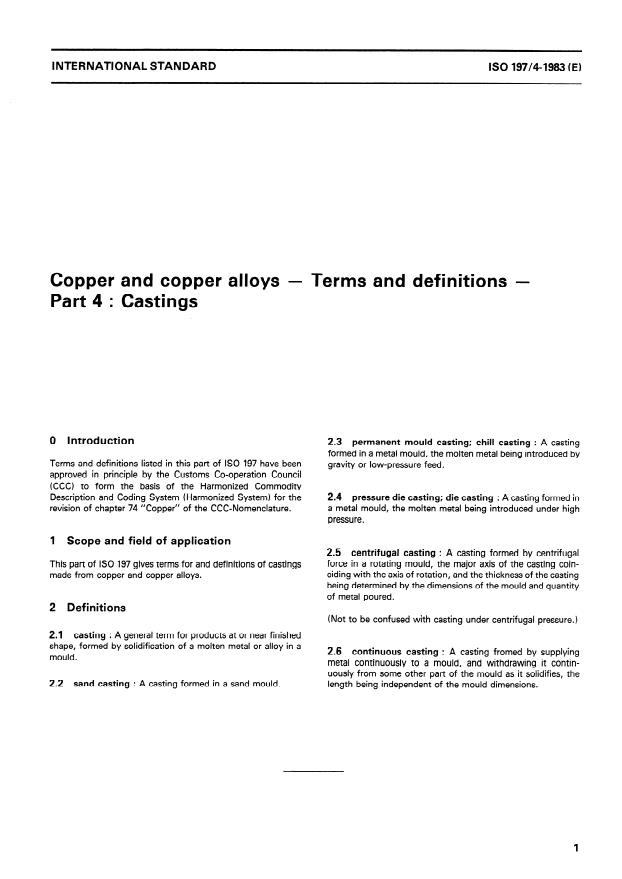
The terms and definitions have been approved in principle by the Customs Co-operation Council (CCC) to form the basis of the Harmonized Commodity Description and Coding System (Harmonized System) for the revision of chapter 74 "Copper" of the CCC-Nomenclature. This part of ISO 197 defines the following terms: casting, sand casting, permanent mould casting (chill casting), pressure die casting (die casting), centrifugal casting and continuous casting.
- Status
- Published
- Publication Date
- 30-Nov-1983
- Technical Committee
- ISO/TC 26 - Copper and copper alloys
- Drafting Committee
- ISO/TC 26 - Copper and copper alloys
- Current Stage
- 9093 - International Standard confirmed
- Start Date
- 31-Dec-2024
- Completion Date
- 29-Aug-2026
Buy Documents

ISO 197-4:1983 - Copper and copper alloys — Terms and definitions — Part 4: Castings Released:12/1/1983

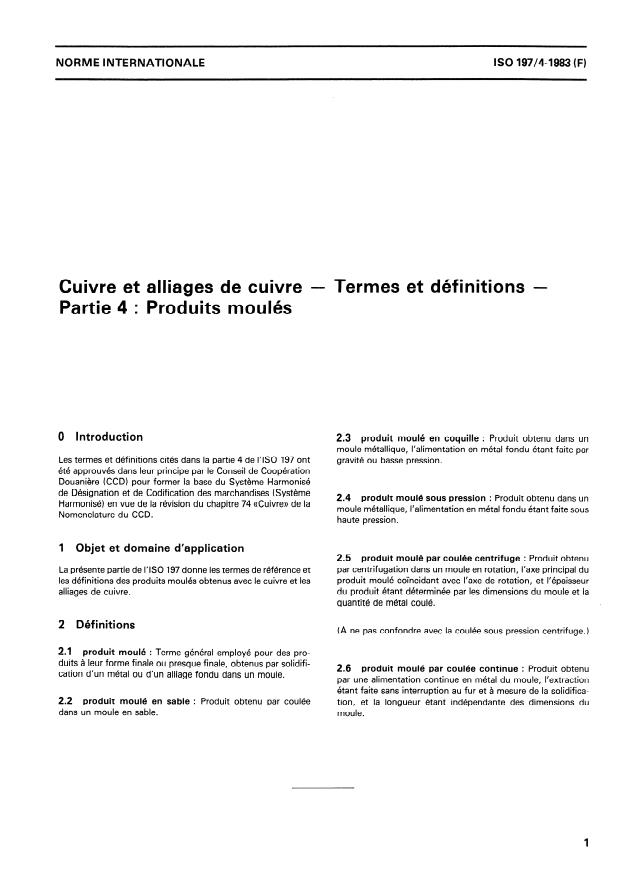

ISO 197-4:1983 - Cuivre et alliages de cuivre — Termes et définitions — Partie 4: Produits moulés Released:12/1/1983
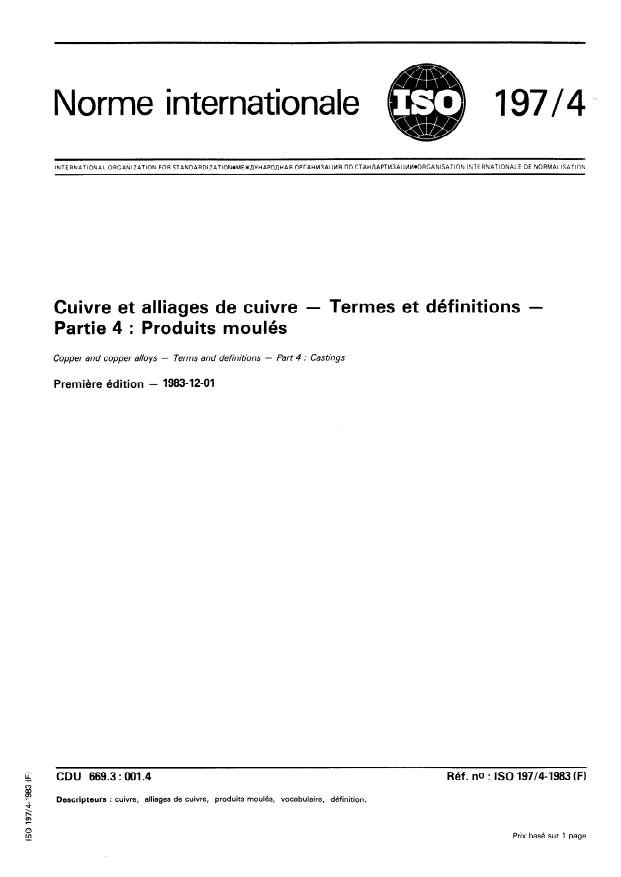
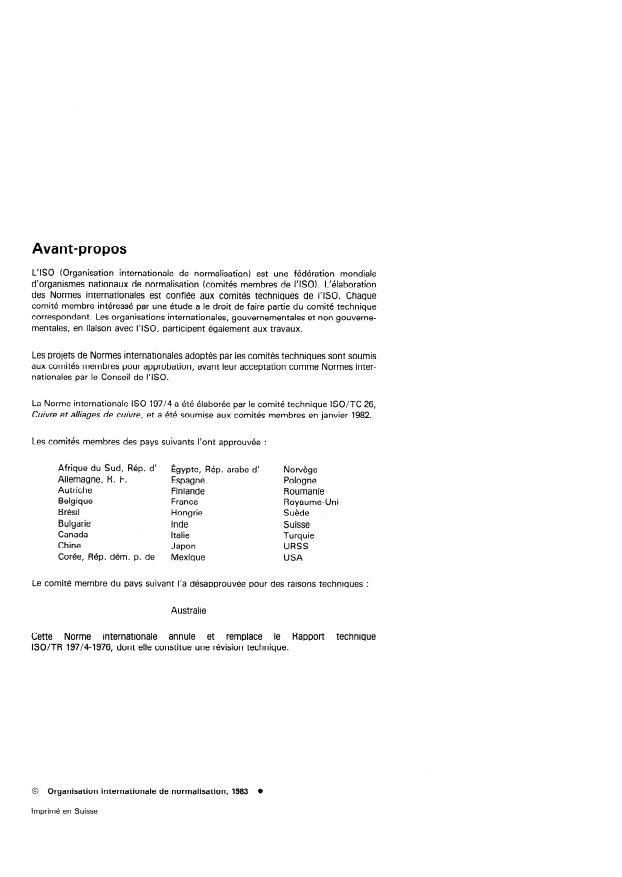
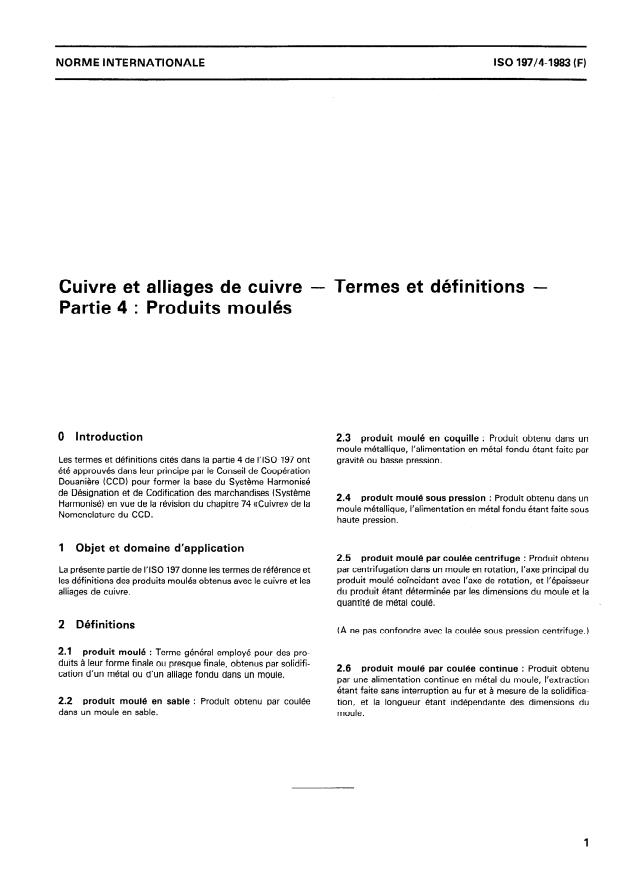

ISO 197-4:1983 - Cuivre et alliages de cuivre — Termes et définitions — Partie 4: Produits moulés Released:12/1/1983
Overview
ISO 197-4:1983 is an important international standard published by the International Organization for Standardization (ISO) that defines key terminology related to copper and copper alloys castings. This standard specifically covers terms and definitions applicable to various casting methods used in copper manufacturing processes. It serves as a foundational reference for industry professionals, manufacturers, and technical committees, ensuring consistent understanding and communication regarding copper castings worldwide.
Approved by the Customs Co-operation Council (CCC), the terms are intended to underpin the Harmonized Commodity Description and Coding System (Harmonized System) for chapter 74 on Copper. This ISO standard updates and replaces the earlier Technical Report ISO/TR 197/4-1976, reflecting the latest consensus on casting terminology.
Key Topics
ISO 197-4:1983 defines precise terms for types of castings and casting methods specifically for copper and copper alloys. The standard supports clear and uniform vocabulary across manufacturing, trade, and regulatory domains.
The key definitions include:
- Casting: A broad term for copper products formed by solidifying molten metal in a mould, resulting in finished or near-finished shapes.
- Sand Casting: A casting formed by pouring molten copper into a sand mould.
- Permanent Mould Casting (Chill Casting): Casting in a reusable metal mould, where molten copper is introduced by gravity or low-pressure feed.
- Pressure Die Casting (Die Casting): Casting produced by injecting molten copper under high pressure into a metal mould.
- Centrifugal Casting: Casting formed using centrifugal force in a rotating mould, where the casting’s thickness corresponds to the mould dimensions and metal volume.
- Continuous Casting: A process involving continuous supply and withdrawal of molten copper, creating products with length independent of mould size.
This comprehensive glossary facilitates precise identification and classification of copper castings based on production methods.
Applications
The definitions outlined in ISO 197-4:1983 have practical value across several sectors:
- Manufacturing & Foundries: Enables accurate specification of casting methods for copper alloys, improving production quality and traceability.
- Trade & Customs: Serves as the basis for harmonizing commodity coding in international copper product trade, aiding tariff classification and import/export clearance.
- Quality Assurance & Standards Compliance: Provides a standardized vocabulary for quality control, certification, testing, and regulatory approvals.
- Research & Development: Assists materials scientists and engineers in developing new copper casting techniques with clear terminology.
By adopting ISO 197-4:1983, stakeholders minimize misunderstandings and boost efficiency in technical documentation, contracts, and industry communication related to copper castings.
Related Standards
ISO 197-4:1983 is part 4 of the broader ISO 197 series that covers terms and definitions for copper and copper alloys. Other relevant standards in the series and related domains include:
- ISO 197-1: General terms and definitions for copper and copper alloys.
- ISO 4783: Copper and copper alloys - Chemical analysis methods.
- ISO 6506-1: Metallic materials - Brinell hardness test.
- ISO 945: Cast irons - Classification and designation.
Together, these standards create an integrated framework supporting the international copper industry’s technical, commercial, and regulatory needs.
Keywords: ISO 197-4, copper castings, copper alloys, casting definitions, sand casting, permanent mould casting, pressure die casting, centrifugal casting, continuous casting, Harmonized System, copper manufacturing standards, international copper terminology, copper alloy casting methods.
Relations
- Effective Date
- 15-Apr-2008
Buy Documents
ISO 197-4:1983 - Copper and copper alloys — Terms and definitions — Part 4: Castings Released:12/1/1983
ISO 197-4:1983 - Cuivre et alliages de cuivre — Termes et définitions — Partie 4: Produits moulés Released:12/1/1983
ISO 197-4:1983 - Cuivre et alliages de cuivre — Termes et définitions — Partie 4: Produits moulés Released:12/1/1983
Get Certified
Connect with accredited certification bodies for this standard

Element Materials Technology
Materials testing and product certification.

Inštitut za kovinske materiale in tehnologije
Institute of Metals and Technology. Materials testing, metallurgical analysis, NDT.
Sponsored listings
Frequently Asked Questions
ISO 197-4:1983 is a standard published by the International Organization for Standardization (ISO). Its full title is "Copper and copper alloys — Terms and definitions — Part 4: Castings". This standard covers: The terms and definitions have been approved in principle by the Customs Co-operation Council (CCC) to form the basis of the Harmonized Commodity Description and Coding System (Harmonized System) for the revision of chapter 74 "Copper" of the CCC-Nomenclature. This part of ISO 197 defines the following terms: casting, sand casting, permanent mould casting (chill casting), pressure die casting (die casting), centrifugal casting and continuous casting.
The terms and definitions have been approved in principle by the Customs Co-operation Council (CCC) to form the basis of the Harmonized Commodity Description and Coding System (Harmonized System) for the revision of chapter 74 "Copper" of the CCC-Nomenclature. This part of ISO 197 defines the following terms: casting, sand casting, permanent mould casting (chill casting), pressure die casting (die casting), centrifugal casting and continuous casting.
ISO 197-4:1983 is classified under the following ICS (International Classification for Standards) categories: 01.040.77 - Metallurgy (Vocabularies); 77.150.30 - Copper products. The ICS classification helps identify the subject area and facilitates finding related standards.
ISO 197-4:1983 has the following relationships with other standards: It is inter standard links to ISO/R 197:1961. Understanding these relationships helps ensure you are using the most current and applicable version of the standard.
ISO 197-4:1983 is available in PDF format for immediate download after purchase. The document can be added to your cart and obtained through the secure checkout process. Digital delivery ensures instant access to the complete standard document.
Standards Content (Sample)
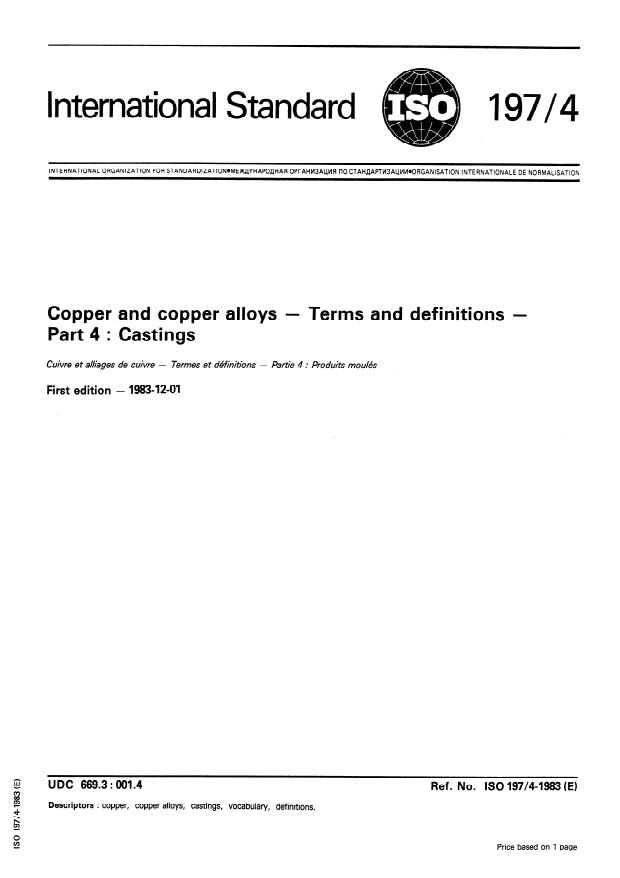
International Standard
INTERNATIONAL ORGANIZATION FOR STANDARDlZATION.MEX)(nYHAPO~HAR OPl-AHM3AQl4R I-IO CTAH~APTM3A~WWORGANISATlON INTERNATIONALE DE NORMALISATION
Copper.and copper alloys - Terms and definitions -
Part 4 : Castings
Cuivre et aliages de cuivre - Termes et d&hitions - Partie 4 : Produits moulhs
First edition - 1983-12-01
UDC 669.3 : 001.4
Ref. No. IS0 197/4-1983 (E)
Descriptors : copper, copper alloys, castings, vocabulary, definitions.
Price based on 1 page
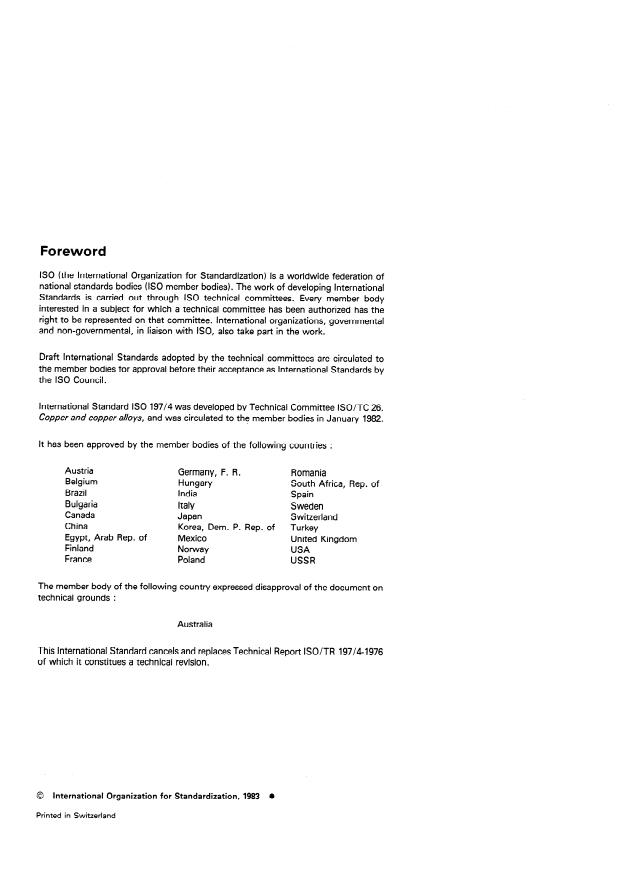
Foreword
IS0 (the International Organization for Standardization) is a worldwide federation of
national standards bodies (IS0 member bodies). The work of developing International
Standards is carried out through IS0 technical committees. Every member body
interested in a subject for which a technical committee has been authorized has the
right to be represented on that committee. International organizations, governmental
and non-governmental, in liaison with ISO, also take part in the work.
Draft International Standards adopted by the technical committees are circulated to
the member bodies for approval before their acceptance as International Standards by
the IS0 Council.
International Standard IS0 197/4 was developed by Technical Committee ISO/TC 26,
Copper and copper alloys, and was circulated to the member bodies in January 1982.
It has been approved by the member bodies of the following countries :
Austria
Germany, F. R. Romania
Belgium
Hungary South Africa, Rep. of
Brazil India Spain
Bulgaria
Italy Sweden
Canada Japan Switzerland
China
Korea, Dem. P. Rep. of Turkey
Egypt, Arab Rep. of Mexico United Kingdom
Finland
Norway USA
France Poland USSR
following country expressed disapproval of the document on
The member body of the
technical grounds
Australia
This International Standard cancels and replaces Technical Report ISO/TR 197/4-1976
of w
...
~-
Norme internationale
197/4-
INTERNATIONAL ORGANIZATION FOR STANDARDIZATION.MEX~YHAPO~t-lAR OPTAHkl3ALWlfl Il0 CTAHAAPTM3AUblM.ORGANISATION INTERNATIONALE DE NORMALISATION
Cuivre et alliages de cuivre - Termes et définitions -
Partie 4 : Produits moulés
Copper and copper afloys - Terms and definitions - Part 4 : Castings
Première édition - lS83-12-01
CDU 669.3 : 001.4 Réf. no : ISO 197/4-1983 (FI
: cuivre, alliages de cuivre, produits moulés, vocabulaire, définition.
Descripteurs
Prix basé sur 1 page
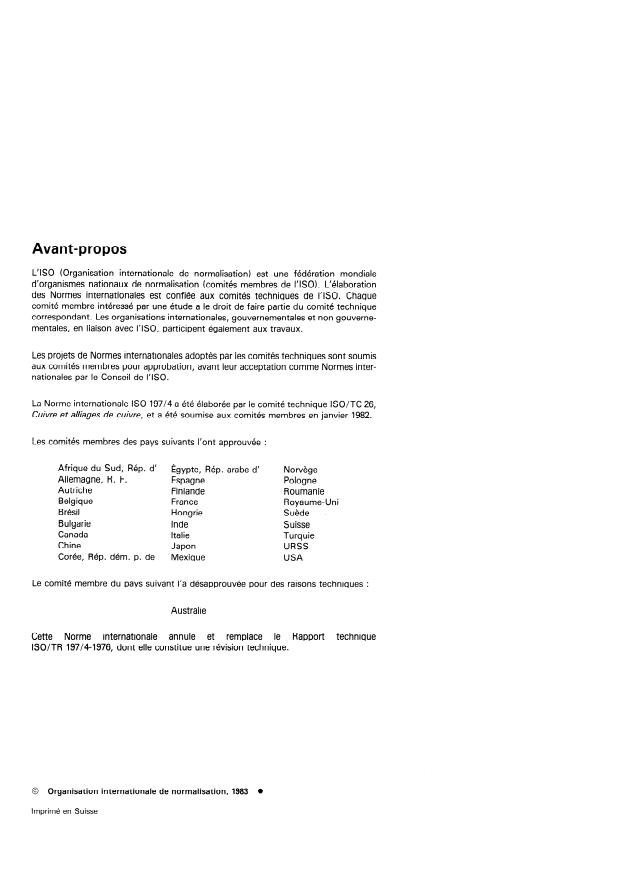
Avant-propos
L’lSO (Organisation internationale de normalisation) est une fédération mondiale
d’organismes nationaux de normalisation (comités membres de I’ISO). L’élaboration
des Normes internationales est confiée aux comités techniques de I’ISO. Chaque
comité membre intéressé par une étude a le droit de faire partie du comité technique
correspondant. Les organisations internationales, gouvernementales et non gouverne-
mentales, en liaison avec I’ISO, participent également aux travaux.
Les projets de Normes internationales adoptés par les comités techniques sont soumis
aux comités membres pour approbation, avant leur acceptation comme Normes inter-
nationales par le Conseil de I’ISO.
La Norme internationale BS0 197/4 a été élaborée par le comité technique ISO/TC 26,
Cuivre et a//iages de cuivre, et a été soumise aux comités membres en janvier 1982.
Les comités membres des pays suivants l’ont approuvée :
Afrique du Sud, Rép. d’
Égypte, Rép. arabe d’ Norvège
Allemagne, R. F.
Espagne Pologne
Autriche Finlande
Roumanie
Belgique
France Royaume-Uni
Brésil Hongrie Suède
Rulgarie Inde Suisse
Canada Italie
Turquie
Chine Japon URSS
Corée, Rép. dém. p. de Mexique
USA
Le comité membre du pays suivant l’a désapprouvée pour des raisons techniques :
Australie
Norme internationale annule et remplace le Ra technique
Cette PPOrt
e révision tech nique.
ISO/TR 197/4- 1976, dont elle constitue un
0 Organisation internationale de no
...
~-
Norme internationale
197/4-
INTERNATIONAL ORGANIZATION FOR STANDARDIZATION.MEX~YHAPO~t-lAR OPTAHkl3ALWlfl Il0 CTAHAAPTM3AUblM.ORGANISATION INTERNATIONALE DE NORMALISATION
Cuivre et alliages de cuivre - Termes et définitions -
Partie 4 : Produits moulés
Copper and copper afloys - Terms and definitions - Part 4 : Castings
Première édition - lS83-12-01
CDU 669.3 : 001.4 Réf. no : ISO 197/4-1983 (FI
: cuivre, alliages de cuivre, produits moulés, vocabulaire, définition.
Descripteurs
Prix basé sur 1 page
Avant-propos
L’lSO (Organisation internationale de normalisation) est une fédération mondiale
d’organismes nationaux de normalisation (comités membres de I’ISO). L’élaboration
des Normes internationales est confiée aux comités techniques de I’ISO. Chaque
comité membre intéressé par une étude a le droit de faire partie du comité technique
correspondant. Les organisations internationales, gouvernementales et non gouverne-
mentales, en liaison avec I’ISO, participent également aux travaux.
Les projets de Normes internationales adoptés par les comités techniques sont soumis
aux comités membres pour approbation, avant leur acceptation comme Normes inter-
nationales par le Conseil de I’ISO.
La Norme internationale BS0 197/4 a été élaborée par le comité technique ISO/TC 26,
Cuivre et a//iages de cuivre, et a été soumise aux comités membres en janvier 1982.
Les comités membres des pays suivants l’ont approuvée :
Afrique du Sud, Rép. d’
Égypte, Rép. arabe d’ Norvège
Allemagne, R. F.
Espagne Pologne
Autriche Finlande
Roumanie
Belgique
France Royaume-Uni
Brésil Hongrie Suède
Rulgarie Inde Suisse
Canada Italie
Turquie
Chine Japon URSS
Corée, Rép. dém. p. de Mexique
USA
Le comité membre du pays suivant l’a désapprouvée pour des raisons techniques :
Australie
Norme internationale annule et remplace le Ra technique
Cette PPOrt
e révision tech nique.
ISO/TR 197/4- 1976, dont elle constitue un
0 Organisation internationale de no
...