

ISO/FDIS 19085-1
(Main)Woodworking machines — Safety — Part 1: Common requirements
- Abstract
This document gives the safety requirements and measures to reduce risks arising during operation, adjustment, maintenance, transport, assembly, dismantling, disabling and scrapping, related to woodworking machines capable of continuous production use, hereinafter referred as "machines". These safety requirements and measures are those common to most of the machines, when they are used as intended and under the conditions foreseen by the manufacturer; reasonably foreseeable misuse has been considered too. The machines are designed to process solid wood and material with similar physical characteristics to wood, with hand feed or integrated feed. This document is intended to be used in conjunction with the other parts of the ISO 19085 series, applicable to specific machine types. The extent to which all significant hazards of a specific machine type are covered is indicated in the specific part of the ISO 19085 series relevant to that machine type. The hazards covered, at least partly, by the requirements of this document, are listed in Annex A. It is not applicable to machines intended for use in potential explosive atmospheres or to machines manufactured prior to the date of its publication.
- Status
- Not Published
- Technical Committee
- ISO/TC 39/SC 4 - Woodworking machines
- Current Stage
- 5000 - FDIS registered for formal approval
- Start Date
- 18-May-2026
- Completion Date
- 16-Mar-2026
Buy Documents
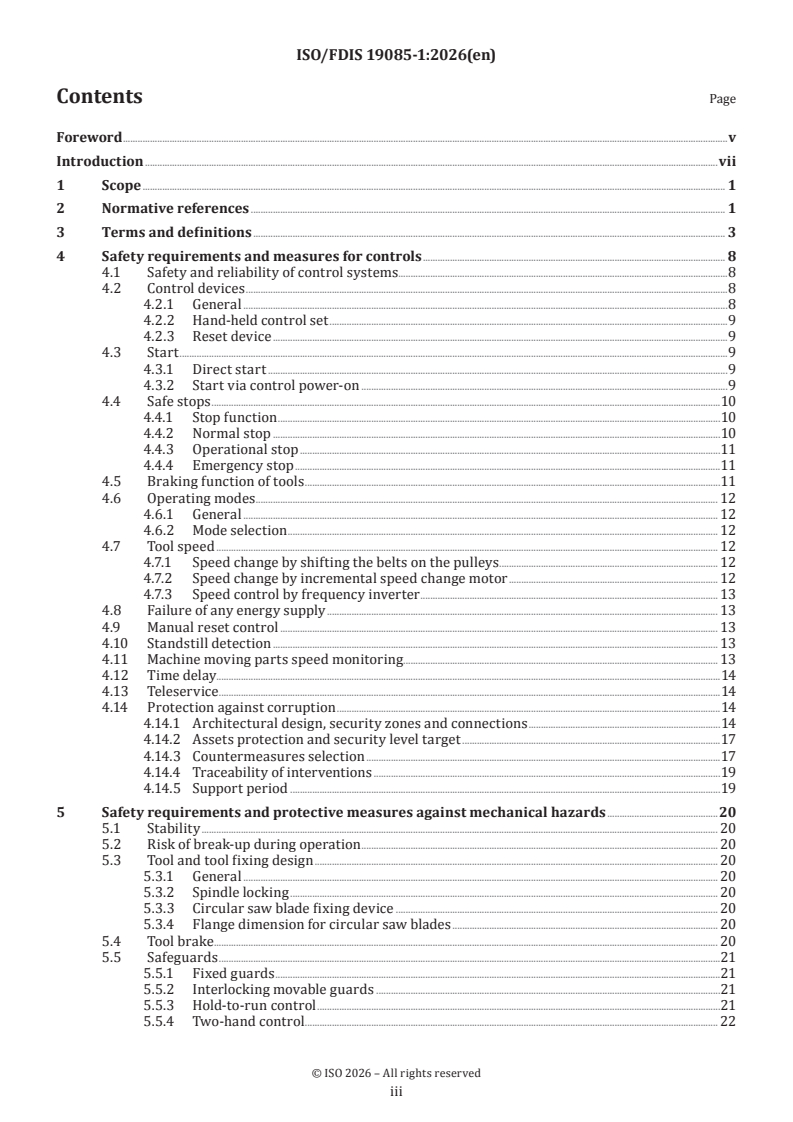
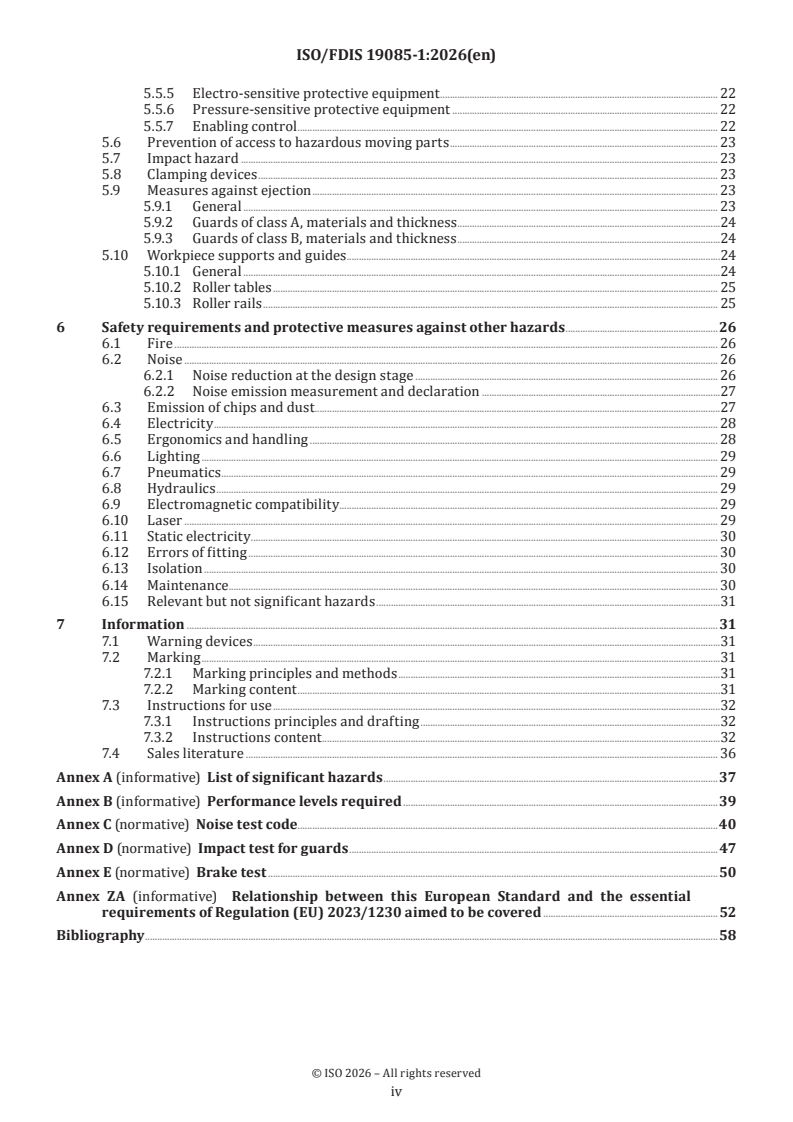
ISO/FDIS 19085-1 - Woodworking machines — Safety — Part 1: Common requirements
REDLINE ISO/FDIS 19085-1 - Woodworking machines — Safety — Part 1: Common requirements
Relations
- Consolidates
prEN ISO 19085-1 - Woodworking machines - Safety - Part 1: Common requirements (ISO/DIS 19085-1:2025) - Effective Date
- 12-Feb-2026
- Effective Date
- 17-Feb-2024
Buy Documents
ISO/FDIS 19085-1 - Woodworking machines — Safety — Part 1: Common requirements
REDLINE ISO/FDIS 19085-1 - Woodworking machines — Safety — Part 1: Common requirements
Get Certified
Connect with accredited certification bodies for this standard

CIS Institut d.o.o.
Personal Protective Equipment (PPE) certification body. Notified Body NB-2890 for EU Regulation 2016/425 PPE.
Gozdarski inštitut Slovenije
Slovenian Forestry Institute. Forest management certification support, timber testing.

Kiwa BDA Testing
Building and construction product certification.
Sponsored listings
Frequently Asked Questions
ISO/FDIS 19085-1 is a draft published by the International Organization for Standardization (ISO). Its full title is "Woodworking machines — Safety — Part 1: Common requirements". This standard covers: This document gives the safety requirements and measures to reduce risks arising during operation, adjustment, maintenance, transport, assembly, dismantling, disabling and scrapping, related to woodworking machines capable of continuous production use, hereinafter referred as "machines". These safety requirements and measures are those common to most of the machines, when they are used as intended and under the conditions foreseen by the manufacturer; reasonably foreseeable misuse has been considered too. The machines are designed to process solid wood and material with similar physical characteristics to wood, with hand feed or integrated feed. This document is intended to be used in conjunction with the other parts of the ISO 19085 series, applicable to specific machine types. The extent to which all significant hazards of a specific machine type are covered is indicated in the specific part of the ISO 19085 series relevant to that machine type. The hazards covered, at least partly, by the requirements of this document, are listed in Annex A. It is not applicable to machines intended for use in potential explosive atmospheres or to machines manufactured prior to the date of its publication.
This document gives the safety requirements and measures to reduce risks arising during operation, adjustment, maintenance, transport, assembly, dismantling, disabling and scrapping, related to woodworking machines capable of continuous production use, hereinafter referred as "machines". These safety requirements and measures are those common to most of the machines, when they are used as intended and under the conditions foreseen by the manufacturer; reasonably foreseeable misuse has been considered too. The machines are designed to process solid wood and material with similar physical characteristics to wood, with hand feed or integrated feed. This document is intended to be used in conjunction with the other parts of the ISO 19085 series, applicable to specific machine types. The extent to which all significant hazards of a specific machine type are covered is indicated in the specific part of the ISO 19085 series relevant to that machine type. The hazards covered, at least partly, by the requirements of this document, are listed in Annex A. It is not applicable to machines intended for use in potential explosive atmospheres or to machines manufactured prior to the date of its publication.
ISO/FDIS 19085-1 is classified under the following ICS (International Classification for Standards) categories: 13.110 - Safety of machinery; 79.120.10 - Woodworking machines. The ICS classification helps identify the subject area and facilitates finding related standards.
ISO/FDIS 19085-1 has the following relationships with other standards: It is inter standard links to prEN ISO 19085-1, ISO 19085-1:2021. Understanding these relationships helps ensure you are using the most current and applicable version of the standard.
ISO/FDIS 19085-1 is available in PDF format for immediate download after purchase. The document can be added to your cart and obtained through the secure checkout process. Digital delivery ensures instant access to the complete standard document.
Standards Content (Sample)
FINAL DRAFT
International
Standard
ISO/TC 39/SC 4
Woodworking machines — Safety —
Secretariat: UNI
Part 1:
Voting begins on:
2026-11-09
Common requirements
Voting terminates on:
Machines à bois — Sécurité —
2026-12-21
Partie 1: Exigences communes
RECIPIENTS OF THIS DRAFT ARE INVITED TO SUBMIT,
WITH THEIR COMMENTS, NOTIFICATION OF ANY
RELEVANT PATENT RIGHTS OF WHICH THEY ARE AWARE
AND TO PROVIDE SUPPOR TING DOCUMENTATION.
IN ADDITION TO THEIR EVALUATION AS
BEING ACCEPTABLE FOR INDUSTRIAL, TECHNO-
ISO/CEN PARALLEL PROCESSING LOGICAL, COMMERCIAL AND USER PURPOSES, DRAFT
INTERNATIONAL STANDARDS MAY ON OCCASION HAVE
TO BE CONSIDERED IN THE LIGHT OF THEIR POTENTIAL
TO BECOME STAN DARDS TO WHICH REFERENCE MAY BE
MADE IN NATIONAL REGULATIONS.
Reference number
FINAL DRAFT
International
Standard
ISO/TC 39/SC 4
Woodworking machines — Safety —
Secretariat: UNI
Part 1:
Voting begins on:
Common requirements
Voting terminates on:
Machines à bois — Sécurité —
Partie 1: Exigences communes
© ISO 2026
All rights reserved.
RECIPIENTS OF THIS DRAFT ARE INVITED TO SUBMIT,
WITH THEIR COMMENTS, NOTIFICATION OF ANY
This ISO publication is protected by copyright and is owned by ISO and/or its licensors.
RELEVANT PATENT RIGHTS OF WHICH THEY ARE AWARE
The content of this ISO publication is provided under licence, not sold. Use is subject to the applicable licence terms issued by ISO,
AND TO PROVIDE SUPPOR TING DOCUMENTATION.
an ISO member body, or an authorized third-party distributor.
IN ADDITION TO THEIR EVALUATION AS
BEING ACCEPTABLE FOR INDUSTRIAL, TECHNO-
Except as required for implementation or expressly permitted by a separate licence, no part of this ISO publication may be
ISO/CEN PARALLEL PROCESSING
LOGICAL, COMMERCIAL AND USER PURPOSES, DRAFT
reproduced, distributed, modified, used, or made available in any form or by any means – electronic or mechanical, including
INTERNATIONAL STANDARDS MAY ON OCCASION HAVE
photocopying, scanning, recording, or posting on internal or external digital platforms. TO BE CONSIDERED IN THE LIGHT OF THEIR POTENTIAL
TO BECOME STAN DARDS TO WHICH REFERENCE MAY BE
Any use beyond the scope of the granted rights is prohibited and may result in legal action.
MADE IN NATIONAL REGULATIONS.
ISO copyright office
CP 401 • CH-1214 Vernier, Geneva
Phone: +41 22 749 01 11
Email: copyright@iso.org
Website: www.iso.org
Published in Switzerland
Reference number
ii
Contents Page
Foreword .v
Introduction .vii
1 Scope . 1
2 Normative references . 1
3 Terms and definitions . 3
4 Safety requirements and measures for controls . 8
4.1 Safety and reliability of control systems.8
4.2 Control devices .8
4.2.1 General .8
4.2.2 Hand-held control set .9
4.2.3 Reset device .9
4.3 Start .9
4.3.1 Direct start .9
4.3.2 Start via control power-on .9
4.4 Safe stops .10
4.4.1 Stop function .10
4.4.2 Normal stop .10
4.4.3 Operational stop .11
4.4.4 Emergency stop .11
4.5 Braking function of tools .11
4.6 Operating modes . 12
4.6.1 General . 12
4.6.2 Mode selection . 12
4.7 Tool speed . 12
4.7.1 Speed change by shifting the belts on the pulleys . 12
4.7.2 Speed change by incremental speed change motor . 12
4.7.3 Speed control by frequency inverter . 13
4.8 Failure of any energy supply . 13
4.9 Manual reset control . 13
4.10 Standstill detection . 13
4.11 Machine moving parts speed monitoring. 13
4.12 Time delay.14
4.13 Teleservice .14
4.14 Protection against corruption .14
4.14.1 Architectural design, security zones and connections .14
4.14.2 Assets protection and security level target .17
4.14.3 Countermeasures selection .17
4.14.4 Traceability of interventions .19
4.14.5 Support period .19
5 Safety requirements and protective measures against mechanical hazards .20
5.1 Stability . 20
5.2 Risk of break-up during operation . 20
5.3 Tool and tool fixing design . 20
5.3.1 General . 20
5.3.2 Spindle locking . 20
5.3.3 Circular saw blade fixing device . 20
5.3.4 Flange dimension for circular saw blades . 20
5.4 Tool brake . . 20
5.5 Safeguards .21
5.5.1 Fixed guards .21
5.5.2 Interlocking movable guards .21
5.5.3 Hold-to-run control .21
5.5.4 Two-hand control . 22
iii
5.5.5 Electro-sensitive protective equipment . 22
5.5.6 Pressure-sensitive protective equipment . 22
5.5.7 Enabling control . 22
5.6 Prevention of access to hazardous moving parts . 23
5.7 Impact hazard . 23
5.8 Clamping devices . 23
5.9 Measures against ejection . 23
5.9.1 General . 23
5.9.2 Guards of class A, materials and thickness .24
5.9.3 Guards of class B, materials and thickness .24
5.10 Workpiece supports and guides . .24
5.10.1 General .24
5.10.2 Roller tables . 25
5.10.3 Roller rails . 25
6 Safety requirements and protective measures against other hazards .26
6.1 Fire . 26
6.2 Noise . 26
6.2.1 Noise reduction at the design stage . 26
6.2.2 Noise emission measurement and declaration .27
6.3 Emission of chips and dust .27
6.4 Electricity . 28
6.5 Ergonomics and handling . 28
6.6 Lighting . 29
6.7 Pneumatics . 29
6.8 Hydraulics . 29
6.9 Electromagnetic compatibility. 29
6.10 Laser . 29
6.11 Static electricity. 30
6.12 Errors of fitting . 30
6.13 Isolation . 30
6.14 Maintenance . 30
6.15 Relevant but not significant hazards .31
7 Information .31
7.1 Warning devices .31
7.2 Marking .31
7.2.1 Marking principles and methods .31
7.2.2 Marking content .31
7.3 Instructions for use .32
7.3.1 Instructions principles and drafting .32
7.3.2 Instructions content .32
7.4 Sales literature . 36
Annex A (informative) List of significant hazards .37
Annex B (informative) Performance levels required .39
Annex C (normative) Noise test code.40
Annex D (normative) Impact test for guards .47
Annex E (normative) Brake test .50
Annex ZA (informative) Relationship between this European Standard and the essential
requirements of Regulation (EU) 2023/1230 aimed to be covered .52
Bibliography .58
iv
Foreword
ISO (the International Organization for Standardization) is a worldwide federation of national standards
bodies (ISO member bodies). The work of preparing International Standards is normally carried out through
ISO technical committees. Each member body interested in a subject for which a technical committee
has been established has the right to be represented on that committee. International organizations,
governmental and non-governmental, in liaison with ISO, also take part in the work. ISO collaborates closely
with the International Electrotechnical Commission (IEC) on all matters of electrotechnical standardization.
The procedures used to develop this document and those intended for its further maintenance are described
in the ISO/IEC Directives, Part 1. In particular, the different approval criteria needed for the different types
of ISO documents should be noted. This document was drafted in accordance with the editorial rules of the
ISO/IEC Directives, Part 2 (see www.iso.org/directives).
ISO draws attention to the possibility that the implementation of this document may involve the use of (a)
patent(s). ISO takes no position concerning the evidence, validity or applicability of any claimed patent
rights in respect thereof. As of the date of publication of this document, ISO had not received notice of (a)
patent(s) which may be required to implement this document. However, implementers are cautioned that
this may not represent the latest information, which may be obtained from the patent database available at
www.iso.org/patents. ISO shall not be held responsible for identifying any or all such patent rights.
Any trade name used in this document is information given for the convenience of users and does not
constitute an endorsement.
For an explanation of the voluntary nature of standards, the meaning of ISO specific terms and expressions
related to conformity assessment, as well as information about ISO's adherence to the World Trade
Organization (WTO) principles in the Technical Barriers to Trade (TBT), see www.iso.org/iso/foreword.html.
This document was prepared by Technical Committee ISO/TC 39, Machine tools, Subcommittee SC 4,
Woodworking machines, in collaboration with the European Committee for Standardization (CEN) Technical
Committee CEN/TC 142, Woodworking machines - Safety, in accordance with the Agreement on technical
cooperation between ISO and CEN (Vienna Agreement).
This document is intended to be used in conjunction with the other parts of the ISO 19085 series.
This third edition cancels and replaces the second edition (ISO 19085-1:2021), which has been technically
revised. The main changes are as follows:
— the verification methods at the end of each subclause have been deleted, since self-evident;
— some definitions have been improved and refined; those derived from feed have been deleted since they
were unnecessary and imprecise, and they have been replaced by a note to entry in 3.10;
— subclauses 4.2, 4.6 and 5.10 have been subdivided to include more comprehensive and differentiated
requirements and for others parts of the ISO 19085 series to reference their text more accurately;
— in 4.2.2, requirements for hand-held control set have been added that were taken from some parts of the
ISO 19085 series;
— a new text on push button with normally open contact has been added to 4.3.1, 4.3.2, 4.9 and 5.5.3;
— in 4.7.3, the requirements applicable to some machines only have been deleted (they will be moved to the
relevant parts of the ISO 19085 series);
— in 4.10, the text on monitoring has been deleted, as well as the duplicated text on operational stop that is
already present in 4.4.3;
— a new subclause 4.14 has been added that contains requirements for protection against corruption, as
well as the relevant domain definitions in Clause 3 and information for use in 7.3.2;
— subclause 5.1 has been revised to only refer to ISO 12100, the testing requirement has been deleted from
this document, since not common to most machines;
v
— subclauses 5.4 and 5.9 have been simplified in structure, for easier reading;
— in 6.3, the first paragraph has been corrected and reworded, and NOTE 3 has been deleted since it is
addressed to CADES;
— in 6.4, the required protection degree for electrical components or their enclosures has been changed to
IP 52; connection plug requirement has been changed to wired in clockwise rotating field;
— in 6.6, the requirements for lighting have been clarified;
— 7.2 and 7.3 have been rearranged: principles have been separated in 7.x.1 and content has been merged
in 7.x.2;
— 7.4 on sales literature has been added;
— Annex E containing the stability test has been deleted since it is not common to most machines; subsequent
annexes have been renumbered accordingly.
A list of all parts in the ISO 19085 series can be found on the ISO website.
Any feedback or questions on this document should be directed to the user’s national standards body. A
complete listing of these bodies can be found at www.iso.org/members.html.
vi
Introduction
The ISO 19085 series provides technical safety requirements for the design and construction of woodworking
machinery, as well as for the content of the relevant instruction handbook. The ISO 19085 series is intended
for designers, manufacturers, suppliers and importers of the machines specified in the Scope of its parts.
This document is a type-C standard as stated in ISO 12100.
This document is of relevance, in particular, for the following stakeholder groups representing the market
players with regard to machinery safety:
— machine manufacturers (small, medium and large enterprises);
— health and safety bodies (regulators, accident prevention organizations, market surveillance, etc.).
Others can be affected by the level of machinery safety achieved with the means of the document by the
above-mentioned stakeholder groups:
— machine users/employers (small, medium and large enterprises);
— machine users/employees (e.g. trade unions, organizations for people with special needs);
— service providers, for example, for maintenance (small, medium and large enterprises);
— consumers (in case of machinery intended for use by consumers).
The above-mentioned stakeholder groups have been given the possibility to participate in the drafting
process of this document.
The machinery concerned and the extent to which hazards, hazardous situations or hazardous events are
covered are indicated in the Scope of this document.
When requirements of this type-C standard are different from those which are stated in type-A or type-B
standards, the requirements of this type-C standard take precedence over the requirements of the other
standards for machines that have been designed and built according to the requirements of this type-C
standard.
The full set of requirements for a particular type of woodworking machine are the requirements given in the
part of the ISO 19085 series applicable to that type of woodworking machine, together with the requirements
from this document that are cited in the applicable part of the ISO 19085 series.
This document was developed, at its first edition, taking the requirements that are common to most
woodworking machines from pre-existing specific standards on safety of different types of woodworking
machines, which were “stand-alone” standards, i.e. not parts of a multi-parts series like the ISO 19085 series.
This document can be used as a guide when the designer has to do a full risk assessment according to
ISO 12100 and design the means for reducing the risks arising from relevant hazards for any woodworking
machine not covered by a specific part of the ISO 19085 series. As the ISO 19085 series reflects the state-of-
the-art of woodworking machinery safety, referring to any subclause of its parts can also be helpful when
searching for solutions to similar risks.
In the other parts of the ISO 19085 series, a subclause can either refer to the same subclause of this document,
or give specific requirements, or both. The specific text can be subdivided into further subclauses.
The ISO 19085 series is structured as follows:
— this document (i.e. ISO 19085-1) specifies the basic safety elements (like control devices, safeguards,
guards’ materials, most common workpiece supports and guides, etc.) and their design requirements
that are suitable to woodworking machines;
— all other parts of the ISO 19085 series specify whether the basic safety elements are required for the
relevant machine type and the requirements for their implementation on the machine.
vii
For the clearest possible reference among parts, all parts of the ISO 19085 series have exactly the same
structure of subclauses numbering and headings; each part shows all subclauses headings, even those that
are not relevant to it (stating so), in all cases where this avoids shifting the following subclauses down and
losing their numbering correspondence with this document, which can be confusing.
viii
FINAL DRAFT International Standard ISO/FDIS 19085-1:2026(en)
Woodworking machines — Safety —
Part 1:
Common requirements
1 Scope
This document specifies safety and cyber security requirements and measures common to most
woodworking machines, capable of continuous production use and designed to process solid wood and
materials with similar physical characteristics to wood, hereinafter referred to also as “machines”.
This document deals with significant hazards, hazardous situations or hazardous events (listed in Annex A),
relevant to woodworking machinery, when it is used as intended and under conditions of misuse which are
reasonably foreseeable by the manufacturer.
This document is also applicable to the other life cycle phases of woodworking machines: transport,
assembly, adjustment, maintenance, disabling, dismantling and scrapping.
This document also deals with cyber security hazards significant to woodworking machines in relation to
the potential loss of availability, confidentiality and integrity, not only related with machines safety.
This document is not applicable to machines intended for use in potential explosive atmospheres or to
machines manufactured before the date of its publication.
2 Normative references
The following documents are referred to in the text in such a way that some or all of their content constitutes
requirements of this document. For dated references, only the edition cited applies. For undated references,
the latest edition of the referenced document (including any amendments) applies.
ISO 3744:2025, Acoustics — Determination of sound power levels of noise sources using sound pressure —
Engineering methods for an essentially free field over a reflecting plane
ISO 3746:2010, Acoustics — Determination of sound power levels and sound energy levels of noise sources using
sound pressure — Survey method using an enveloping measurement surface over a reflecting plane
ISO 4413:2010, Hydraulic fluid power — General rules and safety requirements for systems and their components
ISO 4414:2010, Pneumatic fluid power — General rules and safety requirements for systems and their
components
ISO 4871:1996, Acoustics — Declaration and verification of noise emission values of machinery and equipment
ISO 11201:2010, Acoustics — Noise emitted by machinery and equipment — Determination of emission sound
pressure levels at a work station and at other specified positions in an essentially free field over a reflecting
plane with negligible environmental corrections
ISO 11202:2010, Acoustics — Noise emitted by machinery and equipment — Determination of emission
sound pressure levels at a work station and at other specified positions applying approximate environmental
corrections
ISO 11202:2010/Amd 1:2020, Acoustics — Noise emitted by machinery and equipment — Determination
of emission sound pressure levels at a work station and at other specified positions applying approximate
environmental corrections — Amendment 1
ISO 11204:2010, Acoustics — Noise emitted by machinery and equipment — Determination of emission sound
pressure levels at a work station and at other specified positions applying accurate environmental corrections
ISO 12100:2010, Safety of machinery — General principles for design — Risk assessment and risk reduction
ISO 13849-1:2023, Safety of machinery — Safety-related parts of control systems — Part 1: General principles
for design
ISO 13850:2015, Safety of machinery — Emergency stop function — Principles for design
ISO 13851:2019, Safety of machinery — Two-hand control devices — Principles for design and selection
ISO 13856-1:2013, Safety of machinery — Pressure-sensitive protective devices — Part 1: General principles for
design and testing of pressure-sensitive mats and pressure-sensitive floors
ISO 13856-2:2013, Safety of machinery — Pressure-sensitive protective devices — Part 2: General principles for
design and testing of pressure-sensitive edges and pressure-sensitive bars
ISO 13856-3:2013, Safety of machinery — Pressure-sensitive protective devices — Part 3: General principles for
design and testing of pressure-sensitive bumpers, plates, wires and similar devices
ISO 14118:2017, Safety of machinery — Prevention of unexpected start-up
ISO 14119:2024, Safety of machinery — Interlocking devices associated with guards — Principles for design and
selection
ISO 14120:2015, Safety of machinery — Guards — General requirements for the design and construction of fixed
and movable guards
ISO 20607:2019, Safety of machinery — Instruction handbook — General drafting principles
I EC 6 020 4 -1:2016 +A 1: 2021, Safety of machinery — Electrical equipment of machines — Part 1: General
requirements
I EC 6 0529:198 9+A M D1: 19 9 9+ A M D2: 2013, Degrees of protection provided by enclosures (IP Code)
IEC 60825-1:2014, Safety of laser products — Part 1: Equipment classification and requirements
IEC 60947-5-1:2024, Low-voltage switchgear and controlgear – Part 5-1: Control circuit devices and switching
elements - Electromechanical control circuit devices
IEC 61310-1:2007, Safety of machinery — Indication, marking and actuation — Part 1: Requirements for visual,
acoustic and tactile signals
IEC 61439-1:2020, Low-voltage switchgear and controlgear assemblies — Part 1: General rules
IEC 61496-1:2020, Safety of machinery — Electro-sensitive protective equipment — Part 1: General requirements
and tests
IEC 61496-2:2020, Safety of machinery — Electro-sensitive protective equipment — Part 2: Particular
requirements for equipment using active opto-electronic protective devices (AOPDs)
IEC 61496-3:2025, Safety of machinery — Electro-sensitive protective equipment — Part 3: Particular
requirements for active opto-electronic protective devices responsive to diffuse reflection (AOPDDR)
IEC 61800-5-2:2016, Adjustable speed electrical power drive systems — Part 5-2: Safety requirements —
Functional
IEC 62443-3-2:2020, Security for industrial automation and control systems - Part 3-2: Security risk assessment
for system design
IEC 62443-3-3:2013, Industrial communication networks - Network and system security - Part 3-3: System
security requirements and security levels
EN 847-1:2017, Tools for woodworking — Safety requirements — Part 1: Milling tools, circular saw blades
EN 847-2:2017, Tools for woodworking — Safety requirements — Part 2: Requirements for the shank of shank
mounted milling tools/circular saw blades
EN 847-3:2013, Tools for woodworking — Safety requirements — Part 3: Clamping devices
EN 1837:2020, Safety of machinery — Integral lighting of machines
EN 50370-1:2005, Electromagnetic compatibility (EMC) — Product family standard for machine tools — Part 1:
Emission
EN 50370-2:2003, Electromagnetic compatibility (EMC) — Product family standard for machine tools — Part 2:
Immunity
EN 50525-2-21:2011, Electric cables — Low voltage energy cables of rated voltages up to and including
450/750 V (U0/U) — Part 2-21: Cables for general applications — Flexible cables with crosslinked elastomeric
insulation
3 Terms and definitions
For the purposes of this document, the terms and definitions given in ISO 12100:2010, ISO 13849-1:2023 and
the following apply.
ISO and IEC maintain terminology databases for use in standardization at the following addresses:
— ISO Online browsing platform: available at https:// www .iso .org/ obp
— IEC Electropedia: available at https:// www .electropedia .org/
3.1
woodworking machine
machine designed to process wood and material with similar physical characteristics to wood (3.2)
3.2
material with similar physical characteristics to wood
engineered wood, engineered wood and solid wood composed with plastic or light alloy laminates or edges
or profiles, as well as cork, bone, rigid rubber and plastics
Note 1 to entry: Examples of engineered wood are particleboard, fibreboard, plywood, cross laminated timber (CLT).
Engineered wood is also commonly called wood-based material.
Note 2 to entry: Examples for plastics are thermoplastic materials and thermoplastic resins, thermosetting resins,
expanded plastic materials, polyurethane (PU), phenol and polyvinylchloride (PVC).
3.3
easily machinable material
material of which the unexpected contact with a spinning tool does not mechanically generate sparks and
does not result in damage of the tool
EXAMPLE Material with similar physical characteristics to wood (3.2) or light alloy.
3.4
control power-on
control that does not directly start any dangerous movement, but, after activation, enables the supply of
energy to machine actuators (3.5)
3.5
machine actuator
powered mechanism used to move a machine part or axis
EXAMPLE Drive, pneumatic cylinder, hydraulic cylinder.
3.6
operational stop
standstill of machine actuators (3.5) without cutting off the energy supply to them and with monitoring of
the standstill condition
3.7
run-up time
time elapsed from the actuation of the start control device until the tool reaches the intended speed
3.8
run-down time
time elapsed from the actuation of the stop control device until tool standstill
3.9
normal processing mode
MODE 1
condition with all safeguards in place and functional, typically used for normal processing but not limited to
it
3.10
feed
controlled relative movement between workpiece and tool
Note 1 to entry: The feed can be controlled by hand or by a powered mechanism. The first case is called hand feed
or manual feed; the second case is called powered feed or mechanical feed. The powered feed mechanism can be
integrated with the machine or demountable.
3.11
climb cutting
cutting where the projection of the movement of the cutting knife in the direction of the feed (3.10) has the
same sense as the relative movement of the workpiece against the tool
Note 1 to entry: For an example of climb cutting, see Figure 1 a).
3.12
cutting against the feed
cutting where the projection of the movement of the cutting knife in the direction of the feed (3.10) has the
opposite sense to the relative movement of the workpiece against the tool
Note 1 to entry: For an example of cutting against the feed, see Figure 1 b).
a) Climb cutting
b) Cutting against the feed
Key
1 fixed axis tool
2 moving axis tool
3 feed (workpiece)
4 workpiece (moving)
5 feed (tool)
6 workpiece (fixed)
Figure 1 — Climb cutting and cutting against the feed
3.13
boring tool
tool whose feed (3.10) is only in the direction of its axis of rotation
3.14
ejection
uncontrolled movement of the workpiece or part of it or of the tool or part of it from the machine
3.15
kickback
unexpected movement of the workpiece or part of it opposite to the sense of the movement of the workpiece
during processing
3.16
anti-kickback device
device that either reduces the possibility of a kickback (3.15) or stops the kickback
3.17
electro-sensitive protective equipment
ESPE
assembly of devices or components, or both, working together for protective tripping or presence-sensing
purposes, and comprising at a minimum:
— a sensing device,
— controlling or monitoring devices,
— output signal switching devices
Note 1 to entry: Safety-related control systems associated with the ESPE or the ESPE itself can include a secondary
switching device, muting functions, stopping performance monitor, start interlock, etc.
EXAMPLE Light beam [active opto-electronic protective devices (AOPD)], laser scanner [active opto-electronic
protective devices responsive to diffuse reflection (AOPDDR)], capacitive, active infrared, ultra-sonic and image
monitoring equipment.
[SOURCE: ISO 13855:2024, 3.1.5, modified — "and/or a safety-related data interface" has been deleted from
the definition, Note 1 to entry has been replaced and an EXAMPLE has been added.]
...
ISO/TC 39/SC 4/WG 1
Secretariat: UNI
Date: 2026-05-0610-13
Woodworking machines — Safety — —
Part 1:
Common requirements
TTTThhhhiiiissss d d d drrrraaaafffftttt iiiissss ssssuuuubmibmibmibmitttttttteeeedddd t t t to ao ao ao a p p p paaaarrrraaaalllllllleeeellll vot vot vot voteeee iiiinnnn I I I ISSSSOOOO,,,, C C C CENENENEN.
© Machines à bois — Sécurité —
Partie 1: Exigences communes
FDIS stage
TThhiiss d drraafftt iiss ssuubmibmitttteedd t to ao a p paarraalllleell vot votee iinn I ISSOO,, C CENEN.
All rights reserved. Unless otherwise specified,
This ISO publication is protected by copyright and is owned by ISO and/or its licensors.
The content of this ISO publication is provided under licence, not sold. Use is subject to the applicable licence terms issued
by ISO, an ISO member body, or an authorized third-party distributor.
Except as required in the context of its for implementation or expressly permitted by a separate licence, no part of this
ISO publication may be reproduced or utilized otherwise, distributed, modified, used, or made available in any form or
by any means, – electronic or mechanical, including photocopying, scanning, recording, or posting on internal or external
digital platforms.
Any use beyond the internet or an intranet, without prior written permission. Permission can be requested from either
ISO at the address below or ISO’s member body in the countryscope of the requestergranted rights is prohibited and may
result in legal action.
ISO copyright office
CP 401 • Ch. de Blandonnet 8
CH-1214 Vernier, Geneva
Phone: + 41 22 749 01 11
Fax: +41 22 749 09 47
Email: copyright@iso.org
Website: www.iso.org
Published in Switzerland
iii
Contents
Foreword . vi
Introduction . viii
1 Scope . 1
2 Normative references . 1
3 Terms and definitions . 3
4 Safety requirements and measures for controls . 9
4.1 Safety and reliability of control systems . 9
4.2 Control devices . 10
4.3 Start. 11
4.4 Safe stops . 12
4.5 Braking function of tools . 13
4.6 Operating modes . 14
4.7 Tool speed . 15
4.8 Failure of any energy supply . 15
4.9 Manual reset control . 15
4.10 Standstill detection . 16
4.11 Machine moving parts speed monitoring . 16
4.12 Time delay . 16
4.13 Teleservice . 16
4.14 Protection against corruption . 17
5 Safety requirements and protective measures against mechanical hazards . 23
5.1 Stability . 23
5.2 Risk of break-up during operation . 23
5.3 Tool and tool fixing design . 23
5.4 Tool brake . 24
5.5 Safeguards . 24
5.6 Prevention of access to hazardous moving parts . 26
5.7 Impact hazard . 27
5.8 Clamping devices . 27
5.9 Measures against ejection . 27
5.10 Workpiece supports and guides . 28
6 Safety requirements and protective measures against other hazards . 32
6.1 Fire . 32
6.2 Noise . 32
6.3 Emission of chips and dust . 33
6.4 Electricity . 33
6.5 Ergonomics and handling . 34
6.6 Lighting . 35
6.7 Pneumatics . 35
6.8 Hydraulics . 35
6.9 Electromagnetic compatibility . 35
6.10 Laser . 35
6.11 Static electricity . 35
6.12 Errors of fitting . 35
6.13 Isolation . 35
6.14 Maintenance . 36
6.15 Relevant but not significant hazards . 37
7 Information . 37
iv
7.1 Warning devices . 37
7.2 Marking . 37
7.3 Instructions for use . 38
7.4 Sales literature . 42
Annex A (informative) List of significant hazards . 43
Annex B (informative) Performance levels required . 46
Annex C (normative) Noise test code . 48
Annex D (normative) Impact test for guards . 61
Annex E (normative) Brake test . 64
Annex ZA (informative) Relationship between this European Standard and the essential
requirements of Regulation (EU) 2023/1230 aimed to be covered. 66
Bibliography . 75
v
Foreword
ISO (the International Organization for Standardization) is a worldwide federation of national standards
bodies (ISO member bodies). The work of preparing International Standards is normally carried out through
ISO technical committees. Each member body interested in a subject for which a technical committee has been
established has the right to be represented on that committee. International organizations, governmental and
non-governmental, in liaison with ISO, also take part in the work. ISO collaborates closely with the
International Electrotechnical Commission (IEC) on all matters of electrotechnical standardization.
The procedures used to develop this document and those intended for its further maintenance are described
in the ISO/IEC Directives, Part 1. In particular, the different approval criteria needed for the different types of
ISO documents should be noted. This document was drafted in accordance with the editorial rules of the
ISO/IEC Directives, Part 2 (see www.iso.org/directives).
Field Code Changed
ISO draws attention to the possibility that the implementation of this document may involve the use of (a)
patent(s). ISO takes no position concerning the evidence, validity or applicability of any claimed patent rights
in respect thereof. As of the date of publication of this document, ISO had not received notice of (a) patent(s)
which may be required to implement this document. However, implementers are cautioned that this may not
represent the latest information, which may be obtained from the patent database available at
www.iso.org/patents. ISO shall not be held responsible for identifying any or all such patent rights.
Any trade name used in this document is information given for the convenience of users and does not
constitute an endorsement.
For an explanation of the voluntary nature of standards, the meaning of ISO specific terms and expressions
related to conformity assessment, as well as information about ISO's adherence to the World Trade
Organization (WTO) principles in the Technical Barriers to Trade (TBT), see www.iso.org/iso/foreword.html.
Field Code Changed
This document was prepared by Technical Committee ISO/TC 39, Machine tools, Subcommittee SC 4,
Woodworking machines, in collaboration with the European Committee for Standardization (CEN) Technical
Committee CEN/TC 142, Woodworking machines - Safety, in accordance with the Agreement on technical
cooperation between ISO and CEN (Vienna Agreement).
This document is intended to be used in conjunction with the other parts of the ISO 19085 series.
This third edition cancels and replaces the second edition (ISO 19085-1:2021), which has been technically
revised. The main changes are as follows:
— — the verification methods at the end of each subclause have been deleted, since self-evident;
— — some definitions have been improved and refined; those derived from feed have been deleted since
they were unnecessary and imprecise, and they have been replaced by a note to entry in 3.103.10;;
— subclauses 4.2— subclauses 4.2, 4.6, 4.6 and 5.105.10 have been subdivided to include more
comprehensive and differentiated requirements and for others parts of the ISO 19085 series to reference
their text more accurately;
— — in 4.2.24.2.2,, requirements for hand-held control set have been added that were taken from some
specific parts of the ISO 19085 series;
— — a new text on push button with normally open contact has been added to 4.3.1, 4.3.2, 4.9 and 5.5.34.3.1,
4.3.2, 4.9, 5.5.3, 5.5.7;;
— — in 4.7.34.7.3,, the requirements applicable to some machines only have been deleted, to (they will be
moved to the relevant specific parts of the ISO 19085 series;);
vi
— — in 4.104.10,, the text on monitoring has been deleted, as well as the duplicated text on operational stop
that is already present in 4.4.34.4.3;;
— — a new subclause 4.14subclause 4.14 has been added that contains requirements for protection against
corruption, as well as the relevant domain definitions in Clause 3Clause 3 and information for use in
7.3.27.3.2;;
— subclause 5.1— subclause 5.1 has been revised to only refer to ISO 12100, the testing
requirement has been deleted from this document, since not common to most machines;
— subclauses 5.4— subclauses 5.4 and 5.95.9 have been simplified in structure, for easier reading;
st
— — in 6.36.3,, the 1 §first paragraph has been corrected and reworded, and noteNOTE 3 has been deleted
since it is addressed to CADES;
— — in 6.46.4,, the required protection degree for electrical components or their enclosures has been
changed to IP 52; connection plug requirement has been changed to wired in clockwise rotating field;
— — in 6.66.6,, the requirements for lighting have been clarified;
— 7.2— 7.2 and 7.37.3 have been rearranged: principles have been separated in 7.x.1, and content has
been merged in 7.x.2;
— 7.4— 7.4 on sales literature washas been added;
— Annex E— Annex C containing the stability test has been deleted from this document, since it is not
common to most machines; subsequent annexes have been renumbered accordingly.
A list of all parts in the ISO 19085 series can be found on the ISO website.
Any feedback or questions on this document should be directed to the user’s national standards body. A
complete listing of these bodies can be found at www.iso.org/members.html.
vii
Introduction
The ISO 19085 series provides technical safety requirements for the design and construction of woodworking
machinery, as well as for the content of the relevant instruction handbook. The ISO 19085 series applies tois
intended for designers, manufacturers, suppliers and importers of the machines specified in the Scope of its
parts.
This document is a type-C standard as stated in ISO 12100.
This document is of relevance, in particular, for the following stakeholder groups representing the market
players with regard to machinery safety:
— — machine manufacturers (small, medium and large enterprises);
— — health and safety bodies (regulators, accident prevention organizations, market surveillance, etc.).
Others can be affected by the level of machinery safety achieved with the means of the document by the above-
mentioned stakeholder groups:
— — machine users/employers (small, medium and large enterprises);
— — machine users/employees (e.g. trade unions, organizations for people with special needs);
— — service providers, for example, for maintenance (small, medium and large enterprises);
— — consumers (in case of machinery intended for use by consumers).
The above-mentioned stakeholder groups have been given the possibility to participate in the drafting process
of this document.
The machinery concerned and the extent to which hazards, hazardous situations or hazardous events are
covered are indicated in the Scope of this document.
When requirements of this type-C standard are different from those which are stated in type-A or type-B
standards, the requirements of this type-C standard take precedence over the requirements of the other
standards for machines that have been designed and built according to the requirements of this type-C
standard.
The full set of requirements for a particular type of woodworking machine are the requirements given in the
part of the ISO 19085 series applicable to that type of woodworking machine, together with the requirements
from this document that are cited in the applicable part of the ISO 19085 series.
This document was developed, at its first edition, taking the requirements that are common to most
woodworking machines from pre-existing specific standards on safety of different types of woodworking
machines, which were “stand-alone” standards, i.e. not parts of a multi-parts series like the ISO 19085 isseries.
This document can be used as a guide when the designer has to do a full risk assessment according to ISO
12100 and design the means for reducing the risks arising from relevant hazards for any woodworking
machine not covered by a specific part of the ISO 19085 series. As the ISO 19085 series reflects the state-of-
the-art of woodworking machinery safety, referring to any subclause of its parts can also be helpful when
searching for solutions to similar risks.
In the other parts of the ISO 19085 series, a subclause can either refer to the same subclause of this document,
or give specific requirements, or both. The specific text can be subdivided into further subclauses.
viii
The ISO 19085 series is structured as follows:
— this document (i.e. ISO 19085-1) specifies the basic safety elements (like control devices, safeguards,
guards’ materials, most common workpiece supports and guides, etc.) and their design requirements that
are suitable to woodworking machines;
— all other parts of the ISO 19085 series specify whether the basic safety elements are required for the
relevant machine type and the requirements for their implementation on the machine.
For the clearest possible reference among parts, all parts of the ISO 19085 series have exactly the same frame
asstructure of subclauses numbering and headings, and; each part shows all subclauses headings, even those
that are not relevant to it (stating so), in all cases where this avoids shifting the following subclauses down
and losing their numbering correspondence with this document, which couldcan be confusing.
ix
DRAFT International Standard ISO/FDIS 19085-1:2026(en)
Woodworking machines — Safety — —
Part 1:
Common requirements
1 Scope
This document specifies safety and cyber security requirements and measures common to most woodworking
machines, capable of continuous production use and designed to process solid wood and materials with
similar physical characteristics to wood, hereinafter referred to also as “machines”.
This document deals with significant hazards, hazardous situations or hazardous events (listed in
Annex AAnnex A),), relevant to woodworking machinery, when it is used as intended and under conditions of
misuse which are reasonably foreseeable. by the manufacturer.
This document is also applicable to the other life cycle phases of woodworking machines: transport, assembly,
adjustment, maintenance, disabling, dismantling and scrapping.
This document also deals with cyber security hazards significant to woodworking machines in relation withto
the potential loss of availability, confidentiality and integrity, not only related with machines safety.
This document is not applicable to machines intended for use in potential explosive atmospheres or to
machines manufactured prior tobefore the date of its publication.
2 Normative references
The following documents are referred to in the text in such a way that some or all of their content constitutes
requirements of this document. For dated references, only the edition cited applies. For undated references,
the latest edition of the referenced document (including any amendments) applies.
ISO 3744:20102025, Acoustics — Determination of sound power levels and sound energy levels of noise sources
using sound pressure — Engineering methods for an essentially free field over a reflecting plane
ISO 3746:2010, Acoustics — Determination of sound power levels and sound energy levels of noise sources using
sound pressure — Survey method using an enveloping measurement surface over a reflecting plane
ISO 4413:2010, Hydraulic fluid power — General rules and safety requirements for systems and their
components
ISO 4414:2010, Pneumatic fluid power — General rules and safety requirements for systems and their
components
ISO 4871:1996, Acoustics — Declaration and verification of noise emission values of machinery and equipment
ISO 11201:2010, Acoustics — Noise emitted by machinery and equipment — Determination of emission sound
pressure levels at a work station and at other specified positions in an essentially free field over a reflecting plane
with negligible environmental corrections
ISO 11202:2010, Acoustics — Noise emitted by machinery and equipment — Determination of emission sound
pressure levels at a work station and at other specified positions applying approximate environmental
corrections
ISO 11202:2010/Amd 1:2020, Acoustics — Noise emitted by machinery and equipment — Determination of
emission sound pressure levels at a work station and at other specified positions applying approximate
environmental corrections — Amendment 1
ISO 11204:2010, Acoustics — Noise emitted by machinery and equipment — Determination of emission sound
pressure levels at a work station and at other specified positions applying accurate environmental corrections
ISO 11688-1:2009, Acoustics — Recommended practice for the design of low-noise machinery and equipment —
Part 1: Planning
ISO 12100:2010, Safety of machinery — General principles for design — Risk assessment and risk reduction
ISO 13849--1:2023, Safety of machinery — Safety-related parts of control systems — Part 1: General principles
for design
ISO 13850:2015, Safety of machinery — Emergency stop function — Principles for design
ISO 13851:2019, Safety of machinery — Two-hand control devices — Principles for design and selection
ISO 13856--1:2013, Safety of machinery — Pressure-sensitive protective devices — Part 1: General principles for
design and testing of pressure-sensitive mats and pressure-sensitive floors
ISO 13856--2:2013, Safety of machinery — Pressure-sensitive protective devices — Part 2: General principles for
design and testing of pressure-sensitive edges and pressure-sensitive bars
ISO 13856--3:2013, Safety of machinery — Pressure-sensitive protective devices — Part 3: General principles for
design and testing of pressure-sensitive bumpers, plates, wires and similar devices
ISO 14118:2017, Safety of machinery — Prevention of unexpected start-up
ISO 14119:2024, Safety of machinery — Interlocking devices associated with guards — Principles for design and
selection
ISO 14120:2015, Safety of machinery — Guards — General requirements for the design and construction of fixed
and movable guards
ISO 20607:2019, Safety of machinery — Instruction handbook — General drafting principles
IEC 60204--1:2016+A1:2021, Safety of machinery — Electrical equipment of machines — Part 1: General
requirements
IEC 60529:1989+AMD1:1999+AMD2:2013, Degrees of protection provided by enclosures (IP Code)
IEC 60825--1:2014, Safety of laser products — Part 1: Equipment classification and requirements
IEC 60947-5-1:2024, Low-voltage switchgear and controlgear – Part 5-1: Control circuit devices and switching
elements - Electromechanical control circuit devices
IEC 61310--1:2007, Safety of machinery — Indication, marking and actuation — Part 1: Requirements for
visual, acoustic and tactile signals
IEC 61439--1:2020, Low-voltage switchgear and controlgear assemblies — Part 1: General rules
IEC 61496--1:2020, Safety of machinery — Electro-sensitive protective equipment — Part 1: General
requirements and tests
IEC 61496--2:2020, Safety of machinery — Electro-sensitive protective equipment — Part 2: Particular
requirements for equipment using active opto-electronic protective devices (AOPDs)
IEC 61496--3:2025, Safety of machinery — Electro-sensitive protective equipment — Part 3: Particular
requirements for active opto-electronic protective devices responsive to diffuse reflection (AOPDDR)
IEC 61800--5--2:2016, Adjustable speed electrical power drive systems — Part 5-2: Safety requirements —
Functional
IEC 62443-3-2:2020, Security for industrial automation and control systems - Part 3-2: Security risk assessment
for system design
IEC 62443-3-3:2013, Industrial communication networks - Network and system security - Part 3-3: System
security requirements and security levels
EN 847--1:2017, Tools for woodworking — Safety requirements — Part 1: Milling tools, circular saw blades
EN 847--2:2017, Tools for woodworking — Safety requirements — Part 2: Requirements for the shank of shank
mounted milling tools/circular saw blades
EN 847--3:2013, Tools for woodworking — Safety requirements — Part 3: Clamping devices
EN 894-2:1997+A1:2008, Safety of machinery — Ergonomics requirements for the design of displays and control
actuators — Part 2: Displays
EN 1837:2020, Safety of machinery — Integral lighting of machines
EN 50370--1:2005, Electromagnetic compatibility (EMC) — Product family standard for machine tools —
Part 1: Emission
EN 50370--2:2003, Electromagnetic compatibility (EMC) — Product family standard for machine tools —
Part 2: Immunity
EN 50525--2--21:2011, Electric cables — Low voltage energy cables of rated voltages up to and including
450/750 V (U0/U) — Part 2-21: Cables for general applications — Flexible cables with crosslinked elastomeric
insulation
3 Terms and definitions
For the purposes of this document, the terms and definitions given in ISO 12100:2010, ISO 13849--1:2023 and
the following apply.
ISO and IEC maintain terminology databases for use in standardization at the following addresses:
— — ISO Online browsing platform: available at https://www.iso.org/obp
— — IEC Electropedia: available at https://www.electropedia.org/
3.1 3.1
woodworking machine
machine designed to process wood and material with similar physical characteristics to wood (3.2(3.2))
3.2 3.2
material with similar physical characteristics to wood
engineered wood, engineered wood and solid wood composed with plastic or light alloy laminates or edges or
profiles, as well as cork, bone, rigid rubber and plastics
Note 1 to entry: Examples of engineered wood are particleboard, fibreboard, plywood, cross laminated timber (CLT).
Engineered wood is also commonly called wood-based material.
Note 2 to entry: Examples for plastics are thermoplastic materials and thermoplastic resins, thermosetting resins,
expanded plastic materials, polyurethane (PU), phenol and polyvinylchloride (PVC).
3.3 3.3
easily machinable material
material of which the unexpected contact with a spinning tool does not mechanically generate sparks and does
not result in a damage of the tool
EXAMPLE Material with similar physical characteristics to wood (3.2) or light alloy.
3.4 3.4
control power-on
control that does not directly start any dangerous movement, but, after activation, enables the supply of
energy to machine actuators (3.5(3.5))
3.5 3.5
machine actuator
powered mechanism used to move a machine part or axis
EXAMPLE driveDrive, pneumatic cylinder, hydraulic cylinder.
3.6 3.6
operational stop
standstill of machine actuators (3.5(3.5)) without cutting off the energy supply to them and with monitoring
of the standstill condition
3.7 3.7
run-up time
time elapsed from the actuation of the start control device until the tool reaches the intended speed
3.8 3.8
run-down time
time elapsed from the actuation of the stop control device until tool standstill
3.9 3.9
normal processing mode
MODE 1
condition with all safeguards in place and functional, typically used for normal processing but not limited to it
3.10 3.10
feed
controlled relative movement between workpiece and tool
Note 1 to entry: The feed can be controlled by hand or by a powered mechanism. The first case is called hand feed or
manual feed; the second case is called powered feed or mechanical feed. The powered feed mechanism can be integrated
with the machine or demountable.
3.11
3.11
climb cutting
cutting where the projection of the movement of the cutting knife in the direction of the feed (3.10(3.10)) has
the same sense as the relative movement of the workpiece against the tool
Note 1 to entry: See Figure 1 For an example of climb cutting, see Figure 1 a).
3.12 3.12
cutting against the feed
cutting where the projection of the movement of the cutting knife in the direction of the feed (3.10(3.10)) has
the opposite sense to the relative movement of the workpiece against the tool
Note 1 to entry: See Figure 1 For an example of cutting against the feed, see Figure 1 b).
a) Climb cutting
b) Cutting against the feed
Key
1 fixed axis tool
2 moving axis tool
3 feed (workpiece)
4 workpiece (moving)
5 feed (tool)
6 workpiece (fixed)
Figure 1 — Climb cutting and cutting against the feed
3.13 3.13
boring tool
tool whose feed (3.10(3.10)) is only in the direction of its axis of rotation
3.14 3.14
ejection
uncontrolled movement of the workpiece or part of it or of the tool or part of it from the machine
3.15 3.15
kickback
unexpected movement of the workpiece or part of it opposite to the sense of the movement of the workpiece
during processing
3.16 3.16
anti-kickback device
device that either reduces the possibility of a kickback (3.15(3.15)) or stops the kickback
3.17 3.17
electro-sensitive protective equipment
ESPE
assembly of devices or components, or both, working together for protective tripping or presence-sensing
purposes, and comprising at a minimum:
— — a sensing device,
— — controlling or monitoring devices,
— — output signal switching devices
Note 1 to entry: Safety-related control systems associated with the ESPE or the ESPE itself can include a secondary
switching device, muting functions, stopping performance monitor, start interlock, etc.
EXAMPLE Light beam [active opto-electronic protective devices (AOPD),)], laser scanner [active opto-electronic
protective devices responsive to diffuse reflection (AOPDDR),)], capacitive, active infrared, ultra-sonic and image
monitoring equipment.
[SOURCE: ISO 13855:2024, 3.1.45, modified — "and/or a safety-related data interface" has been deleted from
the abbreviated term, the EXAMPLE anddefinition, Note 1 to entry havehas been replaced and an EXAMPLE has
been added.]
3.18 3.18
pressure-sensitive protective equipment
PSPE
assembly of devices and components triggered using the “mechanical activated trip” method to provide
protection under hazardous situations
EXAMPLE Pressure-sensitive mats, bumpers, pressure-sensitive edges.
Note 1 to entry: PSPE generate a stopping signal by the use of different techniques, e.g. mechanical contacts, fibre-optic
sensors, pneumatic sensors.
[SOURCE: ISO 13482:2014, 3.30, modified — "and bars" and "and floors" have been removed from the
EXAMPLE.]
3.19 3.19
teleservice
machine diagnosis (including trouble-shooting), software update from a remote service site and telecontrol
(3.20(3.20))
3.20 3.20
telecontrol
control of the machine movements from a remote service site
3.21
Intervention
3.21
intervention
legitimate or illegitimate action or event that changes ofthe hardware components and the
software or data which modifies or interrupts the behaviour, state or operation of the machine temporarily or
permanently leading to a hazardous situation or that causes loss of availability (3.27,), confidentiality (3.29,)
and integrity (3.28)
Note 1 to entry: Action taken on safety routines, safety variables, calibration data, firmware updates of safety-related
parts of software are considered interventions in the sense of this document.
Note 2 to entry: Normal operational changes to variables, such as opening a safety gate, or triggering an ESPE, do not
constitute an intervention in the sense of a change to data.
3.22
Modification
3.22
modification
Changechange caused by an intervention (3.21(3.21))
EXAMPLES: softwareEXAMPLE Software version, parametrization of devices and software.
3.23
3.23 Security
security context
security provided to the machine by the environment in which the machine is intended to be
used
Note 1 to entry: The security provided to the machine by its intended environment can effectively restrict the threats that
are applicable to the machine.
[SOURCE: IEC 62443-4-1:2018, 3.1.23, modified — the word “product” ishas been replaced by the word
“machine”]”.]
3.213.24
countermeasure
3.24
Countermeasure
action, device, procedure or technique that reduces a threat, a vulnerability or the
consequences of an attack by minimizing the harm the attack can cause or by discovering and reporting it so
that corrective action can be taken
[SOURCE: IEC 62443-4-2:2019, 3.1.15]
3.25
3.25 Compensating
tracing log
countermeasure
Countermeasure employed in lieu of or in addition to inherent security capabilities to comply
with one or more security requirements
[SOURCE: IEC 62443-4-2 :2019, 3.1.9]
3.26
Tracing log
Collectioncollection of data recording interventions (3.21) that affect the safety-related
control system
3.27
Corruption
3.26
corruption
accidental or illegitimate modification (3.22) of machine data potentially resulting in
hazardous situations or loss of availability (3.27,), confidentiality (3.29,) and integrity (3.28)
3.28
Availability
3.27
availability
Ensuring thatthe state of access to data that is guaranteed within an agreed time frame
3.29
Integrity
3.28
integrity
Ensuring the quality of
— logical correctness and reliability of the control system,
— the logical completeness of the hardware and software to implement the protection mechanisms and the
consistency of the data structures and the , and correctness of the stored data.
correctness of the stored data
3.30
Confidentiality
—
3.29
confidentiality
Ensuring thatthe quality of information that is not disclosed to unauthorised persons,
processes or devices
3.31
3.30 Security
security zone
grouping of logical or physical assets (3.32) based upon risk or other criteria, such as
criticality of assets, operational function, physical or logical location, required access (for example,e.g. least
privilege principles) or responsible organization.
[SOURCE: IEC 62443-3-2:2020, 3.1.25]
3.32
Asset
3.31
asset
physical or logical object having either a perceived or actual value to the industrial
automation and control system of a machine (IACS (3.33)
[SOURCE: IEC 62443-3-3:2013, 3.1.1]
Note 1 to entry: an An asset can be tangible or intangible.
EXAMPLES: HW ComponentsEXAMPLE Hardware components, connections, SWsoftware, know-how,
sensitive personal data, production plan data.
3.33
IACS
Industrial Automation and Control System of a machine
3.34
3.32 Defence
defence in depth approach
Implementingimplementing multiple layers of cybersecurity controls to protect against a
range of threats at different layers.
3.35
3.33 Security
security level
measure of confidence that the industrial automation and control system of a machine (IACS
(3.33) is free from vulnerabilities and functions in the intended manner
Note 1 to entry: Vulnerabilities can either be designed into the IACS, inserted at any time during its lifecycle or result
from changing threats. Designed-in vulnerabilities maycan be discovered long after the initial deployment of the IACS,
for examplee.g. an encryption technique has been broken or an improper policy for account management such as not
removing old user accounts. Inserted vulnerabilities may be the result of a patch or a change in policy that opens up a
new vulnerability.
[SOURCE: IEC 62443-3-3:2013, 3.1.38]
4 Safety requirements and measures for controls
4.1 Safety and reliability of control systems
Any safety function (see ISO 12100:2010, 3.30), either realized in electric, pneumatic, hydraulic or mechanic
technology, shall be designed and implemented in accordance with ISO 13849--1:2023.
The parts of the machine control systems that are assigned to provide safety functions are called safety-related
parts of control systems (SRP/CS).
The ability of SRP/CS to perform a safety function under foreseeable conditions is allocated to one of five
levels, called performance levels (PL).
NOTE 1 The concept of PL belongs to SRP/CS: each safety function has its own PL, which can differ from those of other
safety functions. Therefore, no single PL exists forSince a machine, typically havinghas more safety functions, no single
PL exists for a machine and expressions like “machine PL” make no sense indeed.
The required performance level (PL ) for each safety function is given in the relevant subclauses of
r
Clause 4Clause 4 and Clause 5Clause 5.
Annex BAnnex B summarizes the performance levels required for all safety functions.
NOTE 2 SpecificSome parts of the ISO 19085 series can introduce further safety functions not considered in this
document or a PL different from that given in this document for the same safety function, depending on the risk
r
assessment done for the relevant machine in accordance with ISO 12100:2010.
For machines for which no specific part of the ISO 19085 series exists, if the risk assessment results in a PLr
higher than that of this document for any safety function, the higher PL shall apply.
r
Wherever PL and PL are mentioned in ISO 19085 series, their requirements refer to ISO 13849-1:2023.
r
The Safety-Related Embedded Softwaresafety-related embedded software (SRESW) of the SRP/CS shall be in
accordance with
ISO 13849-1:2023, 7.1 and 7.3.
The Safety-Related Application SoftwareThe safety-related application software (SRASW) of the SRP/CS shall
be in accordance with
ISO 13849-1:2023, 7.1 and 7.4.
A verification that the PL of each safety function and safeguard achieves the PL shall be done in accordance
r
with ISO 13849-1:2023, Clause 8.
SRP/CS shall be validated in accordance with ISO 13849-1:2023, Clause 10.
4.2 Control devices
4.2.1 General
All hand-operated control devices shall be positioned between 600 mm and 1 800 mm above floor level. For
electric control devices, see also IEC 60204--1:2016+A1:2021, 10.1.2.
It shall be possible to actuate the normal stop or emergency stop control device from the same operator
position as the start control device.
An emergency stop device shall be fitted in the vicinity ofnear the hold-to-run control device and of, near the
enabling control device and on any hand-held control set.
4.2.2 Hand-held control set
Mode selector and control devices for reset and for control power-on shall not be fitted on hand-held control
sets.
When a wireless control set loses its connection to the machine, an emergency stop shall be automatically
activated.
The SRP/CS for the emergency stop activation including the detection of connection loss, in case of wireless
control disconnection, shall achieve PL = c.
r
NOTE forThe PLr of all safety functions with control device on hand-held control sets, see are given in the relevant
subclauses.
4.2.3 Reset device
Reset devices shall be situated outside the hazard zone in a position with a good view to the hazard zone. It
shall not be possible to actuate the reset control device from inside the hazard zone.
4.3 Start
4.3.1 Direct start
Before start of the machine, all relevant safeguards shall be in place and operational. This is achieved by the
interlocking arrangements described in 4.64.6 and 5.65.6.
Start shall only be possible by actuation of the start control device provided for that purpose. Unintended
actuation shall be impeded (e.g. by a control device with shroud).
Start of powered feed (integrated or demountable) shall only be possible when the tools involved in machining
are spinning.
The SRP/CS for prevention of unexpected start shall achieve PL = c.
r
...