

ISO 3002-1:1982/Amd 1:1992
(Amendment)Basic quantities in cutting and grinding — Part 1: Geometry of the active part of cutting tools — General terms, reference systems, tool and working angles, chip breakers — Amendment 1
General Information
- Abstract
Adds new clause 8 (Direction of the helix and cutting direction) and new figures 36 to 41.
- Status
- Published
- Publication Date
- 24-Nov-1992
- Technical Committee
- ISO/TC 29 - Small tools
- Drafting Committee
- ISO/TC 29 - Small tools
- Current Stage
- 6060 - International Standard published
- Start Date
- 25-Nov-1992
- Completion Date
- 29-Aug-2026
Buy Documents
ISO 3002-1:1982/Amd 1:1992 - Basic quantities in cutting and grinding — Part 1: Geometry of the active part of cutting tools — General terms, reference systems, tool and working angles, chip breakers — Amendment 1 Released:11/25/1992
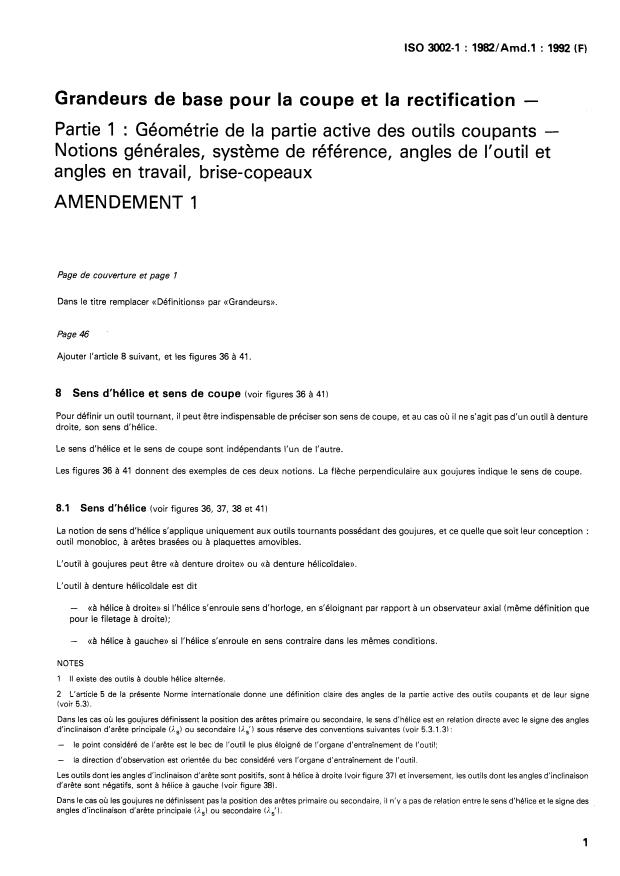
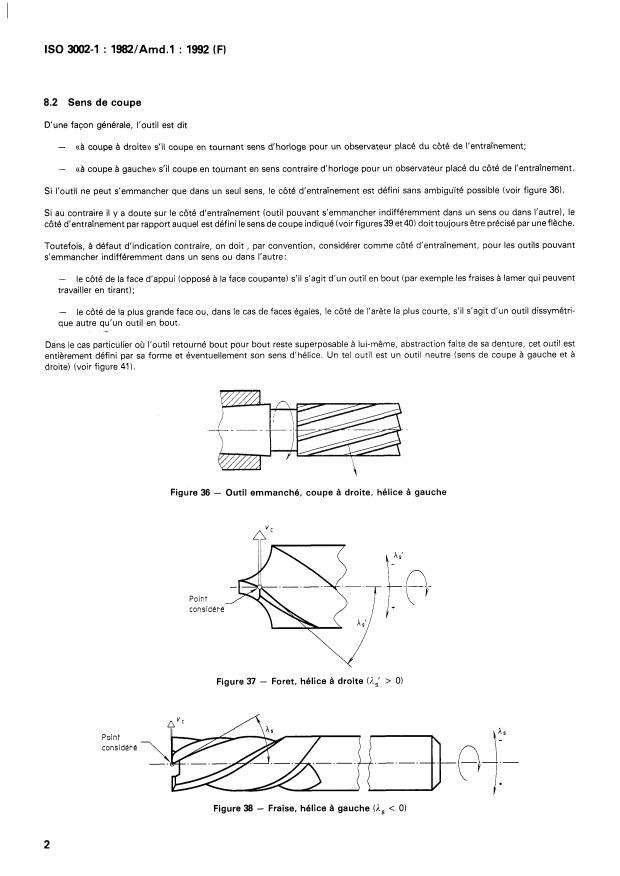
ISO 3002-1:1982/Amd 1:1992 - Grandeurs de base pour la coupe et la rectification — Partie 1: Géométrie de la partie active des outils coupants — Notions générales, systeme de référence, angles de l'outil et angles en travail, brise-copeaux — Amendement 1 Released:11/25/1992
ISO 3002-1:1982/Amd 1:1992 - Grandeurs de base pour la coupe et la rectification — Partie 1: Géométrie de la partie active des outils coupants — Notions générales, systeme de référence, angles de l'outil et angles en travail, brise-copeaux — Amendement 1 Released:11/25/1992
Overview
ISO 3002-1:1982/Amd 1:1992 is an important international standard published by the International Organization for Standardization (ISO). It focuses on the basic quantities in cutting and grinding, specifically addressing the geometry of the active part of cutting tools. This document extends Part 1 of ISO 3002-1 by adding a new clause that clarifies the concepts of direction of the helix and cutting direction for rotating tools with flutes. These additions provide clearer definitions and graphical illustrations to assist tool engineers and users in better understanding tool geometry and performance.
Key Topics
This amendment introduces the following critical elements to the existing ISO 3002-1 framework:
Helix Direction (Sens d’Hélice):
The helix direction describes the winding orientation of flutes on rotating cutting tools, such as solid tools, brazed edges, or insert tools. The standard defines:- Right-hand helix: Helix winds clockwise from the observer’s axial viewpoint, moving away from the tool’s drive end.
- Left-hand helix: Helix winds counterclockwise under the same conditions.
It also notes tools with double alternating helixes and explains the relationship between helix direction and the tool’s cutting edge inclination angles.
Cutting Direction (Sens de Coupe):
This defines the rotation direction in which the tool actively cuts material.- Right cutting direction: The tool rotates clockwise as observed from the drive side.
- Left cutting direction: The tool rotates counterclockwise from the same viewpoint.
The amendment clarifies how to determine the drive side, especially for tools that can be mounted in either direction, and provides guidance on interpreting neutral tools that cut identically in both directions.
Reference Systems and Angles:
Detailed definitions and conventions regarding tool and working angles remain fundamental. The amendment supplements these with new figures (36 to 41) illustrating helix and cutting direction.Chip Breakers:
While chip breaker geometry is referenced, the focus is primarily on the helix and cutting direction enhancements.
Applications
ISO 3002-1:1982/Amd 1:1992 is essential for professionals involved in:
Tool Design and Manufacturing:
Provides engineers and tool makers with standardized terminology and graphical guidance to accurately describe cutting tool geometry, ensuring tool characteristics meet design intent and machining applications.Metal Cutting and Grinding Operations:
Enables precise identification of tool orientation and cutting direction to optimize machining parameters, tool life, and surface finish.Quality Control and Communication:
Supports consistent documentation and communication across manufacturers, suppliers, and end-users in industries such as automotive, aerospace, and general manufacturing.Tool Selection and Application:
Helps machinists and process planners choose appropriate tools based on helix direction and cutting direction, which affect chip evacuation, cutting forces, and finished part quality.
Related Standards
ISO 3002 Series:
A comprehensive series detailing basic quantities in cutting and grinding, including geometric descriptions, cutting data, and tool condition monitoring.ISO 4287 and ISO 4288:
Standards relating to surface texture, important for understanding the effects of cutting tool geometry on finished surfaces.ISO 13399:
Covers cutting tool data representation and exchange, complementing geometric definitions in ISO 3002-1.ISO 1941:
Provides terminology for cutting tools, harmonizing vocabulary alongside ISO 3002-1.
By adhering to ISO 3002-1:1982/Amd 1:1992, professionals in tool design, manufacturing, and metal cutting industries ensure globally recognized definitions and methods for describing active tool geometries and cutting mechanisms-key to improving precision, efficiency, and consistency in machining operations.
Relations
- Effective Date
- 06-Jun-2022
- Effective Date
- 15-Apr-2008
Buy Documents
ISO 3002-1:1982/Amd 1:1992 - Basic quantities in cutting and grinding — Part 1: Geometry of the active part of cutting tools — General terms, reference systems, tool and working angles, chip breakers — Amendment 1 Released:11/25/1992
ISO 3002-1:1982/Amd 1:1992 - Grandeurs de base pour la coupe et la rectification — Partie 1: Géométrie de la partie active des outils coupants — Notions générales, systeme de référence, angles de l'outil et angles en travail, brise-copeaux — Amendement 1 Released:11/25/1992
ISO 3002-1:1982/Amd 1:1992 - Grandeurs de base pour la coupe et la rectification — Partie 1: Géométrie de la partie active des outils coupants — Notions générales, systeme de référence, angles de l'outil et angles en travail, brise-copeaux — Amendement 1 Released:11/25/1992
Get Certified
Connect with accredited certification bodies for this standard

DVS-ZERT GmbH
German welding certification society.
CARES (UK Certification Authority for Reinforcing Steels)
UK certification for reinforcing steels and construction.
EWF/IIW (European/International Welding Federation)
International welding personnel certification.
Sponsored listings
Frequently Asked Questions
ISO 3002-1:1982/Amd 1:1992 is a standard published by the International Organization for Standardization (ISO). Its full title is "Basic quantities in cutting and grinding — Part 1: Geometry of the active part of cutting tools — General terms, reference systems, tool and working angles, chip breakers — Amendment 1". This standard covers: Adds new clause 8 (Direction of the helix and cutting direction) and new figures 36 to 41.
Adds new clause 8 (Direction of the helix and cutting direction) and new figures 36 to 41.
ISO 3002-1:1982/Amd 1:1992 is classified under the following ICS (International Classification for Standards) categories: 01.060 - Quantities and units; 25.100.01 - Cutting tools in general. The ICS classification helps identify the subject area and facilitates finding related standards.
ISO 3002-1:1982/Amd 1:1992 has the following relationships with other standards: It is inter standard links to ISO 3002-1:1982; is excused to ISO 3002-1:1982. Understanding these relationships helps ensure you are using the most current and applicable version of the standard.
ISO 3002-1:1982/Amd 1:1992 is available in PDF format for immediate download after purchase. The document can be added to your cart and obtained through the secure checkout process. Digital delivery ensures instant access to the complete standard document.
Standards Content (Sample)
ISO
INTERNATIONAL
3002-1
STANDARD
Second edition
1982-08-01
AMENDMENT 1
1992-12-01
_-
--
Basic quantities in cutting and grinding -
Part 1 I
Geometry of the active part of cutting tools -
General terms, reference Systems, tool and working
angles, chip breakers
AMENDMENT 1
Grandeurs de base pour Ia coupe et Ia rectification -
Partie 7 : Georne trie de Ia Partie active des outils coupan ts - Notions ghkales,
s ystkme de reference, angles de l’outil et angles en travaiL brise-copeaux
AMENDEMENT 7
Reference number
ISO 3002-1 : 1982/Amd.l : 1992 (E)
ISO 3002-1 : 1982/Amd.l : 1992 (E)
Foreword
ISO (the International Organization for Standardization) is a worldwide federation of
national Standards bodies (ISO member bodies). The work of preparing International
Standards is normally carried out through ISO technical committees. Esch member
body interested in a subject for which a technical committee has been established has
the right to be represented on that committee. International organizations, govern-
mental and non-governmental, in liaison with ISO, also take part in the work. ISO
collaborates closely with the International Electrotechnical Commission (IEC) on all
matters of electrotechnical standardization.
Draft International Standards adopted by the technical committees are circulated to
the member bodies for voting. Publication as an International Standard requires
approval by at least 75 % of the member bodies casting a vote.
Amendment 1 PO International Standard ISO 30024 : 1982 was prepared by Technical
Committee lSO/TC 29, SmaN took.
0 ISO 1992
All rights reserved. No part of this publication may be reproduced or utilized in any form or by any
means, electronie or mechanical, including photocopying and microfilm, without Permission in
writing from the publisher.
International Organkation for Standardization
Case postale 56 l CH-1211 Geneve 20 l Switzerland
Printed in Switzerland
ISO 3002-1 : 1982/Amd.l : 1992 (EI
Basic quantities in cutting and grinding -
Part 1 : Geometry of the active part of cutting tools - General
terms, reference Systems, tooi and working angles, chip
breakers
AMENDMENT 1
Page 46
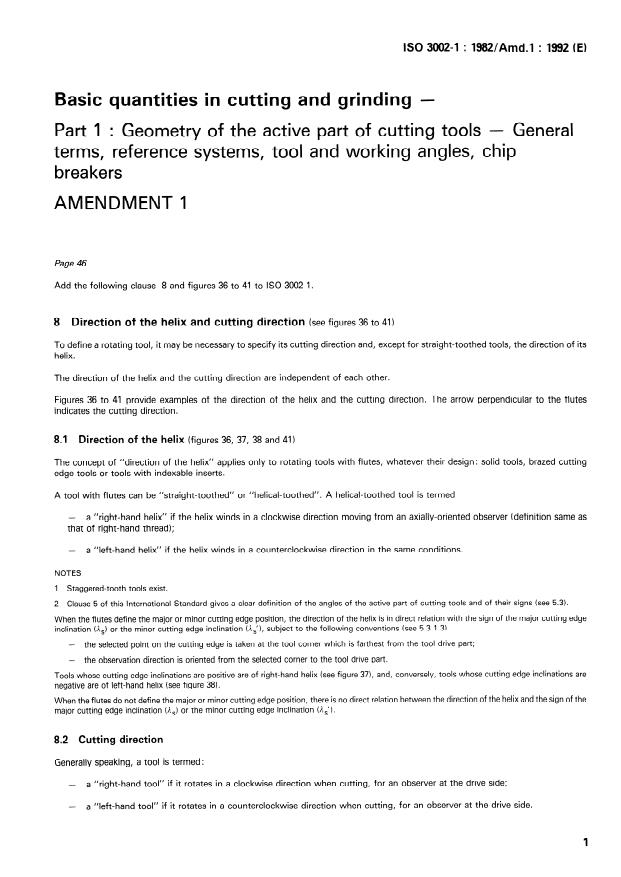
Add the following clause 8 and figures 36 to 41 to ISO 3002-1.
8 Direction of the helix and cutting direction (see figures 36 to 41)
To define a rotating tool, it may be necessary to specify its cutting direction and, except for straight-toothed tools, the direction of its
helix.
The direction of the helix and the cutting direction are independent of each other.
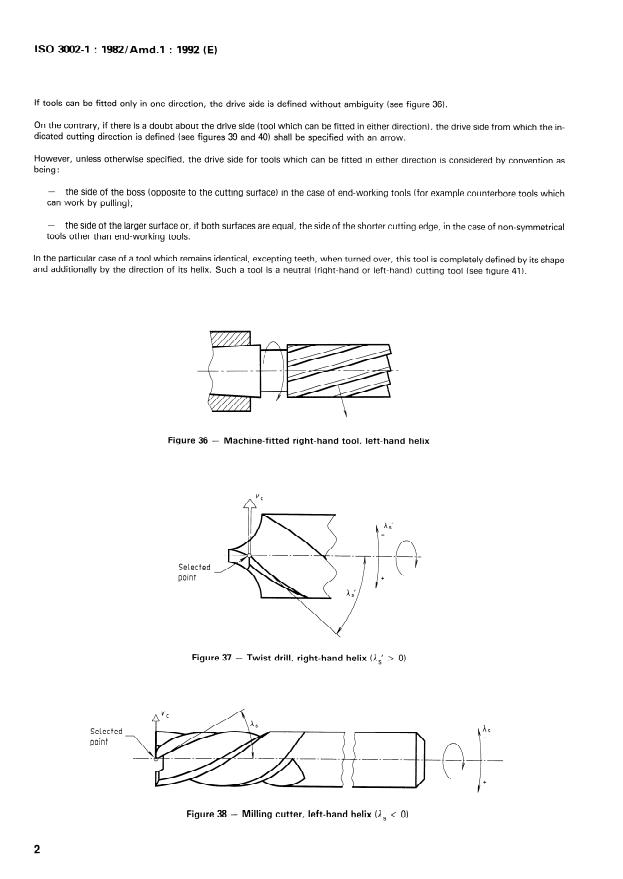
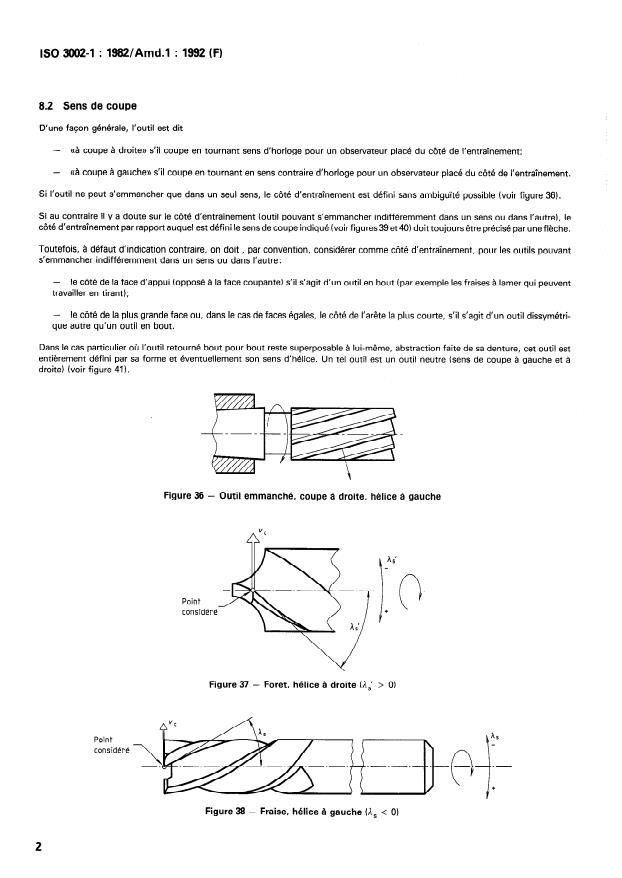
Figures 36 to 41 provide examples of the direction of the helix and the cutting direction. The arrow perpendicular
to the flutes
indicates the cutting direction.
8.1 Direction of the helix (figures 36, 37, 38 and 41)
The concept of ” directio In of the helix” applies only to rotating tools with flutes, whatever their design: solid tools, brazed cutting
edge tools or too Is with indexable inserts.
A tool with flutes tan be “straight-toothed” or “helical-toothed”. A helical-toothed tool is termed
-
a ” rig ht- hand helix” if the helix Winds in a clockwise direction moving from an axially-oriented observer (definition same as
of right-hand thread);
-
a “Ieft-band helix” if the helix Winds in a counterclockwise direction in the Same conditions.
NOTES
1 Staggered-tooth tools exist.
2 Clause 5 of this International Standard gives a clear definition of the angles of the active part of cutting tools and of their signs (See 5.3).
When the flutes define the major or minor cutting edge Position, the direction of the helix is in direct relation with the sign of the major cutting edge
inclination (As) or the minor cutting edge inclination (A,‘), subject to the f
...
NORME IS0
I NTER NATIONALE 3002- I
Deuxihme édition
1982-08-01
AMENDEMENT 1
1992-12-01
Grandeurs de base pour la coupe et la
rectification -
Partie 1 :
Géométrie de la partie active des outils coupants -
Notions générales, système de référence, angles de
l’outil et angles en travail, brise-copeaux
AMENDEMENT 1
Basic quantities in cutting and grinding -
Part 1 : Geometry of the active part of cutting tools - General terms, reference
systems, tool and working angles, chip breakers
AMENDMENT 1
~-
~~
Numéro de référence
IS0 3002-1 : 1982/Amd.l : 1992 (FI
IS0 3002-1 : 1982/Amd.l : 1992 (FI
Avant- p ro pos
L’ISO (Organisation internationale de normalisation) est une fédération mondiale
d’organismes nationaux de normalisation (comités membres de I‘ISO). L’élaboration
des Normes internationales est en général confiée aux comités techniques de I‘ISO.
Chaque comité membre intéressé par une étude a le droit de faire partie du comité
technique créé B cet effet. Les organisations internationales, gouvernementales et non
gouvernementales, en liaison avec I’ISO participent également aux travaux. L’ISO col-
labore étroitement avec la Commission électrotechnique internationale (CEI) en ce qui
concerne la no.Lmalisation électrotechnique.
Les projets de Normes internationales adoptés par les comités techniques sont soumis
aux comités membres pour vote. Leur publication comme Normes internationales
requiert l’approbation de 75 YO au moins des comités membres votants.
1 B la Norme internationale IS0 3002-1 : 1982 a été élaboré par le
L’Amendement
comité technique ISO/TC 29, Petit oufilage.
O IS0 1992
Droits de reproduction rBservBs. Aucune partie de cette publication ne peut être reproduite ni
utilisbe sous quelque forme que ce soit et par aucun procBd6, Blectronique ou mécanique,
y compris la photocopie et les microfilms, sans l’accord écrit de I’éditeur.
Organisation internationale de normalisation
Case postale 56 CH-121 1 Genhve 20 Suisse
Imprim6 en Suisse
IS0 3002-1 : 1982/Amd.l : 1992 (F)
Grandeurs de base pour la coupe et la rectification -
Partie 1 : Géométrie de la partie active des outils coupants -
Notions générales, système de référence, angles de l’outil et
angles en travail, brise-copeaux
AMENDEMENT 1
Page de couverture et page 1
Dans le titre remplacer ((Définitions)) par ((Grandeurs)).
Page 46
Ajouter l’article 8 suivant, et les figures 36 à 41.
8 Sens d’helice et sens de coupe (voir figures 36 à 41)
Pour définir un outil tournant, il peut être indispensable de préciser son sens de coupe, et au cas OÙ il ne s’agit pas d’un outil à denture
droite, son sens d‘hélice.
Le sens d‘hélice et le sens de coupe sont indépendants l‘un de l’autre.
Les figures 36 $I 41 donnent des exemples de ces deux notions. La flèche perpendiculaire aux goujures indique le sens de coupe.
8.1
Sens d’h6lice (voir figures 36, 37, 38 et 41)
La notion de sens d’hélice s’applique uniquement aux outils tournants possédant des goujures, et ce quelle que soit leur conception :
outil monobloc, à arêtes brasées ou à plaquettes amovibles.
L‘outil à goujures peut être cd denture droitea ou ((à denture hélico’idale)).
L’outil $I denture hélicoïdale est dit
-
(($I hélice $I droite)) si l‘hélice s’enroule sens d‘horloge, en s‘éloignant par rapport à un observateur axial (même définition que
pour le filetage à droite);
-
cd hélice à gauche)) si l’hélice s’enroule en sens contraire dans les mêmes conditions.
NOTES
1 II existe des outils B double hélice alternée.
2 L‘article 5 de la présente Norme internationale donne une définition claire des angles de la partie active des outils coupants et de leur signe
(voir 5.3).
Dans les cas où les goujures définissent la position des arêtes primaire ou secondaire, le sens d’hélice est
...
ISO
NORME
3002-I
INTERNATIONALE
Deuxième édition
1982-08-01
AMENDEMENT 1
1992-12-01
Grandeurs de base pour la coupe et la
rectification -
Partie 1 :
Géométrie de la partie active des outils coupants -
Notions générales, système de référence, angles de
l’outil et angles en travail, brise-copeaux
AMENDEMENT 1
Basic quantities in cutting and grinding -
Part 1 : Geometry of the active part of cutting tools - General terms, reference
systems, tool and working angles, chip breakers
AMENDMENT 7
Numéro de référence
ISO 3002-l : 1982/Amd.l : 1992 (F)
ISO 3002-l : 1982/Amd.l : 1992 (F)
Avant-propos
L’ISO (Organisation internationale de normalisation) est une fédération mondiale
d’organismes nationaux de normalisation (comités membres de I’ISO). L’élaboration
des Normes internationales est en général confiée aux comités techniques de I’ISO.
Chaque comité membre intéressé par une étude a le droit de faire partie du comité
technique créé à cet effet. Les organisations internationales, gouvernementales et non
gouvernementales, en liaison avec I’ISO participent également aux travaux. L’ISO col-
labore étroitement avec la Commission électrotechnique internationale (CH) en ce qui
concerne la normalisation électrotechnique.
Les projets de Normes internationales adoptés par les comités techniques sont soumis
aux comités membres pour vote. Leur publication comme Normes internationales
requiert l’approbation de 75 % au moins des comités membres votants.
L’Amendement 1 à la Norme internationale ISO 3002-l : 1982 a été élaboré par le
comité technique ISO/TC 29, Petit outillage.
0 ISO 1992
Droits de reproduction réservés. Aucune partie de cette publication ne peut être reproduite ni
utilisée sous quelque forme que ce soit et par aucun procédé, électronique ou mécanique,
y compris la photocopie et les microfilms, sans l’accord écrit de l’éditeur.
Organisation internationale de normalisation
Case postale 56 l CH-1211 Genève 20 l Suisse
Imprimé en Suisse
60 3002-l : 1982/Amd.l : 1992 (F)
Grandeurs de base pour la coupe et la rectification -
Partie 1 : Géométrie de la partie active des outils coupants -
Notions générales, système de référence, angles de l’outil et
angles en travail, brise-copeaux
AMENDEMENT 1
Page de couverture et page 7
Dans le titre remplacer «Définitions» par c
Page 46
Ajouter l’article 8 suivant, et les figures 36 à 41.
8 Sens d’hélice et sens de coupe (voir figures 36 à 41)
Pour définir un outil tournant, il peut être indispensable de préciser
son sens de coupe, et au cas où il ne s’agit pas d’un outil à denture
droite, son sens d’hélice.
Le sens d’hélice et le sens de coupe sont indépendants l’un de l’autre.
Les figures 36 à 41 donnent des exemples de ces deux notions. La flèche perpendiculaire aux goujures indique le sens de coupe.
8.1 Sens d’hélice (voir figures 36, 37, 38 et 41)
La notion de sens d’hélice s’applique uniquement aux outils tournants et ce quelle que soit leur
conception :
I
ou til monobloc, à arêtes brasées ou à plaquettes amovibles.
L’outil à goujures peut être «a denture droite» ou «à denture hélicoïdale».
L’outil à denture hélicoïdale est dit
-
«a hélice à droite» si l’hélice s’enroule sens d’horloge, en s’éloignant par rapport à un observateur axial (même définition
pour le filetage à droite);
-
«a hélice à gauche» si l’hélice s’enroule en sens contraire dans les mêmes conditions.
NOTES
1 II existe des outils à double hélice alternée.
2 L’article 5 de la présente Norme internationale donne une définition claire des angles de la partie active des outils coupants et de leur signe
(voir 5.3).
Dans les cas où les goujures définissent la position des arêtes primaire ou secondaire, le sens d’hélice est en relation directe avec le signe des angles
d’inclinaison d’arête principale (i
...