

oSIST prEN 15376:2026
(Main)Automotive fuels - Ethanol as a blending component for petrol - Requirements and test methods
- Abstract
This document specifies requirements and test methods for marketed and delivered ethanol to be used as an extender for automotive fuel for petrol engine vehicles in accordance with the requirements of EN 228 [5]. It is applicable to ethanol used for blending at all levels up to and including 85 % (V/V).
NOTE For the purposes of this document, the term “% (m/m)” and “% (V/V)” are used to represent respectively the mass fraction, µ, and the volume fraction, φ.
- Status
- Not Published
- Public Enquiry End Date
- 30-Sep-2026
- Technical Committee
- NAD - Petroleum products, lubricants and related products
- Current Stage
- 4020 - Public enquire (PE) (Adopted Project)
- Start Date
- 24-Jun-2026
- Due Date
- 11-Nov-2026
- Completion Date
- 02-Oct-2026

oSIST prEN 15376:2026 is the SIST publication of the CEN draft European Standard for automotive fuels. It specifies requirements and test methods for marketed and delivered ethanol used as a blending component for petrol, so producers, blenders and laboratories can check fuel-grade ethanol for use in petrol engine vehicles.
What does oSIST prEN 15376:2026 specify?
oSIST prEN 15376:2026 covers ethanol intended for blending with petrol in accordance with EN 228, up to and including 85 % (V/V). The document is organized into scope, normative references, sampling, and requirements and test methods.
- Clause 1 sets the application range and the 85 % (V/V) blending limit.
- Clause 2 lists the reference standards used for test methods, sampling and precision.
- Clause 3 sets the sampling approach.
- Clause 4 covers dyes and markers, additives, denaturing, general quality requirements, climate-related water behavior, and dispute handling.
What are the key requirements of oSIST prEN 15376:2026?
oSIST prEN 15376:2026 focuses on how ethanol is sampled, how it may be treated, and which measured properties it must meet before denaturing. The main practical point is that the document ties product acceptance to named test methods, so the same lot can be checked consistently by suppliers, blenders and laboratories.
Sampling and handling
Clause 3 says samples shall be taken according to EN ISO 3170 and/or according to national standards or regulations for sampling alcohol. It also says national requirements should be set out or referenced in a national annex, and that container guidance in the test method standards needs attention. In practice, sampling has to be controlled carefully because the test methods are sensitive to container choice and sample handling.
Additives, markers and denaturing
Clause 4.1 allows dyes or markers if they do not cause harmful side effects to vehicle or fuel distribution systems. Clause 4.2 recommends considering anti-corrosion additives and other suitable fuel additives, provided they are compatible with the finished petrol and have no known harmful side effects. Clause 4.3 permits denaturants required by customs rules, but they must not harm vehicles or petroleum distribution systems, and their concentration is left to national authorities without conflicting with EN 228.
Quality limits and test methods
Clause 4.4.1 and Table 1 set the main limits for ethanol before denaturing and link each property to a method. The table covers composition, water, acidity, electrical conductivity, appearance, chloride, sulfate, copper, phosphorus, involatile material and sulfur. In practice, this is the core acceptance check for a batch of ethanol, because it tells labs what to measure and which method to use.
Clause 4.4.2 gives a way to identify biological origin when needed. It recommends a traceable record of biological origin, and also points to age determination based on C-14 as a useful check when the audit trail is questioned.
Climate and disputes
Clause 4.5 requires suppliers to make sure no water segregation occurs under the climatic and fuel distribution conditions in the country concerned. Clause 4.6 says disputes are handled using EN ISO 4259-2, and it names specific dispute methods for water, copper, sulfur and phosphorus. In practice, this matters when results are close to limits or when different laboratories disagree.
What terms does oSIST prEN 15376:2026 define?
- EN 228 - The petrol specification that this ethanol is intended to support as a blending component.
- Ethanol as a blending component for petrol - Ethanol used to extend or blend automotive fuel for petrol engine vehicles.
- ETBE (Ethyltertbutylether) - A denaturant listed as a non-harmful option for vehicle systems.
- MTBE (Methyltertbutylether) - A denaturant listed as a non-harmful option for vehicle systems.
- TBA (Tertiary Butyl Alcohol) - A denaturant listed as a non-harmful option for vehicle systems.
- % (m/m) - The notation used here for mass fraction, written as µ in the note.
- % (V/V) - The notation used here for volume fraction, written as φ in the note.
- EN ISO 4259-2 - The precision and dispute standard used to interpret test results when there is disagreement.
Who uses oSIST prEN 15376:2026?
oSIST prEN 15376:2026 is used by ethanol producers, downstream distributors and petrol blenders when they prepare fuel-grade ethanol for the market. It is also used by quality control laboratories that test composition and impurities, and by buyers who need a clear acceptance specification for supply contracts.
Regulatory and customs bodies can use it when checking denaturing practice and traceability. It is also relevant to auditors and technical staff who need to compare test results, sampling practice and product records.
What changed in oSIST prEN 15376:2026 from the previous edition?
oSIST prEN 15376:2026 supersedes EN 15376:2014. The foreword states two technical changes:
- removal of dated references in fuel specifications so the latest versions apply
- removal of footnote b in Table 1 for EN 15721, because it was not considered necessary given the low water content specification
Which standards are used with oSIST prEN 15376:2026?
oSIST prEN 15376:2026 cites these standards for measurement, sampling and interpretation.
| Standard | What it contributes |
|---|---|
| EN 15485 | Sulfur content by wavelength dispersive X-ray fluorescence |
| EN 15486 | Sulfur content by ultraviolet fluorescence |
| EN 15487 | Phosphorus content by ammonium molybdate spectrometry |
| EN 15488 | Copper content by graphite furnace atomic absorption spectrometry |
| EN 15489 | Water content by Karl Fischer coulometric titration |
| EN 15491 | Total acidity by colour indicator titration |
| EN 15492 | Inorganic chloride and sulfate by ion chromatography |
| EN 15691 | Dry residue by gravimetry |
| EN 15692 | Water content by Karl Fischer potentiometric titration |
| EN 15721 | Higher alcohols, methanol and other impurities by gas chromatography |
| EN 15769 | Appearance by visual method |
| EN 15837 | Phosphorus, copper and sulfur by ICP OES |
| EN 15938 | Electrical conductivity |
| EN ISO 3170 | Manual sampling of hydrocarbon liquids |
| EN ISO 4259-2 | Precision data interpretation and dispute handling |
| EN 228 | Petrol specification that ethanol is intended to support |
| EN 16640 | Radiocarbon method for bio-based carbon content |
What does the oSIST prEN 15376:2026 document contain?
oSIST prEN 15376:2026 contains the core acceptance framework for ethanol used in petrol blending. Table 1 brings together the quantitative limits and the matching test methods for undenatured ethanol, so users can test purity and contamination against one document.
The text also gives practical rules for dyes, markers, additives and denaturants, plus a clause on traceable biological-origin evidence. Its precision clause points users to EN ISO 4259-2 and to specific dispute methods for water, sulfur, copper and phosphorus. The bibliography links the document to EU fuel-quality legislation and to EN 228 and EN 16640.
Relations
- Effective Date
- 01-Sep-2026
Get Certified
Connect with accredited certification bodies for this standard

ECOCERT
Organic and sustainability certification.

Element Materials Technology
Materials testing and product certification.

ABS Group Brazil
ABS Group certification services in Brazil.
Sponsored listings
Frequently Asked Questions
oSIST prEN 15376:2026 is a draft published by the Slovenian Institute for Standardization (SIST). Its full title is "Automotive fuels - Ethanol as a blending component for petrol - Requirements and test methods". This standard covers: This document specifies requirements and test methods for marketed and delivered ethanol to be used as an extender for automotive fuel for petrol engine vehicles in accordance with the requirements of EN 228 [5]. It is applicable to ethanol used for blending at all levels up to and including 85 % (V/V). NOTE For the purposes of this document, the term “% (m/m)” and “% (V/V)” are used to represent respectively the mass fraction, µ, and the volume fraction, φ.
This document specifies requirements and test methods for marketed and delivered ethanol to be used as an extender for automotive fuel for petrol engine vehicles in accordance with the requirements of EN 228 [5]. It is applicable to ethanol used for blending at all levels up to and including 85 % (V/V). NOTE For the purposes of this document, the term “% (m/m)” and “% (V/V)” are used to represent respectively the mass fraction, µ, and the volume fraction, φ.
oSIST prEN 15376:2026 is classified under the following ICS (International Classification for Standards) categories: 71.080.60 - Alcohols. Ethers; 75.160.20 - Liquid fuels. The ICS classification helps identify the subject area and facilitates finding related standards.
oSIST prEN 15376:2026 has the following relationships with other standards: It is inter standard links to SIST EN 15376:2014. Understanding these relationships helps ensure you are using the most current and applicable version of the standard.
oSIST prEN 15376:2026 is associated with the following European legislation: EU Directives/Regulations: 98/70/EC; Standardization Mandates: M/344. When a standard is cited in the Official Journal of the European Union, products manufactured in conformity with it benefit from a presumption of conformity with the essential requirements of the corresponding EU directive or regulation.
oSIST prEN 15376:2026 is available in PDF format for immediate download after purchase. The document can be added to your cart and obtained through the secure checkout process. Digital delivery ensures instant access to the complete standard document.
Standards Content (Sample)
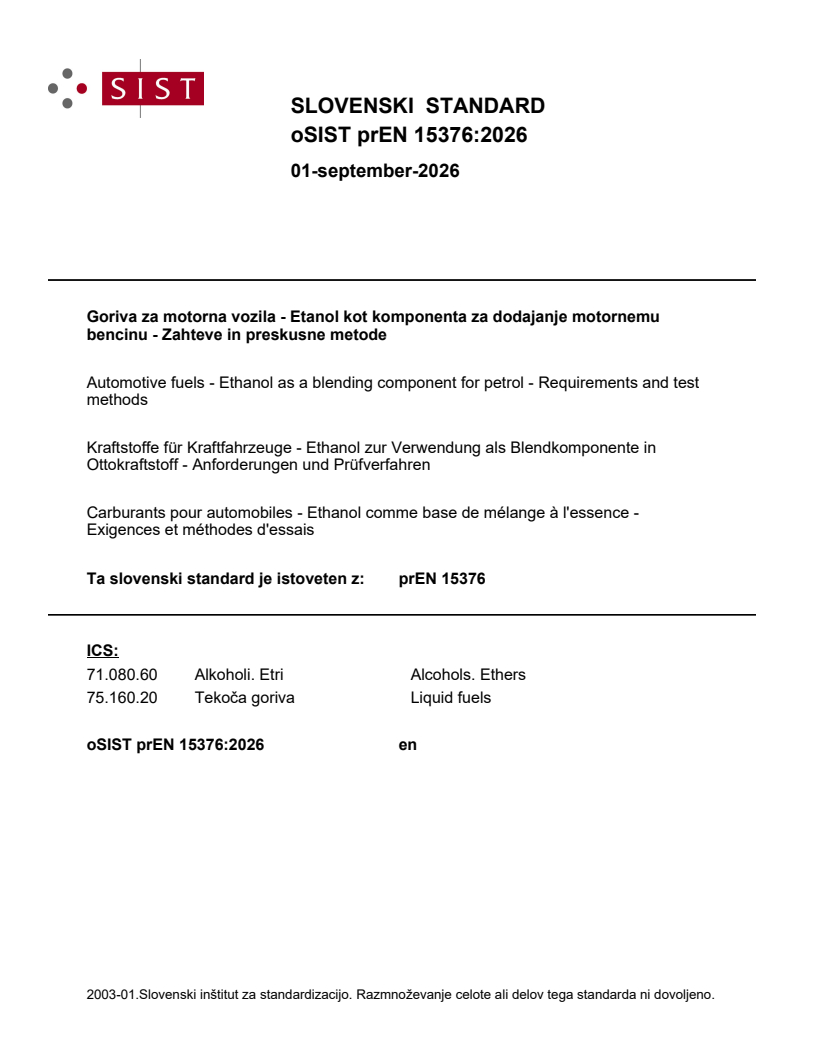
SLOVENSKI STANDARD
01-september-2026
Goriva za motorna vozila - Etanol kot komponenta za dodajanje motornemu
bencinu - Zahteve in preskusne metode
Automotive fuels - Ethanol as a blending component for petrol - Requirements and test
methods
Kraftstoffe für Kraftfahrzeuge - Ethanol zur Verwendung als Blendkomponente in
Ottokraftstoff - Anforderungen und Prüfverfahren
Carburants pour automobiles - Ethanol comme base de mélange à l'essence -
Exigences et méthodes d'essais
Ta slovenski standard je istoveten z: prEN 15376
ICS:
71.080.60 Alkoholi. Etri Alcohols. Ethers
75.160.20 Tekoča goriva Liquid fuels
2003-01.Slovenski inštitut za standardizacijo. Razmnoževanje celote ali delov tega standarda ni dovoljeno.
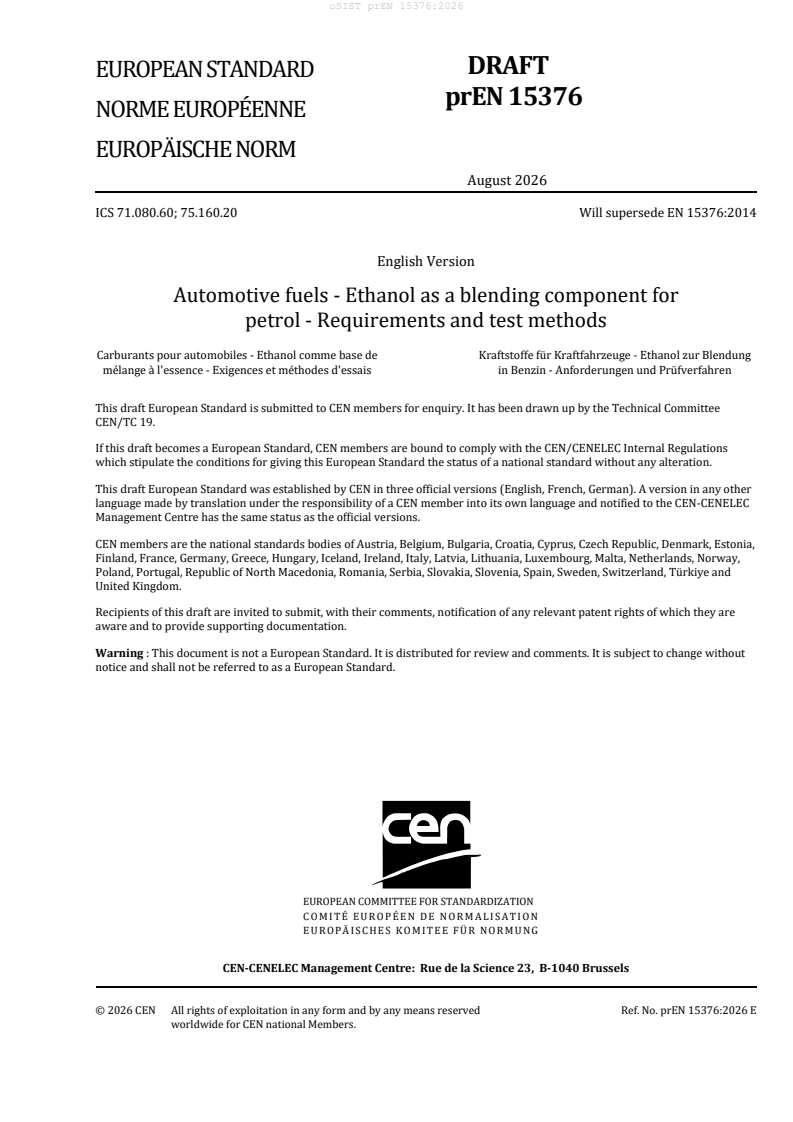
DRAFT
EUROPEAN STANDARD
NORME EUROPÉENNE
EUROPÄISCHE NORM
August 2026
ICS 71.080.60; 75.160.20 Will supersede EN 15376:2014
English Version
Automotive fuels - Ethanol as a blending component for
petrol - Requirements and test methods
Carburants pour automobiles - Ethanol comme base de Kraftstoffe für Kraftfahrzeuge - Ethanol zur Blendung
mélange à l'essence - Exigences et méthodes d'essais in Benzin - Anforderungen und Prüfverfahren
This draft European Standard is submitted to CEN members for enquiry. It has been drawn up by the Technical Committee
CEN/TC 19.
If this draft becomes a European Standard, CEN members are bound to comply with the CEN/CENELEC Internal Regulations
which stipulate the conditions for giving this European Standard the status of a national standard without any alteration.
This draft European Standard was established by CEN in three official versions (English, French, German). A version in any other
language made by translation under the responsibility of a CEN member into its own language and notified to the CEN-CENELEC
Management Centre has the same status as the official versions.
CEN members are the national standards bodies of Austria, Belgium, Bulgaria, Croatia, Cyprus, Czech Republic, Denmark, Estonia,
Finland, France, Germany, Greece, Hungary, Iceland, Ireland, Italy, Latvia, Lithuania, Luxembourg, Malta, Netherlands, Norway,
Poland, Portugal, Republic of North Macedonia, Romania, Serbia, Slovakia, Slovenia, Spain, Sweden, Switzerland, Türkiye and
United Kingdom.
Recipients of this draft are invited to submit, with their comments, notification of any relevant patent rights of which they are
aware and to provide supporting documentation.
Warning : This document is not a European Standard. It is distributed for review and comments. It is subject to change without
notice and shall not be referred to as a European Standard.
EUROPEAN COMMITTEE FOR STANDARDIZATION
COMITÉ EUROPÉEN DE NORMALISATION
EUROPÄISCHES KOMITEE FÜR NORMUNG
CEN-CENELEC Management Centre: Rue de la Science 23, B-1040 Brussels
© 2026 CEN All rights of exploitation in any form and by any means reserved Ref. No. prEN 15376:2026 E
worldwide for CEN national Members.
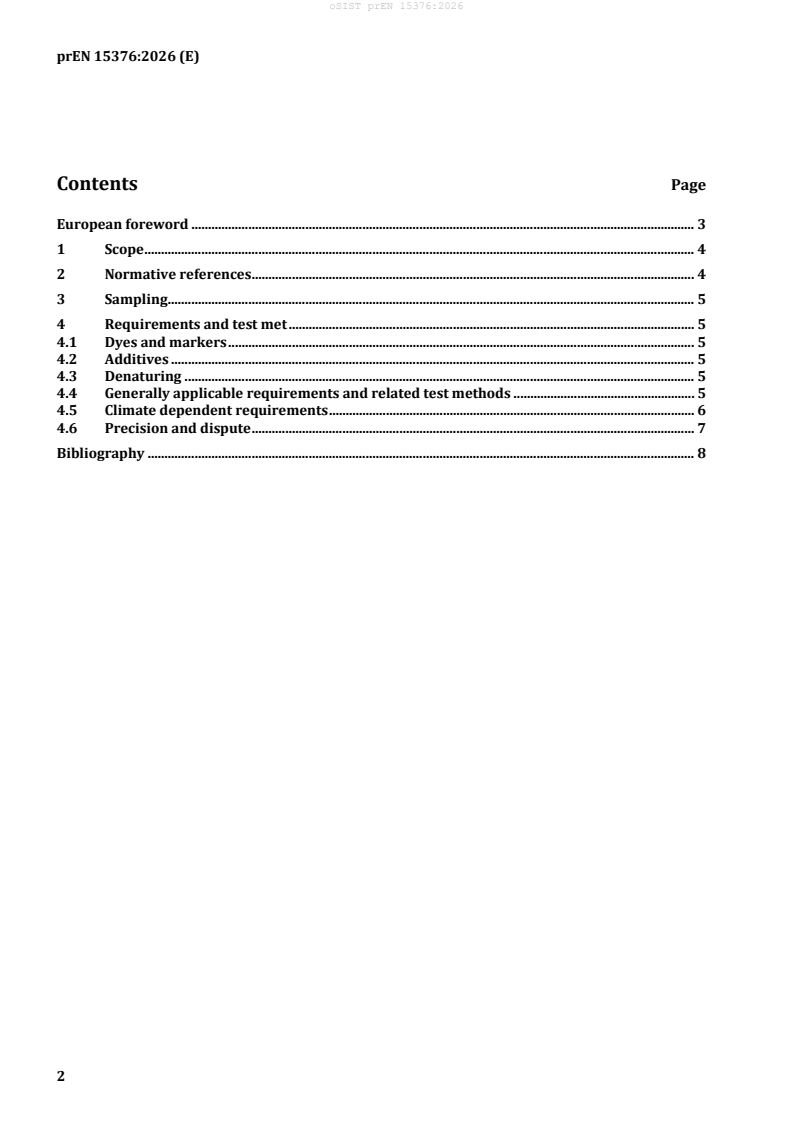
Contents Page
European foreword . 3
1 Scope . 4
2 Normative references . 4
3 Sampling . 5
4 Requirements and test met . 5
4.1 Dyes and markers . 5
4.2 Additives . 5
4.3 Denaturing . 5
4.4 Generally applicable requirements and related test methods . 5
4.5 Climate dependent requirements . 6
4.6 Precision and dispute . 7
Bibliography . 8
European foreword
This document (prEN 15376:2026) has been prepared by Technical Committee CEN/TC 19 “Gaseous
and liquid fuels, lubricants and related products of petroleum, synthetic and biological origin”, the
secretariat of which is held by NEN.
This document is currently submitted to the CEN Enquiry.
This document will supersede EN 15376:2014.
This document has originally been prepared under mandate M/344 given to CEN by the European
Commission and the European Free Trade Association along with other standards intended to be
complementary to the regulatory measures contained in various EU Directives, see [1], [2], [3] and [4].
If (bio)ethanol is meant for use as automotive fuel component, this document applies. It is intended to
call up this European Standard in EN 228 [5], in order to define the quality of (bio)ethanol which is
added/blended to the petrol.
Significant technical changes between this document and the previous edition EN 15376:2014 are:
— removal of dated references based on the decision of CEN/TC 19 to remove all dated references in
fuel specifications ensuring that the latest version applies;
— removal of footnote b in Table 1 for EN 15721 found not necessary considering the low level of
water content specification.
1 Scope
This document specifies requirements and test methods for marketed and delivered ethanol to be used
as an extender for automotive fuel for petrol engine vehicles in accordance with the requirements of
EN 228 [5]. It is applicable to ethanol used for blending at all levels up to and including 85 % (V/V).
NOTE For the purposes of this document, the term “% (m/m)” and “% (V/V)” are used to represent
respectively the mass fraction, µ, and the volume fraction, φ.
2 Normative references
The following documents are referred to in the text in such a way that some or all of their content
constitutes requirements of this document. For dated references, only the edition cited applies. For
undated references, the latest edition of the referenced document (including any amendments) applies.
EN 15485, Ethanol as a blending component for petrol — Determination of sulfur content — Wavelength
dispersive X-ray fluorescence spectrometric method
EN 15486, Ethanol as a blending component for petrol — Determination of sulfur content — Ultraviolet
fluorescence method
EN 15487, Ethanol as a blending component for petrol — Determination of phosphorus content —
Ammonium molybdate spectrometric method
EN 15488, Ethanol as a blending component for petrol — Determination of copper content — Graphit
...