

kSIST FprEN 16191:2026
(Main)Tunnel boring machines - Safety requirements
- Abstract
This document is applicable to tunnel boring machines and equipment as defined in Clause 3 used for the primary purpose of creating an underground void through the construction of horizontal and inclined tunnels and other underground excavations.
NOTE 1 Other underground excavations can include access structures to complex tunnel layouts such as in underground stations, utilities, underground storage facilities as well as below ground tunnel portals.
It deals with all significant hazards, hazardous situations and events relevant to such machinery when they are used as intended and under the conditions of misuse which are reasonably foreseeable by the manufacturer (see Clause 4).
This document covers monitoring for hazardous atmospheres within the confines of the tunnel boring machines.
Requirements for air locks and pressurized transfer shuttles are covered by FprEN 12110-1:2026 and FprEN 12110-2:2026.
The following items and applications are not covered by this document:
- the additional requirements for the use of entire tunnelling machinery within a hyperbaric environment;
- the additional requirements for use of tunnelling machinery in potentially explosive atmospheres;
NOTE 2 For the application in potentially explosive atmospheres, see EN ISO/IEC 80079-38:2016 for guidance.
- ancillary tools and equipment which are not an integral part required for the intended use of the tunnelling machinery, but located on the machinery by the user;
- supply network for services to the tunnelling machinery (e.g. power supply, water, pipes, compressed air, ventilation duct, etc.);
- loading and transport machinery which is not an integral part of the tunnelling machinery, e.g. delivery vehicle for logistic support, tunnel spoil removal system;
- EMC interactions between the tunnelling machinery and third-party surface and underground assets, e.g. railway signalling;
- vibration as a significant and relevant hazard.
This document is not applicable to tunnel boring machines which are manufactured before the date of publication of this European Standard by CEN.
- Status
- Not Published
- Public Enquiry End Date
- 09-May-2023
- Technical Committee
- I13 - Imaginarni 13
- Current Stage
- 5020 - Formal vote (FV) (Adopted Project)
- Start Date
- 02-Oct-2026
- Due Date
- 20-Nov-2026
- Completion Date
- 02-Oct-2026



kSIST FprEN 16191:2026 is a CEN European Standard for the safety of tunnel boring machines and associated equipment. It specifies safety requirements for machinery used to create underground voids in horizontal and inclined tunnels and other underground excavations, and it is written for manufacturers, users and safety bodies who need to design, verify or assess these machines.
As a type C standard under EN ISO 12100, kSIST FprEN 16191:2026 focuses on the machine-specific hazards of tunnel boring work. It covers protective measures, verification, and information for use so that the machinery can be planned, built and operated with the relevant risks in mind.
What does kSIST FprEN 16191:2026 specify?
kSIST FprEN 16191:2026 specifies safety requirements for tunnel boring machines and associated machines and equipment used for excavation and construction in tunnels and shafts. It addresses significant hazards, hazardous situations and events when the machinery is used as intended and under reasonably foreseeable misuse.
The scope includes monitoring for hazardous atmospheres within the confines of the tunnel boring machines. It also points readers to separate requirements for air locks and pressurized transfer shuttles in the prEN 12110-1 and prEN 12110-2 parts named in the document.
The scope excludes several related areas, including:
- additional requirements for whole tunnelling machinery in a hyperbaric environment
- additional requirements for use in potentially explosive atmospheres
- ancillary tools and equipment that are not integral to the intended use
- service supply networks such as power, water, pipes, compressed air and ventilation ducting
- loading and transport machinery that is not an integral part of the tunnelling machine
- EMC interactions with third-party surface and underground assets
- vibration as a significant and relevant hazard
The document is organized into these main parts:
- Clause 1 - Scope
- Clause 2 - Normative references
- Clause 3 - Terms and definitions
- Clause 4 - Safety requirements and/or protective/risk reduction measures
- Clause 5 - Verification of the safety requirements and/or protective/risk reduction measures
- Clause 6 - Information for use
- Annex A - List of significant hazards
- Annex B - Examples of tunnelling machines
- Annex C - Verification of the safety requirements and/or protective/risk reduction measures
- Annex D - Noise test code
- Annex E - Minimum requirements for refuge chamber
- Annex ZA - Relationship with Directive 2006/42/EC
What are the key requirements of kSIST FprEN 16191:2026?
kSIST FprEN 16191:2026 requires the machine to be designed first by applying the clause 4 measures and, for residual hazards not covered there, by following EN ISO 12100. In practice, this means the manufacturer has to work through the machine hazards systematically instead of relying on general machine safety principles alone.
Protective measures for the main machine hazards
Clause 4.2 covers the physical hazards around the machine itself: sharp corners, hot surfaces, cutter heads, handling operations, rotation and axial movement, structural failure, access openings, walkways, falling objects, subsurface risks and pipe jacking rigs. For the user, this matters because the standard expects safe access, guarding and structural protection where people work close to moving, hot or highly loaded parts.
Clause 4.2 also covers pressurized parts of the machine, including air locks, pressurized transfer shuttle handling, and other pressurized compartments such as intermediate chambers and excavation chambers. These requirements matter in practice because personnel may need to enter or work near pressurized spaces, and the machine has to control access, pressure, supply lines and emergency conditions.
Control stations and control systems
Clauses 4.3 and 4.5 require control stations to be ergonomic and visible, and control systems to be safe and reliable. They also cover control devices, remote control, starting and stopping, emergency stop, lockable mode selectors, warning systems and behavior after power failure.
In practice, this means the operator must be able to see what the machine is doing, start and stop it in a controlled sequence, and stop it quickly in an emergency. The controls also have to remain understandable and dependable when power is lost or when the machine changes mode.
Access, guarding and maintenance access
Clauses 4.4 and 4.17 cover guards and protective devices, access to excavation chambers and cutter heads, additional requirements for accessible cutterheads, and maintenance on cutter heads or shield-mounted cutter booms and excavators. Clause 4.2.10 also addresses access to operating positions and servicing points, including walkways and moveable working platforms.
This is important because tunnel boring machines are serviced in confined spaces where a poor access design can create trip, crush or entrapment hazards. The standard therefore links day-to-day operation with maintenance access, not just with production work.
Atmosphere, ventilation, dust, gas and laser guidance
Clause 4.7 covers laser guidance, including positioning the laser window to minimize eye exposure and limiting provided lasers to class 3R. Clause 4.8 covers ventilation, dust control, atmospheric monitoring, methane ingress and internal combustion engines.
In practice, the machine has to manage dust and gas inside the tunnel and warn or protect people when atmospheric conditions change. This is especially relevant for enclosed tunnel work where ventilation and gas monitoring are part of the normal safety case.
Electrical, hydraulic, pneumatic and fire safety
Clauses 4.10 to 4.12 cover electrical equipment, bonding, switchgear, lighting, standby and emergency power, EMC, high-voltage isolation, hydraulic and pneumatic systems, and fire prevention and fire protection. Portable extinguishers and fixed extinguishing systems are also covered, as is a water curtain on towed back-up equipment.
For the reader, this means the standard treats power loss, shock risk, fluid injection, fire and lighting failure as core design issues. The machine has to keep essential functions available and limit the consequences of electrical or fluid-system faults.
Rescue, refuge and information for use
Clause 4.13 requires accessible storage for rescue equipment on towed back-up equipment. Clause 4.14 requires any refuge chamber to comply with Annex E. Clause 6 requires information for safe operation, warning signs, symbols and marking.
This matters because tunnel work depends on emergency readiness as much as normal operation. The machine needs clear markings, usable instructions and, where provided, a refuge chamber with agreed life-support arrangements.
Clause 5 requires verification by design check, calculation, visual verification, measurement or functional testing, preferably during manufacture and shop assembly. Annex C shows which verification method applies to each requirement. For buyers and inspectors, that gives a clear route for checking whether the machine really meets the standard.
What terms does kSIST FprEN 16191:2026 define?
- tunnelling machinery - tunnel boring machines and associated machines and equipment designed for excavation and construction of tunnels and shafts.
- shield machine - a steerable ground support structure in which excavation takes place and tunnel support can be erected.
- shielded tunnel boring machine - a full-face shield machine with rotating cutter head(s), often separated from the shield by a controllable bulkhead.
- micro tunnelling machine - a shielded tunnel boring machine for non-man entry, controlled remotely from outside the tunnel.
- back-up equipment - the steel construction that carries services and crew facilities for the machine.
- control station - any location from which one or more machine functions can be controlled by an operator.
- refuge chamber - an enclosed space for life support when persons are trapped underground by smoke, fume or gas other than methane.
- pressurized transfer shuttle - a mobile personnel lock for transferring people under pressure between fixed hyperbaric systems.
Who uses kSIST FprEN 16191:2026?
kSIST FprEN 16191:2026 is used by machine manufacturers, machine users and employers, service providers such as maintenance contractors, and health and safety bodies such as regulators and market surveillance organizations. The introduction also notes relevance for workers and their representatives, including organizations for people with special needs.
In practice, manufacturers use it to design and document safer tunnel boring machines. Users and employers use it to agree operating conditions, maintenance arrangements, rescue provisions and emergency procedures. Safety bodies use it when checking whether the machine design and information for use address the relevant tunnel hazards.
What changed in kSIST FprEN 16191:2026 from the previous edition?
kSIST FprEN 16191:2026 supersedes EN 16191:2014. The foreword states that the revision includes updated definitions, revised safety requirements, an updated list of significant hazards, and an updated Annex ZA.
Which standards are used with kSIST FprEN 16191:2026?
| Standard | What it contributes |
|---|---|
| EN ISO 12100:2010 | General risk assessment and risk reduction principles; also the basis for type C standards |
| EN 3-7:2004+A1:2007 | Portable fire extinguishers |
| EN 620:2021 | Fixed belt conveyors for bulk materials |
| EN 818-4:1996+A1:2008 | Chain slings for lifting |
| EN 894-3:2000+A1:2008 | Design of control actuators |
| EN 981:1996+A1:2008 | Auditory and visual danger and information signals |
| FprEN 1570-1:2022 | Safety requirements for lifting tables |
| EN 1808:2015 | Suspended access equipment |
| EN 1837:2020 | Integral lighting of machines |
| EN 1993-1-1:2005 | General steel structure design rules |
| EN 1993-1-8:2005 | Design of steel joints |
| EN 12021:2014 | Compressed gases for breathing apparatus |
| prEN 12110-1:2023 | Air locks using compressed air and oxygen breathing systems |
| prEN 12110-2:2023 | Non-air breathing mixtures and saturation techniques in personnel locks and pressurized transfer shuttles |
| EN 12195-1:2010 | Securing forces for load restraint on road vehicles |
| EN 13414-1:2003+A2:2008 | Steel wire rope slings |
| EN 13480-3:2017 | Metallic industrial piping design and calculation |
| EN 14359:2017 | Gas-loaded accumulators |
| EN 14973:2015 | Conveyor belts for underground installations |
| EN 16228-1:2014+A1:2021 | Common safety requirements for drilling and foundation equipment |
| EN 16228-2:2014+A1:2021 | Mobile drill rigs for civil and geotechnical engineering |
| EN 60076-2:2011 | Temperature rise for liquid-immersed transformers |
| EN 60204-1:2018 | Electrical equipment of machines, general requirements |
| EN 60204-32:2008 | Electrical equipment for hoisting machines |
| EN 60529:1991 | IP code for enclosure protection |
| EN 60825-1:2014 | Laser safety classification and requirements |
| EN 61310-1:2008 | Visual, acoustic and tactile signals |
| EN IEC 60079-0:2018 | General requirements for equipment in explosive atmospheres |
| EN IEC 60204-11:2019 | Electrical equipment above 1000 V AC or 1500 V DC |
| EN IEC 61439-1:2021 | Low-voltage switchgear and controlgear assemblies |
| EN ISO 3411:2007 | Operator dimensions and minimum operator space |
| EN ISO 3449:2008 | Falling-object protective structures |
| EN ISO 3457:2008 | Guards definitions and requirements |
| EN ISO 4413:2010 | Hydraulic fluid power systems |
| EN ISO 4414:2010 | Pneumatic fluid power systems |
| EN ISO 4871:2009 | Declaration and verification of noise emission values |
| EN ISO 10218-2:2011 | Robot system integration safety |
| EN ISO 11161:2007 | Integrated manufacturing systems safety |
| EN ISO 11202:2010 | Noise emission sound pressure levels at workstations |
| EN ISO 11688-1:2009 | Low-noise machinery design |
| EN ISO 12922:2020 | Hydraulic fluids specification |
| EN ISO 13732-1:2008 | Assessment of hot-surface contact risk |
| EN ISO 13766-1:2018 | EMC for machines with internal electrical power supply |
| EN ISO 13849-1:2015 | Safety-related parts of control systems |
| EN ISO 13850:2015 | Emergency stop function |
| EN ISO 14118:2018 | Prevention of unexpected start-up |
| EN ISO 14119:2013 | Interlocking devices associated with guards |
| EN ISO 14120:2015 | Fixed and movable guards |
| EN ISO 14122-1:2016 to -4:2016 | Permanent means of access to machinery |
| EN ISO 19353:2019 | Fire prevention and fire protection |
| ISO 3795:1989 | Burning behavior of interior materials |
| ISO 3864-1:2011 | Safety colors and safety signs |
| ISO 6405-1:2017 | Symbols for operator controls and displays |
| ISO 11112:1995 | Operator’s seat dimensions and requirements |
| ISO 12508:1994 | Bluntness of edges at operator and maintenance areas |
| ISO 15380:2016 | Hydraulic fluids categories HETG, HEPG, HEES and HEPR |
| EN 50171:2021 | Independent power supply for refuge chamber facilities |
What does the kSIST FprEN 16191:2026 document contain?
kSIST FprEN 16191:2026 contains detailed requirement clauses, verification methods and use information for tunnel boring machines. Clause 4 covers the machine hazards and protective measures; Clause 5 and Annex C show how those requirements are verified; and Clause 6 covers instructions, warnings, symbols and marking.
Annex A lists the significant hazards and links them to the relevant clauses. Annex B gives example machine types with figures. Annex D provides the noise test code, including the measurement conditions used for declared noise values. Annex E gives minimum refuge chamber requirements for design, air supply, power, visual identification and interior equipment.
Relations
- Effective Date
- 27-Jun-2018
- Effective Date
- 19-Jan-2023
- Effective Date
- 18-Jan-2023
Get Certified
Connect with accredited certification bodies for this standard

DIBt (Deutsches Institut für Bautechnik)
German Institute for Building Technology.

DIN CERTCO
DIN Group product certification.

Zavod za gradbeništvo Slovenije (ZAG) - Inšpekcija
ZAG inspection body for construction products, structures, and materials.
Sponsored listings
Frequently Asked Questions
kSIST FprEN 16191:2026 is a draft published by the Slovenian Institute for Standardization (SIST). Its full title is "Tunnel boring machines - Safety requirements". This standard covers: This document is applicable to tunnel boring machines and equipment as defined in Clause 3 used for the primary purpose of creating an underground void through the construction of horizontal and inclined tunnels and other underground excavations. NOTE 1 Other underground excavations can include access structures to complex tunnel layouts such as in underground stations, utilities, underground storage facilities as well as below ground tunnel portals. It deals with all significant hazards, hazardous situations and events relevant to such machinery when they are used as intended and under the conditions of misuse which are reasonably foreseeable by the manufacturer (see Clause 4). This document covers monitoring for hazardous atmospheres within the confines of the tunnel boring machines. Requirements for air locks and pressurized transfer shuttles are covered by FprEN 12110-1:2026 and FprEN 12110-2:2026. The following items and applications are not covered by this document: - the additional requirements for the use of entire tunnelling machinery within a hyperbaric environment; - the additional requirements for use of tunnelling machinery in potentially explosive atmospheres; NOTE 2 For the application in potentially explosive atmospheres, see EN ISO/IEC 80079-38:2016 for guidance. - ancillary tools and equipment which are not an integral part required for the intended use of the tunnelling machinery, but located on the machinery by the user; - supply network for services to the tunnelling machinery (e.g. power supply, water, pipes, compressed air, ventilation duct, etc.); - loading and transport machinery which is not an integral part of the tunnelling machinery, e.g. delivery vehicle for logistic support, tunnel spoil removal system; - EMC interactions between the tunnelling machinery and third-party surface and underground assets, e.g. railway signalling; - vibration as a significant and relevant hazard. This document is not applicable to tunnel boring machines which are manufactured before the date of publication of this European Standard by CEN.
This document is applicable to tunnel boring machines and equipment as defined in Clause 3 used for the primary purpose of creating an underground void through the construction of horizontal and inclined tunnels and other underground excavations. NOTE 1 Other underground excavations can include access structures to complex tunnel layouts such as in underground stations, utilities, underground storage facilities as well as below ground tunnel portals. It deals with all significant hazards, hazardous situations and events relevant to such machinery when they are used as intended and under the conditions of misuse which are reasonably foreseeable by the manufacturer (see Clause 4). This document covers monitoring for hazardous atmospheres within the confines of the tunnel boring machines. Requirements for air locks and pressurized transfer shuttles are covered by FprEN 12110-1:2026 and FprEN 12110-2:2026. The following items and applications are not covered by this document: - the additional requirements for the use of entire tunnelling machinery within a hyperbaric environment; - the additional requirements for use of tunnelling machinery in potentially explosive atmospheres; NOTE 2 For the application in potentially explosive atmospheres, see EN ISO/IEC 80079-38:2016 for guidance. - ancillary tools and equipment which are not an integral part required for the intended use of the tunnelling machinery, but located on the machinery by the user; - supply network for services to the tunnelling machinery (e.g. power supply, water, pipes, compressed air, ventilation duct, etc.); - loading and transport machinery which is not an integral part of the tunnelling machinery, e.g. delivery vehicle for logistic support, tunnel spoil removal system; - EMC interactions between the tunnelling machinery and third-party surface and underground assets, e.g. railway signalling; - vibration as a significant and relevant hazard. This document is not applicable to tunnel boring machines which are manufactured before the date of publication of this European Standard by CEN.
kSIST FprEN 16191:2026 is classified under the following ICS (International Classification for Standards) categories: 91.220 - Construction equipment; 93.060 - Tunnel construction. The ICS classification helps identify the subject area and facilitates finding related standards.
kSIST FprEN 16191:2026 has the following relationships with other standards: It is inter standard links to SIST EN 16191:2014, SIST EN 16191:2014, SIST EN 16191:2014. Understanding these relationships helps ensure you are using the most current and applicable version of the standard.
kSIST FprEN 16191:2026 is associated with the following European legislation: EU Directives/Regulations: 2006/42/EC, 2023/1230; Standardization Mandates: M/396, M/605. When a standard is cited in the Official Journal of the European Union, products manufactured in conformity with it benefit from a presumption of conformity with the essential requirements of the corresponding EU directive or regulation.
kSIST FprEN 16191:2026 is available in PDF format for immediate download after purchase. The document can be added to your cart and obtained through the secure checkout process. Digital delivery ensures instant access to the complete standard document.
Standards Content (Sample)
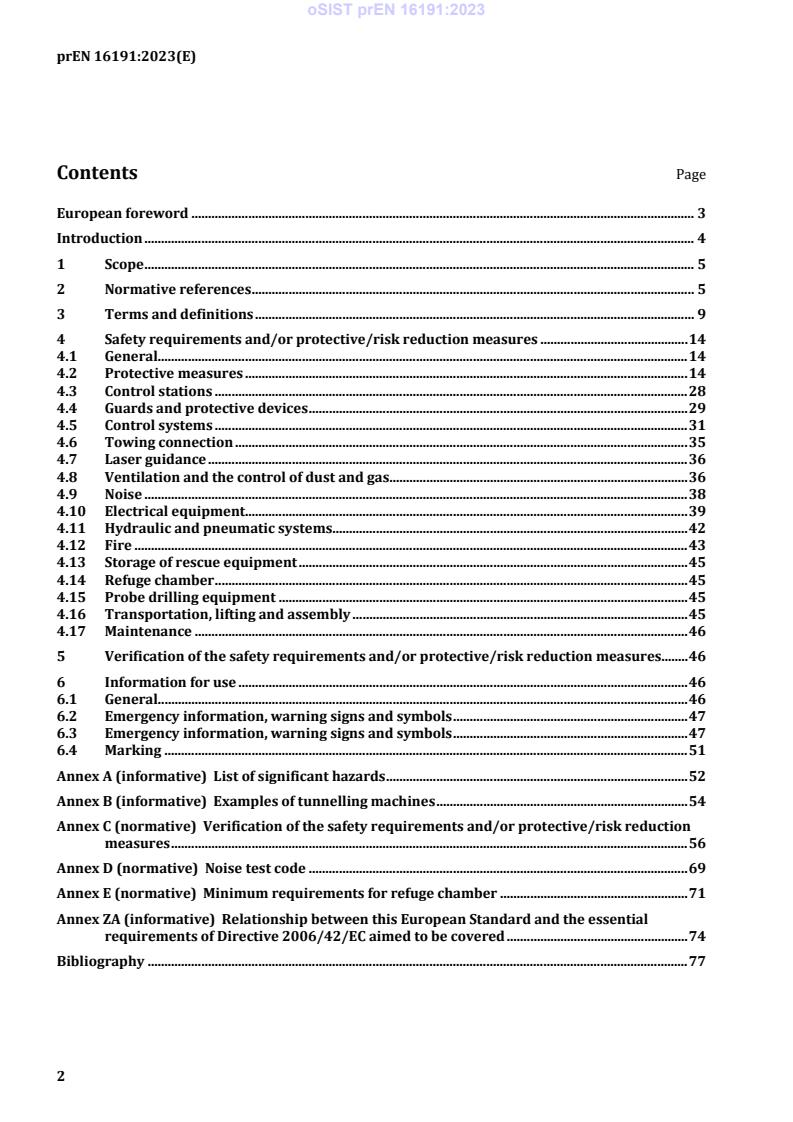
Contents
- Introduction
- 1 Scope
- 2 Normative references
- 3 Terms and definitions
- 3.1 tunnelling machinery
- 3.2 shield machine
- 3.3 shielded tunnel boring machine
- 3.4 telescopic shield machine
- 3.5 unshielded tunnel boring machine
- 3.6 reaming machine
- 3.7 incline shaft boring machine
- 3.8 micro tunnelling machine
- 3.9 thrust boring machine
- 3.10 auger boring machine
- 3.11 partial face excavation equipment
- 3.12 gripping system
- 3.13 regripping
- 3.14 excavation chamber
- 3.15 back-up equipment
- 3.16 pipe jacking rig
- 3.17 lining erection equipment (erector)
- 3.18 erecting device
- 3.19 rock bolting device
- 3.20 probe drilling equipment
- 3.21 control station
- 3.22 main control station
- 3.23 walkway
- 3.23.1 main walkway
- 3.23.2 servicing point access walkway
- 3.24 access opening
- 3.25 servicing point
- 3.26 working area
- 3.27 trailing cable
- 3.28 essential services
- 3.29 refuge chamber
- 3.30 air lock
- 3.31 shield bulkhead
- 3.32 internal diameter
- 3.33 external diameter
- 3.34 quick unloading device
- 3.35 closed mode operation
- 3.36 accessible cutterhead
- 3.37 delivery vehicle
- 3.38 standstill mode
- 3.39 pressurized transfer shuttle
- 3.40 shuttle docking position
- 3.41 shuttle path
- 3.42 hyperbaric intervention
- 3.43 associated system
- 4 Safety requirements and/or protective/risk reduction measures
- 4.1 General
- 4.2 Protective measures
- 3.32 ≥ 5,5 m — H ≥ 2,0 m — H ≥ 1,7 m
- 4.3 Control stations
- 4.4 Guards and protective devices
- 4.5 Control systems
- 4.6 Towing connection
- 4.7 Laser guidance
- 4.8 Ventilation and the control of dust and gas
- 4.9 Noise
- 4.10 Electrical equipment
- 4.11 Hydraulic and pneumatic systems
- 4.12 Fire
- 4.13 Storage of rescue equipment
- 4.14 Refuge chamber
- 4.15 Probe drilling equipment
- 4.16 Transportation, lifting and assembly
- 4.17 Maintenance
- 5 Verification of the safety requirements and/or protective/risk reduction
- 6 Information for use
- 6.1 General
- 6.2 Emergency information, warning signs and symbols
- 6.3 Emergency information, warning signs and symbols
- 6.4 Marking
- Annex A
- 1 Mechanical hazards
- 4.6 b) Friction or abrasive hazard 4.2.1
- 2 Electrical hazards
- 4 Hazards generated by noise
- 5 Hazards generated by radiation
Introduction
This document is a type C standard as stated in EN ISO 12100:2010. The machinery concerned and the extent to which hazards, hazardous situations and events are covered are indicated in the scope of this document.
The intended use of the machinery is agreed between the manufacturer and the user, taking into account information on predicted ground, ground water, tunnel diameter, tunnel alignment and environmental conditions.
It also takes account of operational procedures agreed between the manufacturer and user including services to the TBM, power supply, tunnel ventilation system, spoil removal systems and supply logistics as well as emergency procedures.
This document is of relevance, in particular, for the following stakeholder groups representing the market players with regard to machinery safety:
- machine manufacturers (small, medium and large enterprises);
- health and safety bodies (regulators, accident prevention organizations, market surveillance, etc.). Others can be affected by the level of machinery safety achieved with the means of the document by the above-mentioned stakeholder groups:
- machine users/employers (small, medium and large enterprises);
- machine users/employees (e.g. trade unions, organizations for people with special needs);
- service providers, e.g. for maintenance (small, medium and large enterprises);
- consumers (in case of machinery intended for use by consumers). The above-mentioned stakeholder groups have been given the possibility to participate at the drafting process of this document.
When requirements of this type C standard are different from those which are stated in type A or B standards, the requirements of this type C standard take precedence over the provisions of the other standards for machines that have been designed and built according to the requirements of this type C standard.
oSIST prEN 16191:2023 prEN 16191:2023(E)
1 Scope
This document is applicable to tunnel boring machines and associated machines and equipment as defined in Clause 3 used for the primary purpose of creating an underground void through the construction of horizontal and inclined tunnels and other underground excavations. NOTE 1 Other underground excavations can include access structures to complex tunnel layouts such as in underground stations, utilities, underground storage facilities as well as below ground tunnel portals. It deals with all significant hazards, hazardous situations and events relevant to such machinery when they are used as intended and under the conditions of misuse which are reasonably foreseeable by the manufacturer (see 4).
This document covers monitoring for hazardous atmospheres within the confines of the tunnel boring machines.
Requirements for air locks and pressurized transfer shuttles are covered by prEN 12110-1:2023 and prEN 12110-2:2023.
Hand-arm and whole-body vibration are not considered as significant hazards for tunnel boring machines.
The following items and applications are not covered by this document:
- the additional requirements for the use of entire tunnelling machinery within a hyperbaric environment; - the additional requirements for use of tunnel boring machines in potentially explosive atmospheres; NOTE 2 For the application in potentially explosive atmospheres, see EN ISO/IEC 80079-38:2016 for guidance.
- ancillary tools and equipment which are not an integral part of the tunnel boring machine, but located on the machinery;
- supply network for services to the tunnel boring machine (e.g. power supply, water, pipes, compressed air, ventilation duct, etc.);
- loading and transport machinery which is not an integral part of the tunnel boring machine, e.g. delivery vehicle for logistic support, tunnel spoil removal system;
- EMC interactions between the tunnelling machinery and third-party surface and underground assets, e.g. railway signalling.
This document is not applicable to tunnel boring machines which are manufactured before the date of publication of this European Standard by CEN.
2 Normative references
The following documents are referred to in the text in such a way that some or all of their content constitutes requirements of this document. For dated references, only the edition cited applies. For undated references, the latest edition of the referenced document (including any amendments) applies. EN 3-7:2004+A1:2007, Portable fire extinguishers — Part 7: Characteristics, performance requirements and test methods EN 620:2021, Continuous handling equipment and systems — Safety requirements for fixed belt conveyors for bulk materials
oSIST prEN 16191:2023 prEN 16191:2023(E)
EN 818-4:1996+A1:2008, Short link chain for lifting purposes — Safety — Part 4: Chain slings — Grade 8 EN 894-3:2000+A1:2008, Safety of machinery — Ergonomics requirements for the design of displays and control actuators — Part 3: Control actuators EN 981:1996+A1:2008, Safety of machinery — System of auditory and visual danger and information signals FprEN 1570-1:2022, Safety requirements for lifting tables — Part 1: Lifting tables serving up to two fixed landing EN 1808:2015, Safety requirements for suspended access equipment — Design calculations, stability criteria, construction — Examinations and tests EN 1837:2020, Safety of machinery — Integral lighting of machines
EN 1993-1-1:2005 , Eurocode 3: Design of steel structures — Part 1-1: General rules and rules for buildings EN 1993-1-8:2005, Eurocode 3: Design of steel structures — Part 1-8: Design of joints EN 12021:2014, Respiratory equipment — Compressed gases for breathing apparatus prEN 12110-1:2023, Tunnel boring machines — Air locks — Part 1: Requirements for air locks utilising compressed air as the pressurising or breathing medium along with requirements for oxygen breathing systems for decompression purposes prEN 12110-2:2023, Tunnel boring machines — Air locks — Part 2: Safety requirements for the use of nonair breathing mixtures and saturation techniques in personnel locks and for pressurised transfer shuttles
EN 12195-1:2010 , Load restraining on road vehicles — Safety — Part 1: Calculation of securing forces EN 13414-1:2003+A2:2008, Steel wire rope slings — Safety — Part 1: Slings for general lifting service
EN 13480-3:2017 , Metallic industrial piping — Part 3: Design and calculation EN 14359:2017, Gas-loaded accumulators for fluid power applications EN 14973:2015, Conveyor belts for use in underground installations — Electrical and flammability safety requirements EN 16228-1:2014+A1:2021, Drilling and foundation equipment — Safety — Part 1: Common requirements EN 16228-2:2014+A1:2021, Drilling and foundation equipment — Safety — Part 2: Mobile drill rigs for civil and geotechnical engineering, quarrying and mining EN 60076-2:2011, Power transformers — Part 2: Temperature rise for liquid-immersed transformers (IEC 60076-2:2011)
As impacted by EN 1993-1-1:2005/A1:2014.
As impacted by EN 12195-1:2010/AC:2014.
As impacted EN 13480-3:2017/A1:2021.
oSIST prEN 16191:2023 prEN 16191:2023(E) EN 60204-1:2018, Safety of machinery — Electrical equipment of machines — Part 1: General requirements (IEC 60204-1:2016, modified) EN 60204-32:2008, Safety of machinery — Electrical equipment of machines — Part 32: Requirements for hoisting machines (IEC 60204-32:2008) EN 60529:1991, Degrees of protection provided by enclosures (IP code) (IEC 60529:1989) EN 60825-1:2014, Safety of laser products — Part 1: Equipment classification and requirements (IEC 60825-1:2014) EN 61310-1:2008, Safety of machinery — Indication, marking and actuation — Part 1: Requirements for visual, acoustic and tactile signals (IEC 61310-1:2007) EN IEC 60079-0:2018, Explosive atmospheres — Part 0: Equipment — General requirements (IEC 60079- 0:2017) EN IEC 60204-11:2019, Safety of machinery — Electrical equipment of machines — Part 11: Requirements for equipment for voltages above 1000 V AC or 1500 V DC and not exceeding 36 kV (IEC 60204-11:2018) EN IEC 61439-1:2021, Low-voltage switchgear and controlgear assemblies — Part 1: General rules (IEC 61439-1:2020) EN ISO 3411:2007, Earth-moving machinery — Physical dimensions of operators and minimum operator space envelope (ISO 3411:2007) EN ISO 3449:2008, Earth-moving machinery — Falling-object protective structures — Laboratory tests and performance requirements (ISO 3449:2005) EN ISO 3457:2008, Earth-moving machinery — Guards — Definitions and requirements (ISO 3457:2003) EN ISO 4413:2010, Hydraulic fluid power — General rules and safety requirements for systems and their components (ISO 4413:2010) EN ISO 4414:2010, Pneumatic fluid power — General rules and safety requirements for systems and their components (ISO 4414:2010) EN ISO 4871:2009, Acoustics — Declaration and verification of noise emission values of machinery and equipment (ISO 4871:1996) EN ISO 10218-2:2011, Robots and robotic devices — Safety requirements for industrial robots — Part 2:
Robot systems and integration (ISO 10218-2:2011) EN ISO 11161:2007, Safety of machinery — Integrated manufacturing systems — Basic requirements (ISO 11161:2007) EN ISO 11202:2010, Acoustics — Noise emitted by machinery and equipment — Determination of emission sound pressure levels at a work station and at other specified positions applying approximate environmental corrections (ISO 11202:2010) EN ISO 11688-1:2009, Acoustics — Recommended practice for the design of low-noise machinery and equipment — Part 1: Planning (ISO/TR 11688-1:1995)
oSIST prEN 16191:2023 prEN 16191:2023(E)
EN ISO 12100:2010, Safety of machinery — General principles for design — Risk assessment and risk reduction (ISO 12100:2010) EN ISO 12922:2020, Lubricants, industrial oils and related products (class L) — Family H (Hydraulic systems) — Specifications for hydraulic fluids in categories HFAE, HFAS, HFB, HFC, HFDR and HFDU (ISO 12922:2020) EN ISO 13732-1:2008, Ergonomics of the thermal environment — Methods for the assessment of human responses to contact with surfaces — Part 1: Hot surfaces (ISO 13732-1:2006) EN ISO 13766-1:2018, Earth-moving and building construction machinery — Electromagnetic compatibility (EMC) of machines with internal electrical power supply — Part 1: General EMC requirements under typical electromagnetic environmental conditions (ISO 13766-1:2018) EN ISO 13849-1:2015, Safety of machinery — Safety-related parts of control systems — Part 1: General principles for design (ISO 13849-1:2015) EN ISO 13850:2015, Safety of machinery — Emergency stop function — Principles for design (ISO 13850:2015) EN ISO 14118:2018, Safety of machinery — Prevention of unexpected start-up (ISO 14118:2017) EN ISO 14119:2013, Safety of machinery — Interlocking devices associated with guards — Principles for design and selection (ISO 14119:2013) EN ISO 14120:2015, Safety of machinery — Guards — General requirements for the design and construction of fixed and movable guards (ISO 14120:2015) EN ISO 14122-1:2016, Safety of machinery — Permanent means of access to machinery — Part 1: Choice of fixed means and general requirements of access (ISO 14122-1:2016) EN ISO 14122-2:2016, Safety of machinery — Permanent means of access to machinery — Part 2: Working platforms and walkways (ISO 14122-2:2016) EN ISO 14122-3:2016, Safety of machinery — Permanent means of access to machinery — Part 3: Stairs, stepladders and guard-rails (ISO 14122-3:2016) EN ISO 14122-4:2016, Safety of machinery — Permanent means of access to machinery — Part 4: Fixed ladders (ISO 14122-4:2016) EN ISO 19353:2019, Safety of machinery — Fire prevention and fire protection (ISO 19353:2019) ISO 3795:1989, Road vehicles, and tractors and machinery for agriculture and forestry — Determination of burning behaviour of interior materials ISO 3864-1:2011, Graphical symbols — Safety colours and safety signs — Part 1: Design principles for safety signs and safety markings ISO 6405-1:2017, Earth-moving machinery — Symbols for operator controls and other displays — Part 1:
Common symbols ISO 11112:1995, Earth-moving machinery — Operator’s seat — Dimensions and requirements
oSIST prEN 16191:2023 prEN 16191:2023(E) ISO 12508:1994, Earth-moving machinery — Operator station and maintenance areas — Bluntness of edges ISO 15380:2016, Lubricants, industrial oils and related products (class L) — Family H (Hydraulic systems) - Specifications for hydraulic fluids in categories HETG, HEPG, HEES and HEPR
3 Terms and definitions
For the purposes of this document the terms and definitions given in EN ISO 12100:2010 and the definitions given below apply.
ISO and IEC maintain terminology databases for use in standardization at the following addresses:
- ISO Online browsing platform: available at https://www.iso.org/obp/
- IEC Electropedia: available at https://www.electropedia.org/
3.1 tunnelling machinery
tunnel boring machines and associated machines and equipment designed for excavation and construction of tunnels and shafts, as described in 3.2 to 3.10
3.2 shield machine
steerable ground support structure within which tunnel excavation takes place by manual, mechanical or hydraulic means and within which erection of tunnel support can take place Note 1 to entry: The shield machine is propelled forward by reaction onto the tunnel lining. See Figure B.1 in Annex B. Shield machines provide lateral and/or radial ground support. In addition, they can provide various types of face support and ground water control.
3.3 shielded tunnel boring machine
shield machine for full face excavation, having one or more rotating cutter heads in which the cutter head(s) can be separated from the rest of the shield by a bulkhead, the passage of material through which can be controlled Note 1 to entry: Reaction forces caused by the excavation process are transferred into the tunnel lining. See Figure B.2.
3.4 telescopic shield machine
shielded tunnel boring machine as defined in 3.3 equipped with a gripping system as described in 3.12 Note 1 to entry: Telescopic shield machine is also known as a double shield machine.
3.5 unshielded tunnel boring machine
machine fitted with a rotating cutter head, but which lacks a shield for ground support or can be partially shielded for protection of the cutter head only Note 1 to entry: See Figure B.3.
Note 2 to entry: The torque and thrust reactions are resisted by anchoring the complete machinery against the ground by means of a gripping system.
oSIST prEN 16191:2023 prEN 16191:2023(E)
3.6 reaming machine
unshielded tunnel boring machine intended to enlarge a pilot tunnel in one or more steps Note 1 to entry: In most cases, unshielded tunnel boring machinery work the full face of the tunnel. However, in some cases the tunnel is driven in two or more phases, by starting with a pilot hole which is enlarged in one or more steps. This method is called reaming. In principle these machines are the same as an unshielded tunnel boring machine driving the whole tunnel area in one step.
3.7 incline shaft boring machine
tunnelling machine as defined in 3.2 to 3.6 designed to operate in incline, decline or near vertical direction
3.8 micro tunnelling machine
shielded tunnel boring machine designed for non-man entry operation (except for maintenance purposes when out of service) which is remotely controlled by an operator from outside the tunnel Note 1 to entry: See Figure B.4.
3.9 thrust boring machine
machine for constructing pipelines by displacement
3.10 auger boring machine
non-steerable machine for constructing pipelines using continuous flight augers for excavation and spoil removal
3.11 partial face excavation equipment
cutter boom or backhoe excavator installed in a shield machine Note 1 to entry: See Figure B.1.
3.12 gripping system
equipment for the transfer of the reactive forces caused by the excavation process into the tunnel wall
3.13 regripping
process of disengaging the gripping system, relocating and re-engaging the gripping system
3.14 excavation chamber
front part of a shield between ground face and shield bulkhead, into which the ground is excavated Note 1 to entry: Depending on the type of tunnelling machinery the excavation chamber may be separated into different compartments.
oSIST prEN 16191:2023 prEN 16191:2023(E)
3.15 back-up equipment
steel construction which accommodates equipment, to provide the machine with services (including water, compressed air, electrical power, hydraulic power) for its operation and its crew with facilities for their work and comfort Note 1 to entry: For tunnelling machinery described in 3.2 to 3.7 the back-up equipment is normally towed behind the machine, i.e. it is “towed back-up equipment”, whereas for pipe jacking and micro tunnelling equipment, thrust boring and auger boring machines, the back-up equipment is installed at the bottom of an access shaft or on the surface adjacent thereto.
3.16 pipe jacking rig
hydraulic jacking equipment, intended to drive a pipe string through the ground to form a tunnel lining
3.17 lining erection equipment (erector)
handling and erecting equipment for tunnel lining segments, situated within or immediately behind a shield machine
3.18 erecting device
equipment for handling and erection of other ground support elements such as steel ribs, situated within a tunnel boring machine and its back-up equipment
3.19 rock bolting device
equipment for drilling and installation of rock bolts, situated within or behind an unshielded tunnel boring machine
3.20 probe drilling equipment
drilling equipment for ground investigation ahead of and around the tunnel
3.21 control station
any location on a tunnelling machinery or back-up equipment from where one or more functions of the tunnelling machinery, back-up equipment or their separate working units can be controlled by an operator
3.22 main control station
control station from where the excavation operation and the advance of the tunnelling machinery is controlled
3.23 walkway
3.23.1 main walkway
provides access along the entire length of the backup equipment including permitting moving between working areas and also forms an escape route
oSIST prEN 16191:2023 prEN 16191:2023(E)
3.23.2 servicing point access walkway
part of the walkway system on tunnel machinery, including micro tunnelling machines accessible only in standstill mode that permits walking or moving to servicing points
3.24 access opening
opening within tunnelling machinery through which a man may pass to access servicing points, for example in the shield bulkhead or the cutterhead
3.25 servicing point
any location on a tunnelling machinery or back-up equipment where maintenance or servicing is carried out
3.26 working area
area on or in tunnelling machinery, where work is performed, for example rock bolt installation, ring beam erection, segment handling and ring erection, services extension
3.27 trailing cable
power cable which extends from the towed back-up equipment to the tunnel power supply normally stowed on the cable drum or cable trail
3.28 essential services
services as defined in this standard which are maintained in the event of a loss of the main power supply
3.29 refuge chamber
enclosed space which provides life support for persons trapped in tunnel by smoke, fume or gas other than methane
3.30 air lock
pressure vessel with one or more compartments that permits passage between areas of different pressure [SOURCE: prEN 12110-1:2023, 3.3]
3.31 shield bulkhead
structure which separates the excavation chamber from the tunnel
3.32 internal diameter
internal diameter of the lining through which the backup equipment is being towed Note 1 to entry: For unshielded machines, the internal diameter is that within the planned rock support.
oSIST prEN 16191:2023 prEN 16191:2023(E)
...