

kSIST FprEN ISO 25202:2026
(Main)Leather - Chemical analysis - Determination of glutaraldehyde content (ISO/FDIS 25202:2026)
- Abstract
This document specifies a method for the determination of free and released glutaraldehyde in leathers, using liquid chromatography (LC).
- Status
- Not Published
- Public Enquiry End Date
- 27-Feb-2025
- Technical Committee
- IUSN - Leather
- Current Stage
- 5020 - Formal vote (FV) (Adopted Project)
- Start Date
- 23-Jul-2026
- Due Date
- 10-Sep-2026
- Completion Date
- 24-Jul-2026

Overview
kSIST FprEN ISO 25202:2026 defines a precise and reliable method for the chemical analysis of leather, focusing on the determination of glutaraldehyde content. Developed through collaboration with ISO, CEN, and IULTCS, this international standard is specifically designed for laboratories, regulatory bodies, and the leather industry that require accurate measurement of free and released glutaraldehyde in leather materials.
The standard details a selective and robust method based on high performance liquid chromatography (HPLC), using derivatization with 2,4-dinitrophenylhydrazine (DNPH) and UV detection. Importantly, this method is considered not sensitive to colored extracts commonly found in leather, ensuring accuracy across a broad spectrum of leather types.
Key Topics
- Glutaraldehyde Quantification: The standard outlines how to reliably quantify both free and released glutaraldehyde present in leather samples.
- HPLC Methodology: Emphasis is placed on the use of liquid chromatography techniques for selectivity and reliability.
- Sample Preparation: Procedures include prescribed methods for extracting and preparing leather specimens, ensuring consistency and repeatability.
- Chemical Reagents: Guidance is provided on the grade and preparation of reagents, including stock solutions of glutaraldehyde and derivatizing agents.
- Instrumental Conditions: Typical liquid chromatography parameters are included to aid laboratories in achieving standardized results.
- Expression and Reporting: Results should be expressed in mg/kg, with clear identification, test conditions, and deviations fully documented in the test report.
Applications
This standard is valuable for a variety of purposes related to the global leather supply chain and regulatory compliance:
- Quality Control: Leather goods manufacturers and suppliers can confirm that production processes meet regulatory and safety requirements by determining glutaraldehyde content.
- Regulatory Testing: Helps ensure products conform to national and international chemical safety regulations regarding the use of glutaraldehyde in leather processing.
- Research and Development: Laboratories and research institutions use this method to assess the efficacy of tanning agents or to monitor residual chemicals in finished products.
- Consumer Safety: By measuring glutaraldehyde content, manufacturers reduce the risk of skin sensitivities or allergic reactions in end-users.
- Import/Export Compliance: Supports global trade in leather and leather goods by providing internationally recognized test results for customs and regulatory review.
Related Standards
This standard interfaces closely with other international documents in the fields of leather chemical analysis and laboratory practices:
- ISO 2418: Leather - Chemical, physical, mechanical and fastness tests - Position and preparation of specimens for testing
- ISO 4044: Leather - Chemical tests - Preparation of chemical test samples
- ISO 3696: Water for analytical laboratory use - Specification and test methods
- ISO 17226-1: Leather - Chemical determination of formaldehyde content - Part 1: Method using high-performance liquid chromatography
Practical Value
kSIST FprEN ISO 25202:2026 supports the traceability and standardization of chemical analysis results across different laboratories and jurisdictions, fostering confidence in both domestic and international markets for leather goods. It delivers a validated and harmonized technique for detecting hazardous substances, improving the overall safety and quality in the leather industry.
Keywords: glutaraldehyde determination, leather chemical analysis, ISO 25202, HPLC in leather testing, regulatory compliance, leather industry standards, leather safety, SIT, IULTCS, CEN, laboratory methods for glutaraldehyde, leather quality control
Get Certified
Connect with accredited certification bodies for this standard

Control Union Certifications
Global certification for agriculture and sustainability.

ECOCERT
Organic and sustainability certification.

Hohenstein Institut
Textile testing and certification.
Sponsored listings
Frequently Asked Questions
kSIST FprEN ISO 25202:2026 is a draft published by the Slovenian Institute for Standardization (SIST). Its full title is "Leather - Chemical analysis - Determination of glutaraldehyde content (ISO/FDIS 25202:2026)". This standard covers: This document specifies a method for the determination of free and released glutaraldehyde in leathers, using liquid chromatography (LC).
This document specifies a method for the determination of free and released glutaraldehyde in leathers, using liquid chromatography (LC).
kSIST FprEN ISO 25202:2026 is classified under the following ICS (International Classification for Standards) categories: 59.140.30 - Leather and furs; 71.040.40 - Chemical analysis. The ICS classification helps identify the subject area and facilitates finding related standards.
kSIST FprEN ISO 25202:2026 is available in PDF format for immediate download after purchase. The document can be added to your cart and obtained through the secure checkout process. Digital delivery ensures instant access to the complete standard document.
Standards Content (Sample)
SLOVENSKI STANDARD
oSIST prEN ISO 25202:2025
01-februar-2025
Usnje - Kemijska analiza - Določevanje vsebnosti glutaraldehida (ISO/DIS
25202:2024)
Leather - Chemical analysis - Determination of glutaraldehyde content (ISO/DIS
25202:2024)
Leder - Chemische Analyse - Bestimmung des Glutaraldehydgehalts (ISO/DIS
25202:2024)
Cuir - Analyse chimique - Détermination de la teneur en glutaraldéhyde (ISO/DIS
25202:2024)
Ta slovenski standard je istoveten z: prEN ISO 25202
ICS:
59.140.30 Usnje in krzno Leather and furs
71.040.40 Kemijska analiza Chemical analysis
oSIST prEN ISO 25202:2025 en,fr,de
2003-01.Slovenski inštitut za standardizacijo. Razmnoževanje celote ali delov tega standarda ni dovoljeno.
oSIST prEN ISO 25202:2025
oSIST prEN ISO 25202:2025
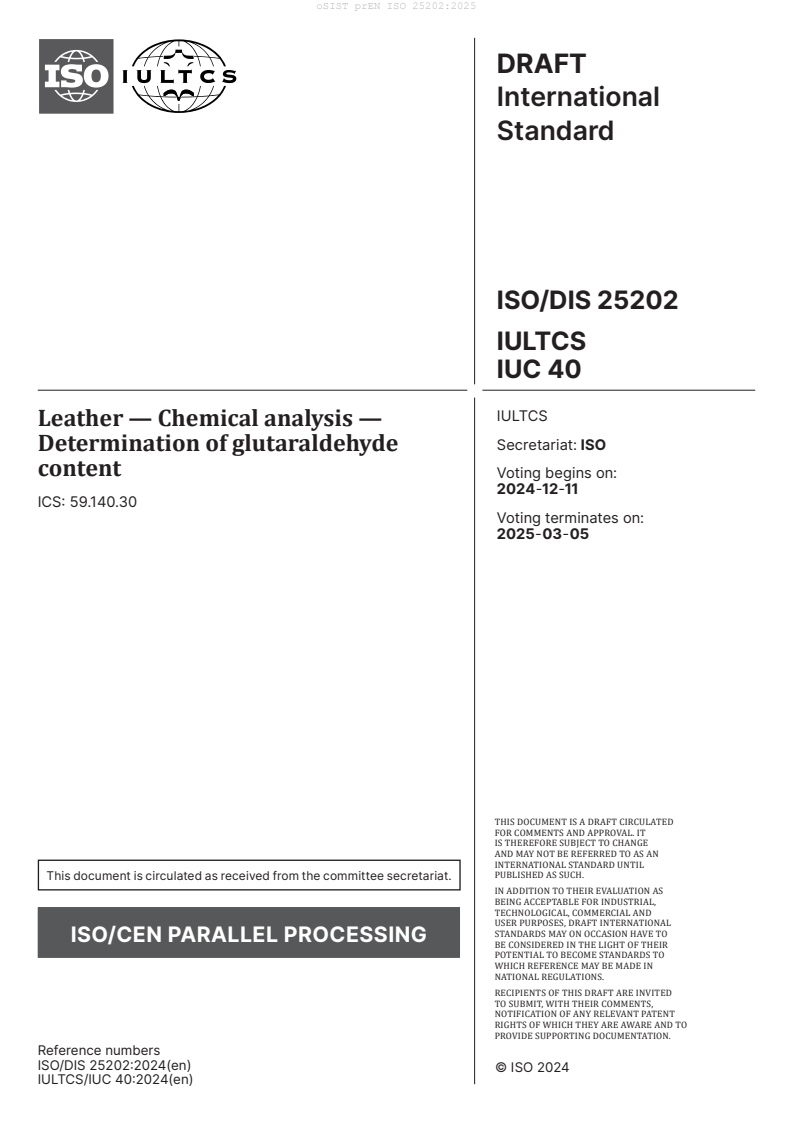
DRAFT
International
Standard
ISO/DIS 25202
IULTCS
IUC 40
IULTCS
Leather — Chemical analysis —
Secretariat: ISO
Determination of glutaraldehyde
content
Voting begins on:
2024-12-11
ICS: 59.140.30
Voting terminates on:
2025-03-05
THIS DOCUMENT IS A DRAFT CIRCULATED
FOR COMMENTS AND APPROVAL. IT
IS THEREFORE SUBJECT TO CHANGE
AND MAY NOT BE REFERRED TO AS AN
INTERNATIONAL STANDARD UNTIL
PUBLISHED AS SUCH.
This document is circulated as received from the committee secretariat.
IN ADDITION TO THEIR EVALUATION AS
BEING ACCEPTABLE FOR INDUSTRIAL,
TECHNOLOGICAL, COMMERCIAL AND
USER PURPOSES, DRAFT INTERNATIONAL
STANDARDS MAY ON OCCASION HAVE TO
ISO/CEN PARALLEL PROCESSING
BE CONSIDERED IN THE LIGHT OF THEIR
POTENTIAL TO BECOME STANDARDS TO
WHICH REFERENCE MAY BE MADE IN
NATIONAL REGULATIONS.
RECIPIENTS OF THIS DRAFT ARE INVITED
TO SUBMIT, WITH THEIR COMMENTS,
NOTIFICATION OF ANY RELEVANT PATENT
RIGHTS OF WHICH THEY ARE AWARE AND TO
PROVIDE SUPPORTING DOCUMENTATION.
Reference numbers
ISO/DIS 25202:2024(en)
IULTCS/IUC 40:2024(en)
oSIST prEN ISO 25202:2025
DRAFT
ISO/DIS 25202:2024(en)
International
Standard
ISO/DIS 25202
IULTCS
IUC 40
IULTCS
Leather — Chemical analysis —
Secretariat: ISO
Determination of glutaraldehyde
content
Voting begins on:
ICS: 59.140.30
Voting terminates on:
THIS DOCUMENT IS A DRAFT CIRCULATED
FOR COMMENTS AND APPROVAL. IT
IS THEREFORE SUBJECT TO CHANGE
AND MAY NOT BE REFERRED TO AS AN
INTERNATIONAL STANDARD UNTIL
PUBLISHED AS SUCH.
This document is circulated as received from the committee secretariat.
IN ADDITION TO THEIR EVALUATION AS
BEING ACCEPTABLE FOR INDUSTRIAL,
© ISO 2024
TECHNOLOGICAL, COMMERCIAL AND
USER PURPOSES, DRAFT INTERNATIONAL
All rights reserved. Unless otherwise specified, or required in the context of its implementation, no part of this publication may
STANDARDS MAY ON OCCASION HAVE TO
ISO/CEN PARALLEL PROCESSING
be reproduced or utilized otherwise in any form or by any means, electronic or mechanical, including photocopying, or posting on
BE CONSIDERED IN THE LIGHT OF THEIR
the internet or an intranet, without prior written permission. Permission can be requested from either ISO at the address below
POTENTIAL TO BECOME STANDARDS TO
WHICH REFERENCE MAY BE MADE IN
or ISO’s member body in the country of the requester.
NATIONAL REGULATIONS.
ISO copyright office
RECIPIENTS OF THIS DRAFT ARE INVITED
CP 401 • Ch. de Blandonnet 8
TO SUBMIT, WITH THEIR COMMENTS,
CH-1214 Vernier, Geneva
NOTIFICATION OF ANY RELEVANT PATENT
Phone: +41 22 749 01 11
RIGHTS OF WHICH THEY ARE AWARE AND TO
PROVIDE SUPPORTING DOCUMENTATION.
Email: copyright@iso.org
Website: www.iso.org
Reference numbers
Published in Switzerland ISO/DIS 25202:2024(en)
IULTCS/IUC 40:2024(en)
ii
oSIST prEN ISO 25202:2025
ISO/DIS 25202:2024(en)
IULTCS/IUC 40:2024(en)
Contents Page
Foreword .iv
1 Scope . 1
2 Normative references . 1
3 Terms and definitions . 1
4 Principle . 1
5 Reagents . 1
6 Apparatus . 2
7 Preparation of test specimens . 2
8 Procedure . 3
8.1 Sample processing .3
8.1.1 Extraction .3
8.1.2 Reaction with DNPH .3
8.2 Determination by LC .3
9 Expression of results . 4
9.1 General .4
9.2 Calculation of the glutaraldehyde content .4
9.3 Precision of the test method .4
10 Test report . 4
Annex A (informative) LC conditions . 5
Bibliography . 6
iii
oSIST prEN ISO 25202:2025
ISO/DIS 25202:2024(en)
IULTCS/IUC 40:2024(en)
Foreword
ISO (the International Organization for Standardization) is a worldwide federation of national standards
bodies (ISO member bodies). The work of preparing International Standards is normally carried out through
ISO technical committees. Each member body interested in a subject for which a technical committee
has been established has the right to be represented on that committee. International organizations,
governmental and non-governmental, in liaison with ISO, also take part in the work. ISO collaborates closely
with the International Electrotechnical Commission (IEC) on all matters of electrotechnical standardization.
The procedures used to develop this document and those intended for its further maintenance are described
in the ISO/IEC Directives, Part 1. In particular, the different approval criteria needed for the different types
of ISO documents should be noted. This document was drafted in accordance with the editorial rules of the
ISO/IEC Directives, Part 2 (see www.iso.org/directives).
ISO draws attention to the possibility that the implementation of this document may involve the use of (a)
patent(s). ISO takes no position concerning the evidence, validity or applicability of any claimed patent
rights in respect thereof. As of the date of publication of this document, ISO [had/had not] received notice of
(a) patent(s) which may be required to implement this document. However, implementers are cautioned that
this may not represent the latest information, which may be obtained from the patent database available at
www.iso.org/patents. ISO shall not be held responsible for identifying any or all such patent rights.
Any trade name used in this document is information given for the convenience of users and does not
constitute an endorsement.
For an explanation of the voluntary nature of standards, the meaning of ISO specific terms and expressions
related to conformity assessment, as well as information about ISO's adherence to the World Trade
Organization (WTO) principles in the Technical Barriers to Trade (TBT) see www.iso.org/iso/foreword.html.
This document was prepared by the European Committee for Standardization (CEN) Technical Committee
CEN/TC 289, Leather, in collaboration with the Chemical Test Commission of the International Union of
Leather Technologists and Chemists Societies (IUC Commission, IULTCS), in accordance with the Agreement
on technical cooperation between ISO and CEN (Vienna Agreement). This method is technically similar to
the Colorimetric Section of the method IUC 19 which was declared an official method at the IULTCS Delegates
meeting on 31st May 2003 i
...