

kSIST FprES 203 408 V1.2.1:2026
(Main)Environmental Engineering (EE) - Colour and marking of DC cable and connecting devices
- Abstract
RES/EE-02111
- Status
- Not Published
- Technical Committee
- SPN - Services and Protocols for Networks
- Current Stage
- 5020 - Formal vote (FV) (Adopted Project)
- Start Date
- 10-Aug-2026
- Due Date
- 28-Sep-2026
- Completion Date
- 10-Aug-2026

kSIST FprES 203 408 V1.2.1:2026 presents ETSI ES 203 408 V1.2.1, a final draft ETSI Standard from ETSI Technical Committee Environmental Engineering (EE). It specifies common practice for the colour and marking of DC cables, conductors, connectors and related distribution devices in Telecom sites that feed ICT and facilities equipment. The document is written for operators, equipment manufacturers, installers, end customers and certification bodies that need a clear way to identify DC installations and avoid confusion with AC and other DC interfaces.
What does kSIST FprES 203 408 V1.2.1:2026 specify?
kSIST FprES 203 408 V1.2.1:2026 defines identification practice for DC power distribution in buildings, rooms and equipment used for Telecom and ICT applications. It focuses on up to 400 VDC distribution and also gives recommendations for other LVDC cabling such as -48 VDC and -60 VDC so that different power interfaces are not confused in the same site.
The document is organized into seven clauses plus two annexes.
| Clause or annex | What it covers |
|---|---|
| Clause 1 | Scope and application |
| Clause 2 | Normative and informative references |
| Clause 3 | Definitions, symbols and abbreviations |
| Clause 4 | Electrical Distribution identification coverage |
| Clause 5 | Identification principle |
| Clause 6 | DC distribution devices additional colour and marking |
| Clause 7 | Durability of marking and reading errors limitation |
| Annex A | Informative review of colour and marking practices in AC and DC cabling |
| Annex B | Bibliography |
Clause 4 identifies the parts of a DC distribution system that need marking, including lines, power sources, outputs, sub-distribution boards, interconnection boxes and plug strips. In practice, that means the standard is not limited to a wire colour scheme - it also covers the places where people connect, disconnect and inspect the power system.
What are the key requirements of kSIST FprES 203 408 V1.2.1:2026?
Identification rules
kSIST FprES 203 408 V1.2.1:2026 requires conductor and terminal identification to follow IEC 60445, with letters in upper case Latin characters and numerals in Arabic numerals. The identifying colour, graphical symbol or alphanumeric notation shall be on or next to the corresponding terminal, so the marking is visible where work is done.
The standard says colour identification shall extend over the full length of the conductor from the DC source to interface A3 or P, either by insulation colour or by markers and labels at intervals. This matters because a technician should be able to trace the conductor without guessing where one system ends and another begins.
The document also allows different identification methods in one installation, but only if they do not create ambiguity and the relationship between methods is documented. For existing installations, the requirement is triggered when extensions or alterations are made, so site changes do not leave mixed and unclear marking.
Up to 400 VDC wires and cables
Clause 5.2 sets the rules for up to 400 VDC conductor wires and cables for A3 or P interfaces. It prefers integral insulation colour where possible, and it allows colour markers or identification labels at regular intervals when that is not practical.
For new single-wire installations, the conductors are identified using the colours and labels in Table 1. For multiwire cables, if the internal wire colour is not the expected one, the document calls for added sleeves, rings or similar markers at both ends. Bare conductors are marked at termination and connection points.
The clause also lists conductor types for which colour marking is not required, such as concentric conductors, cable metal sheath or armour used as a protective conductor, and certain bare or extraneous conductive parts. In practice, this keeps the rule focused on conductors where colour marking improves safety and tracing.
Table 1 distinguishes line conductors by polarity and earthing arrangement, including HRMG and TN-S DC cases. It also notes that functional earthing is to be defined by the manufacturer or relevant product committee and documented with the equipment.
Other LVDC cabling
Clause 5.3 gives additional recommendations for other DC voltage distribution cabling outside the up to 400 VDC A3 or P interfaces. It is aimed at -48 VDC and -60 VDC distribution, especially interface A, so these circuits can be recognized as separate from the higher-voltage DC systems.
The practical point is that low-voltage telecom DC cabling should not be left to local habit or legacy colour codes alone. The standard recommends text and alphanumeric symbols at the termination, and it notes that colour markings are not defined in the same way as for the up to 400 VDC system.
Distribution devices, boards and plug strips
Clause 6 extends identification to boxes, outputs, sub-distribution boards and plug strips inside ICT equipment rooms and cabinets. The main rule is that different voltage levels such as -48 VDC, 400 VDC and AC should not be mixed in the same box or mechanical module unless there are separate compartments or insulation separators and clear marking.
Table 3 ties the external box colour or label background to the voltage type and the earthing arrangement. That matters at cabinet and rack level, where a fast visual check helps prevent wrong connection and servicing errors.
Clause 6.4 also allows a coloured round circle around each socket instead of a fully coloured plastic part. This gives designers some flexibility while still making the voltage type easy to spot.
Durability
Clause 7 applies IEC 60445, clause 7.1, for durability of marking and limitation of reading errors. In practice, the identification has to survive normal handling and remain legible enough for maintenance and inspection.
What terms does kSIST FprES 203 408 V1.2.1:2026 define?
- Cable identification - A colour, graphical symbol or alphanumeric notation placed on or next to a wire, cable terminal or junction box to show what the conductor is.
- ICT - Information and Communication Technologies; the document uses this for telecom and data-centre equipment and related systems.
- HRMG - High Resistance Mid-point Grounding, an earthing arrangement used in the DC identification tables.
- IT - Isolation Terra earthing, where connection to earth is made through high resistance or impedance.
- TN-S DC - A DC distribution earthing arrangement where earth and the negative DC wires are separated.
- Line conductor - The energized AC phase conductor or DC pole conductor that transmits electric energy but is not a neutral conductor.
- DC - Direct Current, the power form covered throughout the document.
- UPS - Uninterruptable Power Supply, mentioned as one of the AC-related systems that can coexist with DC distribution.
Who uses kSIST FprES 203 408 V1.2.1:2026?
kSIST FprES 203 408 V1.2.1:2026 is used by Telecom and data centre operators, equipment manufacturers, installers and end customers who need to specify, build or inspect DC power distribution. It is also relevant for certification bodies and engineering teams that document how cables, connectors, outputs and distribution boards are identified.
In practice, these users apply it when selecting conductor colours, labelling multiwire cables, marking cabinets and plug strips, and documenting extensions or alterations. It is especially useful where -48 VDC, up to 400 VDC and AC systems share the same building or equipment room.
What changed in kSIST FprES 203 408 V1.2.1:2026 from the previous edition?
The version history identifies V1.1.1, published in December 2016, as the earlier publication and V1.2.1, August 2026, as the current MAP draft version. The document itself presents V1.2.1 as the version submitted for ETSI Membership Approval Procedure.
Which standards are used with kSIST FprES 203 408 V1.2.1:2026?
| Standard | What it contributes |
|---|---|
| Recommendation ITU-T L.1203 | Equivalent colour and marking identification for up to 400 VDC power distribution for ICT systems |
| Recommendation ITU-T L.1200 | The up to 400 V direct current power feeding interface at ICT equipment input |
| IEC 60445 | Basic and safety principles for marking and identification of terminals, terminations and conductors |
| IEC 60757 | Code for designation of colours used for conductor identification |
| IEC 60417 | Graphical symbols used on equipment |
| IEC 60617 | Graphical symbols used in diagrams |
| ETSI EN 300 132-2 | The -48 VDC power supply interface for ICT equipment |
| ETSI EN 300 132-3 | The up to 400 VDC power supply interface for ICT equipment |
| ETSI EN 300 253 | Earthing and bonding for ICT equipment powered by -48 VDC |
| ETSI EN 301 605 | Earthing and bonding for 400 VDC data and telecom equipment |
What does the kSIST FprES 203 408 V1.2.1:2026 document contain?
The document contains the identification tables that assign colours and labels to DC conductors and distribution devices, plus figures that show example building and room-level DC architectures. Those tables are the practical core of the standard because they turn the identification principle into markings that installers can apply.
Annex A reviews existing colour and marking practices across standards and sectors, including building cabling, transport, aircraft, machinery and national DC coding examples. It is informative background that helps readers understand why the document tries to harmonize DC marking with IEC practice.
Annex B provides the bibliography.
Get Certified
Connect with accredited certification bodies for this standard

IMQ S.p.A. (Certification)
Italian electrical product certification.

SLG Prüf- und Zertifizierungs GmbH
German testing and certification body.

UL Solutions
Global safety science company with testing, inspection and certification.
Sponsored listings
Frequently Asked Questions
kSIST FprES 203 408 V1.2.1:2026 is a standard published by the Slovenian Institute for Standardization (SIST). Its full title is "Environmental Engineering (EE) - Colour and marking of DC cable and connecting devices". This standard covers: RES/EE-02111
RES/EE-02111
kSIST FprES 203 408 V1.2.1:2026 is classified under the following ICS (International Classification for Standards) categories: 01.070 - Colour coding; 19.040 - Environmental testing; 29.060.20 - Cables. The ICS classification helps identify the subject area and facilitates finding related standards.
kSIST FprES 203 408 V1.2.1:2026 is available in PDF format for immediate download after purchase. The document can be added to your cart and obtained through the secure checkout process. Digital delivery ensures instant access to the complete standard document.
Standards Content (Sample)
Final draft ETSI ES 203 408 V1.2.1 (2026-08)
ETSI STANDARD
Environmental Engineering (EE);
Colour and marking of DC cable and connecting devices
2 Final draft ETSI ES 203 408 V1.2.1 (2026-08)
Reference
RES/EE-02111
Keywords
cable, identification, power
ETSI
650 Route des Lucioles
F-06921 Sophia Antipolis Cedex - FRANCE
Tel.: +33 4 92 94 42 00 Fax: +33 4 93 65 47 16
Siret N° 348 623 562 00017 - APE 7112B
Association à but non lucratif enregistrée à la
Sous-Préfecture de Grasse (06) N° w061004871
Important notice
The present document can be downloaded from the
ETSI Search & Browse Standards application.
The present document may be made available in electronic versions and/or in print. The content of any electronic and/or
print versions of the present document shall not be modified without the prior written authorization of ETSI. In case of any
existing or perceived difference in contents between such versions and/or in print, the prevailing version of an ETSI
deliverable is the one made publicly available in PDF format on ETSI deliver repository.
Users should be aware that the present document may be revised or have its status changed,
this information is available in the Milestones listing.
If you find errors in the present document, please send your comments to
the relevant service listed under Committee Support Staff.
If you find a security vulnerability in the present document, please report it through our
Coordinated Vulnerability Disclosure (CVD) program.
Notice of disclaimer & limitation of liability
The information provided in the present deliverable is directed solely to professionals who have the appropriate degree of
experience to understand and interpret its content in accordance with generally accepted engineering or
other professional standard and applicable regulations.
No recommendation as to products and services or vendors is made or should be implied.
No representation or warranty is made that this deliverable is technically accurate or sufficient or conforms to any law
and/or governmental rule and/or regulation and further, no representation or warranty is made of merchantability or fitness
for any particular purpose or against infringement of intellectual property rights.
In no event shall ETSI be held liable for loss of profits or any other incidental or consequential damages.
Any software contained in this deliverable is provided "AS IS" with no warranties, express or implied, including but not
limited to, the warranties of merchantability, fitness for a particular purpose and non-infringement of intellectual property
rights and ETSI shall not be held liable in any event for any damages whatsoever (including, without limitation, damages
for loss of profits, business interruption, loss of information, or any other pecuniary loss) arising out of or related to the use
of or inability to use the software.
Copyright Notification
No part of this document may be reproduced in any form, by any means and in any media, without the prior written
authorization of ETSI and except as expressly permitted below.
By way of exception and when the document is a normative deliverable (European Standard (EN),
Technical Specification (TS), Group Specification (GS) or ETSI Standard (ES)), ETSI authorizes to reproduce
and incorporate into products, services and technical documentation only those extracts (e.g. templates) that are strictly
necessary for the technical implementation of the normative deliverable, to ensure compliance with the latter.
Nothing in this notice shall be construed as limiting any mandatory exceptions to copyright provided by applicable law.
© ETSI 2026.
All rights reserved.
ETSI
3 Final draft ETSI ES 203 408 V1.2.1 (2026-08)
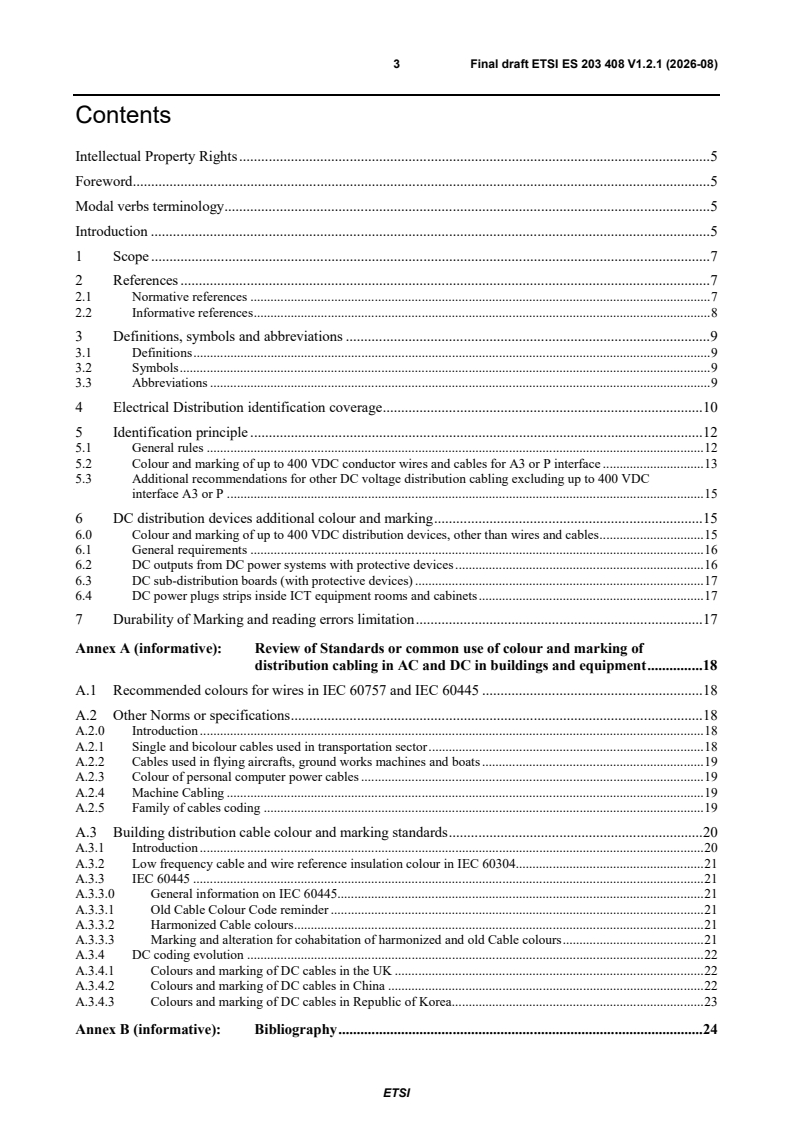
Contents
Intellectual Property Rights . 5
Foreword . 5
Modal verbs terminology . 5
Introduction . 5
1 Scope . 7
2 References . 7
2.1 Normative references . 7
2.2 Informative references . 8
3 Definitions, symbols and abbreviations . 9
3.1 Definitions . 9
3.2 Symbols . 9
3.3 Abbreviations . 9
4 Electrical Distribution identification coverage . 10
5 Identification principle . 12
5.1 General rules . 12
5.2 Colour and marking of up to 400 VDC conductor wires and cables for A3 or P interface . 13
5.3 Additional recommendations for other DC voltage distribution cabling excluding up to 400 VDC
interface A3 or P . 15
6 DC distribution devices additional colour and marking . 15
6.0 Colour and marking of up to 400 VDC distribution devices, other than wires and cables . 15
6.1 General requirements . 16
6.2 DC outputs from DC power systems with protective devices . 16
6.3 DC sub-distribution boards (with protective devices) . 17
6.4 DC power plugs strips inside ICT equipment rooms and cabinets . 17
7 Durability of Marking and reading errors limitation . 17
Annex A (informative): Review of Standards or common use of colour and marking of
distribution cabling in AC and DC in buildings and equipment . 18
A.1 Recommended colours for wires in IEC 60757 and IEC 60445 . 18
A.2 Other Norms or specifications . 18
A.2.0 Introduction . 18
A.2.1 Single and bicolour cables used in transportation sector . 18
A.2.2 Cables used in flying aircrafts, ground works machines and boats . 19
A.2.3 Colour of personal computer power cables . 19
A.2.4 Machine Cabling . 19
A.2.5 Family of cables coding . 19
A.3 Building distribution cable colour and marking standards . 20
A.3.1 Introduction . 20
A.3.2 Low frequency cable and wire reference insulation colour in IEC 60304 . 21
A.3.3 IEC 60445 . 21
A.3.3.0 General information on IEC 60445 . 21
A.3.3.1 Old Cable Colour Code reminder . 21
A.3.3.2 Harmonized Cable colours . 21
A.3.3.3 Marking and alteration for cohabitation of harmonized and old Cable colours . 21
A.3.4 DC coding evolution . 22
A.3.4.1 Colours and marking of DC cables in the UK . 22
A.3.4.2 Colours and marking of DC cables in China . 22
A.3.4.3 Colours and marking of DC cables in Republic of Korea . 23
Annex B (informative): Bibliography . 24
ETSI
4 Final draft ETSI ES 203 408 V1.2.1 (2026-08)
History . 25
ETSI
5 Final draft ETSI ES 203 408 V1.2.1 (2026-08)
Intellectual Property Rights
Essential patents
IPRs essential or potentially essential to normative deliverables (European Standard (EN), Technical Specification (TS),
Group Specification (GS) or ETSI Standard (ES)) may have been declared to ETSI. The declarations pertaining to these
essential IPRs, if any, are publicly available for ETSI members and non-members, and can be found in
ETSI SR 000 314: "Intellectual Property Rights (IPRs); Essential, or potentially Essential, IPRs notified to ETSI in
respect of ETSI standards", which is available from the ETSI Secretariat. Latest updates are available on the
ETSI IPR online database.
Pursuant to the ETSI Directives including the ETSI IPR Policy, no investigation regarding the essentiality of IPRs,
including IPR searches, has been carried out by ETSI. No guarantee can be given as to the existence of other IPRs not
referenced in ETSI SR 000 314 (or the updates on the ETSI Web server) which are, or may be, or may become,
essential to the present document.
Trademarks
The present document may include trademarks and/or tradenames which are asserted and/or registered by their owners.
ETSI claims no ownership of these except for any which are indicated as being the property of ETSI, and conveys no
right to use or reproduce any trademark and/or tradename. Mention of those trademarks in the present document does
not constitute an endorsement by ETSI of products, services or organizations associated with those trademarks.
DECT™, PLUGTESTS™, UMTS™ and the ETSI logo are trademarks of ETSI registered for the benefit of its
Members. 3GPP™, LTE™ and 5G™ logo are trademarks of ETSI registered for the benefit of its Members and of the
3GPP Organizational Partners. oneM2M™ logo is a trademark of ETSI registered for the benefit of its Members and of ®
the oneM2M Partners. GSM and the GSM logo are trademarks registered and owned by the GSM Association.
Foreword
This final draft ETSI Standard (ES) has been produced by ETSI Technical Committee Environmental Engineering (EE),
and is now submitted for the ETSI Membership Approval Procedure (MAP).
Modal verbs terminology
In the present document "shall", "shall not", "should", "should not", "may", "need not", "will", "will not", "can" and
"cannot" are to be interpreted as described in clause 3.2 of the ETSI Drafting Rules (Verbal forms for the expression of
provisions).
"must" and "must not" are NOT allowed in ETSI deliverables except when used in direct citation.
Introduction
The present document has been developed to assist the ICT industry in their development and wider use of DC
powering solutions above the DC voltage range mainly used until now for Telecommunication network equipment
(-48 VDC ETSI EN 300 132-2 [7]).
The present document has been jointly developed by ETSI TC EE and ITU-T Study Group 5 in order to ensure
equivalent technical content. It is published respectively by ITU as Recommendation ITU-T L.1203 [1] and ETSI
Standard ETSI ES 203 408.
DC power has been the main source of power for the Telecommunication industry since the very beginning as it is
efficient, reliable and easily scalable.
ETSI
6 Final draft ETSI ES 203 408 V1.2.1 (2026-08)
This solution is a well proven arrangement that has been used for over a century in almost all telecommunication
network equipment sites in cohabitation with AC for servers and other buildings services (lighting, facility plugs, lifts,
etc.).
It is recognized that DC power has many potential applications further to those for ICT equipment and that such
applications could benefit from the standards defined in ITU/ETSI. It is also recognized that further standardization
activities on LVDC are now starting in other standardization organizations such as IEC. Thus ITU-T/ETSI will pursue
cooperation with such organizations to reach maximum international alignment.
ETSI and ITU-T have standardized the widespread DC power interface at inputs of Telecom/ICT equipment used in
Telecom networks, Data centers, and customer sites. The legacy interface for billions of equipment is the SELV voltage
range so called -48 VDC, where the positive pole is grounded as defined for example for interface "A" in ETSI
EN 300 132-2 [7]. Other complementary ETSI standards define a whole DC distribution including earthing and bonding
such as ETSI EN 300 253 [9].
Higher voltages than -48 VDC are already widely used in Telecom networks for remote powering of signal repeaters on
copper or optical Telecom transmission lines, with a usual operation in symmetrical voltage up to ±200 V in RFT-C or
RFT-V telecom remote power feeding standardized in ETSI EN 302 099 [i.1].
The higher power density of ICT equipment and overall site power in MW for Data centers have led to the use of higher
voltage levels, firstly in AC single or 3 phases up to 400 VAC at the input of servers. The need for resilience, energy
efficiency and cost optimization has pushed the introduction of the up to 400 VDC power feeding interface standardized
in ETSI EN 300 132-3 [8] and in Recommendation ITU-T L.1200 [2]. This is now available on many servers and
Telecommunication network equipment.
As there is a progressive introduction of the new DC power interface in cohabitation with existing -48 VDC and AC
distribution, ETSI EN 301 605 [10] has been introduced to ensure safety and proper operation, especially in mass
bonding of EMC sensitive equipment and correct earthing connection to the building structure earthing network.
There is also a requirement for Telecom/Data center operators, equipment manufacturers, installers and end customers
to clarify the colour and marking of cables in their installations. This avoids confusion and errors between the different
AC and DC power interfaces and distribution equipment used in the building and inside ICT systems.
Considering the user side, and very long background experience in use of DC of the Telecom sector, the present
document makes recommendations directly contributing to safety principles laid down in IEC Guide 104 [i.9] and
ISO/IEC Guide 51 [i.10]. It accelerates and encourages the preparation of international standards of cable identification
intended for use by manufacturers, users or certification bodies.
With reference to safety, it is important there is no ambiguity with respect to cable colours and identification. The
present document therefore recommends harmonisation with existing IEC standards including IEC 60445 [3] and
IEC 60050-195 [i.2], allowing a standardized industry approach.
For useful information, colours of cables inside equipment are considered in annex A as DC is already widely used for a
multitude of applications, e.g. ICT equipment, car and trucks electric circuits, solar PV, etc.
ETSI
7 Final draft ETSI ES 203 408 V1.2.1 (2026-08)
1 Scope
The scope of the present document is to define common practice for identification of cabling or parts of the DC power
distribution for the Telecom sites (buildings/rooms) feeding ICT and facilities equipment (power plant, cooling,
building access systems, monitoring, etc.).
This applies to 400 VDC cabling for ICT equipment and environment equipment using interface defined in ETSI
EN 300 132-3 [8] or Recommendation ITU-T L.1200 [2] and avoids confusion between the DC colour and marking of
up to 400 VDC distribution (interface A3) and the other power interfaces identification: -48 VDC distribution interface
A, AC interface A1 and uninterrupted AC given by inverters or UPS systems used in the building.
To ensure safety, it is important there is no ambiguity with respect to cable colours and identification, The present
document therefore recommends harmonisation with existing IEC standards including IEC 60445 [3] and
IEC 60050-195 [i.2], allowing a standardized industry approach.
The Recommendation defines:
• requirements for the colour and identification of separate wires used in DC distribution systems and
installations, and as much as possible inside equipment between A or P interface and end use;
• marking and identification of DC multiwire cables, connectors and any associated equipment for DC power
distribution;
• marking identification for sui-distribution boards and interconnection boxes;
• harmonisation with IEC 60445 [3].
For DC wires in multiwire cables, recommendations are given for harmonization with separate individual wire
requirements.
Recommendations are given on other distribution items (wires, cables and interconnection items) including the
functional earthing and bonding arrangement for distribution outside and inside equipment to avoid any confusion with
DC distribution identification of the present document.
2 References
2.1 Normative references
References are either specific (identified by date of publication and/or edition number or version number) or
non-specific. For specific references, only the cited version applies. For non-specific references, the latest version of the
referenced document (including any amendments) applies.
Referenced documents which are not found to be publicly available in the expected location might be found in the
ETSI docbox.
NOTE: While any hyperlinks included in this clause were valid at the time of publication, ETSI cannot guarantee
their long-term validity.
The following referenced documents are necessary for the application of the present document.
[1] Recommendation ITU-T L.1203: "Colour and marking identification of up to 400VDC power
distribution for ICT systems".
[2] Recommendation ITU-T L.1200 (2012): "Direct current power feeding interface up to 400 V at the
input to telecommunication and ICT equipment".
[3] IEC 60445:2021: "Basic and safety principles for man-machine interface, marking and
identification - Identification of equipment terminals, conductor terminations and conductors".
[4] IEC 60757:2021: "Code for designation of colours".
ETSI
8 Final draft ETSI ES 203 408 V1.2.1 (2026-08)
[5] IEC 60417:2026 DB: "Graphical symbols for use on equipment".
[6] IEC 60617:2026 DB: "Graphical symbols for diagrams".
NOTE: IEC DB documents refer to Database of Graphical Symbol. Some are joint with ISO e.g. IEC 60417 and
ISO 7000.
[7] ETSI EN 300 132-2 (V2.8.1): "Environmental Engineering (EE); Power supply interface at the
input of Information and Communication Technology (ICT) equipment; Part 2: -48 V Direct
Current (DC)".
[8] ETSI EN 300 132-3 (V2.3.1): "Environmental Engineering (EE); Power supply interface at the
input of Information and Communication Technology (ICT) equipment; Part 3: Up to 400 V
Direct Current (DC)".
[9] ETSI EN 300 253 (V2.2.1): "Environmental Engineering (EE); Earthing and bonding of ICT
equipment powered by -48 VDC in telecom and data centres".
[10] ETSI EN 301 605 (V1.1.1): "Environmental Engineering (EE); Earthing and bonding of 400 VDC
data and telecom (ICT) equipment".
2.2 Informative references
References are either specific (identified by date of publication and/or edition number or version number) or
non-specific. For specific references, only the cited version applies. For non-specific references, the latest version of the
referenced document (including any amendments) applies.
NOTE: While any hyperlinks included in this clause were valid at the time of publication, ETSI cannot guarantee
their long-term validity.
The following referenced documents may be useful in implementing an ETSI deliverable or add to the reader's
understanding, but are not required for conformance to the present document.
[i.1] ETSI EN 302 099 (V2.3.1): "Environmental Engineering (EE); Powering of equipment in access
network".
[i.2] IEC 60050-195 (2021): "IEC Terminology International Electrotechnical Vocabulary - Part 195:
Earthing and protection against electric shock".
[i.3] IEC 60050-826 (2022): "International Electrotechnical Vocabulary - Part 826: Electrical
installations".
[i.4] BS 7671/A4 (2026): "Requirements for Electrical Installations. IET Wiring Regulations".
[i.5] HD 308 S2:2001: "Identification of cores in cables and flexible cords".
[i.6] HD 324 S1 (withdrawn) (1977): "Colored insulation and bare wire identification package".
[i.7] HD 384.5.514 (withdrawn): "Identification, including 514.3: Identification of conductors".
[i.8] IEC 60364-1 (2025): "Low-voltage electrical installations - Part 1: Fundamental principles,
assessment of general characteristics, definitions".
[i.9] IEC Guide 104: "The preparation of safety publications and the use of basic safety publications
and group safety publications".
[i.10] ISO/IEC Guide 51: "Safety aspects - Guidelines for their inclusion in standards".
[i.11] ISO 19642 (2023): "Road vehicles. Automotive cables".
[i.12] ISO 2574 (1994): "Flying machine electric cable - Identification marking".
[i.13] ISO 9247 (1990): "Ground work machine - electric wire and cables -- identification and marking
principles".
ETSI
9 Final draft ETSI ES 203 408 V1.2.1 (2026-08)
[i.14] IEC EN 60204-1 (2018): "Safety of machinery -Electrical equipment of machines -Part 1:General
requirements".
[i.15] IEC 60304 (1982): "Standard colours for insulation for low-frequency cables and wires".
[i.16] Void.
[i.17] Void.
[i.18] Void.
[i.19] IEC 60446 (withdrawn) (2007): "Basic and safety principles for man-machine interface, marking
and identification - identification of conductors by colours or alphanumerics".
[i.20] CCSA YD/T 2378 (2020): "240V Direct Current Power supply system for Telecommunications".
3 Definitions, symbols and abbreviations
3.1 Definitions
For the purposes of the present document, the following terms and definitions apply:
cable identification: colour, graphical symbol, text in alphanumeric notation located on or adjacent to wire or cable
terminals or junction boxes
electrical equipment: item used for purposes like generation, conversion, distribution or utilization of electric energy
(e.g. electrical machines, transformers, switch gear and control gear, measuring instruments, wiring systems,
current-using equipment, etc.) (IEC 60050-826 [i.3])
IT (Isolation Terra): Isolation Terra earthing as defined in IEC 60364-1 [i.8].
NOTE: The two letters IT are coding one of the 3 families of electrical distribution where connection to earth is
made through high resistance or impedance device i.e. HRMG in ETSI EN 301 605 [10].
line conductor: AC phase conductor or DC pole conductor (deprecated) conductor which is energized in normal
operation and capable of contributing to the transmission or distribution of electric energy but which is not a neutral
conductor (IEC 60050-195 [i.2])
TN-S DC: Distribution earthing arrangements as defined in IEC 60364-1 [i.8] and ETSI EN 301 605 [10] where earth
and negative (DC) wires are separated
3.2 Symbols
For the purposes of the present document, the following symbols apply:
48 VDC -48 Volt Direct Current voltage as defined in ETSI EN 300 132-2 [7]
400 VDC up to 400 Volt Direct Current voltage as defined in Recommendation ITU-T L.1200 [2]
A (interface) ICT/Telecom equipment -48 VDC power interface as defined in in ETSI EN 300 132-2 [7]
A3 (interface) ICT/Telecom equipment up to 400 VDC power interface as defined in ETSI EN 300 132-3 [8]
P ICT/Telecom equipment up to 400 VDC power interface as defined in Recommendation
ITU-T L.1200 [2]
3.3 Abbreviations
For the purposes of the present document, the following abbreviations apply:
AC Alternative Current
DC Direct Current
EMC Electro Magnetic Compatibility
HRMG High Resistance Mid-point Grounding
ETSI
---------------------
...