

SIST EN 14077:2004
(Main)Petroleum products - Determination of organic halogen content - Oxidative microcoulometric method
General Information
- Abstract
The method is directly applicable to the determination of low concentrations (2 mg/kg to 100 mg/kg) of organic halogen in petroleum products such as gasolines, middle distillates and residual fuels. Except for fluorine (F); the organic halogens chlorine (C), bromine (Br) and iodine (J) that may be present in the sample are determined quantitatively. The halogen is reported as the equivalent number of chloride ions. A procedure is described for the removal of inorganic halides from residual fluids.
- Status
- Published
- Publication Date
- 30-Jun-2004
- Technical Committee
- NAD - Petroleum products, lubricants and related products
- Current Stage
- 6060 - National Implementation/Publication (Adopted Project)
- Start Date
- 01-Jul-2004
- Due Date
- 01-Jul-2004
- Completion Date
- 01-Jul-2004

Overview
EN 14077:2003 (CEN) specifies an oxidative microcoulometric method for the determination of organic halogen content in petroleum products. The standard is intended for low-level concentrations (2 mg/kg to 100 mg/kg) and covers common fuel types such as gasolines, middle distillates and residual fuels. Fluorine is excluded; chlorine (Cl), bromine (Br) and iodine (I) present as organic halogens are determined quantitatively and reported as the equivalent number of chloride ions. The standard also describes a procedure for the removal of inorganic halides from residual fluids prior to measurement.
Key Topics
- Scope and applicability
- Measurement range: 2–100 mg/kg organic halogen.
- Applicable sample types: gasolines, middle distillates, residual fuels.
- Analytes covered
- Quantitative determination of organic Cl, Br, I (fluorine excluded).
- Results expressed as chloride-ion equivalents to provide a single reporting metric.
- Analytical technique
- Uses an oxidative microcoulometric approach (oxidation of organohalogen compounds and coulometric detection of resulting halide ions).
- Matrix preparation
- Includes a procedure for removal of inorganic halides from residual fluids to prevent interference and ensure selective measurement of organic-bound halogen.
- Classification
- ICS code: 75.080 (Petroleum products in general).
Applications
- Refinery and fuel quality control
- Monitoring organic halogen levels to protect downstream catalysts, treat corrosion risk, and meet product specifications.
- Commercial fuel suppliers
- Verifying compliance with fuel quality limits and contractual requirements for halogen content.
- Independent testing laboratories
- Routine screening and certification of petroleum streams and blended fuels.
- Regulatory and environmental testing
- Assessing halogenated organics in fuels where low-level contamination is relevant to emissions or environmental risk.
- Research and development
- Evaluating feedstock and additive effects on halogen content in new fuel formulations.
Related Standards
- EN 14077:2003 is part of the suite of CEN standards addressing petroleum product testing. For comprehensive test programs, laboratories commonly consult other CEN/ISO/ASTM standards for complementary parameters (boiling range, sulfur, water content, etc.).
Keywords: EN 14077:2003, organic halogen, petroleum products, microcoulometric, halogen content determination, chlorine, bromine, iodine, residual fuels, gasoline, middle distillates, inorganic halide removal.
Relations
- Effective Date
- 28-Jan-2026
- Effective Date
- 28-Jan-2026
- Effective Date
- 28-Jan-2026
- Effective Date
- 28-Jan-2026
- Effective Date
- 28-Jan-2026
- Effective Date
- 09-Feb-2026
- Effective Date
- 09-Feb-2026
- Effective Date
- 09-Feb-2026
- Effective Date
- 09-Feb-2026
- Effective Date
- 09-Feb-2026
- Effective Date
- 09-Feb-2026
- Effective Date
- 09-Feb-2026
- Effective Date
- 09-Feb-2026
- Effective Date
- 09-Feb-2026
- Effective Date
- 09-Feb-2026
Get Certified
Connect with accredited certification bodies for this standard

Element Materials Technology
Materials testing and product certification.

ABS Group Brazil
ABS Group certification services in Brazil.

ABS Quality Evaluations Inc.
American Bureau of Shipping quality certification.
Sponsored listings
Frequently Asked Questions
SIST EN 14077:2004 is a standard published by the Slovenian Institute for Standardization (SIST). Its full title is "Petroleum products - Determination of organic halogen content - Oxidative microcoulometric method". This standard covers: The method is directly applicable to the determination of low concentrations (2 mg/kg to 100 mg/kg) of organic halogen in petroleum products such as gasolines, middle distillates and residual fuels. Except for fluorine (F); the organic halogens chlorine (C), bromine (Br) and iodine (J) that may be present in the sample are determined quantitatively. The halogen is reported as the equivalent number of chloride ions. A procedure is described for the removal of inorganic halides from residual fluids.
The method is directly applicable to the determination of low concentrations (2 mg/kg to 100 mg/kg) of organic halogen in petroleum products such as gasolines, middle distillates and residual fuels. Except for fluorine (F); the organic halogens chlorine (C), bromine (Br) and iodine (J) that may be present in the sample are determined quantitatively. The halogen is reported as the equivalent number of chloride ions. A procedure is described for the removal of inorganic halides from residual fluids.
SIST EN 14077:2004 is classified under the following ICS (International Classification for Standards) categories: 75.080 - Petroleum products in general. The ICS classification helps identify the subject area and facilitates finding related standards.
SIST EN 14077:2004 has the following relationships with other standards: It is inter standard links to SIST EN ISO 595-2:2000, SIST EN ISO 3170:2025, SIST EN 12503-6:2002, SIST EN ISO 3696:1998, SIST EN ISO 3171:1999, SIST EN 60255-27:2014, SIST EN 60143-1:2015, SIST EN 61788-19:2014, SIST EN IEC 61757-1-1:2020, SIST EN 61215-2:2017, SIST EN 60115-1:2023, SIST EN 61003-1:2017, SIST-TS CLC/TS 61400-26-3:2017, SIST EN 62391-1:2016, SIST EN 62132-8:2012. Understanding these relationships helps ensure you are using the most current and applicable version of the standard.
SIST EN 14077:2004 is available in PDF format for immediate download after purchase. The document can be added to your cart and obtained through the secure checkout process. Digital delivery ensures instant access to the complete standard document.
Standards Content (Sample)
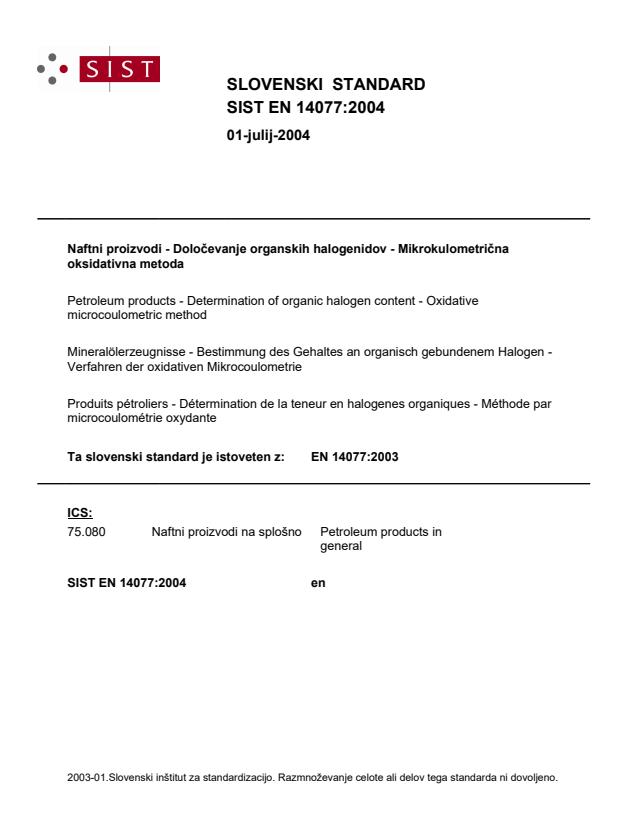
2003-01.Slovenski inštitut za standardizacijo. Razmnoževanje celote ali delov tega standarda ni dovoljeno.HWULþQDMineralölerzeugnisse - Bestimmung des Gehaltes an organisch gebundenem Halogen - Verfahren der oxidativen MikrocoulometrieProduits pétroliers - Détermination de la teneur en halogenes organiques - Méthode par microcoulométrie oxydantePetroleum products - Determination of organic halogen content - Oxidative microcoulometric method75.080Naftni proizvodi na splošnoPetroleum products in generalICS:T
...