

SIST EN 15534-1:2014+A1:2018
(Main)Composites made from cellulose-based materials and thermoplastics (usually called wood-polymer composites (WPC) or natural fibre composites (NFC)) - Part 1: Test methods for characterisation of compounds and products
General Information
- Abstract
This European Standard specifies test methods for the determination of properties of composites made from cellulose-based materials and thermoplastics, usually called wood-polymer composites (WPC) or natural fibre composites (NFC).
NOTE For editorial reasons, in EN 15534 the abbreviation "WPC" is used for ecomposites made from cellulose-based materials and thermoplastics.
This part of EN 15534 is applicable to cellular or non-cellular compounds and products, made from cellulose-based materials and thermoplastics, intended to be or being processed through plastics processing techniques, without threshold for the cellulose-based material content.
All the properties listed in this part of EN 15534 are not necessarily assessed for a given application. Test parameters and requirements of the test methods for a given application are specified in the relevant part of EN 15534.
Profiles for the management of electrical power cables, communication cables and power track systems used for the distribution of electrical power, profiles for windows or doors and profiles for guttering are not covered by EN 15534).
- Status
- Published
- Publication Date
- 18-Dec-2017
- Technical Committee
- IPMA - Polimer materials and products
- Current Stage
- 6060 - National Implementation/Publication (Adopted Project)
- Start Date
- 09-Nov-2017
- Due Date
- 14-Jan-2018
- Completion Date
- 19-Dec-2017


Overview
EN 15534-1:2014+A1:2017 is the CEN European standard that specifies test methods for characterising composites made from cellulose‑based materials and thermoplastics-commonly called wood‑polymer composites (WPC) or natural fibre composites (NFC). This Part 1 document defines how to prepare specimens, condition samples and perform laboratory tests to determine physical, mechanical, durability and thermal properties of both cellular and non‑cellular compounds and finished products intended to be processed by plastics techniques. There is no minimum cellulose content threshold in scope. Note: some profile applications (electrical cable management, windows/doors, guttering) are excluded from EN 15534.
Key topics and technical requirements
The standard covers a wide range of measurable properties and associated test methods, including:
- Specimen preparation and conditioning (reference conditioning, factory control, third‑party testing)
- Physical properties: appearance, density, moisture content, slipperiness (pendulum & inclination tests), dimensional characteristics and linear mass for profiles
- Mechanical properties: impact resistance (including falling mass for products), tensile and flexural properties, creep behaviour, indentation resistance, nail/screw withdrawal and pull‑through resistance
- Durability: artificial weathering, natural ageing, moisture resistance (swelling, cyclic and boiling tests), resistance to biological agents (fungi, termites, algae), and salt spray
- Thermal properties: heat deflection temperature (HDT), linear thermal expansion, heat reversion, heat build‑up, and fire reaction tests (single flame and SBI where applicable)
- Other tests: degree of chalking, gloss change, peel strength for laminated profiles
The standard emphasises that not all tests are mandatory for every application; relevant properties and acceptance criteria are specified in the application‑specific parts of EN 15534.
Practical applications
EN 15534-1 is used to:
- Support product development and material formulation for WPC/NFC compounds
- Define quality control procedures and factory production control tests
- Provide consistent laboratory test methods for comparative performance evaluation
- Demonstrate durability and safety (e.g., reaction to fire, biological resistance) for market acceptance
- Supply data for design decisions (creep, mechanical strength, thermal expansion) and compliance documentation
Who should use this standard
- WPC/NFC manufacturers and compound formulators
- Independent testing laboratories and certification bodies
- Product designers, specifiers and engineers
- Procurement and quality assurance teams seeking standardized performance data
- Regulatory and standards organizations referencing harmonized test methods
Related standards
- Other parts of EN 15534 (application‑specific test parameters and requirements)
- Relevant ISO, EN and national standards referenced within EN 15534‑1 for specific test procedures
Keywords: EN 15534-1, wood‑polymer composites, WPC, natural fibre composites, NFC, test methods, characterisation, durability, mechanical properties, thermal properties, CEN.
Relations
- Effective Date
- 01-Apr-2026
- Effective Date
- 01-Apr-2026
- Effective Date
- 04-Feb-2026
- Effective Date
- 28-Jan-2026
- Effective Date
- 28-Jan-2026
- Effective Date
- 28-Jan-2026
- Effective Date
- 28-Jan-2026
- Effective Date
- 28-Jan-2026
- Refers
SIST EN ISO 291:2009 - Plastics - Standard atmospheres for conditioning and testing (ISO 291:2008) - Effective Date
- 28-Jan-2026
- Effective Date
- 28-Jan-2026
- Effective Date
- 28-Jan-2026
- Effective Date
- 28-Jan-2026
- Effective Date
- 28-Jan-2026
- Effective Date
- 28-Jan-2026
- Effective Date
- 28-Jan-2026
Get Certified
Connect with accredited certification bodies for this standard

DIN CERTCO
DIN Group product certification.
Gozdarski inštitut Slovenije
Slovenian Forestry Institute. Forest management certification support, timber testing.

Smithers Quality Assessments
US management systems and product certification.
Sponsored listings
Frequently Asked Questions
SIST EN 15534-1:2014+A1:2018 is a standard published by the Slovenian Institute for Standardization (SIST). Its full title is "Composites made from cellulose-based materials and thermoplastics (usually called wood-polymer composites (WPC) or natural fibre composites (NFC)) - Part 1: Test methods for characterisation of compounds and products". This standard covers: This European Standard specifies test methods for the determination of properties of composites made from cellulose-based materials and thermoplastics, usually called wood-polymer composites (WPC) or natural fibre composites (NFC). NOTE For editorial reasons, in EN 15534 the abbreviation "WPC" is used for ecomposites made from cellulose-based materials and thermoplastics. This part of EN 15534 is applicable to cellular or non-cellular compounds and products, made from cellulose-based materials and thermoplastics, intended to be or being processed through plastics processing techniques, without threshold for the cellulose-based material content. All the properties listed in this part of EN 15534 are not necessarily assessed for a given application. Test parameters and requirements of the test methods for a given application are specified in the relevant part of EN 15534. Profiles for the management of electrical power cables, communication cables and power track systems used for the distribution of electrical power, profiles for windows or doors and profiles for guttering are not covered by EN 15534).
This European Standard specifies test methods for the determination of properties of composites made from cellulose-based materials and thermoplastics, usually called wood-polymer composites (WPC) or natural fibre composites (NFC). NOTE For editorial reasons, in EN 15534 the abbreviation "WPC" is used for ecomposites made from cellulose-based materials and thermoplastics. This part of EN 15534 is applicable to cellular or non-cellular compounds and products, made from cellulose-based materials and thermoplastics, intended to be or being processed through plastics processing techniques, without threshold for the cellulose-based material content. All the properties listed in this part of EN 15534 are not necessarily assessed for a given application. Test parameters and requirements of the test methods for a given application are specified in the relevant part of EN 15534. Profiles for the management of electrical power cables, communication cables and power track systems used for the distribution of electrical power, profiles for windows or doors and profiles for guttering are not covered by EN 15534).
SIST EN 15534-1:2014+A1:2018 is classified under the following ICS (International Classification for Standards) categories: 79.080 - Semi-manufactures of timber; 83.140.99 - Other rubber and plastics products. The ICS classification helps identify the subject area and facilitates finding related standards.
SIST EN 15534-1:2014+A1:2018 has the following relationships with other standards: It is inter standard links to SIST EN 321:2004, SIST EN ISO 179-1:2026, SIST EN ISO 11925-2:2026, SIST EN ISO 4589-2:2017, SIST EN ISO 1183-3:2000, SIST EN 152:2012, SIST EN ISO 2813:2015, SIST EN 13893:2003, SIST EN ISO 291:2009, SIST EN ISO 75-2:2013, SIST EN 317:1996, SIST EN ISO/CIE 11664-1:2019, SIST EN ISO 527-2:2025, SIST EN ISO 9239-1:2025, SIST EN ISO 75-1:2020. Understanding these relationships helps ensure you are using the most current and applicable version of the standard.
SIST EN 15534-1:2014+A1:2018 is available in PDF format for immediate download after purchase. The document can be added to your cart and obtained through the secure checkout process. Digital delivery ensures instant access to the complete standard document.
Standards Content (Sample)
2003-01.Slovenski inštitut za standardizacijo. Razmnoževanje celote ali delov tega standarda ni dovoljeno.Kompoziti iz materialov na osnovi celuloze in plastomerov (navadno imenovani lesno-polimerni kompoziti (WPC) ali kompoziti iz naravnih vlaken (NFC)) - 1. del: Preskusne metode za karakterizacijo spojin in proizvodovVerbundwerkstoffe aus cellulosehaltigen Materialien und Thermoplasten (üblicherweise Holz-Polymer-Werkstoffe (WPC) oder Naturfaserverbundwerkstoffe (NFC) genannt) - Teil 1: Prüfverfahren zur Beschreibung von Compounds und ErzeugnissenComposites à base de matières cellulosiques et de thermoplastiques (communément appelés composites bois-polymères (WPC) ou composites fibres d'origine naturelle (NFC)) - Partie 1: Méthodes d'essai pour la caractérisation des compositions et des produitsComposites made from cellulose-based materials and thermoplastics (usually called wood-polymer composites (WPC) or natural fibre composites (NFC)) - Part 1: Test methods for characterisation of compounds and products83.140.99Drugi izdelki iz gume in polimernih materialovOther rubber and plastics products79.080Polizdelki iz lesaSemi-manufactures of timberICS:Ta slovenski standard je istoveten z:EN 15534-1:2014+A1:2017SIST EN 15534-1:2014+A1:2018en,fr,de01-februar-2018SIST EN 15534-1:2014+A1:2018SLOVENSKI
STANDARD
EUROPEAN STANDARD NORME EUROPÉENNE EUROPÄISCHE NORM
EN 15534-1:2014+A1
November
t r s y ICS
y {ä r z râ
z uä r z rä r sâ
z uä s v rä { { Supersedes EN
s w w u væ sã t r s vEnglish Version
Composites made from celluloseæbased materials and methods for characterisation of compounds and productsComposites à base de matières cellulosiques et de caractérisation des compositions et des produits
Verbundwerkstoffe aus cellulosehaltigen Materialien Beschreibung von Compounds und Erzeugnissen This European Standard was approved by CEN on
{ November
t r s u and includes Amendment
s approved by CEN on
{ August
t r s yä
egulations which stipulate the conditions for giving this European Standard the status of a national standard without any alterationä Upætoædate lists and bibliographical references concerning such national standards may be obtained on application to the CENæCENELEC Management Centre or to any CEN memberä
translation under the responsibility of a CEN member into its own language and notified to the CENæCENELEC Management Centre has the same status as the official versionsä
CEN members are the national standards bodies of Austriaá Belgiumá Bulgariaá Croatiaá Cyprusá Czech Republicá Denmarká Estoniaá Finlandá Former Yugoslav Republic of Macedoniaá Franceá Germanyá Greeceá Hungaryá Icelandá Irelandá Italyá Latviaá Lithuaniaá Luxembourgá Maltaá Netherlandsá Norwayá Polandá Portugalá Romaniaá Serbiaá Slovakiaá Sloveniaá Spainá Swedená Switzerlandá Turkey and United Kingdomä
EUROPEAN COMMITTEE FOR STANDARDIZATION COMITÉ EUROPÉEN DE NORMALISATION EUROPÄISCHES KOMITEE FÜR NORMUNG
CEN-CENELEC Management Centre:
Avenue Marnix 17,
B-1000 Brussels
t r s y CEN All rights of exploitation in any form and by any means reserved worldwide for CEN national Membersä Refä Noä EN
s w w u væ sã t r s v ªA sã t r s y ESIST EN 15534-1:2014+A1:2018
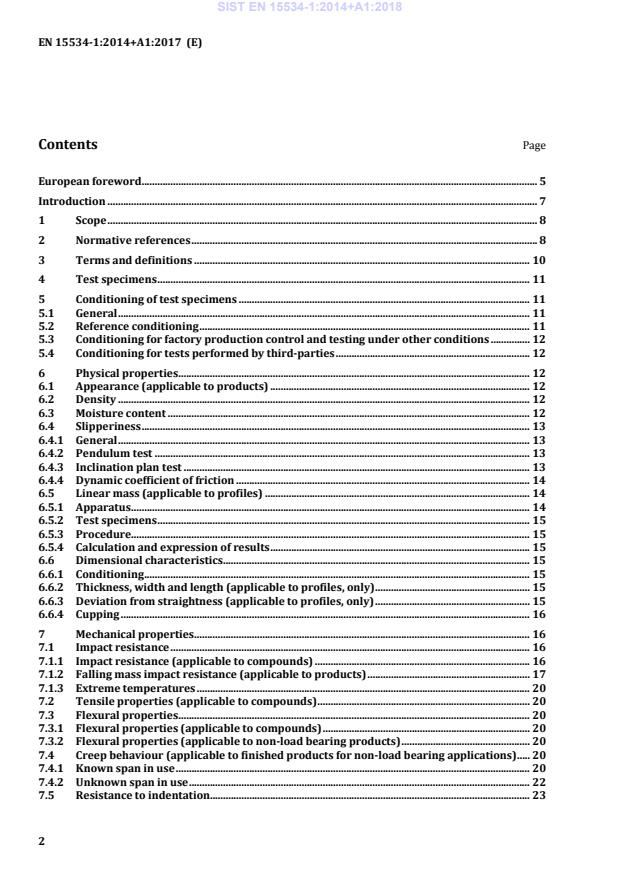
(E) 2 Contents Page European foreword . 5 Introduction . 7 1 Scope . 8 2 Normative references . 8 3 Terms and definitions . 10 4 Test specimens . 11 5 Conditioning of test specimens . 11 5.1 General . 11 5.2 Reference conditioning . 11 5.3 Conditioning for factory production control and testing under other conditions . 12 5.4 Conditioning for tests performed by third-parties . 12 6 Physical properties . 12 6.1 Appearance (applicable to products) . 12 6.2 Density . 12 6.3 Moisture content . 12 6.4 Slipperiness . 13 6.4.1 General . 13 6.4.2 Pendulum test . 13 6.4.3 Inclination plan test . 13 6.4.4 Dynamic coefficient of friction . 14 6.5 Linear mass (applicable to profiles) . 14 6.5.1 Apparatus . 14 6.5.2 Test specimens . 15 6.5.3 Procedure. 15 6.5.4 Calculation and expression of results . 15 6.6 Dimensional characteristics. 15 6.6.1 Conditioning . 15 6.6.2 Thickness, width and length (applicable to profiles, only) . 15 6.6.3 Deviation from straightness (applicable to profiles, only) . 15 6.6.4 Cupping . 16 7 Mechanical properties . 16 7.1 Impact resistance . 16 7.1.1 Impact resistance (applicable to compounds) . 16 7.1.2 Falling mass impact resistance (applicable to products) . 17 7.1.3 Extreme temperatures . 20 7.2 Tensile properties (applicable to compounds) . 20 7.3 Flexural properties . 20 7.3.1 Flexural properties (applicable to compounds) . 20 7.3.2 Flexural properties (applicable to non-load bearing products) . 20 7.4 Creep behaviour (applicable to finished products for non-load bearing applications) . 20 7.4.1 Known span in use . 20 7.4.2 Unknown span in use . 22 7.5 Resistance to indentation. 23 SIST EN 15534-1:2014+A1:2018
(E) 4 10.3.6 Test report . 49 Annex A (normative)
Determination of the modulus of elasticity in bending and bending strength of profiles . 51 A.1 Principle . 51 A.2 Apparatus . 51 A.3 Test specimens . 52 A.4 Atmosphere for conditioning and testing . 53 A.5 Procedure. 53 A.6 Expression of results . 54 A.6.1 Modulus of elasticity in bending . 54 A.6.2 Bending strength . 56 A.7 Test report . 57 Bibliography . 59
1) In preparation. SIST EN 15534-1:2014+A1:2018
(E) 6 — prEN 15534-7, Composites made from cellulose-based materials and thermoplastics (usually called wood-polymer composites (WPC) or natural fibre composites (NFC)) — Part 7: Specifications for general purpose profiles in external applications1) According to the CEN-CENELEC Internal Regulations, the national standards organizations of the following countries are bound to implement this European Standard: Austria, Belgium, Bulgaria, Croatia, Cyprus, Czech Republic, Denmark, Estonia, Finland, Former Yugoslav Republic of Macedonia, France, Germany, Greece, Hungary, Iceland, Ireland, Italy, Latvia, Lithuania, Luxembourg, Malta, Netherlands, Norway, Poland, Portugal, Romania, Serbia, Slovakia, Slovenia, Spain, Sweden, Switzerland, Turkey and the United Kingdom. SIST EN 15534-1:2014+A1:2018
(E) 8 1 Scope This European Standard specifies test methods for the determination of properties of composites made from cellulose-based materials and thermoplastics, usually called wood-polymer composites (WPC) or natural fibre composites (NFC). NOTE
For editorial reasons, in EN 15534 the abbreviation “WPC” is used for “composites made from cellulose-based materials and thermoplastics”. This part of EN 15534 is applicable to cellular or non-cellular compounds and products, made from cellulose-based materials and thermoplastics, intended to be or being processed through plastics processing techniques, without threshold for the cellulose-based material content. All the properties listed in this part of EN 15534 are not necessarily assessed for a given application. Test parameters and requirements of the test methods for a given application are specified in the relevant part of EN 15534. Profiles for the management of electrical power cables, communication cables and power track systems used for the distribution of electrical power, profiles for windows or doors and profiles for guttering are not covered by EN 155342). 2 Normative references The following documents, in whole or in part, are normatively referenced in this document and are indispensable for its application. For dated references, only the edition cited applies. For undated references, the latest edition of the referenced document (including any amendments) applies. EN 84:1997, Wood preservatives - Accelerated ageing of treated wood prior to biological testing - Leaching procedure EN 117:2012, Wood preservatives - Determination of toxic values against Reticulitermes species (European termites) (Laboratory method) EN 152:2011, Wood preservatives - Determination of the protective effectiveness of a preservative treatment against blue stain in wood in service - Laboratory method EN 317, Particleboards and fibreboards - Determination of swelling in thickness after immersion in water EN 321:2001, Wood-based panels - Determination of moisture resistance under cyclic test conditions EN 322:1993, Wood-based panels - Determination of moisture content EN 477:1995, Unplasticized polyvinylchloride (PVC-U) profiles for the fabrication of windows and doors - Determination of the resistance to impact of main profiles by falling mass EN 479, Unplasticized polyvinylchloride (PVC-U) profiles for the fabrication of windows and doors - Determination of heat reversion EN 927-3, Paints and varnishes - Coating materials and coating systems for exterior wood - Part 3: Natural weathering test
2) Profiles that are excluded are in the scopes of standards prepared by CEN/TC 33, CENELEC/TC 213 or CEN/TC 128. SIST EN 15534-1:2014+A1:2018
(E) 10 EN ISO 2813, Paints and varnishes - Determination of specular gloss of non-metallic paint films at 20°, 60° and 85° (ISO 2813) EN ISO 4589-2, Plastics - Determination of burning behaviour by oxygen index - Part 2: Ambient-temperature test (ISO 4589-2) EN ISO 4628-6, Paints and varnishes - Evaluation of degradation of coatings - Designation of quantity and size of defects, and of intensity of uniform changes in appearance - Part 6: Assessment of degree of chalking by tape method (ISO 4628-6) EN ISO 4892-2:2013, Plastics - Methods of exposure to laboratory light sources - Part 2: Xenon-arc lamps (ISO 4892-2:2013) EN ISO 9227, Corrosion tests in artificial atmospheres - Salt spray tests (ISO 9227) EN ISO 9239-1, Reaction to fire tests for floorings - Part 1: Determination of the burning behaviour using a radiant heat source (ISO 9239-1) !EN ISO 11664-1, Colorimetry — Part 1: CIE standard colorimetric observers (ISO 11664-1)" !EN ISO 11664-2, Colorimetry — Part 2: CIE standard illuminants (ISO 11664-2)" !EN ISO 11664-4, Colorimetry — Part 4: CIE 1976 L*a*b* Colour space (ISO 11664-4)" EN ISO 11925-2, Reaction to fire tests - Ignitability of products subjected to direct impingement of flame - Part 2: Single-flame source test (ISO 11925-2) !EN ISO 16474-3:2013, Paints and varnishes - Methods of exposure to laboratory light sources — Part 3: Fluorescent UV lamps (ISO 16474-3:2013)" ISO 11359-2, Plastics - Thermomechanical analysis (TMA) - Part 2: Determination of coefficient of linear thermal expansion and glass transition temperature ISO 16869, Plastics - Assessment of the effectiveness of fungistatic compounds in plastics formulations !ISO 18314-1, Analytical colourimetry — Part 1: Practical colour measurement" ASTM D3273–00(2005), Standard Test Method for resistance to Growth of Mold on the Surface of Interior Coatings in an Environmental Chamber CIE3) Publication 51, A method for assessing the quality of daylight simulators for colorimetry 3 Terms and definitions For the purposes of this document, the terms and definitions given in EN ISO 472:2013 and the following apply.
3) Commission internationale de l'éclairage, Central Bureau, Kegelgasse 27, A-1030, Vienna, Austria. SIST EN 15534-1:2014+A1:2018
(E) 12 The atmosphere 20/65 (20 °C, 65 % RH) may also be used. In that case, these conditions shall be declared in the test report. Constant mass is considered to be reached when the results of two successive weighing operations, carried out at an interval of 24 h, do not differ by more than 0,1 % (arithmetic mean value) determined on the basis of the mass of the cellulosic material present in the WPC material. If the content of cellulosic material is not known, it shall be determined using a suitable method. If the tested material contains a matrix polymer which itself absorbs water (e.g. starch), the mass of the respective matrix polymer shall be added to the mass of the cellulosic material. If the time until constant mass is reached is considered excessively long, the change in mass of the specimens shall be monitored and recorded over a period of 96 h by taking at least four measurements. Tests are conducted after conditioning for at least 96 h and the moisture content at the time of testing shall be determined according to 6.3 and stated. The content of cellulosic material of the WPC material shall be stated. For each test method, the moisture content of one additional test specimen shall be determined according to 6.3 before testing and shall be declared in the test report. NOTE It is most probable that the moisture equilibrium of the material is not reached but the product is assumed to be suitable for testing. 5.3 Conditioning for factory production control and testing under other conditions For the purpose of factory production control and testing under other conditions, the conditioning shall be carried out according to the specifications defined by the manufacturer. The conditioning parameters and tolerances shall be documented. 5.4 Conditioning for tests performed by third-parties In the case where the tests are performed in a test laboratory of a third party, the tests should be started from the fourth week and not later than the sixth week after the production date of the specimens. The specimens shall be stored under conditions specified in 5.2, except during the transport. 6 Physical properties 6.1 Appearance (applicable to products) The surfaces of the specimens shall illuminated by a source that complies with the CIE standard illuminant D65 (see CIE Publication No. 51) with an illumination of at least 600 lx. The light is incident upon the surfaces at an angle of approximately 45°, and the direction of viewing is approximately along the perpendicular to the plane of the surfaces. 6.2 Density The density of WPC materials shall be determined according to either EN ISO 1183-1 [Method A (immersion method), or Method C (titration method)] or EN ISO 1183-3. For solid profiles, the density of WPC materials may also be determined according to EN 323 [1]. 6.3 Moisture content The moisture content of WPC materials shall be determined according to EN 322:1993 with the following change in 5.2. SIST EN 15534-1:2014+A1:2018
(E) 14 6.4.3.6 Test specimen The test specimen is a surface of at least 1 000 mm in length and 500 mm in width. Components of irregular shape shall be placed on aside the other, as nearby as possible, to cover the test surface of 1 000 mm x 500 mm. The number of test specimens shall be as specified in the reference standard. 6.4.3.7 Test method The test specimen is mounted and centred on the flat plate of the test rig. During the whole test, the test specimen shall be continuously and regularly wetted with a least 5 l/min of the test liquid. If the fugues develop mainly in a specific direction, the specimen shall be tested in this direction and at a 90° angle. The test person moves half the length of a step forwards and backwards in an upright position, looking down to the test specimen surface, in a downstream direction. At the same time, the inclination of the test rig is increased by about 1° per second, starting from a horizontal position. The angle of inclination causing the test person to feel insecure shall be established through repeated changes of the inclination of the rig around the critical value. 6.4.3.8 Evaluation The test results are expressed according to three rating classes: — Class A: 12°: the items with a test result from 12° to 17°; — Class B: 18°: the items with a test result from 18° to 23°; — Class C: 24°: the items with a test result from 24° upwards. 6.4.3.9 Test report The test report shall include the following information: a) a reference to this subclause of EN 15534-1; b) all the information necessary for identification of the product tested; c) the angle of inclination and rating group. 6.4.4 Dynamic coefficient of friction The dynamic coefficient of friction on the surfaces of the product shall be determined according to EN 13893. 6.5 Linear mass (applicable to profiles) 6.5.1 Apparatus 6.5.1.1 Balance, with an accuracy of 0,1 g. 6.5.1.2 Rule or measuring tape, with an accuracy of 0,5 mm. SIST EN 15534-1:2014+A1:2018
is the value of the linear mass of the test specimen, expressed in grams per metre; M
is the mass of the test specimen, expressed in grams; L
is the length of the test specimen, expressed in metres. 6.6 Dimensional characteristics 6.6.1 Conditioning Condition the test specimens before measuring according to 5.2 or, for the purpose of factory production control, according to 5.3. 6.6.2 Thickness, width and length (applicable to profiles, only) The measurements of the thickness and width of a test specimen shall be carried out manually with an accuracy of 0,05 mm and the measurement of the length, with an accuracy of 1 mm. The number of test specimens shall be as specified in the reference standard. 6.6.3
Deviation from straightness (applicable to profiles, only) The test shall be carried out on the whole cross-section of the profile. The length of the test specimen shall be (1 000 ± 5) mm. The number of test specimens shall be as specified in the reference standard. The test specimen shall be tested in flatwise and edgewise positions. Place the test specimen with its concave side on a flat surface. Measure the gap(s) between the test specimen and the flat surface with an appropriate measuring device. Record the maximum value of the gap. SIST EN 15534-1:2014+A1:2018
(E) 16 6.6.4 Cupping Measure the cupping (flatness deviation across the width) of the test specimen by using a bow gauge placed at the position of greatest deformation. Use a bow gauge, the length of which is at minimum the width of the test specimen, graduated to allow a reading to 0,1 mm (see Figure 1).
Key 1 test specimen 2 bow gauge Figure 1 — Bow gauge for measuring cupping Place the test specimen concave side up without restraint on a flat horizontal surface. Place the bow gauge so that the three points (two fixed and one movable) are lightly touching the surface of the test specimen in the area of greatest deformation, and measure the flatness deviation (shown on the dial gauge) to the nearest 0,1 mm. The two fixed points shall be at 5 mm apart from the edges of the flat surface of the test specimen. The measured point shall correspond to the maximum bow. The measuring tip of the bow gauge shall have a diameter between 10 mm to 16 mm. The maximum flatness deviation measured using the bow gauge shall be recorded. The number of test specimens shall be as specified in the reference standard. 7 Mechanical properties 7.1 Impact resistance 7.1.1 Impact resistance (applicable to compounds) The Charpy impact strength of compound shall be determined according to EN ISO 179-1 by using Method ISO 179-1/1fU. SIST EN 1553
...