


SIST EN 10250-4:2021
(Main)Open die steel forgings for general engineering purposes - Part 4: Stainless steels
Open die steel forgings for general engineering purposes - Part 4: Stainless steels
This document specifies the technical delivery requirements for open die forgings, forged bars and products pre-forged and finished in ring rolling mills, manufactured from stainless steels with ferritic, martensitic, austenitic and austenitic-ferritic structures.
NOTE The majority of steels listed in this part of EN 10250 are identical to steels specified EN 10088-3 and EN 10028-7, and more extensive information on properties is given in these European Standards.
General information on technical delivery conditions is given in EN 10021.
Freiformschmiedestücke aus Stahl für allgemeine Verwendung - Teil 4:Nichtrostende Stähle
Dieses Dokument legt die technischen Lieferbedingungen für Freiformschmiedestücke, geschmiedete Stäbe sowie vorgeschmiedete und in Ringwalzwerken fertigumgeformte Erzeugnisse fest, die aus nichtrostenden Stählen mit ferritischem, martensitischem, austenitischem oder austenitisch-ferritischem Gefüge gefertigt werden.
ANMERKUNG Die meisten Stähle, die in diesem Teil der EN 10250 aufgeführt sind, sind mit Stählen identisch, die in EN 10088-3 und EN 10088-7 festgelegt sind. Umfassende Angaben über deren Eigenschaften werden in jenen Europäischen Normen gemacht.
Allgemeine Angaben über die technischen Lieferbedingungen enthält EN 10021.
Pièces forgées en acier pour usage général - Partie 4: Aciers inoxydables
Le présent document spécifie les conditions techniques de livraison des pièces obtenues par forgeage libre, des barres forgées et des produits préforgés et finis par laminage circulaire, fabriqués en aciers inoxydables à structure ferritique, martensitique, austénitique et austéno-ferritique.
NOTE La majorité des aciers énumérés dans la présente partie de l'EN 10250 sont identiques à ceux spécifiés dans l'EN 10088-3 et l’EN 10028-7, et des informations plus complètes quant aux caractéristiques de ces aciers sont fournies dans ces Normes européennes.
Les informations générales sur les conditions techniques de livraison sont données dans l'EN 10021.
Prosto kovani jekleni izkovki za splošno tehnično uporabo - 4. del: Nerjavna jekla
General Information
- Status
- Published
- Public Enquiry End Date
- 30-Nov-2018
- Publication Date
- 01-Jun-2021
- Technical Committee
- IFEK - Ferrous metals
- Current Stage
- 6060 - National Implementation/Publication (Adopted Project)
- Start Date
- 27-May-2021
- Due Date
- 01-Aug-2021
- Completion Date
- 02-Jun-2021
Relations
- Effective Date
- 26-May-2021
- Effective Date
- 22-Mar-2017
Overview
EN 10250-4:2021 - Open die steel forgings for general engineering purposes (Part 4: Stainless steels) is a CEN European Standard that defines the technical delivery requirements for open-die forgings, forged bars and products pre-forged or finished in ring-rolling mills manufactured from stainless steels. It covers stainless grades with ferritic, martensitic, austenitic and austenitic‑ferritic (duplex) microstructures and provides requirements for chemical composition, corrosion characteristics, heat treatment and mechanical properties.
Key topics and technical requirements
- Scope and product types: Applies to open die forgings, forged bars and ring-rolled products made from stainless steels for general engineering use.
- Chemical composition: Cast analysis and product analysis requirements are given in tabulated form (Tables 1–3), with permissible deviations between cast and product analysis specified (Table 4). Intentional additions of elements not listed require purchaser agreement.
- Corrosion resistance: Resistance to intergranular corrosion for austenitic, austenitic‑ferritic and ferritic grades is addressed by reference to EN ISO 3651-2; note that EN ISO 3651-2 is not applicable to martensitic and precipitation‑hardening steels.
- Heat treatment: Guidance for heat treatment conditions is provided in Annex A (Tables A.1–A.3). Grain size is at manufacturer’s discretion. If post‑heat‑treatment straightening is performed, procedures must avoid harmful residual stresses; thermal stress relief applied to forgings must also be applied to test specimens.
- Mechanical properties: Room temperature mechanical properties and testing requirements are in Tables 5–7; low temperature properties are shown in Annex B. Elevated temperature proof strength references are given to EN 10088‑3.
- Testing and delivery: Test-piece preparation, sampling and test methods are aligned with EN 10250‑1 requirements and relevant normative references.
Practical applications
- Specification benchmark for manufacturers and purchasers when ordering stainless steel forgings for pumps, valves, shafts, rings and general engineering components.
- Basis for quality control, inspection and acceptance testing of forged stainless steel components used in chemical, petrochemical, power generation and marine industries.
- Reference for material selection where corrosion resistance, mechanical performance at room and low temperature, and heat‑treatability are critical.
Who uses this standard
- Forging manufacturers, heat‑treaters and ring‑rolling mills
- Design and procurement engineers specifying forged stainless components
- Quality assurance, inspection and testing laboratories
- Project managers and fabricators in oil & gas, chemical processing, power and marine sectors
Related standards
- EN 10250‑1:1999 (General requirements for open die forgings)
- EN 10088‑3 and EN 10028‑7 (more extensive information on stainless steel grades and properties)
- EN 10021 (technical delivery conditions - general guidance)
- EN ISO 3651‑2 (intergranular corrosion testing)
Keywords: EN 10250-4:2021, stainless steel forgings, open die forgings, technical delivery requirements, corrosion resistance, heat treatment, mechanical properties, CEN.


Frequently Asked Questions
SIST EN 10250-4:2021 is a standard published by the Slovenian Institute for Standardization (SIST). Its full title is "Open die steel forgings for general engineering purposes - Part 4: Stainless steels". This standard covers: This document specifies the technical delivery requirements for open die forgings, forged bars and products pre-forged and finished in ring rolling mills, manufactured from stainless steels with ferritic, martensitic, austenitic and austenitic-ferritic structures. NOTE The majority of steels listed in this part of EN 10250 are identical to steels specified EN 10088-3 and EN 10028-7, and more extensive information on properties is given in these European Standards. General information on technical delivery conditions is given in EN 10021.
This document specifies the technical delivery requirements for open die forgings, forged bars and products pre-forged and finished in ring rolling mills, manufactured from stainless steels with ferritic, martensitic, austenitic and austenitic-ferritic structures. NOTE The majority of steels listed in this part of EN 10250 are identical to steels specified EN 10088-3 and EN 10028-7, and more extensive information on properties is given in these European Standards. General information on technical delivery conditions is given in EN 10021.
SIST EN 10250-4:2021 is classified under the following ICS (International Classification for Standards) categories: 77.140.20 - Stainless steels; 77.140.85 - Iron and steel forgings. The ICS classification helps identify the subject area and facilitates finding related standards.
SIST EN 10250-4:2021 has the following relationships with other standards: It is inter standard links to SIST EN 10250-4:2000, SIST EN 10250-4:2000. Understanding these relationships helps ensure you are using the most current and applicable version of the standard.
SIST EN 10250-4:2021 is associated with the following European legislation: Standardization Mandates: M/005. When a standard is cited in the Official Journal of the European Union, products manufactured in conformity with it benefit from a presumption of conformity with the essential requirements of the corresponding EU directive or regulation.
SIST EN 10250-4:2021 is available in PDF format for immediate download after purchase. The document can be added to your cart and obtained through the secure checkout process. Digital delivery ensures instant access to the complete standard document.
Standards Content (Sample)
SLOVENSKI STANDARD
01-julij-2021
Nadomešča:
SIST EN 10250-4:2000
Prosto kovani jekleni izkovki za splošno tehnično uporabo - 4. del: Nerjavna jekla
Open die steel forgings for general engineering purposes - Part 4: Stainless steels
Freiformschmiedestücke aus Stahl für allgemeine Verwendung - Teil 4:Nichtrostende
Stähle
Pièces forgées en acier pour usage général - Partie 4: Aciers inoxydables
Ta slovenski standard je istoveten z: EN 10250-4:2021
ICS:
77.140.20 Visokokakovostna jekla Stainless steels
77.140.85 Železni in jekleni kovani Iron and steel forgings
izdelki
2003-01.Slovenski inštitut za standardizacijo. Razmnoževanje celote ali delov tega standarda ni dovoljeno.
EN 10250-4
EUROPEAN STANDARD
NORME EUROPÉENNE
May 2021
EUROPÄISCHE NORM
ICS 77.140.20; 77.140.85 Supersedes EN 10250-4:1999
English Version
Open die steel forgings for general engineering purposes -
Part 4: Stainless steels
Pièces forgées en acier pour usage général - Partie 4 : Freiformschmiedestücke aus Stahl für allgemeine
Aciers inoxydables Verwendung - Teil 4: Nichtrostende Stähle
This European Standard was approved by CEN on 12 April 2021.
CEN members are bound to comply with the CEN/CENELEC Internal Regulations which stipulate the conditions for giving this
European Standard the status of a national standard without any alteration. Up-to-date lists and bibliographical references
concerning such national standards may be obtained on application to the CEN-CENELEC Management Centre or to any CEN
member.
This European Standard exists in three official versions (English, French, German). A version in any other language made by
translation under the responsibility of a CEN member into its own language and notified to the CEN-CENELEC Management
Centre has the same status as the official versions.
CEN members are the national standards bodies of Austria, Belgium, Bulgaria, Croatia, Cyprus, Czech Republic, Denmark, Estonia,
Finland, France, Germany, Greece, Hungary, Iceland, Ireland, Italy, Latvia, Lithuania, Luxembourg, Malta, Netherlands, Norway,
Poland, Portugal, Republic of North Macedonia, Romania, Serbia, Slovakia, Slovenia, Spain, Sweden, Switzerland, Turkey and
United Kingdom.
EUROPEAN COMMITTEE FOR STANDARDIZATION
COMITÉ EUROPÉEN DE NORMALISATION
EUROPÄISCHES KOMITEE FÜR NORMUNG
CEN-CENELEC Management Centre: Rue de la Science 23, B-1040 Brussels
© 2021 CEN All rights of exploitation in any form and by any means reserved Ref. No. EN 10250-4:2021 E
worldwide for CEN national Members.
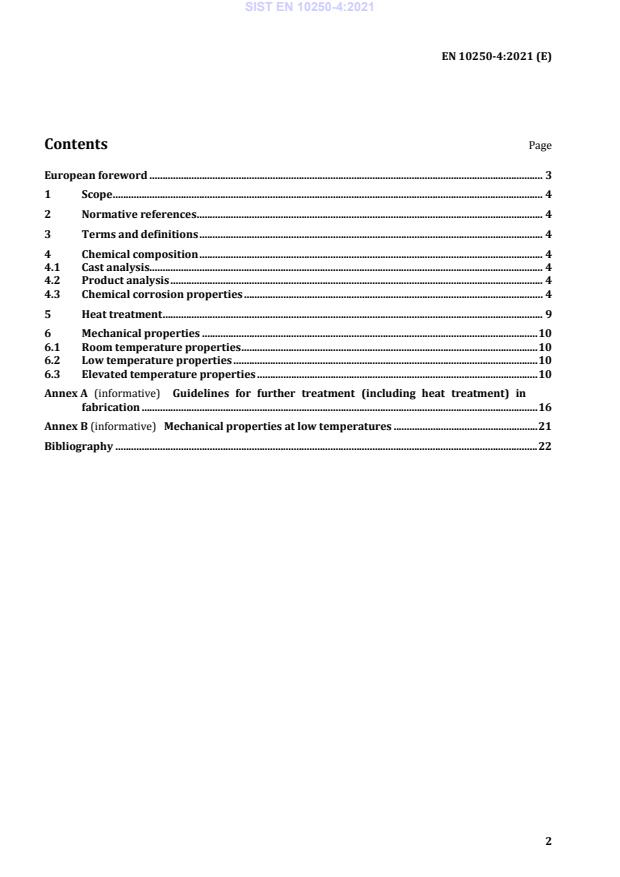
Contents Page
European foreword . 3
1 Scope . 4
2 Normative references . 4
3 Terms and definitions . 4
4 Chemical composition . 4
4.1 Cast analysis . 4
4.2 Product analysis . 4
4.3 Chemical corrosion properties . 4
5 Heat treatment . 9
6 Mechanical properties . 10
6.1 Room temperature properties . 10
6.2 Low temperature properties . 10
6.3 Elevated temperature properties . 10
Annex A (informative) Guidelines for further treatment (including heat treatment) in
fabrication . 16
Annex B (informative) Mechanical properties at low temperatures . 21
Bibliography . 22
European foreword
This document (EN 10250-4:2021) has been prepared by Technical Committee CEN/TC 459/SC 11
“Steel castings and forgings”, the secretariat of which is held by AFNOR.
This European Standard shall be given the status of a national standard, either by publication of an
identical text or by endorsement, at the latest by November 2021, and conflicting national standards
shall be withdrawn at the latest by November 2021.
Attention is drawn to the possibility that some of the elements of this document may be the subject of
patent rights. CEN shall not be held responsible for identifying any or all such patent rights.
This document supersedes EN 10250-4:1999.
In comparison with the previous edition, the following technical modifications have been made:
— addition of EN 10028-7 after EN 10088-3 in the note of the Scope;
— removal of EN 10021 and EN 10088-3 from the Normative references;
— addition of Clause 3, Terms and definitions;
— restructuration of Clause 4, Chemical composition;
— introduction of three steel grades in Table 2: X1CrNi25-21, X1CrNiSi18–15–4 and
X2CrNiMnMoN25–18–6-5;
— alignment of silicon characteristics with EN 10088-3 in Table 4;
— addition of 2 columns on resistance to intergranular corrosion in Tables 6 and 7;
— introduction of footnotes in Tables of Annex A;
— deletion of Annex C, Elevated temperature proof strength.
The EN 10250 series, Open die steel forgings for general engineering purposes, consists of the following
parts:
— Part 1: General requirements;
— Part 2: Non-alloy quality and special steels;
— Part 3: Alloy special steels;
— Part 4: Stainless steels.
According to the CEN-CENELEC Internal Regulations, the national standards organisations of the
following countries are bound to implement this European Standard: Austria, Belgium, Bulgaria,
Croatia, Cyprus, Czech Republic, Denmark, Estonia, Finland, France, Germany, Greece, Hungary, Iceland,
Ireland, Italy, Latvia, Lithuania, Luxembourg, Malta, Netherlands, Norway, Poland, Portugal, Republic of
North Macedonia, Romania, Serbia, Slovakia, Slovenia, Spain, Sweden, Switzerland, Turkey and the
United Kingdom.
1 Scope
This document specifies the technical delivery requirements for open die forgings, forged bars and
products pre-forged and finished in ring rolling mills, manufactured from stainless steels with ferritic,
martensitic, austenitic and austenitic-ferritic structures.
NOTE The majority of steels listed in this part of EN 10250 are identical to steels specified EN 10088-3 and
EN 10028-7, and more extensive information on properties is given in these European Standards.
General information on technical delivery conditions is given in EN 10021.
2 Normative references
The following documents are referred to in the text in such a way that some or all of their content
constitutes requirements of this document. For dated references, only the edition cited applies. For
undated references, the latest edition of the referenced document (including any amendments) applies.
EN 10250-1:1999, Open die steel forgings for general engineering purposes - Part 1: General requirements
3 Terms and definitions
No terms and definitions are listed in this document.
ISO and IEC maintain terminological databases for use in standardization at the following addresses:
• ISO Online browsing platform: available at https://www.iso.org/obp
• IEC Electropedia: available at https://www.electropedia.org/
4 Chemical composition
4.1 Cast analysis
The chemical composition of the steel shall be determined by cast analysis and shall conform to the
analysis given in Tables 1, 2 and 3 (see A.7, A.8, and A.11 of EN 10250-1:1999).
Elements not quoted in Tables 1, 2, and 3 shall not be added intentionally to the steel without the
agreement of the purchaser, except for the purpose of finishing the heat. All reasonable measures
should also be taken to prevent the addition from the scrap, or other material used in the manufacture
of the steel, of such elements which affect the corrosion resistance, mechanical properties and
applicability of the steel.
4.2 Product analysis
The product analysis shall not deviate from the specified cast analysis (see Tables 1, 2 and 3) by more
than the values specified in Table 4 (see 9.2 of EN 10250-1:1999).
4.3 Chemical corrosion properties
Referring to resistance to intergranular corrosion as defined in EN ISO 3651-2, for austenitic, austenitic-
ferritic and ferritic stainless steels the specifications in Tables 6 and 7 apply.
NOTE 1 EN ISO 3651-2 is not applicable for testing martensitic and precipitation hardening steels.
NOTE 2 The corrosion resistance of stainless steels is very dependent on the type of environment and can
therefore not always be clearly ascertained through laboratory tests. It is therefore advisable to draw on the
available experience of the use of the steels.
Table 1 — Steel grades and chemical composition - Ferritic and martensitic grades
Steel designation
C Si max Mn max P max S max Cr Mo Ni Others
% % % % % % % % %
Name Number
a
X6CrAl13 1.4002 ≤ 0,08 1,00 1,00 0,040 12,00 to 14,00 – – Al 0,10 to 0,30
0,030
a
X6Cr17 1.4016 ≤ 0,08 1,00 1,00 0,040 16,00 to 18,00 – – –
0,030
a
X12Cr13 1.4006 0,08 to 0,15 1,00 1,50 0,040 11,50 to 13,50 – ≤ 0,75 –
0,030
a
X20Cr13 1.4021 0,16 to 0,25 1,00 1,50 0,040 12,00 to 14,00 – – –
0,030
a
X30Cr13 1.4028 0,26 to 0,35 1,00 1,50 0,040 12,00 to 14,00 – – –
0,030
a
X17CrNi16–2 1.4057 0,12 to 0,22 1,00 1,50 0,040 15,00 to 17,00 – 1,50 to 2,50 –
0,030
X3CrNiMo13–4 1.4313 ≤ 0,05 0,70 1,50 0,040 0,015 12,00 to 14,00 0,30 to 0,70 3,50 to 4,50 N ≥ 0,020
a
X4CrNiMo16–5-1 1.4418 ≤ 0,06 0,70 1,50 0,040 15,00 to 17,00 0,80 to 1,50 4,00 to 6,00 N ≥ 0,020
0,030
Nb = 5xC to 0,45
a
X5CrNiCuNb16–4 1.4542 ≤ 0,07 0,70 1,50 0,040 15,00 to 17,00 ≤ 0,60 3,00 to 5,00 Cu = 3,00 to 5,00
0,030
a
For products to be machined a controlled sulfur content of 0,015 % to 0,030 % is recommended.
Table 2 — Steel grades and chemical composition - Austenitic grades
Steel designation C P
Si max Mn max S max N Cr Mo Ni Nb Ti Others
max max
% % % % % % % % % %
Name Number
% %
17,50 to
a
X2CrNi18–9 1.4307 0,030 1,00 2,00 0,045 ≤ 0,11 – 8,00 to 10,00 – – –
≤ 0,030
19,50
10,00 to
18,00 to
a
X2CrNi19–11 1.4306 0,030 1,00 2,00 0,045 ≤ 0,11 – – – –
0,030
b
20,00
12,00
0,12 to 17,00 to – – –
a
X2CrNiN18–10 1.4311 0,030 1,00 2,00 0,045 – 8,50 to 11,50
0,030
0,22 19,50
17,00 to – – –
a
X5CrNi18–10 1.4301 0,07 1,00 2,00 0,045 ≤ 0,11 – 8,00 to 10,50
0,030
19,50
9,00 to
17,00 to 5xC to
a
X6CrNiTi18–10 1.4541 0,08 1,00 2,00 0,045 – – – –
0,030
b
19,00 0,70
12,00
10,00 to
16,50 to 2,00 to
a
X2CrNiMo17–12–2 1.4404 0,030 1,00 2,00 0,045 ≤ 0,11 – – –
0,030
b
18,50 2,50
13,00
0,12 to 16,50 to 2,00 to 10,00 to
a
X2CrNiMoN17–11–2 1.4406 0,030 1,00 2,00 0,045 – – –
0,030
0,22 18,50 2,50 12,00
16,50 to 2,00 to 10,00 to
a
X5CrNiMo17–12–2 1.4401 0,07 1,00 2,00 0,045 ≤ 0,11 – – –
0,030
18,50 2,50 13,00
10,50 to
16,50 to 2,00 to 5xC to
a
X6CrNiMoTi17–12–2 1.4571 0,08 1,00 2,00 0,045 – – –
0,030
b
18,50 2,50 0,70
13,50
0,12 to 16,50 to 2,50 to 11,00 to
X2CrNiMoN17–13–3 1.4429 0,030 1,00 2,00 0,045 0,015 – – –
0,22 18,50 3,00 14,00b
10,50 to
16,50 to 2,50 to
a
X3CrNiMo17–13–3 1.4436 0,05 1,00 2,00 0,045 ≤ 0,11 – – –
0,030
b
18,50 3,00
13,00
17,00 to 2,50 to 12,50 to
a
X2CrNiMo18–14–3 1.4435 0,030 1,00 2,00 0,045 ≤ 0,11 – – –
0,030
19,00 3,00 15,00
Steel designation C P
Si max Mn max S max N Cr Mo Ni Nb Ti Others
max max
% % % % % % % % % %
Name Number
% %
19,00 to 4,00 to 24,00 to Cu 1,20 to
X1NiCrMoCu25–20–5 1.4539 0,020 0,70 2,00 0,030 0,010 ≤ 0,15 – –
21,00 5,00 26,00 2,00
20,00 to
24,00 to
X1CrNi25-21 1.4335 0,020 0,25 2,00 0,025 0,010 ≤ 0,11 0,20 – – –
26,00
22,00
9,00 to
17,00 to 10xC to
X6CrNiNb18–10 1.4550 0,08 1,00 2,00 0,045 0,015 – – – –
b
19,00 1,00
12,00
3,7 to 16,5 to
X1CrNiSi18–15–4 1.4361 0,015 2,00 0,025 0,010 ≤ 0,10 0,20 14,0 to 16,0 – – –
4,5 18,5
26,00 to 3,00 to 30,00 to Cu 0,70 to
X1NiCrMoCu31–27–4 1.4563 0,020 0,70 2,00 0,030 ≤ 0,010 ≤ 0,11 – –
28,00 4,00 32,00 1,50
0,18 to 19,50 to 6,00 to 17,500 to Cu 0,50 to
X1CrNiMoCuN20–18–7 1.4547 0,020 0,70 1,00 0,030 0,010 – –
0,25 20,50 7,00 18,50 1,00
5,00 to 0,30 to 24,00 to 4,00 to 16,00 to
X2CrNiMnMoN25–18–6-5 1.4565 0,030 1,00 0,030 0,015 ≤ 0,15 – –
7,00 0,60 26,00 5,00 19,00
0,15 to 19,00 to 6,00 to 24,00 to
X1NiMoCuN25–20–7 1.4529 0,020 0,50 1,00 0,030 0,010 – – –
0,25 21,00 7,00 26,00
a
For products to be machined a controlled sulfur content of 0,015 % to 0,030 % is recommended.
b
Where for special reasons, e.g. hot workability for fabrication where it is necessary to minimize the delta ferrite content, or with the aim of low permeability, the maximum Ni
content may be increased by the following amounts:
– 0,50 %: 1.4571
– 1,00 %: 1.4306, 1.4429, 1.4436, 1.4541, 1.4550
– 1,50 %: 1.4404
Table 3 — Steel grades and chemical composition - Austenitic-ferritic grades
C Si Mn P S
Steel designation N Cr Mo Ni Others
max max max max max
Name Number % % % % % % % % % %
Cu 0,10 to
X2CrNiN23–4 1.4362 0,030 1,00 2,00 0,035 0,015 0,05 to 0,20 22,00 to 24,00 0,10 to 0,60 3,50 to 5,50
0,60
a
X3CrNiMoN27–5-2 1.4460 0,05 1,00 2,00 0,035 0,05 to 0,20 25,00 to 28,00 1,30 to 2,00 4,50 to 6,50 –
0,030
X2CrNiMoN22–5-3 1.4462 0,030 1,00 2,00 0,035 0,015 0,10 to 0,22 21,00 to 23,00 2,50 to 3,50 4,50 to 6,50 –
Cu 1,00 to
X2CrNiMoCuN25–6-3 1.4507 0,030 0,70 2,00 0,035 0,015 0,15 to 0,30 24,00 to 26,00 2,70 to 4,00 5,50 to 7,50
2,50
X2CrNiMoN25–7-4 1.4410 0,030 1,00 2,00 0,035 0,015 0,20 to 0,35 24,00 to 26,00 3,00 to 4,50 6,00 to 8,00 –
W 0,50 to
1,00
X2CrNiMoCuWN25–7-4 1.4501 0,030 1,00 1,00 0,035 0,015 0,20 to 0,30 24,00 to 26,00 3,00 to 4,00 6,00 to 8,00
Cu 0,50
...
Questions, Comments and Discussion
Ask us and Technical Secretary will try to provide an answer. You can facilitate discussion about the standard in here.
Loading comments...