

kSIST FprEN 280-1:2026
(Main)Mobile elevating work platforms - Part 1: Design calculations - Stability criteria - Construction - Safety - Examinations and tests
- Abstract
1.1 This document specifies safety requirements and measures for all types and sizes of mobile elevating work platform (MEWP, see 3.1) intended to move persons to working positions where they are carrying out work from the work platform (WP) with the intention that persons are getting on and off the work platform only at access positions at ground level or on the chassis
1.2 This document is applicable to the structural design calculations and stability criteria, construction, safety examinations and tests before MEWPs are first put into service. This document deals with all significant hazards, hazardous situations or hazardous events relevant to MEWPs, when it is used as intended and under conditions of misuse which are reasonably foreseeable by the manufacturer.
It does not cover the hazards arising from:
a) use in potentially explosive atmospheres;
b) work from the platform on or within the Minimum Approach Distances of external live electric systems;
c) use of compressed gases for load bearing components;
d) getting on and off the work platform at changing levels;
e) specific applications (e.g. railway, ships) covered by national or local regulations.
1.3 This document does not apply to:
a) machinery serving fixed landings (see e.g. EN 81 20:2020 and EN 81 50:2020, EN 12159:2024);
b) fire-fighting and fire rescue appliances (see e.g. EN 1777:2010);
c) unguided work cages suspended from lifting appliances (see e.g. EN 1808:2015);
d) elevating operator position on rail dependent storage and retrieval equipment (see EN 528:2021+A1:2022);
e) tail lifts (see EN 1756 1:2021 and EN 1756 2:2004+A1:2009);
f) mast climbing work platforms (see EN 1495:1997+A2:2009);
g) fairground equipment;
h) lifting tables (see EN 1570 1:2024 and EN 1570 2:2016);
i) aircraft ground support equipment (see e.g. EN 1915 1:2023 and EN 1915 2:2001+A1:2009);
j) elevating operator positions on industrial trucks (see EN ISO 3691 3:2016).
This document is not applicable to MEWPS manufactured before the date of its publication.
1.4 Classification of MEWPS:
MEWPs are divided into two main groups:
a) Group A: MEWPs where the vertical projection of the centre of the area of the platform in all platform configurations at the maximum chassis inclination indicated in the information for use is always inside the tipping lines.
b) Group B: All other MEWPs.
Relating to travelling, MEWPs are divided into three types:
1) Type 1: Travelling is only allowed with the MEWP in its transport position, or no travelling of the MEWP is possible due to only being moveable (3.1.3) by design;
2) Type 2: Travelling with lifted work platform is controlled from a point of control at the chassis;
3) Type 3: Travelling with lifted work platform is controlled from a point of control at the work platform.
NOTE Type 2 and type 3 can be combined.
- Status
- Not Published
- Public Enquiry End Date
- 12-Jan-2025
- Technical Committee
- DTN - Lift and transport appliances
- Current Stage
- 5020 - Formal vote (FV) (Adopted Project)
- Start Date
- 27-Jul-2026
- Due Date
- 14-Sep-2026
- Completion Date
- 29-Sep-2026

kSIST FprEN 280-1:2026 is the Slovenian adoption of the European standard prEN 280-1 for mobile elevating work platforms (MEWPs), published by SIST. It specifies design calculations, stability criteria, construction, safety requirements, examinations and tests for machines that move persons to working positions and let them get on and off only at access positions at ground level or on the chassis.
The introduction says this is a type C standard, so its machine-specific safety rules are intended to take precedence over type A and type B standards for MEWPs built to it.
What does kSIST FprEN 280-1:2026 specify?
kSIST FprEN 280-1:2026 sets safety requirements for all types and sizes of MEWPs intended to carry persons to a work platform. It covers structural design calculations, stability, construction, safety examinations and tests before first putting the machine into service.
The scope focuses on hazards that can be addressed by design and verification for intended use and reasonably foreseeable misuse. It excludes several specific hazard sources and machine families, so it is the right document for general MEWP design and conformity work, not for every access or lifting machine.
| Annex | What it covers |
|---|---|
| B | Use of MEWPs in wind speeds greater than 12.5 m/s |
| C | Dynamic factors in stability and structural calculations |
| D | Calculation of wire rope drive systems |
| E | Calculation example for wire rope drive systems |
| F | Calculation example for the z factor in kerb obstacle collision |
| G | Additional requirements for cableless controls and control systems |
| H | Dimensions of steps and ladders |
| I | Stress history parameters |
| K | Requirements for Performance Level d safety functions |
| L | Information on rescue procedure |
| M | Noise Test Code |
| ZA | Relationship with Regulation (EU) 2023/1230 |
In scope, MEWPs include machines that are propelled, moveable, or both. The document also notes that goods-handling machines fitted with work platforms as interchangeable equipment are regarded as MEWPs.
What are the key requirements of kSIST FprEN 280-1:2026?
The core of kSIST FprEN 280-1:2026 is in Clause 4, which turns MEWP safety into concrete design and control requirements. In practice, the manufacturer has to control overturning, unwanted motion, falling risk, crushing risk, electrical and hydraulic hazards, and the quality of the information given to the user.
Structural design and stability
Clause 4.2 requires structural and stability calculations for rated load, dead weights, wind loads, manual forces and special loads. That matters because the machine must be safe in the real operating envelope, not just in a nominal loading case.
Clause 4.2.4 and 4.2.5 use the calculated loads to check overturning and stabilizing moments and to verify structural strength. Annex C explains the reasoning behind the dynamic factors, and the document uses example working conditions such as lifting, travelling and slope operation to show how worst cases are considered.
Clause 4.4.1 adds methods to avoid overturning and exceeding permissible stresses, including load sensing systems, moment sensing systems, variable operating parameters and movement sequencing. For the designer, this means the control logic and envelope limits are part of the safety design, not just the metal structure.
Chassis, travelling and stabilizers
Clause 4.3 sets requirements for the chassis, stabilizers, braking, travel indicators, protection against unauthorized use and safe travel on slopes. Type 2 and type 3 MEWPs have extra travel-related controls and stability checks because the work platform can be raised while travelling.
Clause 4.3.2 addresses stabilizers and oscillating axles. If an axle can oscillate, the design has to control or lock that movement before the extending structure is deployed, so the machine does not shift into an unstable condition.
Extending structure and drive systems
Clause 4.4 and Clause 4.5 cover the extending structure and its drive systems. The standard separates general drive-system safety from the specific requirements for wire rope, chain, lead screw and rack-and-pinion drives.
In practice, that means the design must prevent inadvertent movement, include braking on all drives, and provide means for inspection and re-tensioning where applicable. For wire ropes and chains, the rules address drums, pulleys, terminations, slack detection and visual examination; for lead screws and rack and pinions, the focus is on strength, separation prevention and safe wear checking.
Annex D gives the calculation method for wire rope drive systems, and Annex E gives a worked example. That helps manufacturers size rope diameters and pulley diameters consistently instead of relying on local practice.
Work platform, access and fall protection
Clause 4.6 covers levelling, fall-off protection, access, hand protection, communication from the platform, transport protection, anchorages and exchangeable work platforms. This is the part that most directly affects operator safety at the work position.
The document requires fall-off protection at the platform and at access points, and it sets requirements for anchorages for personal fall protection systems. It also requires marking and design provisions for rescue-related and fall-protection use, so the platform can support the way people actually work at height.
Annex H gives the dimensions of steps and ladders. That matters for boarding and maintenance access, where awkward access is a common cause of slips and falls.
Controls, electrical and hydraulic systems
Clause 4.7 sets requirements for controls, including direction of movement, control positions, emergency stop, prevention of unexpected movements, auxiliary recovery and overriding. Type 2 and type 3 travel controls are treated separately because travel while elevated creates higher risk.
Clause 4.8 and Clause 4.9 cover electrical equipment and hydraulic systems. The machine has to use suitable electrical equipment, protect batteries, resist water ingress where needed, limit hydraulic pressure, vent trapped air and keep hose connections and fluid cleanliness under control.
Clause 4.10 covers hydraulic cylinders, and Clause 4.11 covers safety functions. Annex K adds detailed requirements for Performance Level d safety functions, including validation and inspection expectations for unmonitored non-electrical parts in certain architectures.
Verification, tests and information for use
Clause 5 requires design checks, manufacturing checks and tests. Type tests apply to the first machine of a new design or a design with significant changes, and tests before placing on the market include brake tests, overload tests and functional tests.
The stability test and the dynamic tests are especially important for type 2 and type 3 MEWPs. They check that the machine remains stable under the intended worst cases, including kerb and depression conditions, and that braking stops the machine without overturning.
Clause 6 covers information for use and marking. In practice, the manufacturer has to provide operating instructions, transport and storage information, commissioning guidance, periodic examination instructions, maintenance information, and permanent markings on the machine and work platform.
Annex M adds the Noise Test Code. That supports noise measurement, declaration and verification, which matters for risk assessment and for comparing machine noise at the design stage.
What terms does kSIST FprEN 280-1:2026 define?
The document defines the main machine classes and safety concepts used throughout the standard.
- MEWP - a mobile elevating work platform that is propelled, moveable, or both.
- EWP - an elevating work platform consisting at least of a work platform with controls, an extending structure and a chassis.
- Work platform - a fenced platform or cage that carries people, tools and materials to the working position.
- Extending structure - the structure between chassis and work platform that moves the platform to position, such as a boom, ladder or scissors mechanism.
- Group A - a MEWP whose platform centre stays inside the tipping lines at the maximum chassis inclination stated for use.
- Group B - any MEWP that is not Group A.
- Type 2 - a MEWP that travels with the lifted work platform, with travel controlled from the chassis.
- Type 3 - a MEWP that travels with the lifted work platform, with travel controlled from the work platform.
- Load sensing system - a system that monitors the vertical load and vertical forces on the work platform.
- CCS - a cableless control system with at least one remote station and one base station that transmit commands without a wired connection.
Who uses kSIST FprEN 280-1:2026?
kSIST FprEN 280-1:2026 is mainly used by MEWP manufacturers and design engineers. They use it to size structures, select drive systems, set stability limits, design controls and prepare the technical file for examinations and tests.
It is also used by test laboratories, conformity assessment bodies, market surveillance authorities, health and safety bodies, buyers, fleet managers and maintenance providers. In practice they use it to check whether a machine is suitable, how it should be inspected, what it must be marked with, and what information has to go into the instructions for use.
What changed in kSIST FprEN 280-1:2026 from the previous edition?
The foreword says this document supersedes EN 280-1:2022. The listed changes include:
- clarified definition of travelling
- new definitions of lowered travel position, Safety function and Elevated travel position
- amended and specified requirements for the load sensing system
- amended requirements for manual adjustment of the work platform above 5°
- rewritten hand-protection requirements for different MEWP types
- a new restriction for travelling controls when the work platform is outside the lowered travel position and/or transport position
- restructured and amended depression tests for type 2 and type 3 MEWPs
- a fully revised Annex F example for the dynamic factor z in kerb obstacle collision
- an updated Annex ZA aligned with the new CEN-Guide 414:2017
- editorial changes for clarity
Which standards are used with kSIST FprEN 280-1:2026?
The normative references provide the detailed methods and component requirements that this MEWP standard builds on.
| Reference | What it contributes |
|---|---|
| EN 12385-4 | Safety requirements for stranded steel wire ropes |
| EN 13001-3-1, EN 13001-3-6 | Steel structure and hydraulic cylinder design competence |
| EN 14033-1 to -4, EN 15746-1 to -2, EN 15954-1 to -2, EN 15955-1 to -2 | Railway-machine running, travelling, working and general safety requirements |
| EN 61310-1 | Visual, acoustic and tactile signals |
| EN 60204-1 | Electrical equipment of machines |
| EN 60529 | Degrees of protection of enclosures (IP code) |
| EN IEC 62061 | Functional safety of safety-related control systems |
| EN 62745 | Cableless control systems |
| EN ISO 3744, EN ISO 11201, EN ISO 4871, EN ISO 11688-1 | Noise measurement, declaration and low-noise design |
| EN ISO 12100 | Risk assessment and risk reduction |
| EN ISO 13849-1 | Safety-related parts of control systems |
| EN ISO 13850 | Emergency stop function |
| EN ISO 13854 | Minimum gaps to avoid crushing |
| ISO 4305 | Stability determination |
| ISO 4309 | Wire rope care, inspection and discard |
What does the kSIST FprEN 280-1:2026 document contain?
The document contains the main MEWP safety requirements, then the verification methods that prove those requirements are met. It includes calculation clauses, test clauses, and information-for-use clauses, supported by figures, load cases and inspection points.
Several annexes provide the detailed technical material that is too specific for the main clauses. These include calculation methods and worked examples for stability and wire rope drives, a kerb-collision example for the z factor, a noise test code, cableless-control rules, step and ladder dimensions, stress-history guidance, rescue information and the legal correspondence table for Regulation (EU) 2023/1230.
Relations
- Effective Date
- 06-Jul-2022
Frequently Asked Questions
kSIST FprEN 280-1:2026 is a draft published by the Slovenian Institute for Standardization (SIST). Its full title is "Mobile elevating work platforms - Part 1: Design calculations - Stability criteria - Construction - Safety - Examinations and tests". This standard covers: 1.1 This document specifies safety requirements and measures for all types and sizes of mobile elevating work platform (MEWP, see 3.1) intended to move persons to working positions where they are carrying out work from the work platform (WP) with the intention that persons are getting on and off the work platform only at access positions at ground level or on the chassis 1.2 This document is applicable to the structural design calculations and stability criteria, construction, safety examinations and tests before MEWPs are first put into service. This document deals with all significant hazards, hazardous situations or hazardous events relevant to MEWPs, when it is used as intended and under conditions of misuse which are reasonably foreseeable by the manufacturer. It does not cover the hazards arising from: a) use in potentially explosive atmospheres; b) work from the platform on or within the Minimum Approach Distances of external live electric systems; c) use of compressed gases for load bearing components; d) getting on and off the work platform at changing levels; e) specific applications (e.g. railway, ships) covered by national or local regulations. 1.3 This document does not apply to: a) machinery serving fixed landings (see e.g. EN 81 20:2020 and EN 81 50:2020, EN 12159:2024); b) fire-fighting and fire rescue appliances (see e.g. EN 1777:2010); c) unguided work cages suspended from lifting appliances (see e.g. EN 1808:2015); d) elevating operator position on rail dependent storage and retrieval equipment (see EN 528:2021+A1:2022); e) tail lifts (see EN 1756 1:2021 and EN 1756 2:2004+A1:2009); f) mast climbing work platforms (see EN 1495:1997+A2:2009); g) fairground equipment; h) lifting tables (see EN 1570 1:2024 and EN 1570 2:2016); i) aircraft ground support equipment (see e.g. EN 1915 1:2023 and EN 1915 2:2001+A1:2009); j) elevating operator positions on industrial trucks (see EN ISO 3691 3:2016). This document is not applicable to MEWPS manufactured before the date of its publication. 1.4 Classification of MEWPS: MEWPs are divided into two main groups: a) Group A: MEWPs where the vertical projection of the centre of the area of the platform in all platform configurations at the maximum chassis inclination indicated in the information for use is always inside the tipping lines. b) Group B: All other MEWPs. Relating to travelling, MEWPs are divided into three types: 1) Type 1: Travelling is only allowed with the MEWP in its transport position, or no travelling of the MEWP is possible due to only being moveable (3.1.3) by design; 2) Type 2: Travelling with lifted work platform is controlled from a point of control at the chassis; 3) Type 3: Travelling with lifted work platform is controlled from a point of control at the work platform. NOTE Type 2 and type 3 can be combined.
1.1 This document specifies safety requirements and measures for all types and sizes of mobile elevating work platform (MEWP, see 3.1) intended to move persons to working positions where they are carrying out work from the work platform (WP) with the intention that persons are getting on and off the work platform only at access positions at ground level or on the chassis 1.2 This document is applicable to the structural design calculations and stability criteria, construction, safety examinations and tests before MEWPs are first put into service. This document deals with all significant hazards, hazardous situations or hazardous events relevant to MEWPs, when it is used as intended and under conditions of misuse which are reasonably foreseeable by the manufacturer. It does not cover the hazards arising from: a) use in potentially explosive atmospheres; b) work from the platform on or within the Minimum Approach Distances of external live electric systems; c) use of compressed gases for load bearing components; d) getting on and off the work platform at changing levels; e) specific applications (e.g. railway, ships) covered by national or local regulations. 1.3 This document does not apply to: a) machinery serving fixed landings (see e.g. EN 81 20:2020 and EN 81 50:2020, EN 12159:2024); b) fire-fighting and fire rescue appliances (see e.g. EN 1777:2010); c) unguided work cages suspended from lifting appliances (see e.g. EN 1808:2015); d) elevating operator position on rail dependent storage and retrieval equipment (see EN 528:2021+A1:2022); e) tail lifts (see EN 1756 1:2021 and EN 1756 2:2004+A1:2009); f) mast climbing work platforms (see EN 1495:1997+A2:2009); g) fairground equipment; h) lifting tables (see EN 1570 1:2024 and EN 1570 2:2016); i) aircraft ground support equipment (see e.g. EN 1915 1:2023 and EN 1915 2:2001+A1:2009); j) elevating operator positions on industrial trucks (see EN ISO 3691 3:2016). This document is not applicable to MEWPS manufactured before the date of its publication. 1.4 Classification of MEWPS: MEWPs are divided into two main groups: a) Group A: MEWPs where the vertical projection of the centre of the area of the platform in all platform configurations at the maximum chassis inclination indicated in the information for use is always inside the tipping lines. b) Group B: All other MEWPs. Relating to travelling, MEWPs are divided into three types: 1) Type 1: Travelling is only allowed with the MEWP in its transport position, or no travelling of the MEWP is possible due to only being moveable (3.1.3) by design; 2) Type 2: Travelling with lifted work platform is controlled from a point of control at the chassis; 3) Type 3: Travelling with lifted work platform is controlled from a point of control at the work platform. NOTE Type 2 and type 3 can be combined.
kSIST FprEN 280-1:2026 is classified under the following ICS (International Classification for Standards) categories: 53.020.99 - Other lifting equipment. The ICS classification helps identify the subject area and facilitates finding related standards.
kSIST FprEN 280-1:2026 has the following relationships with other standards: It is inter standard links to SIST EN 280-1:2022. Understanding these relationships helps ensure you are using the most current and applicable version of the standard.
kSIST FprEN 280-1:2026 is associated with the following European legislation: EU Directives/Regulations: 2006/42/EC, 2023/1230, 2023/1230, 2023/1230; Standardization Mandates: M/396, M/605. When a standard is cited in the Official Journal of the European Union, products manufactured in conformity with it benefit from a presumption of conformity with the essential requirements of the corresponding EU directive or regulation.
kSIST FprEN 280-1:2026 is available in PDF format for immediate download after purchase. The document can be added to your cart and obtained through the secure checkout process. Digital delivery ensures instant access to the complete standard document.
Standards Content (Sample)
SLOVENSKI STANDARD
oSIST prEN 280-1:2025
01-januar-2025
Premične dvižne delovne ploščadi - 1. del: Konstrukcijski izračuni - Merila
stabilnosti - Konstrukcijska izvedba - Varnost - Pregledi in preskusi
Mobile elevating work platforms - Part 1: Design calculations - Stability criteria -
Construction - Safety - Examinations and tests
Fahrbare Hubarbeitsbühnen - Teil 1: Berechnung - Standsicherheit - Bau - Sicherheit -
Prüfungen
Plates-formes élévatrices mobiles de personnel - Partie 1: Calculs de conception -
Critères de stabilité - Construction - Sécurité - Examens et essais
Ta slovenski standard je istoveten z: prEN 280-1
ICS:
53.020.99 Druga dvigalna oprema Other lifting equipment
oSIST prEN 280-1:2025 en,fr,de
2003-01.Slovenski inštitut za standardizacijo. Razmnoževanje celote ali delov tega standarda ni dovoljeno.
oSIST prEN 280-1:2025
oSIST prEN 280-1:2025
DRAFT
EUROPEAN STANDARD
prEN 280-1
NORME EUROPÉENNE
EUROPÄISCHE NORM
October 2024
ICS 53.020.99 Will supersede EN 280-1:2022
English Version
Mobile elevating work platforms - Part 1: Design
calculations - Stability criteria - Construction - Safety -
Examinations and tests
Plates-formes élévatrices mobiles de personnel - Partie Fahrbare Hubarbeitsbühnen - Teil 1: Berechnung -
1: Calculs de conception - Critères de stabilité - Standsicherheit - Bau - Sicherheit - Prüfungen
Construction - Sécurité - Examens et essais
This draft European Standard is submitted to CEN members for enquiry. It has been drawn up by the Technical Committee
CEN/TC 98.
If this draft becomes a European Standard, CEN members are bound to comply with the CEN/CENELEC Internal Regulations
which stipulate the conditions for giving this European Standard the status of a national standard without any alteration.
This draft European Standard was established by CEN in three official versions (English, French, German). A version in any other
language made by translation under the responsibility of a CEN member into its own language and notified to the CEN-CENELEC
Management Centre has the same status as the official versions.
CEN members are the national standards bodies of Austria, Belgium, Bulgaria, Croatia, Cyprus, Czech Republic, Denmark, Estonia,
Finland, France, Germany, Greece, Hungary, Iceland, Ireland, Italy, Latvia, Lithuania, Luxembourg, Malta, Netherlands, Norway,
Poland, Portugal, Republic of North Macedonia, Romania, Serbia, Slovakia, Slovenia, Spain, Sweden, Switzerland, Türkiye and
United Kingdom.
Recipients of this draft are invited to submit, with their comments, notification of any relevant patent rights of which they are
aware and to provide supporting documentation.
Warning : This document is not a European Standard. It is distributed for review and comments. It is subject to change without
notice and shall not be referred to as a European Standard.
EUROPEAN COMMITTEE FOR STANDARDIZATION
COMITÉ EUROPÉEN DE NO R M A L I S A T IO N
EUROPÄISCHES KOMITEE FÜR NORMUN G
CEN-CENELEC Management Centre: Rue de la Science 23, B-1040 Brussels
© 2024 CEN All rights of exploitation in any form and by any means reserved Ref. No. prEN 280-1:2024 E
worldwide for CEN national Members.
oSIST prEN 280-1:2025
prEN 280-1:2024 (E)
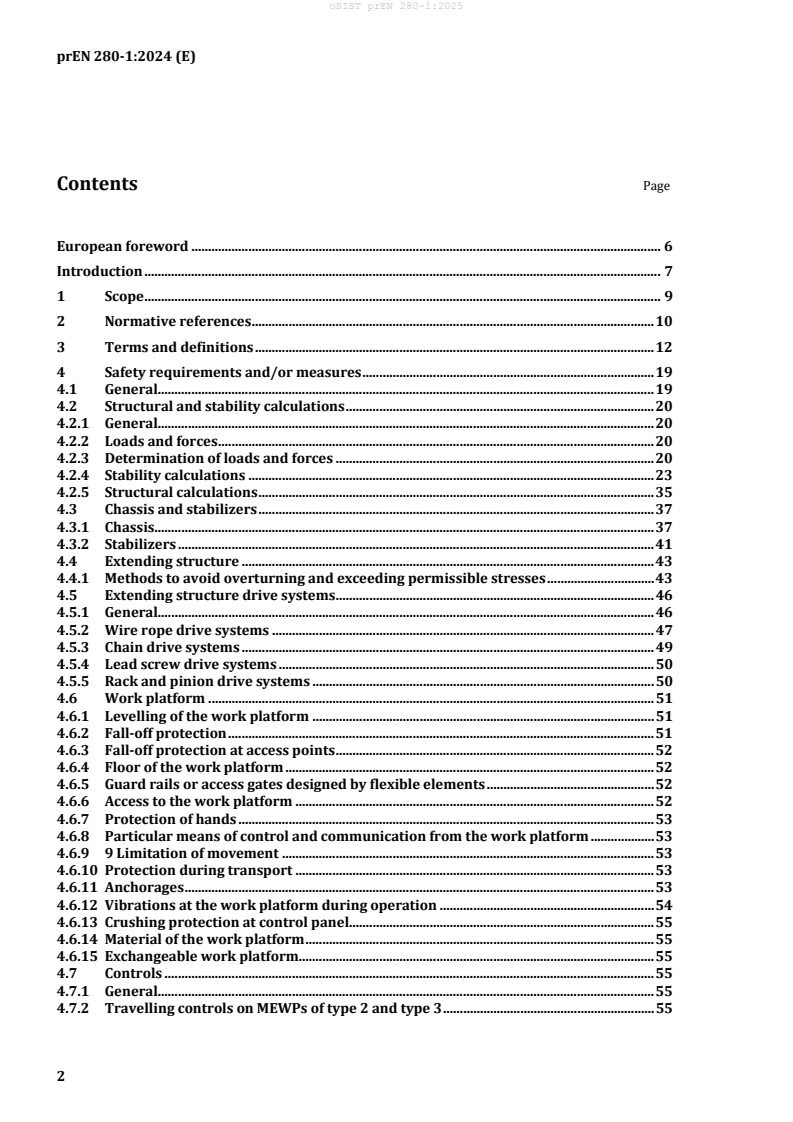
Contents Page
European foreword . 6
Introduction . 7
1 Scope . 9
2 Normative references . 10
3 Terms and definitions . 12
4 Safety requirements and/or measures . 19
4.1 General. 19
4.2 Structural and stability calculations . 20
4.2.1 General. 20
4.2.2 Loads and forces . 20
4.2.3 Determination of loads and forces . 20
4.2.4 Stability calculations . 23
4.2.5 Structural calculations . 35
4.3 Chassis and stabilizers . 37
4.3.1 Chassis. 37
4.3.2 Stabilizers . 41
4.4 Extending structure . 43
4.4.1 Methods to avoid overturning and exceeding permissible stresses . 43
4.5 Extending structure drive systems . 46
4.5.1 General. 46
4.5.2 Wire rope drive systems . 47
4.5.3 Chain drive systems . 49
4.5.4 Lead screw drive systems . 50
4.5.5 Rack and pinion drive systems . 50
4.6 Work platform . 51
4.6.1 Levelling of the work platform . 51
4.6.2 Fall-off protection . 51
4.6.3 Fall-off protection at access points . 52
4.6.4 Floor of the work platform . 52
4.6.5 Guard rails or access gates designed by flexible elements . 52
4.6.6 Access to the work platform . 52
4.6.7 Protection of hands . 53
4.6.8 Particular means of control and communication from the work platform . 53
4.6.9 9 Limitation of movement . 53
4.6.10 Protection during transport . 53
4.6.11 Anchorages . 53
4.6.12 Vibrations at the work platform during operation . 54
4.6.13 Crushing protection at control panel . 55
4.6.14 Material of the work platform . 55
4.6.15 Exchangeable work platform. 55
4.7 Controls . 55
4.7.1 General. 55
4.7.2 Travelling controls on MEWPs of type 2 and type 3 . 55
oSIST prEN 280-1:2025
prEN 280-1:2024 (E)
4.7.3 Direction of movement . 56
4.7.4 Control positions. 56
4.7.5 Emergency stop . 56
4.7.6 Pilot and solenoid operated control valves . 56
4.7.7 Prevention of unexpected movements . 56
4.7.8 Auxiliary recovery . 56
4.7.9 Overriding . 57
4.8 Electrical equipment . 57
4.9 Hydraulic systems . 58
4.10 Hydraulic cylinders . 60
4.10.1 Structural design. 60
4.10.2 Load holding function . 64
4.11 Safety functions . 64
4.12 Noise . 67
4.12.1 General . 67
4.12.2 Noise determination and declaration . 67
5 Verification of the safety requirements and/or measures . 68
5.1 Examinations and tests . 68
5.1.1 General . 68
5.1.2 Design check . 68
5.1.3 Manufacturing check . 68
5.1.4 Tests . 69
5.2 Type tests of MEWPs . 77
5.3 Tests before placing on the market . 77
6 Information for use . 77
6.1 Accompanying documents . 77
6.1.1 Information . 77
6.1.2 Record provisions . 81
6.2 Marking . 81
Annex A (informative) List of significant hazards . 84
Annex B (informative) Use of MEWPs in wind speeds greater than 12,5 m/s (Beaufort-Scale)
................................................................................................................................................................... 88
Annex C (informative) Dynamic factors in stability and structural calculations . 89
C.1 Stability calculations . 89
C.2 Structural calculations . 90
Annex D (normative) Calculation of wire rope drive systems. 91
D.1 General . 91
D.2 Calculation of wire rope drive systems . 91
D.3 Calculation of rope diameters (coefficient c) . 92
D.4 Calculation of the diameters of rope drums, rope pulleys and compensating pulleys
[coefficient (h1 · h2)] . 93
D.5 Efficiency of wire rope drive systems . 97
Annex E (informative) Calculation example — Wire rope drive systems . 99
E.1 Method used to determine the coefficients and ratios used for 4.5.2 (wire rope drive
systems) using the load cycle figures in 4.2.5.3 and operating speeds in 4.4.5 . 99
oSIST prEN 280-1:2025
prEN 280-1:2024 (E)
E.1.1 General. 99
E.1.2 Notes . 99
E.1.3 Annex D (normative) method summarized . 99
E.1.4 Calculation example . 100
E.1.4.1 General. 100
E.1.4.2 Mode of operation (drive group) (see E.2 and Table E.1) . 100
E.1.4.3 Calculation of minimum rope diameter (see D.3) . 102
E.1.4.4 Working coefficients . 102
E.2 Calculation of the diameters of rope drums, pulleys and static pulleys . 102
Annex F (informative) Calculation example – z factor, kerb obstacle collision . 105
Annex G (normative) Additional requirements for cableless controls and control systems
................................................................................................................................................................ 108
G.1 General. 108
G.2 Control limitation . 108
G.3 Stop . 108
G.4 Indications . 108
G.5 Remote station and base station . 108
Annex H (normative) Dimensions of steps and ladders . 110
Annex I (informative) Stress history parameters . 112
I.1 Introduction . 112
I.2 Guidance for selection of S class . 112
I.3 Stress history parameters . 113
I.3.1 General procedure . 113
I.3.2 Direct calculation of stress history class . 116
I.3.3 Simplified method to determine stress history class . 117
Annex J (informative) Fatigue assessment: Relationship between S classes in
EN 13001-3-1:2012+A2:2018 and B groups in DIN 15018 . 118
Annex K (normative) Requirements for Performance Level d safety functions . 119
K.1 General. 119
K.1.1 Introduction . 119
K.1.2 Performance Level d safety functions utilizing category 2 architecture . 119
K.1.3 Performance Level d safety functions implemented by SIL 2 functions with a
hardware fault tolerance of zero . 120
K.2 Requirements for unmonitored non-electrical parts of category 3 architectures . 120
Annex L (informative) Information on rescue procedure . 121
Annex M (normative) Noise Test Code . 122
M.1 General. 122
oSIST prEN 280-1:2025
prEN 280-1:2024 (E)
M.2 Emission sound pressure level determination . 122
M.2.1 General . 122
M.2.2 Uncertainty . 123
M.3 Sound power level determination . 124
M.3.1 Measurement surface . 124
M.3.2 Sound Power Level Calculation (LwA) [dB] . 124
M.3.3 Uncertainty . 124
M.4 Installation and mounting conditions . 125
M.5 Operating conditions . 125
Annex ZA (informative) Relationship between this European Standard and the essential
requirements of Regulation (EU) 2023/1230 aimed to be covered . 126
Bibliography . 132
oSIST prEN 280-1:2025
prEN 280-1:2024 (E)
European foreword
This document (prEN 280-1:2024) has been prepared by Technical Committee CEN/TC 98 “Lifting
platforms”, the secretariat of which is held by DIN.
This document is currently submitted to the CEN Enquiry.
This document will supersede EN 280-1:2022.
This document includes the following major changes with respect to EN 280-1:2022:
— 3.12: definition of “travelling” has been specified;
— 3.32: new definition of “lowered travel position”;
— 3.30: new definition of “Safety function”;
— 3.31: new definition “Elevated travel position”;
— 4.4.1.2: requirements for the load sensing system were amended and specified;
— 4.6.1: requirements for manual adjustment of the work platform exceeding 5° was amended;
— 4.6.9: protection of hands was totally reworded with regard to different requirements for the
different types of MEWPs;
— 4.7.2: the restriction was added: “when the work platform is out of the lowered travel position and/or
transport position;
— 5.1.4.2.2.2: depression tests for MEWPs of type 2 and 3 was restructured and amended;
— Annex F (informative): the calculation example for the dynamic factor “z” for kerb obstacle collisions
was totally revised;
— Annex ZA: Adoption of the annex to new CEN-Guide 414:2017.
Various editorial changes were made for better reading and understanding of the document.
This document has been prepared under a standardization request addressed to CEN by the European
Commission. The Standing Committee of the EFTA States subsequently approves these requests for its
Member States.
For the relationship with EU Legislation, see informative Annex ZA, which is an integral part of this
document.
oSIST prEN 280-1:2025
prEN 280-1:2024 (E)
Introduction
This document is a type C standard as stated in EN ISO 12100:2010.
This document is a type-C standard as stated in EN ISO 12100.
This document is of relevance, in particular, for the following stakeholder groups representing the market
players with regard to machinery safety:
— machine manufacturers (small, medium and large enterprises);
— health and safety bodies (regulators, accident prevention organizations, market surveillance etc.).
Others can be affected by the level of machinery safety achieved with the means of the document by the
above-mentioned stakeholder groups:
— machine users/employers (small, medium and large enterprises);
— machine users/employees (e.g. trade unions, organizations for people with special needs);
— service providers, e.g. for maintenance (small, medium and large enterprises);
— consumers (in case of machinery intended for use by consumers).
The above-mentioned stakeholder groups have been given the possibility to participate at the drafting
process of this document.
The machinery concerned and the extent to which hazards, hazardous situations or hazardous events are
covered are indicated in the Scope of this document.
When requirements of this type-C standard are different from those which are stated in type-A or type-B
standards, the requirements of this type-C standard take precedence over the requirements of the other
standards for machines that have been designed and built according to the requirements of this type-C
standard.”
The object of this document is to define rules for safeguarding persons and objects against the risk of
accidents associated with the operation of Mobile Elevating Work Platforms (MEWPs).
— This document does not repeat all the general technical rules applicable to every electrical,
mechanical or structural component.
— The safety requirements of this document have been drawn up on the basis that MEWPs are
periodically maintained according to manufacturers' instructions, working conditions, frequency of
use and national regulations.
It is assumed that MEWPs are used only by qualified and trained operators.
It is also assumed that MEWPs are checked for function daily by the operator before start of work and
are not put into operation unless all required control and safety functions are available and in working
order.
It is assumed, if a MEWP is seldom used, the checks are carried out before start of work.
— As far as possible this document sets out only the requirements that materials and equipment need
to meet in the interest of safety, and it is assumed that persons operating MEWPs are adequately
trained.
oSIST prEN 280-1:2025
prEN 280-1:2024 (E)
— Where for clarity an example of a safety measure is given in the text, this does not need to be
considered as the only possible solution. Any other solution leading to the same risk reduction is
permissible if an equivalent level of safety is achieved.
— As no satisfactory explanation could be found for the dynamic factors used for stability calculations
in previous national standards, the results of the tests carried out by the former CEN/TC 98/WG 1 to
determine a suitable factor and stability calculation method for MEWPs have been adopted. The test
method is described in Annex C (informative) as a guide for manufacturers wishing to use higher or
lower operating speeds and to take advantage of developments in control systems.
Similarly, to avoid the unexplained inconsistencies in coefficients of utilization for wire ropes found in
other standards for lifting devices, appropriate extracts of the widely accepted standard DIN 15020-1
have been taken into 4.5.2 and Annex D (normative) with a worked example in Annex E (informative).
oSIST prEN 280-1:2025
prEN 280-1:2024 (E)
1 Scope
1.1 This document specifies safety requirements and measures for all types and sizes of Mobile
Elevating Work Platform (MEWP, see 3.1) intended to move persons to working positions where they are
carrying out work from the work platform (WP) with the intention that persons are getting on and off the
work platform only at access positions at ground level or on the chassis
NOTE Machines designed for the handling of goods such as a variable reach truck which are equipped with
work platforms as interchangeable equipment are regarded as MEWPs.
1.2 This document is applicable to the structural design calculations and stability criteria, construction,
safety examinations and tests before MEWPs are first put into service. It identifies the hazards arising
from the use of MEWPs and describes methods for the elimination or reduction of these hazards.
It does not cover the hazards arising from:
a) use in potentially explosive atmospheres;
b) work from the platform on external live electric systems;
c) use of compressed gases for load bearing components;
d) getting on and off the work platform at changing levels;
e) specific applications (e.g. railway, ships) covered by National or local regulations.
1.3 This document does not apply to:
a) machinery serving fixed landings (see e.g. EN 81-20:2020 and EN 81-50:2020, EN 12159:2024);
b) fire-fighting and fire rescue appliances (see e.g. EN 1777:2010);
c) unguided work cages suspended from lifting appliances (see e.g. EN 1808:2015);
d) elevating operator position on rail dependent storage and retrieval equipment (see
EN 528:2021+A1:2022);
e) tail lifts (see EN 1756-1:2021 and EN 1756-2:2004+A1:2009);
f) mast climbing work platforms (see EN 1495:1997+A2:2009);
g) fairground equipment;
h) lifting tables (see EN 1570-1:2024 and EN 1570-2:2016);
i) aircraft ground support equipment (see e.g. EN 1915-1:2023 and EN 1915-2:2001+A1:2009);
j) elevating operator positions on industrial trucks (see EN ISO 3691-3:2016).
1.4 Classification of MEWPS:
MEWPs are divided into two main groups:
a) Group A: MEWPs where the vertical projection of the centre of the area of the platform in all platform
configurations at the maximum chassis inclination indicated in the information for use is always
inside the tipping lines.
oSIST prEN 280-1:2025
prEN 280-1:2024 (E)
b) Group B: All other MEWPs.
Relating to travelling, MEWPs are divided into three types:
1) Type 1: Travelling is only allowed with the MEWP in its transport position, or no travelling of the
MEWP is possible due to only being moveable (3.1.3) by design;
2) Type 2: Travelling with lifted work platform is controlled from a point of control at the chassis;
3) Type 3: Travelling with lifted work platform is controlled from a point of control at the work
platform.
NOTE Type 2 and type 3 can be combined.
2 Normative references
The following documents are referred to in the text in such a way that some or all of their content
constitutes requirements of this document. For dated references, only the edition cited applies. For
undated references, the latest edition of the referenced document (including any amendments) applies.
EN 12385-4:2002+A1:2008, Steel wire ropes - Safety - Part 4: Stranded ropes for general lifting
applications
EN 13001-3-1:2012+A2:2018, Cranes - General Design - Part 3-1: Limit States and proof competence of
steel structure
EN 13001-3-6:2018+A1:2021, Cranes - General design - Part 3-6: Limit states and proof of competence of
machinery - Hydraulic cylinders
EN 14033-1:2017, Railway applications - Track - Railbound construction and maintenance machines - Part
1: Technical requirements for running
EN 14033-2:2017, Railway applications - Track - Railbound construction and maintenance machines - Part
2: Technical requirements for travelling and working
EN 14033-3:2017, Railway applications - Track - Railbound construction and maintenance machines - Part
3: General safety requirements
EN 14033-4:2019, Railway applications - Track - Railbound construction and maintenance machines - Part
4: Technical requirements for running, travelling and working on urban rail
EN 15746-1:2020, Railway applications - Track - Road-rail machines and associated equipment - Part 1:
Technical requirements for travelling and working
EN 15746-2:2020, Railway applications - Track - Road-rail machines and associated equipment - Part 2:
General safety requirements
EN 15954-1:2013, Railway applications - Track - Trailers and associated equipment - Part 1: Technical
requirements for running and working
EN 15954-2:2013, Railway applications - Track - Trailers and associated equipment - Part 2: General safety
requirements
EN 15955-1:2013, Railway applications - Track - Demountable machines and associated equipment - Part
1: Technical requirements for running and working
oSIST prEN 280-1:2025
prEN 280-1:2024 (E)
EN 15955-2:2013, Railway applications - Track - Demountable machines and associated equipment - Part
2: General safety requirements
EN 61310-1:2008, Safety of machinery - Indication, marking and actuation - Part 1: Requirements for
visual, acoustic and tactile signals (IEC 61310-1:2007)
EN 60204-1:2018, Safety of machinery - Electrical equipment of machines - Part 1: General requirements
(IEC 60204-1:2016)
EN 60529:1991, Degrees of protection provided by enclosures (IP Code) (IEC 60529:1989+A2:2013)
EN IEC 62061:2021, Safety of machinery - Functional safety of safety-related electrical, electronic and
programmable electronic control systems (IEC 62061:2021)
EN 62745:2017, Safety of machinery – Requirements for cableless control systems of machinery
(IEC 62745:2017)
EN ISO 3744:2010, Acoustics - Determination of sound power levels and sound energy levels of noise sources
using sound pressure - Engineering methods for an essentially free field over a reflecting plane (ISO
3744:2010)
EN ISO 4871:2009, Acoustics - Declaration and verification of noise emission values of machinery and
equipment (ISO 4871:1996)
EN ISO 11201:2010, Acoustics - Noise emitted by machinery and equipment - Determination of emission
sound pressure levels at a work station and at other specified positions in an essentially free field over a
reflecting plane with negligible environmental corrections (ISO 11201:2010)
EN ISO 11688-1:2009, Acoustics - Recommended practice for the design of low-noise machinery and
equipment - Part 1: Planning (ISO/TR 11688-1:1995)
EN ISO 12100:2010, Safety of machinery - General principles for design - Risk assessment and risk reduction
(ISO 12100:2010)
EN ISO 13849-1:2023, Safety of machinery - Safety-related parts of control systems - Part 1: General
principles for design (ISO 13849-1:2023)
EN ISO 13850:2015, Safety of machinery - Emergency stop function - Principles for design (ISO 13850:2015)
EN ISO 13854:2019, Safety of machinery - Minimum gaps to avoid crushing of parts of the human body (ISO
13854:2017)
ISO 4305:2014, Mobile cranes - Determination of stability
ISO 4309:2017, Cranes — Wire ropes — Care and maintenance, inspection and discard
As impacted by EN 60529:1991/AC:1993-05, EN 60529:1991/A1:2000, EN 60529:1991/A2:2013,
EN 60529:1991/A2:2013/AC:2019-02 and EN 60529:1991/AC:2016-12.
As impacted by EN IEC 62061:2021/A1:2024.
As impacted by EN 62745:2017/A11:2020.
As impacted by ISO 4305:2014/A1:2016.
oSIST prEN 280-1:2025
prEN 280-1:2024 (E)
3 Terms and definitions
For the purposes of this document, the terms and definitions given in EN ISO 12100:2010 and the
following apply.
ISO and IEC maintain terminological databases for use in standardization at the following addresses:
— IEC Electropedia: available at https://www.electropedia.org/
— ISO Online browsing platform: available at https://www.iso.org/obp
3.1
mobile elevating work platform
MEWP
EWP that is either propelled, or moveable, or both
3.1.1
elevating work platform
EWP
machine that is intended to move persons to working positions where they are carrying out work from
the work platform with the intention that persons are getting on and off the work platform only at access
positions at ground level or on the chassis and which consists as a minimum of a work platform with
controls, an extending structure and a chassis
3.1.2
propelled
intended to perform changes of location along the ground by integrated mobility devices following a
surface
Note 1 to entry: Mobility is independent from the nature of the propulsion, whether self-propelled, pulled or pushed.
Note 2 to entry: Integrated mobility devices include for example wheels, tracks, casters, and air cushion systems
3.1.3
moveable
intended to be relocated by external means, through the use of integrated moving points, from one
location to another, where no re-build or commissioning is required after relocation
Note 1 to entry: Integrated moving points include for example lifting points, lugs, and fork pockets
3.2
work platform
fenced platform or a cage which can be moved under load to the required working position and from
which erection, repair, inspection or similar work can be carried out
Note 1 to entry: See Figure 1.
3.3
work platform levelling system
system to maintain the level of the work platform within a specified tilting angle
oSIST prEN 280-1:2025
prEN 280-1:2024 (E)
3.4
extending structure
structure which is connected to the chassis and supports the work platform and which allows movement
of the work platform to its required position
Note 1 to entry: See Figure 1.
Note 2 to entry: It can, for example, be a single or a telescoping or an articulating boom or ladder, or a scissors
mechanism or any combination of them, and can or cannot slew on the base.
3.5
chassis
base of the MEWP, which can contain integrated mobility devices and/or integrated moving points
Note 1 to entry: Integrated mobility devices include for example wheels, tracks, casters, and air cushion systems.
Note 2 to entry: Integrated moving points include for example lifting points, lugs, and fork pockets
Note 3 to entry: See Figure 1
3.6
stabilisers
devices and systems used to stabilise MEWPs by supporting and/or levelling the complete MEWP or the
extending structure, e.g. jacks, suspension locking devices, extending axles
Note 1 to entry: See Figure 1.
3.7
access position
position(s) to provide access to and from the work platform
Note 1 to entry: Access position and transport position can be identical.
3.8
transport
delivery of a MEWP to its place of use
3.9
transport position
configuration(s) of the MEWP prescribed by the manufacturer in which the MEWP is intended to be
transported
Note 1 to entry: Access position and transport position can be identical.
3.10
lowering
operations to move the work platform to a lower level
Note 1 to entry: See Figure 2.
3.11
lifting
operations to move the work platform to a higher level
Note 1 to entry: See Figure 2.
oSIST prEN 280-1:2025
prEN 280-1:2024 (E)
3.12
rotating
circular movement of the work platform about a vertical axis
Note 1 to entry: See Figure 2.
3.13
slewing
circular movement of the extending structure about a vertical axis
Note 1 to entry: See Figure 2.
3.14
travelling
movements of the chassis along the ground by integrated mobility devices following a surface, except
movements during transport
Note 1 to entry: See Figure 2.
3.15
vehicle mounted MEWP
MEWP where the chassis is a road vehicle, designed to be or to become EU type-approved for operation
on public roads, and where travelling controls are located within the cab of the vehicle
3.16
pedestrian controlled MEWP
MEWP where the controls for powered movement in the transport position are located so that they are
capable of being operated by a person walking close to the MEWP
3.17
self-propelled
able to perform travelling and transport with an integrated propulsion system
3.18
rated load
load for which the MEWP has been designed for normal operation and which is composed of persons,
tools and material acting vertically on the work platform
Note 1 to entry: A MEWP can have more than one rated load.
3.19
load cycle
cycle starting from the access position, carrying out work and returning to the access position
3.20
wire rope drive system
system that comprises one or more wire rope(s) running on rope drums and on or over rope pulleys as
well as any associated rope drums, rope pulleys and compensating pulleys
3.21
chain drive system
system that comprises one or more chain(s) running on chain sprockets and on or over chain pulleys as
well as any associated chain sprockets, chain pulleys and compensating pulleys
oSIST prEN 280-1:2025
prEN 280-1:2024 (E)
3.22
type test
test on the representative model of a new design or one incorporating significant changes to an existing
design, carried out by or on behalf of the manufacturer or their authorised representative
3.23
totally manually powered MEWP
MEWP with movement powered only by manual effort
3.24
rail mounted MEWP
MEWP where travelling is guided by rails
3.25
load sensing system
system of monitoring the vertical load and vertical forces on the work platform
Note 1 to entry: The system includes the measuring device(s), the way the measuring devices are incorporated in
the machinery and the signal processing system.
3.26
moment sensing system
system of monitoring the moment acting about the tipping line tending to overturn the MEWP
Note 1 to entry: The system includes the measuring device(s), the way the measuring devices are incorporated in
the machinery and the signal processing system.
3.27
cableless control
transmission of the machine operator's commands without any wired connection
3.28
cableless control system
CCS
system consisting of at least one remote station and one base station, which uses cableless control to
transmit commands between them
[SOURCE: EN 62745:2017 , 3.2]
3.29
self-revealing failure or fault
failure or fault of a component where the failure or fault is apparent to the MEWP operator and can be
revealed without the use of monitoring services
Note 1 to entry: Failure or fault can be apparent to the MEWP operator through:
— changes of operating characteristics, and/or
— visual evidence, and/or
— audible evidence, and/or
— other evidence.
oSIST prEN 280-1:2025
prEN 280-1:2024 (E)
3.30
working envelope
space in which the work platform is designed to work within the specified loads and forces under normal
operating conditions
Note 1 to entry: MEWPS can have more than one working envelope.
3.31
exchangeable work platform
work platform according to 3.2 which is intended to be exchanged without using tools
Note 1 to entry: Such platforms can be of different sizes and/or capacities.
Note 2 to entry: Such platforms do not modify the original function of the MEWP.
Note 3 to entry: Work platforms which are interchangeable equipment intended to be fitted on machines other
than MEWPs are not covered by this definition. For the combination refer to note in 1.1.
3.32
lowered travel position
configuration(s) of the MEWP for travel up to maximum travel speed
Note 1 to entry: The lowered travel position, access position (3.7) and transport position (3.9) can be identical.
3.33
safety function
function of a machine whose failure can result in an immediat
...