

SIST EN 13381-11:2026
(Main)Test methods for determining the contribution to the fire resistance of structural members - Part 11: Applied reactive protection to solid steel bars in tension based on mechanically loaded fire tests
General Information
- Abstract
This document describes the test and assessment procedure for determining the contribution of reactive fire protection systems to the fire resistance of solid steel bars used as tension members, when exposed to the standard temperature/time curve specified in EN 1363-1. In special circumstances, where specified in National Building Regulations, there can be a need to subject reactive fire protection systems to a slow heating curve (smouldering fire) as defined in EN 1363-2. The corresponding test and assessment procedure are described in Annex E. The fire protection performance is determined by testing mechanically loaded steel bars in horizontal orientation. Information regarding the testing of additional unloaded specimens is given to assess the influence of the bar orientation and smouldering fire behaviour.
The principles of the testing and assessment procedure can also be applied for other section shapes such as angles, channels and flats. This document does not include steel bars used as reinforcement in concrete construction.
The document is applicable to steel bars up to a maximum diameter of 130 mm. In the case of rectangular bars, the maximum edge length shall be limited to 130 mm with a maximum aspect ratio of 2:1 against the shorter edge length.
The test programme and the assessment are designed to cover:
- a range of valid fire protection classification periods;
- a range of thickness of the applied reactive fire protection system;
- a range of steel bar dimensions and profiles;
- a range of specified design temperatures;
- a range of load utilisation factors in case of fire;
- a range of bar orientation.
This document also provides the assessment procedure, which prescribes how the analysis of the test data shall be made and gives guidance on the procedures by which interpolation shall be undertaken. The assessment procedure is used to establish:
a) on the basis of data derived from mechanically loaded testing steel bar, any practical constraints on the use of the reactive fire protection system under fire test conditions (the physical performance);
b) on the basis of the temperature data derived from testing steel bar the thermal properties of the reactive fire protection system (the thermal performance).
The limits of applicability of the results of the assessment arising from the fire test are defined together with permitted direct application of the results to different steel types and sizes over the range of thicknesses of the applied reactive fire protection system tested.
- Status
- Published
- Public Enquiry End Date
- 30-Mar-2025
- Publication Date
- 07-May-2026
- Technical Committee
- POZ - Požarna varnost
- Current Stage
- 6060 - National Implementation/Publication (Adopted Project)
- Start Date
- 04-May-2026
- Due Date
- 09-Jul-2026
- Completion Date
- 08-May-2026

Overview
SIST EN 13381-11:2026 is a European standard that specifies test methods for determining the contribution of applied reactive fire protection systems to the fire resistance of solid steel bars used as tension members. Developed by SIST, this standard covers procedures for mechanically loaded fire tests, including scenarios involving standard and slow heating (smouldering fire) conditions as defined in EN 1363-1 and EN 1363-2. Its focus is on evaluating how reactive fire protection systems-such as intumescent coatings-improve the fire performance of steel bars in horizontal or other specified orientations. The document also addresses the assessment procedure, constraints, and direct applications of test results across varying profiles and steel types, excluding steel bars used as reinforcement in concrete.
Key Topics
- Scope of Application
- Applicable to solid steel bars (circular or rectangular) up to 130 mm diameter or edge, with a maximum aspect ratio of 2:1.
- Excludes reinforcing bars in concrete.
- Fire Test Methods
- Testing under both standard and (if required by regulations) slow heating curves.
- Mechanically loaded specimens are typically tested in a horizontal orientation.
- Unloaded specimens may also be used to assess orientation and smouldering fire behaviour.
- Reactive Protection Systems
- Focuses on applied reactive materials, such as intumescent coatings.
- Assesses the performance based on thermal behavior and mechanical integrity during fire exposure.
- Test Program and Parameters
- Includes various parameters: fire resistance classification periods, thicknesses of applied protection, range of bar sizes and shapes, target design temperatures, load utilization factors, and bar orientation.
- Testing is designed to establish both thermal and mechanical performance, defining constraints and usability of fire protection systems.
- Assessment Procedure
- Detailed analysis and interpolation of test data to determine performance.
- Defines the limits and direct applications to other steel types and sizes.
Applications
The procedures and findings in SIST EN 13381-11:2026 offer significant practical value for:
- Fire Safety in Building Design
- Ensuring tension members-such as tie rods and bracing members in steel structures-meet regulatory fire resistance requirements through validated testing methods.
- Manufacturers of Fire Protection Materials
- Providing a recognized framework for testing and certifying new reactive fire protection systems intended for use on steel bars in tension.
- Structural Engineers and Designers
- Supplying essential data to select appropriate fire protection strategies for steel elements, thereby optimizing safety and material usage.
- Testing Laboratories
- Guiding the setup, instrumentation, and execution of fire resistance tests on steel bars in compliance with European and national building regulations.
- Regulatory Compliance
- Facilitating conformity assessment for building products according to harmonized fire testing standards.
Related Standards
- EN 1363-1:2020 - Fire resistance tests - General requirements
- EN 1363-2 - Fire resistance tests - Alternative and additional procedures (including slow heating curves)
- EN 13381-8 - Fire resistance tests for applied reactive protection to steel members
- EN 13381-10 - Applied protection to solid steel bar in tension
- EAD 350402-00-1106 - Reactive coatings for fire protection of steel elements
- EN ISO 13943 - Fire safety - Vocabulary
- EN 10025-1, EN 10204 - Delivering steel products and specifying inspection requirements
By adhering to SIST EN 13381-11:2026, stakeholders in construction, fire safety, and material manufacturing ensure the reliable performance of reactive fire protection systems for solid steel bars, supporting safe and compliant structural design.
Keywords: fire resistance, reactive fire protection, solid steel bars, tension members, fire testing, EN 13381-11, steel structures, intumescent coatings, mechanical load, fire safety standard, SIST EN 13381-11:2026
Relations
- Refers
SIST EN 60584-1:2014 - Thermocouples - Part 1: EMF specifications and tolerances (IEC 60584-1:2013) - Effective Date
- 06-May-2026
- Effective Date
- 06-May-2026
- Effective Date
- 06-May-2026
- Effective Date
- 06-May-2026
- Effective Date
- 06-May-2026
- Effective Date
- 06-May-2026
- Effective Date
- 06-May-2026
- Effective Date
- 06-May-2026
- Effective Date
- 06-May-2026
Get Certified
Connect with accredited certification bodies for this standard

DIBt (Deutsches Institut für Bautechnik)
German Institute for Building Technology.
DIN CERTCO
DIN Group product certification.

Kiwa BDA Testing
Building and construction product certification.
Sponsored listings
Frequently Asked Questions
SIST EN 13381-11:2026 is a standard published by the Slovenian Institute for Standardization (SIST). Its full title is "Test methods for determining the contribution to the fire resistance of structural members - Part 11: Applied reactive protection to solid steel bars in tension based on mechanically loaded fire tests". This standard covers: This document describes the test and assessment procedure for determining the contribution of reactive fire protection systems to the fire resistance of solid steel bars used as tension members, when exposed to the standard temperature/time curve specified in EN 1363-1. In special circumstances, where specified in National Building Regulations, there can be a need to subject reactive fire protection systems to a slow heating curve (smouldering fire) as defined in EN 1363-2. The corresponding test and assessment procedure are described in Annex E. The fire protection performance is determined by testing mechanically loaded steel bars in horizontal orientation. Information regarding the testing of additional unloaded specimens is given to assess the influence of the bar orientation and smouldering fire behaviour. The principles of the testing and assessment procedure can also be applied for other section shapes such as angles, channels and flats. This document does not include steel bars used as reinforcement in concrete construction. The document is applicable to steel bars up to a maximum diameter of 130 mm. In the case of rectangular bars, the maximum edge length shall be limited to 130 mm with a maximum aspect ratio of 2:1 against the shorter edge length. The test programme and the assessment are designed to cover: - a range of valid fire protection classification periods; - a range of thickness of the applied reactive fire protection system; - a range of steel bar dimensions and profiles; - a range of specified design temperatures; - a range of load utilisation factors in case of fire; - a range of bar orientation. This document also provides the assessment procedure, which prescribes how the analysis of the test data shall be made and gives guidance on the procedures by which interpolation shall be undertaken. The assessment procedure is used to establish: a) on the basis of data derived from mechanically loaded testing steel bar, any practical constraints on the use of the reactive fire protection system under fire test conditions (the physical performance); b) on the basis of the temperature data derived from testing steel bar the thermal properties of the reactive fire protection system (the thermal performance). The limits of applicability of the results of the assessment arising from the fire test are defined together with permitted direct application of the results to different steel types and sizes over the range of thicknesses of the applied reactive fire protection system tested.
This document describes the test and assessment procedure for determining the contribution of reactive fire protection systems to the fire resistance of solid steel bars used as tension members, when exposed to the standard temperature/time curve specified in EN 1363-1. In special circumstances, where specified in National Building Regulations, there can be a need to subject reactive fire protection systems to a slow heating curve (smouldering fire) as defined in EN 1363-2. The corresponding test and assessment procedure are described in Annex E. The fire protection performance is determined by testing mechanically loaded steel bars in horizontal orientation. Information regarding the testing of additional unloaded specimens is given to assess the influence of the bar orientation and smouldering fire behaviour. The principles of the testing and assessment procedure can also be applied for other section shapes such as angles, channels and flats. This document does not include steel bars used as reinforcement in concrete construction. The document is applicable to steel bars up to a maximum diameter of 130 mm. In the case of rectangular bars, the maximum edge length shall be limited to 130 mm with a maximum aspect ratio of 2:1 against the shorter edge length. The test programme and the assessment are designed to cover: - a range of valid fire protection classification periods; - a range of thickness of the applied reactive fire protection system; - a range of steel bar dimensions and profiles; - a range of specified design temperatures; - a range of load utilisation factors in case of fire; - a range of bar orientation. This document also provides the assessment procedure, which prescribes how the analysis of the test data shall be made and gives guidance on the procedures by which interpolation shall be undertaken. The assessment procedure is used to establish: a) on the basis of data derived from mechanically loaded testing steel bar, any practical constraints on the use of the reactive fire protection system under fire test conditions (the physical performance); b) on the basis of the temperature data derived from testing steel bar the thermal properties of the reactive fire protection system (the thermal performance). The limits of applicability of the results of the assessment arising from the fire test are defined together with permitted direct application of the results to different steel types and sizes over the range of thicknesses of the applied reactive fire protection system tested.
SIST EN 13381-11:2026 is classified under the following ICS (International Classification for Standards) categories: 13.220.50 - Fire-resistance of building materials and elements; 91.080.13 - Steel structures. The ICS classification helps identify the subject area and facilitates finding related standards.
SIST EN 13381-11:2026 has the following relationships with other standards: It is inter standard links to SIST EN 60584-1:2014, SIST EN ISO 6892-1:2020, SIST ISO 8421-2:1995, SIST EN ISO 7500-1:2018, SIST EN 10025-1:2004, SIST EN 10204:2004, SIST EN 1363-2:1999, SIST EN ISO 13943:2024, SIST EN 1363-1:2020. Understanding these relationships helps ensure you are using the most current and applicable version of the standard.
SIST EN 13381-11:2026 is associated with the following European legislation: EU Directives/Regulations: 305/2011; Standardization Mandates: M/117. When a standard is cited in the Official Journal of the European Union, products manufactured in conformity with it benefit from a presumption of conformity with the essential requirements of the corresponding EU directive or regulation.
SIST EN 13381-11:2026 is available in PDF format for immediate download after purchase. The document can be added to your cart and obtained through the secure checkout process. Digital delivery ensures instant access to the complete standard document.
Standards Content (Sample)
SLOVENSKI STANDARD
01-junij-2026
Preskusne metode za ugotavljanje prispevka k požarni odpornosti konstrukcijskih
elementov - 11. del: Reaktivna zaščita trdnih jeklenih palic v napetosti na podlagi
požarnih preskusov z mehansko obremenitvijo
Test methods for determining the contribution to the fire resistance of structural members
- Part 11: Applied reactive protection to solid steel bars in tension based on mechanically
loaded fire tests
Prüfverfahren zur Bestimmung des Beitrages zum Feuerwiderstand von tragenden
Bauteilen - Teil 11: Brandschutzmaßnahmen für Stahl-Vollstäbe unter
Zugbeanspruchung basierend auf einer Brandprüfung unter mechanischer Belastung
Méthodes d'essai pour déterminer la contribution à la résistance au feu des éléments de
construction - Partie 11: Protection réactive appliquée aux barres d'acier pleines
précontraintes (tirants) basé sur des essais de feu soumis à des contraintes mécaniques
Ta slovenski standard je istoveten z: EN 13381-11:2026
ICS:
13.220.50 Požarna odpornost Fire-resistance of building
gradbenih materialov in materials and elements
elementov
91.080.13 Jeklene konstrukcije Steel structures
2003-01.Slovenski inštitut za standardizacijo. Razmnoževanje celote ali delov tega standarda ni dovoljeno.
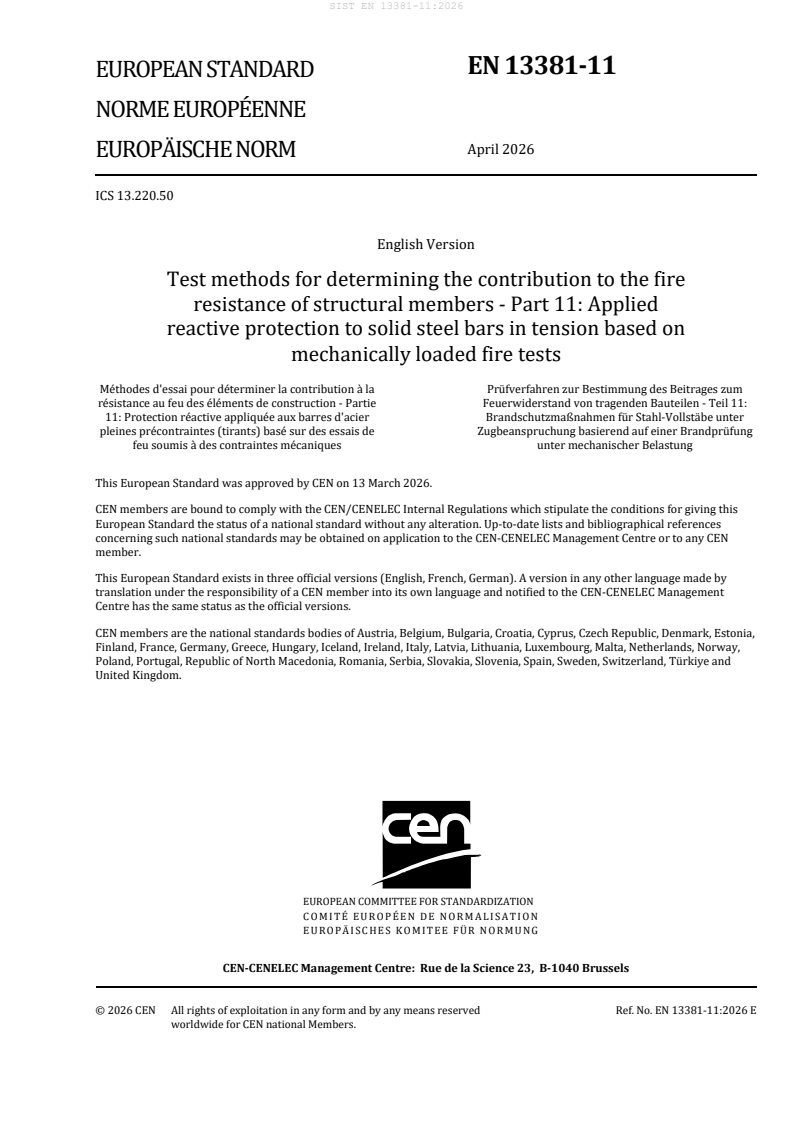
EN 13381-11
EUROPEAN STANDARD
NORME EUROPÉENNE
April 2026
EUROPÄISCHE NORM
ICS 13.220.50
English Version
Test methods for determining the contribution to the fire
resistance of structural members - Part 11: Applied
reactive protection to solid steel bars in tension based on
mechanically loaded fire tests
Méthodes d'essai pour déterminer la contribution à la Prüfverfahren zur Bestimmung des Beitrages zum
résistance au feu des éléments de construction - Partie Feuerwiderstand von tragenden Bauteilen - Teil 11:
11: Protection réactive appliquée aux barres d'acier Brandschutzmaßnahmen für Stahl-Vollstäbe unter
pleines précontraintes (tirants) basé sur des essais de Zugbeanspruchung basierend auf einer Brandprüfung
feu soumis à des contraintes mécaniques unter mechanischer Belastung
This European Standard was approved by CEN on 13 March 2026.
CEN members are bound to comply with the CEN/CENELEC Internal Regulations which stipulate the conditions for giving this
European Standard the status of a national standard without any alteration. Up-to-date lists and bibliographical references
concerning such national standards may be obtained on application to the CEN-CENELEC Management Centre or to any CEN
member.
This European Standard exists in three official versions (English, French, German). A version in any other language made by
translation under the responsibility of a CEN member into its own language and notified to the CEN-CENELEC Management
Centre has the same status as the official versions.
CEN members are the national standards bodies of Austria, Belgium, Bulgaria, Croatia, Cyprus, Czech Republic, Denmark, Estonia,
Finland, France, Germany, Greece, Hungary, Iceland, Ireland, Italy, Latvia, Lithuania, Luxembourg, Malta, Netherlands, Norway,
Poland, Portugal, Republic of North Macedonia, Romania, Serbia, Slovakia, Slovenia, Spain, Sweden, Switzerland, Türkiye and
United Kingdom.
EUROPEAN COMMITTEE FOR STANDARDIZATION
COMITÉ EUROPÉEN DE NORMALISATION
EUROPÄISCHES KOMITEE FÜR NORMUNG
CEN-CENELEC Management Centre: Rue de la Science 23, B-1040 Brussels
© 2026 CEN All rights of exploitation in any form and by any means reserved Ref. No. EN 13381-11:2026 E
worldwide for CEN national Members.
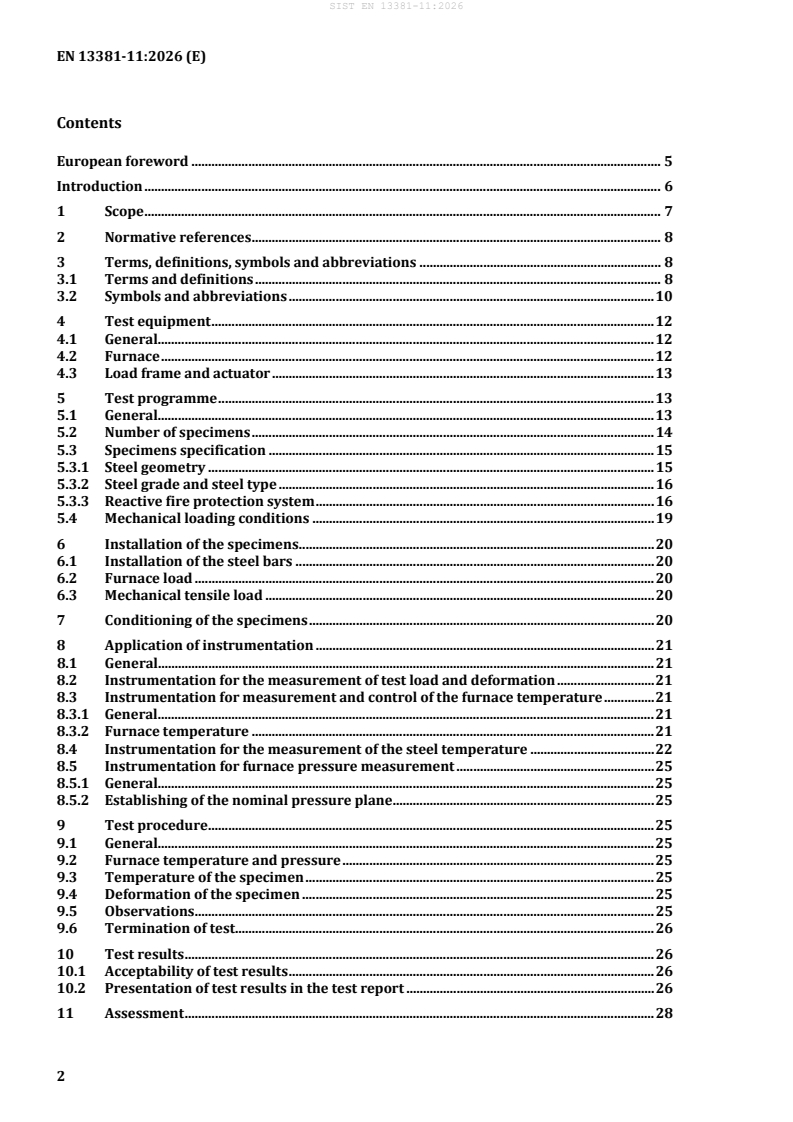
Contents
European foreword . 5
Introduction . 6
1 Scope . 7
2 Normative references . 8
3 Terms, definitions, symbols and abbreviations . 8
3.1 Terms and definitions . 8
3.2 Symbols and abbreviations . 10
4 Test equipment . 12
4.1 General. 12
4.2 Furnace . 12
4.3 Load frame and actuator . 13
5 Test programme . 13
5.1 General. 13
5.2 Number of specimens . 14
5.3 Specimens specification . 15
5.3.1 Steel geometry . 15
5.3.2 Steel grade and steel type . 16
5.3.3 Reactive fire protection system . 16
5.4 Mechanical loading conditions . 19
6 Installation of the specimens . 20
6.1 Installation of the steel bars . 20
6.2 Furnace load . 20
6.3 Mechanical tensile load . 20
7 Conditioning of the specimens . 20
8 Application of instrumentation . 21
8.1 General. 21
8.2 Instrumentation for the measurement of test load and deformation . 21
8.3 Instrumentation for measurement and control of the furnace temperature . 21
8.3.1 General. 21
8.3.2 Furnace temperature . 21
8.4 Instrumentation for the measurement of the steel temperature . 22
8.5 Instrumentation for furnace pressure measurement . 25
8.5.1 General. 25
8.5.2 Establishing of the nominal pressure plane . 25
9 Test procedure . 25
9.1 General. 25
9.2 Furnace temperature and pressure . 25
9.3 Temperature of the specimen . 25
9.4 Deformation of the specimen . 25
9.5 Observations . 25
9.6 Termination of test . 26
10 Test results . 26
10.1 Acceptability of test results . 26
10.2 Presentation of test results in the test report . 26
11 Assessment . 28
11.1 General . 28
11.2 Preparation of experimental data obtained in the fire tests . 28
11.3 Performance . 31
11.3.1 Thermal performance . 31
11.3.2 Mechanical performance . 31
11.4 Assessment procedure. 32
11.5 Interpolation procedure limits . 34
12 Method to transfer results between different steel bar orientations . 35
12.1 General . 35
12.2 Experimental setup for an unloaded fire test . 35
12.3 Correction due to different dry film thicknesses of the reactive fire protection system
................................................................................................................................................................... 38
12.4 Evaluation of the test data . 39
13 Application of the test and assessment results to different profile types. 40
14 Report of the assessment . 41
15 Limits of the applicability of the results of the assessment . 41
Annex A (informative) Example of a test set and the resulting scope of application based on
the assessment. 43
A.1 General . 43
A.2 Example . 43
Annex B (informative) Example of an assessment . 45
B.1 General . 45
B.2 Definition of the intended scope of application by the manufacturer . 45
B.3 Preparation of experimental data obtained in the fire tests . 46
B.4 Performance . 47
B.5 Results of the mechanically loaded fire tests . 48
B.6 Result of the assessment . 50
Annex C (normative) Linear interpolation analysis . 51
C.1 General . 51
C.2 Examples of interpolation methods containing only specimens which were not
excluded from the assessment . 51
C.3 Interpolation methods to consider values which were excluded from the assessment
................................................................................................................................................................... 61
Annex D (informative) Example of the procedure to consider the influence of the bar
orientation on the thermal performance of reactive fire protection system . 67
D.1 General . 67
D.2 Results from additional fire test with eight unloaded steel bars . 67
Annex E (normative) Test method to the slow heating curve (smouldering fire) . 70
E.1 General . 70
E.2 Test equipment. 70
E.3 Test specimen . 70
E.4 Termination of test . 70
E.5 Assessment of the results. 70
Bibliography . 71
European foreword
This document (EN 13381-11:2026) has been prepared by Working Group 1 ‘Structural and separating
elements’ under Technical Committee CEN/TC 127 “Fire safety in buildings”, the secretariat of which is
held by BSI.
This European Standard shall be given the status of a national standard, either by publication of an
identical text or by endorsement, at the latest by October 2026, and conflicting national standards shall
be withdrawn at the latest by October 2026.
Attention is drawn to the possibility that some of the elements of this document may be the subject of
patent rights. CEN shall not be held responsible for identifying any or all such patent rights.
This document has been prepared under a standardization request addressed to CEN by the European
Commission. The Standing Committee of the EFTA States subsequently approves these requests for its
Member States.
This document is one of a series of standards for evaluating the contribution to the fire resistance of
structural members by applied fire protection materials. Other parts of this series are:
— Part 1: Horizontal protective membranes.
— Part 2: Vertical protective membranes.
— Part 3: Applied protection to concrete members.
— Part 4: Applied passive protection to steel members.
— Part 5: Applied protection to concrete/profiled sheet steel composite members.
— Part 6: Applied protection to concrete filled hollow steel columns.
— Part 7: Applied protection to timber members.
— Part 8: Applied reactive protection to steel members.
— Part 9: Applied fire protection systems to steel beams with web openings.
— Part 10: Applied protection to solid steel bar in tension.
Any feedback and questions on this document should be directed to the users’ national standards body.
A complete listing of these bodies can be found on the CEN website.
According to the CEN-CENELEC Internal Regulations, the national standards organisations of the
following countries are bound to implement this European Standard: Austria, Belgium, Bulgaria, Croatia,
Cyprus, Czech Republic, Denmark, Estonia, Finland, France, Germany, Greece, Hungary, Iceland, Ireland,
Italy, Latvia, Lithuania, Luxembourg, Malta, Netherlands, Norway, Poland, Portugal, Republic of North
Macedonia, Romania, Serbia, Slovakia, Slovenia, Spain, Sweden, Switzerland, Türkiye and the United
Kingdom.
Introduction
The evaluation of a system's capability to provide fire protection performance to beams and/or columns
with I- or H-section as well as hollow section is undertaken by test and assessment procedures detailed
in EN 13381-8 for reactive (intumescent) fire protection systems. The scope of the above standard
excludes the assessment of solid steel bars used as tension bars.
In general, it is not possible to use the results of fire protection systems tested according to EN 13381-8
on beams or columns with open or closed profile to steel tension bars with solid section. This has several
reasons:
a) the profiles used for steel bars are usually much slenderer than the profiles used for beams or
columns. Consequently, to achieve the same fire resistance usually higher dry film thicknesses of the
reactive fire protection system are required;
b) due to the different profile shape, there is an altered foaming and cracking behaviour of reactive fire
protection systems. On the predominantly flat surfaces of a beam with open profile, reactive fire
protection systems behave differently than on highly convex curved surface of steel bars with
circular solid section;
c) because the tensile stresses in a steel bar are equal along the entire bar length and within the cross-
section, the failure occurs at the position, where the highest steel temperature is present. Therefore,
tensile bars are vulnerable to local defects, e.g. cracks or ununiform foam thicknesses of reactive fire
protection systems. Furthermore, beams have the possibility of cross-sectional plasticisation. Due to
the resulting stress redistribution and the activation of additional load capacity reserves, in fire tests
beams suffer lower strains compared to a bar in pure tension. This is also clear from the fact that the
tests of a steel bar usually end with the breakage. In mechanically loaded beam tests such a high
strain is usually not achieved;
d) columns are not suitable for a comparison with steel bars, because the cross-sections are much
bigger as well as the thermal and mechanical strains are acting in opposite direction;
e) in contrast to beams, which are generally used in a horizontal position, steel bars are used in different
orientations. This can influence the thermal protection performance of the reactive fire protection
system.
For reactive fire protection systems that have already been successfully tested and assessed according to
EN 13381-8, the test standard EN 13381-10 offers under certain conditions the possibility to extend the
scope of application to steel tension bars with solid sections. The fire tests in EN 13381-10 are based
upon unloaded specimens. Because this approach contradicts to the German national safety level, where
the fire resistance of structural members need to be tested under mechanical load, an A-Deviation was
granted, meaning that it is not possible to apply EN 13381-10 in Germany. In addition, recent research
and testing on loaded and unloaded steel bars protected with reactive fire protection coatings has shown
the need for mechanically loaded fire testing.
This document provides a test and assessment procedure to cover a reactive fire protection system's
scope of application to solid circular or rectangular steel bars used as tension bars based on mechanically
loaded fire tests. This document is a stand-alone test standard and does not require a successful
completion of the test procedure according to EN 13381-8. This document has been created to cover a
testing and assessment procedure based primarily upon mechanically loaded fire tests. Across a range of
solid circular and/or rectangular bars fire tests on mechanically loaded specimens are carried out.
Unloaded specimens may be used to assess additional aspects, such as the influence of the bar orientation
as well as smouldering fire behaviour. The assessment procedure described in this document aims to
determine the reactive fire protection system's thermal protection performance.
1 Scope
This document describes the test and assessment procedure for determining the contribution of reactive
fire protection systems to the fire resistance of solid steel bars used as tension bars, when exposed to the
standard temperature/time curve specified in EN 1363-1. In special circumstances, where specified in
National Building Regulations, there can be a need to subject reactive fire protection systems to a slow
heating curve (smouldering fire) as defined in EN 1363-2. The corresponding test and assessment
procedure are described in Annex E. The fire protection performance is determined by mechanically
loaded steel bars usually fire tested in horizontal orientation. Information regarding the testing of
additional unloaded specimens is given to assess the influence of the bar orientation and smouldering
fire behaviour.
The principles of the testing and assessment procedure can also be applied for other profile types. This
document does not include steel bars used as reinforcement in concrete construction.
This document is applicable to steel bars up to a maximum diameter of 130 mm. In the case of rectangular
bars, the maximum edge length is limited to 130 mm with a maximum aspect ratio of 2:1 against the
shorter edge length.
The test programme and the assessment are designed to cover:
— a range of fire protection classification periods;
— a range of thickness of the applied reactive fire protection system;
— a range of steel bar dimensions and profiles;
— a range of specified design temperatures;
— a range of load utilization factors in case of fire;
— a range of bar orientation.
This document also provides the assessment procedure, which prescribes how the analysis of the test
data are made and gives guidance on the procedures by which interpolation is undertaken. The
assessment procedure is used to establish:
a) on the basis of data derived from mechanically loaded testing steel bar, any practical constraints on
the use of the reactive fire protection system under fire test conditions (the mechanical
performance);
b) on the basis of the temperature data derived from testing steel bar the thermal properties of the
reactive fire protection system (the thermal performance).
The limits of applicability of the results of the assessment arising from the fire test are defined together
with permitted direct application of the results to different steel grades, steel types and profile
dimensions over the range of dry film thicknesses of the applied reactive fire protection system tested.
2 Normative references
The following documents are referred to in the text in such a way that some or all of their content
constitutes requirements of this document. For dated references, only the edition cited applies. For
undated references, the latest edition of the referenced document (including any amendments) applies.
EAD 350402-00-1106, Reactive coatings for fire protection of steel elements
EN 1363-1:2020, Fire resistance tests — Part 1: General requirements
EN 1363-2, Fire resistance tests — Part 2: Alternative and additional procedures
EN 10025-1, Hot rolled products of structural steels — Part 1: General technical delivery conditions
EN 10204, Metallic products — Types of inspection documents
EN 60584-1, Thermocouples - Part 1: EMF specifications and tolerances (IEC 60584-1)
EN ISO 13943, Fire safety — Vocabulary (ISO 13943)
EN ISO 6892-1, Metallic materials — Tensile testing — Part 1: Method of test at room temperature
(ISO 6892-1)
EN ISO 7500-1, Metallic materials — Calibration and verification of static uniaxial testing machines — Part
1: Tension/compression testing machines — Calibration and verification of the force-measuring system
(ISO 7500-1)
ISO 8421-2, Fire protection — Vocabulary — Part 2: Structural fire protection
3 Terms, definitions, symbols and abbreviations
3.1 Terms and definitions
For the purposes of this document, the terms and definitions given in EN 1363-1, EN ISO 13943 and
ISO 8421-2, and the following apply.
ISO and IEC maintain terminology databases for use in standardization at the following addresses:
— ISO Online browsing platform: available at https://www.iso.org/obp
— IEC Electropedia: available at https://www.electropedia.org/
3.1.1
steel bar
element of building construction, which is loadbearing, fabricated from steel and has a solid circular or
rectangular (including square) cross-section composed entirely of steel with a consistent cross-sectional
size throughout its length
3.1.2
reactive fire protection material
reactive materials which are specifically formulated to provide a chemical reaction upon heating such
that their mechanical form changes and in doing so provide fire protection by thermal insulative and
cooling effects
3.1.3
reactive fire protection system
reactive fire protection material together with a specified primer and top coat if applicable
3.1.4
fire protection
protection afforded to the steel member by the reactive fire protection system such that the temperature
of the steel member is limited throughout the period of exposure to fire
3.1.5
test specimen
steel bar plus the reactive fire protection system under test
3.1.6
dry film thickness
dried thickness of the reactive fire protection material excluding primer and top coat
3.1.7
fire protection thickness
mean dry film thickness of the reactive fire protection material excluding primer and top coat
3.1.8
stickability
ability of a reactive fire protection system to remain sufficiently coherent and in position for a well-
defined range of deformations, furnace and steel temperatures, such that its ability to provide fire
protection is not significantly impaired
3.1.9
steel temperature
average temperature of the two measuring stations nearest the rupture point
3.1.10
section factor
ratio of the fire exposed outer perimeter area of the steel bar per unit length, to its cross-sectional volume
per unit length
3.1.11
mechanical load
axial tensile force applied to the mechanically loaded specimen during the fire test (see 6.3)
3.1.12
load utilisation in case of fire
ratio of mechanical load to the tensile load carrying capacity of steel bar in case of fire (see 6.3)
3.1.13
test programme
describes the intended scope of application (see Clause 5)
3.1.14
test set
part of the test programme and consists of a group of mechanically loaded specimens (template see 5.3)
3.1.15
design steel temperature
temperature of a steel bar to be used for the assessment of the mechanical and thermal performance
3.1.16
deformation steel bar temperature
temperature of a steel bar to be used by the structural engineer to check the deformation of the steel bar
and the entire steel construction at elevated temperature
3.2 Symbols and abbreviations
For the purposes of this document, the following symbols and abbreviations apply.
Table 1 — Symbols and abbreviations
Symbol Unit Description
−1
α K thermal expansion coefficient
−1
A /V m Section factor of the unprotected steel section
m
A mm Cross-sectional area of the steel section
section
b mm Width of the rectangular solid steel section
D mm Diameter of the circular solid steel section
d mm Intended dry film thickness of reactive fire protection system
p
Intended minimum dry film thickness of the loaded or tall
dmin mm
section tested according to EN 13381-8
Intended maximum dry film thickness of the loaded or tall
d mm
max
section tested according to EN 13381-8
D mm Diameter of the smallest tested tension bar from the test set
small
D mm Diameter of the largest tested tension bar from the test set
large
Selected diameter of steel bar for which appropriate dry film
D mm
select
thickness is calculated
Mean value of all dry film thickness measurements of the
DFT mm
mean
reactive fire protection thickness at a steel bar
Dry film thickness of the smallest tested tension bar from the
DFT mm
small
test set
Dry film thickness of the largest tested tension bar from the
DFT mm
large
test set
Dry film thickness of the unloaded steel bar used as reference
DFT mm
ref
specimen
DFT of the unloaded steel bar for which the correction time
mean
DFT mm
K
(t ) is calculated
corection,k,i
−1
ė min Strain rate of steel
F kN The mechanical tensile load applied to the specimen
load
f N/mm Yield strength at room temperature
y,20°C
f N/mm 0,2 % proof stress at room temperature
p0.2,20°C
h mm Height of the rectangular steel section
L mm Fire exposed length of the mechanically loaded specimen
F
L mm Total length of the mechanically loaded specimen
G
L mm Total length of unloaded steel bar
U
r mm Radius of the circular solid steel section
s mm Cross-sectional dimension of the specimen
Design steel temperature for the thermal and mechanical
θ °C
i
assessment
Steel temperature for the check of the total deformation of the
θ °C steel bar and the entire steel construction at elevated
def
temperature
θ °C Steel temperature at time t
s i
θ °C Steel temperature when the rupture occurred
rupture
Selected design temperature value for which the dry film
θ °C
select
thickness will be calculated
Average temperature of unloaded steel bar for different
θ °C
average,unloaded,i
orientation (i)
Average temperature of unloaded specimen in different
θ °C orientation (i) for bars exposed to slow heating (SH)
SH,average,unloaded,i
temperature/time curve
Temperature difference between steel bars with different
Δθ °C
k
orientation
t min Fire performance period
t min Fire resistance time
F
t min The time when the load-bearing capacity (t ) is reached
C C
Time for which the load utilization factor in case of fire is
t min
C,i
calculated for interpolation purposes
Corrected time, when unloaded steel bar reached design
tcorrection,k,i min
temperature θ
i
t min Time for the reference specimen section to reach the design
k,i
temperature
t min Time when the steel bar rupture occurred
rupture
Temperature difference between unloaded steel bars with
ΔTunloaded,i °C
different orientations
Temperature difference between loaded steel bars with
ΔT °C
load,k
different orientations
U mm Deformation of the tension bar
dU/dt mm/min Rate of deformation
Limit value of the rate of deformation of the mechanically
(dU/dt) mm/min
limit
loaded steel bar
Load utilization factor in case of fire. The parameter is
µ ‒ equivalent to the load utilization at the time t = 0 min (µ
fi 0
according to EN 1993-1-2)
µ ‒ Upper limit of load utilization factor in case of fire
fi,max
µ ‒ Lower limit of load utilization factor in case of fire
fi,min
Selected load utilization factor in case of fire used in the
µ ‒
fi,select
interpolation method
Abbreviation Description
DFT Dry film thickness of the reactive fire protection system
MS Measuring station
MP Measuring point
TC Thermocouple
ULS Ultimate limit state
4 Test equipment
4.1 General
The furnace and test equipment shall conform to that specified in EN 1363-1. A number of steel bars are
fire tested with a mechanical tensile load. These tension bars are first subjected to a tensile load, which
is kept constant throughout the fire test, and then exposed to fire according to the protocol given in
EN 1363-1. It is recommended that the tests be continued until the specimen reaches the maximum
design steel temperature specified in the scope of testing or rupture of the specimen occurs. The
description in this document refers to a fire test in horizontal position of the bar. However, it is also
possible to conduct the fire test in vertical position. The load device and the furnace shall be changed
accordingly. The procedures given in EN 1363-1 shall be followed in the performance of this test unless
specific contrary instructions are given in this document. The specimens shall be chosen to suit the scope
of testing.
4.2 Furnace
The furnace shall permit the dimensions of the specimens to be exposed to heating, as specified in
Clause 5 and their installation within the test furnace to be as specified in Clause 6. A minimum distance
of 300 mm shall be kept between the specimen surface and the edge of the burner outlet, the burner
flame, other obstacles (except furnace plate thermocouples and specimen thermocouples) and furnace
walls, floor and ceiling (see 6.1 and Figure 1). In addition, a direct impingement of the flame shall be
avoided. In General, the furnace shall be able to create a uniform temperature distribution around the
specimen. Furthermore, the required furnace temperature shall be reached at the plate thermocouples
positioned near the specimen.
Key
1 undisturbed and obstacle free zone
2 specimen (tension bar)
3 ≥ 300 mm
4 fire exposed length of the specimen (L ≥ 1 000 mm)
F
Figure 1 — Undisturbed and obstacle free zone around the specimen in the furnace
(the geometric limitations also apply to other bar orientations)
4.3 Load frame and actuator
The loading equipment shall be capable of subjecting the specimens to the level of tensile load specified
in the scope of testing (see 5.1). Furthermore, the loading equipment shall be able to generate conditions
of uniform loading, which can maintain the test load at a constant value (±2 % of the required value,
according to EN ISO 7500-1) until failure of the tension bar (maximum temperature or rupture).
The load frame shall have room temperature over the entire duration of the fire test (a locally higher
temperature of the load frame of not more than 50 K is allowed; it is recommended to locate the load
frame outside of the furnace). A computer-based controlling of the loading system and deformation
measurement is recommended.
5 Test programme
5.1 General
The manufacturer of the reactive fire protection system specifies the intended scope of application by
defining the test programme. To develop the test programme the testing institute can be consulted. Based
on the selected test programme the different test sets can be defined. The test programme contains at
least one test set. If the general parameters selected in the test programme have more than one entry per
line, several test sets shall be created. A subdivision into different test sets is required, because in the
assessment only specimens with comparable parameters, i.e. identical entries for the general parameters,
can be assessed together. In general, it is possible to include the data of one specimen for different test
sets. A change or extension of a test set is possible by changing or adding new values for a variable
parameter. For variable parameters a range can be specified. A change of the variable parameters does
not require a new test set. Recommendations and details for the selection of the specimens of a test set
are given in 5.3. The general structure of a test programme for mechanically loaded specimens is given in
Table 2.
Table 2 — Example of the test programme to specify the intended scope of application of the
reactive fire protection system
Examples (If more than one entry per line
General parameter:
is selected several test sets are required)
1) Reactive fire protection system Name of the intumescent coating, including information
about the primer and steel bar surface preparation
2) Fire resistance class R30, R60, R90, …
3) Steel type Hot-rolled steel; cold-formed steel
4) Steel grade S235; S275; S355; S420; S460
5) Profile type Circular; rectangular (including square)
6) Orientation of the tension ba Horizontal; inclined; vertical
7) Load utilization factor in case of fire µ ≤ 0,65 (fully loaded steel bar); µ ≤ 0,60, …
fi fi
8) Fire exposed length of the tension bar L
F = 1000 mm
Variable parameter: Examples (In each line a range shall be defined)
9) Steel temperature range for thermal
assessment purpose (design θ (min., int., max.) = 350 °C, 400 °C, …, 750 °C
i
temperature)
Section factor and cross-sectional dimension:
−1 −1
10) Steel bar dimension (min., int., max.) = 100 m (Ø40 mm),133 m (Ø30 mm),
−1
200 m (Ø20 mm)
11) Dry film thickness of reactive fire
d (min., int., max.) = 1 mm, 2 mm, 3 mm
p
protection system
The aim of the information addressed in the test programme is to set an intended scope of application for
the reactive fire protection system. The amount of testing influences the assessment and limits the final
scope of application for the product. Generally, an increase of the intended scope of application or an
increase of the gradations of the defined parameters requires a more extensive test programme, i.e.
higher number of test sets. However, in many cases the final scope of application of the tested reactive
fire protection system can be larger than specified in the test programme. All permitted extensions are
given in 15.
5.2 Number of specimens
The number of specimens depends on the scope of testing (see 5.1 and 5.3). In general, the specimens
shall be tested with mechanical tensile load. Since the loaded fire tests are usually only performed in one
bar orientation, e.g. horizontally, additional unloaded specimens can be tested to assess the influence of
other bar orientations and thus to increase the intended scope of application (see 12).
The intended scope of testing will determine the selection of the specimens. The general matrix of the
test set is given in Table 3. A change to one of the general parameters requires an additional test set.
Based on the test programme defined in Clause 5 each combination of a steel bar dimension and a fire
protection dry film thickness selected in a test set shall be examined by a loaded fire test.
Table 3 — Template of a test set for fire tests of tension bars with reactive fire protection system
General parameter of tested steel bar
Fire resistance class: …
Steel grade and type: …
Fire exposed length of the tension bar: …
Shape of the tension bar: …
Fire protection system: …
Load utilization factor in case of fire µ …
fi:
a
Orientation of the tension bar : …
Variable parameters
Number
Design steel
of loaded
Tension bar Section factor Diameter / Protection
temperature
fire tests
b
dimension A /V b × h thickness
m
range
−1
[-] [m ] [mm] [mm] [°C] [-]
Small profile max min … 1
…
Intermediate int int
… …
profile
Large profile min max … 1
A test set shall consist at least of a small and a large profile. It is possible to add one or several
intermediate steel profiles to the test set.
a
To enable the use of reactive fire protection systems for all bar orientations, unloaded fire tests
according to 12 shall be carried out to assess the performance of the product. Each test set requires an
unloaded fire test, where the specimens shall have same profile type and the same dimension of the
small profile as well as the corresponding DFT in this test set.
b
The individual dry film thickness of reactive fire protection system (minimum/maximum) shall be
selected based on the intended scope of application.
5.3 Specimens specification
5.3.1 Steel geometry
The cross-section of the steel bar is characterized by the profile type, the largest cross-sectional
dimension (s) and the section factor (A /V). The steel bar can have a rectangular (including square) or
m
circular shape (see Figure 2). The size of rectangular solid bars is defined by the width (b) and the height
(h). The height of rectangular bars shall be always larger than the width. For circular solid bars the
radius (r) or the diameter (D) characterizes the size of the cross-section. The largest cross-sectional
dimension of a specimen is equal to the height of a rectangular bar or the diameter of a circular bar. The
section factor is the ratio of the fire exposed outer perimeter area of the steel bar per unit length to its
cross-sectional volume per unit length.
Key
left rectangular cross-section (h ≥ b)
middle square cross-section (h = b)
right circular cross-section
1 height (h)
2 width (b)
3 radius (r)
4 diameter (D)
5 steel bar
Figure 2 — Possible profile types (cross-sectional shapes of a steel bar to be tested)
The length of the mechanically loaded specimen depends on the fire exposed length of the specimen (L )
F
within the furnace and the required length to connect the specimen with the load frame and the actuator
outside of the furnace. The fire exposed length of the specimen shall be at least fifteen times the largest
cross-sectional dimension (s), but not less than 1 000 mm
...