

ASTM C1358-18
(Test Method)Standard Test Method for Monotonic Compressive Strength Testing of Continuous Fiber-Reinforced Advanced Ceramics with Solid Rectangular Cross Section Test Specimens at Ambient Temperatures
General Information
- Abstract
SIGNIFICANCE AND USE
4.1 This test method may be used for material development, material comparison, quality assurance, characterization, reliability assessment, and design data generation.
4.2 Continuous fiber-reinforced ceramic matrix composites (CFCCs) are generally characterized by fine-grain sized (
4.3 Generally, ceramic and ceramic matrix composites have greater resistance to compressive forces than tensile forces. Ideally, ceramics should be compressively stressed in use, although engineering applications may frequently introduce tensile stresses in the component. Nonetheless, compressive behavior is an important aspect of mechanical properties and performance. The compressive strength of ceramic and ceramic composites may not be deterministic. Therefore, test a sufficient number of test specimens to gain an insight into strength distributions.
4.4 Compression tests provide information on the strength and deformation of materials under uniaxial compressive stresses. Uniform stress states are required to effectively evaluate any nonlinear stress-strain behavior that may develop as the result of cumulative damage processes (for example, matrix cracking, matrix/fiber debonding, fiber fracture, delamination, etc.) that may be influenced by testing mode, testing rate, effects of processing or combination of constituent materials, or environmental influences. Some of these effects may be consequences of stress corrosion or sub-critical (slow) crack growth which can be minimized by testing at sufficiently rapid rates as outlined in this test method.
4.5 The results of compression tests of test specimens fabricated to standardized dimensions from a particulate material or selected portions of a part, or both, may not totally represent the strength and deformation properties of the entire, full-size product or its in-service behavior in different environments.
4.6 For quality control purposes, results derived from standardized compressive test specimens may be considered i...
SCOPE
1.1 This test method covers the determination of compressive strength, including stress-strain behavior, under monotonic uniaxial loading of continuous fiber-reinforced advanced ceramics at ambient temperatures. This test method addresses, but is not restricted to, various suggested test specimen geometries as listed in the appendixes. In addition, test specimen fabrication methods, testing modes (force, displacement, or strain control), testing rates (force rate, stress rate, displacement rate, or strain rate), allowable bending, and data collection and reporting procedures are addressed. Compressive strength, as used in this test method, refers to the compressive strength obtained under monotonic uniaxial loading, where monotonic refers to a continuous nonstop test rate with no reversals from test initiation to final fracture.
1.2 This test method applies primarily to advanced ceramic matrix composites with continuous fiber reinforcement: unidirectional (1D), bidirectional (2D), and tridirectional (3D) or other multi-directional reinforcements. In addition, this test method may also be used with glass (amorphous) matrix composites with 1D, 2D, 3D, and other multi-directional continuous fiber reinforcements. This test method does not directly address discontinuous fiber-reinforced, whisker-reinforced, or particulate-reinforced ceramics, although the test methods detailed here may be equally applicable to these composites.
1.3 The values stated in SI units are to be regarded as the standard and are in accordance with IEEE/ASTM SI 10.
1.4 This standard does not purport to address all of the safety concerns, if any, associated with its use. It is the responsibility of the user of this standard to establish appropriate safety, health, and environmental practices and determine the applicability of regulatory limitations prior to use. Refer to Section 7 for specific precautions.
1.5 This international standard was...
- Status
- Published
- Publication Date
- 30-Jun-2018
- Technical Committee
- C28 - Advanced Ceramics
- Drafting Committee
- C28.07 - Ceramic Matrix Composites
Buy Documents
ASTM C1358-18 - Standard Test Method for Monotonic Compressive Strength Testing of Continuous Fiber-Reinforced Advanced Ceramics with Solid Rectangular Cross Section Test Specimens at Ambient Temperatures
REDLINE ASTM C1358-18 - Standard Test Method for Monotonic Compressive Strength Testing of Continuous Fiber-Reinforced Advanced Ceramics with Solid Rectangular Cross Section Test Specimens at Ambient Temperatures
Overview
ASTM C1358-18 establishes the standard test method for evaluating the monotonic compressive strength of continuous fiber-reinforced advanced ceramics with solid rectangular cross-section specimens at ambient temperatures. Developed by ASTM Committee C28 on Advanced Ceramics, this method is crucial for understanding the mechanical properties of these high-performance materials and is widely used in material development, comparison, quality assurance, and generating design data.
This standard focuses on ceramic matrix composites (CMCs) that utilize continuous fiber reinforcement, including unidirectional (1D), bidirectional (2D), tridirectional (3D), or multidirectional configurations. The procedure measures compressive strength under controlled, uniaxial loading, providing valuable insights into the stress-strain behavior and reliability of advanced structural ceramics and glass matrix composites.
Key Topics
- Compressive Strength Testing: Provides detailed methodology for testing compressive properties of continuous fiber-reinforced ceramics using monotonic (non-reversing, nonstop loading) tests.
- Specimen Geometry: Covers recommended specimen shapes (primarily solid, straight-sided or contoured "bow-tie" configurations) and dimensions to ensure uniform load application and minimize buckling or off-axis failures.
- Test Procedures: Address guidelines for:
- Test specimen fabrication and preparation
- Gripping methods and device requirements to ensure accurate force transmission
- Testing modes (force, displacement, strain control) and rates
- Allowable misalignment and methods to limit bending during testing
- Data acquisition and reporting, including the importance of measuring both applied force and deformation over time
- Material Behavior: Investigates mechanical responses such as matrix cracking, fiber/matrix debonding, and overall strength distribution. Recommends testing multiple specimens due to potential variability.
- Safety Considerations: Highlights precautionary measures due to the brittle nature of ceramics, including the risk of flying fragments and sharp fibers.
Applications
ASTM C1358-18 is pivotal in various industries where continuous fiber-reinforced ceramic matrix composites (CFCCs) are used, such as:
- Aerospace: Components demanding high compressive strength and resistance to extreme temperatures (heat shields, turbine parts)
- Automotive: Advanced brakes, structural reinforcements, and exhaust systems using high-performance ceramics
- Energy: Thermal barrier coatings and parts in nuclear and power generation facilities
- Manufacturing R&D: Materials development, specification, and qualification
- Quality Assurance and Reliability Assessment: Ensures materials meet rigorous mechanical performance standards before deployment in demanding operational environments
This test method is also adaptable for testing glass matrix composites with continuous fiber reinforcement, expanding its relevance in glass-ceramic engineering applications.
Related Standards
ASTM C1358-18 references and aligns with several key international and ASTM standards, including:
- ASTM C1145: Terminology of Advanced Ceramics
- ASTM D695: Test Method for Compressive Properties of Rigid Plastics
- ASTM D3410/D3410M: Test Method for Compressive Properties of Polymer Matrix Composite Materials
- ASTM E4: Practices for Force Verification of Testing Machines
- ASTM E83: Practice for Verification and Classification of Extensometer Systems
- ASTM E1012: Practice for Verification of Testing Frame and Specimen Alignment
Understanding and implementing ASTM C1358-18 helps organizations achieve reliable, comparable data critical for the development, qualification, and safe use of advanced ceramics and composites in high-performance engineering applications.
Keywords: ASTM C1358-18, compressive strength testing, ceramic matrix composites, continuous fiber-reinforced ceramics, structural ceramics, mechanical properties, quality assurance, ambient temperature testing.
Relations
- Effective Date
- 01-Jul-2018
- Refers
ASTM D6856/D6856M-23 - Standard Guide for Testing Fabric-Reinforced “Textile” Composite Materials - Effective Date
- 01-Nov-2023
- Effective Date
- 15-Oct-2019
- Effective Date
- 01-Jul-2019
- Effective Date
- 15-Apr-2019
- Effective Date
- 01-Apr-2018
- Effective Date
- 01-Sep-2016
- Effective Date
- 01-Aug-2016
- Effective Date
- 01-Jul-2015
- Effective Date
- 01-Jun-2014
- Effective Date
- 01-May-2013
- Effective Date
- 01-Feb-2013
- Effective Date
- 01-Feb-2013
- Effective Date
- 01-Jun-2012
- Effective Date
- 01-Jun-2012
Buy Documents
ASTM C1358-18 - Standard Test Method for Monotonic Compressive Strength Testing of Continuous Fiber-Reinforced Advanced Ceramics with Solid Rectangular Cross Section Test Specimens at Ambient Temperatures
REDLINE ASTM C1358-18 - Standard Test Method for Monotonic Compressive Strength Testing of Continuous Fiber-Reinforced Advanced Ceramics with Solid Rectangular Cross Section Test Specimens at Ambient Temperatures
Frequently Asked Questions
ASTM C1358-18 is a standard published by ASTM International. Its full title is "Standard Test Method for Monotonic Compressive Strength Testing of Continuous Fiber-Reinforced Advanced Ceramics with Solid Rectangular Cross Section Test Specimens at Ambient Temperatures". This standard covers: SIGNIFICANCE AND USE 4.1 This test method may be used for material development, material comparison, quality assurance, characterization, reliability assessment, and design data generation. 4.2 Continuous fiber-reinforced ceramic matrix composites (CFCCs) are generally characterized by fine-grain sized ( 4.3 Generally, ceramic and ceramic matrix composites have greater resistance to compressive forces than tensile forces. Ideally, ceramics should be compressively stressed in use, although engineering applications may frequently introduce tensile stresses in the component. Nonetheless, compressive behavior is an important aspect of mechanical properties and performance. The compressive strength of ceramic and ceramic composites may not be deterministic. Therefore, test a sufficient number of test specimens to gain an insight into strength distributions. 4.4 Compression tests provide information on the strength and deformation of materials under uniaxial compressive stresses. Uniform stress states are required to effectively evaluate any nonlinear stress-strain behavior that may develop as the result of cumulative damage processes (for example, matrix cracking, matrix/fiber debonding, fiber fracture, delamination, etc.) that may be influenced by testing mode, testing rate, effects of processing or combination of constituent materials, or environmental influences. Some of these effects may be consequences of stress corrosion or sub-critical (slow) crack growth which can be minimized by testing at sufficiently rapid rates as outlined in this test method. 4.5 The results of compression tests of test specimens fabricated to standardized dimensions from a particulate material or selected portions of a part, or both, may not totally represent the strength and deformation properties of the entire, full-size product or its in-service behavior in different environments. 4.6 For quality control purposes, results derived from standardized compressive test specimens may be considered i... SCOPE 1.1 This test method covers the determination of compressive strength, including stress-strain behavior, under monotonic uniaxial loading of continuous fiber-reinforced advanced ceramics at ambient temperatures. This test method addresses, but is not restricted to, various suggested test specimen geometries as listed in the appendixes. In addition, test specimen fabrication methods, testing modes (force, displacement, or strain control), testing rates (force rate, stress rate, displacement rate, or strain rate), allowable bending, and data collection and reporting procedures are addressed. Compressive strength, as used in this test method, refers to the compressive strength obtained under monotonic uniaxial loading, where monotonic refers to a continuous nonstop test rate with no reversals from test initiation to final fracture. 1.2 This test method applies primarily to advanced ceramic matrix composites with continuous fiber reinforcement: unidirectional (1D), bidirectional (2D), and tridirectional (3D) or other multi-directional reinforcements. In addition, this test method may also be used with glass (amorphous) matrix composites with 1D, 2D, 3D, and other multi-directional continuous fiber reinforcements. This test method does not directly address discontinuous fiber-reinforced, whisker-reinforced, or particulate-reinforced ceramics, although the test methods detailed here may be equally applicable to these composites. 1.3 The values stated in SI units are to be regarded as the standard and are in accordance with IEEE/ASTM SI 10. 1.4 This standard does not purport to address all of the safety concerns, if any, associated with its use. It is the responsibility of the user of this standard to establish appropriate safety, health, and environmental practices and determine the applicability of regulatory limitations prior to use. Refer to Section 7 for specific precautions. 1.5 This international standard was...
SIGNIFICANCE AND USE 4.1 This test method may be used for material development, material comparison, quality assurance, characterization, reliability assessment, and design data generation. 4.2 Continuous fiber-reinforced ceramic matrix composites (CFCCs) are generally characterized by fine-grain sized ( 4.3 Generally, ceramic and ceramic matrix composites have greater resistance to compressive forces than tensile forces. Ideally, ceramics should be compressively stressed in use, although engineering applications may frequently introduce tensile stresses in the component. Nonetheless, compressive behavior is an important aspect of mechanical properties and performance. The compressive strength of ceramic and ceramic composites may not be deterministic. Therefore, test a sufficient number of test specimens to gain an insight into strength distributions. 4.4 Compression tests provide information on the strength and deformation of materials under uniaxial compressive stresses. Uniform stress states are required to effectively evaluate any nonlinear stress-strain behavior that may develop as the result of cumulative damage processes (for example, matrix cracking, matrix/fiber debonding, fiber fracture, delamination, etc.) that may be influenced by testing mode, testing rate, effects of processing or combination of constituent materials, or environmental influences. Some of these effects may be consequences of stress corrosion or sub-critical (slow) crack growth which can be minimized by testing at sufficiently rapid rates as outlined in this test method. 4.5 The results of compression tests of test specimens fabricated to standardized dimensions from a particulate material or selected portions of a part, or both, may not totally represent the strength and deformation properties of the entire, full-size product or its in-service behavior in different environments. 4.6 For quality control purposes, results derived from standardized compressive test specimens may be considered i... SCOPE 1.1 This test method covers the determination of compressive strength, including stress-strain behavior, under monotonic uniaxial loading of continuous fiber-reinforced advanced ceramics at ambient temperatures. This test method addresses, but is not restricted to, various suggested test specimen geometries as listed in the appendixes. In addition, test specimen fabrication methods, testing modes (force, displacement, or strain control), testing rates (force rate, stress rate, displacement rate, or strain rate), allowable bending, and data collection and reporting procedures are addressed. Compressive strength, as used in this test method, refers to the compressive strength obtained under monotonic uniaxial loading, where monotonic refers to a continuous nonstop test rate with no reversals from test initiation to final fracture. 1.2 This test method applies primarily to advanced ceramic matrix composites with continuous fiber reinforcement: unidirectional (1D), bidirectional (2D), and tridirectional (3D) or other multi-directional reinforcements. In addition, this test method may also be used with glass (amorphous) matrix composites with 1D, 2D, 3D, and other multi-directional continuous fiber reinforcements. This test method does not directly address discontinuous fiber-reinforced, whisker-reinforced, or particulate-reinforced ceramics, although the test methods detailed here may be equally applicable to these composites. 1.3 The values stated in SI units are to be regarded as the standard and are in accordance with IEEE/ASTM SI 10. 1.4 This standard does not purport to address all of the safety concerns, if any, associated with its use. It is the responsibility of the user of this standard to establish appropriate safety, health, and environmental practices and determine the applicability of regulatory limitations prior to use. Refer to Section 7 for specific precautions. 1.5 This international standard was...
ASTM C1358-18 is classified under the following ICS (International Classification for Standards) categories: 81.060.30 - Advanced ceramics. The ICS classification helps identify the subject area and facilitates finding related standards.
ASTM C1358-18 has the following relationships with other standards: It is inter standard links to ASTM C1358-13, ASTM D6856/D6856M-23, ASTM D3878-19a, ASTM C1145-19, ASTM D3878-19, ASTM D3878-18, ASTM D6856/D6856M-03(2016), ASTM D3878-16, ASTM D3878-15, ASTM E4-14, ASTM D3878-07(2013), ASTM C1145-06(2013)e1, ASTM C1145-06(2013), ASTM E1012-12e1, ASTM E1012-12. Understanding these relationships helps ensure you are using the most current and applicable version of the standard.
ASTM C1358-18 is available in PDF format for immediate download after purchase. The document can be added to your cart and obtained through the secure checkout process. Digital delivery ensures instant access to the complete standard document.
Standards Content (Sample)
This international standard was developed in accordance with internationally recognized principles on standardization established in the Decision on Principles for the
Development of International Standards, Guides and Recommendations issued by the World Trade Organization Technical Barriers to Trade (TBT) Committee.
Designation: C1358 − 18
Standard Test Method for
Monotonic Compressive Strength Testing of Continuous
Fiber-Reinforced Advanced Ceramics with Solid Rectangular
Cross Section Test Specimens at Ambient Temperatures
This standard is issued under the fixed designation C1358; the number immediately following the designation indicates the year of
original adoption or, in the case of revision, the year of last revision.Anumber in parentheses indicates the year of last reapproval.A
superscript epsilon (´) indicates an editorial change since the last revision or reapproval.
1. Scope 1.5 This international standard was developed in accor-
dance with internationally recognized principles on standard-
1.1 This test method covers the determination of compres-
ization established in the Decision on Principles for the
sive strength, including stress-strain behavior, under mono-
Development of International Standards, Guides and Recom-
tonic uniaxial loading of continuous fiber-reinforced advanced
mendations issued by the World Trade Organization Technical
ceramics at ambient temperatures. This test method addresses,
Barriers to Trade (TBT) Committee.
but is not restricted to, various suggested test specimen
geometries as listed in the appendixes. In addition, test
2. Referenced Documents
specimen fabrication methods, testing modes (force,
2.1 ASTM Standards:
displacement, or strain control), testing rates (force rate, stress
C1145Terminology of Advanced Ceramics
rate, displacement rate, or strain rate), allowable bending, and
D695Test Method for Compressive Properties of Rigid
data collection and reporting procedures are addressed. Com-
Plastics
pressive strength, as used in this test method, refers to the
D3379TestMethodforTensileStrengthandYoung’sModu-
compressive strength obtained under monotonic uniaxial
lus for High-Modulus Single-Filament Materials
loading, where monotonic refers to a continuous nonstop test
D3410/D3410MTest Method for Compressive Properties of
rate with no reversals from test initiation to final fracture.
Polymer Matrix Composite Materials with Unsupported
1.2 This test method applies primarily to advanced ceramic
Gage Section by Shear Loading
matrix composites with continuous fiber reinforcement: unidi-
D3479/D3479MTest Method for Tension-Tension Fatigue
rectional (1D), bidirectional (2D), and tridirectional (3D) or
of Polymer Matrix Composite Materials
other multi-directional reinforcements. In addition, this test
D3878Terminology for Composite Materials
method may also be used with glass (amorphous) matrix
D6856/D6856MGuide for Testing Fabric-Reinforced “Tex-
composites with 1D, 2D, 3D, and other multi-directional
tile” Composite Materials
continuous fiber reinforcements. This test method does not
E4Practices for Force Verification of Testing Machines
directly address discontinuous fiber-reinforced, whisker-
E6Terminology Relating to Methods of MechanicalTesting
reinforced,orparticulate-reinforcedceramics,althoughthetest
E83Practice for Verification and Classification of Exten-
methods detailed here may be equally applicable to these
someter Systems
composites.
E337Test Method for Measuring Humidity with a Psy-
1.3 The values stated in SI units are to be regarded as the chrometer (the Measurement of Wet- and Dry-Bulb Tem-
peratures)
standard and are in accordance with IEEE/ASTM SI 10.
E1012Practice for Verification of Testing Frame and Speci-
1.4 This standard does not purport to address all of the
men Alignment Under Tensile and Compressive Axial
safety concerns, if any, associated with its use. It is the
Force Application
responsibility of the user of this standard to establish appro-
IEEE/ASTM SI 10American National Standard for Metric
priate safety, health, and environmental practices and deter-
Practice
mine the applicability of regulatory limitations prior to use.
Refer to Section 7 for specific precautions.
3. Terminology
3.1 Definitions:
This test method is under the jurisdiction of ASTM Committee C28 on
Advanced Ceramics and is the direct responsibility of Subcommittee C28.07 on
Ceramic Matrix Composites. For referenced ASTM standards, visit the ASTM website, www.astm.org, or
CurrenteditionapprovedJuly1,2018.PublishedJuly2018.Originallyapproved contact ASTM Customer Service at service@astm.org. For Annual Book of ASTM
in 1996. Last previous edition approved in 2013 as C1358–13. DOI: 10.1520/ Standards volume information, refer to the standard’s Document Summary page on
C1358-18. the ASTM website.
Copyright © ASTM International, 100 Barr Harbor Drive, PO Box C700, West Conshohocken, PA 19428-2959. United States
C1358 − 18
3.1.1 The definitions of terms relating to compressive limit is required, specify the procedure and sensitivity of the
testing, advanced ceramics, and fiber-reinforced composites test equipment. E6
appearing in Terminology E6, Test Method D695, Practice
3.2.12 slow crack growth (SCG), n—subcritical crack
E1012, Terminology C1145, Test Method D3410/D3410M,
growth(extension)whichmayresultfrom,butisnotrestricted
and Terminology D3878 apply to the terms used in this test
to, such mechanisms as environmentally assisted stress corro-
method. Pertinent definitions are shown as follows, with the
sion or diffusive crack growth. C1145
appropriate source given in parentheses.Additional terms used
in conjunction with this test method are defined in 3.2.
4. Significance and Use
3.2 Definitions of Terms Specific to This Standard:
4.1 Thistestmethodmaybeusedformaterialdevelopment,
3.2.1 advanced ceramic, n—highly engineered, high-
material comparison, quality assurance, characterization, reli-
performance, predominantly non-metallic, inorganic, ceramic
ability assessment, and design data generation.
material having specific functional attributes. C1145
−1
4.2 Continuous fiber-reinforced ceramic matrix composites
3.2.2 axial strain [LL ], n—average longitudinal strains
(CFCCs) are generally characterized by fine-grain sized
measured at the surface on opposite sides of the longitudinal
(<50 µm) matrices and ceramic fiber reinforcements. In
axisofsymmetryofthespecimenbytwostrainsensingdevices
addition, continuous fiber-reinforced glass (amorphous) matrix
located at the mid length of the reduced section. E1012
composites can also be classified as CFCCs. Uniaxially loaded
−1
3.2.3 bending strain [LL ], n—difference between the
compressive strength tests provide information on mechanical
strainatthesurfaceandtheaxialstrain.Ingeneral,thebending
behavior and strength for a uniformly stressed CFCC.
strain varies from point to point around and along the reduced
section of the specimen. E1012
4.3 Generally, ceramic and ceramic matrix composites have
greater resistance to compressive forces than tensile forces.
3.2.4 breaking force [F], n—force at which fracture occurs.
Ideally, ceramics should be compressively stressed in use,
E6
although engineering applications may frequently introduce
3.2.5 ceramic matrix composite, n—material consisting of
tensile stresses in the component. Nonetheless, compressive
two or more materials (insoluble in one another), in which the
behavior is an important aspect of mechanical properties and
major,continuouscomponent(matrixcomponent)isaceramic,
performance. The compressive strength of ceramic and ce-
while the secondary component(s) (reinforcing component)
ramic composites may not be deterministic. Therefore, test a
may be ceramic, glass-ceramic, glass, metal, or organic in
sufficient number of test specimens to gain an insight into
nature. These components are combined on a macroscale to
strength distributions.
form a useful engineering material possessing certain proper-
4.4 Compression tests provide information on the strength
ties or behavior not possessed by the individual constituents.
and deformation of materials under uniaxial compressive
−2
3.2.6 compressive strength [FL ], n—maximum compres-
stresses. Uniform stress states are required to effectively
sive stress which a material is capable of sustaining. Compres-
evaluate any nonlinear stress-strain behavior that may develop
sive strength is calculated from the maximum force during a
as the result of cumulative damage processes (for example,
compression test carried to rupture and the original cross-
matrix cracking, matrix/fiber debonding, fiber fracture,
sectional area of the specimen. E6
delamination, etc.) that may be influenced by testing mode,
3.2.7 continuous fiber-reinforced ceramic matrix composite
testingrate,effectsofprocessingorcombinationofconstituent
(CFCC), n—ceramic matrix composite in which the reinforc-
materials, or environmental influences. Some of these effects
ing phase consists of a continuous fiber, continuous yarn, or a
may be consequences of stress corrosion or sub-critical (slow)
woven fabric.
crackgrowthwhichcanbeminimizedbytestingatsufficiently
rapid rates as outlined in this test method.
3.2.8 gage length [L], n—original length of that portion of
the specimen over which strain or change of length is
4.5 The results of compression tests of test specimens
determined. E6
fabricated to standardized dimensions from a particulate ma-
−2
terial or selected portions of a part, or both, may not totally
3.2.9 modulus of elasticity [FL ], n—ratio of stress to
represent the strength and deformation properties of the entire,
corresponding strain below the proportional limit. E6
full-size product or its in-service behavior in different environ-
3.2.10 percentbending,n—bendingstraintimes100divided
ments.
by the axial strain. E1012
−2 4.6 For quality control purposes, results derived from stan-
3.2.11 proportional limit stress in compression [FL ],
dardized compressive test specimens may be considered in-
n—greatest stress that a material is capable of sustaining
dicative of the response of the material from which they were
without any deviation from proportionality of stress to strain
taken for given primary processing conditions and post-
(Hooke’s law).
processing heat treatments.
3.2.11.1 Discussion—Many experiments have shown that
valuesobservedfortheproportionallimitvarygreatlywiththe 4.7 The compressive behavior and strength of a CFCC are
sensitivity and accuracy of the testing equipment, eccentricity dependent on, and directly related to, the material.Analysis of
of loading, the scale to which the stress-strain diagram is fracturesurfacesandfractography,thoughbeyondthescopeof
plotted, and other factors. When determination of proportional this test method, are recommended.
C1358 − 18
5. Interferences fractures will normally constitute invalid tests. In addition, for
frictional face-loaded geometrics, gripping pressure is a key
5.1 Test environment (vacuum, inert gas, ambient air, etc.),
variable in the initiation of fracture. Insufficient pressure can
including moisture content (for example, relative humidity),
shear the outer plies in laminated CFCCs, while too much
may have an influence on the measured compressive strength.
pressurecancauselocalcrushingoftheCFCCandmayinitiate
In particular, the behavior of materials susceptible to slow
fracture in the vicinity of the grips.
crack growth will be strongly influenced by test environment,
5.5 Lateral supports are sometimes used in compression
testing rate, and test temperature. Conduct tests to evaluate the
tests to reduce the tendency of test specimen buckling.
maximum strength potential of a material in inert environment
However, such lateral supports may introduce sufficient fric-
or at sufficiently rapid testing rates, or both, to minimize slow
tional stress so as to artificially increase the force required to
crack growth effects. Conversely, conduct tests in environ-
produce compressive failure. In addition, the lateral supports
ments or at test modes, or both, and rates representative of
and attendant frictional stresses may invalidate the assumption
service conditions to evaluate material performance under use
of uniaxial stress state. When lateral supports are used, the
conditions. Monitor and report relative humidity and ambient
frictional effect should be quantified to ensure that its contri-
temperaturewhentestingisconductedinuncontrolledambient
butionissmall,andthemeansfordoingsoreportedalongwith
air with the intent of evaluating maximum strength potential.
the quantity of the frictional effect.
Testingathumiditylevels>65%relativehumidity(RH)isnot
recommended.
6. Apparatus
5.2 Surface preparation of test specimens, although nor-
6.1 Testing Machines—Machinesusedforcompressivetest-
mallynotconsideredamajorconcerninCFCCs,canintroduce
ing shall conform to Practices E4. The forces used in deter-
fabrication flaws that may have pronounced effects on com-
mining compressive strength shall be accurate to within 61%
pressive mechanical properties and behavior (for example,
at any force within the selected force range of the testing
shape and level of the resulting stress-strain curve, compres-
machine as defined in Practices E4. A schematic showing
sive strength and strain, proportional limit stress and strain,
pertinent features of one possible compressive testing appara-
etc.). Machining damage introduced during test specimen
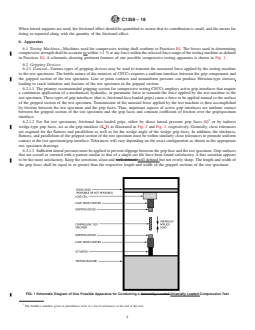
tus is shown in Fig. 1.
preparation can be either a random interfering factor in the
6.2 Gripping Devices:
determination of ultimate strength of pristine material (that is,
increased frequency of surface-initiated fractures compared to 6.2.1 General—Various types of gripping devices may be
used to transmit the measured force applied by the testing
volume-initiated fractures), or an inherent part of the strength
machine to the test specimens. The brittle nature of the
characteristics to be measured. Surface preparation can also
matrices of CFCCs requires a uniform interface between the
lead to the introduction of residual stresses. Universal or
standardized test methods of surface preparation do not exist.
In addition, the nature of fabrication used for certain compos-
ites (for example, chemical vapor infiltration or hot pressing)
may require the testing of test specimens in the as-processed
condition (that is, it may not be possible to machine the test
specimen faces without compromising the in-plane fiber archi-
tecture).Finalmachiningstepsmayormaynotnegatemachin-
ing damage introduced during the initial machining. Thus,
report test specimen fabrication history since it may play an
important role in the measured strength distributions.
5.3 Bending in uniaxial compressive tests can introduce
eccentricity, leading to geometric instability of the test speci-
men and buckling failure before true compressive strength is
attained.Inaddition,ifdeformationsorstrainsaremeasuredat
surfaces where maximum or minimum stresses occur, bending
may introduce over or under measurement of strains, depend-
ing on the location of the strain measuring device on the test
specimen. Bending can be introduced from, among other
sources, initial load train misalignment, misaligned test speci-
mens as installed in the grips, warped test specimens, or load
train misalignment introduced during testing due to low lateral
machine/grip stiffness.
5.4 Fractures that initiate outside the uniformly stressed
gage section of a test specimen may be due to factors such as
stress concentrations or geometrical transitions, extraneous
stressesintroducedbygripping,orstrength-limitingfeaturesin
FIG. 1 Schematic Diagram of One Possible Apparatus for Con-
the microstructure of the test specimen. Such non-gage section ducting a Uniaxially Loaded Compression Test
C1358 − 18
grip components and the gripped section of the test specimen.
Line or point contacts and nonuniform pressure can produce
Hertzian-type stresses, leading to crack initiation and fracture
of the test specimen in the gripped section.
6.2.1.1 The primary recommended gripping system for
compressivetestingCFCCsemploysactivegripinterfacesthat
require a continuous application of a mechanical, hydraulic, or
pneumatic force to transmit the force applied by the test
machine to the test specimen. These types of grip interfaces
(thatis,frictionalface-loadedgrips)causeaforcetobeapplied
normal to the surface of the gripped section of the test
specimen. Transmission of the uniaxial force applied by the
test machine is then accomplished by friction between the test
specimen and the grip faces. Thus, important aspects of active
gripinterfacesareuniformcontactbetweenthegrippedsection
of the test specimen and the grip faces and constant coefficient
of friction over the grip/specimen interface.
6.2.1.2 For flat test specimens, frictional face-loaded grips,
either by direct lateral pressure grip faces (1) or by indirect
wedge-type grip faces, act as the grip interface (2, 3) as
FIG. 3 Example of an Indirect Wedge-Type Grip Face for a Face-
illustrated in Fig. 2 and Fig. 3, respectively. Generally, close
Loaded Grip Interface
tolerances are required for the flatness and parallelism as well
asforthewedgeangleofthewedgegripfaces.Inaddition,the
thickness,flatness,andparallelismofthegrippedsectionofthe Transmission of the force applied by the test machine is then
accomplished by a directly applied uniaxial force to the test
test specimen must be within similarly close tolerances to
promote uniform contact at the test specimen/grip interface. specimen ends. Thus, important aspects of this type of grip
interfaceareuniformcontactbetweentheloadinganvilandthe
Tolerances will vary depending on the exact configuration as
shown in the appropriate test specimen drawings. test specimen and good contact between the test specimen and
lateral supports.
6.2.1.3 Sufficientlateralpressuremustbeappliedtoprevent
slippage between the grip face and the test specimen. Grip 6.2.1.5 For flat test specimens, a controlled, face-supported
fixture (4) as illustrated in Fig. 4 can be used. Generally, close
surfacesthatarescoredorserratedwithapatternsimilartothat
of a single-cut file have been found satisfactory. A fine
serration appears to be the most satisfactory. Keep the serra-
tions clean and well defined but not overly sharp. The length
and width of the grip faces shall be equal to or greater than the
respective length and width of the gripped sections of the test
specimen.
6.2.1.4 An alternative recommended gripping system for
compressive testing CFCCs employs passive grip interfaces
that employ lateral supports and loading anvils to transmit the
applied force to the compressive test specimen. The lateral
supportspreventbothbucklingofthetestspecimeninthegage
section and splitting and brooming of the ‘grip’ section.
The boldface numbers given in parentheses refer to a list of references at the
end of the text.
FIG. 2 Example of a Direct Lateral Pressure Grip Face for a Face-
Loaded Grip Interface FIG. 4 Example of a Controlled, Face-Supported Fixture (4)
C1358 − 18
tolerances are required for the flatness and parallelism. In Such devices (2) usually employ angularity and concentricity
addition, the thickness, flatness, and parallelism of the sup- adjusters to accommodate inherent load train misalignments.
ported section of the test specimen must be within similarly Regardless of which method is used, perform an alignment
close tolerances to promote uniform contact at the test verification as discussed in 6.3.1.1.
specimen/lateral support interface. Tolerances will vary de-
6.4 Strain Measurement—Determine strain by means of
pendingontheexactconfigurationasshownintheappropriate
either a suitable extensometer or strain gages.
test specimen drawings.
6.4.1 Extensometers used for compressive testing of CFCC
6.3 Load Train Couplers:
test specimens shall satisfy Practice E83, Class B-1 require-
6.3.1 General—Various types of devices (load train cou-
mentsandarerecommendedtobeusedinplaceofstraingages
plers)maybeusedtoattachtheactiveorpassivegripinterface
for test specimens with gage lengths of ≥25 mm, and shall be
assemblies to the testing machine. The load train couplers, in
used for high-performance tests beyond the range of strain
conjunction with the type of gripping device, play major roles
gage applications. Calibrate extensometers periodically in
in the alignment of the load train and thus subsequent bending
accordance with Practice E83. For extensometers which me-
(that is, eccentricity) imposed in the test specimen. Fixed but
chanicallycontactthetestspecimen,thecontactshallnotcause
adjustable load train couplers are primarily recommended for
damage to the test specimen surface. However, shallow
compression testing CFCCs to ensure a consistently well-
grooves (0.025 to 0.051 mm deep) machined into the surfaces
aligned load train for the entire test. The use of well-aligned,
of CFCCs to prevent extensometer slippage have been shown
fixed couplers does not automatically guarantee low bending
to not have a detrimental effect on failure strengths (4).In
(thatis,eccentricity)inthegagesectionofthecompressivetest
addition, support the weight of the extensometer so as not to
specimen. Well-aligned, fixed couplers provide for well-
introduce bending greater than that allowed in 6.5.
aligned load trains, but the type and operation of grip
6.4.2 Anadditionalrecommendation,butnotarequirement,
interfaces, as well as the as-fabricated dimensions of the
for the actual testing is strain determined directly from strain
compressive test specimen, can add significantly to the final
gages. Two strain gages, one mounted on each of the opposite
bending (that is, eccentricity) imposed in the gage section of
faces of the width surfaces, can be used to monitor incidences
the test specimen.
of bending eccentricity and, hence, tendency to buckling.
6.3.1.1 At a minimum, verify the alignment of the testing
Buckling can be detected when the strain on one face reverses
system at the beginning and end of a test series, unless the
(decreases) while the strain on the other face increases rapidly.
conditions for verifying alignment are otherwise met. An
additional verification of alignment is recommended, although
NOTE 2—If Poisson’s ratio is to be determined, instrument the test
not required, at the middle of the test series. Use either a
specimen to measure strain in both longitudinal and lateral directions at
dummy or actual test specimen. Allowable bending require- the same position on the test specimen. Either a stacked, biaxial strain
gage or two suitably oriented uniaxial strain gages (attached as close to
ments are discussed in 6.5. See Practice E1012 for discussions
each other as possible) are suitable for this purpose.
of alignment and Appendix X1 for suggested procedures
NOTE 3—Unless it can be shown that strain gage readings are not
specific to this test method.Atest series is interpreted to mean
unduly influenced by localized strain events such as fiber crossovers,
adiscretegroupoftestsonindividualtestspecimensconducted
strain gages should not be less than 9 to 12 mm in length for the
within a discrete period of time on a particular material
strain-measurement direction and not less than 6 mm in width for the
configuration, test specimen geometry, test condition, or other direction normal to strain measurement. Larger strain gages than those
recommended here may be required for fabric reinforcements to average
uniquely definable qualifier (for example, a test series com-
thelocalizedstraineffectsofthefibercrossovers.Choosethestraingages,
posedofmaterialAcomprisingtentestspecimensofgeometry
surface preparation, and bonding agents so as to provide adequate
B tested at a fixed rate in strain control to final fracture in
performance on the subject materials. Employ suitable strain recording
ambient air).
equipment. Many CFCCs may exhibit high degrees of porosity and
surface roughness and therefore require surface preparation, including
NOTE 1—Compressive test specimens used for alignment verification
surface filling, before the strain gages can be applied.
shouldbeequippedwitharecommendedeightseparatelongitudinalstrain
gagestodeterminebendingcontributionsfrombotheccentricandangular
6.5 Allowable Bending—Axial misalignment with the intro-
misalignment of the grip heads. Ideally, the verification test specimen
duction of bending stresses, due either to eccentricity or
should be of identical material to that being tested. However, in the case
angular misalignment, may produce a geometric instability in
of CFCCs, the type of reinforcement or degree of residual porosity may
the compressive test specimen, leading to buckling and mea-
complicate the consistent and accurate measurement of strain. Therefore,
use an alternate material (isotropic, homogeneous, continuous) with sured compressive strengths less than the true compressive
similar elastic modulus, elastic strain capability, and hardness to the test
strength.Onestudyonpolymericcompositeshasindicatedthat
material. In addition, dummy test specimens used for alignment verifica-
a misalignment of even 2.5% bending, as defined in Practice
tion should have the same geometry and dimensions of the actual test
E1012,willcauseanapparentstrengthdroptoonly87%ofthe
specimens, as well as similar mechanical properties as the test material to
ultimate compressive strength (5).
ensure similar axial and bending stiffness characteristics as the actual test
specimen and material.
6.5.1 Actual studies of the effect of bending on the com-
6.3.2 Fixed load train couplers may incorporate devices pressive strength distributions of CFCCs do not exist. Until
which require either a one-time, pre-test alignment adjustment such information is forthcoming for CFCCs, this test method
oftheloadtrainwhichremainsconstantforallsubsequenttests adopts a conservative recommendation of the lowest achiev-
or an in-situ, pre-test alignment of the load train which is able percent bending for compressive testing CFCCs.
conducted separately for each test specimen and each test. Therefore, the maximum allowable percent bending at the
C1358 − 18
onset of the cumulative fracture process (for example, nonlin- 7.2 Exposed fibers at the edges of CFCC test specimens
earityinthecompressivestress-straincurve)fortestspecimens present a hazard due to the sharpness and brittleness of the
tested under this test method shall not exceed 5%, with 1% ceramic fiber. Inform all those required to handle these
recommended, measured at a mean strain equal to either materials of such conditions and the proper handling tech-
one-half the anticipated strain at the onset of the cumulative niques.
fracture process (for example, nonlinearity in the compressive
stress-strain curve) or a strain of −0.0005 (that is, −500
8. Test Specimen
microstrain),whicheverisgreater.Unlessalltestspecimensare
8.1 Test Specimen Geometry:
properly strain gaged and percent bending monitored until the
8.1.1 General—Unliketensiletests,inwhichtestspecimens
onset of the cumulative fracture process, there will be no
withreduced(orcontoured)gagesectionsareusedtominimize
record of percent bending at the onset of fracture for each test
non-gage section failures, in compressive tests anisotropy and
specimen. Therefore, verify the alignment of the testing sys-
sensitivity to the geometric instability of buckling may dis-
tem. See Practice E1012 for discussions of alignment and
courage the use of contoured test specimens. Generally,
Appendix X1 for suggested procedures specific to this test
straight-sided test specimens are recommended for compres-
method.
sion tests. However, contoured compressive test specimens
NOTE4—Lateralstiffnessofthegrip/machine(inadditiontomisaligned
have been used successfully to test some types of CFCCs (4).
grips/load train, test specimens misaligned in the grips, or misshapen test
specimens) will influence load train alignment and the resulting eccen- NOTE 5—The final dimensions of compressive test specimens are
tricity introduced in the test specimen. Therefore, unlike a tension test
dependent on the ultimate use of the compressive strength data. For
whichmayproduceacertainamountofself-alignmentatincreasingforces example, if the compressive strength of an as-fabricated component is
in a compliant load train, a compression test may produce a certain
required, the dimensions of the resulting compressive test specimen may
amount of misalignment at increasing forces in a compliant load train. reflect the thickness, width, and length restrictions of the component. If it
Therefore, lateral grip/machine stiffnesses as high as possible are recom-
is desired to evaluate the effects of interactions of various constituent
mendedforcompressiontests.Increasingbendingwithincreasingforceas materials for a particular CFCC manufactured via a particular processing
measured in the alignment verification is an indication of a low lateral
route, then the size of the test specimen and resulting gage section will
stiffness of the grip/machine (among other sources). reflect the desired volume to be sampled.
6.6 Data Acquisition—Obtain, at minimum, an autographic
8.1.1.1 Thefollowingparagraphsdiscussrecommendedtest
recordofappliedforceandgagesectiondeformation(orstrain)
specimengeometries,althoughanygeometryisacceptableifit
versus time. Either analog chart recorders or digital data
meetsthegripping,fracturelocation,andbendingrequirements
acquisition systems can be used for this purpose, although a
of this test method. Deviations from the recommended geom-
digital record is recommended for ease of later data analysis.
etries may be necessary depending upon the particular CFCC
Ideally, use an analog chart recorder or plotter in conjunction
being evaluated. Conduct stress analyses of untried test speci-
with the digital data acquisition system to provide an immedi-
mengeometriestoensurethatstressconcentrations,whichcan
ate record of the test as a supplement to the digital record.
lead to undesired fractures outside the gage sections, do not
Recording devices shall be accurate to within 61% of the
exist. Contoured test specimens by their nature contain inher-
selected range for the testing system including readout unit, as
ent stress concentrations due to geometric transitions. Stress
specified in Practices E4, and should have a minimum data
analyses can indicate the magnitude of such stress concentra-
acquisition rate of 10 Hz, with a response of 50 Hz deemed
tions while revealing the success of producing a uniform
more than sufficient.
compressive stress state in the gage section of the test
6.6.1 Record strain or deformation of the gage section, or
specimen.
both,eithersimilarlytotheforceorasindependentvariablesof
8.1.1.2 Fig. 5 shows the nomenclature and an example of a
force.Crossheaddisplacementofthetestmachinemayalsobe
straight-sided test specimen (3) that can be used in either the
recorded but should not be used to define displacement or
frictional, face-loaded grips or the controlled, face-supported
strain in the gage section.
fixture. Important tolerances for this geometry include paral-
lelism and flatness of faces, all of which will vary depending
6.7 Dimension Measuring Devices—Micrometers and other
on the exact configuration as shown in the appropriate test
devicesusedformeasuringlineardimensionsshallbeaccurate
specimen drawing.
and precise to at least one-half the smallest unit to which the
8.1.1.3 Fig. 6 shows the nomenclature and an example of a
individual dimension is required to be measured. Measure
cross-sectional dimensions to within 0.02 mm using contoured, “bow tie” test specimen (4) that can be used in
either the frictional, face-loaded grips or the controlled, face-
dimension-measuring devices with accuracies of 0.01 mm.
supported fixture. Important tolerances for the face-loaded
geometry include parallelism and flatness of faces, which will
7. Precautionary Statement
vary depending on the exact configuration as shown in the
7.1 Duringtheconductofthistestmethod,thepossibilityof
appropriate test specimen drawing.
flying fragments of broken test material may be high. The
brittle nature of advanced ceramics and the release of strain 8.2 The recommended minimum gage length of the test
energy contribute to the potential release of uncontrolled specimen is 25 mm, with the length of at least 50 mm of the
fragments upon fracture. Means for containment and retention gripped sections at each end of the test specimen. Recom-
of these fragments for safety, as well as later fractographic mended minimum width and minimum thickness are 10 and
reconstruction and analysis, is highly recommended. 3mm, respectively. However, other combinations of gage
C1358 − 18
NOTE 1—Illustration not intended to be an engineering or production drawing, or both.
FIG. 5 Example of a Straight-Sided Compressive Test Specimen
C1358 − 18
NOTE 1—Illustration not intended to be an engineering or production drawing, or both.
FIG. 6 Example of a “Bow Tie” Compressive Test Specimen (4)
C1358 − 18
length, width, and thickness can be used as long as the 8.4 Specimen Preparation:
l
slenderness ratio, ⁄k, ≤30 (6, 7). 8.4.1 Depending upon the intended application of the com-
8.2.1 The slenderness ratio can be calculated as: pressive strength data, use one of the following test specimen
preparation procedures. Regardless of the preparation proce-
l l
5 =12 (1)
dure used, report sufficient details regarding the procedure to
k b
allow replication.
where:
8.4.2 As-Fabricated—The compressive test specimen simu-
l = length of the gage section, lates the surface/edge conditions and processing route of an
k = least radius of gyration of the cross section, and
application where no machining is used; for example, as-cast,
b = thickness of the cross section.
sintered, or injection-molded part. No additional machining
specifications are relevant.As-processed test specimens might
The investigations reported in Refs (6) and (7) indicate that
possess rough surface textures and non-parallel edges and as
measured compressive strengths of composites were indepen-
such may cause excessive misalignment or be prone to
dent of slenderness ratios (that is, presumably indicative of the
l
non-gage section fractures, or both.
true compressive strength) for ⁄k ≤ 30.
8.4.3 Application-Matched Machining—The compressive
8.2.2 When testing woven fabric laminate composites, it is
test specimen has the same surface/edge preparation as that
recommended that the gage length and width equal, at a
given to the component. Unless the process is proprietary,
minimum, one length and one width of the weave unit cell.
report the stages of material removal, wheel grits, wheel
(Unit cell count = 1 across the given dimension.)Two or more
bonding, amount of material removed per pass, and type of
weave unit cells are preferred across a given gage dimension.
coolant used.
NOTE 6—The weave unit cell is the smallest section of weave
8.4.4 CustomaryPractices—Ininstanceswhereacustomary
architecture required to repeat the textile pattern (see Guide D6856/
machining procedure has been developed that is completely
D6856M).The fiber architecture of a textile composite, which consists of
interlacing yarns, can lead to inhomogeneity of the local displacement satisfactory for a class of materials (that is, it induces no
fields within the weave unit cell. The gage dimensions should be large
unwanted surface/subsurface damage or residual stresses), use
enoughsothatanyinhomogenitieswithintheweaveunitcellareaveraged
this procedure.
out across the gage. This is a particular concern for test specimens where
8.4.5 Standard Procedure—In instances where 8.4.2 – 8.4.4
thefabricarchitecturehaslarge,heavytowsoropenweaves,orboth,with
are not appropriate, 8.4.5 shall apply. Studies to evaluate the
large unit cell dimensions and the gage sections are narrow or short, or
both.
machinability of CFCCs have not been completed. Therefore,
NOTE 7—Deviations from the recommended unit cell counts may be
the standard procedure of 8.4.5 can be viewed as preliminary
necessary depending upon the particular geometry of the available
guidelines and a more stringent procedure may be necessary.
material.Such“small”gagesectionsshouldbenotedinthetestreportand
8.4.5.1 Conductallgrindingorcuttingwithamplesupplyof
used with adequate understanding and assessment of the possible effects
appropriatefilteredcoolanttokeeptheworkpieceandgrinding
of weave unit cell count on the measured mechanical properties.
wheelconstantlyfloodedandparticlesflushed.Grindingcanbe
8.3 For the frictional, face-loaded grips, end tabs may be
done in at least two stages, ranging from coarse to fine rate of
required to provide a compliant layer for gripping and to
material removal. All cutting can be done in one stage
prevent splitting and brooming of the gripped ends of the test
appropriate for the depth of cut.
specimens. Balanced 0/90° cross-ply tabs made from unidirec-
8.4.5.2 Stock removal rate should be on the order of
tional nonwoven E-glass have proven to be satisfactory for
0.03mm per pass, using diamond tools that have between 320
certain fiber-reinforced polymers. For CFCCs, tab materials
and 600 grit. Remove equal stock from each face where
comprised of fiberglass-reinforced epoxy, polymethylene res-
applicable.
ins (PMR), or carbon fiber-reinforced resins have been used
successfully (8). However, metallic tabs (for example, alumi-
8.5 Handling Precaution—Exercise care in storing and
num alloys) may be satisfactory as long as the tabs are strain
handling finished test specimens to avoid the introduction of
compatible (that is, having a similar bulk elastic modulus
random and severe flaws. In addition, pay attention to pre-test
within 610% of that of the CFCC) with the CFCC material
storage of test specimens in controlled environments or desic-
being tested. Each beveled tab (bevel angle <15°) should be a
cators to avoid unquantifiable environmental degradation of
minimumof50mmlong,thesamewidthofthetestspecimen,
test specimens prior to testing. If conditioning is required,Test
and have the total thickness of the tabs on the order of the
MethodD3479/D3479Mrecommendsconditioningandtesting
thickness of the test specimen. Any high-elongation (tough)
polymeric composite test specimens in a room or enclosed
adhesive system may be used with the length of the tabs
space maintained at a temperature and relative humidity of 23
determined by the shear strength of the adhesive, size of the
6 3°C and 65 6 10%, respectively. Measure ambient
test specimen, and estimated strength of the composite. In any
conditions in accordance with Test Method E337.
case,ifasignificantfraction(≥20%)offracturesoccurswithin
8.6 Number of Test Specimens—A minimum of five test
one test specimen width of the tab, re-examine the tab
specimens is required for the purpose of estimating a mean.A
materials and configuration, gripping method, and adhesive,
greaternumberoftestspecimensmaybenecessaryifestimates
and make necessary adjustment to promote fracture within the
regarding the form of the strength distribution are required. If
gagesection.Fig.7showsanexampleofatabdesignmodified
material cost or test specimen availability limits the number of
to be used for compressive testing of CFCCs.
tests to be conducted, fewer tests may be conducted to
determine an indication of material properties.
C1358 − 18
NOTE 1—Illustration not intended to be an engineering or production drawing, or both.
FIG. 7 Example of a Bevelled Tab Used Successfully for Face-Loaded CFCC Tensile Test Specimens
C1358 − 18
generallyrelateddirectlytocompressivestress,isthepreferredtestmode.
8.7 Valid Tests—A valid individual test is one which meets
However, in CFCCs, the nonlinear stress-strain behavior in tension is
all the following requirements: all the testing requirements of
characteristic of the “graceful” fracture process of these materials,
this test method and, failure occurs in the uniformly stressed
indicating a cumulative damage process which is strain dependent.
gage section unless those tests failing outside the gage section
Generally, displacement- or strain-controlled tests are employed in such
are interpreted as interrupted tests for the purpose of censored
cumulative damage or yielding deformation processes to prevent a
“runaway”condition(thatis,rapiduncontrolleddeformationandfracture)
test analyses.
characteristic of force- or stress-controlled tests. Thus, to elucidate the
potential “toughening” mechanisms under controlled fracture of the
9. Procedure
CFCC, displacement or strain control is preferred. However, such behav-
9.1 Specimen Dimensions—Determine the thickness and
ior is dependent on the creation and propagation of tensile microcracks in
width of the gage section of each test specimen to within the matrix. Such microcracks are not the prevalent fracture mode when
CFCCs are tested in compression. Therefore, and especially for suffi-
0.02mmonatleastthreedifferentcross-sectionalplanesinthe
ciently rapid test rates, differences in the fracture process may not be
gagesection.Toavoiddamageinthecriticalgagesectionarea,
noticeable and any of these test modes may be appropriate.
make these measurements either optically (for example, an
9.2.2 Strain Rate—Strain is the independent variable in
optical comparator) or mechanically using a flat, anvil-type
nonlinear analyses such as yielding. As such, strain rate is a
micrometer. In either case, the resolution of the instrument
method of controlling tests of deformation processes to avoid
shallbeasspecifiedin6.7.Exerciseextremecautiontoprevent
“runaway” (that is, uncontrolled, rapid failure) conditions. For
damage to the test specimen gage section. Ball-tipped or
the linear elastic region of CFCCs, strain rate can be related to
sharp-anvilmicrometersmaybepreferredwhenmeasuringtest
stress rate such that:
specimens with rough or uneven surfaces. Record and report
the measured dimensions and locations of the measurements
dε σ˙
ε˙ 5 5 (2)
for use in the calculation of the compressive stress. Use the
dt E
average of the multiple measurements in the stress calcula-
where:
tions.
−1
ε = strain rate in the test specimen gage section, s ,
˙
9.1.1 Alternatively, to avoid damage to the gage section,
ε = strain in the test specimen gage section,
post-fracture measurement of the gage section dimensions can
t = time, s,
be made using procedures described in 9.1. In some cases, the
σ˙ = nominal stress rate in the test specimen gage section,
fracture process can severely fragment the gage section in the
MPa/s, and
immediate vicinity of the fracture, thus making post-fracture
E = elastic modulus of the CFCC, MPa.
measurements of dimensions difficult. In these cases, it is
advisable to follow the procedures outlined in 9.1 for pre-test Strain-controlled tests can be accomplished using an exten-
measurements to ensure reliable measurements.
someter contacting the gage section of the test specimen as the
9.1.2 Conduct periodic, if not 100 %, inspection/ primary control transducer.
measurements of all test specimens and test specimen dimen-
−6
NOTE 9—Compressive strain rates on the order of −50 × 10 to −500
sions to ensure compliance with the drawing specifications.
−6 −1
×10 s are recommended to minimize environmental effects when
Generally, high-resolution optical methods (for example, an
testing in ambient air. Alternatively, select strain rates to produce final
optical comparator) or high-resolution digital point contact
fracture in 5 to 10 s to minimize environmental effects when testing in
methods (for example, coordinate measurement machine) are ambient air.
satisfactory, as long as the equipment meets the specifications
9.2.3 Displacement Rate—The size differences of each test
in 6.7. The frequency of gage section fractures and bending in
specimen geometry require a different forcing rate for any
the gage section are dependent on proper overall test specimen
given stress rate. As the test specimen begins to fracture, the
dimensions within the required tolerances.
strain rate in the gage section of the test specimen will change
9.1.3 In some cases it is desirable, but not required, to
even though the rate of motion of the crosshead remains
measure surface finish to quantify the surface condition of the
constant.Forthisreason,displacementrate-controlledtestscan
gage section. Suc
...
This document is not an ASTM standard and is intended only to provide the user of an ASTM standard an indication of what changes have been made to the previous version. Because
it may not be technically possible to adequately depict all changes accurately, ASTM recommends that users consult prior editions as appropriate. In all cases only the current version
of the standard as published by ASTM is to be considered the official document.
Designation: C1358 − 13 C1358 − 18
Standard Test Method for
Monotonic Compressive Strength Testing of Continuous
Fiber-Reinforced Advanced Ceramics with Solid Rectangular
Cross-Section Cross Section Test Specimens at Ambient
Temperatures
This standard is issued under the fixed designation C1358; the number immediately following the designation indicates the year of
original adoption or, in the case of revision, the year of last revision. A number in parentheses indicates the year of last reapproval. A
superscript epsilon (´) indicates an editorial change since the last revision or reapproval.
1. Scope*Scope
1.1 This test method covers the determination of compressive strength, including stress-strain behavior, under monotonic
uniaxial loading of continuous fiber-reinforced advanced ceramics at ambient temperatures. This test method addresses, but is not
restricted to, various suggested test specimen geometries as listed in the appendix.appendixes. In addition, test specimen
fabrication methods, testing modes (force, displacement, or strain control), testing rates (force rate, stress rate, displacement rate,
or strain rate), allowable bending, and data collection and reporting procedures are addressed. Compressive strength, as used in
this test method, refers to the compressive strength obtained under monotonic uniaxial loading, where monotonic refers to a
continuous nonstop test rate with no reversals from test initiation to final fracture.
1.2 This test method applies primarily to advanced ceramic matrix composites with continuous fiber reinforcement:
uni-directional (1–D), bi-directional (2–D), and tri-directional (3–D)unidirectional (1D), bidirectional (2D), and tridirectional (3D)
or other multi-directional reinforcements. In addition, this test method may also be used with glass (amorphous) matrix composites
with 1–D, 2–D, 3–D,1D, 2D, 3D, and other multi-directional continuous fiber reinforcements. This test method does not directly
address discontinuous fiber-reinforced, whisker-reinforced, or particulate-reinforced ceramics, although the test methods detailed
here may be equally applicable to these composites.
1.3 The values stated in SI units are to be regarded as the standard and are in accordance with SI 10-02 IEEE/ASTM SI 10.
1.4 This standard does not purport to address all of the safety concerns, if any, associated with its use. It is the responsibility
of the user of this standard to establish appropriate safety safety, health, and healthenvironmental practices and determine the
applicability of regulatory limitations prior to use. Refer to Section 7 for specific precautions.
1.5 This international standard was developed in accordance with internationally recognized principles on standardization
established in the Decision on Principles for the Development of International Standards, Guides and Recommendations issued
by the World Trade Organization Technical Barriers to Trade (TBT) Committee.
2. Referenced Documents
2.1 ASTM Standards:
C1145 Terminology of Advanced Ceramics
D695 Test Method for Compressive Properties of Rigid Plastics
D3379 Test Method for Tensile Strength and Young’s Modulus for High-Modulus Single-Filament Materials
D3410/D3410M Test Method for Compressive Properties of Polymer Matrix Composite Materials with Unsupported Gage
Section by Shear Loading
D3479/D3479M Test Method for Tension-Tension Fatigue of Polymer Matrix Composite Materials
D3878 Terminology for Composite Materials
D6856D6856/D6856M Guide for Testing Fabric-Reinforced “Textile” Composite Materials
E4 Practices for Force Verification of Testing Machines
This test method is under the jurisdiction of ASTM Committee C28 on Advanced Ceramics and is the direct responsibility of Subcommittee C28.07 on Ceramic Matrix
Composites.
Current edition approved Feb. 15, 2013July 1, 2018. Published March 2013July 2018. Originally approved in 1996. Last previous edition approved in 20112013 as
C1358 – 11.C1358 – 13. DOI: 10.1520/C1358-1310.1520/C1358-18.
For referenced ASTM standards, visit the ASTM website, www.astm.org, or contact ASTM Customer Service at service@astm.org. For Annual Book of ASTM Standards
volume information, refer to the standard’s Document Summary page on the ASTM website.
*A Summary of Changes section appears at the end of this standard
Copyright © ASTM International, 100 Barr Harbor Drive, PO Box C700, West Conshohocken, PA 19428-2959. United States
C1358 − 18
E6 Terminology Relating to Methods of Mechanical Testing
E83 Practice for Verification and Classification of Extensometer Systems
E337 Test Method for Measuring Humidity with a Psychrometer (the Measurement of Wet- and Dry-Bulb Temperatures)
E1012 Practice for Verification of Testing Frame and Specimen Alignment Under Tensile and Compressive Axial Force
Application
SI 10-02 IEEE/ASTM SI 10 American National Standard for Use of the International System of Units (SI): The Modern Metric
SystemMetric Practice
3. Terminology
3.1 Definitions:
3.1.1 The definitions of terms relating to compressive testing, advanced ceramics, and fiber-reinforced composites,composites
appearing in Terminology E6, Test Method D695, Practice E1012, Terminology C1145, Test Method D3410/D3410M, and
Terminology D3878 apply to the terms used in this test method. Pertinent definitions are shown as follows, with the appropriate
source given in parentheses. Additional terms used in conjunction with this test method are defined in 3.2.
3.2 Definitions of Terms Specific to This Standard:
3.2.1 advanced ceramic, n—highly engineered, high-performancehigh-performance, predominantly non-metallic, inorganic,
ceramic material having specific functional attributes. C1145
−1
3.2.2 axial strain [LL ], n—average longitudinal strains measured at the surface on opposite sides of the longitudinal axis of
symmetry of the specimen by two strain-sensing strain sensing devices located at the mid length of the reduced section. E1012
−1
3.2.3 bending strain [LL ], n—difference between the strain at the surface and the axial strain. In general, the bending strain
varies from point to point around and along the reduced section of the specimen. E1012
3.2.4 breaking force [F], n—force at which fracture occurs. E6
3.2.5 ceramic matrix composite, n—material consisting of two or more materials (insoluble in one another), in which the major,
continuous component (matrix component) is a ceramic, while the secondary component(s) (reinforcing component) may be
ceramic, glass-ceramic, glass, metal, or organic in nature. These components are combined on a macroscale to form a useful
engineering material possessing certain properties or behavior not possessed by the individual constituents.
−2
3.2.6 compressive strength [FL ], n—maximum compressive stress which a material is capable of sustaining. Compressive
strength is calculated from the maximum force during a compression test carried to rupture and the original cross-sectional area
of the specimen. E6
3.2.7 continuous fiber-reinforced ceramic matrix composite (CFCC), n—ceramic matrix composite in which the reinforcing
phase consists of a continuous fiber, continuous yarn, or a woven fabric.
3.2.8 gage length [L], n—original length of that portion of the specimen over which strain or change of length is determined.
E6
−2
3.2.9 modulus of elasticity [FL ], n—ratio of stress to corresponding strain below the proportional limit. E6
3.2.10 percent bending, n—bending strain times 100 divided by the axial strain. E1012
−2
3.2.11 proportional limit stress in compression [FL ], n—greatest stress that a material is capable of sustaining without any
deviation from proportionality of stress to strain (Hooke’s law).
3.2.11.1 Discussion—
Many experiments have shown that values observed for the proportional limit vary greatly with the sensitivity and accuracy of the
testing equipment, eccentricity of loading, the scale to which the stress-strain diagram is plotted, and other factors. When
determination of proportional limit is required, specify the procedure and sensitivity of the test equipment. E6
3.2.11 percent bending, n—bending strain times 100 divided by the axial strain. E1012
3.2.12 slow crack growth (SCG), n—subcritical crack growth (extension) which may result from, but is not restricted to, such
mechanisms as environmentally-assisted environmentally assisted stress corrosion or diffusive crack growth. C1145
4. Significance and Use
4.1 This test method may be used for material development, material comparison, quality assurance, characterization, reliability
assessment, and design data generation.
4.2 Continuous fiber-reinforced ceramic matrix composites (CFCCs) are generally characterized by fine-grain sized (<50 μm)
(<50 μm) matrices and ceramic fiber reinforcements. In addition, continuous fiber-reinforced glass (amorphous) matrix composites
can also be classified as CFCCs. Uniaxial-loaded Uniaxially loaded compressive strength tests provide information on mechanical
behavior and strength for a uniformly stressed CFCC.
C1358 − 18
4.3 Generally, ceramic and ceramic matrix composites have greater resistance to compressive forces than tensile forces. Ideally,
ceramics should be compressively stressed in use, although engineering applications may frequently introduce tensile stresses in
the component. Nonetheless, compressive behavior is an important aspect of mechanical properties and performance. The
compressive strength of ceramic and ceramic composites may not be deterministicdeterministic. Therefore, test a sufficient number
of test specimens to gain an insight into strength distributions.
4.4 Compression tests provide information on the strength and deformation of materials under uniaxial compressive stresses.
Uniform stress states are required to effectively evaluate any nonlinear stress-strain behavior that may develop as the result of
cumulative damage processes (for example, matrix cracking, matrix/fiber debonding, fiber fracture, delamination, etc.) that may
be influenced by testing mode, testing rate, effects of processing or combination of constituent materials, or environmental
influences. Some of these effects may be consequences of stress corrosion or sub-critical (slow) crack growth which can be
minimized by testing at sufficiently rapid rates as outlined in this test method.
4.5 The results of compression tests of test specimens fabricated to standardized dimensions from a particulate material or
selected portions of a part, or both, may not totally represent the strength and deformation properties of the entire, full-size product
or its in-service behavior in different environments.
4.6 For quality control purposes, results derived from standardized compressive test specimens may be considered indicative
of the response of the material from which they were taken for given primary processing conditions and post-processing heat
treatments.
4.7 The compressive behavior and strength of a CFCC are dependent on, and directly related to, the material. Analysis of
fracture surfaces and fractography, though beyond the scope of this test method, are recommended.
5. Interferences
5.1 Test environment (vacuum, inert gas, ambient air, etc.)etc.), including moisture content (for example, relative
humidity)humidity), may have an influence on the measured compressive strength. In particular, the behavior of materials
susceptible to slow crack growth will be strongly influenced by test environment, testing rate, and test temperature. Conduct tests
to evaluate the maximum strength potential of a material in inert environment or at sufficiently rapid testing rates, or both, to
minimize slow crack growth effects. Conversely, conduct tests in environments or at test modes, or both, and rates representative
of service conditions to evaluate material performance under use conditions. Monitor and report relative humidity and ambient
temperature when testing is conducted in uncontrolled ambient air with the intent of evaluating maximum strength potential.
Testing at humidity levels >65 % relative humidity (RH) is not recommended.
5.2 Surface preparation of test specimens, although normally not considered a major concern in CFCCs, can introduce
fabrication flaws that may have pronounced effects on compressive mechanical properties and behavior (for example, shape and
level of the resulting stress-strain curve, compressive strength and strain, proportional limit stress and strain, etc.)etc.). Machining
damage introduced during test specimen preparation can be either a random interfering factor in the determination of ultimate
strength of pristine material (that is, increased frequency of surface-initiated fractures compared to volume-initiated fractures), or
an inherent part of the strength characteristics to be measured. Surface preparation can also lead to the introduction of residual
stresses. Universal or standardized test methods of surface preparation do not exist. In addition, the nature of fabrication used for
certain composites (for example, chemical vapor infiltration or hot pressing) may require the testing of test specimens in the
as-processed condition (that is, it may not be possible to machine the test specimen faces without compromising the in-plane fiber
architecture). Final machining steps may,may or may not,not negate machining damage introduced during the initial machining.
Thus, report test specimen fabrication history since it may play an important role in the measured strength distributions.
5.3 Bending in uniaxial compressive tests can introduce eccentricity, leading to geometric instability of the test specimen and
buckling failure before true compressive strength is attained. In addition, if deformations or strains are measured at surfaces where
maximum or minimum stresses occur, bending may introduce over or under measurement of strains, depending on the location of
the strain-measuring strain measuring device on the test specimen. Bending can be introduced from, among other sources, initial
load train misalignment, misaligned test specimens as installed in the grips, warped test specimens, or load train misalignment
introduced during testing due to low lateral machine/grip stiffness.
5.4 Fractures that initiate outside the uniformly stressed gage section of a test specimen may be due to factors such as stress
concentrations or geometrical transitions, extraneous stresses introduced by gripping, or strength-limiting features in the
microstructure of the test specimen. Such non-gage section fractures will normally constitute invalid tests. In addition, for frictional
face-loaded geometrics, gripping pressure is a key variable in the initiation of fracture. Insufficient pressure can shear the outer
plies in laminated CFCCs;CFCCs, while too much pressure can cause local crushing of the CFCC and may initiate fracture in the
vicinity of the grips.
5.5 Lateral supports are sometimes used in compression tests to reduce the tendency of test specimen buckling. However, such
lateral supports may introduce sufficient frictional stress so as to artificially increase the force required to produce compressive
failure. In addition, the lateral supports and attendant frictional stresses may invalidate the assumption of uniaxial stress state.
C1358 − 18
When lateral supports are used, the frictional effect should be quantified to ensure that its contribution is small, and the means for
doing so reported along with the quantity of the frictional effect.
6. Apparatus
6.1 Testing Machines—Machines used for compressive testing shall conform to Practices E4. The forces used in determining
compressive strength shall be accurate to within 61 % at any force within the selected force range of the testing machine as defined
in Practices E4. A schematic showing pertinent features of one possible compressive testing apparatus is shown in Fig. 1.
6.2 Gripping Devices:
6.2.1 General—Various types of gripping devices may be used to transmit the measured force applied by the testing machine
to the test specimens. The brittle nature of the matrices of CFCCs requires a uniform interface between the grip components and
the gripped section of the test specimen. Line or point contacts and nonuniform pressure can produce Hertzian-type stresses,
leading to crack initiation and fracture of the test specimen in the gripped section.
6.2.1.1 The primary recommended gripping system for compressive testing CFCCs employs active grip interfaces that require
a continuous application of a mechanical, hydraulic, or pneumatic force to transmit the force applied by the test machine to the
test specimen. These types of grip interfaces (that is, frictional face-loaded grips) cause a force to be applied normal to the surface
of the gripped section of the test specimen. Transmission of the uniaxial force applied by the test machine is then accomplished
by friction between the test specimen and the grip faces. Thus, important aspects of active grip interfaces are uniform contact
between the gripped section of the test specimen and the grip faces and constant coefficient of friction over the grip/specimen
interface.
6.2.1.2 For flat test specimens, frictional face-loaded grips, either by direct lateral pressure grip faces (1) or by indirect
wedge-type grip faces, act as the grip interface (2, 3) as illustrated in Fig. 2 and Fig. 3, respectively. Generally, close tolerances
are required for the flatness and parallelism as well as for the wedge angle of the wedge grip faces. In addition, the thickness,
flatness, and parallelism of the gripped section of the test specimen must be within similarly close tolerances to promote uniform
contact at the test specimen/grip interface. Tolerances will vary depending on the exact configuration as shown in the appropriate
test specimen drawings.
6.2.1.3 Sufficient lateral pressure must be applied to prevent slippage between the grip face and the test specimen. Grip surfaces
that are scored or serrated with a pattern similar to that of a single-cut file have been found satisfactory. A fine serration appears
to be the most satisfactory. Keep the serrations clean and well-defined well defined but not overly sharp. The length and width of
the grip faces shall be equal to or greater than the respective length and width of the gripped sections of the test specimen.
FIG. 1 Schematic Diagram of One Possible Apparatus for Conducting a Uniaxially-Loaded Uniaxially Loaded Compression Test
The boldface numbers given in parentheses refer to a list of references at the end of the text.
C1358 − 18
FIG. 2 Example of a Direct Lateral Pressure Grip Face for a Face-Loaded Grip Interface
FIG. 3 Example of aan Indirect Wedge-Type Grip FacesFace for a Face-Loaded Grip Interface
6.2.1.4 An alternative recommended gripping system for compressive testing CFCCs employs passive grip interfaces whichthat
employ lateral supports and loading anvils to transmit the applied force to the compressive test specimen. The lateral supports
prevent both buckling of the test specimen in the gage section and splitting and brooming of the ‘grip’ section. Transmission of
the force applied by the test machine is then accomplished by a directly applied uniaxial force to the test specimen ends. Thus,
important aspects of this type of grip interface are uniform contact between the loading anvil and the test specimen and good
contact between the test specimen and lateral supports.
6.2.1.5 For flat test specimens, a controlled, face-supported fixture (4) as illustrated in Fig. 4 can be used. Generally, close
tolerances are required for the flatness and parallelism. In addition, the thickness, flatness, and parallelism of the supported section
of the test specimen must be within similarly close tolerances to promote uniform contact at the test specimen/lateral support
interface. Tolerances will vary depending on the exact configuration as shown in the appropriate test specimen drawings.
6.3 Load Train Couplers:
6.3.1 General—Various types of devices (load train couplers) may be used to attach the active or passive grip interface
assemblies to the testing machine. The load train couplers, in conjunction with the type of gripping device, play major roles in the
alignment of the load train and thus subsequent bending (that is, eccentricity) imposed in the test specimen. Fixed,Fixed but
adjustable load train couplers are primarily recommended for compression testing CFCCs to ensure a consistently well-aligned
load train for the entire test. The use of well-alignedwell-aligned, fixed couplers does not automatically guarantee low bending (that
is, eccentricity) in the gage section of the compressive test specimen. Well-alignedWell-aligned, fixed couplers provide for
well-aligned load trains, but the type and operation of grip interfaces, as well as the as-fabricated dimensions of the compressive
test specimen, can add significantly to the final bending (that is, eccentricity) imposed in the gage section of the test specimen.
6.3.1.1 AsAt a minimum, verify the alignment of the testing system at the beginning and end of a test series, unless the
conditions for verifying alignment are otherwise met. An additional verification of alignment is recommended, although not
required, at the middle of the test series. Use either a dummy or actual test specimen. Allowable bending requirements are
discussed in 6.5. See Practice E1012 for discussions of alignment and Appendix X1 for suggested procedures specific to this test
method. A test series is interpreted to mean a discrete group of tests on individual test specimens conducted within a discrete period
C1358 − 18
FIG. 4 Example of a Controlled Face Supported Fixture (4)Controlled, Face-Supported Fixture (4)
of time on a particular material configuration, test specimen geometry, test condition, or other uniquely definable qualifier (for
example, a test series composed of material A comprising ten test specimens of geometry B tested at a fixed rate in strain control
to final fracture in ambient air).
NOTE 1—Compressive test specimens used for alignment verification should be equipped with a recommended eight separate longitudinal strain gages
to determine bending contributions from both eccentric and angular misalignment of the grip heads. Ideally, the verification test specimen should be of
identical material to that being tested. However, in the case of CFCCs, the type of reinforcement or degree of residual porosity may complicate the
consistent and accurate measurement of strain. Therefore, use an alternate material (isotropic, homogeneous, continuous) with similar elastic modulus,
elastic strain capability, and hardness to the test material. In addition, dummy test specimens used for alignment verification,verification should have the
same geometry and dimensions of the actual test specimens, as well as similar mechanical properties as the test material to ensure similar axial and
bending stiffness characteristics as the actual test specimen and material.
6.3.2 Fixed load train couplers may incorporate devices which require either a one-time, pretestpre-test alignment adjustment
of the load train which remains constant for all subsequent tests or an in situ,in-situ, pretestpre-test alignment of the load train
which is conducted separately for each test specimen and each test. Such devices (2)(2) usually employ angularity and
concentricity adjusters to accommodate inherent load train misalignments. Regardless of which method is used, perform an
alignment verification as discussed in 6.3.1.1.
6.4 Strain Measurement—Determine strain by means of either a suitable extensometer or strain gages.
6.4.1 Extensometers used for compressive testing of CFCCsCFCC test specimens shall satisfy Practice E83, Class B-1
requirements and are recommended to be used in place of strain gages for test specimens with gage lengths of ≥25 mm, and shall
be used for high-performance tests beyond the range of strain gage applications. Calibrate extensometers periodically in
accordance with Practice E83. For extensometers which mechanically contact the test specimen, the contact shall not cause damage
to the test specimen surface. However, shallow grooves (0.025 to 0.051 mm deep) machined into the surfaces of CFCCs to prevent
extensometer slippage have been shown to not have a detrimental effect on failure strengths (4).(4). In addition, support the weight
of the extensometer so as not to introduce bending greater than that allowed in 6.5.
6.4.2 An additional recommendation, but not requirement a requirement, for the actual testing is strain determined directly from
strain gages. Two strain gages, one mounted on each of the opposite faces of the width surfaces, can be used to monitor incidences
of bending eccentricity and, hence, tendency to buckling. Buckling can be detected when the strain on one face reverses (decreases)
while the strain on the other face increases rapidly.
NOTE 2—If Poisson’s ratio is to be determined, instrument the test specimen to measure strain in both longitudinal and lateral directions at the same
position on the test specimen. Either a stacked, biaxial strain gage or two suitably oriented uniaxial strain gages (attached as close to each other as
possible) are suitable for this purposes.purpose.
NOTE 3—Unless it can be shown that strain gage readings are not unduly influenced by localized strain events such as fiber crossovers, strain gages
C1358 − 18
should not be less than 9 to 12 mm in length for the strain-measurement direction and not less than 6 mm in width for the direction normal to strain
measurement. Larger strain gages than those recommended here may be required for fabric reinforcements to average the localized strain effects of the
fiber crossovers. Choose the strain gages, surface preparation, and bonding agents so as to provide adequate performance on the subject materials. Employ
suitable strain recording equipment. Many CFCCs may exhibit high degrees of porosity and surface roughness and therefore require surface preparation,
including surface filling, before the strain gages can be applied.
6.5 Allowable Bending—Axial misalignment ofwith the introduction of bending, bending stresses, due either to eccentricity or
angular misalignment, willmay produce a geometric instability in the compressive test specimen, leading to buckling and measured
compressive strengths less than the true compressive strength. One study on polymeric composites has indicated that a
misalignment of even 2.5 % bending, as defined in Practice E1012, will cause an apparent strength drop to only 87 % of the
ultimate compressive strength (5).(5).
6.5.1 Actual studies of the effect of bending on the compressive strength distributions of CFCCs do not exist. Until such
information is forthcoming for CFCCs, this test method adopts a conservative recommendation of the lowest achievable percent
bending for compressive testing CFCCs. Therefore, the maximum allowable percent bending at the onset of the cumulative fracture
process (for example, non linearity nonlinearity in the compressive stress-strain curve) for test specimens tested under this test
method shall not exceed five,5 %, with one1 % recommended, measured at a mean strain equal to either one half one-half the
anticipated strain at the onset of the cumulative fracture process (for example, non linearity nonlinearity in the compressive
stress-strain curve) or a strain of −0.0005 (that is, −500 microstrain)microstrain), whichever is greater. Unless all test specimens
are properly strain gaged and percent bending monitored until the onset of the cumulative fracture process, there will be no record
of percent bending at the onset of fracture for each test specimen. Therefore, verify the alignment of the testing system. See
Practice E1012 for discussions of alignment and Appendix X1 for suggested procedureprocedures specific to this test method.
NOTE 4—Lateral stiffness of the grip/machine (in addition to misaligned grips/load train, test specimens misaligned in the grips, or misshapen test
specimens) will influence load train alignment and the resulting eccentricity introduced in the test specimen. Therefore, unlike a tension test which may
produce a certain amount of self-alignment at increasing forces in a compliant load train, a compression test may produce a certain amount of
misalignment at increasing forces in a compliant load train. Therefore, lateral grip/machine stiffnesses as high as possible are recommended for
compression tests. Increasing bending with increasing force as measured in the alignment verification is an indication of a low lateral stiffness of the
grip/machine (among other sources).
6.6 Data Acquisition—Obtain, at the minimum, an autographic record of applied force and gage section deformation (or strain)
versus time. Either analog chart recorders or digital data acquisition systems can be used for this purpose, although a digital record
is recommended for ease of later data analysis. Ideally, use an analog chart recorder or plotter in conjunction with the digital data
acquisition system to provide an immediate record of the test as a supplement to the digital record. Recording devices shall be
accurate to within 61 % of the selected range for the testing system including readout unit, as specified in Practices E4, and should
have a minimum data acquisition rate of 10 Hz, with a response of 50 Hz deemed more than sufficient.
6.6.1 Record strain or deformation of the gage section, or both, either similarly to the force or as independent variables of force.
Cross-headCrosshead displacement of the test machine may also be recorded but should not be used to define displacement or
strain in the gage section.
6.7 Dimension-Measuring Dimension Measuring Devices—Micrometers and other devices used for measuring linear dimen-
sions shall be accurate and precise to at least one half one-half the smallest unit to which the individual dimension is required to
be measured. Measure cross-sectional dimensions to within 0.02 mm using dimension-measuring devices with accuracies of 0.01
mm.
7. Precautionary Statement
7.1 During the conduct of this test method, the possibility of flying fragments of broken test material may be high. The brittle
nature of advanced ceramics and the release of strain energy contribute to the potential release of uncontrolled fragments upon
fracture. Means for containment and retention of these fragments for safety, as well as later fractographic reconstruction and
analysis, is highly recommended.
7.2 Exposed fibers at the edges of CFCC test specimens present a hazard due to the sharpness and brittleness of the ceramic
fiber. Inform all those required to handle these materials of such conditions and the proper handling techniques.
8. Test Specimen
8.1 Test Specimen Geometry:
8.1.1 General—Unlike tensile tests, in which test specimens with reduced (or contoured) gage sections are used to minimize
non-gage section failures, in compressive tests anisotropy and sensitivity to the geometric instability of buckling may discourage
the use of contoured test specimens. Generally, straight-sided test specimens are recommended for compression tests. However,
contoured compressive test specimens have been used successfully to test some types of CFCCs (4).(4).
NOTE 5—The final dimensions of compressive test specimens are dependent on the ultimate use of the compressive strength data. For example, if the
compressive strength of an as-fabricated component is required, the dimensions of the resulting compressive test specimen may reflect the thickness,
width, and length restrictions of the component. If it is desired to evaluate the effects of interactions of various constituent materials for a particular CFCC
manufactured via a particular processing route, then the size of the test specimen and resulting gage section will reflect the desired volume to be sampled.
C1358 − 18
8.1.1.1 The following paragraphs discuss recommended test specimen geometries, although any geometry is acceptable if it
meets the gripping, fracture location, and bending requirements of this test method. Deviations from the recommended geometries
may be necessary depending upon the particular CFCC being evaluated. Conduct stress analyses of untried test specimen
geometries to ensure that stress concentrations, thatwhich can lead to undesired fractures outside the gage sections, do not exist.
Contoured test specimens by their nature contain inherent stress concentrations due to geometric transitions. Stress analyses can
indicate the magnitude of such stress concentrations while revealing the success of producing a uniform compressive stress state
in the gage section of the test specimen.
8.1.1.2 Fig. 5 shows the nomenclature and an example of a straight-sided test specimen (3) that can be used in either the
frictional, face-loaded grips or the controlled, face-supported fixture. Important tolerances for this geometry include parallelism
and flatness of faces, all of which will vary depending on the exact configuration as shown in the appropriate test specimen
drawing.
8.1.1.3 Fig. 6 shows the nomenclature and an example of a contoured, “bow-tie” “bow tie” test specimen (4)(4) that can be used
in either the frictional, face-loaded grips ofor the controlled, face-supported fixture. Important tolerances for the face-loaded
geometry include parallelism and flatness of faces, which will vary depending on the exact configuration as shown in the
appropriate test specimen drawing.
8.2 The recommended minimum gage length of the test specimen is 25 mm, with the length of at least 50 mm of the gripped
sections at each end of the test specimen. Recommended minimum width and minimum thickness are 10 and 3 mm, 3 mm,
l
respectively. However, other combinations of gage length, width, and thickness can be used as long as the slenderness ratio, ⁄k,
≤30 (6,7).(6, 7).
8.2.1 The slenderness ratio can be calculated as:
l l
5=12 (1)
k b
where:
l = length of the gage section,
k = least radius of gyration of the cross section, and
b = thickness of the cross section.
The investigations reported in Refs.Refs (56) and (67) indicate that measured compressive strengths of composites were
l
independent of slenderness ratios (that is, presumably indicative of the true compressive strength) for ⁄k ≤ 30.
8.2.2 When testing woven fabric laminate composites, it is recommended that the gage length and width equal, at a minimum,
one length and one width of the weave unit cell. (Unit cell count = 1 across the given dimension.) Two or more weave unit cells
are preferred across a given gage dimension.
NOTE 6—The weave unit cell is the smallest section of weave architecture required to repeat the textile pattern (see Guide D6856D6856/D6856M).
The fiber architecture of a textile composite, which consists of interlacing yarns, can lead to inhomogeneity of the local displacement fields within the
weave unit cell. The gage dimensions should be large enough so that any inhomogenities within the weave unit cell are averaged out across the gage.
This is a particular concern for test specimens where the fabric architecture has large, heavy tows and/or open weaves or open weaves, or both, with large
unit cell dimensions and the gage sections are narrow and/or short.or short, or both.
NOTE 7—Deviations from the recommended unit cell counts may be necessary depending upon the particular geometry of the available material. Such
“small” gage sections should be noted in the test report and used with adequate understanding and assessment of the possible effects of weave unit cell
count on the measured mechanical properties.
8.3 For the frictional, face-loaded grips, end tabs may be required to provide a compliant layer for gripping and to prevent
splitting and brooming of the gripped ends of the test specimens. Balanced 0/90° cross-ply tabs made from unidirectional
non-wovennonwoven E-glass have proven to be satisfactory for certain fiber-reinforced polymers. For CFCCs, tab materials
comprised of fiber-glass reinforced fiberglass-reinforced epoxy, polymethylene resins (PMR), or carbon fiber-reinforced resins
have been used successfully (78). However, metallic tabs (for example, aluminum alloys) may be satisfactory as long as the tabs
are strain compatible (that is, having a similar bulk elastic modulus within 610 % of that of the CFCC) with the CFCC material
being tested. Each beveled tab (bevel angle <15°) should be a minimum of 50 mm long, the same width of the test specimen, and
have the total thickness of the tabs on the order of the thickness of the test specimen. Any high-elongation (tough) adhesive system
may be used with the length of the tabs determined by the shear strength of the adhesive, size of the test specimen, and estimated
strength of the composite. In any case, if a significant fraction (≥20 %) of fractures occuroccurs within one test specimen width
of the tab, re-examine the tab materials and configuration, gripping method, and adhesive, and make necessary adjustment to
promote fracture within the gage section. Fig. 7 shows an example of a tab design modified to be used for compressive testing of
CFCCs.
C1358 − 18
NOTE 1—Illustration not intended to be an engineering or production drawing, or both.
FIG. 5 Example of a Straight-Sided Compressive Test Specimen
C1358 − 18
NOTE 1—Illustration not intended to be an engineering or production drawing, or both.
FIG. 6 Example of a ’Bow-Tie’ “Bow Tie” Compressive Test Specimen (4)(4)
C1358 − 18
NOTE 1—Illustration not intended to be an engineering or production drawing, or both.
FIG. 7 Example of a Bevelled Tab Used Successfully for Face-Loaded CFCC Tensile Test Specimens
C1358 − 18
8.4 Specimen Preparation:
8.4.1 Depending upon the intended application of the compressive strength data, use one of the following test specimen
preparation procedures. Regardless of the preparation procedure used, report sufficient details regarding the procedure to allow
replication.
8.4.2 As-Fabricated—The compressive test specimen simulates the surface/edge conditions and processing route of an
application where no machining is used; for example, as-cast, sintered, or injection molded injection-molded part. No additional
machining specifications are relevant. As-processed test specimens might possess rough surface textures and non-parallel edges
and as such may cause excessive misalignment or be prone to non-gage section fractures, or both.
8.4.3 Application-Matched Machining—The compressive test specimen has the same surface/edge preparation as that given to
the component. Unless the process is proprietary, report the stages of material removal, wheel grits, wheel bonding, amount of
material removed per pass, and type of coolant used.
8.4.4 Customary Practices—In instances where a customary machining procedure has been developed that is completely
satisfactory for a class of materials (that is, it induces no unwanted surface/subsurface damage or residual stresses), use this
procedure.
8.4.5 Standard Procedure—In instances where 8.4.28.4.2 – 8.4.4 through 8.4.4are not appropriate, 8.4.5 shall apply. Studies to
evaluate the machinability of CFCCs have not been completed. Therefore, the standard procedure of 8.4.5 can be viewed as
preliminary guidelines and a more stringent procedure may be necessary.
8.4.5.1 Conduct all grinding or cutting with ample supply of appropriate filtered coolant to keep the workpiece and grinding
wheel constantly flooded and particles flushed. Grinding can be done in at least two stages, ranging from coarse to fine rate of
material removal. All cutting can be done in one stage appropriate for the depth of cut.
8.4.5.2 Stock removal rate should be on the order of 0.03 mm 0.03 mm per pass, using diamond tools that have between 320
and 600 grit. Remove equal stock from each face where applicable.
8.5 Handling Precaution—Exercise care in storing and handling finished test specimens to avoid the introduction of random and
severe flaws. In addition, pay attention to pre-test storage of test specimens in controlled environments or desiccators to avoid
unquantifiable environmental degradation of test specimens prior to testing. If conditioning is required, Test MethodsMethod
D3479/D3479M recommendrecommends conditioning and testing polymeric composite test specimens in a room or enclosed
space maintained at a temperature and relative humidity of 23 6 3°C3 °C and 65 6 10 %, respectively. Measure ambient
conditions in accordance with Test Method E337.
8.6 Number of Test Specimens—A minimum of five test specimens is required for the purpose of estimating a mean. A greater
number of test specimens may be necessary if estimates regarding the form of the strength distribution are required. If material
cost or test specimen availability limitlimits the number of tests to be conducted, fewer tests may be conducted to determine an
indication of material properties.
8.7 Valid Tests—A valid individual test is one which meets all the following requirements: all the testing requirements of this
test method and, failure occurs in the uniformly stressed gage section unless those tests failing outside the gage section are
interpreted as interrupted tests for the purpose of censored test analyses.
9. Procedure
9.1 Specimen Dimensions—Determine the thickness and width of the gage section of each test specimen to within 0.02 mm
0.02 mm on at least three different cross-sectional planes in the gage section. To avoid damage in the critical gage section area,
make these measurements either optically (for example, an optical comparator) or mechanically using a flat, anvil-type micrometer.
In either case, the resolution of the instrument shall be as specified in 6.7. Exercise extreme caution to prevent damage to the test
specimen gage section. Ball-tipped or sharp-anvil micrometers may be preferred when measuring test specimens with rough or
uneven surfaces. Record and report the measured dimensions and locations of the measurements for use in the calculation of the
compressive stress. Use the average of the multiple measurements in the stress calculations.
9.1.1 Alternatively, to avoid damage to the gage section, post-fracture measurement of the gage section dimensions can be made
using procedures described in 9.1. In some cases, the fracture process can severely fragment the gage section in the immediate
vicinity of the fracture, thus making post-fracture measurements of dimensions difficult. In these cases, it is advisable to follow
the procedures outlined in 9.1 for pretestpre-test measurements to ensure reliable measurements.
9.1.2 Conduct periodic, if not 100 %, inspection/measurements of all test specimens and test specimen dimensions to ensure
compliance with the drawing specifications. Generally, high-resolution optical methods (for example, an optical comparator) or
high-resolution digital point contact methods (for example, coordinate measurement machine) are satisfactory, as long as the
equipment meets the specifications in 6.7. The frequency of gage section fractures and bending in the gage section are dependent
on proper overall test specimen dimensions within the required tolerances.
9.1.3 In some cases it is desirable, but not required, to measure surface finish to quantify the surface condition of the gage
section. Such methods as contacting profilometry can be used to quantify surface roughness. Report surface roughness and
direction of the measurement.
9.2 Test Modes and Rates:
C1358 − 18
9.2.1 General—Test modes and rates can have distinct and strong influences on fracture behavior of advanced ceramics, even
at ambient temperatures, depending on test environment or condition of the test specimen. Test modes may involve force,
displacement, or strain control. Recommended rates of testing are intended to be sufficiently rapid to obtain
...