

ASTM D6302-98(2017)
(Practice)Standard Practice for Evaluating the Kinetic Behavior of Ion Exchange Resins
General Information
- Abstract
SIGNIFICANCE AND USE
5.1 This practice is intended to evaluate changes in the performance of ion exchange resins used in mixed beds operating as polishing systems for solutions of low ionic strength, typically,
5.2 The conditions of this test must be limiting kinetically, such that kinetic leakage, and not equilibrium leakage, is tested. This leakage is influenced by a combination of influent flow velocity and concentration, as well as bed depth.
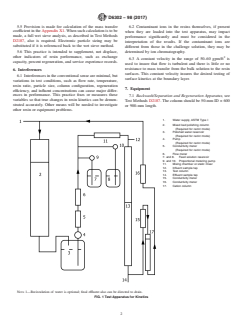
5.3 It is recommended that the practice be followed with the resin ratio, flow rate, and influent quality as indicated. The design of the apparatus permits other variations to be used that may be more appropriate to the chemicals used in a specific plant and the nature of its cooling water, but the cautions and limitations noted in the practice must be accommodated.
5.4 It is possible that the cation resin could experience kinetics problems. In many cases, however, the anion resins are more likely to experience the types of degradation or fouling that could lead to impaired kinetics. Testing of field anion and cation resins together is an option, especially when historic data on the mixed bed will be compiled. Recognize, however, that many variables can be introduced, making it difficult to interpret results or to compare to historical or new resin data on separate components.
5.5 Provision is made for calculation of the mass transfer coefficient in the Appendix X1. When such calculation is to be made, a full wet sieve analysis, as described in Test Methods D2187, also is required. Electronic particle sizing may be substituted if it is referenced back to the wet sieve method.
5.6 This practice is intended to supplement, not displace, other indicators of resin performance, such as exchange capacity, percent regeneration, and service experience records.
SCOPE
1.1 This practice is intended to evaluate changes in kinetic performance of ion exchange resins used in mixed beds to produce high purity water. Within strict limitations, it also may be used for comparing resin of different types. This standard does not seek to mimic actual operating conditions. Specific challenge solutions and conditions are specified. At the option of the user, other conditions may be tested.
1.2 The values stated in SI units are to be regarded as standard. No other units of measurement are included in this standard.
1.3 This standard does not purport to address the safety concerns, if any, associated with its use. It is the responsibility of the user of this standard to establish appropriate safety and health practices and determine the applicability of regulatory limitations prior to use.
1.4 This international standard was developed in accordance with internationally recognized principles on standardization established in the Decision on Principles for the Development of International Standards, Guides and Recommendations issued by the World Trade Organization Technical Barriers to Trade (TBT) Committee.
- Status
- Published
- Publication Date
- 31-May-2017
- Technical Committee
- D19 - Water
- Drafting Committee
- D19.08 - Membranes and Ion Exchange Materials
Overview
ASTM D6302-98(2017): Standard Practice for Evaluating the Kinetic Behavior of Ion Exchange Resins provides guidance for assessing the kinetic performance of ion exchange resins, particularly those deployed in mixed-bed polishing systems for producing high purity water. This standard is vital for monitoring changes in resin effectiveness over time, comparing differing resin types, and optimizing mixed-bed operations in low ionic strength applications. The procedures outlined do not replicate exact operating plant conditions but are designed to create stringent kinetic limitations, ensuring that test results reflect kinetic-rather than equilibrium-leakage of ions.
Key Topics
- Kinetic Performance Evaluation: Focuses on determining how quickly ion exchange resins can remove contaminants under specified test conditions, where kinetic factors dominate over equilibrium.
- Test Conditions: The method sets parameters for influent flow velocity, concentration, bed depth, and resin ratios to ensure kinetic limitations are established. Adjustments to fit specific site needs are permissible if noted precautions are observed.
- Mixed Bed Systems: Primarily targets mixed bed ion exchange systems, commonly used as polishing steps in ultrapure water production processes.
- Resin Types and Degradation: The practice helps identify potential degradation or fouling in anion and cation exchange resins. Anion resins are typically more susceptible to impaired kinetics, though both resin types should be evaluated to ensure system reliability.
- Supplementary Testing: The standard can be used alongside other performance metrics such as exchange capacity, percent regeneration, and historical service data for comprehensive resin management.
- Mass Transfer Coefficient Calculation: Provides procedures in the appendix for calculating the mass transfer coefficient based on resin particle size analysis, further facilitating the comparative analysis of resin kinetics.
Applications
ASTM D6302-98(2017) is most relevant for industries and facilities where high purity water is critical, such as power generation, microelectronics manufacturing, and laboratory settings. Practical applications include:
- Commissioning New Resin Beds: Establishing baseline kinetic performance for future reference and maintenance planning.
- Routine Maintenance and Troubleshooting: Periodic testing of field resin samples to monitor condition, diagnose performance degradation, and determine the need for resin replacement or regeneration optimization.
- Comparative Resin Analysis: Supporting objective comparison between different ion exchange resin brands or types within a controlled laboratory framework.
- System Optimization: Informing operational adjustments (e.g., flow rates, bed depth) to maximize system efficiency and water purity.
- Data Integrity and Validation: Supplementing service records and other analytical results for robust trend analysis and decision-making.
Related Standards
For comprehensive evaluation and consistent procedures, ASTM D6302-98(2017) references several other ASTM standards, including:
- ASTM D1129 - Terminology Relating to Water
- ASTM D1193 - Specification for Reagent Water
- ASTM D2187 - Test Methods for Physical and Chemical Properties of Particulate Ion-Exchange Resins
- ASTM D2687 - Practices for Sampling Particulate Ion-Exchange Materials
- ASTM D5391 - Test Method for Electrical Conductivity and Resistivity of Flowing High Purity Water Sample
These related standards guide the preparation of water samples, terminology, resin sampling, and analytical techniques necessary for accurate kinetic evaluation.
By adhering to ASTM D6302-98(2017), operators and laboratory personnel can ensure consistent, reliable evaluation of ion exchange resin kinetics to maintain optimal water quality and system performance. Incorporating this standard into routine maintenance enhances resin lifecycle management and safeguards critical water purification processes.
Relations
- Replaces
ASTM D6302-98(2009) - Standard Practice for Evaluating the Kinetic Behavior of Ion Exchange Resins - Effective Date
- 01-Jun-2017
- Effective Date
- 01-Apr-2024
- Effective Date
- 01-May-2020
- Effective Date
- 01-Aug-2017
- Effective Date
- 15-May-2016
- Effective Date
- 01-Mar-2010
- Effective Date
- 01-May-2009
- Effective Date
- 01-Dec-2007
- Effective Date
- 01-Sep-2006
- Effective Date
- 01-Sep-2006
- Effective Date
- 01-Mar-2006
- Effective Date
- 15-Feb-2006
- Effective Date
- 01-Apr-2005
- Effective Date
- 01-Jun-2004
- Effective Date
- 01-Mar-2004
Get Certified
Connect with accredited certification bodies for this standard

ECOCERT
Organic and sustainability certification.

Eurofins Food Testing Global
Global leader in food, environment, and pharmaceutical product testing.

Intertek Bangladesh
Intertek certification and testing services in Bangladesh.
Sponsored listings
Frequently Asked Questions
ASTM D6302-98(2017) is a standard published by ASTM International. Its full title is "Standard Practice for Evaluating the Kinetic Behavior of Ion Exchange Resins". This standard covers: SIGNIFICANCE AND USE 5.1 This practice is intended to evaluate changes in the performance of ion exchange resins used in mixed beds operating as polishing systems for solutions of low ionic strength, typically, 5.2 The conditions of this test must be limiting kinetically, such that kinetic leakage, and not equilibrium leakage, is tested. This leakage is influenced by a combination of influent flow velocity and concentration, as well as bed depth. 5.3 It is recommended that the practice be followed with the resin ratio, flow rate, and influent quality as indicated. The design of the apparatus permits other variations to be used that may be more appropriate to the chemicals used in a specific plant and the nature of its cooling water, but the cautions and limitations noted in the practice must be accommodated. 5.4 It is possible that the cation resin could experience kinetics problems. In many cases, however, the anion resins are more likely to experience the types of degradation or fouling that could lead to impaired kinetics. Testing of field anion and cation resins together is an option, especially when historic data on the mixed bed will be compiled. Recognize, however, that many variables can be introduced, making it difficult to interpret results or to compare to historical or new resin data on separate components. 5.5 Provision is made for calculation of the mass transfer coefficient in the Appendix X1. When such calculation is to be made, a full wet sieve analysis, as described in Test Methods D2187, also is required. Electronic particle sizing may be substituted if it is referenced back to the wet sieve method. 5.6 This practice is intended to supplement, not displace, other indicators of resin performance, such as exchange capacity, percent regeneration, and service experience records. SCOPE 1.1 This practice is intended to evaluate changes in kinetic performance of ion exchange resins used in mixed beds to produce high purity water. Within strict limitations, it also may be used for comparing resin of different types. This standard does not seek to mimic actual operating conditions. Specific challenge solutions and conditions are specified. At the option of the user, other conditions may be tested. 1.2 The values stated in SI units are to be regarded as standard. No other units of measurement are included in this standard. 1.3 This standard does not purport to address the safety concerns, if any, associated with its use. It is the responsibility of the user of this standard to establish appropriate safety and health practices and determine the applicability of regulatory limitations prior to use. 1.4 This international standard was developed in accordance with internationally recognized principles on standardization established in the Decision on Principles for the Development of International Standards, Guides and Recommendations issued by the World Trade Organization Technical Barriers to Trade (TBT) Committee.
SIGNIFICANCE AND USE 5.1 This practice is intended to evaluate changes in the performance of ion exchange resins used in mixed beds operating as polishing systems for solutions of low ionic strength, typically, 5.2 The conditions of this test must be limiting kinetically, such that kinetic leakage, and not equilibrium leakage, is tested. This leakage is influenced by a combination of influent flow velocity and concentration, as well as bed depth. 5.3 It is recommended that the practice be followed with the resin ratio, flow rate, and influent quality as indicated. The design of the apparatus permits other variations to be used that may be more appropriate to the chemicals used in a specific plant and the nature of its cooling water, but the cautions and limitations noted in the practice must be accommodated. 5.4 It is possible that the cation resin could experience kinetics problems. In many cases, however, the anion resins are more likely to experience the types of degradation or fouling that could lead to impaired kinetics. Testing of field anion and cation resins together is an option, especially when historic data on the mixed bed will be compiled. Recognize, however, that many variables can be introduced, making it difficult to interpret results or to compare to historical or new resin data on separate components. 5.5 Provision is made for calculation of the mass transfer coefficient in the Appendix X1. When such calculation is to be made, a full wet sieve analysis, as described in Test Methods D2187, also is required. Electronic particle sizing may be substituted if it is referenced back to the wet sieve method. 5.6 This practice is intended to supplement, not displace, other indicators of resin performance, such as exchange capacity, percent regeneration, and service experience records. SCOPE 1.1 This practice is intended to evaluate changes in kinetic performance of ion exchange resins used in mixed beds to produce high purity water. Within strict limitations, it also may be used for comparing resin of different types. This standard does not seek to mimic actual operating conditions. Specific challenge solutions and conditions are specified. At the option of the user, other conditions may be tested. 1.2 The values stated in SI units are to be regarded as standard. No other units of measurement are included in this standard. 1.3 This standard does not purport to address the safety concerns, if any, associated with its use. It is the responsibility of the user of this standard to establish appropriate safety and health practices and determine the applicability of regulatory limitations prior to use. 1.4 This international standard was developed in accordance with internationally recognized principles on standardization established in the Decision on Principles for the Development of International Standards, Guides and Recommendations issued by the World Trade Organization Technical Barriers to Trade (TBT) Committee.
ASTM D6302-98(2017) is classified under the following ICS (International Classification for Standards) categories: 71.100.80 - Chemicals for purification of water. The ICS classification helps identify the subject area and facilitates finding related standards.
ASTM D6302-98(2017) has the following relationships with other standards: It is inter standard links to ASTM D6302-98(2009), ASTM D2687-95(2024), ASTM D1129-13(2020)e2, ASTM D2187-17, ASTM D2687-95(2016), ASTM D1129-10, ASTM D2187-94(2009), ASTM D2687-95(2007)e1, ASTM D1129-06ae1, ASTM D1129-06a, ASTM D1193-06, ASTM D1129-06, ASTM D5391-99(2005), ASTM D2187-94(2004), ASTM D1129-04e1. Understanding these relationships helps ensure you are using the most current and applicable version of the standard.
ASTM D6302-98(2017) is available in PDF format for immediate download after purchase. The document can be added to your cart and obtained through the secure checkout process. Digital delivery ensures instant access to the complete standard document.
Standards Content (Sample)
This international standard was developed in accordance with internationally recognized principles on standardization established in the Decision on Principles for the
Development of International Standards, Guides and Recommendations issued by the World Trade Organization Technical Barriers to Trade (TBT) Committee.
Designation: D6302 − 98 (Reapproved 2017)
Standard Practice for
Evaluating the Kinetic Behavior of Ion Exchange Resins
This standard is issued under the fixed designation D6302; the number immediately following the designation indicates the year of
original adoption or, in the case of revision, the year of last revision.Anumber in parentheses indicates the year of last reapproval.A
superscript epsilon (´) indicates an editorial change since the last revision or reapproval.
1. Scope 3. Terminology
1.1 This practice is intended to evaluate changes in kinetic
3.1 Definitions:
performance of ion exchange resins used in mixed beds to
3.1.1 For definitions of terms used in this standard, refer to
producehighpuritywater.Withinstrictlimitations,italsomay
Terminology D1129.
be used for comparing resin of different types. This standard
does not seek to mimic actual operating conditions. Specific
4. Summary of Practice
challenge solutions and conditions are specified.At the option
4.1 An apparatus is described in which a specified volume
of the user, other conditions may be tested.
ofregeneratedresinsampleismixedwithacorrespondingnew
1.2 The values stated in SI units are to be regarded as
resin.The mixed bed then is operated at a controlled high flow
standard. No other units of measurement are included in this
rateonaninfluentofknowncomposition,andthequalityofthe
standard.
effluent is measured by conductivity, and if agreed upon, other
1.3 This standard does not purport to address the safety
appropriate analytical procedures.
concerns, if any, associated with its use. It is the responsibility
of the user of this standard to establish appropriate safety and
5. Significance and Use
health practices and determine the applicability of regulatory
5.1 This practice is intended to evaluate changes in the
limitations prior to use.
performance of ion exchange resins used in mixed beds
1.4 This international standard was developed in accor-
operating as polishing systems for solutions of low ionic
dance with internationally recognized principles on standard-
strength,typically,<10mg/Ldissolvedsolids,thatareintended
ization established in the Decision on Principles for the
to produce very high purity effluents. It is recommended that
Development of International Standards, Guides and Recom-
when new resins are installed in a plant it be used to provide a
mendations issued by the World Trade Organization Technical
baselineagainstwhichthefutureperformanceofthatresincan
Barriers to Trade (TBT) Committee.
be judged.
2. Referenced Documents
5.2 The conditions of this test must be limiting kinetically,
2.1 ASTM Standards: such that kinetic leakage, and not equilibrium leakage, is
D1129Terminology Relating to Water
tested. This leakage is influenced by a combination of influent
D1193Specification for Reagent Water flow velocity and concentration, as well as bed depth.
D2187Test Methods for Physical and Chemical Properties
5.3 Itisrecommendedthatthepracticebefollowedwiththe
of Particulate Ion-Exchange Resins
resin ratio, flow rate, and influent quality as indicated. The
D2687PracticesforSamplingParticulateIon-ExchangeMa-
design of the apparatus permits other variations to be used that
terials
may be more appropriate to the chemicals used in a specific
D5391Test Method for Electrical Conductivity and Resis-
plant and the nature of its cooling water, but the cautions and
tivity of a Flowing High Purity Water Sample
limitations noted in the practice must be accommodated.
5.4 It is possible that the cation resin could experience
This practice is under the jurisdiction ofASTM Committee D19 on Water and
kineticsproblems.Inmanycases,however,theanionresinsare
is the direct responsibility of Subcommittee D19.08 on Membranes and Ion
more likely to experience the types of degradation or fouling
Exchange Materials.
that could lead to impaired kinetics. Testing of field anion and
Current edition approved June 1, 2017. Published June 2017. Originally
cation resins together is an option, especially when historic
approved in 1998. Last previous edition approved in 2009 as D6302–98 (2009).
DOI: 10.1520/D6302-98R17.
data on the mixed bed will be compiled. Recognize, however,
For referenced ASTM standards, visit the ASTM website, www.astm.org, or
that many variables can be introduced, making it difficult to
contact ASTM Customer Service at service@astm.org. For Annual Book of ASTM
interpretresultsortocomparetohistoricalornewresindataon
Standards volume information, refer to the standard’s Document Summary page on
the ASTM website. separate components.
Copyright © ASTM International, 100 Barr Harbor Drive, PO Box C700, West Conshohocken, PA 19428-2959. United States
D6302 − 98 (2017)
5.5 Provision is made for calculation of the mass transfer 6.2 Contaminant ions in the resins themselves, if present
coefficient in the Appendix X1.When such calculation is to be when they are loaded into the test apparatus, may impact
made, a full wet sieve analysis, as described in Test Methods
performance significantly and must be considered in the
D2187, also is required. Electronic particle sizing may be
interpretation of the results. If the contaminant ions are
substituted if it is referenced back to the wet sieve method.
different from those in the challenge solution, they may be
determined by ion chromatography.
5.6 This practice is intended to supplement, not displace,
other indicators of resin performance, such as exchange
6.3 A constant velocity in the range of 50–60 gpm/ft is
capacity, percent regeneration, and service experience records.
used to insure that flow is turbulent and there is little or no
resistance to mass transfer from the bulk solution to the resin
6. Interferences
surfaces. This constant velocity insures the desired testing of
6.1 Interferences in the conventional sense are minimal, but
surface kinetics at the boundary layer.
variations in test conditions, such as flow rate, temperature,
resin ratio, particle size, column configuration, regeneration
7. Equipment
efficiency, and influent concentrations can cause major differ-
ences in performance. This practice fixes or measures these
7.1 Backwash/Separation and Regeneration Apparatus, see
variables so that true changes in resin kinetics can be demon-
Test Methods D2187. The column should be 50-mm ID × 600
strated accurately. Other means will be needed to investigate
or 900-mm length.
other resin or equipment problems.
1. Water supply, ASTM Type I
2. Mixed bed polishing column
(Required for recirc mode)
3. Polished water reservoir
(Required for recirc mode)
4. Pump
(Required for recirc mode)
5. Conductivity meter
(Required for recirc mode)
6. Flow meter
7. and 8. Feed solution reservoir
9. and 10. Proportional metering pump
11. Mixing chamber or static mixer
12. Influent sample tap
13. Test column
14. Effluent sample tap
15. Conductivity meter
16. Conductivity meter
17. Cation column
NOTE 1—Recirculation of water is optional; final effluent also can be directed to drain.
FIG. 1 Test Apparatus for Kinetics
D6302 − 98 (2017)
7.2 Kinetics Test Apparatus (see Fig. 1): 8.5 Test Solutions—Test solutions can be modified for spe-
7.2.1 Feed Pumps,capableofcontrolleddeliveryof0.5to3 cific systems, however, the following are recommended for
mL/min. One is required, the second is optional for use where routine testing. Although a target feed injection rate of 0.5
another reagent, such as ammonia, is to be added. mL/min is used here, the feed concentrations and metering
7.2.2 Circulating Pump, capable of delivery of 1 to 1.5 pump flows can be altered, so long as the test column influent
L/min. concentrations and flow rate are nominal as specified.
7.2.3 Glass Column, nominal 25-mm ID × 600 mm. The
8.5.1 Ammonia Feed Solution (3.0 g/Las NH ) Optional for
column shown in Fig. 1 of Test Methods D2187 may be Use with Ammoniated Systems—Tare a beaker with about 50
modified for this purpose.
mL of water on an analytical balance with 0.01-g sensitivity.
7.2.4 Mixing Chamber. Add20.9gofconcentratedammoniumhydroxide(sp.gr.0.90)
7.2.5 Conductivity Meter With Recorder and Temperature
from a dropping bottle. Transfer to a 2-Lvolumetric flask, and
Compensation—See Test Method D5391. dilute to volume. Mix well. When delivered at the rate of 0.5
7.2.6 Flow Meter—Capableofmeasuringflowsintherange
mL/min into 1 L/min flow, the concentration in the influent
of about 1 L/min. should be 1.5 mg NH /L.
7.2.7 Cation Column, nominal 25-mm ID × 600-mm
NOTE 2—Ammonium hydroxide generates irritating ammonia vapors.
column,typicallywitha15–45-cmdepthofresin.Thiscolumn
8.5.2 Sodium Sulfate Feed Solution (0.9 g Na SO /L)—Dry
should be prepared the day before testing to allow to rinse to
2 4
the Na SO for1hat 100–105°C, then store in a desiccator.
>17.5 MΩ (see 8.3).
2 4
Weigh0.900goftheanhydroussodiumsulfate,anddissolveit
NOTE 1—Pressure relief should be provided for this system to allow no
in 1 L of water. Mix well. When delivered at the rate of 0.5
more pressure than the materials can tolerate, typically 50 psig or less.
mL/min into 1 L/min flow, the concentration of the influent
8. Reagents should be 0.145 mg/L Na and 0.300 mg/L SO .
8.1 PurityofReagents—Reagentsmeetingthespecifications 8.6 Regenerant, Sodium Hydroxide Solution (87 g/L)—Add
of the Committee on Analytical Reagents of the American
345 g NaOH to 3.5 Lof water with stirring. Cool and dilute to
Chemical Society may not be suitable for use in this practice. 4.0 L. This solution is caustic and liberates heat during
All reagents used should be of the highest grade commercially dissolution. This is equivalent to 8% NaOH by weight.
available and should be tested for both anionic and cationic
NOTE 3—This solution is intentionally stronger than typical field
impuritiesbyionchromatographyafterthefeedsolutionshave
processes so that maximum percent regeneration is achieved.
3,4
been prepared.
Reagent grade 50% NaOH (763 g NaOH/L) also can be
8.2 Purity of Water—Unless otherwise indicated, references
used and would require 456 mL to make 4.0 L.
towatershallbeunderstoodtomeanreagentwaterconforming
8.7 Regenerant, Hydrochloric Acid Solution (1 + 9)—
to Specification D1193, Type I. It shall be checked by ion
Carefully pour 200 mLof hydrochloric acid (HCl, sp. gr. 1.19)
chromatography at the ppb level prior to use, if ion chroma-
into 1800 mL of water, stirring constantly. Cool to 256 5°C.
tography will be used for analysis.
NOTE 4—For field cation samples, sulfuric acid typically would be
8.3 Standard Cation Resin—New hydrogen-form, strong
substituted for HCl, since H SO is the usual regenerant in the field.
2 4
acid, cation resin is to be used; nuclear grade is preferred. Do
not regenerate this resin. This resin should be stored in
9. Sampling
impermeable containers at temperatures that do not exceed
25°C.Backwashtheresinwithwaterat100%expansionforat 9.1 Collect the sample in accordance with Practices D2687.
least 15 min.The resin should be rinsed thoroughly with water It is extremely important that the resin sample properly
to≥17.5MΩresistivitybeforebeingusedinakineticstest.The represent the entire bed being evaluated. Core sampling is
samecationresinmaybeusedinthetestcolumn,aswellasthe required. A sample containing at least 300 mL of anion, or
cation column. It is recommended that a specific type and cation resin, or both, must be provided. The sample may be
brand of resin be used consistently where results are to be taken before or after separation of a mixed bed, so long as it is
compared. representative. Use a plastic or glass container with a water-
tight cap and label in accordance with Practices D2687.
8.4 Standard Anion Resin—Use new, hydroxide-form,
strong base anion resin; nuclear grade preferred. Follow other
9.2 Subsamples taken in the laboratory also must be taken
requirements as given in 8.3.
by careful coring to preserve the representativeness of the
sample.
Reagent Chemicals, American Chemical Society Specifications, American
10. Backwash and Separation Procedure
Chemical Society, Washington, DC. For suggestions on the testing of reagents not
listed by the American Chemical Society, see Analar Standards for Laboratory
10.1 Place about 800 mL of mixed bed resin sample or
Chemicals, BDH Ltd., Poole, Dorset, U.K., and the United States Pharmacopeia
about 500 mL of individual resin sample in the backwash/
and National Formulary, U.S. Pharmaceutical Convention, In
...