

ASTM D6274-18
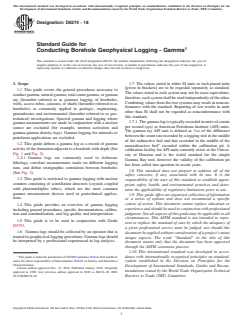
(Guide)Standard Guide for Conducting Borehole Geophysical Logging - Gamma
General Information
- Abstract
SIGNIFICANCE AND USE
5.1 An appropriately developed, documented, and executed guide is essential for the proper collection and application of gamma logs. This guide is to be used in conjunction with Guide D5753.
5.2 The benefits of its use include improving selection of gamma logging methods and equipment, gamma log quality and reliability, and usefulness of the gamma log data for subsequent display and interpretation.
5.3 This guide applies to commonly used gamma logging methods for geotechnical applications.
5.4 It is essential that personnel (see the Personnel section of Guide D5753) consult up-to-date textbooks and reports on the gamma technique, application, and interpretation methods.
SCOPE
1.1 This guide covers the general procedures necessary to conduct gamma, natural gamma, total count gamma, or gamma ray (hereafter referred to as gamma) logging of boreholes, wells, access tubes, caissons, or shafts (hereafter referred to as boreholes) as commonly applied to geologic, engineering, groundwater, and environmental (hereafter referred to as geotechnical) investigations. Spectral gamma and logging where gamma measurements are made in conjunction with a nuclear source are excluded (for example, neutron activation and gamma-gamma density logs). Gamma logging for minerals or petroleum applications are excluded.
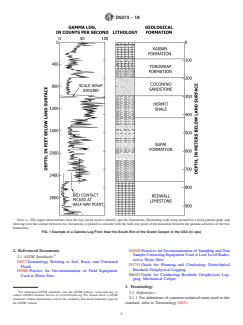
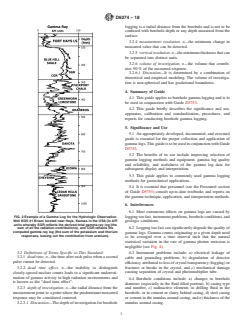
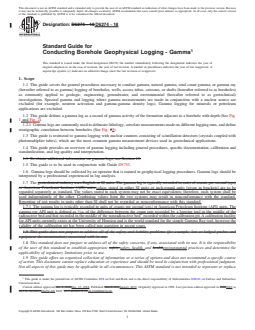
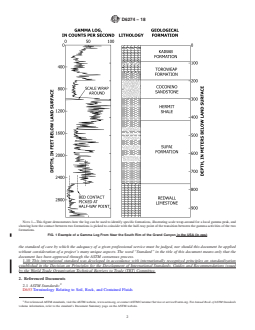
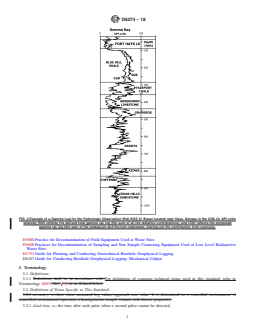
1.2 This guide defines a gamma log as a record of gamma activity of the formation adjacent to a borehole with depth (See Fig. 1 and Fig. 2).
FIG. 1 Example of a Gamma Log From Near the South Rim of the Grand Canyon in the USA (in cps)
Note 1: This figure demonstrates how the log can be used to identify specific formations, illustrating scale wrap-around for a local gamma peak, and showing how the contact between two formations is picked to coincide with the half-way point of the transition between the gamma activities of the two formations.
FIG. 2 Example of a Gamma Log for the Hydrologic Observation Well KGS #1 Braun located near Hays, Kansas in the USA (in API units whereby SGR reflects the derived total gamma ray log (the sum of all the radiation contributions), and CGR reflects the computed gamma ray log (the sum of the potassium and thorium responses, leaving out the contribution from uranium).
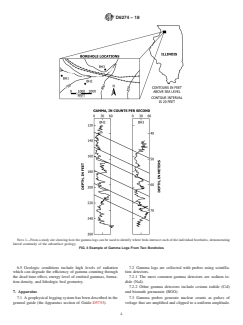
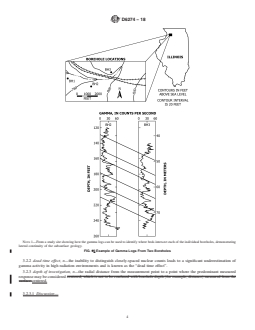
1.2.1 Gamma logs are commonly used to delineate lithology, correlate measurements made on different logging runs, and define stratigraphic correlation between boreholes (See Fig. 3).
FIG. 3 Example of Gamma Logs From Two Boreholes
Note 1: From a study site showing how the gamma logs can be used to identify where beds intersect each of the individual boreholes, demonstrating lateral continuity of the subsurface geology.
1.3 This guide is restricted to gamma logging with nuclear counters consisting of scintillation detectors (crystals coupled with photomultiplier tubes), which are the most common gamma measurement devices used in geotechnical applications.
1.4 This guide provides an overview of gamma logging including general procedures, specific documentation, calibration and standardization, and log quality and interpretation.
1.5 This guide is to be used in conjunction with Guide D5753.
1.6 Gamma logs should be collected by an operator that is trained in geophysical logging procedures. Gamma logs should be interpreted by a professional experienced in log analysis.
1.7 The values stated in either SI units or inch-pound units [given in brackets] are to be regarded separately as standard. The values stated in each system may not be exact equivalents; therefore, each system shall be used independently of the other. Combining values from the two systems may result in nonconformance with the standard. Reporting of test results in units other than SI shall not be regarded as nonconformance with this standard.
1.7.1 The gamma log is typically recorded in units of counts per second (cps) or American Petroleum Institute (API) units. The gamma ray API unit is defined as 1/20...
- Status
- Published
- Publication Date
- 14-Dec-2018
- Technical Committee
- D18 - Soil and Rock
- Drafting Committee
- D18.01 - Surface and Subsurface Investigation
Overview
ASTM D6274-18 is the Standard Guide for Conducting Borehole Geophysical Logging - Gamma, published by ASTM International. This guide outlines the accepted procedures and best practices for conducting gamma (including natural gamma, total count gamma, or gamma ray) logging in boreholes, wells, access tubes, caissons, or shafts, specifically for geologic, engineering, groundwater, and environmental (collectively, geotechnical) investigations. The guide is designed for use with commonly used methods and equipment, enhancing the quality, reliability, and usefulness of gamma log data for interpretation and application in geotechnical projects. It is to be used in conjunction with ASTM Guide D5753.
Key Topics
Purpose and Scope
- Establishes the methodology for gamma logging in geotechnical investigations
- Excludes spectral gamma, gamma logs using nuclear sources, and applications for minerals or petroleum
- Defines gamma logs as records of gamma activity adjacent to boreholes plotted with depth
Equipment and Measurement
- Specifies use of nuclear counters with scintillation detectors (e.g., sodium iodide crystals)
- Details proper apparatus and calibration requirements
- Addresses measurement units: counts per second (cps) or API units
Data Quality and Standardization
- Emphasizes calibration and standardization (including use of calibration facilities such as the University of Houston for API units)
- Guides on correction for effects like dead time, instrument or probe issues, borehole and geologic conditions
- Recommends procedures for ensuring log repeatability and reliability
Field Procedures
- Outlines processes for planning, executing, and documenting logging activities
- Discusses appropriate logging speed, digitizing intervals, scale selections, and the necessity for professional training
Log Interpretation and Reporting
- Provides recommendations for log display, data filtration, and integration with project data
- Stresses the importance of interpreting logs with qualified expertise
- Suggests documentation and reporting practices as per project objectives
Applications
Geotechnical Site Characterization
- Gamma logging is widely used to delineate lithology and stratigraphy, identify bed boundaries, and correlate formations across boreholes
- Supports hydrogeological studies by identifying potential aquifer zones and confining layers
Groundwater and Environmental Assessments
- Facilitates the interpretation of subsurface geology for well screen placement, monitoring well installations, and contamination mapping
- Incorporates gamma logs in environmental site assessments to detect radioisotope contamination and assist in remediation planning
Engineering Projects
- Assists in foundation design and evaluation by providing a reliable profile of subsurface conditions
- Used for verifying the continuity and integrity of geological units for construction or infrastructure development
Quality Control and Data Integration
- Gamma logs are critical for cross-correlation with other borehole geophysical logs (e.g., resistivity, caliper) to improve project accuracy
Related Standards
- ASTM D5753 - Guide for Planning and Conducting Geotechnical Borehole Geophysical Logging
- ASTM D653 - Terminology Relating to Soil, Rock, and Contained Fluids
- ASTM D5088 - Practice for Decontamination of Field Equipment Used at Waste Sites
- ASTM D5608 - Practices for Decontamination of Sampling and Non-Sample Contacting Equipment Used at Low Level Radioactive Waste Sites
- ASTM D6167 - Guide for Conducting Borehole Geophysical Logging: Mechanical Caliper
These related ASTM standards provide specialized guidance on preparation, terminology, equipment decontamination, and complementary logging methods, supporting comprehensive geophysical logging programs.
Keywords: ASTM D6274-18, gamma logging, borehole geophysics, natural gamma log, geotechnical investigations, standardization, calibration, stratigraphic correlation, well logging, environmental site characterization.
Relations
- Effective Date
- 15-Dec-2018
- Effective Date
- 01-May-2020
- Refers
ASTM D6167-19 - Standard Guide for Conducting Borehole Geophysical Logging: Mechanical Caliper - Effective Date
- 01-May-2019
- Refers
ASTM D5753-18 - Standard Guide for Planning and Conducting Geotechnical Borehole Geophysical Logging - Effective Date
- 01-Feb-2018
- Effective Date
- 01-Feb-2016
- Effective Date
- 01-Aug-2015
- Effective Date
- 15-Jan-2015
- Effective Date
- 01-Aug-2014
- Effective Date
- 01-Sep-2011
- Refers
ASTM D6167-11 - Standard Guide for Conducting Borehole Geophysical Logging: Mechanical Caliper - Effective Date
- 01-May-2011
- Effective Date
- 01-May-2010
- Effective Date
- 01-May-2010
- Effective Date
- 01-Jan-2009
- Effective Date
- 01-Dec-2008
- Effective Date
- 01-Nov-2008
Get Certified
Connect with accredited certification bodies for this standard

BSMI (Bureau of Standards, Metrology and Inspection)
Taiwan's standards and inspection authority.
Sponsored listings
Frequently Asked Questions
ASTM D6274-18 is a guide published by ASTM International. Its full title is "Standard Guide for Conducting Borehole Geophysical Logging - Gamma". This standard covers: SIGNIFICANCE AND USE 5.1 An appropriately developed, documented, and executed guide is essential for the proper collection and application of gamma logs. This guide is to be used in conjunction with Guide D5753. 5.2 The benefits of its use include improving selection of gamma logging methods and equipment, gamma log quality and reliability, and usefulness of the gamma log data for subsequent display and interpretation. 5.3 This guide applies to commonly used gamma logging methods for geotechnical applications. 5.4 It is essential that personnel (see the Personnel section of Guide D5753) consult up-to-date textbooks and reports on the gamma technique, application, and interpretation methods. SCOPE 1.1 This guide covers the general procedures necessary to conduct gamma, natural gamma, total count gamma, or gamma ray (hereafter referred to as gamma) logging of boreholes, wells, access tubes, caissons, or shafts (hereafter referred to as boreholes) as commonly applied to geologic, engineering, groundwater, and environmental (hereafter referred to as geotechnical) investigations. Spectral gamma and logging where gamma measurements are made in conjunction with a nuclear source are excluded (for example, neutron activation and gamma-gamma density logs). Gamma logging for minerals or petroleum applications are excluded. 1.2 This guide defines a gamma log as a record of gamma activity of the formation adjacent to a borehole with depth (See Fig. 1 and Fig. 2). FIG. 1 Example of a Gamma Log From Near the South Rim of the Grand Canyon in the USA (in cps) Note 1: This figure demonstrates how the log can be used to identify specific formations, illustrating scale wrap-around for a local gamma peak, and showing how the contact between two formations is picked to coincide with the half-way point of the transition between the gamma activities of the two formations. FIG. 2 Example of a Gamma Log for the Hydrologic Observation Well KGS #1 Braun located near Hays, Kansas in the USA (in API units whereby SGR reflects the derived total gamma ray log (the sum of all the radiation contributions), and CGR reflects the computed gamma ray log (the sum of the potassium and thorium responses, leaving out the contribution from uranium). 1.2.1 Gamma logs are commonly used to delineate lithology, correlate measurements made on different logging runs, and define stratigraphic correlation between boreholes (See Fig. 3). FIG. 3 Example of Gamma Logs From Two Boreholes Note 1: From a study site showing how the gamma logs can be used to identify where beds intersect each of the individual boreholes, demonstrating lateral continuity of the subsurface geology. 1.3 This guide is restricted to gamma logging with nuclear counters consisting of scintillation detectors (crystals coupled with photomultiplier tubes), which are the most common gamma measurement devices used in geotechnical applications. 1.4 This guide provides an overview of gamma logging including general procedures, specific documentation, calibration and standardization, and log quality and interpretation. 1.5 This guide is to be used in conjunction with Guide D5753. 1.6 Gamma logs should be collected by an operator that is trained in geophysical logging procedures. Gamma logs should be interpreted by a professional experienced in log analysis. 1.7 The values stated in either SI units or inch-pound units [given in brackets] are to be regarded separately as standard. The values stated in each system may not be exact equivalents; therefore, each system shall be used independently of the other. Combining values from the two systems may result in nonconformance with the standard. Reporting of test results in units other than SI shall not be regarded as nonconformance with this standard. 1.7.1 The gamma log is typically recorded in units of counts per second (cps) or American Petroleum Institute (API) units. The gamma ray API unit is defined as 1/20...
SIGNIFICANCE AND USE 5.1 An appropriately developed, documented, and executed guide is essential for the proper collection and application of gamma logs. This guide is to be used in conjunction with Guide D5753. 5.2 The benefits of its use include improving selection of gamma logging methods and equipment, gamma log quality and reliability, and usefulness of the gamma log data for subsequent display and interpretation. 5.3 This guide applies to commonly used gamma logging methods for geotechnical applications. 5.4 It is essential that personnel (see the Personnel section of Guide D5753) consult up-to-date textbooks and reports on the gamma technique, application, and interpretation methods. SCOPE 1.1 This guide covers the general procedures necessary to conduct gamma, natural gamma, total count gamma, or gamma ray (hereafter referred to as gamma) logging of boreholes, wells, access tubes, caissons, or shafts (hereafter referred to as boreholes) as commonly applied to geologic, engineering, groundwater, and environmental (hereafter referred to as geotechnical) investigations. Spectral gamma and logging where gamma measurements are made in conjunction with a nuclear source are excluded (for example, neutron activation and gamma-gamma density logs). Gamma logging for minerals or petroleum applications are excluded. 1.2 This guide defines a gamma log as a record of gamma activity of the formation adjacent to a borehole with depth (See Fig. 1 and Fig. 2). FIG. 1 Example of a Gamma Log From Near the South Rim of the Grand Canyon in the USA (in cps) Note 1: This figure demonstrates how the log can be used to identify specific formations, illustrating scale wrap-around for a local gamma peak, and showing how the contact between two formations is picked to coincide with the half-way point of the transition between the gamma activities of the two formations. FIG. 2 Example of a Gamma Log for the Hydrologic Observation Well KGS #1 Braun located near Hays, Kansas in the USA (in API units whereby SGR reflects the derived total gamma ray log (the sum of all the radiation contributions), and CGR reflects the computed gamma ray log (the sum of the potassium and thorium responses, leaving out the contribution from uranium). 1.2.1 Gamma logs are commonly used to delineate lithology, correlate measurements made on different logging runs, and define stratigraphic correlation between boreholes (See Fig. 3). FIG. 3 Example of Gamma Logs From Two Boreholes Note 1: From a study site showing how the gamma logs can be used to identify where beds intersect each of the individual boreholes, demonstrating lateral continuity of the subsurface geology. 1.3 This guide is restricted to gamma logging with nuclear counters consisting of scintillation detectors (crystals coupled with photomultiplier tubes), which are the most common gamma measurement devices used in geotechnical applications. 1.4 This guide provides an overview of gamma logging including general procedures, specific documentation, calibration and standardization, and log quality and interpretation. 1.5 This guide is to be used in conjunction with Guide D5753. 1.6 Gamma logs should be collected by an operator that is trained in geophysical logging procedures. Gamma logs should be interpreted by a professional experienced in log analysis. 1.7 The values stated in either SI units or inch-pound units [given in brackets] are to be regarded separately as standard. The values stated in each system may not be exact equivalents; therefore, each system shall be used independently of the other. Combining values from the two systems may result in nonconformance with the standard. Reporting of test results in units other than SI shall not be regarded as nonconformance with this standard. 1.7.1 The gamma log is typically recorded in units of counts per second (cps) or American Petroleum Institute (API) units. The gamma ray API unit is defined as 1/20...
ASTM D6274-18 is classified under the following ICS (International Classification for Standards) categories: 17.040.99 - Other standards related to linear and angular measurements. The ICS classification helps identify the subject area and facilitates finding related standards.
ASTM D6274-18 has the following relationships with other standards: It is inter standard links to ASTM D6274-10, ASTM D5088-20, ASTM D6167-19, ASTM D5753-18, ASTM D5608-16, ASTM D5088-15a, ASTM D5088-15, ASTM D653-14, ASTM D653-11, ASTM D6167-11, ASTM D5753-05(2010), ASTM D5608-10, ASTM D653-09, ASTM D653-08a, ASTM D653-08. Understanding these relationships helps ensure you are using the most current and applicable version of the standard.
ASTM D6274-18 is available in PDF format for immediate download after purchase. The document can be added to your cart and obtained through the secure checkout process. Digital delivery ensures instant access to the complete standard document.
Standards Content (Sample)
This international standard was developed in accordance with internationally recognized principles on standardization established in the Decision on Principles for the
Development of International Standards, Guides and Recommendations issued by the World Trade Organization Technical Barriers to Trade (TBT) Committee.
Designation: D6274 − 18
Standard Guide for
Conducting Borehole Geophysical Logging - Gamma
This standard is issued under the fixed designation D6274; the number immediately following the designation indicates the year of
original adoption or, in the case of revision, the year of last revision. A number in parentheses indicates the year of last reapproval. A
superscript epsilon (´) indicates an editorial change since the last revision or reapproval.
1. Scope 1.7 The values stated in either SI units or inch-pound units
[given in brackets] are to be regarded separately as standard.
1.1 This guide covers the general procedures necessary to
The values stated in each system may not be exact equivalents;
conductgamma,naturalgamma,totalcountgamma,orgamma
therefore,eachsystemshallbeusedindependentlyoftheother.
ray (hereafter referred to as gamma) logging of boreholes,
Combining values from the two systems may result in noncon-
wells, access tubes, caissons, or shafts (hereafter referred to as
formance with the standard. Reporting of test results in units
boreholes) as commonly applied to geologic, engineering,
other than SI shall not be regarded as nonconformance with
groundwater, and environmental (hereafter referred to as geo-
this standard.
technical) investigations. Spectral gamma and logging where
1.7.1 Thegammalogistypicallyrecordedinunitsofcounts
gamma measurements are made in conjunction with a nuclear
per second (cps) or American Petroleum Institute (API) units.
source are excluded (for example, neutron activation and
The gamma ray API unit is defined as ⁄200 of the difference
gamma-gamma density logs). Gamma logging for minerals or
betweenthecountraterecordedbyaloggingtoolinthemiddle
petroleum applications are excluded.
of the radioactive bed and that recorded in the middle of the
1.2 This guide defines a gamma log as a record of gamma
nonradioactive bed” recorded within the calibration pit. A
activityoftheformationadjacenttoaboreholewithdepth(See
calibration facility forAPI units currently exists at the Univer-
Fig. 1 and Fig. 2).
sity of Houston and is the world standard for the simple
1.2.1 Gamma logs are commonly used to delineate
Gamma Ray tool, however the validity of the calibration pit
lithology, correlate measurements made on different logging
has been called into question in recent years.
runs, and define stratigraphic correlation between boreholes
1.8 This standard does not purport to address all of the
(See Fig. 3).
safety concerns, if any, associated with its use. It is the
1.3 This guide is restricted to gamma logging with nuclear
responsibility of the user of this standard to establish appro-
counters consisting of scintillation detectors (crystals coupled
priate safety, health, and environmental practices and deter-
with photomultiplier tubes), which are the most common
mine the applicability of regulatory limitations prior to use.
gamma measurement devices used in geotechnical applica-
1.9 This guide offers an organized collection of information
tions.
or a series of options and does not recommend a specific
course of action. This document cannot replace education or
1.4 This guide provides an overview of gamma logging
experienceandshouldbeusedinconjunctionwithprofessional
including general procedures, specific documentation, calibra-
judgment. Not all aspects of this guide may be applicable in all
tion and standardization, and log quality and interpretation.
circumstances. This ASTM standard is not intended to repre-
1.5 This guide is to be used in conjunction with Guide
sent or replace the standard of care by which the adequacy of
D5753.
a given professional service must be judged, nor should this
1.6 Gamma logs should be collected by an operator that is
document be applied without consideration of a project’s many
trained in geophysical logging procedures. Gamma logs should
unique aspects. The word “Standard” in the title of this
be interpreted by a professional experienced in log analysis.
document means only that the document has been approved
through the ASTM consensus process.
1.10 This international standard was developed in accor-
dance with internationally recognized principles on standard-
This guide is under the jurisdiction ofASTM Committee D18 on Soil and Rock
and is the direct responsibility of Subcommittee D18.01 on Surface and Subsurface
ization established in the Decision on Principles for the
Characterization.
Development of International Standards, Guides and Recom-
Current edition approved Dec. 15, 2018. Published January 2019. Originally
mendations issued by the World Trade Organization Technical
approved in 1998. Last previous edition approved in 2010 as D6274–10. DOI:
10.1520/D6274-18. Barriers to Trade (TBT) Committee.
Copyright © ASTM International, 100 Barr Harbor Drive, PO Box C700, West Conshohocken, PA 19428-2959. United States
D6274 − 18
NOTE 1—This figure demonstrates how the log can be used to identify specific formations, illustrating scale wrap-around for a local gamma peak, and
showing how the contact between two formations is picked to coincide with the half-way point of the transition between the gamma activities of the two
formations.
FIG. 1 Example of a Gamma Log From Near the South Rim of the Grand Canyon in the USA (in cps)
2. Referenced Documents D5608 Practices for Decontamination of Sampling and Non
2 Sample Contacting Equipment Used at Low Level Radio-
2.1 ASTM Standards:
active Waste Sites
D653 Terminology Relating to Soil, Rock, and Contained
D5753 Guide for Planning and Conducting Geotechnical
Fluids
Borehole Geophysical Logging
D5088 Practice for Decontamination of Field Equipment
D6167 Guide for Conducting Borehole Geophysical Log-
Used at Waste Sites
ging: Mechanical Caliper
3. Terminology
For referenced ASTM standards, visit the ASTM website, www.astm.org, or
3.1 Definitions:
contact ASTM Customer Service at service@astm.org. For Annual Book of ASTM
3.1.1 For definitions of common technical terms used in this
Standards volume information, refer to the standard’s Document Summary page on
the ASTM website. standard, refer to Terminology D653.
D6274 − 18
logging is a radial distance from the borehole and is not to be
confused with borehole depth or any depth measured from the
surface.
3.2.4 measurement resolution, n—the minimum change in
measured value that can be detected.
3.2.5 verticalresolution,n—theminimumthicknessthatcan
be separated into distinct units.
3.2.6 volume of investigation, n—the volume that contrib-
utes 90 % of the measured response.
3.2.6.1 Discussion—It is determined by a combination of
theoretical and empirical modeling. The volume of investiga-
tion is non-spherical and has gradational boundaries.
4. Summary of Guide
4.1 This guide applies to borehole gamma logging and is to
be used in conjunction with Guide D5753.
4.2 This guide briefly describes the significance and use,
apparatus, calibration and standardization, procedures, and
reports for conducting borehole gamma logging.
5. Significance and Use
5.1 An appropriately developed, documented, and executed
guide is essential for the proper collection and application of
gammalogs.ThisguideistobeusedinconjunctionwithGuide
D5753.
5.2 The benefits of its use include improving selection of
gamma logging methods and equipment, gamma log quality
and reliability, and usefulness of the gamma log data for
subsequent display and interpretation.
5.3 This guide applies to commonly used gamma logging
methods for geotechnical applications.
5.4 It is essential that personnel (see the Personnel section
of Guide D5753) consult up-to-date textbooks and reports on
the gamma technique, application, and interpretation methods.
6. Interferences
6.1 Most extraneous effects on gamma logs are caused by
FIG. 2 Example of a Gamma Log for the Hydrologic Observation loggingtoofast,instrumentproblems,boreholeconditions,and
Well KGS #1 Braun located near Hays, Kansas in the USA (in API
geologic conditions.
units whereby SGR reflects the derived total gamma ray log (the
6.2 Logging too fast can significantly degrade the quality of
sum of all the radiation contributions), and CGR reflects the
computed gamma ray log (the sum of the potassium and thorium gamma logs. Gamma counts originating at a given depth need
responses, leaving out the contribution from uranium).
to be averaged over a time interval such that the natural
statistical variation in the rate of gamma photon emission is
negligible (see Fig. 4).
3.2 Definitions of Terms Specific to This Standard:
6.3 Instrument problems include: a) electrical leakage of
3.2.1 dead time, n—the time after each pulse when a second
cable and grounding problems, b) degradation of detector
pulse cannot be detected.
efficiency attributed to loss of crystal transparency (fogging) or
fractures or breaks in the crystal, and c) mechanical damage
3.2.2 dead time effect, n—the inability to distinguish
causing separation of crystal and photomultiplier tube.
closely-spaced nuclear counts leads to a significant underesti-
mation of gamma activity in high radiation environments and
6.4 Borehole conditions include: a) changes in borehole
is known as the “dead time effect”.
diameter (especially in the fluid-filled portion), b) casing type
3.2.3 depth of investigation, n—the radial distance from the and number, c) radioactive elements in drilling fluid in the
measurement point to a point where the predominant measured borehole, or in cement or slurry behind casing, d) steel casing
response may be considered centered. or cement in the annulus around casing, and e) thickness of the
3.2.3.1 Discussion—The depth of investigation for borehole annulus around casing.
D6274 − 18
NOTE 1—From a study site showing how the gamma logs can be used to identify where beds intersect each of the individual boreholes, demonstrating
lateral continuity of the subsurface geology.
FIG. 3 Example of Gamma Logs From Two Boreholes
6.5 Geologic conditions include high levels of radiation 7.2 Gamma logs are collected with probes using scintilla-
which can degrade the efficiency of gamma counting through tion detectors.
the dead time effect, energy level of emitted gammas, forma- 7.2.1 The most common gamma detectors are sodium io-
tion density, and lithologic bed geometry. dide (NaI).
7.2.2 Other gamma detectors include cesium iodide (CsI)
7. Apparatus and bismuth germanate (BGO).
7.1 Ageophysical logging system has been described in the 7.3 Gamma probes generate nuclear counts as pulses of
general guide (the Apparatus section of Guide D5753). voltage that are amplified and clipped to a uniform amplitude.
D6274 − 18
NOTE 1—The fluctuations in gamma activity in counts per second is shown to vary by progressively smaller amounts as the averaging period (time
constant) is increased from 1 to 20 s.
FIG. 4 Example of Natural Statistical Fluctuation of Gamma Counts From a Test Source of Given Strength
7.3.1 Gamma probes typically used for geotechnical appli- 7.4.2 Thedepthofinvestigationforgammalogsisgenerally
cations can be logged inside boreholes as small as 5 cm [2-in.]
considered to be 15 to 30 cm [0.5 to 1.0 ft].
in diameter.
7.5 Vertical resolution of gamma logs is determined by the
7.4 The volume of investigation and depth of investigation
size of the volume from which gammas can reach a nuclear
are determined by the density of the material near the probe,
detector suspended in the borehole. In typical geological
whichcontrolstheaveragedistanceagammaphotoncantravel
formations surrounding a fluid-filled borehole, this is a roughly
before being absorbed.
spherical volume about 30 to 60 cm [1 to 2 ft] in diameter.
7.4.1 The volume of investigation for gamma logs is gen-
Excessive logging speed can decrease vertical resolution.
erally considered spherical with a radius of 15 to 30 cm [0.5 to
1.0 ft] from the center of the detector in typical geological 7.6 Measurement resolution of gamma probes is determined
by the counting efficiency of the nuclear detector being used in
formations. The volume becomes elongated when detector
length exceeds approximately 15 cm [0.5 ft]. the probe. Typical measurement resolution is 1 cps.
D6274 − 18
7.7 A variety of gamma logging equipment is available for 8.4 Gamma log output needs to be corrected for dead time
geotechnical investigations. It is not practical to list all of the when logging in formations with unusually large count rates,
sources of potentially acceptable equipment. suchasuranium-richpegmatitesorphosphaticsands,andareas
contaminated with radioactive waste.
8.4.1 Dead time corrections are usually negligible under
8. Calibration and Standardization of Gamma Logs
typical logging conditions when measured gamma counts are
8.1 General:
less than a few hundred counts per second.
8.1.1 National Institute of Standards and Technology
8.4.2 Dead time corrections are estimated by comparing the
(NIST) calibration and standardization procedures do not exist
gamma log response under the influence of two similar
for gamma logging. A calibration facility for API units cur-
radioactive sources. The measured count rate would approxi-
rently exists at the University of Houston and is the world
mately double over that with one source when both sources are
standard for the simple Gamma Ray tool.
placed in the sample volume of the logging tool.The dead time
8.1.2 Gamma logs can be used in a qualitative (for example,
causesthecountratestobeslightlylessthandouble.Deadtime
comparative) or quantitative (for example, estimating radioiso-
is given by the formula:
tope concentration) manner depending upon the project objec-
Dead Time 5 t 5 2~N 1N 2 N !/~N ~N 1N !! (1)
0 1 2 12 12 1 2
tives.
8.1.3 Gamma calibration and standardization methods and
Corrected count rate 5 N* 5 N/ 1 2Nt
~ !
frequency shall be sufficient to meet project objectives.
where:
8.1.3.1 Calibrationandstandardizationshouldbeperformed
each time a gamma probe is suspected to be damaged, N,N = the count rates measured using each of the two
1 2
modified, repaired, but at least once a year. similar sources,
N = the count rate obtained using both of the similar
8.2 Calibration is the process of establishing values for
sources in counts per second,
gamma response associated with specific levels of radioisotope
t = the dead time correction in seconds,
concentration in the sampled volume and is accomplished with
N = the measured count rate in a formation in counts
arepresentativephysicalmodel.Calibrationdatavaluesrelated
per second, and
to the physical properties (for example, radioisotope concen-
N* = the count rate after correction for the dead time
tration)mayberecordedinunits(forexample,cps),thatcanbe
effect.
converted to units of radioactive element concentration (for
t isusuallyfoundtobeafewmicrosecondsformostgamma
example, ppm Radium-226 or percent Uranium-238 equiva-
logging equipment.
lents).
8.2.1 Calibration is performed by recording gamma log
9. Procedure
response in cps in boreholes centered within volumes contain-
ing known homogenous concentrations of radioactivity ele- 9.1 See the Procedure section of Guide D5753 for planning
a logging program, data formats, personnel qualifications, field
ments. To be able assess the temperature impact on the results,
it is suggested that a temperature log is maintained during the documentation, and header documentation.
9.1.1 Document gamma specific information (for example,
calibration.
crystal size, type, and location).
8.2.2 Calibration volumes should be designed to contain
material as close as possible to that in the environment where
9.2 Identify gamma logging objectives. Select appropriate
the logs are to be obtained to allow for effects such as gamma
equipment to meet objectives.
energy level, formation density, and activity of daughter
9.3 Gamma logs are commonly run with other logging
isotopes on the calibration process.
measurements in combination probes for correlation purposes.
8.3 Standardization is the process of checking logging
This is most often done by equipping other classes of logging
response to show evidence of repeatability and consistency,
probes (electric, indication, neutron porosity, etc.) with gamma
and to ensure that logging probes with different detector
detectors (see Fig. 5).
efficiencies measure the same amount of gamma activity in the
9.3.1 Detector location on the probe needs to be appropriate
same formation. The response in cps of every gamma detector
to meet the project objectives. Long combination probe strings
is different for the same radioactive environment.
with the gamma detector located at a significant distance from
8.3.1 Calibration serves as a check of standardization.
the bottom of the probe may be inappropriate. Gamma detec-
8.3.2 Arepresentative borehole may be used to periodically
tion position on the logging probe is especially important in
check gamma probe response, provided the borehole and shallow boreholes where over drilling the borehole is not
surroundingenvironmentdonotchangewithtimeortheeffects
possible.
of such changes on gamma response can be documented.
9.3.2 Gamma probes are usually run free-hanging where the
8.3.3 A small radioactive source(s) (thorium-treated lantern probe lies against one side of the borehole; that is, as a
mantles, small bottles of potassium chloride, laboratory radio- mandrel. However, gamma detectors are sometimes included
active test sources, or sleeves containing natural radioisotopes with combination probes that are run centralized or decentral-
(phosphate sands, etc.)) placed over the gamma detector can be ized in the borehole. Gamma response may be somewhat
used to check the gamma probe response if the level of gamma different depending upon the method used (for example,
activity in the source(s) has been certified. free-hanging or centralized) in a given geologic environment.
D6274 − 18
NOTE 1—This figure shows a small depth offset that should be removed by adjusting the depth scale on one of the logs; note that the average count
rates for the two different gamma detectors differ as a result of different detector efficiencies.
FIG. 5 Example of Gamma Logs From Gamma Detectors in Two Different Logging Tools (Electrical Resistivity on Density)
9.3.3 Gamma equipment decontamination is addressed ac- 9.5 Gamma probe operation is typically checked before the
cording to project specifications (see Practice D5
...
This document is not an ASTM standard and is intended only to provide the user of an ASTM standard an indication of what changes have been made to the previous version. Because
it may not be technically possible to adequately depict all changes accurately, ASTM recommends that users consult prior editions as appropriate. In all cases only the current version
of the standard as published by ASTM is to be considered the official document.
Designation: D6274 − 10 D6274 − 18
Standard Guide for
Conducting Borehole Geophysical Logging - Gamma
This standard is issued under the fixed designation D6274; the number immediately following the designation indicates the year of
original adoption or, in the case of revision, the year of last revision. A number in parentheses indicates the year of last reapproval. A
superscript epsilon (´) indicates an editorial change since the last revision or reapproval.
1. Scope
1.1 This guide covers the general procedures necessary to conduct gamma, natural gamma, total count gamma, or gamma ray
(hereafter referred to as gamma) logging of boreholes, wells, access tubes, caissons, or shafts (hereafter referred to as boreholes)
as commonly applied to geologic, engineering, groundwater, and environmental (hereafter referred to as geotechnical)
investigations. Spectral gamma and logging where gamma measurements are made in conjunction with a nuclear source are
excluded (for example, neutron activation and gamma-gamma density logs). Gamma logging for minerals or petroleum
applications are excluded.
1.2 This guide defines a gamma log as a record of gamma activity of the formation adjacent to a borehole with depth (See Fig.
1 and Fig. 2).
1.2.1 Gamma logs are commonly used to delineate lithology, correlate measurements made on different logging runs, and define
stratigraphic correlation between boreholes (See Fig. 23).
1.3 This guide is restricted to gamma logging with nuclear counters consisting of scintillation detectors (crystals coupled with
photomultiplier tubes), which are the most common gamma measurement devices used in geotechnical applications.
1.4 This guide provides an overview of gamma logging including general procedures, specific documentation, calibration and
standardization, and log quality and interpretation.
1.5 To obtain additional information on gamma logs, see Section 13.
1.5 This guide is to be used in conjunction with Guide D5753.
1.6 Gamma logs should be collected by an operator that is trained in geophysical logging procedures. Gamma logs should be
interpreted by a professional experienced in log analysis.
1.7 The geotechnical industry uses English or SI units. The gamma log is typically recorded in units of counts per second (cps)
or American Petroleum Institute (API) units.values stated in either SI units or inch-pound units [given in brackets] are to be
regarded separately as standard. The values stated in each system may not be exact equivalents; therefore, each system shall be
used independently of the other. Combining values from the two systems may result in nonconformance with the standard.
Reporting of test results in units other than SI shall not be regarded as nonconformance with this standard.
1.7.1 The gamma log is typically recorded in units of counts per second (cps) or American Petroleum Institute (API) units. The
gamma ray API unit is defined as ⁄200 of the difference between the count rate recorded by a logging tool in the middle of the
radioactive bed and that recorded in the middle of the nonradioactive bed” recorded within the calibration pit. A calibration facility
for API units currently exists at the University of Houston and is the world standard for the simple Gamma Ray tool, however the
validity of the calibration pit has been called into question in recent years.
1.9 This guide does not purport to address all of the safety and liability problems (for example, lost or lodged probes and
equipment decontamination) associated with its use.
1.8 This standard does not purport to address all of the safety concerns, if any, associated with its use. It is the responsibility
of the user of this standard to establish appropriate safety safety, health, and healthenvironmental practices and determine the
applicability of regulatory limitations prior to use.
1.9 This guide offers an organized collection of information or a series of options and does not recommend a specific course
of action. This document cannot replace education or experience and should be used in conjunction with professional judgment.
Not all aspects of this guide may be applicable in all circumstances. This ASTM standard is not intended to represent or replace
This guide is under the jurisdiction of ASTM Committee D18 on Soil and Rock and is the direct responsibility of Subcommittee D18.01 on Surface and Subsurface
Characterization.
Current edition approved Oct. 1, 2010Dec. 15, 2018. Published March 2011January 2019. Originally approved in 1998. Last previous edition approved in 20042010 as
D6274–98(2004).D6274–10. DOI: 10.1520/D6274-10.10.1520/D6274-18.
Copyright © ASTM International, 100 Barr Harbor Drive, PO Box C700, West Conshohocken, PA 19428-2959. United States
D6274 − 18
NOTE 1—This figure demonstrates how the log can be used to identify specific formations, illustrating scale wrap-around for a local gamma peak, and
showing how the contact between two formations is picked to coincide with the half-way point of the transition between the gamma activities of the two
formations.
FIG. 1 Example of a Gamma Log From Near the South Rim of the Grand Canyon in the USA (in cps)
the standard of care by which the adequacy of a given professional service must be judged, nor should this document be applied
without consideration of a project’s many unique aspects. The word “Standard” in the title of this document means only that the
document has been approved through the ASTM consensus process.
1.10 This international standard was developed in accordance with internationally recognized principles on standardization
established in the Decision on Principles for the Development of International Standards, Guides and Recommendations issued
by the World Trade Organization Technical Barriers to Trade (TBT) Committee.
2. Referenced Documents
2.1 ASTM Standards:
D653 Terminology Relating to Soil, Rock, and Contained Fluids
For referenced ASTM standards, visit the ASTM website, www.astm.org, or contact ASTM Customer Service at service@astm.org. For Annual Book of ASTM Standards
volume information, refer to the standard’s Document Summary page on the ASTM website.
D6274 − 18
FIG. 2 Example of a Gamma Log for the Hydrologic Observation Well KGS #1 Braun located near Hays, Kansas in the USA (in API units
whereby SGR reflects the derived total gamma ray log (the sum of all the radiation contributions), and CGR reflects the computed
gamma ray log (the sum of the potassium and thorium responses, leaving out the contribution from uranium).
D5088 Practice for Decontamination of Field Equipment Used at Waste Sites
D5608 Practices for Decontamination of Sampling and Non Sample Contacting Equipment Used at Low Level Radioactive
Waste Sites
D5753 Guide for Planning and Conducting Geotechnical Borehole Geophysical Logging
D6167 Guide for Conducting Borehole Geophysical Logging: Mechanical Caliper
3. Terminology
3.1 Definitions:
3.1.1 Definitions shall be in accordance with For definitions of common technical terms used in this standard, refer to
Terminology D653, Ref .(1), or as defined below.
3.2 Definitions of Terms Specific to This Standard:
3.2.1 accuracy, n—how close measured log values approach true value. It is determined in a controlled environment. A
controlled environment represents a homogeneous sample volume with known properties.
3.2.1 dead time, n—the time after each pulse when a second pulse cannot be detected.
D6274 − 18
NOTE 1—From a study site showing how the gamma logs can be used to identify where beds intersect each of the individual boreholes, demonstrating
lateral continuity of the subsurface geology.
FIG. 23 Example of Gamma Logs From Two Boreholes
3.2.2 dead time effect, n—the inability to distinguish closely-spaced nuclear counts leads to a significant underestimation of
gamma activity in high radiation environments and is known as the “dead time effect”.
3.2.3 depth of investigation, n—the radial distance from the measurement point to a point where the predominant measured
response may be considered centered, which is not to be confused with borehole depth (for example, distance) measured from the
surface.centered.
3.2.3.1 Discussion—
D6274 − 18
The depth of investigation for borehole logging is a radial distance from the borehole and is not to be confused with borehole depth
or any depth measured from the surface.
3.2.4 measurement resolution, n—the minimum change in measured value that can be detected.
3.2.6 repeatability, n—the difference in magnitude of two measurements with the same equipment and in the same environment.
3.2.5 vertical resolution, n—the minimum thickness that can be separated into distinct units.
3.2.6 volume of investigation, n—the volume that contributes 90 % of the measured response. It is determined by a combination
of theoretical and empirical modeling. The volume of investigation is non-spherical and has gradational boundaries.
3.2.6.1 Discussion—
It is determined by a combination of theoretical and empirical modeling. The volume of investigation is non-spherical and has
gradational boundaries.
4. Summary of Guide
4.1 This guide applies to borehole gamma logging and is to be used in conjunction with Guide D5753.
4.2 This guide briefly describes the significance and use, apparatus, calibration and standardization, procedures, and reports for
conducting borehole gamma logging.
5. Significance and Use
5.1 An appropriately developed, documented, and executed guide is essential for the proper collection and application of gamma
logs. This guide is to be used in conjunction with Guide D5753.
5.2 The benefits of its use include improving selection of gamma logging methods and equipment, gamma log quality and
reliability, and usefulness of the gamma log data for subsequent display and interpretation.
5.3 This guide applies to commonly used gamma logging methods for geotechnical applications.
5.4 It is essential that personnel (see the Personnel section of Guide D5753) consult up-to-date textbooks and reports on the
gamma technique, application, and interpretation methods.
6. Interferences
6.1 Most extraneous effects on gamma logs are caused by logging too fast, instrument problems, borehole conditions, and
geologic conditions.
6.2 Logging too fast can significantly degrade the quality of gamma logs. Gamma counts originating at a given depth need to
be averaged over a time interval such that the natural statistical variation in the rate of gamma photon emission is negligible (see
Fig. 34).
6.3 Instrument problems include include: a) electrical leakage of cable and grounding problems, b) degradation of detector
efficiency attributed to loss of crystal transparency (fogging) or fractures or breaks in the crystal, and c) mechanical damage
causing separation of crystal and photomultiplier tube.
6.4 Borehole conditions include include: a) changes in borehole diameter (especially in the fluid-filled portion); portion), b)
casing type and number; number, c) radioactive elements in drilling fluid in the borehole, or in cement or slurry behind casing;
andcasing, d) steel casing or cement in the annulus around casing, and e) thickness of the annulus.annulus around casing.
6.5 Geologic conditions include high levels of radiation which can degrade the efficiency of gamma counting through the dead
time effect, energy level of emitted gammas, formation density, and lithologic bed geometry.
7. Apparatus
7.1 A geophysical logging system has been described in the general guide (the Apparatus section of Guide D5753).
7.2 Gamma logs are collected with probes using scintillation detectors.
7.2.1 The most common gamma detectors are sodium iodide (NaI).
7.2.2 Other gamma detectors include cesium iodide (CsI) and bismuth germanate (BGO).
7.3 Gamma probes generate nuclear counts as pulses of voltage that are amplified and clipped to a uniform amplitude.
7.3.1 Gamma probes typically used for geotechnical applications can be logged inside boreholes as small as 2-in. (5-cm) 5 cm
[2-in.] in diameter.
7.4 The volume of investigation and depth of investigation are determined by the density of the material near the probe, which
controls the average distance a gamma photon can travel before being absorbed.
D6274 − 18
NOTE 1—The fluctuations in gamma activity in counts per second is shown to vary by progressively smaller amounts as the averaging period (time
constant) is increased from 1 to 20 s.
FIG. 34 Example of Natural Statistical Fluctuation of Gamma Counts From a Test Source of Given Strength
7.4.1 The volume of investigation for gamma logs is generally considered spherical with a radius of 0.5 to 1.0 ft (15 to 30 cm)15
to 30 cm [0.5 to 1.0 ft] from the center of the detector in typical geological formations. The volume becomes elongated when
detector length exceeds approximately 0.5 ft (15 cm).15 cm [0.5 ft].
7.4.2 The depth of investigation for gamma logs is generally considered to be 0.5 to 1.0 ft (15 to 30 cm).15 to 30 cm [0.5 to
1.0 ft].
7.5 Vertical resolution of gamma logs is determined by the size of the volume from which gammas can reach a nuclear detector
suspended in the borehole. In typical geological formations surrounding a fluid-filled borehole, this is a roughly spherical volume
about 1 to 2 ft (30 to 60 cm)30 to 60 cm [1 to 2 ft] in diameter. Excessive logging speed can decrease vertical resolution.
7.6 Measurement resolution of gamma probes is determined by the counting efficiency of the nuclear detector being used in the
probe. Typical measurement resolution is 1 cps.
7.7 A variety of gamma logging equipment is available for geotechnical investigations. It is not practical to list all of the sources
of potentially acceptable equipment.
D6274 − 18
8. Calibration and Standardization of Gamma Logs
8.1 General:
8.1.1 National Institute of Standards and Technology (NIST) calibration and standardization procedures do not exist for gamma
logging. A calibration facility for API units currently exists at the University of Houston and is the world standard for the simple
Gamma Ray tool.
8.1.2 Gamma logs can be used in a qualitative (for example, comparative) or quantitative (for example, estimating radioisotope
concentration) manner depending upon the project objectives.
8.1.3 Gamma calibration and standardization methods and frequency shall be sufficient to meet project objectives.
8.1.3.1 Calibration and standardization should be performed each time a gamma probe is suspected to be damaged, modified,
repaired, and at periodic intervals.but at least once a year.
8.2 Calibration is the process of establishing values for gamma response associated with specific levels of radioisotope
concentration in the sampled volume and is accomplished with a representative physical model. Calibration data values related to
the physical properties (for example, radioisotope concentration) may be recorded in units (for example, cps), that can be converted
to units of radioactive element concentration (for example, ppm Radium-226 or percent Uranium-238 equivalents).
8.2.1 Calibration is performed by recording gamma log response in cps in boreholes centered within volumes containing known
homogenous concentrations of radioactivity elements. To be able assess the temperature impact on the results, it is suggested that
a temperature log is maintained during the calibration.
8.2.2 Calibration volumes should be designed to contain material as close as possible to that in the environment where the logs
are to be obtained to allow for effects such as gamma energy level, formation density, and activity of daughter isotopes on the
calibration process.
8.3 Standardization is the process of checking logging response to show evidence of repeatability and consistency, and to ensure
that logging probes with different detector efficiencies measure the same amount of gamma activity in the same formation. The
response in cps of every gamma detector is different for the same radioactive environment.
8.3.1 Calibration ensures serves as a check of standardization.
8.3.2 The American Petroleum Institute maintains a borehole in Houston, Texas, where two formations have been fabricated to
provide homogeneous levels of gamma activity so that probes can be standardized on the basis of the response in these boreholes.
th
1 API gamma unit is 1/200 of the full scale response in the representative shale model in this borehole (see Guide D5753).
8.3.3 For geotechnical applications, gamma logs should be presented in API units for standardization.
8.3.2 A representative borehole may be used to periodically check gamma probe response providingresponse, provided the
borehole and surrounding environment doesdo not change with time or their effects the effects of such changes on gamma response
can be documented.
8.3.3 A small radioactive source(s) (thorium-treated lantern mantles, small bottles of potassium chloride, laboratory radioactive
test sources, or sleeves containing natural radioisotopes (phosphate sands, etc.)) placed over the gamma detector can be used to
check calibration if the sources have been related to a calibration facility.the gamma probe response if the level of gamma activity
in the source(s) has been certified.
8.4 Gamma log output needs to be corrected for dead time when logging in formations with unusually large count rates, such
as uranium-rich pegmatites or phosphatic sands, and areas contaminated with radioactive waste.
8.4.1 Dead time corrections are usually negligible under typical logging conditions when measured gamma counts are less than
a few hundred counts per second.
8.4.2 Dead time corrections are estimated by comparing the gamma log response under the influence of two similar radioactive
sources. The measured count rate would approximately double over that with one source when both sources are placed in the
sample volume of the logging tool. The dead time causes the count rates to be slightly less than double. Dead time is given by
the formula:
Dead Time 5 t 5 2~N 1N 2 N !/~N ~N 1N !! (1)
0 1 2 12 12 1 2
Corrected count rate 5 N*5 N/ 12 N t
~ !
where:
N , N = the count rates measured using each of the two similar sources,
1 2
N = the count rate obtained using both of the similar sources in counts per second,
t = the dead time correction in seconds,
N = the measured count rate in a formation in counts per second, and
N* = the count rate after correction for the dead time effect.
t is usually found to be a few microseconds for most gamma logging equipment.
9. Procedure
9.1 See the Procedure section of Guide D5753 for planning a logging program, data formats, personnel qualifications, field
documentation, and header documentation.
D6274 − 18
9.1.1 Document gamma specific information (for example, crystal size, type, and location).
9.2 Identify gamma logging objectives. Select appropriate equipment to meet objectives.
9.3 Gamma logs are commonly run with other logging measurements in combination probes for correlation purposes. This is
most often done by equipping other classes of logging probes (electric, indication, neutron porosity, etc.) with gamma detectors
(see Fig. 45).
9.3.1 Detector location on the probe needs to be appropriate to meet the project objectives. Long combination probe strings with
the gamma detector located at a significant distance from the bottom of the probe may be inappropriate. Gamma detection position
on the logging probe is especially important in shallow boreholes where over drilling the borehole is not possible.
9.3.2 Gamma probes are usually run free-hanging where the probe lies against one side of the boreholeborehole; that is, as a
mandrel. However, gamma detectors are sometimes included with combination probes that are run cent
...