

ASTM F377-03(2022)
(Practice)Standard Practice for Calibration of Braking/Tractive Measuring Devices for Testing Tires
General Information
- Abstract
SIGNIFICANCE AND USE
5.1 Calibration is essential in the use of various test platforms and devices to insure that the test results generated by these test devices are accurate, repeatable and meaningful. This standard gives the necessary instructions for the calibration of all of the test devices cited in the Scope.
SCOPE
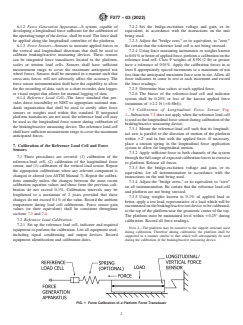
1.1 This practice gives procedures for the calibration of:
reference load cells
calibration platform systems by using a reference load cell
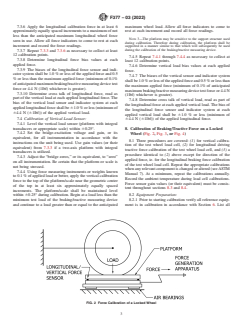
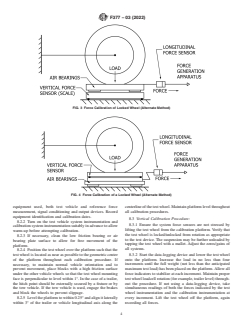
static calibration of braking/tractive force on locked wheels of tire test trailers, instrumented vehicles, and laboratory tire testing machines by using the calibration platform system as a calibration fixture.
1.2 The values stated in SI units are to be regarded as standard. The values in parentheses are for information only.
1.3 This standard does not purport to address all of the safety concerns, if any, associated with its use. It is the responsibility of the user of this standard to establish appropriate safety, health, and environmental practices and determine the applicability of regulatory limitations prior to use.
1.4 This international standard was developed in accordance with internationally recognized principles on standardization established in the Decision on Principles for the Development of International Standards, Guides and Recommendations issued by the World Trade Organization Technical Barriers to Trade (TBT) Committee.
- Status
- Published
- Publication Date
- 30-Sep-2022
- Technical Committee
- F09 - Tires
- Drafting Committee
- F09.10 - Equipment, Facilities and Calibration
Overview
ASTM F377-03(2022) is the internationally recognized standard practice for the calibration of braking and tractive measuring devices used in tire testing. Developed by ASTM, this standard specifies procedures to ensure consistent, accurate, and repeatable measurements in laboratory and field tests involving tire traction and braking performance. Calibration, as mandated by this standard, is fundamental for verifying the precision, reliability, and traceability of testing instruments such as load cells, platform calibration systems, and force sensors.
Key Topics
- Calibration Procedures: Provides detailed steps for calibrating reference load cells and platform systems using SI units as the default. Procedures address both longitudinal (tractive/braking) and vertical loads.
- Reference Load Cells: Outlines requirements for calibrating reference load cells using equipment and procedures traceable to national standards organizations such as NIST.
- Platform Calibration: Details static calibration of braking and tractive force on locked wheels via tire test trailers, instrumented vehicles, and laboratory test machines.
- Bias and Cross-Talk Measurement: Establishes methods to assess and minimize measurement bias and cross-talk between force directions, ensuring test accuracy.
- Recordkeeping and Reporting: Specifies that all calibration activities, equipment identification, ambient conditions, and bias values must be documented for traceability and compliance.
- Calibration Frequency: Recommends recalibration at least annually or when component changes occur, with intervals extendable up to two years if prior results maintain acceptable consistency.
Applications
ASTM F377-03(2022) is vital for organizations involved in tire performance evaluation, safety research, and regulatory compliance. Typical applications include:
- Tire Manufacturers: Ensuring their internal and supplier test results for braking and traction are precise and comparable, supporting product development and quality assurance.
- Testing Laboratories: Standardizing the calibration of measuring equipment to maintain high-quality, traceable results in tire testing services.
- Automotive OEMs: Establishing reliable baseline data for tire and vehicle dynamic testing related to braking, traction, and overall tire behavior.
- Regulatory and Standards Bodies: Supporting compliance with technical regulations and performance thresholds for vehicle and tire safety.
- Research Institutions: Facilitating accurate, reproducible measurement of braking and tractive forces in academic and applied research related to tire-road interaction.
Related Standards
Professionals using ASTM F377-03(2022) should also consider these related ASTM standards to ensure a complete calibration and testing program:
- ASTM E74: Standard Practices for Calibration and Verification for Force-Measuring Instruments - alternative or complementary calibration procedures for load cells.
- ASTM F538: Terminology Relating to Characteristics and Performance of Tires - provides definitions and context for key terms used within ASTM F377.
- ISO and National Metrology Standards: For further traceability and alignment with internationally recognized calibration frameworks.
By adhering to ASTM F377-03(2022), users can ensure the accuracy and reliability of braking and tractive force measurements, ultimately contributing to improved tire safety, product development, and regulatory compliance in the automotive industry. Regular calibration following these best practices is essential for meaningful, comparable, and auditable tire performance data.
Relations
- Effective Date
- 01-May-2013
- Effective Date
- 01-Mar-2013
- Effective Date
- 01-Dec-2012
- Effective Date
- 15-Jun-2009
- Effective Date
- 01-Mar-2006
- Effective Date
- 01-Dec-2004
- Effective Date
- 01-Dec-2003
- Effective Date
- 05-Apr-2002
- Effective Date
- 05-Apr-2002
- Effective Date
- 05-Apr-2002
- Effective Date
- 10-Apr-1999
Get Certified
Connect with accredited certification bodies for this standard

TÜV Rheinland
TÜV Rheinland is a leading international provider of technical services.

TÜV SÜD
TÜV SÜD is a trusted partner of choice for safety, security and sustainability solutions.

DEKRA Certification Inc.
DEKRA US certification services.
Sponsored listings
Frequently Asked Questions
ASTM F377-03(2022) is a standard published by ASTM International. Its full title is "Standard Practice for Calibration of Braking/Tractive Measuring Devices for Testing Tires". This standard covers: SIGNIFICANCE AND USE 5.1 Calibration is essential in the use of various test platforms and devices to insure that the test results generated by these test devices are accurate, repeatable and meaningful. This standard gives the necessary instructions for the calibration of all of the test devices cited in the Scope. SCOPE 1.1 This practice gives procedures for the calibration of: reference load cells calibration platform systems by using a reference load cell static calibration of braking/tractive force on locked wheels of tire test trailers, instrumented vehicles, and laboratory tire testing machines by using the calibration platform system as a calibration fixture. 1.2 The values stated in SI units are to be regarded as standard. The values in parentheses are for information only. 1.3 This standard does not purport to address all of the safety concerns, if any, associated with its use. It is the responsibility of the user of this standard to establish appropriate safety, health, and environmental practices and determine the applicability of regulatory limitations prior to use. 1.4 This international standard was developed in accordance with internationally recognized principles on standardization established in the Decision on Principles for the Development of International Standards, Guides and Recommendations issued by the World Trade Organization Technical Barriers to Trade (TBT) Committee.
SIGNIFICANCE AND USE 5.1 Calibration is essential in the use of various test platforms and devices to insure that the test results generated by these test devices are accurate, repeatable and meaningful. This standard gives the necessary instructions for the calibration of all of the test devices cited in the Scope. SCOPE 1.1 This practice gives procedures for the calibration of: reference load cells calibration platform systems by using a reference load cell static calibration of braking/tractive force on locked wheels of tire test trailers, instrumented vehicles, and laboratory tire testing machines by using the calibration platform system as a calibration fixture. 1.2 The values stated in SI units are to be regarded as standard. The values in parentheses are for information only. 1.3 This standard does not purport to address all of the safety concerns, if any, associated with its use. It is the responsibility of the user of this standard to establish appropriate safety, health, and environmental practices and determine the applicability of regulatory limitations prior to use. 1.4 This international standard was developed in accordance with internationally recognized principles on standardization established in the Decision on Principles for the Development of International Standards, Guides and Recommendations issued by the World Trade Organization Technical Barriers to Trade (TBT) Committee.
ASTM F377-03(2022) is classified under the following ICS (International Classification for Standards) categories: 43.040.40 - Braking systems. The ICS classification helps identify the subject area and facilitates finding related standards.
ASTM F377-03(2022) has the following relationships with other standards: It is inter standard links to ASTM E74-13a, ASTM E74-13, ASTM E74-12, ASTM F538-09, ASTM E74-06, ASTM E74-04, ASTM F538-03, ASTM E74-02, ASTM E74-01, ASTM E74-00a, ASTM F538-99. Understanding these relationships helps ensure you are using the most current and applicable version of the standard.
ASTM F377-03(2022) is available in PDF format for immediate download after purchase. The document can be added to your cart and obtained through the secure checkout process. Digital delivery ensures instant access to the complete standard document.
Standards Content (Sample)
This international standard was developed in accordance with internationally recognized principles on standardization established in the Decision on Principles for the
Development of International Standards, Guides and Recommendations issued by the World Trade Organization Technical Barriers to Trade (TBT) Committee.
Designation: F377 − 03 (Reapproved 2022)
Standard Practice for
Calibration of Braking/Tractive Measuring Devices for
Testing Tires
ThisstandardisissuedunderthefixeddesignationF377;thenumberimmediatelyfollowingthedesignationindicatestheyearoforiginal
adoption or, in the case of revision, the year of last revision.Anumber in parentheses indicates the year of last reapproval.Asuperscript
epsilon (´) indicates an editorial change since the last revision or reapproval.
1. Scope 3.1.1 bias, n—the difference between the average measured
test result and the accepted reference value; it measures in an
1.1 This practice gives procedures for the calibration of:
inverse manner the accuracy of a test.
reference load cells
3.1.2 longitudinal force, [F], of a tire, n—the component of
calibration platform systems by using a reference load cell
the tire force vector in the X’ direction.
staticcalibrationofbraking/tractiveforceonlockedwheels
of tire test trailers, instrumented vehicles, and laboratory tire
3.1.3 vertical load, n—the normal reaction of the tire on the
testing machines by using the calibration platform system as a
road which is equal to the negative of normal force.
calibration fixture.
4. Summary of Practice
1.2 The values stated in SI units are to be regarded as
standard. The values in parentheses are for information only.
4.1 Reference-load cells shall be calibrated using proce-
dures and equipment traceable to the National Institute of
1.3 This standard does not purport to address all of the
Standards and Technology (NIST), or appropriate national
safety concerns, if any, associated with its use. It is the
standards organization.
responsibility of the user of this standard to establish appro-
priate safety, health, and environmental practices and deter-
NOTE 1—Practice E74 may be used as an alternative method for
mine the applicability of regulatory limitations prior to use.
load-cell calibration.
1.4 This international standard was developed in accor-
4.2 Thecalibratedreference-loadcellisusedtocalibratethe
dance with internationally recognized principles on standard-
calibration-platform systems or used as the longitudinal force
ization established in the Decision on Principles for the
sensor. The tire test trailer, instrumented vehicle, or laboratory
Development of International Standards, Guides and Recom-
tire testing machine is calibrated with the platform.
mendations issued by the World Trade Organization Technical
Barriers to Trade (TBT) Committee.
5. Significance and Use
5.1 Calibration is essential in the use of various test plat-
2. Referenced Documents
forms and devices to insure that the test results generated by
2.1 ASTM Standards:
thesetestdevicesareaccurate,repeatableandmeaningful.This
E74 Practices for Calibration and Verification for Force-
standard gives the necessary instructions for the calibration of
Measuring Instruments
all of the test devices cited in the Scope.
F538 Terminology Relating to Characteristics and Perfor-
mance of Tires
6. Apparatus
6.1 The calibration system consists of the following basic
3. Terminology
components:
3.1 Definitions:
6.1.1 Platform—The platform on which the test wheel is
placed shall have a flat high friction top surface. The platform
shall be of sufficient dimensions to support the entire tire
This practice is under the jurisdiction ofASTM Committee F09 on Tires and is
contact patch throughout the calibration process.Alow friction
the direct responsibility of Subcommittee F09.10 on Equipment, Facilities and
bearing (an air bearing is recommended) permitting free
Calibration.
horizontal motion and capable of sustaining a vertical load
Current edition approved Oct. 1, 2022. Published November 2022. Originally
equal to the largest anticipated wheel load shall support the
approved in 1974. Last previous edition approved in 2015 as F377 – 03 (2015).
DOI: 10.1520/F0377-03R22.
platform. The longitudinal movement shall be sufficient to
For referenced ASTM standards, visit the ASTM website, www.astm.org, or
obtain the necessary required force levels. The platform may
contact ASTM Customer Service at service@astm.org. For Annual Book of ASTM
also be instrumented with integrated transducers (Force Sen-
Standards volume information, refer to the standard’s Document Summary page on
the ASTM website. sors) to measure vertical and longitudinal forces.
Copyright © ASTM International, 100 Barr Harbor Drive, PO Box C700, West Conshohocken, PA 19428-2959. United States
F377 − 03 (2022)
6.1.2 Force Generation Apparatus—A system, capable of 7.2.2 Set the bridge-excitation voltage and gain, or its
developing a longitudinal force sufficient for the calibration of equivalent, in accordance with the instructions on the unit
the operating range of the device, shall be used.The force shall being used.
be applied along the longitudinal centerline of the platform. 7.2.3 Adjust the "bridge zero," or its equivalent, to "zero."
6.1.3 Force Sensors—Sensors to measure applied forces in
Be certain that the reference load cell is not being stressed.
the vertical and longitudinal directions that shall be used to 7.2.4 Using force measuring instruments or weights known
calibrate braking/tractive measuring devices. These sensors
to0.01%orbetterofappliedforce,performacalibrationonthe
can be integrated force transducers located in the platform, reference load cell. Class F weights of 8.9N (2 lb) or greater
scales or tension load cells. Sensors shall have sufficient
have a tolerance of 0.01%. Apply the calibration forces in at
measurement range to cover the maximum anticipated test least 8 appropriately spaced increments to a maximum of not
wheel forces. Sensors shall be mounted in a manner such that
less than the anticipated maximum force seen in use.Allow all
cross-axis forces will not adversely affect the accuracy. The force indicators to come to rest at each increment and record
force sensor instrumentation shall have the capability to allow
the force readings.
for the recording of data, such as a chart recorder, data logger, 7.2.5 Determine bias values at each applied force.
or visual output that allows for manual logging of data.
7.2.6 The biases of the reference-load cell and indicator
6.1.4 Reference Load Cell—The force standard that pro-
system shall be 0.25% or less of the known applied force
vides direct traceability to NIST or appropriate national stan-
(minimum of 62.2N(60.5lbf)).
dards organization that shall be used to certify other force
7.3 Calibration of Longitudinal Force Sensor Fig.
sensors or weights used within this standard. If integrated
1—Subsection 7.3 does not apply when the reference load cell
platform transducers are not used, the reference load cell may
isusedasthelongitudinalforcesensorduringcalibrationofthe
be used as the longitudinal force sensor during calibration of
braking/tractive measuring device.
the braking/tractive measuring device. The reference load cell
7.3.1 Mount the reference-load cell such that its longitudi-
shall have sufficient measurement range to cover the maximum
nal axis is parallel to the direction of motion of the platform
anticipated forces.
within 62° and in line with the applied force. If necessary,
place a tension spring in the longitudinal force application
7. Calibration of the Reference Load Cell and Force
system to allow for longitudinal motion.
Sensors
7.3.2 Apply sufficient force to both channels of the system
7.1 Three procedures are covered: (1) calibration of the
throughthefullrangeofexpectedcalibrationforcestoexercise
reference-load cell, (2) calibration of the longitudinal force
to platform. Release all forces.
sensor, and (3) calibration of the vertical load sensor. Repeat
7.3.3 Set the bridge-excitation voltage and gain, or its
the appropriate calibrations when any relevant component is
equivalent, for all instrumentation in accordance with the
changed or altered (see ASTM Manual 7). Repeat the calibra-
instructions on the unit being used.
tions annually unless the changes between the most recent
7.3.4 Adjust the “bridge zeros,” or its equivalent, to “zero”
calibration equation values and those from the previous cali-
on all instrumentation. Be certain that the reference load cell
bration do not exceed 0.1%. Calibration intervals may be
and platform are not being stressed.
lengthened to a maximum of 2 years provided that these
7.3.5 Using weights known to 0.1% of applied load or
changes do not exceed 0.1% of the value. Record the ambient
better, apply a test load, representative of a load which will be
temperature during load cell calibrations. Force sensor gain
encounteredonthebraking/tractivetestdevicetobecalibrated,
values (or their equivalent) shall be consistent throughout
to the top of the platform near the geometric center of the top.
sections 7.3 and 7.4.
The platform must be maintained level within 60.25° during
7.2 Reference Load Calibration:
calibration. Record all force readings.
7.2.1 Set up the reference load cell, indicator and required
NOTE 2—The platform may be sensitive to the support structure used
equipment to perform the calibration. List all equipment used,
during calibration. Therefore during calibration, the platform shall be
including signal conditioning and output devices. Record
supported in a manner similar to that which will subsequently be used
equipment identification and calibration dates. during the calibration of the braking/tractive measuring device.
FIG. 1 Force Calibration of a Platform Force Transducer
F377 − 03 (2022)
7.3.6 Apply the longitudinal calibration force in at least 6 maximum wheel load. Allow all force indicators to come to
approximately equally spaced increments to a maximum of not rest at each increment and record all force readings.
less than the anticipated maximum longitudinal wheel force
NOTE 3—The platform may be sensitive to the support structure used
seen in use. Allow all force indicators to come to rest at each
during calibration. Therefore during calibration, the platform shall be
increment and record the force readings.
supported in a manner similar to that which will subsequently be used
during the calibration of the braking/tractive measuring device.
7.3.7 Repeat 7.3.3 and 7.3.6 as necessary to collect at least
12 calibration points.
7.4.5 Repeat 7.4.1 through 7.4.4 as necessary to collect at
7.3.8 Determine longitudinal force bias values at each
least 12 calibration points.
applied for
...