


EN 1789:2020+A1:2023
(Main + Amendment)Medical vehicles and their equipment - Road ambulances
General Information
- Abstract
This European Standard specifies requirements for the design, testing, performance and equipping of road ambulances used for the transport, monitoring, treatment and care of patients. It contains requirements for the patient’s compartment in terms of the working environment, ergonomic design and the safety of the crew and patients.This European Standard does not cover the training of the staff which is the responsibility of the authority/authorities in the country where the ambulance is to be registered.
This European Standard is applicable to road ambulances capable of transporting at least one person on a stretcher and excludes the transportation of hospital beds.
This standard also specifies requirements for ambulances intended to carry transport incubator systems.
The European Standard covers the specific requirements of each type of road ambulance which are
designated according to the patient condition e.g. patient transport road ambulance types A1, A2, B and C.
This European Standard gives general requirements for medical devices carried in road ambulances and used therein and outside hospitals and clinics in situations where the ambient conditions can differ from normal indoor conditions.
- Status
- Published
- Publication Date
- 12-Dec-2023
- Technical Committee
- CEN/TC 239 - Rescue systems
- Current Stage
- 6060 - Definitive text made available (DAV) - Publishing
- Start Date
- 13-Dec-2023
- Due Date
- 27-Oct-2024
- Completion Date
- 13-Dec-2023
Buy Documents







Overview
EN 1789:2020+A1:2023 is the European Standard from CEN for medical vehicles and their equipment - road ambulances. It specifies requirements for the design, testing, performance and equipping of road ambulances used for the transport, monitoring, treatment and care of patients. The standard applies to ambulances capable of transporting at least one person on a stretcher (excludes hospital beds) and includes provisions for ambulances that carry transport incubator systems. EN 1789 defines ambulance types by patient condition (A1, A2, B, C) and includes general requirements for medical devices used in variable ambient conditions.
Key Topics and Technical Requirements
The standard addresses technical and safety topics across vehicle design and patient care environments, including:
- Patient compartment design: ergonomic layout, working environment, dimensions and seating for crew and patients.
- Safety and retention systems: stretcher fixation, restraint systems, fixation of medical devices and furniture, rounded edges.
- Electrical systems and EMC: battery/alternator requirements, electrical installation, electromagnetic compatibility and warning systems (lights/siren).
- Vehicle body and fire safety: driver configuration, bulkhead, doors/windows/emergency exits and loading area requirements.
- Environmental controls: ventilation, anaesthetic gas scavenging, heating and cooling systems, interior lighting and acceptable interior noise levels.
- Medical device provisions: storage, temperature/humidity protection, mechanical strength, gas installation, marking and maintenance.
- Testing and verification: procedures for testing retention systems, compartment dimensions, ventilation/heating/cooling performance, lighting and noise.
- Special topics: requirements for electric propelled ambulances (Annex E), and informative annexes covering hygiene, visibility and national deviations.
Practical Applications
EN 1789 is used to ensure ambulance safety, functionality and regulatory compliance during:
- Design and engineering of new ambulances and patient compartments
- Vehicle conversion and upfitting by bodybuilders and converters
- Procurement and specification by health services, EMS agencies and hospitals
- Certification, conformity assessment and type approval testing
- Equipment selection and installation of onboard medical devices
Using EN 1789 helps fleets reduce operational risk, improve ergonomic care environments, and standardize ambulance features across regions.
Who Uses This Standard
- Ambulance manufacturers and converters
- Emergency Medical Services (EMS) managers and procurement officers
- Medical device manufacturers supplying ambulance equipment
- Test laboratories, certification bodies and national regulators
- Designers and engineers of vehicle interiors and life-support systems
Related Standards and References
- EN 1789 includes Annex ZA showing the relationship to EU directives (e.g., medical device regulations referenced in the document).
- Prepared by CEN/TC 239; national implementation required across CEN member states.
Keywords: EN 1789, road ambulances standard, ambulance equipment, patient compartment, ambulance design, CEN ambulance standard.
Relations
- Effective Date
- 11-Oct-2023
- Effective Date
- 25-Aug-2026
- Effective Date
- 25-Aug-2026
- Effective Date
- 25-Aug-2026
- Effective Date
- 09-Feb-2026
- Effective Date
- 09-Feb-2026
- Effective Date
- 09-Feb-2026
- Effective Date
- 09-Feb-2026
- Effective Date
- 09-Feb-2026
- Effective Date
- 09-Feb-2026
- Effective Date
- 09-Feb-2026
- Effective Date
- 28-Jan-2026
- Refers
EN 1865-5:2012 - Patient handling equipment used in road ambulances - Part 5: Stretcher support - Effective Date
- 28-Jan-2026
- Effective Date
- 28-Jan-2026
- Effective Date
- 28-Jan-2026
Buy Documents
Get Certified
Connect with accredited certification bodies for this standard

TÜV Rheinland
TÜV Rheinland is a leading international provider of technical services.

TÜV SÜD
TÜV SÜD is a trusted partner of choice for safety, security and sustainability solutions.

BSI Group
BSI (British Standards Institution) is the business standards company that helps organizations make excellence a habit.
Sponsored listings
Frequently Asked Questions
EN 1789:2020+A1:2023 is a standard published by the European Committee for Standardization (CEN). Its full title is "Medical vehicles and their equipment - Road ambulances". This standard covers: This European Standard specifies requirements for the design, testing, performance and equipping of road ambulances used for the transport, monitoring, treatment and care of patients. It contains requirements for the patient’s compartment in terms of the working environment, ergonomic design and the safety of the crew and patients.This European Standard does not cover the training of the staff which is the responsibility of the authority/authorities in the country where the ambulance is to be registered. This European Standard is applicable to road ambulances capable of transporting at least one person on a stretcher and excludes the transportation of hospital beds. This standard also specifies requirements for ambulances intended to carry transport incubator systems. The European Standard covers the specific requirements of each type of road ambulance which are designated according to the patient condition e.g. patient transport road ambulance types A1, A2, B and C. This European Standard gives general requirements for medical devices carried in road ambulances and used therein and outside hospitals and clinics in situations where the ambient conditions can differ from normal indoor conditions.
This European Standard specifies requirements for the design, testing, performance and equipping of road ambulances used for the transport, monitoring, treatment and care of patients. It contains requirements for the patient’s compartment in terms of the working environment, ergonomic design and the safety of the crew and patients.This European Standard does not cover the training of the staff which is the responsibility of the authority/authorities in the country where the ambulance is to be registered. This European Standard is applicable to road ambulances capable of transporting at least one person on a stretcher and excludes the transportation of hospital beds. This standard also specifies requirements for ambulances intended to carry transport incubator systems. The European Standard covers the specific requirements of each type of road ambulance which are designated according to the patient condition e.g. patient transport road ambulance types A1, A2, B and C. This European Standard gives general requirements for medical devices carried in road ambulances and used therein and outside hospitals and clinics in situations where the ambient conditions can differ from normal indoor conditions.
EN 1789:2020+A1:2023 is classified under the following ICS (International Classification for Standards) categories: 11.160 - First aid; 43.160 - Special purpose vehicles. The ICS classification helps identify the subject area and facilitates finding related standards.
EN 1789:2020+A1:2023 has the following relationships with other standards: It is inter standard links to EN 1789:2020, IEC 60364-7-721:2017, ISO 3795:1989, ISO 5128:1980, EN 60601-1:2006/A1:2013, EN 60601-2-4:2011/A1:2019, EN 60601-2-4:2011, EN 60601-1-12:2015/A1:2020, EN 60601-2-27:2014, EN 60601-1-12:2015, EN 60601-1:2006, EN 443:2008, EN 1865-5:2012, EN ISO 10079-2:2022, EN ISO 27427:2019. Understanding these relationships helps ensure you are using the most current and applicable version of the standard.
EN 1789:2020+A1:2023 is available in PDF format for immediate download after purchase. The document can be added to your cart and obtained through the secure checkout process. Digital delivery ensures instant access to the complete standard document.
Standards Content (Sample)
SLOVENSKI STANDARD
01-marec-2024
Medicinska vozila in pripadajoča oprema - Cestna reševalna vozila
Medical vehicles and their equipment - Road ambulances
Rettungsdienstfahrzeuge und deren Ausrüstung - Krankenkraftwagen
Véhicules de transport sanitaire et leurs équipements - Ambulances routières
Ta slovenski standard je istoveten z: EN 1789:2020+A1:2023
ICS:
11.160 Prva pomoč First aid
43.160 Vozila za posebne namene Special purpose vehicles
2003-01.Slovenski inštitut za standardizacijo. Razmnoževanje celote ali delov tega standarda ni dovoljeno.
EN 1789:2020+A1
EUROPEAN STANDARD
NORME EUROPÉENNE
December 2023
EUROPÄISCHE NORM
ICS 11.160; 43.160 Supersedes EN 1789:2020
English Version
Medical vehicles and their equipment - Road ambulances
Véhicules de transport sanitaire et leurs équipements - Rettungsdienstfahrzeuge und deren Ausrüstung -
Ambulances routières Krankenkraftwagen
This European Standard was approved by CEN on 13 April 2020 and includes Amendment approved by CEN on 21 September
2023.
CEN members are bound to comply with the CEN/CENELEC Internal Regulations which stipulate the conditions for giving this
European Standard the status of a national standard without any alteration. Up-to-date lists and bibliographical references
concerning such national standards may be obtained on application to the CEN-CENELEC Management Centre or to any CEN
member.
This European Standard exists in three official versions (English, French, German). A version in any other language made by
translation under the responsibility of a CEN member into its own language and notified to the CEN-CENELEC Management
Centre has the same status as the official versions.
CEN members are the national standards bodies of Austria, Belgium, Bulgaria, Croatia, Cyprus, Czech Republic, Denmark, Estonia,
Finland, France, Germany, Greece, Hungary, Iceland, Ireland, Italy, Latvia, Lithuania, Luxembourg, Malta, Netherlands, Norway,
Poland, Portugal, Republic of North Macedonia, Romania, Serbia, Slovakia, Slovenia, Spain, Sweden, Switzerland, Türkiye and
United Kingdom.
EUROPEAN COMMITTEE FOR STANDARDIZATION
COMITÉ EUROPÉEN DE NORMALISATION
EUROPÄISCHES KOMITEE FÜR NORMUNG
CEN-CENELEC Management Centre: Rue de la Science 23, B-1040 Brussels
© 2023 CEN All rights of exploitation in any form and by any means reserved Ref. No. EN 1789:2020+A1:2023 E
worldwide for CEN national Members.
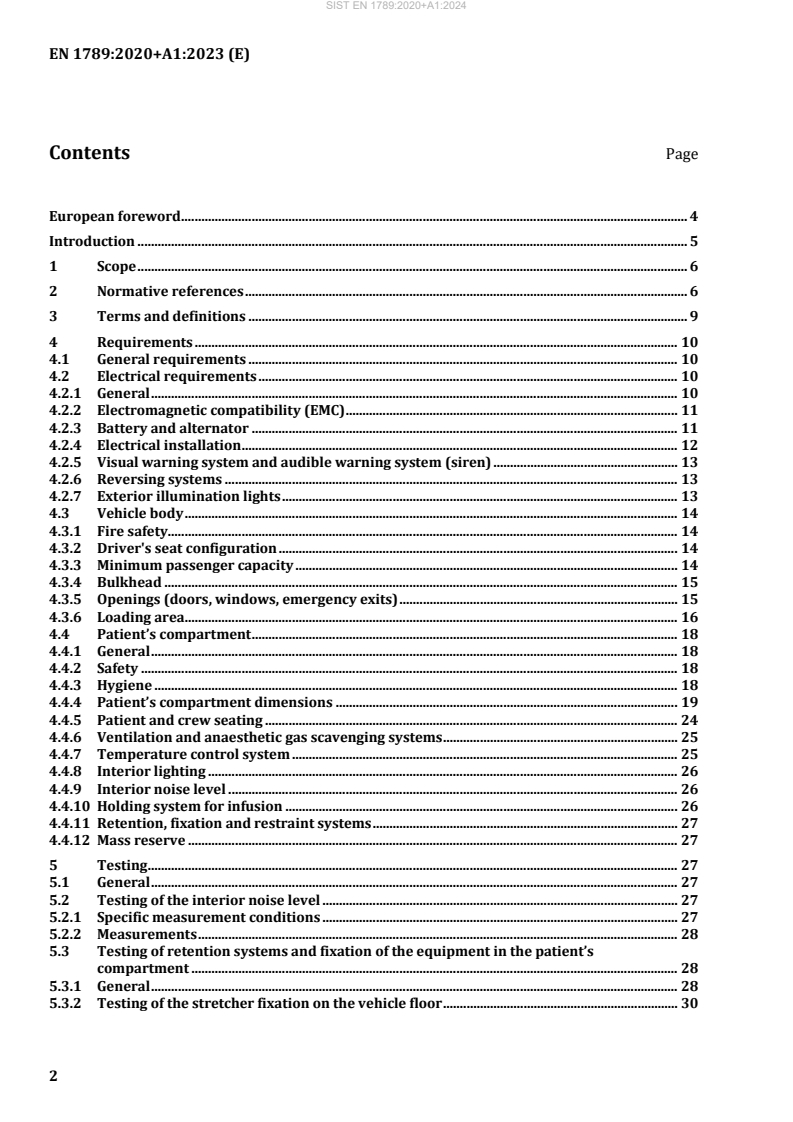
Contents Page
European foreword . 4
Introduction . 5
1 Scope . 6
2 Normative references . 6
3 Terms and definitions . 9
4 Requirements . 10
4.1 General requirements . 10
4.2 Electrical requirements . 10
4.2.1 General . 10
4.2.2 Electromagnetic compatibility (EMC) . 11
4.2.3 Battery and alternator . 11
4.2.4 Electrical installation . 12
4.2.5 Visual warning system and audible warning system (siren) . 13
4.2.6 Reversing systems . 13
4.2.7 Exterior illumination lights . 13
4.3 Vehicle body . 14
4.3.1 Fire safety . 14
4.3.2 Driver's seat configuration . 14
4.3.3 Minimum passenger capacity . 14
4.3.4 Bulkhead . 15
4.3.5 Openings (doors, windows, emergency exits) . 15
4.3.6 Loading area. 16
4.4 Patient’s compartment . 18
4.4.1 General . 18
4.4.2 Safety . 18
4.4.3 Hygiene . 18
4.4.4 Patient’s compartment dimensions . 19
4.4.5 Patient and crew seating . 24
4.4.6 Ventilation and anaesthetic gas scavenging systems . 25
4.4.7 Temperature control system . 25
4.4.8 Interior lighting . 26
4.4.9 Interior noise level . 26
4.4.10 Holding system for infusion . 26
4.4.11 Retention, fixation and restraint systems . 27
4.4.12 Mass reserve . 27
5 Testing . 27
5.1 General . 27
5.2 Testing of the interior noise level . 27
5.2.1 Specific measurement conditions . 27
5.2.2 Measurements . 28
5.3 Testing of retention systems and fixation of the equipment in the patient’s
compartment . 28
5.3.1 General . 28
5.3.2 Testing of the stretcher fixation on the vehicle floor . 30
5.3.3 Testing of the medical devices fixation. 30
5.3.4 Testing of furniture . 30
5.3.5 Test procedure . 31
5.4 Testing of rounded edges and radius inside the patient's compartment. 32
5.4.1 Testing of rounded edges . 32
5.4.2 Testing of radius inside the patient's compartment . 33
5.5 Procedure to verify the patient's compartment specifications . 33
5.6 Procedure to verify the loading area specifications . 33
5.6.1 General . 33
5.6.2 Procedure to verify the loading angle of 16° . 33
5.7 Procedure to verify the dimensions of the patient's compartment . 35
5.7.1 Type A and B road ambulances. 35
5.7.2 Type C road ambulances . 35
5.8 Procedure to verify the seats dimensions of the patient's compartment . 36
5.9 Testing of the ventilation system . 36
5.10 Testing of the heating system . 37
5.11 Testing of the cooling system . 37
5.11.1 Test procedure . 37
5.11.2 Testing of independent air conditioning system . 38
5.12 Testing of interior lighting . 38
5.13 Testing of infusion holding system . 38
6 Equipment and medical devices . 39
6.1 Provision of medical devices . 39
6.2 Medical devices storage. 39
6.3 Requirements for medical devices . 39
6.3.1 General . 39
6.3.2 Temperature . 39
6.3.3 Humidity and ingress of liquids . 39
6.3.4 Mechanical strength . 39
6.3.5 Fixation of devices . 40
6.3.6 Electrical safety . 40
6.3.7 User interface . 40
6.3.8 Gas installation . 40
6.3.9 Marking and instructions . 42
6.3.10 Maintenance . 42
6.4 List of equipment . 42
Annex A (informative) Test summary . 51
Annex B (informative) Recognition . 52
B.1 Recognition and visibility of ambulances . 52
B.2 Recognition of crew . 52
Annex C (informative) Hygiene . 53
Annex D (informative) A–deviations . 54
D.1 Deviation in Spain. 54
Annex E (normative) Electric propelled vehicles . 55
Annex ZA (informative) Relationship between this European Standard and the essential
requirements of Directive 93/42/EEC [OJ L 169] aimed to be covered . 56
Bibliography . 57
European foreword
This document (EN 1789:2020+A1:2023) has been prepared by Technical Committee CEN/TC 239
“Rescue systems”, the secretariat of which is held by DIN.
This European Standard shall be given the status of a national standard, either by publication of an
identical text or by endorsement, at the latest by June 2024, and conflicting national standards shall be
withdrawn at the latest by June 2024.
Attention is drawn to the possibility that some of the elements of this document may be the subject of
patent rights. CEN shall not be held responsible for identifying any or all such patent rights.
!This document supersedes EN 1789:2020".
This document includes Amendment 1, approved by CEN on 2023-09-21.
The start and finish of text introduced or altered by amendment is indicated in the text by tags !"
This document has been prepared under a standardization request given to CEN by the European
Commission and the European Free Trade Association, and supports essential requirements of
EU Directive(s).
For relationship with EU Directive(s), see informative Annex ZA which is an integral part of this
document.
Any feedback and questions on this document should be directed to the users’ national standards body.
A complete listing of these bodies can be found on the CEN website.
According to the CEN-CENELEC Internal Regulations, the national standards organisations of the
following countries are bound to implement this European Standard: Austria, Belgium, Bulgaria,
Croatia, Cyprus, Czech Republic, Denmark, Estonia, Finland, France, Germany, Greece, Hungary, Iceland,
Ireland, Italy, Latvia, Lithuania, Luxembourg, Malta, Netherlands, Norway, Poland, Portugal, Republic of
North Macedonia, Romania, Serbia, Slovakia, Slovenia, Spain, Sweden, Switzerland, Türkiye and the
United Kingdom.
Introduction
Road ambulances are subject to a higher risk in use. The exact circumstances of operation cannot
always be planned or anticipated in detail.
Vehicles are designed so as to be safe. Design requirements can be derived from European and national
occupational safety and health legislation.
Under EU law, employers are responsible for carrying out a risk assessment (89/391/EEC, OSH
framework directive) and for provision of safe work equipment (89/655/EEC, use of work equipment
directive) that allows employees to work without their health being at risk.
The document was first developed in the late 1990s to define a common approach to requirements to
enhance patient and crew safety. The document has evolved and matured through several amendments
and revisions.
!This revision in 2020 had two key objectives:"
— The first objective was to revise the technical side of the document with more manageable
verification in mind, while maintaining the high quality and strict nature of the requirements.
— The second objective was to check all the references and regulations, paying special attention to EU
regulations and updated standardization rules.
Testing of special purpose vehicle, such as an ambulance, is complex. Multiple functions (e.g. fixations,
maintain systems, noise, illumination, heating, cooling etc.) may require numerous tests, which can be
destructive. In this edition, carefully planned tests according to worst-case scenario strategies have
reduced the number of destructive tests without sacrificing test qualities.
!The previous edition EN 1789:2007+A2:2014" contained a number of direct references to EU
regulations. According to CEN Internal Regulations Part 3:2017 and to avoid duplication as well as
outdated references and to enable use of this standard independently of the ECE rules, EU regulations
and directives, these references have now been removed from the normative section of the standard.
This document is a reference document which can be used in support of regulations.
For the purpose of verification of an ambulance according to EU vehicle approval process, a section of
!EN 1789:2020" (i.e. patient’s compartment) has been referenced directly in Regulation (EU)
2018/858.
!The energy sources for motor vehicles are in turmoil due to environmental fight against global
climate warming. Alternative energies are becoming more regular in motor vehicles and electric
vehicles are already common by most vehicle manufacturers.
In all standardization criteria, combustion engine characteristics have guided the requirements.
Therefore, the most obvious ambulance standard requirements (EN 1789) need adjustments
introduced by an Amendment to allow verification of electric engine ambulances as compliant to this
document."
1 Scope
This document specifies requirements for the design, testing, performance and equipping of road
ambulances used for the transport, monitoring, treatment and care of patients. It contains requirements
for the patient’s compartment in terms of the working environment, ergonomic design and the safety of
the crew and patients. This document does not cover the training of the crew, which is the
responsibility of the authority/authorities in the country where the ambulance is to be registered.
This document is applicable to road ambulances capable of transporting at least one patient on a
stretcher and excludes the transportation of hospital beds.
This document also specifies requirements for ambulances intended to carry transport incubator
systems.
This document covers the specific requirements of each type of road ambulance, which are designated
according to the patient condition.
This document gives general requirements for medical devices carried in road ambulances and used
therein and outside hospitals and clinics in situations where the ambient conditions can differ from
normal indoor conditions.
2 Normative references
The following documents are referred to in the text in such a way that some or all of their content
constitutes requirements of this document. For dated references, only the edition cited applies. For
undated references, the latest edition of the referenced document (including any amendments) applies.
!EN 16165:2021, Determination of slip resistance of pedestrian surfaces - Methods of evaluation"
EN 3-7:2004+A1:2007, Portable fire extinguishers - Part 7: Characteristics, performance requirements
and test methods
EN 443:2008, Helmets for fire fighting in buildings and other structures
!EN 455-1:2020+A1:2022, Medical gloves for single use - Part 1: Requirements and testing for freedom
from holes"
EN 455-2:2015, Medical gloves for single use - Part 2: Requirements and testing for physical properties
EN 794-3:1998+A2:2009, Lung ventilators - Part 3: Particular requirements for emergency and transport
ventilators
!EN ISO 20417:2021, Medical devices - Information to be supplied by the manufacturer (ISO
20417:2021, Corrected version 2021-12)"
Patient handling equipment used in ambulances - Part 1: General stretcher
!prEN 1865-1:2023,
systems and patient handling equipment"
!prEN 1865-2:2022 , Patient handling equipment used in ambulances - Part 2: Power assisted
stretcher"
At draft stage.
!prEN 1865-4:2023 , Patient handling equipment used in ambulances - Part 4: Foldable patient
transfer chair"
!prEN 1865-5:2023 , Patient handling equipment used in ambulances - Part 5: Stretcher support"
EN 12470-1:2000+A1:2009, Clinical thermometers - Part 1: Metallic liquid-in-glass thermometers with
maximum device
!EN ISO 27427:2019, Anaesthetic and respiratory equipment - Nebulizing systems and components
(ISO 27427:2013)"
EN 13976-1:2018, Rescue systems - Transportation of incubators - Part 1: Interface requirements
EN 60601-1:2006+A1:2013, Medical electrical equipment - Part 1: General requirements for basic safety
and essential performance (IEC 60601-1:2005 + Cor.:2006 + Cor.:2007 + A1:2012)
!EN 60601-1-12:2015+A1:2020, Medical electrical equipment - Part 1-12: General requirements for
basic safety and essential performance - Collateral Standard: Requirements for medical electrical
equipment and medical electrical systems intended for use in the emergency medical services environment
(IEC 60601 1 12:2014 + A1:2020)"
!EN 60601-2-4:2011+A1:2019, Medical electrical equipment - Part 2-4: Particular requirements for
the basic safety and essential performance of cardiac defibrillators (IEC 60601 2 4:2010 + A1:2018)"
EN 60601-2-27:2014, Medical electrical equipment - Part 2-27: Particular requirements for the basic
safety and essential performance of electrocardiographic monitoring equipment
!EN ISO 407:2021, Small medical gas cylinders - Pin-index yoke-type valve connections
(ISO 407:2021)"
EN ISO 5359:2014+A1:2017, Anaesthetic and respiratory equipment - Low-pressure hose assemblies for
use with medical gases (ISO 5359:2014 + Amd 1:2017)
!EN ISO 9170-1:2020, Terminal units for medical gas pipeline systems - Part 1: Terminal units for use
with compressed medical gases and vacuum (ISO 9170-1:2017)"
EN ISO 7396-1:2016+A1:2019, Medical gas pipeline systems - Part 1: Pipeline systems for compressed
medical gases and vacuum (ISO 7396-1:2016 + Amd 1:2017)
!EN ISO 10079-1:2022, Medical suction equipment - Part 1: Electrically powered suction equipment
(ISO 10079-1:2022)"
!EN ISO 10079-2:2022, Medical suction equipment - Part 2: Manually powered suction equipment (ISO
10079-2:2022)"
!EN ISO 10079-3:2022, Medical suction equipment - Part 3: Suction equipment powered from a vacuum
or positive pressure gas source (ISO 10079-3:2022)"
EN ISO 10524-1:2019, Pressure regulators for use with medical gases - Part 1: Pressure regulators and
pressure regulators with flow-metering devices (ISO 10524-1:2018)
EN ISO 10524-2:2019, Pressure regulators for use with medical gases - Part 2: Manifold and line pressure
regulators (ISO 10524-2:2018)
EN ISO 10524-3:2019, Pressure regulators for use with medical gases - Part 3: Pressure regulators
integrated with cylinder valves (VIPRs) (ISO 10524-3:2019)
!EN ISO 11197:2019, Medical supply units (ISO 11197:2019)"
!EN ISO 14971:2019+A11:2021, Medical devices - Application of risk management to medical devices
(ISO 14971:2019)"
!prEN ISO 15002:2022 , Flow control devices for connection to a medical gas supply system
(ISO/DIS 15002:2022)"
!EN ISO 15223-1:2021, Medical devices - Symbols to be used with information to be supplied by the
manufacturer - Part 1: General requirements (ISO 15223-1:2021)"
EN ISO 19054:2006+A1:2016, Rail systems for supporting medical equipment (ISO 19054:2005+
Amd1:2016)
EN ISO 20471:2013+A1:2016, High visibility clothing — Test methods and requirements
(ISO 20471:2013, Corrected version 2013-06-01+Amd 1:2016)
EN ISO 21420:2020-06, Protective gloves - General requirements and test methods (ISO 21420:2020)
EN ISO 80601-2-55:2018, Medical electrical equipment - Part 2-55: Particular requirements for the basic
safety and essential performance of respiratory gas monitors (ISO 80601-2-55:2018)
EN ISO 80601-2-61:2019, Medical electrical equipment - Part 2-61: Particular requirements for basic
safety and essential performance of pulse oximeter equipment (ISO 80601-2-61:2017, Corrected version
2018-02)
IEC 60364-7-721:2017, Low-voltage electrical installations — Part 7-721: Requirements for special
installations or locations — Electrical installations in caravans and motor caravans
ISO 3795:1989, Road vehicles, and tractors and machinery for agriculture and forestry — Determination
of burning behaviour of interior materials
ISO 5128:1980, Acoustics — Measurement of noise inside motor vehicles
3 Terms and definitions
For the purposes of this document, the following terms and definitions apply.
ISO and IEC maintain terminological databases for use in standardization at the following addresses:
— IEC Electropedia: available at http://www.electropedia.org/
— ISO Online browsing platform: available at http://www.iso.org/obp
3.1
patient
person whose condition requires appropriately trained personnel to provide medical care and/or
suitable transport
3.2
emergency patient
patient who through sickness, injury or other circumstances is in immediate or imminent danger to life
unless emergency treatment and/or monitoring and suitable transport to diagnostic facilities or
medical treatment is provided
3.3
road ambulance
vehicle intended to be crewed by a minimum of two appropriately trained crew members for the
provision of care and transport of at least one stretchered patient
3.4
type A road ambulance
patient transport ambulance
vehicle designed and equipped for the transport of patients who are not expected to become emergency
patients
Note 1 to entry: Two types of patient transport ambulance exist:
— type A1: suitable for transport of a single patient;
— type A : suitable for transport of one or more patient(s) (on stretcher(s) and seat(s)).
3.5
type B road ambulance
emergency ambulance
vehicle designed and equipped for the transport, basic treatment and monitoring of patients
3.6
type C road ambulance
mobile intensive care unit
vehicle designed and equipped for the transport, advanced treatment and monitoring of patients
3.7
net vehicle mass
net mass of the road ambulance including the driver taken as 75 kg, 90% fuel tank and all fixed
installations
Note 1 to entry: Loose portable patient handling, sanitary, medical and technical equipment are not included in
net vehicle mass.
3.8
road ambulance loading capacity
difference between the permissible gross vehicle mass and the net vehicle mass of the road ambulance
Note 1 to entry: This represents the mass that may be distributed on the road ambulance such that the
permissible axle loads are not exceeded.
3.9
fixation system
system or device to ensure the permanent fixation of medical devices or other equipment into the road
ambulance
3.10
retention system
bracket or other interface device used to secure a mobile or transportable item of equipment or medical
device in the road ambulance without the use of tools
3.11
restraint system
device or combination of devices that minimize movement of the vehicle occupants during crash or
major deceleration (e.g. seat belts)
3.12
patient compartment
interior section of an road ambulance for patient treatment and/or transport
4 Requirements
4.1 General requirements
Road ambulances and equipment shall, when operated in normal use and maintained according to the
instructions of the manufacturer, cause no safety hazard which could reasonably be foreseen using risk
management procedures, e.g. in accordance with !EN ISO 14971:2019+A11:2021", and which is
connected with their intended application, in normal condition and in single fault condition.
4.2 Electrical requirements
4.2.1 General
Electrical installations added to the base vehicle shall comply with those clauses of !IEC 60364-7-
717:2009" which are applicable to road ambulances. For the supply system of the medical equipment
EN 60601-1:2006+A1:2013 and !EN 60601-1-12:2015+A1:2020", Clause 11 shall apply.
4.2.2 Electromagnetic compatibility (EMC)
In order to minimize the risk to the safe operation of the complete road ambulance and any of the
equipment operated on or in the vehicle from the effects of electromagnetic influences:
— Communication equipment (e.g. radio installation) shall comply with national and/or European
regulations.
— The complete operational vehicle shall consist of components, equipment or sub systems that
comply or are certified as conforming to the respective industry EMC regulations.
A road ambulance as supplied and certified may not be fully equipped and therefore some
responsibility for added equipment after conversion rests with the customer/user.
4.2.3 Battery and alternator
Batteries shall be positioned to allow maintenance without removing the battery from its securing
device. The construction of the battery and all connections to it shall be such as to prevent any
possibility of an inadvertent short circuit.
For types A2, B and C road ambulances the electrical system shall be capable of holding a reserve of
electrical power for restarting the engine.The characteristics of the alternator, the starter batteries as
well as additional batteries, if fitted, shall comply with Table 1.
Additional batteries may be required to power the medical devices carried on board and the intended
use of the road ambulance.
Table 1 — Minimum capacity/power
Type of road ambulance
A A B C
1 2
Nominal 54 Ah 54 Ah up to 80 Ah 80 Ah
voltage 4 seats and 80
12 V Ah for more than
4 seats in the
Starter
patient
battery(ies)
compartment
Nominal – – 63 Ah 63 Ah
voltage (2 × 12 V) (2 × 12 V)
24 V
Nominal – – a 80 Ah
80 Ah
voltage
12 V
Additional
b
battery(ies)
Nominal – – a 63 Ah
63 Ah
voltage (2 × 12 V)
(2 × 12 V)
24 V
Alternator power 700 W 700 W 1 200 W 1 200 W
a
Recommended for special operational conditions.
b
Additional batteries shall have high cyclic stability (e.g. gel batteries) and shall be of a sealed type.
When the engine is idling electrical stability should be maintained between electrical load and
alternator output. In order to achieve this it may be necessary to fit an electrical load prioritization
device to the vehicle.
4.2.4 Electrical installation
4.2.4.1 In type B and C road ambulances there shall be a recessed externally mounted power
connector to enable external power to be provided for operations such as the following:
— charging battery(ies);
— operating medical devices, when installed;
— operating a patient compartment heater, when installed;
— operating an engine preheater, when installed.
The connector for 110 V or 220/240 V shall be a male connector and not interfere with the electrical
and mechanical safety.
It shall not be possible to start the engine whilst it is connected to an external power supply unless an
automatic mechanical disconnection is fitted.
If no automatic mechanical disconnection is fitted, the connector shall be on the driver’s side.
The 110 V or 220/240 V circuit shall be protected either by an “earth leakage device” with a maximum
setting of 30 mA or by a separate transformer. If the protection is given only by an “earth leakage
device” there shall be a label near the plug that reads as follows: “CAUTION! CONNECT ONLY TO AN
AUTHORISED SOCKET.”
4.2.4.2 A minimum number of separately protected 12 V DC outlets shall be available according to
Table 2. The outlets shall be available for medical devices, located in the area of use and in the storage
area. The nominal voltage shall be 13,8 V. Voltage fluctuations shall not exceed the range of 12,4 V and
15,1 V.
The power supply shall continuously supply the medical devices with electrical power with the engine
running. The outlets for the medical devices shall be labelled with the nominal voltage and current
rating. The outlets shall have a visible indication under intended operational conditions in order to
show if there is voltage on the outlet.
If the road ambulance is intended to carry a transport incubator system it shall have a four-pole
connector as specified in EN 13976-1:2018, subclause 4.2.3, Figure 2. In that case the nominal current
needs to be assessed (minimum 23 Amp according to EN 13976-1:2018, subclause 4.1.3).
Table 2 — 12 V connections for medical devices in patient’s compartment
Type of road ambulance
A A B C
1 2
1 1 1 1 3 1 3 1
Minimum number of
connections
10 15 10 15 10 15 10 15
Minimum capacity in
Ampere
4.2.4.3 Any additional electrical systems fitted to the base vehicle shall be separate from the base
vehicle electrical system and the body or chassis shall not be used as an earth return for additional
circuits.
All circuits in the additional system(s) shall have separate overload protection. All circuits shall be well
identified and cables clearly marked at the connection points and at a maximum of 1 m intervals along
its length.
NOTE Overload protection can consist of either fuses or so called Electronic Management Control systems.
The system shall have enough circuits and be so constructed that when/if a circuit fails the patient
treatment area shall remain illuminated and at least one power supply source for medical technical
equipment shall still work.
Every power socket in the patient compartment shall be fitted with a permanently visible indicator light
to confirm that there is power to the socket.
4.2.4.4 No wiring shall be located in or pass through conduit intended for medical gas installation.
The wiring shall not be loaded higher than that stated by the wire manufacturer.
4.2.4.5 Where there are different voltage systems, the connections shall be non-interchangeable.
4.2.5 Visual warning system and audible warning system (siren)
4.2.5.1 General
The road ambulance shall be fitted with a visual warning and audible warning system (in accordance
with national regulations) to alert other road vehicles and pedestrians of its approach, in order to
expedite its journey through traffic, whilst being used for emergency operation.
4.2.5.2 Visual warning system
The vehicle shall have 360-degree visibility of warning lights around the vehicle.
Recommended additional warning lights for type B and type C road ambulances are:
— additional warning lights facing forward, sideways of the vehicle (front and rear corner) and facing
backwards to ensure traffic safety and high visibility in heavy traffic.
4.2.5.3 Audible warning systems (siren)
The vehicle shall have an audible warning system additional to the warning lights. The audible warning
system shall activate the visual warning light.
The audible alarm can only be in function if the visible alarm is in operation.
4.2.6 Reversing systems
The ambulance shall be fitted with an audible reversing warning alarm, activated by the selection of the
reverse gear. This function shall be possible to disable from the driver seating position, with default
back to on, when reverse gear is engaged the next time.
There shall be a system enabling the driver to detect obstacles behind.
4.2.7 Exterior illumination lights
Exterior lighting with a minimum of 5 lx illuminating the surrounding the patient compartment area
according to Figure 1 shall be provided on type B and type C vehicles. Illumination shall be measured at
ground level.
Dimensions in millimetres
Key
Grey area Area of illumination of at least 5 lx
Figure 1 — Exterior lighting for type B and type C
4.3 Vehicle body
4.3.1 Fire safety
All interior materials shall have a burning rate of less than 100 mm/minute when tested in accordance
with ISO 3795:1989.
4.3.2 Driver's seat configuration
For all types of road ambulances the ergonomic space of the driver’s compartment and of the seat
adjustment as approved by the base manufacturer shall not be reduced.
4.3.3 Minimum passenger capacity
The minimum passenger capacity shall be in accordance with Table 3.
NOTE Passenger includes crew, patient and accompanying persons.
Table 3 — Minimum passenger capacity
Type of road ambulance
A A B C
1 2
Number of passengers on seats
and/or stretchers (in addition to 3 4 3
a
the driver)
a
With two stretchers.
A notice shall be displayed in the drivers' compartment stating the maximum number of seated and
stretcher passengers that can be carried.
The notice shall be supplied by the manufacturer taking into account the maximum weight capacity of
the vehicle.
4.3.4 Bulkhead
A full bulkhead or a bulkhead with a door shall separate the driver’s compartment from the patient’s
compartment. Where a door is fitted, it shall not be possible to drive the vehicle with the door in the
open position. This door shall be secured against opening if the road ambulance is in motion.
NOTE A bulkhead is also called a “partition wall”.
One or two windows with a minimum separation of 100 mm shall be provided in the bulkhead. The
windows shall allow direct visual contact with the driver. The opening area of the window shall have a
maximum area of 0,2 m . It shall be secured against self-opening and shall have an adjustable blind or
other means of preventing the driver being disturbed by the light of the patient’s compartment.
4.3.5 Openings (doors, windows, emergency exits)
4.3.5.1 General
The patient compartment shall have at least two openings. One at the rear (door/tailgate) and one at
the side.
All openings shall have seals to protect against the ingress of water.
All openings shall comply with the minimum dimensions according to Table 4.
Table 4 — Minimum opening dimensions in the patient's compartment
Type of road ambulance
a a
B C
A A
1 2
mm mm
mm mm
c b 800 1 200 1 400
Height
Side opening
600 660 660
c
Width
Height 900 900 1 200 1 500
Rear opening
Width 900 900 1 050 1 050
a
Corner radius of conversions which reduce the opening area by less than 10 % are permitted.
b
The dimensions provided by the original manufacturer shall not be reduced.
c
If it is a window, the height and width dimensions may be interchanged.
4.3.5.2 Emergency exits
The patient compartment shall have at least two emergency exits on different sides of the vehicle. One
of the emergency exits can be on the roof. The emergency exits shall be easy to open from the inside.
The side door and rear door can be used as emergency exits. The free minimum size shall be 500 mm x
700 mm.
4.3.5.3 Doors
There shall be a central locking system which shall be possible to operate from the driver and patient
compartment.
Each external door allowing direct access to the patient’s compartment shall be fitted with a security
system which enables the following:
a) lock and unlock from inside without use of a key;
b) lock and unlock from outside with use of a key;
c) unlock from the outside using a key when the door is locked from the inside;
NOTE 1 This security system can be integrated with an optional central locking system.
NOTE 2 The key can be a mechanical or non-mechanical device.
The patient’s compartment doors shall be capable of being positively restrained in the open position.
An audible and/or visual signal shall warn the driver when any external door including those not
allowing direct access to the patient's compartment, is not co
...
SLOVENSKI STANDARD
01-marec-2024
Medicinska vozila in pripadajoča oprema - Cestna reševalna vozila
Medical vehicles and their equipment - Road ambulances
Rettungsdienstfahrzeuge und deren Ausrüstung - Krankenkraftwagen
Véhicules de transport sanitaire et leurs équipements - Ambulances routières
Ta slovenski standard je istoveten z: EN 1789:2020+A1:2023
ICS:
11.160 Prva pomoč First aid
43.160 Vozila za posebne namene Special purpose vehicles
2003-01.Slovenski inštitut za standardizacijo. Razmnoževanje celote ali delov tega standarda ni dovoljeno.
EN 1789:2020+A1
EUROPÄISCHE NORM
EUROPEAN STANDARD
Dezember 2023
NORME EUROPÉENNE
ICS 11.160; 43.160 Ersetzt EN 1789:2020
Deutsche Fassung
Rettungsdienstfahrzeuge und deren Ausrüstung -
Krankenkraftwagen
Medical vehicles and their equipment - Road Véhicules de transport sanitaire et leurs équipements -
ambulances Ambulances routières
Diese Europäische Norm wurde vom CEN am 13. April 2020 angenommen und schließt Änderung ein, die am 21. September
2023 vom CEN angenommen wurde.
Die CEN-Mitglieder sind gehalten, die CEN/CENELEC-Geschäftsordnung zu erfüllen, in der die Bedingungen festgelegt sind, unter
denen dieser Europäischen Norm ohne jede Änderung der Status einer nationalen Norm zu geben ist. Auf dem letzten Stand
befindliche Listen dieser nationalen Normen mit ihren bibliographischen Angaben sind beim CEN-CENELEC-Management-
Zentrum oder bei jedem CEN-Mitglied auf Anfrage erhältlich.
Diese Europäische Norm besteht in drei offiziellen Fassungen (Deutsch, Englisch, Französisch). Eine Fassung in einer anderen
Sprache, die von einem CEN-Mitglied in eigener Verantwortung durch Übersetzung in seine Landessprache gemacht und dem
Management-Zentrum mitgeteilt worden ist, hat den gleichen Status wie die offiziellen Fassungen.
CEN-Mitglieder sind die nationalen Normungsinstitute von Belgien, Bulgarien, Dänemark, Deutschland, Estland, Finnland,
Frankreich, Griechenland, Irland, Island, Italien, Kroatien, Lettland, Litauen, Luxemburg, Malta, den Niederlanden, Norwegen,
Österreich, Polen, Portugal, der Republik Nordmazedonien, Rumänien, Schweden, der Schweiz, Serbien, der Slowakei, Slowenien,
Spanien, der Tschechischen Republik, der Türkei, Ungarn, dem Vereinigten Königreich und Zypern.
EUROPÄISCHES KOMITEE FÜR NORMUNG
EUROPEAN COMMITTEE FOR STANDARDIZATION
COMITÉ EUROPÉEN DE NORMALISATION
CEN-CENELEC Management-Zentrum: Rue de la Science 23, B-1040 Brüssel
© 2023 CEN Alle Rechte der Verwertung, gleich in welcher Form und in welchem Ref. Nr. EN 1789:2020+A1:2023 D
Verfahren, sind weltweit den nationalen Mitgliedern von CEN
vorbehalten.
Inhalt
Seite
Europäisches Vorwort . 4
Einleitung . 5
1 Anwendungsbereich . 6
2 Normative Verweisungen . 6
3 Begriffe . 8
4 Anforderungen . 10
4.1 Allgemeine Anforderungen . 10
4.2 Elektrische Anforderungen . 10
4.2.1 Allgemeines . 10
4.2.2 Elektromagnetische Verträglichkeit (EMV) . 10
4.2.3 Batterie und Generator . 10
4.2.4 Elektrische Anlagen . 11
4.2.5 Optisches Warnsystem und akustische Warnanlage (Einsatzhorn) . 13
4.2.6 Rückfahrsystems . 13
4.2.7 Außenbeleuchtung . 13
4.3 Karosserie . 14
4.3.1 Brandschutz . 14
4.3.2 Anordnung des Fahrersitzes . 14
4.3.3 Mindestpassagierkapazität . 14
4.3.4 Trennwand . 15
4.3.5 Öffnungen (Türen, Fenster, Notausstieg) . 15
4.3.6 Einladebereich . 16
4.4 Patientenraum . 17
4.4.1 Allgemeines . 17
4.4.2 Sicherheit . 17
4.4.3 Hygiene . 18
4.4.4 Maße des Patientenraums . 18
4.4.5 Sitze für Patient und Personal . 24
4.4.6 Lüftungsanlage und Anästhesiegasabsaugung . 25
4.4.7 Temperatursteuerungssystem . 25
4.4.8 Innenbeleuchtung . 26
4.4.9 Innengeräuschpegel . 26
4.4.10 Infusionshalterung . 27
4.4.11 Halte-, Befestigungs- und Rückhaltesysteme . 27
4.4.12 Gewichtsreserve . 27
5 Prüfung . 28
5.1 Allgemeines . 28
5.2 Prüfung des Innengeräuschpegels . 28
5.2.1 Spezifische Messbedingungen . 28
5.2.2 Messungen . 28
5.3 Prüfung der Haltesysteme und der Befestigung der Ausrüstung im Patientenraum . 29
5.3.1 Allgemeines . 29
5.3.2 Prüfung der Befestigung der Krankentrage am Fahrzeugboden . 31
5.3.3 Prüfung der Vorrichtungen zur Befestigung von medizinischen Geräten. 31
5.3.4 Prüfung der Einrichtungen . 31
5.3.5 Durchführung der Prüfung . 32
5.4 Prüfung von abgerundeten Kanten und Radius im Patientenraum . 33
5.4.1 Prüfung von abgerundeten Kanten . 33
5.4.2 Prüfung des Radius im Patientenraum . 34
5.5 Verfahren zur Verifizierung der Spezifikationen des Patientenraums . 34
5.6 Verfahren zur Verifizierung der Spezifikationen des Ladebereichs . 34
5.6.1 Allgemeines . 34
5.6.2 Verfahren zur Verifizierung des Ladewinkels von 16° . 35
5.7 Verfahren zur Verifizierung der Maße des Patientenraums . 36
5.7.1 Krankenkraftwagen der Typen A und B . 36
5.7.2 Krankenkraftwagen des Typs C . 36
5.8 Verfahren zur Verifizierung der Sitzmaße im Patientenraum . 37
5.9 Prüfung der Lüftungsanlage . 38
5.10 Prüfung der Heizungsanlage . 38
5.11 Prüfung der Kühlanlage . 39
5.11.1 Durchführung der Prüfung . 39
5.11.2 Prüfung der unabhängigen Klimaanlage . 39
5.12 Prüfung der Innenbeleuchtung . 40
5.13 Prüfung der Infusionshaltevorrichtung . 40
6 Ausrüstung und medizinische Geräte . 40
6.1 Bereitstellung von Medizinprodukten (Geräten) . 40
6.2 Unterbringung der Medizinprodukte (Geräte) . 40
6.3 Anforderungen an Medizinprodukte (Geräte) . 41
6.3.1 Allgemeines . 41
6.3.2 Temperatur . 41
6.3.3 Feuchtigkeit und Eintritt von Flüssigkeiten . 41
6.3.4 Festigkeit . 41
6.3.5 Befestigung der Geräte . 41
6.3.6 Elektrische Sicherheit . 42
6.3.7 Benutzerschnittstelle . 42
6.3.8 Gasinstallation . 42
6.3.9 Kennzeichnung und Anweisungen . 44
6.3.10 Instandhaltung . 44
6.4 Ausrüstungs-Tabellen . 44
Anhang A (informativ) Prüfzusammenfassung . 53
Anhang B (informativ) Erkennung . 54
B.1 Erkennbarkeit und Sichtbarkeit von Krankenkraftwagen . 54
B.2 Erkennbarkeit des Personals . 54
Anhang C (informativ) Hygiene . 55
Anhang D (informativ) A-Abweichungen . 56
D.1 Abweichung in Spanien . 56
Anhang E (normativ) Elektrisch angetriebene Fahrzeuge . 57
Anhang ZA (informativ) Zusammenhang zwischen dieser Europäischen Norm und den
grundlegenden Anforderungen der abzudeckenden Richtlinie 93/42/EWG [ABl L 169] . 58
Literaturhinweise . 60
Europäisches Vorwort
Dieses Dokument (EN 1789:2020+A1:2023) wurde vom Technischen Komitee CEN/TC 239
„Rettungssysteme“ erarbeitet, dessen Sekretariat von DIN gehalten wird.
Diese Europäische Norm muss den Status einer nationalen Norm erhalten, entweder durch Veröffentlichung
eines identischen Textes oder durch Anerkennung bis Juni 2024, und etwaige entgegenstehende nationale
Normen müssen bis Juni 2024 zurückgezogen werden.
Es wird auf die Möglichkeit hingewiesen, dass einige Elemente dieses Dokuments Patentrechte berühren
können. CEN ist nicht dafür verantwortlich, einige oder alle diesbezüglichen Patentrechte zu identifizieren.
!Dieses Dokument ersetzt EN 1789:2020."
Dieses Dokument enthält die Änderung 1, angenommen von CEN am 21. September 2023.
Der Beginn und das Ende von neuem oder geändertem Text werden durch die Markierungen !" angezeigt.
Dieses Dokument wurde im Rahmen eines Normungsauftrages erarbeitet, den die Europäische Kommission
und die Europäische Freihandelsassoziation CEN erteilt haben, und unterstützt grundlegende Anforderungen
der EU-Richtlinie(n).
Zum Zusammenhang mit EU-Richtlinie(n) siehe informativen Anhang ZA, der Bestandteil dieses Dokuments
ist.
Rückmeldungen oder Fragen zu diesem Dokument sollten an das jeweilige nationale Normungsinstitut des
Anwenders gerichtet werden. Eine vollständige Liste dieser Institute ist auf den Internetseiten von CEN
abrufbar.
Entsprechend der CEN-CENELEC-Geschäftsordnung sind die nationalen Normungsinstitute der folgenden
Länder gehalten, diese Europäische Norm zu übernehmen: Belgien, Bulgarien, Dänemark, Deutschland, die
Republik Nordmazedonien, Estland, Finnland, Frankreich, Griechenland, Irland, Island, Italien, Kroatien,
Lettland, Litauen, Luxemburg, Malta, Niederlande, Norwegen, Österreich, Polen, Portugal, Rumänien,
Schweden, Schweiz, Serbien, Slowakei, Slowenien, Spanien, Tschechische Republik, Türkei, Ungarn,
Vereinigtes Königreich und Zypern.
Einleitung
Krankenkraftwagen sind einem erhöhten Benutzungsrisiko ausgesetzt. Die exakten Betriebsumstände
können nicht immer im Detail geplant oder vorhergesehen werden.
Die Fahrzeuge werden so konstruiert, dass sie sicher sind. Konstruktionsanforderungen können der
europäischen und nationalen Gesetzgebung zur Arbeitssicherheit entnommen werden.
Nach EU-Gesetzgebung sind Arbeitgeber dazu verpflichtet eine Risikobeurteilung (Richtlinie 89/391/EWG zu
Rahmenbedingungen der Arbeitssicherheit) durchzuführen sowie eine sichere Arbeitsumgebung
(Richtlinie 89/655/EWG zur Verwendung von Arbeitsausrüstung) zu bieten, die es Arbeitnehmern
ermöglicht, ihrer Arbeit ohne Gesundheitsrisiken nachzugehen.
Dieses Dokument wurde gegen Ende der 1990er Jahre entwickelt, um einen gemeinsamen Ansatz für
Anforderungen an die Verbesserung der Sicherheit von Patienten und Personal festzulegen. Das Dokument
wurde durch mehrere Änderungen und Revisionen weiterentwickelt und verfeinert.
!Die Revision im Jahr 2020 hatte zwei Hauptziele:"
— Das erste Ziel bestand darin, den technischen Aspekt des Dokuments zu revidieren, um die
Handhabbarkeit der Prüfung zu verbessern und gleichzeitig die hohe Qualität und Stringenz der
Anforderungen zu bewahren.
— Das zweite Ziel bestand darin, alle Verweisungen und Vorschriften unter besonderer Beachtung der EU-
Verordnungen und aktualisierten Normungsregeln zu überprüfen.
Die Prüfung von Spezialfahrzeugen wie etwa Krankenkraftwagen ist komplex. Mehrere Funktionen (z. B.
Halterungen, Haltesysteme, Geräusche, Beleuchtung, Heizung, Kühlung usw.) können zahlreiche, teilweise
zerstörende Prüfungen erfordern. In dieser Ausgabe wurde die Anzahl der zerstörerischen Prüfungen durch
sorgfältig geplante Prüfungen nach Worst-Case-Szenario-Strategien reduziert, ohne die Prüfqualität zu
beeinträchtigen.
!Die vorherige Version EN 1789:2007+A2:2014" enthielt eine Reihe direkter Verweisungen auf EU-
Verordnungen. Gemäß der CEN-Geschäftsordnung, Teil 3:2017, und um doppelte sowie veraltete
Verweisungen zu vermeiden und die Nutzung dieser Norm unabhängig von ECE-Vorschriften,
EU-Verordnungen und EU-Richtlinien zu ermöglichen, wurden diese Verweisungen jetzt aus dem normativen
Teil dieser Norm entfernt.
Dieses Dokument ist ein Bezugsdokument, das zur Unterstützung von Verordnungen verwendet werden kann.
Für die Zwecke der Übereinstimmung eines Krankenkraftwagens gemäß dem Fahrzeugzulassungsprozess der
EU wurde in der Verordnung (EU) 2018/858 direkt auf einen Abschnitt von !EN 1789:2020" (d. h. der
Patientenraum) verwiesen.
!Die Energiequellen für Kraftfahrzeuge befinden sich aufgrund des Kampfes gegen die globale
Klimaerwärmung im Umbruch. Alternative Energien werden bei Kraftfahrzeugen immer üblicher und
Elektrofahrzeuge sind bereits bei den meisten Fahrzeugherstellern verfügbar.
Bei allen Standardisierungskriterien haben sich die Anforderungen an den Eigenschaften von
Verbrennungsmotoren orientiert. Daher müssen die offensichtlichsten Standardanforderungen für
Krankenkraftwagen (EN 1789) durch eine Änderung angepasst werden, um die Verifizierung von
Elektromotoren bei Krankenkraftwagen zur Erfüllung dieses Dokuments zu ermöglichen."
1 Anwendungsbereich
Dieses Dokument legt Anforderungen an Gestaltung, Prüfung, Ausführung und Ausrüstung für
Krankenkraftwagen fest, die für den Transport, die Überwachung, die Behandlung und die Versorgung von
Patienten genutzt werden. Es enthält Anforderungen an den Patientenraum im Hinblick auf die
Arbeitsumgebung, die ergonomische Gestaltung und die Sicherheit des Personals und der Patienten. Dieses
Dokument behandelt nicht die Ausbildung des Personals. Dafür ist die Behörde/ sind die Behörden des Landes
zuständig, in dem der Krankenkraftwagen registriert ist.
Dieses Dokument gilt für Krankenkraftwagen, in denen mindestens ein Patient liegend auf einer Krankentrage
transportiert werden kann. Es schließt den Transport von Krankenhausbetten aus.
Dieses Dokument legt auch die Anforderungen für Krankenkraftwagen fest, die für den Transport von
Transportinkubatorsystemen vorgesehen sind.
Dieses Dokument behandelt die besonderen Anforderungen an jeden Typ von Krankenkraftwagen, die
entsprechend dem Patientenzustand bezeichnet sind.
Dieses Dokument enthält allgemeine Anforderungen an Medizinprodukte (Geräte), die in Krankenkraftwagen
befördert und im Krankenkraftwagen sowie außerhalb von Krankenhäusern und Kliniken verwendet werden,
wo sich die Umgebungsbedingungen von den normalen Innenraumbedingungen unterscheiden können.
2 Normative Verweisungen
Die folgenden Dokumente werden im Text in solcher Weise in Bezug genommen, dass einige Teile davon oder
ihr gesamter Inhalt Anforderungen des vorliegenden Dokuments darstellen. Bei datierten Verweisungen gilt
nur die in Bezug genommene Ausgabe. Bei undatierten Verweisungen gilt die letzte Ausgabe des in Bezug
genommenen Dokuments (einschließlich aller Änderungen).
!EN 16165:2021, Bestimmung des Gleitwiderstandes von Fußgängerbereichen — Ermittlungsverfahren"
EN 3-7:2004+A1:2007, Tragbare Feuerlöscher — Teil 7: Eigenschaften, Leistungsanforderungen und
Prüfungen
EN 443:2008, Feuerwehrhelme für die Brandbekämpfung in Gebäuden und anderen baulichen Anlagen
!EN 455-1:2020+A1:2022, Medizinische Handschuhe zum einmaligen Gebrauch — Teil 1: Anforderungen und
Prüfung auf Dichtheit"
EN 455-2:2015, Medizinische Handschuhe zum einmaligen Gebrauch — Teil 2: Anforderungen und Prüfung der
physikalischen Eigenschaften
EN 794-3:1998+A2:2009, Lungenbeatmungsgeräte — Teil 3: Besondere Anforderungen an Notfall- und
Transportbeatmungsgeräte
!EN ISO 20417:2021, Medizinprodukte — Anforderungen an vom Hersteller bereitgestellte Informationen
(ISO 20417:2021, korrigierte Fassung 2021-12)"
EN 1865-1:2010+A1:2015, Krankentransportmittel im Krankenkraftwagen — Teil 1: Allgemeine
Krankentragesysteme und Krankentransportmittel
!prEN 1865-2:2022 , Krankentransportmittel im Krankenkraftwagen — Teil 2: Kraftunterstützte
Krankentrage"
EN 1865-4:2012, Krankentransportmittel im Krankenkraftwagen — Teil 4: Klappbare Patiententragesessel
EN 1865-5:2012, Krankentransportmittel im Krankenkraftwagen — Teil 5: Festlegungen zur
Krankentrageaufnahme
EN 12470-1:2000+A1:2009, Medizinische Thermometer — Teil 1: Mit metallischer Flüssigkeit gefüllte
Glasthermometer mit Maximumvorrichtung
!EN ISO 27427:2019, Anaesthetic and respiratory equipment — Nebulizing systems and components
(ISO 27427:2013)"
EN 13976-1:2018, Rettungssysteme — Inkubatortransport — Teil 1: Anforderungen an Schnittstellen
EN 60601-1:2006+A1:2013, Medizinische elektrische Geräte— Teil 1: Allgemeine Festlegungen für die
Sicherheit einschließlich der wesentlichen Leistungsmerkmale (IEC 60601-1:2005 + Cor.:2006 + Cor.:2007 +
A1:2012)
!EN 60601-1-12:2015+A1:2020, Medical electrical equipment — Part 1-12: General requirements for basic
safety and essential performance — Collateral Standard: Requirements for medical electrical equipment and
medical electrical systems intended for use in the emergency medical services environment
(IEC 60601-1-12:2014 + A1:2020)"
!EN 60601-2-4:2011+A1:2019, Medical electrical equipment — Part 2-4: Particular requirements for the
basic safety and essential performance of cardiac defibrillators (IEC 60601-2-4:2010 + A1:2018)"
EN 60601-2-27:2014, Medizinische elektrische Geräte — Teil 2-27: Besondere Festlegungen für die Sicherheit
einschließlich der wesentlichen Leistungsmerkmale von Elektrokardiographie-Überwachungsgeräten
!EN ISO 407:2021, Kleine Gasflaschen für die medizinische Anwendung — Ventilseitenstutzen mit
Anschlussbügel nach dem PIN-Index-System (ISO 407:2021)"
EN ISO 5359:2014 + A1:2017, Anästhesie- und Beatmungsgeräte — Niederdruck-Schlauchleitungssysteme zur
Verwendung mit medizinischen Gasen (ISO 5359:2014 + Amd 1:2017)
!EN ISO 9170-1:2020, Entnahmestellen für Rohrleitungssysteme für medizinische Gase — Teil 1:
Entnahmestellen für medizinische Druckgase und Vakuum (ISO 9170-1:2017)"
EN ISO 7396-1:2016+A1:2019, Rohrleitungssysteme für medizinische Gase — Teil 1: Rohrleitungssysteme für
medizinische Druckgase und Vakuum (ISO 7396-1:2016 + Amd 1:2017)
!EN ISO 10079-1:2022, Medizinische Absauggeräte — Teil 1: Elektrisch betriebene Absauggeräte
(ISO 10079-1:2022)"
!EN ISO 10079-2:2022, Medizinische Absauggeräte — Teil 2: Handbetriebene Absauggeräte
(ISO 10079-2:2022)"
!EN ISO 10079-3:2022, Medizinische Absauggeräte — Teil 3: Vakuum- oder druckquellenbetriebene
Absauggeräte (ISO 10079-3:2022)"
EN ISO 10524-1:2019, Druckminderer zur Verwendung mit medizinischen Gasen — Teil 1: Druckminderer und
Druckminderer mit Durchflussmessgeräten (ISO 10524-1:2018)
EN ISO 10524-2:2019, Druckminderer zur Verwendung mit medizinischen Gasen — Teil 2:
Hauptstellendruckregler und Leitungsdruckminderer (ISO 10524-2:2018)
EN ISO 10524-3:2019, Druckminderer zur Verwendung mit medizinischen Gasen — Teil 3: Druckminderer in
Flaschenventilen (ISO 10524-3:2019)
!EN ISO 11197:2019, Medizinische Versorgungseinheiten (ISO 11197:2019)"
!EN ISO 14971:2019+A11:2021, Medizinprodukte — Anwendung des Risikomanagements auf
Medizinprodukte (ISO 14971:2019)"
!prEN ISO 15002:2022 , Durchflussregeleinrichtungen zum Anschluss an ein Versorgungssystem für
medizinische Gase (ISO/DIS 15002:2022)"
!EN ISO 15223-1:2021, Medizinprodukte — Symbole zur Verwendung im Rahmen der vom Hersteller
bereitzustellenden Informationen — Teil 1: Allgemeine Anforderungen (ISO 15223-1:2021)"
EN ISO 19054:2006+A1:2016, Schienensysteme zum Halten medizinischer Geräte
(ISO 19054:2005 + Amd 1:2016)
EN ISO 20471:2013+A1:2016, Hochsichtbare Warnkleidung — Prüfverfahren und Anforderungen
(ISO 20471:2013, korrigierte Fassung 2013-06-01+Amd 1:2016)
EN ISO 21420:2020-06; Schutzhandschuhe — Allgemeine Anforderungen und Prüfverfahren (ISO 21420:2020)
EN ISO 80601-2-55:2018, Medizinische elektrische Geräte — Teil 2-55: Besondere Festlegungen für die
Sicherheit einschließlich der wesentlichen Leistungsmerkmale von Überwachungsgeräten für Atemgase
(ISO 80601-2-55:2018)
EN ISO 80601-2-61:2019, Medizinische elektrische Geräte — Teil 2-61: Besondere Festlegungen für die
Sicherheit einschließlich der wesentlichen Leistungsmerkmale von Pulsoximetriegeräten (ISO 80601-2-61:2017,
korrigierte Fassung 2018-02)
IEC 60364-7-721:2017, Low-voltage electrical installations — Part 7-721: Requirements for special
installations or locations — Electrical installations in caravans and motor caravans
ISO 3795:1989, Road vehicles, and tractors and machinery for agriculture and forestry — Determination of
burning behaviour of interior materials
ISO 5128:1980, Acoustics — Measurement of noise inside motor vehicles
3 Begriffe
Für die Anwendung dieses Dokuments gelten die folgenden Begriffe.
ISO und IEC stellen terminologische Datenbanken für die Verwendung in der Normung unter den folgenden
Adressen bereit:
— IEC Electropedia: verfügbar unter https://www.electropedia.org/
— ISO Online Browsing Platform: verfügbar unter https://www.iso.org/obp
3.1
Patient
Person, deren Zustand den Einsatz ausreichend geschulten Personals für medizinische Versorgung und/oder
einen geeigneten Transport erfordert
3.2
Notfallpatient
Patient, der sich durch Krankheit, Verletzung oder andere Umstände in unmittelbarer oder drohender
Lebensgefahr befindet, sofern nicht eine Notfallbehandlung und/oder -überwachung und ein geeigneter
Transport zu Diagnoseeinrichtungen oder medizinischer Behandlung erfolgt
3.3
Krankenkraftwagen
Fahrzeug für die Versorgung und den Transport von mindestens einem Patienten auf einer Krankentrage, das
für die Besetzung mit mindestens zwei entsprechend ausgebildeten Personen vorgesehen ist
3.4
Krankenkraftwagen des Typs A
Krankentransportwagen
Fahrzeug, das für den Transport von Patienten konstruiert und ausgerüstet ist, bei denen nicht erwartet wird,
dass sie zu Notfallpatienten werden
Anmerkung 1 zum Begriff: Es existieren zwei Typen von Krankentransportwagen:
— Typ A : geeignet für den Transport eines einzelnen Patienten;
— Typ A : geeignet für den Transport eines oder mehrerer Patienten (auf Krankentrage(n) oder -sitz(en)).
3.5
Krankenkraftwagen des Typs B
Notfallkrankenwagen
Fahrzeug, das für den Transport, die Erstversorgung und die Überwachung von Patienten konzipiert und
ausgerüstet ist
3.6
Krankenkraftwagen des Typs C
Rettungswagen
Fahrzeug, das für den Transport, die erweiterte Behandlung und Überwachung von Patienten konstruiert und
ausgerüstet ist
3.7
Leergewicht
Nettomasse des Krankenkraftwagens einschließlich des Fahrers, angenommen mit 75 kg,
90 % Füllstand des Kraftstofftanks und aller festen Einbauten
Anmerkung 1 zum Begriff: Nicht zum Leergewicht zählen lose, tragbare Gegenstände der sanitätsdienstlichen,
medizinischen und technischen Ausrüstung.
3.8
Nutzlast des Krankenkraftwagens
Differenz zwischen dem zulässigen Bruttofahrzeuggewicht und dem Leergewicht des Krankenkraftwagens.
Anmerkung 1 zum Begriff: Dies stellt die Masse dar, die so im Krankenkraftwagen verteilt werden darf, dass die jeweils
zulässigen Achslasten nicht überschritten werden.
3.9
Befestigungssystem
System oder Gerät zur Sicherung der ständigen Befestigung von Medizinprodukten (Geräten) oder anderen
Ausrüstungsgegenständen im Krankenkraftwagen
3.10
Halterungssystem
Tragevorrichtung oder andere Halteeinrichtung zur Sicherung von tragbaren oder transportablen
Ausrüstungsgegenständen oder Medizinprodukten (Geräten) im Krankenkraftwagen ohne Verwendung von
Werkzeugen
3.11
Rückhaltesystem
Vorrichtung oder Kombination aus Vorrichtungen, die bei einem Unfall oder verstärkter Abbremsung die
Bewegung der Fahrzeuginsassen minimiert (z. B. Sicherheitsgurte)
3.12
Patientenraum
innerer Bereich eines Krankenkraftwagens für den Transport und/oder die Behandlung von Patienten
4 Anforderungen
4.1 Allgemeine Anforderungen
Krankenkraftwagen und deren Ausrüstung dürfen bei bestimmungsgemäßer Verwendung und Wartung
entsprechend den Vorgaben der Ausbauhersteller keine Sicherheitsgefahren verursachen, die bei Anwendung
von Risikomanagementverfahren, z. B. nach !EN ISO 14971:2019 + A11:2021" unter Berücksichtigung
der bestimmungsgemäßen Anwendung unter Normalbedingungen und unter einer Einzelfehlerbetrachtung
vernünftigerweise vorhersehbar sind.
4.2 Elektrische Anforderungen
4.2.1 Allgemeines
Die elektrischen Installationen, die zu dem Grundfahrzeug hinzugefügt werden, müssen den Abschnitten nach
!IEC 60364-7-717:2009" entsprechen, die auf Krankenkraftwagen anwendbar sind.
EN 60601-1:2006+A1:2013 und !EN 60601-1-12:2015+A1:2020", Abschnitt 11, gelten für das
Versorgungssystem der medizinischen Geräte.
4.2.2 Elektromagnetische Verträglichkeit (EMV)
Um das von der Beeinflussung durch elektromagnetische Strahlungen ausgehende Risiko für den sicheren
Betrieb des gesamten Krankenkraftwagen oder der im oder auf dem Fahrzeug betriebenen Ausrüstung zu
minimieren, ist Folgendes zu beachten:
— Kommunikationseinrichtungen (z. B. Funkanlagen) müssen mit den nationalen und/oder europäischen
Vorschriften übereinstimmen;
— das gesamte Einsatzfahrzeug muss aus Komponenten, Ausrüstung oder Subsystemen bestehen, die die
jeweils branchenspezifischen EMV-Regelungen erfüllen oder nach diesen zertifiziert sind.
Ein zugelassener Krankenkraftwagen im Lieferzustand ist nicht zwingend vollständig ausgestattet, sodass der
Kunde/Benutzer eine gewissen Mitverantwortung für die nach dem Umbau hinzugefügten Geräte trägt.
4.2.3 Batterie und Generator
Batterien müssen so angeordnet sein, dass alle Wartungsarbeiten durchgeführt werden können, ohne die
Batterien aus ihrer Halterung zu nehmen. Die Batterien und alle zugehörigen Verbindungen müssen so
beschaffen sein, dass jede Möglichkeit eines versehentlichen Kurzschlusses ausgeschlossen ist.
Bei Krankenkraftwagen des Typs A2, B und C muss das elektrische System über eine Stromreserve verfügen,
die für den Neustart des Motors ausreicht. Die Eigenschaften des Generators, der Anlasserbatterien und aller
gegebenenfalls vorhandenen zusätzlichen Batterien müssen Tabelle 1 entsprechen.
Zusätzliche Batterien können zur Stromversorgung der mitgeführten Medizinprodukte (Geräte) und für den
beabsichtigten Einsatz des Krankenkraftwagens benötigt werden.
Tabelle 1 — Mindestkapazität/-leistung
Krankenkraftwagentyp
A A
B C
1 2
54 Ah bei bis zu
Nenn- 4 Sitzen und
spannung 54 Ah 80 Ah bei mehr 80 Ah 80 Ah
12 V als 4 Sitzen im
Anlasser-
Patientenraum
batterie(n)
63 Ah 63 Ah
Nenn-
spannung — —
(2 × 12 V) (2 × 12 V)
24 V
Nenn-
a
spannung — — 80 Ah 80 Ah
12 V
Zusätzliche
b
Batterie(n)
a
Nenn- 63 Ah 63 Ah
spannung — —
(2 × 12 V) (2 × 12 V)
24 V
Generatorleistung 700 W 700 W 1 200 W 1 200 W
a
Empfohlen für besondere Einsatzbedingungen.
b
Zusätzliche Batterien müssen eine hohe zyklische Stabilität aufweisen (z. B. Gel-Batterien) und versiegelt sein.
Wenn der Motor im Leerlauf ist, sollte ein elektrisches Gleichgewicht zwischen elektrischem
Leistungsverbrauch und Generatorleistung bestehen. Um dieses zu erreichen, kann es notwendig sein, ein
Gerät zur Erkennung des elektrischen Leistungsverbrauchs im Fahrzeug einzubauen, das Ladeprioritäten
setzt.
4.2.4 Elektrische Anlagen
4.2.4.1 Bei Krankenkraftwagen des Typs B und C muss zur Stromversorgung für die folgenden Funktionen
an der Außenseite eine eingebaute Steckverbindung vorhanden sein:
— Aufladen der Batterie(n);
— Betrieb eingebauter medizinischer Geräte;
— Betrieb einer Patientenraumheizung, sofern eingebaut;
— Betrieb einer Motorvorheizung, sofern eingebaut.
Die Steckverbindung für 110 V oder 220 V/240 V muss eine männliche Steckvorrichtung sein und darf die
elektrische und mechanische Sicherheit nicht beeinflussen.
Es darf nicht möglich sein, den Motor anzulassen, während das Fahrzeug an eine äußere Stromversorgung
angeschlossen ist, es sei denn eine automatische mechanische Trennvorrichtung ist installiert.
Wenn keine automatische mechanische Trennvorrichtung installiert ist, muss die Steckvorrichtung an der
Fahrerseite angeordnet sein.
Der Stromkreis für 110 V oder 220 V/240 V muss durch einen "Fehlerstrom-Schutzschalter" mit einem
Nennfehlerstrom von höchstens 30 mA oder durch einen Trenntransformator geschützt sein. Wenn der
Schutz nur durch einen „Fehlerstrom-Schutzschalter“ gegeben ist, muss eine Kennzeichnung mit folgender
Aufschrift in der Nähe des Steckers vorhanden sein: „VORSICHT! NUR GEEIGNETE STECKDOSE
VERWENDEN.“
4.2.4.2 Eine Mindestanzahl separat geschützter 12-V-Gleichstrom-Anschlüsse muss nach Tabelle 2
vorhanden sein. Die Anschlüsse müssen für medizinische Geräte zur Verfügung stehen und sich im
Anwendungsbereich und im Staubereich befinden. Die Nennspannung muss 13,8 V betragen.
Spannungsschwankungen dürfen einen Bereich von 12,4 V und 15,1 V nicht überschreiten.
Die Stromversorgung muss die medizinischen Geräte bei laufendem Motor dauerhaft mit Strom versorgen.
Die Anschlüsse für medizinische Geräte müssen mit der Nennspannung und dem Nennstrom gekennzeichnet
sein. Die Anschlüsse müssen unter vorgesehenen Betriebsbedingungen sichtbar anzeigen, ob an dem
Anschluss Spannung anliegt oder nicht.
Falls der Krankenkraftwagen ein Inkubatortransportsystem transportieren soll, muss er über eine vierpolige
Steckdose nach EN 13976-1:2018, 4.2.3, Bild 2, verfügen. In diesem Fall muss der Nennstrom bemessen
werden (nach EN 13976-1:2018, 4.1.3 mindestens 23 Ampere).
Tabelle 2 — 12-V-Steckverbindungen für Medizinprodukte (Geräte) im Patientenraum
Krankenkraftwagentyp
A A B C
1 2
Mindestanzahl von Steckverbindungen 1 1 1 1 3 1 3 1
Mindestkapazität in Ampere 10 15 10 15 10 15 10 15
4.2.4.3 Jedes zusätzliche elektrische System in einem Krankenkraftwagen muss vom elektrischen System
des Grundfahrzeuges getrennt sein. Der Aufbau oder das Fahrgestell dürfen nicht als Erdung für zusätzliche
Stromkreise benutzt werden.
Alle Stromkreise im zusätzlichen System müssen einen gesonderten Überlastungsschutz haben. Alle
Stromkreise müssen gut gekennzeichnet sein, und die Kabel müssen an den Anschlussstellen und in
Abständen von höchstens 1 m über ihre gesamte Länge deutlich gekennzeichnet werden.
ANMERKUNG Der Überlastungsschutz kann aus Sicherungen oder sogenannten „elektronisch gesteuerten
Kontrollsystemen (en: Electronic Management Control systems)“ bestehen.
Das System muss so aufgebaut sein, dass genügend Stromkreise vorhanden sind. Bei Ausfall eines
Stromkreises muss der Patientenbehandlungsbereich beleuchtet und mindestens eine Stromquelle für die
medizinisch-technischen Ausrüstungen weiterhin in Betrieb bleiben.
Jede Steckdose im Patientenraum muss mit einer dauerhaft sichtbaren optischen Anzeige ausgestattet sein,
um zu bestätigen, dass Strom an der Steckdose anliegt.
4.2.4.4 Keine Leitung darf in Fächern, die für Installationen für medizinische Gase vorgesehen sind, liegen
oder diese durchqueren. Die Leitungen dürfen nicht höher belastet werden als vom Hersteller der Leitung
angegeben.
4.2.4.5 Wenn es elektrische Systeme unterschiedlicher Spannung gibt, dürfen deren Steckverbindungen
nicht verwechselbar sein.
4.2.5 Optisches Warnsystem und akustische Warnanlage (Einsatzhorn)
4.2.5.1 Allgemeines
Der Krankenkraftwagen muss mit einem optischen Warnsystem und einer akustischen Warnanlage (gemäß
nationaler Regelungen) ausgestattet sein, die bei Notfalleinsätzen dazu dient, andere Straßenfahrzeuge und
Fußgänger auf das Herannahen des Krankenkraftwagens aufmerksam zu machen und um dessen
Vorankommen durch den Verkehr zu beschleunigen.
4.2.5.2 Optisches Warnsystem
Das Fahrzeug muss mit rund um das Fahrzeug sichtbaren Warnleuchten ausgestattet sein (360-Grad-
Sichtbarkeit).
Empfohlene zusätzliche Warnleuchten für Krankenkraftwagen des Typs B und C sind:
— zusätzliche Warnlampen vorne, an den Seiten des Fahrzeugs (vordere und hintere Ecken) und hinten, um
die Verkehrssicherheit und hohe Sichtbarkeit bei starkem Verkehr sicherzustellen.
4.2.5.3 Akustische Warnanlage (Einsatzhorn)
Das Fahrzeug muss zusätzlich zu den Warnleuchten mit einer akustischen Warnanlage ausgestattet sein. Die
akustische Warnanlage muss die optischen Warnleuchten aktivieren.
Die akustische Warnanlage darf nur funktionieren, wenn das optische Warnsystem in Betrieb ist.
4.2.6 Rückfahrsysteme
Der Krankenkraftwagen muss mit einem akustischen Rückfahrsignal ausgestattet sein, das durch Einlegen des
Rückwärtsgangs aktiviert wird. Diese Funktion muss von der Sitzposition des Fahrers aus deaktivierbar sein
und beim nächsten Einlegen des Rückwärtsganges standardmäßig erneut aktiviert werden.
Das Fahrzeug muss mit einem System ausgestattet sein, das es dem Fahrer ermöglicht, Hindernisse hinter dem
Fahrzeug zu erkennen.
4.2.7 Außenbeleuchtung
Fahrzeuge des Typs B und des Typs C müssen über eine Außenbeleuchtung mit mindestens 5 lx verfügen, die
den Patientenraum umgebenden Bereich nach Bild 1 beleuchtet. Die Beleuchtung muss auf Bodenniveau
gemessen werden.
Maße in Millimeter
Legende
grauer Bereich — mit mindestens 5 lx beleuchteter Bereich
Bild 1 — Außenbeleuchtung für Typ B und Typ C
4.3 Karosserie
4.3.1 Brandschutz
Alle Materialien der Innenausstattung müssen bei der Prüfung nach ISO 3795:1989 eine Verbrennungsrate
von unter 100 mm/Minute aufweisen.
4.3.2 Anordnung des Fahrersitzes
Für alle Krankenkraftwagentypen darf der ergonomische Freiraum des Fahrerhauses und der
Sitzeinstellungen, wie vom Basisfahrzeughersteller vorgegeben, nicht eingeschränkt werden.
4.3.3 Mindestpassagierkapazität
Die Mindestpassagierkapazität muss Tabelle 3 entsprechen.
ANMERKUNG Zu den Passagieren zählen Personal, Patient und Begleitpersonen.
Tabelle 3 — Mindestpassagierkapazität
Krankenkraftwagentyp
A A B C
1 2
Anzahl der Passagiere auf Sitzen 3 4 3 4
und/oder Krankentragen a
(zusätzlich zum Fahrer)
a
Mit zwei Krankentragen.
Im Fahrerraum muss ein Hinweis mit der Höchstanzahl von sitzenden oder auf der Trage liegenden
Passagieren angebracht werden, die transportiert werden können.
Der Hinweis muss durch den Hersteller unter Berücksic
...