

EN 13592:2017
(Main)Plastics sacks for household waste collection - Types, requirements and test methods
- Abstract
This European Standard specifies the general characteristics, test methods and requirements for sacks, bags and bin liners, made from plastic films, used for household waste collection, or household selective waste collection including collection of biodegradable waste for organic recycling (biodegradation and composting).
For the purpose of this European Standard biodegradable and compostable sacks, including ties if any, are those which comply with EN 13432.
This European standard applies only to sacks, bags and bin liners for which the first use is for household waste collection, or household selective waste collection.
NOTE For editorial reasons, in this document the terms "sack" and "bag" are synonymous.
- Status
- Published
- Publication Date
- 21-Feb-2017
- Withdrawal Date
- 30-Aug-2017
- Technical Committee
- CEN/TC 261 - Packaging
- Current Stage
- 9093 - Decision to confirm - Review Enquiry
- Start Date
- 01-Feb-2023
- Completion Date
- 21-Oct-2026

Overview
EN 13592:2017 (CEN) specifies types, requirements and test methods for plastics sacks, bags and bin liners used for household waste collection - including separate collection of biodegradable waste for organic recycling. The standard covers designations, dimensions, material identification and performance criteria to ensure sacks are fit for lifting, transport and disposal in municipal collection systems. Biodegradable/compostable sacks referenced here must also comply with EN 13432.
Key topics and requirements
- Scope and use: Applies only where the first intended use is household waste collection or selective household collection. It excludes liners used only to protect bins that are not lifted during emptying.
- Designation and dimensions: Defines how sacks are designated (use, dimensions in mm, type, polymer abbreviation, colour, nominal thickness Nt and reference to EN 13592). Useful width and length are measured and tolerances are specified.
- Types covered: Standard sacks, drawtight, T‑shirt, strap, four‑flap and star‑sealed sacks (list is illustrative, not exhaustive).
- Material identification: Requires polymer abbreviations per EN ISO 1043‑1 and declaration of nominal film thickness (Nt).
- Film thickness and tolerances: Thickness is measured and both individual and average tolerances are checked (methods include mechanical scanning and gravimetric technique).
- Opacity and leakage resistance: Opacity and leakage tests are specified to meet visibility and hygiene expectations for household refuse.
- Mechanical performance: Drop/impact resistance (drop tests with defined acceptance criteria and retesting procedure) and closing device/tie performance are required. Tensile strength of ties is specified (minimum tensile strength of ties: 40 N, with sampling rules).
- Testing conditions & sampling: Conditioning and testing atmospheres are defined (room temperature range recorded) and sampling procedures are given (Annex B). Test methods reference established standards (e.g., EN ISO 527, ISO 4593, EN ISO 7965‑2, EN 22248).
Applications and users
- Manufacturers of plastic film sacks and converters - for product specification, quality control and lab testing.
- Municipal waste authorities and service providers - to specify acceptable sacks for curbside and selective collection programs.
- Procurement teams - to write contract requirements that ensure compatibility with collection vehicles and handling systems.
- Test laboratories and certification bodies - to perform required mechanical, optical and compositional tests.
Related standards
- EN 13432 (compostability/biodegradability)
- EN ISO 527 series (tensile properties)
- ISO 4593 / ISO 4591 (film thickness)
- EN ISO 7965‑2 (sack drop test)
- EN 22248 (vertical impact test)
EN 13592:2017 helps align product performance, safety and recyclability expectations across Europe by defining clear, testable criteria for household waste sacks.
Relations
- Effective Date
- 01-Mar-2017
- Effective Date
- 04-Jun-2014
- Effective Date
- 25-Aug-2026
- Refers
ISO 4593:1993 - Plastics — Film and sheeting — Determination of thickness by mechanical scanning - Effective Date
- 25-Aug-2026
- Effective Date
- 28-Jan-2026
- Effective Date
- 28-Jan-2026
- Effective Date
- 28-Jan-2026
- Effective Date
- 28-Jan-2026
- Effective Date
- 28-Jan-2026
- Effective Date
- 28-Jan-2026
- Effective Date
- 28-Jan-2026
Get Certified
Connect with accredited certification bodies for this standard

BRCGS (Brand Reputation Compliance Global Standards)
Global food safety and quality standards owner.
CIS Institut d.o.o.
Personal Protective Equipment (PPE) certification body. Notified Body NB-2890 for EU Regulation 2016/425 PPE.

Kiwa BDA Testing
Building and construction product certification.
Sponsored listings
Frequently Asked Questions
EN 13592:2017 is a standard published by the European Committee for Standardization (CEN). Its full title is "Plastics sacks for household waste collection - Types, requirements and test methods". This standard covers: This European Standard specifies the general characteristics, test methods and requirements for sacks, bags and bin liners, made from plastic films, used for household waste collection, or household selective waste collection including collection of biodegradable waste for organic recycling (biodegradation and composting). For the purpose of this European Standard biodegradable and compostable sacks, including ties if any, are those which comply with EN 13432. This European standard applies only to sacks, bags and bin liners for which the first use is for household waste collection, or household selective waste collection. NOTE For editorial reasons, in this document the terms "sack" and "bag" are synonymous.
This European Standard specifies the general characteristics, test methods and requirements for sacks, bags and bin liners, made from plastic films, used for household waste collection, or household selective waste collection including collection of biodegradable waste for organic recycling (biodegradation and composting). For the purpose of this European Standard biodegradable and compostable sacks, including ties if any, are those which comply with EN 13432. This European standard applies only to sacks, bags and bin liners for which the first use is for household waste collection, or household selective waste collection. NOTE For editorial reasons, in this document the terms "sack" and "bag" are synonymous.
EN 13592:2017 is classified under the following ICS (International Classification for Standards) categories: 13.030.40 - Installations and equipment for waste disposal and treatment; 55.080 - Sacks. Bags. The ICS classification helps identify the subject area and facilitates finding related standards.
EN 13592:2017 has the following relationships with other standards: It is inter standard links to EN 13592:2003+A1:2007/AC:2008, EN 13592:2003+A1:2007, ISO 4591:1992, ISO 4593:1993, EN 22248:1992, EN ISO 1043-1:2011, EN ISO 291:2008, EN ISO 527-3:2018, EN ISO 527-1:2019, EN ISO 7965-2:1996, EN 4343:2002. Understanding these relationships helps ensure you are using the most current and applicable version of the standard.
EN 13592:2017 is available in PDF format for immediate download after purchase. The document can be added to your cart and obtained through the secure checkout process. Digital delivery ensures instant access to the complete standard document.
Standards Content (Sample)
2003-01.Slovenski inštitut za standardizacijo. Razmnoževanje celote ali delov tega standarda ni dovoljeno.Kunststoffsäcke für die Abfallsammlung aus Haushalten - Typen, Anforderungen und PrüfverfahrenSacs en plastique pour la collecte des déchets ménagers - Types, exigences et méthodes d'essaiPlastics sacks for household waste collection - Types, requirements and test methods55.080Sacks. Bags13.030.40Naprave in oprema za odstranjevanje in obdelavo odpadkovInstallations and equipment for waste disposal and treatmentICS:Ta slovenski standard je istoveten z:EN 13592:2017SIST EN 13592:2017en,fr,de01-september-2017SIST EN 13592:2017SLOVENSKI
STANDARDSIST EN 13592:2003+A1:2008/AC:2008SIST EN 13592:2003+A1:20081DGRPHãþD
EUROPEAN STANDARD NORME EUROPÉENNE EUROPÄISCHE NORM
EN 13592
February
t r s y ICS
w wä r z r Supersedes EN
s u w { tã t r r u ªA sã t r r yEnglish Version
Plastics sacks for household waste collection æ Typesá requirements and test methods Sacs en plastique pour la collecte des déchets ménagers æ Typesá exigences et méthodes d 5essai
Kunststoffsäcke für die Abfallsammlung aus Haushalten æ Typená Anforderungen und PrüfverfahrenThis European Standard was approved by CEN on
t s November
t r s xä
egulations which stipulate the conditions for giving this European Standard the status of a national standard without any alterationä Upætoædate lists and bibliographical references concerning such national standards may be obtained on application to the CENæCENELEC Management Centre or to any CEN memberä
translation under the responsibility of a CEN member into its own language and notified to the CENæCENELEC Management Centre has the same status as the official versionsä
CEN members are the national standards bodies of Austriaá Belgiumá Bulgariaá Croatiaá Cyprusá Czech Republicá Denmarká Estoniaá Finlandá Former Yugoslav Republic of Macedoniaá Franceá Germanyá Greeceá Hungaryá Icelandá Irelandá Italyá Latviaá Lithuaniaá Luxembourgá Maltaá Netherlandsá Norwayá Polandá Portugalá Romaniaá Serbiaá Slovakiaá Sloveniaá Spainá Swedená Switzerlandá Turkey and United Kingdomä
EUROPEAN COMMITTEE FOR STANDARDIZATION COMITÉ EUROPÉEN DE NORMALISATION EUROPÄISCHES KOMITEE FÜR NORMUNG
CEN-CENELEC Management Centre:
Avenue Marnix 17,
B-1000 Brussels
t r s y CEN All rights of exploitation in any form and by any means reserved worldwide for CEN national Membersä Refä Noä EN
s u w { tã t r s y ESIST EN 13592:2017
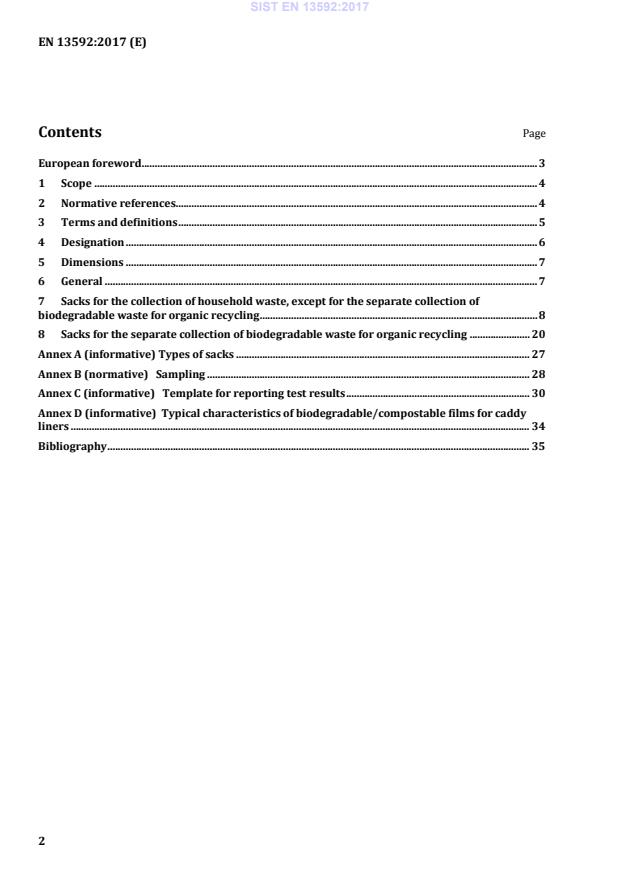
Sampling . 28 Annex C (informative)
Template for reporting test results . 30 Annex D (informative)
Typical characteristics of biodegradable/compostable films for caddy liners . 34 Bibliography . 35 SIST EN 13592:2017
Í
x where x is the minimum value of: ttNN+2515or 0,35Nt,
as 1
as 2
as 2
7.1.3.3 Average values The arithmetic average value of the film thickness, calculated according to either 7.2.3.2 or 7.2.3.3, shall be: a) > Nt –5 %, when Nt > 20 m; b) > Nt –8 %, when Nt
¶ 20 m. 7.1.4 Opacity 7.1.4.1 General Unless otherwise specified, the individual and average values of the opacity shall be in accordance with 7.1.4.2 and 7.1.4.3. No defective sack shall be permitted out of 10 sacks (or strips) for individual values of each sack (or strip) and the average value of the 10 measurements when tested according to 7.2.4.1. SIST EN 13592:2017
¶ 55 % for household waste collection sacks; b)
· 45 % for household selective waste collection sacks. 7.1.4.3 Average value The arithmetic average value of the opacity calculated for 10 measurements shall be: a)
· 60 % for household waste collection sacks; b)
¶ 40 % for household selective waste collection sacks. 7.1.5 Resistance to leakage No defective sack shall be permitted out of five sacks when tested according to 7.2.5. 7.1.6 Drop impact resistance 7.1.6.1 Sacks for household waste collection No more than three defective sacks shall be permitted out of 20 sacks when tested according to 7.2.6. If this requirement is not satisfied, then 10 additional sacks shall be tested according to 7.2.6 and in total no more than five defective sacks out of the 30 sacks shall be permitted. 7.1.6.2 Sacks for selective waste collection Unless otherwise specified in an agreement between the supplier and the customer specifying different test loads, the test loads given in Table 2 shall be applied. No more than three defective sacks shall be permitted out of 20 sacks when tested according to 7.2.6. If this requirement is not satisfied, then 10 additional sacks shall be tested according to 7.2.6 and in total no more than five defective sacks out of the 30 sacks shall be permitted. 7.1.7 Resistance of the closing device 7.1.7.1 Tensile strength of ties For sacks provided with an integrated or added tie, the tensile strength of the tie when measured according to 7.2.7.1 shall not be less than 40 N. No more than one failure out of the 10 ties tested is permitted. When the ties are not integrated to the sacks, the number of ties shall not be less than the number of sacks. 7.1.7.2 Resistance of the closing system of drawtight sacks No more than two defective sacks out of 10 shall be permitted when tested according to 7.2.7.2. For sacks for selective waste collection if there is an agreement between the supplier and the customer specifying different test loads (see 7.1.6.2), these agreed test loads shall be applied. In the absence of an agreement between the supplier and the customer, the test loads according to Table 3 shall be applied. SIST EN 13592:2017
7.2.3.3 Gravimetric method Cut out one strip of (100 ± 0,5) mm width from each of the five sacks from Group V, in the transversal
direction and in the middle of the sack. Measure the length li of each strip by using the rule. Calculate the total length of the five strips, lt. Weigh together the five strips pt with the balance. Calculate the average value of the film thickness, t, by using the following formula: ttpltρ××=0001,01 where t is the average film thickness, in micrometres; lt is the total length of the five strips, in millimetres; pt is the weight
of the five strips, in grams;
is the density of the film material, expressed in grams per cubic centimetres. SIST EN 13592:2017
Key 1 variable power supply 2 photoelectric cell 3 plastic film test specimen 4 light meter 5 matt black base of (3 ± 0,5) cm thickness 6
matt black diagram of (1 ± 0,1) cm diameter Key 1 variable power supply 2 photoelectric cell 3 plastic film test specimen 4 light meter 5 matt black base
a) Reference apparatus b) Other apparatus Figure 1 — Typical apparatus for the control of opacity 7.2.4.1.3 Procedure This test shall be performed using 10 strips, 100 mm minimum wide, cut from each of the 10 sacks from Group I in the same way as for those for the thickness test, avoiding printed areas as far as possible. Turn on the light source and wait 5 min for the stabilization of the light. Set up the light, using the variable power supply, to an illuminance, as measured by the photo electric cell, such that lo = 1 000 lx. Place the test specimen with the inner side of the sack on the cell and record the illuminance of the transmitted light, l1, looking for: a) for household waste collection and pre-collection sacks, the lowest value over the entire area of the test specimen; b) for household selective waste collection sacks, the highest value over the entire area of the test specimen. Express the result as a percentage, rounded to the nearest integer. For example, for a value of 38,5 %, the result is 39 %. Repeat the procedure for each sack. SIST EN 13592:2017
Volume l
P
¶ 400 and L
¶ 400 400
¶ P
¶ 520 and 400
¶ L
¶ 700 P > 520 or L > 700 Tap water 2 3 6 Mixture of water and saw dust (50/50 in volume) 2 3 6 7.2.5.2 Procedure When sacks are supplied with a tie sealed to the sack, the tie shall not be removed before performing this test. Pour into a sack 2 l, 3 l or 6 l of water, as applicable (see Table 1). Hang up the sack by the top to the support and monitor the sack for 5 min, for any evidence of leak. If a drop leaks within these 5 min, start counting the number of drops, n, escaping from the sack during 1 min: a) If n is less than or equal to 20, the sack is declared “conform”; b) If n is greater than 20, proceed with the second step, using the same sack. Prepare 2 l, 3 l or 6 l, as applicable (see Table 1) of the wet mixture, as defined in 7.2.5.1.3. Pour the volume of the wet mixture in the sack. Hang up the sack by the top to the support and monitor the sack for 5 min, for any evidence of leak. Count the number of drops, n, if any, escaping from the sack during 1 min. If n is less than or equal to 20, the sack passes is declared “conform”. If n is greater than 20 or if all water escaped during the first 5 min, the sack is declared “non-conform”. Repeat the procedure for each sack. SIST EN 13592:2017
...