

EN ISO 9455-5:2020
(Main)Soft soldering fluxes - Test methods - Part 5: Copper mirror test (ISO 9455-5:2020)
General Information
- Abstract
This document specifies a qualitative method for assessing the aggressiveness of a flux towards copper.
The test is applicable to all fluxes of type 1 as defined in ISO 9454‑1.
- Status
- Published
- Publication Date
- 13-Oct-2020
- Withdrawal Date
- 29-Apr-2021
- Technical Committee
- CEN/TC 121 - Welding
- Drafting Committee
- CEN/TC 121 - Welding
- Current Stage
- 6060 - Definitive text made available (DAV) - Publishing
- Start Date
- 14-Oct-2020
- Completion Date
- 14-Oct-2020

Overview
EN ISO 9455-5:2020 - "Soft soldering fluxes - Test methods - Part 5: Copper mirror test" specifies a qualitative method to assess the aggressiveness of fluxes towards copper. Published by CEN/ISO, this test is applicable to fluxes of type 1 (see ISO 9454-1) and is intended to detect the presence of free halide activators that can attack copper films used in electronic and soldering assemblies.
Key topics and requirements
- Test principle: A flux test solution is applied to a vacuum‑deposited copper film (a “copper mirror”) on glass; flux reactivity is judged by whether the copper film is removed (becomes transparent).
- Sample preparation
- Liquid fluxes: used full strength.
- Solid/paste fluxes: dissolve or dilute to 25 % (m/m) solids (propan-2-ol is the usual solvent).
- Flux‑cored solder: extract flux (Soxhlet) and adjust extract to 25 % solids after determining non‑volatile matter (ISO 9455‑1 or ISO 9455‑2).
- Copper mirror: vacuum‑deposited copper ~50 nm thick; transmittance at 500 nm between 5 % and 15 %. Mirrors must be stored under dry nitrogen and cleaned immediately before test.
- Cleaning and conditioning: brief immersion (≤ 5 s) in EDTA 0.1 % to remove oxide, rinse, acetone wipe, then place one drop (≤ 0.05 ml) of flux test solution and one drop of rosin reference solution (25 % colophony in propan‑2‑ol) on separate mirror areas. Maintain at 25 °C ± 2 °C and (50 ± 5) % RH for 24 h.
- Assessment: a flux passes if no removal (no visible white background through the film) occurs on either mirror. If the rosin control fails, repeat using fresh mirrors.
- Limitations/notes: the method is qualitative and amines in fluxes can mask reactivity, producing misleading pass results.
Applications and users
- Quality control and acceptance testing of soft soldering fluxes for electronics and electrical assemblies.
- Product development and stability testing by flux manufacturers and formulators.
- Solder process engineers, metallurgists, and independent test laboratories evaluating flux compatibility with copper substrates.
- Procurement and compliance teams specifying flux performance in manufacturing specifications.
Related standards
- ISO 9454‑1 - Definition and classification of flux types (type 1).
- ISO 9455‑1 / ISO 9455‑2 - Methods for determination of non‑volatile matter used when preparing flux extracts.
- Use keywords when searching or documenting: EN ISO 9455-5:2020, copper mirror test, soft soldering fluxes, flux aggressiveness, free halide activators.
This standard provides a straightforward, industry‑accepted qualitative check to screen fluxes for copper‑attacking behavior prior to use in sensitive soldering and electronic assembly processes.
Relations
- Effective Date
- 11-May-2020
- Effective Date
- 25-Aug-2026
- Effective Date
- 25-Aug-2026
- Effective Date
- 28-Jan-2026
- Effective Date
- 09-Feb-2026
- Effective Date
- 12-Feb-2026
Get Certified
Connect with accredited certification bodies for this standard

DVS-ZERT GmbH
German welding certification society.
CARES (UK Certification Authority for Reinforcing Steels)
UK certification for reinforcing steels and construction.
EWF/IIW (European/International Welding Federation)
International welding personnel certification.
Sponsored listings
Frequently Asked Questions
EN ISO 9455-5:2020 is a standard published by the European Committee for Standardization (CEN). Its full title is "Soft soldering fluxes - Test methods - Part 5: Copper mirror test (ISO 9455-5:2020)". This standard covers: This document specifies a qualitative method for assessing the aggressiveness of a flux towards copper. The test is applicable to all fluxes of type 1 as defined in ISO 9454‑1.
This document specifies a qualitative method for assessing the aggressiveness of a flux towards copper. The test is applicable to all fluxes of type 1 as defined in ISO 9454‑1.
EN ISO 9455-5:2020 is classified under the following ICS (International Classification for Standards) categories: 25.160.50 - Brazing and soldering. The ICS classification helps identify the subject area and facilitates finding related standards.
EN ISO 9455-5:2020 has the following relationships with other standards: It is inter standard links to EN ISO 9455-5:2014, ISO 9455-2:1993, ISO 9455-1:1990, EN 3446:1995, EN 61189-5-2:2015, ISO 9455-5:2020. Understanding these relationships helps ensure you are using the most current and applicable version of the standard.
EN ISO 9455-5:2020 is available in PDF format for immediate download after purchase. The document can be added to your cart and obtained through the secure checkout process. Digital delivery ensures instant access to the complete standard document.
Standards Content (Sample)
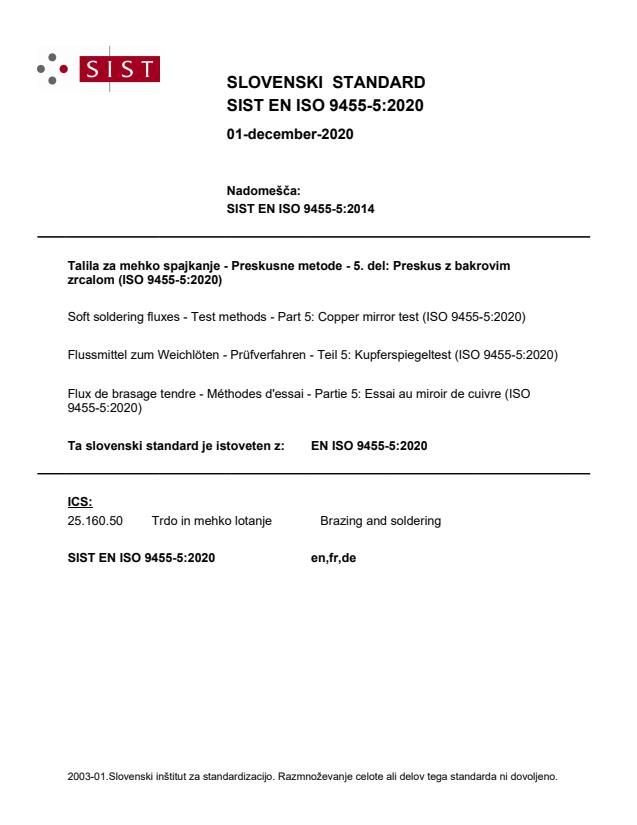
SLOVENSKI STANDARD
01-december-2020
Nadomešča:
SIST EN ISO 9455-5:2014
Talila za mehko spajkanje - Preskusne metode - 5. del: Preskus z bakrovim
zrcalom (ISO 9455-5:2020)
Soft soldering fluxes - Test methods - Part 5: Copper mirror test (ISO 9455-5:2020)
Flussmittel zum Weichlöten - Prüfverfahren - Teil 5: Kupferspiegeltest (ISO 9455-5:2020)
Flux de brasage tendre - Méthodes d'essai - Partie 5: Essai au miroir de cuivre (ISO
9455-5:2020)
Ta slovenski standard je istoveten z: EN ISO 9455-5:2020
ICS:
25.160.50 Trdo in mehko lotanje Brazing and soldering
2003-01.Slovenski inštitut za standardizacijo. Razmnoževanje celote ali delov tega standarda ni dovoljeno.
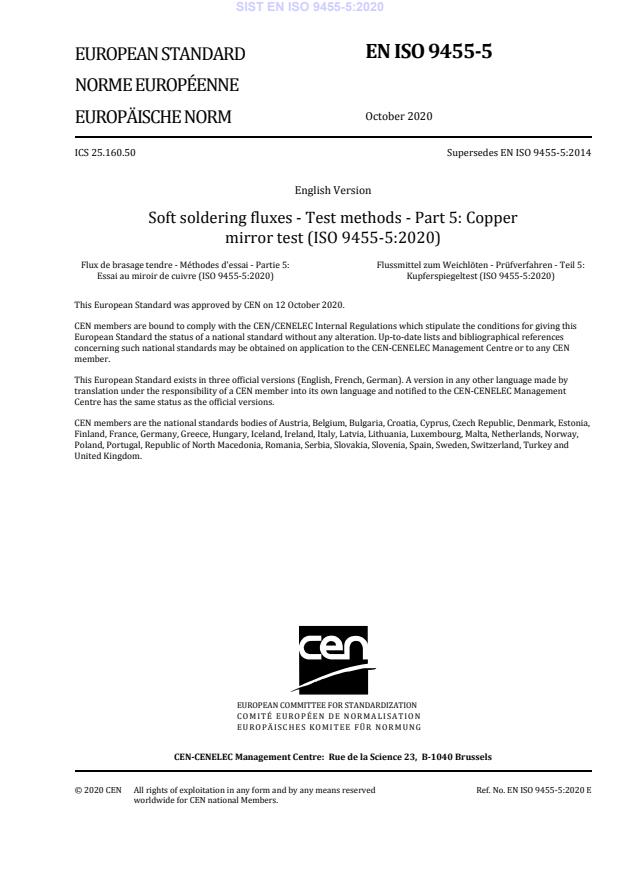
EN ISO 9455-5
EUROPEAN STANDARD
NORME EUROPÉENNE
October 2020
EUROPÄISCHE NORM
ICS 25.160.50 Supersedes EN ISO 9455-5:2014
English Version
Soft soldering fluxes - Test methods - Part 5: Copper
mirror test (ISO 9455-5:2020)
Flux de brasage tendre - Méthodes d'essai - Partie 5: Flussmittel zum Weichlöten - Prüfverfahren - Teil 5:
Essai au miroir de cuivre (ISO 9455-5:2020) Kupferspiegeltest (ISO 9455-5:2020)
This European Standard was approved by CEN on 12 October 2020.
CEN members are bound to comply with the CEN/CENELEC Internal Regulations which stipulate the conditions for giving this
European Standard the status of a national standard without any alteration. Up-to-date lists and bibliographical references
concerning such national standards may be obtained on application to the CEN-CENELEC Management Centre or to any CEN
member.
This European Standard exists in three official versions (English, French, German). A version in any other language made by
translation under the responsibility of a CEN member into its own language and notified to the CEN-CENELEC Management
Centre has the same status as the official versions.
CEN members are the national standards bodies of Austria, Belgium, Bulgaria, Croatia, Cyprus, Czech Republic, Denmark, Estonia,
Finland, France, Germany, Greece, Hungary, Iceland, Ireland, Italy, Latvia, Lithuania, Luxembourg, Malta, Netherlands, Norway,
Poland, Portugal, Republic of North Macedonia, Romania, Serbia, Slovakia, Slovenia, Spain, Sweden, Switzerland, Turkey and
United Kingdom.
EUROPEAN COMMITTEE FOR STANDARDIZATION
COMITÉ EUROPÉEN DE NORMALISATION
EUROPÄISCHES KOMITEE FÜR NORMUNG
CEN-CENELEC Management Centre: Rue de la Science 23, B-1040 Brussels
© 2020 CEN All rights of exploitation in any form and by any means reserved Ref. No. EN ISO 9455-5:2020 E
worldwide for CEN national Members.
Contents Page
European foreword . 3
European foreword
This document (EN ISO 9455-5:2020) has been prepared by Technical Committee ISO/TC 44 "Welding
and allied processes" in collaboration with Technical Committee CEN/TC 121 “Welding and allied
processes” the secretariat of which is held by DIN.
This European Standard shall be given the status of a national standard, either by publication of an
identical text or by endorsement, at the latest by April 2021, and conflicting national standards shall be
withdrawn at the latest by April 2021.
Attention is drawn to the possibility that some of the elements of this document may be the subject of
patent rights. CEN shall not be held responsible for identifying any or all such patent rights.
This document supersedes EN ISO 9455-5:2014.
According to the CEN-CENELEC Internal Regulations, the national standards organizations of the
following countries are bound to implement this European Standard: Austria, Belgium, Bulgaria,
Croatia, Cyprus, Czech Republic, Denmark, Estonia, Finland, France, Germany, Greece, Hungary, Iceland,
Ireland, Italy, Latvia, Lithuania, Luxembourg, Malta, Netherlands, Norway, Poland, Portugal, Republic of
North Macedonia, Romania, Serbia, Slovakia, Slovenia, Spain, Sweden, Switzerland, Turkey and the
United Kingdom.
Endorsement notice
The text of ISO 9455-5:2020 has been approved by CEN as EN ISO 9455-5:2020 without any
modification.
INTERNATIONAL ISO
STANDARD 9455-5
Third edition
2020-10
Soft soldering fluxes — Test
methods —
Part 5:
Copper mirror test
Flux de brasage tendre — Méthodes d'essai —
Partie 5: Essai au miroir de cuivre
Reference number
ISO 9455-5:2020(E)
©
ISO 2020
ISO 9455-5:2020(E)
© ISO 2020
All rights reserved. Unless otherwise specified, or required in the context of its implementation, no part of this publication may
be reproduced or utilized otherwise in any form or by any means, electronic or mechanical, including photocopying, or posting
on the internet or an intranet, without prior written permission. Permission can be requested from either ISO at the address
below or ISO’s member body in the country of the requester.
ISO copyright office
CP 401 • Ch. de Blandonnet 8
CH-1214 Vernier, Geneva
Phone: +41 22 749 01 11
Email: copyright@iso.org
Website: www.iso.org
Published in Switzerland
ii © ISO 2020 – All rights reserved
ISO 9455-5:2020(E)
Contents Page
Foreword .iv
1 Scope . 1
2 Normative references . 1
3 Terms and definitions . 1
4 Principle . 1
5 Reagents . 1
6 Apparatus . 2
7 Procedure. 2
7.1 Preparation of the flux test solution . 2
7.1.1 Liquid flux samples . 2
7.1.2 Solid flux samples . 2
7.1.3 Flux-cored solder . 2
7.2 Preparation of copper mirrors for test . 3
7.3 Determination . 3
8 Assessment and expression of results . 3
9 Test report . 3
Bibliography . 4
ISO 9455-5:2020(E)
Foreword
ISO (the International Organization for Standardization) is a worldwide federation of national standards
bodies (ISO member bodies). The work of preparing International Standards is normally carried out
through ISO technical committees. Each member body interested in a subject for which a technical
committee has been established has the right to be represented on that committee. International
organizations, governmental and non-governmental, in liaison with ISO, also take part in the work.
ISO collaborates closely with the International Electrotechnical C
...