


CEN/TS 16157-15:2026
(Main)Intelligent transport systems — DATEX II data exchange specifications for traffic management and information — Part 15: JSON Schema mapping
General Information
- Abstract
This document specifies a schema mapping using JavaScript Object Notation (JSON) as defined by JSON Schema (draft 2020-12) and subsequent versions. The schema mapping is the derived from the current UML model for DATEX II defined in 16157 Part 1. The schema mapping follows the JSON format defined by the Internet Engineering Task Force (IETF) in RFC 8259.
- Status
- Not Published
- Publication Date
- 29-Sep-2026
- Technical Committee
- CEN/TC 278 - Road transport and traffic telematics
- Drafting Committee
- CEN/TC 278/WG 8 - Road traffic data (RTD)
- Current Stage
- 5060 - Closure of Vote - Formal Approval
- Start Date
- 20-Aug-2026
- Due Date
- 28-Apr-2026
- Completion Date
- 20-Aug-2026

Overview
CEN/TS 16157-15:2026 is a Technical Specification developed by the European Committee for Standardization (CEN) under the broader DATEX II family, which sets data exchange specifications for intelligent transport systems (ITS). Focusing on traffic management and information systems, this part (Part 15) defines the schema mapping from the DATEX II UML model (per CEN/TS 16157-1) to a robust and interoperable JSON Schema representation according to the JSON Schema draft 2020-12 and RFC 8259. Standardizing this mapping is essential for facilitating seamless, reliable, and future-proof data exchange between traffic-related actors such as road authorities, infrastructure providers, and mobility service companies.
Key Topics
DATEX II UML-to-JSON Mapping: The standard outlines formal rules and mapping guidance to convert structure and semantics defined in the DATEX II UML model into JSON Schemas. This includes how to represent classes, enumerations, relations, and data types in JSON.
JSON Schema Compliance: It ensures the generated schemas are fully compliant with the 2020-12 JSON Schema draft and RFC 8259, supporting modern ITS software practices and interoperability at both national and pan-European levels.
Extensibility and Maintenance: The methodology supports extensible and maintainable schema generation, allowing for Level B (backward-compatible) and Level C (non-backward-compatible) extensions as ITS data exchange needs evolve.
Standardized File Structures: Describes file naming conventions, use of namespaces, cross-file references, and recommendations to maintain clarity and avoid naming conflicts in complex deployments.
Attribute and Relationship Mapping: Covers explicit rules for mapping attributes (e.g., scalars or references), class inheritance, multi-valued relationships, and special handling for identifiable elements.
Applications
CEN/TS 16157-15:2026 delivers practical benefits and use cases in the domain of intelligent transport systems, by:
Enabling System Interoperability: The standard’s JSON Schema mapping fosters interoperability between diverse traffic management solutions, data consumers, and service providers, regardless of national or regional boundaries.
Facilitating Integration with Modern Web Services: JSON is the de facto standard for web APIs and cloud infrastructure. This mapping enables DATEX II-compliant data to be exchanged efficiently through RESTful interfaces, IoT gateways, and cloud-native ITS applications.
Supporting Data Validation and Consistency: JSON Schema definitions generated under this standard allow developers to automatically validate traffic and travel data, ensuring compliance with agreed structure, reducing integration errors, and improving overall data quality.
Streamlining Extension and Customization: Built-in support for schema extensibility (Level B/C) means stakeholders can introduce custom data elements or adjust schemas as operational requirements or regulations change, without breaking existing data exchange flows.
Reducing Risk and Costs: By promoting standardized, automated schema generation and validation, the specification reduces vendor lock-in, lowers integration costs, and encourages broader ITS ecosystem participation.
Related Standards
CEN/TS 16157-15:2026 is part of the broader DATEX II series dedicated to intelligent transport data exchange:
EN 16157-1:2018 – Intelligent transport systems - DATEX II data exchange specifications for traffic management and information - Part 1: Context and framework: Defines the underlying UML model, context, and framework on which Part 15 is based.
CEN/TS 17466 – DATEX II JSON Mapping (superseded): The earlier approach to JSON mapping, now extended and formalized in Part 15.
IETF RFC 8259 – The JavaScript Object Notation (JSON) Data Interchange Format: The baseline specification for JSON encoding.
For more information and implementation tools, visit www.datex2.eu.
By adopting CEN/TS 16157-15:2026, transport sector organizations and technology vendors can ensure future-proof, interoperable, and reliable data exchange across Europe and globally, leveraging the power of standardized JSON schemas for intelligent traffic management and information solutions.
Frequently Asked Questions
CEN/TS 16157-15:2026 is a draft published by the European Committee for Standardization (CEN). Its full title is "Intelligent transport systems — DATEX II data exchange specifications for traffic management and information — Part 15: JSON Schema mapping". This standard covers: This document specifies a schema mapping using JavaScript Object Notation (JSON) as defined by JSON Schema (draft 2020-12) and subsequent versions. The schema mapping is the derived from the current UML model for DATEX II defined in 16157 Part 1. The schema mapping follows the JSON format defined by the Internet Engineering Task Force (IETF) in RFC 8259.
This document specifies a schema mapping using JavaScript Object Notation (JSON) as defined by JSON Schema (draft 2020-12) and subsequent versions. The schema mapping is the derived from the current UML model for DATEX II defined in 16157 Part 1. The schema mapping follows the JSON format defined by the Internet Engineering Task Force (IETF) in RFC 8259.
CEN/TS 16157-15:2026 is available in PDF format for immediate download after purchase. The document can be added to your cart and obtained through the secure checkout process. Digital delivery ensures instant access to the complete standard document.
Standards Content (Sample)
SLOVENSKI STANDARD
01-julij-2026
Inteligentni transportni sistemi - Specifikacije za izmenjavo podatkov DATEX II pri
upravljanju prometa in informiranju - 15. del: Povezovanje s shemo JSON
Intelligent transport systems — DATEX II data exchange specifications for traffic
management and information — Part 15: JSON Schema mapping
Intelligente Verkehrssysteme - DATEX II Datenaustauschspezifikation für
Verkehrsmanagement und Verkehrsinformation - Teil 15: Abbildung des JSON-Schema
Systèmes de transport intelligents — Spécifications Datex II d'échange de données pour
la gestion du trafic et l'information routière — Partie 15 : Mappage de Schéma JSON
Ta slovenski standard je istoveten z: FprCEN/TS 16157-15
ICS:
35.240.60 Uporabniške rešitve IT v IT applications in transport
prometu
2003-01.Slovenski inštitut za standardizacijo. Razmnoževanje celote ali delov tega standarda ni dovoljeno.
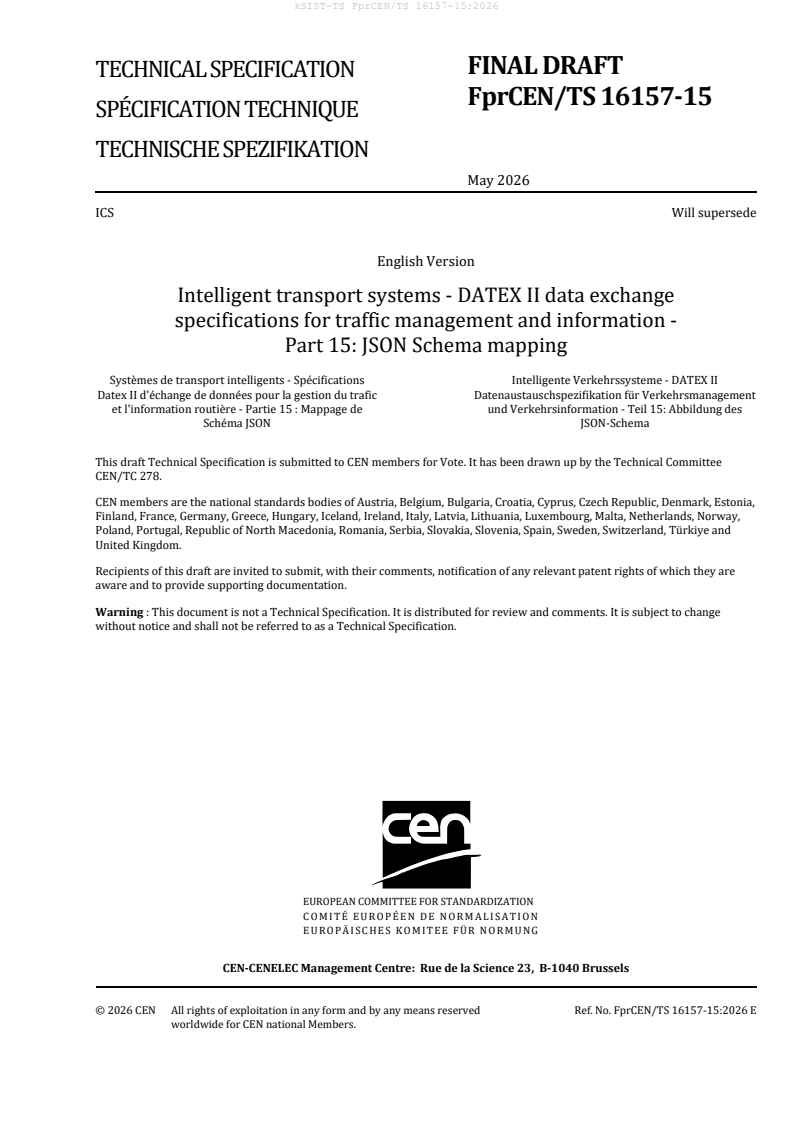
FINAL DRAFT
TECHNICAL SPECIFICATION
FprCEN/TS 16157-15
SPÉCIFICATION TECHNIQUE
TECHNISCHE SPEZIFIKATION
May 2026
ICS Will supersede
English Version
Intelligent transport systems - DATEX II data exchange
specifications for traffic management and information -
Part 15: JSON Schema mapping
Systèmes de transport intelligents - Spécifications Intelligente Verkehrssysteme - DATEX II
Datex II d'échange de données pour la gestion du trafic Datenaustauschspezifikation für Verkehrsmanagement
et l'information routière - Partie 15 : Mappage de und Verkehrsinformation - Teil 15: Abbildung des
Schéma JSON JSON-Schema
This draft Technical Specification is submitted to CEN members for Vote. It has been drawn up by the Technical Committee
CEN/TC 278.
CEN members are the national standards bodies of Austria, Belgium, Bulgaria, Croatia, Cyprus, Czech Republic, Denmark, Estonia,
Finland, France, Germany, Greece, Hungary, Iceland, Ireland, Italy, Latvia, Lithuania, Luxembourg, Malta, Netherlands, Norway,
Poland, Portugal, Republic of North Macedonia, Romania, Serbia, Slovakia, Slovenia, Spain, Sweden, Switzerland, Türkiye and
United Kingdom.
Recipients of this draft are invited to submit, with their comments, notification of any relevant patent rights of which they are
aware and to provide supporting documentation.
Warning : This document is not a Technical Specification. It is distributed for review and comments. It is subject to change
without notice and shall not be referred to as a Technical Specification.
EUROPEAN COMMITTEE FOR STANDARDIZATION
COMITÉ EUROPÉEN DE NORMALISATION
EUROPÄISCHES KOMITEE FÜR NORMUNG
CEN-CENELEC Management Centre: Rue de la Science 23, B-1040 Brussels
© 2026 CEN All rights of exploitation in any form and by any means reserved Ref. No. FprCEN/TS 16157-15:2026 E
worldwide for CEN national Members.
FprCEN/TS 16157-15:2026 (E)
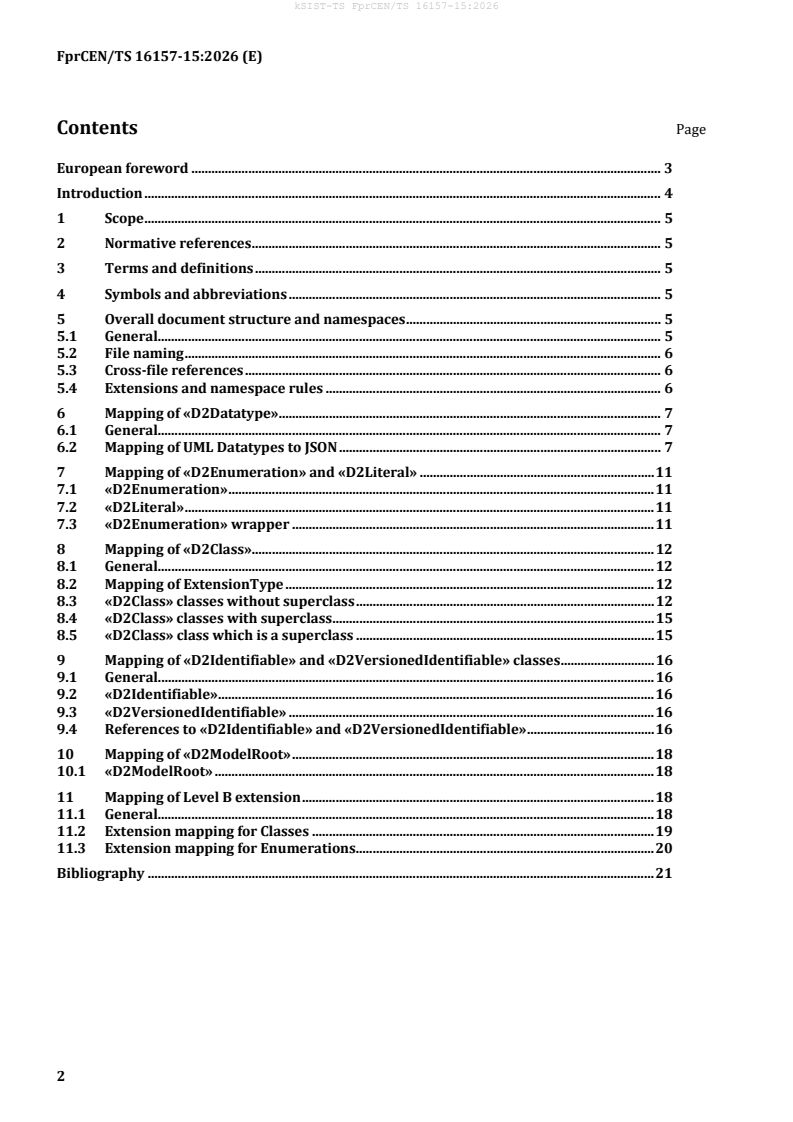
Contents Page
European foreword . 3
Introduction . 4
1 Scope . 5
2 Normative references . 5
3 Terms and definitions . 5
4 Symbols and abbreviations . 5
5 Overall document structure and namespaces . 5
5.1 General. 5
5.2 File naming . 6
5.3 Cross-file references . 6
5.4 Extensions and namespace rules . 6
6 Mapping of «D2Datatype» . 7
6.1 General. 7
6.2 Mapping of UML Datatypes to JSON . 7
7 Mapping of «D2Enumeration» and «D2Literal» . 11
7.1 «D2Enumeration» . 11
7.2 «D2Literal» . 11
7.3 «D2Enumeration» wrapper . 11
8 Mapping of «D2Class» . 12
8.1 General. 12
8.2 Mapping of ExtensionType . 12
8.3 «D2Class» classes without superclass . 12
8.4 «D2Class» classes with superclass . 15
8.5 «D2Class» class which is a superclass . 15
9 Mapping of «D2Identifiable» and «D2VersionedIdentifiable» classes . 16
9.1 General. 16
9.2 «D2Identifiable» . 16
9.3 «D2VersionedIdentifiable» . 16
9.4 References to «D2Identifiable» and «D2VersionedIdentifiable» . 16
10 Mapping of «D2ModelRoot» . 18
10.1 «D2ModelRoot» . 18
11 Mapping of Level B extension . 18
11.1 General. 18
11.2 Extension mapping for Classes . 19
11.3 Extension mapping for Enumerations. 20
Bibliography . 21
FprCEN/TS 16157-15:2026 (E)
European foreword
This document (FprCEN/TS 16157-15:2026) has been prepared by Technical Committee CEN/TC 278
“Intelligent transport systems”, the secretariat of which is held by NEN.
This document is currently submitted to the Vote as TS.
This document will supersede CEN/TS 17466.
The CEN 16157 series consist of several parts under the general title “Intelligent transport systems —
DATEX II data exchange specifications for traffic management and information”. Other parts may be
developed in the future.
A list of all parts in a series can be found on the CEN website: www.cencenelec.eu.
As a user of this document, attention is drawn to the resources of www.datex2.eu. This web site contains
related software tools and software resources that aid the implementation of EN 16157 DATEX II.
FprCEN/TS 16157-15:2026 (E)
Introduction
This document defines a common set of data exchange specifications to support the vision of a seamless
interoperable exchange of road traffic and travel information across boundaries, including national,
urban, interurban, road administrations, infrastructure providers and service providers. Standardization
in this context is a vital constituent to ensure interoperability, reduction of risk, reduction of the cost
base, promotion of open marketplaces and many social, economic and community benefits to be gained
from more informed travellers, network managers and transport operators.
Deploying intelligent transport systems in line with European Sustainable and Smart Mobility Strategy
as issued by the European Commission requires co-ordination of traffic management operation and
development of seamless pan-European information services. These jointly aim at contributing to the
transformation of the European transport system for the objectives of efficient, safe, sustainable, smart
and resilient mobility.
In this context the European Commission has been supporting the development of information exchange
between the actors of road traffic management and related services for several years. In the road sector,
DATEX II has been long in fruition, with the European Commission being fundamental to its development
through an initial contract and subsequent co-funding of the further evolution of the standard and user
support ecosystem. With this standardization of DATEX II, there is a real basis for common exchange
between the actors of the traffic and travel information sector both in the collaboration between traffic
management organisations and their systems, as well as in coherent information provision to service
providers. DATEX II supports the requirements of the stakeholder organisations involved in the road
traffic and travel domain in compliance with the EU policy and legal frameworks aimed at the sector.
Attention is drawn to the possibility that some of the elements of this document may be the subject of
patent rights. CEN shall not be held responsible for identifying any or all such patent rights.
This European Standard includes the framework and context for exchanges, the modelling approach, data
content, data structure and relationships.
This European Standard supports a methodology that is extensible.
Part 15 of the CEN/TS 16157 series (this Technical Specification) specifies the mapping from UML models
into a JSON Schema representation, in compliance with CEN/EN 16157-1, which defines the overall
context and framework for such mappings, including the corresponding XML Schema representation.
FprCEN/TS 16157-15:2026 (E)
1 Scope
The CEN 16157 multipart standard specifies and defines component aspects supporting the shared use
of data and information in the field of traffic and travel. The component aspects include the modelling
approach, the data content, the data structure and relationships and the communications specification.
This document defines a mapping from UML models, compliant with EN 16157-1, into JavaScript Object
Notation (JSON) using JSON Schema as specified in draft 2020-12 and subsequent versions.
The schema mapping conforms to the JSON format defined by the Internet Engineering Task Force (IETF)
in RFC 8259.
In the context of describing generation of schema, this refers to the webtool made available as part of the
CEN 16157 multipart standard, which can generate the JSON schema mapping specified in this document.
2 Normative references
The following documents are referred to in the text in such a way that some or all of their content
constitutes requirements of this document. For dated references, only the edition cited applies. For
undated references, the latest edition of the referenced document (including any amendments) applies.
EN 16157-1:2018, Intelligent transport systems - DATEX II data exchange specifications for traffic
management and information - Part 1: Context and framework
3 Terms and definitions
There are no terms and definitions listed in this document.
ISO and IEC maintain terminology databases for use in standardization at the following addresses:
— ISO Online browsing platform: available at https://www.iso.org/obp/
— IEC Electropedia: available at https://www.electropedia.org/
4 Symbols and abbreviations
UML Unified Modeling Language
JSON JavaScript Object Notation
LCC lower camel case
UCC upper camel case
URI Uniform Resource Identifier
URL Uniform Resource Locator
5 Overall document structure and namespaces
5.1 General
The mapping rules described in this document define the structure of types, properties, and elements
derived from the UML model. In order to provide a usable implementation format these types, properties
and elements are organised into JSON Schema definition files. Each file corresponds to one
«D2Namespace» and contains the complete set of class, enumeration, and reference definitions belonging
to that package.
FprCEN/TS 16157-15:2026 (E)
The "title" properties are optional. The "description" properties are intended solely for documentation
purposes and shall only be included if a schema that includes definitions and descriptions is being
generated, with exception on necessary information to the programmer, where description will be
generated.
The whole set of type and element definitions provided in the following sections are wrapped into
multiple JSON schema definition files, each with the following JSON structure:
{
"$schema": "https://json-schema.org/draft/2020-12/schema",
"$defs": {
Definitions of classes, enumerations, wrappers and references are
inserted here
}
…other top-level members if applicable
}
5.2 File naming
Each «D2Namespace» in the source model shall be mapped to its own JSON Schema definition file using:
DATEXII__.json
where:
• is taken from the corresponding attribute on the class stereotyped as
«D2ModelRoot».
• is the name of the package stereotyped as «D2Namespace».
5.3 Cross-file references
Where one «D2Namespace»uses constructs from another «D2Namespace»then the schema within the
using namespace shall use a JSON Schema $ref construct referencing a schema in the schema file for the
used namespace, in the following pattern:
"": {
"$ref":
".json#/$defs/"
}
5.4 Extensions and namespace rules
• Level B (backward-compatible) extensions. If a model contains Level B extension classes, the
JSON Schema constructs for those extension classes shall be placed in the JSON Schema for the
concepts they extend.
• Level C (non-backward-compatible) extensions. If an extended model is not backward
compatible, a distinct schema filename shall be used to clearly distinguish the Level C schema from
the Level A schema. The schema filename shall be used to reference other schema using the keyword
$ref.
NOTE The tool provided to generate schemas will prefix the schema filenames, and subsequently use this
prefixed filename for reference other schemas using the keyword $ref.
FprCEN/TS 16157-15:2026 (E)
6 Mapping of «D2Datatype»
6.1 General
In this document UML datatypes classified as «D2Datatype» are, in principle, mapped to JSON Schema
definitions bearing the same name as the UML datatype.
Exceptions to this mapping — that is, instances where a «D2Datatype» is mapped differently — are
documented in the following sections.
Additionally, the value of the "definition" tagged value in UML is mapped to the description property in
JSON Schema. The general structure is as follows:
: {
"title": "",
"description": "",
"type": "RestrictionBase"
}
The value of "type" (referred to as "RestrictionBase" in pseudocode) is determined by the following
algorithm:
1. If the assigned «D2Datatype» stereotype has a non-empty schemaType property (see EN 16157-
1:2018, Part 1: Context and framework, Section 6.2.4), then this value is mapped according to the
Mapping of Datatypes table (see below).
2. If both schemaType and schemaTypeInclude properties of the «D2Datatype» stereotype are empty,
then the value of "type" is replaced with a $ref pointing to the supertype definition:
"$ref": "#/$defs/"
6.2 Mapping of UML Datatypes to JSON
6.2.1 schemaType attribute
The ollowing table shows mapping of schemaType attribute in UML to JSON type. If no mapping is found,
string shall be used as default mapping. Where a phrase in angle brackets ends with
“FromFacetsInUMLModel”, the part before that suffix is the name from tag in the UML ‘facets’ tagged
value.
NOTE Derived types of types defined in Table 1 can also contain definition of facets.
Table 1 — Mapping table datatypes, schemaType
schemaType JSON
base64Binary “type:”:”string”
“contentEncoding”:”base64”
“pattern”:”^[A-Za-z0-9+/]+={0,2}$”
boolean "type": "boolean"
date "type": "string"
“format”: “date”
dateTime "type": "string"
"format": "date-time"
FprCEN/TS 16157-15:2026 (E)
decimal "type": "number"
(Optional facets)
“minimum”:
“maximum”:
double "type": "number"
(Optional facets)
“minimum”:
“maximum”:
float "type": "number"
(Optional facets)
“minimum”:
“maximum”:
int "type": "integer"
(Optional facets)
“minimum”:
“maximum”:
integer "type": "integer"
(Optional facets) minInclusive and maxInclusive
“minimum”:
“maximum”:
language “type:”:”string”
“pattern”: "^[a-z]{2}$"
negativeInteger "type": "integer", " exclusiveMaximum": 0
positiveInteger "type": "integer", "exclusiveMinimum ": 0
nonNegativeInteger "type": "integer", "minimum": 0
string "type": "string"
(Optional facets)
“maximumLength”:
“pattern”:”
time "type": "string"
“format”: “time”
url "type": "string"
FprCEN/TS 16157-15:2026 (E)
6.2.2 schemaTypeInclude attribute
The following table shows mapping of schemaTypeInclude attribute in UML to JSON type.
Table 2 — Mapping table datatypes, schemaTypeInclude
schemaTypeInclude JSON
MultiLingualString {
MultilingualString: {
"title": "MultilingualString",
"description": "",
"type": "object",
"additionalProperties": false,
"properties": {
"values": {
"type": "array",
"items": {
"$ref":
"#/$defs/MultiLingualStringValue"
}
}
}
},
"MultiLingualStringValue": {
"title": "MultiLingualStringValue",
"description": "",
"type": "object",
"additionalProperties": false,
"properties": {
"lang": {
"type": "string",
"pattern": "^[a-z]{2}$"
},
"value": {
"type": "string"
}
},
"required": [
"lang",
"value"
]
}
}
----------------
...