

EN 18239:2026
(Main)Digital product passport - Access rights management, information system security, and business confidentiality
- Abstract
This document specifies the requirements for digital product passport (DPP) access rights management, including IT security, data protection, and responsibility transfer between economic operators. It defines the framework for managing confidential information access, while acknowledging that public DPP data requires no access restrictions to be read.
- Status
- Published
- Publication Date
- 15-Sep-2026
- Technical Committee
- JTC 24 - Digital Product Passport (DPP)
- Drafting Committee
- WG 3 - Security
- Current Stage
- 6060 - Definitive text made available (DAV) - Publishing
- Start Date
- 16-Sep-2026
- Due Date
- 02-Sep-2026
- Completion Date
- 16-Sep-2026

EN 18239:2026 is a CEN European Standard on digital product passport (DPP) access rights management, information system security, and business confidentiality. It specifies how access to controlled DPP data is managed, how responsibilities move between economic operators, and how public DPP data can be read without access restrictions. It is aimed at organisations and people who implement, operate, or govern DPP services and DPP data access.
What does EN 18239:2026 specify?
EN 18239:2026 defines the framework for controlling access to DPP information while protecting confidential business information and supporting IT security, data protection, and responsibility transfer between economic operators. It also states that public DPP data is readable without access restrictions.
The document is organized into scope, normative references, terms and definitions, business transactions and responsibilities, requirements for business confidentiality and access rights, and requirements for system and service resilience.
| Annex | What it covers |
|---|---|
| Annex A | Authentication assumptions for access to controlled DPP data |
| Annex ZA | Relationship with Regulation (EU) 2024/1781 and the part of Article 11 it is intended to cover |
What are the key requirements of EN 18239:2026?
EN 18239:2026 separates public DPP data from controlled DPP data and sets different access rules for each. In practice, this means anyone can read public data, while controlled data needs authenticated and authorized access.
Access rights and confidentiality
Clause 5 requires actors in a DPP system to have globally unique operator identifiers, and it ties access rights to product-group-specific legal acts. Access terms are defined at data-element level, so control can be applied to individual items of information rather than only to whole records.
The standard also requires measures to protect business confidentiality, prevent mass scraping, and avoid discrimination based only on location or jurisdiction. For implementers, this means the access model must be technically granular and legally aligned.
Authentication, accountability, and delegation
Clause 5 requires authentication and authorization for controlled DPP data, with accountability supported by non-repudiation and auditable logs. It also allows delegation of access roles and requires mechanisms for granting, changing, suspending, renewing, or revoking access.
In practice, a DPP operator needs documented procedures for role changes, emergency revocation, and traceable access decisions.
System resilience and security
Clause 6 requires an access revocation policy, digital operational resilience, and security by design. It also calls for service availability, incident detection and response, recovery capability, redundant resources, and mitigation of Denial-of-Service (DoS) attacks.
This matters because DPP services are expected to remain usable and recoverable even when security events or disruptions occur.
Management system alignment
Clause 6 points to Business Continuity Management (BCM) and Information Security Management System (ISMS) practices. It also describes continuous improvement using a Plan-Do-Check-Act (PDCA) cycle.
For organisations, this means access control is not a one-time setup - it has to be maintained, reviewed, and improved.
What terms does EN 18239:2026 define?
- Controlled DPP data - DPP information whose access is limited by user access rights.
- System resilience - the ability to recover from security compromises or attacks.
- System availability - the ability of a system to be accessible and usable on demand by an authorized actor.
- Cyber resilience - the ability to keep business continuity despite adverse conditions, attacks, or compromises.
- Actor - an organization or individual that fulfils a role.
- Notified actor - an organization or individual entitled by an accrediting body or authority to fulfil a role in the DPP life cycle.
- Digital product passport (DPP) - a digital record of product characteristics throughout its life cycle.
- Non-repudiation - protection against denial that an entity took part in an action.
Who uses EN 18239:2026?
EN 18239:2026 is used by economic operators such as manufacturers, authorized representatives, importers, distributors, dealers, and fulfilment service providers. It also applies to consumers, professional repairers, independent operators, recyclers, market surveillance authorities, customs authorities, and DPP service providers, including main and back-up providers.
These groups use the standard to decide who may read, modify, issue, or manage DPP data, and to define how access rights move when product responsibilities change.
Which standards are used with EN 18239:2026?
EN 18239:2026 references EN 18219:2026 for globally unique operator identifiers. It also cites EN ISO 11354-1:2011 for the DPP life-cycle phases and stages used as a basis for access management.
For security and resilience, it points to EN ISO/IEC 27000:2020, EN ISO/IEC 27001:2023, EN ISO 22301:2019, and ISO/IEC 27031:2025. Annex A draws on authentication concepts from ISO/IEC 29115:2013, and the terms section also references ISO 26800:2011, ISO 23234:2021, ISO/IEC 29180:2012, and ISO 9241-20:2021.
What does the EN 18239:2026 document contain?
EN 18239:2026 contains requirements text, definitions, and implementation guidance for access control and security around DPP data. It includes a structured treatment of business transactions and responsibilities, detailed requirements for confidentiality and access management, and a resilience section covering access revocation, service availability, recovery, and continuous improvement.
Annex A gives assumptions for authentication to controlled DPP data, including identity proofing, multifactor authentication, protection of cryptographic information, and timely suspension or revocation. Annex ZA maps the standard to Article 11 of Regulation (EU) 2024/1781 for voluntary conformity use.
Get Certified
Connect with accredited certification bodies for this standard

BSI Group
BSI (British Standards Institution) is the business standards company that helps organizations make excellence a habit.

Bureau Veritas
Bureau Veritas is a world leader in laboratory testing, inspection and certification services.

DNV
DNV is an independent assurance and risk management provider.
Sponsored listings
Frequently Asked Questions
EN 18239:2026 is a standard published by the European Committee for Standardization (CEN). Its full title is "Digital product passport - Access rights management, information system security, and business confidentiality". This standard covers: This document specifies the requirements for digital product passport (DPP) access rights management, including IT security, data protection, and responsibility transfer between economic operators. It defines the framework for managing confidential information access, while acknowledging that public DPP data requires no access restrictions to be read.
This document specifies the requirements for digital product passport (DPP) access rights management, including IT security, data protection, and responsibility transfer between economic operators. It defines the framework for managing confidential information access, while acknowledging that public DPP data requires no access restrictions to be read.
EN 18239:2026 is classified under the following ICS (International Classification for Standards) categories: 13.020.20 - Environmental economics. Sustainability; 35.240.63 - IT applications in trade. The ICS classification helps identify the subject area and facilitates finding related standards.
EN 18239:2026 is associated with the following European legislation: EU Directives/Regulations: 2024/1781, (EU) 2024/1781; Standardization Mandates: M/604, M/604 AMD 1. When a standard is cited in the Official Journal of the European Union, products manufactured in conformity with it benefit from a presumption of conformity with the essential requirements of the corresponding EU directive or regulation.
EN 18239:2026 is available in PDF format for immediate download after purchase. The document can be added to your cart and obtained through the secure checkout process. Digital delivery ensures instant access to the complete standard document.
Standards Content (Sample)
SLOVENSKI STANDARD
01-november-2026
Digitalni potni list izdelka - Upravljanje dostopnih pravic, varnost informacijskega
sistema in poslovna zaupnost
Digital product passport - Access rights management, information system security, and
business confidentiality
Digitaler Produktpass - Management der Benutzerrechte, IT-Sicherheit und
Geschäftsgeheimnisse
Passeport numérique des produits - Gestion des droits d'accès, sécurité du système
d'information et confidentialité des affaires
Ta slovenski standard je istoveten z: EN 18239:2026
ICS:
13.020.20 Okoljska ekonomija. Environmental economics.
Trajnostnost Sustainability
35.240.63 Uporabniške rešitve IT v IT applications in trade
trgovini
2003-01.Slovenski inštitut za standardizacijo. Razmnoževanje celote ali delov tega standarda ni dovoljeno.
EUROPEAN STANDARD EN 18239
NORME EUROPÉENNE
EUROPÄISCHE NORM
September 2026
ICS 13.020.20
English version
Digital product passport - Access rights management,
information system security, and business confidentiality
Passeport numérique des produits - Gestion des droits Digitaler Produktpass - Management der
d'accès, sécurité du système d'information et Benutzerrechte, IT-Sicherheit und
confidentialité des affaires Geschäftsgeheimnisse
This European Standard was approved by CEN on 17 August 2026.
CEN and CENELEC members are bound to comply with the CEN/CENELEC Internal Regulations which stipulate the conditions for
giving this European Standard the status of a national standard without any alteration. Up-to-date lists and bibliographical
references concerning such national standards may be obtained on application to the CEN-CENELEC Management Centre or to
any CEN and CENELEC member.
This European Standard exists in three official versions (English, French, German). A version in any other language made by
translation under the responsibility of a CEN and CENELEC member into its own language and notified to the CEN-CENELEC
Management Centre has the same status as the official versions.
CEN and CENELEC members are the national standards bodies and national electrotechnical committees of Austria, Belgium,
Bulgaria, Croatia, Cyprus, Czech Republic, Denmark, Estonia, Finland, France, Germany, Greece, Hungary, Iceland, Ireland, Italy,
Latvia, Lithuania, Luxembourg, Malta, Netherlands, Norway, Poland, Portugal, Republic of North Macedonia, Romania, Serbia,
Slovakia, Slovenia, Spain, Sweden, Switzerland, Türkiye and United Kingdom.
CEN-CENELEC Management Centre:
Rue de la Science 23, B-1040 Brussels
© 2026 CEN/CENELEC All rights of exploitation in any form and by any means
Ref. No. EN 18239:2026 E
reserved worldwide for CEN national Members and for
CENELEC Members.
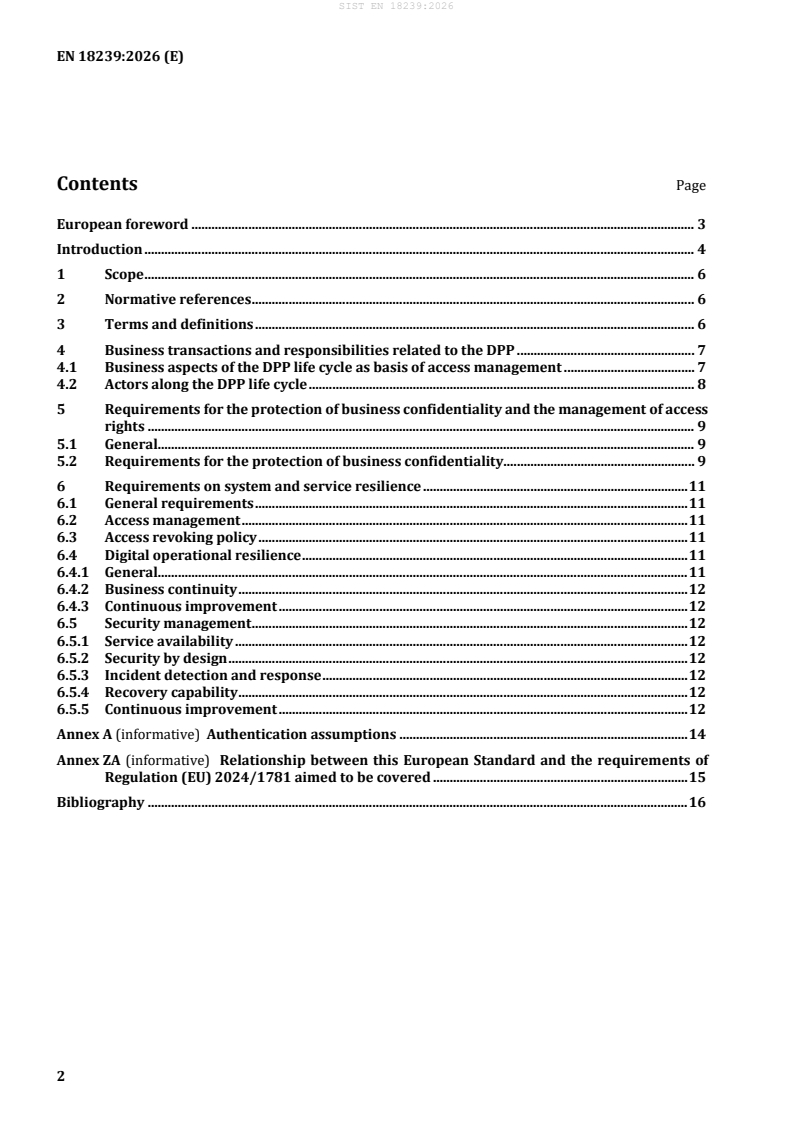
Contents Page
European foreword . 3
Introduction . 4
1 Scope . 6
2 Normative references . 6
3 Terms and definitions . 6
4 Business transactions and responsibilities related to the DPP . 7
4.1 Business aspects of the DPP life cycle as basis of access management . 7
4.2 Actors along the DPP life cycle . 8
5 Requirements for the protection of business confidentiality and the management of access
rights . 9
5.1 General. 9
5.2 Requirements for the protection of business confidentiality . 9
6 Requirements on system and service resilience . 11
6.1 General requirements . 11
6.2 Access management . 11
6.3 Access revoking policy . 11
6.4 Digital operational resilience . 11
6.4.1 General. 11
6.4.2 Business continuity . 12
6.4.3 Continuous improvement . 12
6.5 Security management . 12
6.5.1 Service availability . 12
6.5.2 Security by design . 12
6.5.3 Incident detection and response . 12
6.5.4 Recovery capability . 12
6.5.5 Continuous improvement . 12
Annex A (informative) Authentication assumptions . 14
Annex ZA (informative) Relationship between this European Standard and the requirements of
Regulation (EU) 2024/1781 aimed to be covered . 15
Bibliography . 16
European foreword
This document (EN 18239:2026) has been prepared by the Joint Technical Committee CEN-CENELEC/
JTC 24 “Digital Product Passport - Framework and System”, the secretariat of which is held by DIN.
This European Standard shall be given the status of a national standard, either by publication of an
identical text or by endorsement, at the latest by March 2027, and conflicting national standards shall be
withdrawn at the latest by March 2027.
Attention is drawn to the possibility that some of the elements of this document may be the subject of
patent rights. CEN-CENELEC shall not be held responsible for identifying any or all such patent rights.
This document has been prepared under a standardization request addressed to CEN-CENELEC by the
European Commission. The Standing Committee of the EFTA States subsequently approves these
requests for its Member States.
For the relationship with EU Legislation, see informative Annex ZA, which is an integral part of this
document.
Any feedback and questions on this document should be directed to the users’ national standards
body/national committee. A complete listing of these bodies can be found on the CEN and CENELEC
websites.
According to the CEN-CENELEC Internal Regulations, the national standards organisations of the
following countries are bound to implement this European Standard: Austria, Belgium, Bulgaria, Croatia,
Cyprus, Czech Republic, Denmark, Estonia, Finland, France, Germany, Greece, Hungary, Iceland, Ireland,
Italy, Latvia, Lithuania, Luxembourg, Malta, Netherlands, Norway, Poland, Portugal, Republic of North
Macedonia, Romania, Serbia, Slovakia, Slovenia, Spain, Sweden, Switzerland, Türkiye and the United
Kingdom.
Introduction
0.1 Background
A digital product passport (DPP) is a key enabling mechanism to make product information traceable and
accessible across value chains – supporting economic operators, manufacturers, distributors, repairers,
recyclers and consumers to make informed decisions and to support a circular economy. The
implementation of DPPs will be carried out progressively. Sector-specific initiatives will determine the
precise DPP content and requirements for individual product groups.
To support the implementation of DPPs, 8 standards have been developed:
— EN 18219:2026 – Digital product passport – Unique identifiers
— EN 18220:2026 – Digital product passport – Data carriers
— EN 18216:2026 – Digital product passport – Data exchange protocols
— EN 18222:2026 – Digital product passport – Application Programming Interfaces (APIs) for the
product passport lifecycle management and searchability
— EN 18223:2026 – Digital product passport – System interoperability
— EN 18221:2026 – Digital product passport – Data storage, archiving, and data persistence
— EN 18239:2026 – Digital product passport – Access rights management, information system security,
and business confidentiality (this document)
— EN 18246:2026 – Digital product passport – Data authentication, reliability and integrity
0.2 Overview
This document aims at harmonizing the identity management that ensures that organisations,
individuals, machines and services are provided with acknowledged identities. This document defines
clear requirements related to access control measures to regulate the access to controlled DPP data.
This document defines rules and requirements related to:
— access right management;
— access control;
— clarification of DPP system roles and responsibilities to provide the means to define mechanisms on
how to exchange access right information between economic operators, back-up system operators
and registry of the regulated market controlling entity;
— measures to regulate the access to controlled DPP data;
— possibility for product group specific definition of access rights by relevant legal acts;
— information system security;
— business confidentiality and their representation in access rights management;
— differentiation of access rights of different user groups and authorities;
— guarantee of IT-security, cybersecurity, and data protection; and
— clarification of DPP system roles and responsibilities to provide the means to define mechanisms on
how to transfer responsibilities, access-rights, and data from one economic operator to another.
EXAMPLE When a DPP will need to be updated to include information related to repair activities performed
by a professional repairer.
1 Scope
This document specifies the requirements for digital product passport (DPP) access rights management,
including IT security, data protection, and responsibility transfer between economic operators. It defines
the framework for managing confidential information access, while acknowledging that public DPP data
requires no access restrictions to be read.
2 Normative references
The following documents are referred to in the text in such a way that some or all of their content
constitutes requirements of this document. For dated references, only the edition cited applies. For
undated references, the latest edition of the referenced document (including any amendments) applies.
EN 18219:2026, Digital product passport — Unique identifiers
3 Terms and definitions
For the purposes of this document, the following terms and definitions apply:
ISO and IEC maintain terminology databases for use in standardization at the following addresses:
— ISO Online browsing platform: available at https://www.iso.org/obp
— IEC Electropedia: available at https://www.electropedia.org/
3.1
controlled DPP data
information on DPP whose access is controlled based on the user’s access rights
Note 1 to entry: User: person who interacts with a system, product or service
[SOURCE: ISO 26800:2011, 2.10, modified – Notes changed]
3.2
system resilience
ability to recover from security compromises or attacks
[SOURCE: ISO/IEC 29180:2012]
3.3
system availability
property of being accessible and usable on demand by an authorized actor
[SOURCE: EN ISO/IEC 27000:2020]
3.4
cyber resilience
ability to maintain business continuity despite adverse conditions, attacks, or compromises on critical
data flow and related information systems
3.5
actor
organization or individual that fulfils a role
[SOURCE: ISO 23234:2021, 3.4]
3.6
notified actor
organization or individual entitled by an authorized accrediting body or authority, that fulfils a role in the
DPP life cycle
3.7
digital product passport
DPP
digital record of product characteristics throughout its life cycle
Note 1 to entry: Example characteristics include environment sustainability, environmental impact and
recyclability.
3.8
non-repudiation
ability to protect against denial by one of the entities involved in an action of having participated in all or
part of the action
[SOURCE: ISO/IEC 29115:2013, 3.19]
3.9
information/communication technology
ICT
technology for gathering, storing, retrieving, processing, analysing and transmitting information
[SOURCE: ISO 9241-20:2021, definition 3.4]
3.10
identity proofing
process by which the registration authority captures and verifies sufficient information to identify an
entity to a specified or understood level of assurance
[SOURCE: ISO/IEC 29115:2013, 3.15]
4 Business transactions and responsibilities related to the DPP
4.1 Business aspects of the DPP life cycle as basis of access management
Access rights management is defined for the different life cycle phases and stages of a DPP. Such phases
and stages are based on EN ISO 11354-1:2011.
In general, not all the phases and the stages mentioned in this document might be applicable to every
product sector. Therefore, only the phases and stages relevant for a specific product group shall be
considered. Moreover, in case a product group specific stage is not represented in the following list, it
shall be considered during the access rights management implementation.
4.2 Actors along the DPP life cycle
This section identifies the main actors who are responsible for the handling of a DPP relevant product
across the value chain and therefore need to access a DPP along its business stages. The identified actors
are the following:
1. Economic operators (in short EOs): role encompassing the manufacturer, the authorized
representative, the importer, the distributor, the dealer and the fulfilment service provider.
a. Manufacturers: any natural or legal person that manufactures a product or that has a product
designed or manufactured and markets that product under their name or trademark.
b. Authorized representatives: any natural or legal person established in the regulated market
that has received a legally binding (e.g. written) mandate from the manufacturer to act on the
manufacturer’s behalf in relation to specified tasks with regard to the manufacturer’s
obligations.
c. Importers: any natural or legal person that places a product coming from outside the regulated
market on the regulated market.
d. Distributors: any natural or legal person in the supply chain, other than the manufacturer or
the importer, that makes a product available on the market.
e. Dealers: a distributor or any other natural or legal person that offers products for sale, hire or
hire purchase, or that displays products to end users in the course of a commercial activity,
including through distance selling; and includes any natural or legal person that puts a product
into service in the course of a commercial activity.
f. Fulfilment service providers: any natural or legal person offering, in the course of commercial
activity, services such as: warehousing, packaging, addressing and dispatching, without having
ownership of the products involved.
2. Other value chain actors
a. Consumers: individual member of the general public purchasing or using goods, property or
services for private purposes [EN ISO 14025:2010, 3.16].
b. Professional repairers: a natural or legal person that provides professional repair or
maintenance services for a product, irrespective of whether that person acts within the
manufacturer’s distribution system or independently.
c. Independent operators: natural or legal person that is independent of the manufacturer and is
directly or indirectly involved in the refurbishment, repair, maintenance or repurposing of a
product, and includes waste management operators, refurbishers, repairers, manufacturers or
distributors of repair equipment, tools or spare parts, as
...