

EN 10346:2026
(Main)Continuously hot-dip coated steel flat products for cold forming - Technical delivery conditions
- Abstract
This document specifies requirements for continuously hot-dip coated products made of low carbon steels for cold forming, of steels for construction and steels with high proof strength for cold forming coated with zinc (Z), zinc-iron alloy (ZF), zinc-aluminium alloy (ZA), aluminium-zinc alloy (AZ), zinc-magnesium alloy (ZM), aluminium-silicon alloy (AS) or aluminium (A) and for continuously hot-dip coated products made of multiphase steels for cold forming coated with zinc (Z), zinc-iron alloy (ZF), zinc-aluminium alloy (ZA) or zinc-magnesium alloy (ZM) in thicknesses of 0,20 mm ≤ t ≤ 6,5 mm.
By agreement at the time of enquiry and order, this document is applicable to continuously hot-dip coated flat products of an expanded validity range defined for thicknesses t < 0,20 mm with agreed mechanical properties and test specimens, adhesion of coating and surface condition requirements. This document is applicable to strip of all widths and to sheets cut from it (≥600 mm width) and cut lengths (<600 mm width).
NOTE The products covered by this document are used where cold formability, high strength, a defined minimum yield strength and/or corrosion resistance are the most important factors. Corrosion resistance of the product is depending on coating type and coating thickness, hence to its mass (see also 7.3.2). The products covered by this document can be used as substrates for organic coated flat products specified in EN 10169 for building and general engineering applications.
- Status
- Published
- Publication Date
- 13-Oct-2026
- Current Stage
- 6060 - Definitive text made available (DAV) - Publishing
- Start Date
- 14-Oct-2026
- Due Date
- 30-Sep-2026
- Completion Date
- 30-Sep-2026
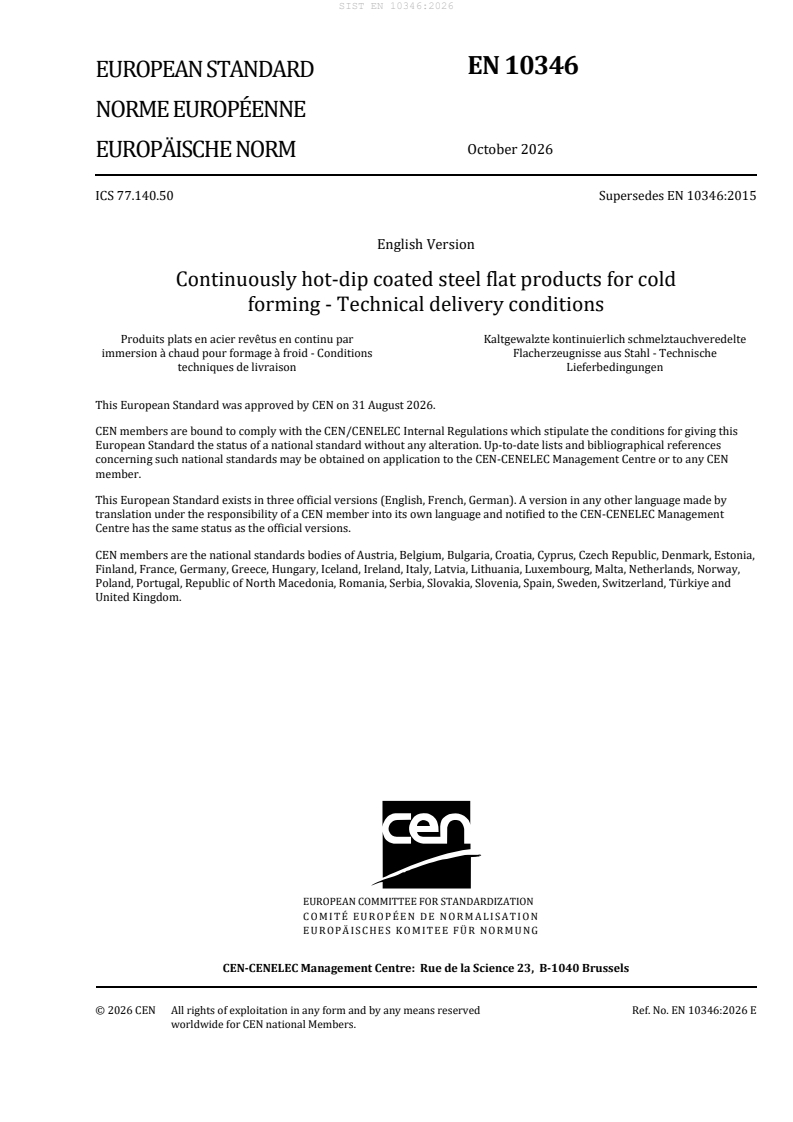

EN 10346:2026 is a CEN standard for continuously hot-dip coated steel flat products for cold forming. It specifies technical delivery conditions for low carbon steels, steels for construction, steels with high proof strength for cold forming, and multiphase steels, with coatings such as zinc (Z), zinc-iron alloy (ZF), zinc-aluminium alloy (ZA), zinc-magnesium alloy (ZM), aluminium-silicon alloy (AS) and aluminium (A). It is intended for strip, sheets cut from strip, and cut lengths, where formability, strength and corrosion resistance matter in practice.
What does EN 10346:2026 specify?
EN 10346:2026 covers continuously hot-dip coated flat products in the thickness range 0,20 mm ≤ t ≤ 6,5 mm, with an expanded thickness range below 0,20 mm available by agreement. The document is organized as a delivery standard: it defines product families, ordering information, manufacturing and processing notes, material requirements, inspection, marking, packing, storage and transportation.
The document applies to strip of all widths, sheets cut from it with width at least 600 mm, and cut lengths below 600 mm. It also notes that these products can be used as substrates for organic coated flat products specified in EN 10169 for building and general engineering applications.
| Annex | What it covers |
|---|---|
| Annex A | Reference method for coating mass of Z, ZF, ZA and ZM |
| Annex B | Reference method for coating mass of AS and A |
| Annex C | Reference method for mass of the Al-Fe-Si alloy layer on AS coatings |
| Annex D | Tensile test results and coating impact |
| Annex E | Steel designations for multiphase steels for cold forming |
What are the key requirements of EN 10346:2026?
EN 10346:2026 sets the ordering, material, surface and inspection conditions that make these coated steels usable in production and fabrication. The most important point for users is that the steel family, coating type, coating mass, surface state and inspection route all have to be aligned at the time of enquiry and order.
Classification and ordering
Clause 4 classifies the steels by intended use and strength level, including low carbon steels for cold forming, steels for construction, steels with high proof strength for cold forming, and multiphase steels for cold forming. Steel names and steel numbers must follow EN 10027-1 and EN 10027-2, so buyers can order the exact grade without ambiguity.
Clause 5 lists the mandatory order information. This includes product form, dimensions, the dimensional standard, the standard number EN 10346, the steel name or number, coating type, nominal coating mass, coating finish, surface quality, surface treatment and, where relevant, the specimen choice for mechanical testing. In practice, this is the data that prevents wrong grades, wrong coatings or wrong finish from being supplied.
Chemical composition and mechanical properties
Clause 7.1 ties chemical composition to cast-analysis limits in Tables 1 to 5, with product-analysis deviations only when agreed. That matters because chemistry drives formability, strength and coating compatibility, and any extra elements need to be reported on the inspection document.
Clause 7.2 sets mechanical-property requirements by steel family and by test direction. It also states how long the stated properties apply after the products are made available, with different periods for low carbon steels, construction steels, bake-hardening steels, high strength steels and multiphase steels. For buyers, this means stock age and processing time matter, especially for grades sensitive to ageing or stretcher strains.
Coatings, coating mass and surface condition
Clause 7.3 limits the coating types to the specified metallic coatings for each steel family and defines the coating-mass designation. Table 12 gives the coating-mass classes, and different masses on each surface can be agreed. This affects corrosion resistance, but also formability and weldability, so coating selection is not just a corrosion decision.
Clause 7.4 and 7.5 define the finish and surface-quality system. The surface qualities A, B and C correspond to as-coated, improved and best quality surfaces, with skin passing used for B and C. In practice, this tells the purchaser what level of appearance, paintability and defect tolerance to expect.
Clause 7.6 lists surface treatments: chemically passivated, oiled, both, phosphated, phosphated and oiled, or sealed. The treatments are aimed at temporary corrosion protection and downstream processing, so the purchaser needs to decide whether transport protection or forming performance is the priority.
Inspection and acceptance
Clause 8 sets the inspection route. Unless otherwise agreed, delivery is with non-specific inspection and no inspection document. If specific testing is required, the type of inspection document must be agreed, and EN 10204 governs the document type. The test unit is limited to a maximum of 30 t or a fraction of 30 t of the same grade, thickness, coating mass and surface condition.
Clause 8 also defines the main tests: tensile testing, r- and n-value determination where specified, bake-hardening index where specified, and coating-mass determination. This is the basis for acceptance, claims and traceability.
What terms does EN 10346:2026 define?
- Nominal (specified) thickness - the ordered thickness of the metallic coated product, including both the steel core and the coating.
- Steel core thickness - the nominal thickness minus the metallic coating layers, used as the design thickness for calculations in EN 1993-1-3.
- Coating mass - the total coating mass on both surfaces, expressed in grams per square metre, and used in the coating designation.
- Bake-hardening steel (B) - steel that increases in proof strength after heating around 170 °C for 20 min, which helps formed parts resist denting.
- Dual-phase steel with improved formability (XH) - steel mainly made of ferrite and martensite with small amounts of bainite and retained austenite, giving higher uniform elongation.
- Complex-phase steel with improved formability (CH) - steel mainly made of martensite, bainite and retained austenite, with a high yield ratio at a given tensile strength.
- Transformation induced plasticity steel (T) - steel with retained austenite that transforms during forming, increasing work hardening and elongation.
- Surface quality A, B or C - the surface quality classes used to match appearance, defect tolerance and paintability to the intended use.
Who uses EN 10346:2026?
EN 10346:2026 is used by steel producers, coil coaters, stockholders, purchasers and quality staff who order, test or certify coated flat products. It is also relevant to fabricators and processors doing cold forming, welding, bonding or organic coating, because the standard links surface state and coating type to downstream processing.
Designers and suppliers working with cold-formed structural steel elements and roof, ceiling, floor and wall applications use it together with EN 1090-4 and the Eurocode references named in the document. The note in the scope also points to building and general engineering applications where corrosion resistance and formability are both important.
What changed in EN 10346:2026 from the previous edition?
The document states that it will supersede EN 10346:2015. The foreword lists these technical changes: the scope and normative references were updated; definitions were added in Clause 3; hot-dip aluminium coating was added and hot-dip aluminium-zinc alloy coating was deleted; new steel families XH, CH and AH were added; options for S550GDR and S650GDR were added; new construction and micro-alloyed grades were added, including requirements for minimum proportional elongation for some thicker products; new cold-rolled and hot-rolled multiphase steels were added; and new informative Annexes D and E were introduced.
Which standards are used with EN 10346:2026?
EN 10346:2026 relies on several companion standards for steel definition, designation, testing and delivery. EN 10020, EN 10021 and EN 10079 provide the general steel definitions and delivery-condition framework. EN 10027-1 and EN 10027-2 define steel names and numerical designations.
EN 10049 is used for roughness measurement, EN 10143 for tolerances on dimensions and shape, and EN 10204 for inspection documents. EN 10325, EN ISO 6892-1, EN ISO 10113 and EN ISO 10275 support the mechanical tests for bake-hardening, tensile properties, plastic strain ratio and strain-hardening exponent. The document also names EN 10373 for model-based property determination, EN 1090-4 and EN 1993-1-1/1-3 for structural use, EN 10169 for organic coated products, and EN ISO 14713-1 for corrosion-protection guidance.
What does the EN 10346:2026 document contain?
EN 10346:2026 contains chemistry tables for the steel families, mechanical-property tables by family and coating type, and coating-mass tables with designation rules. It also gives the available coating finishes, surface-quality classes and surface-treatments, so the purchaser can specify how the product should look and behave in service.
The inspection clauses define sampling, tensile testing, r- and n-value determination, bake-hardening index testing, surface inspection and coating-mass testing. Annexes A to C provide the chemical strip-off methods for coating mass and the Al-Fe-Si alloy layer, while Annex D explains how tensile results can differ depending on whether the coating is included in the calculation. Annex E links the multiphase steel names in this standard with the designations used in VDA 239-100.
Relations
- Effective Date
- 28-Apr-2021
- Effective Date
- 18-Nov-2026
- Effective Date
- 18-Nov-2026
- Effective Date
- 18-Nov-2026
- Effective Date
- 18-Nov-2026
- Refers
EN 10049:2013 - Measurement of roughness average Ra and peak count RPc on metallic flat products - Effective Date
- 18-Nov-2026
- Refers
EN 10373:2021 - Determination of the physical and mechanical properties of steels using models - Effective Date
- 18-Nov-2026
- Effective Date
- 18-Nov-2026
- Effective Date
- 18-Nov-2026
- Effective Date
- 18-Nov-2026
- Effective Date
- 18-Nov-2026
- Effective Date
- 18-Nov-2026
- Effective Date
- 18-Nov-2026
- Effective Date
- 18-Nov-2026
- Effective Date
- 21-Oct-2026
Get Certified
Connect with accredited certification bodies for this standard

Element Materials Technology
Materials testing and product certification.

Inštitut za kovinske materiale in tehnologije
Institute of Metals and Technology. Materials testing, metallurgical analysis, NDT.
Sponsored listings
Frequently Asked Questions
EN 10346:2026 is a standard published by the European Committee for Standardization (CEN). Its full title is "Continuously hot-dip coated steel flat products for cold forming - Technical delivery conditions". This standard covers: This document specifies requirements for continuously hot-dip coated products made of low carbon steels for cold forming, of steels for construction and steels with high proof strength for cold forming coated with zinc (Z), zinc-iron alloy (ZF), zinc-aluminium alloy (ZA), aluminium-zinc alloy (AZ), zinc-magnesium alloy (ZM), aluminium-silicon alloy (AS) or aluminium (A) and for continuously hot-dip coated products made of multiphase steels for cold forming coated with zinc (Z), zinc-iron alloy (ZF), zinc-aluminium alloy (ZA) or zinc-magnesium alloy (ZM) in thicknesses of 0,20 mm ≤ t ≤ 6,5 mm. By agreement at the time of enquiry and order, this document is applicable to continuously hot-dip coated flat products of an expanded validity range defined for thicknesses t < 0,20 mm with agreed mechanical properties and test specimens, adhesion of coating and surface condition requirements. This document is applicable to strip of all widths and to sheets cut from it (≥600 mm width) and cut lengths (<600 mm width). NOTE The products covered by this document are used where cold formability, high strength, a defined minimum yield strength and/or corrosion resistance are the most important factors. Corrosion resistance of the product is depending on coating type and coating thickness, hence to its mass (see also 7.3.2). The products covered by this document can be used as substrates for organic coated flat products specified in EN 10169 for building and general engineering applications.
This document specifies requirements for continuously hot-dip coated products made of low carbon steels for cold forming, of steels for construction and steels with high proof strength for cold forming coated with zinc (Z), zinc-iron alloy (ZF), zinc-aluminium alloy (ZA), aluminium-zinc alloy (AZ), zinc-magnesium alloy (ZM), aluminium-silicon alloy (AS) or aluminium (A) and for continuously hot-dip coated products made of multiphase steels for cold forming coated with zinc (Z), zinc-iron alloy (ZF), zinc-aluminium alloy (ZA) or zinc-magnesium alloy (ZM) in thicknesses of 0,20 mm ≤ t ≤ 6,5 mm. By agreement at the time of enquiry and order, this document is applicable to continuously hot-dip coated flat products of an expanded validity range defined for thicknesses t < 0,20 mm with agreed mechanical properties and test specimens, adhesion of coating and surface condition requirements. This document is applicable to strip of all widths and to sheets cut from it (≥600 mm width) and cut lengths (<600 mm width). NOTE The products covered by this document are used where cold formability, high strength, a defined minimum yield strength and/or corrosion resistance are the most important factors. Corrosion resistance of the product is depending on coating type and coating thickness, hence to its mass (see also 7.3.2). The products covered by this document can be used as substrates for organic coated flat products specified in EN 10169 for building and general engineering applications.
EN 10346:2026 is classified under the following ICS (International Classification for Standards) categories: 77.140.50 - Flat steel products and semi-products. The ICS classification helps identify the subject area and facilitates finding related standards.
EN 10346:2026 has the following relationships with other standards: It is inter standard links to EN 10346:2015, EN 10079:2007, EN 10021:2006, EN ISO 6892-1:2019, EN ISO 10275:2020, EN 10049:2013, EN 10373:2021, EN 10143:2006, EN 10027-2:2015, EN 10204:2004, EN 10325:2006, EN 10020:2000, EN ISO 10113:2020, EN 10027-1:2016, EN 13071-2:2008. Understanding these relationships helps ensure you are using the most current and applicable version of the standard.
EN 10346:2026 is available in PDF format for immediate download after purchase. The document can be added to your cart and obtained through the secure checkout process. Digital delivery ensures instant access to the complete standard document.
Standards Content (Sample)
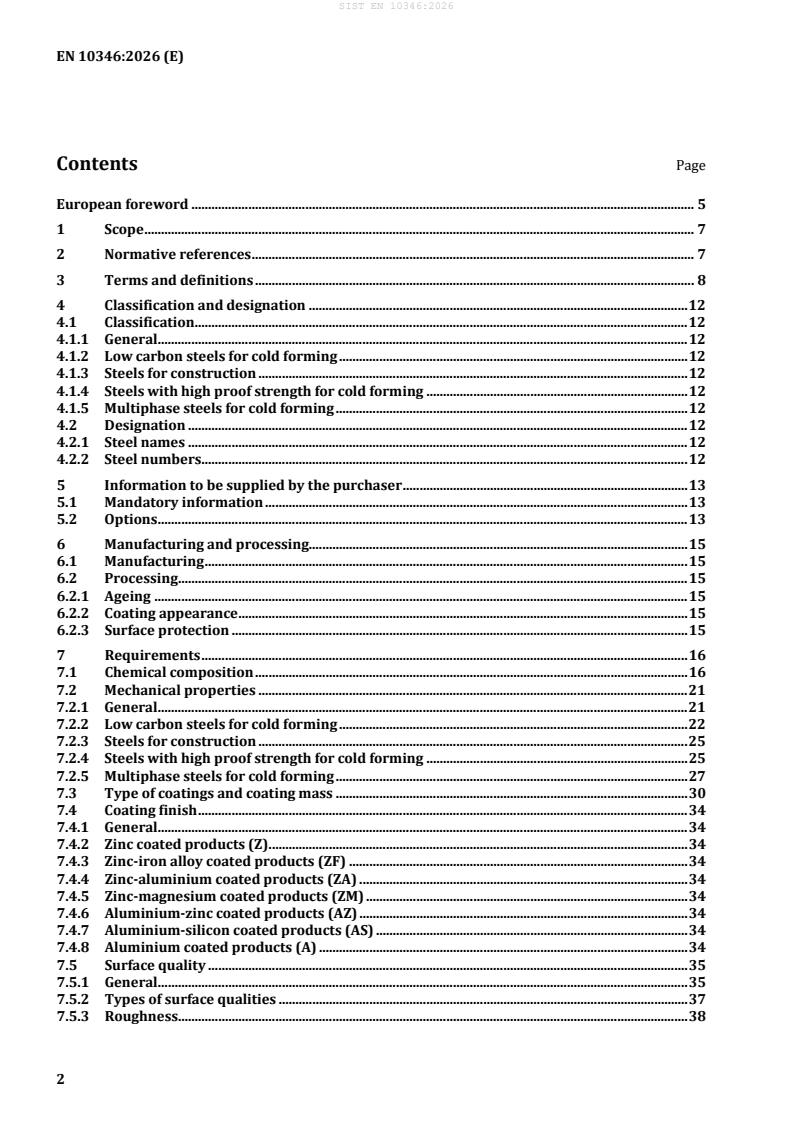
Contents
- 1 Scope
- 2 Normative references
- 3 Terms and definitions
- 3.1 nominal thickness
- 3.2 steel core thickness
- 3.3 hot-dip zinc coating
- 3.4 hot-dip zinc-iron alloy coating
- 3.5 hot-dip zinc-aluminium coating
- 3.6 hot dip zinc-magnesium coating
- 3.7 hot-dip aluminium-zinc alloy coating
- 3.8 hot-dip aluminium-silicon alloy coating
- 3.9 hot-dip aluminium coating
- 3.10 coating mass
- 3.11 bake-hardening steel
- 3.12 complex-phase steel
- 3.13 complex-phase steel with improved formability
- 3.14 dual-phase steel
- 3.15 dual-phase steel with improved formability
- 3.16 ferritic-bainitic steel
- 3.17 high strength interstitial free steel
- 3.18 low alloy steel, micro-alloyed steel
- 3.19 low carbon steel
- 3.20 multi-phase steels with high global formability
- 3.21 steel for construction
- 3.22 transformation induced plasticity steel
- 4 Classification and designation
- 4.1 Classification
- 4.2 Designation
- 5 Information to be supplied by the purchaser
- 5.1 Mandatory information
- 5.2 Options
- 6 Manufacturing and processing
- 6.1 Manufacturing
- 6.2 Processing
- 7 Requirements
- 7.1 Chemical composition
- 7.2 Mechanical properties
- Annex D describes the different measurement methods for execution of the tensile test and
- 7.3 Type of coatings and coating mass
- 7.4 Coating finish
- 7.5 Surface quality
- 7.6 Surface treatment (surface protection)
- 7.7 Coil breaks and bends (kinks)
- 7.8 Stretcher strains
- 7.9 Coating mass
- 7.10 Adhesion of coating
- 7.11 Surface condition
- 7.12 Tolerances on dimensions and shape
- 7.13 Suitability for further processing
- 8 Inspection
- 8.1 Types of inspection and inspection documents
- 8.2 Test units
- 8.3 Tests to be carried out
- 8.4 Sampling
- 8.5 Test methods
- 8.6 Retests
- 9 Marking
- 10 Packing
- 11 Storage and transportation
- Annex A
- Annex B
- Annex C
- Annex D
- Annex E
- Bibliography
1 Scope
This document specifies requirements for continuously hot-dip coated products made of low carbon steels for cold forming, of steels for construction and steels with high proof strength for cold forming coated with zinc (Z), zinc-iron alloy (ZF), zinc-aluminium alloy (ZA), aluminium-zinc alloy (AZ), zincmagnesium alloy (ZM), aluminium-silicon alloy (AS) or aluminium (A) and for continuously hot-dip coated products made of multiphase steels for cold forming coated with zinc (Z), zinc-iron alloy (ZF), zincaluminium alloy (ZA) or zinc-magnesium alloy (ZM) in thicknesses of 0,20 mm ≤ t ≤ 6,5 mm. By agreement at the time of enquiry and order, this document is applicable to continuously hot-dip coated flat products of an expanded validity range defined for thicknesses t < 0,20 mm with agreed mechanical properties and test specimens, adhesion of coating and surface condition requirements. This document is applicable to strip of all widths and to sheets cut from it (≥600 mm width) and cut lengths (<600 mm width).
NOTE The products covered by this document are used where cold formability, high strength, a defined minimum yield strength and/or corrosion resistance are the most important factors. Corrosion resistance of the product is depending on coating type and coating thickness, hence to its mass (see also 7.3.2). The products covered by this document can be used as substrates for organic coated flat products specified in EN 10169 for building and general engineering applications.
2 Normative references
The following documents are referred to in the text in such a way that some or all of their content constitutes requirements of this document. For dated references, only the edition cited applies. For undated references, the latest edition of the referenced document (including any amendments) applies. EN 10020, Definition and classification of grades of steel EN 10021, General technical delivery conditions for steel products EN 10027-1, Designation systems for steels — Part 1: Steel names EN 10027-2, Designation systems for steels — Part 2: Numerical system EN 10049, Measurement of roughness average Ra and peak count RPc on metallic flat products EN 10079, Definition of steel products EN 10143, Continuously hot-dip coated steel sheet and strip — Tolerances on dimensions and shape EN 10204, Metallic products — Types of inspection documents EN 10325, Steel — Determination of yield strength increase by the effect of heat treatment [Bake- Hardening-Index] EN 10373, Determination of the physical and mechanical properties of steels using models EN ISO 6892-1, Metallic materials — Tensile testing — Part 1: Method of test at room temperature (ISO 6892-1) EN ISO 10113, Metallic materials — Sheet and strip — Determination of plastic strain ratio (ISO 10113) EN ISO 10275, Metallic materials — Sheet and strip — Determination of tensile strain hardening exponent (ISO 10275)
SIST EN 10346:2026 EN 10346:2026 (E)
3 Terms and definitions
For the purposes of this document, the terms and definitions given in EN 10020, EN 10021, EN 10079, EN 10204 and the following apply.
ISO and IEC maintain terminology databases for use in standardization at the following addresses:
- ISO Online browsing platform: available at https://www.iso.org/obp/ - IEC Electropedia: available at https://www.electropedia.org/ NOTE General definitions and guidelines for the protection of iron and steel can be found in EN ISO 14713-1.
3.1 nominal thickness
t nom ordered thickness of the metallic coated product Note 1 to entry: Nominal thickness includes both steel core and coating.
3.2 steel core thickness
t cor nominal thickness minus the metallic coating layers Note 1 to entry: The steel core thickness is in accordance with the definition in EN 1993-1-3. It is the design thickness for calculations in accordance with EN 1993-1-3.
3.3 hot-dip zinc coating
Z application of a zinc coating by immersing the prepared strip in a molten bath of zinc Note 1 to entry: The zinc content is at least 98,5 mass %.
Note 2 to entry: See also 7.4.2.
3.4 hot-dip zinc-iron alloy coating
ZF application of a zinc-iron coating by immersing the prepared strip in a molten bath of zinc and a subsequent annealing Note 1 to entry: The zinc content of the bath is at least 99 mass %. Note 2 to entry: The annealing produces an iron-zinc coating with an iron content of normally 8 mass % to 12 mass %.
Note 3 to entry: See also 7.4.3.
SIST EN 10346:2026 EN 10346:2026 (E)
3.5 hot-dip zinc-aluminium coating
ZA application of a zinc-aluminium coating by immersing the prepared strip in a molten bath of zincaluminium Note 1 to entry: The composition of the bath is approximately 5 mass % aluminium, small amounts of mischmetal and the balance zinc.
Note 2 to entry: See also 7.4.4.
3.6 hot dip zinc-magnesium coating
ZM application of a zinc-magnesium coating by immersing the prepared strip in a molten bath of zincaluminium-magnesium Note 1 to entry: The composition of the bath is sum of aluminium and magnesium from 1,5 mass % to 8 mass %, containing minimum of 0,2 mass % magnesium and the balance zinc. Note 2 to entry: For information on chemical composition and density, the manufacturer can be asked for advice. Note 3 to entry: Due to differences in coating bath chemistry, the properties provided by each coating can differ (e.g. surface aspect, processability, corrosion resistance) and the manufacturer can be asked for advice. Note 4 to entry: See also 7.4.5.
3.7 hot-dip aluminium-zinc alloy coating
AZ application of an aluminium-zinc coating by immersing the prepared strip in a molten bath of aluminiumzinc-silicon Note 1 to entry: The composition of the bath is 55 mass % of aluminium, 1,6 mass % of silicon and the balance zinc. Note 2 to entry: See also 7.4.6.
3.8 hot-dip aluminium-silicon alloy coating
AS application of an aluminium-silicon coating by immersing the prepared strip in a molten bath of aluminium-silicon Note 1 to entry: The composition of the bath is 8 mass % to 11 mass % silicon, up to 5 mass % iron, up to 1 mass % additional elements and the balance aluminium.
Note 2 to entry: See also 7.4.7.
3.9 hot-dip aluminium coating
A application of an aluminium coating by immersing the prepared strip in a molten bath of pure aluminium Note 1 to entry: The iron content in the bath is less than 5 mass %. Note 2 to entry: See also 7.4.8.
SIST EN 10346:2026 EN 10346:2026 (E)
3.10 coating mass
total mass of coating given for both surfaces Note 1 to entry: In combination with the symbol for the coating type (Z, ZF, ZA, ZM, AZ, AS, A), the nominal coating mass is used as coating designation.
Note 2 to entry: The coating mass is expressed in grams per square metre. Note 3 to entry: See also 7.9.
3.11 bake-hardening steel
B steel exhibiting an increase in proof strength following heating of 170°C ± 2°C for 20 min Note 1 to entry: These steels have a good suitability for cold forming and present a high resistance to plastic straining (which is increased on finished parts during heat treatment) and a good dent resistance.
3.12 complex-phase steel
C steel with a multiphase microstructure containing mainly bainite, ferrite, whereas martensite, tempered martensite, retained austenite and pearlite can be present as additional phases Note 1 to entry: The fine grained microstructure can be generated by retarded recrystallization or precipitation of micro-alloying elements.
3.13 complex-phase steel with improved formability
CH steel consisting mainly of martensite, bainite and retained austenite Note 1 to entry: Depending on strength class, small amounts of ferrite can also be present. Note 2 to entry: At a given high tensile strength, complex phase steels with improved formability show higher elongation.
3.14 dual-phase steel
X steel consisting of mainly ferrite and martensite and possible bainite as a complementary phase Note 1 to entry: According to their high tensile strength levels, dual phase steels show a low yield strength ratio and a high work hardening rate.
3.15 dual-phase steel with improved formability
XH steel consisting mainly of ferrite and martensite and small amounts of bainite and retained austenite Note 1 to entry: According to their high tensile strength levels, dual phase steels with improved formability show higher elongation.
SIST EN 10346:2026 EN 10346:2026 (E)
3.16 ferritic-bainitic steel
F steel with a matrix of ferrite or strengthened ferrite containing bainite or strengthened bainite Note 1 to entry: The strengthening of the matrix is caused by a high density of dislocations, by grain refinement and precipitation of micro-alloying elements.
3.17 high strength interstitial free steel
Y steel whose composition is controlled to achieve improved plastic strain ratio r and strain hardening exponent n values Note 1 to entry: These steels have both a high mechanical strength and an excellent suitability for cold forming, due to their solid solution hardening and interstitial free microstructure.
3.18 low alloy steel, micro-alloyed steel
LA steel containing one or more of alloying elements Nb, Ti and V to achieve required proof strength levels Note 1 to entry: Combined precipitation and grain refinement hardening allow reaching a high mechanical resistance while reducing the content of alloying elements.
Note 2 to entry: Alternatively, carbon-manganese alloying concepts in combination with grain refinement can be used.
3.19 low carbon steel
steel with low carbon content characterized by low yield strength and high ductility
3.20 multi-phase steels with high global formability
AH steel containing a combination of tempered martensite, bainite and retained austenite Note 1 to entry: Ferrite and martensite can be present.
3.21 steel for construction
S steel with minimum strength levels and no special demand for suitability for cold forming
3.22 transformation induced plasticity steel
T steel with a ferritic matrix containing retained austenite capable of transformation into martensite during the forming process (TRIP effect) Note 1 to entry: Because of high work-hardening rate the steel reaches high uniform elongation values and high tensile strength levels.
SIST EN 10346:2026 EN 10346:2026 (E)
4 Classification and designation
4.1 Classification
4.1.1 General
The steels covered by this document are either alloy quality steels or non-alloy quality steels in accordance with EN 10020. All steels in Tables 1, 3, 4, 5 and steel grade S650GDR in Table 2 are alloy quality steels. All steels in Table 2 with the exception of S650GDR are non-alloy quality steels.
4.1.2 Low carbon steels for cold forming
The steel grades are classified in accordance with their increasing suitability for cold forming as follows (see Table 7):
- DX51D: bending and profiling quality;
- DX52D: drawing quality;
- DX53D: deep drawing quality;
- DX54D: special deep drawing quality;
- DX55D: special deep drawing quality (only +AS);
- DX56D: extra deep drawing quality;
- DX57D: super deep drawing quality;
- DX58D: extra super deep drawing quality.
Only steel grades DX51D, DX52D and DX53D can be ordered as hot rolled products.
4.1.3 Steels for construction
The steel grades are classified in accordance with their increasing minimum proof strength R (see p0,2 Table 8).
4.1.4 Steels with high proof strength for cold forming
The steel grades are classified in accordance with their increasing minimum proof strength R (see p0,2 Table 9).
Only low alloy/micro-alloyed steel grades can be ordered as hot rolled products.
4.1.5 Multiphase steels for cold forming
The steel grades are classified in accordance with their increasing minimum tensile strength R (see m Tables 10 and 11). See Annex E for the steel names and steel numbers of advanced high strength steels (AHSS).
4.2 Designation
4.2.1 Steel names
The steel names shall be in accordance with EN 10027-1.
4.2.2 Steel numbers
The steel numbers shall be in accordance with EN 10027-2.
SIST EN 10346:2026 EN 10346:2026 (E)
5 Information to be supplied by the purchaser
5.1 Mandatory information
The following information shall be supplied by the purchaser at the time of enquiry and order:
a) quantity to be delivered; b) type of product (strip, sheet, cut length); c) number of the dimensional standard: EN 10143; d) nominal dimensions and the tolerances on dimensions and shape and, if applicable, letters denoting relevant special tolerances; e) term “steel”; f) number of this document, i.e. EN 10346; g) steel name or steel number and symbol for the type of hot-dip coating as given in Tables 1 to 5;
h) number designating the nominal mass of coating (e.g. 275 = 275 g/m including both surfaces, see Table 12); i) letter denoting the coating finish (N or M, see 7.4.2 and Table 13); j) letter denoting the surface quality (A, B or C, see 7.5 and Tables 13 to 15); k) letter denoting the surface treatment (C, O, CO, P, PO or S, see 7.6); l) if relevant (see 8.5.1), selection of the test piece (proportional (A ) or non-proportional (A ) prop 80 specimen) for determination of the mechanical properties.
EXAMPLE 1 sheet, delivered with dimensional tolerances in accordance with EN 10143 with nominal thickness of 0,80 mm, ordered with special thickness tolerances (S), nominal width 1 200 mm, ordered with special width tolerances (S), nominal length 2 500 mm, ordered with special flatness tolerances (FS), made of steel
DX53D+Z (1.0951+Z) in accordance with EN 10346, coating mass 100 g/m (100), minimized spangle (M), surface quality (B), surface treatment oiled (O):
1 sheet EN 10143 — 0,80Sx1200Sx2500FS — steel EN 10346 — DX53D+Z100–M–B–O or:
1 sheet EN 10143 — 0,80Sx1200Sx2500FS — steel EN 10346 — 1.0951+Z100 –M–B–O.
5.2 Options
A number of options are specified in this document and listed below. If the purchaser does not indicate a wish to implement any of these options, the products shall be supplied in accordance with the basis specification of this document (see 5.1).
1) specification of product thicknesses deviating from those generally covered in the scope (i.e. t < 0,20 mm) (see Clause 1); 2) verification of the product analysis (see 7.1);
SIST EN 10346:2026 EN 10346:2026 (E) 3) date of supply for products free from stretcher strains when cold forming (see 7.2.1.3); 4) products supplied suitable for the manufacture of a specific part (see 7.2.2.2 and 7.2.4.2); 5) supply of steel grade S550GDR with specified minimum ratio R /R ≥ 1,10 and A ≥ 12 % (for m e 80 products with t < 3,0 mm) or A ≥ 15 % (for products with t ≥ 3,0 mm) for dimensioning in prop accordance with EN 1993-1-1 (see 7.2.3 – Table 8), where R is either R or R in dependence of e p0,2 eH yield point phenomenon (footnote c, Table 8).
In case of organic coated steel, this option 5 is upon agreement of the manufacturer; 6) supply of steel grade S550GDR or S650GDR with specified minimum ratio R /R ≥ 1,05 for m e dimensioning in accordance with EN 1993-1-1 (see 7.2.3 – Table 8), where R is either R or R in e p0,2 eH dependence of yield point phenomenon (footnote c, Table 8).
In case of organic coated steel, this option 6 is upon agreement of the manufacturer; 7) coating masses different from those of Table 12 and/or special requirements for different coating masses on each surface (see 7.3.2); 8) special coatings and/or surface qualities (see Tables 13 and 15, footnote a); 9) hot-dip zinc coated products with pronounced spangle (see 7.4.2.1 or 7.4.6); 10) special requirements for a maximum Al-Fe-Si alloy layer mass occurring during hot-dip aluminiumsilicon coating (see 7.4.7); 11) hot-dip coated products with surface quality A without skin passing (see 7.5.2.1); 12) requirement for special applications on bright appearance for aluminium-silicon coated products (type B surface, see NOTE to 7.5.2.2); 13) range and verification of surface roughness (see 7.5.3); 14) selection of the protective oil (see 7.6.1); 15) type of S coating (see 7.6.6); 16) products free from coil breaks (see 7.7.1); 17) type of inspection and, if applicable, inspection document to be delivered (see 8.1); 18) notification of which surface has been inspected (see 8.5.4.2); 19) marking desired by branding of the products (see 9.2); 20) requirement for packing (see Clause 10); 21) according to EN 1090-4 i) determination of the ratio bend radius to thickness, if relevant; ii) display of the result of the adhesion test in the inspection document (see 7.10).
SIST EN 10346:2026 EN 10346:2026 (E)
6 Manufacturing and processing
6.1 Manufacturing
Unless there are restrictions by the selected steel grade, the processes used in steelmaking and the manufacture of the products shall be left to the discretion of the manufacturer.
6.2 Processing
6.2.1 Ageing
Due to ageing, a reduction in formability can take place for all the products supplied according to this document. Coil breaks or fluting can occur additionally during processing. The risk of coil breaks increases, especially for thicknesses > 0,9 mm, with the duration of storage. Therefore the user should process the products after their receipt as quick as possible (see 7.2.1.3).
6.2.2 Coating appearance
The coating surface can vary and change to a dark appearance by oxidation. Due to ageing of the coating a certain cracking of the surface can appear during processing which can consequently reduce abrasion resistance.
The user should take these characteristics into account.
6.2.3 Surface protection
Regarding surface protection during transport and storage the following shall be taken into consideration:
- Only a temporary corrosion resistance during transportation or storage is provided by any surface protection applied. Colour changes can occur.
- In particular, protection by oiling is dependent on storage time. The primarily uniform oil film becomes more and more unequal, and bare spots can develop. Different oils can show different behaviour.
SIST EN 10346:2026 EN 10346:2026 (E)
7 Requirements
7.1 Chemical composition
The chemical composition according to the cast analysis shall be as specified in Tables 1 to 5. If a product analysis is agreed at the time of enquiry and order, the permitted deviations from the cast analysis given in Tables 1 to 5 shall meet the requirements in Table 6. Table 1 — Chemical composition (cast analysis) of low carbon steels for cold forming Chemical composition Designation % by mass max.
Steel grade Symbols for the types of a C Si Mn P S Ti Steel Steel available coatings name number DX51D 1.0917 +Z,+ZF,+ZA,+ZM,+AZ,+AS 0,18 1,20 0,12 DX52D 1.0918 +Z,+ZF,+ZA,+ZM,+AZ,+AS DX53D 1.0951 +Z,+ZF,+ZA,+ZM,+AZ,+AS DX54D 1.0952 +Z,+ZF,+ZA,+ZM,+AZ,+AS DX55D 1.0962 +AS 0,12 0,50 0,60 0,10 0,045 0,30 DX56D 1.0963 +Z,+ZF,+ZA,+ZM,+AZ,+AS DX57D 1.0853 +Z,+ZF,+ZA,+ZM,+AS DX58D 1.9946 +Z a By agreement at the time of enquiry and order, the content of Ti for the steel grades mentioned in this Table may be lowered to < 0,05 % which means that the steel grade is non alloyed.
SIST EN 10346:2026 EN 10346:2026 (E) Table 2 — Chemical composition (cast analysis) of steels for construction Chemical composition % by mass Designation max.
...