

CEN/TS 115-4:2026
(Main)Safety of escalators and moving walks - Part 4: Interpretations related to EN 115 family of standards
- Abstract
This document is a collection of interpretations related to the EN 115 series. This document collects interpretations to EN 115-1:2008+A1:2010 and EN 115-1:2017. Interpretations to other standards of the EN 115 series will be added when they are available.
Interpretations aim to improve the understanding of the clause(s) they are referring to and by that facilitating common understanding between manufacturers, installers, notified bodies, inspection bodies and national authorities.
Interpretations do not have the same status as the European standards to which they are related. However, the application of interpretations given to the interested parties confidence that the relevant European standard has not been wrongly applied.
- Status
- Published
- Publication Date
- 09-Feb-2027
- Technical Committee
- CEN/TC 10 - Lifts, escalators and moving walks
- Drafting Committee
- CEN/TC 10/WG 2 - Escalators and moving walks
- Current Stage
- 6060 - Definitive text made available (DAV) - Publishing
- Start Date
- 29-Apr-2026
- Due Date
- 10-Feb-2027
- Completion Date
- 10-Feb-2027

CEN/TS 115-4:2026 is a CEN Technical Specification for the EN 115 family on safety of escalators and moving walks. It gathers interpretations for EN 115-1:2008+A1:2010 and EN 115-1:2017 to help manufacturers, installers, notified bodies, inspection bodies and national authorities read the clauses in the same way. The document explains how the EN 115-1 provisions are understood in practice; it is not the same as the European standards it interprets.
What does CEN/TS 115-4:2026 specify?
CEN/TS 115-4:2026 specifies a collection of interpretations related to the EN 115 series, with the present collection focused on EN 115-1. It is organized as a short front section, a list of normative references, a clause-by-clause list of interpretations in Clause 3, and the detailed interpretation texts in Clause 4.
Clause 3 presents the interpretations in two ways - by interpretation number and by EN 115-1 clause or subclause. Clause 4 then gives the full question-and-answer style text for each interpretation.
The document also makes clear that interpretations are meant to improve understanding and common application, but they do not have the same status as the European standards they refer to. In practice, that matters when a project team needs to justify a design choice, an inspection result, or a reading of a clause that has caused disagreement.
What are the key requirements of CEN/TS 115-4:2026?
CEN/TS 115-4:2026 does not add a new design code of its own. Instead, its key content is the practical interpretation of EN 115-1 clauses that affect design, installation, inspection and building interfaces.
Application status and intended use
The document states that interpretations are a practical way to answer clause questions, feed user experience back to the responsible committee, and guide later development of the EN 115 family. It also says that applying the interpretations gives confidence that the related European standard has not been wrongly applied. For users, this means the text is meant to reduce ambiguity in real projects, not to replace EN 115-1.
Starting, stopping and braking
Several interpretations clarify how the control system should behave. For example, automatic start in two-direction mode is permitted only for escalators, not moving walks, and the direction and mode must be clearly visible to the user. Another interpretation says that starting switches require the operator to ensure that no user or object is on the step/pallet band before start.
The braking interpretations are especially important in practice. Electrical braking with inverter can be treated as “other means” for operational braking when it is combined with an auxiliary brake and with monitoring for excessive speed and unintended reversal. The text also explains that the braking sequence has to begin immediately, so the control logic cannot introduce an intentional delay.
Structural, durability and measurement points
The document clarifies how to read the requirements for step and pallet geometry, gaps, grooves and wear-related checks. It covers the measurement of the clearance between consecutive steps or pallets, the groove width and web width in the tread, and the way these dimensions are measured when edges are rounded. It also addresses nominal infinite fatigue life for driving elements and step/pallet chains, which matters for durability verification and design documentation.
The interpretations also touch on fire reaction and friction-related checks. For steps and pallets, the fire classification requirement is linked to EN 13501-1, and the interpretations explain how surface inserts are treated. For anti-slip properties, the document points readers to the way surface profiles and walking direction are assessed.
Landings, unrestricted areas and fixed devices
Several interpretations focus on the spaces around escalators and moving walks. The unrestricted area at landings must remain flat, with only a small permissible inclination, and fixed stairs are not allowed in that area. Where fixed devices such as guiding barriers or traffic columns are placed in the unrestricted area, the interpretations describe placement rules, safety-distance checks and how the area may be extended.
This matters because many design problems arise at the interface with the building, not inside the escalator itself. The document also clarifies additional stop switches at handrail level, handrail clearances, and the handling of fixed balustrade arrangements in hazardous areas.
Shopping trolleys, baggage carts and user access
Annex I interpretations explain when barriers are needed to prevent shopping trolleys and baggage carts from entering the installation. The text says the need depends on whether it is reasonably foreseeable that trolleys can be taken onto the escalator or moving walk. It also gives practical constraints on barrier location, size, load resistance and monitoring when the installation works in both directions.
Annex G is interpreted for access by guide dogs for blind people. The document confirms that escalators and moving walks are for transporting persons only, and that if a lift is available it is the preferred method of vertical travel for people with guide dogs.
Seismic design
Annex M is treated as a major technical topic in this document. The interpretations explain how seismic parameters are to be obtained, how the customer and supplier divide responsibilities, and how Annex M relates to EN 1998-1. They also clarify structural retention, support overlap, uplift checks, and post-event inspection after a seismic event of sufficient intensity.
For projects in seismic regions, this section is important because it ties escalator and moving walk design to the building’s seismic behavior and to the interface between machine supports and the structure.
What terms does CEN/TS 115-4:2026 define?
- Nominal speed - The speed stated by the manufacturer for which the escalator or moving walk is designed.
- Unrestricted area - The landing area around the installation that is kept clear for safe passenger movement and for building-interface conditions.
- Auxiliary braking system - A brake system used to stop and hold the escalator or moving walk when the operational brake is not used in the usual way.
- Failure lock - A safety function that prevents certain unsafe restarting or operating conditions after a detected failure.
- Inter storey drift - The relative movement between building storeys used in Annex M to check the interface between the building and the escalator or moving walk.
- Nominal infinite fatigue life - A design intent that the part is treated as having fatigue resistance suitable for very long-term service under the specified design loading.
- Guide dogs - Dogs used by blind people, addressed in Annex G as part of the access and user-signage topic.
Who uses CEN/TS 115-4:2026?
CEN/TS 115-4:2026 is used by manufacturers and installers who need to design and place components in line with EN 115-1 interpretations. It is also used by notified bodies, inspection bodies and national authorities when checking whether an installation has been assessed consistently.
In practice, it helps engineers, quality managers and project buyers working on escalators and moving walks. The main tasks are design review, conformity assessment, inspection planning, building-interface coordination and documentation of braking, guarding, access and seismic behavior.
What changed in CEN/TS 115-4:2026 from the previous edition?
CEN/TS 115-4:2026 supersedes CEN/TS 115-4:2020. The European foreword states that interpretations 151 to 158 are added in this edition.
Those added interpretations cover failure lock in inspection mode, the stop device reference in inspection control, accessibility to guide dogs, nominal infinite fatigue life, fixed balustrade in the hazardous area, inspection and tests, shopping trolley width and skirt deflector, and groove width and web width.
Which standards are used with CEN/TS 115-4:2026?
| Standard | What it contributes |
|---|---|
| EN 115-1:2008+A1:2010 | One of the main EN 115-1 editions interpreted by this Technical Specification |
| EN 115-1:2017 | The other main EN 115-1 edition interpreted by this Technical Specification |
| EN 115-2 | Named in the EN 115 family overview as the part for improving the safety of existing escalators and moving walks |
| CEN/TR 115-3 | Named in the EN 115 family overview as the correlation between EN 115-1:2008+A1:2010 and EN 115-1:2017 |
| EN 1991-1-1 | Used in interpretations for structural actions on fixed devices and barriers |
| EN 1993-1-1:2005 | Used for steel structure design in seismic and support-related interpretations |
| EN 1998-1:2004 | The seismic design basis used in Annex M interpretations |
| EN 1990:2002+A1:2005 | Cited in the seismic interpretations for action combinations and seismic design situations |
| EN 13501-1:2007+A1:2009 | Used for fire classification of steps and pallets |
| EN 13823 | Used in the fire test discussion for reaction-to-fire assessment |
| EN 1929-1 | Used as the basis for the shopping trolley impact conditions in barrier interpretations |
| EN ISO 13857:2019 | Cited for safety distances to prevent reaching hazard zones |
| EN ISO 13854 | Cited in the bibliography for minimum gaps to avoid crushing of parts of the human body |
What does the CEN/TS 115-4:2026 document contain?
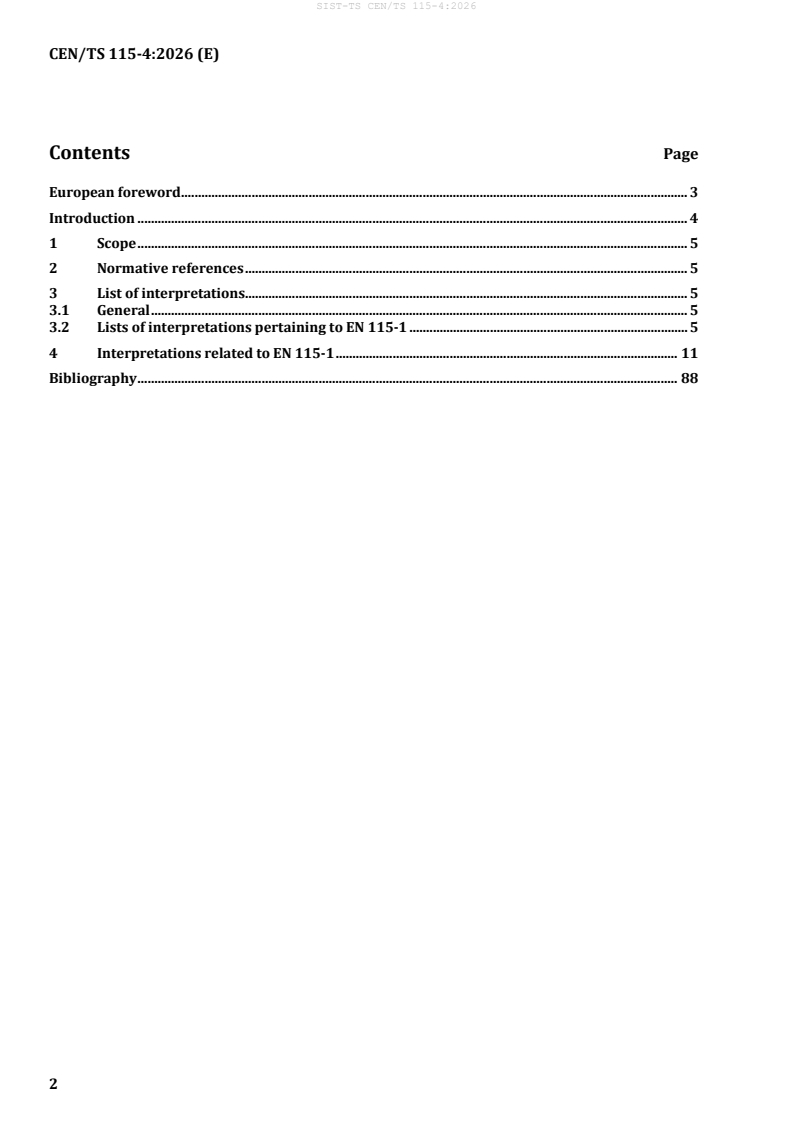
CEN/TS 115-4:2026 contains a foreword, an introduction, the scope, normative references, a structured list of interpretations, and the detailed interpretation texts. Clause 3 provides two tables that index the interpretations by number and by EN 115-1 clause or subclause.
Clause 4 contains the full interpretation texts, many of which address dimensions, gaps, braking behavior, barriers, access control, fire reaction, inspection control and seismic design. The document also includes figures and table references inside the interpretation texts, so users can trace how each clarification relates to the original EN 115-1 requirement.
The bibliography points to related standards that support the interpretations, including structural design, fire testing and safety-distance documents.
Relations
- Effective Date
- 02-Jul-2025
- Effective Date
- 07-Oct-2026
Get Certified
Connect with accredited certification bodies for this standard

DIBt (Deutsches Institut für Bautechnik)
German Institute for Building Technology.

DIN CERTCO
DIN Group product certification.

Aboma Certification B.V.
Specialized in construction, metal, and transport sectors.
Sponsored listings
Frequently Asked Questions
CEN/TS 115-4:2026 is a technical specification published by the European Committee for Standardization (CEN). Its full title is "Safety of escalators and moving walks - Part 4: Interpretations related to EN 115 family of standards". This standard covers: This document is a collection of interpretations related to the EN 115 series. This document collects interpretations to EN 115-1:2008+A1:2010 and EN 115-1:2017. Interpretations to other standards of the EN 115 series will be added when they are available. Interpretations aim to improve the understanding of the clause(s) they are referring to and by that facilitating common understanding between manufacturers, installers, notified bodies, inspection bodies and national authorities. Interpretations do not have the same status as the European standards to which they are related. However, the application of interpretations given to the interested parties confidence that the relevant European standard has not been wrongly applied.
This document is a collection of interpretations related to the EN 115 series. This document collects interpretations to EN 115-1:2008+A1:2010 and EN 115-1:2017. Interpretations to other standards of the EN 115 series will be added when they are available. Interpretations aim to improve the understanding of the clause(s) they are referring to and by that facilitating common understanding between manufacturers, installers, notified bodies, inspection bodies and national authorities. Interpretations do not have the same status as the European standards to which they are related. However, the application of interpretations given to the interested parties confidence that the relevant European standard has not been wrongly applied.
CEN/TS 115-4:2026 is classified under the following ICS (International Classification for Standards) categories: 91.140.90 - Lifts. Escalators. The ICS classification helps identify the subject area and facilitates finding related standards.
CEN/TS 115-4:2026 has the following relationships with other standards: It is inter standard links to CEN/TS 115-4:2020, EN 1991-1-1:2025. Understanding these relationships helps ensure you are using the most current and applicable version of the standard.
CEN/TS 115-4:2026 is available in PDF format for immediate download after purchase. The document can be added to your cart and obtained through the secure checkout process. Digital delivery ensures instant access to the complete standard document.
Standards Content (Sample)
Contents
- Introduction
- 1 Scope
- 2 Normative references
- 3 List of interpretations
- 3.1 General
- Annex G 153 2020-11-27
- Annex I 120 2012–03–14 Barriers to prevent shopping trolleys access
- Annex K 131 2014–11–14 Friction coefficient, material
- Annex M 145 2019-09-30
- Annex M 146 2019-09-30
- Annex M 147 2019-09-30
- Annex M 148 2019-09-30
- Annex M 149 2019-09-30 Loading during a seismic event
- 1. The load and deflection requirements of 5.3.3.3 shall be met up to a height of 25 mm above
- 1. Pallet chains are not mentioned
- 1. Pallet chains are missing in the paragraph. This shall be updated during the next revision
- 4 No exit
- 1 General requirements
- 2 Placement requirements
- 3 Traffic columns requirements
- 4 Guiding barriers requirements
- 5 Additional requirements
- 6 Annex: Illustrations
- Annex I says: “Where shopping trolleys and baggage carts are available in the area around
- 1. Operational brake operate automatically (event of loss of voltage supply)
- 3. Brought to rest with a uniform deceleration (under any load condition)
- 4. Electro-mechanical (other means) integrity equivalent to A, B1, G
- 1. Wouldn’t it make sense to require a minimum exit capacity of the unrestricted area for the
- 1. Annex H gives guidance for the maximum capacity of escalators and moving walks. This shall
- 5.3.5 2010
- 5.5.2.1 2010/2017
- 1. In 5.1 reference is made to Annex M as an additional recommendation, which would mean
- 2. Annex M specifies the special provisions and safety rules for escalators and moving walks
- 1. The special operational and environmental conditions, mentioned in 5.1, shall always be
- 2. Annex M shall be applied for escalators and moving walks installed in buildings in
- 2. Annex M, M.2.3 does not show detailed information concerning the determination of the
- Annex M defined seismic requirements for escalators and moving walks subject to seismic
- 1. Figure M1 defines for the calculation a ground type A used for the building design for
- 2. M.3.4 defines the importance factor γ as 0,85. Figure M1 states “Determination of the
- 3. Is the importance factor γ defined in Annex M, M.3.4 equal to 0,85 in any relation to the
- 2. The importance factor is not fixed and M.3.4 needs to be updated accordingly in the next
- 3. In EN 1998-1:2004 (EUROCODE 8) γ is the importance factor of the building. The importance
- 2. Due to EN 1990:2002/A1:2005/AC:2010, seismic condition is always classified as an
- 1. The frequency of occurrence and the magnitude of earthquakes are represented by seismic
- 1. M.2.2 defines that escalators and moving walks shall be retained in vertical direction. In
- 2. The code requires the supports to be designed, so that they overlap the building interface
- 2. The conditions for keeping the escalator or moving walks in safe position on the supports
- Bibliography
Introduction
Standards reflect the consensus of the best European expertise and are prepared with highest care. Product standards cannot be formulated in such a way that they describe all possible technical solutions and therefore exclude all uncertainties regarding the understanding of the required provisions. On the other hand, technology is in a permanent evolution, the progress of which cannot be incorporated into standards quickly enough.
Interpretations are a practical way to give:
a) answers to questions regarding the understanding of clauses in standards; b) feedback to the CEN-Committee responsible for a standard about the practical experiences resulting from the use of the standard; c) guidance to further development and improvement of standards following:
1) experience, especially accidents and incidents; 2) progress in technology; 3) state of the art.
SIST-TS CEN/TS 115-4:2026 CEN/TS 115-4:2026 (E)
1 Scope
This document is a collection of interpretations related to the EN 115 series. This document collects interpretations to EN 115-1:2008+A1:2010 and EN 115-1:2017. Interpretations to other standards of the EN 115 series will be added when they are available.
Interpretations aim to improve the understanding of the clause(s) they are referring to and by that facilitating common understanding between manufacturers, installers, notified bodies, inspection bodies and national authorities.
Interpretations do not have the same status as the European standards to which they are related. However, the application of interpretations given to the interested parties confidence that the relevant European standard has not been wrongly applied.
2 Normative references
The following documents are referred to in the text in such a way that some or all of their content constitutes requirements of this document. For dated references, only the edition cited applies. For undated references, the latest edition of the referenced document (including any amendments) applies. EN 1991-1-1, Eurocode 1: Actions on structures — Part 1-1: General actions — Densities, self-weight, imposed loads for buildings EN 1993-1-1:2005, Eurocode 3: Design of steel structures — Part 1-1: General rules and rules for buildings EN 1998-1:2004, Eurocode 8: Design of structures for earthquake resistance — Part 1: General rules, seismic actions and rules for buildings EN 13501-1:2007+A1:2009, Fire classification of construction products and building elements — Part 1:
Classification using data from reaction to fire tests
3 List of interpretations
3.1 General
The following lists show the valid interpretations contained in this document. 3.2 Lists of interpretations pertaining to EN 115-1 The interpretations related to EN 115-1 are listed in Tables 1 and 2. Table 1 shows the list of interpretations in their numerical order. Table 2 shows the list of interpretations in order of the clauses of EN 115-1:2008+A1:2010 and EN 115-1:2017.
These interpretations are detailed in Clause 4.
SIST-TS CEN/TS 115-4:2026 CEN/TS 115-4:2026 (E) Table 1 — List of interpretations in numerical order Interpretation Related clause/ Date of Keywords number subclause validity 101 5.3.1 2012–03–14 Increased height of the web on step treads side
102 5.5.2.4, 5.5.3.3 2012–03–14 Form of 25 cm area 103 5.5.3.3 2012–03–14 Load on skirting 104 5.12.2.1.3, 5.12.2.2.2 2012–03–14 Automatic restart in two-direction mode 105 A.2.1 2012–03–14 Unrestricted area, fixed stairs, building height 106 5.12.2.5 2012–03–14 Number of inspection control on site 107 A.2.4 2012–03–14 Rigid deflectors Barrier to prevent access of shopping trolleys and 108 I.1 2012–03–14 baggage carts 109 5.4.3.2 2012–03–14 Testing of steps and pallets drive 110 5.2.1.2 2012–03–14 Stiffness of exterior panel 111 5.12.2.2.4.1 Table 6 h) 2012–03–14 Stopping of succeeding escalators 112 5.3.5 2012–03–14 Measurement of step to step gap 113 5.9 2012–03–14 Fire protection of steps and pallets 114 5.6.2.1 2012–03–14 Handrail clearances 115 A.2.5 2012–03–14 Unrestricted area at the exit 5.12.2.2.4.1 Table 6 h), 116 2012–03–14 Area of exit A.2.5 Additional stop switch at handrail level - Building 117 A.2.5, I.2 2012–03–14 interfaces to escalator/moving walk 118 5.8.2.1, A.3.5 2012–03–14 Standing area in machinery spaces 119 A.2 2012–03–14 Fixed devices in unrestricted areas 120 Annex I 2012–03–14 Barriers to prevent shopping trolleys access 121 5.4.2.2.2 2014–11–14 Auxiliary braking system 122 5.3.6 2014–11–14 Location detection missing step device 5.4.2.1.1.1, 5.4.2.1.1.3, 123 2014–11–14 Electrical braking with inverter 5.12.1.2.1.1 124 5.4.1.3.2 2014–11–14 Safety factor of driving elements - 2 horizontal steps ≤ 6 m vs.
3 horizontal steps > 6 m; 125 4.9, 5.7.2.1 2014–11–14 - Lower escalator transition curve, exit/entry 126 5.3.3.2.2 2014–11–14 Step riser, inserts 127 5.7.3.2.6 2014–11–14 Comb switch 128 5.12.2.1.1 2014–11–14 Starting with passengers on the step/pallet band 129 5.12.2.1.3 2014–11–14 Automatic initiation of starting 130 5.7.2.1 2014–11–14 Landing, vertical difference, consecutive steps
SIST-TS CEN/TS 115-4:2026 CEN/TS 115-4:2026 (E) Interpretation Related clause/ Date of Keywords number subclause validity 131 5.5.3.4 d), Annex K 2014–11–14 Friction coefficient, material Measure b 132 A.2.2 2014–11–14
133 5.5.3.4 2014–11–14 Skirt deflector 134 3.1.19, 5.4.1.2 2014–11–14 Definition of nominal speed 135 5.4.2.3 2014–11–14 Excessive speed 136 A.2.5 2014–11–14 Unrestricted area 137 A.2.5 2014–11–14 Unrestricted area 138 5.3.5 2019-09-30 Clearance between two consecutive steps 139 J.2 2019-09-30 Testing and assessing anti-slip properties 140 5.3.3.3.1/5.3.3.3.2 2019-09-30 Step / pallet test frequency 141 5.5.2.1 2019-09-30 Vertical height of the balustrade 142 5.12.3 (EN 115-1:2017) 2019-09-30 Stop device – Disconnection of the power supply 5.4.3.2 and 6 2019-09-30 143 Step/pallet chain – nominal infinite fatigue life (EN 115-1:2017) 2019-09-30 Auxiliary braking system / verification according 144 5.4.2.2.2 (EN 115-1:2017) Table 11 5.1 and Annex M 2019-09-30 Seismic – requirements for Escalators / Moving
(EN 115-1:2017) walks vs. Building 2019-09-30 Seismic – requirements for Escalators / Moving 146 Annex M (EN 115-1:2017) walks vs. Building 2019-09-30 Seismic – requirements for Escalators / Moving 147 Annex M (EN 115-1:2017) walks vs. Building 2019-09-30 Seismic – requirements for Escalators / Moving 148 Annex M (EN 115-1:2017) walks vs. Building 149 Annex M (EN 115-1:2017) 2019-09-30 Loading during a seismic event Annex M, M.2.2 – M.2.4 2019-09-30 150 Structural requirements for seismic conditions (EN 115-1:2017) 151 5.12.2.8 2020-07-10 Failure lock, Enabled in inspection mode 152 5.12.3.2 2020-10-16 Stop device in reach of the starting devices Accessibility of escalators and moving walks to 2020-11-27 153 Annex G guide dogs for blind people 154 5.4.1.3.2, 5.4.3.2 2021-09-10 Nominal infinite fatigue life 155 A.2.7 2021-09-10 Fixed balustrade in the hazardous area 156 7.3.1 f) 2022-12-08 Inspection and tests 2023-05-01 Shopping trolley, nominal step width, skirt 157 I.1/I.2 deflector 158 5.3.2.2.5, 5.3.2.2.7, Figure 5 2024-06-11 Groove width and web width
SIST-TS CEN/TS 115-4:2026 CEN/TS 115-4:2026 (E) Table 2 — Interpretations in clause/subclause order Related clause / Interpretation Date of Keywords subclause number validity 3.1.19 134 2014–11–14 Definition of nominal speed - 2 horizontal steps ≤ 6 m vs.
3 horizontal steps > 6 m; 4.9 125 2014–11–14 - Lower escalator transition curve, exit/entry Seismic – requirements for Escalators / Moving 5.1 145 2019-09-30 walks vs. Building 5.2.1.2 110 2012–03–14 Stiffness of exterior panel 5.3.1 101 2012–03–14 Increased height of the web on step treads side 5.3.2.2.5, 5.3.2.2.7, 158 2024-06-11 groove width and web width Figure 5 5.3.3.2.2 126 2014–11–14 Step riser, inserts 5.3.3.3.1 140 2019-09-30 Step / pallet test frequency 5.3.3.3.2 140 2019-09-30 Step / pallet test frequency 5.3.5 112 2012–03–14 Measurement of step to step gap 5.3.5 138 2019-09-30 Clearance between two consecutive steps 5.3.6 122 2014–11–14 Location detection missing step device 5.4.1.2 134 2014–11–14 Definition of nominal speed 5.4.1.3.2 124 2014–11–14 Safety factor of driving elements 5.4.1.3.2, 5.4.3.2 154 2021-09-10 Nominal infinite fatigue life 5.4.2.1.1.1 123 2014–11–14 Electrical braking with inverter 5.4.2.1.1.3 123 2014–11–14 Electrical braking with inverter 5.4.2.2.2 121 2014–11–14 Auxiliary braking system Auxiliary braking system / verification 5.4.2.2.2 144 2019-09-30 according Table 11 5.4.2.3 135 2014–11–14 Excessive speed 5.4.3.2 109 2012–03–14 Testing of steps and pallets drive 5.4.3.2 143 2019-09-30 Step/pallet chain – nominal infinite fatigue life 5.5.2.1 141 2019-09-30 Vertical height of the balustrade
5.5.2.4, 5.5.3.3 102 2012–03–14 Form of 25 cm area 5.5.3.3 103 2012–03–14 Load on skirting 5.5.3.4 d) 131 2014–11–14 Friction coefficient, material 5.5.3.4 133 2014–11–14 Skirt deflector 5.6.2.1 114 2012–03–14 Handrail clearances - 2 horizontal steps ≤ 6 m vs.
3 horizontal steps > 6 m; 5.7.2.1 125 2014–11–14 - Lower escalator transition curve, exit/entry
SIST-TS CEN/TS 115-4:2026 CEN/TS 115-4:2026 (E) Related clause / Interpretation Date of Keywords subclause number validity 5.7.2.1 130 2014–11–14 Landing, vertical difference, consecutive steps 5.7.3.2.6 127 2014–11–14 Com switch 5.8.2.1 118 2012–03–14 Standing area in machinery spaces 5.9 113 2012–03–14 Fire protection of steps and pallets 5.12.1.2.1.1 123 2014–11–14 Electrical braking with inverter Starting with passengers on the step/pallet 5.12.2.1.1 128 2014–11–14 band 5.12.2.1.3 104 2012–03–14 Automatic restart in two-direction mode 5.12.2.1.3 129 2014–11–14 Automatic initiation of starting 5.12.2.2.4.1 Table 6 h) 111 2012–03–14 Stopping of succeeding escalators 5.12.2.2.4.1 Table 6 h) 116 2012–03–14 Area of exit 5.12.2.5 106 2012–03–14 Number of inspection control on site Failure lock, Enabled in inspection mode 5.12.2.8 151 2020-07-10
5.12.3 142 2019-09-30 Stop device – Disconnection of the power supply 5.12.3.2 152 2020-10-16 Stop device in reach of the starting devices 6 143 2019-09-30 Step/pallet chain – nominal infinite fatigue life 7.3.1 f) 156 2022-12-08 Inspection and tests A.2 119 2012–03–14 Fixed devices in unrestricted areas A.2.1 105 2012–03–14 Unrestricted area, fixed stairs, building height Measure b A.2.2 132 2014–11–14
A.2.4 107 2012–03–14 Rigid deflectors A.2.5 115 2012–03–14 Unrestricted area at the exit A.2.5 116 2012–03–14 Area of exit Additional stop switch at handrail level - A.2.5 117 2012–03–14 Building interfaces to escalator/moving walk A.2.5 136 2014–11–14 Unrestricted area A.2.5 137 2014–11–14 Unrestricted area A.2.7 155 2021-09-10 Fixed balustrade in the hazardous area A.3.5 118 2012–03–14 Standing area in machinery spaces Accessibility of escalators and moving walks to
Annex G 153 2020-11-27
guide dogs for blind people
Annex I 120 2012–03–14 Barriers to prevent shopping trolleys access
Barrier to prevent access of shopping trolleys I.1 108 2012–03–14 and baggage carts shopping trolley, nominal step width, skirt I.1/I.2 157 2023-05-01 deflector
SIST-TS CEN/TS 115-4:2026 CEN/TS 115-4:2026 (E) Related clause / Interpretation Date of Keywords subclause number validity Additional stop switch at handrail level - I.2 117 2012–03–14 Building interfaces to escalator/moving walk J.2 139 2019-09-30 Testing and assessing anti-slip properties
Annex K 131 2014–11–14 Friction coefficient, material
Seismic – requirements for Escalators / Moving
Annex M 145 2019-09-30
walks vs. Building Seismic – requirements for Escalators / Moving
Annex M 146 2019-09-30
walks vs. Building Seismic – requirements for Escalators / Moving
Annex M 147 2019-09-30
walks vs. Building Seismic – requirements for Escalators / Moving
Annex M 148 2019-09-30
walks vs. Building
Annex M 149 2019-09-30 Loading during a seismic event
Annex M.2.2 – M.2.4 150 2019-09-30 structural requirements for seismic conditions
SIST-TS CEN/TS 115-4:2026 CEN/TS 115-4:2026 (E) 4 Interpretations related to EN 115-1 INTERPRETATION 101 CEN Related to Page 1 of 1 Valid from:
Edition: Clause(s):
EN 115-1 2010 5.3.1 Date of modification:
2011–03–30 Key-word(s):
Replacing interpretation Nr.: 01 Increased height of the web on step treads side QUESTION Is it permitted to have an increased height of the web at both sides of the step tread (demarcation lines opposite to the skirt panels)?
INTERPRETATION Increased height of the rib (web) is permitted as long as the same safety level as for a totally flat step/pallet will be ensured. This shall be proofed in detail by risk analysis.
Date of approval by CEN/TC 10 members: 2012–03–14
SIST-TS CEN/TS 115-4:2026 CEN/TS 115-4:2026 (E) INTERPRETATION 102 CEN Related to Page 1 of 1 Valid from:
Edition: Clause(s):
EN 115-1 2010 5.5.2.4, 5.5.3.3 Date of modification:
Key-word(s):
Replacing interpretation
Nr.: 18 Form of 25 cm area QUESTION
5.5.2.4 and 5.5.3.3 specify an area of 25 cm on to which the force shall be applied. Which form (square, circle, rectangle) shall this area have?
INTERPRETATION
With the definition of 25 cm , it was intended to precise the term “lump load” used in former codes.
Normally, the equipment for such tests has a circular or square surface so that such formed areas will be the practice in general.
This will be considered in the next revision of the standard.
Date of approval by CEN/TC 10 members: 2012–03–14
SIST-TS CEN/TS 115-4:2026 CEN/TS 115-4:2026 (E) INTERPRETATION 103 CEN Related to Page 1 of 1 Valid from:
Edition: Clause(s):
EN 115-1 2010 5.5.3.3 Date of modification:
Key-word(s):
Replacing interpretation Nr.: 20 Load on skirting QUESTION 1. 5.5.3.3 defines the load carrying ability of the skirting and deformation. Does this apply to the whole skirting or only to the area of 25 mm according to 5.5.3.2? 2. If the whole skirting has to be dimensioned for the test load, shall then also the comb plate lighting, if installed in the skirting, withstand this load?
INTERPRETATION
1. The load and deflection requirements of 5.3.3.3 shall be met up to a height of 25 mm above
the risk of the line of the step nose or the tread surface of the pallets or belt where entrapment exists. Above the height of 25 mm, the force requirements of the balustrade of 500 N (see 5.5.2.4) shall be fulfilled.
2. The comb plate lighting has to withstand the test load according to 5.5.3.3 if the lighting or part of it is arranged within the area of skirting of 25 mm above the tread surface. All other requirements of the skirting according to 5.5.3 are still valid. This includes that under the force requirements above the skirting shall remain plain and butt-joined according to 5.5.3.1. At the next revision of EN 115-1:2008+A1:2010, 5.5.3 has to be amended accordingly. Date of approval by CEN/TC 10 members: 2012–03–14
SIST-TS CEN/TS 115-4:2026 CEN/TS 115-4:2026 (E) INTERPRETATION 104 CEN Related to Page 1 of 1 Valid from:
Edition: Clause(s):
EN 115-1 2010 5.12.2.1.3, 5.12.2.2.2 Date of modification:
Key-word(s):
Replacing interpretation Nr.: 22 Automatic start in two-direction mode QUESTION Is it allowed to make an arrangement as follows:
The escalator can start automatically in both directions by a user passing a light barrel depending on the direction from which the user is coming. Both directions can be predetermined directions at the same time.
When the escalator has stopped after a sufficient time (5.12.2.2.2), the signal lights show “green” light in both landings.
However, when a user comes to the end of a running escalator by passing the “red” signal light and stays near to the comb waiting till the escalator has stopped, there is another light barrel installed in the skirting above the comb and when the user passes this light barrel, the escalator stops and can be re-started only with a key.
INTERPRETATION Operation in “two direction mode” for escalators with automatic start is permitted under the following conditions:
a) On escalators which can start automatically in either direction (“two direction mode”) by the entering of a user, the “two direction mode” and the momentary capable direction of travel shall be clearly visible to the user and marked distinctly on the escalator (see 7.2.2 plus “two direction mode” sign). They shall start in the direction determined by the user entering first. When the escalator is started by a user from either direction, the indicator opposite from the initiated starting side shall automatically indicate “no entry” (see 7.2.2). b) Measures for control and/or monitoring function shall prevent:
- failures of the control elements actuating the automatic start at the entries (e.g. no or partly no detection of users);
- a restart of the step band when a user has entered the area between the control element and the comb intersection line and the step band is stopped.
c) Control and monitoring function shall be regarded as electric safety devices and shall be applied as safety switches (5.12.1.2.2), fail safe circuits (5.12.1.2.3) or SIL 1 according to PESSRAE (5.12.1.2.6).
The application of “two direction mode” is not permitted for moving walks. This will be considered in the next revision of the standard.
Date of approval by CEN/TC 10 members: 2012–03–14
SIST-TS CEN/TS 115-4:2026 CEN/TS 115-4:2026 (E) INTERPRETATION 105 CEN Related to Page 1 of 1 Valid from:
Edition: Clause(s):
EN 115-1 2010 A.2.1 Date of modification:
Key-word(s):
Replacing interpretation Nr.: 24 Unrestricted area, fixed stairs, building height QUESTION At the landings of the escalator, on the unrestricted area of 2,50 m (2,00 m) depth, is the existence of fixed stairs forbidden?
The height on the unrestricted area shall be not less than 2,30 m, if the building's regulation does not impose more?
INTERPRETATION The existence of fixed stairs is forbidden in the unrestricted area. The area shall be flat. A maximum inclination of 6° is permissible.
In A.2.1, a building height is stated for the unrestricted area which is necessary from the view of machinery safety. National authorities are free to request more. This will be considered in the next revision of the standard.
Date of approval by CEN/TC 10 members: 2012–03–14
SIST-TS CEN/TS 115-4:2026 CEN/TS 115-4:2026 (E) INTERPRETATION 106 CEN Related to Page 1 of 1 Valid from:
Edition: Clause(s):
EN 115-1 2010 5.12.2.5 Date of modification:
Key-word(s):
Replacing interpretation Nr.: 26 Number of inspection control on site QUESTION For the inspection control for 2 parallel or criss-cross escalators, shall we have 2 portable control devices or is it sufficient to have one control device for both?
INTERPRETATION According to the Machinery Directive, each escalator/moving walk shall be equipped with a permanent available portable control device.
The wording of the standard (5.12.2.5) will be improved in the next revision of the standard.
Date of approval by CEN/TC 10 members: 2012–03–14
SIST-TS CEN/TS 115-4:2026 CEN/TS 115-4:2026 (E) INTERPRETATION 107 CEN Related to Page 1 of 1 Valid from:
Edition: Clause(s):
EN 115-1 2010 A.2.4 Date of modification:
Key-word(s):
Replacing interpretation Nr.: 33 Rigid deflectors QUESTION Are deflectors which correspond to A.2.4 of EN 115-1:2008+A1:2010 permitted to be pendulous, in order to prevent vandalism?
INTERPRETATION Deflectors shall be mounted rigidly in order to meet all requirements. A pendulous deflector can be used in addition before the mandatory rigid deflector.
The rigid mounting of the deflector will be considered in the next revision of the standard.
Date of approval by CEN/TC 10 members: 2012–03–14
SIST-TS CEN/TS 115-4:2026 CEN/TS 115-4:2026 (E) INTERPRETATION 108 CEN Related to Page 1 of 1 Valid from:
Edition: Clause(s):
EN 115-1 2010 I.1 Date of modification:
Key-word(s):
...